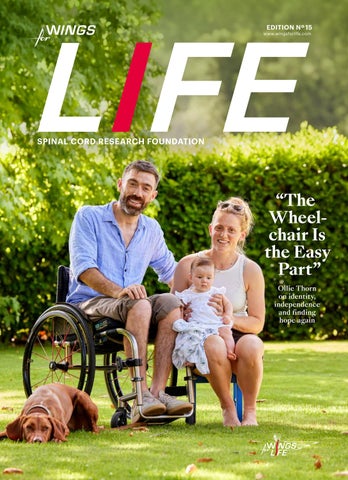
EDITION Nº 15
www.wingsforlife.com
SPINAL CORD RESEARCH FOUNDATION
“The Wheelchair Is the Easy Part” Ollie Thorn on identity, independence and finding hope again
TAKE A JOURNEY THROUGH – art, cuisine AND AVIATION
A
like no
PLACE OTHER
For more than 20 years, Red Bull Hangar-7 at Salzburg Airport has been an institution in the city of Salzburg—a landmark and architectural highlight, an exciting excursion destination, and a culinary think tank. The concept? To create a place where art, cuisine, and a love of aviation come together in an inspiring symbiosis. The wing-shaped structure made of glass and steel has become a landing spot for international top chefs and, in addition to housing the historic fleet of The Flying Bulls, also features many other exhibits from the Red Bull universe as well as regularly changing exhibitions of contemporary art.
Foreword
Imprint Wings for Life International Spinal Cord Research Foundation Fürstenallee 4, 5020 Salzburg, Austria Phone: +43 662 6582-4244 Email: office@wingsforlife.com Company Registration: FN 251592p Legal Form: Private non-profit foundation Register Court: Landesgericht Salzburg (Jurisdiction) Chief Executive Officer: Sonja Kraus, Peter Luckeneder
Photo: Helge Kirchberger
Chair of the Board: Anita Gerhardter Wings for Life United Kingdom: Seven Dials Warehouse 42–56 Earlham Street London WC2H 9LA Great Britain UK Registered Charity No: 1138804 Wings for Life USA: Spinal Cord Research Foundation Inc. 1630 Stewart Street, Santa Monica, 90404, CA 501 c3 Charity Editors: Christina Herbst, Stefanie Schwarz, Denise Siebke Contributors: Markus Böttinger, Verena May, Beatrice Sandner CEOs Red Bull Media House Publishing: Dietmar Otti, Marcus Weber Red Bull Media House GmbH Project Management: Jennifer Silberschneider Art Director: Peter Schwarz-Knehtl Grafic Designer: Tino Liebmann Photo Editor: Izabela Idziak Lithography: Nenad Isailovic Translation: Manfred Thurner Producer: Sabine Wessig Printer: Offset 5020 Druckerei & Verlag Ges.m.b.H., Bayernstraße 27, 5071 Wals-Siezenheim, Austria Acknowledgement: We would like to express our gratitude to Red Bull Media House for producing this magazine free of charge.
20261010
Dear friends and supporters, The start of 2026 marked a new chapter for Wings for Life. After many years at the helm, I handed over the reins of day-to-day management to Sonja Kraus and Peter Luckeneder. Both continue to guide the foundation with a wealth of experience, dedication, and passion. This is, however, not a farewell on my part. As Chair of the Board, I remain closely involved with Wings for Life, primarily focusing my efforts on research and the strategic development of the Wings for Life World Run (page 52). Hannes Kinigadner has also entered a new chapter in his life. His serious accident in 2003 prompted his father, Heinz Kinigadner, and Dietrich Mateschitz to launch our foundation. Hannes and his partner, Lisa, welcomed their first child this summer. Starting on page 12, the couple share their special family joy. Enjoy a magazine bursting with interesting and touching stories: from new funding models using artificial intelligence (page 48) to the next generation of researchers, and individuals such as Delia Guggenheim (page 24) and Ollie Thorn (page 62), who share their life stories with us. Our goal remains the same as it was on day one – we strive to make spinal cord injury curable. Thank you from the bottom of our hearts for supporting us and joining us on this extraordinary journey. Enjoy your read, Anita Gerhardter and the Wings for Life Team WINGS FOR LIFE
3
52
People 12 One Family, One Hope
Hannes Kinigadner and Lisa Gürtler share the joy of their family life.
24 Dream Bigger
Since her accident, Delia Guggenheim has chosen new goals over limitations.
4
WINGS FOR LIFE
Research 62 “The Wheelchair Is the Easy Part”
Ollie Thorn talks about the invisible challenges of living with a spinal cord injury.
70 When Research Brings Hope
Wolfgang Illek shows how clinical trials are opening up new perspectives for him.
30 When Every Minute Matters
Professor Claudius Thomé explains why the first hours after an injury are crucial.
40 The Spinal Cord in Focus
Seven research projects are exploring new approaches in the search for a cure.
Photos: Sinisa Kanizaj for Wings for Life World Run, Helge Kirchberger, Limex Images/Andreas Schaad, Armin Walcher
Content
30
38
12 38 Talents in Science
A conversation with researcher Dr. Charlotte Decourt from Imperial College London.
20 Where Tomorrow’s Research Begins
The Summer School brings together earlycareer researchers from around the world.
48 Research Gets a Boost
Fundraising 6 A Year That Moved Us Our favorite highlights from 2026.
52 Running Towards New Hope
346,527 people raised € 9.2 million for research at the Wings for Life World Run.
STANDARDS
3 Foreword, Imprint
47 Funded Projects
Our Research Projects 2026/27
A new grant is bringing artificial intelligence into spinal cord research. Cover photo: Richie Hopson Photos back cover: Helge Kirchberger, Marv Watson
WINGS FOR LIFE
5
Fundraising
Our Highlights
2026
6
WINGS FOR LIFE
Our objective is crystal clear. We are committed to finding a cure for spinal cord injury. Along the journey, every contribution counts – from new research findings to events that bring people together to raise valuable donations. Here are a few moments that made our 2026 special.
1 USA
Photo: Katie Lozancich
Skateboarding Meets Research Brooke Johnson and Jason Biundo have more in common than their hope for progress in spinal cord research. Brooke, a passionate skateboarder, lost her stepfather Roger to a spinal cord injury. In 2025, she skated across the United States in 119 days, raising more than USD 55,000 for Wings for Life. Jason, meanwhile, suffers from a spinal cord injury himself: a climbing accident in 2019 left him paraplegic. Today, the Harvard doctoral candidate is conducting research at Boston Children’s Hospital on new approaches to regeneration and healing. During a visit to the lab, the two shared their stories, experiences, and hopes. It quickly became clear: progress happens when people come together to make a difference.
WINGS FOR LIFE
7
Fundraising
2 Austria
129 Minds Share a Common Goal Harvard Medical School, Balgrist University Hospital, or Yale University: Salzburg played host to leading figures in spinal cord research for three days. 129 researchers from around the world gathered at the Wings for Life Scientific Meeting to share the latest findings and forge important connections. The first “Asia Primer” set the stage for the meeting by bringing together researchers, clinicians, and specialized centers based in Asia. This opening event was followed by two days packed with exciting presentations and networking opportunities. The discussions covered everything that drives research – from initial findings in the lab to approaches for clinical application.
8
WINGS FOR LIFE
WINGS FOR LIFE
9
Photo: Armin Walcher
Fundraising
3 Sharp Eyes, Sure Instincts Idyllic countryside stretched as far as the eye could see, while the crack of shotguns rang through the air. Our annual “Clay Day” brought 22 teams together at the historic Courteenhall Estate near Northampton for an afternoon of clay pigeon shooting, sporting spirit, and quintessentially British tradition. Our guests competed for the highest score and enjoyed a relaxed afternoon alongside Formula 1 stars such as Max Verstappen, Yuki Tsunoda, and David Coulthard. By the end of the day, the result spoke for itself: A total of GBP 600,000 was raised for spinal cord research.
10
WINGS FOR LIFE
Photos: Philip Panting Photography, ADAC Motorsport
Great Britain
4 Austria
DTM and Wings for Life: a Strong Team Wings for Life is an official charity partner of the DTM, one of the most exciting touring car series. During the season-opening weekend at the Red Bull Ring, the foundation hosted several initiatives right at the racetrack, including efforts to recruit participants for the Wings for Life World Run and to raise funds for spinal cord research. Among those in attendance were Wings for Life ambassador and Dakar Rally winner Matthias Walkner, as well as Olympic and World Champion skier Marcel Hirscher.
WINGS FOR LIFE
11
People
12
WINGS FOR LIFE
Our Blessing, Our Hope
Photo: Helge Kirchberger
Hannes Kinigadner is paralyzed from the shoulders down, leaving him dependent on assistance every day. Lisa Gürtler initially submitted an application to provide such assistance. A relationship that began with a great deal of trust soon transformed into love, culminating in the birth of their baby. An extraordinary story about a shared journey, painful limitations, and unwavering hope.
WINGS FOR LIFE
13
People
L
isa and Hannes speak softly as we visit them in their newly remodeled apartment in the Zillertal region of Tyrol. Maria is sleeping peacefully in Lisa’s arms. “When she was born,
Hannes and Lisa shortly before the birth of their daughter.
it just felt incredible. Suddenly, life stops revolving around yourself. All you care about is her well-being,” Hannes says with pride. Lisa and he became parents for the first time only recently.
Why don’t you start by telling us how you met … Lisa: I was working as a guide at a
high-rope course when I happened to come across Hannes’s ad for a new assistant. The idea of helping someone made perfect sense to me. Even though I had no prior experience in the field, we agreed to give it a try. Hannes walked me through everything, and it worked out wonderfully. It was basically learning by doing … Hannes: I’d only ever had male assistants. At first, I wasn’t sure if Lisa could handle it physically, to be perfectly honest. Tasks like transferring me from the recumbent bike back into the wheelchair, you know? She did great, though, and really surprised me in a positive way.
Sounds like a really strong team … Hannes: It started out as a purely
professional relationship. We were both wary of jeopardizing that dynamic. Nevertheless, I really liked Lisa right from the start … Lisa: I was impressed by how
Hannes handles his situation, by how he enjoys life despite his limitations and always looks on the bright side. We both realized pretty early on that we really liked each other. I wouldn’t have dared to make the first move, though. He was my boss, after all. Hannes took the initiative, and now we’re so happy together. 14
WINGS FOR LIFE
Lisa was a professional cyclist on the Austrian national team; now she and Hannes share their passion for bike tours.
“The wheelchair makes no difference to me. It’s all about the person and how we connect.” Lisa Gürtler
Lisa, did you have any reservations about falling in love with someone who suffered a spinal cord injury? Lisa: The wheelchair makes no dif-
Photos: Helge Kirchberger, private
ference to me. It’s all about the person and how we connect. This is how I met Hannes, and by now I have a real feel for what’s possible and when he needs help. Hannes: Lisa is still there for me
when I need her, but I now have new assistants to help me, especially in the mornings and evenings. Lisa has other commitments now … WINGS FOR LIFE
15
People
“After my accident, I naturally often found myself wondering whether I’d ever have a family at all.” Hannes Kinigadner
16
WINGS FOR LIFE
Baby Maria turns the couple into a family – and challenges Hannes as they navigate their new everyday life.
They’re really wonderful commitments. You recently had a baby.
moving. So far, Maria has really made things easy for us. She’s a very cheerful and easy-going baby.
Lisa: It was a very deliberate deci-
sion on our part to take this next step together. I enjoyed an uncomplicated pregnancy and a smooth delivery. The moment when you hold your own baby in your arms is truly beautiful and deeply
Hannes: After my accident, I nat-
urally often found myself wondering whether I’d ever have a family at all. The fact that I’m now a father is such a blessing. Holding Maria for the first time was indescribable, an experience that must be life-changing for anyone. In my case, however, there’s the added factor that I’m suddenly reminded of certain limitations that I’d long since accepted. I can’t, for example, simply say: “Hand her over, Lisa. I’ll take over now.” Tell us about your daily routine with the baby. Hannes: During the week, I work
at our Kini Bike World, and I’m out and about a fair bit. On the weekends, my assistant comes in the morning to help me with the transfer and personal care. Then we share breakfast together, though I usually just have a coffee with milk. We used to be very active, cycling or traveling. As my assistant, Lisa was always right beside me. Now
Photos: Helge Kirchberger
Looking forward to this new chapter in their lives: Lisa and Hannes with ultrasound images of their baby.
i
EVEN PEOPLE AFFECTED BY A HIGH-LEVEL SPINAL CORD INJURY
can start a family. In most cases, semen is extracted from men by means of various ejaculation aids. It is then processed in a laboratory and implanted into the partner. WINGS FOR LIFE
17
People
Photo: Helge Kirchberger
Hannes, Maria, and Lisa (from left) in their garden in Zillertal, Tyrol.
18
WINGS FOR LIFE
“I’d love to just pick Maria up myself, carry her safely, change her diaper, get her dressed, or simply hold her when she cries.” Hannes Kinigadner
things have calmed down a little, and we’re home most of the time. In terms of taking care of Maria, Lisa actually takes care of practically everything right now. Lisa: Hannes is such a devoted fa-
ther. Of course, I knew better than anyone that I wouldn’t be able to ask him to change diapers while I was cooking. I suspect that the new situation is more challenging for him than for me.
Hannes Kinigadner crashed during a charity motorcycle race in 2003, suffering a high-level spinal cord injury. His father, Heinz Kinigadner, founded the Wings for Life foundation a year later with his friend and Red Bull founder Dietrich Mateschitz. The goal is to make his son’s severe spinal cord injury – and those of countless others – curable by funding spinal cord research. For more information on current projects, see page 47 and visit www.wingsforlife.com/research
Hannes: Yes, that’s quite tough.
Ever since my accident, I’ve dreamed of regaining my physical abilities and breaking free from this wheelchair. Now that Maria is in my life, that dream has taken on a whole new dimension. Where I used to focus mainly on my own independence, I now think about what I could do for my daughter as a father. I’d love to just pick Maria up myself, carry her safely, change her diaper, get her dressed, or simply hold her when she cries. When Maria takes her first steps someday, I’d like to be there to support her and catch her if she falls. If her blanket slips off when she’s out of my reach, I’d like to be able to just tuck her back in – or quickly change her into a clean T-shirt if hers gets wet or dirty. Thinking further ahead, I’d like to walk hand in hand with her, go swimming, ride a bike, run around, or even just show her something practical. I can be there for her, talk to her, explain things to her, and guide her. Yet, as a father, there are some experiences that you really want to share
with your child. Those are the moments when my spinal cord injury really hurts all over again, even after all these years. What would finding a cure mean to you personally? Hannes: We’re taking Maria to
Ibiza soon. That island means the world to me, because I’ve been going there since I was a child and have so many wonderful memories of it. I’d love to pass that connection on to my daughter. I have this image in my head of me carrying Maria to the water on the beach and dipping her little feet into the sea for the first time. And yet that’s exactly what I can’t do. Wings for Life gives me hope that these simple things will be possible someday.
Wings for Life supports research projects around the globe to empower people like Hannes to live more independent lives. Thank you for supporting us with your donation and by participating in the Wings for Life World Run. WINGS FOR LIFE
19
Research
Summer School 2026 Every two years, the International Spinal Cord Injury Summer School brings together young researchers to connect with leading international experts from academia and clinical practice. The week-long event focuses on recent findings, unresolved questions, and new approaches – and on shaping the future of spinal cord research together.
20
WINGS FOR LIFE
Broadening Horizons At this year’s Summer School in Stockholm, participants look beyond their respective fields of research. They listen, ask questions, exchange ideas and explore new perspectives.
Photos: Wings for Life, Stefan Zimmerman
Understanding Current Research From biological changes resulting from a spinal cord injury to cell transplants and new methods of rehabilitation, the Summer School explores the full spectrum of spinal cord research. One question remains central throughout: How does a scientific discovery eventually translate into a treatment?
WINGS FOR LIFE
21
Research
“I’ve felt welcome here from day one. We share our research, learn from each other, and have fun. The Summer School has truly been one of the greatest experiences during my doctoral studies.” Joey Abou Chaaya University of Montpellier
“Experts from all over the world gather here. It presents a great opportunity to deepen my knowledge and learn what others in the field are currently pursuing.” Dr. Daniela Souza de Oliveira Carnegie Mellon University
Research Meets Clinical Practice Research comes to life on Clinical Practice Day. At Karolinska University Hospital, young researchers learn how to assess the severity of spinal cord injuries using the ASIA classification. They also experience firsthand how the Aleris Rehabilitation Center guides patients on their journey to regain as much independence as possible. Ultimately, every scientific question revolves around a human being.
“The students join from different labs and research institutions. They connect when given the space to do so. That’s exactly what we strive for: a new generation of researchers who collaborate.” Prof. Christian Göritz Karolinska Institutet
22
WINGS FOR LIFE
Science Thrives on Exchange The poster presentations provide a forum for early-career researchers to discuss their projects with experienced researchers. Feedback, fresh perspectives, and critical questions contribute to advancing ideas – and, in some cases, inspire future collaborations.
Encounters Form Networks
Photos: Wings for Life, Stefan Zimmerman
The Summer School extends beyond lecture halls and seminar rooms. Whether on a boat tour through the Stockholm archipelago, over a group dinner, or during a visit to the Nobel Prize Museum, participants have plenty of time to build relationships outside the realm of research. It is precisely during these informal interactions that the most stimulating academic discussions tend to unfold, giving rise to new ideas and fostering networks for future collaborations.
A Lasting Community The participants leave Stockholm with invaluable assets: new perspectives, international friendships, and networks that could shape spinal cord research for many years to come.
WINGS FOR LIFE
23
People
24
WINGS FOR LIFE
Two More Minutes Delia Guggenheim’s life took a radical turn near her own front door. The Swiss native has been suffering from a spinal cord injury since a cycling accident.
Photo: Muriel Florence Rieben/The Red Bulletin
I
t was the first genuinely warm Sunday of spring. Delia was riding her road bike in shorts for the first time in a while. She had already been on the road for four hours, riding from Zurich through Winterthur to Baden – a route she knows like the back of her hand. The road ahead was straight, unobstructed, and familiar. Just two more minutes, and she would have been home. Little did she know that a woman under the influence of drugs
was driving directly behind her. Moments earlier, another driver had filmed the car swerving uncontrollably across the road. Not long after, the vehicle struck Delia from behind. Although she cannot recall much of what happened, she remembers one thing clearly: “I had this awful feeling of dread in the pit of my stomach, as if I were caught in a nightmare. I waited for the dream to end, until I finally realized that this was really happening.”
Delia noticed that she could no longer move her legs. She was having trouble breathing. Then a deep sense of fatigue washed over her. “I was sure I would die if I gave in to that fatigue.” The first two weeks after the accident were the hardest. Delia was intubated in the ICU, a tube protruding from her throat to help assist her breathing. Speaking was out of the question. “It was like being imprisoned,” she says. Delia had broken several vertebrae, WINGS FOR LIFE
25
While Delia is in the hospital, her mother Claudia visits her every day.
her spinal cord had been crushed in the neck area, and her spine had been completely severed and displaced at chest level. It quickly became clear that Delia would not be able to walk again. “At that point, I had given up any hopes that someone would come along and tell me I would regain my ability to walk.” A Life Rebuilt
During rehab, she discovered what life with a spinal cord injury really entails. Sitting up, eating, swallowing – she needed to relearn it all. Every tiny step forward came with 26
WINGS FOR LIFE
the realization of what she could no longer do. “People always assume that someone in a wheelchair simply cannot walk. Yet not being able to walk is actually the least of their problems.” Delia describes her spinal cord injury as follows: “I have lost all sensation of touch, but it feels like being trapped in warm concrete.” Some moments still hit harder than others. Like the first time she sat outside in the sun again and felt the warmth on her face, but not on her legs. Or while playing badminton with friends and her mother,
when she realized how much longer it took her to cover the distance from one corner to the other in her wheelchair. “Every first-time experience involved a few tears initially. However, it was essential to push through those moments. Things always seemed to improve afterward.” Prior to the accident, Delia’s life revolved around exercise. She loved swimming and biking. “But running – that was my greatest passion. I miss it so much – so, so much.” Alongside her athletic pursuits, she studied psychology,
People
“Running was my greatest passion. I miss it so much – so, so much.” Delia Guggenheim
specializing in sports psychology. Today, she coaches 16 endurance athletes, writes weekly training plans, and provides guidance on both their progress and setbacks. Wings for Delia
The Wings for Life World Run took place four weeks after the accident. At the time, Delia was still being treated at Balgrist University Hospital. Her mother, together with her former coach and friends, formed a running team
called “Wings for Delia”. People from far and wide turned up to run laps around the clinic in her name. “So many people showed up,” says Delia. “Feeling that they were all there for me – that was truly amazing.” She is particularly inspired by the idea that, on this day, people all over the world set out to raise funds for spinal cord research. “Knowing that someone somewhere on the other side of the world is running for me makes me feel like I’m not alone in facing this fate.”
Photos: Muriel Florence Rieben/The Red Bulletin, Daniel Krähenbühl, private
Delia is visibly moved when her friends and family form a team and take part in the Wings for Life World Run for her just four weeks after her accident.
WINGS FOR LIFE
27
People
Dreaming Bigger
A year before her accident, Delia competed in one of the world’s most famous and grueling desert races, the “Marathon des Sables”, running across the Sahara for several days. She is currently preparing for the next edition in October: 70 kilometers of sand and dunes over three days, accompanied by three teammates and staying in a camp fully equipped for wheelchair users. The decisive unknown variable is 28
WINGS FOR LIFE
“People tend to tell you what you can’t do and what’s no longer possible, but I refuse to set any boundaries or limits for myself.” Delia Guggenheim
the heat. Delia can no longer sweat below her neck – only on her face. In the desert, that’s a risk, rather than a minor detail.* Yet she insists: “People tend to tell you what you can’t do and what’s no longer possible, but I refuse to set any boundaries or limits for myself. Instead, I encourage myself to dream bigger.” Delia is deliberately cautious regarding her hopes for a cure. Nevertheless, she remains convinced that a cure will be found one day,
Photos: Eduard Meltzer, Marathon Des Sables
This year, Delia organized her own App Run event as part of the Wings for Life World Run. The route took participants around Balgrist University Hospital – where she was treated after her accident.
The Swiss athlete during her participation in the Marathon des Sables.
and that even small improvements could make a massive difference for many people. When asked what advice she’d like to share with those who are dealing with recent injuries or find themselves in a similar situation, she answers without hesitation: “Things will be different, but they’ll work out. The laughter returns.” She freely acknowledges that many doors close, but she also highlights the new ones that open.
It takes a moment for her to pinpoint what she herself misses most. Then her eyes well up: “I’d love to hug my loved ones at eye level again, really embrace my mum. That would be so wonderful.” *Many people suffering from spinal cord injuries are unable to sweat at all or only to a limited extent as the nerve pathways responsible for perspiration are severed. This disrupted temperature regulation ability can, in severe cases, result in heatstroke. Help ful countermeasures include seeking shade, using cold packs, or moistening the skin.
“Backbone” Documentary Delia is one of four remarkable individuals featured in ServusTV’s documentary titled “Backbone”. Scan the QR code to watch on ServusTV On.
WINGS FOR LIFE
29
Research
When Every Minute Matters A spinal cord injury triggers a race against time. Neurosurgeon Professor Claudius Thomé explains what happens during the first few hours, where medical science stands today, and why research may have just arrived at a pivotal point.
30
WINGS FOR LIFE
Photo: Limex Images/Andreas Schaad
Professor Claudius Thomé is the director of the University Clinic for Neurosurgery in Innsbruck; he has been a professor and department chair at the Medical University of Innsbruck since 2010. WINGS FOR LIFE
31
Professor Claudius Thomé’s areas of expertise include neurotraumatology and spinal surgery. He is also a member of Wings for Life’s Internal Scientific Advisory Board.
I
t starts with a fall, an impact, or an accident in general. Life comes to a standstill from one second to the next. While those affected and their loved ones face a period of uncertainty, precisely coordinated medical procedures are set in motion: emergency response, diagnostics, surgery, and intensive care. According to Professor Claudius Thomé, director of the University Clinic for Neurosurgery 32
WINGS FOR LIFE
in Innsbruck, the first few hours are critical, as further damage can develop following the initial injury. Pressure, swelling, and insufficient blood flow can cause additional damage to nerve cells. At the same time, the acute phase presents an opportunity to limit further damage through rapid and optimal care. Professor Thomé, please walk us through the process.
A person has suffered an accident. There’s a suspicion of a spinal cord injury. What’s the first thing to do?
Initial treatment begins directly at the scene of the accident. It is crucial to stabilize the spine to prevent further injury caused by lifting or repositioning the patient. Simultaneously, blood circulation must be maintained. The injured spinal cord requires the best possible protection at this moment. The patient
Research
is typically admitted through the trauma room upon arrival at our facility, where an interdisciplinary team coordinates treatment. The first priority is to assess neurological deficits, stabilize the cardiovascular system, and treat any other related injuries. Imaging follows as quickly as possible. In cases of severe trauma, this typically involves a full-body CT scan. This allows us not only to examine the spine but also to detect internal bleeding or other injuries.
“It was once thought that very little could be done after a complete spinal cord injury. We now know how wrong that assumption is.” Professor Claudius Thomé
Photos: Limex Images/Andreas Schaad
Why are the first few hours so crucial?
It was once thought that if someone suffered a complete spinal cord injury with severe damage, very little could be done anyway. Accordingly, there was no need for urgency. We now know how wrong that assumption is. We’ve learned that two things are especially important: relieving pressure on the spinal cord as early as possible while simultaneously ensuring blood flow. The spinal cord can sustain further damage after the initial injury. Bone fragments may exert pressure, and bleeding or swelling could occur. If blood pressure is too low, the injured spinal cord receives insufficient blood flow. This can lead to further cell destruction. What exactly does this mean for treatment?
In addition to a CT scan, we also promptly perform an MRI scan on many patients. This allows us to assess the spinal cord itself, WINGS FOR LIFE
33
Research
more accurate, and intensive care has also advanced. We have also improved greatly at preventing complications such as pneumonia or urinary tract infections. This has a significant impact on neurological recovery, especially in the first few days and weeks. Which limitations still pose challenges?
We still lack medication to administer during the acute phase to reliably protect the injured spinal cord. Various approaches have been explored, but no major breakthrough has been achieved yet. That is precisely why studies like the DISCUS study, backed by Wings for Life, are so exciting.
which helps us plan surgery more effectively. Blood pressure management is also key. In the past, surgeons figured that slightly lower blood pressure during surgery might actually be beneficial because the patient would bleed less. Today we know that optimal blood flow to the spinal cord is crucial in spinal cord injuries. A great deal has changed in the field of surgery, too. With navigation and intraoperative imaging, we can now operate with much greater preci34
WINGS FOR LIFE
sion, stabilize the spine accurately, and verify that the decompression has been performed optimally. What can modern medicine accomplish that wouldn’t have been possible 15 or 20 years ago?
The decisive factor is not so much a single major breakthrough as the sum of many improvements. Procedures are faster and better organized, diagnostics are more precise, surgeries have become
What does the DISCUS study investigate?
The idea is to create more space for the swollen spinal cord during the acute phase. A similar principle of creating additional space to prevent further pressure buildup has long been established in the treatment of severe traumatic brain injuries. A comparable approach is being explored for spinal cord injuries. The procedure, known as duraplasty, involves enlarging the membrane surrounding the spinal cord. This creates more space for the spinal cord in the event of swelling and helps maintain blood flow. The study could prove that we can improve the prognosis for certain patient groups by employing a relatively simple surgical procedure. If this is confirmed, it would be an-
Photos: Limex Images/Andreas Schaad
Professor Claudius Thomé is President-Elect of the European Association of Neurosurgical Societies (EANS), Europe’s largest professional society for neurosurgery.
In his research, the neurosurgeon also explores the mechanisms that influence the growth and regeneration of nerve cells in the central nervous system.
“We’ve learned that two things are especially important: relieving pressure on the spinal cord as early as possible while simultaneously ensuring blood flow.” Professor Claudius Thomé
other step toward improving standard care during the acute phase. Why are clinical trials so essential to progress?
Every spinal cord injury is different. That’s why we need large, carefully designed trials to gain meaningful insights. Only then can we determine whether new treatments, surgeries, or medications truly help – and for which group of patients. The logistical challenge is daunting because these are mostly emergencies. You have very little time, and many decisions must be made promptly. Systematic categorization of patients and scientific evaluation, however, are key if we want to improve.
Why is it so difficult to regenerate the spinal cord?
If we injure a nerve in the arm, for example, it can regrow under certain conditions. The spinal cord, however, is part of the central nervous system. Dead cells do not simply regenerate. Functional reorganization in the spinal cord is also significantly more challenging than, say, in the brain following a stroke. We are gradually learning more about how we can leverage other neural pathways to restore function, either through electrical stimulation or technological assistance. The major challenge still remains enabling regeneration. Over the past few decades, we have learned a great deal about WINGS FOR LIFE
35
Research
What would you say to a young person who, after suffering a spinal cord injury, wants to know whether research has the potential to change their life?
I tell patients that we’re currently making progress in several areas. One approach is electrical stim-
ulation, where we see that it can improve certain functions, or even partially restore them, in patients with chronic conditions. While this isn’t regeneration in the traditional sense, it can still restore function by reorganizing existing neural connections. The other approach involves actual regeneration. The objective is to alter the conditions in the injured spinal cord in a way that makes regeneration possible again. These include, for example, stem
cell-based therapies. I expect to see new studies and possibilities in this area over the next five to ten years. Of course, we don’t really know yet which of these will actually work. Have there been any encounters with patients that still move you deeply to this day?
Yes, one young patient had a particularly profound impact on me. She suffered a severe cervical spine injury in a tragic accident. Follow-
“I draw strength primarily from my patients’ gratitude. Their appreciation tells me that my work matters.” Professor Claudius Thomé
36
WINGS FOR LIFE
Photos: Limex Images/Andreas Schaad
why the process is so challenging. Yet understanding is not the same as curing.
As a neurosurgeon, Professor Claudius Thomé treats people with severe spinal cord injuries. He sees first-hand just how crucial the first hours after an accident can be.
ing serious complications, she consciously decided to withdraw from treatment and sadly passed away shortly thereafter. Her story reminded me of how commonplace and unpredictable accidents can be, and how difficult it is for those affected to cope with a situation in which a single moment can change everything. You witness terrible tragedies and bear a great deal of responsibility. Where do you find personal strength?
I draw strength primarily from my patients’ gratitude. Their appreciation tells me that my work matters. And, of course, I find strength in surgical success. There’s nothing
quite like the feeling when a patient returns after a serious illness or injury and is doing well. If we were to repeat this interview in ten years, what accomplishment would you most hope to have witnessed?
In the short term, I would like to see us establish the best possible acute care on a global scale: prompt surgery, optimal blood pressure control, infection prevention, and, broadly speaking, a treatment approach where everything we currently know is actually applied during the first week. That would make a huge difference in itself. After that, I could envision a kind of phased therapy. In the acute
phase, we protect the spinal cord as best we can. In the next phase, we’d use medication to prevent further cell loss and harmful scarring. Later on, we’d aim to facilitate regeneration and restore lost functions. Rehabilitation would complement these efforts. Combining these different approaches could lead to significantly better outcomes for patients. Even partial successes would represent a major achievement. If a patient regained substantially more function – be it in mobility, bladder function, or autonomic processes – they would have gained a great deal. I firmly believe we are entering an era in which such advances will actually become possible. WINGS FOR LIFE
37
Research
Dr. Charlotte Decourt, PharmD, PhD, is Postdoctoral Fellow at Imperial College London
recently started dancing salsa and bachata. These activities help me return to work more focused and inspired.
Can you explain your current research project in simple terms?
I like the expression “This too shall pass.” Nothing lasts forever, good or bad. Everything is temporary, and we never really know how much time we have. It helps me put things into perspective, even if it’s not always easy.
I investigate how a person’s overall health – including age, lifestyle, metabolism and other diseases – can influence how a spinal cord injury evolves and how much recovery is possible. My hypothesis is that some proteins produced by organs outside the nervous system and released into the blood can influence the severity of a spinal cord injury.
Dr. Decourt, what inspired you to become a researcher?
What does a typical workday look like for you?
I think my main motivation has always been curiosity. I’m fascinated by how things are connected and how small interactions can lead to complex results. Everything around us is based on biological, physical, or chemical principles that are still not fully understood. Being a researcher gives me the opportunity to keep asking questions and trying to understand the world better.
No two days are the same. Some days I’m doing experiments; other days, I analyze data, write, or discuss ideas with colleagues. It’s demanding but also stimulating.
What fascinates you most about spinal cord research in particular?
The spinal cord’s inability to regenerate after injury is a biological paradox. Movement and sensation 38
WINGS FOR LIFE
What have you learned about yourself through your work in research?
Research has taught me to keep going, even when things don’t go as planned. Science is full of trials, failures, and adjustments. Uncertainty pushes me to think differently. How do you find balance in your everyday research life?
I enjoy running, working out, and
Do you have a personal motto or philosophy that you live by?
What advice would you give to young researchers?
It’s normal to feel like you don’t know enough. Research means facing uncertainty and discomfort. Stay curious and humble; not understanding something right away is part of the process. Feeling a bit lost means you are learning. Is there a moment in your career that you particularly like to remember?
Receiving my first funding from Wings for Life was a proud moment. Having a panel of experts trust my project and believe in my ideas gave me confidence and energy to continue. If you had one wish for the future of spinal cord research, what would it be?
My wish is that one day, this research will no longer be necessary because an effective solution has been found for everyone living with a spinal cord injury.
Photo: Armin Walcher
Talents in Science
are essential for survival, so you would expect the nervous system to have better repair mechanisms. Understanding why this isn’t the case could help us improve recovery for patients.
Dr. Charlotte Decourt investigates whether clinically available cholesterol-lowering drugs can promote spinal cord healing and improve neurological recovery and metabolic health. More information at wingsforlife.com/research
“Receiving my first funding from Wings for Life was a proud moment.” Dr. Charlotte Decourt
WINGS FOR LIFE
39
Research
The Spinal Cord in Focus Something remarkable is unfolding in laboratories in the U.S., Switzerland, or Portugal. Researchers are closing in on the great mystery of spinal cord injuries, leveraging new technologies, unexpected approaches, and inspiration from nature. Here, we shine a spotlight on seven research projects that warrant attention.
40
WINGS FOR LIFE
White blood cells fuel the inflammatory response after a spinal cord injury. Researchers now want to find out exactly how they do this.
Professor Judith Fraussen is an assistant professor and researcher at Hasselt University in Belgium.
The True Role of White Blood Cells
Photo: Armin Walcher
Professor Judith Fraussen, Hasselt University, Belgium Blood holds more information than originally believed. Certain white blood cells – known as B cells – trigger the inflammatory response following a spinal cord injury. Exactly how they do this remains unclear. A team of researchers from Belgium is currently investigating this question at the genetic level and has already identified a promising target: a receptor called CD74, which appears to play a key role. The better we understand how B cells fuel inflammation, the more precisely we can intervene. New therapies could start right here.
WINGS FOR LIFE
41
Research
Familiar Means, Unknown Potential
Dr. Jacob Davis, University of California, USA The initial damage caused by a spinal cord injury is only the beginning. Over the following weeks, inflammation sets in, destroying additional tissue and causing cells to die in a gradual process that has, thus far, been difficult to stop. Medical professionals refer to this as secondary
Postdoctoral researcher Dr. Jacob Davis conducts research at the University of California, San Francisco, USA.
damage. A team of researchers from San Francisco is now exploring an approach utilizing a drug that is already in use in every intensive care unit. Researchers hypothesize that anesthetics and sedatives administered during the acute phase – that is, immediately after an injury – could reduce inflammation and thereby improve recovery prospects. The objective is to compare these medications. Once the most effective medication has been identified, it could fundamentally transform acute care. 42
WINGS FOR LIFE
Highlighting the Hidden Macrophages: Underestimated Allies
Dr. Giuseppe Scesa, Shirley Ryan AbilityLab Chicago, USA
Photos: Armin Walcher
The damage isn’t done with the spinal cord injury itself. Chronic inflammation sets in and gradually destroys more nerve tissue. At the center of it all are increasing concentrations of macrophages – the immune system’s scavenger cells – which are actually designed to help our bodies. In a sense, they do, because they are capable of absorbing fat particles that accumulate at the site of injury. Unless these lipids are removed, they continue to fuel the inflammation. A research team from Chicago is investigating this very process. The idea is to deliberately stimulate the natural removal of these fat particles, thereby easing the inflammation before it destroys even more tissue.
Neuroscientist Dr. Giuseppe Scesa during his presentation at the Wings for Life Scientific Meeting.
Dr. David Gergely, University of Zurich, Switzerland The spinal cord reveals more than previously assumed. Neuroscientists from Switzerland have developed a technique that highlights the hidden. Harnessing innovative magnetic resonance imaging (MRI) techniques, they make visible for the first time what is actually happening in the injured spinal cord – which areas still retain function, which are active during movement, and what potential for regeneration lies dormant. So, what does this mean? It could allow us to predict early on how someone might recover at an early stage, and to design individualized, targeted, and effective treatments.
Dr. David Gergely is a medical physicist at Balgrist University Hospital in Switzerland. WINGS FOR LIFE
43
Research
Small Switch, Huge Impact
Bryce Collison, The Ohio State University, USA Every cell contains a dormant repair program. It’s there but no longer gets activated. After a spinal cord injury occurs, an entire network of genes that could promote healing simply remains inactive. Researchers at The Ohio State University are currently exploring this phenomenon. The focus is on a protein complex known as cohesin, which could breathe new life into these dormant genes. If researchers can unravel the underlying mechanism – and find a way to influence it – it could trigger nerve growth in previously unresponsive areas.
Neuroscientist Bryce Collison is based at The Ohio State University in the U.S. 44
WINGS FOR LIFE
Neuroscientist Dr. Mónica Sousa conducts research at the University of Porto in Portugal.
Learning from the African Spiny Mouse
Photos: Armin Walcher, private
Dr. Mónica Sousa, University of Porto, Portugal The African spiny mouse is unremarkable in appearance, but it harbors a biological mystery that has caught the attention of scientists across the globe. Following a spinal cord injury, their bodies are capable of regenerating tissue without scarring. In humans and most other mammals, this remains inconceivable to this day. A team of researchers from Portugal is now investigating crucial questions. What processes at the cellular level make this healing process possible? Which genes and mechanisms control it? And above all: Can it eventually be applied to humans? The answer to these questions could change absolutely everything. WINGS FOR LIFE
45
Photo: Stefan Zimmerman
Research
Professor Grégoire Courtine is researcher at EPFL in Lausanne. He was one of the lecturers at this year’s International Spinal Cord Injury Summer School, where he gave early-career researchers valuable insights into his work.
A Wake-Up Call for the Spinal Cord
Professor Grégoire Courtine, EPFL, Switzerland A Swiss research team has already successfully demonstrated that targeted electrical stimulation can “awaken” the spinal cord and significantly improve post-injury recovery. What was initially hard to imagine is now a clinical reality. Now it’s time for the next step. Researchers are still uncertain about how to tailor this therapy optimally for each patient – what is the optimal timing, what role does the severity of the injury play, and exactly what happens at the cellular level. The researchers are combining intensive rehabilitation and epidural electrical stimulation with a clear objective: to provide personalized treatment for patients worldwide.
46
WINGS FOR LIFE
Electrical stimulation can “awaken” the spinal cord and improve post-injury recovery.
Read about all projects in detail at wingsforlife.com/research
Our Funded Research Projects 2026/27
1
15 Countries Australia Austria Belgium Canada
Find a cure for spinal cord injury
Chile China France Germany
Great Britain Sweden Japan Switzerland Portugal USA Spain
Research areas
Basic research
40%
Neuroprotection
Investigation of fundamental scientific questions
10 Imaging
Preclinical research
39%
77
3
Examination of findings in living organisms
Secondary damage
3 Reconstruction
ongoing research projects
Clinical research
21%
Testing of therapies and medication in humans
24 Regeneration
6 Bioinformatics
Total number of funded research projects 19
25
36
44
55
63
82
Rehabilitation
4 372
111 125 144 172 191 211 239 259 276 299 324 344
Plasticity
3
13
25
26 20
24
20
20
22
23
21
20
20
20
20
19 20
20
17
18
20
20
15
16
20
20
14 20
12
13
11
20
20
10
20
20
08
09 20
07
20
20
06
3
20
Illustrations: iStock/Getty Images
11
11
Remyelination
years – the average duration that projects get funded
WINGS FOR LIFE
47
Research
Smart Support for Research
Photo: Stefan Zimmerman
The newly established AI Project Grant is designed to harness the potential of artificial intelligence for spinal cord research.
48
WINGS FOR LIFE
A
neuro-prosthesis that adapts to its wearer quickly. A computer program that uses MRI scans and motion analysis to predict how well a person will recover from a spinal cord injury. Wings for Life aims to support such research initiatives with the new AI Project Grant, initiated by the foundation in collaboration with the Microsoft AI for Good Lab. Although the funded projects pursue different objectives, they all leverage artificial intelligence (AI) to address the same challenge: analyzing data more quickly and accurately. A Smart Assistant for Neuro-Technologies
One of the selected projects is led by a research team headed by Professor Grégoire Courtine, Professor Jocelyn Bloch, and Professor Henri Lorach. Researchers are developing a neuro-prosthesis that relies on brain signals to control targeted electrical stimulation of the spinal cord. This technology has already enabled patients with spinal cord injuries to regain control of specific lost movements. To date, the system needs to be painstakingly set up for each patient and calibrated over a period of weeks. AI is set to accelerate this process in the future: an adaptive system could interpret brain signals more quickly and tailor the control of the neuro-prosthesis to individual needs. This would make it easier to use the technology in everyday clinical practice.
Professor Henri Lorach is part of a research project supported through the Wings for Life AI Project Grant.
Improved Predictions for Research
A second project, headed by Dr. James Cotton and Dr. Andrew Park, is exploring another question. How well might someone recover from a spinal cord injury?
So far, this question has been difficult to answer with any certainty. Artificial intelligence will therefore be employed to combine and analyze MRI images and movement analyses recorded via smartphone. The researchers hope WINGS FOR LIFE
49
Research
to characterize patients more accurately and better predict recovery following a spinal cord injury. The benefits would extend beyond patients; clinical trials could also be planned more effectively. In the long term, this may contribute to more targeted development and evaluation of new therapies.
faced by researchers. This is precisely where artificial intelligence can prove its worth. It helps to efficiently analyze large amounts of data, identify patterns, and support researchers in navigating complex decisions. While it does not replace scientific experience or clinical expertise, it can open up new perspectives on existing data.
Why Use Artificial Intelligence?
Modern spinal cord research yields enormous amounts of data, ranging from imaging and motion analysis to clinical investigations. Finding meaningful patterns in this data is one of the greatest challenges 50
WINGS FOR LIFE
In Partnership with Microsoft
To harness this potential in a purposeful manner, Wings for Life launched the AI Project Grant. The grant program was first announced in 2026 in collaboration
with the Microsoft AI for Good Lab. Wings for Life provides a total of up to 900,000 Euros to eligible projects for a maximum of three years. Microsoft supplements this funding with technical infrastructure, computing power, and expertise in the fields of artificial intelligence and data science, as well as Azure Credits totaling up to 900,000 Euros. Artificial intelligence may not cure a spinal cord injury. However, it could help researchers identify correlations more readily and accelerate the development of new therapies.
Photo: tadamichi/iStock
Artificial intelligence has the potential to process vast amounts of data and open up new perspectives in spinal cord research.
RUN FOR THOSE WHO CAN’T MAY 9TH, 2027
NI
A
AN LJ A
E
L J UB
Wings for Life World Run
SLOV
52
WINGS FOR LIFE
Photo: Sinisa Kanizaj for Wings for Life World Run
Running for New Hope
WINGS FOR LIFE
53
Photo: Alberto Nevado for Wings for Life World Run
Wings for Life World Run
54
WINGS FOR LIFE
346,527 people from 192 nations took to the streets around the globe for the Wings for Life World Run. From running their favorite routes using the app, to taking part in app run events, or one of the seven flagship runs: runners across the world collectively raised an incredible 9.2 million Euros for the cause. 100 % of the funds are directly allocated to promising research projects led by scientists worldwide. One of them is Alejandro ArrieroCabañero (as seen left). The young Spaniard was in Valencia not only as a participant but also as a researcher – his work is funded by Wings for Life. The generous donations collected across the globe on this day will help him advance his research: “Thanks to the support of Wings for Life, I can write my doctoral thesis and test a drug for spinal cord injuries. Many small stones make a mountain, which is why every single participant really counts.”
C EN IA IN
VAL
A huge thank you to everyone – world runners, volunteers, and sponsors – for the!amazing support! Together we will find a cure for spinal cord injury.
S PA
WINGS FOR LIFE
55
Wings for Life World Run
56
WINGS FOR LIFE
Photo: Suguru Saito for Wings for Life World Run
A
N
FU K K UO A
JAP
WINGS FOR LIFE
57
Photo: Predrag Vuckovic for Wings for Life World Run
A
58
TIA
ZA
Wings for Life World Run
R DA
CRO
WINGS FOR LIFE
WINGS FOR LIFE
59
Wings for Life World Run
NA IA
VI
EN
R
AUS T
60
WINGS FOR LIFE
WINGS FOR LIFE
61
Photo: Philipp Carl Riedl for Wings for Life World Run
People
“The Wheelchair Is the Easy Part” Ollie Thorn took on a handbike ride to Mount Everest Base Camp to raise funds for Wings for Life. But the real challenge of his life began much earlier, when a motorbike crash left him with a spinal cord injury in 2012. Here, he talks about identity, vulnerability, the everyday realities people rarely see – and the kind of hope he now allows himself to have.
62
WINGS FOR LIFE
WINGS FOR LIFE
63
Photo: Richie Hopson
People People would assume Everest was the hardest thing you’ve ever done. Was it?
Do you think that drive to prove what’s possible comes from your injury?
It was incredible, but the hardest part was the two years beforehand: making it happen, getting people to believe in it, finding a team, raising the money. A lot of people were really excited until I said I had a disability and was going to do it on a handbike. Then I just wouldn’t hear anything back. So a lot of it was about holding on to belief when not many other people had it yet.
Yeah, definitely. I think I still fight that every day in some way – proving to myself that I’m still able, still capable, not a burden. That probably started right at the beginning. You were just 23 when it happened. Can you tell us about the day that changed your life?
I’d only been in the Army for a few months, and I was absolutely
Ollie sustained severe injuries in the crash: he broke more than 40 bones and suffered a spinal cord injury at the thoracic level.
64
WINGS FOR LIFE
loving it. I went home on weekend leave and got on my motorbike like I’d done thousands of times before. And then someone pulled out from a side road while I was on a dual carriageway – and I went straight into the side of a Land Rover. I don’t remember the accident itself, but I was told the air ambulance got to me really quickly, by chance, because one was flying past. I had over 40 broken bones, multiple surgeries, and I was put in a medically induced coma for about a month. When I woke up, I was
Ollie is a motivational speaker, podcaster, and disability rights activist.
“My identity was wrapped up in my physicality – what I could do, how fast I could run, how many press-ups I could do – and that was completely gone.” Ollie Thorn
machine-breathing. Eventually I was told I had a complete spinal cord injury at T5.
Photos: Richie Hopson
Do you remember what that felt like?
Not one exact moment. When my memories started forming properly after the coma, I remember simply knowing that I had suffered a spinal cord injury. But I was so poorly with everything else that I couldn’t really comprehend what it meant. I couldn’t even breathe for myself. I think I just emotionally
detached from it. It all just went in a box at the back of my mind. Like, God forbid touching that box. I did everything I could not to go near it. I think that was the only way I could mentally manage it at the time. What was the hardest thing to come to terms with?
The sense of self. My identity was wrapped up in my physicality – what I could do, how fast I could run, how many press-ups I could do, all that classic young-man, Army mentality. And that was
completely gone. Then there was the vulnerability of being reliant on other people for things I’d never even thought about before. That was incredibly scary. Was that also when your idea of disability changed?
Yeah. I didn’t realize how negatively I viewed disability until I became disabled myself. That was really confronting. Society tends to frame disability in extremes: either the inspirational superhero, or the burden. But most of life doesn’t WINGS FOR LIFE
65
People
Fotos: Eduard Meltzer, Marathon Des Sables
Today, Ollie lives in Surrey, UK, with his wife, their two children and their beloved family dog.
66
WINGS FOR LIFE
Much has changed since his spinal cord injury, but Ollie’s love of sport and movement remains unchanged.
sit in those extremes. It sits in the painfully ordinary.
rugby and all these things, and I didn’t want any of them. It felt like another isolation point. Then someone showed me a video of a guy sit-skiing. He didn’t look like what I imagined disability to be. He just looked like this bloke out in the mountains having fun. That became the vision. I couldn’t have been further away from it at the time, but it gave me a reason to start doing little things every day so that, when the opportunity came, I could say yes.
chair, that’s the easy bit. It’s all the other aspects: bladder and bowel management, sexual function, skin vulnerability, pressure sores, temperature regulation, spasms, coughing, infections. Those are the things that really shape your day and your independence. I really struggle to cough because I don’t have my abs. If something goes slightly down the wrong way, it can be properly scary. Those are the things with far greater consequence in daily life.
Was there a moment when something shifted?
What do most people still get wrong about spinal cord injuries?
What are the small moments that still hurt the most?
Yeah. Loads of people came in talking about wheelchair basketball,
That it’s mainly about the wheelchair. If it was just using a wheel-
What did that “painfully ordinary” look like in those first months?
Photos: Richie Hopson
Brutal, really. I was on bed rest for about five months because I had a pressure sore from the coma. I was rolled every three hours, 24 hours a day. People imagine rehab as something active and heroic, but a lot of it was just staring at the wall or counting ceiling tiles. Just trying to get through the hours.
Being with my kids and not being able to engage in the way I’d want to. Not being able to run and jump WINGS FOR LIFE
67
People
into a paddling pool with my toddler. Not being able to move instinctively. Those are the moments that hurt. Not always the big dramatic stuff – the little reminders. Is that part of the reason you are supporting Wings for Life?
Yeah. A spinal cord injury doesn’t just happen to one person. It affects
“A spinal cord injury doesn’t just happen to one person. It affects family, relationships, everyone around you.” Ollie Thorn
Great memories: Ollie and his friends celebrating as they completed their challenge and reached Everest Base Camp.
family, relationships, everyone around you. It’s like throwing a stone in a pond: there’s the immediate plop, but it’s the ripples that carry on for so long. If I can do anything to stop more ripples, I want to be part of that. Through my Everest challenge, we raised £44,000 for Wings for Life, and that means a huge amount to me – because it feels like a way of turning something difficult into something useful for other people. What do you let yourself hope for now?
I think my hopes are probably the same as everyone else’s: healthy kids, a happy marriage, keeping my shoulders healthy so I can still ride my bike and sit-ski. Of course there’s always an aspiration to hope for a cure, but I struggle to hope too much for myself. Maybe that’s self-protection. So, where my hope really sits is in the hope for others – that there won’t be more people lying in a hospital bed being told they’re never going to walk again and then having to live through everything else that comes with spinal cord injury.
Probably have sex with my wife. Pick up my kids, hug and hold them not from a seated position. Play and run with them. Run over sand, mud, grass – whatever. Just that feeling of moving freely through the world, not being trapped by the injury anymore. 68
WINGS FOR LIFE
Photo: Richie Hopson
What would be the first thing you’d like to do if there were a cure tomorrow?
BEYOND THE ORDINARY
INSPIRING STORIES FROM THE WORLD OF RED BULL BROUGHT TO YOU IN EVERY ISSUE
getredbulletin.com
Personal
Hope Through Research Amidst optimism and doubt: “Research inspires hope, even when days prove challenging.”
A
70
WINGS FOR LIFE
Wolfgang Illek, Head of Fundraising at Wings for Life, has been paralyzed from the neck down since a cycling accident in 2004.
“Advances in research offer hope. And sometimes, the next step is just a click away.” Wolfgang Illek
represent a tremendous improvement in my quality of life as well. The SCI Trials Finder immediately informed me that the vagus nerve stimulation study is currently being conducted exclusively in Texas, rendering it geographically inaccessible to me. This information saves time and provides clarity. Nevertheless, hope prevails. If the clinical trial set to begin this fall proves successful, this therapy could become available in a matter of years regardless of location – perhaps even at home. Advances in research offer hope. And sometimes, the next step is just a click away.
Visit the SCI Trials Finder here:
Photo: Wolfgang Lienbacher
fter all these years, I have never given up hope of gaining greater independence. Still, some days I feel discouraged and struggle to maintain motivation. Whenever that happens, I remind myself of current research projects and the importance of embracing new developments. I perceive research as a means to open new doors. That is why I regularly access the SCI Trials Finder, which serves as my primary source of information concerning clinical trials. The platform functions like a “matching platform” in that it connects patients with researchers. Experienced clinical experts assess all trials and present them in clear, accessible language. Only trials that meet specific quality criteria are included. I am currently particularly excited about Professor Michael Kilgard’s electrical vagus nerve stimulation – a therapy that may prove especially beneficial for patients suffering from chronic high-level spinal cord injuries. Initial findings indicate that this method could significantly improve hand function. This would
scitrialsfinder.net
Matching people with Spinal Cord Injury & Clinical Trials The SCI Trials Finder helps people to easily locate, understand and participate in clinical trials that fit their situation. And it helps scientists to find suitable patients for their trial. Trials carefully curated Written in common language Easy to use and mobile optimized Seemless contact to trial locations Instant notification of new trials Metadata of all trials
Proudly supported by
Our mission:
R
EC
H
DI
UNITED KINGDOM HSBC, Account Number: 80077577 Sort Code: 40-11-60 IBAN: GB11HBUK40116080077577
GO
INTERNATIONAL Bankhaus Carl Spängler & Co, Salzburg, IBAN: AT27 1953 0001 0001 1911 BIC: SPAEAT2S Beneficiary: Wings for Life, Fürstenallee 4, 5020 Salzburg, Austria
100 %
GUA RAN TEE
R TL Y TO R E S E A
BIC: HBUKGB4194R, Beneficiary: Wings for Life, Seven Dials Warehouse, 42–56 Earlham Street, London WC2H 9LA, UK USA Wells Fargo Bank NA, Account number: 4555650969 Routing transit number: 121000248 SWIFT No: WFBIUS6S Beneficiary: Wings for Life USA – Spinal Cord Research Foundation Inc., 1630 Stewart Street, Santa Monica, CA 90404
C
DONATION ACCOUNTS
DONAT LL
NS IO
A
You can help too.