THE WINE MERCHANT. An independent magazine for independent retailers
Issue 163, November 2026
Dog of the month: Billie Holiday Lovetts. Newlyn
Beaujolais Nouveau boom continues in the indie trade Importers have been upping their orders this year despite a challenging vintage plagued by frost, drought and hail
Anton Rodriguez
B
eaujolais Nouveau is making a
comeback in the UK independent
wine trade, with several suppliers
reporting substantial sales growth as the 2026 release approaches and indies plan celebrations.
At Yapp Brothers, sales have doubled in
just one year. The company reintroduced
Nouveau in 2025 after a 20-year absence,
initially prompted by enquiries from trade customers.
“We are definitely seeing a renaissance of
Nouveau,” says Yapp’s Tom Ashworth. “We shipped around 600 bottles and it all sold
that week – mainly to bars and indies, with a little direct to consumer.”
This year Yapp has doubled its order to
around 1,200 bottles of Arnaud Aucoeur’s unfiltered Nouveau, encouraged by
increased trade interest and consumer pre-orders.
Flint Wines is also experiencing a surge
in demand. It first listed Château Thivin
Nouveau in 2025 in response to customer enquiries and reports a 50% increase in sales this year.
“The best contemporary Nouveau wines
are crunchy, bright and chillable in a
style that’s currently bang on trend,” says
Flint’s Will Heslop. “Beaujolais, in general, has captured the imagination of a new generation of wine lovers.”
Tim Killen at Alpine Wines agrees that
Nouveau is attracting a broader
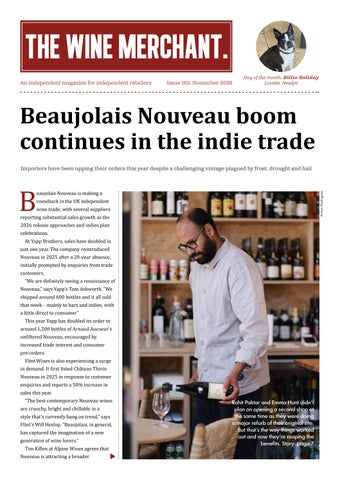
Rohit Paktar and Emma Hunt didn't plan on opening a second shop at the same time as they were doing a major refurb of their original site. But that's the way things worked out and now they're reaping the benefits. Story: page 7
NEWS
Inside this month 4 comings & Goings Good news for Poole, Saddleworth
Nouveau novelty has not worn off
and Nottingham wine lovers
10 budget round-up No respite on duty, but indies will benefit from business rate changes
19 Bright ideas Move over John Lewis, there’s a better Christmas ad in Morpeth
21 the burning question How many wines can you taste before palate fatigue sets in?
28 merchant profile Into the heart of polo country with Fairview Wines in West Sussex
36 sustainability The green credentials of wine can be a talking point for indie merchants
43 wines under £15 It seems there’s no shortage of excellent wines at bargain prices
52 running clubs The independents who welcome sweaty striders on a regular basis
67 Q&A: mark savage MW Meet the man who blames Hugh Johnson for everything
audience. “You’ve got people in their
60s who remember the Beaujolais runs
and the parties, but there’s also a younger crowd who like Gamay. They like a lighter style of wine, but also something with complexity.”
He reports incremental sales growth,
while Wines Under the Bonnet says
volumes are holding steady after several
years of renewed interest. The latter has even sold a dozen jeroboams, reflecting
Nouveau’s increasingly celebratory appeal.
concentrated, well-balanced wines. “It’s been both a horror and a
magnificent vintage,” says Killen at Alpine. “Most of our growers are 50% down on
their harvest. But the contrast is that the quality is stunning.”
For Ashworth at Yapp, Nouveau’s revival
reflects something beyond wine quality. Nostalgia plays a part, but so does the
growing appeal of informal, experience-led drinking.
“A bavette and a bottle of Beaujolais
Nouveau among friends is a good-value,
fun night out,” he says. “It’s a contrast to tablecloths and tasting menus.”
• Indies plan their Nouveau celebrations
– page 48.
The UK is now the third-largest export
market for Beaujolais Nouveau, behind
Japan and the US. Globally, around 13.8 million bottles were sold in 2025, with exports accounting for approximately
4.9 million. Yet the renewed enthusiasm among British independents appears to
be as much about changing perceptions
of the wine as a revival of the traditional November festivities.
Improved winemaking has helped
shake off Nouveau’s old reputation for
thin, bubblegum-flavoured reds, although
Heslop at Flint believes its essential appeal remains its playfulness rather than its ageing potential.
The 2026 vintage could prove
particularly interesting. Frost, drought and hail have severely reduced yields, with
some growers reporting losses of around 50%, but early assessments suggest
A recipe for a “good-value, fun night out”
THE WINE MERCHANT MAGAZINE winemerchantmag.com 01323 871836 Instagram/Bluesky: @WineMerchantMag Unit 52 Newhaven Enterprise Centre, Denton Island, Newhaven, East Sussex BN9 9BA Editor and Publisher: Graham Holter graham@winemerchantmag.com Assistant Editor: Claire Harries claire@winemerchantmag.com Reporter: Jacob Stokes jacob@winemerchantmag.com Advertising: Sarah Hunnisett sarah@winemerchantmag.com Accounts: Naomi Young naomi@winemerchantmag.com Admin and reader liaison: Charlotte Gingell charlotte@winemerchantmag.com The Wine Merchant is circulated to the owners of the UK’s 1,022 specialist independent wine shops. Produced in Sussex by East Print. © Graham Holter Ltd 2026 Registered in England: No 6441762 VAT 943 8771 82
THE WINE MERCHANT november 2026 2
Pooling resources for Dorset launch Canford Cliffs village in Poole will soon be home to a new indie. Fox & Vine is a joint venture between two friends, Tom Fox and Daniel Freeman. There’s no doubt that this stretch of
coastline, which includes Sandbanks, is an
affluent one, but Freeman is keen to stress that Fox & Vine will cater for all budgets.
“We don’t want Fox & Vine to feel exclusive
or intimidating. Quite the opposite,” he says. “We want someone looking for a £12
bottle for supper to feel just as welcome as someone choosing a £100 bottle of
Champagne. Good wine shouldn’t have to come with an attitude.”
Freeman has had his eye on the premises
for a while. “I’ve lived here for around 20
years now,” he explains, “and this shop has
been empty since 2022 or 2023, and every
time I walk or drive past, I go, ‘we should do something with that unit’.
“It’s quite a sizeable shop with room for
Daniel Freeman (left) and Tom Fox expect an 80/20 split in favour of retail
about 50 or so people to sit comfortably
in at the weekend and ordering between
back area we’ll have a bar, some nice comfy
thankfully, but we’re creating something
in the bar. There are two areas really – the front will be dedicated to retail and in the chairs and a big table. People will be able
to come in and have wine by the glass but we’re mainly looking at an 80/20 split in favour of retail.”
Plans also include the hosting of wine
tastings and producer-led events, and
Freeman is confident the local community will be eager to participate.
“We’ve put stuff on social media, and
we’ve had some really good feedback from people already, saying that they’re really looking forward to doing wine tastings.
That’s quite a large part of the offering that we’ll have,” he says.
“I’ve been talking to one of the guys that
used to run the Oddbins in Lilliput and he
said they used to have customers who had
second homes down in Sandbanks, coming
five to ten grand’s worth of wine at a time.
There are still people around who do that,
Final date for Callander indie
that we feel the area has been missing;
Macmillan Wines in Callander,
Champagnes, spirits and locally produced
September 1.
developing a piece of AI software that
managed by Athol Macmillan. When the
a proper independent wine merchant,
offering a carefully selected range of wines, drinks, with a real emphasis on quality.” The pair are also in the process of
they hope to share on an iPad in store to
help guide customers. “The idea is that the
customers can use it themselves, or we can lead with it and use it alongside our own expertise,” Freeman says.
Perthshire, has ceased trading. The business was officially dissolved on The shop on Main Street had previously
been home to a branch of Victoria Wine, chain went out of business at the end of 2009, Macmillan, whose family owned
the freehold, took on the premises and
launched his own shop a few months later. • Bonjour Wines in Cheshire has closed its
• Le Vieux Comptoir in Marylebone, London,
high street location in Tarporley. Sue Kelly,
has closed after 13 years of trading. The
and daughter Kelly Coop, started the business
business, owned by Laurent Faure, comprised
in 2022 and will continue to operate online
a restaurant on the ground floor, with a wine
only, offering free local delivery and wine
shop above.
subscription boxes.
THE WINE MERCHANT november 2026 4
Tiny deal sees Reserve get bigger Manchester’s Reserve Wines has increased its footprint to five shops, with the recent purchase of fellow merchant Tiny’s Tipple in Chorlton. Ed Gillibrand had traded from the
Wilbraham Road store since he started the business almost 14 years ago, but vacated
the premises in October once the deal with Reserve was done.
Kate Goodman, owner of Reserve Wines,
says: “Ed built something really special here, and we’re going to keep that going while adding a few touches of our own.
“It will still be a bottle shop, but we’ll also
be adding some seating so you can enjoy a
drink in too. There’ll be plenty of wines by the glass, you can open any bottle off our
shelves for a small corkage fee, and there’ll
be sharing boards and nibbly bits including cheese from Chorlton Cheesemongers just up the road.”
Gillibrand adds: “The lease had come to
an end a while back and although we had
plans to move to Devon, we weren’t ready, so I was just sort of holding over.
“If we were to stay here we would
probably do something similar to
what Reserve are doing, but it’s a lot of
investment; you have to staff it and you’ve
got to change your opening hours. Obviously Reserve have been doing it for years and
they’ve worked out what works and what doesn’t. The fact that it continues to be a
Kate Goodman with Ed Gillibrand. “He built something really special here”
days. When it goes well, it’s really enjoyable, but when it’s not going so well, it’s not so great.”
The last few months have seen Donnelly
carrying out the renovations as well as attending trade tastings and supplier
meetings. The shop promises to offer wine,
craft beer, artisan spirits upon opening, Saddle up for new with plans to add cheeses and charcuterie Goodman adds that she’s “itching to get boards as well as tasting events in the going” with all the ideas she has for the shop Saddleworth indie wine shop is my legacy really.”
which is scheduled to reopen under the Reserve name in mid-November.
Can we expect to see a Tiny’s Tipple in
Taste Saddleworth was scheduled
to open in the Pennines as The Wine
Devon any time soon? “I haven’t completely
Merchant went to press.
venture, so a bit like the hybrid model as I
Lee Donnelly, who has been documenting
ruled it out,” admits Gillibrand. “It would have to be a slightly different sort of
think it’s hard to stay as purely retail these
The new venture, based within the Rose
& Crown Business centre in Delph, is led by his progress on Instagram since July.
THE WINE MERCHANT november 2026 6
future.
• Licensing permitting, Stockton-on-Tees may soon welcome its only independent wine shop. Lu Lu’s Pantry & Wine Room will have a deli, café and retail offering on the ground floor and a wine room above for tastings, and wines by the glass.
in and take away. It has a very small Double trouble for drink brunch menu, a select wine list to drink in, and it’s only open during the day Cornish couple
committed to a major expansion at its Newlyn site found itself opening a second shop in the middle of the refurb. Lovetts owners Emma Hunt and Rohit
Paktar are now starting to reap the
rewards of opening Arcade Wines in Penzance.
The commitment to opening a second
shop coincided with an unexpected option
independent businesses in the area.”
• Bath indie Kingsmead Street Bottle has
Lovetts, now in its eighth year, serves
closed. Owner Simon Bowden says: “We
“We have wine on tap, we have a
ongoing increase of all costs, along with
“Newlyn is a working harbour and we
us no choice but to close our doors.” Palmer
coffee and other provisions during the day,
have tried everything over the last couple
mixologist and we do small plates in the
the government not hearing the calls from
have an incredible community. It’s very
Street Bottle in Frome, a sister company also
and is also a bar.
of years to increase revenue to cover the
evenings too,” Hunt says.
many in our industry to cut VAT. It has left
diverse with artists, fishermen, builders
owned by Bowden, continues to trade. Anton Rodriguez
A Cornish wine merchant which
Wednesday to Saturday.
and lots of people who have set up
to extend the original Lovetts premises.
“About this time last year our landlord
told us that the hairdresser who had the premises next door and upstairs was
retiring and offered us the space, increasing our footprint by 100%,” says Hunt.
“We’d already taken out a loan to do
Arcade Wines in Penzance, but we couldn’t say no. Basically we had to do both at
once and, I won’t lie, it was very hard, and
almost killed us, even though we have lots
of experience. We haven’t clawed ourselves out yet, but we’re getting there.”
Running two sites means double the
overheads, but Hunt says they have “a
small but very good team” which includes
a “highly skilled barista”, an essential for a
business that prides itself on the quality of the coffee as much as the wine.
“Our focus at Arcade Wines is incredible
coffee. If someone asks, ‘where can you get
the best coffee in Penzance?’ the answer ‘I’d
like to hear is ‘Arcade Wines’. If the question is ‘where can I buy a really interesting bottle of Greek wine in Penzance?’ the answer is also ‘Arcade Wines’.
The two shops may only be a couple
of miles apart, but they are sufficiently different to attract a wide range of customers.
“There is some crossover of clientele, but
there are people in Penzance that we don’t see in Newlyn and vice versa,” says Hunt. “Arcade Wines is a bottle shop that
specialises in really high-end coffee to
Arcade Wines: the best coffee in Penzance?
THE WINE MERCHANT november 2026 7
THE INDEPENDENT takes ADVANTAGE Importer the retail plunge A monthly column from Alliance Wine/ H2Vin exploring practical, creative ways independents can sell smarter – covering everything from fine-wine offers to pricing tweaks and experiential events
S
ome of the best margins in the independent wine trade come from a slightly unglamorous place – the overstocked importer with a clearance list and a deadline to shift it. We’ve all been there. A line sells well, you back yourself, you order big, and then it just ... slows. Suddenly you’re staring at excess stock you were very confident about three months ago. It’s the same story for importers, only when their stocktake is done, there could be a few hundred cases of perfectly good wine needing a new home, fast. Bin ends have an unfair reputation. The word alone conjures dusty bottles and lines nobody wanted – but that’s rarely the case. When an importer needs to move stock quickly, margins improve, significantly. The trick is being first to know. Ask your rep to flag clearance lines, get on the email list, and when something interesting lands, move on it. And when the stock arrives, have a little fun with it. A keenly priced mixed case (just in time for gifting season), a box of wrapped mystery bottles at the till, a “members first” email before anything hits the shop floor. Bin ends don’t need a fanfare. They just need a merchant who knows what to do with them. If you are interested in seeing Alliance’s current clearance list, please drop me an email at Alex.Badouin@ alliancewine.com.
Alex Baudouin Head of Independent Off Trade
Specialist importer Basket Press Wines launched a new wine shop and bar, Six Seconds, in Hackney last month. Founders Jiri Majerik and Zainab
Majerikova have chosen the former Haacha Bar site on Kingsland Road.
The Basket Press range of low-
intervention wines, sourced from central
and eastern Europe, will be supplemented by additional bottles from other UK
importers. These include Otros Vinos,
Dynamic Vines, Progression Wines and Wines Under the Bonnet.
“They’re not directly related to wine but
six seconds is the time your brain needs to switch between a rational and emotional state.
“For example, if you’re kissing somebody
it takes six seconds for that kiss to start having a positive effect on you, to begin
releasing oxytocin and serotonin to your brain.”
Going natural in Nottingham November will see the arrival of Subterranean Wines in Sneinton Market, Nottingham. A collaboration between retailer Essen
General Store in Beeston, owned by Sam Skinner-Watts and Edward Moore and wine importer Joel Wright of Wright’s
Wines, the shop will specialise in natural wine.
Wright says the vision is cave à manger
style, with a few small tables so customers can have a bit of cheese and charcuterie to Six Seconds opened in Hackney last month
“We wanted to have our own wine shop
for a long time,” says Majerik. “But the idea
grew a bit with the space we found. It has a
proper bar and a small kitchen so we can do more than we originally planned.
“We will run it as a shop during the day,
and in the evening too as there will always
be the retail option, but from 2pm when we open, people can come in and have a glass and a bite.
“At the moment we are doing small plates
but we are hoping to have chefs come in to do residencies. We’re planning to do
different events including wine tastings and winemaker’s visits. It’s going to be quite a varied space.”
Why the Six Seconds name? “If you look
up the six seconds theory, there’s at least
two or three which are related to how your brain works,” explains Majerikova.
THE WINE MERCHANT november 2026 8
accompany the wine, which will mostly be
sourced from his portfolio of more than 30 winemakers.
“We are putting in a little bar and we’re
going to have keg lines as well,” says
Wright. “The price point for natural wines is a little bit more and having some wine
in keg means we can offer them at a good price.
“We’ll have an orange wine, which will be
a Gewürztraminer blend, and for the white we’ll have a Riesling/Pinot Gris blend from Alsace. The red will be a light Syrah from
the Ardèche. Our keg wines will probably
continue to be from Alsace and the Ardèche, which are just two regions where I think you can still find really good value.
“We sell a lot to restaurants, I guess
because there aren’t that many wine shops that specialise in natural wine,” he adds.
“We are starting to grow all around the UK, but primarily natural wine is still biggest in London, so I’d say roughly 80% of our wines go to east London.”
NEWS
Relief on business rates, but not duty Chancellor John Healey's October statement confirms a 4.55% increase from next February, though some independent wine shops could save nearly £7,000 a year depending on their rateable value
T
he government has confirmed
independent wine shops currently
another inflation-linked increase in
paying business rates could see their
alcohol duty. But there was better
bills eliminated, provided they meet the
news for independent wine retailers, with
qualifying conditions. For some, the saving
thousands of small shops set to benefit
could be almost £7,000.
from an increase in the business rates relief
At Symposium Wines in Lewes, East
threshold.
Sussex, the figure will be more modest –
Chancellor John Healey announced in
though it’s still welcome, says co-owner
the Budget that alcohol duty will increase
Henry Breeze.
by 4.55% from February 1, 2027, adding
further costs for wine merchants and their customers.
The increase will add 14p in duty to a
bottle of Prosecco and 18p to a bottle of 14.5% abv red wine. A bottle of gin will attract an additional 49p in duty.
“It is positive news, undoing the
Consumers will pay £1.50 more duty on some red wines compared with August 2023
The WSTA says wine sales volumes have
significant business rate increase we
experienced last year,” he says. “Our bill was £1,309.40.
“Given the increases of costs, notably the
minimum wage rises in the last two or three years, this is very welcome and will help
The WSTA described the decision as
fallen by 8% since the introduction of the
businesses and failing to deliver additional
It calculates that, by February next year,
• The government has given little
2023. The equivalent increases for port and
or a fundamental overhaul of the
“breathtaking”, arguing that successive duty increases are damaging sales, squeezing revenue for the Treasury.
Miles Beale, WSTA chief executive,
said: “No one will be toasting this record-
breaking 4.55% RPI increase on top of rising inflation – least of all British consumers who will be paying for this.
“Instead of providing breathing space
in a cost-of-living crisis, the Chancellor’s alcohol tax hikes will further suffocate
British business and serve up nothing for consumers.”
The business rate cut has been the subject of speculation since the summer
new alcohol duty system in August 2023,
while spirits volumes have declined by 15%.
reduce the burden.”
duty on a bottle of 14.5% abv red wine will
encouragement to wine importers
gin will be £2.19 and £2.15 respectively.
controversial strength-based alcohol duty
being impacted”, adding that the current
28 concludes that the reforms introduced
But independent wine merchants in
complexity for parts of the wine trade.
From April 2027, the rateable value
different vintages and alcoholic strengths, has
have risen by £1.50, or 56%, since August
Beale urged ministers to “stop the hikes,
look at the numbers and listen to those approach was closing businesses and
hoping for a return to duty easement
system. An HMRC evaluation published on October in August 2023 are broadly achieving their
pricing consumers out of the market.
objectives, despite acknowledging increased
on business rates.
duty on individual wines, particularly across
relief will increase from £12,000 to £18,000
But it argues that businesses have generally
properties with rateable values of up to
develop lower-strength wines have had little
England received more encouraging news threshold for 100% small business rates
The report recognises that calculating
created additional administrative burdens.
for qualifying retail, hospitality and leisure
adapted to the system.
£21,000, compared with £15,000 currently.
impact. Average wine strength has dipped
premises. Tapered relief will extend to
The change means that many smaller
THE WINE MERCHANT november 2026 10
HMRC acknowledges that incentives to
only marginally, from 11.7% to 11.6%.
Daniel Lambert Wines’ selection of sparkling wines from
Pioneers of Fuissé Rooted in Fuissé since 1840, Domaine Ferret has been shaped by generations of remarkable women and safeguarded by Maison Louis Jadot since 2008. Celebrated for the parcel-by-parcel vinification pioneered by Madame Ferret herself, the Domaine crafts distinctive Chardonnay from 100% organic vineyards, capturing Fuissé’s extraordinary mosaic of soils.
Pouilly-Fuissé
A true ambassador of Fuissé, crafted from the finest parcels of its picturesque amphitheatre. Elegant and mineral, with beautifully balanced richness and freshness, and layers of stone fruit, acacia and spiced hazelnut.
Contact Hatch Mansfield, the exclusive UK distributor of Domaine Ferret. info@hatch.co.uk | www.hatchmansfield.com
THE WINE MERCHANT november 2026 11
NEWS
Trolls can’t hurt Matt as he stands up for RNLI Wnco Mwnco owner faces abuse from the far-right after he bans them from his shop in Cardigan – and then doubles down by donating £2 to the lifeboat charity for every bottle sold
F
ew business owners relish a public spat with far-right trolls. But Matt Jones, owner of Wnco Mwnco in
Cardigan, decided it was worth putting
his head above the parapet to show his support for the RNLI.
“I want to make myself absolutely
clear,” he explained on his social media, in remarkably measured tones. “If you
think that RNLI volunteers who sacrifice
their time to help people in need at sea are anything other than heroes … you’re not welcome in my shop. Don’t even bother. Fuck off.”
Matt reports that “about 64,000” people
saw the post, a fair proportion of whom responded with abuse.
“I expected some dickheads, but I
really had no expectation that this was going to happen,” he says. “It was a bit overwhelming, to be honest.
“I mean, I do recognise I’m not supposed
to mix business and politics. But I read
things, and I just can’t keep my mouth shut sometimes.”
Didn’t the scale of the abuse shake him
up, even a bit?
“Not really, to be honest. I did a post
around election time about how I’d sent
one of Reform’s flyers back to them with
some helpful commentary and attached it to a really heavy book on English history and
posted it to their
freepost address. “I’d had a
few dickheads
come out of the
woodwork after
that one, so I wasn’t going into it blind. I
knew there’d be some kind of pushback.
But yeah, it was a lot more than I expected. “But I also knew that these people are
all talk and they don’t actually do anything
to back up what they say. And actually that [Reform] post was at the time my most popular post I’d ever done.
“So yeah, it’s just something to talk about
with customers. And luckily for me, most
of my customers are nice, rational people who feel the same way.”
Out of all the responses to his RNLI post,
Matt Jones: “It was a bit overwhelming”
“About half of those are bots, at least, and
my mouth is and double down.”
Matt estimates that about 500 comments were hostile.
then the rest of them don’t live anywhere
near me, and they’re not anyone I need to worry about,” he says.
“So actually, the abusive comments are
nothing to me. What matters is the people
waving to me on the street and saying, ‘love your post’.
“I’ve had a lot of people coming into the
shop for the first time just because they’ve seen the post and they want to support.
The goodwill I’ve had outweighs the bad.”
Matt decided to reiterate his admiration
for the RNLI in another post and pledged
to donate £2 to the charity for every bottle sold the following Saturday.
He raised about £120. “It did feel a bit
insignificant, to be honest, but it’s a gesture of support, and I really hope that other
people see this and hopefully aren’t afraid to do something similar,” he says.
“It felt like the right thing to do, but I
didn’t want it to seem like I was virtue signalling and just trying to bring in
business. I wanted to put my money where
THE WINE MERCHANT november 2026 12
Cardigan RNLI station wasn’t involved in
the saga. “I’ve not had any contact with our local team about this,” Matt says. “They’re
customers; I don’t want to put them under any other pressures.
“I donate to their raffle every year. I
supply wine at cost to their fundraising
events, and I give the members a discount in the shop. The only stipulation is that they have to come in and say ‘I’ve got
barnacles on my bits’ to get the discount.” Matt isn’t likely to be less vocal in
future on subjects that he cares about.
“My biggest learning from this is that it’s not going to discourage me from doing
anything like that again, because I think
overwhelmingly it’s been positive,” he says.
Luckily for me, most of my customers are nice, rational people who feel the same way
Elizabeth Cox
Rising Stars
“T
Sarah's Cellar Battle, East Sussex
o say that Elizabeth has saved me sounds
middle and it doesn’t matter if you’ve come in on your
really dramatic,” says Sarah Truman, “but
own or with a group – you end up talking to people.
before she arrived, everyone would say to
Sarah has created something really fun and enjoyable,
me, ‘you are Sarah’s Cellar. You’ve got to be here or it
with a great atmosphere. It’s a place where time just
wouldn’t be the same.’ That makes you nervous because
seems to flow like the wine; nice and relaxed, with
I’ve put my name over the door. I’m here all the time. I
always time for a chat.”
know what people like to drink, where they like to sit
Working part-time at Sarah’s Cellar leaves Elizabeth
and who they get on with. I manage the space and my
time for her creative projects and the possibility of
customers really carefully, but in Elizabeth I’ve found
returning to supply teaching.
somebody who can do exactly
“Sarah’s not going to need a
the same thing.”
full-time employee unless things
Recruiting staff from among
go really crazy, so it’s nice that I
happy customers makes sense:
can balance Friday evening shifts,
the relationship is already
Saturdays and tastings with the
established and they understand
extra hours she needs when she’s
the culture you’ve created.
away. I’ve got my teaching, I write
Elizabeth is a case in point.
as well, and I’ve got a little craft
“Elizabeth has been a customer
business. Having lots of different
of mine since I opened in
projects and learning about
the original premises,” says
different things really suits me.
Sarah. “She hasn’t got a wine
Sarah keeps a small stock which
background, but she’s clever and
constantly rotates, so learning
makes notes on everything. She
about what we have in is my
comes to every tasting in the shop
main education – I get to learn
and listens to customers. She has
loads.”
an exceptional personality – she’s
Sarah is delighted that she can
great with people.”
now step away from the shop,
Disenchanted with her career as
even taking a recent holiday.
a primary school teacher, Elizabeth
“Elizabeth said she wanted to
found refuge at Sarah’s Cellar,
get her teeth into reorganising
first as a customer and then as an employee. Both
things in here,” she says. “She’s remerchandised, moved
experiences helped rebuild her confidence.
everything around and done some super-cleaning. I
“Teaching is an incredibly stressful sector,” she says.
don’t know how she’s done it, but it looks great. And
“Trying to build interpersonal relationships at work is
now she’s handled the ordering for a week, it’s given me
hard because your colleagues are already stressed and
the confidence to realise I don’t have to be here all the
the other people you work with are children. I would
time. She can work on a Saturday and close
go to Sarah’s Cellar because it’s so lovely and has given
up for me, and I can go home at a normal,
me a real sense of community. There’s a big table in the
sensible hour.”
Elizabeth wins a bottle of Champagne Devaux Cuvée D courtesy of Liberty Wines
If you’d like to nominate a Rising Star, email claire@winemerchantmag.com
THE WINE MERCHANT november 2026 14
Thanks to all our readers & advertisers for your support in 2026 Our next edition will be published on January 15, 2027 the website will continue to be updated throughout december and into the new year. Merry Christmas!
THE WINE MERCHANT november 2026 15
TRIED & TESTED
Eduardo Torres Acosta Versante Nord Rosso 2022
Domaine de la Taille aux Loups Clos de Mosny 2023
The parcels used here are all bush vines over 50 years
Jacky Blot elevated this often-overshadowed Loire
coiled with citrus peel, taut red fruit and an amaro
fine Riesling in its ripping precision and with a texture
old from the northern side of Etna. Delicately perfumed
with smoke, cranberries and rocks, with a palate tightly bitterness. Piedmont levels of seriousness, and there’s no doubt that patience will be rewarded. RRP: £31
ABV: 14.5%
appellation to heights that few others could have
managed. Clos de Mosny is a really special wine: like and authority that seems inherent in world-class Chenin, though not often at this humble price. RRP: £30
ABV: 12.5%
Justerini & Brooks (020 7484 6430)
Indigo Wine (020 7733 8391) indigowine.com
justerinis.com
Chateau Ksara Obeïdi 2025
Lorca Lo % Ancellotta Malbec 2025
The Bekaa Valley producer is on a mission to
showcase Lebanon’s signature grapes in single-
Expectations are always lowered when alcohol dips
an aromatic, low-acidity variety that in this case
But here, picked early and blended with a variety
varietal form. That started with Merwah in 2018, then old-vine Carignan, and now it’s the turn of Obeïdi,
produces a satisfyingly rich wine. The high-altitude
anyone who only enjoys Malbec in fruitbomb form.
known for its colour and fruitiness, it produces a very
vines imbue mountain freshness and a stony edge. RRP: £22
below 10% and there’s no point pouring this for
credible, chillable and guilt-free midweek quaffer.
ABV: 13%
RRP: £12.65
Berkmann Wine Cellars (020 7609 4711)
ABV: 9.5%
Ucopia Wines (01435 517080)
berkmann.co.uk
ucopiawines.co.uk
Château Maison Blanche Yvorne Grand Cru 2022
Victor Berard Vinsobres 2022
Chasselas rarely gets much kudos in the UK, where
Rhône appellations, usually at punchier prices than
Victor Berard famously makes super reds in various
it’s sometimes dismissed as blandly aromatic. This
Schenk-owned Chablais estate makes a very different case. Fermented in barrel, the wine is luscious and
honeyed but there’s a distinctive flinty minerality too. Complex and full-bodied – a real treat. RRP: £39.95
ABV: 12.6%
Schenk Family UK (01753 521336)
this Vinsobres. But you’re getting the full Berard
experience for your money. Black cherries, garrigue
notes, pepper and spice are all in the mix, and while the wine is undoubtedly plush and powerful, it’s also nicely balanced – and a lot of fun. RRP: £16
ABV: 14.5%
GCF Exclusive (07789 008540)
schenkfamily-wine.co.uk
lgcf.fr
Tiko Estate Saperavi Solo 2024
In Situ Gran Reserva Carmenere 2024
Made in Georgia’s Kakheti region, this has crowd-
pleasing brightness and a red-cherry bite, and the
Owner and winemaker Horacio Vincente studied
– a gentle earthiness that suggests a wide array of
his Aconcagua wines. This one is velvety and luscious,
supple, rounded tannins that you might associate
with the variety. There’s a lovely umami element too potential food matches. Bring on the mtsvadi, pkhali and badrijani nigvzit! RRP: £18
ABV: 13%
Astrum Wine Cellars (020 3328 4620) astrumwinecellars.com
oenology at Bordeaux university and worked at
Mouton-Rothschild, so there’s a slight French accent to with violets and blackcurrants, but the faint stalky note in the background completes it. RRP: £18.50-£19.50
ABV: 13.5%
Delibo Wine Agencies (07802 405627) delibo.co.uk
THE WINE MERCHANT november 2026 17
ight ideas br
83: Beat John Lewis at their own game Mark Stephenson Grape & Grain, Morpeth
In a nutshell: Don’t have several million
to have a laugh during a very quiet month.
media reel and you might just make an ad
sparks interaction with people and gives
pounds for a glossy Christmas campaign?
It can be lonely in the shop, but doing
Embrace the lo-fi approach with a social
something like that gives you a purpose. It
to rival the big names.
you a boost.
“You can’t go weeks without posting
The concept:
anything. You have to keep on top of it.
As a shopkeeper contemplates the
Sometimes you wonder, ‘Is it really worth
changing seasons, his melancholy is
it?’ But then you go to trade events or
interrupted by some furry friends. Oliver
customers come in saying, ‘Your latest
Postgate would be proud.
video had me howling,’ and you think it’s pretty fun.”
Tell us more.
Do different platforms reach different
“The things you have to do for your
audiences?
business these days! The crazy thing is,
it’s totally against my character to do daft things like that. I’m quite reserved. In a
group, I’m always the quiet one at the back, and I’m more comfortable with one-to-one conversations.
“From day one, I’ve wanted to avoid
coming across as pretentious. I want to
be able to take the mick out of myself, and social media is a good way of doing that
Mark is reconciled with a problematic Santa
or someone comes in asking if you sell Guinness 0.0%. We’ve all got the same problems. That’s the gist of it.”
Your videos certainly feel authentic.
and making people feel at ease before they
“We haven’t got the tools of the big boys,
The violent arrival in your reel of your
or slick. They’re a bit clumsy, but we’re
come in.”
shop Santa, heralding the festive season, will strike a chord with fellow indies. “I think it’s something we can all relate to. I’m a bit of an open book, and sometimes it’s good to show the warts and all. We all have those moments when you’re
looking at the till and there are no sales,
so these films are literally just me on my
iPhone. I don’t want them to be polished
authentic – we’re a small independent and
“Facebook reaches a more local audience, whereas Instagram is good for reaching
the wider industry. That’s partly down to
demographics. Like a lot of market towns, our customers tend to be 30 or 40-plus. A lot are on Facebook but probably not Instagram.
“Instagram brings us closer to the wider
trade and the people whose products we sell.
“We’re not on X. It’s a hornet’s nest of
negativity.”
Has a customer ever caught you mid-
that’s part of our charm. We’re proud of
strangulation by a puppet?
Does making them help pass a quiet
in, I ripped it off and said, ‘Right, how do I
who we are.”
“Yes! I was filming the Titanic one, wearing
day?
explain this?’ They said, ‘You’re not doing
“Without a doubt. I made one in January
that silly beard. When a customer came one of those videos again?’”
Mark wins a WBC gift box containing some premium drinks and a box of chocolates. Tell us about a bright idea that’s worked for you and you too could win a prize. Email claire@winemerchantmag.com
THE WINE MERCHANT november 2026 19
DAVID PERRY
storage area. This morning, with cold
drizzle chilling the air and another delivery of mature claret to find room for, I took the plunge. “Some point” had arrived.
What was all summer rosé yesterday
is Saint-Émilion, Aussie Cab Sauv and
Irregular Thoughts The rosé has finally stopped selling. Meanwhile, my Bacchus bubbles away
I
ripeness, or risk losing the lot to powdery mildew – again.
something that sounded like “twirly” and I peered out at a miserable winter’s day.
stack of rosé in the middle of the shop …
H
have to put the remaining rosé away at
mildew looks elsewhere. On the plus side,
aving dug up the early potatoes,
We had to venture to the bank in
I had a patch of earth with
Salisbury a couple of days ago, and I wore a
nothing in it. It’s a beautifully
T-shirt all day. (Gone are the days when you
stopped buying rosé about three weeks ago. Why?
People were still in shorts. I was in a
T-shirt at the bank. Brave souls were still
splashing about in the sea. Families were
another few days before accepting that
a toss-up: hope for a bit more sun and
onto my face. Not today. Mrs P mumbled
September and into October, people
In a normal year, English vineyards
would still be nervously hanging on for
than the 20 it ought to be. As ever, it’s
the light is flooding into the bedroom and
weather staying summery right through
I’m sure there used to be a gap between
summer and Christmas. Not any more.
I picked my grapes almost three weeks
Normally I know it’s time to get up because
The strange thing is that, despite the
supermarkets.
ago. The sugar level was only 13, rather
went off at 7.30am, it was still quite dark.
wasn’t begging for a loan.)
full of pumpkins, and Christmas is in the
Tate & Lyle. Not this year.
the weather changed. When my alarm
wouldn’t have been impressed. And I
and dumplings. Window displays are
level, and maybe chuck in a few bags of
week of October, and this morning
manager. Anyway, I’m sure young Rhianna
poached salmon and salad to beef stew
they had to harvest, whatever the sugar
t’s getting towards the end of the first
put on your best suit to talk to the bank
Rioja today. Overnight we’ve gone from
crumbly, “friable” bit of rich soil that
14 litres of juice squeezed, but no time for a third pressing
still having barbecues. I still had a huge but sales simply stopped.
For a while I’d been thinking I would
some point and bring it back out next
spring. I’d mentally made space in the
begs for something to grow in it. In a
moment of weakness, I invested 99p in a packet of pumpkin seeds from Bargains
opposite. I dropped them into the empty bed. They grew quickly and rampantly.
As the pumpkins plumped up, the leaves
went white and powdery. That’s powdery mildew. The pumpkins don’t mind it. The I have five big, orange pumpkins in my window display.
I lost all of last year’s grapes, so this year
I abandoned organic growing and bought
some more of Bargains’ bug spray (which promises to deal with mildew as well). I
Pumpkins don’t mind a bit of powdery mildew
THE WINE MERCHANT november 2026 20
I can imagine scaling it all up to a full commercial vineyard. I’m absolutely not going to, but I can imagine it
sprayed each individual bunch of grapes half a dozen times, and it appeared to work.
By mid-September, they were still
?
THE BURNING QUESTION
looking healthy, but a few grapes were
beginning to go mouldy – not mildew, but
How many wines can you taste before your palate gets tired?
�
We all have good days and bad days. There are times when you don’t feel it, only to be encouraged by that second wind you can get when running. You can get into a rhythm when the senses are in tune and convey with ease the words you need – magic. Blind tastings are fun but the concentration levels required are taxing on the old brain cells. During the Bordeaux En Primeur tastings, parched lips are not uncommon after a few days. An early-evening cleansing ale revives the palate sufficiently to enjoy something decent with dinner!
maybe botrytis. I left the sole Chardonnay vine alone. All its grapes have now rotted, so I made the right choice.
One evening, at closing time, Mrs P
joined me and we picked the lot. Seven big, flat cardboard wine boxes full. Enough to fill the back of my van. We rushed them
home, where I had a small press waiting.
”
As I started pressing the grapes, Mrs
P began sorting them. She discarded a
bucketful of wrong ’uns. Pressing each
batch of grapes twice, we worked furiously and, as the sun began to set, the 25-litre
fermentation bucket was about half full. There was still a lot of juice in the must,
but no time for a third pressing. We might have squeezed out another few litres, but
decided on quality over quantity. Anyway, it was getting dark and we were tired and hungry.
I was concerned about oxidation, but
Alice’s Nick had slipped me a small packet
Will Gardener * Champagne winner * Nickolls & Perks, Stourbridge
�
The maximum I can taste in one session is around 20. Then I refresh myself with water and a break. Like everything else to do with the human body, you get better with practice. I think it’s important to taste wines regularly and individually, aside of group tastings, to refresh the palate’s memory because it changes with time and the recollection of some wines might fade. I’ve been told that a wine brings bergamot notes: I have worked in fruit and vegetables and in my opinion it’s not possible for a wine to taste like bergamot.
”
of white stuff that did the job. Something-
Pedro Mota OPS Wines, London
or-other metabisulphite – magic stuff. I’d
�
abandoned organic already, so “contains
You can’t avoid palate fatigue, whatever your experience, age, level of expertise – everyone has their threshold. But you can mitigate the effects by drinking lots of water, using spittoons, sensible ordering and pacing of the wines. One tip – if it’s an important trade tasting and you have the time, do the whites and reds on different days, as it’s always the reds that suffer. After 40 or so mouthfuls a fine wine can taste like an entry-level quaffer.
sulphites” was hardly an issue.
Today I have 14 litres of Bacchus
bubbling away. I had to add a bit of sugar. It still tastes sweet, but it’s clear, clean and aromatic. It’s in a cold place, so
fermentation is nice and slow. I’ll give it another couple of weeks.
”
Having planted the bare-rooted vines,
tended them for five seasons, harvested the grapes and started making wine,
I can imagine scaling it all up to a full
commercial vineyard. I’m absolutely not going to, but I can imagine it.
Hopefully, in a few weeks’ time, I’ll have
around 18 bottles of Clos Shaftesbury
Vines Bacchus 2026, just right for summer drinking – oh, hang on. I’ll have to find
somewhere to store three half-cases of
white. I may have just the place – on top of this season’s rosé.
David Perry is the owner of
Nick Holt Noah’s Goat, Hastings
�
I can taste 200+ wines if I speed-taste without making written notes, only mental ones. If no one talks to me, I can actually taste all day without a problem. I usually get bored before I reach palate fatigue! If I stop to make notes, it always slows me down.
”
Richard Ballantyne MW, Noble Grape, Cowbridge, south Wales
Champagne Gosset The oldest wine house in Champagne: Äy 1584
Shaftesbury Wines in Dorset
THE WINE MERCHANT november 2026 21
MARKETING
Horse and art: Scots indie honours a star Long before AI-generated artwork became commonplace, Kenneth Vannan of Villeneuve Wines in Peebles commissioned a local artist to create some illustrations for his business. More than 40 years later, they are still an integral part of its branding
T
here’s a wine-drinking donkey,
band whose members pretended to be
appear on business cards, social media and
most conventional images for a wine
fooled the media for ages,” says Vannan.
all the time. After 40-odd years, I can’t
some birds in a glass and a cockerel clutching a joint. They’re not the
merchant’s branding, but they’ve served Villeneuve Wines remarkably well since the early 1980s.
The illustrations are by Harry Horse,
the professional name of Richard Horne,
an eccentric English artist whom Kenneth Vannan met while working part-time in a
Peebles pub before establishing Villeneuve in 1982.
“He was an absolutely top bloke,” Vannan
recalls. “If you’ve ever seen Withnail and I, he was very like the Richard E Grant
character. The way he dressed, the way he acted. He never did anything normally.” Horse was a man of many talents. He
wrote and illustrated acclaimed children’s books, became a political cartoonist and
American southerners, raising money
through gigs to buy tickets home. “They
In 1983 or 1984, Vannan commissioned
three A4 watercolours, giving Horse
complete artistic freedom. The fee was around £25 each, plus a few bottles of inexpensive red wine.
“We used them for business cards and
letterheads,” Vannan says. “People would
look at the business card and go, ‘Oh, that’s nice,’ and keep it on their desk.”
Horse also painted a hanging shop sign
and produced sketches for Beaujolais Nouveau breakfast invitations.
The artist died tragically in Shetland in
2007, aged 46, but his illustrations remain integral to Villeneuve’s identity. They still
played banjo in Swamptrash, a Scottish
THE WINE MERCHANT november 2026 22
even enormous shop doormats.
“Yeah, his his work is visible in our shop
think of anything better,” says Vannan. “It’s got a story too. It’s not AI or
computer-designed. It was made by a very interesting character.”
He believes other independents could
benefit from commissioning original
artwork, particularly when AI-generated imagery risks becoming increasingly interchangeable.
Vannan points to craft breweries, which
regularly commission artists to decorate limited-run cans, as an example worth following.
“I’m all for that,” he says. “It would be
great to see artists getting used a bit more.”
DUNCAN MCLEAN Northabout Just answer the question: did you really think that decent wine stops at Thurso?
Holidaymakers don’t bring their own fish. They don’t need to bring their own booze, either
I
enjoyed the interview with James Goodhart in the October issue of The Wine Merchant. If I ever make it as far south as North Yorkshire, I’ll be sure to visit Cellar 21. I particularly liked the photo of James with his pork pie birthday cake. It reminded me of a small producer we used to have here who made excellent handraised pies under the unimprovable name The Porkney Pie Company. Sadly, they have gone the way of all hot-water crust, but local butchers still make traditional Scotch pies with fillings such as haggis and clapshot. Speaking of haggis, I was sad to read of the death in August of Matthew Jukes, at far too young an age. His enthusiasm for Australian wine made his notes on the subject essential reading. I met Matthew only once, at a 100 Best Australian Wines event in Adelaide. Having recently
completed an exhaustive series of tastings with Macsween of Edinburgh to find the perfect wine match for haggis, I took him to task for his recommendation of “broad, luscious new world Chardonnay, or a scented, white Côtes du Rhône at the lighter end. If you want to go over the top, try any Grand Cru Pinot Gris from Alsace, or a Condrieu”. All great wines, but in my book nowhere near as good a match for greasy, livery haggis as a medium-bodied, high-acid red. Piemonte Barbera is my top recommendation. Matthew refused to be swayed, and quite right too: he always trusted his own palate and instincts. I was impressed that someone who was, as David Gleave of Liberty Wines put it, “English home counties to the core” should think to mention haggis at all. Something else James Goodhart
THETHE WINE WINE MERCHANT MERCHANTnovember november 2026 2026 2323
mentioned in his interview made me laugh, though it was a rueful laugh. Speaking of where his customers came from, he said, “We get a lot of people on their way up to Scotland, to go fishing or something like that. They pop in, we give them a free coffee, and they end up with five or six cases in the back of the car to drink at some lodge in Scotland.” “Damn and blast!” I thought. “They could have been buying five or six cases from MY shop, without having it sloshing around in the back of their car as they drove up the tortuously winding A9.” The reality is that we’re used to visitors not knowing what to expect when they come to Orkney. They sometimes splash out on a case or two (and a kilo of cheese), but disappointingly often we’re told, “we didn’t know if there would be any shops in Orkney, so we took all our food with us from Surrey”. Lidl in Thurso is also frequently mentioned: the last food shop before crossing the Pentland Firth and the starvation that must surely await on the far side. A few years ago, one of my trade customers, a small country house hotel by a fishing loch, mentioned that a famously persistent TV interviewer was coming to stay for a week. They were excited, and so was I: surely he would guddle in the upper end of the hotel’s wine list! Sadly, no … under the impression that good wine was not available outside the M25, or at least not north of Melsonby, he brought his own supplies to the hotel and insisted on drinking nothing else. The next time I delivered to the hotel, I saw multiple bottles of a non-list wine in the glass bin: Louis Jadot Mâcon-Villages Blanc. Outside in the car park, as I made to drive off, the interviewer was leaning his lanky frame against the back of an estate car with fishing rods fixed to the roof, barking angrily into his phone. Was he really yelling, “Answer the question!”? I’d like to think so. And I’d also like to think he was tearing a strip off his PA, who’d advised him to carry cases of basic Burgundy all the way to Orkney when he could have been enjoying his freshly caught trout with much more interesting bottles from the hotel’s wine supplier. Duncan McLean is proprietor of Kirkness & Gorie, Kirkwall
ROB HOULT
with a new judge in the shape of Nigella Lawson (damehood incoming, surely). I
couldn’t help thinking this was a factor in
the low ticket sales, as most of the nation’s
over-45 men sat glued to the box, earnestly insisting that they “have always been big
Another Thing Wine is food’s poor relation on screen. So how can it get its Nigella moment?
fans of baking”, and that they’d watched
every previous series on catch-up, actually, you just hadn’t noticed. The Nigella factor in full flow.
I
t got me thinking about the difference between food and wine on television
and, to a lesser extent, in the cinema.
Food plays such an important role on
screen, from the lame mid-80s erotica of
Nine and a Half Weeks, with Mickey Rourke, Kim Basinger and the entire contents of a fridge, to the over-hammy “performative
eating as acting” that crops up in so many films. Its absolute nadir, for me, was Julie
& Julia, featuring a man eating cake so
horribly that I nearly walked out of the cinema. (Why do actors have to eat so noisily? It’s a visual medium. We can chuffing see it!)
But that’s the thing: food is so visual.
It’s a riot of colour and shape. We can’t
taste or smell it on screen, yet the images stimulate our minds and make us feel as
though we know exactly what it tastes like. A customer of mine was once a MasterChef contestant and told me that most of his Food looks flaming good on TV. But all wine looks pretty much the same
B
ridget and I recently took two of
our younger children – although at 19 and 21, “younger” is a relative
term – to the cinema to see the latest Shaun the Sheep movie. It was my idea. I’m a big fan of Aardman Animations and the film had garnered rave reviews.
Tuesday is one of the few quiet evenings
we get, so it suited us perfectly. I booked tickets at our local Showcase cinema
because, at my age, I appreciate a very comfortable seat. When I booked that
morning, I noticed I had free rein of the seating plan. Even so, I was surprised
to discover that we were the only four
people in the cinema. Nobody else turned
up. Showcase offers private screenings
for a fee, so getting one for free made the Yorkshireman in me very, very happy.
First things first: the film was amazing.
Genuinely funny, not too long, and the
technical skill involved in putting it on
screen was incredible. Secondly, though, why was the cinema so empty? Perhaps Shaun the Sheep is seen as a children’s
movie – although The Sunday Times review suggested otherwise. Showcase was the
only cinema showing it later than a childfriendly 5pm; we were watching it at a positively naughty 6.40pm.
But that particular Tuesday was also
the night the new series of Bake Off aired,
THE WINE MERCHANT november 2026 24
food was tasted cold because filming took so long.
We viewers see a plate move from pass
to judge in mere seconds, apparently to
be tasted straight from the pan. We can’t
see temperature, and as long as the judges heap on the praise, we believe the food is every bit as lovely as it looks.
This is where wine, in its visual form,
falls down. The first amateur cook to be booted off MasterChef may have served
something resembling roadkill rather than haute cuisine. A Michelin-starred chef on
Whenever wine is discussed on television or radio, or written about, it always seems to be in glowing terms
Great British Menu, meanwhile, will have
rustled up something that looks like a film
BOOK REVIEW
Aldi claret and a glass of Château Le Pin are
wine liBerated:
set, contains 128 ingredients and has you drooling from miles away. Alas, a glass of
visually pretty much indistinguishable. No
matter how many delightful word pictures you conjure up, it still looks like red liquid in a glass.
S
o how does wine get its Nigella
The Ecological Revolution & the Vintners Inspiring Change
moment? How does it move from
by adam L huss
print and radio to the big screen? I
cHELSEA GREEN £18.95
think wine needs to take a leaf out of food’s book. After tasting a handshake-worthy
cake, Paul Hollywood doesn’t spit it out, so why should we do that with wine?
Yes, I know cake doesn’t get you drunk,
but a sugar rush and a few extra inches
around the waist aren’t exactly positives. Getting gazeboed* on telly might be the only way to convey the true wonder of wine. A couple of glasses in, the guard
comes down, and you’d certainly know
what people really thought of the wines.
And why not have some negative opinions for a change? Whenever wine is discussed on television or radio, or written about, it
always seems to be in glowing terms. That doesn’t tally with my own wine-tasting experience.
A riotous 60 minutes of wine drinking,
accompanied by increasingly ebullient
waffle, might finally make the telly chiefs
take wine seriously. We could move beyond recommending only wines that would suit
Terry and June. There’s also the play-alongat-home option, which would make the show more immersive – something TV
executives seem to crave – while boosting wine sales across the land. A full-on 4D experience.
It wouldn’t even need to be one of those
“get better as the episodes progress”
shows, like Strictly or Bake Off. It could be a game show, with celebrities – proper ones, too. The bigger the name, the more fun it would be to watch them get sozzled. I’ve
got the perfect title: Blanquette y Blanc. I’ll get my coat.
* I didn’t think I’d be allowed to use the more
technical term, “wankered”.
Rob Hoult owns Hoults Wine Merchants in Huddersfield
T
“If wine can be an art form, an embodiment of our potential to create beauty, even a sacrament, it will become all the more important in reminding us of our reasons for facing inevitable crises with courage and hope.” For Huss, that means reconnecting wine with its origins. “A bottle of wine itself cannot be a form of art. The bottle is merely the signature on the painting; the end result of a culture built of systems that grow from the earth.” His arguments become less convincing when he turns to what he calls “vinifera culture”. Here, the philosopher sometimes gives way to something closer to a
he best way to convey what Adam
conspiracy theorist, and his passion begins
Huss achieves in Wine Liberated
to sound desperate rather than moving.
is to compare my notes on its
Some criticisms are persuasive. Huss
opening and closing sections. After the first
rightly questions the logic of planting
16 pages, I’d scribbled “deeply cynical
disease-susceptible vinifera in unsuitable
opening” and “unnecessarily strident in
environments, then depending on synthetic
its tone”. I was getting bogged down in
spraying to keep vines alive at the expense
every line, challenging every argument and
of surrounding ecosystems. Why not plant
growing more contrarian with
hybrids, he asks, especially when
each sentence.
the option to plant hybrids – or simply not plant at all – exists?
Some 150 pages later, my
Elsewhere, his analogies strain
notes consisted almost entirely of quotations. Not because I was
credibility. He compares the
exhausted, or because the book
dominance of vinifera, a species
had changed dramatically, but
encompassing thousands of
because I’d lowered a guard
cultivars, to the Dutch colonising
I hadn’t realised was up. I’d
the world and imposing salted
allowed Huss to speak uninterrupted. In his words, I’d been liberated. He hadn’t won me over with revolutionary
liquorice as the only available sweet. More bizarre is his claim that “vinifera culture uses wines of pure vinifera to create
ideas. Wine enthusiasts will be familiar
and enforce status and class distinctions
with the damage caused by monoculture,
among drinkers”. This overlooks how the
the merits of hybrids and the argument for
global spread and standardisation of
growing vines only where they can thrive
vinifera, whatever their drawbacks, have
without intensive intervention. Nor is his
made a wider range of wines accessible
criticism of the modern wine trade especially
to more people, challenging rather than
novel. The book’s impact comes instead
reinforcing some traditional barriers.
from its philosophical foundations and Huss’s heartfelt commitment to his cause. That emotional intensity is both its
Yet Wine Liberated achieves something rare for a wine book: it’s genuinely moving. Huss doesn’t simply impart information. He
greatest strength and its principal
provokes questions, challenges assumptions
weakness. Huss is most persuasive when
and leaves room for disagreement. Early
discussing ecology and our relationship
on, I repeatedly asked myself: “Liberation
with the natural world. His practical
to what end?” By the final pages, I felt he
knowledge and personal experience lend
had answered that question – and several
weight to arguments enriched by moments
others.
of genuine philosophical insight.
THE WINE MERCHANT november 2026 25
Jacob Stokes
BITS & BOBS
Favourite Things
Bottles of £12 Champagne are back as grocers begin their festive price cuts. Tesco, Sainsbury’s, Asda and Morrisons
have opened their pre-Christmas
Champagne push with 25%-off six-bottle deals. Entry-level own-label prices have
The Bishop’s Cave, St Albans Favourite wine on my list
Going into the autumn and winter I’d pick our Bodegas Lleiroso Ribera del Duero Crianza.
Favourite wine and food match
It has to be cheese and wine. Recently I loved a pairing I did at a Portuguese tasting putting Quinta da Casaboa Homenagem with an aged cheese from the Azores called Sao Jorge. The salty, umami flavour with the big, rich, red was just amazing.
Favourite wine shop
La Cave de Bruno in East Dulwich. I visited this shop in 2014 when they first opened and will always have a soft spot for it as they were part of the inspiration for me getting into the industry.
around 30,000 bottles of wine worth
with 25% off for Clubcard holders buying
surveillance systems at the Cortona facility
discounts, down to £34 and £30 a bottle
Guado al Tasso. Between 8,000 and 10,000
October 14, pairing single-bottle offers six bottles or more. Taittinger and GH Mumm both have £10 single-bottle
respectively, falling further to £25.50 and £22.50 on the six-bottle deal.
Tesco’s cheapest Champagne, Gartissier,
is priced at £16 before the six-bottle discount brings it down to just £12. The Drinks Business, October 26
warehouse in Tuscany. The gang disabled alarm and
before using forklifts to load two trucks
with wines including Solaia, Tignanello and bottles of Solaia alone were taken.
Antinori, which described the operation
as highly organised, has warned customers around the world to be wary of suspicious offers through unofficial sales channels. Reuters, October 9
• Margaux has overtaken Chardonnay as Britain’s most popular wine-related baby name, according to an analysis of three decades of birth registrations. The Drinks Business examined almost 40,000 names registered in England and Wales between 1996 and 2025, looking for those borrowed from grape varieties, regions, wine styles and famous labels. Down to £22.50 on a six-bottle deal
Favourite wine trade person
I’m going to say Stuart BowmanHood from Frederick’s who we’ve been buying from for a long time. He’s a top all-round chap who really cares about what he is importing and never lets you down on a delivery, to the point that he’ll drive the missing cases over to me from his personal stash if something goes awry.
Seven masked thieves have stolen €5m from a Marchesi Antinori
Favourite wine trip
Navarra. It was a really pure “discovery” trip for me. It ended up with me importing my first wine directly from a vineyard there – Castillo de Monjardin. We experienced wonderful hospitality and food in an amazing landscape.
Cheap Tignanello could be stolen
already slipped below £12.
Tesco was first out of the blocks on
Dan Leak
Magpie
Own-label Tesco Champagne is £12
The Drinks Business, October 12 • October saw a record number of attacks on commercial shipping in the Strait of Hormuz, keeping insurance and fuel costs high. (Reuters)
Updates from the supply chain
• Container freight rates are edging up again. Drewry’s World Container Index reached $4,585 per 40ft container on October 22, up 2% in a week. Shipping schedules remain patchy, with 44 planned sailings on major east-west routes cancelled between October 19 and November 22. (Drewry)
THE WINE MERCHANT november 2026 26
• European wholesale gas prices recently touched €100/MWh, adding pressure to glassmaking, warehousing and transport. (Reuters) • Low water on the Rhine is disrupting barge traffic. At Kaub, water levels fell to around 10cm in mid-October, well below the level at which barges can carry normal loads, so surcharges and delays remain in place and some freight is being shifted to road or rail. (Wine & Spirits Shippers Association)
Surrey special agent is honoured
Solar panel shade is good for vines
M&S claims a cloudy wine first
A Surrey wine has
Researchers in southern Italy have
Cloudy wine is moving further into the
acquired an extraordinary
found that vines grown beneath solar
mainstream, with Marks & Spencer
connection with a British
panels can produce substantially
introducing what is
wartime agent who
heavier bunches than those grown in
claimed to be the first
parachuted into a vineyard
full sunshine.
cloudy still wine sold
in Bordeaux. Greyfriars Vineyard named
its Yvonne cuvée after Yvonne Cormeau, an SOE radio
operator who was dropped into occupied France in
1943 and worked with the Resistance.
The link emerged after one
of Cormeau’s descendants
visited Greyfriars and explained that her grandmother had trained nearby before being sent behind enemy lines.
The Drinks Business, October 13
A trial on Primitivo vines in Puglia found
by a major British
that shading from photovoltaic panels
supermarket.
the accumulation of sugar and preserving
by avoiding the fining and
more than doubled shoot growth and
increased bunch weight, while slowing acidity.
The system, known as agrivoltaics,
allows the same land to be used for
grape growing and electricity generation, although researchers caution that the
results will depend on variety and climate. Vinetur, October 7
• A robot dog is patrolling Spanish vineyards. A four-legged machine
Trouble is an organic
rosé left deliberately hazy
filtration processes normally used to clarify wine.
The trend follows the
growing popularity of pét nat and other minimally
processed wines, although
deliberately cloudy styles are far from a new winemaking invention. The Guardian, October 15
• A 90-year collection of Château Haut-
called Agrhound is being tested among
• Moët Hennessy, Analog Devices and UC
Brion has fetched €3.4m at auction in
Tempranillo vines in Ribera del Duero.
Davis are working on machine-learning
Paris. The Sotheby’s sale included vintages
Equipped with cameras, sensors and AI, it
technology capable of recognising chemical
dating back to 1935. A five-litre jeroboam of
is designed to walk across steep or uneven
signatures in grapes and wine. Its first
Haut-Brion 1989 sold for €62,500, setting a
vineyard terrain that presents problems for
target is Fresh Mushroom Aroma, a fault
record for the format.
wheeled robots.
that can be difficult to detect conventionally.
Decanter, October 5
Global Agriculture, October 26
Electronics World, October 27
A wine blended for business class United Airlines has developed a wine by conducting blending trials at 35,000 feet. Winemaker Jesse Katz of California’s Aperture Cellars tasted nine potential blends during a flight after finding that dry cabin air muted aromas and fruit while accentuating acidity, tannin and texture. The resulting Air and Vine 2024 Sonoma red is 76% Cabernet Sauvignon, with Malbec, Merlot, Petit Verdot and Cabernet Franc, and is due to be served in United’s Polaris business class from 2028. Decanter, October 26
Jesse Katz conducted trials at 35,000 feet
THE WINE MERCHANT november 2026 27
The story so far Robert Wattie’s career in food and beverages has taken him all over the world, including a stint sniffing out criminality at a London hotel. Those experiences, and his 11 years running Fairview Wines, have given him plenty of inspiration for a novel. Graham Holter pays a visit when Robert is focused on his equally interesting day job
M
y conversation with Robert
Wattie is interrupted a couple of times by customers, including a
couple keen to buy another bottle of The Mentors Petit Verdot 2019 – a wine so
chosen wines are boxed up and after more
chit-chat and pleasantries the couple leave happy, promising to return soon. “Regular customers?” I ask.
“I don’t think I’ve ever met them before,”
popular it’s now sold out.
Robert smiles back. But then he smiles
some alternatives. A Bordeaux blend
his own expense. Here is a man who clearly
Robert greets them like old friends
and enthusiastically steers them through from Veneto; an appassimento from the
Languedoc; a Carmenère from Chile. The
THE WINE MERCHANT november 2026 28
almost all of the time: big, generous smiles
that regularly give way to laughter, often at
adores being part of the wine trade and has no intention of hiding it.
Merchant Profile: Fairview Wines, Midhurst
How did you come to take on the shop? I was walking home from the pub and
saw this place sitting empty. I only had a
warehouse then, not a shop, and I thought, “this would be a great wine shop”. There
wasn’t a proper To Let sign, just a business card in the bottom corner of the window. I phoned on Monday morning and the
landlord said, “I’ve already got five people ahead of you”. Then he asked what I
wanted to do with it. I said, “turn it into a wine shop”. He said, “go and get the keys
the second I took it on they put the listing back. That’s my luck.
Did you know how you wanted it to look? I had an idea, but once I had agreed to take
the place I did think, “how are you going to
do this, Rob?” I looked at other wine shops, but so many bottles were lined up row
of the mix, and if you come on the right
night you’ll find the place transformed into a venue for small gigs. That, and the novel he’s writing, keep Robert pretty busy.
business.
Fairview began as a wholesale business, didn’t it? beverage for years. When I decided to leave that world, the original plan was actually
it was something I had become rather good at. That contract disappeared when the hotel company involved was bought.
I was sitting at a bar in London and
overheard two Italian men saying they needed to find a UK importer for their
wine. I said, “I might be interested”. I still work with them; I’ve just ordered four pallets.
Did you know how you were going to
don’t know much about wine, that wall of
obviously I thought, “let’s start a wine
and often tell which country it comes from
Absolutely not. I was getting divorced,
bottles can be intimidating.
business”. A friend told me it would cost
back and then be drawn towards a label.
Importing and wholesaling are a vital part
all that storage here has transformed the
sell it?
The idea here was that people could step
be, but even here retailing is a challenge.
about 35 pallets. I still use bond, but having
after row. You and I can glance at a label
before we have read anything. But if you
club. It’s a good place for a wine shop to
extends underneath next door and I can fit
to investigate staff theft in hotels, because
listed building status had been lifted, but
just up the road from Cowdray Park polo
stock. Downstairs is enormous. The cellar
Rack. After that the British Heart
Foundation took it over and gutted it. The
moneyed corner of north west Sussex,
you see here is perhaps a tenth of the
Yes. I had worked in hotels and food and
Later it was Pescod’s and then Wine
Fairview Wines is based in the heart
You do have to keep it full. The cost of
filling a wine shop is insane, but what
now”. His family’s wine shop had been here about 200 years ago.
of Midhurst, an old market town in a
The inspiration, really, is a library.
Lighting is important to me; that comes from my time in hotels. One of my best
friends is a very talented carpenter, so we sat down over a couple of nights. He said,
“tell me what you want and I’ll make it fit”. We measured the whole place and built it.
One of my first two pallets was faulty. I got a credit for it and sold it as mulled wine THE WINE MERCHANT november 2026 29
broke and my job was in the shit, so
about £250,000 to establish one properly. He wasn’t far wrong, although you can grow it gradually, which is what I did.
My best friend helped me buy the first
two pallets. One was faulty, but I got a
credit for it, turned the wine into mulled wine and sold it at a market. That paid
for another pallet. My first customer was
a friend in the club world in London. The
second was a care home. I don’t know how that happened, but I thought, great. It was random and I just kept building.
I used London City Bond and worked
from a house in Fernhurst. The front room was storage and the top room was my
office. Then this place came along.
I go to trade fairs and I travel, but a lot of it comes through word of mouth. Somebody
How does the business divide now?
will say, “you should meet my friend”.
About 60% to 65% is trade. I use the shop
That is how I found Château Carpe
as a hub for local customers, because
Diem [in Provence]. Someone put me in
every time you can avoid putting stock
touch with Albéric [Philipon] just after I
into bond you save booking-in charges,
started the company. He was flying through
storage and delivery charges. I still keep
Heathrow, so we met at Caffè Nero and
wine in bond so I can supply nationally, and
tasted the wine out of coffee cups. Classic.
I have customers all over. There’s one in
I’ve been working with them for eight
Gloucester that I drive to once a month. He
years.
has been with me for years.
If I’m looking for something specific
We’re small and nimble. It’s mainly me,
from a particular region, I’ll phone the
with a couple of part-timers who cover the
producers I already know. I might say,
shop. At the moment we import perhaps
“I’m really loving the rosés you do, but I’m
40% to 45% of the range ourselves. I want to get that to 60%, with the rest bought domestically.
The direct imports might give me about
five points more margin. My rough target at retail is 37.5% to 40%, but on wine bought domestically it is probably more like
32.5%, because customers can compare
prices. The wines I import myself give me
a better margin and make the range more distinctive.
looking for someone in Bandol or Cassis. Robert mainly works alone but has some part-time employees who help at the shop
Why not?” I always tell producers: give
me something people know and give me something different.
Some merchants are nervous about
What kinds of things are you looking for
buying too much of that kind of stuff
when you buy direct?
because it requires an awful lot of hand-
I’m constantly trying to find a great
selling.
example of what a region is trying to
Hand-selling is what I enjoy most. I
Italians are the best for that. You ask, “what
asks for, and that selling every bottle will
produce, at the best price I can get it for. Then I throw in a few oddities. The
did Grandpa make?” and they say, “he made this”. I bought one of those odd bottles
from Piedmont recently and sold the case
in a week. One customer tried a bottle and came back for the lot.
That probably happens because I can’t
contain my enthusiasm. I like saying, “Here’s Canadian ratafia – go figure.
I learnt about relationships with producers from Jeremy Hunt and I try to emulate that. We don’t have contracts
understand why merchants worry they
will be lumbered with something nobody become a chore.
Sometimes I get it wrong. There have
been wines that I’ve ended up taking home
Do you know anybody?” They say, “try
my mate”, and a conversation begins. The wines aren’t always what I’m looking for, but every now and then it works. I try to
visit most producers, although I can’t get to everyone.
I’ve never asked any of them for
exclusivity. I’m a small independent, and
they are businesses; I hope we respect each other enough to treat each other well. I learned about relationships from
[Thorman Hunt founder] Jeremy Hunt and
the way he works with his vineyards, and I
try to emulate that. Albéric and his wife are
like family. We don’t have a contract and we have never even discussed one. We know
each other, respect each other and pay each other. They do what they say they will do. It is a great working relationship.
Canadian wine has become a Fairview
and drinking myself. You just think, “fine,
speciality. Was that always part of the
slightly beyond what they already know. If
Canada, so it was natural for me to lean
got that one wrong”. It happens.
plan?
somebody likes a ripe, fruit-forward Petit
into it when I started the company. The
But when it works, you help people move
Yes. I’m British-Canadian and was born in
Verdot or Primitivo, you might show them
name Fairview comes from the Fairview
a French appassimento-style wine with the same generous fruit and soft tannins. Then perhaps you add a Carmenère with a more savoury, green-pepper note. It branches
out a little without asking them to leap into something completely alien.
How do you find new producers to work with?
THE WINE MERCHANT november 2026 30
Slopes in Vancouver, where I lived for quite a while. It has nothing to do with the South African producer, although I met them in
Düsseldorf and we had a good laugh about it. I stock their wines too.
Canadian wine works well for a small
importer because the producers cannot make vast quantities. There isn’t the
pressure on me to put it everywhere.
The online business is predominantly
Canadian. People travel there, discover
a winery and search for the wine when
they come home. If they are looking for Canadian wine, we are going to appear.
I also wholesale quite a lot of it to other independents.
Ice wine does particularly well in
winter, but I have table wines from British Columbia, Ontario and Prince Edward
I tell customers that their lists should be 80% what the customer expects and 20% should be their own identity
County, as well as sparkling wine. Canada is
nothing about wine, but the attitude was:
I also co-import with other wine shops.
said, “Rob, I’m taking you to France. It’s
a good talking point at the moment, but the wines stand up.
Smaller merchants may not import
themselves, so we sit down and look at
the gaps in their range. I bring the wine in, store it and deliver it to them. That
collaborative side is something I enjoy.
Where did your own enthusiasm for wine begin? Jeremy Hunt got me into the wine trade.
In my early 20s I was on a traineeship at the Savoy and doing room service. One
day they sent me to the wine cellar. I knew
“You’re going to learn.”
We used Thorman Hunt a lot, and Jeremy
time you learned something about wine.” I spent four days around Carcassonne with him, and I think that is where I fell in love with it. The first vineyard I ever visited
was a Corbières property whose wine I still stock through Thorman Hunt.
I learned a lot from Jeremy. He is an
amazing guy. I still use Thorman Hunt and the quality is fantastic. If you buy one of their wines without tasting it, you don’t worry.
More importantly, I learned about
relationships from him: the way he works with his vineyards and the genuine affection there.
How do you approach wine lists for your trade customers? My hotel and food-and-beverage
background makes that side feel natural. A lot of pub wine lists are almost
interchangeable: Chilean Sauvignon, Pinot Grigio, New Zealand Sauvignon, Malbec, Merlot – eight whites, eight reds, two
rosés and two sparkling wines. You can practically write the list blind.
I tell customers that 80% should be what
their customer expects and 20% should
be their own identity. Put in a few brilliant things that are different and slightly
aspirational. Imagine two people sitting
down for dinner. One of them knows a bit
about wine and spots a 12% Malbec from the Loire. “What the hell is that? Let’s try
it.” The bottle becomes the part of the meal they remember.
You don’t necessarily need a completely
obscure grape. It can be a familiar
The bespoke racking system was inspired more by a library than by traditional wine shops
variety from an unfamiliar place:
What does the typical shop customer
unique. There are limits. I once had a César
to £24. We have house wines near the
Canadian Cabernet, Loire Côt or a Mencía.
spend?
from Burgundy that I could sell in the shop,
entrance at £10 or £11, and they need to be
Suddenly the list has a life and looks
The sweet spot for still wine is about £15
but I wouldn’t put it on a pub list because
solid. Sometimes a customer says, “I’ve got
even most wine enthusiasts have never heard of it.
Yes, the staff need training, but you
should be doing that whenever you create
a new list. Make it fun and give them a few anecdotal facts they can pull out of their
a house full of late teenagers. Can you drop off 24 bottles of Pinot Grigio? That’s all
they’re going to drink.” Fine. I’ll give them
10% off 12 bottles and deliver locally. It is
nice that they still come to us instead of the
not really a late-evening town.
People come because they want
recommendations. That is what an
independent should be. Somebody asks
for a wine that has sold out, and you don’t say, “no, sorry”. That is your opportunity.
You ask what they liked about it and find a route to something else.
Why is independent wine retailing so resilient and so loved, do you think?
supermarket.
Because it gives people a personal
interesting.
what they want?
homogenising so much: the way we shop,
and the chef are part of it, and the wine list
bring your own bottle and fill it for £6.75.
hat. They don’t need a lecture. Usually it is just one line explaining why that bottle is At a food-led pub, the menu and the
service are theatre. The waiter, the host
should be too. At a wet-led pub, somebody generally walks in and asks for a glass of
Pinot Grigio without looking at a list. Then the job is simply to find the best wine you can at the price, without compromising more than you have to.
Do customers mainly arrive knowing We have lots of regulars, plus people
visiting Midhurst. Refill wine is popular:
Saturday from 9.30am to 11am can be the busiest part of the week. People are going
to the butcher or buying a newspaper and
remember they need wine for the weekend. That is why the advice to open from 11am until 8pm doesn’t work here. Midhurst is
THE WINE MERCHANT november 2026 32
experience that is being stripped out of
the rest of life. AI and supermarkets are work, interact and even write. Working life is go, go, go. Don’t stop and talk to
anybody or you will fall behind. In our free time, I think we will increasingly want the opposite.
Going to a wine shop isn’t simply paying
£2 or £3 more for a bottle. You enjoy
yourself, learn something and have a
conversation. On a Saturday I open bottles
and people come in; by the end you can
the displays, put in benches and have the
high streets, let us open them up, have
rather than a chore.
the wine. This place is like my home; I don’t
feel part of the fabric of the wine shop and
have half the town here. I love that. It
becomes part of people’s leisure time That is why I think independents
will have a renaissance. We give people
discovery and human contact. If we don’t do that, their palates don’t change and
wine loses its feel. Look at what happened with craft beer: people learned styles,
became curious and started asking for
particular things. Wine is moving a little in that direction too.
But resilience also comes from being
prepared to adapt. Nobody is immune
from the problems on the high street. An independent has to buy, sell, deliver, do the accounts, manage people and solve
artist at one end with lights behind them. I charge a fixed ticket price that includes
want somebody having to come up in the
middle and ask, “can I get a glass of wine?” and then be charged another fiver.
I don’t make money from it. Most
of the ticket income goes to the artist. We recently had a musician from
Newfoundland, and there’s another coming from Cornwall.
The only difficulty is persuading some of
them to stop. You put them on at seven and at 10 o’clock you are saying, “James, we all loved it, but we’ve got work tomorrow.”
Could you put in tables and chairs and
whatever has gone wrong that day. You
make it a wine bar too?
live music or allowing people to sit down
sit here on a Saturday afternoon, drink
keep pushing and find another way. For
I’m thinking about a hybrid element.
for a glass. The bottle matters, but the
some wine and have charcuterie. A few
Fairview that might mean more tastings,
reason to visit is the experience around it. You mentioned AI. How do you use it in the business? It is genuinely useful, as long as you train it in the way you want it to work. I have
redesign. I’d like Fairview to become still
more experience-based: a tasting room and wine bar mixed with the shop.
Is Midhurst protected from the
It is particularly good for tasting notes
lot of skills. You are HR, the accountant,
and for gathering anecdotal information.
buyer, stock person, delivery driver and
finds: give most credit to the producer,
then to the wine writers I trust, and work outwards from there.
The notes are useful for subscription
boxes and the wine lists I create. I’m also trying to improve the newsletters, which
take much more time than people imagine, and AI should make that easier. It doesn’t replace the tasting or my judgement. It
helps organise the information and express it in my voice. You still have to train it,
check it and know what you want to say.
Tell us about the gigs in the shop. How do those work? I love music and I like musicians. We clear
council and find out what grants are
coming and how it might help. I have
discussed my ideas with the council and
the response was, “when you have a plan, let us know and we’ll see whether we
can match-fund some of it”. You don’t ask, you don’t get. Merchants often contact
councils only when permission has been
refused or a parking restriction appears.
If you approach them with something that improves the community and retains jobs, they can be very supportive.
Tell us about the novel you’re writing.
in investigating a wine heist. It is set in
I don’t think anywhere is immune.
have trained it to rank the information it
My advice is to speak to the district
tables and chairs would need only a small
verbiage, how I write and what I am
hour can be done much more quickly. I
make the shop a community hub.
It is a crime novel set in the wine world.
problems affecting other high streets?
A job that might otherwise take me an
as Midhurst’s market square. Make people
People keep saying it would be lovely to
set up the AI I use so it understands my looking for.
some al fresco dining and use spaces such
Running a one-shop independent takes a salesperson. There isn’t a job you don’t do. Technology can do some work for you, but it doesn’t remove the mental load because it won’t do the thinking.
Towns have to entertain. The big
supermarkets are moving out of town
towards the American model: drive there
and buy everything. If we want people on
Working life is go, go, go. Don’t stop and talk to anybody or you will fall behind. In our free time, I think we will increasingly want the opposite THE WINE MERCHANT november 2026 33
George Lenez is a world-class sommelier
who falls from grace and becomes involved
1998 and 1999, when I started at the Savoy. People’s names may have been changed to protect the not-so-innocent, because none of them were.
I want people to learn about wine
through osmosis while enjoying a thriller.
Phylloxera and grafting are part of the plot, for example.
I’m extremely dyslexic and didn’t read a
book until I was 22. Then I was given tinted glasses and read Birdsong by Sebastian
Faulks. It blew my hair back. I fell in love with the way books create worlds.
Jeremy Hunt appears in mine, in his own
way. He has been immortalised.
Are you on speed or something? Where does all this energy come from? I think I’ve always been this way.
Hospitality was the perfect place for me. I left home very young – I was 15, just
about to turn 16 – and I’ve always had that energy. It’s simply how I am.
Do you ever feel that you’re burning out? Sometimes, yes. About once a month I’ll
have a day when I don’t pick up the phone or look at it. I just need complete
darkness and to switch off. I am a hyper
person, but I get a lot from the things I’m passionate about. I love doing them.
Looking back, would you do anything differently? I would have had a slightly larger war
chest. I didn’t have money; I borrowed for the first pallets and have built and funded it gradually. We work in pennies much of the time in wine.
You need a mathematical brain, a love
of wine and a willingness to deal with
paperwork. You also have to stay calm
when the trade goes wrong, because it goes spectacularly wrong. A shipment gets stuck because somebody else on the container
hasn’t completed their paperwork, and you need the wine for an event next week. You ask, “can I come and get mine?” No. Those
moments are stressful, but most of the time it is pretty good.
I’ve been doing it for 11 years and loved
the journey. The thing I love about wine
is that however long I stay in it, I’ll never know everything.
Where would you like Fairview to be in five years? Perhaps there will be one or two more shops and something with a stronger
tasting-room or wine-bar element. This
shop will remain the anchor. I love it – and trying to move all this shelving would finish me off.
More than anything, I’d like enthusiastic
staff to come in, learn here and stay in the
trade. Jeremy gave me that enthusiasm and showed me how much fun wine could be. I’d like to pass it on.
In five years, I would love customers with
children old enough to work to say, “go and work for Robert. It’s a solid business, it has been there for years and you’ll learn a lot”. I want the business to be respected by
customers, trade clients and competitors. If you start a wine business to make millions, you are in the wrong business. But slowly,
almost without noticing, life improves. My daughter has riding lessons now, and the business manages to pay for those. That will do.
THE WINE MERCHANT november 2026 34
A living legacy With more than 400 years of history, Cartuxa is one of Portugal’s most celebrated wine estates. Its distinctive Alentejo wines also sustain a charitable foundation with deep roots in the region
C
artuxa, based in Évora in Portugal’s Alentejo region, has a history
spanning more than 400 years. Its
wines reflect the character of one of the country’s most dynamic wine regions.
Adega Cartuxa occupies one of Portugal’s
oldest vineyard sites. Vines have been
cultivated at Quinta de Valbom since 1517,
when the Jesuits established the vineyards. The order also helped found the
University of Évora, Portugal’s second-
oldest university. Nearby, the Carthusians
built the Cartuxa monastery between 1587 and 1598.
After both religious orders were
expelled from Portugal, the vineyards and monastery were seized by the state and
fell into neglect. The Eugénio de Almeida family acquired the properties in 1871
and began their restoration. The family
subsequently expanded the vineyards, and Cartuxa now works with 1,050 hectares
across four estates: 650 hectares owned and 400 leased long-term.
In 1963, fourth-generation family
member Vasco Maria Eugénio de Almeida established the Fundação Eugénio
de Almeida, a charitable foundation
supporting the social, cultural, educational and spiritual development of the region. He also restored the winery and
monastery and welcomed back the Jesuits
and Carthusian monks. The latter remained at the monastery until 2019. Although
Vasco Maria died in 1975, his foundation
In association with Mentzendorff For more information about Cartuxa, visit mentzendorff.co.uk
The spectacular vaulted cellars
continues its work, funded by 100% of the winery’s profits.
C
artuxa’s vineyards lie in the Évora sub-region of Alentejo,
where hot, dry conditions
The Pêra-Manca name was first
registered in the 1870s, and its red
wines subsequently won gold medals in
Bordeaux. Political upheaval, phylloxera
and the vineyard owner’s death in 1920 brought production to
an end. Cartuxa revived the label
and varied non-calcareous
in 1990 for its flagship wines,
Mediterranean soils produce
made from native grape varieties.
wines typically characterised by
Pêra-Manca has since acquired
depth, complexity and balanced
a cult following in Portugal and
acidity.
internationally.
The area’s winemaking
The Fundação Eugénio
reputation stretches back
de Almeida also cultivates
centuries. Its historic wines
were known as Pêra-Manca, a
name derived from the “pedras
400 hectares of olive groves,
producing cold-extracted extra
mancas”, or fallen stones, scattered across
virgin olive oils with acidity below 0.2%.
João II in 1488 and reportedly travelled
fruity, spicy notes of green tomato leaf.
the landscape. They were mentioned in
a letter from Évora town council to King
aboard Pedro Álvares Cabral’s ship when he reached Brazil in 1500. According to
legend, barrels of Pêra-Manca were stored in the hold as ballast.
THE WINE MERCHANT november 2026 36
EA Olive Oil blends Cobrançosa, Picual, Arbequina, Koroneiki and Galega, with
Cartuxa Olive Oil combines Cobrançosa, Picual and Arbequina, offering fresh,
complex flavours and a bitter-almond finish.
Sustainability special
A conversation starter Sustainability is a talking point that can give indies the edge over supermarkets, argues Jacob Stokes
F
or an industry that talks so much about sustainability, the wine trade’s consumers are still largely sheltered
from the conversation – and from the environmental,
social and economic realities behind it.
That shouldn’t come as a surprise, given that more than
80% of off-trade wine purchases in the UK are still made
in supermarkets, where the transfer of information rarely extends beyond the bare bones of region, variety, brand
and, ultimately, price. There’s little room for conversation in supermarkets, let alone a nuanced discussion about sustainability.
Instead, the subject is often reduced to certification logos
and seals. These might be national schemes, such as New
Zealand’s SWNZ – Sustainable Winegrowing New Zealand – or South Africa’s Integrity & Sustainability Certified seal, or international certifications such as organic or biodynamic. It is precisely the lack of engagement at the point of
sale that makes such logos necessary. But without any
explanation, they are unlikely even to be noticed, let alone explored in a meaningful way. And so the cycle continues.
Independent merchants are the outlets most likely to break
that information deadlock. They already provide context
for almost every other aspect of wine, many of which are naturally intertwined with sustainability.
Wine on tap, a concept embraced by many indies,
illustrates how successfully merchants can engage
consumers by sharing sustainability goals. It can provide a route to premiumisation, as consumers become more
willing to invest in sustainable products, while also helping merchants distinguish themselves from the multiples by
placing people, provenance and values at the heart of the sale.
Of course, not every consumer will want to engage with
sustainability, and neither will every merchant. As the wider debate becomes increasingly fragmented under economic and political pressures, the benefits of championing
sustainability need to make financial sense more than ever.
For merchants, integrating sustainability into the way they
buy and sell wine can be more than a worthy brand value: it can offer a genuine point of difference.
THE WINE MERCHANT november 2026 37
“Amps Wine Merchants have been working with Lawson Dry Hills for the past 15 years. The quality of the wines is top draw and service and support first class.” Philip Amps
Proudly estate grown, made and bottled by us Available from regional wholesalers all over the UK! Email belinda@lawsonsdryhills.co.nz for more information.
THE WINE MERCHANT november 2026 38
Plus Pinot Gris, Chardonnay, Riesling, Gewurztraminer, Pinot Noir & our Reserve wines
Sustainability special
The vineyard
The winery
Talking about vineyards to customers is a balancing act.
Information about pests, disease control, soil compaction
The workings of a winery do not always translate
rock formations – tempting though they may be for some of
flow? An old basket press? Indigenous yeasts? Temperature
and root penetration is unlikely to persuade most people to spend more, nor are lengthy geological explanations about us.
But vineyard life is a different matter. Sheep, ducks and
chickens grazing among cover crops; biodiversity encouraged through vineyard management; beehives; indigenous flora
and fauna … these are tangible examples that consumers can readily understand. The preservation and encouragement of life is something people can get behind and, potentially, be willing to pay more for.
Water is another important part of the story. Wine
production is a thirsty business, and climate change is
making water stewardship increasingly significant. Regions
and producers that manage water carefully therefore have a
story worth telling, particularly when contrasted with heavily irrigated regions such as Australia’s Riverland.
Dry farming and old vines can carry plenty of romance,
while still linking back to the preservation of resources.
Rainwater harvesting and wastewater recycling may sound rather less evocative, but they are no less important.
glamorously to the point of sale. What is the most exciting thing you tell your customers about a winery? Gravity
control? For what it’s worth, my answer would be Natte Valleij’s appassimento of Cinsault stems.
But what about sustainability? Again, the stories may lack
some of the romance of the vineyard, involving as they often do pomace, wastewater and solar panels.
Yet the idea of circularity is a powerful one. Grape skins,
seeds, stems and lees can be composted, distilled, used for
energy or repurposed into cosmetics. Winery wastewater can be recovered and used for irrigation. Solar panels can allow producers to generate much of their own energy and, in some cases, operate largely off grid.
Being transparent about these measures, however small
they may seem, is another way of distinguishing independent merchants’ wines from supermarket products, which often
reach the shelf with little traceability or context. Combined with the other services and expertise that merchants
provide, such stories might encourage consumers who
alternate between supermarkets and independents to think twice about where they buy.
Consumers don’t think much about winery design – but may be interested in the green credentials of the facility
THE WINE MERCHANT november 2026 39
Some easy wins for indies Sustainability doesn’t have to mean costly infrastructure projects. Lanchester Wines CEO Tony Cleary MBE explains how smaller investments can deliver commercial benefits for independent merchants – and why he believes the trade needs to fight back against EPR charges
W
hen it comes to sustainability, Lanchester Wines practises what it preaches. Done properly, it argues, sustainability can reduce risk, cut costs, build resilience and future-proof a business. Its experience suggests that environmental commitments need not come at the expense of commercial performance. Over their 25-year lifespan, its three wind turbines are expected to negate approximately 25 million kilograms of CO₂ emissions compared with grid electricity – equivalent to the annual emissions of around 2,500 people in the UK. In what the company describes as a first for a UK business, its geothermal heat pump system draws heat from disused mine water, reducing the carbon footprint of its space heating by 80%. Yet despite these large-scale investments, Tony Cleary, co-founder and CEO of the Lanchester Group, believes smaller, more achievable measures are just as important – and encourages independent merchants to explore them. “Indies aren’t going to be able to put a wind turbine up, but there are lots of small wins available that add up and help,” says Cleary. “We bought three electric vans three months ago. They were silly money. But we’re going to pay for those vans in 14 months, purely from the savings of running them on electricity rather than diesel.” He adds: “Of course, we have our wind and solar power, and we also do a lot of miles, so we get payback reasonably quickly. But even for indies charging overnight on cheap tariffs and only doing local deliveries, it’s still worth it in the long run.” 300g bottles save 12p on EPR per case of six
25 million tonnes of carbon negated
C
leary is particularly outspoken on extended producer responsibility (EPR). “We need to start talking to each other and fight back. Every new tax brought in is clobbering our industry,” he says. “Indies are being taxed twice: they’re being charged once for having their recycling taken away and then for EPR.” He believes merchants should challenge what he calls the “badly written” rules. Wine bottles supplied to hospitality are generally treated as household packaging for EPR purposes. But primary packaging may be classified as non-household where it’s supplied to a business that provides the product to the end user with all packaging removed. “If indies pour wine by the glass they don’t pay EPR, but if they put the bottle on the table, they do, and it goes in the same bin. So, if indies insist on pouring bottles for customers, like they do behind the bar, I’d argue there’s no difference. And I’d ask someone to prove otherwise,” says Cleary. He also points to lightweight packaging as a way of reducing costs. “90% of Lanchester Wines’ UK packed brands are
THE WINE MERCHANT november 2026 40
in a lightweight 300g bottle. It’s a 12p EPR saving per case of six compared to the average bottle, which is around 400g. Now, I know it doesn’t sound a lot, but indies sell a lot of cases of wine. It adds up.” The environmental case for lighter bottles has traditionally centred on lower transport emissions, a benefit Cleary continues to emphasise. But financial sustainability is becoming equally important. “All the government is going to do is keep putting that price up and up, and businesses will be paying more and more and they simply won’t survive. That’s why I think it’s so important,” he says. Perhaps Cleary’s most pertinent point for independent merchants and the wider trade is not about turbines, vans or bottles – or even EPR – but about the expectations of the next generation of wine drinkers. “When I speak to businesses, I try to get them to understand that young people care about sustainability, and they’re going to be the business’s main market for the next 20 years,” he says. “Recently, people have wanted me to speak more and more about money and costs. Businesses are always asking, ‘what’s this going to cost me?’ and ‘what am I going to save?’ rather than ‘why should I do it?’” For Cleary, the answer to that last question is straightforward: the next generation.
In association with Lanchester Wines
Tony Cleary: EPR rules are “badly written”
Sustainability special
The bottle It goes without saying that there are different levels to how far merchants take their commitment to sustainability.
For some, especially those focused on natural wine, it can underpin an entire range. For others with more diverse
offerings, it might mean stocking a handful of producers with particularly strong sustainability credentials. In many cases it may barely enter the buying equation.
But whether sustainability is an explicit consideration or
not, where merchants place their money and endorsement matters. Although many supply-chain decisions may seem
beyond an individual merchant’s sphere of influence, we see
time and again that independents, often among the industry’s earliest adopters, can help set wider trends and changes in thinking in motion.
One area where indies have generally chosen continuity
rather than innovation is the glass bottle. There are sound
reasons for this. Leaving aside any national pride in the fact that the transportable glass bottle was invented on these
shores, the bigger issue is the importance of presenting wine as a premium product. For many consumers, the optics of
wine in a can, box or keg still work against that perception. If widespread adoption of alternative formats remains
unlikely, the argument therefore shifts to how the glass bottle itself can become more sustainable.
The simplest first step is reducing bottle weight. Given that
a significant share of wine’s carbon footprint comes from the production and distribution of 75cl glass bottles, choosing
unnecessarily heavy glass is increasingly difficult to justify. I ran the numbers on one of the heaviest bottles I can
remember handling, from a biodynamic producer in the
south of France. Weighing 1,774g when full, the empty bottle alone comes in at just over a kilogram.
Production that year was 15,970 bottles. Had the producer
instead used a 360g lightweight Bordeaux bottle, more than 10,000kg of glass could have been removed from the supply chain for that vintage alone – roughly the weight of eight
Ford Focus hatchbacks. Multiply decisions like that across a
portfolio, region or country and the impact quickly becomes substantial.
For consumers accustomed to associating heavy bottles
with prestige, merchants have an important role in
explaining that bottle weight has little to do with wine
quality – but a great deal to do with the carbon generated in producing and transporting it.
There are also important discussions to be had about
bulk shipping and glass colour, though these involve more complicated commercial considerations than simply
choosing a lighter bottle. For that reason, bottle weight
remains one of the most obvious and readily achievable ways
The bigger picture As an agricultural product, wine naturally encourages us to
focus on environmental sustainability. But there is a danger in doing so at the expense of the economic pressures facing the industry and the wider world.
Environmental measures can only endure if they are
financially viable. On paper, the ideas discussed here can all
appear entirely rational. But if those measures are achieved while someone along the chain – whether a grape picker
or a UK merchant – cannot make a proper living, then the arrangement is not sustainable in any meaningful sense.
That is where premiumisation and sustainability can go
hand in hand. After around 30 years of steady growth in
wine exports and value, from the 1990s into the early 2020s, repeated races to the bottom arguably helped undermine
wine’s perceived value. Whether through intensive farming
regimes based on routine spraying or relentless discounting in the multiples, there have been times when the industry
has seemed in danger of losing respect for its own product. The current decline in wine volumes can also be viewed
as an opportunity to reconsider that model. If some of
the consumers leaving the category were retained only
through ever-lower prices, perhaps the industry now has an
opportunity to reshape itself around the things independent merchants have always argued wine should represent: provenance, quality, craft and story.
The fact that supermarkets have experienced sharper
volume declines than independent merchants, while also attempting to premiumise and diversify their ranges,
suggests that some of this shift may already be under way. If we want a more environmentally sustainable trade, in
which producers can afford to implement and maintain the
measures we consider sensible, we have to work backwards
from the point of sale. That means reinforcing wine’s position as a drink with an
unusually rich story and sense of place –
and creating enough
value throughout the chain to support it. And if any part
of the wine trade is well placed to
communicate that story directly to consumers, it is
independent retail.
for the wine trade to reduce its environmental impact.
THE WINE MERCHANT november 2026 41
ASK
Phoebe
Phoebe Weller of Valhalla's Goat in Glasgow is our unregulated agony aunt
What’s the cure for lacklustre, lunatic staff? Dear Phoebe
Twenty-two years I’ve had this shop. I held on through the Lehman Brothers, through Brexit and the pandemic and the council’s “temporary” bollards. I have The Cure on repeat. I don’t make eye contact. It works. The problem is my staff. My manager wanged on about lunar cycles for 40 minutes over the weekend to a customer who wanted a Rioja for a shepherd’s pie. The parttimer won’t answer the phone because it “crosses a boundary”. How do I get these people to just sell some wine? Keith, Keith
Dear Keith
Fine with Rioja, less so with moon talk
of a goose in a jacuzzi on it. Is integrity
manager is always one sigh from tears.
people who “have staff”. Nor do I trust
Lovecats. That was them, wasn’t it? And
they did that version of that Craig David
Dear Sylvan
the landline. Why would I speak to a
few things about covers! Mainly Lilac Wine
owner told me to show initiative, so I
(Buckley) and Perhaps Perhaps Perhaps
I can trust you because you like Lambrusco. Have you tried M&S’s? They just don’t get
ordered all the bottles by label colour,
Pistachio Bar? They just don’t get it! When
the till. Is it all retail or just wine retail
Tony was in hospital with his bunions of
that loves suffering?
covered in the wrong type of chocolate.
Dear Forest
I don’t know about you, but I rarely trust
dead, or is it me?
A man asked them for a Chablis and got
people who play The Cure, apart from
Sylvan, Keith
15 minutes on climate change and soil
song. Not my favourite cover, and I know a
I rarely trust people with qualifications, but
stranger? There’s an Instagram. The
it! Have you also tried their Gigantic Daddy
and now they’ve told me to just stand by
the imagination I bought their Exceedingly
Forest, Keith
They just don’t get it! Not to be trusted!
I rarely trust conversations over the phone,
(Cake, but not their I Will Survive). Leave
biodynamics alone, you ex-Oddbins prick. Hope that Helps! Phoebe
Somebody think of the educators Dear Phoebe
I am the Senior Wine Educator (unaccredited) of our wine shop. I’m four years into the Diploma, and can name every soil in Alsace. The owner calls our range of Lambrusco my “silly little crusade” and my part-timer just
erosion. They keep asking me to answer
Chocolatey Custard Creams which they had HTH, Phoebe
Higher-ups are getting me down Dear Phoebe
I do seven hours a week at a bottle
sold a mousey, flat pét-nat to a Fine
shop to fund my mosaic zine and flat
Wine Regular because it had a picture
full of mice. The vibes are not it. The
THE WINE MERCHANT november 2026 42
nor mosaics. I am never sure whether either really exists. So I can see your
problem! I saw a documentary (How It’s
Made) once about a factory making the bits for mosaics and it made my stomach turn. The same is true of the voices through
the wires, although How It’s Made has not
covered this in any significant depth. Bottle filing by label colour coming soon to this humble establishment! HTH, Phoebe
WINES UNDER £15.00
Abigail Connolly is a big fan of Masi Modello – an “all-day red” that she sells for £14.85. Read about some of her other sub-£15 recommendations – and those of other indies and suppliers – in the following pages
WINES UNDER £15: 1276 WINES 1276wines.co.uk
1276 WINES BACCHUS 2024 HEREFORDSHIRE, UK RRP £14.99 Bacchus uniquely captures the essence of the English countryside. Almost an “English garrigue”, our 2024 Bacchus is redolent of freshly mown lawns, cottage herb gardens and wild hedgerows, bursting with elderflower, blackberry leaf, nettle and mint. A touch of malolactic fermentation and generous batonnage has given a richer and more generous mouth feel and softer, riper acidity than is often associated with this variety – almost a “Bacchus Sur Lie”. Enjoy with fresh seafood, sushi and creamy, herby pasta dishes.
1276 WINES PINOT NOIR PRÉCOCE 2023 HEREFORDSHIRE, UK RRP £14.99 Pinot Noir Précoce has become a flagship English variety, offering medium bodied red wines with an often surprising level of depth, complexity and potential. Our 2023 vintage has really hit its stride after a couple of years in bottle. A core of ripe dark plum, dried strawberry and black cherry, overlaid with thyme, black pepper, spiced black tea and truffle.
Based on the site of a 13th century vineyard, 1276 Wines produces a range of award-winning still and sparkling wines at our Herefordshire vineyard and winery. Every bottle is made exclusively with our own sustainably grown and selectively hand-harvested fruit, and with traditional winemaking methods. We allow the fruit to take centre stage, ensuring that our wines are a true expression of our vineyard and the unique signature of each vintage. For trade enquiries, please contact rob. yeatman@1276wines.co.uk Head winemaker Laurence Cocking
A versatile food wine, it makes a great match for game, pork and roasted root vegetables.
WINES UNDER £15: CONDOR WINES
OJOS DEL SUR PINOT NOIR PATAGONIA, ARGENTINA RRP £14.99
FAMILIA TRAVERSA VIÑA SALORT ALBARIÑO CANELONES, URUGUAY
condorwines.co.uk
ANT MOORE A+ PINOT GRIS MARLBOROUGH, NEW ZEALAND RRP £13.99
RRP £13.99 A classic expression of Patagonian Pinot Noir, combining bright red cherry and strawberry fruit with delicate spice and subtle vanilla notes. Fresh, elegant and beautifully balanced, it offers vibrant acidity, silky tannins and a refined finish. Reflecting Patagonia’s cool-climate character, Ojos del Sur delivers purity of fruit, finesse and an appealing freshness that makes it both distinctive and effortlessly approachable. Certified sustainable.
A distinctive expression of Albariño from Canelones, where Atlantic influences help shape the grape’s naturally fresh, aromatic style. Zesty citrus, crisp stone fruit and delicate floral notes combine with bright acidity and a subtle saline edge. Elegant, refreshing and beautifully balanced, this captures Albariño’s affinity with coastal climates, delivering purity of fruit, finesse and a crisp, moreish finish. Certified sustainable.
THE WINE MERCHANT november 2026 44
A lovely example of New Zealand Pinot Gris, combining ripe pear and juicy stone fruit with delicate floral notes and a hint of spice. Generous yet refreshing, it balances a rounded, textured palate with lively acidity and a clean, persistent finish. Approachable and versatile, Ant Moore a+ captures the variety’s signature fruit-forward character while retaining the freshness and vibrancy that make New Zealand whites so appealing. Certified sustainable.
Abigail Connolly
Jack Young
Connolly’s, Birmingham
Charlie’s Drinks Store, north London
I’ve always thought of wines under £15
There’s an interesting contradiction in
important part of how people actually buy
of a finger, you can seek out cult natural-
as weekday wines. Not because they’re
lesser wines, but because they’re such an and drink.
£15 is an interesting threshold: high
enough to expect something good, but low enough to take a punt. Customers might try an unfamiliar grape, explore a new
region or simply trust a recommendation. Yet it’s still more than they’re likely to spend in a supermarket, so the wine
has to overdeliver – particularly in an independent shop.
For a first-time visitor, £15 is a relatively
low-risk entry into a world that can feel
intimidating. A £40 bottle is a decision; a £13 bottle is an invitation.
It’s crucial to offer plenty of variety and
some banging wines below £15. A great
bottle at that price doesn’t just brighten someone’s evening; it can make them
curious about the rest of the shop. They
might come back for a dinner-party bottle, something special for an anniversary or a gift for the ever-discerning in-laws.
wine at the moment. In some ways, it has
never been more accessible: with a swipe
wine producers from the Jura, old vintages
of Cornas and rare Burgundies – or scoff at aggregated Vivino reviews.
Yet wine is becoming less affordable.
It’s all very well being able to track down rare bottles, but what’s the point if only dusty chino-wearing collectors can buy
them? Even former midweek staples now often cost upwards of £20. There are
reasons, of course – inflation, rising costs,
scarcity and all the rest – but to us, access is fundamental.
Wine is meant to be enjoyed, whatever
the occasion or budget. A strong selection of thoughtfully made wines below £15
means that, even when you’re feeling the
pinch at the end of the month, you can still pick up a tangy Roditis or a crunchy, fruit-
driven red to enjoy with midweek football
Jack’s juicy bargains Quinta de Santiago Assinatura de Família (Festa) A benchmark Vinho Verde: a bright little rascal bursting with freshly squeezed citrus and green apple, plus a hint of summery spritz. A great expression of the style. £14.50 Wildeberg Paarl Vine Garden Red Field Blend (Boutinot) A sustainably farmed field blend of young-vine Grenache, Carignan and Cinsault from Paarl. Picked early, it’s pale and just 11.5% abv, with redcurrant and raspberry fruit and savoury notes that keep it from being pure glou-glou. Delicious, and exactly the sort of wine that belongs under £15. £14.50 Les Vignerons d’Estézargues Côtes du Rhône Cuvée des Galets Rouge (Delibo Wine Agencies) A fabulous organic, unfiltered Côtes du Rhône from a forward-thinking cooperative. Everything a Côtes du Rhône should be: bright, juicy, plush and velvety, with Grenache-led ripe berry fruit and a lick of pepper. £14.80
and pizza.
Those weekday wines may be everyday
purchases, but they set the tone.
Abi’s absolutely fabulous recommendations Familia Traversa Viña Salort Albariño, Uruguay (Condor Wines) People know the grape, but not necessarily the region. It really showcases the savoury side of Albariño. The Viña Salort Tannat is an absolute banger too! £14.50 Masi Modello Trevenezie IGT Rosso (Berkmann Wine Cellars) Light, fresh and fruit-forward. Chill it down, or don’t. It’s an all-day red. £14.85 In Situ Reserva Pinot Noir, Aconcagua Valley (Delibo Wine Agencies) A really good example of Pinot Noir at a fraction of the price. £13 Jack Young’s got customers covered for midweek football and pizza nights
THE WINE MERCHANT november 2026 45
WINES UNDER £15: GCF EXCLUSIVE
CASTILLO DE ARESAN CHARDONNAY 2025
VINO DE LA TIERRA DE CASTILLA LA MANCHA, SPAIN
Email ontrade.uk@lgcf.fr to discuss the full range and place a duty-paid order
LA GRANGE CHÂTEAU DES MIRAN 2025
L’ESQUISSE MALBEC MAISON RIGAL 2025
RRP £14.99
RRP £14
Located South of Valence, the estate’s vineyards date back to the 17th century and are almost totally surrounded by a stone wall which protects them from the harsh Mistral winds.
Since 1755 Maison Rigal has been a leading winemaker and grower in the Cahors AOP, birthplace of “vin noir”, which flourishes in the Lot Valley. L’Esquisse is made from 100% Malbec, selected from vineyards on the limestone plateau, aged in concrete and stainlesssteel tanks for six months to promote aromas and a modern, fruit-forward style.
ORGANIC CÔTES DU RHÔNE, FRANCE
CAHORS, FRANCE
RRP £13 Part of GCF’s international portfolio since 2017, Castillo de Aresan highlights the exceptional potential of La Mancha, with 172 hectares of organic vineyards in Villarrobledo. The estate’s Chardonnay is harvested at night and fermented in stainless steel to preserve freshness. Ageing on fine lees adds texture to produce an expressive style, with aromas of peach, apricot, ripe pear and citrus notes. Fresh and balanced, with juicy, tropical fruit and a long, vibrant, citrussy finish.
Organic since 2014 and with a gravityfed winery, the wine beautifully expresses the local terroir. Great concentration and freshness, notes of small black fruits, spice and aromatic woody herbs provide complexity. The tannins are round, leading to a fine long and warm finish.
Faye Buckle
Château Burgozone Côte du Danube Viognier, Bulgaria (Delibo Wine Agencies) A Carouse staple that flies out by the glass. From a passionate, family-run winery overlooking the Danube towards Romania, working with native and international varieties. £14.50
Like everyone, we’re constantly on the
lookout for balanced, well-made wines under £15.
Our range is smaller than we’d like, but
it brings people through the door and
keeps them coming back. We try to offer a
Réserve de Fleur, Côtes du Rhône (Delibo Wine Agencies) A no-frills, organic, unoaked Côtes du Rhône, created by Delibo and Denis Deschamps. Juicy, fresh and typical of the region. £13.95
diversity of styles and grape varieties that our next-door neighbours, Tesco Express, can’t match.
Our sales reps are really helpful,
regularly introducing us to affordable
Vins-Clairs Claudine, Côtes de Gascogne (Vins-Clairs) Looks pretty on the shelf and tastes delicious. An organically grown own-label wine from Vins-Clairs. £14.50
wines that fit our ethos of low-
intervention, sustainable and organic winemaking.
Delibo supplies several of our bestsellers
in this category. We also look to importers’ own labels, such as Vins-Clairs and Modal. wines offer consistently good value while supporting the wineries directly.
typical of the terroir.
Faye’s fantastic four
Carouse Wines, Bristol
Made with trusted producers, these
Cassis, blackberry and peppery spicy notes lead to a palate with supple and elegant tannins
You can’t find these in Tesco Express
THE WINE MERCHANT november 2026 46
Adega da Borba Convento da Vila Tinto, Alentejo (Graft Wine Co) From an Alentejo co-operative focused on sustainably-grown native Portuguese varieties. Spicy and herbaceous. £14. 75
WINES UNDER £15: NORTH SOUTH WINES northsouthwines.co.uk
PATUSCO VINHO VERDE ROSÉ
ODULÍN FRIULANO
RRP £10.50
RRP £13.50
Portugal is used to big waves, especially in Nazaré, and in wine terms, Vinho Verde is the swell that is yet to break. Patusco Rosé is a pink, semi-sparkling Vinho Verde from Calçada Wines, which follows the successful launch of a white version. As the name and label suggest, it’s bright and fun: a patusco is someone who never turns down a good time. Light salmon in colour, with a lively fizz and super-fresh acidity, it is packed with wild strawberry and raspberry fruit. At 11% abv, it is a fridge or BTG essential for when the impromptu festive drinks parties roll in.
Friuli has serious white wine pedigree and Odulín, a new range from The Wine People, shows why.
OXTE CÉZANNE GARNACHA
MINA MESA ZINFANDEL
DEEN VAT DURIF
RRP £14
RRP £12
RRP £14
Bodem Bodegas is a family-owned sustainable winery based in Cariñena.
Big, ripe and unapologetically Californian, Mina Mesa is produced by Scheid Family Wines using sustainably farmed fruit in a winery run entirely on wind power.
Durif is the rich, inky crossbreed of Syrah and Peloursin that started life in France before successfully emigrating to Australia.
PORTUGAL
SIERRA DE ALGAIRÉN, SPAIN
This is Garnacha country and their Oxte Cézanne expression is sourced from Sierra de Algairén, the grape’s birthplace. Cold pre-fermentation maceration and three months on lees make this a juicy, supple red. It leans gently towards the lighter, brighter end of the Garnacha spectrum and can even be served lightly chilled. Cézanne is easy on the eye, palate and wallet.
FRIULI, ITALY
SAAM FAIRTRADE GRENACHE BLANC PAARL, SOUTH AFRICA RRP £13.50
The region’s native grape varieties take centre stage, and this Friulano spends time on lees with a portion in barrique to build texture. This puts it at the fuller end of the spectrum, with satisfying palate weight. Expect notes of Mediterranean heathland herbs, wild rose and orange blossom, then citrus, peach and apricot, finishing with a spicy lift.
PASO ROBLES, CALIFORNIA
Zinfandel leads the blend, with cameos from Petite Sirah, Syrah, Pinot Noir, Petit Verdot and Cabernet Sauvignon. Dense fruit flavours range from ripe plum to raspberry and redcurrant, with notes of vanilla from a lick of new oak. It’s full-bodied, vegan and ready to go.
SAAM means “together” in Afrikaans, and this Fairtrade-certified range of ethical wines supports local grapeproducing farm families and workers in the Paarl region. It helps fund projects such as a creche and youth programme at Eenzaamheid Farm. Sourced from dry-land bush vines, which rely solely on natural rainfall, this Grenache Blanc delivers concentrated fruit with a distinct minerality. It’s balanced and versatile, with ripe peach, gooseberry, green fig and a high-energy finish.
AUSTRALIA
To keep the fruit lively, De Bortoli matures 15% of the final blend in tank, while the rest spends 12 months in American and French oak. Layers of blueberry and plum give way to liquorice and chocolate. Christmas cake, even. Deen Vat is all about enjoyment without a fuss, and this will keep hearty red drinkers happy.
THE WINE MERCHANT november 2026 47
Nouveau riches The third Thursday of November is almost upon us, and for a growing number of independent wine merchants that means it’s time to celebrate the first Beaujolais wines of 2026 – and with good reason By Jacob Stokes
I
n some ways, Beaujolais Nouveau today is very different from the wine of 30 years ago.
In production terms, selected yeasts and
intensive carbonic maceration have increasingly
given way to native yeasts, gentler extraction and slower fermentations – a marked departure from
the fizzy, fruit-sweet styles of the 1990s and early
2000s. The wines are generally better quality now, and producers are understandably asking higher prices.
The wider Beaujolais category has changed
too, emerging from Nouveau’s long shadow and
demonstrating its potential to produce world-class
wines, particularly in its 10 crus. As expectations of Beaujolais have risen in terms of style, quality and
value for money, Nouveau has also upped its game. But, crucially, one thing hasn’t changed.
Beaujolais Nouveau is still an excuse for a party: an opportunity to celebrate another vintage, a chance to connect with each other and, for merchants, a lucrative way to get people through the door.
Le Beaujolais Nouveau est (nearly) arrivé, so we checked in with a couple of indies to see how they’re welcoming the 2026 vintage.
reasonably priced: the cheapest is £21, from
Yapp Brothers. The others are from smaller, lowintervention wineries supplied by Alpine, The
Modest Merchant and Wines Under the Bonnet. The most expensive is around £28.
We’re teaming up with two other wine bars
in the city centre to do a little Beaujolais crawl.
Well, I say a crawl – we’re only about five minutes away from each other. We’ll have nine wines on
show between us, and if you have a glass at each bar, you’ll get a limited-edition poster print, a collaboration between our designers.
We meet with the other two wine bars regularly
to talk and make sure we aren’t stepping on each
other’s toes. Sheffield is a small city with a growing wine scene, so we always talk. We all said how
popular Beaujolais was, so we wanted to make
more of an event of it. November, and the whole
pre-Christmas period, can be tough, and this will really kick-start the festive season. There are all these reports
about Gen Z drinking
less, but we’ve seen a
massive uptick in 25- to 30-year-olds going out and drinking. I think
Charles Cornelius
Barks Wine Shop, Sheffield We did a very low-key Beaujolais Nouveau last year. We just got some in, and I made a video
pairing Beaujolais with a Greggs steak bake. We
weren’t really expecting much, but it was actually extremely popular. So this year we’ve decided to take it up a level.
I’ve placed a big order with four importers,
and we’re stocking Beaujolais Nouveau from
four different producers this time. They’re fairly
they just want to have
fun with it, and Beaujolais Nouveau is a great way to
do that, especially going into Christmas, when
everything can feel quite serious. The wine takes
a back seat – it’s the backdrop to people having a good night.
Chilled reds in general are performing so well.
Even going into the colder weather, we’ll keep a
chilled red on by the glass. I think people, not just younger drinkers, aren’t as afraid of fruit as
THE WINE MERCHANT november 2026 48
Prestafood & Co
THE WINE MERCHANT november 2026 49
they used to be. It’s not about being stuffy or
momentum now. Last year was quite funny,
wines by the glass each week. On the retail side, we
to reschedule. I was like, “You can’t reschedule
all about oak; people are embracing fruit and
juiciness. Chilled reds are often our best-selling
also have what I call a chilled red shelf, and we’re constantly replenishing those wines.
We plan to host three big parties every year:
our birthday in April, our summer party and now, I’m hoping, Beaujolais Nouveau as the third. Even though last year’s event was small, people were asking what we were doing this year. So I think
it’s going to become a big feature in people’s wine calendars.
In Sheffield, we’re trying to grow as a northern
powerhouse of wine, and I think it’s great that not
just our three bars but lots of neighbourhood bars are getting involved and making a big song and dance about it.
actually. We had a customer book an entire
sitting, and they rang me two weeks beforehand Christmas, mate.” Anyway, we did, and we still filled the second session almost a week later. This year we’re offering two sittings again.
We’re going to do a tasting flight of five Beaujolais Nouveau wines, a French-inspired cheese and
charcuterie menu and a few Beaujolais cru wines
for people who want to crack on. Generally, around 50 customers will do the flight of five.
More interestingly, though, last year we also did
a mixed six-pack of wines, and we ended up selling more than 240 bottles, mainly through retail. I
think the last bottle was sold in the second week of December, and people were still asking for it into Christmas.
The suppliers we’re using for our five wines
this year are Flint, Les Caves de Pyrene, Alpine,
Gregory Andrews
Roberson and Uncharted.
D Vine Cellars, Clapham, south London
When we first started doing Beaujolais Nouveau, back in 2012, I’ve got to be
honest: it was like pulling teeth. We had
The quality of the wine has improved, no
question. I do think it’s largely because of climate change. Compared with 12 years ago,
they’re harvesting three weeks earlier,
and that gives the wines another three
about half a dozen people, a couple of
weeks of fermentation time, so they’re
berets and a few French flags. It was almost so naff it was unique.
My first staff member’s dad was one
of these idiots who used to drive across to
more complete and less prone to poor
winemaking. They’re not conservative
wines by any stretch, but they’re proper
wines. You rarely get that lolly-water style
France on the Wednesday, chuck as much wine into
any more.
felt a commitment to it and just ploughed on.
be embraced. It’s not elitist; it’s just fun. And that
a Porsche Carrera as possible and do a cannonball
run back to London. So I think, because of that, we It’s definitely evolved, and we see a lot of
Beaujolais Nouveau is a traditional wine festival,
but I think it works brilliantly today and should needs to be championed right now.
When we first started doing Beaujolais Nouveau, back in 2012, it was like pulling teeth. We had about half a dozen people, a couple of berets and a few French flags THE WINE MERCHANT november 2026 50
Nicolas Dormont
Swansea goes nuts for Nouveau ‘The biggest day of the year’
For many Swansea locals, Beaujolais Nouveau
trumps Christmas as the biggest day of the year. Hairdressers and beauty salons open before
daybreak, while extra emergency services stand by and local journalists and photographers prepare for crowds to flood into the city centre from midday until late into the night.
The phenomenon traces its roots to former
Wales rugby union captain Clem Thomas, who began bringing Beaujolais Nouveau back from
France in the 1960s to uncork at the No Sign Wine Bar, which he once owned. The bar remains at the heart of the celebrations some 60 years later.
Many people take the day off to make the most
of the events. “Beaujolais Day is a bit like being
on holiday,” says Swansea Business Improvement District manager Andrew Douglas, “and when
you’re on holiday it’s acceptable to have a beer at 10 o’clock in the morning.”
As a wine merchant in what owner Nick John
describes as the “Beaujolais Nouveau capital of the world”, ND John is naturally getting involved, but
framing its celebrations as a civilised alternative to
Already sold out well in advance, ND John’s event
features two sittings, each offering a tasting of
Beaujolais Nouveau and a selection of cheeses. “If anything was going to kill it, it was Covid, but it’s
Justine Nerini
the chaos that can engulf the city centre.
just kept going and is never going to stop. Some restaurants we supply are fully booked for the
Jules Travet
following year by the end of the day,” says Nick.
THE WINE MERCHANT november 2026 51
A RUNNING THEME The Marathon du Médoc isn’t for everyone. But a more modest circuit ending up at your favourite wine shop for a convivial glass? Now we’re talking. Claire Harries puts on her trainers and catches up with indies who have started their own running clubs
BOTTLE CHOP LEEDS Bottle Chop’s location in the residential suburb of Far Headingley is well-placed for a neighbourhood running club. “I head up the Leeds Winos Run Club, which has been going for over two years,” says James Moorhouse. “One evening I was sitting in our window with the owners, Gemma and Elis, and we were watching customers running past. “We were sat there for a while just waving at lots of our regulars, and we thought: why not start our own running club? We had nothing to lose, and we haven’t looked back. “We run every Tuesday evening, with group sizes ranging from 60 in gorgeous weather to 40, even in terrible weather. The route changes weekly and is open to people of all abilities and ages.
Every week one of the Bottle Chop runners wins a raffle prize. All club members get 20% off a drink when they finish the run
“Every runner is entered into our weekly wine raffle, with a lucky winner taking home a bottle of natural wine, or a hamper at special events. Runners also receive 20% off their drink when they get back. Our next themed run is going to be in November to celebrate Beaujolais Nouveau, with cheese and wine on every lap of the 5km route.”
THE WINE MERCHANT november 2026 52
MOUSE & GRAPE PINNER Passing the baton from Bottle Chop to Mouse & Grape, owner Jessica Summer says she was inspired by Winos Run Club. “I’m not really a big runner, but a friend of mine from Leeds was running with Bottle Chop. She told me how brilliant it was and how she found it a really good way to get into running, and that she’d met some lovely people.”
Jessica Summer: “It’s a nice way to create more of a community”
Since Jessica started the running club in the summer, it’s proved very popular and she’s confident that it will continue to grow. “I think it’s a nice way to create more of a community, and also to start moving a bit more myself,” she says. “People come back for drinks and cheese afterwards. We do 20% off your first purchase, whether you want to stay and have a glass of wine or buy a bottle to take away. “We were running in the local park, which is about 5km if you run around it four times, and it meant people could do as many laps as they liked. Now it’s getting darker, we have adjusted to a well-lit circular route along the roads. We have runners of all abilities, and you run at your own pace. “The whole point is that you’re showing up for yourself and doing a bit of exercise before you come and have a drink.”
THE WINE MERCHANT november 2026 53
BASIL’S REIGATE For the past 18 months, owner Tom Drew has been working with Run to Wine, the running community founded by wine writer and runner Katie Brook. “Before we opened, I messaged Katie asking her if she’d be interested in hosting one of her events here,” he explains. “She was living in London at the time, and she’s since moved down here, so it all came together quite nicely. It’s very much a joint venture, with our space, our wines and our local area for the run, plus her wine knowledge and running passion combo.” Katie selects wines from Tom’s list, adding a few of her own sourced elsewhere, and presents a wine tasting session after the run. She also handles ticket sales via her website and Eventbrite. “She’s got two or three routes of 5km that she mapped out on her first visit. I think the summer is better because you can go a bit further afield where you don’t need things to be well lit. But running in a group offers that safety element, so we do get good numbers in the winter for that reason. “We can get between 10 and 20 participants, but there is a bigger picture for me. We do it on a Tuesday night, which is traditionally quieter, so it doesn’t impact trade on other evenings. We’ve had quite a few people who discovered us through Run to Wine and then became regulars. Katie has quite a big following on social media, so there’s some good cross-pollination.”
A healthy Tuesday night in Surrey
THE WINE MERCHANT november 2026 54
The best view in Bristol
CAROUSE WINES BRISTOL “Run clubs are quite prevalent in Bristol,” says owner Faye Buckle. “There was nothing around this specific area, so I thought it’d be a nice opportunity to start one. I’m a big advocate for work-life, drinking and socialising balance. It’s important to be healthy and be able to enjoy yourself. “We started it at the beginning of February – it was pretty dark and wet and horrible, so it definitely took a little while to get people interested. Most people started coming as individuals rather than in groups, and everyone has met and found new friends through this club. It also just makes the run feel less painful when you’re chatting the whole way round.
“We usually all stay and have a drink together afterwards, and then some people will meet other friends here and have a couple of drinks with them.” Bristol is known for its hills, and Faye admits that while they try to stick to flatter routes, sometimes they throw in a wild card. “Perrett Park has got the best view in Bristol, but it is pretty hilly, so we tend to put that in as a surprise. If you say we’re going to do a hilly one, people might pull out, but when we’re actually doing it together – and we’re all different standards – it feels so good, and once it’s done, it’s done.”
THE WINE MERCHANT november 2026 55
Two generations later, Luca’s father
abandoned the difficult, unprofitable
business of farming for a government job in Turin. Luca, however, had spent his
childhood holidays with his grandparents in the vineyards and was determined to return. He took charge of the estate in 2001, aged just 19.
His decision to concentrate on Ruchè
was considered eccentric locally. So was his adoption of green harvesting, which
scandalised older growers who couldn’t
understand why anyone would deliberately
A PIEMONTE
PECULIARITY
throw away perfectly good grapes.
But the gamble worked. Ferraris now
owns around 60 hectares, with further
plantings planned, and exports its wines internationally.
The priest who saved Ruchè Ruchè’s origins remain mysterious. Its
presence around Castagnole Monferrato
was documented in the 18th century, but nobody knows exactly how it arrived.
Traditionally grown among Barbera and Grignolino, it was sometimes made into
Ferraris Agricola has more than one string to its bow. But there’s no doubt that its calling card is Ruchè, a little-known aromatic variety that makes amazingly versatile red wines. As our London masterclass demonstrated, they are a very good fit for independents
W
hen Michael Palij MW first encountered Ruchè, the
Winetraders UK founder knew
he had discovered something special. The problem was persuading himself that anyone in the UK would buy it.
“I love what you’re doing,” he told Luca
Ferraris, whose family estate in north west Italy was enthusiastically vinifying the
variety. “The wines are amazing, but there’s no hope of me ever buying them.”
Several years and numerous tastings
later, Palij relented. He offered to take a
shipment into his UK warehouse, on the understanding that he would only pay
when he needed to reorder. The wines sold considerably faster than he anticipated.
Five years into the relationship, Ferraris
has become an important part of the
Winetraders portfolio, and Palij has become
evangelical about Ruchè, a red grape grown in a tiny corner of Piemonte that most wine drinkers have never heard of.
The grape produces intensely perfumed
wines, with rose petals, red fruit and spice among its defining characteristics. The Ferraris story is almost as
improbable as that of the grape itself.
In the early 20th century, Luca’s greatgrandfather emigrated to America,
discovered gold and sent the proceeds
home to his wife, instructing her to buy a house, a cellar and a vineyard.
She did exactly that, acquiring a property
in Castagnole Monferrato in 1921. But her
husband died in the mines before he could return, leaving her to establish the wine business with their young son.
THE WINE MERCHANT november 2026 56
sweet wine for domestic consumption.
Its modern revival owes much to a local
priest, Don Giacomo Cauda, who arrived in the parish in the 1960s.
Cauda was initially convinced that Ruchè
was spoiling his wine. He separated the
unfamiliar grapes from his other varieties, intending to prove his point. But when he accidentally served the resulting wine to a visiting bishop, it was enthusiastically received.
Cauda became Ruchè’s greatest
champion, planting a vineyard entirely
with the variety in 1964 and producing a dry varietal wine. He subsequently campaigned for official recognition,
achieved with DOC status in 1987. DOCG recognition followed in 2010.
Today the denomination covers seven
communes centred on Castagnole
Monferrato. As well as being highly
aromatic, Ruchè is also naturally rich
in sugar, meaning alcohol levels can be surprisingly high. But as the Ferraris
tasting demonstrated, Ruchè has more than enough personality to carry it.
A sparkler, a Viognier and then on to the Ruchè Indies at the London masterclass work their way through the Ferraris line-up
T
he tasting begins with a departure from Ruchè: 2021 Tenuta Santa Chiara Alta Langa DOCG Brut (RRP £31; 12.5% abv). The sparkling wine project began when Luca and Chiara drove through the hills of Alta Langa to collect their children from summer camp. Impressed by the landscape, Chiara agreed that it would be an ideal place to make traditional-method sparkling wine. By the following weekend, Luca had bought the land. The wine, named after Chiara, is two-thirds Pinot Nero and one-third Chardonnay, grown at around 550 metres. It spends about 30 months on lees, with a dosage of seven to eight grams per litre. The result is generous and approachable, with attractive fruit, creamy texture and a striking saline freshness. Chiara deliberately avoids the austere, bonedry style increasingly fashionable in Alta Langa. “We’re young and fun people,” she says. “We don’t want it too formal.” Next comes 2025 Piemonte Viognier DOC Sensazioni (RRP £23.50; 12.5% abv). Ferraris planted its first Viognier in 2006, having sourced vines from Condrieu. It was an unusual choice for Monferrato, but a logical companion to Ruchè: an aromatic white for customers who appreciated aromatic reds. Today the estate produces around 40,000 bottles annually. Fermented and matured in stainless steel, Sensazioni is deliberately uncomplicated in its production, but not in its character. It’s fresh, lightly floral and restrained for Viognier, without the weight or excessive perfume that can make some examples rather exhausting. Chiara says
experiments with oak and extended ageing were abandoned in favour of this brighter, more immediate style. The first Ruchè we try is 2025 Sant’Eufemia (RRP £23.50; 13.5% abv), the estate’s most approachable expression. Fermented and aged in stainless steel, it bursts with rose petals, strawberries and sweet spices. The tannins are gentle and the finish fresh, with a little residual sugar helping to round out the palate. Chiara calls this the estate’s “summer Ruchè”, recommending it lightly chilled, even with sushi or delicate fish dishes. It’s an inspired introduction to the variety: exuberant without being heavy, and sufficiently versatile to interest consumers who might normally choose Pinot Noir. 2024 Clàsic (RRP £25.50; 14.5% abv) takes things in a more serious direction. This is the original Ferraris style, fermented in stainless steel but matured in large oak casks. The unusually wet 2024 vintage brought some welcome freshness to a grape that can struggle with excessive sugar accumulation. The result is beautifully balanced, with floral aromas giving way to ripe red fruit, savoury complexity and finely judged
Chiara Ferraris in London
acidity. Despite its alcohol, nothing feels exaggerated or out of balance. It’s easy to understand why this has been one of Ferraris’ most decorated wines. At £25.50, it also makes a persuasive case for Ruchè as an alternative to pricy Pinot Noir. Then comes 2024 Vigna del Parroco (RRP £33.50; 15% abv), arguably the most historically significant wine in the range. Ferraris acquired Don Cauda’s original vineyard in 2016. Its vines, planted in 1964, represent a direct link to Ruchè’s modern resurrection and include a different clone from that used in most of the estate’s other vineyards. Winemaking follows the priest’s traditional approach, with 80% of the wine matured in stainless steel and 20% in 500-litre oak tonneaux. There’s considerable concentration, with dark cherries, dried flowers and a subtle balsamic quality. Yet the alcohol is remarkably well integrated, supported by freshness and supple tannins. Chiara recommends mushrooms and truffles as ideal companions, pointing out that much of the prized white truffle associated with Alba is actually found in Monferrato.
Finally, 2022 Opera Prima Riserva (RRP £45; 15.5% abv) demonstrates just how far Ruchè can be taken. First produced experimentally in 2007, it was conceived as a challenge to the assumption that this aromatic variety was only suitable for relatively youthful drinking. Grapes from a naturally
THE WINE MERCHANT november 2026 57
Liam Plowman Wild+Lees, Herne Hill, south London This was my first experience of Ruchè and it was very easy to like. Lots of gentle red fruit but also a keynote floral character, with violet and roses to the fore. Quaffable but interesting. I don’t think any of our customers would’ve heard of it, but most of them are up for exploration. The way in for us would be as a by-the-glass offering on our list. We usually introduce more obscure wines this way and it’s a great way to spread the word. The Clàsic stood out for me. It had some pleasing complexity but I could really drink it all evening, with or without food.
Nish Patel Shenfield Wine Co, Essex
Chiara Ferraris in Alta Langa
low-yielding vineyard undergo a slow fermentation with an extended submerged-cap maceration, followed by 24 to 36 months in 500-litre oak tonneaux. The result is quite unlike the exuberant Sant’Eufemia. The overt floral character has retreated, replaced by earth, spice, concentrated fruit and considerable savoury depth. It’s powerful, certainly, but also composed and impressively structured. Chiara reports that bottles from 2010 and 2011 are still drinking beautifully.
Liam Plowman
Aldo Giuliani Symposium London, east London I’ve tried a few Ruchè wines before, and I was genuinely impressed by how versatile and varied this variety can be when handled well. I think open-minded consumers who are keen to explore something new could be drawn in quite easily. You get fresh, supple styles with intriguing, distinctive rose aromas and great drinkability, alongside more mature expressions. It may take some time and effort, of course, since you can’t rely on a well-known appellation or grape variety, but I’m confident people can really enjoy it. For a merchant, I’d say the real opportunity is on-trade and by-theglass: it’s a wine that sells itself at the table once you pour a taste. Its food versatility – and the fact that it sits outside the usual price comparisons – makes it a good way to differentiate the offer and protect margin, rather than compete on labels everyone already stocks. Personally, I really enjoyed the Sant’Eufemia and the Vigna del Parroco, for exactly the reasons I mentioned. Two very different expressions – one easy and refreshing, the other more complex and layered – but both modern and vibrant.
Ruchè offers much of the aromatic complexity and elegance of Nebbiolo, but with an added dimension of floral exuberance, freshness and peppery spice. Where Nebbiolo is known for structure, tannic grip and longevity, Ruchè charms through its aroma, vibrancy and an incredible aromatic intensity. I know my customers would love to explore Ruchè. How could they be persuaded? “How often do you discover a grape variety that genuinely surprises you? Ruchè is one of Piemonte’s best-kept secrets: beautifully aromatic, fresh, floral and spicy, with real character and, at the right price, remarkable value. I love it and you should try it.” All four Ruchè wines were beautifully made, balanced and showed a clear progression in depth, complexity and seriousness. I particularly liked the Vigna del Parroco. Medium-bodied, fresh and full of juicy fruit, it had a good level of energy, finishing long and savoury. It was the wine that stayed with me most. However, when I consider the range as a whole, I keep coming back to the Clàsic. At £25.50 it is a wonderfully satisfying glass of wine that delivers far beyond its price point. It has the charm, aromatic lift, freshness and character that makes Ruchè so appealing, without needing the extra weight or complexity of the more ambitious bottlings.
In association with importer Winetraders UK For more information visit winetradersuk.co.uk or call 01993 882440 Luca Ferraris doing some quality control
THE WINE MERCHANT november 2026 58
RESEARCH
Will indie tills jingle all the way? New research from Hallgarten suggests consumers are prepared to spend more on wine this Christmas, with premium bottles particularly appealing. But independent merchants still face stiff competition from supermarkets
H
allgarten & Novum Wines’ Festive Trends Report 2026 offers some useful insights for independent
merchants preparing for Christmas.
The survey of 500 wine consumers – all
of whom had bought wine for themselves or their household in the previous four
weeks – found that 67% expect to spend more on wine for drinking at home than they did last year.
Inflation is an obvious factor. Yet there
are signs of an appetite for trading up: 54% say they would spend £26 or more, while
77% of 18 to 34-year-olds expect to spend more than last year.
Volumes may also rise, with 44%
expecting to buy more bottles than in 2025. In all, 85% anticipate buying the same number or more.
For key celebrations, £26 to £40 is the
most popular price bracket, chosen by 33% of respondents. A further 21% intend to spend £41 or more per bottle, including 8% who plan to spend at least £75.
Less encouraging, though familiar,
are the figures for where people expect
77% of 18 to 34-year-olds expect to spend more on wine than they did last Christmas
As for countries on consumers’
meal. Tastes are more varied here: 36%
on 36% and Italy on 35%. Champagne
mineral, high-acid styles – a reminder that
to shop. Asked to name their two most
Christmas lists, England/UK leads with
specialist wine merchants.
remains the preferred sparkling wine,
likely outlets, 78% chose supermarkets, compared with just 30% who selected The gap narrows among premium
wine consumers – defined as those who typically spend £15 or more per bottle – with supermarkets chosen by 66%
and specialist merchants by 46%. This
suggests independents have more to gain from emphasising their difference than from trying to compete directly with
supermarkets. Only 3.8% of consumers are unwilling to trade up, suggesting scope for merchants to encourage a higher spend once customers are through the door.
39% of responses, followed by France ahead of Prosecco, although English
sparkling wine overtakes Prosecco among 18 to 34-year-olds.
P
references for still reds are more
predictable. Some 72% favour one of three categories: bold and rich,
smooth and medium-bodied, or classic
European reds. Familiar styles, it seems,
remain firmly on the festive shopping list. Nearly half of respondents intend to
serve white wine with their main festive
THE WINE MERCHANT november 2026 59
favour crisp, refreshing styles, while 28%
prefer rich, oaky whites. Just 7.8% opt for the wines generating the most discussion in the trade aren’t necessarily those consumers favour.
Moderation remains part of the picture.
The leading approach is to drink less but
better, while 29% plan to include alcoholfree days over the festive period. Some 35% believe the low- and no-alcohol
category has improved, and 15% intend
to buy alternatives this year. Meanwhile,
17% have no plans to moderate, offering a certain reassurance that some festive traditions endure.
MAKE A DATE
VIN: A French Wine Tasting More than 40 French producers, importers and distributors will present wines from across France, including producers seeking UK representation. There will also be sparkling and no- and low-alcohol sections, wine walks with Tom Surgey and the French Champion Awards with Matt Walls. Register/contact: pandora.mistry@ businessfrance.fr. Thursday, January 7 Hyatt Regency London – The Churchill 30 Portman Square London W1H 7BH
Charles Taylor Burgundy En Primeur Tasting Winemakers will present wines from the 2025 Burgundy vintage. Attendance is by invitation only. Register/contact: office@ charlestaylorwines.com. Thursday, January 7 Central London venue to be confirmed
Flint Wines Burgundy En Primeur Tasting Taste wines from more than 50 producers, highlighting the 2025 vintage in Burgundy. Contact orders@flintwines.com for registration. Tuesday, January 12 Fishmongers’ Hall 110 London Bridge London EC4R 9EL
Beaune up on the 2025 vintage in London in January
Alliance Wine Burgundy En Primeur Tasting
Ripley Wines Burgundy En Primeur Tasting
The tasting will feature Albert Bichot, newly added to the Alliance Wine/ H2Vin portfolio, alongside other Burgundy producers. Register/contact: events@alliancewine. com.
Around 20 growers will present the 2025 vintage, including Domaine Fourrier, Benjamin Leroux, Domaine de l’Arlot and Domaine Joseph Drouhin. Register/contact: info@ripleywines.com.
Wednesday, January 13 Shooting Gallery, Haymarket Hotel 1 Suffolk Place London SW1Y 4HX
Liberty Wines Burgundy & Beaujolais Tasting Producers will pour wines from Liberty’s Burgundy and Beaujolais portfolios. Register/contact: events@libertywines. co.uk. Wednesday, January 13 Central London venue to be confirmed
THE WINE MERCHANT november 2026 60
Wednesday, January 13 Royal College of Nursing 20 Cavendish Square London W1G 0RN
Etna DOC & Barolo DOCG Tasting Fifteen Barolo producers and 20 from Etna will take part. Christine Marsiglio MW will lead masterclasses on Etna’s volcanic terroirs and the expression of Nebbiolo in Barolo. Register/contact: aloisel@hopscotch. one. Monday, January 18 Central London venue to be confirmed
Maltby & Greek Annual Portfolio Tasting
Borsa Vini Italiani: Italian Trade Tasting
Wines from more than 30 Greek producers will be joined by spirits and talks, including a winemaker masterclass. Contact: clare@island-media.co.uk.
The Italian Trade Agency will once again bring together producers from across the world’s most diverse wine nation. Register/contact: c.povero.ext@ice.it.
Monday, January 18 Mare Street Market 2 Lewis Cubitt Walk London N1C 4DY
Liberty Wines Annual Portfolio Tasting
Tuesday, January 26 IET London: Savoy Place 2 Savoy Place London WC2R 0BL
The Premier League of Spanish Wines
Around 850 wines and 200 winery representatives are expected at Liberty’s annual tasting. Register/contact: events@libertywines. co.uk.
The third edition will feature more than 225 wines from over 20 Spanish wineries, covering regions including Rioja, Ribera del Duero, Toro and Navarra. Register/contact: drinks@canddwines. co.uk.
Hatch Mansfield Portfolio Tasting
ZONIN1821 Portfolio Tasting
Hatch Mansfield will present wines from across its portfolio, with many representatives from its producer partners attending. The Hatch range includes names such as Taittinger, Louis Jadot, M Chapoutier, Gaja, Esporão, CVNE, Domaine Carneros and Errazuriz. Domaine Evremond’s latest release will also be on taste. Register/contact: events@hatch.co.uk.
The Italian wine producer and supplier expects to show more than 250 wines, including those from Castello di Albola in Chianti Classico, Tenuta Oltrenero in Oltrepò Pavese, Feudo Principi di Butera in Sicily and Ca’ Bolani in Friuli. Winemakers will attend. Register/contact: eventsuk@zonin1821. com.
Tuesday, January 19 The Kia Oval London SE11 5SS
Monday, January 25 116 Pall Mall London SW1Y 5ED
Tuesday, January 26 Westminster Chapel, Buckingham Gate, London SW1E 6BS
Wednesday, January 27 Barts North Wing St Bartholomew’s Hospital West Smithfield London EC1A 7BE
THE WINE MERCHANT november 2026 61
Unbottling with Rachel Gibson MBACP
Seeing red Are you an angry person? I’m not talking about the kind of anger one feels when your elegant Alsace bottles won’t fit in your carefully-measured shelves. This type of frustrated fury dissipates shortly after some careful rejigging. Equally, I’m not talking about the kind of reactive anger that pops up unexpectedly and results in a verbal tirade, perhaps at unsympathetic credit controllers. I’m referring to the kind of anger that not only makes us boil over with rage, but that we relentlessly hold inside us, buried deep down, whilst it quietly eats away at our core being. Anger emerges when we feel that something has blocked the way of a desired outcome, or when we believe there’s a violation of the way things should be. When we feel anger, we often feel that someone else is to blame for an unfair or unjust situation, and that something should be done to resolve it. We may feel unheard or misunderstood. Anger is not just a feeling. Holding onto it can have a physical reaction within our bodies. We may carry it as tension and stress, affecting our posture, our digestive system, our concentration and our selfesteem. Anger may translate into the way we think of ourselves, through our inner dialogue. We may think “I’m angry with myself”, “I’m disappointed and hurt” or “I feel vulnerable and scared”. Finding ways to regulate ourselves and cope with these feelings are vital for the health of our brains and our bodies. In therapy we may use the analogy of the Anger Iceberg to look at the emotions that are visible to others (above the water) and those that are hidden below and out of sight (beneath the water). Anger is rarely an emotion that is felt in isolation, and exploring those complex, submerged feelings can help to understand and unravel that corrosive, and potentially explosive, sense of rage. Rachel is an integrative counsellor and a member of the British Association for Counselling & Psychotherapy. She formerly ran Wine Utopia in Winchester. She offers ongoing online counselling sessions at the reduced rate of £35 per 50 minutes, so mention this article. Email rachel@rachelgibsoncounselling.co.uk or visit rachelgibsoncounselling.co.uk
SUPPLIER BULLETIN
ALIVINI Alivini Company Ltd Units 2-3, 199 Eade Road London N4 1DN
As Guardians of Montalcino and Makers of Exceptional Brunello, Col d’Orcia believes that great wine begins with respect for the land. Through a long-standing commitment to sustainable viticulture, the estate works in harmony with nature, nurturing healthy soils and promoting biodiversity.
020 8880 2526 london@alivini.com Scan to discover our useful links and more!
Distributing Italian Excellence to the UK since 1975
AWIN BARRATT SIEGEL WINE AGENCIES 28 Recreation Ground Road Stamford Lincolnshire PE9 1EW 01780 755810 orders@abs.wine www.abs.wine
@ABSWines
THE WINE MERCHANT november 2026 62
schenk family uk Unit 5, The E Centre Easthampstead Road Bracknell RG12 1NF
Authentic Tuscan heritage
01753 521336
www.schenkfamily-wine.co.uk
@schenkfamilyuk
richmond wine agencies The Links, Popham Close Hanworth TW13 6JE 020 8744 5550
With Christmas fast approaching, check out our gorgeous Ribera del Duero from Bodegas Cepa 21 with glass pack at two different price points. For more information, please contact your account manager.
Mark Isham, head of RWA: mark@richmondwineagencies.com Tim Hawtin, south west & London: tim@richmondwineagencies.com Julia Langshaw, north of the UK: julia@richmondwineagencies.com Monika Kent, north of UK and other regions monika@richmondwineagencies.com
Tempranillo Hito, Ribera del Duero
Tempranillo, Ribera del Duero
Cepa 21 2024
Cepa 21 2021
(+ glass, in gift box)
(+ glass, in gift box)
Case size: 1 x 75cl
Case size: 1 x 75cl
Promo RRP: 25.95 (30% GP)
Promo RRP: 34.95 (31% GP)
THE THETHE WINE WINEWINE MERCHANT MERCHANT september november 2026 2026 MERCHANT june 2025 63
SUPPLIER BULLETIN
hatch mansfield New Bank House 1 Brockenhurst Road Ascot SL5 9DL 01344 871800
Your ticket includes a glass of
CHAMPAGNE TAITTINGER on arrival
info@hatch.co.uk www.hatchmansfield.com Hatch Mansfield
Join us for the Laser Clay Wine Shoot in support of The Drinks Trust
1 4 TH J A N U A R Y 2 0 2 7 10.30am start | Rudding Park, Harrogate
hatchmansfield
Book a team of five or join individually for a day of laser clay shooting, a three-course lunch and a raffle featuring exceptional wines, dining experiences, hotel stays and winery tours. All proceeds go directly to The Drinks Trust.
Every indie. Every month. The Wine Merchant is the only publication devoted entirely to the independent trade. If your wines deserve to be part of what we write about, contact sarah@winemerchantmag.com
THE WINE MERCHANT november 2026 64
Scan to book
Fells Fells House, Station Road Kings Langley WD4 8LH 01442 870 900 For more details about these wines and other wines from our awardwinning portfolio from some of the world’s leading wine-producing families contact: info@fells.co.uk
www.fells.co.uk
@FellsWine je_fells
liberty wines 020 7720 5350 order@libertywines.co.uk www.libertywines.co.uk @liberty_wines
S A V E T HE DA T E S - J A N U A RY 2 0 27 B U R G U N DY & B E AUJ O L A I S TA S T I N G
AN N UAL PO RT F O L I O TA S T I N G
13 T H JANUARY 10:00AM - 5:00PM
1 9 T H JA N UA R Y 10:00A M - 5:30PM
Meet the producers and taste a wide selection of wines from our Burgundy and Beaujolais portfolio.
Our biggest tasting of the year, with around 850 wines on show and 200 winery representatives in attendance.
We hope you can join us. For more details and to register your interest, please email events@libertywines.co.uk (strictly Trade & Press only).
THE WINE MERCHANT november 2026 65
SUPPLIER BULLETIN
hallgarten wines Mulberry House Parkland Square 750 Capability Green Luton LU1 3LU 01582 722 538 sales@hnwines.co.uk www.hnwines.co.uk @hnwines
mentzendorff
For many years now, the Champagne AYALA team has been exploring Chardonnay’s potential in the light of global warming. The Chardonnay grape is more capable of adapting to climate variation and warmer temperatures. The last few years have all provided ideal growing conditions for Chardonnay, naturally preserving acidity and freshness until harvest while also proving less vulnerable to disease, ensuring pure, elegant champagnes after cellar ageing.
The Woolyard 52 Bermondsey Street London SE1 3UD 020 7840 3600 info@mentzendorff.co.uk www.mentzendorff.co.uk
As the most featured grape variety in Champagne AYALA’s blends and the foundation of the pure and balanced style of the Maison, Chardonnay is the essence of the brand ambition embodying the excellence and expertise of this grape variety in Champagne. Therefore, Maison AYALA makes Le Blanc de Blancs its signature champagne and introduces A/18, a unique expression of this cuvée.
THE THEWINE WINEMERCHANT MERCHANT september november 2026 2026 66
Q&A “I don’t worry about things beyond my control, which means pretty much everything”
Mark Savage MW Savage Selection
What job would you be doing if you weren’t in the wine trade? Had you asked that question when I was six years old, I would probably have said that I was aiming for the Diplomatic Service. My father was an expert in the tribal languages of Uganda, so I might just have managed to inherit some of his wider linguistic skills as well as a suitable temperament. How do you relax? When not working at my desk or in some vineyard, I am more than likely to be found on a tennis court, most frequently a real tennis court. I was sadly over 60 by the time I caught that particular bug, but I have so far managed to play on about 24 different courts – most of those in the UK, but also some in Australia and France. What’s the best book you’ve recently read?
Any superstitions? I do my best not to worry about things beyond my control, which means pretty much everything.
Who’s your favourite wine critic? I once told Hugh Johnson that it was his fault that I had not pursued a more important career. I have always regarded him as the most inspiring writer on wine in my lifetime, and it was his initial book, Wine, published in 1966, which fired my own enthusiasm and curiosity.
What’s your most treasured possession? I would prefer not to have to contemplate life without my wife, daughters and faithful lurcher Bert.
Born in Kampala in 1949, Mark was president of Oxford University Wine Circle and a member of the winning OU Varsity Match tasting team with Oz Clarke and Charles Metcalfe in 1970. He became an MW in 1980, shortly before he sold Windrush Wines. In 1988 he set up Savage Selection, the importing and wholesaling business working with small, family-owned wine estates. What is the first wine you remember drinking? La Gratitude, a decent white wine produced by Stellenbosch Wine Farmers, which had found its way up to Kenya. That was about as close as any wine got to Uganda, where I lived for the first 10 years of my life. Good as it was, I do not think it was responsible for my catching the wine bug.
the voice of Dietrich Fischer-Dieskau and listen to Alfred Brendel playing the piano.
What’s your proudest moment? I do recall being surprised beyond belief at receiving the Lifetime Achievement Award from The Drinks Business, the sort of prize that suggests that you should be hanging up your boots.
When the Dog Speaks, the Philosopher Listens by Nigel McGilchrist is unquestionably the most interesting book that I have discovered this year. I have never seen a review, but it is brilliant. I read every paragraph at least three times and I never want to get to the end. Give us a TV recommendation. I would much rather read a book or walk the dog than look at a screen.
Do you have any sporting loyalties? The great Rhône wine expert John Livingstone-Learmonth and I both share a peculiar devotion to a famous steeplechaser called Flyingbolt, stablemate of the immortal Arkle back in the 1960s, and we have even been known to hold a dinner at home during Cheltenham Festival week as an excuse to remember the horse’s exploits while cracking open a bottle or two of old Côte-Rôtie or Cornas. Who’s your favourite music artist? On my desert island, I would want to hear
THE WINE MERCHANT november 2026 67
Who’s your hero? Of the many people I have been lucky to work with, two stand out. David Lett planted Pinots at his Eyrie Vineyard in 1966, following his own judgement rather than the discouragement of UC Davis, and thus giving the fledgling Oregon wine industry its proper sense of direction. Jan “Boland” Coetzee, a legend in the history of Springbok rugby, went on to become a legend in Cape winemaking too when establishing his Vriesenhof estate at Stellenbosch in 1980. He remained a profoundly humble man, an ego-free zone. Such humility is a hallmark of the greatest winegrowers. I miss both of them greatly. Any hidden talents? At my age, it is far too late to expect any to be revealed. What’s your favourite place in the UK? My home of these past 47 years, in a corner of the Cotswolds that has managed to escape the attention of tourists and celebrity incomers, where I can still walk for two hours on a Saturday morning without seeing a soul or a moving vehicle. If we could grant you one wish … Ataraxia.