THE WINE MERCHANT. An independent magazine for independent retailers
Issue 162, October 2026
Dog of the month: Dita Kork Wine & Deli, Whitley Bay
Aussie wines were allowed to cook at sea – but why? The Vinorium has unanswered questions after wines that needed to be refrigerated were destroyed by 45˚C heat
A
n independent wine importer
has called for greater clarity from
freight companies after a £42,000
shipment was destroyed by heat damage en route to the UK.
The Vinorium, based in Kent, entrusted
the Adelaide shipment to Kuehne+Nagel’s specialist drinks logistics operation,
VinLog. Owner Stuart McCloskey says additional thermal protection was
requested, but the wine travelled in a
standard rather than refrigerated container and spent around 10 days in Singapore,
where outside temperatures reached about 35°C. Marine surveyors later estimated temperatures inside the container exceeded 45°C.
The wines were declared a total loss.
K+N denied liability, arguing that a reefer
container had not been specifically booked and calculating its contractual liability at £3,499. McCloskey argues that specialist wine logistics should include warnings
where the proposed method of carriage creates a foreseeable risk.
A replacement shipment handled by
another logistics company also travelled via Singapore without the specified
thermal covers and was subsequently
written off, taking total losses to around £84,200.
K+N declined to comment on the
specifics due to client confidentiality. • Full story: pages 22-25
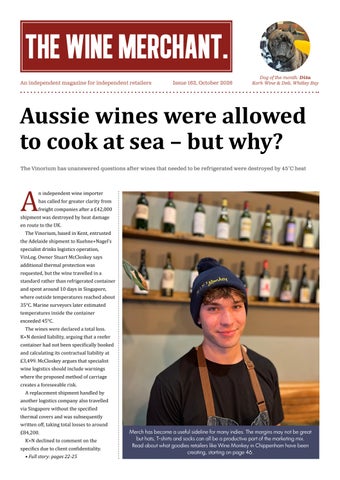
Merch has become a useful sideline for many indies. The margins may not be great but hats, T-shirts and socks can all be a productive part of the marketing mix. Read about what goodies retailers like Wine Monkey in Chippenham have been creating, starting on page 46.
Inside this month 4 comings & Goings Stockport and London welcome new independent merchants
12 tried & TesTED A first look at Thorman Hunt’s only South African agency
• Liberty Wines has added four
Australian producers to its portfolio: Luke Lambert, Patrick Sullivan and A. Rodda
from Victoria, and Tasmania’s Decades.
Lambert was previously represented by
Indigo Wine, while Sullivan was with Les
Caves de Pyrene. A. Rodda and Decades are both new to the UK market.
15 the burning question What are the biggest health hazards for people working in wine retail?
16 merchant profile We head to Cheshire where things are going nicely for Morgan Edwards
30 rioja and the rest Where the action is happening right now in the Spanish red wine scene
40 fortified factoids It’s that time of year when customers seek out the stronger stuff
• Thorman Hunt has taken on UK
Lenoble was previously sold in the UK
Hemel-en-Aarde estate, owned by Frederik
as Alliance reports a 30% year-on-year
distribution of Hasher Family Wines, its first South African agency. The Upper
Herten and Céline Haspeslagh, focuses
mainly on Pinot Noir and Chardonnay. The
first six wines are due to arrive in the UK in late autumn.
• Hallgarten & Novum Wines has added
Some tasty Christmas goodies to add to the mix this festive season
54 ask phoebe Been cheated out of an award? There’s only one person to turn to
59 Q&A: david knott David Knott: a brave loosehead prop in his time, but with a fear of pigeons
Nectar Imports. The appointments come increase in fine wine sales. Lenoble is
based in Damery, while Bichot’s Burgundy holdings include estates in Chablis, the Côte de Nuits and Moulin-à-Vent.
• Hallgarten & Novum Wines has signed
Pfalz producer Weingut Müller-Catoir to
two Italian producers: Soave specialist
Howard Ripley Wines, joins fellow German
by Winetraders, works principally with
its German portfolio. The Haardt estate, previously represented in the UK by
producers Dr Loosen and Villa Wolf, which
50 happy hampers
by Flint Wines, while Bichot was with
have also signed with Hallgarten this year. • Hallgarten has also taken over
exclusive UK distribution of Tokaj producer Disznókő from Gonzalez Byass UK, which
had represented the estate since 2016. The range includes dry Furmint, late-harvest and Szamorodni wines, as well as Tokaji Aszú 5 and 6 Puttonyos.
• Alliance Wine has added Champagne Lenoble and Burgundy producer Maison Albert Bichot to its French portfolio.
Inama and Abruzzo winery Terre di Civita. Inama, which was introduced to the UK
Garganega on the volcanic soils of Monte
Foscarino, while Terre di Civita is a small family estate producing Pecorino and Montepulciano d’Abruzzo.
• Champagnes & Châteaux has been appointed UK agent for Hunter Valley
producer Brokenwood Wines, previously represented by Bancroft Wines. It is
the importer’s first Australian agency.
Brokenwood, founded in 1970, is best known for Graveyard Vineyard Shiraz
and Hunter Valley Semillon, alongside its Cricket Pitch range.
THE WINE MERCHANT MAGAZINE winemerchantmag.com 01323 871836 Instagram/Bluesky: @WineMerchantMag Unit 52 Newhaven Enterprise Centre, Denton Island, Newhaven, East Sussex BN9 9BA Editor and Publisher: Graham Holter graham@winemerchantmag.com Assistant Editor: Claire Harries claire@winemerchantmag.com Reporter: Jacob Stokes jacob@winemerchantmag.com Advertising: Sarah Hunnisett sarah@winemerchantmag.com Accounts: Naomi Young naomi@winemerchantmag.com Admin and reader liaison: Charlotte Gingell charlotte@winemerchantmag.com The Wine Merchant is circulated to the owners of the UK’s 1,034 specialist independent wine shops. Produced in Sussex by East Print. © Graham Holter Ltd 2026 Registered in England: No 6441762 VAT 943 8771 82
THE WINE MERCHANT october 2026 2
THE WINE MERCHANT october 2026 3
Bodega opens at historic mill site August saw the launch of Bodega in Stockport. Co-founders Tom Wilmot and Dan Watt have taken a unit in Weir Mill, the redevelopment of one of Stockport’s historic industrial areas into a new residential and leisure neighbourhood. Aside from its bar and retail operation,
Bodega has a slightly different offering.
“We have a wine-storage concept,” explains general manager Adam Poppitt. “Our wine vault is built into the engine room of the
original mill, and this holds 1,152 bottles.
“The idea is that people can subscribe to
the wine-cellar experience, where we can hold either six, 12 or 18 of their bottles,
which they can buy from us or provide from their own collection. Then they can book a
table and consume that wine whenever they want, for a small corkage fee.
“Each bottle has its own QR code, so it’s
got its placement in the cellar, and every
member has their own little portal or login section so they can track and pick their
wines and replenish whenever they want to. We’ve only been open three weeks and we
have six members already, some who have
bought the wines from us or from Majestic.” The bar can seat 50 people inside and a
further 12 outside. Poppitt says Bodega has
around 50 wines available for retail, a range he hopes to increase.
Weir Mill is a residential and leisure development in Stockport
As the neighbourhood grows around them,
Poppitt says he is already talking to potential
“All of a sudden, the Underbank section,
which is around the old market town, has
says. “I worked at Cork of the North for a
just taken off completely. This scene is
long time, so I have good contacts at Liberty,
expanding and now this is here as well,
Boutinot, Raymond Reynolds and Thorman
which is great for the area.
Hunt, and we definitely want to use more
“It was one of Andy Burnham’s projects
suppliers and expand the range.”
to get Stockport back on track while he was
Bodega is one of the first businesses to
mayor of Greater Manchester, and I think
open in the new complex and expects to be residential units are also due to be occupied.
“I grew up in Manchester and for the first
25 to 30 years of my life, Stockport had a there wasn’t much going on,” he says.
in order to expand the retail offering,” he
an independent bookshop. More than 200
tasting events.
bit of a bad rep. It had a few amenities, but
“At the moment we are working with
Alliance, but we are looking to other people
joined by cafés and restaurants as well as
new tenants about collaborations and
There are currently 50 wines in the retail range
THE WINE MERCHANT october 2026 4
this is the next step of that process. We’re really looking forward to being a big part of it.”
Ugly, wonky labels expect significant savings. “They can save anything from a few pounds right up to but bargain wines 80% off the normal retail price on some Matt Ellis closed The Smiling Grape in St Neots in 2025 and sold his beer website shortly afterwards, before heading off to Moldova with his wine-tour business, Tipple Tours. Now he’s back with The Bargain Bottle Shop. “The idea behind it is to buy perfectly
good wines that have become commercially awkward,” explains Ellis. This encompasses casualties of courier companies as well as discontinued lines and bankrupt stock. “We’ll be buying from a couple of
specialist AWRS-registered wholesalers
who deal in this type of clearance market. We even purchase damaged-label wines that arrive in black bags and just need a good clean after other bottles in the
original wine-subscription cases have
been broken. You’d be amazed how much
wine ends up needing a new home simply
of the more extreme bargains. Same wine,
uglier label, much sillier price. Think of us now as the TK Maxx for booze.”
The business has already launched
online and Ellis says a physical shop in St Neots will follow.
“I’m treating the first few weeks as
something of a soft launch while I build the range, sort the delivery areas and discover just how many bottles of booze can fit into a 100-square-foot storage unit,” he adds. Tipple Tours is still very much
operational and, for now, Ellis will juggle
the two businesses, putting retail on hold while he is away.
“As the business grows, the plan is to
put the right people and systems in place so the online shop can continue running alongside the tours,” he says.
because a courier has smashed a bottle or two in the case and ruined a label.”
The business will rely solely on products
bought through this channel, with no core constantly changing depending on what I can get my hands on,” Ellis says.
“One week we might have a load of
the next it could be Italian fizz, random
craft beer or something I didn’t even know I needed until somebody offered me 200 of
them at a ridiculous price.”
Customers can
Tony Resta: Angel delight
Store number three for Yield Yield, the north London independent, is opening its third site. The new premises, on Essex Road in
Angel, will offer drinking in as well as takehome sales, with cheese and charcuterie also available.
Owner Tony Resta has been trading in
north London for more than a decade. His Return of the Matt
How low can you go?
We’re delighted to see that Iris Fabre, one-time manager of the now-defunct Real Drinks indie in west London, has been running a Lowbrow Wine School at WSET headquarters. “This session is ideal for curious beginners, pop culture experts, or anyone who just loves a good meme,” the blurb explains. Wines including Kylie Minogue Prosecco and Snoop Cali were paired with Perello olives, sausage rolls and crisps.
The thrill is gone
Hitchin indie The Wee Vinoteca has issued a public apology on its socials for the crime of making wine boring. “Some people like the thrill of a supermarket punt, the gamble on ‘the one on offer’, never quite knowing what you’ll get,” its statement says. But that service is not available in its own shop. “We’re sorry. Every bottle is now vetted and matched to your taste, so the excitement of not knowing is gone. We take full responsibility.”
Non-shoplifters of the world unite
range. “The whole idea is that the stock is
Californian Pinot Noir with wonky labels,
Bacchus
first shop, Yield N16, opened in Newington Green in 2015 and was followed in 2021 by Yield N1 on St Paul’s Road, Islington.
THE WINE MERCHANT october 2026 5
Reading one-star Google reviews of wine shops remains something of a guilty pleasure, though in our experience they tend to expose deficiencies in the reasoning of customers more than shortcomings in the businesses they’re complaining about. We wonder how many indies have had the pleasure of a visit by the self-styled “retired dentist and nonshoplifter” who entered a Yorkshire wine shop when it was technically closed, announced he would not be buying anything, moaned about the location and shelf layout and then boasted about how he scored free wine from hotels in response to complaints. Well done to the owner for patiently “listening to his many stories” before politely encouraging him, and his equally unpleasant friend, to leave.
THE INDEPENDENT debts ADVANTAGE Friarwood of almost £1.9m A monthly column from Alliance Wine/ H2Vin exploring practical, creative ways independents can sell smarter – covering everything from fine-wine offers to pricing tweaks and experiential events
London indie Friarwood Fine Wines collapsed with debts of nearly £1.9m after being squeezed by rising costs, weaker consumer demand and tighter margins, according to administrator Antony Batty.
P
icture the customer who comes in on December 23, harried, no idea where to start. What they leave with, and
what they spend, was decided long before you said a word. I know – it’s barely autumn and I’m already on the C word. But a calm, lucrative Christmas season is built now, not in the scramble. Most of the upselling happens on the shelf. Your whole range is the tool: whatever sits at the top of your range sets the frame for everything below. A £120 bottle anchor makes the £20 bottle an easy yes, and the £40 bottle feel sensible rather than a splurge. Build ladders within the producers your customers trust, so trading up feels like discovery, not a hard sell. That’s your edge over any supermarket: not the wine alone, but the journey around it – the reason they come back all year round. That’s the ground supermarkets can’t touch. A story, a bottle put in a hand, the one their guests will ask about. And the Christmas table wine is rarely the whole
The merchant, which had branches in
Parsons Green and Wimbledon and traces
its origins to 1967, entered administration
on July 3. Its problems had intensified since
Covid: a combination of Brexit, inflation, the
war in Ukraine, higher freight and packaging costs and EPR, according to Batty.
Friarwood cut its workforce from
around 20 to 13, reducing overheads and
stock levels and continuing to invest in its online platform. Director Ben Carfagnini
spent more than a year seeking a buyer or investor, but no deal was concluded.
Majority shareholder JAC-KET Holdings,
based in Canada, continued to provide
financial support, but eventually declined to inject further funds.
Accounts for the 10 months to March
2026 showed turnover of £3.08m and a pre-tax loss of £320,234. This followed
a £356,139 loss in the year to May 2025,
compared with a £12,124 profit in 2024.
The list of creditors contains relatively
few trade names. Moët Hennessy UK is
owed £2,397, Fine & Rare Wines £1,486, Bordeaux Index £1,044 and Maisons Marques & Domaines £694.
By far the largest creditor is JAC-KET
Holdings, owed £1.3m. HMRC is owed around £194,600.
The administrators continued trading
Friarwood for a short period after their
appointment, generating around £269,000 in sales before the Parsons Green shop closed on August 3.
Remaining stock was transferred to
the company’s bonded warehouse, with
administrators seeking buyers for the wine, intellectual property, website, customer
lists and other assets. Unsecured creditors are expected to receive only around 0.41p in the pound.
• Glasgow’s Sylvan La Cave was granted an on-licence last month. Audrey Junner, the licensing lawyer representing the venue in Battlefield, said the premises had faced “many licensing challenges” since opening last December.
Low-intervention wines in Brighton
sale; fizz to open, something sweet for
La Cave Noire, a natural wine bottle
pudding, a cheeky extra for the cheese.
shop and tasting room, will open in
You know all this. December is just when
Brighton next year.
it pays best. That customer on the 23rd?
Reza Hojabr, who describes himself as a
They’ll be back in January. Don’t waste the
Brighton native, and partner Tio Mathews,
year’s highest-margin occasion on “goes
who has extensive hospitality experience
well with turkey”.
running venues across North America, plan
If you’d like to talk through your range,
to launch the business in May.
or how our Winter Offers can benefit you,
“We are just two people building a
please contact me at alex.baudouin@
space dedicated to low-intervention,
alliancewine.com.
independent winemakers whose work we genuinely love,” says Hojabr. “We want to create somewhere that feels tactile and
Alex Baudouin Head of Independent Off Trade
Ben Carfagnini in 2015
THE WINE MERCHANT october 2026 6
grounded, focusing on small producers
who are making incredible things away from the mainstream.”
COMING DOWN THE LINE
Final chapter for Novel Wines
Hot topics that could impact independent wine merchants
By WSTA chief executive
Miles Beale
Novel Wines entered creditors’
It's not too late to contact your MP
voluntary liquidation on September 18. Despite permanently closing its shop in
We are staring down the barrel of another Autumn Budget on October 28. We have a new prime minister and chancellor, but sadly the UK’s economic gloom remains. With government borrowing up, the chancellor will be looking for ways to raise revenue. The WSTA has long argued that raising alcohol duty does not necessarily bring in more money for the Treasury, and is calling for a duty cut. Other asks include reinstating the mid-point tax rate for wine, establishing a single duty rate for drinks between 3.5% and 8.4% ABV, and increasing the National Insurance contributions threshold. It’s not too late to support these calls by writing to your MP. For help, contact samuel@wsta.co.uk. Digital Proof of Age (DPOA) for alcohol sales became permissible on September 15. Its use is optional and physical ID remains valid. A visual check of digital ID alone is insufficient: proof must be checked through a certified Digital Verification Service listed on gov.uk. The WSTA has also launched cybersecurity guidance for wine and spirit businesses. Scan the QR code to read it. According to the National Cyber Security Centre, food and drink is a prime target for attacks including ransomware, phishing, malware and DDoS, with complex supply chains and busy periods such as Christmas creating particular vulnerabilities. Finally, if you’re in or around Manchester, join the WSTA Get Together at Fenix on October 8, from 6pm to 10pm. It’s open to everyone in the wine and spirit trade, with discounts for SME members and free tickets for WSTA member buyers. Contact samantha@wsta.co.uk for tickets.
Find out more at wsta.co.uk
Bath in early 2024, the business continued to trade online and serve wholesale customers.
Founder Ben Franks resigned as
a director in July 2024. William Hill, Simon Parkinson’s business has now closed
Vin Santo’s crypt is on the market
who joined the board in January 2024,
resigned in November 2025, leaving Mark Roberts as the sole director and majority shareholder.
• August saw the opening of Sane in Camden Passage, Islington. Launched by sommelier Maxime Maiano, the shop and
Vin Santo in Chester ceased trading in
bar specialises in sake as well as wine. It
September. Simon Parkinson opened
is close to the former location of Pacific
the hybrid store in 2020, at the height
Wines on Islington High Street, which closed
of the Covid era, in the Watergate Street
earlier this year.
site previously occupied by Corks Out. The premises, a 13th-century vaulted
• Chez Vin in Otley, West Yorkshire, is up
£45,000 a year. Some of Vin Santo’s former
according to agent Alan J Picken. The
cellar that has housed a wine merchant
for sale. The business, owned by David
fixtures, display cabinets, bar equipment
business and freehold is being marketed
Vinological, which started in Chester
has a thriving wholesale dimension to its
since 1863, is listed with an agent at
Lawson, has a turnover of around £250,000,
and refrigeration remain in place.
for £200,000 plus stock at valuation.
Market before relocating to Brook Street. It
business, and relationships with “many local
Parkinson entered retail in 2019 with
closed shortly after the launch of Vin Santo.
According to the sales particulars, Chez Vin
restaurants and bars”.
London independent Lea & Sandeman has appointed Catherine Jaën MW as head of buying, initially taking responsibility for Burgundy and working alongside Charles Lea, David Porter and Derek Robertson. Jaën joins from Lay & Wheeler, where she spent six years as buying director. Her previous roles include positions at Goedhuis & Co and Robert Rolls & Co. She became a Master of Wine in 2017 and has been part of the Burgfest tasting group for nine years. She also brings practical winemaking experience, having completed seven vintages in Burgundy, including a year working at Domaine Comte Armand in Pommard.
THE WINE MERCHANT october 2026 8
Get your own copy of The Wine Merchant Subscribe for just £85 at winemerchantmag.com
THE WINE MERCHANT october 2026 9
Harry Edwards
Rising Stars
T
The Strong Water Company Aberdeenshire
he Strong Water Company, owned by Guy and
good experience, tasting all these amazing wines
Mungo Finlayson, has two shops in Banchory
and learning from some really cool people, though I
and Ballater. The brothers welcomed Harry to
never quite got to the 1970 Pétrus” – Harry spotted a
the team in June and are delighted to support his continuing progress as he awaits the results of his WSET Level 3.
Facebook advert for The Strong Water Co. “I knew the guys and liked watching the shop grow in Ballater; I’d been to the Banchory one as well. I was
“Harry was one of the junior sommeliers at The
really excited to work with them because I love what
Fife Arms, so he came to us with plenty of
they do, and I really wanted to
knowledge,” says Mungo. “There
see a different side of the wine
are lots of things you can teach
industry. And I guess it’s nice to
that are easy to learn from a
have my evenings back as well!
book, but it’s harder to be the
“It’s been really fun seeing a
kind of person who is willing
different kind of clientele and,
to speak to everyone and is
because it’s retail, we have more
naturally approachable. That’s
regulars. With hotels, you don’t
what Harry is.
tend to see people again, so
“I think it’s very important in
you don’t build as much of a
retail not to overload customers
connection as you do here. I’m
with information, which will just
also enjoying the style of service
turn them off, and Harry is very
and the way they do things here.”
good at identifying just the right
As an enthusiastic traveller,
amount of information and detail
it seems inevitable that Harry’s
each customer requires.”
future will involve working a
Cornish-born Harry earned
harvest at some point.
his hospitality chops working at
“Every holiday, I try to see a
wedding venues and boutique
different part of the world and
spots such as the Talland Bay
learn about something – I’m
Hotel. “The general manager
quite an inquisitive person.
there started teaching about wine,
I’ve been to India and Japan, and this year I’m visiting
which I thought was quite interesting,” he says. “When
Vietnam, Cambodia and China. I’ll probably do a big trip
I got to the point of wanting to move away from home
to South Africa next year, which will definitely include a
and travel a bit, I did my WSET Level 2 and really fell in
lot of wine,” he says.
love with wine.
“Maybe in the very distant future I’d like to have my
“I’d always been attracted to Scotland. I’d never
own business. My ultimate goal was to explore the
actually visited; I just moved up here, which is pretty
supplier side of the business, but more recently I think
wild, but it turned out well in the end.”
I’d like to work abroad, do a harvest and see
While appreciating all the opportunities that came with working as a junior sommelier – “it was really
where that takes me. For now, though, I’m really happy where I am.”
Harry wins a bottle of Champagne Devaux Cuvée D courtesy of Liberty Wines
If you’d like to nominate a Rising Star, email claire@winemerchantmag.com
THE WINE MERCHANT october 2026 10
We would like to invite you to join us for the New Zealand New Release tasting.
This will bring together our latest releases including wines from the 2026 vintage to London. The tasting will be in a self pour format, with wines laid out by varietal, vintage, region and price point. All wines presented are produced in accordance with one of our recognised sustainability programmes. DATE Tuesday 17 November 2026
VENUE St James Room, 67 Pall Mall, London, SW1Y 5ES TASTING OPEN 10am-4pm
We hope to see you there!
THE WINE MERCHANT october 2026 11
Scan the QR code to register to attend
TRIED & TESTED
Sandridge Barton Don’t Feed the Ponies Sonny Under Flor 2022
Dog Point Marlborough Sauvignon Blanc 2025
People often wonder what would happen if you took
Many indies have followed Dog Point from the
of years. It’s this: autumn in liquid form, with pungent
at the Berkmann tasting. No gooseberries here:
some Devon-grown Pinot Blanc, Madeleine Angevine
and Pinot Gris and left it in old oak barrels for a couple baked apples and hazelnuts coming to the fore under
the yeasty flor. More English wine should be this weird. RRP: £27
ABV: 10%
Sandridge Barton (01803 732203)
beginning and one merchant in particular was having difficulty containing his enthusiasm for this release just wafts of smoke twirling around mangoes and grapefruits and a lip-smacking, saline finish. RRP: £23.75
ABV: 12.5%
Berkmann Wine Cellars (020 7609 4711)
sandridgebarton.com
berkmann.co.uk
The Wharie Experience The Red 2023
Familia Gil Vidilla Verdejo 2025
Swiss-born Guillaume Lagger’s New Forest project is
Rueda, one of the 11 Spanish estates that make up the
This organic Verdejo is made by Bodegas Shaya in
Gil family portfolio. Grown at 500 metres above sea
focused purely on low-intervention wines made from
level, there’s a vibrancy and zest that complements
PiWi and hybrid varieties – hence this Cabernet Noir-
the warm lushness of the fruit. It lives for the moment
Rondo blend. Savoury and light on its toes, it bears
yet dances on the tongue long after the final sip: a
a passing resemblance to a slightly dusky Cab Franc.
happy wine at a happy price point.
Gentle, easy-going and supremely likeable. RRP: £15.50
RRP: £15
ABV: 11%
ABV: 13%
Bancroft Wines (020 7232 5450)
The Wharie Experience (07517 492769) wharie.co.uk
bancroftwines.com
Tenuta Sant’Antonio Scaia Paradiso Rosso 2020
Léon Beyer Réserve Personnelle Alsace Pinot Gris 2024
A Veneto blend dominated by Corvina and Rondinella
Throw a dart at Yapp’s French list and you’ll always hit
in the glass, has a wispy brick-red hue. There’s a
Day tasting. The Beyer family have been honing their
and made in the ripasso technique, which may
account for the depth and power in a wine which,
pleasant earthiness too, which will be welcomed by those who find ripasso wines a little too pruney. RRP: £23.99
ABV: 14%
C&C Wines (020 3261 0929)
something remarkable – and this sumptuous Pinot Gris was as good as anything on show at the Independents’ craft since 1580 and have created a voluptuous and spicy iteration of the varietal with earthy intrigue. RRP: £22.25
ABV: 13.5%
Yapp Brothers (01747 860423)
carsoncarnevalewines.com
yapp.co.uk
Esporão Defesa White 2025
Hasher Family Wines Cyriel Cabernet Franc 2023
There’s no doubt that consumers love zippy,
uncomplicated Portuguese whites and Defesa now
Thorman Hunt’s new Hemel-en-Aarde agency, its
Antão Vaz, Arinto and Verdelho, it has just enough
tangy red fruit and natural acidity rather than crunchy
comes with eye-catching, capsule-free packaging that matches the wine in the bottle. An Alentejo blend of
tropicality and exactly enough freshness to make it a hit with the Vinho Verde crowd. RRP: £15-£16
ABV: 13%
Hatch Mansfield (01344 871800) hatchmansfield.com
first in the Cape, is worth checking out based on this
showing. It’s a soft and subtle style of Cab Franc, with greenness, and its year in old French barrels adds a faint sweetness to the mix. One to savour. RRP: £38
ABV: 13.5%
Thorman Hunt (020 7735 6511) thormanhunt.co.uk
THE WINE MERCHANT october 2026 12
ight ideas br
82: A meaty match
Dave Elsey Bouquet Wine Cellar, Derby
In a nutshell: A collaboration with the
But it’s easy to do – we don’t provide a
Tell us more.
inspiration rather than being too
local butcher to recommend what styles of
specific recipe, we just share an image
wine pair best with different cuts of meat.
of what we’ve made. It’s about providing prescriptive.
“We’re in a little village and our local
“It can be tricky to photograph food well,
butcher, Barry Fitch, is just around
but for me it works by getting in close and
the corner. What we sell complements
maybe adding any nice-looking props, such
each other, so why not have a collab?
as a chunky wooden chopping board.”
I was a butcher for 15 years before I
Do you work with other local
started working at Bouquet, and this is a
businesses?
combination of wanting to support other local businesses, sparking conversations
“Quite a while ago we started doing Bacon
and encouraging people to try new things.
and Bloody Mary Sundays. We get the
“Quite a few of us on the team were
shopping at Barry’s for evening meals
Rebecca Tomlinson of Bouquet with Barry Fitch the butcher
and weekend roasts and we were pairing
our wines with his meats, so I thought it’d be a really good idea if we could get him involved as well.”
maybe a Pinot Gris, something to work
“About once a fortnight, we’ll select a
Barry’s front door to ours, so people know
How does the collab work? cut of meat from Barry’s, pair it with a wine and share on our socials. Instead of promoting one single wine, we talk
more generally about the wine in terms of style. For example, a recent cut we talked about was pork loin steak, so it was a
case of ‘we would match this with a dry
white or an off-dry white because it cuts through the fat’. Then we can continue that conversation with the customer as they might tell us about the other
ingredients they are using as well as their
other preferences. So if they were making something spicy then we can talk about
with the heat.
“We’ve made a fast [Instagram] reel from
bread from a local supplier and of course the bacon is from Barry’s. We also do
pop-ups at local events, so recently we
did burgers and wings at the Little Eaton
Carnival, so again we make sure that with
anything we do that is food-related, we’re utilising local people.” What’s next?
where we are. There’s been a few times
“I’m always thinking about other things we
they want some recommendations to go
member of our team making the pairing
where people have come in not necessarily having bought the cut they were after, but
with what they have bought. Thanks to the cross-activity and the signage in Barry’s, they know where we are and that we’re
happy to make suggestions based on their purchase.”
Does it take long to create the content? “Because we took the idea to them, I said I’d create all the social media content, and Barry’s share it on their socials.
can do, and maybe next we might go down a more individual route, with a different
each month and perhaps providing a recipe card as well.
“I know there are some things that
people might not want to touch, like beef
cheeks or ox tongue – things that might not be the first choice when you walk into a
butcher’s – but they really are superb cuts of meat that you can do lots of great stuff
with and will go well with bold red wines. So that’s something to think about.”
Dave wins a WBC gift box containing some premium drinks and a box of chocolates. Tell us about a bright idea that’s worked for you and you too could win a prize. Email claire@winemerchantmag.com
THE WINE MERCHANT october 2026 13
DAVID PERRY
flinty chalk. But all three use Sauvignon Blanc for their white wines, they are all
on chalky soil and they are geographical neighbours. The difference? About £8 a bottle. Whenever anyone baulks at the
price of Sancerre or Pouilly-Fumé, I offer
Irregular Thoughts Everybody loves good neighbours – especially if they’re £8 a bottle cheaper
them the Coteaux du Giennois and tell them it’s “just across the road”.
On another occasion, while visiting
Rhône producers Dauvergne et Ranvier (thank you, Daniel Lambert), we were
offered a wine called Les Voisins d’En Face – the neighbour opposite. It’s a straight Syrah from the northern Rhône. The
story behind this wine is that a five-star
restaurant asked D&R to produce a wine it could use as its house red. It needed a
few thousand bottles! D&R made the Syrah from a plot in, or rather just on the edge
of, Saint-Joseph. They make more than the
restaurant requires, so the rest ends up on the shelves of indies. It’s not Saint-Joseph, but it’s a pretty good looky-likey. We sell it at £15, almost £20 less than the SaintJoseph we have.
Following that, we also have their
Viognier, Le Voisin du Dessous – the
neighbour below. Staying in the village
many years ago, I remember vines growing on near-vertical cliffs descending to the
road next to the Rhône. There is nothing below! This bothered me a little until it There are often interesting things to discover next door
W
e do one or two tastings every year for the Wessex Wine
Society. They are a group of
enthusiastic amateurs who meet monthly during autumn and winter. They pay for
four bottles of each of eight different wines and generally place a composite order
worth a few thousand pounds. We like them!
Having exhausted most themes, the last
one we did was based around “668 – The neighbour of the beast!” Well, it should
have been, but we called it “Les Voisins” – the neighbours.
Some of our bestsellers are just that: the
lesser-known, and thus better-value, wines from next door.
It probably started on a visit to the
Loire a few years ago. On the way to
Sancerre, our first stop was at a winery that produced Sancerre, Pouilly-Fumé
and Coteaux du Giennois. The winery was
based in the Giennois, so I asked where the region was in relation to Sancerre. With
a shrug, the proprietor waved his thumb at the road outside and said something like, “the other side”. It may have been
miles away, but I like to tell the story as
though it was just on the other side of the road. Everything has to stop somewhere,
and everything has to start somewhere. I
remember sitting on a beach in sunshine, watching it rain on the town inland.
Giennois is a long, thin strip of chalk
running along a ridge; Sancerre is a hill of chalky clay; and Pouilly-Fumé is a hill of
THE WINE MERCHANT october 2026 14
dawned on me that maybe these desperate vines, wrapped around poles and clinging
to a cliff face above a fairly busy road, may well have been the neighbours below.
Condrieu would be one of my desert-
island wines, but it is eye-wateringly
expensive. We have one or two bottles
left that were originally bought at a big discount. They are still nudging £40,
though. The neighbour below is only £15. It is not the same, but it is a close enough “dupe” to be worth a go.
I guess it is like anything from handbags
Whenever anyone baulks at the price of Sancerre or Pouilly-Fumé, I offer them the Coteaux du Giennois and tell them it’s “just across the road”
to hi-fi: the closer you get to the top, the higher the price for the smallest
improvement. The quality/price curve
is steep at the start but flattens out as it
?
THE BURNING QUESTION
asymptotes towards 100%. A small change at the top may double the price. A big
What are the biggest health hazards for wine merchants?
�
both and let me know. The Condrieu always
I learnt years ago that you only want to drop a pallet on your foot once. My team know I’m ready for business if I come to work in my steel-toe-cap shoes, which I order specially from Italy. Shouting ‘lift with your back!’ across the storeroom can result in some funny looks and hand signals. And, obviously, there are the paper and cardboard cuts from hell. Apart from the obvious hazard of drinking too much, injuries and health problems are definitely manageable.
purchases.
Simon Evans * Champagne winner * The Naked Grape, Hampshire and Berkshire
change at the bottom is a few quid more. The jump in quality between a £15 and
a £50 wine can be smaller than the jump
between an £8 and a £15 bottle. Anyway, the two Viogniers sit next to each other,
and I have persuaded a few people to buy
gets top marks but, as it’s not an everyday
”
wine, the neighbour gets the repeat
F
or the Wessex Wine Society tasting, we had to add a few more “next-
door” wines. The obvious one was
a Crémant de Bourgogne. Here we go: just
like Champagne, and right next door. Well,
not exactly. It is from Mâcon, so more than 300 kilometres from Reims, but who’s counting?
Probably my favourite swap-out is
Alfeno, from the Montecucco DOC, a tiny Tuscan appellation opposite the slopes
�
I’ll share the regimen my dentist recommended for looking after my teeth after tastings. All that acid softens the enamel, so brushing immediately afterwards can remove thin layers of it. Rinse thoroughly with water and then with mouthwash, and try not to eat or drink anything else for about 30 minutes. My worst wine injury was when I foolishly tried to slow down a pallet on the tailgate of a truck and the driver dropped it right on top of my hand. I still have a middle finger that goes in three different directions as a result.
”
of Brunello (grazie, Dario at Vineyards
Archie McDiarmid Luvians, St Andrews
Direct). Again, it isn’t Brunello, but it
�
doesn’t have the price tag either. It’s about
I pulled something in my back unloading a van about five years ago. I now spend £50 every two weeks trying to control it. And that’s possibly not as painful as a cardboard cut from breaking down boxes. How does something so minor cause such pain? A seasonal hazard is tennis elbow from constantly wrapping bottles in December. An all-year-round source of stress is trying to explain tactfully that alcohol and dehydration, rather than sulphites, are probably what cause your hangover.
£20, which is not at all bad for a very classy Sangiovese with a pricey neighbour. You
get bragging rights for discovering a DOC
most people won’t have heard of, which is
probably more impressive than showing up with a £100 Brunello. It was the bestseller from the Wessex tasting.
”
Their second favourite was Mâcon-
Solutré-Pouilly from Domaine Sévé (Davy & Co). The Pouilly-Fuissé Terroir is on
the shelf at £27, but the MS-P is only £19. The descriptions on the almost identical
back labels tell us that the richness of the
clay-limestone soil gives the PF roundness
and minerality, and the MS-P notes of fresh fruit. Same grape, same soil, same area,
same family – mind you, the PF includes eight quid’s worth of French oak.
Everybody loves good neighbours and,
with savings like those, good neighbours become good friends!
David Perry is the owner of
Andrew Kinnersley The Grape & The Good, Wells
�
I have a lady I see regularly for my coat-hanger shoulder. It’s not a very glamorous name, but there is a thing called coathanger pain, and it comes from carrying heavy things in front of you too much. It’s a really tight feeling across the back of your neck and shoulders. It costs me about £50 a month, but I think that’s money well spent. We’re supposed to look after ourselves, and we should invest in our wellbeing. Sarah Hatton, Mitchells Wine, Sheffield
”
Champagne Gosset The oldest wine house in Champagne: Äy 1584
Shaftesbury Wines in Dorset
THE WINE MERCHANT october 2026 15
Edward Speakman (left) and Morgan Ward
Merchant Profile
First name terms Morgan Ward and Edward Speakman went into business using a name that suggests approachability and informality – and the friendships they’ve formed in their Knutsford community bear this out. Nigel Huddleston heads to Cheshire to say hello
W
ine’s inherent versatility and sociability have made it the anchor for an increasingly
wide range of events. Things have moved on from the basics – food in general, or cheese more specifically – to include
tastings that pair wine in more abstract ways: colours, music, literature and the like.
Cheshire’s Morgan Edwards may have
trumped the lot recently with a tasting that matched various wines with the residents of a local bird of prey centre.
“It was an interesting one,” says co-
owner Morgan Ward. “The owner comes
in here for drinks every now and then and wanted to get more local people involved, rather than just bird enthusiasts who
travelled from here, there and everywhere. “It was very much the American bald
eagle paired with a big Napa Cabernet, that
sort of idea. Our customers who went loved it and most of them have been back there.” Leftfield tastings are just one side of the
personality of the business that Morgan cofounded with old university friend Edward Speakman, eight years ago in Knutsford.
Morgan came from a high-flying job in
the City, while Edward had been working in wine for well-known auction houses.
As a result, top-end fine wine – including
private client business and valuations – has become a core plank of the business.
“I love the bar side of things, the events
and the social side,” says Morgan, “and Ed
leads the fine wine side. We complement
ours who worked in the wine trade said, if
market hall, the business moved to its
business plan together.
each other really well.”
Having started out in the local indoor
current location in 2022: a historic,
compact and atmospheric building in the
centre of the town, with the shop at street level, a tasting room/bar on the first floor and a garden terrace to the rear.
“We grew organically from day one,
really,” says Morgan. “We had a bit of a cult following but lockdown and doing same-
day deliveries put us on a wider map and eventually paid for us to get these bigger
you’re serious, go to France, look at some vineyards, see what you think and put a We went to the Languedoc and came
back looking for a premises with a van
load of wine. At that point, we didn’t know what that would look like: it could have been wholesale or it could have been
retail. We quickly realised there wasn’t
really a decent wine shop locally and that
Knutsford was the place we wanted to be. Why was that?
premises.
I was in Sale and Ed was nearer Chester,
whether that means a tasting at a local
was working in an auction house here as
“We’re always trying to keep relevant
locally and maintain the momentum,
bird of prey centre, or for U3A, or a charity event with the Rotary club. There’s always something going on to get involved with.”
so Knutsford was very much the middle town and we’d always meet up here. Ed
well. We knew the town well and both had family here.
It maybe gives the impression to the
How did you get started?
outside world of being a bit bigger than
We were both at similar stages in our
it actually is, perhaps because it’s got a
wine from our university days. A friend of
are quite a few housing estates further
careers and wanted to start our own
motorway services named after it?
business, and we were always interested in
It’s small to medium-sized I’d say. There
We went to the Languedoc and came back looking for a premises with a van load of wine
destination town. It’s peaceful and quite
THE WINE MERCHANT october 2026 17
out from the centre but it’s very much a affluent. Tatton Park’s on our doorstep,
a big National Trust property, so we get
quite a few tourists at the weekend, but it’s certainly one of those towns where
people know each other. There are lots of community groups and there was a lot
of “shop local” going on during
lockdown, which seems to have carried on, and we’ve benefited from that.
It is in this affluent area of Cheshire
and people sometimes think that means the streets are paved with gold, but you really need to build up the trust of the
community and be part of it. We really like it here.
How does the balance of shop and bar work? We are predominantly a shop, but we open later on Thursday, Friday and Saturday,
until 10 o’clock, and we’re normally fully booked. The bar is really important to
us, as it gives us a chance to show off our
wines, but we are mainly shop-focused. We do a lot of deliveries locally.
We don’t tend to focus on wholesale. We
The bar is really important to us, as it gives us a chance to show off our wines, but we are mainly shop-focused nicely historically. We didn’t want to call
ourselves Knutsford Wine Shop because then it’s harder to expand. We wanted a
be in fine wine.
Unusually, you gave your first names to the business rather than your surnames. How come? We just thought it sounded better. Also,
Edward had a great-grandfather who was called Morgan Edwards, so it just fitted
Arthur Lee, who advised us, and they said
the yellow would fit with the other colours and the furniture we had – and actually it
sort of somehow does. We did all the work ourselves, except for the joinery and the
carpet fitting, all the serious jobs. We did
all the painting and sourcing [of furniture]. Is the building listed?
been before it was listed. The shell of
in there, hopefully building up an element How did the upgrade to the new premises come about?
our next stage, so it was all very easy and
vintages of Sassicaia or whatever it might
a wonderful interiors shop locally, called
of trust.
and to back ourselves by putting our names
was the way we wanted to go. We do a
lot of private client stuff, sourcing certain
of painting the staircase yellow. There’s
It is, Grade II, but that hasn’t caused
There was a hairdresser here and a very
but we soon realised that the retail side
ourselves but we’d never have thought
more generic, traditional-sounding name,
used to do a lot more when we started and we were importing a lot more ourselves,
and we agreed on most of the colours
good friend of ours knew that they were
looking to leave and we were looking for
fortunate for both of us. A lot of customers say they used to have their hair done
here. It’s been a commercial property for
hundreds of years. It’s just a lovely building and feels really homely. When we first
walked in, we just knew it was the right setting for us. We’re very traditional in
the wines we stock and to be in an older building suits our MO.
We knew we wanted a split space,
us many problems. It has weirdly been extended at the back, which may have the building was fine, so we haven’t
structurally needed to do anything and the space naturally suits and breaks up what we do.
The only issue is a really small kitchen,
which limits us on food, but we don’t really want to go down the restaurant route
anyway because of all the costs associated with that. We do cheeseboards, olives,
crisps, premium snacks, and we’re really busy with what we do. There are a lot of really good restaurants, so what we do
complements them rather than clashing.
Looking at the shelves behind you there are empties of things like Tignanello and Pétrus, which makes it look a lot
with either two larger rooms [at street
level] or, as we have here, an upstairs and
downstairs. There are so many wine shops and bottle shops that aren’t a shop any
more as soon as they’ve got a drinker in
there. Who wants to reach over a table to shop when someone’s sat there having a drink?
It’s got a Dickensian, Pickwick Papers sort of look. It does. It’s 1580s, the second-oldest
building in the town centre, and that gives us this really quirky space with crooked
walls and beams and things. It’s beautiful The current store opened in 2022
in the winter, with the candles lit, just a lovely setting for a quiet drink.
We knew we wanted it to be traditional
THE WINE MERCHANT october 2026 18
Covid’s “shop local” spirit has endured
like you’re rooted in the fine wine world. Most of those have been drunk in here, but unfortunately not by us. But one
or two have! It’s important to try these
things to be able to sell them. We’re quite fortunate that we’re in a fairly affluent town and there are people who really
appreciate and know about wine. A lot
of our customers are here to buy a gift or for a nice experience, but there is quite a large proportion who are involved in
wine circles or tasting groups, who have travelled to wine regions.
The other side of that is we’re fortunate
to be in the triangle of Knutsford, Alderley Edge and Wilmslow where a lot of
footballers live, from Manchester United,
City, Liverpool, Everton. We’ve got a lot of
stock from Napa because Napa, Bordeaux, Rioja, those bigger reds, seem to be what they’re after. We’ll introduce them to
different wines and they’ll tell us about
The Heaton Moor store can seat 120
things they’ve tried when they’ve been on
holiday in LA or wherever. So, there’s a real fun element there as well, in that you’re never quite sure who’s going to walk in.
Do you operate at a more everyday level too? I think £8.99 is probably our cheapest bottle at the minute. For a long time,
especially when we were in the market hall, our range was probably about £7
The vertical of Tignanello is a focal point of the shop
through to £25-£30, with a few fine wines
finding fine wines through private sellers
range below that as well. But we try to
or different merchants. Our buying method
particular auction houses, but quite often it
Your website features your valuation
to go all over the place to value cellars, and
above that. That’s now flipped: we’re
mostly £20 up to £50 or £60 and then a
cover most bases. What’s very important,
has changed with what we sell.
from £10 a bottle all the way through,
service quite prominently.
customers.
clients, and that’s grown since we’ve
is getting to know what customers like,
With Ed’s history of valuation work, we
Having started with the van load from
been more active in that space. A lot of
and most of them are regular long-term
the Languedoc, is that region still one you focus on? It will always be a bit sentimental for us and we still do see the huge benefit in
Languedoc wines – there’s such good value from there – but it’s less important now.
We’re now doing more valuation work or
started out with a lot of access to private the valuation business comes through
solicitors for probate and divorce matters, or just through people moving house and looking to move their wine on, or our
own customers who have their own wine cellars. It sometimes gives us access to
fine wines that might not be on the open market.
THE WINE MERCHANT october 2026 19
It might be advising them about
is just giving a valuation where they’re not
yet ready to sell. It’s a lot of time and travel sometimes the money doesn’t match the
time taken and expense. Having said that, the benefit is having access to the wines and it’s such a fun side of the business.
We’ve seen some amazing things, some
really rare wines just hidden away in the
back of someone’s fairly normal garage –
and you just hope it’s been stored correctly. Is authentication an issue?
With Ed’s history in the auction houses,
he’s very good at that, just from experience. We have so far been lucky and, touch
wood, not had any issues, but we do a
our strong point. We built it when we
That side of things must pit you against
less so as we’ve become busier, so we’re
lot of due diligence as part of that whole process.
some pretty big longstanding players, the likes of Berry Bros. It means you have to be very conscious of pricing and market moves. The fine wine market can move very quickly and catch
you out, and you can look expensive or get
left behind. It’s really about keeping on top
of market data as much as margins and the like. It’s a bit more fluid.
Is ecommerce significant in all this? We do ecommerce but the website isn’t
first started and were quite diligent about
With all the fine wine activity going on, where do the usual UK importers fit in?
adding new products, but we’ve become
We work with most of the big boys. At any
the site and move to a different platform,
the stock from private cellars. It’s an ever-
actually in talks at the minute to upgrade and really get on top of it.
That’s our next focus for expansion.
We’re really happy with the building we’re in; we could always do with more space
and the bar’s always full, so we could do
with more tables, but actually we see the website is what fails us at the minute.
We’ve got such rare wines that when you
do put them online they sell quite quickly, mostly to London but a lot to round here as well.
time, there are probably wines from 20–-5
suppliers on our shelves, without counting changing range but after eight years we’ve got to the level where we’re happy with
most of our stock. Half the stock is from
agencies and more generic and the other
half is something we might only have a case or half a case of. With Bordeaux, Burgundy, Rioja and Rhône, we like to have wines
that are ready to drink, rather than last
year’s vintage, which you don’t necessarily get through a lot of the more mainstream suppliers, so that tends to come through our fine wine work.
Any favourites among those more regular suppliers? Service-wise, we’ve always found Cachet
and House of Townend to be really good. Cachet are very easy to work with and
offer a lot of helpful advice, and keen to
get involved in tastings. But to be honest, most of our suppliers are keen to get
involved in tastings and really help out.
It’s a good industry for that. We do quite
a lot with Berkmann, Boutinot, Liberty …
Top Selection have been very good for us,
as a slightly smaller supplier. We deal with Jeroboams as well, who are really good to work with.
Tell us about your wine club. We do two price points, £75 or £100,
either every month, every other month
or every quarter, and it’s either red, white or mixed. We set it up about four or five
years ago and we probably have about 60 subscriptions locally. We were looking at
the bigger companies, like Laithwaites and Naked Wines at the time, and it seemed
people were bored of just getting the same things in their boxes every month. We set out to be more educational with it, so we
include a producer profile, a region profile,
tasting notes and what to pair it with on an A5 piece of paper for each wine. The tricky
side is to find new and interesting wines at
The garden area is a useful space for events
those price points after five years of doing
THE WINE MERCHANT october 2026 20
it but we still manage to do it. We’ve only
wine, and the Collect art gallery brought a
year.
no because it helps with PR and keeps the
put the price up once in that time but I
Banksy along. We do get very interesting
think we’ll probably have to do it again this
events coming our way. It’s very hard to say momentum going. But it goes from that to
You said earlier that you’d moved away
charity events where you’ve got a gazebo
from wholesale. Why is that?
in a field on a Sunday afternoon. We do all
We really enjoyed it but you’re working on
sorts of things.
much smaller margins and dealing with a
Do you have your own events in the
lot of other small businesses. If one or two of those go bump you’re left with quite a
shop?
were paying the tax up front and going on
pick a region and dive into it and that can
sizeable bill. We weren’t using a bond and
We do our own at least once a fortnight,
the road to sell it locally, a sort of wine-
include fine wine nights or generic nights,
we would if we were to do it again now. We of-the-week-in-the-pubs model, and once
you’re in, you might get a few more wines on the menu. It soon became apparent
that the shop side of it was a more friendly model, less cut-throat and more social.
Never say never, though. We do still keep
thinking about the future and it might be the way forward if we had more staff to
give us the time to find more wineries and go to tastings.
What about expansion of the retail side? It would be lovely to have 10 shops that are all successful, but there’s also a headache that comes with that. The two of us are
very much part of the business. Most of our customers are regulars and we know what
either upstairs or in the garden. We’ll
Most of our customers are regulars and we know what they like. We’ve made some great friends
such as the wines of Greece, or really
specialist ones around something like Loire Valley Sauvignon. This evening we have
the local ghost-hunter tour coming in at 6 o’clock. They get all their gadgets and
gizmos out to see what they can find, but we’ve never had anything.
Will there be a return visit to the birds of prey centre?
car dealerships nearby who we’ve worked with. We did one with Aiden Byrne, the
celebrity chef who owns Li-ly down the
road. He did the canapés and we did the
They’ve got other events coming up soon that we’re going to be involved with.
There’s a vulture festival coming up. There are many fun sides to this job. You never know what’s going to happen.
they like. It’s actually really good fun and we’ve made some great friends over the
years, many of whom were at Ed’s wedding recently. It’s very much a community
business. If we had two or three shops we couldn’t be in them all at the same time. Tell us more about the events you’re involved in. We do our own Grand Wine Fair once a year. It’s essentially a trade fair for the
public. We do it in a local church and have about 300 wines open for 300 people. It always raises some good orders on the
night. All our suppliers support it and we build on it every year.
We’ve done a few classic car events,
where we’re just there as a bar or a shop
front, but also lots of corporate or private
The building is Grade II listed
events. There are quite a few prestigious
THE WINE MERCHANT october 2026 21
sun, sea and spoiled wine Stuart McCloskey believes he was entitled to think that the wine he was shipping from Australia would be adequately protected from heat damage. But when a £42,000 consignment was destroyed, he was told that his cargo had not been refrigerated as he had thought – and his carrier calculated its liability at just £3,499. By Graham Holter
T
vulnerability of fine wine to prolonged heat exposure,” McCloskey says. “It is precisely
account of the dispute, denies liability.
specialist The Vinorium, one shipment has
was loaded into a standard container
temperature protection, thereby accepting
here are plenty of things that can go wrong between an Australian cellar
door and a UK warehouse. For Stuart
McCloskey, owner of Kent-based Australian provided a particularly brutal lesson in
what can happen when fine wine, extreme heat and the small print of international freight collide.
The shipment left Adelaide in September
2025. It contained valuable wines from one of The Vinorium’s most important producers and was entrusted to
Kuehne+Nagel’s specialist drinks logistics operation, VinLog.
What happened next, McCloskey says,
resulted in the entire shipment being written off through heat damage.
The central issue is temperature control.
why specialist wine logistics services exist.” But, according to McCloskey, the wine
rather than a refrigerated reefer and routed via Singapore.
There it spent around 10 days, he says,
with outside temperatures of around 35°C. Marine surveyors later estimated that
temperatures inside the container itself exceeded 45°C.
By the time the wine reached the UK
there were serious concerns about its condition. Subsequent investigation
concluded that it had suffered heat damage and the £42,000 shipment was declared a total loss.
that beverages can travel in standard
O
and insulation kits are also available. The
that the thermal protection they had
Kuehne+Nagel’s own VinLog blurb says or refrigerated (“reefer”) containers;
additional services including thermoliners website seems pretty unequivocal: “Your temperature-sensitive wines, spirits and
drinks ship in reefer containers that ensure they always arrive with full flavour,” it says. McCloskey’s shipment did not. The
Vinorium had specifically requested additional thermal protection, as it
routinely does for Australian shipments. “We understand the particular
ne question remains particularly important to McCloskey. He says
neither The Vinorium nor its insurer
has been given evidence demonstrating requested was actually fitted.
“Why did K+N accept the shipment without warning us that the protection arranged was inadequate?” THE WINE MERCHANT october 2026 22
Kuehne+Nagel, according to McCloskey’s
Its position was that The Vinorium
had selected passive rather than active the foreseeable risk of heat damage,
and that passive protection would not
have been adequate for the conditions
encountered. A reefer, it argued, should have been specifically booked.
McCloskey disputes that version of
events. “For the avoidance of doubt, we did not book ‘passive protection’,” he insists. It is Kuehne+Nagel’s use of the word
“foreseeable” that particularly troubles him.
“If K+N considered heat damage a
foreseeable consequence of transporting these wines without active temperature
control, why did its specialist wine logistics operation accept the shipment without
warning us that the protection arranged was inadequate?” he asks.
Indeed, information supplied during
the recovery process suggested that an operator involved in loading had also
expected a reefer – but did not query the arrival of a standard container.
For McCloskey, that goes to
the heart of what an importer is buying when it pays for
specialist wine logistics. “K+N knew the
A container ship loads in Vietnam (unconnected to The Vinorium’s case)
cargo. It knew the route,” he says.
knew the nature of the cargo and
on The Vinorium’s case. McCloskey’s
K+N’s position creates what McCloskey
from that known risk?”
to a contractual liability limit which
“Specialist expertise was precisely what we were paying for.”
regards as a fundamental contradiction.
“They cannot have it both ways,” he says.
“If a reefer has to be specifically requested, their published description should make
that clear. It doesn’t. In my view, that makes the description fundamentally misleading to wine merchants. It tells us that our
temperature-sensitive wines ship in reefers when, according to K+N’s own defence, that is not necessarily the case. Ours certainly did not.”
T
he dispute then became increasingly legal.
Kuehne+Nagel relied, McCloskey
says, on a clause in its Sea Waybill terms
dealing with goods considered unsuitable for carriage in the container used. But he
questioned whether that provision applied to his shipment because The Vinorium had not packed or consolidated the container:
considered the risk foreseeable, what
reasonable steps did it take to protect it
He also examined The Starsin, a House
of Lords case concerning damaged timber
argument is simply that the legal position is more complicated than pointing
Kuehne+Nagel calculated at £3,499.
by the Hague Rules on contractual clauses
M
FIMBank judgement, which dealt with the
2026, McCloskey says, Zurich decided not
and plywood, and the restrictions placed
that seek to exclude liability. More recently, he looked at the Supreme Court’s 2024
Hague-Visby regime and its strict limitation periods.
None provides a ready-made judgement
“K+N knew the cargo. It knew the route. Specialist expertise was precisely what we were paying for”
cCloskey wanted his argument
tested in court, but it never was.
The Vinorium’s insurer, Zurich,
had already paid the claim. In September
to pursue recovery proceedings, taking into account litigation costs, Kuehne+Nagel’s
asserted liability limit and the approaching deadline for commencing proceedings.
“I understand that decision,” McCloskey
says. “But an economic decision not to
litigate should not be confused with a court deciding that K+N was right.”
He even offered to pursue Kuehne+Nagel
himself, with any recovery relating to the insured loss going back to Zurich. Zurich
it was a Kuehne+Nagel groupage operation. He also began looking at the wider law
governing carriage by sea, including the
Hague-Visby Rules [the international code governing carriers’ responsibilities for
goods carried by sea] and several Supreme Court judgments.
McCloskey has no pretensions to be a
shipping lawyer and does not claim the cases he studied prove The Vinorium
would have succeeded in court. But he
became convinced that Kuehne+Nagel’s
contractual defence deserved to be tested. One case was Volcafe Ltd v Compania
Sud Americana de Vapores, a 2018
Supreme Court dispute involving coffee damaged by condensation. The court considered the carrier’s duty to take
proper care of cargo and rejected the idea that the natural vulnerability of the goods necessarily provided a complete defence
where reasonable precautions could have been taken.
“That had an obvious resonance,”
McCloskey says. “If the specialist carrier
Both The Vinorium’s shipments from Adelaide were routed via Singapore
THE WINE MERCHANT october 2026 24
Were owners of other wines told that one consignment sharing their journey had been declared a total loss?
declined and, having indemnified The
leave the winery.
“Specify how your wine is to be
transported,” he says. “Put temperature requirements and protective measures in writing. Understand the contractual
liability limits. Keep the documentation.
And insure the cargo for the financial loss your business would genuinely suffer if every bottle disappeared tomorrow.”
matters further under its own name.
U
insurer paid the claim.
logistics provider, with a direct Adelaide-
Standish Wine Co stands by its UK partner
That shipment, too, went via Singapore.
Both of The Vinorium’s shipments contained 2023 wines from The Standish Wine Company in the Barossa Valley.
booking two shipments with two logistics
“These are tiny-production, premium Barossa wines which many of our customers buy every vintage, with some building vertical collections over many years,” McCloskey says. “Much of the allocation had already been sold to customers before arrival.
Vinorium, asked the company not to pursue McCloskey says he will respect that
request – and remains grateful that the
Indeed, one of his clearest messages to
other merchants is about insurance.
“Carrier liability and cargo insurance
are not the same thing,” he explains. “A
freight company may be entrusted with
wine worth tens or hundreds of thousands of pounds while its eventual liability may
bear little resemblance to the commercial loss.”
T
here is another unresolved issue with potentially wider implications for the trade.
The Vinorium’s wines were travelling
as groupage, sharing a multi-shipper
container with other cargo. McCloskey
does not know what other wines were in it, whether their owners were informed
about what happened to his shipment or whether those wines were examined for heat damage.
He is careful not to claim that other
wines were affected in the same way as
his. “I do not know the answers to those
questions, and I will not speculate,” he says. But he believes they are legitimate
questions. How much other wine was
travelling in the same container? Were the
owners told that one consignment sharing their journey had been declared a total
loss through heat damage? Were any other wines inspected or tested?
McCloskey says his experience
fundamentally changes the questions
importers need to ask before their wines
nfortunately, The Vinorium’s problems did not stop there.
A replacement shipment was
subsequently entrusted to a different
to-UK sailing requested and thermal covers specified for every pallet.
McCloskey says the covers were not fitted. It was also declared a total loss. So after companies, McCloskey was staring at losses of around £84,200.
It raises questions about the level
of expertise wine importers like The
Vinorium should be entitled to expect. “If a company sells specialist wine
logistics, specialist knowledge must mean something,” he says. “It should mean
understanding the vulnerability of the
product, recognising the risks presented by
the route and proposed method of carriage, and warning the customer when those two things do not safely align.”
It brings him back to the word that has
bothered him throughout the dispute. “If the danger was ‘foreseeable’, the
opportunity to address it was before the
container left Adelaide,” he says. “Not after the wine had been destroyed.”
“That made the first loss particularly painful. Dan and Nicole Standish subsequently went to extraordinary lengths to help us replace the wines, including releasing stock from their own museum reserves which had deliberately been held back for future release. Those replacement wines then suffered a second catastrophic heat-damage event with an entirely different logistics provider. “So although there is obviously a substantial financial value attached to both shipments, the greater difficulty was that these weren’t wines we could simply reorder from a wholesaler. Once those small allocations and museum stocks were gone, they were gone.”
The Wine Merchant invited Kuehne+Nagel to comment on the case. We received this reply from Paolo Montrone, global head of sea logistics for VinLog: “Kuehne+Nagel is committed to working closely with customers to support the safe and efficient transportation of their goods. When concerns arise, we believe they are best addressed directly with the customer through the appropriate channels. Respecting customer confidentiality and
maintaining constructive dialogue with our customers are important principles for our business. We understand that situations involving product damage can be disappointing and frustrating for any business. However, we are bound by confidentiality protocols and are not at liberty to disclose details regarding individual customer shipments, processes and parties’ liabilities externally.”
THE WINE MERCHANT october 2026 25
ROB HOULT
for a living.
I’m not making light of the current
financial strains that many people are
dealing with. We are in Huddersfield, a
once prosperous woollen town that is now trying to become a commuter town for
Another Thing What are we doing about the cost-ofliving crisis? Certainly not cutting prices
Leeds and Manchester. The Transpennine Route Upgrade now appears to be its
largest employer, if all the folk in orange
high-vis are anything to go by. And I’m not suggesting that our clientele aren’t “that”
type of person either: we’ve got every type of customer, from students on a budget to the ones who have their butler place the order.
No, what I’m struggling with is where
the price of our wine fits in when it comes
to the cost of living as a crisis. I don’t think that me offering Châteauneuf-du-Pape at £9 a bottle is the answer to era-defining
socio-economic issues. I think if you have to choose between turning the central
heating on in winter and a bottle of Rioja
Reserva, then maybe the problem is more than merely financial, and to that extent we’d only become part of the problem
rather than the solution. Alcohol can be
addictive and we seem to be constantly on shaky ground from a health perspective. I
don’t think we want to rock that particular boat by encouraging those in financial hardship to think that the answer is Chateau Musar. Unwelcome scenes in the Hoults car park
W
e have been nominated to
appear in a list of the “best”
independent wine businesses
in the UK. I won’t say much more about it, as it’s with a rival title and I’ve spent the
last decade reading the list and every now and then shouting “as if” at high volume. Our lack of inclusion in this list
beforehand hasn’t bothered me one bit, obviously.
I’m a touch uneasy about any of the
good – pride cometh before a fall and all that.
Having said that, I did decide to fill in
the “please like me” form. Lots of the usual types of question. I tried to answer them in the way I would, rather than the way
I might think someone would like me to. There was one question that I did find a little odd, though:
“How are you shaping your portfolio/offer
to deal with the ongoing cost-of-living crisis
awards and accolades we could end up
and inflationary pressures?”
naturally to me. I don’t really think it’s my
to define so many current issues, but I
being in with a chance of, as they require a level of self-promotion that doesn’t come
place to tell my peers that I am really very
Now, this might not seem so strange a
question. The cost-of-living crisis is used
struggled with it in relation to what we do
THE WINE MERCHANT october 2026 26
I recently read a post on Instagram
from a high-end bakery and delicatessen
complaining about the constant financial pressures put on them by successive
governments and urging Mr Burnham to do something about it. Again, I don’t disagree that times are tough for many businesses,
particularly those with high staffing costs. But one of the comments they made was about having to absorb cost increases to
help their customers with the cost-of-living crisis. Really? We’re not on about a simple sliced white loaf; we’re talking artisan
I don’t think that me offering Châteauneuf-duPape at £9 is the answer to era-defining socio-economic issues
(their word, not mine) sourdough loaves,
and they definitely don’t sell for a quid a go. If it’s all about price, then Aldi exists, and
fancy sourdough loaves would have gone
the way of the dodo a long time ago. I’m not sure that suburban, tattooed hipsters are really that stressed about a 30p increase on a £6 loaf of bread. But it’s that bit
BOOK REVIEW
the wines of provence
about “absorbing” rising costs that I really
by elizabeth gabay mw and ben bernheim
of gas, electricity, rent, rates, dry goods etc
classic wine library £35
struggled with, and I’ve seen it mentioned
when it comes to wine too. The rising costs are the nature of inflation, and if you start absorbing those costs, then your prices
won’t fit and you’ll very likely run out of cash.
Back in 1986, we sold Moët & Chandon
for £119 a case of 12 bottles. Nowadays,
everyone is going to be selling it for a darn sight more than a tenner. A quick note: we also sold a wine simply called EEC White
Blend at £17 a dozen, so some things have definitely changed, thankfully!
W
e run our business to make a profit, and I’m sure most
businesses do. We don’t fleece
our customers. We constantly look to value as the guiding principle rather than just “how much” – we are in Yorkshire, after
all. Absorbing price increases is just taking money out of your own wallet at the end
of the day. When alcohol duty goes up, as it inevitably will, I don’t care whether it’s 2p or 20p: that cost has to be passed on, and
with a margin too. If that means that a wine doesn’t sell, or a customer deems it to be
the straw that broke the camel’s back and goes elsewhere, then so be it.
Absorbing costs only reduces profit
margins and creates a sort of downward spiral that makes it harder to hold true
to the principles that a business is built
on. I know it’s lovely to think that we’re being very altruistic by seeking out the
finest wines and matching them to each customer, but we are, at the end of the
day, retailers, and making money makes a business work properly. Let’s not think of profit as a dirty word. I’m off now to scoff gold-plated swan sandwiches and count my sovereigns.
Rob Hoult owns Hoults
frequently more interesting than the sections about the regions where the grapes are grown. There’s a good reason for this: I’d never heard of areas like Pierrefeu or Notre-Dame-des-Anges, but the names of brands like Minuty, Mirabeau and Miraval were familiar to me. Even so, too much of the book is devoted to describing estates whose wines drinkers will never see or taste, even if they travel to the south of France. Reflecting my preference for reds and whites, I thought the parts about Bandol
I
n the 2010 film The Ghost Writer,
and Cassis were the highlights of the book.
the protagonist, played by Ewan
The latter has an air of mystery about it: a
McGregor, says he’s never seen the
diminutive coastal appellation, one of the
point of white wine; well, for a long time,
first to be awarded AOC status in 1936,
I didn’t really see the point of rosé. It was
whose wines are expensive and as rare as
somewhere between white and red wine,
hen’s teeth.
and I thought it was inferior to both.
I don’t think I’ve ever seen a bottle
A recent, excellent bottle of Tavel
of Cassis, but the whites – “soft, rich”
somewhat mollified me, however, so I
and “sometimes flabby” – sound very
approached The Wines of Provence with
appealing. It is “clearly the region for
interest and an open mind. (I realise that
white wine in Provence”, according to the
Tavel is in the Rhône Valley, but let’s not split
authors, with Marsanne and Clairette, those
hairs.) Moreover, as the authors observe in
stalwarts of the Rhône Valley, the principal
the concluding chapter of this book, “one
grapes.
thing has always been clear: Provence is more than rosé”. Like a batsman playing himself in, the
This is a good book, by two people who clearly know their stuff and write well. I think it may be a hard sell, unfortunately, as
book takes a bit of time to hit its stride.
the majority of drinkers of La Vieille Ferme
There’s an obligatory opening chapter
and Whispering Angel probably don’t give
about “Provence history”, which I really
a monkey’s about things like grapes and
didn’t find very diverting. “No shortage of
terroir.
actors, film stars and directors have been
While that may be true of wine drinkers
attracted to the area for holidays” was
in general, there’s usually a market of
one of the rather desperate observations I
specialists for these books. Dare I say,
highlighted in my copy.
though, that most people working in the
Things start to pick up when the writers,
trade probably don’t drink Provence rosé?
Elizabeth Gabay MW and Ben Bernheim, move on to “the business of Provence wine”. I think this is a really fascinating subject. There have been some visionary people involved in the marketing of Provence rosé, and the brilliance of the labelling and bottle design turns out to be less of a modern phenomenon than I assumed. The curvy Domaines Ott bottle and the sublime Clos Cibonne label have long histories, I learned. Unusually for a book in The Classic Wine Library series, the producer profiles are
Wine Merchants in Huddersfield
THE WINE MERCHANT october 2026 27
Michael Walker
BITS & BOBS
Favourite Things
British businessman Stephen Burton has been jailed for six years in the US for his part in a wine investment fraud involving almost $100m. Burton and fellow Briton James
Broadway Cellars, St Ives Favourite wine on my list
I have recently been enjoying Duncan Savage’s Salt River Sauvignon Blanc. 30-year-old bush vines, textured, layered, saline freshness – it has it all.
Favourite wine and food match
Blue cheese (preferably a Stilton) and Billecart-Salmon, demi-sec. Something a little bit different to the traditional Sauternes pairing.
Sémillon Gris gets official status
Wellesley, also known as Andrew Fuller,
Sémillon Gris has been formally
wine collectors and secured against more
country of origin.
Prosecutors said the company controlled
a deliberate crossing. Andrea and Chris
ran Bordeaux Cellars, telling investors
Jack Baldock
Magpie
Jail terms for fine wine scammers
recognised as a grape variety in its own
their money was being lent to wealthy
right, with South Africa registered as its
de la Romanée-Conti and Château Lafleur.
occurring mutation of Sémillon rather than
than 25,000 bottles, including Domaine as few as 217 bottles.
The pair used clients’ money to fund
personal expenses and make interest
payments to other investors. Wellesley was sentenced to 10 years in prison earlier this year, while Burton received his six-year sentence in September.
Bloomberg, September 3
The pink-skinned grape is a naturally
Mullineux have been among those working to secure its recognition and establish clean planting material.
The variety survived in some of South
Africa’s old vineyards despite coming
close to disappearing, and can now be propagated from certified material. Decanter, September 4
• A cork that can be opened and resealed without a corkscrew has been
Favourite wine trip
I was lucky enough to go to Vinitaly last year with Liberty Wines, and what an experience it was. It’s less a wine fair and more a full sensory assault, in the best way.
recognised at this year’s Vinitech-Sifel
Favourite wine trade person
bottling lines. It was among 30 products
Over the years I’ve met so many incredible people, each bringing their own kind of passion, knowledge and enthusiasm to the table. That’s one of the best things about this industry. Everyone you meet, whether it’s a producer, a sommelier, an importer or someone just starting out, will teach you something new every time. There’s no ego required to love wine properly. The best people in this trade are usually the most generous with what they know, and the most excited to share a bottle, a story, or an opinion you didn’t expect.
Favourite wine shop
Bacchanalia Wine Merchants on Mill Road, Cambridge. Jim has an incredible selection of wines and his knowledge is second to none.
Innovation Trophies. Amorim’s Twist & Pop is a microgranulated closure designed to be twisted out by hand while still fitting a conventional wine bottle and existing recognised at the awards. Investors were told DRC wines were involved
Vinetur, September 22 expensive. Around 2.5m barrels of oil a day are now being transferred between ships near Oman to keep supplies moving, adding extra costs. (Reuters)
Updates from the supply chain
• Shipping lines have cancelled 58 scheduled sailings on major east–west routes between late September and early November. Fewer ships mean less available space and a greater risk of delays. (Drewry) • Disruption around the Red Sea and Strait of Hormuz continues to make some shipping routes slower and more
THE WINE MERCHANT october 2026 28
• France’s 2026 wine harvest is estimated at just 33.9m hectolitres, 17% below the five-year average. Champagne is particularly badly affected, which could mean tighter supply and firmer prices for some French wines next year. (Reuters) • UK ports handled 5% less freight by tonnage in the second quarter than a year earlier, although container and other unitised traffic was almost unchanged. (Department for Transport)
Forklifts borrowed to steal Barolo Thieves made off with more than 3,000
QUIZ TIME
bottles of Barolo in a carefully planned
With Flying Füchs
raid on Conterno Fantino in Monforte d’Alba. Four masked intruders broke into
1. Which of these grape varieties is NOT permitted in Châteauneuf-du-Pape? (a) Counoise (b) Muscardin (c) Mondeuse (d) Vaccarèse
the Piedmont winery on the night of
September 16 and spent around three
hours loading bottles, including magnums and wines from the Vigna Sorì Ginestra vineyard.
The gang reportedly used the winery’s
forklift and vans, pushing the vehicles away from the property before starting their
engines. The stolen wine is estimated to be
Plant is more than 450 years old
World’s oldest vine bears fruit again
worth hundreds of thousands of euros.
Maribor’s famous Žametovka vine is
• California vineyard managers are
Guinness World Records as the world’s
La Stampa, September 22
testing an autonomous robot that uses ultraviolet light to tackle powdery mildew. The Thorvald machine moves through vineyard rows at night, exposing vines to concentrated UV-C light in an attempt to control the disease without conventional fungicides.
celebrating its 40th ceremonial picking. The Slovenian vine, recognised by
oldest grapevine, is thought to be more than 450 years old and still produces a small annual crop.
Cuttings from the vine have been planted
around the world, while Maribor now
stages events, exhibitions and a festival
2. The wine region of Tokaj straddles Hungary and which neighbouring country? (a) Slovakia (b) Romania (c) Slovenia (d) Croatia 3. Which of these was invented first? (a) The corkscrew (b) The tin can (c) The bicycle (d) The postage stamp 4. What name is given to the small vessel traditionally used for tasting wine in Burgundy, often worn on a chain by a négociant or winemaker? 5. Which country is home to the wine regions of Kakheti, Kartli and Imereti?
Answers on page 52
around its remarkable survivor.
Yahoo Tech, September 16
Visit Maribor, September 27
corkage
by Brett that's sir
hugo fortescue
over there ...
it's exactly the same order as last month ...
a pleasure as always, sir hugo
... so that should amount to precisely £849.65
3.passi later ...
he certainly was ...
he's a big fan of our low
intervention wines
I'm not sure sir hugo was really buying what i'd call low-intervention wines ...
THE WINE MERCHANT october 2026 29
DID YOU SEE ME
INTERVENE ?
Rioja and the rest Spain’s red wines are dominated by its pre-eminent region, which is enjoying buoyant sales in a turbulent market. But there is so much more for consumers to discover By Jacob Stokes
I
f this article on Spanish reds mirrored the
country’s total DO export figures, Rioja would account for around 40% of the word count.
The truth is that Rioja is a phenomenon. In a
global market that has been shrugging off red wine for two decades, and has just recorded its lowest
overall consumption since 1961, a region such as Rioja should surely be in a Bordeaux-like crisis: ripping up any idle vine in sight and manically
distilling grape juice into hand sanitiser. But no, not a bit of it.
In 2024, Rioja increased its sales by 0.6%,
From juicy joven styles that chill down to
immensely smashable levels to reservas and gran reservas for savouring with a beautiful
roast, Rioja can be as casual as it is special, and
as straightforward as it is complex. It can service
almost any need a general consumer might have. Perhaps it is not the part of the range that has a
merchant skipping out of the house in the morning, but rather the bit that gives them a house to skip out of in the first place.
Garnacha: a climatic chameleon
while global wine consumption fell by 3.3%. Sales
Away from Rioja, Spain is awash with red wines of
by 13.2% as the new strength-based duty system
while bigness and power were the yardsticks for
retreated in 2025, with shipments to the UK – by
far Rioja’s most important export market – down
took effect. Even so, Rioja achieved a record 39.1% share of the value of Spain’s PDO wine exports. At
home it remained just as dominant, accounting for 38% of Spain’s red-wine market even as the wider category shrank by 3.5%.
Even without the figures, anyone working in
the UK trade can sense that stability. At its root is the effortless, almost automatic demand for
Rioja across the board. Many merchants will have had the same names on their shelves for years,
knowing exactly what to expect from one vintage to the next. At a time when indies’ attention is
being pulled in more directions than ever, Rioja is the part of the range that simply delivers, quietly and confidently.
Left: mist swirls in Ribeira Sacra
a more skip-inducing nature: wines that lived in
the shadows of the country’s heavy hitters, at least success. Even in regions such as Ribera del Duero and Toro, whose wines have long been prized
for their dictatorial intensity, styles are steadily
shifting towards freshness and elegance. It is no
surprise that winemakers seem keen to point this out in every other sentence.
As Priorat and Roussillon have shown for years,
and producers across the globe are demonstrating with increasing frequency, Garnacha/Grenache is a climatic chameleon. It can produce elegant,
mineral-driven wines in the heat and some of the
most hauntingly delicate expressions when pushed to its cool-climate limit – in South Africa’s Bot River, for example.
In Spain’s red-wine prospectus, there is arguably
no Garnacha more attuned to current tastes than the mountain-grown expressions of Sierra de
Gredos. Here, just over an hour’s drive west
THE WINE MERCHANT october 2026 31
of Madrid, Garnacha reveals its Burgundian
side. Old bush vines are scattered across three
distinctive valleys at 600m to 1,250m above sea level, largely rooted in sandy granite soils.
These are the credentials that have enthused
and energised a new generation of winemakers. Like the people behind many a modern revival,
this cohort has no desire to put itself – or, indeed, a cooperage – ahead of the personality of the terroir, instead favouring low-intervention methods. The result is a distinctive style, particularly when set against the richer expression of Garnacha found
in Aragón, which is widely regarded as the grape’s birthplace.
Sierra de Gredos remains without a DO of its
own, largely because the mountain range crosses three autonomous communities. Its wines can
instead fall within three DOs – Cebreros, Méntrida and Vinos de Madrid – or a regional IGP. Cebreros,
recognised nationally in 2017 and protected at EU level in 2019, covers the Ávila section of Gredos
between the Alberche and Tiétar river basins. Its three broad zones – the Alberche, Alto Alberche and Tiétar valleys – help to explain the area’s
climatic and geological diversity. Cebreros wines
may also carry the supplementary term Sierra de Gredos when they meet the relevant origin rules.
Red wines from green Spain
As Spain begins to reimagine its red-wine offer for the tastes of the moment, one area looks
more suitable than any other: the cool, wet north west. With Rías Baixas Albariño already firmly established on the world stage, this corner of
Spain, sitting above Portugal on the Atlantic coast,
regions. Many of their finest vineyards cling to
steep river-valley slopes. In Ribeira Sacra, some
terraces – which legend says were first carved out
by the Romans – sit on inclines of more than 60%. Slate and schist are recurring features in both
regions, particularly on the poorer hillside sites. It
is on these steep, infertile slopes that Mencía finds some of its finest expressions.
The regions begin to diverge in the ways their
climates are moderated. The textbook comparison is the Douro, where conditions become more
continental as you travel inland and east, away from the Atlantic – a point the WSET syllabus
seems determined to beat into every student. The same broad pattern applies here. Ribeira Sacra
grows more continental towards its eastern edge;
then comes Valdeorras, followed by Bierzo over the border in Castilla y León.
Ribeira Sacra’s wines are often leaner and
fresher, but Bierzo has altitude on its side. Ribeira Sacra’s vineyards can reach around 700m to
750m, while the Bierzo PDO extends from 355m to
1,200m, with most vines between 400m and 800m. That broad span gives producers plenty of scope to temper the region’s more continental conditions. Before a drastic reshaping in the 1990s, Bierzo
was known for unremarkable, dilute wines from its fertile valley floor. Today, when all its key
factors come together in the right hands, it leans beautifully into a more intense, fruit-loaded
expression of Mencía: one that sits between the
floral, red-fruited tension of Ribeira Sacra and the power of Spain’s more traditional greats.
is also capable of producing exceptional reds led by the local Mencía grape.
Although Mencía is grown in varying quantities
across the north west, two DOs stand out above all: Ribeira Sacra in Galicia and Bierzo, just across the regional border in Castilla y León. Bierzo may not
technically be Galician, but its climate and resulting wines have more in common with Galicia than
with Ribera del Duero and Toro, which share its autonomous community.
There are plenty of parallels between the two
THE WINE MERCHANT october 2026 32
The Winemaker Files: Eva de Benito
Rioja: a cultural treasure Eva de Benito has helped shape Viña Real’s wines since joining the Rioja Alavesa producer in 2003. She explains how its vineyards influence wines such as Bakeder, Gran Reserva and La Virgen – and why Rioja’s traditional and site-specific identities can thrive side by side In association with Hatch Mansfield
What makes Rioja Alavesa distinctive, and how does it influence your wines? Although it accounts for only around 20% of Rioja DOCa’s production, Rioja Alavesa has an extraordinary diversity of producers, many small and family-owned. Around 40% of its land is planted to vines. Clay-limestone soils and the protection of the Sierra de Cantabria define wines with expressive red and black fruit, freshness, austerity and ageing potential. Our ambition is to capture all those nuances.
How has your approach to winemaking changed during your time at Viña Real? Rather than changing, I would say Viña Real has shaped the way I understand winemaking. I joined in 2003, just before the Laguardia winery opened. The challenge has been to preserve the identity of this Rioja Alavesa name while exploring new styles, without losing the house’s hallmark longevity and vibrant fruit. It also allows me to explore Laguardia through Bakeder and interpret an exceptional vineyard such as La Virgen.
What was the idea behind Bakeder, and what does it express about Laguardia? Bakeder is a Laguardia village wine, a pure Tempranillo that speaks of its vineyard landscape. The fruit comes from our south-facing vineyards on clay-limestone terraces. It expresses what Laguardia Tempranillo means to us: red and black fruit, floral notes and fine-grained tannins, with freshness and acidity. These vineyards have historically supplied Viña Real, so Bakeder carries that legacy forward.
admired for its ability to age while retaining a youthful spirit. The secret is simple: exceptional fruit. High-quality grapes produce balanced, elegant wines, with freshness, acidity and tannin working in harmony. I feel a responsibility towards that legacy. My goal is for today’s Gran Reserva to be opened with pride 50 years from now and to show the graceful evolution that has always defined it.
Has the style of Viña Real Gran Reserva changed over the years? It has evolved in certain respects. Time in oak has been reduced, the proportion of French oak has increased and recent vintages no longer include Garnacha or the small amount of Viura once used in the blend. But its ageworthy character remains unchanged. It is still released almost a decade after harvest, in the knowledge that it will be opened many years later. In many ways, time itself is one of its ingredients. What’s special about the vineyard that produces La Virgen? La Virgen is more than 45 years old and lies in the traditional San Cristóbal area
And the Gran Reserva? Gran Reserva is Viña Real’s flagship,
THE WINE MERCHANT october 2026 33
of Labastida, sheltered by the Sierra de Toloño. It is a two-hectare section within a larger vineyard, planted on clay with a surface layer of gravel. Warm days and cool nights before harvest preserve freshness while allowing the fruit to develop precision and clarity. The wine is vibrant, with defined fruit and lively natural acidity.
Do you think Rioja is becoming more focused on individual vineyards and villages, rather than simply Crianza, Reserva and Gran Reserva? The two approaches coexist, and the traditional categories remain an essential part of Rioja’s identity. A new generation of smaller producers focused on individual vineyards has encouraged larger wineries to pay closer attention to particular places. Both models make sense in a region as diverse as Rioja: its landscapes, soils and vineyards allow different narratives to exist side by side. What should indies be telling their customers about Rioja today? Rioja is one of wine’s great cultural treasures, bringing together centuries of history, diverse soils and climatic influences. Historic wineries now sit alongside a new generation bringing energy and fresh perspectives. For merchants, it offers a story that remains alive and continues to evolve, as new ways of understanding vineyards find expression in wine. That diversity is one of Rioja’s greatest strengths.
DUNCAN MCLEAN
bottles to full advantage, from light pine to rich mahogany.
And yet these three customers were
all staring at the ceiling. To be exact, they
were staring at the top of the highest shelf,
where there’s just space to line up a row of
Northabout Our product range is pretty good. But a lot of people just like pretty colours
I
’ve mentioned before how I regret
A few years ago someone asked if we
starting to sell cheese, and how my
could source a particular cheese we’d
and unwrapping, cutting and weighing,
the product in question (which shall
days are haunted by the accursed stuff
and its ceaseless demands for wrapping
paring and peeling, cleaning and cleaning, and cleaning and cleaning. In the years before cheese (BC), footfall was low,
and I sold a few dozen bottles of wine
each day, spending the rest of the time
reading Decanter and The Wine Merchant,
pondering new wines from suppliers, and writing tasting notes and food-matching
ideas for fliers and shelf talkers. Now, AD (After Dolcelatte)
footfall is vastly higher, I still
sell a few dozen bottles a day,
but there is no
time for reading,
pondering and writing,
as my day is filled with wrapping and
unwrapping, cutting and weighing, etc, etc. The increased footfall is all in the direction of the cheese fridge …
One particularly depressing thing about
cheese is how customers are so easily
attracted to brightly coloured varieties. We could have, amongst 50 other choices in
our fridge, wonderful 22-month-matured Parmigiano Reggiano, fine and subtle
Ossau-Iraty, delightfully mushroomy Baron Bigod, but if we plunk down a block of pale factory cheddar infused with liquidised spinach so it’s the colour of a 1970s
bathroom suite, that’s the one customers will ask for.
never heard of. It was Christmas, we were feeling jolly, so we said yes, even though
remain nameless to protect the innocent) was a pale factory cheddar infused with port, so it was the colour of strawberry
bubblegum that had been chewed up and spat out. The customer loved it, and so
did everyone else. Soon it was our festive bestseller.
“Ooh, I like the look of that pink one,”
they’d exclaim. “What does it taste like?” “It’s rather unpleasant,” I’d reply.
“The texture’s reminiscent of stale
marshmallows and the flavour’s like a
strawberry-scented candle. If any port has
ever been near it, I guarantee it’s not 1963 Quinta do Noval.”
“Sounds great! Give me 200 grams. In
fact, just give me the whole block!”
I
was reminded of the seductive force of garish blocks of colour again this
week, when I noticed three customers
in a row exhibiting the same peculiar
behaviour in front of our whisky shelves. Let me tell you, our whisky shelves are
things of beauty. They fill one wall of the shop and are built from the original wooden shop counter that our
founder, James Kirkness, a joiner before he became a shopkeeper, lovingly crafted in the 1850s. A
dozen years ago we installed subtle
LED lights at the back of the shelves:
they show off the golden glows of the
THE WINE MERCHANT october 2026 34
empty tubes and boxes. Stock of fast-selling bottles waits in a handy cupboard, but if
someone wants something slow-moving
we have to get the stepladder out to fetch the relevant box down.
“You see that Invergordon 18-Year-Old?”
one of them said, pointing almost vertically upwards. “How much is that?”
I walked round the counter to the bottle
which was literally in front of his nose. I pointed at the price label.
“Are you interested in single grain
whiskies?” I said. “That’s a rare preference.” “No, I just like the box,” he said. “Such
lovely colours! I’ll take it!”
When it comes to wine, I have a liking for
plain white labels with an old-fashioned
serif text telling me where the wine comes
from and who made it. Best of all, I like the labels where words pile up like concrete poetry, or an explosion in a typesetter’s storeroom. Rioja seems to be keen on
labels like this; Queirón Mi Lugar from Ontañón is a favourite, with its great
agglomeration of text detailing the name
of the village, the fact that the grapes were picked by hand, that the vineyards have
been in the family for four generations, that the vines are low-yielding, and a whole lot
more. There’s only slightly less text than in Don Quixote. Needless to say, it sells a lot
slower than the Merlot with a cartoon of a wombat on it.
Queirón Mi Lugar and I are up against
human nature. And that nature is a highly visual one, evolved over the
aeons our ancestors spent learning
to spot lunch as it trotted across the African savannah. Ah well. There’s a big gale blowing in, meaning the last cruise liner of the
season has been cancelled. It’s going to be a quiet day. Time
to get out my felt pens and do some colouring in.
Duncan McLean is proprietor of Kirkness & Gorie, Kirkwall
180 YEARS O F D E VA U X
Sponsored feature
Pascal Dubois, CEO of Champagne Devaux, reflects on a big milestone – but his focus is firmly on the future
180 years is an extraordinary milestone. But what does 180 years actually mean for Devaux today? It means responsibility, transmission and time. Devaux has survived because it has constantly adapted while remaining true to its roots. Today, 180 years is not about looking backwards, but about using that heritage to make the right decisions for the next generation. In Champagne, time is essential – both to the wine and to the building of a House. Devaux’s history is one of constant reinvention. What have been the decisive turning points? The move from the Jura to Épernay was an important first step, as the House expanded its activities. The decisive turning point came in 1987, when Union Auboise acquired the Devaux brand and brought it to the Côte des Bar. From then on, the ambition was clear: to establish Devaux as a leading Champagne House of the Côte des Bar and demonstrate that the region is a distinctive terroir capable of producing exceptional wines. For us, terroir is not simply a place of origin; it has to be felt in the glass – through the freshness, structure and precision of the wines. Devaux is a collective story – a House owned by winegrowers. What does this model bring? It creates a very direct connection with the vineyard. Our winegrowers have a long-term stake in the health of their land and the future of the region. That shapes the way we think and invest. We are not simply buying grapes;
we are building a Champagne House together with the people who cultivate its vineyards. The book about Devaux’s history describes a strong culture of long-term thinking. How does that influence decisions today? Champagne itself requires long-term thinking: vines last for decades and our wines can spend years in the cellar. At Devaux, we invest in reserve wines, ageing, vineyards and relationships with our partners. Some decisions may not deliver immediate returns, but they strengthen the House over time. The best decisions are those that benefit future generations. How important is it for Devaux to help define and promote the identity of the Côte des Bar? It is central to our identity. Our role is to demonstrate this through our wines and to help make the Côte des Bar better understood and recognised within Champagne. How do you see environmental responsibility and the long-term future of Devaux? For me, environmental responsibility is part of a much broader duty towards what we have inherited. We are only passing through. We have received vineyards, know-how and a heritage, and our role is to enrich them before handing them on. This means respecting the soil, the balance of nature and the people who work with us. Our environmental approach started in the late 1990s, well before sustainability became such an important issue. The challenge is to adapt without
THE WINE MERCHANT october 2026 35
losing what makes Champagne exceptional. The UK has been an important market for Devaux for decades. What can the UK contribute to the next chapter? Our relationship with the UK goes back many years, including our partnership with Liberty Wines since 2005. The UK has a sophisticated wine trade and a strong openness to wines with a sense of place. We want to deepen understanding of Devaux and help more people discover the Côte des Bar. What would you like people opening a bottle of Devaux at the 200th anniversary to say about the House? I would like them to say that Devaux moved forward without losing its soul. That it remained deeply connected to its winegrowers and the Côte des Bar while continuing to evolve. And, above all, that the wines still had a sense of time. If someone opens a bottle in 2046 and says, “This is unmistakably Devaux”, I will consider that a success. In association with Champagne Devaux The range is imported by Liberty Wines
‘All our wines must be delicious – Few importers inspire quite the same loyalty among independent wine merchants as Les Caves de Pyrene. Director Doug Wregg explains why natural wine is only part of the story, where he sees value in a squeezed market – and what keeps him hooked after all these years
Almost everyone in the independent trade will have heard of Les Caves de Pyrene. What do you hope they would say about the business, and what might they get wrong?
I hope people would think of us not just as a business, but as a group of people who are passionate about good wine, love telling stories, and enjoy helping our customers convey the excitement and pleasure these wines can bring. Some may well think we are niche, dealing only in natural wines, or only French, because of the name. But we have all wines for all times, so to speak. Broadly speaking, what’s the underlying philosophy behind your
buying, in terms of the style of wines you look for and the producers you work with?
We believe that wine is made in the vineyard and that each wine should be singular, reflecting its origin and vintage. We work with, and ship directly from, small artisan producers around the world, and specialise in wines made from grapes grown in organic, biodynamic and regenerative vineyards. We’re associated with lowintervention wines, but we’re less concerned with labels than with making sure every wine is as delicious and drinkable as it can be. How much has the range grown and evolved recently? Or has it been reined in a little in response to market conditions?
down to a wine of inferior quality. Knowing the provenance of a wine is empowering and helps us make more informed decisions. My feeling is that we should examine our choices more, buy better and drink less. Do you worry that words like “sustainable”, “low intervention” and
If anything, we’ve trimmed our range. But we still have 2,500 products! We have developed one part of the portfolio in response to demand, working with producers and co-ops to make more entry-level organic and low-intervention wines. When consumers are counting the pennies, having a selection of wines like these is invaluable. Doug Wregg at the Real Wine Fair
Biodynamic viticulture at Loxarel, Catalonia
We know consumer spending is under
huge pressure. Do you think people will make compromises in their buying habits, perhaps in how much they spend or in the sustainability credentials of what they
“natural” are too vague, and in some cases abused by people in the supply chain? There is a feeling that parts of the wine industry are quite prone to greenwashing.
I don’t worry too much. You have to define most wine terms, as a lot of people don’t necessarily know what they mean. I do use words such as low intervention and natural because they indicate a particular no- or low-chemical farming approach and a lighttouch winemaking method. Of course, terms I see as positive may be considered pejorative by others. Each wine is only as good as it tastes, and categorising it simplistically, without due explanation, is not helpful. It’s true that there is a lot of greenwashing, but that tends to happen in bigger companies trying to make their products appeal to a younger generation. Which is why we need to tell the real stories instead of trading on buzzwords. Indies tell us how much they like working with you. Why do you think
buy?
this bond is so strong, and how is it maintained?
In terms of what they spend, perhaps. I’d like to believe that, if you love decent wine, you wouldn’t compromise your principles or trade
We love working with enthusiastic people and feel invested in their businesses too. Although we have grown as a company, we encourage all our employees to feel part of the family, and many of them are given shares in the business. The service ethos extends throughout the company, from the reps and the sales desk taking orders to the credit control and shipping teams.
THE WINE MERCHANT october 2026 36
– and drinkable’ How would you sum up the situation in the UK wine trade right now, and specifically for indies?
We are all floating in a kind of limbo. Businesses have taken on the burden of so many extra costs in such a short space of time, with increased taxation and regulation. The prognosis isn’t good either, with the climate crisis becoming more severe and wars, both military and trade. Society is atomising. Innovation within the trade can bring positive change, but government could also help enormously by offering more business rates support for small businesses, as well as cutting VAT and duty. Tell us about the most interesting and exciting developments at Les Caves in recent times.
There are two. As mentioned, we are developing a portfolio within the portfolio of high-quality, low-priced organic and low-intervention wines, with examples from France, Italy, Spain, Portugal, Austria, Australia and elsewhere. Although the thinking behind the farming and winemaking is similar, the wines are very much rooted in the traditions of their respective regions. The second is training. We are finally offering our own courses, which will be certified for students taking WSET Levels 1 and 2. Are there any countries or regions that you are especially hopeful about at the moment in terms of wine production?
Central Italy currently seems to have more farmers working biodynamically and making cracking wines from “humble” grape varieties such as Trebbiano, Verdicchio, Montepulciano and Falanghina. The country that has come on leaps and bounds at all levels in recent years, and is seemingly beloved by all sectors of the trade, is South Africa. If a merchant is interested in starting to work with you, what is expected from both sides?
Feedback and transparency are key to any good relationship. Any potential problem can be solved if we work together. Do ask for advice and recommendations, and give us a clear brief about what you might like. We want to show you wines that we love, but also wines that are relevant to your business.
Some highlights from the Les Caves line-up Clos Lapeyre, Jean-Bernard Larrieu, Jurançon Thrillingly fresh dry and sweet wines from the foothills of the Pyrenees, made by a producer we have worked with from the beginning.
Mas de Daumas-Gassac, Guibert Family, Languedoc An iconic estate that rose to world fame in the mid-1980s, making wonderfully elegant organic wines from its beautiful terroir in the Gassac valley.
Thierry & Louis Germain, Saumur-Champigny Classy Cab Franc and Chenin of purity and tension from biodynamic vineyards.
Domaine Pierre Frick, Alsace One of the original biodynamic domaines. Profound wines, many from grand cru vineyards, that are worthy of long ageing.
Comando G, Dani Landi & Fernando Garcia, Sierra de Gredos Tiny parcels of old Garnacha vines dotted around pockets in the mountains of Gredos, west of Madrid. These are some of the most sought-after wines in Spain.
Ferdinando Principiano, Serralunga, Barolo Eloquent and elegant Baroli from carefully tended vineyards.
Arianna Occhipinti, Ragusa, Sicily A legendary low-intervention estate making benchmark Frappato, Nero d’Avola and blends from amazing sandy soils.
Radford Dale, Alex Dale, Stellenbosch and Elgin, South Africa Several ranges of wines, made mainly from low-yielding bush vines. Radford Dale is leading the organic charge in South Africa with its Elgin project.
You’ve been doing this job a long time. What keeps you enthused?
The friends I have made, and am still making, within the trade, the bottles we share, and those occasions when I am surprised and delighted by something I am drinking. I am forever learning, and I love sharing what I have learned.
In association with Les Caves de Pyrene Find out more at lescaves.co.uk or call 01483 538820
Comando G, Sierra de Gredos
THE WINE MERCHANT october 2026 37
INTERVIEW
Cellar 21, a decade on Bon Coeur Fine Wines in Melsonby, North Yorkshire has been trading for more than three decades. The team recently celebrated 10 years of its wine shop, Cellar 21, which shares premises with the company’s bonded warehouse. Claire Harries catches up with founder James Goodhart
Tell us about the beginnings of Bon
got to do 100,000 bottles a year. That
Coeur.
encourages your sales team to recommend
I started the business 32 years ago. When
those wines because you need the volume,
you’re 24, you think you know a lot, and
not because they’re the right wines for the
you learn that you don’t. But I suppose
job.
that gives you the confidence to start
We work with quite a few UK suppliers.
something yourself. Plus, at that age you
You have to if you want brands – if you
don’t necessarily have any dependants, so the risk is all yours.
You were selling wholesale and to
want Taittinger, you have to work with James Goodhart (centre) with the retail team
private clients until you opened Cellar 21 a decade ago? The main thing was buying the premises. We had to rebuild them, which allowed
us to design the building exactly how we
wanted it. Having a shop on the premises
just gives you another side to the business. Is there much difference between
and expand that way.
It’s about getting in front of your
customers, offering good service and
are almost like influencers – old-school
influencers, I suppose. They’ll find a new
wine and tell all their mates to buy it, and their mates look up to them because they know their stuff.
You need to keep changing your portfolio
to stay fresh and interesting for your
customers. There are “safer” wines that
you know people always want, but you’ve got to work out where the market’s going
you look a bit different from everyone else. Do you supply other indies?
How much of your range do you import
knowing your wine.
We probably ship in about 80% of the
Private customers are all different. Some
the UK, you can put your own label on it so
could look at. We’re big enough to play the
it’s 50% about listening and 50% about
directly?
all look to you.
own thing. Even if a wine is shipped into
Not at the moment, but it’s something we
to your other clients? and what they should be buying, and they
with Pol Roger. But we’re trying to do our
building those relationships. We often say
selling direct to consumers and selling They all want to know what the trends are
Hatch, and if you want Pol Roger, you work
might do. A lot of people about the same size as us are doing it, so it’s a market I volume game; turnover is about £7m.
What are the biggest challenges facing
wines ourselves, but we don’t hold any
the wine industry right now?
honest, and we don’t like to be tied. Often,
how much red tape there is – and there’s
agencies.
I think if you asked most wine merchants
if you have an agency for something, you’ve
more and more of it – they’d probably say
We like to be entirely independent, to be
When you’re 24, you think you know a lot, and you learn that you don’t. But that gives you the confidence to start something yourself THE WINE MERCHANT october 2026 38
whether they’d start up again, knowing no.
The first thing I’d ask the government
is to help with shipping. Since Brexit, it’s costing us twice as much to ship. They
had a good system in place and decided to get rid of it, so it’s not as though it’s never worked. There’s so much paperwork that
very few companies want to do it any more. By the time you add it up, the paperwork
A local butcher supplied a birthday pork pie to celebrate 10 years of the shop
for each shipment costs £165, shipping
I was with a Dutch wine consultant who
What’s the size of your catchment area
there are the packaging taxes …
bad for you. Wine has been hit from lots of
nowhere, but we’re a mile and a half off the
costs have doubled, and you’ve got fuel
surcharges running at about 15%. Then Have you seen a shift in consumers’ attitudes to wine over the years? There’s a huge willingness among people
said it’s awful in Holland, where there’s
here?
different sides and consumption is going
A1, a major north-south road, and we’ve
so much advertising about alcohol being
We’re lucky. We’re almost in the middle of
down.
got the A66, a major east–west road.
like that. They pop in, we give them a free
to learn more about wine. The further
coffee, and they end up with five or six
north you go, I think there’s less access to
cases in the back of the car to drink at some
wine education than you’d have in London,
lodge in Scotland. It gives them a break and
where you could probably go to a tasting
a bit of retail therapy.
every night.
We do events and tastings all the time,
A lot of younger people are becoming
more health-conscious, and those who
drink generally prefer cocktails. I think
every country is having the same problem.
We get a lot of people on their way up
to Scotland, to go fishing or something
A mile and a half off the A1
THE WINE MERCHANT october 2026 39
which a lot of the locals love. They enjoy
learning and having a bit of fun, so we keep things casual.
FORTIFIED FACTOIDS
PORT WAS ONCE A PUB CLASSIC At the height of Queen Victoria’s reign, 90% of the wine consumed in Britain was either sherry or port. Port crossed the class divide:
vintage port for the wealthy, cheap ruby for the pubs, often served with lemonade. The scale of the trade emerges in Hansard’s
record of a 1958 Commons debate on alcohol duty. One MP said: “Contrary to the general impression, port has not been a rich
man’s drink; over 90% of port drunk has always been part of the public house trade.”
A FRESH START WITH CASK FINISHES Whisky labels routinely spell out the cask finish, with
ex-sherry, port and Madeira casks all playing important roles. Enthusiasts want to know what each contributes
and, almost by accident, learn the flavour profiles of
different fortified wines. That gives the fortified wine sector a chance to sell more than its old barrels to
distilleries. It could sell the wines themselves to a new
band of curious, discerning drinkers.
Jacob Stokes runs through some quirks, titbits and trivia that surround port, sherry and Madeira
THE WINE MERCHANT october 2026 40
IS MADEIRA INDESTRUCTIBLE?
YOUR BARD
Madeira takes the idea that nothing lasts forever as a
Sherry, then known as sack, is
to Jancis Robinson MW, only one was “in anything other
works. Its greatest champion
mentioned more than 40 times
personal affront. At a vertical tasting last October, a
across eight of Shakespeare’s
collector opened 18 Madeiras from the 1870s. According
is Falstaff who, as one of
than peak condition”. The oldest wine reviewed on
literature’s most famous
her website is a 1780 Madeira, which scored 17.5/20.
drinkers, can surely be trusted
For context, in that vintage an 11-year-old Napoleon
on the subject. In one sprawling
Bonaparte was starting his first year at military school.
monologue, he claims that
Madeira was as entwined with the American
sherry clears the brain and
Revolution as tax evasion. North American colonists
warms the blood, and that skill
had enjoyed it since the 1640s, developing a taste for
at arms and book-learning are
the oxidised style created by the long sea voyage. By the
useless “till sack commences it
mid-18th century, British North America accounted for a
and sets it in act and use”.
quarter of Madeira exports, and producers blended their wines to suit the tastes of individual colonies.
WHERE HAS ALL THE BANYULS GONE? In the 1950s, 50 million bottles of VDN were sold each year. Roussillon’s VDNs from Rivesaltes, Banyuls and Maury
were traditionally made for extended ageing. But from the 1990s, as anything other than dry table wine fell out of
fashion, that became increasingly hard to sustain. Outdoor
conditioning in demijohns, followed by decades in vast old oak barrels, has all but disappeared. In its place are token
A SHAKE-UP IN SHERRY COUNTRY
VDNs made simply to meet minimum appellation rules.
Sherry can’t be accused of standing still, even though its
vineyard area has shrunk from 22,000ha in 1978 to 7,000ha
today. Alongside a promising future for still wine, the Consejo
has introduced some important regulatory changes.
The biggest is the removal of the rule requiring sherry to be
aged in one of the three traditional towns of Jerez, Sanlúcar de Barrameda and El Puerto de Santa María. Bodegas anywhere
within the demarcated sherry region can now make and age it. This brings to an end the so-called “sherry triangle”, in place
since the DO was created in 1933.
Other changes include the authorisation of six historic local
varieties and the introduction of Fino Viejo, effectively a
counterpart to Manzanilla Pasada. Both must be aged for at
least seven years before release.
THE WINE MERCHANT october 2026 41
TAWNY’S TIME P HAS COME From the affordable pleasure of a 10 Year Old to the rarefied territory of a 50 Year Old, Taylor’s Aged Tawny collection offers merchants a remarkably broad range of styles, occasions and price points
In association with Mentzendorff
THE WINE MERCHANT october 2026 42
ort has never exactly been short of tradition. The problem, perhaps, is that some of those traditions have become a little too successful. For many customers the word still conjures up Christmas, Stilton, decanters and the vague feeling that somebody should pass it to the left. Aged tawny provides a useful reminder that port can be considerably more relaxed than that. There is no decanting to worry about. The wines are bottled ready to drink and Taylor’s recommends serving them slightly chilled, between 12°C and 16°C. And because the long ageing has taken place in seasoned oak rather than principally under cork, an opened bottle is rather less of a now-or-never proposition than vintage port. For an independent merchant, that makes aged tawny an unusually straightforward category to talk about. It can be poured after dinner, certainly, but equally brought out with dessert, nuts, cheese or simply a couple of glasses at the end of an evening. Taylor’s also offers a particularly neat way of illustrating what happens as time in cask increases. Its range moves through 10, 20, 30 and 40 Year Old Tawnies before arriving at Golden Age, its 50 Year Old. It’s not simply a case of each wine becoming richer and heavier. Fruit gradually gives way to nuttiness, spice and savoury complexity, while concentration is balanced by a freshness that stops the wines becoming ponderous. 10 YEAR OLD: GREAT FOR GIFTING Taylor’s 10 Year Old Tawny is the natural entry point, typically appearing on UK shelves at around the £30 mark. That puts it comfortably within gifting territory without requiring a particularly momentous birthday. The wine is matured in seasoned oak casks of around 630 litres, during which time its youthful colour and fruit are gradually transformed. There is still plenty of ripe berry character in the finished wine, but Taylor’s describes fig, chocolate, butterscotch, oak and nuttiness too. That combination makes the 10 Year Old arguably the most immediately versatile wine in the range. Taylor’s suggests
almonds, berry-fruit desserts and dark chocolate, as well as blue cheese. Walnuts or roasted almonds are another, gloriously uncomplicated, option. In other words, this does not need an elaborate ceremony. Slightly chilled tawny, a bowl of nuts and two glasses is perhaps a more useful image to put into a customer’s mind than the traditional port decanter.
20 YEAR OLD: THE NEXT STEP At around £50, the 20 Year Old represents a significant step up but remains within reach as a serious present or specialoccasion bottle. Current UK listings put it broadly between £45 and £55. Here, the balance between fruit and mature cask character has shifted. Taylor’s says the fruit has mellowed further while the spicy and nutty aromas of ageing have become more intense. The house’s tasting note brings in orange flower, oak, jammy fruit and a long, rich finish. This is also where tawny port’s affinity with caramelised flavours becomes particularly useful. Crème brûlée is an obvious partner, as are figs, almonds, caramel and strawberries. Dried fruit and walnuts allow for the even simpler approach of putting the bottle on the table and dispensing with pudding altogether. For merchants who only want two aged tawnies on the shelf, 10 and 20 years make a logical pairing: one accessible enough to encourage experimentation, the other offering an obvious upgrade. 30 YEAR OLD: NEW TERRITORY The jump to 30 Year Old takes the category into a different realm. Taylor’s says only every two or three years is a reserve with sufficient structure, fruit and power set aside for prolonged oak ageing. Wines that have reached their peak after three decades are then blended to achieve the required balance and house style. UK retail prices are currently around £115, so this is less an impulse purchase than a bottle with a reason attached to it: a 30th birthday or anniversary perhaps, or simply a present for somebody who has moved beyond the familiar choices. The profile has become correspondingly more contemplative. Dried fruit, honey, caramel and nuts are wrapped in a silky
texture, but Taylor’s also points to a slightly austere quality that stops sheer richness taking over. The suggested food territory remains figs, almonds, caramel and crème brûlée, but at this level there is a good case for keeping things simple. A few walnuts, dried fruit or no accompaniment at all allows the wine itself to become the pudding. 40 YEAR OLD: DRAMA UNFOLDS By 40 years, tawny has moved decisively into luxury territory. Taylor’s 40 Year Old is produced in limited quantities and currently sells in the UK at roughly £175 to £195. Four decades in wood have concentrated the wine dramatically. Taylor’s talks about dried fruit, honey, nutmeg, roasted coffee and intense nuttiness, with evaporation over the years creating an almost viscous texture and extraordinary length. What is interesting is that the basic serving advice does not suddenly become more complicated as the price rises. It remains ready to drink, with no decanting required, and is still best served gently chilled. The food suggestions remain refreshingly attainable too: figs, almonds, caramel, crème brûlée, strawberries, walnuts and dried fruit. There is something rather appealing about pairing a £170-plus bottle of port with a handful of good walnuts. 50 YEAR OLD: STRIKING GOLD Finally comes Taylor’s Golden Age 50 Year Old Tawny. At around £250-plus in current UK retail listings, this is emphatically a special-occasion wine. Taylor’s itself presents the wine as a natural choice for a 50th birthday, anniversary or other fivedecade milestone. It is blended from rare ports that have spent five decades in seasoned oak, with wines originating in the eastern reaches of the Douro and matured in Taylor’s cellars. By this stage the flavour vocabulary has become decidedly exotic. Taylor’s finds rum and raisin, clove and nutmeg, prunes, quince and apricot, lemon and orange zest, scorched pineapple, passion fruit and lychee, together with toasted coconut, almonds and butterscotch. Crucially, alongside all that concentration is enough
THE WINE MERCHANT october 2026 43
acidity to provide freshness and poise. That freshness is an important part of the story across the range. Aged tawny may be sweet, complex and increasingly concentrated as the decades accumulate, but it need not feel heavy or old-fashioned. Perhaps that is the most useful message for merchants. Taylor’s five age statements create an unusually clear ladder, from a bottle in the mid-£20s to a genuinely rare wine costing 10 times as much. Customers can quickly grasp what they are trading up to: additional time, rarity and complexity. Taylor's Aged Tawny range comes in gift presentation boxes for maximum impact in the festive season
To Christmas – and beyond! The festive season gives port its biggest shop-window moment, but the bottle need not retreat with the decorations. Lanchester Wines is encouraging merchants to use Vista Alegre’s range as a route into chilled serves, spritzes and cocktails throughout the year
P
ort has a peculiar retail habit.
Rosé can take the place of sweet vermouth
It enjoys a burst of attention in
in a Negroni-style serve, with gin, Campari
December, takes its place beside the
and fresh orange, or form the base of a
Stilton and then, all too often, disappears
lighter drink with Prosecco and blood
from the conversation. That leaves both the
orange soda.
merchant and the customer missing much
None of this requires turning the shop
of the fun.
into a cocktail bar. A chilled bottle at a
Lanchester Wines thinks the answer is to
tasting, a simple recipe card or a small
begin with a familiar Christmas purchase,
“Port beyond Christmas” selection will
then show people what else port can do. Its
do much of the work. Merchants could
Vista Alegre range covers white, rosé, ruby
bundle a bottle with tonic, bitters or soda,
and tawny styles, giving retailers several
or use a January event to revisit the bottles
ways to move the bottle away from its
customers bought in December.
after-dinner connotations.
That follow-up matters. Port offers
In Portugal, serving port chilled, over ice
plenty of flavour for the money and a bottle
or with tonic is hardly radical. In a British
provides numerous modest serves, but
wine shop it can still feel like a useful little
versatility only becomes a selling point
revelation.
There is a solid Douro story behind the
range. Vista Alegre is made by Vallegre, a five-generation family company
headquartered at Quinta da Vista Alegre
in the Cima Corgo, a few kilometres from
Pinhão. The estate’s winegrowing history reaches back to the 19th century. At
Vallegre’s Midão cellar, port matures in
casks, vats and barrels that can be more than 100 years old.
The styles give merchants the chance
for quirky handselling. Fine White can be poured cold with tonic and mint, or
lengthened with pineapple juice over ice. Fine Rosé, made from Touriga Nacional, Touriga Franca, Tinta Roriz and Tinta
Barroca, brings raspberry, cherry, floral and grapefruit notes. It can work as a
In association with Lanchester Wines
For more information about Vista Alegre and all other wines in the range, visit lanchesterwines.co.uk
Fine Rosé: an obvious spritz ingredient
straightforward chilled aperitif, but its colour and berry fruit also make it an obvious spritz ingredient.
when somebody shows the customer what it looks like. A festive sale is welcome.
Better still is a reason for port to keep
earning shelf space once the tinsel has been packed away.
Ruby remains the fruit-driven option for
chocolate, blue cheese and the traditional post-dinner glass. Tawny heads towards spice, dried fruit and nuts: Vista Alegre
Fine Tawny spends five years in oak casks
and makes a persuasive partner for mature cheese, nut-based puddings or nothing more elaborate than a bowl of roasted
almonds. Keep the cheeseboard, of course. Just give staff more than one script.
C
ocktails provide the most visible alternative. Lanchester Wines suggests a Tawny Port Old
Fashioned, combining 25ml of Vista Alegre Fine Tawny with 50ml bourbon, maple
syrup, Angostura bitters and orange peel.
THE WINE MERCHANT october 2026 44
A Tawny Port Old Fashioned
Quinta do Vesúvio Queen of the Douro
K
nown to many as “The Queen of the Douro”, Quinta do Vesúvio’s magnificent house, chapel and winery were built in 1827 – almost two centuries ago. Its vineyards have long been considered among the most important in the region. Described as a cornerstone of Douro winemaking by the Viscount of Villa Maior in 1876, Vesúvio was central to the development of the Douro Superior at that time. Covering 137 hectares, Vesúvio’s vineyards have predominantly northern and western exposures, at altitudes ranging from 110 metres near the Douro River to 450 metres. Their sheltered aspect and relatively cool conditions help produce grapes of extraordinary freshness and finesse, despite the heat of the Douro Superior. Quinta do Vesúvio produces a concise selection of wines. Its “second wine”, Pombal do Vesúvio, and the estate’s flagship Quinta do Vesúvio are considered two of the finest wines in the Douro Valley. The quinta also produces a Vintage Port; the 2024 vintage earned 98 points from James Suckling. In association with Fells For enquiries or more information, email info@fells.co.uk
Quinta do Vesúvio Vintage Port 2024 The first declared vintage in seven years was well worth the wait. The 2024 marks a return to classic Douro elegance and harmony. As Charles Symington puts it, these are “wines that whisper, rather than shout”. Production was smaller than usual at Vesúvio, which remains the only estate to foot-tread its grapes in traditional lagares. Irresistible young, but it will age beautifully.
Pombal do Vesúvio 2023
Quinta do Vesúvio 2022 One of the Douro’s marquee wines. A cool September after an extraordinarily hot summer brought freshness and elegance to match its concentration and power. Made from 65% Touriga Nacional and 30% Touriga Franca, and aged for 15 months in French oak, it offers dark, brooding cassis and bramble, with the quinta’s hallmark notes of garrigue and lavender.
THE WINE MERCHANT october 2026 45
The estate’s second wine is largely made from the same varieties, with a touch of Alicante Bouschet for ripeness and earlier drinking. Ten months in French oak barrels have accentuated its plush fruit and emphasised the elegance of highaltitude grapes. Beautifully balanced, approachable and remarkable value.
magnificent
MERCH Creative, commercially savvy and never shy of a bit of branding, plenty of indies have made merchandise a useful sideline. Claire Harries exits via the gift shop and admires some particularly eye-catching wares
Amy Caiger
Indie Wine Club, Tooting, south London “Branded wine glasses were always something I wanted when I opened Indie Wine Club,” Amy says. “I think they help to reinforce the brand and they also look cool. The glasses are mainly for daily use in our bar, but we also sell them in our shop.
“The only tricky element was that we also needed the certified 125ml measure on them since we pour at the tables. It took quite a bit of searching, but we finally found a supplier that did both. Once we found the supplier, the process was very easy. I added ‘Tooting Market’ to our existing logo so when they are in people’s cupboards at home they remember where we are – whether they bought them, or if they somehow found their way into their bags!” Actually, stolen glasses have not been a problem. “Even at our larger tastings, they are all returned to us,” Amy says.
Perhaps it helps that they are available to buy in store, which serves as a gentle reminder that these items have a value attached.
“They make great gifts and mementos, especially around Christmas. We’ve had some of our customers buy them to remember us by when they’ve moved away, which is sweet. “As well as our regular wine glass, we also had a limited-edition first birthday glass designed by an artist, which was a fun way to celebrate our first year.
“They’re not a massive money spinner for us, but that’s not why we got them. They are great for brand recognition and engagement. Our customers love them and they are always photographed and posted on social media.”
THE WINE MERCHANT october 2026 47
Bryan Houde
Wine Monkey, Chippenham, Wiltshire “Merchandise is one of those things that is nice to have but it’s not an essential,” says Bryan. “I’d love to do more but it’s about finding time, ideas, suppliers, and obviously money to do it.” Currently the Wine Monkey merch consists of T-shirts in two different designs, bobble hats, corkscrews, jute bags and DropStops.
“It’s expressive and fun and allows customers to join in. Plus if someone is walking down the street with my Wine Monkey bag or bobble hat, they’re advertising for me,” says Bryan.
“The jute bags are great because they’re heavy duty and will last almost forever and they are a little bit different to the regular tote bag that everyone else makes. The corkscrews are really good for gifting – if someone is buying a nice bottle for a gift, it’s a nice add-on, a sort of grab-and-go concept. “The DropStops are a really good tool because they are inexpensive, so they are great for giving away to certain customers. We also use them in the bar and they’re a good talking point because a lot of customers have never seen them before. I’ve built them into the bottle price of every single bottle I sell, so we encourage them to take them home as they are reusable and then there’s my brand sitting in someone’s kitchen drawer.”
Like the DropStops and corkscrews, the T-shirts are also an item used within the business as they form part of the uniform. “I’m looking for other ideas of things that are useful,” Bryan adds. “It would be great to do branded ice buckets.”
THE WINE MERCHANT october 2026 48
Suzy Nutt
Pulp, Ealing, west London Pulp’s tote bags, caps, T-shirts and socks all feature the signature “scrollsant” pastry mashup of a flaky croissant and a rolled scroll synonymous with the wine and coffee shop.
“It’s a silly little doodle I did years ago but it just seems to work on everything really well because it’s so simple,” says Suzy. “I think once you’ve been into the shop and had one of them freshly baked it’s all very identifiable, especially within our neighbourhood. “I love merch and I also love quality, so I’ve made sure all our stuff is really highend. That said, I didn’t want to price people out of being able to get something.
“Not everyone wants to spend £25 on a cap or £30 on a T-shirt, but the socks are only a tenner. They are made of organic cotton bamboo and they look great. We’re already ordering a repeat run because they’ve been so popular. It’s funny because they’ve appealed to all age groups. Teenagers, parents and grandparents are all wearing them. “It makes sense to do as big an order as possible so we can pass on a reduced price to our customers. We don’t work on big margins at all when it comes to merch as for us it’s more about having customers come in and buy something at a reasonable price that they can take away and wear around London. Maybe we are looking at a 15% or 20% margin.”
THE WINE MERCHANT october 2026 49
HAPPY HAMPERS Keep the tills ringing throughout the festive season with some tempting gourmet gifts.
ICED BISCUITS These hand-decorated biscuits from Original Biscuit Bakers come individually wrapped. Cheery, bright and affordable hamper fillers and a thoughtful festive extra at the till.
Whether you choose to display chocolates alongside the vintage ports, have some festive cookies by the counter or go full-throttle with a dedicated bespoke Christmas hamper station, there’s always room for extra treats
Available in a case size of 16 (20 for Santa Man & Tree). RRP £1.75-£3.50 info@originalbiscuitbakers. co.uk
EDIBLE ART
Family-run Tenuta Marmorelle is synonymous
Art Chocolat has created a really
with premium Italian food products. Traditional
bougie box of chocs. The miniature Jackson Pollock-like creations look festive enough to hang on the tree. Flavour combinations include yuzu dark chocolate, raspberry and black sesame,
Panettone is very much part of its offering, and this Christmas sees the launch of the ultra-luxe Red Velvet Panettone. RRP £19.50 tenutamarmorelle.com
ground, milk chocolate orange. RRP
info@art-chocolat.com
This single-estate
Assam tea is all about
terroir: it’s created from selected leaves from the
Tonganagaon tea gardens.
Roots & Wings specialises
ginger and miso, and on more familiar from £13.99 to £69.99.
BREAKFAST TEA
CRANBERRY SAUCE Cranberry sauce is a Christmas classic, and this version from GingerBeard’s Preserves offers a modern twist. The deep and rich flavours of the Moor Beer Old Freddy Walker combined with the tart cranberries brings something new to the party. RRP £4.55 claire@gingerbeardspreserves.co.uk
THE WINE MERCHANT october 2026 50
in organic products, and the loose leaf Organic English
Breakfast Tea is new to the range. RRP £6.99
p.furniss@rootsandwings. uk.net
CHRISTMAS GIN For Christmas in a bottle, look no further than Orkney Gin Company’s Special Edition Christmas Old Tom Gin. Beautiful on the outside and quintessentially Christmas on the inside with flavours of citrus, cinnamon, nutmeg and cloves. RRP £38 info@orkneygincompany.com
GOURMET MUSTARD Jazz up cold-cuts and leftovers with some gourmet condiments. The sweeter Dijon base of the Truffle Mustard, combined with the earthy truffle flavours, will thrill mustard lovers and convert any doubters of the yellow stuff. RRP £10.95 truffleguysuk.com
CHEESE BISCUITS Baked on the Isle of Mull, these meltin-the-mouth cheese biscuits are made with award-winning local mature cheddar ensuring a satisfyingly cheesy punch. RRP £3.99 islandbakery.scot
ARTISANAL CHOCOLATE Choc-Affair is an ethically run artisanal chocolate company based in York. Every bar tells a story and its Christmas range is no exception. Chocolate bars that deserve a spot on wine merchants’ shelves all year round. RRP £3.99 choc-affair.com
HANDMADE GINGERBREAD As good as home-baked and, in some cases, infinitely better, this traditional and spicy gingerbread is handmade in small batches in a West Sussex family bakery. A gluten-free version is also available.
Available in a case size of 10. RRP £4.98 per 300g unit. lesleyward@horshamgingerbread.co.uk
THE WINE MERCHANT october 2026 51
MAKE A DATE
Eight Wineries Eight Perspectives South African Tasting Tain l’Hermitage in the Rhône Valley
Thorman Hunt Rhône Tasting
Best of Portugal Tasting
The tasting will present Rhône wines from family growers, including 2025 en primeur samples and wines from drinking vintages. Producers include Vieux Télégraphe, Jean-Luc Jamet, Lionel Faury, Yves Cuilleron, Laurent Fayolle, Mas Mellet, Vincent Paris, La Soumade, La Collière, Chaume-Arnaud, Les Pallières, Domaine des Bernardins, Roger Sabon and Charbonnière. Email vanessa@thormanhunt.co.uk.
Beth Willard presents wines selected from her Portugal Special Report for timatkin.com. The report covers close to 100 producers and 672 wines, including older vintages and wines yet to be released. The tasting will feature wines scoring more than 93 points, including Willard’s first Portuguese 100-point wine. A masterclass, “Journey Around Portugal with 10 Top Wines”, starts at 3pm. Email clare@island-media.co.uk.
Monday, November 2 67 Pall Mall London SW1Y 5ES
Maltby & Greek Xinomavro Tasting Maltby & Greek marks International Xinomavro Day with a drop-in tasting featuring five Greek producers. Alpha Estate, Domaine Karanika, Magoutes Vineyards, Maras Winery and Melitzani Winery will be pouring. A masterclass starts at 3pm. For more information, email clare@ island-media.co.uk. Monday, November 2 Wildflowers Restaurant 57 Pimlico Road London SW1W 8NE
Tuesday, November 3 Westminster Chapel Buckingham Gate London SW1E 6BS
Union des Grands Crus de Bordeaux Tasting More than 100 members of the Union des Grands Crus de Bordeaux will present wines from the 2024 vintage. The tasting covers appellations including the Médoc, Graves, Pessac-Léognan, Sauternes, Barsac, Saint-Émilion and Pomerol. By invitation only. To request a place, email celine@otaria.co.uk. Tuesday, November 3 RHS Lindley Hall London SW1P 2PB
THE WINE MERCHANT october 2026 52
Eight South African producers will pour wines from family-owned estates. The line-up is Mullineux, Vilafonté, Kanonkop, Klein Constantia, Meerlust, Sadie Family Wines, Hamilton Russell Vineyards and Restless River. Places are limited and by invitation only. Email clare@island-media.co.uk. Monday, November 9 Level 9, Blavatnik Building Tate Modern, Bankside London SE1 9TG
Bergerac-Duras Tasting Producers from Bergerac and Duras will pour their wines at a walk-around tasting. Two masterclasses begin at noon and 3pm. Places are available on a first-come, first-served basis. To register, email vdevimeux@ hopscotchgroupe.com. Monday, November 9 Carousel 19-23 Charlotte Street London W1T 1RW
QUIZ TIME Answers to questions on page 29 1. (c) Mondeuse 2. (a) Slovakia 3. (a) The corkscrew – versions of the “bottle screw” were documented in
the 17th century, well before the tin can, bicycle or postage stamp 4. Tastevin 5. Georgia
MAKE A DATE
Love Loire Tasting Masters of Wine Beverley Blanning, author of Wines of the Loire Valley, and Rebecca Gibb, Loire specialist for Vinous, are behind this event. Producers will pour wines from across the Loire, including Sancerre, Chinon, Muscadet, Saumur, Bourgueil, SaintNicolas-de-Bourgueil, Anjou, Vouvray, Montlouis and Touraine. Email clare@island-media.co.uk.
Unbottling with Rachel Gibson MBACP
Eating disorders What do eating disorders have to do with the wine trade? Quite a lot, it turns out. The latest research indicates that up to 3.5 million people in the UK are living with some sort of eating disorder (NHS, 2023). Of course, this covers a wide spectrum, from life-threatening illnesses such as anorexia and bulimia, to lesser-known conditions such as orthorexia and even drunkorexia (worth reading up on).
Tuesday, November 10 Westminster Chapel Buckingham Gate London SW1E 6BS
Fine Rosé Day This tasting follows the 2025 “Can Rosé be a Fine Wine?” debate and discusses to what extent fine rosé is influenced by its terroir. Rosés from around the world, including older vintages, will be available to taste. To register, email ben@pink.wine. Monday, November 16 One Great George Street London SW1P 3AA
New Zealand Winegrowers New Release New Zealand Winegrowers will present recent releases, including wines from the 2026 vintage. The self-pour tasting will arrange wines by variety, vintage, region and price. All wines are produced in accordance with a recognised New Zealand sustainability programme. To register, email sarahs@nzwine.com. Tuesday, November 17 St James Room 67 Pall Mall London SW1Y 5ES
Autumn arrives in the Loire Valley
Wines of Bolivia Masterclass Tim Atkin MW and Cees van Casteren MW will lead a masterclass and tasting. Bolivia’s vineyards range from 1,600m to 2,850m above sea level. The tasting will include wines made from local and international grape varieties. The masterclass runs from 11.30am to 12.30pm, followed by a tasting and food. Luis Pablo Granier, president of Wines of Bolivia and owner of Campos de Solana, and Franz Kohlberg of Tours des Étoiles will attend. Email eleanor@randr.co.uk. Monday, November 23 67 Pall Mall London SW1Y 5ES
The wine trade is notoriously sociable. In this industry there are inevitably regular invites to social events, from drinks in the pub to formal dinners and tastings. Social anxiety is a powerful and sometimes crippling worry for many of us, but combine this with an eating disorder, and you may find yourself in an impossible situation. The way we treat our bodies is, without doubt, intrinsically linked to our minds and mental wellbeing. There may be an overwhelming sense of panic at the thought of having to eat or drink in front of other people. Feelings of shame, fear of judgment and feeling exposed can control our thoughts and often our decision-making. Colleagues may look perfectly healthy on the outside as eating disorders don’t always show up in our physical appearance. Some of us may be struggling with a diagnosable eating disorder, yet so far are doing a good job of hiding it. As an employer or colleague of someone you think may be suffering, it is important to keep the avenues of communication open and to be sensitive. In my experience as a professional therapist working with eating disorders, the common factor that sparks a route to recovery is feeling a sense of hope. We all need something to live for, a purpose and a reason for being here. Not easy in such a challenging world, but also not impossible, and feeling the support of caring people is a good place to start. Rachel is an integrative counsellor and a member of the British Association for Counselling & Psychotherapy. She formerly ran Wine Utopia in Winchester. She offers ongoing online counselling sessions at the reduced rate of £35 per 50 minutes, so mention this article. Email rachel@rachelgibsoncounselling.co.uk or visit rachelgibsoncounselling.co.uk
Maybe the wines have nice alpacaging
THE WINE MERCHANT october 2026 53
ASK
Phoebe
Phoebe Weller of Valhalla's Goat in Glasgow is our unregulated agony aunt
How can I win something but stay sane too? Dear Phoebe
Pants? I may have said this before, but suck
I’ve been nominated for yet another
it up! Catch yourself on! Gaia provides the
Prestigious Independent Wine Shop
conditions for your growth and fulfilment,
Award, but I simply cannot bring myself
like an apple with its little winking calyx
to fill out the 12-page questionnaire
arse and carpelled pips, ready to sprout
about our “brand values”. How many
and unfurl, grow tall and take root, and
times do I have to state that we sell
spread gracious chlorophyllic palms to the
good wine to people who want to drink
heavens – but not with those skiddy MPs
it? The administrative chest-thumping
on. Winning Pants! Not Moanie Pants!
makes me want to gouge my eyes out.
HTH, Phoebe
And yet, deep down, I desperately want to win something – if only for the brief,
So maybe you can buy success
glittering illusion that my life isn’t just stocking shelves and waiting for the coffee buzz to wear off so’s I can have another coffee. What on earth should I
Dear Phoebe
write?
Every year when the Top of the Pops
Augusta, St Augustines
Indies List comes out, I notice a
Dear Auggie
I simply do not know. Have you thought
about getting a marketing degree? Despite my Beloved murmuring “not marketing, son” when his youngest signed up, his
suspicious correlation between the shops taking top spots and the shops Would you want the job of dusting it?
racking up the biggest invoice totals with the competition’s lead sponsor. Do I actually need to transform my
retellings of Strategic Brand Positioning,
their window. Frankly, it’s a farce. We
business model to get on this sodding
Behavioural Segmentation, Stakeholder
have a far better range, our staff actually
list, or do I just need to start shifting
Management and Omnichannel Strategy
know what malolactic fermentation is,
forty cases of commercial Pinot Grigio
have kept me and the cat on tenterhooks!
and our punters love us. Yet year after
a week from whichever importer has
The OU may have something that would
year, we get completely overlooked
their logo on the trophy?
fit into your time between Tactical Shelf-
by whatever shadowy panel of judges
Lucian, Scremerston
aesthetic Management and Iterative
decides these things. Why do the
Caffeine Onboarding. You’re never too old
charlatans always get the glory while
for Adaptive Skillset Integration!
proper shops get ignored?
Cheated of victory by charlatans
Dear Deirdre
Dear Phoebe
Moanie Pants, Deirdre. Have you thought
HTH, Phoebe
Just up the road, the local rivals have picked up yet another shiny trophy for
Deirdre, Dirleton
Dearie, dearie me, dear Deirdre – get you with your Knowledge and your Range
and your Big Moanie Pants. No one likes a maybe your gigantic, hole-y Moanie Pants are the reason you’ve not got Winning
THE WINE MERCHANT october 2026 54
Dear Luci
How very dare you! I can tell you, hand on heart, that those Pinot Grigios are
both nipped and tucked and fantastically refreshing – the real thing, Vorsprung durch Technik, Every Little Helps, I’m
lovin’ it! – and in no way a cynical ploy for
a sticker on a door. It’s a help to be helped
for those that need no help. A helpful hand of happy helping hands. HTH, Phoebe
SUPPLIER BULLETIN
schenk family uk Unit 5, The E Centre Easthampstead Road Bracknell RG12 1NF
Born in the Hills of Piemonte
01753 521336
www.schenkfamily-wine.co.uk
@schenkfamilyuk
richmond wine agencies The Links, Popham Close Hanworth TW13 6JE 020 8744 5550 Mark Isham, head of RWA: mark@richmondwineagencies.com Tim Hawtin, south west & London: tim@richmondwineagencies.com
Gifting options for your Christmas offer Elevate your gifting with our exclusive collection of luxury gift packs, starting from just £15 (RRP £25.95).
For your corporate clients and those seeking perfect gifts alike we present stunning magnums housed in elegant wooden presentation cases, sophisticated multi-bottle
sets and curated wine-and-glass pairings. All hand-picked gift packs so find the ideal gifting solution today at RWA.
Speak to your account manager for details.
Julia Langshaw, north of the UK: julia@richmondwineagencies.com Monika Kent, north of UK and other regions monika@richmondwineagencies.com
THE THETHE WINE WINE MERCHANT MERCHANT september october 2026 2026 WINE MERCHANT june 2025 55
SUPPLIER BULLETIN
hatch mansfield New Bank House 1 Brockenhurst Road Ascot SL5 9DL 01344 871800 info@hatch.co.uk www.hatchmansfield.com
OLIVE OILS
The Perfect Christmas Gift Two new additions to the Hatch portfolio, perfect for the festive gifting season: premium Extra Virgin Olive Oils from Esporão and Zuccardi, bringing the same quality and provenance as their wines.
FA M I L I A Z U C C A R D I
Hatch Mansfield hatchmansfield
Pioneers of Argentine olive oil since Miguel Zuccardi’s first monovarietal harvest in 2004, today growing over 100 varieties across their groves. Producing: Organic Blend Extra Virgin Olive Oil and Arauco Extra Virgin Olive Oil.
ESPORÃO
Founded in 1973, Esporão is one of Portugal’s leading wine and olive oil producers, coldpressing native Alentejo varieties at their own estate mill using sustainable methods. Producing: DOP Norte Alentejano Organic Extra Virgin Olive Oil and Organic Extra Virgin Olive Oil.
AWIN BARRATT SIEGEL WINE AGENCIES 28 Recreation Ground Road Stamford Lincolnshire PE9 1EW 01780 755810 orders@abs.wine www.abs.wine
@ABSWines
THE WINE MERCHANT october 2026 56
Fells by the Glass:
Fells
news, events, stories & more.
Fells House, Station Road Kings Langley WD4 8LH 01442 870 900 For more details about these wines and other wines from our awardwinning portfolio from some of the world’s leading wine-producing families contact: info@fells.co.uk
SIGN UP HERE:
www.fells.co.uk
•
Regular stories from our world-class, family-owned brands
•
Be first to know about exclusive tastings and events
•
In depth interviews with the people behind the bottles
•
News articles and thoughtpieces written for wine lovers by wine lovers
@FellsWine je_fells
liberty wines
Four exciting new additions to our Spanish portfolio
020 7720 5350
For over 30 years, visionary winemaker Telmo Rodríguez and his partner Pablo Eguzkiza have been on a winemaking odyssey to rediscover and revive Spain’s lost vinous heritage. Basa was the first white wine they made, in 1996, sourced from the historic Rueda village of La Seca. A few years later, the duo helped restore and protect the wealth of very old bush vines in Toro. Today, many of the ungrafted vines used for the Gago wines are over 100 years old. We are thrilled to add two more of Telmo’s projects to our list.
order@libertywines.co.uk www.libertywines.co.uk @liberty_wines
Rising star Javi Revert has been a driving force in revitalising remarkable old vineyards and local varieties, particularly the nearextinct Arcos, in La Font de la Figuera, south of Valencia. Javi’s beautifully poised wines are made in small quantities with meticulous attention to detail and are certified organic.
Forjas del Salnés in Rías Baixas is owned by Rodrigo “Rodri” Mendez, widely regarded as one of Galicia’s most talented and intuitive makers of Albariño. Sourced from the prominent, coastal Val do Salnés sub-region, Rodri’s Leirana is vibrant and expressive with a saline finish.
THE WINE MERCHANT october 2026 57
SUPPLIER BULLETIN
hallgarten wines Mulberry House Parkland Square 750 Capability Green Luton LU1 3LU 01582 722 538 sales@hnwines.co.uk www.hnwines.co.uk @hnwines
mentzendorff The Woolyard 52 Bermondsey Street London SE1 3UD 020 7840 3600 info@mentzendorff.co.uk www.mentzendorff.co.uk
Taylor’s holds one of the most extensive reserves of Taylor’s holds one of the most extensive reserves of very old cask aged Port. They include a collection very old cask aged Port. They include a collection of rare Single Harvest Ports. These are Ports from a of rare Single Harvest Ports. These are Ports from a single year which age to full maturity in seasoned single year which age to full maturity in seasoned oak casks and display the year of harvest on the label.
oak casks and display the year of harvest on the label.
In 1976 TheThe Douro Valley experienced In 1976 Douro Valley experiencedan anexceptionally exceptionally drydry winter was followed bybya ahot winter was followed hotsummer, summer,with with conditions bordering onon drought. conditions bordering drought.There Therehad hadnot notbeen been a truly rainy winter since 1972. Rain a truly rainy winter since 1972. Rainfinally finallyarrived arrivedat at thethe endend of August, and September of August, and Septemberwas wascool, cool,with withlight light rainfall. TheThe harvest began onon2323September, rainfall. harvest began September,with withfully fully ripe bunches free fromdisease. disease. ripe bunches free from This Limited Edition Port richchestnut chestnutin incolour, colour, This Limited Edition Port isisrich with a broad amber rim. elegant,floral, floral,beautifully beautifully with a broad amber rim. AnAn elegant, perfumed nose with opulentcore coreofofwild wildhoney, honey, perfumed nose with anan opulent treacle, leaf and a delicatered redcherry cherrycompote, compote, treacle, teatea leaf and a delicate delivers wonderful freshness. Cedarycigar cigarbox box delivers wonderful freshness. Cedary aromas, notes of wild rosemary, thyme and a kiss of aromas, notes of wild rosemary, thyme and a kiss of fresh mint add a discreet level of complexity. The fresh mint add a discreet level of complexity. The palate is luscious and lifted by a fresh acidity with palate is luscious and lifted by a fresh acidity with flavours of blood orange marmalade, dried figs, flavours of blood orange marmalade, dried figs, apricots and rum babá. The finish is bright, lean, fresh apricots and rum babá. finish is bright, lean, fresh andThe harmonious. and harmonious. A superb Single Harvest Tawny Port!
A superb Single Harvest Tawny Port!
THE THEWINE WINEMERCHANT MERCHANTseptember october 2026 2026 58
Q&A “I have a completely irrational fear of pigeons and chickens!” David Knott Graft Wine Company
David started with Majestic before completing a wine MBA at the University of South Australia followed by five years as buyer for the Emirates Group. He founded The Knotted Vine, which merged with Red Squirrel to form Graft, which he now runs. He also created Mother Vine, the bar and shop near Sloane Square in London. What’s the first wine you remember drinking? I remember secretly tasting Champagne with my brother at my uncle’s wedding when I was about nine years old. But as a legal-aged drinker, probably something like Clos de los Siete Malbec. What job would you be doing if you weren’t in the wine trade? Romantically, something in music. Realistically, a restaurant GM.
How do you relax? I’ve recently got into crosswords … they really help me to switch off when work is full on.
What’s the best book you’ve recently read? With two young boys, reading lots of books is a distant memory and mainly limited to cookbooks. I love Fuchsia Dunlop’s books on Chinese food: I think she is the best food writer out there. Her new book came out a few weeks back and is superb. Novelwise, I recently reread The Wind-up Bird Chronicle by Murakami, which I loved. Give us a TV recommendation. I really enjoyed Widow’s Bay and I’m slightly obsessed with the Michael Jordan documentary, The Last Dance.
Do you have any sporting loyalties? Diehard Harlequins supporter. I have a close friend who I have known since I was four whose father Roger Looker was chairman of the rugby club (a bit of club legend and a key figure in turning rugby into a professional game in the 1990s), so we used to go down to the stadium from a very young age. Nowadays I have a season ticket with my brother and it’s a great way to catch up with him in our busy lives over a few beers. It is as much about the Harlequins community and the social aspect as it is the actual rugby. Who’s your favourite music artist? Tough one, so many. A Tribe Called Quest, Pharoahe Monch, LTJ Bukem, Pink Floyd and Billie Holiday would all be in there somewhere.
Who’s your favourite wine critic? I miss Matthew Jukes dearly. I didn’t know him that well but he was always very supportive of Graft and our producers and was generous with his time. And a meticulous taster: I was always amazed
THE WINE MERCHANT october 2026 59
(and envious) by his patience and attention to detail. Any superstitions? Not really but I do have a completely irrational fear of pigeons and chickens.
What’s your most treasured possession? My signed vinyl of Dark Side of the Moon. What’s your proudest moment? Becoming a dad.
What’s your biggest regret? I had an opportunity to live and work in Florence for a well-known Chianti producer, before I started Graft. And if I knew then how hard it was to start your own business, I think I would have taken the opportunity to enjoy a few years in Italy before coming back to start this company.
Who’s your hero? Jason Leonard, and my dad. As an aspiring loosehead prop when I was younger and a kid growing up in the 90s, Leonard was always my sporting hero. And my dad: just because he’s a great dad. He has always been so supportive and was vital to the business at the start. There were many teary phone calls when I didn’t know how we would have enough funds to pay the VAT bill. He has always given me the space to make my own decisions (and mistakes) whilst making it clear he was always available to help or lend an ear if needed, which I really appreciate.
Any hidden talents? Sadly, I can’t think of many. I’m pretty handy at Scrabble but not sure that counts.
What’s your favourite place in the UK? I love London. I lived abroad for nine years before starting Graft and I missed London a lot. I still get a kick of how diverse it is as a city and how much of it there is to explore. I find a new corner or area almost weekly that I haven’t been to before and I’m very lucky that my job lets me explore the amazing restaurants the city has to offer. I do also love the Lakes, so Coniston Water would be up there too. If we could grant you one wish, what would it be? Bit cheesy but that my children lead a happy life and find love. And a world without pigeons and chickens, of course.