THE WINE MERCHANT. An independent magazine for independent retailers
Issue 160, August 2026
Dog of the month: Fenn The Bottle, Newquay
Business rates review could save indies around £6,000 Andy Burnham’s suggestion to raise threshold from £12,000 to £18,000 looks like good news for medium-sized shops
M
any independent wine shops could see savings of around
£6,000 a year if Andy Burnham’s
plan for a review of business rates becomes a reality in his first Budget as prime minister.
During his leadership campaign,
Burnham repeatedly proposed raising
the rateable-value threshold for 100%
small business rates relief from £12,000
to £18,000 – a move which could result in
an extra 140,000 small premises paying no
business rates at all.
business rates are a financial burden they
premises with a rateable value between
could see its annual £5,730 rates bill wiped
There is also speculation of tapered
business rates relief being applied to £18,000 and around £21,000.
Larger independents, and merchants
whose rateable values are relatively high because they are in primary locations in
popular areas, would gain nothing under
the proposals as they have been reported. But the plans could be good news for
many medium-sized businesses for which
could do without.
A shop with a rateable value of £15,000
out. At the top end of the scale, a premises with a rateable value of £18,000 could see
its current £6,876 bill disappear (based on the multiplier of 38.2p in the pound).
The real savings may be lower where
merchants already receive discretionary local relief – or if the plans discriminate against alcohol retailers.
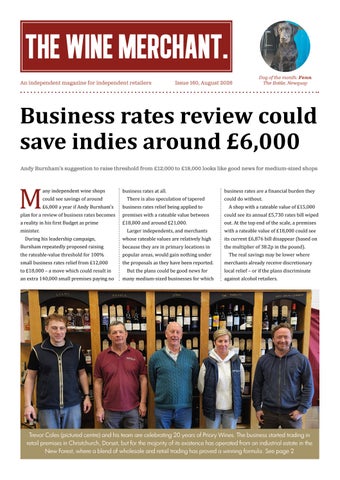
Trevor Coles (pictured centre) and his team are celebrating 20 years of Priory Wines. The business started trading in retail premises in Christchurch, Dorset, but for the majority of its existence has operated from an industrial estate in the New Forest, where a blend of wholesale and retail trading has proved a winning formula. See page 2
NEWS
Inside this month The first two decades of Priory Wines
4 comings & GOINGS Jonathan Cocker was going to retire. So why hasn’t he?
Priory Wines in Lymington, Hampshire, is celebrating 20 years of trading.
12 tried & TESTED Baby Pinotage, Berkshire Bacchus and rosé Rubin. What’s not to like?
15 the burning question How have independents' working hours changed in recent times?
18 suppliers are hurting too Importers spell out the costs they can’t always pass on to retailers
22 merchant profile An audience with Marc Hough at Cork of the North in Manchester
33 South africa focus Jacob Stokes discovers how Chenin shape-shifts across the Cape
Trevor Coles intended to be a high street
retailer, but after four years in Christchurch he relocated the business to a warehouse premises and focused his efforts on wholesale.
“I wouldn’t have survived another five
years on the high street,” he says, referring to his move to an industrial estate on the edge of Lymington.
“We weren’t making any money at all. In
fact, we were losing money with the cost
of the rent and the rates. Even though the
turnover was reasonable for a small shop, the costs killed me down there.”
Although the business is 80%-90%
wholesale, customers have continued to
come through the doors. The out-of-town
location lends itself to the more intentional shopper and Coles says the average tends to be a six or 12-bottle purchase.
With hospitality in crisis, many indies are
42 lovely bubbly Retailers each choose three sparkling wines that customers love
48 putting something back How four indie merchants support their favourite charities
stepping back from wholesale, but Coles believes his location has cushioned him.
“I would say we’re doing the same sort of
volume of sales, but more wine by the glass and higher-end stuff. My rep at Boutinot
frequently says to me, ‘Trevor, you’re in a
bubble down there – you’re not typical of
67 Q&A Hello, Justin Howard-Sneyd. We’ve got some questions we want to ask
what’s happening all over the country’.”
Boutinot supplies most of the range and
Coles has avoided direct importing – “we
don’t do the volume of any one particular wine to make it cost effective,” he says.
“Boutinot are brilliant. I’ve been so lucky.
I’m probably on my fourth rep and they have all been very helpful, friendly and
approachable – I can’t speak highly enough of them.”
The Catch-22 is that the only thing Coles
would like to see more of is retail business. “If we could only drive it up a bit, because obviously your money is in the bank the
next day with retail, and there are slightly better margins,” he says.
“We have wine on taste two or three
times a month, whether that’s themed or
just new wines we have taken on, and we
collaborate with local restaurants to put on wine dinners – they’re always popular.
“We don’t get as much passing trade, but
then on the upside I don’t pay high street prices. I’m paying less in rent and rates
now than when I opened 20 years ago in Christchurch. And I’ve got somewhere
between two and a half and three times the size of the premises.”
So, what’s the plan for the next 20 years?
“I didn’t really have an end date in mind
when we started,” says Coles. “I don’t think it’s a secret that I am talking to a colleague about them buying in or gradually taking over the company.
“Wine is a passion and there’s always
new, interesting wines on the market. And it’s a privilege to deal with some really
nice people. You don’t do this to get rich – it’s a challenge, but it’s a very interesting challenge.”
THE WINE MERCHANT MAGAZINE winemerchantmag.com 01323 871836 Instagram/Bluesky: @WineMerchantMag Unit 52 Newhaven Enterprise Centre, Denton Island, Newhaven, East Sussex BN9 9BA Editor and Publisher: Graham Holter graham@winemerchantmag.com Assistant Editor: Claire Harries claire@winemerchantmag.com Reporter: Jacob Stokes jacob@winemerchantmag.com Advertising: Sarah Hunnisett sarah@winemerchantmag.com Accounts: Naomi Young naomi@winemerchantmag.com Admin and reader liaison: Charlotte Gingell charlotte@winemerchantmag.com The Wine Merchant is circulated to the owners of the UK’s 1,023 specialist independent wine shops. Produced in Sussex by East Print. © Graham Holter Ltd 2026 Registered in England: No 6441762 VAT 943 8771 82
THE WINE MERCHANT august 2026 2
THE WINE MERCHANT august 2026 3
THE INDEPENDENT ADVANTAGE GWC closes its Petersfield store A monthly column from Alliance Wine/ H2Vin exploring practical, creative ways independents can sell smarter - covering everything from fine-wine offers to pricing tweaks and experiential events
A
s we stride into halcyon days of Summer, September might feel like it’s a little way off – but for anyone
considering wines for the winter season, it arrives too quickly. Christmas plans are made earlier every year, and the wines that make it into them are often those that land in front of the right customers at the right time. That’s the thinking behind our roadshow tastings in Manchester and Bristol this autumn. Rather than a sprawling trade tasting where everything blurs into everything else, we’re keeping things focused – a carefully chosen range and a deliberately small guest list, and enough space to talk with us about the wines. It’s an important opportunity not to be missed. You’ll be able to taste wines from three really exciting new producers we’ve brought on board this year, to revisit those you might not have tried recently, and to think ahead to the ranges and gifting selections that will carry you through to the new year. The kind of afternoon, in other words, that’s actually useful. We’ll be in Manchester and Bristol in September. We hope to see you there. If you would like to attend, please follow the QR code below to register. If you have any questions, please touch base with your Alliance sales manager or Alex Baudouin, head of independent off-trade sales: alex.baudouin@alliancewine.com.
Ned Llewellyn Alliance/H2Vin sales director – off-trade
There have been further changes at The General Wine Company in Hampshire with the recent closure of the Petersfield shop. The business was bought by Drinks 21
from Alan Snudden in late 2024.
“Drinks21 is a commercially-led drinks
distribution business, so it’s a completely different world to the independent retail and wholesale business that is General
Wine,” says Gail Brogan, who co-founded
Drinks21 with her husband Steve in 2008. “Closing the shop in Petersfield was a
really difficult decision to make but we just couldn’t get the traction there. However, the Liphook shop is cooking on gas. It’s doing really well and we’ve got really exciting plans for it.
“We’ve got very clear views about where
we want to invest and grow. It’s been a bit bumpy but now we’re there and investing in the future. We’re about to move into
a new warehouse in Liphook and we’re
putting in barcode scanning and that sets
us up for ensuring our picking accuracy is 100%.
“A couple of years ago, Alan set up a
bonded warehouse. It’s a small unit that
holds our bonded stock, and that’s brilliant for cash flow. Our new facility is actually attached to that bonded warehouse.”
Gail says it’s still possible that more
shops will open. “If the right store or
premises came up, in the right place, we’re not closed to that,” she says.
Secret Cellar aims for more sites The Secret Cellar’s branch in Forest Row in East Sussex ceased trading last month. The business has three remaining shops
in Tunbridge Wells, Oxted and Wadhurst
THE WINE MERCHANT august 2026 4
and that footprint is likely to expand,
according to Miles Corish MW (pictured),
co-founder of The Heritage Wine Company, which owns The Secret Cellar brand.
“When we bought The Secret Cellar, we
looked at the performance of the Forest
Row site and it was, almost by 50% if not more, the lowest turnover of any of the outlets,” says Corish.
“We threw everything we had at it.
Instead of it being open three days a week, we put someone there five days a week.
We put about 25% to 30% more wine in
there and we really tried to make it work, but I think the final nail in the coffin was
the rate reviews that that were announced in April.
“We just thought, ‘well if we’re paying
that in rent we should be looking at a
site that’s potentially got more access to turnover’.
“The investments we’ve made into other
outlets actually show that if you make
something presentable and put the right
wine in there and all that sort of stuff, you get rewarded with people coming in and buying more wine.
“So Forest
Row was a
curious thing
to me. And then
talking to people
who’ve been in the business for a long
time, they said, ‘well, you know, this is the
third or fourth wine shop in this spot, none of which have worked previously’.”
With a winning formula in place, there
are plans in motion to find more sites for The Secret Cellar. “We’ve been looking at
other areas in and around the region,” says Corish. “Plus, we’re also looking at more
acquisitions that might fit into the Heritage portfolio. Maybe not only just other
retailers, but potentially other wholesalers, that sort of thing. We’re by no means
retracting, we’re still expanding and just trying to find the right opportunities.”
Branching out to Brontë country West Yorkshire’s Martinez Wines will soon be opening a third site. In addition to the Bingley and Ilkley stores, owner Jonathan Cocker has plumped for a prime site in Haworth. On the cobbled main street, right in
the heart of Brontë country on the edge
of the Pennine moors, the new premises,
previously a restaurant, has a professional kitchen and is arranged over three floors.
“As well as being a good local community,
it is a tourist hotspot,” says Cocker. “It’s a
very proactive village; there’s a lot going on and they make the most of it.
“We’ll do what we do now with the other
shops, tapas and a wine bar, but as there’s
sign of him slowing down just yet.
“The thing is, our net profit has gone
from 9% to 5.5% on the same turnover in
the last three years, and that’s all down to overheads,” he says.
“The way I look at it is you can either
sit around and do nothing and make less money for working as hard, or you can expand, work harder, and get back to where you were financially.
“So, by opening Martinez in Bingley
during the day as a café, by extending Ilkley with the wine garden and by opening in
Haworth, I hope to get back to a net profit
of where we were three to four years ago.” And retirement? “Well, it was going to
be next year,” he says, “but it looks like it’s going to be five years’ time now.”
Jonathan Cocker: still not retired
no parking, we’ll have a smaller shop area. “We’re also planning to do paella, which
we don’t have at the other shops. We’ll do
a daily wine experience at 5pm every day, where people can come in and have six-
50ml tasting glasses, which will vary all the time. That’s really aimed at the tourists as they won’t have to pre-book.”
The third Martinez Wines site was most recently a restaurant
All this will happen on the ground floor
and upstairs will house the bar where there is also a conservatory – lots of space for
Cocker to play around with. He’s already got plans to renovate the garden at the
back. “It’s got beautiful views,” he says.
“It also comes with a nice flat, so I’ve got
a live-in manager organised. She works
for me already and I know her very well.
She’s run pubs in the past and she’s been in charge of our wine garden all this summer.” Cocker prefers to purchase the freehold
wherever possible, and Haworth is no
exception. He got the keys in the first week of August and has a provisional opening date of September 9.
“Generally freehold properties go up
10% a year,” he says, “and you’re not throwing money away on renting.”
Retirement is a word that Cocker
Haworth is a tourist hotspot but also a “proactive village”
occasionally bandies about, but there’s no
THE WINE MERCHANT august 2026 5
THE WINE MERCHANT august 2026 6
Customer buys his favourite shop McMillans of Malton in North Yorkshire is under new ownership with Lee Richardson buying the business from father and son team Jim and James McMillan. Established in 2016 primarily as a
whisky retailer, the business has grown
to offer a range of spirits, as well as wine. Three years after opening it moved to a
bigger premises where it continues to trade
Bacchus familiar with – I’ve already got her into
Vinho Verde, Albariño and Colombard –
but she’ll always buy something she’s not tried as well.
“That’s what’s so great about the bar
upstairs – it means you can just give people a little taste of something and they’ll say
‘I’ll take a couple of bottles’. We sell quite a lot like that.”
It’s business as usual at Liquorice
today.
John Kernaghan, long-time manager
already underway on an additional outside
colleague, Lisa Owens, full time at their
the bar upstairs, so I just want to add to it,”
confident it will be business as usual at the
As a previous customer, Richardson is not
looking to change too much, but work is
at Liquorice in Shenfield, Essex, has left the business to join his former
bar area.
events company Lion Wines.
Richardson says. “There’s a barn building
shop, which also operates as a wine bar
“We’ve got the shop and then we’ve got
out the back so we’re converting that. It
will be a daytime wine bar and we’ll put a coffee machine in there too.
“We’ve already got a nice range of wines
as well as a choice of 100 whiskies, and 40
different gins and rums, so it’s just a matter of tweaking it here and there.”
Richardson has experience of running
bistros and bars for the past 15 years and
says he was attracted by a business that he could potentially handle on his own with the support of one or two other people, rather than running a whole team.
“I took on a couple of members of staff
from James, and they look after the bar
Liquorice owner Jo Eastwood is
and deli.
“John’s not going to be easy to replace,”
within the next six months, but meanwhile we are still serving the community and
we have the continued support of all our fabulous suppliers.”
‘Ambitious plans’ of Brighton indie The Vine House is a wine bar, restaurant
Verde, white Rioja, Italian reds, Lebanese
company created by Tim Hall and Marc
too. “The trouble is, there’s so much stuff
and that 50 sites have already been
the Kemptown area of Brighton.
and Romanian wine,” Richardson knows he
Wise, there are unconfirmed reports that
different wines,” he says.
“I have a customer who comes in every
Friday morning and she always buys four bottles: three of something she’s more
Good news that sales of Flint Vineyard’s wines are going so well that a new winery building is required to help the Suffolk business cope with demand. The Beccles & Bungay Journal also reports the plans will include “vines tripling in size”. Saves all that bending down, we suppose.
“I’ll look to recruit a new manager maybe
shop. It works really well,” he says.
out there and you just have to keep trying
Frankenvines in Suffolk
and we’ll manage.
and shop which opened in mid-June in
has to keep his customers’ tastes in mind,
The idiot who smashed Latitude Wine’s window in Leeds last month to get to a magnum of Chartreuse has nothing to show for their efforts. “Obviously it was a dummy bottle, so more fool them, but it makes this criminal damage more pointless,” says owner Chris Hill. “Don’t they know how much glass costs?” A customer later found and returned the bottle, and other locals have shown their support by pledging to order wine to help Chris cover the repair bill.
she says, “but I have a really good team,
side, so the idea is I can concentrate on the
While he has a personal liking for “Vinho
Dummy steals dummy
Owned by Hall & Wise, a holding
the concept will be rolled out nationwide identified.
Wise, a co-founder of Planet of the
Grapes, also established another local wine shop, 9 Vines in Brighton, which he sold in 2024.
THE WINE MERCHANT august 2026 7
Too soon?
Outstanding in her field
It’s nice to hear that scarecrow competitions are still a thing and great to see independent wine merchants getting competitive about them. We salute the team at Drinkworthy in Newton-le-Willows, Merseyside, whose “Haymy Winehouse” was a very credible entry in this year’s Scarecrow Fest in the town and helped raise a lot of money for good causes.
THE WINE MERCHANT august 2026 8
Beau Constantia
COMING DOWN THE LINE
Friarwood gone after 59 years
opening her shop in 2000, had been up for
Hot topics that could impact independent wine merchants
sale but, with no buyer, has shut for good.
By WSTA chief executive
Friarwood Wines & Spirits, the
Bermondsey, south London, has ceased
independent London wine merchant,
trading. Christophe Lechevalier set up the
has gone into administration.
business a decade ago.
The business, owned since 2015 by Ben
Carfagnini, had stores in Wimbledon and Parsons Green. A closing down sale has been clearing remaining stock.
Friarwood was originally established in
• Lechevalier Wine Bar & Shop in
Barry and Fiona pass on the baton
1967 by Peter Bowen. Under Carfagnini’s
Barry and Fiona Howarth have sold
at the London Wine Fair.
handover to Kat Stoney and Josh Allen.
stewardship the business strengthened its
Lancaster Wine Company and will be
wholesaling activities and was an exhibitor
retiring in September after a phased
administrator.
University and whilst studying for their
Antony Batty & Co has been appointed as Friarwood’s most recent published
accounts, for the year to March 31, 2025,
showed that debts had risen from £1.8m to £2.2m in 12 months. The company had net
assets of £319,352 at the time, compared to £675,491 the year before.
• Alexander Hadleigh Wines in Southampton closed at the end of June. Owner Del Taylor announced her retirement plans in the October 2025 edition of The Wine Merchant. The business, which she started as a wholesaler in 1984, before
“They both attended Lancaster
degrees they fell in love with Lancaster and never left,” says Barry.
“They have both worked in hospitality
in various Lancaster venues, and in the
last four years Kat helped set up and has managed the successful Runner Duck
Wine Room in Lancaster centre, with us
supplying some recommended guest wines on a wholesale basis.
“We are so happy to pass the baton on to
Kat and Josh, who are both keen to carry on the legacy and take Lancaster Wine Company into the future.”
Miles Beale
We'll keep the pressure on the new PM A little over a month since he was elected to Parliament, Andy Burnham has become the seventh UK prime minister in just over 10 years. And, while it’s early, it feels a little different seventh time around. What might this mean for wine and spirit businesses? Wholesale policy change is unlikely, not least because of the limited financial headroom. Burnham has said repeatedly that he will stick to the manifesto commitment not to increase income tax, NI or VAT and will also respect the existing fiscal rules. But we’ve already seen some positive moves. The reduction in business rates for pubs and live music venues is a step in the right direction, but could and should have gone further. In his speech hint on June 29, Burnham spoke of the need to reform business rates for hospitality and high-street businesses; this suggests that further reforms might be under consideration. The WSTA will be pressing the new administration to be ambitious and re-examine the impact of this year’s business rates reforms on all hospitality businesses and high street businesses – and we will want all Wine Merchant readers to put their shoulder to the wheel! And of course there’s an autumn Budget to prepare for. Wine and spirit businesses have had to respond to a range of government policies that have forced up their costs, including February’s increase in excise duty, EPR fees, business rate increases and changes to the National Minimum Wage and employers’ NICS. Against a backdrop of continued consumer concerns over the cost of living and public finances, businesses have had to absorb many of those costs themselves. Enough is enough. Businesses need a break and a proper appreciation by government of the pressures they face and the Budget provides the opportunity to redress the balance. So far, the rhetoric is encouraging. The hard part will be turning words into affordable actions.
Find out more at wsta.co.uk Fiona and Barry enjoy their final tasting event as owners
THE WINE MERCHANT august 2026 9
ight ideas r b
80: Tear and share Duncan Gammie The Wee Vinoteca, Hitchin
In a nutshell: Create information cards
What else do subscribers get in their
collections.
and £150 for a case of six bottles every two
box?
with detachable neck collars to help customers keep track of their wine
“We have three price options at £80, £110
Tell us more.
which includes recipes as well as articles
months. We create our own A4 magazine
“It’s something we started doing for our wine club. Initially we were including
tackling some wine questions people have
reference cards with the curated boxes, but I got this idea when I was at my father-
Are they easy to produce?
He’s a member of our club and I watched
him get his collection of cards out and flip
beginning of this year. Not only are their
prices about half of the original company
in-law’s house for Sunday lunch one day.
“We switched to another printer at the
through them until he found the wine he
we were using, but they are also a really
wanted, then he went to his wine rack and tried to match the card to the wine in the
rack – it was all a bit labour-intensive, and I thought I could do something to make it easier for people.”
Have you had any feedback? “Yes, we’ve been told they are so helpful. It creates this little reference on their
wine rack. The tags include the name of
the wine, producer, country, region, price,
grape variety and suggested food pairings. “Typically what people are doing is
getting their subscription wines and
– I’ve got a massive database of questions that customers frequently ask me about
wine. And I might do a producer focus or a
little breakdown on a grape variety. I think about it as light education.”
And what about the other half of the
lovely local family-run business.
card?
fits-all scenario. We are picking specific
whether to create a lovely box to keep
“When it comes to a print run, it does get
a bit complicated in that it’s not a one-boxwines for specific people, plus we are
growing all the time so there is an element of forecasting ahead.
“There’s also a sweet spot in terms of the
thickness of the card. It’s got to be heavy enough that it feels of a certain quality,
but if it’s too thick the perforation tearing becomes difficult.”
earmarking specific occasions for them.
“The bit that tears off is almost a perfect square, and I’m still trying to work out
them in or whether we go down the route of hole-punching the cards and providing a binder. If I’m honest, the hole punching option would look and feel slightly less
premium as time went on, but a box could be a thing of real beauty.
“This is a lovely problem, but at the
moment our wine club customers are
divided into locals, whose boxes we handdeliver, and those we send out by courier, and that group is growing quite a lot. I’m
And I think that’s where the tags come
redesigning the packaging so we can start
in. They might say, ‘oh, I’ve gone to the
sending out more via courier and once
butcher this weekend – I’ve got a lovely bit
that’s sorted out, the box/folder will be my
of beef’, and they’ll go to the wine rack.”
next challenge.”
Duncan wins a WBC gift box containing some premium drinks and a box of chocolates. Tell us about a bright idea that’s worked for you and you too could win a prize. Email claire@winemerchantmag.com
THE WINE MERCHANT august 2026 10
get your own copy of THE WINE MERCHANT EVERY MONTH
subscribe for £85 at winemerchantmag.com
THE WINE MERCHANT august 2026 11
TRIED & TESTED
Santa Tresa Etna Bianco 2025
Mooiplaas Pinotage 2023
Anyone familiar with Stefano Girelli’s Vittoria region
Frederick’s was looking for “something special” in
Carricante, it’s got the extra minerality you’d predict,
part vineyard and part nature reserve. This Pinotage
South Africa and found it the Bottelary Hills, where
wines will be excited by the prospect of a Santa
brothers Tielman and Louis Roos run a farm that is
Tresa release from Etna. Made with 100% organic
is still a baby, but the nose is already nicely developed,
but absolutely no austerity: the grapes have been
with dark balsamic and ripe blue cheese notes. Lively
handled with the winery’s trademark gentleness, and
acidity but approachable tannin; it’s craggy, but clean.
long ageing on fine lees adds warmth and generosity. RRP: £18
RRP: £25.50
ABV: 12.5%
ABV: 14%
Frederick’s Wine (07823 344173)
North South Wines (020 3871 9210) northsouthwines.co.uk
frederickswine.com
Domaine Frédéric Lambert Chardonnay 2024
Rowles Single Estate Bacchus 2025
Nine months of ageing in oak under a layer of flor has
There won’t be a wine shop in the country with a
with a suggestion of lychees lurking deep within the
it’s clearly at home at Rowles. Elderflower aromas,
shelf labelled Berkshire Bacchus. Yet the grape has a
added extra complexity, but not the wildly oxidative
breezy, easygoing appeal in the summer months and
Jura accents we were braced for. Very slightly oily,
tart green apples, a touch of stinging nettle and a flinty
mix; there’s also a delightful hint of lemon verbena
reduction make this a respectable Friday night aperitif.
and a lingering fennel sort of note on the finish. RRP: £23.99
RRP: £19
ABV: 13.5%
ABV: 12%
Rowles Vineyard
Cachet Wine (01482 638888) cachetwine.co.uk
rowlesvineyard.co.uk
Georgiev / Milkov Pink Side of Rubin 2024
Le Cayre Grenache Noir 2024
Bulgarians Petar Georgiev and Radostin Milkov are
we didn’t check the label before cracking this open
Fifteen per cent alcohol reds? In this heat? Admittedly
winemakers to watch, applying their international
on a sweaty evening in July. But no matter: there’s
experience to the native Rubin – a Nebbiolo/Syrah
no burn, just plush, spicy, leathery fruit that, even
crossing grown in the Thracian Lowlands. Aged in
at room temperature, has a soothing, cooling effect.
acacia and left on lees, its rosé iteration is intriguing
Presumably similar to a dive into the Orbieu River in
and moreish, with richness as well as elegance. RRP: £21
Corbières, 35 metres below the pebbly vineyard.
ABV: 13%
RRP: £14.99
The Jolly Merchants
ABV: 15%
Cachet Wine (01482 638888)
thejollymerchants.co.uk
cachetwine.co.uk
Pol Roger Brut Vintage 2019
Celler de Capçanes Mas Donis Rosat 2025
The 2018 vintage was a hard act to follow but the
2019 wine, from a more challenging year, has been
A pleasingly rugged rosé from the rugged Catalan
precision is just as appealing. A touch of ginger, a
Garnacha, it allows you a glimpse of its only-just-ripe
very well received. More Pinot-dominant than usual, it’s less opulent than its predecessor but the laser
landscape in the Montsant DO. Made in the saignée
suggestion of fresh pastry, a twang of salinity – it’s Pol for the purists, and everyone else should join the fun. RRP: £85-£90
ABV: 12.5%
Pol Roger Portfolio (01432 262800) polroger.co.uk
method by Anna Rovira, working with old-vine
raspberries and strawberries before everything turns
to stone before your very eyes. Then repeat. Very good. RRP: £16.50
ABV: 13%
Alliance Wine (01505 506060) alliancewine.com
THE WINE MERCHANT august 2026 12
Rising Stars
I
Tansy Roberts
Crushed & Cured, Southsea, Portsmouth
t’s been four years since George Bovill opened his
Thankfully it’s become busier and busier and he was
wine shop and bar and Tansy, his very first employee,
able to take me on full-time.
has gone from part-time to becoming his “right-hand person”.
“I love the hospitality side and we’ve got some wonderful regulars that I always enjoy chatting to, but
“Tansy worked with me every Friday and Saturday,”
says George, “and then came on board full-time 18 months ago. She helps me run the business – I cannot
it’s the wine itself that really excites me – especially when the suppliers visit with some cool wines to try. “I go to all the portfolio tastings with George and
do without her. She
I enjoy being part of the
organises all the
decision- making process, not
awesome events we
only on which wines we’re
do including the live
going to stock but on which
music we have on
wines to have on by the glass,
twice a month, quizzes
as we change that monthly.
and all sorts.
We also have a small plates
“I don’t know how
menu and I love it when we
to describe it, but
take time to think about what
everything gets done
else we’re going to add or
exactly how it needs
change.”
to be. From training
Being a local, Tansy says
new members of staff
she’s often recognised by
to helping me taste
customers when she’s out
the wines and make
and asked for her wine
decisions, Tansy is an
recommendations, or what
integral part of the
her favourite wine is. So,
team and an absolute
what has her attention right
necessity to what I do.”
now? “Well, I am a red wine girl and at the minute I’m
Tansy had lots of hospitality experience prior to
loving a Ribera del Duero,” she says.
working at Crushed & Cured but says she hadn’t
In her downtime Tansy likes to build a “little wine-
focused on wine until her role at the Brewhouse &
related trip” into her holiday plans, but aside from that,
Kitchen microbrewery. “They started talking to me about
she’s not yet had the pleasure of an overseas trade visit.
becoming one of their wine experts,” she says. “I didn’t
As a Riesling fan, Austria is pretty high on her wish list.
realise at the time that you could do qualifications in
Meanwhile, she is happy to explore and celebrate
wine. I didn’t stay with them in the end, but I went off
wine in-store and share those experiences with
and did my WSET Levels 2 and 3 off my own bat and it
customers.
just clicked.
“Our Beaujolais party was the first one I
“When I saw on Instagram that George was opening
ever did, and it was so much fun,” she says.
his place, I thought ‘that’s exactly what I want to do’.
“We just want to introduce more stuff like
I live literally around the corner so it’s just perfect.
that, and I’m ready to take it on.”
Tansy wins an 180th anniversary magnum of Champagne Devaux Cuvée D courtesy of Liberty Wines
If you’d like to nominate a Rising Star, email claire@winemerchantmag.com
THE WINE MERCHANT august 2026 13
DAVID PERRY
that I could give him a glowing report by
replying to the email he was about to send – to my Gmail account. Well, yes Eric, you deserve five stars but no, I don’t use that Gmail, as I think we established earlier. Have a nice day now.
Irregular Thoughts I bought a new van last year. The spiral of financial aggravation has just started
This, and a few other frustrations,
all started when I bought a new van.
Ridiculous I know, but it is the sort of
domino effect that would drive Victor Meldrew to an early grave.
I mentioned in passing, about a year ago,
that trusty little Vanny gave up the ghost and was swiftly replaced by a smarter vehicle. Unexpectedly it came with 12
months’ RAC breakdown cover. I didn’t expect to have to use it and I haven’t,
but it’s comforting to know it is there.
For many years I had paid separately for breakdown cover with someone else via
the broker. When I cancelled it I was told
that they had switched it to RAC years ago but I hadn’t known.
The reason I hadn’t known was that I
hadn’t changed my address when I moved home. The reason I hadn’t changed my address was that if they thought I still “Could you take a moment to rate your experience with us today – or will you just write a column about it?”
I
was woken this morning by a text. It
cold. I had had a possible fraud on the card
me know that my email was bouncing back.
to me to ring the provider and tell them
was just after seven. It was a quick
message from Daniel Lambert letting
I am normally up fairly early. Not as early as Daniel evidently. With temperatures currently in the forties I figured he
probably starts early when it will be cooler. That and the fact that it was already eight in the morning in France.
I had a vague idea why my email wasn’t
working. I had glimpsed a shouty message
on the Gmail account I never use but which
pops up on my phone. I just assumed it was spam and didn’t give it a second thought.
Apparently it did require my attention as
they had tried and failed to take a payment of £1.20. They had apparently told me twice already.
I rang the provider at eight. Much to my
surprise they answered and the email was back and working before my toast was
they had registered. The bank had sent me a new card but, of course, it didn’t occur I’d got a new card. And anyway if there
was a problem then surely they would tell me on the email they provide, not some temporary Gmail?
It was explained to me that they had the
Gmail on file as, should they need to tell
me about a problem with my email, such as them cutting it off, they wouldn’t be able to contact me, would they? That seemed fair
enough. The nice young man also explained
What self-respecting fraudster would steal my details and spend £2.67 on RAC Insurance? How does that work? THE WINE MERCHANT august 2026 14
lived there it effectively gave me home
breakdown for free. Clever eh? Maybe not.
T
he problems started when the free cover ran out. The RAC contacted me and asked if I wanted to
continue. Even with the premium of being business cover it was still a no-brainer.
£42 a year as opposed to £6.50 a month
(ie £78) for the previous cover with … er … the RAC. I agreed and paid the year up
front. On the RAC business portal I can see my fleet of one van and I have an app on
my phone which will help find me if I break down.
Then, looking through my bank
statement, I noted a payment, on card, for £2.67 to “RAC Ins”.
I rang the RAC and asked what that was
about. I was told that it wasn’t them at RAC Breakdown, it was their insurance arm.
So, I rang RAC Insurance and told them
who I was and what my account number
was and where I lived, my date of birth and my blood group but they had absolutely
no record of any account. I knew I didn’t
have any insurance policies with them and
they agreed that I didn’t. They put me back to breakdown. They still had no idea and
suggested it must be a fraudster. What self-
respecting fraudster would steal my details
?
THE BURNING QUESTION
and spend £2.67 on RAC Insurance? How does that work?
How many hours do you work – and has it gone up or down?
�
Forty hours a week doing the best job around is nothing to moan about. Rising costs have made us think more carefully about staffing – however, it is more a matter of flexibility than stretching oneself. As with any positive workplace, we’re super flexible with our staff and holidays. This can mean I work more than 60 hours, going weeks without consecutive days off. However, provided it balances out, it’s well worth it to have happy staff who are superb at their jobs.
Spooked by this, I rang the bank who
refunded my £2.67, blocked any payment to “RAC Ins”, cancelled my card and sent me a new one.
All sorted. Except about a week later I got
an email from the RAC telling me my cover had been cancelled as the £2.67 they had
”
collected had been returned to me. Now,
armed with a different account number, I
rang them again and asked just WTF they were doing.
A
s far as I could make out, at the
time I renewed my company cover for the van, someone there had
simultaneously set up unneeded domestic
cover at £32.04 a year in 12 easy payments. They just forgot to tell me. I cancelled it.
It is a lot less than my wife is paying as
an add-on to her insurance. About £80
less! As it was due for renewal, I set up
cover for her car while I was on the phone.
They thought it easier to use the same RAC
Fraser Meadows Great Grog, Edinburgh
�
My hours have definitely increased in the last year as the business has developed and we are also now a restaurant alongside the wine shop. On average I clock up 50 hours, often working late into the evenings. I have a great team of 10 staff who have been very reliable and steady for the last few months, but this is always a very fragile situation and it only takes one person to leave to rock the ship. Overall, I have arrived in a good place where staff costs are managed well and I’m enjoying the business.
”
David Schroetter * Champagne winner * The Pressoir, Wells, Somerset
�
account just a different driver, different car,
My hours have gone up massively over the past year. My typical day will see me up by 8am to sort out the online orders through to opening the shop. We become a wine bar in the evenings so along with all the clearing up at the end of the day my hours sometimes stretch past midnight. I would be tempted to take someone on to prevent burnout, but I like to oversee everything myself. However, with National Insurance changes, I don’t have the budget to attract someone with the level of qualifications I would want.
registered to a different address and paid for from a different account with all 12 instalments taken at once.
Soon after, I got an email from the bank
saying “RAC Ins” had tried to take £32.04
from my account but don’t worry, they had blocked it.
A month later my email stopped working
”
as the payment card number had changed. Because their email bounced back, MyPos have stopped confirming the standing order telling me how much has been transferred to my account each day. All because I bought a new van.
UPDATE: Yesterday I received a letter from
the RAC, to my home address, telling me my cover had been cancelled as they couldn’t take the £2.72, a slightly different random small amount. On the plus side, I now have the MD’s name for correspondence. I’ll let you know his response.
David Perry is the owner of
Martin Flowers InKnotts Wine, Newark
�
We don’t personally feel that our hours have gone up or down in the past year. Adam and myself are the managers and we do 45 hours a week. I know that in other hospitality businesses in the village the hours that people have been expected to work have gone up and some businesses are finding it tough. Thankfully we are able to survive on two members of staff and have two more that we take on as and when we need them, when it gets busy at the weekend.
”
Ashley Barlow, Corks Out, Cheshire
Champagne Gosset The oldest wine house in Champagne: Äy 1584
Shaftesbury Wines in Dorset
THE WINE MERCHANT august 2026 15
BITS & BOBS
Favourite Things
Italy’s wine cellars are holding more unsold product than they have in four years, and the numbers keep getting worse month over month. According to figures released by Unione
Italiana Vini, stockpiles of wine and must rose 8.4% in June compared to a year
earlier, up from a 7.3% increase already
Amy Caiger
Indie Wine Club, London Favourite wine on my list
I love a chilled red, so I’d say Vincent Lacoste “Claret” from Bordeaux which is a recent addition to our shelves. It’s a beautiful, elegant, light red which is very easy to drink – perhaps a bit too easy.
recorded in May. That puts total inventory at 50.3m hectolitres.
Strip out the must and just look at
Favourite wine shop
Our friends and neighbours in Tooting Market, We Brought Beer, also have a lovely wine shop down in Brighton called The Wine Barrel which has lots of really fun low-intervention Italian wines thanks to owner Gianluca Berardi.
Regional Wines, a boutique store in
Wellington, sold out of stock the day he died, while Moore Wilson’s, a boutique
supermarket and wholesaler in Wellington, sold five times the usual volume of Two Paddocks.
The Guardian, July 21
• Naked Wines has reported mixed full-year
bottles sitting unsold in Italian cellars.
up by 35% to £7.6m compared to the year
to nearly 46.6m hectolitres, up 6.7% year
2026, with revenue decreasing by 20% year-
Wanted In Rome, July 24
prior, in line with the company’s medium-
over year – the equivalent of roughly 6.2bn
on-year to £199.1m. Adjusted EBITDA went
term target of between £9m and £14m. The statutory loss before tax increased to £6.3m, compared with a loss of £4.9m in the year before, due to restructuring and write-off of software costs, according to the business. Grocery Gazette, July 23
Burgundy tops Michelin rankings
Favourite wine trip
Favourite wine trade person
increase in its sales.
results for the 52 weeks ended on March 30
Favourite wine and food match
Mags Janjo, owner of MJ Wine Cellars (as well as winemaker, educator and owner of Coulure) for championing black-owned wineries and winemakers. Plus he is such a dude! He is the largest importer of POC wines in the UK and represents some awesome winemakers who are making some really exciting wines. It is so important to showcase diversity in the wine industry.
after news broke – representing a 1,828%
finished wine, and the figure still comes
It’s a classic but a goodie – fish, chips and fizz! For a bit of a twist and to make it a bit more fun I’d swap out the Champagne for Daschbosh Méthode Ancestral – a pét nat with a Champagney feel. To the Yamanashi wine region in Japan. My visit to the small, family-run Grace Winery in particular was awesome. I’ve had their wines on the shelf ever since and our customers love them.
Magpie
Unsold Italian wine hits four-year high
The Michelin Guide has published its Grapes wait to join the glut
Sales boom for Sam Neill wines New Zealand stores have been selling out of Sam Neill’s wine label, and the causes he held dear have had an influx of support, as fans find ways to pay tribute to the adored late actor. Neill was an avid winemaker, producing
Pinot Noir, Riesling and rosé under his label Two Paddocks, in Central Otago.
Liquorland New Zealand, a national
retailer with 175 stores, said Two
Paddocks Pinot Noir went from being the 423rd bestselling wine the week prior to Neill’s death to number five in the days
THE WINE MERCHANT august 2026 16
first-ever wine selection, awarding its highest three-grape distinction to nine Burgundy estates. Alongside the nine estates awarded three
Michelin grapes, 20 received two Michelin grapes, 33 were awarded one Michelin
grape and a further 32 were included as selected producers.
Among those receiving three Michelin
grapes were Domaine de la Romanée-Conti, Domaine Leroy, Domaine d’Auvenay, Cécile Tremblay, Dugat-Py, Roumier, Coche-Dury, Jean-Marc & Thomas Bouley and Hubert Lamy.
Michelin said the top category
recognises producers whose wines “can
be approached with complete confidence, regardless of the vintage”.
The Drinks Business, July 8
Mould makes millionaire mad A multi-millionaire tailor who claims
QUIZ TIME
leaky fridges at his luxury flat caused
With Flying Füchs
his £1m collection of fine French wines to go “mouldy” is suing for more than
1. Which one of these Spanish regions produces Mencía? (a) Penedès (b) Bierzo (c) Navarra (d) Rueda
£550,000.
Breaky Bottom on market for £4m
Tom Reimer claims that the value of
his collection in London was ruined due
to faults with three special wine chillers
2. Plato described drinking wine as a way to: (a) encourage combat (b) sleep more easily (c) develop resistance to urges (d) worship the gods
installed as part of a refurb of his £8m
One of England’s most respected wine
Marylebone apartment in 2021.
estates is to change hands for the first
A 1cm-wide gap on the doors of the
time in its 52-year history following the
three units allowed cool air to escape and
death of founder Peter Hall.
warmer air to enter, he says, leading to
Breaky Bottom Vineyard, tucked away in
a secluded South Downs valley near Lewes,
condensation and mould growth on the
3. F1 winners spray what brand of sparkling wine after the race? (a) Ferrari Trento (b) Moët & Chandon (c) Veuve Clicquot (d) Martini
value of his 1,500-bottle London collection.
4. Australian publication The Real Review has announced its Top Winery of Great Britain for 2026. What is it?
labels and some of the vintages “probably”
has been brought to market by Knight
becoming “corked”, massively reducing the
Frank’s viticulture team with a guide price
The Independent, July 23
of £4m.
The sale follows Hall’s death in October
2025.
• Germany’s national railway operator,
wine here in the 70s, it became apparent
all of its train stations. The ban will cover all
The Drinks Business, July 13
The Independent, July 23
5. Which United States founding father was a knowledgeable European wine enthusiast?
Deutsche Bahn, is implementing a
Hall’s youngest son, Toby Hall, said:
“When my father began to craft sparkling
nationwide ban on alcohol consumption at
that potential has only grown with time.”
to be fully in effect by 15 October.
5,400 stations across the country and is set
just how much potential the site had, and
Answers on page 58
corkage
by Brett
Hi guys ! yep, they've
I ADORE THIS tannat !
let me loose on the old instas ...
so here are the wines that are rocking my world right now !
forget everything you thought you knew about pet nat !
this one is smuggled out of transnistria. it absolutely vibrates with low-intervention energy. just twenty quid !
this slovenian assyrtiko has real adriatic swagger: smoky, saline, tense, feral and almost violently mineral !
iron, tar, blood and thunder ... and incredible value at just £16.99 !
later ...
last, but very
definitely not least ...
brilliant instagram reel, DARREN !
what the hell ?
one small problem ... we don't stock a single
one of those wines !
THE WINE MERCHANT august 2026 17
you told me to choose my favourites
3.passi
SUPPLIERS ARE HURTING TOO
How much have suppliers’ costs risen in the past year? Most suppliers we spoke to were unsure of the exact figure – not
surprising, given the complicated mix of goods, services and taxes
their accounts teams have to wrestle with. The best guesses varied pretty wildly, between 5% and 25%.
North South Wines md Kim Wilson is more precise. “Our
overhead cost base has increased by around 11% year on year,
driven by higher staff, technology and premises costs,” she says. “However, the most significant pressure has been within our
cost of goods sold. Duty increases following the end of the duty easement, EPR and PRN packaging compliance costs, freight
volatility, fuel surcharges and supplier price increases have all
materially increased the cost of bringing wine to the UK market.
“Across the business, we are generally seeing cost inflation in the
low double digits.”
Michael Awin, managing partner of Awin Barratt Siegel Wine
Agencies, adds: “The packaging regulations have tripled our
waste packaging costs over the last few years. And then you’ve got increased bonded warehouse charges and insurance charges, and
The wine industry is facing tough times, and retailers are on the front line. Their suppliers are also finding the going tough, and struggling to maintain margins – and in some cases, viability – as costs mount that they can’t always pass on to their customers.
then fuel surcharges.”
Richard Kelley MW, owner of Dreyfus Ashby, also mentions
fuel surcharges on European shipments – “this fluctuates weekly, but has been as high as 15%” – and a 10% fuel surcharge on all deliveries by London City Bond.
One supplier says cashflow is under pressure “because more and
producers are wanting to be paid upfront”.
Laurie Webster, owner of Ucopia Wines, says: “It’s not so much
the last year that hurts, it is the incremental damage year on year, going all the way back to the disastrous Brexit con.
“The last year has been bad with higher shipping and
distribution costs in particular, with fuel surcharges of around 10% hitting us hard.”
How serious has the situation become? Graham Holter speaks to a number of suppliers to find out
THE WINE MERCHANT august 2026 18
Laurie Webster of Ucopia Wines
Are cost increases being passed on to retailers in full? In short – no. “In the last 12 months, not at all,” says Laurie Webster at Ucopia.
“We do usually, but not always, pass on duty increases in
our pricing. We also reduce our prices when we can if we see a sustained period – six months – of favourable FX rates. We did
this in 2025 and were able to almost completely ameliorate duty increases.”
Kim Wilson at North South says: “We have passed on some of
the increases where necessary, but certainly not all of them.
“The retail market remains highly competitive, and consumers
are extremely price conscious. As a result, we have worked
hard to absorb costs through efficiency improvements, supplier negotiations and operational scale rather than relying solely on Kim Wilson, founder of North South Wines
Has the cost of wine itself been rising? “The producers have been really good,” reports Michael Awin.
“They’ve got global falling sales, and we never pressurise them into ending up selling at a loss.
“We know that they’ve got rising costs as well – glass and
everything else. So they’ve been incredibly good and kept costs down. Our cost increases aren’t coming from the producers.
price increases.
“We only pass costs on when it is absolutely necessary and
outside our control. For example, we have chosen to absorb the current freight surcharges for now, although we will need to review this position at some point.”
One major supplier to indies, who asked not to be named, says:
“We have absorbed the EPR costs hitherto but will eventually have to pass them on and are recalculating all our prices on a case-bycase basis.”
He adds that “increased delivery tariffs have necessitated an
increase in minimum order for deliveries”.
They’re coming from everything else.”
Laurie Webster at Ucopia agrees. “Interestingly, and thankfully,
by and large our suppliers have held firm with wine prices,” he
says. “Remarkable, really, as we know the industry’s woes are not confined to the UK. We have a global predicament.”
Kim Wilson at North South Wines says that “supplier price
increases have continued across a number of key wine regions”. She adds: “While these costs have undoubtedly increased, we
continue to invest in the future and look to offset the pressures
through growth, efficiency savings and productivity improvements wherever possible.”
Another supplier says there have been instances “where
vintages have been bad or producer costs have risen and they have passed these on”.
“Our cost increases aren’t coming from the producers. They’re coming from everything else.” – Michael Awin
THE WINE MERCHANT august 2026 19
Freight surcharges have been absorbed by suppliers
ANALYSIS: SUPPLIER COST INCREASES
Is there solidarity between suppliers and their customers? The suppliers we spoke to are all sympathetic to the pressures
facing their off and on-trade clients – and say that the goodwill flows both ways.
There is agreement that hospitality is where the biggest
problems exist. “If a supplier deals with the on-trade, they are
experiencing the truly negative effect of increasing gross profit margins,” says one supplier.
“I would suggest that many restaurants are now making it
almost untenable for their customers to drink wine.
“Retailers are more proportionate in their response to price
increases, and I think that their margins have not increased as
dramatically. Most retailers now have websites and operate as
bricks-and-mortar and virtual businesses at the same time, which
Are supplier margins being squeezed? There’s universal agreement on this question: yes.
Quantifying the exact scale of the margin hit is trickier.
“It is difficult to assess as we sell to a mix of on-trade and retail
and that mix changes,” explains one supplier. “We also do regular promotions – which affects margin, but helps cash flow.
“We are constantly analysing the margins on each account –
minimum order quantities, value, profitability – more closely to understand the effect of increased costs on our overall
profitability. Our margins have been taking a hit, but we have
been trying where possible to make efficiency savings, reducing overheads etc.”
Another supplier says “margins have been eroded by between
5% and 10% over the last three to four years”, adding: “That’s an estimate, because we’ve got such a mix of different things in the business.”
Kim Wilson at North South says: “Yes, margins remain under
pressure. While gross profit continues to grow in absolute terms, our budgeted gross margin percentage is approximately 12.1% versus 12.9% the previous year.”
Laurie Webster at Ucopia says: “Historically we have always
tried to apply a universal percentage margin to all wines, as
this makes it much easier to forecast profitability, but in recent
years this has become very difficult with lower-end wines as any increases can push them over a key threshold.
“So, these margins are significantly down. This, added to a real
slowdown in sales at the more premium end, is an uncomfortable combination.”
gives them more flexibility.
“But, naturally, their overheads have increased as well.
Having said that, these retailers are not directly competing with supermarkets for their customers. The average spend will be
higher and there doesn’t have to be a glass ceiling for a particular wine.”
Michael Awin at ABS (pictured below) says that some regional
wholesalers – “really good, proper wine people who strive to
deliver really good wine” – are moving away from their traditional suppliers and sourcing cheaper alternatives elsewhere simply to hold on to on-trade accounts.
These are typically entry-level wines of dubious quality, sold at
prices “that we can’t even buy at”, with no guarantee of ongoing supply.
Awin adds: “When a €10 bottle of wine ends up on a restaurant
wine list in London at £90, I don’t blame the restaurant, because they’ve got their own problems.
“They have to make an 85% margin because their rents are up.
Their rates are astronomical. We’ve got the highest energy costs in in Europe, and their staff costs are massive. Everything’s against them.”
Suppliers understand that indies are in no
position to reduce their own margins. “If you look at a typical specialist
independent wine merchant, they don’t have
the money to employ lots of staff,” says Awin.
“They’re usually understaffed. They’re usually run by the owners, and there’s very little they can cut. Their rent and rates have gone through the roof generally.”
THE WINE MERCHANT august 2026 20
Are suppliers’ businesses sustainable if nothing changes? Doug Wregg, director of Les Caves de Pyrene (pictured), says: “We watch costs closely and make any decision based on a balance of necessity – not losing money – and mitigating the effects of any such decision to the wider trade.
“We don’t want to make cuts nor to increase prices, but we must
be viable for the people who work for us and depend upon us.
However, we came out of the recession of 2008-2009 and Covid
lockdown stronger than ever, so we will continue to be prudent, creative and responsive to the needs of the trade.”
Kim Wilson at North South says her 12-year-old business is
similarly battle-hardened by some “very tough times” at the
beginning. She says the company is debt-free and is prioritising its customer service levels to increase market share.
“We are not blind to the fact that percentage margins may come
under pressure, but we are focused on continuing to grow absolute margins so that we can keep investing in the business, developing the team and
Is the worst now over? “No, I do not think it is,” admits Kim Wilson at North South.
“Unfortunately, I think there will be more consolidation and mergers and more businesses will close.
“That said, I am always a glass-half-full person, and there are
still opportunities in the trade. We are certainly seeing that as a
business, but we are having to work harder, and smarter, and show that we want it more than anyone else.
“We are also working closely with our suppliers to identify ways
we can become more efficient together, including exploring longerterm contracts with third-party suppliers where appropriate.”
Another supplier adds: “We are in an 18-month downcycle, and I
suspect this will last another year or two.
“Unless the government takes immediate proactive measures
to support the trade with business rate support and rent capping,
and relieves some of the administrative costs caused by Brexit, we will see this trend continuing.”
He adds: “The underlying worry is that wine is perceived as too
expensive. As costs are never going to decrease, the way margins are calculated will have to change – although I see that as a problem for the on-trade primarily.”
Laurie Webster at Ucopia is characteristically forthright. “I wish
I could say yes, but I can’t,” he says. “The macro-economic situation continues to be dreadful, driven substantially by the juggernaut of
building a financially sustainable company,” she says.
Laurie Webster at Ucopia is
philosophical. “Like so many, I suspect, we are bobbing along in a breakeven scenario,” he says.
“Our current, albeit small,
infrastructure is very strong to the extent that we could double our turnover with very little extra fixed cost. So I am very reluctant to make cuts. Things can only get better.”
The consolidation game How the supplier landscape has changed in two years H2Vin: acquired by Alliance Wine in September 2024 Enotria&Coe: acquired by Majestic Wine in April 2025 SH Jones and Frazier’s: merger agreed in June 2025 Hayward Bros: acquired by Jeroboams in August 2025 The Wine Treasury: collapses in December 2025 with £1m debts Bibendum: combined with Matthew Clark by owner C&C Group in spring 2026 Bancroft Wines: acquired by New Generation Wines in July 2026
shit in the White House.”
THE WINE MERCHANT august 2026 21
Merchant Profile: Cork of the North
LAST NIGHT a DEEJAY served my WINE
An audience with Marc Hough by Jacob Stokes
J
ust before his 40th birthday, Marc Hough proposed to a woman at a music festival, and remembers being “well refreshed” at the time. And in a style perfectly in keeping for the tour DJ of New Order, the pair jumped on a flight to Vegas and got married immediately, following it up with a honeymoon in Madeira. It was here that Marc’s “whirlwind romance” led him to another kind of love, one which in his words has “lasted a lot longer than that particular marriage”. It all started when Marc stumbled into Barbeito’s shop in Funchal in search for local booze. “At that time the only Madeira in the UK was shite for reducing meat juices,” he says. “So, when I was tasting those wines, I was absolutely blown away. So much so that at the end of the fortnight, I emptied out all the clothes from my two suitcases, filled them up with Barbeito and flew home. “When I got back, I threw a party and managed to sell all of the Madeira to my mates. A week later they were ringing me up asking when I’m going back to get more. So, I took orders from them all, worked out whether I could make some money from it, found out I could, and flew out there with two empty suitcases. I filled up at Barbeito, came back on the same day and sold it all again. “It was at that moment when the light bulb went off, and I realised this is how I enter the wine business. You must have had an interest in wine beforehand, then. Even though it sounds like the NSPCC should’ve been involved, I actually started drinking wine when I was 10. My
grandfather used to make his own wine; he was a teacher and used to spend the six weeks holiday in the south of France. He loved it that much that he started making wine at home in the spare bedroom. It was normal to be climbing over demijohns in the bathroom and all the rest of it. He realised that I had a pretty good palate, so he’d use me as a barometer. He’d ask “how does that taste, son? Does it taste like blueberry or raspberry to you? Is it a bit acidic or too sugary?” So, from being a kid I was tasting wine every week. Officially I was supposed to spit it out, but my grandad let me swallow a bit, obviously. What happened in the 30 years between being your grandad’s chef de cave and the Madeira moment? My profession, before I entered the wine trade, was music. I became a nightclub DJ in Manchester in 1987, so I was part of the acid house scene and one of the DJs at the famous Hacienda club, as well as being the tour DJ for New Order. So of course I travelled around the world for decades. And everywhere we went my first question was “what’s the local wine here?” And of course I got all the other bands into it. In the heady days of the 80s and 90s when everybody was necking drugs backstage, it’s hard to believe that before long I’d got them all onto Burgundy.
Everybody was necking drugs backstage. Before long I’d got them all onto Burgundy THE WINE MERCHANT august 2026 23
Eventually, it all led to Cork of the North. Cork of the North started 15 years ago in a warehouse. Well I say a warehouse: it was a room in Safestore in Old Trafford. I was buying from a few people, Boutinot and the like, and wholesaling. I had a website and a private client base and that’s where it all started. Then a few years later I thought it would make sense to have our own premises, so we took on the place in Sale, borrowed a load of money and got all the necessary building work done on it and opened up our first hybrid shop there. At that time the concept of a hybrid was really new. To my knowledge we were the first in Greater Manchester to do it. So, despite the fact that there was a Majestic just down the road, it was successful from the off. Of course we made mistakes, but that’s when you learn, and two years later we opened up here in Heaton Moor – same format, same concept, but much bigger. We can seat 120 people here, and we are slightly stronger on retail. In Sale the revenue split is 70% on-trade and 30% retail, whereas here it’s more like 60/40. What made you go for the hybrid model from the off? When you travel around in Europe, a hybrid is what they do, and I knew that’s what I wanted to do here. The way I saw it with the wine business in this country was, if you’re really well-established as a retailer, you’re OK, but if not, a hybrid is the way you have to go. Unfortunately, everyone has got so used to buying wine from the supermarket because it’s dead easy, and that’s still the case today. Having a place where people can sit
and taste just feeds and amplifies the success of the retail operation too. It’s all well and good trying to tell people how great a wine is, but if they can’t taste it, they’re never going to know. I speak to a lot of other merchants in the business, and a lot of old-school retailers are very reticent and almost scared of doing on-trade, but I would say absolutely try it. If you’ve got all that wine sat on the shelf, why not let someone sit down and drink a bit of it? You don’t need to open late, you don’t need to incur a lot of costs. Sometimes the places that are a bit more rough and ready, where someone’s on a stool drinking a glass on top of an upturned barrel, have the most charm. Both shops are outside of central Manchester. Is that by design? Yes. I wanted to be in the suburbs because that’s where I knew my customer base would be. My customers generally work in town, but they come home to the suburbs, and that’s where they want to buy their wine and go for a drink at the weekend. I also don’t want to be in central Manchester because the people who live and drink in town are a much younger demographic who generally can’t afford wine, and those who do tend to enjoy the more natural stuff, which isn’t necessarily my speciality – and that’s me being polite.
Does the customer base differ at the two shops? It’s an interesting thing. The two shops are only five miles apart, and both are in quite well-heeled commuter suburbs, with lots of big Victorian houses. So, you’d think the demographic would be the same and therefore what they buy would be the same, but they seem to spend more money in Heaton Moor. Put it this way, I sell a lot of Prosecco in Sale and a lot of cava in Heaton Moor. Make of that what you will. Any idea why that might be? In Heaton Moor there’s a lot of old money whereas in Sale there’s a lot of young families who have bought big houses and have giant mortgages, so they don’t necessarily have the disposable income to visit us and buy six nice bottles a week. Tell us about your wine range.
Poland is making some sensational wines – what’s happening there is so exciting I like to try and have a little bit of something from everywhere. If someone’s going to come to Cork of the North, or any other specialist wine shop, they’re looking for something particular or peculiar that they’re not going to find anywhere else. So, I try to have a spread of virtually everything. In that sense we don’t specialise in anything in particular. I want to be able to offer everything to everybody, really. Naturally our French and Italian ranges are strong, but we are finding that lesserknown countries are actually producing the more interesting wines and are being really successful for us. Poland for one is making some sensational wines – what’s happening there is just so exciting. We’re also selling a ton of Bulgarian wine, particularly a wine called Melnik. It tastes like a black forest gâteau and was Winston Churchill’s favourite red. I mean if that doesn’t sell it, what does?
I’m assuming you use a lot of suppliers. I was counting them up today and we’ve probably got too many suppliers at the moment; we have 23 just for wine. But they all do a different job. Our main suppliers are Boutinot, because at the lower end of the scale and entry-level-plus-one wines, they’re unbeatable. We also do a lot with Liberty, because for quality, especially in Italy, they’re unbeatable. We also work closely with Thorman Hunt, Raymond Reynolds, Fells and Les Caves. But one company we have seen consistent growth with is North South; they’re slowly becoming my favourite supplier to work with. Because they’re so new and young, they’re constantly bringing new wines into the portfolio that taste great, look great on the shelf and really deliver from a margin point of view. Another shoutout has to be to Cachet Wines. They’re the absolute go-to for party
THE WINE MERCHANT august 2026 24
bangers, and I use them for a lot for our by-the-glass wines.
You say you probably have too many? The thing is that we’re spoiled now. We’ve got a glut of suppliers doing really nice wines and there’s tons to pick from. But at the end of the day, it’s important to have a relationship with your supplier. If you’re spreading yourself too thinly and not buying as much as you would like to with one particular supplier, the relationship suffers, which neither works for you nor for them. So I’d rather have fewer suppliers now, and I’m moving towards that so that I can maintain good relationships with all of them. But even though suppliers are more likely to offer you a keen price when you’re already buying lots from them, one thing I never want to do is take the piss. Suppliers work on tiny margins and are struggling themselves.
What can reps do to start or maintain those relationships with you? It’s about personalities. People buy from people. I don’t want a salesperson who’s a pushy cockwomble. I don’t want people cold-calling me. If they do that the catalogue is going straight in the bin and I’m drinking that sample bottle that night and they won’t be getting a call back. The best approach from a rep I ever had was a guy called Frankie Lincoln. He works for Hallgarten now, but he used to work for Las Bodegas. He came in one night, didn’t announce who he was and just sat down and ordered himself a glass of wine and a cheese board. As he went to pay, he went, “that was absolutely delicious. And by the way, there’s my card and a bottle for you to try. If you’re interested, give me a bell”. I fell over myself to give him a call. He’d spent money in my place, told me how great it was and given me a bottle to have on him. I did business with him for years. On the flip side, I had another guy, whose name I won’t mention, but he came in at 6pm on a Friday night when we were really rammed and tried to start selling us wine there and then. I asked him to come back another time. He came back at exactly same time the week after. Obviously, I then just told him to fuck off.
The Heaton Moor store can seat 120
Do you still import wine yourself? To be perfectly honest, we aren’t doing half as much importing as we used to. And that’s simply because of Brexit. When I opened up the first branch, 30% of the wines we sold we’d import ourselves; now I would say that figure is more like 4%. The reason for that is that the financial advantage of having your own stuff is
The private label wines have been a big hit
almost gone because of the increasing costs of transport and hauliers because of all the paperwork they’ve got to do. It’s a much more difficult situation where the financial benefits just don’t seem to be there anymore.
Tell us about your two private label wines. The way I see it with own-labels is that they can be very expensive to do; you’ve got to do a lot of volume for it to make commercial sense. So, if you’re going to do it as a vanity project, just don’t even bother, it’ll end up costing a fortune. The reason why we do it is because the wines taste great and are really commercial, so they’re going to be successful. They’re the types of wines I was already selling loads of, and because they say Cork of the North on them, people absolutely love the local aspect. In the case of the Vinho Verde, it was a wine we were already buying, and I got very friendly with the owner of the winery, and he has his own bottling line. One drunken evening we came up with the idea of doing our own label, and he
THE WINE MERCHANT august 2026 25
was more than happy to do it because it wasn’t costing any more for him and I’m now buying six pallets a time. Because of how much we’re getting through, it’s also cheaper for me and it’s helping us deliver a good margin. With the Austrian wine [Ski Lift], I went on a trip to a winery with a UK supplier a couple of years ago and again got friendly with the guys at the winery. I decided to speak to them about bringing in one of their wines which wasn’t in the UK and put our own label on it. It’s an exotic blend of two Austrian varieties, Gelber Muskateller and Bouvier, with Welschriesling and a bit of Sauvignon Blanc too. Both label designs are great. What was the inspiration? With the Vinho Verde label, it’s our house white. I think Cork of the North is a welltrusted wine brand, so it was about having that as a key feature and also reflecting the fact that Vinho Verde is sunshine in the glass. For the other one I was thinking, “well it’s from Austria, what’s the first thing you think of about Austria apart from Hitler?”
Obviously, it’s the Alps isn’t it. So, I thought, “let’s call it Ski Lift”. A kind of white wine system of upliftment. The design is based on 1950s European travel posters and it’s just one of those labels that pops off the shelf. They’ve both been so successful that I’m actually thinking of dipping my toe back into the wholesale market again, but just with our own-label wines. I can’t mention who it is, but the biggest, most successful bar in Manchester is now looking at Ski Lift by the glass. That would be a bit of a game changer for me, because that’s going to drive an enormous amount of volume. So you aren’t currently wholesaling at all then? No. And the reason for that is because it’s a hell of a lot of work and hassle for a very small margin. You’re holding thousands of pounds worth of stock for other people, and of course you’re acting as a bank for them by offering credit. And to be perfectly honest, when you deal with wholesale customers, half of the bastards never pay on time, and you spend half your time chasing them. We were only selling to local bars and restaurants too – we weren’t massive. I think we only had about 45 accounts, and one thing I realised was that when you’re that small, you’re never really going to make a lot of money. Wholesale customers are high maintenance too, constantly wanting you to change the menu and offer more stock. So even though the revenue is less without it, the margins are a lot better, and it doesn’t keep me awake at night because someone owes me three grand. It seems like tastings are a high priority at Cork of the North. Absolutely. One of the big things we do is tasting events, every Wednesday night and Saturday afternoon, at both sites. They’re very well attended; Saturdays in particular always sell out at both sites. We are the most successful place for wine tastings in Greater Manchester by a country mile. We used to theme the tastings, but we’ve moved away from that because you kind of end up ghettoising the whole experience. We could do a Sicilian red tasting and people would just go, “well I don’t like
The Heaton Moor terrace in its pristine, pre-party state
Sicilian red” and end up not coming. So, we just stick to the same format of six wines: three white and three red from all over the world, all different styles. And because we do that, we get people coming back again and again. We charge £40 a head, and we throw in a cheese board for them at that price too. We don’t make an absolute fortune, but of course people come to a tasting and most of them will go away with a couple of bottles of wine. Or if we’ve introduced someone to something new that they love, they’ll be coming back in due course. So, even though you’re not making loads of money from the tasting itself, you’re planting seeds for the future. What do you put the success of the tastings down to? I think it’s because we try not to be too winey. You’ve got to remember, most
A customer called me the Ben Elton of wine, which they meant as an insult, but I took as a compliment THE WINE MERCHANT august 2026 26
people in the wine business are very happy to go and listen to somebody talk about terroir and soil types. But for regular customers, they just want to know what it is, where does it come from, what’s it taste like and is there a funny story behind it. I often say that every wine’s got a story and if it doesn’t, make the fucker up. I always try not to bring politics into it, but I always bring Brexit into it, just in case someone in the audience voted for it. I always make a point of having a go at Tory arseholes like Rishi Sunak that increased duty for everyone unnecessarily too. A couple of months ago, after one of my political wine rants, a customer called me the Ben Elton of wine, which they meant as an insult, but I took it as a complete compliment.
Tell us about your birthday party events. Once a year, both sites will have a birthday party which are incredible events and all my music mates come down and DJ. This year we’ve got Mike Joyce, the drummer from The Smiths, coming down. Over the years we’ve had all the members of New Order, Stone Roses, Happy Mondays and A Certain Ratio come down. We set the decks up outside and it’s just a huge party. And it’s free.
Is it allocated? No, it’s just manic: one in, one out all day. Those days we make more money and sell more wine than on any day over Christmas. Do you sell wine to these band members? Yeah, I got them into wine, so they all still buy wine from me. They’re some of my biggest customers. I send Bez from the Happy Mondays a couple of cases a month. The interesting thing about Bez is that he only drinks organic wine. He says “I don’t want anything with any chemicals in it”. Amusingly, he can’t see the irony. Also, Manny from the Stone Roses, who’s sadly passed away now, used to have us on speed dial to deliver wine to him. He used to drink a lot of Bordeaux, believe it or not. Hilariously, we used to deliver his wine, and he’d come to the door wearing a red satin dressing gown, cackling like Henry the Eighth, drinking his claret from a silver goblet. It was quite a sight.
Indies increasingly report issues with recruiting and retaining high-quality staff. With a hospitality operation of this scale, do you relate to that? Thankfully, we don’t have as much of a high turnover of staff as some places will have, and that’s because we look after them as well as we can. I give all of my staff WSET training: all 20 members of my team have Level 2 and some Level 3, which is great. And obviously I pay them more than they
Marc says 35% retail margins are “long gone”
would get in most places too. I try to make them all feel invested in the business, because they all have a say. If we have a particularly good year, I’ll take them all away somewhere. A couple of years ago we all had a week in the Languedoc on my friend’s vineyard. We’d had a really busy Christmas, they were all knackered and I wanted to thank them all. Of course, there’s a cost to that, but what you get back is so much more. A lot of business people would say I’m absolutely mental, but I try to run my business on socialist-like principles: everybody has a say, we carry everybody with us and when we do well, we share.
There’s a lot of uncertainty in the trade at the moment. How’s business here? Well, in a word, tough. We are selling more wine than we have ever sold and from a revenue point of view we’re increasing by 8% to 15% every year. Unfortunately, though, our margins are constantly being squeezed because our costs are rising by 20% each year, 25% in some years. Our electric costs have quadrupled in the last three years; staffing costs have gone up with the National Insurance increases; the wines we buy are costing more money. Even our paper bags, they’re made from recycled carboard, and the two biggest recycling plants are in Ukraine, so all of a sudden they’ve tripled in price. It’s all these little things that chip away at your margin. So, because of that, I’m always trying to think of new inventive ways to eke out a bit more cash. And the main way to do that is by constantly reviewing all the wines on our list, seeing if there’s anything that tastes better or just as good but is slightly cheaper. Or with wines that we currently sell, doing deals with suppliers and saying to them “right, if I promise to sell a shed load of this, for the volume will you give me a discount?” Traditionally retailers have worked off a 35% margin. Sadly, that’s now long gone. It’s now 40% for all wines on the shelf, or 39% if you want to stop a product going over a certain price. Of course, when we’re selling wine by the glass, I wouldn’t dream of putting something on unless we’re getting at least 75% GP. That’s important because other things that we sell, like crisps and cheeses
THE WINE MERCHANT august 2026 27
There’s a certain guy on social media, who I would call a twat in a cravat, who is sending us back to the 80s and so on, are becoming more expensive by the week. We’ve even had to stop doing charcuterie boards because meat is so expensive.
It seems people are drinking less but better. Do you see that? Very much so. We are seeing that people are spending just as much but buying less. Three or four years ago people were buying wines between £10 and £15. Now those same people are spending £12 to £18 and are more than happy to do so. We don’t really sell wines under £10 anymore. At the end of the day if that’s what you want, you’re not going to come here anyway, you can get that at the Co-op. As for what people are buying, for years and years Malbec and Kiwi Sauvignon Blanc was the most important thing. Thankfully, the bubble has burst on those things and people are much more adventurous and willing to try something new. I think it’s fair to say that Primitivo is the new Malbec, but people on the whole are willing to try anything from anywhere now. That’s exactly what we want isn’t it? That’s exactly what we want, yeah. I’ve spent over a decade trying to demystify wine and stop it being poncey and try to persuade people who don’t drink wine that there’s nothing poncey about it, it’s just a drink. However, there’s a certain guy on television and social media, and I won’t mention his name, who is what I would call a twat in a cravat, who is sending us back to the 80s with his poncey ways. What about the younger generation? We hear a lot about their drinking habits, or lack thereof. I did have a real fear for a couple of years that kids were going to stop buying wine because of the natural wine boom.
Because there are a lot of kids who haven’t been exposed to wine growing up, and their first experience of wine is when they go to university and go to a natural wine bar and end up paying £18 a glass for some cloudy shite that tastes like cider. I was worried that a whole generation would be put off by thinking that’s what wine is. Thankfully that’s shown to not be the case. We get a lot of kids coming in here who previously thought that’s what natural wine was about, and we explain to them that while natural wine can be fantastic, you don’t need to spend a fortune on shite cider. So, you feel positive about the way that attitudes are moving overall then? Yeah. People are always going to drink wine, and people are always going to drink nice wine. And if you give people the best customer service possible, that’s what
When people say they want to spend something between £15 and £20, what they mean is £15 they’re going to be coming back for, just as much as the juice in the bottle. Although, even in 2026, people are intimidated by coming into a wine shop. And if you start throwing a load of technical jargon at them, all you’re doing is reinforcing that. So, we try to make it as easy as possible. We first ask if they’re looking for anything in particular – and then importantly, the second thing we ask is how much they want to spend. And when they say, “I don’t know, maybe something between £15 and
£20”, what they mean is £15, not £20. So, what we always do is, we undersell. We’ll sell them something for £14, and they go, “oh my god isn’t that fantastic? We’ve got a great bottle of wine, and we don’t feel like we’ve had our pants pulled down”. And that’s why they come back – we don’t alienate people. Of course, once you’ve built that trust, when they come back and you start to know their buying habits more and build a relationship, gradually you can reduce it to more specific wines and maybe some more expensive wines. You’ve had two very different careers. Can you draw any similarities between them? There’s a lot of parallels between music and wine. At the end of the day, it’s all about having a good time and making people happy, and that’s what I try to do, whether it’s with music or with wine.
BROADENING OUR HORIZONS IN
Ant Moore from Marlborough and Robert Watkins from Mt. Beautiful in North Canterbury recent additions to the Condor Wines portfolio – for a group of indies, and to hear what m
T
his year marks the 15th anniversary of South American specialist Condor Wines. In a week that saw (most!) of the team take to the tango dance floor in celebration, time was also found to introduce a group of indies to their newest venture: an offering from New Zealand. For now, Condor’s selection comes from Marlborough-based Ant Moore Wines and the North Canterbury estate, Mt. Beautiful. It is a canny move to offer wines from a region that is already loved by consumers alongside another that’s up and coming.
Are consumers regionally aware when it comes to New Zealand?
Our group agrees that customers make a strong connection with Marlborough and Sauvignon Blanc. The feeling is equally strong that most people are aware that New Zealand is a great source of Pinot Noir, though nobody has experience of being asked for a regionally specific example. For some, this low-level awareness is also an opportunity. “North Canterbury is a really fun region to promote because it really is one of the undiscovered gems of the southern hemisphere,” says Archie McDiarmind of Luvians, the St Andrews merchant which was an early adopter of
THE WINE MERCHANT august 2026 30
Condor’s New Zealand wines. “It produces some wonderfully elegant, aromatic but structured Pinot Noir, juicy but crisp Sauvignon Blanc and balanced, mineral Chardonnay.” At Champion Wines in Chislehurst, Kent, there is a strong representation of Australian and New Zealand wines, so customers tend to have an above-average awareness of the diversity New Zealand has to offer. Nevertheless, “for some, anything outside of Sauvignon Blanc is a hand-sell, so it comes down to us to explain the wine and its origins,” says wine sales specialist Chloe Malone. “I love getting people on to the vastness of New Zealand outside of Sauvignon Blanc and appreciating the outstanding premium wines that deserve the love.” It is interesting to hear both Ant Moore and Mt. Beautiful CEO Robert Watkins express different frustrations around regionality. For Ant it is important to emphasise the message around Marlborough and quality, and for it not to be subsumed by large-scale, supermarket offerings. For Robert, North Canterbury is still in the early stages of carving out its reputation and point of difference.
It’s named Mt. Beautiful for a reason
SPONSORED EDITORIAL particularly enjoys the Ant Moore Sauvignon Blanc: “It is well balanced and complex on the palate,” she says. “When I was advised of the price, I was pleasantly shocked – it performs well above its price point.”
Is Pinot Gris New Zealand’s next big thing?
NEW ZEALAND
y came to London to pour their wines – merchants had to say about New Zealand
“We offer a different style and level of complexity,” he says. “Our vineyard yields are roughly half that of Marlborough, which brings intense flavours with very Frenchlike style, particularly in our Sauvignon Blanc, Chardonnay and Pinot Noir wines.”
Talking of varieties, is Sauvignon Blanc still the go-to grape for consumers?
A unanimous yes from everyone in the room. Everyone agrees it is a strong sell, familiar to customers and enduringly popular. The indies are all impressed with the modest bottle age of the Sauvignon Blanc wines on show, with broad appreciation for the slightly more characterful qualities they offer. “Average customers tend to buy or drink young Sauvignon Blanc because they expect the classic profile they already know – freshness, zesty acidity and vibrant fruit aromas,” says Tolga Koymen of Bacchus N4 in London. “The earthy character that develops in an aged Sauvignon can be unexpected for the average customer, but it offers a genuinely interesting and niche opportunity for wine enthusiasts who appreciate complexity and evolution in the glass.” Lisa Owens of Lion Wines in Essex
Maybe! For Tolga Koymen, the wines are a hand-sell “but still not selling as much as Italian Pinot Grigio”. While there is universal love for Ant’s Pinot Gris, there are mixed opinions about how best to sell it from the shelf. For some, the solution is to talk up its foodie credentials while others are keen to present it as a premium offering bearing comparison with its Italian counterparts. “A fair few customers do ask us for New Zealand Pinot Gris,” says Tolga. “Otherwise it’s a hand-sell and when people take it, they really enjoy it.”
Premium New Zealand
Both the Mt. Beautiful and Ant Moore Pinot Noir wines impress, with praise for their fruit expression, drinkability with food and regional distinctiveness. The merchants feel that customers will be receptive to these wines and will appreciate them at their respective price points. There is, after all, an increasing cost of pursuing old world Pinot Noir wines, and New Zealand is an obvious place to direct people towards, especially when they can have the quality that is on show here. Equally, Mt. Beautiful’s stunning Chardonnay sweeps everyone’s taste buds away: “My customers would love it,” says Chloe Malone. People are impressed by the balance achieved in all the wines, and that where oak has been used, it has been handled with sensitivity and skill. More than once the indies remark on the harmonious quality of all the wines. “When it comes to value, New Zealand is never going to operate at the budget end of the spectrum,” says Archie McDiarmid. “But within the £15 to £25 range where most indies, Luvians included, make their bones they can represent fabulous bang for your buck. “The sustainability story plays well, the wines are delicious and supremely food friendly, but complex enough to keep the
THE WINE MERCHANT august 2026 31
most demanding palates interested.” It’s fair to say the New Zealand additions to Condor’s portfolio have been warmly received. “New Zealand is always a top performing country for us but, as with most retailers, Sauvignon Blanc tends to run the show,” says Archie. “Bringing in wines from Ant Moore and Mt. Beautiful helps broaden the range stylistically and, in the case of Mt. Beautiful, regionally in a way that can capture customers’ imaginations.”
Contact aaron@condorwines.co.uk for pricing and samples or call 07715 671914
THE WINES WE TASTED Ant Moore A+ Sauvignon Blanc Unoaked Sauvignon, with an abundance of zesty, tropical fruit. Impressively textural, with a pleasing underscore of limey acidity. Ant Moore A+ Pinot Gris Unoaked, with three months of light ageing on the lees for added weight and roundness. Pretty, white flower nose and a dry, white orchard-fruit palate. Ant Moore A+ Pinot Noir Benchmark, medium-bodied Marlborough Pinot, with just a modest 10% of the wine aged in French oak for nine months. Classic summer berry fruit, with a light touch of spice. Mt. Beautiful Estate Sauvignon Blanc A teeny smidge of barrel-fermented fruit adds an attractive feel to this salty Sauvignon, marked by notes of gooseberry, lemongrass and pink grapefruit. Mt. Beautiful Estate Chardonnay Whole-bunch pressed and wild fermented followed by élevage in one and two-yearold oak. Strikes an elegant balance between biscuity, toasty notes and wonderfully ripe peach and persimmon. Mt. Beautiful Estate Pinot Noir Velvety tannins and a supple, generous palate mark this North Canterbury Pinot. Aged for 11 months in oak, the tannins meld very nicely with plum and dark, autumnal hedgerow fruits.
GRAHAM HOLTER
M
aurice Healy, an Irish lawyer,
is an entertaining guide to the world of wine as it appeared
to gourmands like himself in the first
Editorial Fridge-friendly Bordeaux is a cool idea. Shame the same can’t be said about the name
decades of the 20th century. He has a
lively, humorous style that Hugh Johnson has admitted to imitating and much of
his narrative feels like it could have been written for The World of Fine Wine only
yesterday.
But there are exceptions. Healy discusses
the relative merits of the Médoc and the
Right Bank without mentioning the words Cabernet Sauvignon or Merlot, which
would be unthinkable today. Indeed grape varieties hardly make an appearance in
the book at all, which perhaps illustrates
just how differently we now approach the subject of wine.
Even in the sections on Burgundy,
the token references to “Pinot” are only
included in the context of wines to avoid, made with the inferior Gamay. (Healy is
generally sniffy about Burgundy, at least
I
the type he finds in London, claiming that enjoyed the three bottles of claret that the CIVB kindly sent me recently. This is the 2026 version of claret, I should
explain: the lighter, fruitier stuff that you chill down and drink at picnics.
Bordeaux needs some new ideas beyond
grubbing-up its vineyards and I can
understand why the concept of quaffable, unchallenging, low-tannin wines might
work within a broader marketing strategy. But why call it claret?
The CIVB’s own promotional material
points out that “if claret exists, it is thanks
to the British” but fails to acknowledge that the word has been a synonym for classic
Bordeaux wines here for centuries. Hence
the chagrin of merchants such as Tanners, who look like they’re being forced into
needless rebranding of some long-standing favourites.
British merchants like Tanners look like they’re being forced into needless rebranding
The other problem is that “claret” is
already perilously close to “clairet”, the
rosé style of Bordeaux which does much the same job that the new category is aiming for.
Lately I’ve been enjoying a book called
Stay With Me Flagons by Maurice Healy, first published in 1940. Healy prized
Bordeaux above all other wines and is a helpful source on its nomenclature.
“Claret has been the Englishman’s name
for red Bordeaux wine for hundreds of
years,” he confirms. But he admits there has always been confusion. “There used
also to be imported a wine called vin clairé, which was a mixture of red and white
wines … but this was something inferior. “There was also a frightful confection
called ‘clarré’, which was a compound of
red wine and honey and ginger and canel [cinnamon], and must have been as clear as mud.”
Healy concludes: “Similarity of names
has sometimes caused confusion as to the origin of the name of the most popular of all wines.” This is before we even get to
clairet and the new fridge-friendly claret.
THE THEWINE WINEMERCHANT MERCHANTaugust august2026 2026 3232
“for one really good bottle sold on this country there are fifty mediocre and a
hundred bad”. He claims to have only drunk three first-class Burgundies in his life.)
Also: I don’t recall a single mention by
Healy of “terroir” – unique or otherwise.
Who knew that an 84-year-old book could be so refreshing?
W
e will miss Maria Moutsou, the ever-smiling creator of
Southern Wine Roads. A doctor
and ophthalmologist by trade, she was on
a parallel mission to make the world fall in love with Greek wines.
I last spoke to her in December, when
her illness must have been nearing its
worst, but all she wanted to talk about was how the wineries she cared about so much could find new custodians in the UK. Greece is on a gentle roll in the
independent trade thanks in part to Maria’s efforts. It will be a lovely tribute to her if its peak is still to come – though bittersweet that she will miss it.
Maria’s husband, Armagan, has set up a
JustGiving page in Maria’s memory to raise money for Moorfields Eye Charity.
P
ieter Walser started making wine in his friend’s garage while studying winemaking at university. His creativity and curiosity resulted in a two-decade hunt for the most interesting stories in wine and makes this coastal South African winery the source of some of the Cape’s most exciting wines. Early on, a customer told Pieter she wanted to buy anything but Shiraz. “Of course, I poured her a glass of Shiraz,” Pieter says. “She loved it and bought three cases. That’s when I realised people judge wines based on the varietal displayed on the label, and I didn’t want that for my wines. So I removed the varietal from the label and named my winery The BLANKBOTTLE Winery.” He still doesn’t own a vineyard. He buys fruit from 66 contracted parcels across the Western Cape, from South Africa’s thirdoldest Cinsault vineyard, planted in 1951, to the neatly manicured vineyards of the Helderberg. Pieter’s precise viticulture, hands-on approach to winemaking and unique packaging drive the winery’s cult-like following. They produce a core range of distinctly designed labels. In addition, Pieter also makes a series of special project wines: “Exclusives”, as he calls them. “Some of them I have made for more than 12 years straight,” Pieter says. Each one tells a thrilling story. He designs each label by hand, and the variety appears nowhere on the bottle. Instead, each back label has a QR code. Scanning it takes you down a rabbit hole:
audio clips, creative tech sheets, essays, and now short films all made by Pieter for each individual wine. “I want to entertain the end consumer within the comfort of their own home,” says Pieter. That instinct for reaching the drinker has earned him a place in the finals of the Global Wine Communicator Awards, hosted by 67 Pall Mall in London this September. He is shortlisted in two categories, shortform video and long-form video, alongside
respected industry communicators. Pieter’s first contact with the UK market was in 2012, when he reached the final of Wine Stars, a competition held at the London Wine & Spirits Show. Pieter explains: “Since then, the UK has been very kind to me. For much of my history, the UK has been my biggest export market and will always be close to my heart.” To find out more about any of Pieter’s wines, please contact Alliance Wine.
Moment of Silence 2025
Orbitofrontal Cortex 2025
Master of None 2025
In 2007, a friend took Pieter to Wellington to meet a farmer. It was only in hindsight that the meeting showed significance; the grapes he bought that day came from the farm his family had owned seven generations earlier.
On a flight to Johannesburg, Pieter sat next to a psychologist who runs market research through people’s subconscious reactions. Three months later Pieter was hooked up to various machines. The aim was to monitor his subconscious reaction to 21 different blending components to make the best blend from the data alone. Orbitofrontal Cortex is the control that Pieter made after the experiment, blending what he consciously perceived the best blend to be. The wine suggested by the data (Limbic 2015) was totally different. Now on its 10th vintage, Orbitofrontal Cortex remains a blend of all of Pieter’s favourite components from that year.
Wanting to make a red wine for his wife to drink in summer, Pieter blended Grenache Noir, Pinot Noir and Cinsault in the cellar. The result was lovely but tasted like 50 other South African light reds. So he reached for a stray glass of white wine and whacked a little bit of it into his new creation.
RRP £24.20
Moment of Silence is a blend of Chenin Blanc, Grenache Blanc and Viognier.
The story behind the stories
BLANKBOTTLE was started in 2004 by Pieter Walser – one of the most original winemakers in South Africa, and arguably anywhere. The idea was to overturn preconceptions about grape varieties and wine styles with idiosyncratic blends behind idiosyncratic labels. The wines are now available in the UK through Alliance Wine. In association with Alliance Wine
RRP £33.50
THE WINE MERCHANT august 2026 33
RRP £24.50
Master of None is 80% of those three grapes, with the remaining 20% consisting of white varieties, including Palomino, Fernão Pires, Riesling, Sauvignon Blanc, Sémillon, Chardonnay, Chenin Blanc and Verdelho.
U
nder its Steen alias, the first cuttings of Chenin
the first New Wave: low intervention, old vines, less wood,
after its initial discovery in Anjou.
the individuality of South Africa’s winelands with sparkle
Blanc were taken to the Cape of Good Hope in 1655 by the Dutch East India Company, some 800 years
But it wasn’t until the turn of the millennium that South
Africa really started to get its Chenin act together, moving
away from bulk production and establishing research groups like the Chenin Association and the Old Vine Project to begin reestablishing the variety’s Cape credentials.
With these associations setting the stage for the country’s
producers to come and dance, the young Swartland New
Wave breezed in and busted a collection of moves that neither South Africa, nor the wider wine world, had seen before. And ever since, the conveyor belt of talented young winemakers
from across the western Cape has just kept on turning, each
establishing their own areas of interest and expertise, whilst appearing to share the same principles which distinguished
less alcohol, more terroir ... more fun.
Chenin has thrived within this rubric, keenly expressing
and swagger. It’s risen to be not only the Cape’s undoubted
varietal throne-sitter, but also a key player in a more global
reevaluation of fine wine, all while remaining a comparative bargain in export markets.
With nearly 16,000 hectares of Chenin under vine in South
Africa, the country is responsible for more than half of the world’s entire production. And while Cape Chenin is more than capable of producing excellent entry-level wine, the
country’s 2,500-plus hectares of certified old vines (around 15% of total area under vine) are key to Chenin’s ability to
express specific terroir and reach the top echelons of quality.
But the expression of terroir for Cape Chenin feels different
to a knee-jerk marketing term that a grande marque might
FULL STEEN AHEAD Jacob Stokes celebrates a South African success story
use for its NV blend of a thousand reserve wines. It feels
more generous yellow-fruited mid palate in Stellenbosch – of
soils and at the mercy of some of the harshest viticultural
Like how the Polkadraai Hills in Stellenbosch, docked in
less polished, less PR trained; it feels real and rugged, at the whims of towering mountains, in the clutches of ancient conditions on the planet.
The Cape’s great Chenin creators understand the
importance of unchaining this connection to the extremes,
having the bravery to not get in the way of it with production choices. It’s this attitude that makes regional Chenin as unmistakable as the land it’s born out of.
B
ut some regions have had faster rises to Chenin glory than others, namely Swartland and Stellenbosch, whose premium Chenin has developed a distinct
character and both critical and consumer acclaim
the world over. While stylistic shorthand has helped to sell
these two giants – the austerity and attack of Swartland, and a
course the terroir and prevailing expressions are much more complex.
sandy granite and subject to False Bay bluster, often presents more like Swartland, with a similar linearity and precision.
All of this and more can be explored through single sites until every ventricle in one’s Chenin heart is content.
Even though generalisations are so often inaccurate in wine,
to be generalised about is better than to not have a story at all. At least it gives regions a platform on which to diversify when the time is right. But for a long time with Paarl and Darling, they have not only seemed secondary in terms of Chenin
success but have also existed in the absence of a coherent
story, or at least one which hadn’t yet made it to the UK. But
there are memorable wines in both regions, so let’s dig a little bit deeper.
PAARL Two mountains, two very different styles of Chenin
P
aarl has somewhat lagged behind in establishing
its winemaking identity, for a long time carrying a
reputation for bulk wines and fruit destined for larger
regional blends.
Even producers making wine from 100% Paarl fruit would
historically favour the Coastal Region WO because Paarl hadn’t yet figured out what it wanted to be.
But the tide is shifting, and by championing Chenin, single
sites, old vines and planting the correct, water-sensible young vines for the future, Paarl’s inherent quality is now being unlocked and reframed.
Xander Sadie of Brookdale Estate (imported by Hallgarten &
Novum Wines) is one of the winemakers overseeing this Paarl
propulsion. He says: “The great thing about Paarl is that it’s
really versatile, and that’s down to its two mountain ranges, Paarl Mountain and Klein Drakenstein.
“The two mountain areas create two completely different
styles of Chenin. For producers on the south-facing foothills of Paarl Mountain, vineyard sites are much cooler with an uninterrupted line to the ocean,” says Sadie.
“Where Brookdale is, on Klein Drakenstein, it’s much
warmer. It’s literally a distance of about 12km from us to the Paarl Mountain but the difference is huge. The sun sets at
around eight on our site – but at five o’clock, on the other side, the vineyards are already in the shade.”
The soils on the respective mountain sites also have a huge
impact. “Paarl mountain is almost entirely granite, whereas Klein Drakenstein is schist and clay,” says Sadie.
“Clay is much warmer, it compacts and goes completely
solid, whereas granite stays looser and cooler.
“As a result, Paarl Mountain Chenin tends to be much more
linear and not as wide and textured. They lean much more to
the mineral, elegant styles of Chenin. We on this side manage to get more of that yellow fruit, texture and tension on the
mid palate because of the big temperature fluctuations and
the strong winds from the mainland which funnel through big cracks in the Klein Drakenstein.
“The reason Chenin makes such balanced wine in Paarl,
and all over South Africa, is because it can deal with the harsh conditions. It’s quite hard to lose freshness and energy in Chenin.
“What Chenin does when it gets too warm or too windy is
it closes its stomata, calls it a day and tries again tomorrow. It photosynthesises in the early morning when the conditions are cooler. Whereas a grape variety like Syrah just doesn’t
stop – no matter how hot it gets it just burns through water, energy and acid.
“Basically, when the disco ball is still spinning and the party
is still good, Chenin goes home. Whereas Syrah would be
the guy that’s still doing the worm on the table at four in the Xander Sadie of Brookdale Estate
morning. It’s all fun and games but then when you show up to the board meeting it’s a bit awkward. Chenin just doesn’t get itself into that situation. It can control itself.”
THE WINE MERCHANT august 2026 36
Did you know...
When you see the ‘Certified Heritage Vineyards’ sticker on a bottle of South African wine, it means the grapes have come from vines that are 35 years or older. Old vines produce lower yields of concentrated fruit, creating wines with greater depth, complexity and character. They also play an important role in preserving South Africa’s rich winemaking heritage. As a leading winery in Stellenbosch, Kleine Zalze proudly champions Old Vine Chenin Blanc. Look out for the ‘Certified Heritage Vineyards’ sticker on the Vineyard Selection, Family Reserve and Project Z Chenin Blancs, a mark of some of the Cape’s most treasured vineyards.
These wines are exclusive to Independent Retail
“
Old Vine Chenin Blanc vineyards express the varietal character and terroir more vividly than younger vines do.
Contact Hatch Mansfield, the exclusive UK distributor of Kleine Zalze. info@hatch.co.uk | www.hatchmansfield.com
THE WINE MERCHANT august 2026 37
- RJ Botha, Cellarmaster
”
Paul Clüver Estate Chardonnay Cool-climate elegance Few producers understand coolclimate Chardonnay quite like Paul Clüver. Grown in the elevated vineyards of Elgin, this Estate Chardonnay is rooted in precision and purpose, shaped gently by nature. This makes it an excellent example from one of South Africa’s cooler regions. White peach and citrus are complemented by subtle toasted hazelnut and a fine mineral line, resulting in a wine that is both elegant and quietly complex. RRP £27 Paul Clüver Estate Pinot Noir Pure expression of Elgin Pinot Noir may be known as the “heartbreak grape”, but at Paul Clüver it feels more like a longstanding love affair. Elgin’s cool conditions allow the variety to develop remarkable finesse, with vibrant red and dark berry fruit layered over gentle earthy notes and a touch of spice. Graceful, refined and effortlessly drinkable, it captures the understated charm that has made the estate one of South Africa’s Pinot specialists. RRP £27 Kaapzicht Family Pinotage First Release A modern take on Pinotage The inaugural Family Pinotage marks a new chapter for Kaapzicht. Rather than following the richer, traditional style, this wine embraces a fresher, more contemporary expression of South Africa’s signature grape. Juicy berry fruit, ripe plum and delicate sweet spice make it approachable and versatile, equally at home alongside a relaxed supper or a weekend braai. It’s a confident reminder of how modern Pinotage continues to evolve. RRP £18
Expanding the Cape: Fells Builds on South African Excellence South Africa continues to offer wine merchants one of the world’s most compelling combinations of quality, character and value. With the addition of Kaapzicht Estate and Paul Clüver Family Wines to the Fells portfolio earlier this year, the business now represents six of the country's most respected producers in the UK: Capensis, Dalkeith Wines, Kaapzicht Estate, Paul Clüver Family Wines, Vilafonté and Warwick Wine Estate. Together, these producers showcase the diversity and excellence of South African winemaking. This collection offers merchants a distinctive range of wines with genuine provenance, strong stories and diversity. Feature produced in association with Fells
Kaapzicht Sonsteen Chenin Blanc Artisanal old vine skin-contact Chenin
it demonstrates why Stellenbosch continues to command international recognition. RRP £38.50
“Steen” was once the name by which Chenin Blanc was known in South Africa, and Kaapzicht’s Sonsteen
Capensis Silene 2023 The nuance of Stellenbosch
pays tribute to that history. Produced from certified heritage vineyards over 40 years old and carrying the Old Vine Project seal, the vines grow among granitic soils that contribute both character and freshness. Orange pith, white peach and lively acidity combine to produce a textured yet vibrant Chenin that highlights why old-vine examples remain among the Cape’s greatest strengths. RRP £20.50 Warwick Trilogy A Stellenbosch classic A long-established benchmark for Stellenbosch,Trilogy remains Warwick’s flagship Bordeaux-style blend. Built around Cabernet Franc and Cabernet Sauvignon, with a small proportion of Merlot, it showcases the region’s natural affinity for these classic varieties. Winemaker JD Pretorius has crafted a wine of poise and structure, with black cherry, cassis and cedar framed by refined tannins. Serious and austere,
Capensis Silene captures both the heritage and modern ambition of South African winemaking. The intention of this Chardonnay is to highlight the nuances and profound flavour profile that can be found in the Stellenbosch winegrowing region. Enticing vibrant flavours of tangy lemon drop, and zesty citrus unfold, gracefully balanced by biscuity notes that enhance the wine’s complexity. A smooth, creamy texture elevates the wine’s richness, culminating in a briny, persistent finish that lingers with a mouthwatering elegance. RRP £36.80 Seriously Old Dirt by Vilafonté Honouring South Africa’s ancient soils Seriously Old Dirt takes its inspiration from the Cape’s ancient soils originating one billion years ago. Soil is the foundation of this wine, and the character of the soil is what gives the vine its unique defined personality. Cabernet Franc leads the blend, delivering a silky texture carrying concentrated black fruit and dark chocolate through a long, polished finish. A wine with depth and sophistication reflecting its remarkable terroir and Vilafonté’s uncompromising approach to quality. RRP £26
To find out more about Fells’ expanding South African offering contact either your account manager or SA brand manager Pippa Carter: pippa.carter@fells.co.uk.
THE THEWINE WINEMERCHANT MERCHANTaugust May 2025 2026 38
DARLING
bit of farm, and equally they don’t want to be sat on a combine harvester in November and December.”
But when Alex was shopping around for a block suitable
A balancing act rather than a race to racier Chenin
for his Chenin, there was a specific character to Darling
which distinguished it from other regions. “We didn’t want
a big alcoholic style, but we also didn’t want something with an overly racy acidity, like what you’d find on the granite of
Swartland for example,” he says. “So eventually we settled on Darling.
“I’m going to try to be clever and tell you why that is, even
I
though it’s hearsay to some extent. All I can say is that I take a
Boekenhoutskloof, rely on Darling fruit for key wines. But if
acidity isn’t as racy as if you were using the same cultivar in
t isn’t a lack of raw material in Darling that’s responsible
for its lack of big-name wine estates and producers – quite the opposite. In fact, original new wave icons like Duncan
Savage and Donovan Rall, as well as bigger brands like
there’s someone who has really thrown themselves head first
into understanding and expressing Darling, it’s Alex Milner of Natte Valleij, whose UK importer is Museum Wines.
He stresses structural factors, borne out of the region’s
history as an agricultural heartland, particularly for dairy and wheat, as key reasons for why Darling can’t recreate something like the Swartland boom, despite having real quality potential.
“When Swartland was on the rise, you had lots of small
farms up against the Paardeberg that could be sold to people like Adi Badenhorst and Eben Sadie relatively cheaply,”
says Milner. “Whereas in Darling, the farms are gigantic and
massively diversified; they might have 100 hectares of grapes but 400 hectares of cereals and other winter crops, so the
barrier to market is huge. Your young guy can’t go and buy a
lot of grapes from Darling, from Cinsault to Chenin, Syrah, Cab and a bit of Mourvèdre. And for some reason Darling fruit has a higher pH and more malic acid than other regions.
“So, what you find is that after malolactic fermentation, the
Stellenbosch, for example.
“What really attracts me to fruit like that is you can get away
with greener grapes and have a really nice balanced Chenin at 12.5%. Often, I’ll taste in the barrel and think, ‘oh god, what
have I done?’ The acidity is just way too racy and then come
malolactic suddenly you’re like, ‘oh shit, the acidity has gone’. “I think another big factor which we probably don’t talk
enough about is the huge diurnal differences in Darling too.
For example, on the day of pick we will leave Stellenbosch at
4.20 in the morning wearing T-shirts and by the time you get to Darling at six and you open the truck door, it’s freezing.
Sometimes an intern will forget their jersey, and they’ll be sat shivering in the truck trying to get warm. Every vineyard we work with across the Cape we pick at six and nowhere else will I need to take a jersey with me. But in Darling I do.”
THE WINE MERCHANT august 2026 39
DUNCAN MCLEAN
filling up. I threaded my way back towards Two Paddocks, and found a small scrum gathered around Sam, swirling their glasses and gazing adoringly at him.
“It’ll be quieter at lunchtime,” I thought,
and headed off to sample Maude, Mt
Northabout My brief, noisy but memorable encounter with Sam Neill in Wellington
C
elebrity-endorsed wines are not
a rarity, though they’re extremely
rare – in fact non-existent – in my
shop. It’s hard to imagine Graham Norton or Kylie Minogue pruning vines in hard
winter frost, or power-washing hoppers
and crushers. But Sam Neill, whose death
has just been announced, was different: as
most readers will know, he lived at the Two Paddocks winery near Alexandra in Central Otago, and was genuinely involved in both viticulture and winemaking.
Of course his name on the label (in
small print, on the back) helps sell the
wines, but they don’t need much help, as Two Paddocks’ production is small and they’re good examples of Otago Pinot
Noir, a favourite style of mine: I love those dark seductive aromas and the crunchy redcurrant palate.
In 2017 Kirkness & Gorie won a New
Zealand Winegrowers award for our efforts in promoting Kiwi wine. The prize was a 17-day tour of NZ’s main wine regions, including flights there and back. I have an interest in New Zealand
literature, so scheduled my southward flights a few days before the wine tour began, and met various novelists and poets in the
Auckland area.
Later in the trip,
in Christchurch and Wellington, I’d sneak
away between tastings to talk to academics and story writers. Weirdly, the wine tour had become the day job I had to take
seriously, while literature was the illicit
pleasure I indulged in while no one was looking.
Occasionally the two interests crossed
over. Once was when I met New Zealand’s most acclaimed playwright, Roger Hall, in his apartment by the beach in Takapuna, a few hundred metres from where my
literary hero, Frank Sargeson, had lived 50 years before. Not only did Roger open a
very fine bottle for me, Te Mata’s Coleraine, from 2008, but, when he discovered I was
on my way to an international celebration of Pinot Noir in Wellington, he insisted I
should meet his friend Sam Neill, who he knew was also going to be there.
A
week later, I was standing at the door of a large function room in the Te Papa national museum,
with dozens of Otago’s finest winemakers poised at trestle tables around the hall.
There was a scattering of guests tasting
and taking notes, but only one table was crowded: the Two Paddocks one where Sam was pouring.
“I’ll circle back to him later
when he’s less busy,” I said to
myself, and headed off instead
to taste Pinots from Super
Nanny, Burn Cottage and Felton Road.
An hour later the hall was
THE WINE MERCHANT august 2026 40
Difficulty and Prophet’s Rock.
My phone buzzed in my pocket. It was
a message from Roger Hall: “I told Sam
you were coming. He’s looking forward to meeting you. Just tell him you’re Roger’s writer friend from Scotland.”
The room was busier than ever. I fought
my way through the crowds of happy
red-faced tasters, avoiding jutting elbows
carelessly raising glasses of $100 Pinot to expectant lips. The Two Paddocks table was rammed. I could just make out the
top of Sam’s head and catch a few words
amidst the clamour – something about the pros and cons of barrel toasting. I grabbed an empty glass from a passing trolley,
and thrust my way towards him, my arm stretched out in front of me, partly as an
excuse for my intrusion, partly as a wedge to separate the crowd.
Eventually I made it through. “Mr Neill,” I
said, ‘I just wanted to say hello. I’m …”
“In need of some Two Paddocks?” he
grinned, and poured me a generous slug. “Sam, Sam!” came a shriek in my right
ear. “Is it true you’ve a pet cow called Helena Bonham Carter?”
He shrugged. “She’s the most beautiful
cow you’ll ever see.”
Laughter erupted. I felt myself being
borne backwards through the crowd.
“And a chicken called Meryl Streep?”
someone shouted, as I was ejected from the ruck into the aisle, and peals of laughter
resounded, drowning out whatever Sam might be saying.
I retreated to a quiet corner, pulled out
my notebook, and wrote some tasting
notes about Two Paddocks Last Chance Pinot Noir, 2012:
“Vibrant ruby in colour; lovely aromas of
redcurrant and something earthy; longlasting flavours of redcurrant again, and brambles. Good acidity, very fine tannins. Classic Otago.” Cheers, Mr Neill.
Duncan McLean is proprietor of Kirkness & Gorie, Kirkwall
Standing up for
M
any winemakers are called to Marlborough. Jules Taylor was born there. “The first Sauvignon was planted in 1973, two years after I was born,” she says. “Our landscape has changed immensely.” Her degree was in zoology, plant and microbial science, but she did a post-grad course in winemaking and viticulture and her career path was set. Today, she’s seen as one of her region’s star winemakers, producing vibrant wines aimed at “people who laugh”. The wines are not yet well known in the UK, but a recent distribution deal with Thorman Hunt should soon change that, as will four highly-commended placings in the 2026 Wine Merchant Top 100. Jules worked for 18 months at a custom crush facility in Marlborough before spending eight years bouncing between harvests in Italy and Marlborough. On her permanent return to New Zealand, she took up a role at Marlborough Valley Cellars, a contract winery owned by Kim Crawford, Saint Clair and Cairnbrae. “In the second vintage there, they said, ‘we’d really love to support you into doing your own brand. We will pay for the grapes, the packaging, the winemaking costs, and at the end of the year, if we’ve made any money, we’ll split the profits’.” When MVC was sold in 2005, Kim and Erica Crawford offered Jules and husband George Elworthy a loan to buy their existing stock and make a start on their own venture. They never looked back. They have their own vineyards in Grovetown, and in Brancott Valley, and source the rest of their fruit from trusted contract growers. Jules is in love with Sauvignon Blanc – “it’s my happy wine” – and feels that not everyone has explored the range of styles available in Marlborough. “Don’t think of it as a one-trick pony,” she says. “If you’re prepared to be a bit more curious and delve deeper, there are some really exciting things to see within the variety. “Personally I’m not a huge fan of that red grapefruit kind of thing. I love the riper style, more passion fruit, jalapeno pepper, white currants … a bit of tomato stalk, which you get from the Lower Awatere. “We are leaving the fruit on the vine a little bit longer too. I can be standing in a vineyard and look around and every other grower has harvested the fruit. I spend hours walking up and down those vines,
sauvignon
Jules Taylor offers a new vision of Sarah Ahmed celebrates a region that needs no introduction to British Marlborough, and indies can now source tourists – but may be under the radar for wine lovers, at least for now her acclaimed wines in the UK
In association with Thorman Hunt. For more information visit thormanhunt.co.uk
tasting, tasting, tasting. “Because the moment you pick, you can’t change that flavour, right? You can manipulate acid and all those other parameters, but you cannot change flavour, so we avoid picking early to avoid those harsh acidic green notes.”
B
efore we try the Sauvignons, Jules pours her 2025 Grüner Veltliner, which is a riper style than you’d expect in Austria with sumptuous, rounded fruit. But there’s pepper and bite too. It’s made with whole bunches, wild fermented in old oak. Jules is so encouraged by its reception that she’s planting more. Next is 2024 Chardonnay. “Chardonnay is one of New Zealand’s secrets,” she says. “I love the expression: that more citrus, mineral end of the flavour profile, with a little bit of stone fruit.” Jules pours all three Sauvignons at the same time to highlight the differences. The Better Half 2025 (George’s label) is intended to capture the flavour of berries on the vine: its nose is like fresh guava and the extended skin contact adds to the richness. The Jules Taylor 2025 is the “signature dish”. It’s a house favourite, so evocative of its place and an absolute benchmark Marlborough Sauvignon Blanc.
THE WINE MERCHANT august 2026 41
It’s dry and aromatic, balanced between power and poise. On The Quiet 2025 is “a rebellious take on Sauvignon Blanc”, wild fermented in old barrels and put through full malo. It’s magnificently textural and a wine to confound Sauvignon sceptics. The Pinot Noirs share the same brightness. The Jules Taylor 2024 is smooth and rounded, with cherry and plum notes and a touch of earthiness; The Better Half 2024 is “a really lovely introduction for people who might be new to Pinot Noir, wanting a slightly more fruitforward style”. The single-vineyard On The Quiet, aged in old barrels, has some extra intensity and spice. The fruit is grown biodynamically “in the most beautiful vineyard you’ve ever seen in your life, out of cellphone range, which is lovely,” Jules says. She surveys the opened bottles. “These are wines to be enjoyed, right?” she says. “A lot of people see wine as this thing they can’t understand. But it’s just fermented grape juice. “These wines have a purity. They have an acid backbone, because of the cool climate, that all the other flavours hang off. “I have a lot of fun making them – and my one wish is that people have a lot of fun drinking them.”
OUR BEST BUBBLES
F
or indies, sparkling wine represents a series of tap-ins: Champagne, Prosecco and crémant, to name the easiest. Whether show-stopping or otherwise, this trio has the capacity to cover a huge spectrum of consumer needs. Champagne in particular has an unrivalled ability to instil joy, whether it be through sheer quality and diversity alone, or something more. It’s hard to see a time where Champagne won’t occupy a soft spot in the heart of the trade. So, when forced to recommend an alternative to this beacon of conviviality, The Wine Merchant wanted to know what wines indies reach for. And knowing that some would push the Champagne aside more reluctantly than others, we asked them for their favourite Champagne too.
Jake Bennett-Day
Vino Gusto, Bury St Edmunds, Suffolk Champagne Delavenne Père et Fils Original 60/40 Brut Tradition NV £39.95 (Vindependents) As a bubblehead, I frequently reach for Champagne from the shelves on a Friday as I clock off. And because of the frequency, it was imperative that I found something so satisfying at the humble (just) sub-£40 mark. This house style from Delavenne scratches my itch. It’s a fourth-generation récoltantmanipulant based in Bouzy that has landed on this as its signature cuvée (60% Pinot Noir and 40% Chardonnay) over decades, giving the wine its name. Fruit is exclusively from the grand cru villages of Bouzy, Ambonnay and Delavenne which are in organic conversion, with a focus on highlighting their pristine fruit quality. They even block MLF to ensure fresh fruit remains the primary focus. Though, with a minimum of three years on the lees in their own chalk cellars, the wine develops a nice, generous autolytic character too. This is honest and pure Champagne. Fruit-driven and supple, with lovely baked apple pie, hazelnut and citrus fruit flavours. The palate is generous and full, with beautiful fresh fruit and searing acidity creating tension. My ultimate aperitif Champagne. Vincent Couche Voulez Vous Couche
THE WINE MERCHANT august 2026 42
Avec Moi? NV £25.95 (Vindependents) Am I cheating by picking this? Probably. But, to argue my case, if a customer was looking to drink Champagne without paying Champagne prices, I am excited to suggest this as an option for them. Even with the silly name. Vincent Couche is a brilliant grower Champagne producer, but Voulez Vous Couche Avec Moi? is his slutty side project, made with fruit from his Molesme estate in northern Burgundy, around 20km south of his vineyards in the Côte des Bar. Similar to Delavenne, the split is 65% Pinot Noir, 35% Chardonnay and his vineyards are in biodynamic conversion, so the focus is very much on the fruit. With a short six to 12 months on the lees, zero dosage, no sulphur additions and no fining, this wine is all about transparency and purity. But a healthy thwack of Pinot Noir fruit and 30% of the wine going to barrel lends impressive weight and texture to make this a viable Champagne rival. The nose is full of citrus fruits, dried apricot and white flowers, with just a whiff of brioche. The palate is racy and energetic with lovely salinity, a herbal, savoury edge and a lemon sherbet acidity. Ultra refreshing. I am opening this at home as a Champagne alternative too frequently.
Recaredo Corpinnat Terrers Brut Nature 2020 £42.95 (Les Caves de Pyrene) Recaredo are one of the founding members of the corpinnat movement, a quality-
especially adore Terrers. Produced well
focused collective in Penedès created to
beyond the strict minimum requirements of
Pure and classy, with aromas of brioche,
delineate the region’s best estate-grown
corpinnat, the wine benefits from organic
white flowers, smoke and dried fruit. The
traditional method sparkling wines from
and biodynamic farming and production,
palate is crisp, fresh and deeply mineral
the broader Cava designation, where
very low yields, a minimum of 50 months
with delicate notes of star anise, white
bulk production and international varieties
on the lees under natural cork, and zero
peach and a touch of smoke. The bubbles
commonly produce a very different style
dosage. But what sets this wine truly apart
are impossibly small, thanks to long
of wine.
from Champagne is the Mediterranean
ageing, and the finish is long and zesty.
I love all of Recaredo’s wines, but I
terroir, captured in 4k by local varieties,
THE WINE MERCHANT august 2026 43
chiefly the trendy Xarel·lo.
Andy Cole
Vinotopia, Nailsworth, Gloucestershire We tend to sway people towards crémant and méthode traditionelle rosé on a regular basis: we can’t compete with the supermarket offer on cheap Champagne. Crémant is made in the same method, with similar grape varieties but at a fraction of the price for better quality than a cheap grand marque.
Bauget Jouette Carte Blanche Brut NV £34.95 (Jeroboams Trade) This is a grower Champagne from Epernay,
colour, persistent bubbles and notes of fresh
produced with 60% Chardonnay, 30% Pinot
pear, citrus and subtle brioche. On the palate
Meunier and 10% Pinot Noir. The family
it has a crisp lively mousse, lots of stone fruit, a
has been producing Champagne for five
minerally texture and a bright, saline finish.
generations and has around 14 hectares of vines in Côtes des Blancs and Vallée de la
Figuiére Atmosphere Method
Marne.
Traditionelle Extra Brut 2023
It has depth of flavour, and spends three
£24.95 (Robert Rolls)
years on the lees which gives the wine complexity and freshness. Delicious notes
Produced in La Londe Les Maures, outside of St
of brioche, apricot and hazelnut with a fine
Tropez, this is a sparkling Côtes de Provence
mousse and toasty orchard fruit palate. It’s a
rosé made by a family who moved down from
great wine to enjoy with friends and celebrate
Chablis to Provence back in the 1950s when
any occasion.
they ran out of space and wanted to expand. It’s produced organically using Cinsault and
Langlois Chateau Crémant de Loire
Grenache, vinified in Provence and then aged
Vintage Brut 2021
and bottled in Burgundy to ensure the wine
£26.50 (Mentzendorff)
retains its quality. Rosé sparkling wines have always sold less than their white counterparts
This is my go-to crémant. I sell it to everyone! I
but because this is from Provence, and
discovered it whilst in the Loire. The vineyards
essentially a méthode traditionelle Provence
are situated around Saumur on the south-
rosé, people are more than prepared to give
facing slopes.
it a try.
The wine shows off the terroir of the area
Delicate salmon pink, a gentle fine mousse,
and the skill of the winemaker. Produced in
aromas of wild strawberries, raspberries
the traditional method, the wines are aged
and citrus. Subtle hints of toasted brioche
on the lees for a minimum of three years. The
lead onto bright red berries, finishing with a
vineyard is working towards its sustainability
balanced lively acidity of pink grapefruit and
accreditation.
redcurrants.
It has a polished feel to it with a pale gold
THE WINE MERCHANT august 2026 44
THE WINE MERCHANT august 2026 45
Mike Watkins
Brut Réserve NV
Ranmore Wines, Dorking, Surrey
£20 (Mentzendorff) A blend of three grape varieties: Chenin,
Clearly my first choice is always Champagne.
Chardonnay and Cabernet Franc. The wine
I think a good Champagne is hard to beat;
is fermented for a second time in the bottle
the quality is generally pretty high across the
to obtain the fine bubbles and is then rested
board. Some of the smaller producers deliver
on lees for at least 24 months. A pale gold
excellent value and great quality.
colour with delicate refined bubbles. Pleasant aromas of white flowers. A subtle palate with an intense freshness. Great value and good
Granzamy Pére & Fils Brut Tradition NV
quality from the Bollinger family stable.
£41 (direct import) Domaine Evremond Classic Cuvée NV Our delicious house Champagne is produced
£60 (Hatch Mansfield)
by a small family house based in the village of Venteuil in the Vallée de Marne. The
This joint venture between Champagne
taste is supple and fruity, well balanced and
Taittinger and Hatch Mansfield is aged in
harmonious. We have imported this directly for
stainless steel vats and has undergone full
over 15 years and it has never disappointed.
malolactic fermentation. The wine is a blend
Great value and its point of difference is that it
of 55% Pinot Noir, 35% Chardonnay and 10%
is 100% Pinot Meunier.
Pinot Meunier. It’s elegant and distinctive,
Langlois Crémant de Loire
revealing a fresh and flinty character. Beautifully balanced and laced with a hint of white fruits, grapefruit and spring blossom.
Hatch Mansfield’s Patrick McGrath MW harvesting at Domaine Evremond in Kent
THE WINE MERCHANT august 2026 46
Sponsored feature
A MOUTARD MILESTONE
The family-owned Champagne house, represented in the UK by Lanchester Wines, counts down to its centenary
F
amille Moutard has been producing wine on the famous Kimmeridgian slopes of the Côte des Bar for over 400 years, and in 2027 it will celebrate a century of Champagne production. In a region where rapid growth, from 40 million bottles sold in 1927 to 260 million in 2027, may have dampened the emphasis on family production for some, that certainly isn’t the case at Moutard. “A strong sense of family certainly influences our business, our wines and direction,” says CEO François Moutard. “I have been fortunate to work alongside my parents since the beginning of my career, alongside my sisters Agnès and Véronique since 1982 and for the last 15 years, my three sons, as well as my nephews. I’m proud that my children are involved, ensuring continuity and respect for everything our forefathers built before us.” He adds: “There are always two generations working together, so no one is ever alone. We can pass down expertise while continuing to learn together every day. In many ways, the student has already surpassed the teacher when it comes to making great wine. We must ensure that this continues for centuries to come.” In its 100 years of Champagne production, François says that the family has “continuously strived for excellence, with an artisanal vision that respects the
environment and enables the very best expression of terroir”. But it’s not quality alone that Moutard strives for; it’s also the preservation of local heritage, taking responsibility for expressing some of Champagne’s forgotten varieties.
I
n that spirit, Moutard will also celebrate 75 years of its old-vine Arbane vineyards in 2027. “Cuvée Arbane is from a vineyard planted by my father in 1952,” says François. “It showcases this ancient white variety which has been close to extinction since the 19th century. My father’s determination to preserve Champagne’s rare grape varieties led him to continue cultivating this fragile vine, despite its low yields and the challenges associated with growing it. For these reasons, it was largely abandoned in favour of more productive varieties.” Today fewer than two hectares of Arbane To celebrate 100 years of Champagne production, Moutard will launch a rare, limited-edition cuvée made from three of the heritage varieties it works to preserve: Arbane, Petit Meslier and Pinot Blanc. It’s fermented and matured in oak for one year before spending a further five years ageing in bottle.
THE WINE MERCHANT august 2026 47
remain in Champagne. Moutard’s vineyards are the oldest in the region and it is the only Champagne house able to produce Vieilles Vignes Arbane Champagne. “Moutard is unique not only because we have the oldest Arbane vines in Champagne, but also because we have both a distillery in Champagne and own vineyards and wine production facility in Burgundy too,” says François. “Our eco-responsible approach means we are one of the few Champagne houses whose work begins in the vineyard and extends all the way to the distillery, where we produce Ratafia, brandy, eaux-de-vie and even whisky.” François adds: “Completing the cycle, organic matter from Distillerie Moutard is composted and returned to our vineyards, helping to nourish the soils and prepare them for a new season of vegetative growth.” Asked how he imagines Moutard will look in another 100 years, François says: “We envisage a complete transition to our children and grandchildren, with even stronger distribution around the world. Perhaps we will even invest in a third wine region. “For us, the story never ends. It is a continual journey of growth, innovation and transmission from one generation to the next.”
PUTTING SOMETHING BACK Charities need our support more than ever, but it can be difficult to choose where to focus fundraising efforts. Four fabulous indies tell Claire Harries about which good causes they support and why
KAT STEAD Brigitte Bordeaux, Sherwood, Nottingham In the past 12 months alone, Kat has worked with homeless charity Emmanuel House, Queen’s Medical Centre Children’s Ward, cancer charity Maggie’s Nottingham, City Hub Ukraine, Nottingham Women’s Centre, World Book Day, Disasters Emergencies Committee as well as local schools and scouting organisations. “We support Emmanuel House through monthly standing order donations,” explains Kat. “Other charities we have either given one-off donations or provided vouchers for our wine tastings as raffle prizes and things like that.” City Hub Ukraine is a Nottingham-based charity that organises and collects provisions and transports them to
CHRIS PIPER Christopher Piper Wines, Ottery St Mary, Devon
Ukraine. Brigitte Bordeaux has collaborated with it on more
“We support a number of smaller local charities, but our
2025 Christmas Fair,” says Kat, “and in 2024 we held a
principal support goes to the Lord’s Taverners,” says Chris. “This is a national charity we have been involved with for the past 20 years. The Lord’s Taverners was founded in 1950 by a group of actors and broadcasters at Lord’s Cricket
than one occasion. “They had a fundraising stall at our Ukrainian wine tasting in support of their organisation. “For the past two years we’ve held literary-themed wine tastings for World Book Day with ticket donations and raffle proceeds going to the charity.”
Ground. It runs inclusive, free cricket programmes designed to empower young people facing disability or socio-economic disadvantages.” Christopher Piper Wines helps raise funds for the Exeter branch of the charity. “The Exeter lunch attracts 500 guests and we sponsor the wines and a headline auction prize. At last year’s lunch Darren Gough was our guest speaker and a staggering £60,000 was raised on the day.”
THE WINE MERCHANT august 2026 48
MICHAEL JELLEY Grape Minds, Oxfordshire Like many wine merchants, Grape Minds helps out a number of charities “with different bits and bobs”, but cofounders Michael Jelley and Graeme Woodward have two main causes close to their hearts. “Both Graeme and I have lost family members to Parkinson’s, so we’ve supported Parkinson’s UK since we first opened,” says Michael. In addition to specific promotions for the charity, they sell empty wooden boxes for a minimum donation of £5 and have a collecting tin by the tills in both shops. “At Christmas we promote a tasting box to all customers that features a built-in donation from us and the customer – so a selected case of wine that would normally be £85 we will sell for £90, and give £10 to the charity.” Fundraising in support of Ukraine is also a priority for the
CASSIE GOULD
Grape Minds team. “A member of staff lives in a village
Butlers Wine Cellar, Brighton
that has been particularly active, driving aid over and
“We’re proud to support charities that make a real difference in our local community,” says Cassie. “Henry [Butler] volunteers with Justlife Brighton, a charity that supports people facing homelessness and hardship.” Cassie’s own passion is animal welfare and she is an ambassador for Raystede, an East Sussex organisation that rescues, rehabilitates and rehomes animals of all kinds while also providing education and support. “They care for thousands of animals every year, giving them a second chance and helping them find loving homes,” she says. “We enjoy finding creative ways to raise money for Raystede. Every year we take part in their 50 Miles in May challenge, although we usually push ourselves to walk around 100 miles and ask friends, family and colleagues to sponsor us. “We also host an annual wine tasting evening featuring animal-themed wine labels, accompanied by a raffle. The event sells out every year, brings people together and
buying supplies for friends and contacts over there,” says Michael. “A key figure in that community, who was also a wine lover, sadly died a couple of years ago and in his honour the village ran a wine festival to raise money for their Ukranian projects. We were involved in the planning, supplied staff for free, provided wine at cost and split proceeds of all sales with the charity, raising thousands of pounds. “Last year we auctioned a private tasting for 15 people and it ended up raising so much money we had to seriously upgrade the wines we poured! The next festival for this autumn is being planned as we speak.”
raises valuable funds for the charity in a fun and engaging way.” Butlers even has its own-label gin, Butlers Lucky Paws, featuring Henry and Cassie’s rescue dog, Bubbles, on the label. “The gin is produced at a discounted rate by Murray & Yeatman distillery in Sussex, not far from Raystede, allowing us to donate £3.50 from every bottle sold directly to the charity,” says Cassie.
THE WINE MERCHANT august 2026 49
Tianne, a member of the Cave de Bruno team
ROB HOULT
More often than not it’s a ragtag collection of wines which other guests have brought
with them over the years which were then consigned to the cellar that time forgot. Just how much is that mid 90s bottle of
Somerfield own-brand Muscadet worth?
Another Thing Unlike lawyers, we wine merchants give our advice for free. Is it time to charge?
*Sigh*. No one else at this shindig is
being asked to work for their supper: the teacher isn’t being handed the children’s homework to check over, the accountant definitely hasn’t been asked to entertain everyone with tales of double-entry
book-keeping and the proctologist is not required to perform a quick check once dessert is done.
Maybe I need to put a price list on the
wall with fees for services rendered.
• Wittily written tasting note: £5 per wine. • Video tasting note: £15 per 10 minutes.
(People ask to film me more often than is normal.)
• Selecting a bottle of wine for someone
who is an “expert”: £30. (It should be more as this sort of customer tends to dismiss
my initial suggestions because they aren’t expert enough; a bit of cash would delay my use of two very direct words.)
• Time spent trying to persuade you that
you don’t need 300 bottles of wine for a
wedding with 120 guests of which 30 are
children. And yes, I am sure your friends all drink a lot but that is nearly 2,000 glasses “Which one of these did Rob say was the Chablis?”
A
man walks into a solicitor’s office and asks, “excuse me, how much do you charge?”
The solicitor responds: “I charge £1,000
for three questions.”
The man is taken aback and exclaims:
“Bloody hell, that’s a bit expensive isn’t it?”
The solicitor replies: “Yes it is. Now, what
is your third question?”
Tee-hee indeed. But this joke makes
me think that wine merchants massively
undercharge for the skill and knowledge
we share. In fact, we don’t really charge at all and yet constantly we are asked to tap into our expertise.
I don’t like going to other people’s
houses. That’s just a thing for me. When I
have ended up in someone else’s property
for some sort of soirée, because we are drinking, I will invariably be asked to
proffer my opinion on the wines that we
are being served. Then, as the night wears
on, it is not unusual for me to essentially be asked to appraise an entire wine collection, as if I’m a performing monkey and not a guest.
Now, these wine collections are rarely
cru classé claret and top-notch Burgundy.
At a soirée a proctologist is not required to perform a quick check once dessert is done. But I’m a performing monkey THE WINE MERCHANT august 2026 50
of wine. Oh, you’ve bought six barrels of
beer too: £250. (This actually happened the other week – well, not the charging £250, but the rest.)
The problem is there’s an idea that this
wine merchanting malarkey is just that –
an absolute wheeze, and as far away from a real job as possible. If I’m honest we don’t help ourselves. We have two cork boards
covered with photos of Bridget and myself in gorgeous parts of the world “working”. This generally involves wine – lots of it;
food – lots of it; and sunshine – lots of it.
It’s quite hard to explain to people that a
hot air balloon trip over the vineyards of the Barossa Valley was genuinely a factfinding mission.
I am a born sharer and one of life’s great
natterers, so I give very freely of what
knowledge I have. There is however one bit that irks me and that’s where the value in
what we do is forgotten, and that brings me
back to the joke at the beginning.
The other day a lady rang me up to ask
me if I could put together a wine tasting for a family get-together. She had been
recommended by another customer; she
wanted me to “source” a variety of bottles
from France. However she had no specifics to help me do this sourcing.
BOOK REVIEW
How to Drink Natural Wine
“What kind of wines are you looking
for?” “Well I don’t know.” “What’s your
budget per bottle?” “Well I don’t know.”
“How many different wines?” “Well I don’t know.”
A
fter five minutes of chatting with Mavis from Coronation Street I
decided to take charge. I would
source the wines from the shelves in the
shop; slightly less intrepid but a little more efficient. Twelve people suggests a bottle
each of six different wines. An extra bottle of each for folk to go back to after the
tasting and all is good. £20-a-bottle budget. I’ll get the wines ready and you’ll be good to go.
Then the kicker: “Could you do detailed
tasting notes and descriptions for each wine?” “That will cost as it takes quite
a bit of time.” “I thought that would be something you’d do for free as we are
buying a lot of wine from you.” (At this
point I am rolling my eyes at the idea of
what constitutes “a lot”). The problem is I’m a people pleaser – it’s symptomatic
of being in sales and so I agree to sort out some notes. Luckily the wines I’d chosen
were from Boutinot and they have a very
helpful website, so I just lazily printed off
info sheets from there and popped them in. Was the customer happy? Well, we
delivered the wines on Saturday morning
ready for that evening’s tasting. On Sunday they sent a bank transfer through for the
£233.10 bill. The only thing is I think they may have been a little bleary eyed as we
actually received a payment for £23,310. At last! A customer who truly values
my skills correctly. I wish. Now I’ve got to
work out the cost of sending them back the difference. If we were a law firm I’d have some hefty fees to add on for the admin.
Rob Hoult owns Hoults
Wine Merchants in Huddersfield
of merchants and their customers sit somewhere between these two extremes. However, it’s worth noting that, in a book wholly dedicated to natural wine, these moments of tribalism are mercifully few and far between, and for the most part Signer remains level-headed and self-aware,
by rachel signer
establishing clear and stimulating positions
Mitchell beazley £20
and wine flaws, and their relationship with
on the key tensions surrounding sulphur use terroir and transparency.
H
S
layers of interpretation and insight build
outcome. She focuses keenly on production
upon foundational knowledge of history,
specifics, writing in a way that feels honest
viticulture, winemaking and tasting with
and human – unlike what you’d find in the
ease, constantly provoking thought for the
production section of a textbook. This is
reader who might claim to have a fully
further compounded in a laudable section
formed opinion.
about the importance of biodiversity in
ow to Drink Natural Wine relishes the challenge of informing the wine novice, whilst challenging
and engaging the enthusiast. Gentle
Signer presents natural wine as a
igner makes regular and useful comparisons to conventional production to make clear the
differences in practice, philosophy and
vine-growing, focusing on the shortfalls of
spectrum, conceding its shortfalls in terms
industrial production through the lens of
of outright classification, but defending
monocultures and commercial clones.
its integrity as a category. In fact, when
Life itself is a theme that jumps out of the
tackling what natural wine is, the book
book, whether it be through natural wine
echoes many of the angles that merchants
as a living product, vineyards as a living
might adopt, not least the idea of natural
ecosystem, native yeast populations as
wine being the predominant method of
living members of staff, or stakeholders as
production for thousands of years.
living proof of natural wine philosophy.
Many low-intervention and artisanal
The constant weaving-in of interviews and
producers are indeed natural winemakers
anecdotes as well as producer, wine bar
by most standards, but don’t feel the need
and wine fair recommendations, and the
to associate themselves with the bluster that
beautiful hand-drawn illustrations, perfectly
comes with the category.
underscore Signer’s contention that natural
It’s easy to see why many serious
wine is a way of life.
producers choose not to identify with natural wine per se, despite having every right to do so. The No Rules Culture and We’ve Got the Funk sections of the book certainly do enough to justify a position that the natural wine scene still suffers from a trying-hard-by-pretending-to-nottry culture. Here the book rather clumsily uses the extremes of WSET rubrics and Master Sommelier-speak to separate the established wine trade from natural wine, using these examples to pitch natural wine’s comparatively non-judgemental, relaxed nature. This is pretty misleading: the majority
THE WINE MERCHANT august 2026 51
Jacob Stokes
The wines we’ve been missing Vines growing near Krakow
Jakub Balsamski of Hedonism Wines reports back from the Central & Eastern European Wine Fair, where he finds treats from Poland, Bosnia, Armenia and Cyprus that indies might want to explore
T
alongside Cyprus, the Balkans and eastern Europe,
he Central & Eastern European Wine
bringing together ancient wine cultures, revived
Fair 3.0 returned to London in June,
vineyard traditions and emerging regions still
transforming Plaisterers’ Hall into a
shaping their modern identities. If one word
compelling showcase for many of the wine world’s
captured the atmosphere, it was passion: in the
most dynamic and still-unexplored countries and
animated conversations, in the pride with which
regions.
producers poured their wines, and in the detailed
Organised by Wine Communication, the London-
accounts of the social, economic, political and
based agency, the fair’s third edition confirmed its
place as one of the most engaging and characterful wine events of the year. From the moment
the doors opened, the room filled with wine
professionals eager to discover producers working with distinctive indigenous grapes, deep-rooted
traditions and, in many cases, a greater freedom of
expression than is often possible within the stricter frameworks of the classic wine-producing nations. The breadth of the tasting was striking. Wines
came from as far east as Georgia and Armenia,
The selection presented by Wines of Georgia revealed a different register to the country’s more familiar profile of earth-driven flavours and firm tannins THE WINE MERCHANT august 2026 52
viticultural realities behind each bottle. What
united them was not novelty, but conviction – a
shared belief that these wines deserve attention for their quality, not merely for their origins.
For many visitors, the fair was also a reminder
of how much of Europe’s ampelographic diversity remains hidden in plain sight. Varieties such as
Kangoun and Areni Noir from Armenia, Žilavka from Bosnia and Herzegovina, Tamyanka from
Bulgaria and Vasilissa and Xynisteri from Cyprus
“Shopify assured me that no data breach had occurred, but we’ve all changed our passwords just to be sure”
may be unfamiliar to many consumers, yet the
wines they produce were immediately familiar in
style. They ranged from lightly sparkling summer thirst quenchers, structured whites shaped by
lees ageing and oak, to vibrant, fruit-driven reds and more serious, ageworthy wines with the
concentration and structure to develop for decades. Several producers stood out during the tasting,
although the fair’s scale meant that many more –
from Serbia, Slovenia, Croatia, Moldova, Romania, Bulgaria, North Macedonia and Hungary, among others – could only be glimpsed at in the time available.
S
tork Wines, from Ararat in Armenia, offered a concise but persuasive snapshot of the
country’s potential with both indigenous
and international varieties. Its Kangoun white was fresh and aromatic, showing citrus and tropical
fruit character, while the red – a blend of Areni Noir and Montepulciano – combined red plum, cherry
and bramble fruit with an elegant, medium-bodied frame. The lighter Areni Noir brings delicate fruit
to the more structured Montepulciano, producing a balanced wine aged for six months in oak. With 5ha under vine and annual production of around 10,000 bottles, the estate’s focus is firmly on quality in both vineyard and cellar.
From Emporia Winery in Mostar, Bosnia and
Herzegovina, White Mist Cuvée was among
the more textural and complex whites of the
tasting. A blend of Žilavka, Pošip, Chenin Blanc and Chardonnay, it undergoes spontaneous
fermentation and ageing in concrete tanks, clay amphorae and oak. The result is a layered and
savoury wine, with earthy undertones, pronounced stone fruit notes and a hint of forest floor adding complexity.
Georgia, by contrast, needs little introduction to
today’s wine audience, but the selection presented by Wines of Georgia UK revealed a different
register to the country’s more familiar profile of earth-driven flavours and firm tannins.
Sarah Abbott MW highlighted producers that
could be seen as part of a Georgian new wave:
younger winemakers who have studied or worked
in Europe, the Americas and Australia and returned with an interest in lower-alcohol wines,
THE WINE MERCHANT august 2026 53
– peach and apricot among them – balanced by
vivid acidity. Vasilikon Lefkada 2021, a red made
from the local Lefkada grape and vinified and aged
in oak barrels, combined ruby colour with red fruit and herbal notes. Commandaria, Cyprus’s historic
dessert wine made from Mavro and Xynisteri, also made a strong impression. Oenou Yi Winery’s
example displayed the layered aromas of extended
ageing, with dried fruit, honey and spice. It was one of the most memorable sweet wines of the day.
At a large tasting, only a handful of wines tend
to stay in the memory. Sometimes they recall a
bottle tasted years earlier; sometimes they evoke a
place, a season or a particular moment. Farnňanské Mount Ararat looms over the Stork Wines vineyard in Armenia
in acacia barrels resulted in honeyed character and lees ageing gave it creaminess and a long,
persistent finish, while preserving the aromatic
Wines, where production is overseen by a young
character associated with the varieties.
winemaker called Ana Dokhnadze, presented Rachuli Mtsvane Reserve 2024. Fermented in
T
he fair made a persuasive case for
qvevri and aged in oak, it neatly bridged traditional
looking beyond the familiar appellations,
Georgian methods and a more contemporary
regions and countries. Quality wine is no
stylistic structure.
longer confined to established names, and the
globalisation of wine education and experience has
oland remains better known internationally
helped raise standards across regions that were
for vodka and beer than wine, which made
once overlooked.
the bottles from Kamil Barczentewicz
Many of the wines presented at the fair offer
especially compelling. Working in eastern Poland
excellent value for money for the customer in
and exclusively with vitis vinifera varieties,
an increasingly difficult marketplace. In central
Barczentewicz is producing wines that speak
and eastern Europe, producers are combining
clearly of a cool climate without feeling tentative.
traditional techniques with modern viticulture,
Pinot Noir Dobre Major 2021 showed a light-to-
sustainable practices and renewed confidence in
medium body, elegant structure, red-berry fruit Modre 2023, made entirely from Blaufränkisch,
undergoes spontaneous fermentation and offered forest berries, subtle pepper and floral detail.
Cyprus, one of the Mediterranean’s oldest wine
cultures, provided another reminder that ancient
traditions still are relevant. Vasilikon Winery, in the Paphos region, has vineyards at around 600-700
metres above sea level. Its flagship white, Vasilikon
Gris, it showed an intense golden-yellow colour including peach and mandarin. Twelve months
and more sustainable cellar practices. Naberauli
and a discreet smoky note from oak ageing. Dobre
those wines. A 2023 blend of Pinot Blanc and Pinot and persistent citrus and stone-fruit aromas,
precision viticulture using AI and drones,
P
Pinoty from Viajur Winery in Slovakia was one of
Many of the wines presented at the fair offer excellent value for money for the customer in an increasingly difficult marketplace
Vasilissa 2025, made from the eponymous
indigenous grapes.
Some countries are reclaiming wine cultures
suppressed by decades of state-controlled
production; others are building new identities
in cooler climates where quality wine was once difficult to imagine. With growing institutional support, stronger export ambitions and an
unmistakable sense of purpose among producers, the future of central and eastern European wine
looks not only promising, but increasingly difficult to ignore.
indigenous grape, showed stone and tropical fruits
THE WINE MERCHANT august 2026 54
Four picks from newly launched independent bottler Whisky Craft Loch Lomond 13 Year Old – Cognac Cask Finish (54.8% ABV, RRP £85) Loch Lomond is renowned for its versatile spirit, making it a perfect canvas for creative maturation. This 13-year-old receives a finish in a Cognac cask, adding another layer of complexity without overshadowing the distillery’s naturally fruity character. Bright citrus, tropical fruit, bubble gum and orange oil lead the nose, before a smooth palate of gentle malt and juicy citrus gives way to a light, peppery finish. Bottled at a robust 54.8% ABV, it offers drinkers the opportunity to enjoy it at full strength or explore how a few drops of water unlock even more flavour.
Old Pulteney 16 Year Old – Pinot Noir Finish (57.1% ABV, RRP £90) Independent bottlers often experiment with cask finishes that bring fresh dimensions to classic distillery styles, and this Old Pulteney is a perfect example. A finishing period in Pinot Noir casks introduces notes of strawberry jam while complementing the distillery’s signature coastal brine and savoury depth. The palate is vibrant and maritime before evolving into a sweet red-fruit finish that lingers beautifully. Bottled at an impressive 57.1% ABV, it delivers intensity and texture that reward exploration, with water revealing different layers of fruit and spice.
Bowmore 22 Year Old
Auchentoshan 20 Year Old – Second Fill Bourbon Barrel (53.9% ABV, RRP £120) Triple-distilled Auchentoshan is often celebrated for its elegance, and this 20-yearold independent bottling captures that beautifully. Matured exclusively in a secondfill bourbon barrel, the lighter oak influence allows the distillery character to shine, with lemon zest, honey and fresh mint on the nose leading into orange oil and delicate citrus sweetness on the palate. A clean, peppery finish rounds everything off. At 53.9% ABV and bottled from a single cask, it’s a fascinating opportunity to experience how two decades of gentle maturation can reveal a side of Auchentoshan rarely found in standard releases.
Independent and individual
(49.8% ABV, RRP £175)
Mature Islay whisky remains one of the most sought-after styles among collectors, and this 22-year-old Bowmore demonstrates exactly why. More than two decades in oak have allowed the peat to soften and integrate, creating layers of barbecue smoke, tropical fruit and creamy sweetness. Charred pineapple and gentle campfire smoke develop across the palate, showing remarkable balance rather than overwhelming peat. At 49.8% ABV, it’s bottled with plenty of natural character while remaining beautifully approachable, highlighting how independent bottlers can present mature stock in a way that lets both the spirit and the cask speak for themselves. About Inverarity Morton Inverarity Morton has been at the heart of Scotland’s drinks trade for 80 years. As the country’s leading independent wine and spirits wholesaler, we are proud to work with independent retailers across the UK, helping them bring distinctive, quality products to their customers. sales@inveraritymorton.com
0141 620 6100
inveraritymorton.com
THE WINE MERCHANT august 2026 55
Together, these four releases perfectly illustrate why independent bottlings continue to captivate whisky lovers. From Cognac and Pinot Noir cask finishes to long-term bourbon maturation and mature Islay peat, each bottle offers a unique interpretation of a familiar distillery. Limited releases, higher natural ABVs and the individuality of single casks mean that once they’re gone, they’re gone – making every bottle a genuine snapshot of one cask, one moment and one remarkable whisky.
ASK
Phoebe
Phoebe Weller of Valhalla's Goat in Glasgow is our unregulated agony aunt
Protect me from this prurient paparazzi peril Dear Phoebe
frankly, he’s driving me up the wall. He
I am in absolute bits, my head is
spends half his shift on his phone or
completely gone. I’m just a fresh-faced
getting caught on CCTV doing things he
girl, but I’ve got big ambitions. Everyone
shouldn’t be. Yesterday, a photographer
is talking about me because I’ve just
climbed through the stockroom window
done my first Big Spread. The older
while I was counting cases of Prosecco
regulars in the shop are kicking off.
just to get a picture of us rowed up.
They’re giving me these right dirty looks
KP, Knaphill
over the counter when they come in,
Dear KP
acting like a girl can’t pose for a Red Top and still have a solid handle on the
EPOS systems have come a long way
Bordeaux Classifications. I’m standing
in the last 20 years. Our Roddy’s Bleep
here sweating in a tiny crop top and
device includes live stock tracking and can
giant platforms, trying to hand-sell
automatically generate purchase orders!
Basque wine to old men. The paparazzi
No more guesswork or physical counting in
are literally hiding in the wheelie bins
the cellar! If you need his details HMU!
outside the shop, and I am stressed to
HTH, Phoebe
the eyeballs. J, Brighton check the cork taint on a bottle without
Dear J
a producer asking me how I feel about
infestation of rats in our wheelie bins.
Today one ran into the shop and there
lightbulbs are flashing through the front
toll of unsuitable footwear will hit you later
I’m in a state – and he’s in a gulf state
Count yourself lucky. We have an
it.
wasn’t space for all of us up the ladder.
window, and my head is completely
wanted it massive. I’ve a new business
gone.
partner. We started our whirlwind
KPJ, Jordanhill
venture together in January. He swore
Also, I know you are fresh-faced, but the in life. Think on! HTH, Phoebe
Regretting the reality of reality TV Dear Phoebe
Andre is singing in the stockroom,
Dear KPJ
all these back-door allocations. Turns
of the leading causes of mariticide. I
currently trapped in a notorious Dubai
Ambient partner-induced noise is one
out his finances are fucked. He’s
headphones.
unpaid stock debts and transport bills.
would recommend wearing a soft set of HTH, Phoebe
My bloke, Andre, helps out around the shop and we’ve got cameras stuck in our faces 24/7 filming our new flyon-the-wall reality series. I can’t even
IAIAB. I never wanted natural retail, I
he was a millionaire who could secure
Security cameras operations on this business. I’ve had the frontage enhanced and I’m a survivor. catch him in the act I am in absolute bits. I’ve had a lot of
Dear Phoebe
Dear Phoebe
IAIAB. My bloke is years younger than me, we’re working together, and
THE WINE MERCHANT august 2026 56
cell over a massive dispute regarding His exes are all ringing me up telling me he’s a total conman. I’m at the absolute end of my tether. Kate, Katewell
Dear Kate
This doesn’t sound real. Is this real? Put the CBD gummies down. HTH, Phoebe
MAKE A DATE
WineGB Trade and Press Tasting
Hallgarten & Novum Wines Tastings
This event promises to bring together
Four chances to join the Hallgarten
the full breadth of the category:
Wines team in locations across the
Visitors can explore the entire range
established names, emerging producers,
country as they unveil a snapshot of
and discover what’s new across the
new releases, innovation and the stories
their portfolio highlighting wines
Champagnes & Châteaux portfolio.
shaping the next chapter of home-grown
hand-picked for the autumn and winter
wine.
season.
For the first time the spotlight will be on
the commercial opportunity around the cellar door.
Register by emailing kirsty@winegb.
Contact events@hnwines.co.uk.
Monday, September 7 The Grand Hotel
co.uk.
1 Church Street
1 Old Billingsgate
Tuesday, September 15
Riverside, 16 Lower Thames Street
Citation
London EC3R 6DX
40 Wilson Street
Birmingham B3 2FE
Monday, September 7
Glasgow G1 1HD
Alliance Wine Autumn Roadshow Tastings
Monday, September 21
Alliance is eschewing the idea of a major
London EC3M 5BA
14 Stories 14th Floor, 120 Fenchurch Street
Champagnes & Châteaux Autumn Portfolio Tasting
Parent company Arvitis will be
showcasing its full range of wines including Champagnes Thienot & Canard-Duchêne as well as wines from Dourthe in Bordeaux, and a selection from its other agency producers around the world.
Several producers will be there in
person, including group CEO Stanislas Thiénot.
Other highlights include the launch
of the newly rebranded Dartigalongue
Armagnac range in the UK, with Benoit
Hillion of the Dartigalongue family joining the tasting alongside the new additions to the portfolio.
Email anna@champagnesandchateaux.
co.uk.
Wednesday, September 9
tasting and instead hitting the road to deliver a more focused event involving
Monday, September 28
Fero Lounge
less travel time for merchants.
University Arms Hotel
2nd Floor
52-42 Regent Street
22 Ganton Street
Cambridge CB2 1AD
London W1F 7BU
Each tasting will feature 50+ hand-
picked wines from across the Alliance range, including some of the latest additions to the portfolio.
The aim is to help indies build their lists
for the Christmas season.
Email events@alliancewine.com.
Monday, September 7
Beeswing Wine Bar & Tapas Kampus, 24a Minshull Street Manchester M1 3EF Monday, September 21 The Forge, Colston Yard Bristol BS1 5BD Tuesday, September 29 The Haberdashery 545 Sauchiehall Street Glasgow G3 7PQ
Taste English wines on September 7
THE WINE MERCHANT august 2026 57
MAKE A DATE
Ripley Wines German Tasting
Hatch Mansfield Premium Showcase
vineyards of Mendoza, Piedmont, Tokaj,
The annual opportunity to celebrate
Hatch is promising a smaller, more
the release of the 2025 GGs and 2024
focused tasting highlighting a curated
Registration can be made by emailing
German reds.
selection of premium festive wines
Guests can also taste a selection of wines
from the upcoming VDP auctions, as well
ahead of the Christmas trading period. Registration can be requested by
as the new releases from JJ Prüm.
emailing events@hatch.co.uk.
decade. It is a ripe, dense vintage with
Soho Place Theatre 5th Floor
Buyer Sebastian Thomas says: “Growers
are hailing 2025 as one of the best in a
lively acidity, somewhere between 2023
and 2024 in style. The wines are pure and balanced, with great ageing potential.”
Request your place by emailing emily.
Monday, September 14
4 Soho Place, Charing Cross Road London W1D 3BG
Bridewell Hall, 14 Bride Lane
Lea & Sandeman Autumn/Winter Tasting
London EC4Y 8EQ
The L&S team will be pouring grower
jackson@ripleywines.com.
Wednesday, September 9
Champagne, Spanish wines, wines for
Wines of Moldova Tasting This Northampton tasting will showcase 11 Moldovan wineries with more than
Christmas and introducing a few new faces. To register and for further details contact
caroline@leaandsandeman.co.uk. Tuesday, September 15
60 wines available to sample poured
Royal Society of Chemistry
by the winemakers in person in the
Burlington House, Piccadilly
historic setting of Delapré Abbey.
London W1J 0BA
Wineries participating include Chateau
Purcari, Fautor, Radacini, Castel Mimi,
Terra Dacia, Carlevana, Salcuta, Vinaria
din Vale, Cricova, Casa Vinicola Luca and Alianta Vin.
Register at support@winechateau.co.uk.
Saturday, September 12
Delapré Abbey, London Road Northampton NN4 8AW
QUIZ TIME Answers to questions on page 17 1. (b) Bierzo 2. (c) Develop resistance to urges 3. (b) Moët & Chandon 4. Nyetimber 5. Thomas Jefferson
Vindependents Autumn Portfolio Tasting This portfolio tasting will provide the opportunity to discover new listings, strengthen existing relationships and taste more than 70 producers from 16 countries. The majority of the wines on show are
Ribera del Duero and Marlborough, poured by the producers behind them. louise@vindependents.co.uk. Tuesday, September 15 Cecil Sharp House 2 Regent’s Park Road London NW1 7AY
Liberty Wines Edinburgh Portfolio Tasting Registration: events@libertywines. co.uk. Monday, September 21 Edinburgh venue
Boutinot Independents Portfolio Tastings This autumn’s portfolio tastings in Manchester and London will feature visiting winemakers and producers from Boutinot’s core portfolio across the globe. Alongside the winter promotions there
will be new parcels and the usual chance to buy via Boutinot’s popular “Bordeaux Direct” initiative, which offers exclusive ship-to-order wines from premium Bordeaux estates and châteaux.
For registration email wine@boutinot.
com or contact your account manager. Monday, September 21
Stoller Hall, Hunts Bank
exclusive to Vindependents members
Manchester M3 1DA
to explore the entire range, including
St Mary’s Church
offering the chance for independent
merchants, whether members or not,
Tuesday, September 22
Burgundy’s celebrated villages to the
London W1H 1PG
wines from the slopes of Beaujolais and
THE WINE MERCHANT august 2026 58
Wyndham Place, York Street
method espumante wines made from
Alvarinho), Lyrarakis, Champagne Veuve Fourney, Iria Otero, Marta Maté, Platt
Vineyard, Freccianera, Cortonesi, Jules
Taylor, Padstow Distilling Co and many more.
The Bristol tasting will see Olivier
Condette from Château de Montifaud showing a range of Cognacs from the
producer’s Grande and Petit Champagne vineyards.
For registration and more details about
Etienne Terblanche and Stephanie Wiid of Thistle & Weed, a Graft wine agency in the Cape
any of the events contact vanessa@ thormanhunt.co.uk.
Monday, September 21
SITT Autumn
67 Pall Mall
The Specialist Importers Trade Tasting
Tuesday, September 29
A collaborative trade tasting showcasing
will bring together some of the UK’s top
Paintworks
180 wines from three importer
specialist wine importers, presenting
Bath Road, Arno’s Vale
portfolios: Astrum Wine Cellars, Clark
a selection aimed specifically at
Bristol BS4 3EH
Foyster Wines and Yapp Brothers.
independent buyers.
Independents’ Day Tasting
Yapp Brothers will be pouring a diverse
Registration can be secured by visiting
selection spanning the Rhône, Languedoc,
sittastings.com.
Clape, Grange des Pères, Domaine Alain
St Mary’s Church
Provence, Loire and beyond, including
offerings from Jean-Louis Chave, Domaine
Monday, September 21
Graillot and Domaine Vernay.
Wyndham Place, York Street
in Austria, Georgia, Greece, Portugal
Wednesday, September 23
Filipa Pato (Portugal) and Mac Forbes
London SW1Y 5ES
Tuesday, September 29 Salut Wines 11 Cooper Street Manchester M2 2FW
Graft Wine Autumn Portfolio Tasting
Clark Foyster will be showcasing a
London W1H 1PQ
and Australia including Estate Argyros
Westminster House
This year will see the biggest Graft
11 Portland Street
tasting to date, the company says,
Manchester M1 3HU
with more than 150 wines spanning
selected range from artisan wineries
(Greece), Schloss Gobelsburg (Austria), (Australia.)
new producers, fresh releases and
Thorman Hunt Autumn Tastings
established favourites from across the
hidden gems and rising stars from across
The Thorman Hunt team hosts tastings
Moriset, Ministry of Clouds, Granville Wine
email bianca@yapp.co.uk
France, Italy, Spain, Portugal, Greece,
The Swiss Church
Télégraphe, Le Soula, Vincent Girardin,
Astrum, joining the collective for the first
time, will be pouring its Italian-focused
specialist range including Produttori del
Barbaresco and Cantina Terlano, alongside the country.
For more information and to register
Monday, September 21 79 Endell Street London WC2H 9DY
of 100 premium, artisanal wines produced by family growers from California and Argentina. Highlights will include Paul Prieur, Vieux
Bruno Sorg, Quinta de la Rosa, Soalheiro
(featuring several of its still and traditional
THE WINE MERCHANT august 2026 59
portfolio. Producer highlights include Clos Cibonne,
Domaine des Carlines, Champagne Pertoisand Thistle & Weed, amongst others.
Registration can be arranged by emailing
jenny@graftwine.co.uk.
Tuesday, September 22 Wild by Tart 3-4 Eccleston Yards London SW1W 9AZ
JACOB STOKES
screamo soundtrack to fuel it. It was
discovery, danger and ultimately a middle finger up to convention and control.
Kids are harshest to those they love the
most, and my stiff but well-meaning French parents had taken the brunt of it. They
First Press I must be growing up. My deliquent dislike of French wine is turning to love
brought me into the wine world, and I’d thrown it all back in their faces.
But now, just like in every parent-
teenager tale, I’m coming back. My heart is starting to beat again, my mind beginning
to work again and my smile is breaking out again. And guess what? My stiff but well-
meaning parents haven’t changed one bit.
They just watched. And probably laughed. It wasn’t all just prefrontal cortex
growth, though. There have been a few
catalysts. I’ve been lucky enough to holiday
in the Fifth Republic a few times in the past year, and its effortless relationship with
food and drink has been pretty inspiring. Not in the humble Italian €1 burned
espresso and family heirloom pasta recipes that use no more than five ingredients kind
of way, but in a genuinely relentless pursuit of the highest levels of sensory pleasure kind of way. Everything is elevated, and
often through indies: from fruit to meat, Beaujolais shows Jacob the way
O
ver the past few years, my
relationship with France has been like that of a delinquent teenager
and a couple of stiff, but well-meaning,
parents. As the teenager in the relationship, I’ve been doing the stropping, the moaning and the unwelcomed exploring.
In the shop, you could map my shifts
on Shopify against a drastic plummet in
sales of wine from our trusted allies across the channel. Like all delinquencies, it had
become silly and emotional, but quite real. It all makes sense, though. France
was the country that got me (and so
many others) into wine: the mystique
of Burgundy, the grandeur of Bordeaux, the swagger of the Loire. From my Hull bedroom it seemed like a world worth
exploring. But as soon as I did, my head
was quickly turned by unshakable Italian and South African forces.
It wasn’t solely down to wine quality –
how could it be? It was attitudes, cultures and communication. Where I found PR
waffle and a reluctance to change in France, I found a sense of reality and honesty
in other countries, a more interesting selection of drinks, made by more interesting people.
Of course, that’s exactly what a
delinquent would say about his stiff but
well-meaning parents: a delinquent finds
everything and anything more interesting than his parents.
Somewhere in my developing mind I’d
pinned France as the establishment, the
government to overthrow and the rules to
bread to cheese, coffee to wine. It’s a
culture we could learn from in the UK – to
bring us closer and more connected to the things we consume.
B
ut the ultimate icebreaker, the
thing that got me off the streets
and back round the family table
was Beaujolais, specifically an exploration of the crus. Someone to channel my
resentment into the right places, like a
boxing trainer or a music teacher, ticking all the tribal boxes: old vines, old wood,
whole bunch, sensible alcohol, chill-ability and precision, whilst keeping me on the straight and narrow.
Anyway, I’m courting, there’s no doubt
about it. I even chose Morgon over
Valtellina for our Tried & Tested page last
undermine. Tuscany was the laying about,
month – an unprecedented action in my
buy a bottle of anything strong to drink in
plays, which it does, is the phase really
camping in a field; and Swartland the
random bloke who would pop in the offy to the tent.
Piedmont was the skating on private
property and Stellenbosch the angsty
THE WINE MERCHANT august 2026 60
delinquent world.
But I suppose, so long as the screamo
over? Only time will tell. But one thing
is for certain: my stiff but well-meaning French parents will always be there.
MAKE A DATE
Bodegas Roda & La Horra Tasting Victor Charcán and Vicky Bocanegra from Bodegas Roda and La Horra host a masterclass and lunch to compare Tempranillo from the terroirs of both Rioja and Ribera del Duero.
The Crypt on the Green St James Church, Clerkenwell Close London EC1R 0EA
Unbottling
Wednesday, September 30
with Rachel Gibson MBACP
People’s History Museum Manchester M3 3ER
To register your interest email claire@
Liberty Wines Australia Tasting
Tuesday, September 22
Liberty will showcase the diversity of
Vinoly Room – Fenchurch Restaurant
Australian wine at this tasting featuring
Sky Garden
31 producers.
20 Fenchurch Street
Many of the winemakers will be pouring
mentzendorff.co.uk.
London EC3M 8AF
Vintage Roots Anniversary Tasting This event celebrates 40 years of “the craft and magic” of the organic and
their wares on the day, ranging from family estates Henschke, Clonakilla and Cullen to
a new generation including Luke Lambert, Nocturne and Patrick Sullivan.
Registration: charlotte.stibbards@
libertywines.co.uk.
Tuesday, September 29
biodynamic wines brought to the UK by
Royal College of Surgeons of England
the importer.
38-43 Lincoln’s Inn Fields
It will bring together more than 150
London WC2A 3PE
wines, 11 producer tables and a wide range of wines new to the UK.
Masterclasses will be led by Silvano
Brescianini of Barone Pizzini; Jean-
Sébastien Fleury of Champagne Fleury; and
Indigo Fine Wine / New Release Tasting
Werner Michlits of Meinklang.
The selection will include producers
RSVP to trade@vintageroots.co.uk.
4Kilos, Bien de Altura, César Márquez,
Monday, September 28
Dominio del Águila, Huré Frères, Jable
Royal Society of Chemistry
de Tao, J L Ripa, La Soufrandière, Luis
Burlington House, Piccadilly
Pérez, Remelluri, Scions of Sinai, Sugrue
London W1J 0BA
South Downs, Terroir al Limít, Vitícola
Clément Bärtschi, Clos, Terrasses,
Mentridana, Georg Breuer, William
Grapest Hits Tastings
Downie, Zárate and new additions Weingut Odinstal , Domaine Chardigny, Domaine Devevey and Giuseppe Cipolla.
Bancroft Wines, Condor Wines, Marta Vine, Moreno Wines, North South Wines
Contact megan@indigowine.com.
and RAKQ join forces in the fourth
Tuesday, September 29
edition of this multi-supplier tasting.
Wildflowers Restaurant
Contact felicity@northsouthwines.co.uk.
Newson’s Yard
Monday, September 28
57 Pimlico Road London SW1W 8NE
THE WINE MERCHANT august 2026 61
Working through loss Sometimes we have to take time out of work due to the death of a loved one. Suddenly we are navigating not only our own feelings, but the thoughts and expectations of those around us, including the people we work with. This can be very stressful. Bereavement and grief are inevitable aspects of being alive. The death of a loved one can come as a shock, or it could be expected. The emotions we experience when a person (or animal) dies can be overwhelming, but they can also surprise us. Clients often come to counselling to share their feelings, to be truly heard and to gradually accept the loss. Bereavement can also bring up a plethora of other emotions – anger, resentment, hurt, regret and confusion to name just a few. Sometimes society tells us we “should” feel a certain way about death, but actually we feel quite differently. The death of a person may not feel like a loss. There may be a sense of relief or an unburdening. We may feel guilty for feeling this way. Coming back to work after a bereavement can be hard. There can be pressure to feel “back to normal” when life feels anything but normal. People process loss at different times and in different ways. One moment we feel fine and then suddenly we are hit with a huge wave of grief that comes out of nowhere and consumes us. If you are working with someone who is recently bereaved, don’t be afraid to talk to them about how they are feeling. Expect some ups and downs. That person may feel utterly lost and powerless to their emotions. It might be worth asking them “Is it OK for me to check in with you now and again, and ask how you are doing?” This gives them a sense of autonomy, but also support, which could be exactly what they need. Rachel is an integrative counsellor and a member of the British Association for Counselling & Psychotherapy. She formerly ran Wine Utopia in Winchester. She offers ongoing online counselling sessions at the reduced rate of £35 per 50 minutes, so mention this article. Email rachel@rachelgibsoncounselling.co.uk or visit rachelgibsoncounselling.co.uk
SUPPLIER BULLETIN
hatch mansfield New Bank House 1 Brockenhurst Road Ascot SL5 9DL 01344 871800 info@hatch.co.uk www.hatchmansfield.com
S AV E T H E D AT E Hatch Premium Showcase 2026 14TH SEPTEMBER 2026 10am - 4pm Join us for a drink afterwards in the ground floor bar
Hatch Mansfield hatchmansfield
@sohoplace - 4 Soho Place, Charing Cross Road, London, W1D 3BG For any enquiries, please email events@hatch.co.uk � hatchmansfield YOUTUBE hatchmansfielduk � Hatch Mansfield
AWIN BARRATT SIEGEL WINE AGENCIES 28 Recreation Ground Road Stamford Lincolnshire PE9 1EW 01780 755810 orders@abs.wine www.abs.wine
@ABSWines
THE WINE MERCHANT august 2026 62
schenk family uk
A proud addition to our 2026 portfolio
Unit 5, The E Centre Easthampstead Road Bracknell RG12 1NF 01753 521336
www.schenkfamily-wine.co.uk
@schenkfamilyuk
richmond wine agencies The Links, Popham Close Hanworth TW13 6JE 020 8744 5550 Mark Isham, head of RWA: mark@richmondwineagencies.com Tim Hawtin, south west & London: tim@richmondwineagencies.com Julia Langshaw, north of the UK: julia@richmondwineagencies.com Monika Kent, north of UK and other regions monika@richmondwineagencies.com
YOU FAT BASTARDO! We’re thrilled to be featured in The Wine Merchant Top 100 for this single-varietal Bastardo from Cas’Amaro. This is
perfect for the current young-person trend of drinking red wine chilled. All year round!
Cas’Amaro is an organic producer and its philosophy is to
work in harmony with nature and in each region employing a
minimal intervention approach and to develop and encourage biodiverse local ecostystems.
This is a single-varietal Bastardo (Trousseau from the Jura)
which gives a light and fresh style of red, which can be chilled. The grapes are handpicked, then fermented spontaneously
in concrete, with light pumpovers for a gentle extraction and maturation for a year to soften. A delicious vibrant red, with charming currant, cherry and floral aromatics. The palate is elegant, with smooth tannins and a well balanced acidity. On promotion until the end of August – ask your account manager for details.
THE WINE MERCHANT august 2026 63
SUPPLIER BULLETIN
ALIVINI Alivini Company Ltd Units 2-3, 199 Eade Road London N4 1DN 020 8880 2526 london@alivini.com
Distributing Italian Excellence to the UK since 1975
Every indie. Every month. The Wine Merchant is the only publication devoted entirely to the independent trade. If your wines deserve to be part of what we write about, contact sarah@winemerchantmag.com
THE WINE MERCHANT august 2026 64
Fells Fells House, Station Road Kings Langley WD4 8LH 01442 870 900 For more details about these wines and other wines from our awardwinning portfolio from some of the world’s leading wine producing families contact: info@fells.co.uk
www.fells.co.uk
@FellsWine
Discover the Chablis & Crémant of SIMONNET-FEBVRE Everything from Petit-Chablis to Grand Cru and Chablis’ only Crémant de Bourgogne
je_fells
Explore the range here, for all details email France Portfolio Manager: florence.fagan@fells.co.uk
liberty wines 020 7720 5350 order@libertywines.co.uk www.libertywines.co.uk @liberty_wines
AU S TRALIA TAST ING TUESDAY 29TH SEPTEMBER 2026, 10.00AM TO 5.00PM, CENTRAL LONDON Join us on 29th September to explore and celebrate the remarkable diversity of Australian wine. Meet the producers and taste a wide selection of latest releases from across our Australia portfolio, featuring: A. Rodda NEW Balnaves By Farr Chambers Rosewood Charles Melton Chatto Clonakilla Cullen Dandelion Vineyards Decades NEW Giant Steps
Grosset Heirloom Vineyards Henschke House of Arras Irrewarra Jane Eyre John Duval Koomilya Lambert Wines NEW MMAD Vineyard Mount Horrocks
Mount Pleasant Nocturne Patrick Sullivan NEW Plantagenet Protero S.C. Pannell Shaw + Smith Tolpuddle Vineyard Willunga 100
Over the past 15 years, Australian winemaking has undergone a significant shift, driven by the belief that great wine is made in the vineyard. With a focus on site, fruit quality and minimal intervention in the cellar, these producers are creating distinctive wines that express a real sense of place. For more details and to register your interest, please email events@libertywines.co.uk (strictly Trade & Press only).
THE WINE MERCHANT august 2026 65
SUPPLIER BULLETIN
hallgarten wines Mulberry House Parkland Square 750 Capability Green Luton LU1 3LU 01582 722 538 sales@hnwines.co.uk www.hnwines.co.uk @hnwines
mentzendorff The Woolyard 52 Bermondsey Street London SE1 3UD 020 7840 3600 info@mentzendorff.co.uk www.mentzendorff.co.uk
A Tale of Two Regions: Tempranillo from Rioja & Ribera del Duero Bodegas Roda and Bodegas La Horra announce the launch of Roda I 2021 and Corimbo I 2020. Roda I - Rioja’s benchmark old-vine Tempranillo, prized for its balsamic black fruit character. Corimbo I - La Horra’s flagship organic Tempranillo Reserva, crafted with the same dedication to quality as its Rioja sister. Two estates. Two terroirs. One grape, reimagined.
THE WINE MERCHANT august 2026 66
Q&A “I was beach limbo-dancing champion!” Justin Howard-Sneyd MW Domaine of the Bee
What job would you be doing if you weren’t in the wine trade? I might have taken my biological anthropology training into the world of psychology – especially organisational and consumer psychology, which I have been lucky enough to be exposed to, working for large and small wine companies.
How do you relax? I spent the first 25 years of my life relaxing, and I’m making up for that now. If we have a free weekend, there’s nothing I like better than a small music festival (End of the Road is a particular favourite) or nursing my second pint at The Roundhouse as one of my favourite bands takes to the stage. And trout fishing. Or at least I would if I planned better. What’s the best book you’ve recently read? Orbital by Samantha Harvey. I just adored the observation, the language, the intricate
What’s your most treasured possession? Our VW California Campervan. Our old black one was stolen, and now we have a cream and red one which we use as shopping car, delivery vehicle, mobile office, emergency bedroom, dog prison, ship-in-a-stormy-sea and occasionally campervan. What’s your proudest moment? The evening I was awarded the MW, and was given a couple of extra prizes I wasn’t expecting. Giving up smoking. Holding my son for the first time. Weird: I’ve just realised they all happened between 1997 and 1999.
Justin worked for Safeway and Sainsbury’s before a five-year stint as Waitrose wine boss and then three as Laithwaite’s global wine director. Since 2007 he’s been making his own wine at Domaine of the Bee in Maury. He also runs a wine consultancy business, Hive Wine Consulting, and is a trustee of the Regenerative Viticulture Foundation. What’s the first wine you remember drinking? Apart from the dregs of unattended Champagne glasses that I apparently developed a taste for over my third Christmas, I can remember putting my nose to a barrel of Château Fombrauge in St Emilion in 1977, when my dad took us to visit on a trip to south west France. I was 11.
Who’s your favourite wine critic? Andrew Jefford, by a country mile, with a great fondness for the way Tamlyn Currin describes wine, and Henry Jeffreys’ curiosity and interest in context.
descriptions of our planet from space. I have also recently really enjoyed How to Change your Mind by Michael Pollan and Entangled Life by Merlin Sheldrake.
Give us a TV recommendation. I’ve loved Traitors from minute one of series one, and the recent celebrity version was a joy from start to finish. And Small Prophets is a gem of a series. Do you have any sporting loyalties? I have supported Arsenal since I was six. Our son Sam is now a huge fan which has massively boosted my interest over the past six or seven years. But I admire values more than I blindly stick with team loyalties. A bit like my politics.
Who’s your favourite music artist? Long list. JS Bach, Kate Bush, Robert Smith of The Cure, David Byrne of Talking Heads, Bill Ryder-Jones, Loyle Carner, Steve Malkmus of Pavement, and many more.
THE WINE MERCHANT august 2026 67
What’s your biggest regret? To regret something is to wish your life had gone down a different path, and I would never want to do that. I am not saying I haven’t wasted some incredible opportunities – I have. In fact, as I write, I regret not realising, aged 19, that when a beautiful Scandinavian girl comes up to you on the steps of the Duomo in Florence holding an unlit cigarette and asks “you have fire?” that it is not a lighter she is asking for. But if I’d realised that at the time, I’d probably be a different person. Who’s your hero? Theseus. Thierry Henry. Tom Stoppard.
Any hidden talents? I once was beach limbo-dancing champion. Not telling you how long ago though.
What’s your favourite place in the UK? Redmire Falls on the Ure in Wensleydale. Our childhood picnic and swimming spot. Especially the steep bank leading up to it, which is strewn with wild thyme and vetch, and the hum of bees. If we could grant you one wish, what would it be? David Attenborough becomes prime minister. The citizens of the planet collectively realise that earth is our only home, and act quickly to slow and reverse the damage we have caused. Arsenal win the Champions League. That I could learn how to count.