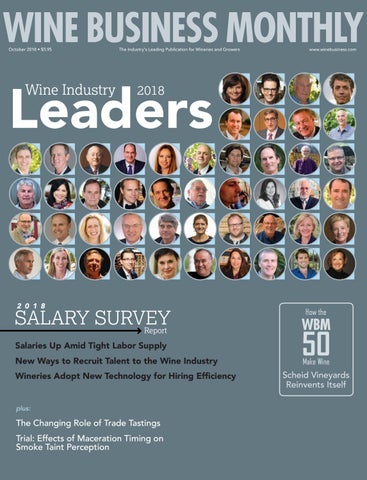
WINE BUSINESS MONTHLY October 2018 • $5.95
The Industry’s Leading Publication for Wineries and Growers
www.winebusiness.com
Leaders Wine Industry
2018
2 0 1 8
SALARY SURVEY Report Salaries Up Amid Tight Labor Supply New Ways to Recruit Talent to the Wine Industry Wineries Adopt New Technology for Hiring Efficiency
plus:
The Changing Role of Trade Tastings Trial: Effects of Maceration Timing on Smoke Taint Perception
How the
WBM
50 Make Wine
Scheid Vineyards Reinvents Itself
THE NEW
AVANT-GARDE DESIGN The new Avant-Garde taking its assertive lines from the world of spirits, AIKIDO redefines the bold spirit of the best-selling KENDO WINE bottle. With its slightly tapered body, slanted shoulder punctuated by a chiseled edge, canted base wall and pointed-tipped punt, AIKIDO has become the new avant-garde design of reference in the wine-making world.
SAVERGLASS INC. Napa (CA): (707) 259-2930 East Coast (NJ): (201) 825-7100 Pacific North West (OR): (707) 337-1479 Mid West (KY): (859) 308-7130
www.saverglass.com HAUTE COUTURE GLASS
How do you seal a Russian River Pinot Noir that’s in no hurry to mature?
NOMACORC PlantCorc®
Not just sealed, solved.
Oxygen ingress matched to wine style
SÜBR Micro-agglomerate
ZEST PlantCorc®
VINTOP Premium Screw Cap
SYNTEK Synthetic
month in review
WINE BUSINESS MONTHLY October 2018 • Volume XXV No. 10 EDITOR Cyril Penn SENIOR TECHNICAL EDITOR Curtis Phillips MANAGING EDITOR Rachel Nichols SENIOR EDITOR Erin Kirschenmann
WINE BUSINESS MONTHLY
OCTOBER 2018
October 2018 • $5.95
WINE BUSINESS MONTHLY
The Industry’s Leading Publication for Wineries and Growers
www.winebusiness.com
COPY EDITOR Paula Whiteside CONTRIBUTORS Lance Cutler Alan Goldfarb Mark Greenspan Michael S. Lasky Liza B. Zimmerman
Leaders Wine Industry
2018
2018
DESIGN & PRODUCTION Scott Summers
Leaders • 2018 SALARY SURVEY Report
As we’re putting the finishing touches on this issue, harvest is in full swing. We’ve had some unusual climate events this season, wildfires included, and more than a few heat spikes, but as the grapes near the finish line we’re expecting milder weather. People have been expecting an average crop but the berries seem to be looking a little larger down the home stretch. It will be interesting to see how the market for grapes and bulk wine responds after the grapes are all in. The October issue is about leadership with a look at the industry’s top leaders. It also features one of the more popular articles we publish—the annual Salary Survey report—along with a report on innovative recruiting practices companies are using to bring people in as well as another on how applicant tracking system software guides the hiring process. Getting good help is one of the biggest issues facing wineries today, and when good vineyard help is too hard to find, automation can be a viable solution. Mechanical harvesting provides superior grapes. The whole discussion seems to have shifted. You’ll want to decide that for yourself, but this issue includes an article based on some of the discussion about mechanical harvesting that took place during the recent Innovation + Quality conference. In some ways it’s a familiar story: successful grower eventually launches wine brand. Scheid Vineyards isn’t the only grower to transition from vineyard operation to fullblown winery, but the company has really reinvented itself. OCTOBER:
STAFF WRITER/NEWS EDITOR Kerana Todorov
PRESIDENT & PUBLISHER Eric Jorgensen 2 0 1 8
SALARY SURVEY Report
ASSOCIATE PUBLISHER Tamara Leon
How the
WBM
50
Salaries Up Amid Tight Labor Supply New Ways to Recruit Talent to the Wine Industry
Make Wine
Scheid Vineyards Reinvents Itself
Wineries Adopt New Technology for Hiring Efficiency
plus:
ADVERTISING Account Support Representative Mary Anne Stockus
The Changing Role of Trade Tastings Trial: Effects of Maceration Timing on Smoke Taint Perception
We have details about another trial that tested a possible treatment for smoke taint, this time looking at the effect of maceration timing, while Mark Greenspan discusses using wind to your advantage in the vineyard. The October issue includes a look at the changing role of trade tastings as a marketing and sales tool, too. Trade tastings are evolving. Curtis Phillips riffs on industry research in his column and specifically about how the American Vineyard Foundation raises money and sets research priorities. Ask not just what AVF can do for you but also what you can do for AVF. Cyril Penn – Editor
ADMINISTRATION Vice President – Data Management Lynne Skinner Circulation Liesl Stevenson Operations Analyst/Customer Support Katie Kohfeld Office Manager/Customer Support Jacki Kardum Public Relations Mary Jorgensen EVENTS Kara Foley Olivia Haywood WINEJOBS.COM Marissa Bell CHAIRMAN Hugh Tietjen PUBLISHING CONSULTANT Ken Koppel For editorial or advertising inquiries, call 707-940-3920 or email info@winebusiness.com
WINE BUSINESS MONTHLY
For subscriptions, call 800-895-9463.
The leading producer of wine industry information and events P
U
I C A T I O B L N
N T S E V E S
Financial
WINE BUSINESS MONTHLY dailY news e M A I L
WINE BUSINESS.com WINE BUSINESS INSIDER
winejobs.com
SYMPOSIUM
C EN T R A L C O A S T
Vineyard
Insights
ECONOMICS
SYMPOSIUM
Classifieds grapes & bulk wine used equipment
Lodi Economics
SYMPOSIUM
winejobs.com
TECH SYMPOSIUM
6 October 2018 WBM
R V I C E S S E
SUMMIT
services & supplies
used barrels real estate
Copyright 2018 Wine Communications Group, Inc. Short passages can be quoted without permission but only if the information is attributed to Wine Business Monthly. Wine Business Monthly is distributed through an audited circulation. Those interested in subscribing for $39/year, or $58 for 2 years, call 800-895-9463 or subscribe online at www.winebusiness.com. You may also fill out the card in this magazine and send it in.
INCREASE YOUR CAPACITY SCOTT PELLETIER 408 500.8797 scott@lagardeinox.com
LAGARDEINOX.COM 1 800 263.5170 info@lagardeinox.com
JASON PEPPER 707 312.1123 jason@lagardeinox.com
contents
October 2018 • Volume XXV No. 10 • The Industry’s Leading Publication for Wineries and Growers • www.winebusiness.com
Leaders Wine Industry
2018
. . . . . . . . . . . . . . . . . . . . . . . . . . . . 15
A leader is someone who makes an impact or shapes how people act or how things occur—an agent of change. When Wine Business Monthly created this list, we wanted to acknowledge the multitude of leaders shaping the industry today. We have a general list of leaders as well as three trend-based category lists: Mergers & Acquisitions, Mechanization and Distribution Disrupters, areas that made an impact on the industry in 2018.
winemaking How the
WBM
50 Make Wine
technology & business
Scheid Family Wines: Transitioning from Grower to Winery . . 32 A transition from grower to winery makes Scheid Family Wines the 33rd largest winery in the United States
2
0
1
8
SALARY SURVEY Report
Wine Industry Salaries Up 2.7 Percent . . . . . . . 68
Alan Goldfarb
Recruiters report tight labor market in strong economy
Winemaker Trial: Oregon Winemaker Checks the Effect of Maceration Timing of Pinot Noir on Smoke Taint Extraction . . . . . . . . . . . . . . . . 38 A to Z Wineworks winemaker Dan Berglund wanted to tackle the wildfire smoke taint problem in a different way: His approach was to see if different soak times and days on skins made a difference in the perception of smoke on the final wine. The results surprised him. Michael S. Lasky
The Future is Up to Us . . . . . . . . . . . . . . . . . . . 42 It takes interest—and funding—to make better wine
Kerana Todorov
Thinking Outside the Box to Attract Top Talent . . . . . . . . . . . . . . . . . . . . 78 Companies are coming up with innovative new recruiting practices to bring people in—even offering tuition assistance to attract Millennials Erin Kirschenmann
Wineries Starting to Use Applicant Tracking System Software . . . . . . . . 82 From initial job posting to final hire, the use of applicant tracking systems (ATS) can reduce time spent following paper trails while increasing the ability to pinpoint the best candidates, not only for the applied position, but for other openings.
Curtis Phillips
grape growing
Michael S. Lasky
Working with Wind . . . . . . . . . . . . 46 High wind conditions are common in many wine-growing regions. Here’s how to deal with them. Mark Greenspan
sales & marketing The Evolution of Tasting Events . . . . . . . . . . . . 58 Lance Cutler
Does Mechanical Harvesting Provide Superior Grapes? . . . . . . . 52
Restaurant Reservation Technology is Changing the On-premise Landscape . . . . . . . . . . . . . . . . 64
Winemakers and growers share their own experiences with machine harvesting
Ease-of-use for consumers and online marketing exposure for operators drive higher usage of booking services.
Kerana Todorov
Liza B. Zimmerman
departments month in review . . . . . . . . . . . . . . . . . . . . . . . . . . . . . . . . 6 news . . . . . . . . . . . . . . . . . . . . . . . . . . . . . . . . . . . . . . . . 12 people . . . . . . . . . . . . . . . . . . . . . . . . . . . . . . . . . . . . . . . 86 advertiser index . . . . . . . . . . . . . . . . . . . . . . . . . . . . . . . 88 jake lorenzo Greek to Me . . . . . . . . . . . . . . . . . . . . . . . . 90
COVER DESIGN:
Scott Summers
winemaker of the month . . . . . . . . . . . . . . . . . . . . . . . . . 89 Kelly Koch, winemaker, Macari Vineyards, North Fork of Long Island, New York
Wine Business Monthly (ISSN 1075-7058) is published monthly by Wine Communications Group, Inc., 35 Maple St., Sonoma, CA 95476. Subscription rates are $39 for domestic; US$49 for Canadian and US$89 for foreign subscribers. Periodicals Postage Paid at Sonoma, CA, and at additional mailing offices. POSTMASTER: Send address changes to: Wine Business Monthly, PO Box 1649, Boulder, CO 80306-1649.
WBM
who’s talking in this issue
October 2018
Dan Berglund, winemaker, A to Z Wineworks, “Winemaker Trial” page 38
“I think that the biggest takeaway for us is that we should just make the best red wine that we can, and not worry too much about trying to reduce that time on skins, especially toward the end of the ferment.”
Jerry Seps, owner, Storybook Mountain Vineyards, “The Evolution of Tasting Events” page 58 “Since trade shows are almost always before consumer events, buyers who stayed into the consumer event could see how many people were crazy for Zinfandel. It encouraged them to buy Zin for their stores or restaurants, and encouraged them to order more cases than they had originally planned.”
Evan Goldstein, president and chief education officer, Full Circle Wine Solutions, “The Evolution of Tasting Events” page 58 “We are finding that more sit down, focused, curated sessions with key objectives, expert presentation and selected wines still draw trade. A lot of people will attend the master classes and then leave. You need an array of stunning wines to get them to stay.”
Aaron Fishleder, president, Vinescape “Does Mechanical Harvesting Provide Superior Grapes?” page 52 “It was almost like the angelic light shone down on these smaller machines―the 690 and the 890. That was a real game-changer for us.”
Heather Johnson, senior regional manager, Robert Half International, “Thinking Outside the Box to Attract Top Talent” page 78 “We did a survey of more than 10,000 employers and 76 percent of them said they lost really great candidates because they didn’t feel like they actually told the story of their company well enough through the first posting, through the website, through the interview process.”
10 October 2018 WBM
news
For daily news you can search or browse by region, visit winebusiness.com/news
Top Stories from WINE BUSINESS.com – In Case You Missed It Ste. Michelle President and CEO Ted Baseler Announces Retirement Ted Baseler, president and CEO of Ste. Michelle Wine Estates, ended his storied and acclaimed career with the company on
October 1, 2018. The announcement capped a 34-year run with the company, including 17 years as president and CEO, during which his vision and leadership for Ste. Michelle, and the industry in general, fueled the evolution of the Washington wine industry and led to historic company and personal achievements. As president and CEO, Baseler increased operating company income from $21 million in 2000 to $146 million in 2017, with a compounded annual growth rate of 12.1 percent. Wine shipment volume grew from 2.8 million cases to 8.5 million cases over that same period, with a compounded annual growth rate of 6.8 percent. He also orchestrated Ste. Michelle’s surprise acquisition of the renowned Stag’s Leap Wine Cellars with the Antinori family in 2007. Jim Mortensen, an accomplished general manager with global experience in consumer packaged goods businesses, has been appointed to succeed Baseler.
Long Meadow Ranch Wine Estates Acquires Stony Hill Vineyard The McCrea family of Stony Hill Vineyard and the Hall family of Long Meadow Ranch announced that Stony Hill Vineyard, founded in the early 1940s and located in the Spring Mountain District, will become part of the Long Meadow Ranch Wine Estates (LMR). The McCrea family will retain an equity interest in the combined entity, which is led by Ted Hall, and executive vice president and COO, Chris Hall. The entire Stony Hill team will become part of the LMR family. Mike Chelini, winemaker for Stony Hill for more than 40 years, will serve as winemaker for the 2018 harvest and continue on in the role of winemaker emeritus. The vineyard, hospitality and operations teams will join the new company as well. Stony Hill will join a lineup of properties owned by LMR in the Mayacamas Mountains, Rutherford, and Anderson Valley. International Wine Associates served as the exclusive advisor to and represented the McCrea family and Stony Hill Vineyard in the transaction.
Precept Wine Acquires Truett-Hurst Wholesale Business Unit for $18 Million Precept Wine announced the acquisition of Truett-Hurst’s wholesale business unit and portfolio of national and exclusive brands created for retailers such as Albertsons, The Kroger Co., Trader Joes, Total Wine & More and many others. The deal gives Precept a foothold in the California wine market and bolsters its exclusive label business, the fastest growing portion of its portfolio. It adds 300,000 cases to Precept’s exclusive label business, which will now account for more than one million cases annually. (Precept’s national brands account for an additional 1 million cases). As part of the acquisition, Truett-Hurst president and CEO Phillip Hurst is joining Precept to focus on national and exclusive brands as chief innovation officer.
Commerce7 Launches Point of Sale System Commerce7, a winery DTC platform, has added a point of sale (POS) system to its suite of products. The POS provides
wineries with an easy solution for processing tasting room orders, streamlining workflow and leverages existing data to allow staff to efficiently manage customers. The Commerce7 POS enables wineries to accept payment via EMV chip and pin cards, or mobile wallets, such as ApplePay or GooglePay. This cloud-connected POS allows for staff to easily access all existing customer, order and club data. The POS enables wineries to streamline their operations with smart notifications, allowing easy management of pickup orders, club shipments and other customer service issues. Staff have the ability to manage multiple orders at one time, add new and edit existing customer information and toggle between customers in real-time. POS • Ecommerce • Wine Club • CRM The tools your staff need. The experience your customers want.
Wholesalers Collaborate with Nielsen, VIP and ATKearney to Produce Big Data Package Customer Centric Commerce
Wine and spirits companies will have access to aggregated data from the country’s biggest wholesalers and Nielsen, all to gain better insights into trends in the industry. SipSource, slated to be launched during the first quarter of 2019, will provide depletion data of more than 250 million cases. The new data product will allow insights into the wine and spirits business with a level of precision that has never been possible in the past, said Thomas McDevitt, senior vice president, enterprise insight and analytics at Southern Glazer’s Wine & Spirits. SipSource is a collaboration between Wine and Spirits Wholesalers of America, large wholesalers such as Southern Glazer’s Wine & Spirits; Nielsen, ATKearney, a consulting firm; and Vermont Information Processing. WBM www.commerce7.com
(604) 755-3518
12 October 2018 WBM
SERVICE FROM THE SOURCE for bottling day and beyond
High-quality, U.S.-made glass direct from the manufacturer Now, wineries of all sizes can experience the high level of attention, responsiveness and ease that comes with buying directly from Ardagh Group. As the largest producer of glass wine bottles made 100% in the USA, Ardagh Group has the resources to meet your unique needs in a highly-flexible manner. We even offer the option to order less than truckload quantities through
West: 707-200-9350 Central/East: 800-428-8642 www.ardaghgroup.com/wine2018 100% Made in the USA
our new concierge service, Ardagh Direct. Our experienced sales teams and manufacturing facilities are ready to serve you — right from the heart of the major North American wine regions. Give us a call today to learn more about our extensive product portfolio and the exceptional service you can expect for bottling day and beyond.
WBM Financial WINE INDUSTRY
SYMPOSIUM
The premier wine industry conference covering financial, business and strategic issues. The Wine Industry Symposium Group, a subsidiary of WINE BUSINESS MONTHLY, would like to thank the following partners and sponsors:
Vintners
I found my job at
winejobs .com Attending Wine Companies 1956
CRU Wine Company
Honig Vineyard & Winery
Opus One Winery LLC
Accolade Wines
Deutsch Family Wine & Spirits
Huneeus Vintners, LLC
Oregon Wine Board
Iron Horse Vineyards
Penrose Hill
JaM Cellars, Inc.
Precept Wine
Keenan Winery
Renteria Vineyard Managment
Antinori California Inc. Benessere Vineyards Broadland Wineries.com C. Mondavi & Family Clos Du Val Winery Colgin Cellars
Dry Creek Vineyard Duckhorn Wine Co. Fetzer Vineyards Foxen Vineyard Grgich Hills Estate Groth Vineyards & Winery
Kivelstadt Cellars Midnight Rose, LLC Montinore Estate
The Hess Collection Winery Treasury Wine Estates Turley Wine Cellars Vintage Wine Estates Vinum Cellars, Inc.
Rombauer Vineyards
Weibel Family Winery
SAV Wines, Inc.
Wente Family Estates
Ste. Michelle Wine Estates
WX Brands
Details for the 2019 event will be announced next spring. See what you missed this year at wineindustryfinancial.com Presented by the Wine Industry Symposium Group, a subsidiary of
WINE BUSINESS MONTHLY
WBMevents
Leaders Wine Industry
2018
WBM October 2018 15
Leaders Wine Industry
2018
A leader is someone who makes an impact or shapes how people act or how things occur—an agent of change. Making and selling wine is a multi-faceted endeavor led by those brave enough (or crazy enough) to pave a new way forward, inspiring generations to come. There are different ways to be a leader. Some of the leaders on this list have discovered new ways of doing things: new ways of marketing, tapping into trends and building brands. Some were entrepreneurial. Others developed a specific expertise; found niches or rallied behind causes they believed in. Some of the influential people on this list are known to virtually anyone who follows the wine industry while others are influential yet fly “under the radar.” All of them are leaders in the North American wine business. When Wine Business Monthly created this list, we wanted to acknowledge the multitude of leaders shaping the industry today. We have a general list of leaders as well as three trend-based category lists: Mergers & Acquisitions, Mechanization and Distribution Disrupters, areas that made an impact on the industry in 2018. Here’s to WBM’s Top Leaders in the Wine Industry 2018!
Mergers & Acquisitions These people are purchasing and selling vineyards, wineries and brands, or helped make those transactions possible.
Barbara Banke
Andrew Browne
chairman and proprietor, Jackson Family Wines
founder, president and CEO
Leading a wave of investment in quality
Leading the fastest-growing wine company in the Pacific Northwest
Jackson Family Wines’ chairman and proprietor has spent the last two decades leading the company she co-founded with her late husband Jess Jackson while building and expanding some of the most well-known wineries in the nation. Jackson Family Wines is the leading supplier of Pinot Noir and Chardonnay. Barbara Banke takes a hands-on role in the development and promotion of various Jackson Family wine estates. After a wave of acquisitions in recent years, Banke has focused on digesting them and on developing vineyard and winery operations in Oregon.
16 October 2018 WBM
Andrew Browne launched Precept Wine in 2003 after working in sales for Southern Wine & Spirits, Chateau St. Jean, Associated Vintners, Corus Brands and Constellation Brands. He took Precept Wine from sales of zero cases to 300,000 in five years and today Precept is the Northwest’s second-largest wine company with annual sales approaching 2 million cases. Precept’s growth has largely been organic, but this year the company purchased the wholesale division of Truett-Hurst Inc. for $18 million.
Tony Correia
Roger Nabedian
principal, The Correia Co.
senior vice president, premium wine division, E&J Gallo Winery
Most well-known vineyard and winery appraiser
Overseeing E&J Gallo’s high-end expansion
It’s often said, “You can’t get the deal done without Tony.” Tony Correia specializes in the appraisal of large, complex agricultural properties and difficult appraisal assignments. He is a frequent instructor of appraisal courses and seminars throughout the nation, and a public speaker on agricultural, appraisal, taxation and estate planning issues, and the vineyard and wine industries.
E&J Gallo, the world’s largest wine company, operates in 100 countries, focusing on all price tiers, from $4 per bottle every-day wines to $150-per-bottle vineyard-designates. Roger Nabedian runs the premium wine group, consisting of at least 45 brands, and he’s overseen a range of acquisitions of premium wineries and vineyards. Nabedian is responsible for consumer products insights and marketing services. In 2018, Gallo purchased the Locations brand from Dave Phinney, as well as two large vineyard properties in Santa Barbara.
Agustin F. Huneeus proprietor, Huneeus Vintners
One of the most successful companies in the wine business Agustin Francisco Huneeus is a second-generation vintner who owns Quintessa, Faust, Flowers Vineyard & Winery and Benton-Lane, and is partners with Andy Erickson on Leviathan. Agustin and his father have a record of buying, building and selling premium wineries and brands, most recently selling The Prisoner Wine Company to Constellation and Veramonte to Gonzalez Byass. This year, Huneeus Vintners purchased Benton-Lane Winery in Oregon, and added vineyards in Oakville and Coombsville to bring their total land holdings in Napa Valley to over 500 acres. In 2016, Agustin purchased the old Belvedere Winery from Bill Hambrecht on Westside Road in Healdsburg, as well as the St. Clement Winery Estate from Treasury Wine Estates.
Jeff Menashe founder and CEO, Demeter Group
Advising some of the industry’s most important mergers and acquisitions Jeff Menashe has played an advisory role in more than $3.5 billion of deals, including the sale of Layer Cake, Cherry Pie and If You See Kay to Vintage Wine Estates, as well as Woodinville Whiskey Company to Moët Hennessy. He’s been involved in recognizing other wine industry leaders too, supporting Sonoma State University’s Business of Wine Video Series and conceiving the Business of Wine Leadership Dinner.
Robert Nicholson principal, International Wine Associates
Guiding some of the largest M&A deals Robert Nicholson has completed more than 55 separate transactions with a combined value of more than $1.5 billion, including sales of many well-known wine estates, vineyards and businesses.
Alex Ryan CEO, Duckhorn Wine Company
Top seller of luxury wine Duckhorn Wine Company is on the move. In the 12 years Alex Ryan has been running Duckhorn, it has grown to be a top seller of luxury wines, has seen two ownership changes, and most recently acquired two important brands— Sonoma’s Kosta Browne and the Central Coast’s Calera Wine Company—adding to Duckhorn’s high-end Pinot Noir portfolio.
Mario Zepponi founder, Zepponi & Co.
Helping premium wineries find appropriate buyers Mario Zepponi’s firm has served as a transaction advisor to several companies with recent transactions such as Meiomi, Kenwood Vineyards, Chalk Hill Estate, Murphy-Goode, Siduri, Goosecross Cellars, Robert Hall and Four Vines.
WBM October 2018 17
Leaders Wine Industry
2018
Distribution Disrupters The wholesale tier of the wine industry continues to consolidate. Mega-wholesalers with national footprints have emerged through mergers and now dominate the market, while smaller outfits have filled gaps. Others have endeavored to change the way they do business within the three-tier system.
Greg Baird
Cheryl Murphy
president and CEO, Breakthru Beverage Group
founder/CEO, Liberation Distribution (LibDib)
Running a $6 billion wholesale juggernaut
Cheryl Murphy spent 20 years in sales and marketing with her family’s winery, Clos LaChance, before launching Liberation Distribution, offering a three-tier compliant web-based platform for beer, wine and spirits producers. The platform operates in California and New York, providing an alternative way for small producers to get to market and plans to expand to other markets in the near future.
Greg Baird runs Breakthru Beverage Group, formed by the merger of Charmer Sunbelt and Wirtz Beverage with operations in 19 markets and a portfolio representing more than $6 billion in annual sales.
Harvey and Wayne Chaplin chairman and CEO of Southern Glazer’s Wine & Spirits, respectively
Running the nation’s largest wholesale distribution company Following the merger of Southern Wine & Spirits and Glazers Distributors, the nation’s largest distributor is Southern Glazer’s Wine & Spirits, operating in 44 states with more than 20,000 employees distributing more than 150 million cases of wine and spirits annually. Harvey R. Chaplin (pictured) serves as chairman while Wayne E. Chaplin is chief executive.
Robert Foye COO and president Americas, Treasury Wine Estates
Taking distribution direct in select markets Treasury Wine Estates is pursuing a direct route-to-market in states where it is legal, California and Washington, by directly distributing to retailers on a national and regional level. In others, such as Florida, it will employ a hybrid model in collaboration with Breakthru Beverage Group.
18 October 2018 WBM
Championing a new, direct distribution model
Robert Trone co-founder, Total Wine & More
Building a retail wine juggernaut Total Wine & More’s “superstores” have a large selection at all price points with low prices on items in wide distribution. A typical store carries 7,000 wine items. Total encouraged direct deals with small suppliers with wholesalers taking smaller percentages and through its private label program. Brothers David and Robert Trone operate 171 stores and are adding more. They’re in 20 states, with $2.7 billion in sales: 47 percent of that from sales of wine—$1.3 billion in wine sales as of 2017.
Leaders Wine Industry
2018
Leaders Wine Industry
2018
Mechanization The labor market has been steadily shrinking over the last five years and labor costs have been skyrocketing, especially in the vineyard. That’s led to more wineries being open to mechanical harvesting. There’s a growing realization that mechanical harvesting will play a bigger role going forward and that the quality of the fruit from mechanically harvested vineyards can be good.
Nick Dokoozlian
Steve McIntyre
vice president of viticulture, chemistry and enology, E&J Gallo Winery
proprietor, Monterey Pacific, Inc.
Putting a spotlight on efficiency with the nation’s largest wine producer Dr. Nick Dokoozlian is responsible for research and innovation in grape and wine production, including growing practices that improve yield and quality, the development and application of grape and wine chemical quality metrics and the impacts of processing, fermentation and aging practices on wine composition and sensory characteristics. He manages external research collaborations with universities and other research agencies. He’s focused on pruning and crop load mechanization to address vine balance and improve fruit and wine compounds while addressing labor costs and availability.
Jean Henin CEO, Pellenc Group
Pushing mechanical harvesting technology forward Jean Henin is a name most people in the U.S. wine industry have probably never heard, but the company he leads is familiar when it comes to harvesting grapes. Henin leads Pellenc Selective Technologies SA, a company that has changed the way grapes are mechanically harvested by bringing optical sorting technology into the vineyard. The latest advances from Pellenc include a leaf remover with a “soft touch” head using new canopy-sensing technology.
Larry Maguire president/vice chairman, Far Niente Wine Estates
Luxury wine and an open mind Oakville-based luxury wine producer Far Niente Wine Estates also includes Vinescape, its vineyard management arm, which is a leader among forward-thinking wine companies making mechanical harvesting part of a vineyard program—when it makes sense.
20 October 2018 WBM
Effective spokesman and mentor for grape growers A founding member of Monterey Wine Company and Monterey Pacific Inc., Steve McIntyre farms 12,000 acres in the Central Coast region of California. He has a unique perspective on what it takes to farm grapes successfully and has been an outspoken leader on farming for quality, environmental sustainability and on issues affecting growers, including labor management.
Towle Merritt general manager, Walsh Vineyard Management
Bringing mechanization to luxury wine As general manager at Walsh Vineyard Management, which operates in Napa Valley, Towle Merritt helped move the level of knowledge and the dialogue on mechanical harvesting forward. His firm allows customers to try new technology cost effectively and has been instrumental in educating clients.
Rodney Schatz proprietor, Peltier Winery & Vineyards
Developing a “no touch” vineyard Rodney Schatz and his family of third-generation growers run Peltier Winery & Vineyards, an innovative winery and custom crush facility in Lodi, California. Schatz is working toward total mechanization within the vineyard—a “no touch” vineyard.
Leaders Wine Industry
2018
What keeps your winery from growing? D I S T R I B U T O R C O N S O L I D AT I O N AGING EQUIPMENT LONG CAPITAL CYCLES MANAGING CASH FLOW PROFITABILITY R E G U L AT O R Y R E Q U I R E M E N T S
If you don’t think a bank can help you optimize growth, minimize risk and help your winery flourish, maybe it’s time to bank differently.
Want a little advice? Ask the Leading Bank for Business.*
At Comerica, we’ve become the Leading Bank for Business by providing more than just banking basics, because we’re not just business bankers. We’re business advisors, here to help plan, guide and consult. With a $350 million wine industry portfolio, nearly 150 years of experience and the industry-specific knowledge your wine business needs, we can help you grow and protect the fruits of your labor. To move forward, move beyond basic banking. Learn how, with the Leading Bank for Business at comerica.com/wine.
®
MEMBER FDIC. EQUAL OPPORTUNITY LENDER. *Comerica ranks first nationally among the top 25 U.S. financial holding companies, based on commercial and industrial loans outstanding as a percentage of assets, as of March 31, 2018. Data provided by S&P Global Market Intelligence.
RAISE YOUR EXPECTATIONS. CB-67921-03 04/18
Leaders Wine Industry
2018
MOSSADAMS.COM/ WINE
OPPORTUNITY RISES IN THE WEST
Here, the sun rises on endless possibility. That’s why we’ve been committed to helping wineries, vineyards, and industry suppliers grow and protect their prosperity for over 35 years. As you explore your next opportunity, we invite you to discover how our industry-smart accounting, consulting, and wealth management services can help your business thrive.
RISE WITH THE WEST.
Assurance, tax, and consulting offered through Moss Adams LLP. Investment advisory services offered through Moss Adams Wealth Advisors LLC. Investment banking offered through Moss Adams Capital LLC.
STR ATEGY & OPER ATIONS CONSULTING TA X IT CONSULTING SUCCES SION PL A NNING VA LUATIONS
Leaders Wine Industry
2018
General List Annette Alvarez-Peters
Gordon Burns
chief wine buyer, beverage alcohol division, Costco
co-founder/technical director, ETS Laboratories
Leading Costco’s wine program Costco sells roughly 4 billion in sales of wine, beer and spirits each year. The company has members in 49 million households. Costco has 12 wine buyers spread throughout the U.S. Annette Alvarez-Peters aims to select brands that deliver quality and low prices Costco is known for.
Andy Beckstoffer vineyard owner, Beckstoffer Vineyards
Most influential Napa grape grower, affecting pricing and making vineyard purchases intriguing One of the most important early leaders in the evolution of the Napa Valley’s emergence as a world-class grape-growing region, Andy Beckstoffer, a founding director of the Napa Valley Grapegrowers association, tied the price of grapes to retail bottle prices. He led the Napa Valley Grapegrowers in establishing the Winery Definition Ordinance, requiring 75 percent of grapes used in Napa Valley labeled wines to come from the appellation. Beckstoffer Vineyards owns and farms 3,600 acres.
Jean-Charles Boisset president, Boisset Collection
Always brainstorming, the most fashionable man in the U.S. wine biz Jean-Charles Boisset’s family established what became Burgundy‘s largest wine producer and France’s third-biggest wine group. In the U.S., Boisset owns DeLoach Winery, Raymond Vineyards, Buena Vista and others. Innovation is continual for Boisset, with new ventures on the way, and his deep passion for fine wine, history and respect for the environment always shines.
Created the analytical backbone of the wine industry Gordon and Marjorie Burns founded ETS Laboratories in 1978, and ETS has been a leader in wine analysis since. Burns has been continuously involved in the wine industry, including leadership roles as a past chair of the American Society of Enology and Viticulture Technical Projects Enology Committee, and its Technical Projects Analytical Quality Committee, and with the Wine Institute Technical Projects Committee. Burns and his firm are considered the gold standard of wine analytics and the firm continues to innovate. This year, ETS made significant contributions to Cal Poly San Luis Obispo and Fresno State University’s wine and viticulture programs.
Fred Franzia co-founder, Bronco Wine Company
The advocate for everyday wines Calling Fred Franzia a colorful character would be an understatement. Bronco Wine Co. changed the industry in 2002 by selling $1.99 wines at Trader Joe’s stores under the Charles Shaw label. It’s now sold something like 1 billion bottles of “Two Buck Chuck.” Bronco is the fourth-largest wine company by volume. The latest: Launching Shaw Organic with the capacity to ramp up to 1 million cases of organic wine.
Ernest J. Gallo chief operating officer, E&J Gallo
Next generation leadership for E&J Gallo Ernest J. Gallo, son of current president and CEO Joseph Gallo and grandson of co-founder Ernest Gallo, was appointed chief operating officer and is scheduled to become president and CEO in 2020. He’s been with the business for 23 years, working in domestic and international sales, marketing, new product development and finance. He most recently served as vice president and general manager of Gallo’s spirits unit. In an interview with Shanken News Daily, Gallo said his main priority right now is to listen and learn from as many people as possible.
WBM October 2018 23
Leaders General List Wine Industry
2018
Antonio Galloni
Chris Indelicato
owner, Vinous Media/Wine Advocate (former)
president & CEO, Delicato Family Vineyards
Gaining influence as a critic and innovator
Leading a third generation of family management
Antonio Galloni was a critic with Robert Parker’s publication The Wine Advocate from 2006 to 2013. In May 2013, he founded Vinous, and two years ago he struck a deal to acquire Delectable, an app that pulls crowd-sourced wine reviews when you snap a photo of the label. He’s since expanded editorial content for Delectable users with articles and reviews from his website.
Chris Indelicato leads one of the fastest growing wineries and one of the largest wine companies—production exceeds 7 million cases—with 90 years of California winemaking and grape growing heritage. His grandfather, Gaspare Indelicato, broke ground on the family’s first vineyards in 1924. He assumed the role of president and CEO at Delicato Family Vineyards in 2004. Chris Indelicato is currently the chairman of Wine Institute.
Margareth Henriquez president & CEO, Krug Maison De Champagne
Improving luxury marketing at Krug Margareth Henriquez was named president of Estates & Wines at luxury company LVMH. As president and CEO of the Champagne House Krug, Henriquez recognized luxury brands are often tied to an individual, usually the founder, and a vision that goes beyond what others are doing with a particular product. Recognizing that buyers of luxury products won’t buy products they don’t understand, she provided transparency in terms of composition of the blends with individual identification codes on back labels. By communicating Joseph Krug’s vision and providing transparency into how that vision is achieved she allowed customers to better understand Krug Champagne.
John Hinman founding partner, Hinman & Carmichael LLP
Leading attorney on alcoholic beverage compliance John Hinman has been advising and representing alcoholic beverage industry clients in all phases of industry regulation, from trade practice, distribution, importation to product fulfillment, retail licensing and production. He represents clients before the TTB, the California ABC and the counterpart agencies of other states. He’s defended more than 200 administrative accusations and hearings both at TTB and the ABC in the last 25 plus years and has taken industry cases as far as the California Supreme Court.
24 October 2018 WBM
Greg Jones Director of wine education and research climatologist, Linfield College
Climate change is top of mind When it comes to climate change and wine, Greg Jones is the go-to-guy. He’s a climatologist with an interest in growing winegrapes. He has given hundreds of international, national and regional presentations on climate and wine-related research. His family is active in the wine industry with Abacela, in Southern Oregon. After 20 years with Southern Oregon University, Jones accepted a position with Linfield College, where he oversees the wine education program.
Phil Markert sales manager, Safeway Southern California Division
Father of Safeway’s wine program Phil Markert, now a senior sales manager with Safeway/Albertsons, has been a wine buyer for more than three decades. He spent 22 years with Safeway in Southern California, becoming Safeway’s national category director of wine in 2002. He’s the guy who created the wine-storewithin-a grocery-store concept. In 2013, he was appointed localization leader at Safeway. When Albertsons merged with Safeway in 2015, decentralizing the organization, Markert recently returned to Southern California to lead the wine team and finish what he started.
Leaders Wine Industry
2018
Leaders General List Wine Industry
2018
Mary Melton
Anita Oberholster
beverage director, P.F. Chang’s
cooperative extension specialist in enology, UC Davis
Wine Buyer for more than 200 P.F. Chang’s restaurants
Making wine research useful
Mary Melton is a key wine buyer, responsible for P.F. Chang’s beverage program across its 211 U.S. restaurants. She manages the creation of beverage menus, the wine program, drink innovation and development, wine education and bartender training. P.F. Chang’s, through Melton’s leadership, was the first to bring Asian food and premium wine together on a broad basis.
Dr. Anita Oberholster joined the UC Davis Department of Viticulture and Enology in 2011. Her research focuses on the influence of viticulture practices and environmental factors on grape ripening and wine quality. Dr. Oberholster has been effective in keeping current with fellow researchers and getting new research findings into the hands of practitioners who can make use of it. She earned her Ph.D. from Adelaide University in Australia.
Bill Newlands president, wine and spirits division, Constellation Brands
Guiding innovation and wine at Constellation Throughout his career in the wine business, Bill Newlands has been an innovator with new products often emerging under his leadership. Remember Arbor Mist? He’s worked for a who’s who of American wineries and was CEO of wine.com in the dot-com day. Newlands rejoined Constellation Brands in 2015 in corporate strategy and business development heading up “new product development and innovation” prior to being named president of the wine division. This year he was promoted to president and chief operating officer for all of Constellation while Rob Sands, who previously held the title of president and chief executive officer, will continue to serve as CEO.
Jeff O’Neill CEO, O’Neill Vintners & Distillers
Leadership in the wine industry for more than three decades Jeff O’Neill is CEO of O’Neill Vintners & Distillers, a large distiller and vintner in California’s Central Valley, an outsourcing partner for key retailers and a builder of national brands. The winery crushes roughly 160,000 tons of grapes annually and is the sixth largest winery in California by volume. O’Neill was a founder of Golden State Vintners in 1985, a public company he led as CEO that sold 19 years later to The Wine Group in a deal worth $111 million. In 2011 O’Neill was involved in building Ram’s Gate Winery in Carneros. His company purchased 80,000-case Robert Hall Winery in Paso Robles in 2016. O’Neill is a past chairman of the California Wine Institute, chairman of The Presidents’ Forum of the Distilled Spirits Industry, a past chairman of the board of Woolf Farms, a 125,000 acre farming conglomerate, and a member of the YPO.
26 October 2018 WBM
Dan Petroski winemaker, Larkmead Cellars/Band of Vintners
Thought leader among winemakers Dan Petroski is winemaker at Larkmead Cellars as well as founder of his own label, Massican. He spent 10 years as a magazine executive before moving to Italy in 2005 where he spent a year living and working with the family that owns Sicilian winery Valle dell’ Acate. Petroski returned from Italy, joining Larkmead as an intern while assisting winemaker Andy Smith with the harvest. Petroski was hired the next year, responsible for daily management of Larkmead winemaking; five years later he was promoted to winemaker. He’s also part of Band of Vintners, born from a seven-member tasting group, each member with a unique wine knowledge base across Napa County. Petroski also hosts periodic salons, which gather leaders throughout the region to discuss strategic issues, such as the future of Cabernet Sauvignon in Napa Valley.
David Ramey founder, Ramey Wine Cellars
Calling attention to the role of oxygen transmission After earning a graduate degree at UC Davis, with his thesis on how aromas evolve in wine, David Ramey worked for Matanzas Creek, Chalk Hill, Dominus Estate and Rudd Estate, then founded Ramey Wine Cellars and started consulting with other wineries. Through the years, he’s emphasized artisan techniques, such as eliminating skin contact for whites, using oxidized juice in making white wine, sur lie aging whites in barrel, native yeast fermentations, eliminating acidification of reds and bottling without filtration. Ramey is keen on the continual use of wine trials to elevate quality and has also been outspoken on using closures to customize oxygen transmission in the bottle. He’s building a 60,000-case winery and tasting room at a 75-acre site he and wife, Carla, bought five years ago.
Carol Reber
Heidi Scheid
vice president, marketing, Duckhorn Wine Company
senior vice president, Scheid Vineyards
Overseeing marketing, strategy at the fastest growing U.S. wine company
Championing Monterey and growing the family business
As vice president of marketing, Carol Reber oversees marketing, strategic planning, brand communications, direct-toconsumer sales, hospitality and more for Duckhorn Vineyards, Paraduxx, Goldeneye, Migration, the recently expanded Decoy brand as well as recent acquisitions of Calera and Kosta Browne. Reber’s career included stints with E&J Gallo, Pricewaterhouse Coopers, The Walt Disney Company, Foster’s Wine Estates Americas (now Treasury Wine Estates) and 585 Wine Partners.
Heidi Scheid’s family farms 4,000 acres of grapes, sells grapes and operates a large custom crush facility, while also making wines for its own brands, which are growing quickly, accounting for some 600,000 cases this year. She served on the California Association of Winegrape Growers board for nine years, as chairman for two, and as a long-time director of the Wine Market Council.
Linda Reiff president and chief executive officer, Napa Valley Vintners
Steward of the Napa Valley brand For the past 23 years, Linda Reiff has guided the evolution and extraordinary growth of the Napa Valley Vintners with a mission of promoting, protecting and enhancing the Napa Valley appellation. She not only guided the direction of the nation’s leading wine auction but created Premiere Napa Valley, the nation’s leading charity barrel auction.
Ray Rouleau sales and service, Vermont Information Processing (VIP)
Leading the “revolution” in sales data and depletions Software and information provider Vermont Information Processing purchased Beverage Data Network, a supplier of wholesaler depletion data to the wines and spirits industry four years ago. Then VIP purchased TradePulse, a depletions data provider focused largely on California wineries. The company is making daily transactional data for three-tier wine sales widely available to wineries, a breakthrough in the way wineries track and manage depletion allowances. Invoice-based data from wholesalers can be downloaded daily.
Clark Smith winemaking consultant, WineSmith
Innovator, inventor, winemaking researcher Winemaking consultant Clark Smith has a long track record of innovation and has been on a mission to make people think about winemaking. He’s known for his early work with adjusting alcohol and VA with reverse osmosis, pioneering the concept of finding the sweet spot and adjusting alcohol back to find the right level. In 1992 he patented applications of reverse osmosis to remove volatile acidity and adjust alcohol, which gave birth to Vinovation, a company that brought European innovations, including micro-oxygenation, ultra-filtration, oak alternatives and electrodialysis to the United States. Most recently, his work focuses on the role of oxygen in winemaking. His latest innovation is a method for measuring a wine’s O2 appetite for managing reduction or oxidation in wines.
Tom Steffanci president, W.J. Deutsch & Sons
Stewarding the fastest-growing wine brand Tom Steffanci leads Deutsch Family Wine & Spirits, the marketer and importer of wine and spirits behind Josh Cellars, the fastest-growing wine brand in the U.S. Deutsch Family Wine & Spirits markets wine and spirits from family-owned companies around the world. Its volume will exceed 11 million cases in 2017 with revenues topping $650 million. Brands Deutsch include [yellow tail], Kunde Family Estate, Girard, Cigar Zin, Vidal-Fleury, Barone Fini and more.
WBM October 2018 27
Leaders General List Wine Industry
2018
Emma Swain
Brian Vos
CEO, St. Supéry Estate Vineyards and Winery
president & CEO, The Wine Group
Leading an Iconic Napa estate and giving back
Innovating in the “premium-plus” price segment
Emma Swain’s career in wine started in finance with Niebaum-Coppola Winery and Sebastiani Vineyards and Winery, where she was COO for 13 years. Swain has been chief executive at St. Supéry Estate Vineyards and Winery since 2009. St. Suprey was recognized with a Sustainable Winegrowing Leadership Award this year. Swain serves as the board chair for the Wine Market Council, is on the board of the Napa Valley Vintners, and on multiple subcommittees, working with non-profits.
Bob Trinchero chairman, Trinchero Family Wines
Retired CEO chairs second-largest family owned winery Louis “Bob” Trinchero’s uncle bought the long-shuttered Sutter Home Family Vineyards in St. Helena in 1947, and the family business rose following the popularity of White Zinfandel and then the move toward higher-end wine. Now 81 and retired from running Trinchero Wine Estates—Bob Torkelson was promoted to CEO—Trinchero continues as chairman. Bob Trinchero and brother Roger Trinchero are not just known for building a sustainably minded wine company—they’re also known for taking care of their employees and supporting their local communities.
Clarice Turner president, Joseph Phelps Vineyards
Global leadership experience for luxury wine Clarice Turner was appointed president at Joseph Phelps Vineyards this year, bringing extensive experience with food and beverages. Prior to joining Phelps, she ran a strategic advisory firm guiding vision, strategy and culture for businesses in transition. She is an advisory board director for Delicato Family Vineyards, serves on the Culinary Institute of America Society of Fellows, is the advisory board director for Women of the Vine & Spirits, and Emeritus board director for the National Restaurant Association. Turner was involved in bringing wine to Starbucks as senior vice president of the north division of Starbucks Corporation.
28 October 2018 WBM
While The Wine Group, which sells more than 50 million cases of wine each year, has long been a leader in value, the company continues to grow its premium business in the $8 to $15 segment, while introducing new brands and line extensions. At the helm is Brian Vos, named president and CEO in 2012.
Joe Wagner owner, Copper Cane Wines & Provisions
Face of transformation and heir to Napa wine powerhouse After selling his Pinot Noir brand Meiomi to Constellation for a reported $315 million, Joe Wagner has been launching brands and buying vineyards. He’s separated from his father’s company, the Wagner Family of Wine, and has launched a slate of wine brands under Copper Cane Wine & Provisions. He’s making a bet on Southern Oregon.
Terry Wheatley president, Vintage Wine Estates
Driving growth, giving back Terry Wheatley was named president of Vintage Wine Estates this year. She joined the company as executive vice president of sales and marketing in 2014, when Canopy Management, a company she co-founded in 2008, was sold to Vintage Wine Estates. Canopy Management included Middle Sister, Monogamy, PromisQous, Purple Cowboy, Wine Sisterhood, Deep Purple, Girl & Dragon and Lady La Femme. Wheatley oversees all channels for Vintage Wine Estates portfolio: domestic and international wholesale, direct-to-consumer, exclusive labels, wine telesales, clubs and winery tasting rooms. Under her leadership, more than 50 percent of the executive leadership team at Vintage Wine Estates is female. Wheatley created an annual scholarship to the wine business program at Sonoma State University to mentor and support female wine industry leaders. She spearheaded Angels Share, providing meals to food banks, Heart of the Vine, assisting victims of the 2017 wine country wildfires and Tough Enough To Wear Pink, helping families facing breast cancer, supported by sales of Vintage Wine Estates wines and distributor partners and retailers.
Leaders Wine Industry
2018
Hall of Fame
David Adelsheim
Joe Ciatti
founder and director, Adelsheim Vineyards
principal, The Zepponi Company
Leading the Oregon wine industry
The Godfather of bulk wine
David Adelsheim founded Adelsheim Vineyard with Ginny Adelsheim in 1971. On behalf of the Oregon wine industry, he has led work on clonal importation, wine labeling regulations, establishing statewide and regional industry organizations, and creating the International Pinot Noir Celebration and Oregon Pinot Camp. As one of the founders of the Oregon wine industry, he’s helped set standards of excellence.
Joe Ciatti has more than 40 years of industry experience, a deep network and a long track record. Ciatti’s grandfather, Guiseppe Bagnani, owned Sonoma County’s Geyser Peak Winery in Alexander Valley for several decades after Prohibition ended. Joe Ciatti established the Joseph W. Ciatti Company, which grew into the world’s largest brokerage of grapes and bulk wines. These days, Joe Ciatti is active in mergers and acquisitions as a principal with Zepponi & Company.
Ted Baseler former chief executive officer, Ste. Michelle Wine Estates
For leading Washington’s preeminent wine company
Nat Dibuduo former president, Allied Grape Growers
Ted Baseler dedicated his career to building Washington state into one of the world’s top wine regions. He led the expansion and acquisitions with a “string of pearls” strategy, a self-described collection of estate wineries whose vineyards produce some of the best wines in the world. Under Baseler’s leadership, Ste. Michelle Wine Estates ran a big tent, a widely inclusive operation that was welcoming to all. Baseler has been committed to community service, serving on boards for several organizations, the Wine Market Council among them. He announced his retirement after 34 years with the company earlier this year.
Advocacy on behalf of California grape growers
Linda Bisson
Shaped public policy as we know it today
former professor, UC Davis Department of Viticulture & Enology
Advanced what we know about fermentation Dr. Linda Bisson retired from the viticulture and enology faculty at the end of 2017. Through extension courses and professional organizations like ASEV, where she has been the science editor of the AJEV for many years, her research in yeast genetics is a scientific legacy that will not be surpassed easily. Most of the teaching material she used for the initial UC Davis Extension winemaking class is accessible to all and can be found on the UCD V&E website.
Nat DiBuduo is a native of the San Joaquin Valley, and his family was among the first to plant varietal winegrapes in the valley in the early 1970s. He joined the Allied Grape Growers cooperative in 2000, and retired from Allied this year. Allied represents 550 growers throughout the San Joaquin Valley and North Coast, marketing some 200,000 tons of grapes.
John DeLuca former president and CEO, Wine Insitute
John DeLuca served as president and chief executive officer of Wine Institute from 1975 to 2003. Not only did he direct the industry’s legal and governmental activities in the U.S. and overseas, but he was arguably the most important spokesman and behind-the-scenes player representing the California wine industry’s hundreds of wineries and thousands of winegrowers.
WBM October 2018 29
Leaders Wine Industry
2018
Hall of Fame
Paul Draper
David Freed
former winemaker, Ridge Vineyards
co-founder, Wine Industry Symposium Group
A lifetime spent pursuing quality, terroir
Connecting growers and lenders, educating industry financial partners
Paul Draper, a verifiable legend in the California wine industry, developed a philosophy about how to make wine and how to treat people and he stuck with it. For nearly 50 years, Draper has championed traditional winemaking techniques, promoted the concept of terroir and became one of the first to recognize the opportunities of site-specific, single-vineyard winemaking. He was also among the first to treat Zinfandel with respect and champion the variety as an age-worthy wine of greatness. Draper officially retired as winemaker for Ridge Vineyards in 2016 but he’s still involved. He turned operation of the winery over to key staff members who have worked at Ridge for decades.
Frank Farella founding partner, Farella Braun + Martel
Key player in Napa Valley’s growth Frank Farella, a founding partner of Farella Braun + Martel, supervises many of the firm’s mergers and acquisition transactions and plays a leading role in the firm’s international hotel practice. Farella has a long history in the wine industry and has been a key player in the growth of the Napa Valley. He served on the board of directors of the Robert Mondavi Corporation and represented Robert Mondavi with respect to his philanthropic activities, including the establishment of the Robert Mondavi Institute and the Robert and Margrit Mondavi Center for the Performing Arts at UC Davis.
Jon Fredrikson founder, Fredrikson & Co
Consulting on wine industry matters Jon Fredrikson runs America’s oldest consulting firm specializing in wine industry matters, offering a broad range of consulting services in wine industry economics, strategic market planning and wine property acquisitions and divestitures.
30 October 2018 WBM
David Freed served as chairman of Silverado Wine Growers and Silverado Premium Properties, privately held real estate investment funds with more than 10,000 acres of vineyard holdings in California, Freed also made another major contribution to the industry: He helped bring new sources of capital into the industry at a time when there wasn’t much capital available by co-founding the annual Wine Industry Financial Symposium.
Joseph Gallo president and CEO, E&J Gallo
Leading the world’s largest family owned wine company E&J Gallo is the world’s largest family-owned winery with sales exceeding 85 million cases. During the past two decades years, the company has completely transformed itself, continuing to dominate in popularly priced wines while also producing wines at the higher price tiers, and moving into the spirits business. He will step aside for his son, Ernest, to take the reins.
Agustin Huneeus Sr. owner/partner, Huneeus Vintners
Recognized wine philosopher and brand builder Agustin Huneeus Sr. purchased a stake in Concha y Toro in 1960, transforming it from jug producer to export powerhouse, the largest winery in Chile. In 1971, he moved to New York to head Seagram’s worldwide operations, including Paul Masson wines and other brands. He moved to California in 1977, founding Noble Vineyard in the San Joaquin Valley, later acquiring Concannon Vineyard in Livermore. Then he launched Franciscan Estates, as well as Estancia Estates, Mount Veeder Winery and Chile’s Veramonte Winery. Franciscan was sold to Constellation in 1999. Huneeus has influenced California wine with a focus on the principle of attaching wine to a place.
Leaders Wine Industry
2018
Hall of Fame
Jerry Lohr
Robert Parker
chairman, J. Lohr Wines
founder, The Wine Advocate
For advocacy of industry research
The world’s most influential wine critic
Jerry Lohr’s work on behalf of the entire wine industry has included posts as director and chair of the Wine Institute and chair of the Monterey Winegrowers Council. He was one of the four founding members of Wine Vision, an industry group that promoted a long-range view of the wine industry. Lohr founded the National Grape and Wine Initiative, representing grape growers, processors, wineries and academic institutions committed to improving the industry.
Norm McKibben founder, Pepper Bridge Winery
“Stormin Norman” was key player in Walla Walla’s boom Norm McKibben, a founding father of Walla Walla’s wine industry, is known as “Stormin’ Norman,” because of his endless energy. In his 30-plus years in Walla Walla, the valley has evolved and credit for that goes largely to McKibben. He’s served as a partner and director at Canoe Ridge Vineyards and Hogue Cellars, and worked closely with Walla Walla’s leading vintners. By 1996, in partnership with Gary Figgins of Leonetti Cellar and Marty Clubb of L’Ecole No. 41, McKibben increased his vineyard holdings to 200 acres. He started Pepper Bridge Winery in 1998.
Michael Mondavi founder, Folio Fine Wine Partners and Michael Mondavi Family Estate
Quiet icon and emissary of California wine Michael Mondavi helped establish and build the Napa Valley wine industry through the family business fifty years ago and the legacy continues through Michael Mondavi Family Estate and Folio Fine Wine Partners, a sales and marketing company for family-owned wine estates around the world.
Robert M. Parker Jr. is the best known, and most influential, U.S. wine critic. His wine ratings using a 100-point scale and his newsletter, The Wine Advocate, are a major factor in setting the prices for newly released Bordeaux wines. Parker has been stepping back a bit, however.
Michaela Rodeno former CEO, St. Supéry and Domaine Chandon
Helped bring two iconic wineries to financial success Michaela Rodeno is one of just a few female CEOs in the wine business, with a four-decade career in Napa Valley. Her career spans the development of two prominent French-owned Napa Valley wineries, Domaine Chandon (1973-1988) and St. Supéry (1988-2009), from inception to financial success. After 10 years on the board of Silicon Valley Bank, Rodeno joined the board of Bank of Marin in 2012. She serves on advisory boards for two tech startups. In 2010, she was named to the Haas Hall Of Fame, and to the Women for WineSense Hall of Fame. Rodeno is active in wine industry leadership, serving on two trade association boards: Visit Napa Valley and the Wine Market Council. The Rodeno family grows, bottles and markets a small amount of Napa Valley Sangiovese under their Villa Ragazzi label.
Marvin Shanken publisher, Wine Spectator
Showcasing wine as a lifestyle Wine Spectator is the dominant magazine for wine consumers. In many ways the magazine’s growth has mirrored that of the U.S. wine industry. Wine Spectator helped the premiumization of wine by showcasing wine as a lifestyle. M. Shanken Communications publishes mostly trade journals, publications people in the wine business have come to rely on. WBM
WBM October 2018 31
winemaking How the
WBM
50
Scheid Family Wines:
Transitioning from Grower to Winery A transition from grower to winery makes Scheid Family Wines the 33rd largest winery in the United States Alan Goldfarb
Make Wine
Alan Goldfarb was the wine editor at the St. Helena Star and the senior editor for AppellationAmerica.com. Alan wrote a monthly column, Checking Lists: A Critical Look at Restaurant Wine for www.tablehopper.com, and he was a contributing writer for Grape Collective, Wine Business Monthly and Wines & Vines Magazine.
32 October 2018 WBM
S C H E I D F A M I L Y W I N E S I S certainly not the only wine company to transition from a vineyard operation to a full-blown winery, but the process in doing so has likely been one of the longest arcs in the industry. Since 1972, Scheid Family Wines has been known as a winegrape grower. In 2005, in order to provide custom wine to their clientele along with custom crush services, they expanded to an 85,000-square-foot fermentation building with 30,000 tons of crush capacity; the equivalent of more than 2 million cases of wine. As part of the transition from grower to winery, Scheid Family Wines also began producing wines under their own labels. What started in 2011 as 8,000 cases under the Scheid Vineyards label has grown to 600,000 cases that comprise a portfolio of both national and private labels. In addition, the company continues to provide winegrapes, custom wines and custom crush services to a wide range of winery clients.
To date, the company has spent $80 million on the conversion from grower to winery and continues to invest in the future. Scheid is increasingly putting emphasis on selling high-quality bottled, rather than bulk, wine. To elevate quality, revenue and perception, the family built a separate 8,000-square-foot Reserve Winery dedicated to the production of 12,000 cases earmarked for the higher-end Scheid Vineyards, Stokes’ Ghost and Metz Road wines. Additionally, Scheid increased their annual 330,000-case bottling capacity with a second bottling line located within the 50,000-square-foot bottling facility, increasing their total single-shift capacity to about 680,000 cases. A third bottling line, which has an estimated capacity of 1 million cases annually, is planned.
PHOTOS SCHEID FAMILY WINES
WBM October 2018 33
How the
WBM
Scheid Family Wines: Transitioning from Grower to Winery
50 Make Wine
Growing from the Ground Up In the beginning, Scheid was dedicated to growing grapes. Founded by Al Scheid as Monterey Farming Corporation and located about a half-hour south of Salinas, in Greenfield, Monterey County, the business was originally structured as a limited partnership of vineyards. For the first 33 years Scheid sold all its grapes to large winery clients. The company went public in 1997 to raise capital, but in 2006 Scheid delisted from the NASDAQ exchange because, according to Scott Scheid (Al’s oldest son, now 58, who was brought onboard in 1986), “The new Sarbanes-Oxley law made it difficult to comply and Wall Street never understood the wine business very well anyway.” Scheid Family Wines now trades over the counter at OTC Markets (as stock symbol: SVIN). Today the company considers itself a wine producer; and through business acumen, Scheid is poised to reinvent itself. Total revenue for the fiscal year ending Febraury 28, 2018 was $57 million, according to Scott Scheid. Over the last decade, the company took a leap into own-winemaking, which Al Scheid pronounced to his son, “was when we jumped off the cliff.” “We’ve been in steady growth—in a straight line—since 1972,” said Scott Scheid, the company’s president and CEO. “We’re getting more savvy and looking to build out capacity of vineyards and production. We’re going from that knocked-kneed horse and turning this thing into a racehorse.” Scheid employs 170 people (up from 75 in 1997). The company farms 11 vineyards along a 70-mile stretch of the Salinas Valley, with a total of 4,000 acres, across a quartet of AVAs. Scheid grows 39 varieties from the Gabilan Mountains in the east to the Santa Lucia Mountains to the west.
34 October 2018 WBM
Its vineyards span four grape-growing regions—Riverview, planted in Region I to Chardonnay and Pinot Noir; Elm, Scheid, Viento, Baja Viento, Hacienda and Mesa del Rio vineyards in Region II, planted to 10 varieties; San Lucas and Kurt’s vineyards in Region III and home to 15 varieties; and Hames Valley Vineyard, planted to 12 varieties in Region IV, 60 acres of which will be farmed organically. Its suggested retail prices range from $12 to $175 per bottle. Currently, about 30 percent of total production is designated under the Scheid Vineyards label, including the District 7, Metz Road, Stokes’ Ghost, VDR, GIFFT (done in conjunction with Kathie Lee Gifford), Ryder Estate and Ranch 32 brands. The production represents a third of the company’s revenues. Scheid invested further in its fermentation building with the installation of 1.5 million gallons of new tanks in 2015. This year, the company installed a high-proof distillation system to use in the adjustment of alcohol levels in wine. Adding to the expansion is the construction of a wind turbine to capture the incessant and valuable gusts that characterize much of the county’s terroir. “Innovation is in our DNA,” said Tony Stephen, Scheid’s chief planning officer. “For 40-something years, we’ve fought the wind.” Now it’s being harnessed. The wind turbine is 394 feet tall and features three blades, each 132 feet long. It’s big enough to supply the winery’s peak electricity demands, plus power 125 homes.
How the
WBM
Scheid Family Wines: Transitioning from Grower to Winery
50 Make Wine
Plans for the Future Scheid Family Wines is currently in Phase 2 of a three-part winery expansion and growth project and crushes 30,000 tons (11,000 of which it uses for its own wine, up from 7,700 last year). “We’re growing so fast, we literally don’t have places to sit and work. This feels like we’ve just hit the starting line,” said Stephen. It’s adding up to a year-long, across-the-board do-over in terms of refining its supply chain, focusing on finished goods, and aenhancing its branding and portfolio by marketing through intellectual and physical expansion. So too is the company embracing technological analytics to gain market share. “We’re a fully estate winery, changing into a branded goods company with brand equity instead of just a B2B company,” said Scheid. “We have great upside potential to make a lot more estate wines. We’ve had the experience of watching other brands develop and realize the importance of good margins, disciplined growth and maintaining and improving quality. With all the tools we have, we decided it was a necessity to make our own wine. Our own brands are becoming our best customers.”
36 October 2018 WBM
Fostering Innovation and Dedication The new facility is set up so there’s no need to shovel tanks, there is no sluicing, and press tanks are not to be found. There are no pump-over crews, and it takes one-third the workforce to run. The winery is highly automated and technologically advanced. “We love technology, and we write our own software,” Tony Stephen said. There is a progressive pitch auger, as well as double-stacked and welded stainless steel tanks to lower the footprint, and there are strategically placed hose clip stations that resemble gleaming church pipe organs. There are nearly 2 miles of wine line, each dedicated to a row so as not to cross the winery floor. There are even rolling presses that maneuver into the winery on tracks through roll-up doors that transport pomace to the outdoor crushpad. There are a multitude of multi-functional tanks with open-top fermentation capabilities, static white fermenters and storage vessels with automated lids and pneumatic diaphragm pumps. Also, there are 100-ton tanks with gravity-sloped sides, colloquially named the “Scheid Slide.”
Stephens, who calls himself the “defacto engineer” of the project, pointed out that there is pant-wide instant hot water and other services every 50 feet in the wienry and full jacket-heated glycol systems. In the end, the youngest member of the next-generation of the Scheid family, 43-year-old Tyler Scheid, summed up the company’s philosophy: “Al would readily admit that much of this has been divine providence at work more than a master plan. I think our company has been extremely adept at handling the punches landed and staying one step ahead of the knockout punches,” he added, paraphrasing a metaphor uttered by his father. “We look for people (employees) who not only thrive on clearly delineated responsibility and organizational charts—for years we didn’t even have an org chart—but also understand that because we’re a pick-up-the-broom outfit; we want people who can think outside the box. From left to right: Kurt
Gollnick, COO; Heidi Scheid, executive vice president; Al Scheid, chairman; Tyler Scheid, project manager; and Scott Scheid, president & CEO. The photo was taken in Scheid’s Riverview Vineyard.
“We’re working on becoming more systematic and ‘corporate’ in many aspects since operating at a larger scale efficiently will demand this of us. It’s an exciting, but very demanding, time to be a member of our employee family, while our company rapidly evolves.” WBM
WBM October 2018 37
winemaking INNOVATION+QUALITY
Submit a wine trial: www.winebusiness.com/winetrials
Winemaker Trial:
Oregon Winemaker Checks the Effect of Maceration Timing of Pinot Noir on Smoke Taint Extraction A to Z Wineworks winemaker Dan Berglund wanted to tackle the wildfire smoke taint problem in a different way: His approach was to see if different soak times and days on skins made a difference in the perception of smoke on the final wine. The results surprised him. Michael S. Lasky
Michael S. Lasky is the former editor of AppellationAmerica.com and is the author of hundreds of articles for national magazines and newspapers.
W I N E R Y:
A to Z Wineworks
WINEMAKER:
Dan Berglund
To determine whether pressing a ferment before dryness or including a cold soak will affect the levels of smoke taint compounds in the finished wine.
OBJECTIVE:
Three 1.5-ton fermenters were filled with machine-harvested Pinot Noir from the same vineyard block. A blend sample of the three tanks was sent in for smoke taint analysis 12 hours after filling, or approximately 20 hours of total soaking time. This result showed a guaiacol concentration of 8.8 µg/L. The first tank had no cold soak and was fermented to dryness for a total of eight days on skins. This tank had a final guaiacol concentration of 14.3 µg/L. The second tank had a three-day cold soak and was then fermented to dryness for a total of 12 days on skins. This tank had a final guaiacol concentration of 13.0 µg/L. The third tank had a three-day cold soak and was then pressed at 5° Brix for a total of eight days on skins. This tank had a final guaiacol concentration of 13.3 µg/L. All three tanks had a final 4-methylguaiacol concentration of 2.0 µg/L. S U M M A R Y:
Lot 1: Pinot Noir with no cold soak, fermented to dryness—8 days on skins Lot 2: Pinot Noir with a three-day cold soak, fermented to dryness—12 days on skins Lot 3: Pinot Noir with a three-day cold soak, pressed at 5° Brix—eight days on skins
38 October 2018 WBM
ANALYSIS NAME
LOT 1
LOT 2
LOT 3
UNITS
free sulfur dioxide
22
7
7
mg/L
molecular sulfur dioxide
0.2
<0.10
0.1
mg/L
total sulfur dioxide
93
88
68
mg/L
titratable acidity
5.5
6
6.2
g/L
pH
3.84
3.72
3.63
volatile acidity (acetic)
0.46
0.43
0.36
g/L
L-malic acid
<0.05
<0.05
0.41
g/L
glucose + fructose
<0.1
<0.1
<0.1
g/L
ethanol at 20°C
13.89
14.32
14.16
% vol
ethanol at 60°F
13.85
14.27
14.11
% vol
guaiacol GC MS/MS
13.8
13.2
11.9
μg/L
4-methylguaiacol GC MS/MS
2.5
2.8
2
μg/L
catechin
64
53
29
mg/L
tannin
365
459
353
mg/L
polymeric anthocyanins
20
29
23
mg/L
total anthocyanins
120
104
122
mg/L
catechin/tannin index
0.175
0.115
0.082
polymeric anthocyanins/ tannin index
0.055
0.063
0.065
ETS LABORATORIES
Despite having four days more on skins than the other two tanks, the second tank did not show any additional extraction of guaiacol or 4-methylguaiacol but actually contained slightly less guaiacol. It also did not seem to make much difference. This suggests that all the smoke taint compounds were extracted in the first eight days on skins, so macerating for an additional four days did not increase levels of smoke taint. In addition, we found that by extracting more tannin from the skins in those additional days of maceration, the smoke taint compounds might be less perceptible in tastings compared to the lots with less time on skins.
CONCLUSION:
E N H A N C I N G
C R A F T S I N C E
etslabs.com
1 9 7 8
Winemaker Trial: Maceration Timing of Pinot Noir on Smoke Taint Extraction
Winemaker’s Postmortem What led to the creation of this trial? “There were quite a few fires in southern Oregon last year, and we source from all over the state. We were concerned that we might have at least some smoke-affected fruit from that harvest with all those fires that were happening. We started doing a lot of research into mitigating smoke taint and the different techniques that you can use to help you extract less of, or remove, the compound, but the problem was conflicting recommendations. Some suggested trying to limit skin contact as much as possible and then add back some tannin for structure. Other sources said that these compounds extract very quickly; and so if you want to make red wine, you’re going to extract almost all these compounds in the first two days of ferment. “We weren’t really interested in trialing only three or four days of skin contact. Instead we wanted to try to see if reducing our current standard protocol by a few days would reduce the smoke chain compounds. “Then we wanted to see if the timing of reducing those days mattered, so we decided not to do a cold soak and ferment to dryness on one of the lots. It had the same number of days on skins as another tank that had a cold soak, but then we pressed up or drained it when it was sweet at 5° Brix. I wanted to see if it was just a total number of days that mattered or if those last few days of higher alcohol extraction would extract some more of those smoke chain compounds.”
How much fruit was ultimately involved and was there hope that some, or all, of it could be used in a blend that would be commercially available? “These were small parcels of fruit put into one-and-a-half-ton, open-top fermenters. It was machine-harvested fruit, and we sectioned off 1.5-tons to each of these smaller fermenters. “This fruit eventually did end up in our big A to Z blend, which is quite a large blend for Oregon, for the A to Z Pinot Noir—more than 2,000 tons for this one blend. There was that little bit of smoke-affected fruit that went into it, but in the end, we were preparing for the worst, and it never really became all that big an issue for us this year, so we’re very thankful for that. We’re really glad that we did extra research, and we feel like we learned a lot more about it.”
What have you learned from the results of the trial and how will you use this knowledge in the future? “I think that the biggest takeaway for us is that we should just make the best red wine that we can and not worry too much about trying to reduce that time on skins, especially toward the end of the ferment. Then it’s left to see how bad your problem is at the end of ferment, and after that is when we have to make our decision about how we move forward with the smoke chain—whether that’s with masking it with oak choices, or whether it’s just
GRAPE PROCESSING SYSTEMS GRAPE PROCESSING SYSTEMS-QUALITY YOU CAN RELY ON Decades of experience, know-how and innovation combined in our grape processing systems. Your advantage of Scharfenberger built equipment: German Engineering, easy Operation and cleaning with proven performance. Call to customize your crushpad today! Euro-Machines est. 1986 More about our products: www.euromachinesusa.com / info@euromachinesusa.com
40 October 2018 WBM
West: 707 864-5800 East: 540-825-5700
blending it in a compensating way or go with removal options as well. I think that our main takeaway was that there didn’t seem to be much of a difference when we reduced the number of days on skins from 12 to eight. It doesn’t really do any further harm by keeping it on skins a few extra days at that point.”
Did the attendees at the IQ Trials Tasting report sensory differences among the lots? “There definitely was, but the interesting point is that a lot of people perceived the one that was pressed early as having slightly more smoke flavor, although not everybody agreed. We didn’t do a scientifically controlled sensory panel on this, but anecdotally it was definitely split from which lot people thought was the smokiest. “I think that what ended up happening is the one that was drained early, when it was pretty sweet, lacked a lot of the structure and some of the other flavors that the control had; and because of that, I think the smoke flavor stood out a little bit more. I thought it interesting that the different phenolic structure of these wines made the smoke perception a little bit different on each of these three lots, and people were a little bit split about which one they thought had the most obvious smoke profile.”
Were there any issues during the trial that needed to be addressed and, if so, how did you fix the problem? “Yes. The one issue encountered was the fruit came in with quite a high pH so, in order to make sure that it was going to be stable enough, I did a fairly large tartaric acid addition: about 11/2 grams per liter of tartaric acid in each of the three lots.”
What would you do different, if anything, because of this trial? “Well, I think it gave me peace of mind that our standard protocol for winemaking is the appropriate way to continue, even when there is the risk of smoke taint. I don’t know if that’s something we would do differently, but maybe it’s worth pointing out that it’s good to know that we don’t need to do anything differently, at least when it comes to the skin contact time. “The next trial that I would like to play around with would maybe be the addition of various tannin or oak products to the fermenter and to see how those might help during ferment. This trial just said to me that our current maturation time is appropriate, and I don’t think it needs to be changed, even if there’s a risk of smoke.” WBM
WINE BUSINESS MONTHLY Trials Forum Every harvest, winemakers conduct their own winemaking trials in pursuit of the finest wine possible. The Wine Business Monthly Trials Forum is a space for winemakers to share their trials so that all can learn from their findings. www.winebusiness.com/winetrials Please submit your trials—and the results—so that we can continue to advance winemaking in the United States. Questions? Email us at winetrials@winebusiness.com
WBM October 2018 41
winemaking
The Future is Up to Us It takes interest—and funding—to make better wine Curtis Phillips Curtis Phillips, an editor for Wine Business Monthly since 2000, is a graduate of UC Davis, and has been a winemaker since 1984 and an agricultural consultant since 1979.
in the movie The Right Stuff where Gordon “Gordo” Cooper, played by Dennis Quaid, declares, “Funding makes this bird go up.” Philip Kaufman could have gone on to add that it takes funding, research and a lot of people to “make this bird go up.” The same holds true for our industry as for the halcyon days of the space race—even though making wine might seem less dramatic an undertaking than launching a manned spacecraft. The idea that it takes money and people to make wine should be self-evident, but the role of research in the wine industry is also vital. The challenge is that the U.S. wine industry is actually kind of small, highly fragmented and, with a few notable exceptions, tends to devote a smaller proportion of total revenues toward research and development. THERE IS A MOMENT
Why Research Matters When the subject of scientific research and its role in the wine industry is broached, I occasionally hear counterarguments like, “Wine is art, not science” (an argument from ignorance); “I just want to make wine and not worry about all that technical stuff ” or “Wine should be made in a traditional manner” (an argument from a sloth); or “That stuff is for cheap industrial wines, but it doesn’t apply to an elite, handcrafted wine” (an argument from snobbery). It is both fortunate and unfortunate that I mostly hear these anti-intellectualist arguments more frequently from outside the wine industry than from within it. Our consumers have farcically incorrect conceptions as to what wine is, how it’s made and, importantly, what constitutes a good wine. One of the things about winemaking that keeps my attention is that it is one of the few professions that requires artistry, craft and technical expertise. Good wine isn’t made by accident, or, to be more precise, consistently good wine can’t be made by accident. Whether they’re consciously determined or not, it’s the grape-grower’s and the winemaker’s intentions, or lack thereof, that determine the final wine.
42 October 2018 WBM
Not About Gizmos As a rule, Americans tend to conflate science with technology. Often the two terms are used as a portmanteau, as in “The Museum of Science and Technology” or the tendency for news organizations to use the same reporter to cover both the Nobel Prize and the iPhone. The two can be related with the term “Technology,” describing the ultimate application of a new scientific discovery, but technology is fundamentally about things while science is about knowledge and ideas. Research may lead to a new gadget or gizmo, but fundamentally that process is more of a question of applied technology than of science.
© 2018 StaVin Inc.
'2%!4 092% /& 4(% 4/..%,)%23
4(% -934%2)/53 ,!"92).4( /& 34!6%3
5.)6%23)49 /& "!22%, 02/&),).'
Wish you were here. Right now is a really great time to visit us, because we’ve never had more to show and tell. From new cutting edge high tech at our toasting facility, to in-depth seminars on Barrel Profiling conducted by our staff scientists—time always seems to fly for those welcome visitors who do stop by. Everyone goes home a bit wiser to state-of-the-moment alternative oaking techniques. Horizon-broadening stuff. Or winemaking reconnaissance, if you prefer. Not everybody opens their doors to the public like we do. But ® then, not everybody does what we do, either. StaVın Incorporated, Post Office Box 1693, Sausalito, CA 94966 Telephone (415) 331-7849 Fax (415) 331-0516 stavin.com
The Future is Up to Us
I realize that this is a pretty nuanced assertion, but let’s take Dr. Linda Bisson’s discovery of the mechanism by which yeast produce hydrogen sulphide (AKA hydrogen sulfide or H2S) during alcoholic fermentation as an example. The end-product was technology that was licensed to Renaissance BioScience for their “H2S-preventing” yeast strains sold by their subsidiary Renaissance Yeast Inc. The science behind that product was Bisson’s work to determine exactly which genes control H2S production, which was partially funded by the American Vineyard Foundation (AVF). With the identification of these genes, the intervening steps from lab to commercial product were relatively straightforward. The identification of the involved genes gave Bisson and her lab a way “to predict the H2S production characteristic for any strain of Saccharomyces cerevisiae.”1 From there the process was one of causing yeast to sporulate (breed) and select2 the offspring that have the correct versions of the relevant genes to breed true under commercial conditions. This is classical selective breeding and any sort of direct genetic manipulation. The end-result was something that could be patented and licensed, but nothing would have been possible if Bisson hadn’t deciphered exactly which genes in the Saccharomyces cerevisiae genome governed the production of H2S during fermentation and identified the specific genetic differences that led some yeast strains to produce little or no H2S while others produce significantly more.
USA
The Differences Between Applied, Basic and Industrial Research ESEC_Annuncio OF USA 08 2018 tr.indd 1
20/08/18
I think that the most succinct way to describe the differences between applied and basic research is to view them both as different aspects of the same 15:23 process. Applied research looks at questions that are likely to be applicable to industry in the short-term while basic research explores fundamental questions. It’s easy to see the benefit of applied research, but those tend to be incremental. The benefits to industry for basic research may take more time to have any tangible benefits, but basic research can lead to the gamechanging breakthroughs. To return to the example above, sequencing the S. cerevisiae genome across several yeast strains, and identifying which genes control what in the yeast cell is a nice example of basic research. The process of taking that knowledge and developing it to the point that it could be used by the wine industry can be taken as an example of applied research. A non-geneticist probably wouldn’t be able to predict that sequencing the S. cerevisiae genome would lead to an economically useful result, although I’m willing to bet that Bisson had a pretty good guess as to where her research was going to lead. I have a motto I like to use, “Science has to be open or it isn’t science.” That probably seems idealistic in an age when patent trolling is a multi-billion dollar industry but at its core science is an open and iterative process. If a large corporation locks its private research away, it may provide an advantage as long as it can maintain its trade secrets and patents, but it doesn’t do the rest of the industry any better than if that particular bit of industrial research had never been conducted. There is the additional concern about industrial, or private, research in that the results are rarely published and therefore independently verified. Unpublished research also can’t serve as a springboard for subsequent discoveries. References:
44 October 2018 WBM
1
United States Patent: US 8,455,216 B2 (Jun. 4, 2013)
2
This is classical selective breeding.
What is the AVF? Simply put, the AVF raises money to fund wine and grape research. Both basic and applied research are funded. Research proposals are evaluated by one of six review committees, four of which cover viticulture research, one for enology research, and one for reviewing proposals for the dissemination of research results. These are the six committees: • Breeding and Genetics • Cultural Practices • Disease Management • Pest Management • Enology • Outreach and Education All project proposals submitted to the AVF for possible funding, not just those submitted to the Outreach and Education Committee, should include an element of education and outreach like presenting and publishing the results.
I Want You
to Volunteer for the AVF I’ve been involved with the AVF as a grant reviewer for nearly two decades now. The important thing about the AVF is that it is us. The AVF isn’t controlled or financed by the Federal or the State Government, or by the University of California. The money to fund research grants comes from us, via voluntary donations. The research priorities are set by us, the U.S. wine industry.
WBM
It takes funding to make wine, and even more funding to make better wine.
WBM October 2018 45
grape growing
Working with Wind High wind conditions are common in many wine-growing regions. Here’s how to deal with them. Mark Greenspan
wind and its impact on viticulture back in the late ’90s while looking at vineyard designs appropriate for the Salinas Valley. A discussion was had regarding whether to plant vines along the prevailing wind direction or in a cross-wind direction. At the time, I had an inclination that the answer was cross-wind but had nothing to prove it. My feeling then was that vine performance would be better when vines were planted perpendicular to the wind rather than parallel to it. This was based on my largely academic (but field-based) experience with micrometeorology (i.e., small-scale weather phenomena). More on this shortly. Wind is a significant factor in many regions. As mentioned above, the Salinas Valley’s summer climate is characterized by steady, substantial winds in the afternoon. These are caused by the hot interior valleys, causing convection of the hot air, and drawing in cooler coastal air. The Salinas Valley is a long, narrow channel and so it acts as sort of a wind tunnel. Windy afternoons are the norm almost every day during the summer, and the wind is relentless—not simply breezy. Similar effects are felt in other coastal regions of California, most notably the Santa Rita Hills of Santa Barbara County, the Petaluma Gap of Sonoma County and the Delta region. All these regions typically feature afternoon winds, primarily during the summer months. Outside of California, the Columbia River Gorge features some howling winds that can make some of the California regions look tame in comparison. I WA S I N T RODUC E D TO
46 October 2018 WBM
Dr. Mark Greenspan has more than a quarter-century of scientific viticulture research and viticultural field experience. He specializes in irrigation and nutrition management, yield and canopy management, vineyard climate and microclimate, vineyard design and vineyard technology. He is the founder of Advanced Viticulture, Inc. based in Windsor, California (www.advancedvit.com), providing consulting, technology, vineyard management and vineyard development for wineries, winemakers and wine growers devoted to producing premium wines. Please direct queries to mark@advancedvit.com or 707-838-3805.
Impact of Wind on Vine Physiology Wind clearly impacts vine physiology, primarily with respect to leaf functionality. There is an unstirred (i.e., non-turbulent) boundary layer immediately adjacent to each leaf surface. This boundary layer, where air flow is slower and more laminar in nature, serves as a natural barrier between the moist interior of the leaves and the harsh and dry exterior of the environment. At higher wind speeds, this boundary layer thins, reducing the resistance to vapor transfer from the leaves and potentially forcing a higher rate of transpiration from them. However, the leaf transpiration is controlled by tiny leaf pores, the stomata, which in grape leaves are on the bottom (technically the abaxial) side. The stomata are numerous, with about 200 of them per square millimeter of leaf surface area. They are formed by two specialized cells in the leaf epidermis, called guard cells. The guard cells cause the stomatal pores to open and close, thus regulating transpiration from the leaves.
Clean Plants Tons and tons of reasons
TM
• Ultra clean rootstocks • 100% containerized • 291 certified virus free clones • Mother vine to vine testing available 24”
• 2010 protocol selections
Magnum Vine
TM
12”
Big Pot Vine
TM
NEW EVENT!
Clonal Field Days See · Touch · Taste 70 Clones · 16 Varieties September 28th & October 12, 2018 starts at 9am Duarte Georgetown Vineyards 4661 Spanish Dry Diggins Rd. Greenwood, CA 95635 For more information or to RSVP : events@duartenursery.com
Clean, Clonal, Containerized
35”
Ubervine
TM
Working with Wind
I like to put a positive spin on the windy climate effect. One could argue that wind conveys an element of terroir to a region. Stomatal closure will reduce photosynthesis and hence slow sugar accumulation. That could allow flavor development to catch up with Brix, thereby allowing growers and winemakers to harvest their fruit at full flavor maturity without having to pick at excessive Brix levels.
LABOR SAVINGS: - Increase Productivity 25% - Eliminate Repetitive Motion InJuries - Attract & Retain Top Workers
SHEAR FEATURES: - Patented safety system B - Light Battery (1.8 lbs) - Cut 1.5” - 2.2”
48 October 2018 WBM
When the boundary layer is thinned out, the evaporative demand is increased. However, the vapor pressure immediately adjacent to the leaf is also reduced as the drier ambient air has a greater influence than it did under less windy conditions. Stomata respond to many environmental factors, (i.e., they close under low-light conditions and under water stress and have temperature optima for maximum aperture. But they also have a very strong response to humidity—vapor pressure, to be more precise. Lower vapor pressure causes stomata to close. This is not a hormonally-regulated process, like the water stress response, and so it can change rapidly with changing conditions. It is also believed that the fluttering of the leaves causes a response that closes stomata. Whatever the case, wind causes stomatal closure, and the response is very strong. I like to refer to some work done in the 1980s in a Chardonnay vineyard in the Salinas Valley1. It was found that wind speeds above 3 m/s (about 6.7 miles per hour) caused much lower stomatal conductance in field-grown Chardonnay vines than nearby vines behind wind protection provided by a row of eucalyptus trees. Exposed vines showed stomatal conductance levels less than 50 percent of the protected vines. The sheltered vines had higher water status values (i.e., they were less stressed), so the stomatal closure was not due to stress but due to the wind itself. A longer, five-year study in the Salinas Valley2 showed that Chardonnay vines placed behind artificial windbreaks had an average of 78 percent increase in leaf area per vine, an average of 41 percent increase in pruning weight and an average of 15 percent higher yields relative to unsheltered vines. So, wind clearly has an impact on vine productivity, not only physiologically but physically. Note the tattered leaves, sliced-off shoot tips of vines grown in high winds. Growing under windy conditions is clearly very difficult. But is it all bad? Not necessarily. I don’t think many would argue that the windy regions listed above are not among the finest wine-growing regions in the world, especially those coastal ones for varieties such as Pinot Noir and Chardonnay. We see thicker skins and more intense color in Pinot Noir vines
Not surprising was that the wind speed was much lower in the cross-wind vineyard than in the with-wind vineyard.
grown in the Petaluma Gap relative to the neighboring Russian River Valley. The wines are not necessarily better, but they are characteristically different. I like to put a positive spin on the windy climate effect. One could argue that wind conveys an element of terroir to a region. Stomatal closure will reduce photosynthesis and hence slow sugar accumulation. That could allow flavor development to catch up with Brix, thereby allowing growers and winemakers to harvest their fruit at full flavor maturity without having to pick at excessive Brix levels. But from a grower’s perspective, wind sucks. It reduces vine vegetative growth, photosynthesis, damages vines physically and can markedly hamper fruit set. So how do we deal with it?
Wind Management Going back to the first paragraph of this article, I mentioned deciding whether to plant vine rows with the wind or cross-wind. I did some investigations of diurnal stomatal conductance, similar to what was done by Freeman et al. in vineyards planted with rows in both orientations. Not surprisingly, I found that stomatal conductance was higher throughout the day in the vineyard planted cross-wind, especially during the afternoon when the vines in the with-wind direction showed stomatal closure. Also not surprising was that the wind speed (measured with a hand-held wind meter) was much lower in the cross-wind vineyard than in the with-wind vineyard. That is simply a matter of physics in that the turbulent air will penetrate much deeper into the plant canopy when the vegetation is in the same direction as the prevailing wind. So, unless one wants to depress stomatal conductance dramatically or for some other reason wants to have tremendous air circulation in a vine canopy, it is better to plant a vineyard with rows perpendicular to the prevailing wind. Do your homework before planting a vineyard and look at the wind characteristics to determine the best row orientation, along with practical constraints, such as point rows, hill slopes, turn-arounds and the like. Planting vines lower to the ground will also help mitigate wind effects. A large gap between the ground and the plant canopy (that usually starts at the fruiting wire) will allow more air flow through the vineyard. Wind doesn’t necessarily travel through a vineyard through the gaps as you may imagine it, but the gap between ground and canopy allows the turbulent air to circulate more effectively. Planting closer to the ground reduces the ability of air to push through, thereby reducing the overall wind in the canopy. It also allows us to create a taller wall of foliage in each row, which can help to block wind and provide more functional leaf area. But, on the other hand, a lower fruiting zone also increases temperature of the fruit, which can be either a benefit or a detriment, depending on the temperature climate of the site, so lower is not always better. Strike a balance. Windbreaks are another feature used to mitigate the effects of wind. While I mentioned that planting cross-wind helps to reduce air flow in the canopy,
IF YOU WANT THE BEST, BUY FROM THE BEST.
Every day, Wonderful Nurseries follows the philosophy that testing is believing. It’s why we confidently offer the cleanest vines in the industry. In line with our “Growers First” philosophy, we have designed every element of our advanced processes & facilities to bring our grower partners peace of mind. This includes our intensive vine testing program, with 100% scion testing for internal mother blocks annually. Our in-house ISO Certified testing lab and built-in safeguards help accomplish this task. When it comes to getting the best in value, selection and cleanliness, Wonderful Nurseries delivers every time, vine after vine. RELY ON THE INDUSTRY’S CLEANEST VINES – 100% TESTED MOTHER BLOCKS
SERVING THE WINE, TABLE GRAPE, RAISIN AND PISTACHIO INDUSTRIES
661.758.4777
WonderfulNurseries.com
P.O. Box 279, 27920 McCombs Ave., Wasco, California 93280 © 2018 Wonderful Nurseries LLC. All rights reserved. WONDERFUL, WONDERFUL NURSERIES and the accompanying logos are trademarks of Wonderful Nurseries LLC or its affiliates.
WBM October 2018 49
Working with Wind THE MOS T INTELLIGENT M ACHINE
FOR YOUR V INE YA RD.
that effect is not as great towards the leading edges of the vineyard, where there is not as much protection provided by adjacent upwind rows. The thing is, it’s not quick and easy to establish a windbreak. To get ample protection, windbreaks need to be tall: 20 feet and higher. It is not practical to erect an artificial windbreak, so typically trees are used. Eucalyptus trees used to be used for this purpose, but they exude oils that taint wines, so they are to be avoided in winegrape vineyards at all costs. Casuarina trees are common windbreak trees, but they are slow-growing and can take years before becoming effective. Poplar trees are also used for windbreaks, and they are very effective if planted close together. But they do require ample irrigation to support them. Another possible solution is to plant a tall grass cover crop between vine rows, which effectively raises the vineyard floor and reduces the under-vine air flow. Commonly, they are grown in narrow bands between vine rows and grasses, such as sudangrass or triticale, which have been used for this purpose. As cover crops can inhibit tractor access, one may grow them in alternate rows to allow tractor passes between the planted rows.
MORE POWER, COMFORT, AND VERSATILITY WITH THE UNDISPUTABLE HARVEST QUALITY BRAUD PROVIDES.
Powered by FPT Industrial common rail electronic engines, BRAUD harvesters give you improved output and economy. With a choice of four or six cylinders, the engines deliver more power and torque with 35% fuel savings on average.
The BRAUD SDC system is recognized as the best picking system in the industry. Each shaking rod is independently hinged for perfect control of the shaking action, with maximum flexibility for gentle picking.
Turlock, CA (209) 632-3931
The proven NORIA system, with its polyurethane baskets, ensures the most gentle treatment of the vines and harvested crop, without ground losses.
Santa Rosa, CA (707) 586-1790
Fairfield, CA (707) 425-9545
The BRAUD harvester cab is fully suspended and sound-proofed for a smoother, more comfortable ride. The pressurized cabs with heat and air-conditioning offer optimum comfort and protection during harvest, spraying and other operations.
Stockton, CA (209) 948-5401
Ukiah, CA (707) 468-5880
ASEV Corner
Quality People Quality Products® | GartonTractor.com | 1-877-TRACTOR
© 2017 CNH Industrial America LLC. All rights reserved. New Holland is a trademark registered in the United States and many other countries, owned by or licensed to CNH Industrial N.V., its subsidiaries or affiliates.
Garton_Grape Harvester Ad_WBM.indd 1
11/16/17 3:16 PM
COLD STAB IS OVER
®
EnartisUSA_Zenith_WBM tr.indd 1
21/08/18 10:37
Babbitt Bearing Company Progressive Cavity Pump, Rotor and Drive Shaft Repair
Industrial Hard Chrome Plating, Grinding, Manufacturing and Repair
De-Stemmer Bushing Fit Repair
Plasma & Flame Spray Applications
Pump Shaft Manufacture and Repair
Welding and All types of Machining
1170 N. Fifth St, San Jose, CA 95112 Phone: (408) 298-1101 Fax: (408) 998-4134 Email: info@bbcmachine.com
www.bbcmachine.com
50 October 2018 WBM
Connect and Expand in 2019 How can 2018 be nearly over and 2019 lurking just around the corner? The pace of life continues to accelerate; and if you’re like me, you plan ahead, strategically fill your calendar and utilize your limited time as efficiently and effectively as possible. Some of my priorities include expanding my professional network, connecting with my community and, of course, striving to stay informed. If you share these priorities, I encourage you to take a closer look at becoming a part of, and participating in, the American Society for Enology and Viticulture (ASEV). ASEV is a professional society that provides a platform for the dissemination of basic and applied research in grape growing and winemaking, as well as the examination of emerging issues that shape the industry. ASEV accomplishes this in a variety of ways, most notably as a resource for research through its publications: the American Journal of Enology and Viticulture (AJEV) and Catalyst: Discovery into Practice. But the true value add happens when the information from our journals and other scientific publications is shared in a collective forum where people can expand on the research findings, ask probing questions and ascertain the implications and applications. Many of you may not be aware that ASEV puts together symposia and conferences that connect researchers, extension agents, students, business decision makers, lab technicians, product innovators, vineyard managers and other industry professionals so they can exchange science-based information and its practical and/ or future applications in grape growing or winemaking. For more technical information sharing, ASEV holds an annual National Conference in June, which will take place in Napa in 2019. Our other major conference, the Unified Wine & Grape Symposium, is co-hosted by ASEV and the California Association of Winegrape Growers (CAWG) and will be opening for registration later this month. The Unified Symposium, held in Sacramento, will take place on January 29-31, 2019 and draws thousands
The tight VSP trellis systems we use now may also be contributing to difficulties under windy conditions as the leaf area is compressed into tight hedgerows, allowing for easier air movement between the rows. So, perhaps considering looser canopies, such as by adding cross-arms to widen out the canopy, could also reduce the detrimental effects of wind. That solution may work only for varieties that tend to be upright in their growth as the wind will cause shoots to lean over when not tightly constrained. So, maybe we are talking about more like sprawl canopies? Or perhaps we should simply revel in the wind as it can make some remarkable wines. Don’t beat yourself up over your beat-up, wind-battered vines. WBM References 1
Freeman, Kliewer and Stern. 1982. Influence of windbreaks and climatic region on diurnal fluctuation of leaf water potential, stomatal conductance, and leaf temperature of grapevines. American Journal of Enology and Viticulture. 33(4): 233-236.
2
Bettiga, Dokoozlian and Williams. 1996. Windbreaks improve the growth and yield of Chardonnay grapevines grown in a cool climate. Proceedings for the 4th International Symposium on Cool Climate Viticulture and Enology. pp. II43-II46.
of industry professionals during this three-day event focused on applied knowledge across grape growing, winemaking, marketing and business. The two conferences have different programmatic approaches but strive for the same goal: to inform and connect the industry. I’m also very excited to share that in April 2019, ASEV will be partnering with the American Society of Brewing Chemists (ASBC) to host the First Joint Symposium on Yeast and Fermented Beverage Flavor, to be held in Sonoma County. This joint symposium features notable speakers who will discuss the impact of yeast on wine, beer, cider and distillate flavor and aroma. Visit asev.org for more information on these events. ASEV, which includes two dynamic chapters, an Eastern U.S. Chapter and the ASEV Japan Chapter, has more than 2,000 members who represent professionals from wineries, vineyards, academic institutions and organizations, and 100 industrial affiliates (companies). Members enjoy access to the AJEV and its archives, technical updates, scholarship programs, and receive discounted rates for the National Conference, the Unified Wine & Grape Symposium and other ASEV hosted events, such as the ASBC/ASEV Joint Yeast Symposium, as well as other symposia proceedings, and on-demand video recordings of past symposia, such as Brettanomyces, Wine Oxidation Chemistry, Water Management, International Symposium on Nitrogen in Grapes and Wine, Rootstock and more. The opportunities we have to gather together as a community are all too few and far between, so I hope we find time to connect in 2019, starting with the Unified Wine & Grape Symposium. You’ll find me and other Board members at the ASEV booth on the main floor of the Sacramento Convention Center. Unified Symposium registration and housing will open on Tuesday, October 23; and just to remind you, ASEV 2019 members receive discounted rates. I certainly hope to see you in January! — John Thorngate, ASEV President
New! IOC Be Thiols™ Wine yeast for thiol expression with very low to no SO2 or H2S production.
Express fruity thiols, reduce acetaldehyde production, and control sulfites in your white and rosé wines.
THE TRUSTED SOURCE FOR WINE YEAST SINCE 1933. 1480 Cader Lane • Petaluma, CA 94954 (707) 765-6666 • www.scottlab.com
WBM October 2018 51
grape growing
Does Mechanical Harvesting Provide Superior Grapes?
This content was featured at
INNOVATION+QUALITY
Winemakers and growers share their own experiences with machine harvesting Kerana Todorov
Kerana Todorov is a staff writer/ news editor at Wine Business Monthly. She can be reached at ktodorov@winebusiness.com.
CHATEAU STE. MICHELLE
The Pellenc Optimum 890 Harvester with an on-board destemmer is used at Canoe Ridge Estate. Corey Beck TWO YEARS BEFORE JOINING
Francis Ford Coppola Winery, Corey
Beck visited Australia, a country known in the wine industry for facing
labor shortages. Beck recalled the incredible, dark, inky wines he tasted in McLaren Vale. The winery’s 400 acres had been machine-harvested with only four vineyard workers and three harvesters. Immediately, he knew it was the future of vineyard operations. “It was like, ‘Wow, this is where it’s going, and this is happening,” he said. Vineyard mechanization continues to grow in popularity, noted Beck, now chief executive officer at Francis Ford Coppola Presents. In May, he moderated a panel, “Does Mechanical Harvesting Provide Superior Grapes?” at Wine Business Monthly’s Innovation + Quality Conference, which was held May 23-24, 2018 at the Silverado Resort and Spa in Napa, California. Beck, tongue in cheek, cautioned that he and his fellow panelists have all “consumed the Kool-Aid.”
52 October 2018 WBM
Bob Bertheau
Aaron Fishleder
Rudy Marchesi
The Results Vinescape president Aaron Fishleder farms about 500 acres of vineyards for Far Niente Winery, its sister wineries (Dolce, Nickel & Nickel Winery, EnRoute Winery and Bella Union) and other companies.
A decade ago, the company tried machine harvesting, but the resultant fruit had a lot of MOG (material other than grapes), Fishleder said. “I think there were some mice, there were pipes, it was terrible,” Fishleder noted. “That pretty much killed the idea of mechanization for us.” Despite the initial results, Fishleder revisited the issue after the 2011 cold, rainy harvest. “I got to thinking, ‘What would happen if we didn’t have our cheap, abundant labor pool and we had another rainy year, what would we do?’” Fishleder recalled. “I looked at our director of winemaking, and I said, ‘You know, why don’t we rent a machine harvester and try it and see what happens?’”
YOUR COMMUTE IS IN ACRES.
Your alarm clock has feathers and your second car is a tractor. You are an American farmer and there’s a whole world out there depending on what you do. And we’re here to help you do it.
WE ARE FARM CREDIT — a nationwide network of customer-owned associations supporting rural communities and agriculture with reliable, consistent credit and financial services.
FarmCreditAlliance.com • (855) 611-4110 toll free
American AgCredit | CoBank | Farm Credit West | Northwest Farm Credit Services
Does Mechanical Harvesting Provide Superior Grapes?
The company rented a Pellenc harvester with a destemmer on board. Yes, some of the older vineyards were torn up, he said, but it produced fruit that looked like caviar. “It was really clean. Yes, there were some stems, and there were some other, maybe, little petiole bits,” he said. That was really not due to the machine, but mostly to the operators’ abilities. “You really have to be good and learn your machine as you get into this.” The company considered purchasing a machine harvester, but the Pellenc they had rented was too big for their vineyards, so “the economics didn’t make sense,” Fishleder said. The following year, the company rented a pull-behind unit from another company. Fishleder had high hopes, but the harvested fruit was not as clean, and the machine was more destructive to the vines, Fishleder recalled. Fishleder then returned to Pellenc, asking for a smaller, pull-behind unit. The Pellenc representatives took him to their yard in Santa Rosa. “It was almost like the angelic light shone down on these smaller machines—the 690 and the 890. That was a real game-changer for us,” he said. The company bought a Pellenc 690. The 2018 harvest is the company’s third with the Pellenc 690. The quality of the wine is exceptional, Fishleder noted. Tasted blindly, these wines may exceed those produced with hand-picked fruit. As a result, more blocks are machine-harvested every year. The Pellenc ran every day in the vineyard in the 2017 harvest, Fishleder said. “I think you’re going to find that our quality is actually improving,” he said.
54 October 2018 WBM
you crushed it
Winery production teams work like heroes during harvest. One adrenalinefilled day after another. Whether it was your first harvest or 50th... way to hang in there. This was P&L’s 35th harvest. A good guess is P&L equipment moved more than a million tons this year. Our goal, always, is to make grape processing more efficient, easier and safer for your workers.
www.pnlspecialties.com PELLENC
■
p. 707 573 3141
■
f. 707 573 3140
1650 Almar Pkwy, Santa Rosa, CA 95403 Licenses: CA #803431, WA #PLSPELS923BZ, OR #180330
Some Pros and Cons of Machine Harvesting Bob Bertheau, head winemaker at Chateau Ste. Michelle, produces wines
at all price points. The company uses a Pellenc Optimum 890 harvester with an onboard destemmer. Machine harvesting is the future, Bertheau said. “It’s our present and our future,” he added. Bertheau spoke on the pros and cons of using the new Pellenc, based on comments from the operator, the vineyard and the winemaker. The Pellenc is a lot better than older, traditional pull-behind models on steeper terrains at the company’s Canoe Ridge Estate vineyard in the Horse Heaven Hills AVA. The machine turns faster than older models, he said. Multiple settings can be stored, a feature Bertheau called “super important.” “It’s a little artistic in terms of the varietals, the slope, the time of year. You have to make adjustments on these harvesters. It’s not just ‘turn it on and go.’” Merlot, for instance, is surprisingly difficult to machine harvest. The machine harvester has to be set a little harder to get all the fruit off, Bertheau said. Bertheau pointed out that tonnage of fruit mechanically harvested is 5 to 7 percent lighter than the weight of hand-picked fruit. This is because the stems are left on the vine or destemmed in the field and are not weighed. This is an issue that has to be discussed with the growers, he and others said. Among the cons, the machine’s buckets can easily plug when harvesting fruit from some trellis systems, such as the Fan trellis system, which is popular in Washington state. The machine only stores 3 tons onboard on hills, which is not as much as the older machines, according to Bertheau. However, loads are much cleaner than those harvested by older models, Bertheau said. There is also less vine damage and no need for a gondola driver, an extra saving. The fruit is delivered in half-ton bins. The bins are then stacked up on trucks and delivered to the winery.
european craftsmanship stainless steel
winery tanks
now in stock, ready to ship
Harvest is on the horizon. You need tanks and you need them now, but compromising on quality to get them fast is not how great wines are made. We’re ready. Our Letina stainless tanks – jacketed, single wall, variable, you name it – are built in Europe and in stock in our Pacific Northwest warehouse, ready to ship. Want more info? Call us today, or visit:
(503) 222-7079
agertank.com/winery AGERTANK.COM WBM October 2018 55
Does Mechanical Harvesting Provide Superior Grapes?
CHATEAU STE. MICHELLE
“I honestly believe that this is the closest you can get to handpick and remove MOG if it’s set properly,” Bertheau said, referring to the Pellenc. “If you also consider the fact of how fast you can pick a block, if you have a block that might take three days to hand pick and it’s ready today, or you see 110 degrees on the horizon, obviously, you can speed things up too and get things in exactly when you want in terms of maturity.” Given the right settings, equipment and personnel, one can make some “really, really good wine,” Bertheau added. “Whether it’s better or worse than hand-picked (fruit), you have to decide that for yourself. I’m not going to say it’s the be-all, end-all for all blocks all the time, but for the amount of fruit we do have to bring in and the quality level we’re looking for, it’s the right thing to do and the way to go,” Bertheau said.
AL&L Crop Solutions, Inc Plant Disease Diagnostic Laboratory
Small Producers Can Benefit from Machine Harvesting Rudy Marchesi, chief viticulturist at Montinore Estate in Forest Grove,
7769 N. Meridian Road, Vacaville, CA 95688
Providing Testing and Diagnosis for Grapevine Diseases Learn more at www.allcropsolutions.com Email: info@allcropsolutions.com Phone: (530) 387-3270, Fax: (707) 693-3050
56 October 2018 WBM
Oregon, gave his take on machine harvesting as a small producer. Montinore Estate chose mechanical harvesting in 2001 in part for financial reasons, he said. “It just made sense financially,” Marchesi said. “It was also getting more and more difficult to find crews and, more importantly, to keep crews, to get them to stay with you for the whole time so that you could pick when you wanted to pick.” There were also the logistics of getting 50 people on sites, as well as buckets, portable toilets and getting the bins out on time. “It didn’t really create a very conducive environment for making wine, I thought,” Marchesi said. “We were kind of distracted with that.” Marchesi wanted more whole berries in Montinore Estate’s fermentation tank. The idea of having totes of berries with no stems was very appealing, he said. The results were good, though there were concerns. Maintenance costs were high—about $40 an acre, Marchesi said—and adjusting the machine to the vineyard presented a learning curve. Some years, the fruit looked pretty clean. Other years, there were petioles in the totes. There was no sorting capability on the machines so the company had to run crews to sort the fruit in the vineyard--another expense. “But all in all, it was better than handpicking as far as I am concerned.” In 2016, the winery purchased a Pellenc 690 Optimum. “We really couldn’t be happier,” Marchesi said, noting that there is very little MOG, if at all, and the machine is much gentler on the vines. Three people do the work of 35
California’s Broker
of Bulk Wine & Grapes
415.209.Wine
7599 Redwood Boulevard, Suite 103, Novato CA 94945 | TurrentineBrokerage.com
HIGH-PERFORMANCE PROCESSING & WASHING SYSTEMS
SCOTT SUMMERS
TBC-2STD Two-Barrel Washer
Maximize Cleaning
to 40 hand pickers. “One of the biggest things, especially now with the labor market, is to be able to pick when we want to pick,” he said. They harvested about 220 acres in 2017. The machine will pay for itself in three years, he said. Marchesi estimated a 100-acre vineyard can still justify the purchase of a harvester. Pull-behind machines are not as expensive, he noted. In addition, self-propelled models can have added functions, including spraying, pre-pruning, wire-lifting and cultivation, as well as farm multiple rows. The machine does have its limitations, he said. Montinore Estate’s Pellenc cannot go up on terrain of more than 30 degrees. “We tried—it just stopped dead with a lot of fruit in the back. It was kind of scary,” Marchesi said. A lot of new vineyards in Oregon are being planted for mechanization. There are about 20 Pellenc machine harvesters operating in Oregon, Marchesi estimated. “I think we’re going to see more of it,” he added. “For us, it’s made an awful lot of sense on all levels.” WBM
Minimize Water Use Durable Portable Ozone-capable Minimize Workplace Injuries
1650 Almar Parkway, Santa Rosa CA 95403 tombeard.com p: 707-573-3150 e: jmendoza@tombeard.com
WBM October 2018 57
sales & marketing
The Evolution of Tasting Events Lance Cutler
ANDREA JOHNSON
Josh Bergström pours the 2011 Bergström Vineyard Pinot Noir for Analemma Wines winemaker Steven Thompson and Wine Business Monthly senior editor Erin Kirschenmann at the 2018 International Pinot Noir Celebration. W H AT I F YOU ORG A N I Z E D
a wine tasting and no one showed up?
That’s how it started out for the Zinfandel Advocates and Producers (ZAP). “In the beginning there were more of us behind the tables pouring wine than people on the other side tasting it,” explained Jerry Seps, owner of Storybook Mountain Vineyards and one of the founding members of ZAP. “Our goal was to show that Zinfandel was capable of being a world-class wine, that it went well with food and that it was an age-worthy varietal. I think we ended up doing a pretty good job.” ZAP’s first tasting was in 1992 when 22 wineries got together in San Francisco’s Mandarin Hotel to spread the message about Zinfandel to the media, buyers and consumers. While it may have started out slowly, 25 years later the ZAP tasting has successfully morphed into a three-day event that showcases more than 140 Zinfandel producers and attracts hundreds of thirsty consumers anxious to taste all of those Zins. Another group that did well in the late 1990s was the Rhône Rangers. Their mission was to educate consumers and the trade about Rhône varietals in much the same way that ZAP had done with Zinfandel. The Rhône
58 October 2018 WBM
Rangers, led by Randall Grahm, Steve Edmonds, Bob Lindquist and others, received great publicity. Their trade shows introduced dozens of Rhône varietal-producing wineries to the public. ZAP focused on a single varietal: Zinfandel. The Rhône Rangers designated 22 traditional varietals from the Rhône and included any wine comprised of 75 percent of a single variety or a combination of those varietals. The range of Rhône varietals being served at a Rhône Ranger event boggled the mind. Media, wine buyers, sommeliers and consumers all flocked to the tastings. The ZAP and Rhône Rangers tastings turned into wildly successful annual events. People marked their calendars and waited eagerly to reacquaint themselves with the wines and to meet new members who introduced them to new wines. Lance Cutler has been a working winemaker in Sonoma County for 35 years. He has been a contributing editor for Wine Business Monthly for more than 10 years. His unique perspective on winemaking has led to our Industry Roundtable series and our Varietal Focus series. Lance is also the author of four books, including The Tequila Lover’s Guide to Mexico.
These early trade tastings usually preceded consumer events. Selling tickets to the consumer could help offset the costs of the trade show itself. As Jerry Seps pointed out, “Since trade shows are almost always before consumer events, buyers who stayed for the consumer event could see how many people were crazy for Zinfandel. It encouraged them to buy Zin for their stores or restaurants, and encouraged them to order more cases than they had originally planned.” Sales of the featured wines increased with the advent of the shows. It could have been the tastings themselves or simply the improved quality of the wines. Surely media coverage helped educate consumers. Restaurant buyers who placed the wines in front of the general public in their restaurants signified that the wines went well with food. The wines appeared on more retail shelves, making it easier for consumers to find them. The trade shows did everything they were supposed to and then some. “When they started, ZAP and the Rhône Ranger tastings gave trade members an opportunity to taste new classes of wine that were not really on their radar,” said Stacie Jacob of Solterra Strategies. “Nowadays, the trade is inundated. There are so many wineries, and they are bringing their wines to the door for trade members to taste, so it gets harder and harder to attract trade people to the large tastings.” These days wineries and associations need to determine whether to spend their marketing dollars focused on trade or decide if they are better off concentrating on direct-to-consumer (DTC) sales. In fact, as wine clubs and DTC sales increase, more wineries are shifting their focus to capture these high-profit areas. The consolidation of distributors has also made it harder for wineries to break into markets, especially those wineries that specialize in less popular varietals or come from lesser known regions. At this point, fewer wineries want to focus on the trade. In fact, even the Rhône Rangers are taking a year off from their annual tastings to reassess the situation. Gary Frascioni, president of the Santa Lucia Highlands Growers Association, summed up the problem. “Education is very important for us in the Santa Lucia Highlands. We used to put on trade shows to attract buyers, writers and consumers to educate them about our wines and the unique features of our region. Attendance at those shows has gone down big time! There is so much competition, and it is very difficult to get buyers to attend shows, so we have backed off the trade shows. Now we focus on bringing sommeliers and other buyers to Santa Lucia Highlands to learn more about the area and to get more familiar with our wines.” Putting on large tastings is difficult and expensive. Michael Wangbickler, president of Balzac Communications and Marketing, explained the nuts and bolts: “The biggest expense is usually the venue. If you hold your event in a hotel, they can usually provide the space, catering and service personnel. If you are not in a hotel, then you have to bring in outside catering, as well as service people. Whichever site you decide, there is the matter of corkage, which is always negotiable.” Not only do you have to rent a venue, provide some food and staff with service personnel, but there are dozens of details that can make or break a trade show. Hundreds of decent wine glasses are needed, along with table linens, dump buckets, water pitchers and signage. Staff is required to send out invitations, manage the list of attendees, see to registration and check people into the event, as well as serve the wine and clean up. A booklet for the event, allowing for guests to read about the wines and wineries and take tasting notes, needs to be published. “The key to all of this is getting the right people to show up to satisfy the client putting on the event,” Wangbickler clarified. “Depending on the type of wine or the particular wine region, we might add a Master Class or seminar. Those events are smaller and tend to fill up quickly, but they can attract more sophisticated tasters to the event.”
A VIP Company
WBM October 2018 59
The Evolution of Tasting Events
Attracting the Right Crowd Mark Feinberg, senior accounts manager for Balzac, thinks that trade
PACKAGING BEYOND THE GLASS CEILING
GLASS BOTTLE SPECIALISTS Select from our premium bottles or custom design the ideal bottle, pewter label or other packaging solution to promote and sell your flagship wines.
WEST COAST info@globalpackage.net 707 224-5670 2793 Napa Valley Corporate Drive Napa California 94558 USA
EAST COAST
usa@estal.info 305 443-7451
estal.com/en
60 October 2018 WBM
GP188888 (3)
globalpackage.net
shows can still be effective, depending on the arc of the region and the wineries. “Our primary clients are regional trade associations, looking to increase the level of awareness for their wines and region. Our company will put together a travelling road show, hitting key cities. We will arrange cities, logistics, venues, sessions, speakers and an agenda that maximizes exposure. Then we will invite key trade members, like media, buyers, sommeliers and distributors, depending on what the association needs.” Very few winery associations attempt to organize and put on their own events. The logistics are just too daunting. Not only that, but most of them have wineries to run. As all aspects of the wine business get more complicated, trade people find themselves time-starved. They are pulled in too many directions and invited to too many events, so getting a good turnout for an event is difficult. Evan Goldstein is a Master Sommelier and president/ chief education officer for Full Circle Wine Solutions. His company organizes events all over the United States. “It is harder and harder to get a good turnout. The people you want there are increasingly uninterested by these events. The larger events tend to be more social, and serious tasters, wanting to learn and educate themselves, are less inclined to attend,” Goldstein said. “We are finding that more sit-down, focused, curated sessions with key objectives, expert presentations and selected wines still draw trade. A lot of people will attend the master classes and then leave. You need an array of stunning wines to get them to stay.” So, a key problem with trade tastings these days is getting people to attend. This is one of the most frustrating aspects for sponsoring associations, as well as participating wineries. A show organizer can set up an amazing tasting, with great wines and get extraordinary RSVPs. Even after sending out email reminders as the event nears, a no-show rate of 50 percent is not uncommon. This can get expensive because place settings need to be put out for master classes, and sponsors are on the hook for no shows. No shows are an even bigger problem if lunch or dinner is being provided, because they still have to pay for each empty seat. Even venues for big tastings charge for a minimum number of attendees, whether they show up or not. Steve Burns, co-owner of O’Donnell-Lane Public Relations, says wineries and associations should assess how a trade show might benefit them, even before they come up with a budget. “You need to determine if there is a need and whether there is an audience. Then figure out what is unique about your group and decide where to have it.” Burns points out that there are many types of trade shows that relate to the wine industry and not all of them are winery associations with their members pouring wines. Wine businesses and publications can benefit by putting on trade shows, and many abound, like Wine Business Monthly’s WiVi Central Coast and Innovation + Quality, the ASEV Conference and the granddaddy of them all, Unified Wine & Grape Symposium. Burns agreed that it is very hard and expensive to put on a tasting. “It’s why they are constantly changing, evolving and disappearing. What is the point of putting on a major event in San Francisco and then finding out that most of the key sommeliers are on a trip to Spain sponsored by the Wines of Rioja or something?” He suggested, “It might be more efficient and less risky to put on smaller events and specifically capture key targets.” Distributors present trade tastings regularly. Some of them host fall and spring tastings while others put it all into one annual blowout. The upside of distributor trade shows is that they regularly work the market. Their sales people call on buyers weekly. If the distributor can bring in 100 different
CE N T RAL COAS T
Insights
INNOVATION+QUALITY
The economic and financial conference for the Central Coast wine industry.
The largest gathering of wineries, growers and vendors on the Central Coast.
March 12, 2019 Allegretto Vineyard Resort, Paso Robles centralcoastinsights.com
March 13, 2019 Paso Robles Event Center wivicentralcoast.com
NUAL
A one-of-a-kind forum – for ultra premium wineries – focused on innovations that advance wine quality. May 22-23, 2019 Silverado Resort & Spa, Napa winebusinessiq.com
WINE INDUSTRY
Lodi Vineyard & Wine
Economics SYMPOSIUM TECHNOLOGY CAN’T-MISS SPEAKERS & SESSIONSS Y M P O S I U M
& VINES conference covering ING The premier vineyard economic and financial issues. ENCE
June 2019 Napa Valley tions. A day of vineyardeconomics.com packaging challenge.
The economic and financial The only conference focused on conference for growers and wineries successfully deploying technology in Lodi and surrounding regions. solutions in the wine industry.
Nicolas Quille Crimson Wine Group
8
Wrap Your Head Around Alternative Packaging
June 2019 Wine & Roses, Lodi lodiwinesymposium.com Pedro Fernandes Lisa Ehrlich Mark Peters Lisa Ehrlich Consulting
G3
Amorim Cork America
Rich Bouwer Winery Operations
Consolidation in the Supply Chain
Consolidation in the Supply Chain
Consolidation in the Supply Chain
Consolidation in the Supply Chain
untville CA
Financial
& WVPACK
WINE INDUSTRY
WINES & VINES PACKAGING CONFERENCE
The premier North American wine packaging event.
August 2019 Napa Valley URING THE INDUSTRY’Swvpack.com TOP SUPPLIERS
August 2019 Napa Valley wbWITS.com
Alison Crowe, Plata Wine Partners
Jordan Kivelstadt, Free Flow Wines/Kivelstadt Cellars
Jessica Gaedeke Nielsen Innovation Practice
Brad Mayer Precept Wine
Wrap Your Head Around Alternative Packaging
Wrap Your Head Around Alternative Packaging
Packaging that Sells
Packaging that Sells
A one-of-a-kind gathering for HR managers to connect with their peers to discuss current HR topics and learn from industry experts.
SYMPOSIUM
Featuring Leslie Sbrocco, host of “Check Please! Bay Area,” as emcee
The premier wine industry conference covering financial, business and strategic issues. September 2019 Napa Valley wineindustryfinancial.com
IT’S NOT September TOO LATE 2019 – REGISTER TODAY! Napa Valley winejobsSUMMIT.com
WINE BUSINESS MONTHLY events WBMevents.com
The Evolution of Tasting Events
Winery Costs suppliers, then it gives local buyers an opportunity to taste a lot of wines in one place, with the added bonus of speaking to winemakers and owners directly. For suppliers, the incentive is to be at a tasting where they might encounter 100 different buyers without having to accompany salespeople on ride-alongs for several days. Not only that, but most of the buyers who attend the tasting are looking to buy wines that will fit their needs, and they are already customers of the distributors.
Matt Hedges is president of Vino del Sol, a leading importer of terroir-
driven wines whose wineries are all estate-grown, sustainably-farmed and family-owned, primarily from Argentina. “Every trade tasting is different, and we’ve learned to participate in the better ones and try to avoid the ones that don’t help us,” Hedges explained. “We hope to attend tastings where attendees are serious and interested in learning about our wines, meeting the producers and building relationships.” Good or bad, all trade tastings involve expenses for suppliers. According to Hedges, the average “table fee” for a distributor tasting runs about $350, plus the price of wines poured. Table fees for large-scale tastings in major cities come in around $2,000 to $3,000, plus product. Because most of Hedges’ wineries are based in Argentina, getting owners or winemakers to attend tastings in the United States involves expenses, starting at $5,000 and going up just to cover airfare and hotels. “The only way to make a visit from Argentina feasible is to work the poor winemakers really hard,” he said. “They might come up for six days, and we’ll have them in three or four different cities, working two or three trade tastings and doing a couple of winemaker dinners. They go home exhausted.” Hedges added, “If our distributor reps don’t make the effort to introduce these winemakers and owners to the right trade people so they can engage in conversation, then they might as well be anonymous pourers, and our time and money are wasted.” Additionally, associations or suppliers who participate in trade shows are expected to subsidize the event and coordinate with their We know you want a bank that’s flexible and can create custom financing solutions based distributors to get the wine delivered. on your unique needs. We know you want knowledgeable and experienced bankers who can help take on the challenges you face and seize on opportunities when they arise. And They might budget for a road show we know that you like working with local independent businesses – just like we do. to three or four different cities, or We’re local wine industry experts, and we’re committed to being the best financial they may focus on a single event. In partners in the business. any case, success is in the metrics. According to Goldstein, “If we tell a sponsor that we expect 50 people for the master class and 300 for the tasting, then we better come close Samantha Foster Dan Aguilar Debbie Watson to hitting those numbers, or that 707.410.6401 707.337.3550 707.304.1115 sponsor will be very unhappy.” Master classes are judged on the mechanicsbank.com quality of programming, content, MEMBER FDIC | Equal Housing Lender organization and how well the wines are received. The big tastings are judged by the quality of the room, food, glassware and the flow of the
We Get It.
62 October 2018 WBM
Weighing Your Packaging Options?
The ZAP tasting event has grown considerably since its inception.
crowd. Most important to sponsors is whether or not they are meeting and able to spend time with trade people interested in their wines. This can be tricky. One hot producer may have lines of people waiting at their table for most of the show while another producer next door has virtually nobody tasting their wine. It’s the same show and the same attendees, but each of those wineries will have completely different ideas regarding the success of the event. The question becomes, “Are trade tastings still viable?” The answer is, “That depends.” Most of our experts agree, the giant trade association trade show has become a bit of a dinosaur. The Rhône Rangers are reconsidering their program. Tre Bicchieri from Italy is no longer an annual event. Santa Lucia Highlands growers have shifted their focus to bringing key people to their home sites. There are a lot of intangibles to hosting a successful trade show. It could depend on pouring the right wines. This summer, Rosé is hot and garners good attendance. There are new wines that are cutting edge: currently wines from Hungary, Croatia and Greece, but who knows what will intrigue buyers next year? Legacy regions almost always draw a crowd; Bordeaux, Burgundy, Napa Valley and vintage Ports are good examples. According to our experts, selecting dates for a trade tasting is critical. You need to avoid major holidays, tax day and shows on Friday. Trade people are too busy to attend a trade show in December and too tired to go to one early in January. Summers can be difficult because people go on vacations; and if it is a beautiful day in the city, they may prefer a ballgame, boat ride or nice lunch in some restaurant with a view. Locations can really help, especially if you are doing a tasting in the latest hot restaurant or the observation deck of some hotel. Given the complexity of logistics and the expense involved in trade shows, it behooves participants to avail themselves of help from experts. Define your needs and what you hope to accomplish, and then get experienced professionals to help you attain your goals. Work with companies known for their professionalism with a good track record and hope your attendees are interested in what you are presenting, spend time engaging your key producers and don’t allow things to devolve into a drunk fest. Then there is the luck factor. Even if you’ve checked all the calendars, picked a great venue, received tons of reservations and have a line-up of sensational wines, your tasting could be dead in the water if Romanée-Conti decides to put on a special tasting for sommeliers and key buyers on the same day. WBM
OTHER GUYS
WATERLOO CONTAINER Experience Service Expertise
Don’t be Penny Wise and Pound Foolish Choosing a packaging provider can be one of the most important decisions you make when planning and branding your product. Be sure to look past the pennies to the overall value you are getting with your packaging purchases. Look for real people with real experience. Look for quality and availability.
Look to Waterloo Container.
888-539-3922
• waterloocontainer.com
WBM October 2018 63
sales & marketing
Restaurant Reservation Technology is Changing the On-premise Landscape Ease-of-use for consumers and online marketing exposure for operators drive higher usage of booking services. Liza B. Zimmerman
Liza Zimmerman has been writing, educating and consulting about wine and food for more than two decades. She is the principal of the San Francisco-based Liza the Wine Chick consulting firm and regularly contributes to publications such as Wine Searcher, DrinkUpNY and Beverage Media. She has also worked almost every angle of the wine and food business: from server and consultant to positions in distribution, education, event planning and sales. She has visited all the world’s major wine-growing regions and holds the Wine & Spirit Education Trust Diploma (D.W.S.), the three-year program that is the precursor to the Master of Wine.
market in 2004, it was trying to level the playing field on reviews. Whether you needed a great hair colorist or a pizza place, the site helped consumers access user opinions on the quality of the product delivered relative to its price point and had helpful information about where businesses were located. Users were hooked from the get-go, and Yelp has since become a go-to place for free and generally dependable ratings for a number of businesses. In the beginning, Yelp was not initially set up to take online reservations for its restaurant clients—according to Nish Nadaraja, who was one of the first employees at Yelp and is now a brand consultant and restaurant investor in San Francisco—so other services, like Open Table and Resy, stepped into the fray. Yelp originally partnered with Open Table for reservations, he noted, and now takes reservations directly through the Yelp site and app. Resy, which is based in New York and launched in 2014, is reported to have a smaller and more highly tailored base of restaurant selections. Its trio of founders includes Ben Leventhal, co-founder of Eater. com; Michael Montero, co-founder and former CTO of CrowdTwist; and Gary Vaynerchuk, an entrepreneur who worked for many years at his family’s single-location wine store Wine Library in Springfield, New Jersey. According to the company’s website, Resy has a network of 10,000 restaurants globally in 160 markets, which has helped seat more than 74 million diners since inception in 2014. Restaurants, according to the site, generally experience a 4.8 percent no-show rate. Other industry sources say it could be as much as 10 percent, and Nadaraja pegs it at between 10 and 30 percent. The company recently launched Resy Select, a new loyalty program, in beta mode this past April, and it has been reported to include perks like access to reservations at trendy restaurants, wait-list priority and a chance to meet WHEN YELP ENTERED THE
64 October 2018 WBM
Resy is the latest restaurant reservation software.
chefs and others working behind the scenes in restaurants, though Resy has declined to confirm this information. These events include, according to the website, the backyard chefs’ series, which offers diners a chance to meet chefs in select markets, from Los Angeles to Buenos Aires. The application also offers, according to the company’s website, real-time point-of-sale data to “track preferences and real-time trends to serve your guests better.” It also features ResyPay, which is a “hospitality-first payment system, 100-percent compatible with your existing payment workflows. Guests can view, pay and split a check in one tap.” Most of these booking services don’t charge the consumer but can charge a restaurant up to approximately $1 a reservation, according to Nadaraja, as well as monthly charges to use the software. Resy charges a software fee, starting around $189 a month.
These kinds of services make it easier for guests to “open the reservation ‘landscape’ and lower labor cost for the restaurant,” said John W. Fischer, a professor at the Culinary Institute of America in Hyde Park, New York. These systems also offer consumers the convenience of easily changing the time of a reservation and often doing so by texting, said Nadaraja. He added that Resy was one of the first apps to offer this option.
The Costs and Benefits of Reservation Systems Over the years, these reservation sites started providing consumer content and feedback on restaurants, like Yelp, for those diners who seek it out to draw them to the site. Open Table features brief restaurant descriptions and an easy-to-read list with the type of cuisine, along with the restaurant’s cross street. Resy offers a short venue description. Fischer thinks that guests may well review the information on the site but may not be browsing for restaurants at the point when they want to make a reservation. However, if a diner is undecided, all three systems can be used as search engines for types of restaurants in different areas and price points—providing an opportunity for these apps to drive traffic to smaller and lesser-known restaurants. Nadaraja added that few restaurants can afford to not use one of these systems, both because of the consumer convenience factor and the added marketing it offers participating restaurants. Building one’s own reservation system, according to Nadaraja, can be technically challenging as it has to be user-friendly for both consumers and non-tech-savvy staff. Not using one of these systems denies lesser-known operators the benefit of being accidentally discovered online, noted Nadaraja. “Open Table is still the big dog, but a lot of restaurateurs are getting tired of them and are switching to Resy,” noted Fischer. “Interestingly, the switch is being driven from the restaurant side, not consumer.” Nadaraja added that the move to other services is also being driven by the fact that Open Table is expensive for restaurants. As a result, “It can be a battle to get new restaurants on board.” Not all reservation systems, he noted, are also completely transparent about the costs—including monthly fees of several hundred dollars to lease the software, as well as per-reservation charges—and Open Table is the clearest “about the $1 fee per booking, and that [pricing] can go higher if you want [additional] features around the application.” He added that, in the end, the more popular restaurants pay less for these services. Another plus for restaurants that use these apps is that all the sites provide compelling marketing and data-driven programs for participating restaurants, as well as data and reservation management technology for no-shows, 66 October 2018 WBM
Restaurant Reservation Technology
as well as other data Nadaraja said many restaurants probably don’t know to properly utilize. Both Yelp and Open Table declined comment for this story, so WBM sought out the feedback of analysts, former executives and restaurateurs familiar with the reservation and content technologies they utilize.
The Convenience Factor These services have long offered convenience at the tap of a finger for a certain generation of restaurant guests. Even dedicated guests with longterm relationships with specific restaurants don’t want to be put on hold, and Nadaraja notes that this is also a slowly dying category of diners. While New York restaurateur Danny Meyer, of Gramercy Tavern fame and author of the 2006 book Setting the Table, has long preferred to use human receptionists to note details, such as special occasions and dining preferences, few diners—these days—are interested in these types of intimate relationships. Access to restaurant reservations, in most urban metro areas, has long been linked to the speed of the reservation process and convenience. According to testimony on the Resy site, the restaurant group now uses the booking application. Despite their tech-driven façade, many of these services are also trying to accommodate some customization of bookings. “Reservation platforms, like Open Table, allow the customer to add their reviews, contact the restaurant for other inquiries, i.e., left behind items, copies of receipts, special requests for milestone events, etc,” noted Larry Bouchard, general manager and partner in the single-location One Market restaurant in San Francisco.
The End Game Many restaurateurs don’t think that technology will ever replace the human presence in reservation systems, at least for now. An interest in online booking apps, according to Bouchard, continues to grow but not “yet to the point, if ever, of making phone reservations entirely obsolete. There will always be occasions where voice-to-voice contact is preferred…. As good as the online reservations systems are, they cannot yet entirely replace the commodity of interpersonal communication between guest and restaurant.” “It streamlines the process for us,” said Tom Glenwright, co-owner of a new bar inside the Hotel San Francisco. “[These services] definitely simplify things; however, at the same time, we don’t want to automate our whole booking process.” According to Crizel Fernandez, general manager at the German restaurant Schroeder’s in San Francisco, “The system allows for ease for our customers to make sure they get a confirmation of their reservation sent directly to them and also helps with some initial planning each evening from a visual perspective through our Yelp ‘Seat Me’ system.” She added that these systems also allow her to save spots for diners during busy periods and larger events. Glenwright added that he and his team are still learning what these services can do. However, “we don’t want to automate the whole booking process.” Hopefully, other restaurants will concur with him and leave the human touch open as an option in the reservation process. WBM
Award-Winning Labels Complimentary press proofs
Unlimited Capabilities | Variable data Custom die-cutting
715 S. Guild Avenue • Lodi, CA 95240 • 209-370-1616 info@watermarklabels.com • watermarklabels.com
WBM October 2018 67
technology & business
2
0
1
This content was featured at
8
SALARY SURVEY Report
Wine Industry Salaries Up 2.7 Percent Recruiters report tight labor market in strong economy Kerana Todorov wine industry grew over the past year, with top positions benefiting the most, according to the 2018 Wine Business Monthly Salary Survey. Overall, average base salaries rose by 2.7 percent over the past year in what is by and large considered a strong economy with the lowest unemployment rates in nearly two decades. The positions analyzed in the 2018 Salary Survey included two dozen administrative, sales, marketing, winemaking and vineyard positions. Wages for about 69 percent of the jobs analyzed in the survey rose over the past year, according to the survey. At the same time, average wages for 21 percent of the jobs decreased, and about 10 percent remained essentially flat. The highest paid employees were chief executive officers, whose weighted average salaries increased by 12.4 percent over the past year, the highest increase of the two dozen positions analyzed in the survey. However, there were differences based on company size. Companies that produce more than 500,000 cases paid their CEOS on average more than $511,000, according to the survey. CEOs at smaller wineries (by case production) received $277,000 in annual salaries, according to the survey. B A S E WAGE S I N T H E
FIGURE 1:
Average Increase in Base Salaries (year-to-year)
6.0
5.4%
5.5
4.7%
Percent Increase
5.0 4.5
4.1%
4.1%
Kerana Todorov is a staff writer/news editor at Wine Business Monthly. She can be reached at ktodorov@winebusiness.com.
Tasting room managers’ pay overall decreased by nearly 7 percent, to about $67,200 a year. Tasting room managers were paid the most—about $68,300 annually—at wineries that produce between 50,000 and 99,999 cases a year. At the largest wineries, those producing more than 500,000 cases annually, tasting room managers received about $66,500 a year in annual pay, according to the survey. At wineries that produce more than 500,000 cases per year, vice presidents of sales earned about $216,000 a year on average—about 10 percent more than a year earlier, according to the survey. Winemaking directors’ salaries averaged about $171,500 a year—4.7 percent more than the previous year. Vineyard managers were paid about $94,000 annually—5.7 percent more than a year earlier. For winemaker 1 positions (those more tactical in nature and requiring fewer years of experience), base pay averaged $106,800 a year, about 2 percent less than in 2017. The more experienced winemakers’ annual base pay averaged about $135,000—4 percent decrease from a year earlier. (Winemaker 2 positions are the more senior, strategic and 4.7% higher-paid.)
4.0 3.5
3.1%
3.0
2.8%
2.3%
2.5
2.4%
2.0
2.0%
1.5 1.0
1.4%
1.3%
0.5 0 2007
2008
2009
Source: 2018 WBM Salary Survey
68 October 2018 WBM
2010
2011
2012
2013
2014
2015
2016
2017
2018
FIGURE 2:
Average Base Salaries (All winery sizes)
Annual Base Pay
(in thousands of dollars)
$K
Winemaker 2
Winemaker 1
Vice President Sales
Tasting Room Manager
Vineyard Manager
$280 $270 $260 $250 $240 $230 $220 $210 $200 $190 $180 $170
W1 salaries up 1.8%
$160 $150
W2 salaries up 3.5%
salaries down 6.9%
salaries up 5.7%
08 09 10 11 12 13 14 15 16 17 18 Year
08 09 10 11 12 13 14 15 16 17 18 Year
$140 $130
salaries up 15.2%
$120 $110 $100 $90 $80 $70 $60 $50 $40 $30 $20 $10 $0
11* 12 13 14 15 16 17 Year
18
11* 12 13 14 15 16 17 18 Year
08 09 10 11 12 13 14 15 16 17 18 Year
* Since 2011 winemaker data is split into winemaker 1 and winemaker 2.
Source: 2018 WBM Salary Survey
Hiring and Salary Trends Recruiters and managers searching for personnel face a small labor pool of good candidates to fill positions in the wine industry. This is the most challenging market in the company’s 30-plus years of recruiting, according to Karen Alary, managing partner at The Personnel Perspective, an HR consulting firm in Santa Rosa. She and other recruiters said they rely on their networks built over the years to fill positions. FIGURE 3:
“The all-time low unemployment means there are fewer active job seekers now than ever before,” Alary said, noting that a recruitment search that used to take a month to fill now takes three to four months. “Generally, companies are pushing to the higher end of the salary band in order to attract the right candidate away from his or her current job, or for a candidate with multiple offers on the table.”
2018 Annual Base Pay by Position, Region Winemaker
Top Sales
Tasting Room Manager
Wine Club Manager
Vineyard Manager
Office Manager
Nationwide
93,072
80,669
53,756
55,453
72,552
57,546
Napa
108,781
95,657
65,837
66,501
85,767
66,286
Sonoma
105,741
86,926
62,636
61,523
73,686
58,631
California Other
75,727
70,000
47,319
45,767
NO DATA
55,667
Central Coast
105,106
72,067
53,009
49,479
84,714
58,873
Washington
84,423
88,604
41,703
56,660
42,000
53,744
Oregon
74,429
75,505
43,863
45,422
67688
51,878
Northwest
77,443
77,908
43,079
49,584
65,105
52,596
Midwest
62,000
58,000
40,078
40,571
55000
47,643
Northeast
54,900
37,143
33,568
NO DATA
50,571
50,673
Mid-Atlantic
66,634
52,130
37,189
37,189
40,400
45,521
Pacific
103,422
88,627
59,943
59,819
81,723
62,170
Region
SOURCE: 2018 WBM Salary Survey (see Methodology for regional descriptions).
WBM October 2018 69
2 0
1
8
SALARY SURVEY Report
FIGURE 4:
Average Base Salaries for Wineries Producing Fewer than 50,000 Annual Cases
Case Production
< 2,499
2,500 - 4,999
5,000 - 9,999
10,000 to 24,999
25,000 to 49,999
(executive VP Sales/ national sales manager)
$56,142
$68,795
$76,268
$87,659
$110,062
Winemaker 1
$73,658
$81,270
$98,681
$95,765
$105,334
Vineyard Manager
$58,133
$57,949
$67,172
$79,141
$87,561
Office Manager
$52,308
$53,286
$58,238
$57,607
$65,544
Tasting Room Manager
$46,552
$48,437
$53,631
$53,594
$61,328
Wine Club Manager
$55,571
$51,140
$57,908
$52,922
$59,355
Top Sales
2018 WBM SALARY SURVEY
However, salaries for current employees at most companies remain flat, she noted, and new hires may earn more than current employees. “This can result in internal equity problems, and compensation practices should be carefully evaluated,” said Alary. Mergers and acquisitions continue to define the wine industry. Tom Hill, president of Hill & Associates, said the wine industry remains healthy overall. However, it is a fragmented industry that is going through transitions—people are losing jobs because of mergers and acquisitions. According to Hill, the higher the position, the fewer job opportunities available. “There is not much to look at,” he said. “It’s tough.” “In 2018, we continue to see strong demand for recruiting services due to a strong economy and a tight labor market,” said John Chuharski, principal at
appear the healthy U.S. economy is making candidates feel more comfortable in their current roles,” he said. This summer, Teahen Group was recruiting for a Napa Valley company president, a national sales manager, a Sonoma winemaker, two regional managers and four district managers. The group was also searching for a winemaker for a position at a winery in Bordeaux. Some of his clients have a matrix of what they pay for a position—most clients pay based on the candidates’ skills and what they bring to the organization. Other clients have a target salary and will not adjust based on unique market conditions, Teahen said, referring to regional differences. Total compensation packages are a critical factor in successful hiring, Teahen said. Two clients offer 15 percent profit sharing in the companies and company cars instead of a vehicle allowance. “I tell our candidates, it is not how much you make but how much you bring home,” he said
Wine & Spirits Recruiting
in Corte Madera, California. Chuharski said there is an ongoing demand for qualified candidates across all functions even while there are pockets of employee restructuring after mergers and acquisitions. Sales and marketing candidates are especially in demand, he noted. That is especially true for suppliers who add resources to support their businesses in an increasingly consolidated wholesale environment. Hank Teahen, CEO of the Teahen Group, reported a rapidly growing trend of would-be candidates unwilling to change executive positions. “It would
70 October 2018 WBM
FIGURE 5:
Winemaker 1 and Winemaker 2
2014-2018 Annual
Base Pay by Winery Size
% DIFF IN % DIFF Winemaker 1 2014 2015 2016 2017 2018 LAST YEAR 2014-2018 CASE PRODUCTION
Under 50,000
$98,552
$98,806
$116,398
$110,359
$107,412
-2.7%
9.0%
50,000 to 99,999
$99,613
$106,317
$108,019
$100,782
$102,822
2.0%
3.0%
100,000 to 499,999
$106,999
$95,141
$100,008
$110,080
$113,041
2.7%
6.0%
Over 500,000
$93,966
$94,758
$92,146
$98,509
$103,934
5.5%
11%
% DIFF IN % DIFF Winemaker 2 2014 2015 2016 2017 2018 LAST YEAR 2014-2018 CASE PRODUCTION
Under 50,000
$120,435
$120,191
$129,891
$126,547
$149,210
-7.6%
24.0%
50,000 to 99,999
$134,021
$127,531
$134,895
$124,376
$128,007
-7.8%
-4.0%
100,000 to 499,999
$124,798
$141,827
$136,644
$142,236
$137,987
4.1%%
114.0%
Over 500,000
$115,121
$111,523
$115,488
$127,235
$123,541
10.2%
7.0%
2018 WBM SALARY SURVEY
Winemaker 1 positions are those more tactical in nature and require fewer years of experience. Winemaker 2 positions are the more senior, strategic, higher-paid positions.
Benefits Beat Out Salary in Some Cases Donna Parker, owner of WinePro Recruiters in Santa Rosa, said the quality
of a benefit package is the subject she hears every time from candidates. “I’ve had candidates turn down offers because the benefit package wasn’t good enough…not the salary, but the benefit package,” she said. She has received assignments all over the country, including in Missouri, Texas, Washington, Oregon and Virginia, over the past year. “Virginia is hot,” she said. “Virginia farmers are making great strides in the vineyards. They’re making some really beautiful, French-style wines.” At the same time, wineries remain conservative about salaries and benefits, Parker said. “They really shouldn’t be.” No one wants to leave Napa for Virginia and make less money, she said. Homes are cheaper in the state than in California—however, a loaf of bread, milk or lettuce costs just as much money. Alary said compensation packages are more generous than in the past to attract and retain the right people. Courtney Andrain, owner of The Cypress Group, anticipates compensation packages to continue to increase and competition for key talent to remain high, as long as the economy remains strong. According to the Wine Business Monthly Salary Survey, the average bonus payment was $12,231 in 2017 and $12,977 in 2018. Merit budget within the wine industry increased on average by 3.5 percent—about 5 percent more than the national average. Terry Lozoff, vice president of marketing at Latitude Beverage, a fastgrowing virtual wine company based in Boston, said the company has filled a handful of new and backfill positions over the past year. These included sales positions across the country and two new employees for marketing, one for finance and another for customer service. The company uses LinkedIn, Indeed and winejobs.com—or word of mouth—to find talent, Lozoff said. “Our challenges are similar to those of any organization—finding good people who are passionate and who have the right experience,” Lozoff said.
& it all begins for your wines BioSystems Enzymatic Reagents and Analyzers
www.admeo.us
Direct-to-Consumer Trends Ridge Vineyards’ recent recruiting efforts have been focused on direct-toconsumer hospitality positions, said J. Nicole Buttina, senior vice president,
human resources. Industry-wide, these positions experience high turnover rates and are more difficult to fill than other positions, according to Buttina. Incentives offered to tasting room personnel vary widely from winery to winery, Buttina said. “Competitive salaries and benefits are always top of mind for us,” Buttina said. Ridge Vineyards’ compensation and benefit packages are evaluated on a regular basis. Recent compensation increases were in the 4 to 5 percent range, Buttina said. Ridge Vineyards employs about 100 full-time and 50 part-time employees. Parker said wine club managers were better compensated, saying DTC is a critical part of the wine business. The survey indicates tasting room managers’ salary averaged about $68,000 a year. Eric Guerra joined Vineyard 29 as chief sales and marketing officer this summer. The Vineyard 29 team, he said, is “amazing.” Guerra said he is always willing to pay more for a “fantastic” sales representative, regardless of if it is a tasting room representative or a wine club manager. “If they’re excellent, they will pay for themselves 10 times over,” Guerra said. “If you have a great winery and a great wine but the people don’t reflect that, that third leg of the table doesn’t work, right?”
Call 831-524-0017 or email info@admeo.us
WBM October 2018 71
2 0
1
8
SALARY SURVEY Report
General Managers and Other Executives
Direct-to-Consumer Wine Club Manager CASE PRODUCTION
AVERAGE SALARY
MEDIAN SALARY
Under 50,000 50,000 to 99,999 100,000 to 499,999 Over 500,000
$64,717 $72,656 $67,423 $66,911 AVERAGE OF ALL WINERY SIZES $67,927
$60,500 $70,000 $69,700 $65,532
Tasting Room Manager CASE PRODUCTION
Under 50,000 50,000 to 99,999 100,000 to 499,999 Over 500,000 AVERAGE OF ALL WINERY SIZES
AVERAGE SALARY
MEDIAN SALARY
$66,069 $68,302 $68,076 $66,474 $67,230
$63,000 $70,248 $66,000 $65,000
Under 50,000 50,000 to 99,999 100,000 to 499,999 Over 500,000 AVERAGE OF ALL WINERY SIZES
AVERAGE SALARY
CASE PRODUCTION MEDIAN SALARY
$35,778 $38,472 $32,831 $33,543 $35,156
$36,400 $37,440 $30,160 $33,280
AVERAGE SALARY
AVERAGE SALARY
Under 50,000 50,000 to 99,999 100,000 to 499,999 Over 500,000
$276,886 $301,703 $277,244 $511,313 AVERAGE OF ALL WINERY SIZES $341,787
MEDIAN SALARY
$318,261 $282,000 $325,000 $400,000
President
Special Events Coordinator CASE PRODUCTION
Administrative Chief Executive Officer
Tasting Room Staff CASE PRODUCTION
General managers have been in demand this year. Benchmark Consulting has made searches to fill seven general manager positions during the first half of 2018, instead of the usual one or two for the entire year, according to the firm. “It’s been the year of the general manager,” said Bardessono. The job descriptions vary. Owners seek to fill general manager positions that sometimes lean more toward sales, Bardessono said. Others prefer a general manager with either operations or winemaking skills. “Sometimes, it’s all e-commerce with very little operations or winemaking,” Bardessono said. “It just all depends.” Andrain primarily fills executive positions in Sonoma and Napa counties. Executive searches are challenging because of the small pool of highly-qualified candidates, she said.
CASE PRODUCTION MEDIAN SALARY
Under 50,000 50,000 to 99,999 100,000 to 499,999 Over 500,000
$49,682 $50,614 $--- $49,313 AVERAGE OF ALL WINERY SIZES $49,870
$45,760 $54,631 $--$47,840
Under 50,000 100,000 to 499,999 Over 500,000
$217,064 $269,157 $357,126 AVERAGE OF ALL WINERY SIZES $281,116
2018 WBM SALARY SURVEY
Under 50,000 100,000 to 499,999 Over 500,000 AVERAGE OF ALL WINERY SIZES
Dawn Bardessono, managing partner at Benchmark Consulting, looks
for work ethic in the candidates. “Work ethic is something you have to come inherently with. If you have to stay open for an hour extra to accommodate a customer, that’s what you have to do. Wine knowledge is trainable while customer service is trainable to a point,” she said. “But you can’t learn how to work. You have to know how to work.”
MEDIAN SALARY
$204,204 $283,250 $330,029
General Manager CASE PRODUCTION
“Case production” categories with < 5 responses have been omitted.
AVERAGE SALARY
AVERAGE SALARY
$198,146 $170,084 $186,351 $184,860
MEDIAN SALARY
$195,000 $168,300 $180,000
Controller CASE PRODUCTION
AVERAGE SALARY
Under 50,000 50,000 to 99,999 100,000 to 499,999 Over 500,000
$120,188 $138,356 $139,067 $156,847 AVERAGE OF ALL WINERY SIZES $138,615
MEDIAN SALARY
$115,000 $135,000 $145,000 $142,800
Human Resources Director CASE PRODUCTION
Under 50,000 100,000 to 499,999 Over 500,000
AVERAGE SALARY
$125,665 $125,481 $135,854 AVERAGE OF ALL WINERY SIZES $129,000
MEDIAN SALARY
$120,000 $118,000 $128,000
“Case production” categories with < 5 responses have been omitted. 2018 WBM SALARY SURVEY
72 October 2018 WBM
Winery Hiring Remains Strong in 2018
Sales & Marketing Executive Vice President Sales CASE PRODUCTION
AVERAGE SALARY
MEDIAN SALARY
100,000 to 499,999 Over 500,000
$256,381 $218,524 $283,160 $275,000 AVERAGE OF ALL WINERY SIZES $269,770
Index of Winery Job Postings
Vice President Marketing CASE PRODUCTION
AVERAGE SALARY
Wineries continued to bolster their winemaking and direct-toconsumer teams in 2018, according to the most recent data report released by Winejobs.com. More than 5,100 winery jobs have been posted so far in 2018. The Winejobs.com Index provides a way to measure and compare trends in the wine job market. Year to date, postings for all winery jobs on the industry’s leading job site increased 8 percent in January 2018 to July 2018, compared with the same time frame in 2017. 2018
2017
520
MEDIAN SALARY
Over 500,000
$215,856 $195,000 AVERAGE OF ALL WINERY SIZES $215,856
480 440 400 360
Major Account Manager
320 280
CASE PRODUCTION
AVERAGE SALARY
MEDIAN SALARY
100,000 to 499,999 Over 500,000
$133,216 $127,000 $130,092 $130,000 AVERAGE OF ALL WINERY SIZES $131,654
Public Relations Director
240 200 160 120 80 40 0
CASE PRODUCTION
AVERAGE SALARY
MEDIAN SALARY
$119,229 $125,000 AVERAGE OF ALL WINERY SIZES $119,229
Jan
Feb
Mar
Apr
May
Jun
Jul
Aug
Sep
Oct
Nov
Dec
Over 500,000
Sales Representative CASE PRODUCTION
AVERAGE SALARY
MEDIAN SALARY
100,000 to 499,999 Over 500,000
$85,084 $85,000 $69,093 $77,905 AVERAGE OF ALL WINERY SIZES $77,088
“Case production” categories with < 5 responses have been omitted. 2018 WBM SALARY SURVEY
Wineries were most actively hiring in March 2018 with posting 860 job listings. Candidates in the cellar/lab/production and direct-toconsumer/tasting room fields were most sought after that month. Winemaking positions at wineries saw growth at 10 percent. Index of Winery Job Postings – YTP Average 800 700 600 500 400 300
Winemaking
Sales & Marketing
2018
2017
2016
2015
2014
2018
2017
2016
2015
2014
2018
2017
0
2016
100
2015
200 2014
Most candidates are already employed, though there are executives between projects because of ownership changes or other circumstances, she said. “The market for ‘A’ players in the wine business has become more and more competitive in the last few years, and compensation models are reflecting that,” Andrain said. “Higher base salaries with compelling shortterm bonuses have become the norm.” The demand for “impactful” senior executives is expected to become even more challenging if the economy remains robust. “Consolidation in both the supplier and distribution sections have made the need more acute,” Andrain said.
Hospitality
Direct-to-consumer/tasting room fields saw the greatest growth at 11 percent YTD compared to 2017. Winejobs.com is the leading online employment resource for the wine industry. With more than 10,000 jobs posted in 2017, winejobs. com is unmatched in usage by those seeking to advance their careers or grow their companies in the wine industry. About the Winejobs.com Index The Winejobs.com Index provides a way to measure and compare trends in the wine job market. March 2007 is set with a base index of 100. The following months’ indexes reflect percentage changes since that base index, providing a quick way to gauge rises and drops in job postings. Derived from the leading online wine job board, these changes can be interpreted as industry-wide trends. In 2008, the Winejobs.com Index accurately predicted a severe drop in wine-related jobs prior to the economic recession.
WBM October 2018 73
2 0
1
8
SALARY SURVEY Report
Vineyard Managers and Winemakers Aaron Lange, who oversees viticulture operations at Lange Twins Family Winery and Vineyards in Acampo, farms in four counties in Northern
Vineyard Manager
California, including San Joaquin, Yolo, Sacramento and Solano counties. There is not enough farm labor at all levels, including at the vineyard management level. University agriculture majors often enter sales, pest control advisor (PCA) or consultant positons. The family-owned company hired an assistant vineyard manager eight months ago found through word of mouth. “If you find the right fit, you never pass them up,” Lange said. “The lack of labor is an enormous challenge for all of agriculture in California right now,” Lange said. “It’s frustrating that Congress can’t agree on some very basic immigration reform. I’m an avid supporter of immigration reform. It needs to happen. I think it’s a fallacy to believe that immigrants on the farm or at the restaurant or on the construction site or the hotels are somehow taking away jobs from native-born Americans.” Most of the employees at Lange Twins are originally from Mexico. Five employees have been with the company for 30 years or longer, and another 20 have worked at Lange 20 years or longer. “They’re like family,” Lange said. “We’re proud to have them.” Increasingly, companies hire at higher wages. “We’re competing with other large corporations,” she said. With minimum wages increasing, Lange estimated 40 to 50 percent of the company’s annual farm costs are directly attributed to hand labor. “We’re seeing a dramatic increase in costs,” he said. Mark Ketcham, owner of Ketcham Estate in Healdsburg, said his winery employs six people, including Ketcham and his wife. The winery has been fortunate, Ketcham said; however, their vineyard management company, like other farm labor contractors, has difficulty finding enough crews to pick multiple vineyards on the same day. Hudson Vineyards in Carneros is among the companies that primarily rely on year-round vineyard employees. Hudson now employs 12 to 14 people year-round to manage 200 acres of planted vineyards. According to the survey, vineyard managers’ annual pay averaged about $93,930. Parker, who has seen an increase in the number of vineyard manager positions, said salaries remain low given the education requirements. Viticulturists do have Ph.D.s, she noted. Bardessono reported she had received fewer requests to fill marketing or winemaking positions. Wineries have figured out how to do more with less, she said.
Vineyard Manager
74 October 2018 WBM
CASE PRODUCTION
Under 50,000 50,000 to 99,999 100,000 to 499,999 Over 500,000 AVERAGE OF ALL WINERY SIZES
AVERAGE SALARY
MEDIAN SALARY
$96,857 $94,266 $90,373 $94,253 $93,937
$91,200 $90,000 $82,868 $92,250
“Case production” categories with < 5 responses have been omitted. 2018 WBM SALARY SURVEY
Rack & Riddle looked this year for an assistant winemaker and a sparkling wine winemaker, according to Mark Garaventa, general manager for
the company, which has locations in Healdsburg and Geyserville. Finding a winemaker with sparkling wine experience is challenging; most sparkling winemakers know how to make still wine, but most still winemakers do not know how to make sparkling wine, he said. Yet the company has received a number of “good quality” candidates this summer, according to Garaventa. At the same time, “It’s really about the fit and culture. We’re like a family—culture is important,” he added. Allen Lombardi, partner at Thomas Allen in Lodi, has been searching for a high-production winemaker for his company this year. The position would pay $85,000 to $110,000 a year. “You’re trying to find the right fit. It’s all about the fit,” he said.
Conclusions What should the wine industry expect with the nation’s unemployment rate at 3.9 percent? “Everyone is employed,” Amy Gardner, president of WineTalent in Sacramento, said. “Everyone is hiring.” Parker said she continues to receive “quality” resumes. However, finding “good people who have well-rounded personalities, as well as experience, remains a major challenge. It’s always a question of matching the companies’ cultures, always.” Overall, she said, the industry is doing “great.” Alary said wineries continue to create more elaborate DTC, social media and e-commerce programs. The demand for this expertise has grown. Mid-sized and large wineries increasingly ask for sales analysts and planning personnel. Wineries are doing more market data analysis, she added. Joanne Sanders, founder and president of Bolt Staffing said the market is exceptionally tight. “We are very busy,” said Sanders, whose firm fills a wide range of positions, including cellar, bottling line, warehouse and tasting room jobs. Wineries need experienced employees, Sanders said. “There aren’t many.” Garaventa said salaries continue to increase. “We’re paying above market for folks. There is nobody in our facility that makes minimum wage,” he said. Rack & Riddle has been looking to fill winemaking, cellar, line lead and other jobs over the past year. “In general, all positions have been difficult to fill because of the tight labor market,” Garaventa said. The company invests time in training its employees, such as cross training bottling line personnel, Garaventa said. “We want to make sure we retain those individuals.” WBM
Winemaking
Enologist 2
Assistant Winemaker CASE PRODUCTION
Under 50,000 50,000 to 99,999 100,000 to 499,999 Over 500,000 AVERAGE OF ALL WINERY SIZES
CASE PRODUCTION AVERAGE SALARY
$70,588 $77,597 $75,981 $74,581 $74,687
MEDIAN SALARY
$70,000 $77,250 $73,000 $73,080
AVERAGE SALARY
Under 50,000 100,000 to 499,999 Over 500,000 AVERAGE OF ALL WINERY SIZES
CASE PRODUCTION
AVERAGE SALARY
Under 50,000 50,000 to 99,999 100,000 to 499,999 Over 500,000
$107,412 $102,822 $113,041 $103,934 AVERAGE OF ALL WINERY SIZES $106,802
MEDIAN SALARY
$100,000 $101,000 $110,880 $105,000
CASE PRODUCTION
AVERAGE SALARY
Under 50,000 50,000 to 99,999 100,000 to 499,999 Over 500,000
$149,210 $128,007 $137,987 $123,541 AVERAGE OF ALL WINERY SIZES $134,686
MEDIAN SALARY
$128,003 $123,000 $130,000 $122,676
AVERAGE SALARY
Under 50,000 100,000 to 499,999 Over 500,000
$166,646 $183,256 $164,720 AVERAGE OF ALL WINERY SIZES $171,540
100,000 to 499,999 Over 500,000 AVERAGE OF ALL WINERY SIZES
MEDIAN SALARY
$162,320 $171,392 $160,000
CASE PRODUCTION
MEDIAN SALARY
$47,306 $43,115 $45,211
AVERAGE SALARY
Over 500,000
$44,990 $43,056
MEDIAN SALARY
$91,898 $91,898
$90,000
Cellar Worker 2 CASE PRODUCTION
AVERAGE SALARY
Under 50,000 50,000 to 99,999 100,000 to 499,999 Over 500,000
MEDIAN SALARY
$42,235 $42,732 $41,647 $43,715 $42,582
$42,162 $39,522 $42,640 $43,638
Cellar Master CASE PRODUCTION
AVERAGE SALARY
Under 50,000 50,000 to 99,999 100,000 to 499,999 Over 500,000 AVERAGE OF ALL WINERY SIZES
2018 WBM SALARY SURVEY
$56,200 $51,480 $58,000
Lab Manager
AVERAGE OF ALL WINERY SIZES
Winemaking Director CASE PRODUCTION
AVERAGE SALARY
AVERAGE OF ALL WINERY SIZES
Winemaker 2
$55,571 $53,848 $61,485 $56,968
Lab Technician 2 CASE PRODUCTION
Winemaker 1
MEDIAN SALARY
MEDIAN SALARY
$69,399 $80,158 $76,802 $86,406 $78,191
$70,000 $78,750 $79,500 $86,607
“Case production” categories with < 5 responses have been omitted. Enologist 2 Under limited supervision, conducts and analyzes laboratory/quality control tests. Supervise workers in the crushing and fermentation process, following legal and regulatory practices and record-keeping requirements. In smaller operations, they may do these processing duties themselves.
Lab Technician 2 Under limited supervision, conducts and analyzes laboratory/quality control tests. This is not an entry level position.
Cellar Worker 2 Under limited supervision, performs various work assignments. May direct less skilled workers. May assist in the training of less skilled workers. Sterilizes cask, tanks and other equipment.
SURVEY METHODOLOGY For this survey, Wine Business Monthly partnered with an independent consulting firm that specializes in compensation and salary surveys. The firm, Western Management Group, in Los Gatos, California, has conducted this salary survey since 1991. For more information, visit www.wmgnet.com or call 408-399-4900 x228, Donna Bowman Survey Director. The data was collected with an effective date of February 1, 2018. For the “under 50,000 cases” data, this survey polled 292 wineries: 14.2 percent of the surveyed wineries produce fewer than 2,499 cases, 22.8 percent produce between 2,500 and 4,999 cases, 22.8 percent produce between 5,000 and 9,999 cases, and 22.2 percent produce more than 10,000 cases to 24,999, and 18.0 percent between 25,000 to 49,999.
Geographically, 32.8 percent of these respondents were from Napa County, 15.7 percent from Sonoma County, 9.9 percent from California’s Central Coast, 4.5 percent Other California, 10.3 percent Oregon, 5.8 percent Washington, and 20.9 percent from all other states. Regions include the following states: Mid-Atlantic (DC, DE, MD, NC, SC, VA, WV), Midwest (IA, IL, IN, KS, KY, MI, MN, MO, ND, NE, OH, SD, WI), Northeast (CT, MA, ME, NH, NJ, NY, PA, RI, VT), Northwest (ID, OR, WA), California-Other.
WBM October 2018 75
Wine Recruiting
24 YEARS OF EXECUTIVE WINE INDUSTRY RECRUITM ENT EXPERIENCE
Benchmark Consulting is the leading resource for exceptional industry talent, career placements and understanding the needs of our clients. We offer organizational and leadership consulting. We are specialists in the Wine Industry, with focus on C-level, sales, marketing, and industry production. Our success is attributed to our integrated wine industry knowledge, personal attention to each client company, and proven business processes.
707-933-1500
www.benchmarkhr.com Benchmark Consulting 1030 Seminary St., Suite A-3 Napa, CA 94558
76 October 2018 WBM
Recruiters
City, State
Benchmark Consulting
Napa, CA
Bolt Staffing Service
Sonoma, CA
Hill & Associates
Napa, CA
HR Terroir Consulting
St. Helena, CA
Silverado Placement Services
Visalia, CA
Stefan Professional Recruiting
Santa Rosa, CA
The Cypress Group
Rutheford, CA
The Moranda Search Group
Santa Rosa, CA
The Personnel Perspective
Santa Rosa, CA
The Stevensville Group
Healdsberg, CA
The Teahen Group
Temecula, CA
Wine & Spirits Recruiting
Corte Madera, CA
Wine Pro Recruiters International
Santa Rosa, CA
WineJobs.com
Sonoma, CA
Wine Talent
Sacramento, CA
BevForce
New York
The Mcdermott Network
Virginia
Marketplace Phone
Website
707-933-1500
www.benchmarkhr.com
707-939-2800
www.boltstaffing.com
707-258-2000
www.bestwinejobs.com
707-225-4641
www.hrterroir.com
559-372-7798 707-595-3371
www.stefanrecruiting.com
707-963-8455
www.cypress-grp.com
707-473-2338
www.morandasearch.com
707-576-7653
www.personnelperspective.com
707-536-7740
www.stevensvillegroup.com
951-587-2675
www.teahengroup.com
707-968-7860
www.winerecruiting.com
707-571-0400
www.wineprorecruiters.com
800-895-9463
www.winejobs.com
916-802-1280
www.winetalent.net
212-966 2417
www.bevforce.com
434-591-1444
www.themcdermottnetwork.com
The Right People for the Job
916-802-1280 amy@winetalent.net WineTalent.net
AMY GARDNER President
WinePro adds competitive value to your organization
Donna Parker Experience: Over 30 years of successful hiring Expertise: National & International Placements Excellence: Just see our Website Client List • winemakers • vineyard managers • sales
• marketing • general managers • finance
www.winepro.com 10 Fourth Street, Suite 216, Santa Rosa, CA. 95401 707-571-0400
Partnering with the Industry’s Best Clients and Candidates Since 2001
winerecruiting.com (707) 968-7860 info@winerecruiting.com
WBM October 2018 77
This content was featured at
technology & business
Thinking Outside the Box to Attract Top Talent Companies are coming up with innovative new recruiting practices to bring people in—even offering tuition assistance to attract Millennials Erin Kirschenmann
Erin Kirschenmann is senior editor for Wine Business Monthly and has been with the magazine since 2012. In addition to production responsibilities for the monthly trade magazine, she writes about wine industry trends, including business, technology and sales and marketing topics for WBM and Winebusiness.com. She graduated from Sonoma State University with a bachelor’s degree in communications with a journalism emphasis. She can be reached at erin@winebusiness.com.
there are certain positions that require previous winery experience—the most obvious being winemaker, lab technician and vineyard manager. Others, however, can apply across industries or regions. An accountant is an accountant, whether they’ve worked at a winery, a tech company or an insurance company. The same holds true for office managers, sales representatives, IT professionals, marketers and others. Those already in the wine industry tend to have connections with other wine-related companies, and word of mouth is a very prominent, popular way of learning about new positions. There is also winejobs.com, which is home to a large number of winery positions. [Editor’s note: Wine Business Monthly created and manages winejobs.com.] But what about those who have never worked at a winery, those who might be better qualified for the position? How do you attract them to a life in wine country when they could just as easily work anywhere the pay is better? A session at the winejobs.com SUMMIT, held last September at the Westin Verasa in Napa, took a look at this issue, and focused on low-cost alternative recruiting methods. Moderated by Marcel Rodrigue, director of talent acquisition at Delicato Family Vineyards, and featuring Melanie Nera, Yelp’s recruiting marketing specialist, and Heather Johnson, senior regional manager for Robert Half International, the panel discussed cost-effective, easy ways to attract new talent. I N T H E W I N E I N D U S T R Y,
78 October 2018 WBM
How to Recruit Outside the Industry For many positions on a winery team, talent can be found anywhere. Before making a move outside the wine industry, Rodrigue and Johnson both agreed that there are some steps any HR or hiring team needs to take. Johnson works with clients to find the right employee, regardless of the industry the candidate is currently working in. “It’s all about selling the story and the opportunity to the candidates. There are a lot of candidates who are interested in moving out of different industries and going into something different. There are a lot of candidates that don’t want to be at large, Silicon Valley companies where they’re employee No. 4,502. They’re looking for an opportunity to make a difference and be at a company where they’re impactful,” she said. Impactful, in this case, does not necessarily mean working for a nonprofit or a company that “makes a difference” as it can often be described. Here, it means that the employee feels that his/her work is valued and making a positive difference to the employer and the company. If this is the case, and the
USE YOUR WEBSITE TO SELL YOUR JOB
Once the candidate sees the opportunity/posting, the first thing he/she will do is head to your website. The second touch point in the recruiting process, the website needs to be professional, sell the brand story and communicate what it’s like to work there—a lofty feat. “They’re going to look at your website and what it tells them. Has your website not been updated in the last 10, 15 years? That could be a problem,” said Johnson. Does the site tell the philosophy of the winery, not just that it’s been in business for 30 or 40 years? Is there a prominent place for employee bios or an “Our Team” section? And why does this matter? “When we’re talking to candidates, they say, ‘Heather, tell me a little bit about this company. Tell me a little bit about the manager that I’d be reporting to. Why are they there? Why did they choose this company?’ Candidates want to know about the opportunity and the story and people behind it,” she said. Descriptions and photos of the managers, if not all employees, can go a long way with a potential hire to help them understand who they would be working with. This can be an easy and essential add-on for a number of wineries, especially those small to mid-sized producers with a relatively small staff. ENSURE YOUR POINT-OF-CONTACT IS A BRAND AMBASSADOR
candidate feels like they would fit in well with the other employees, Johnson said that compensation often doesn’t matter as much. In a few surveys that Robert Half conducted, respondents often said that compensation rated as the fifth most important considerations when choosing a job offer. “We’re looking for candidates who are looking to make that change, the pattern of where they’ve been before. We focus on being the storyteller for your organization because we’ve got to sell them on ‘Why the wine industry?’ What’s the opportunity there? What’s the story? What’s the brand? Because that’s what candidates are really interested in right now—not compensation,” she said. To sell the wine industry lifestyle, Johnson and Rodrigue said that there are some easy (and relatively inexpensive) ways to guide efforts. THINK HARD ABOUT YOUR JOB DESCRIPTION
Think back to the last job description that you wrote. It more than likely had something about experience required, daily tasks and benefits. It might have also included a paragraph about the company—when it was founded, the type of wine you produce, etc. But do you think it said anything about what it’s really like to work at the company? “It first starts with the posting,” said Johnson. “What are you telling the world of people you’re looking for? Right now, if you were to go to Monster, CareerBuilder or Indeed and you put in the role that you’re looking for, you’re probably going to have 30 to 40 companies looking for that same person, so you have to be competitive. How attractive is your actual posting? Is it dry? Is it fun? Is it exciting? Because that’s the first touch.” Similar to selling a bottle of wine, selling employment at your winery starts with the first touch point. It needs to be engaging and, most importantly, true to your brand.
“I’m usually the first point of contact with any candidate,” said Rodrigue. “I’m the forward-facing representative of the company and, guess what, so is your website, so is your job description.” Johnson added that it’s important a hiring manager realizes that finding someone from another industry could add serious value. “There are great things from having candidates come from outside industries in what they bring into different organizations. It’s just really about educating your hiring managers to that,” she said. As director of talent acquisition, Rodrigue knows that all potential hires know what it’s like to work for Delicato. He’s not “going to sell a bag of ice” as he put it, but he will be honest about why he enjoys working there, what the hours are like, why people stay. That story is essential to hiring. “I think people really want to hear your personal story,” said Johnson. “It’s the personal story first. That’s what’s going to resonate with them. It needs to be authentic and I don’t think it needs to be oversold because people can smell that out really quickly.” Rodrigue also knows that it’s up to him to stay in contact and keep the hiring process moving. “You’ve got to take look with your team and figure out the internal hiring process. Who’s our best storyteller to be the initial contact? Then make sure that the hiring process never goes beyond what we call a second weekend. That kills all hiring,” he said. This is something Johnson deals with all the time at Robert Half, and she has to educate her clients about hiring best practices. “Once you get that candidate, that the first person that they talk to at your organization is going to really set the stage for who you are as a company. I know a lot of times we hear from candidates, ‘I got a call back from HR or I got a call back from a recruiter, but the call was only five or 10 minutes,’” Johnson said. “Then they’re not as interested, so you really have to make sure that that first person, whoever that first touch point is, is someone who is a good storyteller about the opportunity.”
WBM October 2018 79
Thinking Outside the Box to Attract Top Talent
SHOW THEM WHAT WORKING AT A WINERY IS LIKE
In addition to selling employment at your company, you might also need to sell living in the area. If there’s a chance you might need to ask someone to relocate to an area they may not know, it’s important to provide a picture of what that life can be like. Describing housing, local schools and things to do can be incredibly beneficial to selling the wine lifestyle. Rodrigue mentioned that providing a list of resources, including materials from a local chamber of commerce or other housing and city authorities, or even creating your own brochure, can be an inexpensive way to help guide potential hires. Some wineries have even used emerging technology to showcase how special their company is. “A couple of our winery clients have done some really interesting things with virtual reality; showing a day in the life of working at a winery. That’s really appealing for people who are not from this area or have never actually visited a winery before,” said Johnson. “We’re actually seeing more and more companies do more VR.” Virtual reality may not be for all, and Johnson does work with quite a few tech companies more inclined toward this route. For the winery with a smaller budget, even putting together a nice YouTube video showcasing the day in a life of an employee can work wonders in selling an open position and, as shown above, telling this story is more important than ever. “We did a survey of more than 10,000 employers and 76 percent of them said they lost really great candidates because they didn’t feel like they actually told the story of their company well enough through the first posting, through the website, through the interview process,” said Johnson.
More than LinkedIn: Using Social and Other Media to Recruit LinkedIn, winejobs.com, Craigslist, Monster
and Indeed are all very obvious places to start when recruiting. But sometimes, depending on the position needing to be filled, other media can be just as beneficial in enticing new candidates. Yelp started its “career” social media channel five years ago and, at the time, they were one of the few companies attempting this method. With no “likes” and few followers, they started a program to promote working at Yelp from scratch. Melanie Nera was part of that team. At the time, she was working on the sales recruiting team, which was tasked with hiring a large number of entry level sales individuals who had just graduating from college. “We knew that those candidates were Millennials and that they were Millennials who were on social media. There were a number of studies that said they spend a good amount of time on social media, so we knew that we needed to meet them where they were,” Nera said.
80 October 2018 WBM
The program was not an immediate success she said. It took a while to find a system and content that worked for the company and type of candidate they were looking to hire. At first, she was posting work-related motivational quotes, but it wasn’t resonating with their target audience. Though it worked for personal accounts and other brands, it wasn’t the Yelp style or employee. Eventually she found that it wasn’t motivational quotes or job postings that found success—it was in telling the Yelp story. “On thing that has worked well for us in the last four years has been doing Takeover Tuesdays (#takeovertuesdays). We give the handle to an employee of our choice and they show us and our audience what it means to live a day in the life at their position,” said Nera. It’s free, it’s authentic and it’s basically a job description.” There are some parameters, of course. Yelp is a publicly traded company so there are a few limitations when it comes to what can be shared, but Nera said that’s usually not a problem. Employees don’t want to share reports or results, but rather the other aspects that take up a day. “Our mission is connecting people with great local business and so if they can feature their favorite local business that’s obviously great. That enables our mission, but for the most part they run with it,” she said. She also created the hashtag #fivestarcareer, which helps her curate content for free, and for very little work. “It’s related to Yelp, and we put it everywhere. It’s on our email signatures, it’s on all our events. It’s on the whiteboards. It’s on the screens in the office. That allows individuals at the company to share their story. If there is a candidate that asks you, ‘What’s the culture like? What does it mean to work where you work?’ What we typically do is we send them to the hashtag. That’s authentic. That’s real. That’s employee-generated content that’s free. Nera utilizes Instagram the most, citing its ability to visually tell a story, and said it’s more effective than Twitter or Facebook for her brand. LinkedIn has been the go-to for those already looking for a job, but Nera was also trying to appeal to those not actively seeking a new position. For others looking to do a social media hiring campaign, she recommended a lot of trial and error. First, it’s crucial to find out who your audience is—who are you looking to hire? Figure out the immediate target audience and where they spend their time and start there. Whether it’s Instagram, Twitter or Facebook, start experimenting. “You’re never going to know what works until you try,” she said. Rodrigue has also started social media recruiting for Delicato. He’s part of a small HR team but has harnessed the power of the
Delicato incorporates career-minded content into its Instagram branding to foster interest in working for the company.
Delicato marketing department to assist in his endeavors, using some of the photos or press releases to show more of the company. This is can include, great 90+ point ratings, harvest pictures, photos of employees and more. “We’ve been playing with Instagram and Twitter and Facebook, and it’s been exciting to see the growth and the excitement from people,” he said. Measuring the effectiveness can be a bit tricky. At the time, Rodrigue was looking to install a new Applicant Tracking System (ATS, see page 82) which would be able to tell where applicants are learning about positions. “There’s ROI in terms of the amount of hires that you’re getting from your social posts, and then there’s also the unquantifiable ones that lead to referrals and brand storytelling, which tends to happen on Instagram, Facebook and Twitter versus LinkedIn,” said Nera. Johnson said that LinkedIn’s social aspects are often forgotten when thinking about recruiting. She pointed out that the place candidates spend the most time in is the feed, not necessarily the job board. She posts photos of her and her team to show that, even though they are in the tech industry and it has a reputation for being “boring,” they are fun people. Even if they aren’t hiring at the moment, it sets the tone for the company culture. “It’s free and it’s widely looked at. I think a funny picture I posted about a dog in the office got over 14,000 hits in a week or two,” she said. The next post featured a listing for a new account manager.
Can they learn a new project? Learn a new technology? People are always, at all ages, interested in progression. policy. Fractl implemented an unrestrained vacation policy and found two things: there was not a “large spike” in out-of-office time and the quality of work improved. Advancement and progression, though not covered in the Fractl survey, are other key attractions to candidates. “That doesn’t always mean the next role, because maybe there are not a lot of manager/director roles available; but what are the opportunities? Can they learn a new project? Learn a new technology? People are always, at all ages, interested in progression. Learning in something different,” she said. LOAN ASSISTANCE
Using Benefits to Attract Candidates A 2015 Glassdoor survey reported that 60 percent of people regard benefits and perks as an essential component in any employment decision. Typically, a benefits package will refer to health care, dental and vision, as well as a 401K and sick/vacation time. Past Benefits Surveys (Conducted by Woodruff-Sawyer & Co., Inc.) have shown that the wine industry has remained competitive in this sector, oftentimes offering more generous benefits packages than other companies and industries in the Bay Area and the state of California. Aside from health, dental and vision care, there are ways to think outside the box with benefits that can help attract new talent. That’s not to say that an employer should lessen healthcare benefits: a survey by Fractl showed that when choosing a new job, 88 percent of its 2,000 U.S. worker respondents would give better health, dental and vision insurance “some consideration” (34 percent) or “heavy consideration” (54 percent). Healthcare is the most expensive benefit an employer can provide, but after that, the three most desirable benefits to workers are pretty low-cost to an employer of any size: more flexible hours, more vacation time and workfrom-home opportunities. In a tasting room, or even harvest, these may not be an option. The tasting room is open from 10 a.m. to 4 p.m. each day and the grapes are ready for harvest on their own time. But for those working on the finance, IT and marketing side, offering these types of perks can be an incredibly valuable recruiting tool. “You can get flexible with what you’re going to offer as far as compensation,” said Johnson, prompting wineries to think about what works for their businesses. Offering unlimited vacation time can even be profitable to a company. Fractl found that $224 billion dollars in unused vacation time is paid out every year. Switching to an unlimited time-off policy can save a company $1,898 per employee, according to Project: Time Off research. For those concerned that employees will abuse the policy: yes, that could happen, but a survey from The Creative Group discovered that just 9 percent of executives think productivity will decrease significantly with this type of
Student debt has become a major consideration for many potential hires, as crippling loans have forced many to work multiple jobs or take less-desirable positions with higher pay to reduce debt. Employers looking to bring together an incentive package for entry and mid-level positions have taken to offering student loan assistance either in addition to, or in place of, 401K contributions. A new startup called Goodly is looking to help employers offer candidates fresh out of university some student loan assistance. When a graduate is hired, he/she can connect a student loan to Goodly which, after verifying the loan, will integrate with payroll operations at the new company. Then the employer and the employee can set a contribution plan that is amenable to both parties. Currently, it offers an employer monthly contribution range of $25 to $200 per employee. Goodly also offers employers reports on the implementation to see if it’s working for the employees. THE LEAST IMPORTANT BENEFITS Google, Twitter and other large companies have seemingly made a compe-
tition of who can offer the most over-the-top perk, from lunches prepared by a professional chef, daily acupuncture sessions, free haircuts and more. But team bonding events, on-site gyms, free snacks and coffee, and company retreats, etc. don’t matter. “Most people don’t care about that anymore,” said Johnson. “That was big thing four or five years ago, ping pong tables and free food. We never hear that anymore. I would say it’s your personal story that will resonate with them first and then the company story.”
Selling the Company In the end, a lot of alternative recruiting comes down to branding. Take some cues from your marketing team—or maybe even ask them to help out in your endeavor by showing more employees, company gatherings, and more on the website or in social media. As many of the experts recommended, it’s about selling your place of employment. Your candidates are assessing you, too. WBM
WBM October 2018 81
technology & business
This content was featured at
Wineries Starting to Use Applicant Tracking System Software From initial job posting to final hire, the use of applicant tracking systems (ATS) can reduce time spent following paper trails while increasing the ability to pinpoint the best candidates, not only for the applied position, but for other openings. Michael S. Lasky Michael S. Lasky is the former editor of AppellationAmerica.com and is the author of hundreds of articles for national magazines and newspapers.
harvest hiring rush or managing year-round hires throughout the winery, applicant tracking systems are a godsend for paper-swamped human resource professionals. As Shanne Malilay, director of talent acquisition with Jackson Family Wines, told attendees at last year’s winejobs.com SUMMIT (winejobssummit.com), “What that means for us, as HR professionals, is you get an applicant who goes through the candidate cycle, becomes a prospective hire, then they become an employee, all with no reentering of data—with just a few mouse clicks. It really eases the process for everyone within the HR organization.” While that’s the basic mission of ATS, many solutions offer robust features that go way beyond applicant tracking. These include improving the candidate experience and integration into social media sites, such as LinkedIn, Facebook and Twitter, as well as job recruitment sites, such as Indeed. com, ZipRecruiter.com and, especially important for the wine industry, winejobs.com. (Editor’s Note: winejobs.com is managed by Wine Business Monthly.) ATS also proves its mettle with streamlining the compliance reporting process.
that candidate information directly through the ATS. All that information is tracked through there. So if any issues pop up along the line about what happened to that candidate, we can follow through efficiently. Why were they never contacted? I just go back through the ATS and find out what the activity was and see who that last point of contact was. The entire application process is streamlined.”
Candidates as Consumers
Paperless Job Requisitioning and Publishing
WHETHER IT’S FOR THE
“Thinking about our candidates being consumers of our products, we want to make sure they have a good experience, a good process throughout,” explained Malilay. “Using the ATS, the very first thing they get from us is an email after they apply. It talks about the interview process. It talks about expectations as far as timing. It talks about how to stay in touch with us while they’re going through the process. We do that all using the ATS. All the other communications that we use can be customized and provide a lot more detail than your standard ‘Thank you for applying. We’ll get back in touch with you.’ Being able to personalize those emails has been very important to Jackson Family Wines. We can actually take forms that are already created and personalize even further. There’s that option in there.” Part of Malilay’s rationale for treating winery job applicants as consumers, he said, is, “I like to think that maybe 80 or 90 percent of our candidates consume our wines. Even if they don’t get a job with us, I still want them to consume our wines, so it has to be a good candidate experience.” Malilay continued, “We can actually send candidate information to multiple managers or HR business partners or anyone else who needs to see
82 October 2018 WBM
Compliance Reporting This streamlining is vital, especially when it comes down to compliance reporting. “The compliance piece could not have been done quickly or easily if we didn’t have an ATS, so the ability to run reports, to be able to track candidates through specific processes and be able to tell why a candidate was not selected for that process, is critical as far as the compliance piece. On reporting, I actually do a monthly report for our leadership team, and then I do a half-year and then a full-year summary report. All the data are pulled directly out of our ATS,” Malilay said.
Before ATS was available, creating job requisitions and routing them for approval became a paper chase and a time suck. Paper forms would have to be routed to the various department principals for signatures and then returned for HR action—and when the various departments are not in the same building, there are further delays. ATS seems like a luxury compared to that. Requisition approvals and candidate approvals are handled directly in the ATS system. Instead of running paper around, managers can access the ATS even from their mobile phones, press a button or two, and get approvals okayed quickly. Once job requisitions are approved, they are ready to be published. While a winery’s website is normally the default job posting location, this has expanded to social media and job listing websites as well. In some cases, job listings are handled exclusively by third-party employment sites, such as winejobs.com (see sidebar). Using the ATS to publish new job posts to LinkedIn, Twitter and other sites can be accomplished either through site integration or just using the ATS
linking capability, which sends the job description along with a link to apply to the job. On the reporting side, all applications from the third party sites are noted accordingly, which down the road helps with getting an ROI report on the value of posting on a particular site.
Plan your winery operations
Applicant Tracking Candidate tracking doesn’t necessarily end after a hire or a rejection. With ATS and its ability to store all submitted resumes, a candidate, active or inactive, can be called up with a few keystrokes. Malilay related an illustrative scenario. “When a senior vice president wanted to know where a person was in the process and needed the information pronto, I was able to query the ATS and get the information for him immediately. Then, if a candidate applies for multiple jobs, I can click on their profile and see every single job they’ve applied for.” The ATS in this instance can also warn HR against serial posters. These are candidates who apply to 10 different listings just so they can get their foot in the door but whose credentials obviously don’t fit all the positions. On the other hand, the ATS is ideal for building talent pipelines. “If you have candidates you identify that might not be the right fit for what your job is currently, it’s really simple to put them into either a folder or a bucket to be able to send email campaigns to them for future positions that come up. Not only that, we’ve used that to send out email blasts. Say, we don’t have jobs coming up for another six months for that specific role. We can email blast those candidates, because they’ve all been put into one folder, to tell them all the exciting things that are going on at our company so as to keep them interested in wanting to come to work with us,” said Malilay.
Barrel Work Planning
Harvest Scheduling
Blend Planning
Contact Shawn Zizzo 707-266-8795 Shawn@ZamApps.com
Best Software Solutions for All Size Wineries Applicant tracking systems are included in the legion of human resource software suites in the marketplace, sometimes integrated, sometimes as an à la carte, add-on module and, in some instances, available as a standalone package. “By our count,” Eric Jorgensen, president of Wine Business Monthly and its job site, winejobs.com, said, “more than half of the top 30 largest wineries [by production size] currently use various ATS systems.” Wine Business Monthly drilled down to see exactly which ATS packages the wine industry has come to rely on: ADP Workforce (bit.ly/2MBnSHv), Success Factors/SAP (successfactors.com), Jobvite (jobvite.com), iCIMS (icims.com), mystaffingpro (mystaffingpro.com), Ulimate Software (ultimatesoftware.com), Taleo/eQuest (equest.com) The use of these application tracking systems is particularly concentrated with large wineries—and that’s because ATS systems are not cheap, each requiring some variant of monthly or annual fee, as well as a usage fee. In recognition of that, winejobs.com engineered its capabilities to seamlessly integrate a winery’s career webpage/system directly into its winejobs. com account, offering similar features of the otherwise unaffordable ATS packages to smaller wineries. To see how it works, check the sidebar, which explains, via a case study, the integration process and the convenient features it offers to any winery. WBM
A CALIFORNIA MOBILE BOTTLING & C A N N I N G C O M PA N Y
SERVICES
ABOUT
• Bottle Cleaning, Sparging
• Over 30 Years of Hands-On Experience
• Pressure Sensitive Labeling
• Supported by a Winery
& Gravity Filling
• Filling and Corking
• Canning: 187ml, 250ml, 375ml, & 500ml
• Velcorin Dosing
• Screwcap Capabilities
• Flexible Scheduling
• Experienced Bottling Line Technicians
• Tech Support for Bottling Prep & Packaging • No Minimums & No Maximums • Competitive Pricing
• And More…
8 0 5 . 4 6 7 . 2 0 02 | I N FO @ C A STO R O B OTT L I N G. C O M W W W. C A S T O R O B O T T L I N G . C O M
WBM October 2018 83
Wineries Starting to Use Applicant Tracking System Softw
Career Pages on Winejobs.com When winejobs.com first launched, wineries could post and track their job openings but not much more. “As we were researching this and talking to wineries, we realized that some wineries right now don’t have the capability of posting jobs on their own website. Others were posting on their winery website but duplicating the post on winejobs.com,” explained Wine Business Monthly publisher Eric Jorgensen. “Our solution was two-fold. First we created a short URL. So when you post your job on winejobs.com, you can get this short URL, post that in your job on your website, which, in turn, will send all the applicants to winejobs.com. You’ll have all the applications in your winejobs. com account. Then, you can use our applicant tracking system tools to manage those applicants through the hiring process,” said Jorgensen. But some wineries do not have the capability of posting jobs on their own website. For those wineries, winejobs.com offers a way to duplicate the look and feel of a winery’s webpage. Applicants who click on the winejobs.com-created winery career page are actually served a webpage on winejobs.com even though it appears as if the applicant is still on the winery page. The first winery to take advantage of winejobs.com’s winery career page design and service was Napa Valley’s Cakebread Cellars. As Nicole Cummings, the winery’s human resources manager, related, “We were Eric’s first client as he was building it out with his team. So I think it only took maybe a couple weeks to make that happen, and they did an excellent job of making the careers page look exactly like our website. You don’t even know that you are actually at winejobs.com when you click our career page link. It’s seamless.
Vintners We are the trusted advisor for 100+ wineries. Call us today to find out why! Contact:
Liz Bishop, Debra Costa and Brian Stephenson at 707.789.3064
550 Gateway Drive, Suite 107 Napa, CA 94558 101 2nd Street, Suite 120 Petaluma, CA 94952 heffins.com License #0564249
Legal Counsel to the Beverage Industry • Applications for ABC and TTB licenses • Distribution agreements & direct shipping advice for all states • ABC and TTB Business Practice Counseling • Accusation, Defense and Protest Hearing Representation • Regulatory clearance of promotions, point-of-sale material, labels and advertising ATTORNEYS: John Hinman Lynne Carmichael Beth Aboulafia Rebecca Stamey-White Suzanne DeGalan Sara Mann Erin Kelleher Alana Joyce John W. Edwards II Barbara Snider
84 October 2018 WBM
260 California Street, Suite 700 San Francisco CA 94111 Telephone 415.362.1215 Facsimile 415.362.1494
beveragelaw.com
Above is the Cakebread career page as it appears but is actually served at winejobs.com. It looks this way because Cummings supplied winejobs.com with the fonts, images and words from
ware
“We just implemented a full-blown human resource information system and one of the things that all these software companies tried to sell us on was a different applicant tracking system, and I just kept promoting winejobs.com and how well winejobs.com has it figured out. Accordingly, we didn’t need to pay for this extra module of a system because winejobs. com has just been so smooth for us, and it’s just working perfectly,” Cummings noted. The automation winejobs.com provided the winery was immediately felt in saved time and money. Cummings says that she previously used Excel spreadsheets to track the number or resumes that would come in for each ad, the date the job was posted, and the number of resumes each job received and who was hired. “Separate from the spreadsheet were all the follow-up ‘no thank you’ letters and phone calls—all time consuming and resource-centric. Now all our resumes are in one place through winejobs. com. And we have our own career page to boot. Management and tracking are all handled for the winery at winejobs.com.” For more information on winejobs.com, contact Marissa Bell at mbell@winebusiness.com.
CROSSFLOW FILTRATION LEES FILTRATION ULTRA FILTRATION ISOBARIC SPARKLING WINE TREATMENT 4EP-4EG TREATMENT VA ADJUSTMENT PH ADJUSTMENT SMOKE TAINT REMOVAL ETHYL ACETATE REMOVAL TCA-TBA REMOVAL DE-ALCOHOLIZATION
• MOBILE CROSSFLOW SERVICES AVAILABLE IN CA, OR & WA • SALES & DELIVERY OF CUSTOM-BUILT CROSSFLOW & DE-ALC UNITS
Cakebread’s site—but when a prospective applicant applies to one of the job postings, the application is Winejob’s form, which appears on the right.
WBM October 2018 85
people Winemaking & Wineries Napa Valley’s Cuvaison Estate Wines, which includes the iconic Cuvaison winery in Los Carneros, and Mount Veeder winery Brandlin Vineyard, has hired consulting winemaker Scott McLeod and consulting viticulturist Kelly Maher. A highly respected consulting winemaker, McLeod spent three years making wine in Italy before joining Rubicon Estate as director of winemaking—a position he held for 18 years. Throughout his career, McLeod gained extensive experience working with luxury Cabernet Sauvignon, Pinot Noir and Chardonnay. In addition to his consulting winemaking business, in 2010, McLeod cofounded WineXRay, a company that combines rigorous science and engineering standards to artisanal winemaking practices. Maher brings an equally illustrious background to his role at Cuvaison. Following a six-year tenure as director of vineyard operations at Domaine Chandon, where he gained extensive experience working with Los Carneros Pinot Noir and Chardonnay, Maher established his own viticultural consulting company in 2002. In the years since, Maher has worked with noted wineries like Futo Wines, Dunn Vineyards and Hourglass, as well as wineries in Australia, Argentina and France. Matchbook Wine Company, a family owned vineyard and winery in the Dunnigan Hills, announced that Brandon Reitz has joined the company as winemaker. Reitz comes to Matchbook with extensive experience in both large production management and small-lot winemaking. He began his wine career helping his father plant vines and produce wine at the family’s D’Artagnan Vineyards and Winery in the Sierra foothills. Reitz has spent the last five years in Napa at Bin to Bottle, most recently as assistant director of winemaking. It was at Bin to Bottle where Reitz worked with Steve Matthiasson and fruit sourced from the Dunnigan Hills. Reitz joins the Matchbook team working alongside head winemaker Dan Cederquist at the Zamora winery. Just a little more than a year after the sale of Stagecoach Vineyard and the purchase of a new winery, Dr. Jan Krupp announced that he has named Julien Fayard as winemaker of his family’s namesake boutique brand, Krupp Brothers. Fayard, who has not missed a harvest since he was 16, grew up on his family’s small vineyard in the Provence region of France. He trained in Bordeaux, working for the First Growth Château Lafite-Rothschild and Smith Haut Lafitte where he oversaw vineyard management and developed his winemaking skills. Julien Fayard
Hudson Ranch is expanding operations to include a state of the art winery and hospitality facility. Owners of the ranch, Lee and Cristina Hudson, have welcomed two new staff members who will be instrumental in the expansion. Clayton Kirchhoff has joined the team as the winemaker. He comes to Hudson with 12 years of winery experience and an innate skill at crafting wines of presence. He has been involved with the winemaking at Hudson over the last five years and additionally gained experience while growing and working in his family vineyards in the Clarksburg AVA. Kirchhoff has worked with and learned from Ehren Jordan at Failla, Mike Hirby at Real Cellars and Luc Morlet at Chateau Boswell. Skip Karabian joins the team as the brand director. Karabian started his career farming large production wines in California’s Central Valley. After five years of farming he moved to Napa and joined Wilson Daniels Ltd. as the domestic brand manager, representing historic Napa wineries. From there he worked at Duckhorn Wine Co. and then Regusci Winery, building his skills in direct to consumer, national wholesale sales and tasting room management.
Clayton Kirchhoff
Skip Karabian
Bob Knebel, president and CEO at Rombauer Vineyards, announced that Alison Surgeon has been promoted to national sales manager. In addition, Kristine Pederson, formerly of Monterey Bay Wine Company, has joined Rombauer as Northern California and Hawaii regional sales manager. Surgeon has been with Rombauer since October of 2004, beginning as the winery’s sales and marketing assistant. Stepping into Surgeon’s shoes as Rombauer’s Northern California and Hawaii regional sales manager is Kristine Pederson. Pederson most recently served as a senior account specialist with Monterey Bay Wine Company, where she was responsible for sales and account management for a number of wineries, including Rombauer Vineyards. A graduate of UC Davis and a Certified Sommelier and Certified Specialist of Wine, Pederson has more than 20 years of experience in the wine industry, including sales positions and harvest internships at several California wineries. Ehlers Estate welcomed Laura Díaz Muñoz as its new winemaker and director of operations. Muñoz comes to Ehlers after more than a decade at Jackson Family Wines, where she launched Galerie wines in 2012, a brand focused on Cabernet Sauvignon, Sauvignon Blanc and Riesling. She first joined Jackson Family Wines in 2007 as associate winemaker for Cardinale, Lokoya, Mt. Brave and La Jota. Originally from Madrid, Spain, Muñoz’s experience making wine internationally is vast. She received a graduate degree in enology at the Polytechnic University of Madrid, honing her
86 October 2018 WBM
For people news you can search or filter visit winebusiness.com/people
technical skills at her first job in La Mancha at Finca Otero. From there, she traveled to Marlborough, New Zealand for a position Isabel Estate Vineyards, followed by a stint at Calina Winery in Chile. As one of the most accomplished and respected female winemakers in Washington state, Katie Nelson returns to Ste. Michelle Wine Estates as senior director of winemaking for Columbia Crest. Nelson landed her first winery job shortly after her 21st birthday as a crush intern in Healdsburg, California, and first joined Ste. Michelle Wine Estates in 1999. In 2015, Nelson was hired as associate winemaker for K Vintners, Charles Smith Wines and Wines of Substance, before returning to Ste. Michelle Wine Estates this month. In Nelson’s new role, she will be responsible for all winemaking decisions across the entire range of the Columbia Crest wines including the Reserve, H3 and Grand Estates tiers. She will also manage other innovation projects that are produced at the Columbia Crest winery. Juan Muñoz-Oca, who was currently director of winemaking has been appointed vice president of winemaking. Muñoz-Oca will remain head winemaker for INTRINSIC and Borne of Fire, and will work closely with the winemakers for other brands in the Ste. Michelle portfolio including Columbia Crest. Christine Coletta and Steve Lornie, owners of Okanagan Crush Pad, announced the addition of Steve Latchford and Lynzee Schatz to their winemaking team. They will work closely with chief winemaker Matt Dumayne. Latchford will manage custom crush client wines, while Schatz will oversee sparkling wine production, which now exceeds 7,500 cases annually. Raised in Kelowna B.C., Schatz was introduced to wine through her mother, who was a budding wine aficionado and avid gardener. In 2006, Lynzee worked at Summerhill Pyramid Winery, where her inquisitive nature gained her the opportunity to start shadowing the cellar hands. She has completed many vintages abroad including stints at Pisoni Vineyards and Winery in California, Domaine Chandon and Yeringberg in Australia’s Yarra Valley, and Tawse and Angels Gate in Ontario. Andrew Delos was named director of winemaking for the Far Niente Family of Wineries and Vineyards, the portfolio of luxury wineries that includes Far Niente, Nickel & Nickel, Dolce and Bella Union in the Napa Valley, as well as the EnRoute winery located in the Russian River Valley. Delos has been with the company 14 years, first as assistant winemaker at Nickel & Nickel, then as winemaker of EnRoute since the first vintage in 2007. In his new position, Delos will continue as EnRoute winemaker, while managing overall production capabilities and coordinating best practices among the winemakers in the Far Niente Family, with the mission of upholding and enhancing the quality of the wines. Quails’ Gate Winery announced that Ross Baker has been promoted to winemaker. Ross has been part of the winemaking team since 2013 and was a protégé of former winemaker Nikki Callaway. A native of Kelowna, Baker completed his Bachelor of Science in wine at the University of British Columbia, Okanagan. Ross previously worked at Villa Maria Estates in Marlborough, New Zealand and also held positions locally at both Red Rooster Winery and Kettle Valley Winery. Quails’ Gate also announced Kailee Frasch has assumed the role of oenologist. Frasch started at the winery in 2016, and holds a Bachelor of Science in microbiology from the University of British Columbia Okanagan, and a certificate in grape and wine technology from Brock University.
Mallory Uran McEligot has been promoted to director of membership and events at Silver Trident Winery. Most recently, McEligot has been the winery’s membership and industry relations manager. She joined Silver Trident in August 2015. A fifth-generation Napan, McEligot lives with her husband in Napa. She writes a blog, VineLiving, an insider’s guide to Napa Valley, and runs an industry group she founded in 2014 called BANG (By Appointment Networking Group). In February, McEligot was awarded the 2018 Rising Wine Star Award for Marketer of the Year by the San Francisco-based Luxury Marketing Council in recognition of her leadership in founding BANG. Shannon Ridge Family of Wines appointed Brian Altomari to the position of national sales manager. Reporting directly to Clay and Angie Shannon, he will be responsible for sales and distribution throughout the U.S. Altomari brings more than 17 years of industry experience to this new position. Prior to joining Shannon Ridge Family of Wines, Altomari worked at Hundred Acre Wine Group, Treasury Wine Estates and Southern Wine and Spirits. Altomari obtained his Bachelor of Science in marketing from Pennsylvania State University. Montinore Estate, a producer of certified estate wines made from Biodynamic grapes, promoted Benjamin Eyer to assistant winemaker. Prior to Montinore Estate, Eyer worked as cellar hand for Rex Hill and A to Z Wineworks, where he was eventually promoted to cellar hand – bottling liaison. After about three years at Rex Hill Vineyards and A to Z Wineworks, Eyer began at Montinore Estate as the winery’s production coordinator. In his promoted role as assistant winemaker, Eyer’s expanded responsibilities include laboratory quality control, winery database management and work order logistics, along with a greater role in tasting, final Benjamin Eyer blending decisions and bottling management. O’Neill Vintners & Distillers named Christine Moll as vice president of marketing. Moll has more than 16 years of industry experience with a proven track record of building brands. At O’Neill Vintners & Distillers, Moll will be responsible for leading the development and execution of all marketing objectives, strategies and plans across the organization. This includes brand and company communications, consumer and trade marketing strategies and plans, digital and direct-to-consumer initiatives, as well as working with Jeff O’Neill and the executive team to develop the long-term strategic plan to unlock new sources of growth for the company. Moll’s most recent position, before joining O’Neill, was as category marketing director at Campari America. Silverado Vineyards appointed Brianna Pastrana as the winery’s event manager. Reporting to Bill Chambers, director of DTC, she will be responsible for the winery’s special event program, which ranges from large group tastings, private events to joint events with entities such as The Stag’s Leap District Winegrowers and Music in the Vineyards. WBM
WBM October 2018 87
advertiser index Thank you to all of our advertisers! Company
web address
A Bright Idea
www.abrightideaonline.com
60
Admeo, Inc.
www.admeo.us
71
Ager Tank & Equipment Co. AL&L Crop Solutions
www.agertank.com www.allcropsolutions.com
page
Company
web address
Heffernan Insurance Brokers
www.heffins.com/ business-insurance/ vintners-and-growers
83
Hinman & Carmichael, LLP
www.beveragelaw.com
84
Infaco USA
www.infaco-usa.com
48
La Garde
www.lagardeinox.com
7
page
55 56
American AgCredit, CoBank, Farm Credit West, Northwest Farm Credit Services
www.farmcreditalliance.com
53
Lehrman Beverage Law
www.bevlaw.com
84
Ardagh Group, Glass
www.ardaghgroup.com
13
Mechanics Bank
www.mechanicsbank.com
62
ATPGroup
www.atpgroup.com
Moss Adams, LLP
www.mossadams.com
22
Babbitt Bearing Co.
www.bbcmachine.com
50
Oenofrance USA, LLC
www.oenofrance.com
44
Baicor LC
www.baicor.com
51
P&L Specialties
www.pnlspecialties.com
55
Bank of the West
www.bankofthewest.com
25
Portocork America
www.portocork.com
3
Benchmark Consulting
www.benchmarkhr.com
76
Prospero Equipment Corp.
www.prosperoequipment.com
54
Bergin Screen Printing and Etching
www.berginglass.com
Saverglass, Inc.
www.saverglass.com/en
2
Berlin Packaging
www.berlinpackaging.com
19
Scott Laboratories, Inc.
www.scottlab.com
51
Bin to Bottle Winery
www.bintobottle.com
41
St. Patrick’s of Texas
www.stpats.com
45
Bucher Vaslin North America
www.bvnorthamerica.com
56
StaVin, Inc.
www.stavin.com
43
Carlsen & Associates
www.carlsenassociates.com
44
Tom Beard Co
www.tombeard.com
57
Castoro Bottling Co.
www.castorobottling.com
83
TradePulse, a VIP Company
www.tradepulse.com
59
C-Line Express
www.c-linexp.com
56
Turrentine Brokerage
www.turrentinebrokerage.com
57
Comerica Bank
www.comerica.com
21
Vinventions USA
www.vinventions.com
4
Criveller Group
www.criveller.com
36
Waterloo Container Co.
www.waterloocontainer.com
63
Della Toffola USA, Ltd.
www.dellatoffola.us
37
Watermark Labels
www.watermarklabels.com
67
Duarte Nursery, Inc.
www.duartenursery.com
47
WBMevents
www.wbmevents.com
61
Enartis USA
www.enartis.com
50
Wine & Spirits Recruiting
www.winerecruiting.com
77
ETS Laboratories
www.etslabs.com
39
Wine Industry Financial Symposium (WIFS)
www.wineindustryfinancial.com
14
Euro-Machines, Inc.
www.euromachinesusa.com
40
Wine Pro Recruiters International
www.winepro.com
77
Free Flow Wines
www.freeflowwines.com
66
Winejobs.com
www.winejobs.com
65, 76
Ganau America, Inc.
www.ganauamerica.com
92
WineTalent
www.winetalent.net
77
Garton Tractor, Inc.
www.gartontractor.com
50
Winetech, LLC
www.winetech.us
85
Global Package, LLC
www.globalpackage.net
60
Wonderful Nurseries
www.wonderfulnurseries.com
49
Gusmer Enterprises
www.gusmerwine.com
Zam Apps
www.zamapps.com/
83
Wine & Beverage Group
88 October 2018 WBM
11, 91
9
35, 85
winemaker of the month
Kelly Koch
winemaker, Macari Vineyards, North Fork of Long Island, New York “Wine Business Monthly is invaluable to me as a winemaker. One of my favorite features is the Varietal Focus. It is very educational to learn the different approaches other winemakers are using and how they are growing and fermenting different varietals in their region. Also, any time I am looking to purchase any new equipment for the winery or laboratory I look up the relevant product reviews on the Wine Business site. This information is so helpful and can make these big decisions a lot easier to approach.� DAVID BENTHAL FOR NORTHFORKER
NAME AND TITLE: Kelly
Koch, winemaker
WINERY NAME/LOCATION: Macari
Vineyards, North Fork of Long Island, New York ANNUAL CASE PRODUCTION: 12,000 PLANTED ACRES: 200
cases
acres
CAREER BACKGROUND: I
grew up in St. Helena, California in the heart of the Napa Valley. I received a Bachelor of Science degree in Viticulture & Enology at UC Davis. After working a harvest in Burgundy, France, I returned to Napa Valley to work in the industry there for a few years. My travels throughout the wine regions of Europe during my time in France had inspired me to learn more about wine beyond California. I moved to New York in spring of 2006 with the intention of staying for a year or two to learn about East Coast
winemaking. I fell in love with the North Fork of Long Island and have been here since! I have had the great pleasure of working with the Macari family since 2010. We are constantly striving to be a quality leader for the region. BIGGEST PROFESSIONAL CHALLENGE: Being
a winemaker on the East Coast requires patience and a wide skill set as no two vintages are the same. While this can be incredibly challenging, it is also very rewarding and fun as a winemaker because each year is a new opportunity to capture the beauty and uniqueness of that particular vintage.
VARIETALS THAT MACARI IS KNOWN FOR: Sauvignon
Blanc and Cabernet Franc are our strong suits, although we grow 15 different white and red varietals.
WBM October 2018 89
jake lorenzo
I T ’ S B E E N 3 0 Y E A R S since Jake Lorenzo last visited Greece, yet it remains one of my favorite places on earth. First off, it is simply gorgeous. It is also the cradle of Western culture and democracy with some of the most iconic buildings in history. Rising out of crystal clear turquoise seas, the windswept white rock islands are populated with olive trees, goats and some of the nicest people on the planet. Some islands grow grapes as well, and the Greeks have been making wine for more than 6,500 years. Nowadays, Greece is making wonderful wines, especially their white wines, but back when this detective spent a month sampling their wares, the choices were less exciting. You could purchase liter bottles of the very basic Domestica in either the red or white version. You could sip on the port-like Mavrodaphne, and then there was Retsina. The great legend of Retsina was that when the Romans conquered Greece, the locals put pine sap into their wine so the Romans wouldn’t drink it. A great story but one this detective knows to be fictional. More likely, Greek winemakers knew that oxygen was not good for their wines, which were stored and shipped in amphorae. They learned they had to seal those two-handled vases to preserve the wine stored inside.
Complexity is in the mouth of the beholder.
According to Columella, a first century writer, they came up with Aleppo pine resin. It sealed the jugs but influenced the aroma and flavor of the wine inside. Around the same time, Pliny the Elder (who much later came to be known as a beer with 40 percent more malt and twice the hops as a normal IPA) suggested adding this pine resin to the fermenting wine to preserve it. Over time, the Greeks developed a taste for the pine-scented and -flavored wine, and Retsina became very popular. If you have ever had Retsina, then you know this proves that some consumers will drink anything, no matter how strange it smells and tastes. Pine resin wasn’t the only sealant that influenced the aromas and flavors of wine. Once bottles were invented, mankind quickly discovered corks. Unfortunately, it took a long time to figure out how to properly sterilize those corks. Cork taint, a spoilage caused primarily by 2,4,6-trichloroanisole (TCA), can create moldy, musty aromas of wet newspapers or cardboard, rendering a wine undrinkable. Lesser TCA infections often go unrecognized by consumers, but still reduce the natural aromas and flavors of a wine. In the mid-2000s cork taint was as high as 9.5 percent, according to some industry tests, so consumers were sucking down a lot of TCA-influenced wine. Fortunately for the wine industry, most consumers rarely recognize flaws in wine, and in many cases, they embrace them. Winemakers know that when Pediococcus pushes a malolactic fermentation, the result can smell like burnt tires, especially in Pinot Noir. Lactobacillus can make wine smell like geranium leaves. A yeast infection of Brettanomyces tends to make wine smell like barnyard, leather or wet wool, or as many old wine collectors would say, “Classic Bordeaux.”
90 October 2018 WBM
Because California benefits from year after year of dry weather during the harvest season, with oodles of bright sunshine during the day followed by cool temperatures at night, we can produce wines with tremendously vibrant fruit flavors and aromas. Grow up on California wine and you most likely love the fruity exuberance of a briary Zinfandel or the red cherry sweetness of a Pinot Noir. But if your wine background is more foreign-based, then California wines can be simple fruit bombs, lacking the nuance and appeal of more sophisticated wine. Complexity is in the mouth of the beholder. Those very same compounds that can spoil a wine can make the same wine more complex and interesting when present in small amounts. It is the Goldilocks dilemma. How much is too much? How much is just right? It all depends on your personal threshold. One man’s VA on the nose is another’s sweet finish on the palate. There is no accounting for personal thresholds when it comes to wine. Jake Lorenzo has a very low threshold for Brettanomyces. I recognize it in tiny amounts. I don’t like it, and I can’t enjoy a wine that has it. I wish I could get over it because there are lots of famous wines with some Brett, but I just can’t do it. If a wine’s SO2 is above 20 to 25 ppm, Chuy starts sneezing uncontrollably. This detective may notice a slight tickle or a slight reduction of fruit aroma when I drink that same wine, so it is no big deal. My friend, the human SO2 detector, can’t speak and desperately tries not to pull any muscles during his sneezing fits, so those wines are out for him. In the winemaking world, the aforementioned Pediococcus, Lactobacillus and Brettanomyces are generally conceded to be spoilage mechanisms. Depending on your personal thresholds, tiny amounts of one in a wine may be acceptable or even interesting. In beer making these three bacteria and yeasts are the holy trinity of “sour” beer. Sour beer is intentionally tart, acidic and sour, often with funky aromas and flavors. Many people love the stuff. Once again, consumers will drink anything, no matter how bad it tastes and smells. Jake Lorenzo is not normal. I eat a lot of different foods, and I have eclectic tastes. I like garlic, but I don’t want it to overpower a dish. Generally, I am not a fan of sweetness in my food or my wine. More than anything, I like balance in my food, along with nuanced complexity. I love a mélange of flavors interacting with one another to create something intricately delicious. The general public is different. As an example, many people can’t get enough garlic in their food. They always want more toasty oak in their wine. They love sweet wine but want to think it is dry. In our commercial world consumers get what they want, so there are plenty of over-oaked, residual-sugared wines for people to drink with their garlicky shrimp scampi. The great thing about our marketing system is that it offers many roads to success. Mainstream producers make products that will offend the least number of people, thus giving them access to the greatest number of consumers. Other producers make distinctive, powerfully flavored or subtle, well-balanced items for a discerning niche market. Both methods can be successful. It depends on getting your product into the hands of the right consumer. Jake Lorenzo says, “Make your sour beer and good luck to you, but this detective is not drinking anything that has Brettanomyces added to it…on purpose.” WBM
ILLUSTRATION BY BOB JOHNSON
Greek to Me
Clear Advantage A complete range of filtration solutions for any wine application
BECOPAD® depth filter sheets and new advanced cartridges offer
precise, repeatable and costeffective filtration. BECO INTEGRA DISC
Let us help you select the optimal solution for all your needs, including: • Clarifying filtration • Fine filtration • Microbiological reduction • Microbiological stabilization
For more information about Eaton BECOPAD and Cartridges, contact ATPGroup at (707) 836-6840 or online at www.ATPGroup.com
PROTECTING YOUR PASSION YOU’VE
CRAFTED
YOUR
MASTERPIECE;
DISCOVER THE IDEAL PRODUCT TO PRESERVE IT. METHODICALLY CLEANED*, EXQUISITELY ENGINEERED
TO
LEAVE
EVERY
UNTARNISHED.
CONSISTENTLY
YOUR
TO
THE
VISION HARD
ENSURE
WORK,
YOUR
LIFE.
BRINGING
YOU’VE
NOW
WINE
BOTTLE
DONE
EFFORTLESSLY
REMAINS
UNIQ.
*Releasable TCA ≤ 0.5ppt. Analysis performed in accordance to ISO 20752
GANAU.COM | 800 694 CORK