
Rivers PrimaryAcademy
Address: Livingstone Road, Blakenall, Walsall, West Midlands, WS3 1LY
Unique reference number (URN): 140196
Inspection report: 17 March 2026
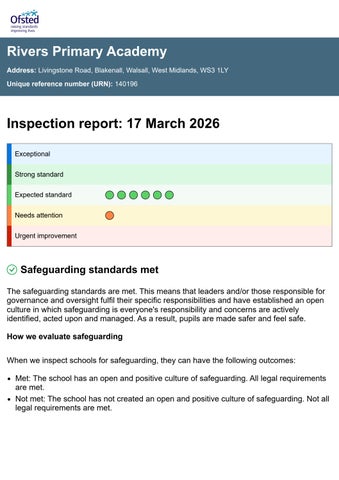
Exceptional
Strong standard
Expected standard
Needs attention
Urgent improvement
Safeguarding standards met
The safeguarding standards are met.This means that leaders and/or those responsible for governance and oversight fulfil their specific responsibilities and have established an open culture in which safeguarding is everyone's responsibility and concerns are actively identified, acted upon and managed As a result, pupils are made safer and feel safe
How we evaluate safeguarding
When we inspect schools for safeguarding, they can have the following outcomes:
Met:The school has an open and positive culture of safeguarding.All legal requirements are met.
Not met:The school has not created an open and positive culture of safeguarding. Not all legal requirements are met
Expected standard
Attendance and behaviour
Expected standard
Leaders ensure attendance is a shared responsibility. Staff in the early years help families build positive habits from the start Leaders check attendance daily and track patterns, including absences on specific days.They follow up concerns quickly.Targeted actions, such as minibus pick up and early breakfast, help families overcome challenges that may limit regular attendance The school’s approaches are making a clear difference Attendance over time is improving and is now close to national figures for most pupils. Last year, there was more movement of pupils in and out of the school than usual This mobility had an impact on the published attendance figures.
Pupils are polite and friendly. Classrooms are calm. Most pupils listen attentively and concentrate on their work.Around school, pupils usually walk sensibly. In the playground, pupils play collaboratively. Bullying is rare. Pupils trust adults to sort problems quickly. Leaders have strengthened behaviour systems so that pupils know what is expected and feel supported to make the right choices. Staff show real care for pupils and use agreed routines, including restorative conversations.This helps pupils feel heard and supported. Calm spaces and time with an adult give pupils the chance to settle and be ready to learn
Curriculum and teaching
Expected standard
The school offers a broad and well-planned curriculum that is ambitious for pupils. From the early years to the end ofYear 6, it sets out what pupils are expected to know.Teachers use curriculum plans to make sure pupils learn the right things at the right time.
Leaders have a clear understanding of the quality of the curriculum and teaching.To help pupils secure the basics, leaders have recently refreshed their approach to reading and mathematics.Teaching typically helps pupils to build mathematical knowledge progressively. Daily phonics lessons help younger pupils learn the sounds they need to read well and older pupils receive effective help when needed. Work in writing is beginning to strengthen pupils’ basic writing skills. However, there is more to do to help pupils write accurately and neatly. Leaders are rightly focusing on this
Regular training helps keep teachers’subject knowledge up to date.Teachers explain ideas carefully, check pupils’understanding and step in quickly if a pupil is unsure Adaptations for pupils with special educational needs and/or disabilities are generally appropriate. Vocabulary teaching is a strength inYears 1 to 6. Pupils are introduced to new words in different subjects and learn to use them confidently in their work
Early years
Expected standard
Children make a positive start to school life. Home visits and regular communication mean that adults build a clear picture of each child’s needs from the outset. Warm interactions and effective partnerships between staff, parents and carers help children settle quickly and feel secure.
Children show enthusiasm for reading They enjoy talking about stories and learning phonics. Staff follow the school’s phonics programme closely.They model sounds accurately and give children plenty of opportunities for repeated practice.This helps them to remember their learning Extra sessions help those who are behind to catch up quickly
Staff benefit from training that is improving their practice.As a result, staff are getting better at strengthening children’s language skills during learning and play For example, an adult encouraged children creating daffodil artwork to use precise vocabulary to describe the flowers.This supported their language development well.
The curriculum is thoughtfully organised around themes that interest children in nursery and reception. It typically helps children develop secure early number knowledge and an understanding of the world around them Indoors and outdoors, children learn to be independent and follow routines with confidence.These experiences help build the foundations needed for learning inYear 1.
Inclusion Expected standard
Leaders have established a warm and inclusive culture, where every pupil is valued Their principle that support should be ‘essential for some, useful for all’, shapes the way staff work Leaders responsible for this aspect of the school’s work play an instrumental role in helping staff understand pupils’needs and learn from effective practice. Staff spot pupils’ learning and developmental needs swiftly.As a result, additional support, including input from specialists, is put in place promptly Leaders rigorously check whether this support is working and make changes when needed. Pupils with complex needs benefit from highly personalised provision in the ‘Oasis’.This supports their communication skills and helps them to manage their emotions
Staff typically use a suitable range of strategies, including word cards, practical resources and visual images, to help pupils access the curriculum Ongoing training enables staff to refine and tailor these approaches more precisely to pupils’needs.
Leaders use additional funding strategically This helps disadvantaged pupils to catch up with their learning, attend regularly and take part in the wide range of enrichment activities. Effective pastoral support for pupils known to social care ensures pupils emotional needs are met and they are ready to learn
Leadership and governance
The leadership team, all appointed since the last inspection, are working with clear purpose and steady determination.They have taken time to understand the school well and have built a shared direction that staff recognise and value. Leaders have an accurate view of the school’s strengths and a clear sense of what still needs to improve.
Leaders make decisions with pupils’best interests at the centre of their work Their focus on strengthening reading and mathematics is helping pupils to achieve more securely.A determined push on attendance means pupils now come to school more regularly than before. Leaders know that writing still needs to improve and are continuing to work on this.
Those in governance meet their statutory duties and offer leaders steady support as well as thoughtful challenge. Members of the local community committee visit the school, speak with staff and see the school's work for themselves.They help shape projects that support families, especially those facing difficult personal circumstances Directors keep a close watch on how well different groups of pupils are doing and look carefully at the difference additional funding makes.They ask probing questions to check that leaders are making the progress they expect against the school’s priorities.
Professional learning for staff is closely linked to school priorities. Staff value the training arranged by the school and the trust, especially the chance to work with colleagues and leaders from other trust schools.They feel well supported by leaders and are proud to be part of the Rivers team
Personal development and wellbeing Expected standard
Pupils are considerate and say, ‘We are kind and take care of each other at this school.’ They reflect on their actions and show respect for others’views. Pupils explain confidently how the school’s ‘ASPIRE’values remind them to be resilient, compassionate and prepare for life beyond school.
Leaders have recently strengthened the personal development programme so that it better reflects the local context.They have also identified the key knowledge they want pupils in each year group to learn.This helps to ensure a steady build in knowledge over time. Pupils have a reasonable understanding of fundamental British values and different religions Voting for school leaders helps pupils to understand democracy in action.Through assemblies and the curriculum, they learn about different cultures. Pupils enjoy discussing scenarios in lessons and say that these help them think carefully about real life situations
Pupils know how to stay safe online and in different situations outside school.They can talk about features of good friendships and understand why they should seek help from a trusted adult when something feels wrong. Daily checks on pupils’emotional wellbeing mean that staff can quickly spot worries and offer pupils immediate help if needed. Skilled staff help pupils to name and manage their emotions and understand themselves better
The school’s enrichment offer is extensive and open to all. Clubs such as magic, art, film and archery reflect pupils’interests and nurture their talents Leaders check who attends to ensure no one misses out. Carefully planned trips, from exploring Roman sites to visiting the seaside, help pupils to deepen their learning and broaden their experiences. Visitors from different professions encourage pupils to be aspirational and to think ahead to the possibilities that lie before them.
Needs attention
Achievement Needs attention
Over time, standards have been similar to national expectations in most subjects. Current evidence from pupils’work indicates that standards in writing are not as high as they should
be Despite recent improvements, gaps remain in grammar, punctuation, spelling and handwriting across year groups.These weaknesses mean that some pupils do not make the progress they should in their writing. Leaders are determined to address this and are rightly prioritising writing to secure improvement and ensure that pupils’work reflects their true capability.
Last year, there was a dip inYear 2 phonics, theYear 4 multiplication check and mathematics outcomes inYear 6. Leaders acted decisively in response to this.Their work to strengthen reading and mathematics is making a positive impact. Pupils are catching up quickly Across the wider curriculum, pupils including disadvantaged pupils and those with special educational needs and/or disabilities make steady gains from their different starting points In science, for example, pupils learn to investigate, observe and record their findings accurately. Pupils are acquiring the knowledge and skills they need in most subjects and are generally well prepared for the next stage of their education.
What it's like to be a pupil at this school
Pupils enjoy coming to school and feel welcomed and safe from the moment they arrive. They talk proudly about belonging to Rivers PrimaryAcademy Pupils say that everyone is encouraged to do their best.
Actions taken by leaders to strengthen the curriculum mean that from one year to the next, pupils build the knowledge and skills they need for future learning securely. Pupils with special educational needs and/or disabilities and disadvantaged pupils benefit from targeted support This helps them to achieve as well as their peers Writing is improving, but some pupils still find spelling, punctuation, grammar and neat presentation difficult.At times, this hinders learning for some pupils.
Classrooms are purposeful. Pupils are respectful and kind towards each other. Behaviour around school is typically orderly. Pupils play together well at social times.They are clear that bullying is not an issue and say that if it does occur, staff deal with it promptly Pupils understand how to stay safe, including online. Most pupils attend school regularly.
Awide mix of experiences help broaden pupils’horizons and build their confidence Pupils enjoy taking part in sporting events, dance showcases and musical performances that let them shine beyond the classroom. Pupils also learn to be responsible by taking on roles, such as pupil parliament members or reading ambassadors Alongside events such as careers week, these opportunities help pupils gain a secure understanding of democracy and how to play a positive role in the community.
The school fosters trusting relationships with parents and carers by inviting them in regularly to share in pupils’learning. In the early years, for instance families take part in the ‘secret storyteller’tradition, where a parent or grandparent quietly arrives to read a story to the class.These moments are valued by pupils and contribute positively to their experiences of school.
Next steps
From early years onwards, leaders should build on their current work to strengthen the curriculum, teaching and how well staff adapt learning to meet pupils' needs.
Leaders should continue to improve pupils’achievement in writing by ensuring that pupils develop secure transcription and handwriting skills.
About this inspection
This school is part of the WindsorAcademyTrust, which means other people in the trust also have responsibility for running the school.The trust is run by the chief executive officer, Dawn Haywood, and overseen by a board of trustees, chaired byAndrew Middleton.
Inspectors carried out this full inspection under section 5 of the EducationAct 2005.
Following our renewed inspection framework, all inspections are now led by His Majesty’s Inspectors (HMIs) or by Ofsted Inspectors (OIs) who have previously served as HMIs
Inspection activities:
Inspectors spoke with the headteacher and other school leaders.They also spoke with representatives from the board of trustees, the local community committee and the trust.
The inspectors confirmed the following information about the school:
All members of the leadership team have been appointed since the previous inspection in February 2022.The headteacher joined the school in September 2024, and the assistant headteachers took up their roles between 2022 and 2025.
The school does not use any alternative provision
Headteacher: Rebecca Bailey
Lead inspector:
Usha Devi, His Majesty's Inspector
Team inspectors:
BarryYeardsley, His Majesty's Inspector
Helen Lowe, Ofsted Inspector
Louise Minter, Ofsted Inspector
The data was used by the inspector(s) during the inspection More recent data may have been published since the inspection took place.
This data is from 17 March 2026
School and pupil context
Total pupils
465
Well above average
What does this mean?
The total number of pupils currently at this school and how this compares to other schools of this phase in England.
National average: 272
School capacity
446
Above average
What does this mean?
The total number of pupils who can attend the school and how this compares to other schools of this phase in England.
National average: 300
Pupils eligible for free school meals (FSM)
49.52%
Well above average
What does this mean?
The proportion of pupils eligible for free school meals at any point in the last six years.
National average: 26.3%
Pupils with an education, health and care (EHC) plan
2.15%
Close to average
What does this mean?
The proportion of pupils with an education, health and care plan This covers pupils with more support than is available through special educational needs support
National average: 3.5%
Pupils with special educational needs (SEN) support
16.56%
Close to average
What does this mean?
The proportion of pupils with reported special educational support needs at the school
National average: 15%
Location deprivation
Well above average
What does this mean?
Based on the English Indices of Deprivation (2019) and the school's location, we have calculated whether the school is located in a more or less deprived area
Resourced Provision or SEND Unit (if applicable)
No resourced provision
What does this mean?
Whether school has Resourced Provision or SEND unit (if applicable).
All pupils' performance
Pupils reaching the expected standard in reading, writing and mathematics
The percentage of pupils meeting the expected standards in a combined reading, writing and mathematics measure
Pupils reaching the expected standard in reading
The percentage of pupils meeting the expected standard in reading.
Pupils reaching the expected standard in teacher-assessed writing
The percentage of pupils meeting the expected standard in teacher-assessed writing
Pupils reaching the expected standard in mathematics
the
Disadvantaged pupils' performance
Disadvantaged pupils are those who have been eligible for free school meals at any point in the last six years and children looked after.
Disadvantaged pupils reaching the expected standard in reading, writing and mathematics
The percentage of disadvantaged pupils meeting the expected standard in reading, writing and mathematics.
Disadvantaged pupils reaching the expected standard in reading
The percentage of disadvantaged pupils meeting the expected standard in reading.
Disadvantaged pupils reaching the expected standard in teacher-assessed writing
The percentage of disadvantaged pupils meeting the expected standard in teacherassessed writing.
Disadvantaged pupils reaching the expected standard in mathematics
percentage of disadvantaged pupils meeting the expected standard in mathematics.
Disadvantaged pupils' performance gap
Disadvantaged pupils are those who have been eligible for free school meals at any point in the last six years and children looked after The school disadvantage gap is the difference
between the performance of the school's disadvantaged pupils compared to the performance of all non-disadvantaged pupils nationally.
Disadvantaged pupils reaching the expected standard in reading, writing and mathematics
The percentage of disadvantaged pupils meeting the expected standard in reading, writing and mathematics, including the disadvantaged gap.
Disadvantaged pupils reaching the expected standard in reading
The percentage of disadvantaged pupils meeting the expected standard in reading and the disadvantaged gap
Disadvantaged pupils reaching the expected standard in teacher-assessed writing
The percentage of disadvantaged pupils meeting the expected standard in teacherassessed writing and the disadvantaged gap.
Disadvantaged pupils reaching the expected standard in mathematics
The percentage of disadvantaged pupils meeting the expected standard in mathematics and the disadvantaged gap.
Absence
Overall absence
The percentage of all possible mornings and afternoons missed due to absence from school (for whatever reason, whether authorised or unauthorised) across all pupils
Persistent absence
The percentage of pupils missing 10% or more of their possible mornings and afternoons.
(2 term)
(3 term)
(3 term)
Our grades explained
Exceptional
Practice is exceptional: of the highest standard nationally Other schools can learn from it
Strong standard
The school reaches a strong standard. Leaders are working above the standard expected of them.
Expected standard
The school is fulfilling the expected standard of education and/or care.This means they are following the standard set out in statutory and non statutory legislation and the professional standards expected of them.
Needs attention
The expected standards are not met but leaders are likely able to make the necessary improvements.
Urgent improvement
The school needs to make urgent improvements to provide the expected standard of education and/or care.
The Office for Standards in Education, Children's Services and Skills (Ofsted) inspects services providing education and skills for children and learners of all ages, and inspects and regulates services that care for children and young people
If you would like a copy of this document in a different format, such as large print or Braille, please telephone 0300 123 1231, or email enquiries@ofsted.gov.uk.
You may reuse this information (not including logos) free of charge in any format or medium, under the terms of the Open Government Licence.To view this licence, visit www.nationalarchives.gov.uk/doc/open-government-licence, write to the Information Policy Team,The NationalArchives, Kew, LondonTW9 4DU, or email: psi@nationalarchives.gsi.gov.uk.
This publication is available at https://reports.ofsted.gov.uk.
Interested in our work?You can subscribe to our monthly newsletter for more information and updates: http://eepurl.com/iTrDn.
Piccadilly Gate
Store Street
Manchester M1 2WD
T: 0300 123 1231
Textphone: 0161 618 8524
E: enquiries@ofsted.gov.uk
W: www.gov.uk/ofsted
© Crown copyright 2026
© Crown copyright