Great Wyrley Academy Address: Hall Lane, Great Wyrley, Walsall, West Midlands, WS6 6LQ Unique reference number (URN): 144988
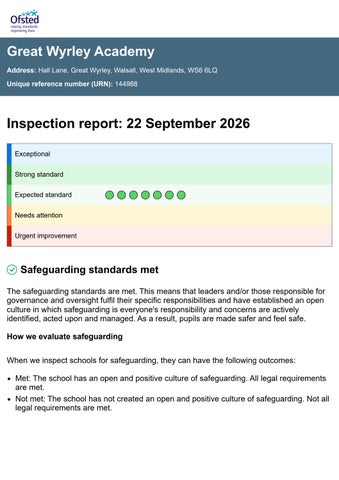
Inspection report: 22 September 2026 Exceptional Strong standard Expected standard Needs attention Urgent improvement
Safeguarding standards met The safeguarding standards are met. This means that leaders and/or those responsible for governance and oversight fulfil their specific responsibilities and have established an open culture in which safeguarding is everyone's responsibility and concerns are actively identified, acted upon and managed. As a result, pupils are made safer and feel safe. How we evaluate safeguarding When we inspect schools for safeguarding, they can have the following outcomes: Met: The school has an open and positive culture of safeguarding. All legal requirements are met. Not met: The school has not created an open and positive culture of safeguarding. Not all legal requirements are met.
Expected standard Achievement
Expected standard
Pupils’ achievement is improving. Historic outcomes in national examinations have been below national averages. However, pupils generally access the curriculum well and can articulate aspects of their current and previous learning. Most pupils make secure progress from their starting points and build knowledge and skills effectively across the curriculum. Pupils with special educational needs and/or disabilities typically achieve well, and disadvantaged pupils have benefited from targeted improvements, although some attainment gaps remain. In lessons, pupils are generally developing and retaining knowledge across the curriculum. Work in pupils books typically reflects leaders’ high expectations and show pupils are building key knowledge over time. However, some variation in the completeness and quality of work is evident for individual pupils. This indicates that achievement for these pupils is not secure and impacts on their future learning. Most pupils are increasingly well prepared for their next steps in education, employment or training and develop the knowledge and skills needed to make informed decisions about their future. Attendance and behaviour
Expected standard
The positive impact of leader’s actions to create a cohesive culture and improve attendance and behaviour is clear. Leaders have overhauled the attendance system. Individual support and rewards have been effective in reducing barriers to attendance. Pupils’ attendance, including for disadvantaged pupils, has improved and is now in line national averages. Pupils with special educational needs and/or disabilities (SEND) now attend above national average. Leaders have a relentless focus on expectations, increased rewards and graduated responses to disruptive behaviour. The impact of these is that pupils settle and typically engage well with their learning. Classrooms are orderly environments, and teachers can teach. Low-level disruptions to learning are rare, and staff and pupils have a shared understanding of the behaviour systems. Pupils describe behaviour expectations as fair and consistently applied. Strategies are adapted to support disadvantaged pupils and pupils with SEND in regulating their behaviour, and focused pastoral support has a positive impact across the school. Suspensions are used appropriately, and while their use is high, it is reducing. Bullying, harassment and other unwanted behaviour are rare. Pupils generally trust staff to respond effectively to any such behaviours swiftly. Leaders have ensured that there are systems in place to ensure that pupils feel safe and can report any concerns. Curriculum and teaching
Expected standard
Leaders have created a well-planned and sequenced curriculum. The curriculum is grounded in research and designed to support pupils in building their knowledge over time. The delivery of the curriculum is supported through a quality programme of staff professional
development and coaching. This ensures that there is a consistency to the standard of curriculum across lessons. Teachers have good subject knowledge and typically use agreed approaches to teaching well. Common classroom routines and teaching strategies, including 'smart starts', 'exit tickets' and modelling, help pupils in accessing the curriculum. Pupils with special educational needs and/or disabilities and disadvantaged pupils are supported to engage in their learning and articulate their understanding. However, there is some variability in the precision of classroom practice across lessons. Opportunities to adapt teaching and check for understanding are sometimes missed. While the variation is not widespread, it does impact on how well some pupils learn, and gaps in knowledge are evident. Developing pupils' foundational knowledge is prioritised. Leaders provide targeted support for pupils with gaps in reading and the development of vocabulary. These support pupils’ confidence with phonics and fluency. Interventions are being refined to secure improvements in pupils’ numeracy, handwriting and oracy. Inclusion
Expected standard
Inclusion is a clear priority for leaders in the school. The learning and wellbeing of pupils who face barriers are a clear focus and the responsibility for all members of staff. Leaders have developed a coherent approach to identifying and responding to need. Collaboration between pupils, families and external partners ensures that there is a structured approach for identifying barriers and coordinating appropriate support. Leaders identify provision and target interventions through tracking and monitoring. They implement professional development that ensures that staff are typically effective in reducing pupils’ barriers. Pupils with special educational needs and/or disabilities (SEND) access the same curriculum as their peers. Teachers are generally well informed of pupils' needs and implement effective adaptations to support learning in lessons. The use of technology and targeted academic support through the SEND Hub highlight the preventative approach to inclusion that leaders take. Leaders make effective decisions to support disadvantaged pupils and funding is used appropriately. Leaders collaborate well with external partners to strengthen provision for pupils with complex needs. Effective links with the virtual school and alternative provision contribute to a coordinated and positive response to pupils' academic, pastoral and wider needs. Leadership and governance
Expected standard
Leaders demonstrate a clear strategic commitment to the school’s motto of ‘relentlessly pursuing excellence’. Leaders know the context and needs of their pupils and respond to ensure that high expectations remain central. They have high expectations of staff and role model professionalism. They make decisions and take actions in pupils’ best interests. Leaders evaluate the school accurately. Leaders have developed a range of systems to identify strengths and areas for development in provision. This results in targeted support being put into place when required. The impact of these systems is quality assured by the
local community committee and trustees. The trust meets their statutory requirements and provides appropriate support and challenge to leaders. There is a shared vision to support pupils in attending school more and, as a result, benefiting fully from being in school. Staff describe a positive working culture of challenge and support. They value the structured professional development they receive and support from leaders. There is a clear focus on staff's wellbeing, and workload is a consideration for leaders. Staff highlight how leaders’ actions are impacting positively on pupils’ attendance, behaviour and learning. Leaders’ communication with families is typically open and constructive. Leaders use the local community committee, coffee mornings and community activities to build relationships and encourage engagement. Parents are positive about the experience that their children receive at the school. Parents highlight that their children are known, valued and supported at Great Wyrley Academy. Personal development and wellbeing
Expected standard
Leaders have carefully reviewed the personal development provision in the school. The provision has a clear focus on how it supports pupils for life in modern Britain. The curriculum is mapped and sequenced and builds over time. Provision is through PSHE lessons, form time activities, assemblies and drop-down days. Generally, pupils demonstrate an understanding of key knowledge and is reflected in the way they conduct themselves around school. Pupils can explain democracy, respect and the importance of listening to different viewpoints. Pupils know the school's ‘Aspire’ values and link these to diversity and citizenship. However, while some pupils have a secure knowledge of different faiths and religions, some pupils' understanding is limited. There is also some variation in pupils' understanding of British values and protected characteristics. These gaps in knowledge relate to the historic provision. Leaders' ambition to unlock pupils' potential is realised through extensive enrichment and extra-curricular provision for all pupils. Leaders' ‘Database of Dreams’ is used to inform strategic planning that support enrichment and careers provision for all pupils, including disadvantaged pupils and pupils with special educational needs and/or disabilities. Pupils benefit from a range of activities that support them in developing their interests, talents and confidence, including darts, choir, running, school productions and the Duke of Edinburgh award. Pupils have meaningful opportunities for leadership, and value these. Pupils value the pastoral support systems that are in place in the school. Pupils identify how staff support their mental health and contribute to their sense of wellbeing. Careers education and guidance are developed. Leaders are ambitious to ensure that pupils receive targeted support to help them make informed choices about education, employment and training. Post-16 provision
Expected standard
The provision for post 16 students' learning and wellbeing is through the Aspire Sixth Form. This post 16 provision is mainly based at another school in the Windsor Academy Trust. Students feel welcome there and recognise that they are an integral part of it. Leaders at Great Wyrley Academy assure themselves that the provision is in the best interests of its own students. Leaders typically communicate with leaders at the Aspire Sixth Form to ensure that its students are safe, attending and that there are no concerns.
Students follow a well-established curriculum that aligns with statutory requirements. Students benefit from a broad range of academic and vocational courses. They value the supportive relationships they have with staff, and the consistent approaches staff use in lessons. Students generally receive personalised feedback, and this supports them in building their knowledge and understanding. Students' work shows clear progression within different subjects. Achievement in national examinations in academic subjects is close to average. However, achievement in applied subjects has been below their peers nationally and is impacted on by small numbers of students in the sixth form. The programme for students’ personal development supports them in securing knowledge related to a range of topics related to personal, social, health and economic education. This provision supports them in preparing for life in modern Britain and in meeting their future career goals.
What it's like to be a pupil at this school Pupils at Great Wyrley Academy are welcoming and friendly. They speak with pride about being a pupil at the school. Pupils are well known to leaders and staff. Staff work hard to understand pupils’ individual circumstances, interests and needs. Relationships between pupils and staff are typically warm and positive. These relationships are fundamental in supporting pupils to come to school more regularly. Pupils that require extra support to attend school benefit from bespoke approaches. Pupils understand the high expectations placed upon them by staff. They are polite and respectful to one another. Pupils move calmly around school during social times and generally engage well during lessons. They listen and cooperate well with each other. Pupils are rewarded for their positive engagement in school life. Pupils are supported to reflect and amend their behaviour if it falls below leaders’ expectations. Pupils feel safe in school. Bullying is reported to be rare, and if does occur, addressed quickly and effectively. Pupils understand that discriminatory or derogatory language is unacceptable. Pupils benefit from teacher’s consistent use of agreed classroom routines. These routines typically support most pupils to engage with the curriculum. Support for disadvantaged pupils and pupils with special educational needs and/or disabilities is generally adapted to allow them to access their learning as well as their peers. However, there are lessons where gaps in pupils’ knowledge and variations in checking understanding can impact on learning and progress. Generally, pupils achieve well in lessons. Pupils really value the range of enrichment opportunities, improving their links to school and the local community. Clubs, trips and leadership opportunities help pupils develop a clear sense of community. The onsite 'Community Hub' and 'Community Fridge' highlight the support that is available for pupils' and families within the local community. Careers guidance and preparation for future education, employment and training help pupils prepare for life beyond school.
Next steps Leaders should ensure that teaching is consistently adapted to meet the needs of all pupils, including those that require additional support or challenge. Leaders should ensure that the personal, social, health and economic curriculum across all key stages is delivered effectively so that all pupils develop secure knowledge and understanding.
About this inspection This school is part of Windsor Academy Trust, which means other people in the trust also have responsibility for running the school. The trust is run by the chief executive officer, Dawn Haywood, and overseen by a board of trustees, chaired by Karen Canham. Inspectors carried out this full inspection under section 5 of the Education Act 2005. Following our renewed inspection framework, all inspections are now led by His Majesty’s Inspectors (HMI) or by Ofsted Inspectors (OIs) who have previously served as HMIs. Inspectors spoke with the headteacher, leaders from the school and from the trust, local community committee, members of teaching and non-teaching staff and several groups of pupils during the inspection. An inspector spoke with the chief executive officer of the trust. The school meets the requirements of the provider access legislation, which requires schools to provide pupils in Years 8 to 13 with information and engagement about approved technical education qualifications and apprenticeships. The inspectors confirmed the following information about the school: The school makes use of 2 unregistered alternative providers. The headteacher commenced their post in September 2026. Headteacher: Alan Brooks
Lead inspector: Andrew Washbourne, His Majesty's Inspector Team inspectors: Peter Bassett, Ofsted Inspector Nazya Ghalib, Ofsted Inspector Matthew Seex, His Majesty's Inspector
Facts and figures used on inspection This was the data available at the time of the full inspection, taken from different sources. More recent data may have been published since the full inspection took place. The inspector(s) used this data during the full inspection on 22 September 2026
School and pupil context Total pupils
606 Well below average What does this mean? The total number of pupils currently at this school and how this compares to other schools of this phase in England. National average: 1,063 School capacity
1,119 Close to average What does this mean? The total number of pupils who can attend the school and how this compares to other schools of this phase in England. National average: 1,154 Pupils eligible for free school meals (FSM)
35.30% Close to average What does this mean? The proportion of pupils eligible for free school meals at any point in the last 6 years.
National average: 30.4% Pupils with an education, health and care (EHC) plan
3.30% Close to average What does this mean? The proportion of pupils with an education, health and care plan. This covers pupils with more support than is available through special educational needs support. National average: 3.53% Pupils with special educational needs (SEN) support
18.15% Above average What does this mean? The proportion of pupils with reported special educational needs support at the school. National average: 14.0% Location deprivation
Below average What does this mean? Based on the English indices of deprivation (2019) and the school's location, we have calculated whether the school is located in a more or less deprived area. Resourced provision or SEND Unit (if applicable)
No resourced provision What does this mean? Whether school has Resourced provision or SEND unit (if applicable).
All pupils' performance English and maths GCSE
Percentage of pupils who achieved grade 5 or above in English and maths GCSE. Year
This school
National average
Compared with national average
2024/25 (final)
26.5%
45.4%
Below
2023/24 (final)
34.4%
45.9%
Below
2022/23 (final)
20.4%
45.3%
Below
Attainment 8 A measure of pupils' point scores across 8 subjects including maths (double weighted), English (double weighted if both language and literature are taken), 3 EBacc measures and 3 GCSE or technical measures. Year
This school
National average
Compared with national average
2024/25 (final)
39.0
46.1
Below
2023/24 (final)
41.0
45.9
Below
2022/23 (final)
35.1
46.3
Below
Progress 8 How much progress pupils made between the end of primary school (key stage 2) and the end of secondary school (key stage 4), compared to pupils across England who got similar results at the end of key stage 2. Year
This school
National average
Compared with national average
2023/24 (final)
-0.08
-0.03
Close to average
2022/23 (final)
-0.58
-0.03
Below
2021/22 (final)
-0.19
-0.03
Close to average
Disadvantaged pupils' performance Disadvantaged pupils are those who have been eligible for free school meals at any point in the last six years and children looked after.
Disadvantaged pupils' English and maths GCSE grade 5 or above Percentage of disadvantaged pupils achieving grade 5 or above in English and maths GCSE. Year
This school
National average
Compared with national average
2024/25 (final)
17.9%
25.8%
Close to average
2023/24 (final)
17.9%
25.8%
Close to average
2022/23 (final)
6.9%
25.2%
Below
Disadvantaged pupils' Attainment 8 A measure of disadvantaged pupils' point scores across 8 subjects including maths (double weighted), English (double weighted if both language and literature are taken), 3 EBacc measures and 3 GCSE or technical measures. Year
This school
National average
Compared with national average
2024/25 (final)
29.3
34.9
Below
2023/24 (final)
31.0
34.6
Close to average
2022/23 (final)
27.5
35.0
Below
Disadvantaged pupils' Progress 8 How much progress disadvantaged pupils made between the end of primary school (key stage 2) and the end of secondary school (key stage 4), compared to pupils across England who got similar results at the end of key stage 2. Year
This school
National average
Compared with national average
2023/24 (final)
-0.53
-0.57
Close to average
2022/23 (final)
-1.36
-0.57
Below
2021/22 (final)
-0.62
-0.55
Close to average
Disadvantaged pupils' performance gap
Disadvantaged pupils are those who have been eligible for free school meals at any point in the last six years and children looked after. The school disadvantage gap is the difference between the performance of the school's disadvantaged pupils compared to the performance of all non-disadvantaged pupils nationally. Disadvantaged pupils' English and maths GCSE grade 5 or above Percentage of disadvantaged pupils who achieved grade 5 or above in English and maths GCSE. Year
This school
National nondisadvantaged score
School disadvantage gap
2024/25 (final)
17.9%
53.1%
-35.3 pp
2023/24 (final)
17.9%
53.1%
-35.3 pp
2022/23 (final)
6.9%
52.4%
-45.5 pp
Disadvantaged pupils' Attainment 8 A measure of disadvantaged pupils' point scores across 8 subjects including maths (double weighted), English (double weighted if both language and literature are taken), 3 EBacc measures and 3 GCSE or technical measures. Year
This school
National nondisadvantaged score
School disadvantage gap
2024/25 (final)
29.3
50.4
-21.1
2023/24 (final)
31.0
50.0
-19.0
2022/23 (final)
27.5
50.3
-22.8
Disadvantaged pupils' Progress 8 How much progress disadvantaged pupils made between the end of primary school (key stage 2) and the end of secondary school (key stage 4), compared to pupils across England who got similar results at the end of key stage 2.
Year
This school
National nondisadvantaged score
School disadvantage gap
2023/24 (final)
-0.53
0.16
-0.69
2022/23 (final)
-1.36
0.17
-1.53
2021/22 (final)
-0.62
0.15
-0.77
Destinations after 16 Destinations after 16 Percentage of pupils staying in education or employment for at least 2 terms after the end of secondary school (key stage 4). Year
This school
National average
Compared with national average
2023 leavers (revised)
87%
92%
Average
2022 leavers (revised)
92%
93%
Average
2021 leavers (revised)
84%
94%
Below
16 to 18 performance A-level average point score The average points that students achieved per A-level entry. Year
This school
National average
Compared with national average
2024/25 (final)
32.50
35.00
Close to average
2023/24 (final)
20.00
34.38
Below
2022/23 (final)
31.50
34.16
Close to average
A-level value added
A score showing students’ progress between the end of key stage 4 and the end of their academic qualification studies. Year
This school
National average
Compared with national average
2024/25 (final)
-0.1
0.0
Close to average
2023/24 (revised)
-0.9
0.0
Below
Absence Overall absence The percentage of all possible mornings and afternoons missed due to absence from school (for whatever reason, whether authorised or unauthorised) across all pupils. Year
This school
National average
Compared with national average
2024/25 (3 term)
10.8%
8.4%
Above
2023/24 (3 term)
11.4%
8.9%
Above
2022/23 (3 term)
12.1%
9.0%
Above
Persistent absence The percentage of pupils missing 10% or more of their possible mornings and afternoons. Year
This school
National average
Compared with national average
2024/25 (3 term)
31.5%
23.4%
Above
2023/24 (3 term)
36.9%
25.6%
Above
2022/23 (3 term)
40.9%
26.5%
Above
Our grades explained Exceptional Practice is exceptional: of the highest standard nationally. Other schools can learn from it. Strong standard
The school reaches a strong standard. Leaders are working above the standard expected of them. Expected standard The school is fulfilling the expected standard of education and/or care. This means they are following the standard set out in statutory and non‑statutory legislation and the professional standards expected of them. Needs attention The expected standards are not met but leaders are likely able to make the necessary improvements. Urgent improvement The school needs to make urgent improvements to provide the expected standard of education and/or care.
The Office for Standards in Education, Children's Services and Skills (Ofsted) inspects services providing education and skills for children and learners of all ages, and inspects and regulates services that care for children and young people. If you would like a copy of this document in a different format, such as large print or Braille, please telephone 0300 123 1231, or email enquiries@ofsted.gov.uk. You may reuse this information (not including logos) free of charge in any format or medium, under the terms of the Open Government Licence. To view this licence, visit www.nationalarchives.gov.uk/doc/open-government-licence, write to the Information Policy Team, The National Archives, Kew, London TW9 4DU, or email: psi@nationalarchives.gsi.gov.uk. This publication is available at https://reports.ofsted.gov.uk. Interested in our work? You can subscribe to our monthly newsletter for more information and updates: http://eepurl.com/iTrDn. Piccadilly Gate Store Street Manchester M1 2WD T: 0300 123 1231 Textphone: 0161 618 8524 E: enquiries@ofsted.gov.uk W: www.gov.uk/ofsted
© Crown copyright 2026
© Crown copyright