


In November 2025, the independent review of curriculum, assessment and qualifications in England (the Curriculum & Assessment Review) published its final report (DfE, 2025)1. The government then issued its formal response outlining how it will accept and implement key recommendations, many of which will come into effect as of 2027/2028 (Gov, 2025)2
As a family of schools, this has prompted us to refine and review our strategic approach to curriculum and assessment, particularly honouring the role of the middle leader in driving curriculum, and above all, the teacher bringing the curriculum to life in their classroom.
This set play outlines our shared philosophy for curriculum across our schools, and what we believe all children are entitled to when they are part of our school communities, particularly children whose learning is most vulnerable. It aims to provide teachers and leaders with clarity through a shared vision, set of principles and how this translates to practice in schools.

1 Curriculum and Assessment Review Report, Department for Education, 2025. Available at https://www.gov.uk/ government/publications/curriculum-and-assessment-review-final-report
2 Government response to Curriculum and Assessment Review Report, 2025. Available at https://www.gov.uk/ government/publications/curriculum-and-assessment-review-final-report-government-response
We are intentional around the language we use for curriculum and assessment strategy, as a sector rich in both terminology and lethal mutations. This shared language supports effective implementation and quality assurance across our schools: a programme of study is the national curriculum; a long term plan will demonstrate how this translates into a sequence for a student’s educational journey; a medium term plan will outline the knowledge, application and opportunities to practice over a termly period. Our teachers complete a process of preparing to teach, either through subject knowledge development, collaborative planning and other related activities in subject development time. Finally, assessment provides teachers and leaders with data to make inferences about student performance and learning over time.
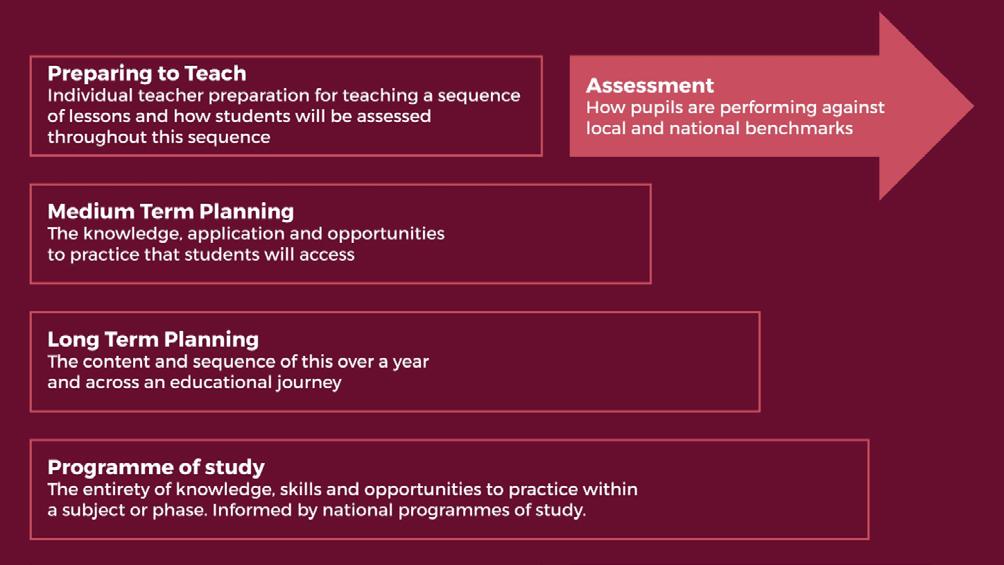
We also recognise that curriculum, assessment, pedagogy and subject knowledge are deeply relational and therefore, are spoken about in unity by leadership teams as interconnected indicators of quality.
The Confederation of School Trusts (CST) in their paper Knowledge building- school improvement at scale (2021) state, ‘the curriculum is fundamentally important. How to teach (pedagogy) follows from what to teach (the curriculum). Not the other way around.’ (CST, 2021). This paper underpins the importance of equipping teachers with the knowledge of what to teach, how and why as one of four propositions for school improvement:
1. The goal is for every teacher in every classroom to be as good as they can be in what they teach (the curriculum) and how they teach (pedagogy).
2. For this to happen, we need to mobilise for every teacher the best evidence from research.
3. There is no improvement for pupils without improvement in teaching, and no improvement in teaching without the best professional development for teachers.
4. Strong structures (in groups of schools) can facilitate better professional development and thus better teaching and improvement for pupils (CST, 2021).
Our curriculum strategy views curriculum development and delivery as strong only when led by the assertion of these four propositions. Our set play for Curriculum and Assessment presents an example of our strong evidence base for curriculum, and the strong structures for our family of schools to facilitate curriculum development as a collective endeavour.
At Windsor Academy Trust, our curriculum strategy is a co-constructed process. It provides our schools with a shared vision and set of principles to ensure a concept of quality, a shared curriculum3 to support our ‘best bets’ for curriculum design, yet still with the local level contextualisation and empowerment of leaders and teachers. This ensures that children in classrooms are taught content that ‘allows them to think beyond their own experiences to see them reflected in a new way.’ Howard & Hill, 2020).
3 For more on this, read our paper
This set play ensures that all children have full access to a high-quality, knowledge -rich curriculum to help them become educated, confident young people with their own views and opinions, all shaped by powerful knowledge and experiences both inside and outside of the classroom. A leading component of this assurance is that our curriculum is inclusive by design: we know that ‘teachers who challenge, support and stretch every learner to help them achieve and thrive.. recognis(e) high standards and inclusion as two sides of the same coin.’ (Dfe, 2026)4, that the curriculum is appropriately challenging, and informed by the recent publication of the Department for Education’s National Curriculum Review.
We also acknowledge that the role between curriculum, assessment, pedagogy and subject content is symbiotic: the curriculum acts as the progression model for students to become experts in and across subject domains, as they progress through phases, and assessment acts as the sampler of the curriculum: it provides teachers, leaders, students and families with data to make inferences about attainment and progress, and feedback from teachers informed by assessment data provides learners with clarity in what they have learned and how to improve. This empowers students to be confident, knowledgeable and take ownership of their learning over time.
Furthermore, we know that phase and subject specific knowledge and expertise are vital when ensuring the curriculum is enacted effectively in the classroom. This means that we dedicate time to ascertaining quality of curriculum enactment, with a view to share excellence across subjects. We understand that curriculum design informs curriculum enactment, and vice versa.
And finally, we recognise that the curriculum is never finished, and it is critical that we secure mechanisms for ongoing development and evaluation. This includes time and an investment of professional development to ensure teachers and leaders are well equipped to evolve the curriculum in response to what they are seeing in the data they have at their disposal, both quantitative assessment data or perhaps work in student books. Our set play outlines how our schools collaborate in the curriculum space, and make these collective decisions that move the curriculum further on in its continual evolution.
In summary:
All children should have access to a high quality knowledge rich curriculum, shaped by experiences in and outside of the classroom;
• Curriculum and assessment are symbiotic and this is evident through curriculum decisions and assessment design;
• Subject and phase specificity is key to ensuring effective curriculum design and enactment;
• The curriculum is ever-evolving, and therefore demands professional development to equip leaders and teachers with the knowledge and expertise needed to deliver and assure the quality of curriculum in classrooms.
4 ‘Every child achieving and thriving’ and the ‘6,500 additional teachers delivery plan,’ Department for Education, February 2026 available at https://www.gov.uk/government/publications/every-child-achieving-and-thriving
Our shared curriculum vision, co-constructed by our Headteachers is that:
Our knowledge rich curriculum exists to enable every student to unlock their academic and personal potential. It empowers students to foster a deep understanding of subjects, through the acquisition of knowledge, skills and practice that allows students to think critically within subject disciplines. This is achieved through a considered sequence of learning that develops mastery over time. It is a key driver of social mobility, removing barriers and allowing every child to thrive through being academically successful.
This means that we know knowledge and skills do not exist in a vacuum for curriculum; students must know to be able to understand and apply their learning over time, alongside repeated opportunities to practise this before critical engagement of subject content is possible.
Our vision holds us all mutually accountable for curriculum choices, and our principles help us to create a shared language for what we mean by curriculum, assessment and the key materials that inform this.
Ofsted (2018)5 outline a research-informed model for curriculum, assessment and the interdependency between the differing component parts that we use to create a shared language across schools. At Windsor Academy Trust, our shared curriculum is where we place our ‘best bets’ as a sequence of study for schools, phases and subjects. This is informed by the national curriculum’s programmes of study, and what we endeavour to provide as classroom learning and experience for all children in our family of schools.
Schools then curate medium term planning informed by this sequence of study, utilising the shared curriculum and their contextual knowledge of children in their schools to plan this sequence. And finally, teacher planning sits at the very heart of curriculum enactment, for as we all know, the reality is that ‘the real curriculum is created by teachers, every day’ (Wiliam, 2019)6. Therefore, our principles must speak to teachers and leaders as they play instrumental roles in curriculum design, development and enactment in classrooms for children. It ensures that we acknowledge both achievement and experience as central indicators of success for children.
5 ‘Ofsted (2018) Curriculum research: assessing intent, implementation and impact. Available at: https://www.gov. uk/government/publications/curriculum-research-assessing-intent-implementation-and-impact
6 Wiliam, D., 2013. Principled curriculum design. London, UK: SSAT (The Schools Network) Limited.
We honour phase, stage and subject in our curriculum design
We know that curriculum coherence and progression is served by phase and subject specificity. This means we know that sequences of study are informed by the age and stage of children, and the needs of the subject. This is also the case for assessment design : it serves the needs of the subject. For schools, this means that long term overviews should be ambitious and hold sufficient challenges for the age and stage of the child accessing them, and this should demonstrate a sense of progression as a child moves through the curriculum in a way that feels both aspirational and appropriate.
We also recognise within this the importance of securing foundational skills on entry to schools for pupils, and monitoring this through various quality assurance activities, particularly at key transition stages where learning is fragile.
Senior and subject leaders work together to ensure shared understanding of what pupils should know and be able to do by key milestone points, and look for evidence of this in teaching, student work and assessment data.
Finally, we know that subject experts are critical in ensuring curriculum quality for all subject disciplines and our curriculum modelling reflects this. Subject leaders are able to articulate the achievement of students across and within cohorts, and how this data has informed their continual development of curriculum.
We consider key concepts and big ideas to ensure students can progress through the curriculum
We know that the most coherent curriculum models are anchored in key concepts and big ideas as a means to students developing an expert understanding of the subject. Mary Myatt supports the idea of a curriculum being ‘held together’ by key concepts: if we identify the concepts aka big ideas and teach children these, then they are likely to know more, remember more and be able to do more, over time.
In Geography for example, place acts as a key concept for students to comprehend an expert understanding of the physical and human characteristics of a town, city or country. In Science, energy acts as a key concept for students to develop an expert understanding of chemical energy in fuel, or energy transfer in food chains or respiration. In English, voice acts as a key concept for students to develop an expert understanding of how voice is constructed by the writer through language choice, shaped by purpose and audience as well as form, and positioned in relation to power, identity or even the social or historical context of the writing.
Having a continued focus on key concepts in our planning and enactment of curriculum also helps to mitigate against student misconception, because students know and understand the relationship between current study and the study that preceded it.
We ensure that the curriculum is well sequenced to build knowledge, skills, and the opportunity to practice
All those who design, develop and enact the curriculum know that substantive knowledge is the content of the subject (photosynthesis or atoms in Science), disciplinary knowledge is how experts in the field think (in History, using sources as evidence or considering the role of causation, for example) and procedural knowledge is the procedure used to apply that thinking (how to analyse a source, or how to conduct an experiment, or how to plan an analytical paragraph). This means we teach the fundamentals of subjects, we teach how to consider these fundamentals as experts, and we practise using recognised procedures for subjects. To ensure students become experts in their own right, we must provide them with frequent, repeated opportunities to practise as part of their curriculum experience.
We build mastery so that students can become proficient as subject experts in their own right
This means that we see mastery as securing proficiency over time. Sequencing learning ensures that students build a foundational understanding to then apply procedural skills in their application of what has been learned. Students should, ‘have strong foundations of knowledge and that they are active participants in their learning – debating, questioning, challenging and pursuing their own inquiry – set up for a lifetime of learning, not passive recipients of information.’ (Dfe, 2026)7. This is only possible if we build student confidence through knowledge and practice over time. Frequent, repeated opportunities to practice act as the lynch pin of remembering more and learning more over time. Daniel Willingham outlines that, ‘The principal determinant of whether students will learn something is whether they get to practise it (Willingham, 2009)8. This is further reinforced by Coe et al.: “If students do not have opportunities to practise what they are expected to learn, they are unlikely to secure it in long-term memory.” (Coe et al., 2014)9
7 ‘Every child achieving and thriving’ and the ‘6,500 additional teachers delivery plan,’ Department for Education, February 2026 available at https://www.gov.uk/government/publications/every-child-achieving-and-thriving
8 Willingham, D.T., 2009. Why Don’t Students Like School?: A Cognitive Scientist Answers Questions About How the Mind Works and What It Means for the Classroom. San Francisco, CA: Jossey-Bass.
9 Coe, R., Aloisi, C., Higgins, S. & Major, L.E. (2014) What makes great teaching? Review of the underpinning research. London: Sutton Trust.
We leverage prior knowledge, using relevant retrieval and storytelling as a means to make learning memorable
Every time a memory is retrieved, that memory becomes strengthened in the future. Retrieval helps students create coherent and integrated mental representations of complex concepts, the kind of deep learning necessary to solve new problems and draw new inferences. Curriculum design can sometimes be reduced to ‘fragments of knowledge [that] float around without being placed in a coherent structure.’ (Myatt, 2018)10 and so we should consider the detrimental effects of overloading working memory, and where we can leverage long term memory as making aspects of the curriculum experience familiar for students. This may be through the use of highly relevant retrieval that links prior and current learning, or teacher explanation making use and signposting previously taught content.
Storytelling supports this significantly with this. Stories can provide a link between knowledge and the lived experience of students so that knowledge is not seen as static. Therefore our curriculum identifies and embraces the intellectual rigour and challenge of high quality reading materials to enhance the learning experience.
We prioritise reading as a core entitlement through high quality text selection and disciplinary vocabulary mapping
Without the ability to read, a student will be a spectator of the curriculum rather than a participant. We therefore acknowledge the role of literacy and oracy within the subject as part of our Literacy set play. For curriculum design and enactment, tier 2 and 3 vocabulary11 is mapped as part of our long term and medium term planning, and text selection is made intentionally with the age, stage and vocabulary in use in mind. To build on our principle regarding memory, enactment will show preteaching vocabulary to make it cognitively manageable for students to comprehend or analyse a text, for instance. And finally, all teachers are teachers of literacy, modelling fluency and prosody in the classroom so that students have a strong model for excellence.
10 Myatt. M, ‘Building Curriculum’ in Impact: Journal of the Chartered College of Teaching September 2018, accessed at https://impact.chartered.college/article/building-curriculum-coherence/
11 Tier 2 are general academic words which occur across different subjects, and are essential for reading comprehension. Tier 3 are subject specific words.
We employ assessment as a key way to sample the fundamental parts of the curriculum
We recognise that curriculum and assessment are symbiotic. From summative assessment that samples what students have learned, through to the enacted formative assessment that teachers use as part of curriculum enactment, assessment acts as a means for students to receive valuable feedback that moves their learning forward, This empowers them to be confident, knowledgeable and take ownership of their learning over time. For teachers and leaders, it acts as a means to make curriculum adaptations that attend to knowledge gaps reported in assessment data.
We see the curriculum as a way to ensure all children feel successful, represented and valued
And finally, ensuring children see themselves within the curriculum is critical to their engagement with learning as meaningful. Bishop (1990)12 argues that when children cannot see themselves within content taught, they may perceive that they are devalued within society. Seeing diverse representation as part of the taught curriculum can foster a sense of belonging for children, and moves us beyond tokenism to instead, presenting and challenging specific narratives that reduces bias and prepares children for their role within a diverse society. This might include the selection of specific texts or voices within the curriculum, but it may also be seeking student feedback when reviewing how the curriculum is being implemented in schools. This is important for all pupils, but especially for those pupils where learning is typically more vulnerable.
Yet this exists beyond the classroom, in the experiences that we curate for children in our Personal Potential provision; children access a ranges of opportunities that enable them to see the synergy between what they learn and the relevance of that to the world around them.
12 Bishop, R.S., 1990, March. Windows and mirrors: Children’s books and parallel cultures. In California State University reading conference: 14th annual conference proceedings (pp. 3-12).
At Windsor Academy Trust, the purpose of assessment is to unlock students’ academic and personal potential.
Our assessment model recognises the clear relationship between assessment and feedback as two key levers to move students’ learning forwards. Our assessments sample the knowledge-rich curriculum and feedback from teachers provides learners with clarity in what they have learned and how to improve. This empowers them to be confident, knowledgeable and take ownership of their learning over time.
Assessments are designed by leaders and teachers to serve a range of purposes and at different levels, from bespoke assessments designed by a teacher to assess a class to assessments that are designed by leaders and shared across the cohort of students in a year group across all schools within Windsor Academy Trust. These assessment principles guide the thinking of leaders and teachers to ensure maximum impact of the assessment and maximum fidelity to the assessment vision.
To support assessment, we have an integrated assessment model which highlights that assessment is a process rather than an event and supports the enactment of our assessment principles in all assessments undertaken by our students. It also offers useful prompt questions to guide leaders and teachers to produce and use assessment in the most effective way.

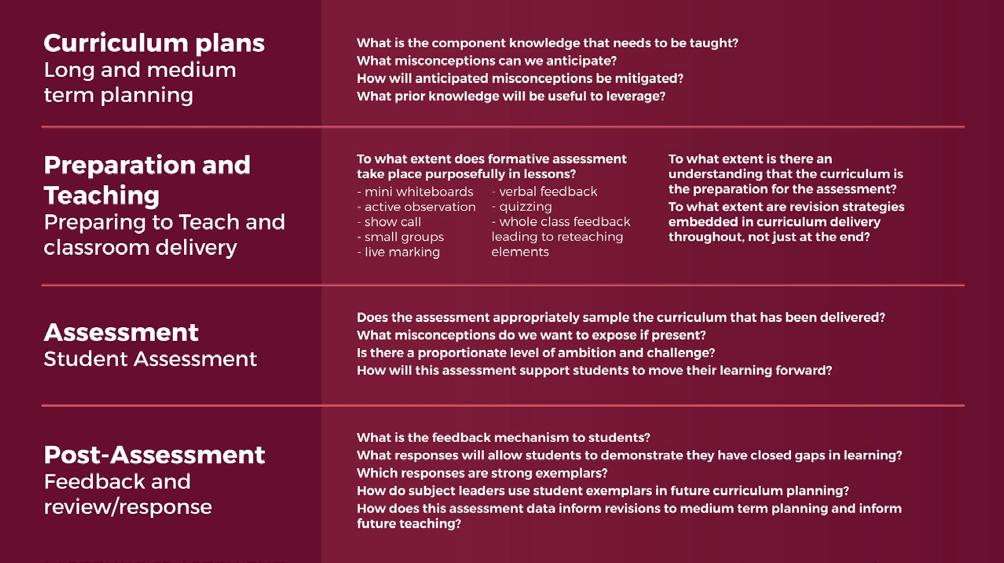
The purpose of the assessment is to sample the curriculum
We know that assessment is only a sample of the entirety of what students have learned over the course of study.This means that we should be intentional about what we choose to assess, and how that content will provide us with key insights as to how students are learning over time, for example, ensuring that it allows students to demonstrate the knowledge and understanding they have gained while exposing key misconceptions that support their learning through the feedback process.
Assessment and feedback act as two key levers to move learning forwards. Formative assessment and subsequent feedback therefore are integrated throughout teaching and learning.
Assessment and feedback work in tandem; in order for effective feedback to be given that helps students move forward, the assessment must be designed in such a way that it demonstrates understanding and exposes misconceptions of key knowledge. This applies just as much to a question asked in a lesson to be answered on a mini-whiteboard with immediate feedback to students as it does to a summative assessment at the end of a cycle of learning. Being intentional about the questions asked is essential to being able to provide students the feedback they need and integrating this throughout teaching and learning means that students are constantly receiving feedback in a variety of forms which is strengthening their learning.
The assessment design serves the distinctive needs of the subject.
It is crucial that assessment design allows for the distinctive needs of each subject in order for it to have maximum impact on student learning. Selecting the most effective way to assess will mean understanding can be evaluated by teachers and leaders in a way which is most useful for the teacher to be able to adapt teaching and provide feedback to students that closes gaps in understanding. This might mean assessment is carried out through observation of performance in a practical subject, a multiple-choice test when the goal is to assess the acquisition of knowledge or an extended written response to assess how well students have acquired knowledge and are able to apply this understanding in context. It is likely that subjects will use a range of different assessment methods depending on what they are assessing and so there will be variety in design within and between subjects. It is important that it is this thinking that leads to high quality assessment design.
All students should know what they have learned and where they need to improve to move learning forward as a result of feedback.
We recognise how important it is for students to know where their knowledge, skills and understanding are strong, and what they need to improve in order to learn most effectively. The Education Endowment Foundation (2021) assert that ‘done well, [teacher feedback] supports pupil progress, building learning, addressing misunderstandings and thereby closing the gap between where a pupil is and where the teacher wants them to be’ (EEF, 2021)13
We base our feedback on three key principles from this report which support teachers in giving effective feedback:
• Lay the foundations for effective feedback
• Deliver appropriately timed feedback that focuses on moving learning forward
• Plan for how pupils receive and use feedback
Intentionality about assessment design facilitates delivery of feedback aligned to these principles. Our integrated assessment model embodies these principles within the process, because teachers and leaders are invited to consider how they check for understanding, assess this understanding and share feedback with students in a timely manner.
13 EEF, Teacher Feedback to Improve Pupil Learning, 2021 accessed at https://d2tic4wvo1iusb.cloudfront.net/ production/eef-guidance-reports/feedback/Teacher_Feedback_to_Improve_Pupil_Learning.pdf
We build resilience through assessment so that students are confident to receive and respond to feedback.
It is important for students to see assessment as an essential and useful part of their learning journey. Without assessment, their teachers are unable to provide feedback that they need to close gaps in their knowledge and understanding. As such, teachers ensure that students become familiarised with the various forms of assessment they will encounter, all the way through their school experience. Students become familiar with formative assessment in lessons because it happens all the time and the engagement strategies used and the approach of our teachers ensures that students experience this type of assessment as low-stakes and useful for their learning in an immediate sense.
For summative assessments which may be perceived as higher-stakes, it is important that we acknowledge this with students but frame it positively so they value assessment as a way of helping them to develop as learners.
Developing resilience happens not in a vacuum distinct from what is happening in the classroom, but rather through assessment, students learn that it is part of the learning process. Students confidence is improved through effective preparation for an assessment (the delivery of the curriculum), a welldesigned assessment allowing them to demonstrate their knowledge and understanding in the most appropriate way for the subject and assessment objectives and finally through effective feedback and post-assessment activities that allow students to see the high value the assessment has had for their learning. In this way, the integrated assessment model is continuously building resilience so that students are confident to receive and respond to feedback.
We recognise the workload implications of assessment and feedback and plan intentionally to mitigate against this.
Our teachers’ time is valuable; we want them to spend it on the most impactful activities such as planning and delivering a really strong curriculum. Assessment is a critical part of their role but through our assessment design and application of the feedback principles, we seek to maximise efficiency with assessment.
For example, designing assessments that are multiple-choice, where appropriate, can yield strong assessment information for teachers to provide effective feedback in a timely manner with a low burden on workload. This can be further maximised through the use of the technology that is embedded in our practice. Developing our use of strong and efficient formative assessment methods, facilitated through active observation in classrooms, can also mean less need for workload-intensive assessment methods further down the line.
And finally, as part of this, we know that assessment does not sit within a curriculum plan as an isolated moment in time, but in the way teachers integrate feedback within their delivery; it is why assessment sits as one of our curriculum enactment principles. The strongest teachers use assessment and feedback as key tools to check understanding, address misconceptions and provide students with what they need to know to move their learning forward.
Through our approach to assessment as an integrated process, teachers and leaders consider the role that assessment plays prior to teaching, during curriculum enactment and the vital post-assessment work that follows to ensure students feel a sense of ownership in what they are learning.

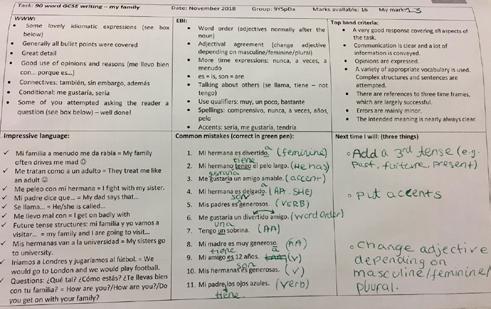
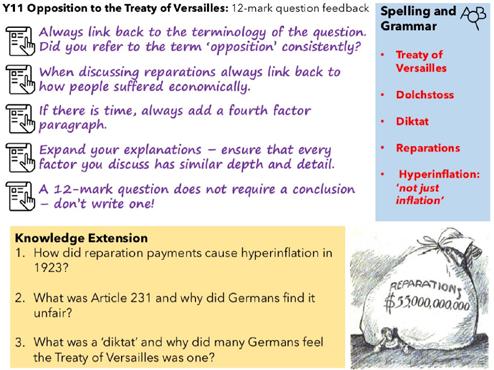
At Windsor Academy Trust, we use whole class feedback and other efficient methods to provide students with precise feedback from teachers to move learning forward swiftly. Whole class feedback is just one of the various ways we provide feedback to students as part of our integrated feedback approach.
Whole class feedback is a way for the teacher to gather formative data as they view assessments, capture excellent models of excellent student work and provide precise feedback including common misconceptions of the class, and individual next steps for students. The feedback typically includes:
• A strong student or teacher created example of excellence;
• Clear success criteria for the assessed piece;
• Common misconception or global errors that were commonly made by students;
• A selection of high leverage next steps that students are directed to complete in part or their entirety to respond to feedback provided.
Whole class feedback is highly contextualised by subjects and phases but can look like these:
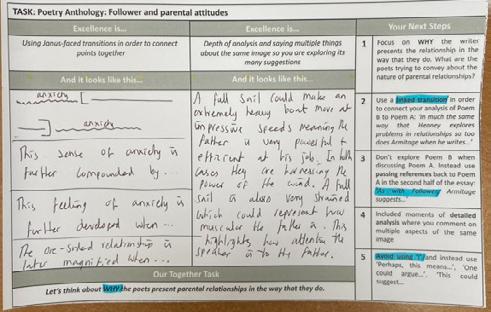
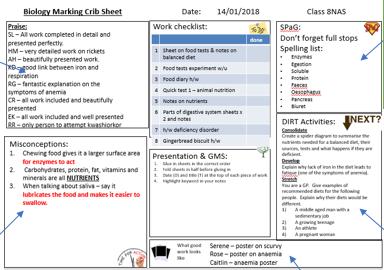
To bring these principles to life, we ensure there are key mechanisms and an infrastructure in place in schools to make time for meaningful collaboration, clear parameters of practice for curriculum review and enactment and supportive line management of middle leaders to create the conditions for this work.
The Curriculum Senior Leader as creator of the conditions for curriculum development
Our senior leaders create the conditions for curriculum development through supportive line management discussions and activities to drive curriculum forward. As line managers of Middle Leaders, their role is instrumental to ensuring Middle Leaders are supported to develop and assure quality of curriculum over time. That may be a learning walk with middle leaders to look at curriculum enactment and teaching quality in the classroom as a way to inform Subject Development Time, or a look over student work to ascertain the level of ambition and challenge for students and to discuss progression and achievement over time.
Senior Leaders as generalists are able to ask pertinent questions such as, ‘assessment data for Year 8 indicated underperformance in the last learning sequence; how might you adapt the curriculum in light of this?’ or ‘we noticed last week. that teachers’ modelling and exemplification was stronger in some places whilst not as much in others: how can you share that expertise to ensure excellence across the team?’ This coaching exercise employed by Senior Leaders empower Middle Leaders to move these insights into actions efficiently.
As the curriculum lies very much in the hands of each respective middle leader, it is they who we must empower to be the experts. Being able to translate your subject specialism is a craft in itself: as Tom Sherrington outlines, ‘Give maximum value to the process, not the products. What matters is that teachers understand their curriculum, the sequence, the choices. This takes time’14
If we create the time and space for subject leaders to contemplate their curriculum, it is key that they feel empowered to do so, but also informed as to what this should look like in practice. Laying such responsibility in the hands of subject leaders as experts ensures that the subject discipline is respected in its true form but also requires knowledge and training for those subject leaders for them to do justice to such an important task. In addition, we must ensure that those that teach it can develop
14 https://twitter.com/teacherhead/status/1137007198108889088
professionally under the expertise of the subject lead. Our Subject Development Time and Preparing to Teach model ensures dedicated time for teachers to discuss and share how they will enact the curriculum effectively in classrooms, or use assessment data to inform curriculum adaptation in future teaching delivery. Middle Leaders facilitate this by knowing their team’s knowledge and expertise, and leveraging this accordingly for the collective group’s benefit.
It is this collegiate process that nurtures curricular work at every level. By doing so, we not only work to improve the curriculum menu now, but we also nurture our curriculum designers of the future. This makes collaboration a deeply important one of our values for curriculum, to ensure we find joy in curriculum practice.
The most effective professional development for teachers will mirror the same high expectations and sequencing we apply to our curriculum: deliberate, planned, and progressively building teacher knowledge and expertise over time. A coherent professional development programme for teachers should not provide standalone training on a series of different components, but should be treated as a carefully sequenced curriculum. Like any good curriculum, professional learning should be rooted in intentionality and specifically focused on school improvement priorities (Sims et al, 2021).
Leaders can achieve this by ensuring professional development is focused on what teachers need to know, do and understand to be able to bring the curriculum to life. The new Ofsted framework reinforces this, stating,’ leaders and teachers have a sophisticated understanding of the differences between subjects;this informs teachers’ choices’ and furthermore, ‘teachers have expert knowledge of the subjects that they teach and, if they have gaps in their knowledge, they are supported so that ineffective teaching does not disadvantage pupils.’ (Ofsted, 2025).
Our Collaborative Planning (Primary) and Subject Development Time (Secondary) ensures that teachers can collectively meet to share how they prepare to teach, share knowledge and expertise or create high leverage materials such as exemplary work or feedback materials that support workload. This might be a teacher of Year 7 Geography ‘teaching’ the team how they will introduce maps with guided practice of how to use an atlas perhaps, or a teacher of Year 9 English annotating Wilfred Owen’s Dulce et Decorum est using a framework for encouraging students to draw alternative interpretations or making observations about the structure of the poem. It might be a Reading Lead demonstrating principles into practice for reading aloud in class, or a Year 4 teacher exemplifying an upcoming practical to investigate how the length of a wire affected the brightness of a bulb, whilst changing single variables to inform pupils’ hypotheses.
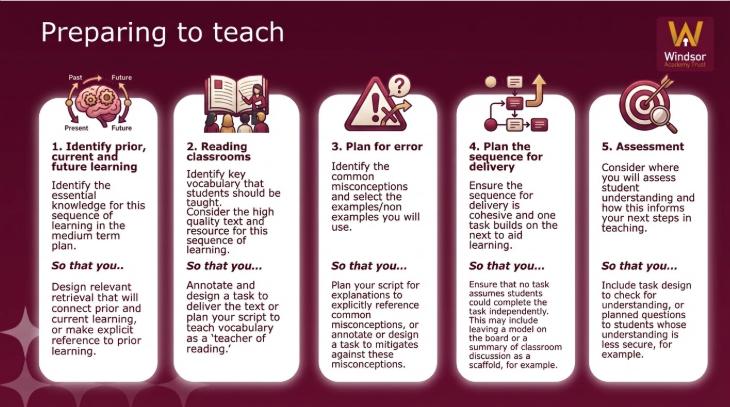
Our ‘preparing to teach’ model provides middle leaders with a shared language for i) the preparatory stage of curriculum enactment and ii) a framework for how we might consider the key principles for curriculum enactment more broadly. This supports Middle Leaders when undertaking quality assurance exercises as part of their leadership of curriculum, as they can use what they see in classrooms or book work to inform the areas of focus for Subject Development Time. This creates a highly effective feedback loop for curriculum leaders. Our ‘preparing to teach model’ ensures that we have a shared language for quality of curriculum enactment in classrooms. This means that we don’t just think about pedagogy of how to teach, but the content of what to teach as an equally important part of the preparation process for classroom delivery. Middle Leaders then use this as a framework when capturing and sharing excellence.
This model holds synergy with our curriculum enactment principles, a shared language for subject specialists to ascertain the quality of curriculum delivery in classrooms. It ensures that a specialist identifies excellent practice, not just in the presence of a teaching strategy, but how effectively it supports the students’ knowledge, skills and understanding over time. We see this as an embellishment of general pedagogy: a subject specialist is therefore well placed to determine global strengths across a team, where they might be variance, and respond accordingly through the discussions that take place in subject and phase teams as a result.
Our leaders know that a curriculum is never finished, and pursue opportunities for excellence as a result to ensure students access a strong, ambitious curriculum provision. However we also know that quality assurance of curriculum is most effective when it does not take place as an isolated event: therefore, quality assurance exercises are a key component of the role of the Middle and Senior Leader.
Examples of this may be that the Education Directorate and Subject Leadership team collaborate with a school to review the curriculum, undertaking activities such as collaborative work analysis, classroom visits to see how the curriculum is being implemented or capturing student voice to hear more on where subject teams support students, particularly those where learning is vulnerable.
Alternatively, senior leaders may dedicate time in schools for middle leaders to look at student work with their teams, identifying examples of strong feedback delivery or capturing an effective way to teach vocabulary, for instance. It might be that senior leaders and middle leaders look over the data from a recent assessment and discuss how that might inform the area of focus for Subject Development Time that week.
Our leaders are responsive and work with the shared understanding that a curriculum will only ever be powerful if implemented well, and the regular activities that take place ensure that there is a way to showcase and scale up effective approaches as swiftly as possible.
The most effective professional development for teachers will mirror the same high expectations and sequencing we apply to our curriculum: deliberate, planned, and progressively building teacher knowledge and expertise over time . A coherent professional development programme for teachers should not provide standalone training on a series of different components, but should be treated as a carefully sequenced curriculum. Like any good curriculum, professional learning should be rooted in intentionality and specifically focused on school improvement priorities (Sims et al, 2021).
Civic Leadership: Driving education for the greater public good

Bishop, R.S., (1990). Windows and mirrors: Children’s books and parallel cultures. In California State University reading conference: 14th annual conference proceedings (pp. 3-12).
Bransford, J. D., Brown, A. L., & Cocking, R. R. (2000). How People Learn Brain, Mind, Experience, and School. Washington DC National Academy Press.
Coe, R., Aloisi, C., Higgins, S. & Major, L.E. (2014) What makes great teaching? Review of the underpinning research. London: Sutton Trust.
Counsell, C. (2018) Taking curriculum seriously. Impact Journal CCT
https://www.ee.ucl.ac.uk/~mflanaga/Cousin%20 Planet%2017.pdf
Howard,K. And Hill,C. (2020) Symbiosis: The curriculum and the classroom. Melton, Woodbridge, John Catt Educational Ltd.
Meyer, J.H.F. and Land, R. (2006) Overcoming Barriers to Student Understanding: Threshold Concepts and Troublesome Knowledge. London and New York: Routledge.
Myatt, M (2018) The Curriculum: Gallimaufry to coherence. Melton, Woodbridge, John Catt Educational Ltd. https://www.marymyatt.com/blog/the-curse-of-content-coverage
Myatt, M (2020). Back on Track: Fewer things in greater depth. Melton, Woodbridge, John Catt Educational Ltd.
Myatt. M, (2018) ‘Building Curriculum’ in Impact: Journal of the Chartered College of Teaching September 2018, accessed at https://impact.chartered.college/article/building-curriculum-coherence/
Ofsted (2018) Curriculum research: assessing intent, implementation and impact. Available at: https:// www.gov.uk/government/publications/curriculum-research-assessing-intent-implementation-andimpact (Accessed: [10th February 2026]).
Oates T. (2011) - Could do better: using international comparisons to refine the National Curriculum in England. Curriculum Journal 22:2 121-150.
Pass, (2004) Cognitive Load Theory: Instructional Implications of the Interaction between Information Structures and Cognitive Architecture. Instructional Science 32(1):1-8 .
Quigley, A. (2018). Closing the vocabulary gap. London: Routledge .
Civic Leadership: Driving education for the greater public good
Wiliam, D., 2013. Principled curriculum design. London, UK: SSAT (The Schools Network) Limited.
Willingham, D.T., 2009. Why Don’t Students Like School?: A Cognitive Scientist Answers Questions About How the Mind Works and What It Means for the Classroom. San Francisco, CA: Jossey-Bass.
Young, M. and Lambert, D. (2014). Knowledge and the Future School: Curriculum and Social Justice (London: Bloomsbury Academic).
Young M and Muller J (2016) Curriculum and the Specialisation of Knowledge. London: Routledge.
EEF, Teacher Feedback to Improve Pupil Learning, 2021 accessed at https://d2tic4wvo1iusb.cloudfront. net/production/eef-guidance-reports/feedback/Teacher_Feedback_to_Improve_Pupil_Learning.pdf