

Appendix 3:



















Appendix 3: Option 2
Introduction
Simple, balanced and locally supported. Option 2 delivers a coherent and balanced set of authorities for the mainland. It has strong local identity and does not require any boundary changes, thus ensuring it is simpler to implement, while configured to better deliver services and ensure devolved power with a community focus.
This proposal creates four new mainland councils built around sensible, proportionate, place-based geographies.
The proposed unitary configuration balances shared local identity and existing service, economic and transport links. Each council is designed to deliver effective leadership, streamlined services and improved accountability, while remaining recognisably local and at a scale that is manageable and effective.
How is this option different
Option 2 differs from Option 1 in one respect: New Forest district forms part of the South West Hampshire unitary instead being located in the Mid Hampshire unitary.
It differs from Option 1A in in that there are no boundary changes or splitting of existing district building blocks when the new authorities are established (we remain open to boundary adjustments at a later stage via Principal Authority Boundary Review).
The Isle of Wight unitary, the North Hampshire unitary and the South East Hampshire unitary are unchanged between Option 1 and Option 2 and the benefits in these regions remain as set out in the main document.
Option 2 also offers substantially similar features to Option 1 in terms of a balanced population and viable financial assessment for example but enables a more balanced approach to geography and tax base across the whole geography.
This is coupled with the benefits in Option 1A of having the New Forest waterside area in the South West unitary – while continuing to ensure a strong and sustainable Mid Hampshire authority.
The image below shows the proposed geography of unitary councils in Option 2.
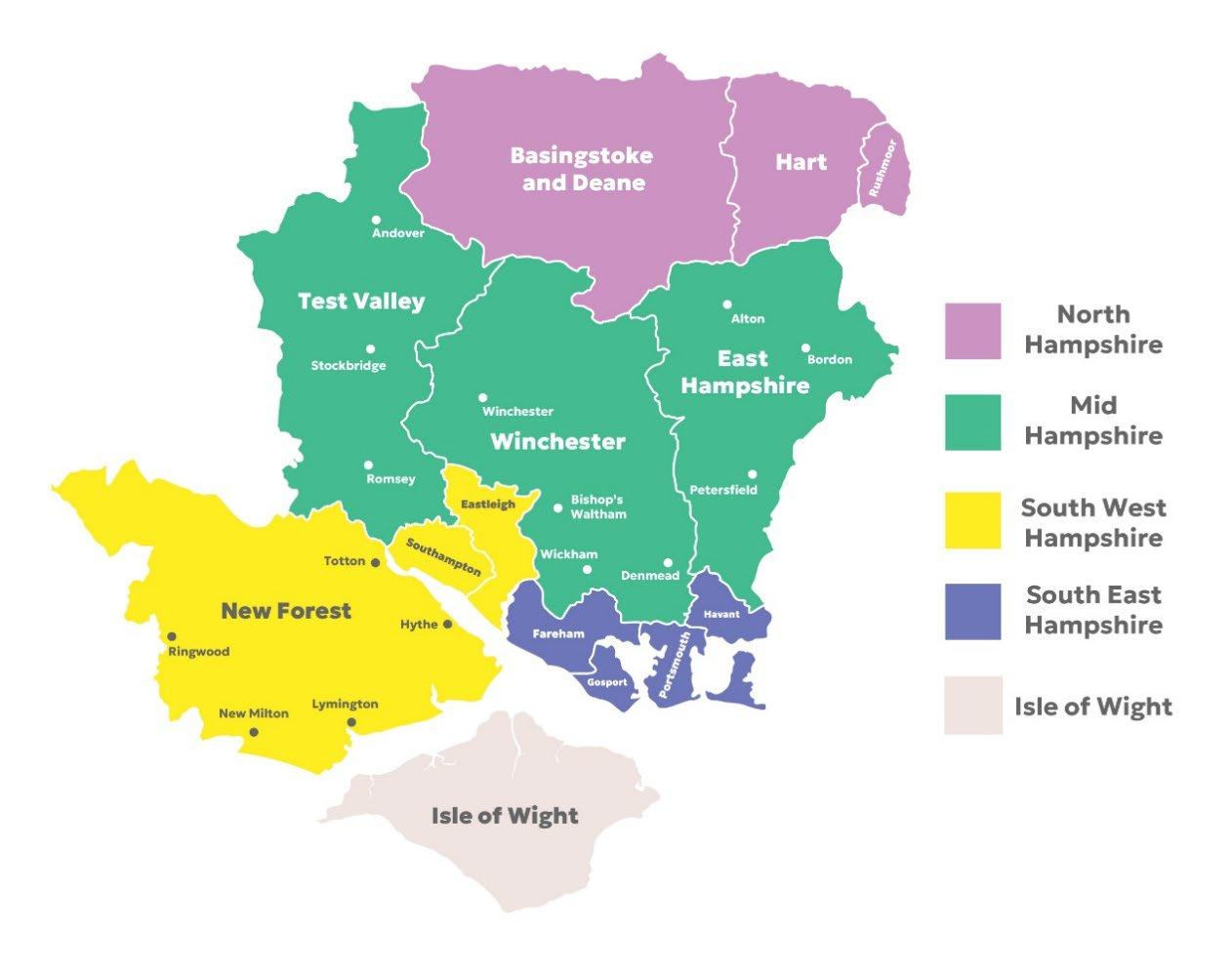

The key additional benefit of Option 2 is that it offers the most balanced geographical unitary configuration for Hampshire and the Isle of Wight. It creates four new mainland unitaries of similar size and scale, avoiding the risk of excessively large geographies or constraining the county’s largest settlement, Southampton, in the smallest unitary.
Option 2
The chart below shows that under Option 2, Mid Hampshire is only twice as large as South West Hampshire, rather than 20 times larger as in Option 1.
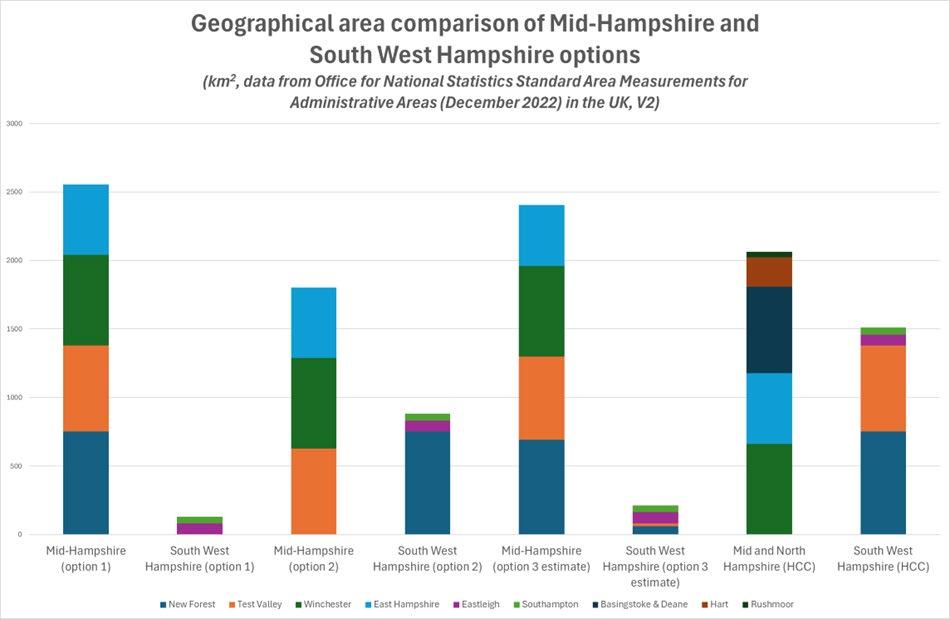
Creating a coastal economic powerhouse
As well as being the most geographically balanced, Option 2 also offers substantial economic benefits to the South West Hampshire Unitary. Including the New Forest and its waterside area in the proposed South West Hampshire unitary offers a strategic opportunity to
align governance with the region’s real-world economic and social dynamics. The area has strong industrial and maritime links with Southampton, including major employers like the Fawley oil refinery and significant commuting flows to Southampton and Eastleigh. By integrating this area into a single authority, the proposal supports more coherent planning across transport, housing, and infrastructure, enabling better service delivery and sustainable growth.
This unified approach would also bring together key economic assets, such as Southampton city centre, the docks, Southampton Airport, and Freeport investment zones, under one governance structure. This would streamline investment decisions, enhance coordination of skills and innovation strategies, and strengthen the region’s ability to attract funding. Overall, the proposal aims to unlock the full potential of the Solent corridor and establish the South West as a coastal economic powerhouse.
Strong coherent and effective central authority for Mid Hampshire
Creating a Mid Hampshire authority from the area of Test Valley, Winchester and East Hampshire avoids the challenges and associated costs of service delivery that comes with excessive geographic size while bringing together authorities and services with similar challenges, demography and experience of delivery in a mixed rural area. It integrates communities which self-identify as rural around the principal settlements of Andover, Winchester, Romsey, Petersfield and Alton – and their associated market towns and villages – with an economy and housing market defined by professional services, technology, creative enterprises, tourism – combined with a continuously developing rural economy and a strong commitment to sustainability.
The net effect is a Mid Hampshire Unitary that is well-placed to transform and localise its services and ensure that its residents and businesses achieve maximum benefit from local government reorganisation in an effective unitary geography for the Mayoral Combined Authority.
Practical to deliver
Option 2 is practical to deliver, being constructed using existing district boundaries, with each new unitary clustered around the main settlements. This places likely service bases at the geographic centre, bringing services nearer to local people and improving access for vulnerable residents who may depend on being closer to support. Natural pyramids of schools will be retained, trust built between schools and community and the new council maintained effectively supporting those with special educational needs.
Although existing district boundaries will only ever be an approximation, there is good evidence to suggest that Option 2 offers the best approximation to the functional economic areas of Mid Hampshire and South West Hampshire, with New Forest being more closely
aligned with Southampton than Winchester. A number of other public services already operate on similar geographies, such as the criminal justice system, with the magistrate’s court in Southampton covering Eastleigh and New Forest, and the crown court in Winchester covering the whole county.
Support for this option
• Respondents to a geography wide and local engagement exercise showed clear resistance to large, remote council models. Option 2 delivers the approach that best avoids this risk and is the only one delivering four mainland unitaries which are all geographically smaller than those proposed by Hampshire County Council.
• Although East Hampshire District Council withdrew from this proposal, the design of Option 2 has been mindful of the needs of the communities in East Hampshire as far as possible. It has been informed by the public engagement exercise undertaken, to which over 200 East Hampshire residents responded.
• Feedback prioritised local identity, access to decision-making, and visible leadership.
• Winchester City Council will make a decision as to its preferred option at its Council meeting on 25 September.
• Eastleigh Borough Council will make a decision as to its preferred option at its Council meeting on 25 September.
Leader’s endorsement
Winchester strongly shares with the other councils the desire to create new unitary councils for our region that are close enough to be local and big enough to stay strong.
This four new mainland and Isle of Wight unitary option delivers this and is:
• simpler to implement
• geographically and economically coherent and balanced
• creates strong councils that will deliver.
In this option, all five councils are constructed from existing district and unitary footprints without any boundary changes and all five councils make sense in their own right.
Our region's two great ports partner with their neighbours to create strong councils in the South East and the South West.
This proposal creates a coherent - and manageably sized – Mid Hampshire authority with its focus on the rural economy and professional services.
As with all other options, it supports a Northern council connecting together the high-tech industries of the M3 corridor and enabling close connection with similar economies in Surrey and Berkshire.
Finally, the unique and special nature of the Isle of Wight is reflected the continuation of its own separate council.
This option is right for Hampshire and the Isle of Wight, and all the councils created are coherent and make sense for the future.
Cllr Martin Tod – Leader of Winchester City Council
Who supports the option?
Winchester City Council
Assessment against MHCLG criteria
Criteria one: A proposal should seek to achieve for the whole of the area concerned the establishment of a single tier of local government.
Proposals should be for sensible economic areas, with an appropriate tax base which does not create an undue advantage or disadvantage for one part of the area.
Financially sustainable
Option 2 has the same financial benefits that have been demonstrated in the core case for change. The four new mainland and Isle of Wight unitary model in this variant continues to offer a streamlined governance model and opportunities to redesign and transform services to achieve significant efficiencies and savings through a place focused approach. The main case for change document quantifies the financial impact of the reorganisation model and demonstrates financial viability. It also demonstrates that Option 2 enables councils to pay back within 3 years, delivering annual savings of £63.8 million.
Specifically, Option 2 offers the most balanced financial position (based on current data and financial positions) across the mainland authorities.
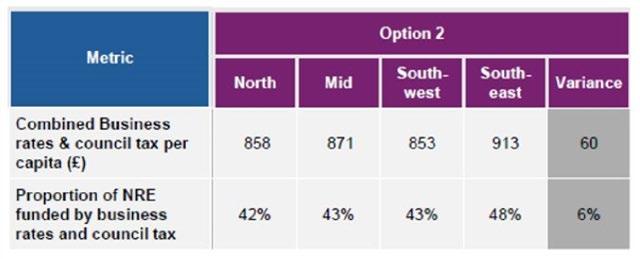
The table above shows combined business rates and council tax per capita and proportion of NRE funded by business rates and council tax position for Option 2.
Economic alignment
Option 2 aligns the new council areas to reflect the functional economic areas and travel-to -work zones.
Hampshire County Council’s Economic Intelligence Reports show a very strong relationship between Southampton, New Forest and Eastleigh in particular (shown in the figures above).
The same data for Test Valley, New Forest District’s only neighbouring authority other than Southampton, indicates a stronger commuting relationship with Wiltshire, Winchester, Eastleigh and Southampton than with New Forest.
As such, the key transport data confirms that the best approximation of sensible economic geographies using existing district boundaries is to bring New Forest into the same unitary area as Southampton and Eastleigh, but to leave Test Valley in Mid Hampshire, as is done under Option 2.
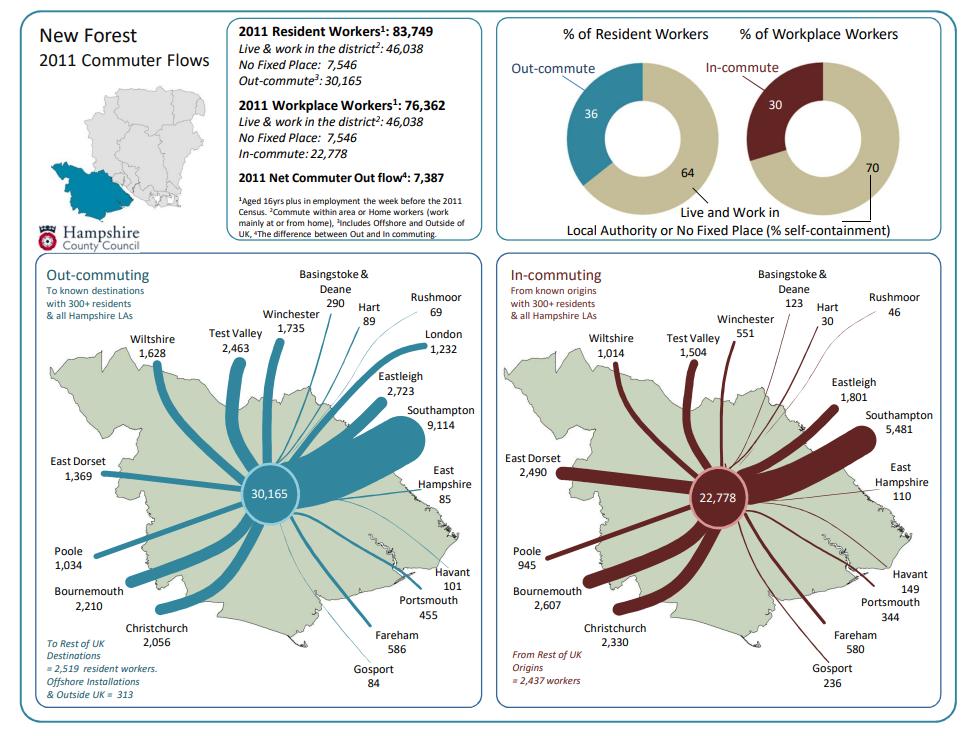
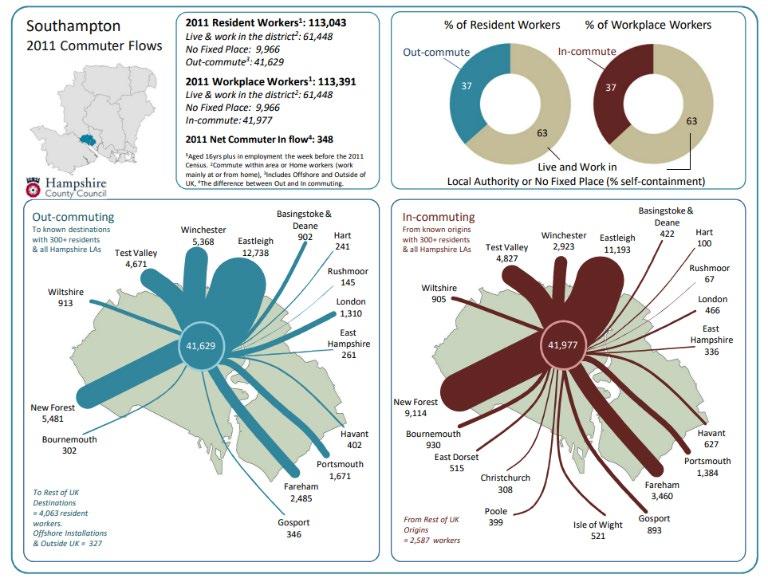
The images above show the New Forest and Southampton 2011 commuter flows. It is noted that post pandemic hybrid working may have reduced the absolute numbers commuting but there is no data to suggest the work orientation between the New Forest to Southampton and Eastleigh has changed.
Economic sectors
As set out in the introduction, the Port of Southampton is a critical piece of national / international infrastructure, and the opportunities for growth spread across both sides of Southampton Water. The Port and marine-related industries extend across Southampton and the New Forest, including Solent Gateway / Marchwood Military port, Fawley refinery and the land identified in the Port Masterplan for expansion at Dibden Bay. The Solent Freeport has its centre of gravity around Southampton Water, with key sites in New Forest, Southampton and Eastleigh.
There is a clear link between the largely urban Waterside and Southampton in economic, labour force and transport terms, but Option 2 reflects that wider rural area of New Forest also provides an attractive residential environment for many who work in the Waterside, Southampton and Eastleigh areas, contributing to the range of skills available to the city’s economy, while also providing a significant recreational resource for residents of more urban areas. There are strong socio - economic links between urban and rural areas, reflecting the fact that cities are interdependent with their hinterlands of towns and villages.
In more general terms, Southampton is clearly a sub -regional centre which is the economic, retail / leisure, cultural and transport hub for the wider area, urban and rural. Geographically, all parts of the New Forest are closer to this hub than to any other hubs within Hampshire, such as Winchester.
Proposals should be for a sensible geography which will help to increase housing supply and meet local needs.
Alignment to Housing Market Areas
The government has defined official local housing market areas (these date from 2010 but are still in use). The final report recommended the use of map 6 on page 25, which clearly shows the Southampton housing market area stretching across most of the rural New Forest.
Effective blending of urban and rural within unitary councils
The existing New Forest district benefits from a mix of rural national park and urban-fringe, industrially developed areas. This blend would be extended in Option 2, combining the current New Forest district with the predominantly urban and suburban areas of Eastleigh and Southampton. This avoids arbitrary urban/rural segregation and supports the mix of existing urban areas, market towns and parishes.
In planning terms, while rural New Forest is a very different type of area to Southampton, under Option 2 the National Park Authority would still undertake its local planning function, providing a continued focus for addressing the unique planning issues faced by rural areas. The National Park Authority would work closely with the wider unitary, with the new council providing the economic / housing / transport functions across the area, aligned to the direction provided by the mayoral strategic authority.
Housing Delivery Targets
Option 2 supports delivery of much-needed housing supply across the whole of the Hampshire and Solent area by balancing housing targets across the new unitary councils. Option 2 avoids having two National Parks in one single unitary authority (as in Option 1), which would create pressure on the amount of available land for development, thus threatening capability of the new unitary council to successfully deliver housing growth.
Criteria two: Unitary local government must be the right size to achieve efficiencies, improve capacity and withstand financial shocks.
Efficiencies should be identified to help improve councils’ finances and make sure that council taxpayers are getting the best possible value for their money.
Option 2 has a more balanced geographical areas than Option 1 – therefore promoting greater agility and responsiveness and benefits of existing partnership working can be leveraged. Asset rationalisation in Option 2 is more deliverable due to moderate travel distances, offering a range of council hubs across the area in principal towns at reasonable cost to the tax payer.
Similarly with no boundary change required, this configuration of councils can move forward without additional work to redefine service boundaries, allowing immediate progress on integration and the early realisation of the benefits of unitary status.
Established partnership working can be amplified at pace to reap efficiencies, building on a strong track record of collaboration.
Mid Hampshire Council: Test Valley, Winchester, East Hampshire
• Joint Planning approaches already in place (e.g. East Hampshire and SDNPA co -plan).
• Strong record of cross-border housing delivery: £12m funding secured jointly for affordable housing at the Winchester/Test Valley border.
• Shared geography for waste, leisure, countryside, and environmental services, including green space and depot planning.
• Opportunity to build on exiting, established shared services (such as the integrated IT service between TVBC and WCC) as well as historical shared service arrangements.
• Costs for large scale services such as waste can vary by up to 50% between urban and rural areas — geographic tailoring is essential for efficiency and can be best delivered by Option 2.
• And in addition, location of the New Forest with the South West council brings additional efficiency benefits.
South West Council: New Forest, Eastleigh, Southampton
• By including all of the New Forest, Option 2 ensures there are no areas at risk of geographical isolation from centralised services.
• Opportunity to place operational service hubs at the geographical centre of the new unitary, following the example of municipal waste from all three areas being disposed of at the Marchwood Energy Recovery Centre at the north end of the Waterside.
• Shared leisure partnerships with NHS and Active Partnerships across the footprint.
• Aligned ICS/health geography covering major hospital and community care services.
• All councils work together through Partnership for South Hampshire to deliver homes for the local South West housing market, while Eastleigh and Southampton have shared resources to deliver Local Plans for both authorities.
• Shared services between Eastleigh and Southampton include building control and licensing. Including all of the New Forest will add scale and resilience to these partnerships.
Criteria three: Unitary structures must prioritise the delivery of high quality and sustainable public services to citizens.
Proposals should show how new structures will improve local government and service delivery, and should avoid unnecessary fragmentation of services
Opportunities to deliver public service reform
A Balanced Model for Public Service Reform
Option 2 offers highly practical geographies for public services, bringing together the most balanced combination of councils and residents for the efficient delivery of coordinated services. Distances to access services in the four main service and economic hubs are lower in Option 2.
This is important for continuing effective delivery of social care services with the present Hampshire adult social care domiciliary care zoned contracts coordinated by contract relationship managers CRM. Those zones and CRM do not map onto Option 1, requiring fragmentation of existing contracts and management and threatening vital services for vulnerable people. Option 2 offers a geography that supports existing care contracts; whilst still positioning the unitary councils to transform care services as set out in the core document.
Children’s and Adults’ Social Care – Local Offer Examples
Delivering high- quality, sustainable care requires a deep understanding of the unique needs and dynamics of local communities. Smaller, place-based unitaries are better placed to:
• Tailor early intervention and safeguarding models around local schools and families.
• Build integrated health and care pathways with local NHS partners (e.g. Solent and Hampshire ICS geographies).
• Invest in trusted community hubs and voluntary sector partnerships. For example:
• Jointly commissioned local supported living schemes, enabling transitions from residential care for example Chesil Lodge in Winchester.
• Top quartile performance in Homelessness prevention working with the third and voluntary sector to support early discharge from HMP Winchester and support asylum applications.
• Stock holding experience in Winchester, and integrated care services supported by the social care authority to maximise ‘at home’ care packages.
This model ensures that the Mid Hampshire Authority in Option 2 can amplify current approaches that that reflects its population profile, geographies, and partner landscape. If unitary councils were to cover vast, disparate geographies, they risk losing touch with specific community needs, especially in social care.
Transport Links
Transport links for service delivery are more clearly defined for Option 2.
As can be seen from the image below, the main road network in the New Forest area forms a triangle pointing towards three large settlements outside the district: Salisbury in Wiltshire, Bournemouth in Dorset, and Southampton in Hampshire. This illustrates the critical economic and social links between the district and its neighbours in other counties.
From a Hampshire and Solent perspective, the district is primarily oriented towards Southampton, with onward traffic progressing to the rest of the county and beyond. All rail traffic through the New Forest also passes through Southampton.
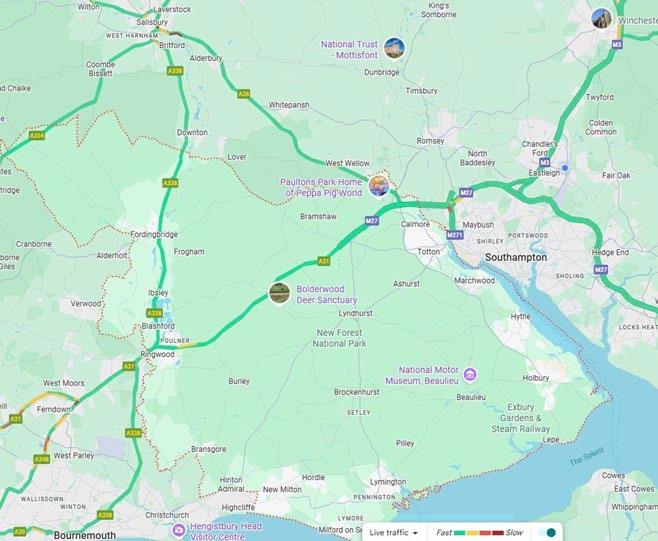
Likewise, the transport links in the Mid Hampshire area are focussed around the M3, A34, A303, A31.
Criteria four: Proposals should show how councils in the area have sought to work together in coming to a view that meets local needs and is informed by local views.
From the geography wide engagement work, 54% of Winchester respondents and 51% of East Hampshire respondents favoured Option 2 - stating support or strong support for this configuration, compared to 29% and 24% supporting Option 1.
Only 20% and 17% of Winchester and East Hampshire respondents supported a boundary change option, with 60% and 51% against changing boundaries.
Option 2 was the second favoured preference for Test Valley residents at 31% support for this option, and there was a clear lack of support for boundary changes at 70% against this proposal.
Option 2 is felt to be a more manageable size of council, which respondents say is beneficial. Respondents expressed concern that services could become too stretched and decision making too far removed over a large geography. However, respondents said the merging of more rural councils would bring benefit.
In July 2025, a deliberative workshop was held with sample of residents across the Winchester district. A similar workshop was also held in Test Valley and a range of deliberative workshops took place in the New Forest.
In Test Valley, participants supported simplification and efficiency but emphasised the need for local decision-making and responsiveness. They valued the rural character and community spirit of their towns and villages.
This is similarly reflected in Winchester participant’s feedback who expressed a need for a connected joined up approach, efficient services, ensuring local voices are meaningfully heard and that services are designed and rooted in the local area, to best serve local communities.
Local identity and culture, and community spirit in their local area was highly valued. Winchester participants support a centralised and simplified approach as long as local needs were met and community voices were heard in decision making.
Through a range of qualitative methods, New Forest residents, including those in Waterside, expressed a strong Forest rooted local identity.
And across all areas concerns were raised that services may not be tailored specifically enough for local populations in larger councils.
Several of the local parish councils in Winchester affected by boundary changes also sought the views of their members and residents in respect of potential boundary changes and potential geographies and their views have been incorporated.
This option supports community feedback and alleviates concerns that councils which are spread over too large a geography to be able to respond to local needs and local identity. It also alleviates the concerns that have been expressed about boundary changes as this option is based on existing boundaries.
Criteria five: New unitary structures must support devolution arrangements.
Where no CA or CCA is already established or agreed then the proposal should set out how it will help unlock devolution.
Option 2 provides the best platform for successful devolution in Hampshire and the Isle of Wight:
• The five unitary authority model provides a stable platform for a pan-Hampshire devolution model.
• Option 2 presents the most equal balance of population and geography, ensuring fair representation for all at the strategic authority.
• With financial stability and maintenance of district boundaries in the Option 2 proposal there will be a stable set of partners for the elected Mayor from day 1.
• The two largest unitaries cover the two largest cities, enhancing the attractiveness of the area for investment in growth coupled with each new council large enough to participate in future Combined Authority arrangements.
Importantly Option 2 avoids the risk to growth posed by a very large rural unitary or the county’s biggest settlement being constrained in a small unitary without sufficient additional land capacity.
Criteria six: New unitary structures should enable stronger community engagement and deliver genuine opportunity for neighbourhood empowerment.
Local representation at a community level is of critical importance. There are 49 town and parish councils in the Option 2 South West unitary and 144 in the Mid Hampshire unitary. This enables ready and effective community engagement at the most local level.
Option 1 would lead to 181 town and parish councils in the Mid Hampshire and only 12 in the South West Unitary comprising Eastleigh and Southampton. Neighbourhood and community engagement is the bedrock of the new unitary councils, therefore a more even split of towns and parish councils to best resource support and share expertise and experience is preferable.
of Parish Councils:
Cultural factors that tend to support Option 2 include features of daily life such as the geographies served by the Southern Daily Echo, which lists the New Forest as one of its districts, and the Hampshire Chronicle, which lists Winchester, Romsey and Hampshire
Public sentiment through a geography wide and local engagement exercise showed clear resistance to large, remote council models.
Respondents prefer governance structures that retain local identity and clarity of purpose. This option avoids the creation of excessively large, remote unitaries and instead offers a more balanced population split across councils, making them more relatable and connected to the communities they serve.
Option 2 delivers the approach that best avoids this risk and is the only one delivering four new mainland unitaries which are all geographically smaller than those proposed by Hampshire County Council.
Option 2 enables each unitary to develop a single corporate plan shaped by local priorities and grounded in neighbourhood knowledge. This is particularly important in services like social care, housing, leisure, and public health, where local understanding, true connection and familiarity with communities allows for more targeted and responsive delivery in local place based on community needs and aspirations.
Locally focused councils are better equipped to:
• Integrate services with local NHS and VCS partners.
• Build trust through consistent presence and familiarity.
• Tailor their strategies to reflect coastal, urban, or rural needs.
In this way, community engagement and neighbourhood empowerment are not simply principles, but daily practices embedded in the design of this proposed structure.
For social care, this is vital: priorities for early years, SEND or elder care differ widely between coastal, rural and urban places. Locally rooted services for families, carers and vulnerable adults reinforce trust in the authority, increasing engagement with formal structures such as area boards and participatory budgeting with effective engagement with pyramids of schools.
Feedback prioritised local identity, access to decision-making, and visible leadership. This model delivers meaningful community engagement not as an afterthought, but as a central design principle. By keeping councils recognisable, place-based, and locally scaled, it empowers residents to participate, influence, and shape the places they live.
Conclusion: Option 2 offers the strongest path forward
Option 2 delivers a coherent and balanced set of authorities for the mainland. It has strong local identity and does not require any boundary changes, thus it is simpler to implement; is configured to better deliver services; and ensures devolved power with a community focus.
This proposal creates four new mainland councils built around sensible, proportionate, place-based geographies. With the unitary configuration balancing shared local identity and existing service, economic and transport links.
• Balanced geography and population across new mainland authorities.
• Practical to deliver, with no boundary change and close proximity to services.
• Continuity and efficiency in public service delivery, with practical geographies, building on strong cross-sector partnerships already in place across health, housing, environment, and community services.
• Focused on natural economic areas, good local connectivity and ability to focus housing delivery on a natural local market
• Balanced tax base, with a financial assessment as good as the other options, enabling resilience and fair contribution within the MCA.
• A varied and natural local community, with a vibrant combination of urban, suburban and rural areas and many shared cultural and economic interests.