

Appendix 2:



















Appendix 2: Option 1
The Power of Place: a transformative vision for local government in Hampshire and the Isle of Wight
Introduction
This appendix builds upon the case for change and shows why Option 1, a new Mid Hampshire unitary authority, including the New Forest, is essential for the success of the overall proposal. Whilst Mid Hampshire is not a single place, its communities do share many similar characteristics and are economically and demographically highly aligned. Mid Hampshire is different from the mainly urban communities in the North, South East and South West of Hampshire and the Isle of Wight.
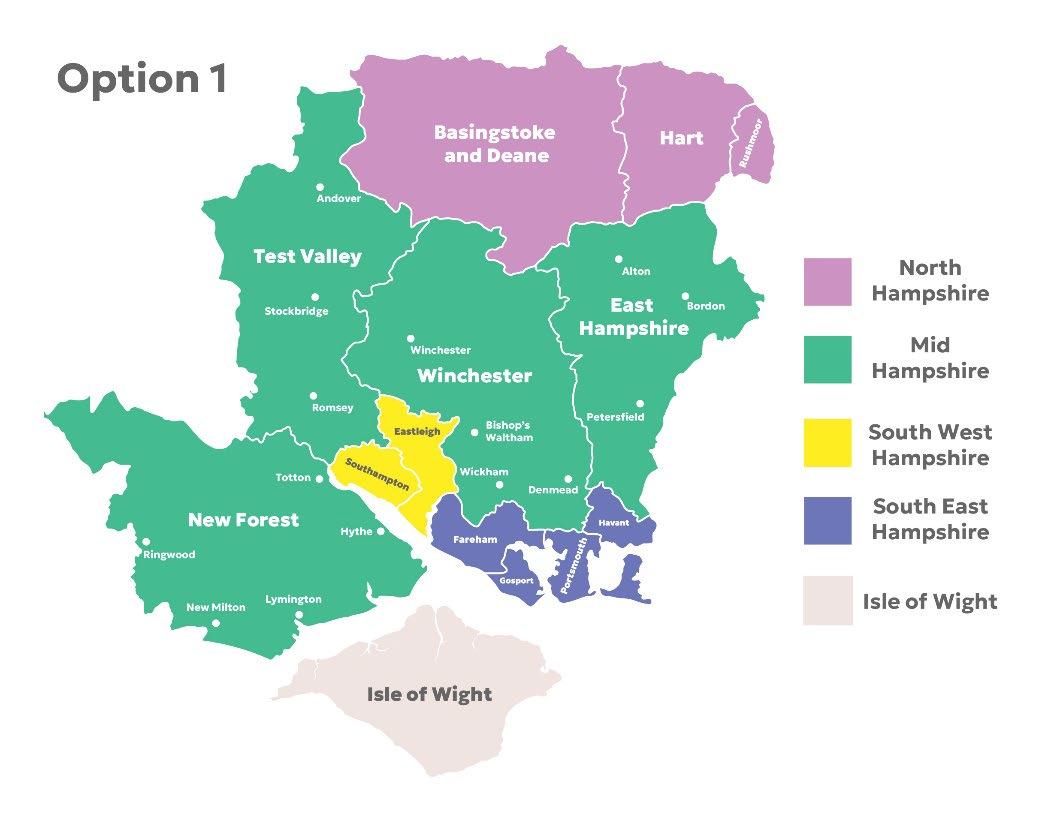
How is this option different
Option 1 differs from Option 2 as it proposes to establish a Mid Hampshire unitary authority on the current footprint of New Forest District Council, Test Valley Borough Council, Winchester City Council and East Hampshire District Council. Option 2 removes the New Forest from this cluster and places it with the city of Southampton and Eastleigh borough.
The Isle of Wight unitary, the North Hampshire unitary and South East Hampshire unitary are unchanged between Option 1 and Option 2 and the benefits in these regions remain as set out in the main document.
Option 1 specifically differs from Option 1A in that Option 1 proposes to use existing administrative boundaries when the new authorities are formed, avoiding the complexity, disruption and costs involved in splitting existing districts. The government feedback on boundary changes, states that such modifications could be considered where
there is strong justification. As the area most significantly impacted by these proposed changes, New Forest District Council will be submitting a separate representation to the Secretary of State setting out why we believe these modifications do not meet the government’s threshold, given their scale, associated risks, and the overwhelming views expressed by the community and businesses during local engagement.
Option 1 ensures a well-balanced mayoral combined authority of four mainland authorities plus the Isle of Wight where it can fulfil its strategic role in respect of the Freeport and the future of port development. It also allows the representation of wider local authority views, representing a greater geography in the development of key port infrastructure which is of national and regional economic significance where all strategic interests are represented.
In 2015, ONS produced travel to work areas (TTWA), based on 2011 census data for the whole country. Whilst these remain the latest available TTWA data set it does not reflect the changing nature of the economy and work patterns post Covid, and whilst commuting will inevitably still occur this shouldn’t form the main basis for justifying proposals.
Our engagement exercise demonstrates that, in community terms, people look to their local facilities such as pubs and community buildings, before their location of employment and that’s the basis of our preventative approach, directing services to the locations where people identify with, not their place of work. In fact, with populations (EIA Appendix 7) for those aged 55 and over of 28% and 21% for the New Forest and Test Valley respectively, and the population of 25 to 54-year- olds at 30.2% and 37.6%, compared with that of Southampton at 45.6% commuting numbers are a less relevant factor in community identity. Commuters will always only be a minority of the overall population and this, as a result, should not be the factor that shapes the new authorities.
Option 1 recognises and understands that the communities and economies of the building block areas share many similar characteristics and are ultimately very different to the mainly urban communities in the rest of mainland Hampshire. Option 1 provides four new mainland authorities that we are confident are right sized to deliver the annual estimated benefits and provide an excellent platform to build financially resilient and sustainable new unitary councils that can facilitate necessary public sector reform.
As such, this appendix focuses on the benefits of the proposed strong Mid Hampshire authority, including the entire New Forest, for the four new mainland unitaries with the Isle of Wight remaining independent, as set out in the Case for Change.
A summary of what this option delivers
The economy of the area is distinct and a Mid Hampshire authority established on the current footprint of New Forest, Test Valley, Winchester and East Hampshire would be best placed to support the new Mayoral Strategic Authority (MSA) to develop the unique economic potential of the area. The MSA will, as a result, benefit from a balanced membership of five constituent councils which collectively represent the full range of different economic interests in the region.
Establishing a single unitary authority to work with similar communities across Mid Hampshire and including the New Forest will enable an extension of our already strong place-based working with frontline local councillors supporting local communities to identify and deliver on their own aspirations and build their own resilience. This place-based approach will establish the conditions for transformative public service reform, that supports a preventative agenda to tackle demand, particularly in relation to adult and children’s social care. This approach reflects the preferences of residents and local partners, who value strong local identity, coherent delivery, and collaborative governance rooted in place.
The proposal to create a Mid Hampshire Council brings together the unique natural geography of the New Forest, the Hampshire South Downs, the world-renowned chalk streams of the Test, Itchen and Meon, with, at its centre, the cathedral city of Winchester.
In summary, this option will:
• Secure the benefits of devolution, including economic growth, by ensuring that the MSA is set up for success with a balanced set of constituent authorities, with a united voice for the mid Hampshire communities which are distinctly different from the rest of the geography. This option is better able to represent the diversity of communities and place across the region.
• Deliver a transformative vision for local government, addressing the challenges within the Hampshire area by creating the conditions for a new council with a vision to move on from outdated models of service delivery towards more place and asset-based approaches with a focus on prevention and reducing demand, thereby enabling the delivery of high quality and sustainable public services to all communities across the region.
• Align closely with communities’ views, as expressed in our recent cross-Hampshire survey and wider insight gained from targeted deliberative engagement across the Mid Hampshire area and specific feedback from key Forest town and parish councils and communities including the Commoners.
• Deliver new arrangements, and benefits to citizens, at pace by avoiding additional risk and lengthy bureaucracy associated with boundary change and the disaggregation of key services at a district level such as housing, waste, revenues and benefits and elections.
Key reasons for support
The main point of difference between this option and others in this Case for Change – and the option put forward by Hampshire County Council and East Hampshire District Council – is the proposal to establish a Mid Hampshire unitary authority on the current footprint of New Forest District Council, Test Valley Borough Council, Winchester City Council and East Hampshire District Council. This would operate alongside three new unitary authorities on the mainland to serve the more urban areas in and around the economic centres of Southampton, Portsmouth and Basingstoke in the South East, South West and North of the county. As such, this appendix focuses on the benefits of the proposed strong Mid Hampshire authority, including the entire New Forest, for the four new mainland and Isle of Wight unitary model set out in the Case for Change.
Securing the benefits of devolution, including economic growth
This approach would establish a balanced group of five strong and collaborative unitary authorities able to advocate effectively for their communities and support the MSA to deliver on its new strategic functions. There is a track record of place-based leadership, public service reform, and economic delivery in the Mid Hampshire area, which a new Mid Hampshire unitary authority would build on to actively partner with and strengthen the MSA.
A Mid Hampshire unitary authority would bring substantial and complementary economic strength, and a strong platform for future growth to support the devolution agenda. With a GVA of £18.2bn, Mid Hampshire is a strategically positioned, high-performing economy that is already driving regional prosperity and national productivity. It forms the natural link between the Solent’s coastal economy, anchored by Freeport tax sites in the New Forest, and the Midlands’ industrial base, offering seamless access to regional and international markets. Its connectivity is underpinned by nationally significant infrastructure: the M3, A34, A303, and M27 form the
backbone of freight and logistics across the region, while fast, frequent rail services connect key towns to London in around an hour, supporting labour mobility and access to talent. Proximity to Southampton International Airport and the Port of Southampton further enhances global reach. The rise of hybrid working patterns has also boosted the area’s attractiveness to residents and businesses seeking high quality of life, digital connectivity, and proximity to major centres without urban congestion.
The area is home to global brands such as INEOS, IBM, Estée Lauder, Arqiva, and Stannah, alongside a vibrant ecosystem of high-growth SMEs in sectors such as green technology, advanced manufacturing, agri-tech, and logistics. The Waterside area of New Forest, home of the internationally significant Fawley Oil Refinery, operated by ExxonMobil, anchors the area’s strengths in energy as well as supporting service delivery in sparse rural areas through its tax base and business rate generation.
This diverse and resilient economic base offers significant headroom for further expansion, particularly in innovation-intensive, exportled industries. Nationally recognised higher education institutions and sixth forms contribute to a high- quality skills pipeline, while active public-private collaboration enables research, workforce development, and enterprise growth. The New Forest faces skills challenges that are aligned with Mid Hampshire councils, as opposed to an urban area. It recently produced with partners a Skills plan to tackle local challenges such as an ageing population, low-paid jobs, and limited access to training. It focuses on helping young people, women returning to work, over-50s, job changers, and aspiring entrepreneurs. The key goals of the plan include supporting lifelong learning and digital skills, helping people into better paid, higher skilled jobs, and strengthening sectors like health, tourism, and green industries, as well as promoting inclusive growth and equal access to training.
Option 1 enables bespoke economic infrastructure and skills solutions right for the area to be developed, enabling Mid Hampshire to accelerate economic development, attract inward investment, and support the wider growth ambitions of the Hampshire and Solent region.
This economic dynamism is deeply intertwined with the area’s natural capital and landscape-led economy. Shaped by two National Parks and internationally protected environments, Mid Hampshire’s geography enables sustainable economic development and housing growth that respects environmental constraints. Tourism is a cornerstone of this model, generating hundreds of millions in annual visitor spend, supporting thousands of jobs, and sustaining a thriving network of small businesses across hospitality, retail, food and leisure. Over eight million people visit the Winchester district every year, spending over £370 million and supporting over 5,760 jobs. The New Forest alone attracts over 15 million visitor days annually and underpins one of the UK’s most valuable rural visitor economies. Its environmental role goes hand in hand with innovation in green tourism, decarbonisation, and nature-based enterprise. Keeping the
district whole is not just about identity – it is about ensuring joined-up infrastructure, sustainability, and stewardship across one of England’s most sensitive and economically vital landscapes.
In addition to its environmental and economic importance, Mid Hampshire plays a nationally strategic role in defence and security. It is home to British Army Headquarters and Middle Wallop Flying Station (home of the Army Air Corps Headquarters) in Test Valley, the TriService Defence College in Winchester, and Marchwood Military Port in the New Forest. These nationally significant assets contribute materially to regional GVA, anchor long-term public investment, and provide high-value employment in defence and logistics sectors critical to UK resilience. Bringing them together in Option 1 will enable the future council to continue the long- established support for armed forces and the wider sector within Hampshire.
Delivering a transformative vision for local government
As set out in the main Case for Change, all the unitary authorities have been assessed to identify the most financially viable option. This option would build on the supporting councils’ history of financial stability and resilience, and their record of place-based leadership and public service reform. By leveraging the economies of scale derived from operating across similar areas and communities, particularly in more sparsely populated rural areas, a new Mid Hampshire unitary authority would build on an already strong placebased and preventative way of working amongst districts and extend it into the unitary context. Central to this is an operational culture that puts frontline councillors at the heart of the authorities work with communities, building on their representative role to empower people to shape their futures, strengthening resilience and trust in public services. There is a clear opportunity to reshape the operating model for local government, focusing on rebuilding the relationship between local people and public systems through neighbourhoodbased, preventative delivery.
Across Mid Hampshire, councils are already working in partnership with the NHS, voluntary sector, and communities to reduce pressure on acute services, support independent living, and improve health outcomes. From the nationally recognised Andover Health Hub to discharge and reablement models in New Forest, Winchester, and East Hampshire, the area is delivering the kind of hyper-local, personcentred public services promoted by the NHS Long Term Plan. These approaches are not isolated and reflect a shared ethos across all four councils. From co - designed regeneration projects like Andover Vision and the Totton Regeneration Partnership to East Hampshire’s Whitehill & Bordon transformation, where community-led design has delivered integrated housing, health and green infrastructure, there is significant evidence in this area of how services and places can be shaped with and for residents.
By establishing the new unitary authorities based on similar areas and communities, the conditions will be set for these ways of working to become the mainstream in the new authorities, grounded in community empowerment and environmental stewardship, reducing demand, and delivering better services more cost effectively. This approach is a blueprint for stronger democracy, offering effective, financially sustainable, and accountable governance. It is a success story to be protected.
Aligning with communities’ views
Transitioning to a unitary authority should protect local interests and identities. Our approach ensures that historical, cultural and community identity and the natural assets that matter to our communities are safeguarded.
Within the independent survey commissioned by the 12 councils this option is the preferred choice of those completing the sur vey, with 48% supporting or strongly supporting Test Valley, Winchester, New Forest and East Hampshire forming the building blocks of a new unitary authority.
Option 1 is strongly preferred by respondents from New Forest and Test Valley. Previous reorganisations have demonstrated that where there is community support for proposals this results in effective and sustainable governance.
Delivering benefits to citizens at pace
This option is the only proposal that both avoids the disruption of boundary change and keeps the New Forest intact within a coherent Mid Hampshire geography. This is critical to maintaining the functional and operational fit of the area, preserving how communities live, work, and access services. Indeed, residents, local councils, and district elected representatives across the New Forest have expressed unanimous concern about the risks of boundary change or splitting Waterside from the rest of New Forest. Both New Forest MPs have indicated their support for Option 1.
Reorganising with similar councils as building blocks will be more efficient than merging diverse areas with very different communities, service delivery models, governance structures and population needs.
Assessment against MHCLG criteria
Criteria one: A proposal should seek to achieve for the whole of the area concerned the establishment of a single tier of local government.
Option 1 provides the most coherent and deliverable route to establishing a single-tier structure for Mid Hampshire. It brings together Test Valley, Winchester, East Hampshire and the New Forest - four councils with closely aligned operational models, shared priorities, and high- quality public service delivery across similar mixed rural-urban geographies. This commonality in approach, particularly around neighbourhood services, housing, and environmental management, offers a strong foundation for integrated, place-based governance.
A key strength of Option 1 is that it preserves both the integrity of the entire New Forest district, including the Waterside, as well as retaining it within a coherent Mid Hampshire geography. Its use of whole districts as the building blocks of reform enables a rapid transition without boundary change, minimising disruption to services, preserving community identity, and providing a stable foundation for future transformation. By working with the grain of existing partnerships, Option 1 avoids the overhead of complex structural adjustments and supports faster, simpler implementation, particularly relevant given likely LGBC boundary reviews post-reorganisation. Equally, retaining the entire New Forest district, geographically, administratively, and strategically, within a coherent Mid Hampshire geography is not just a matter of community preference, but a public policy imperative: preserving a nationally significant landscape, furthering the purposes of the New Forest National Park Authority, and protecting ancient commoning practices and environmental stewardship.
This configuration also delivers significant strategic value to the MSA. With a balanced population of just under 600,000, Mid Hampshire provides democratic parity and operational alignment with other unitary partners. It links two National Parks, significant natural capital, and national growth corridors such as the Solent Freeport’s Waterside tax sites and strategic freight infrastructure (M3, A34, A303). This supports delivery of MSA-wide priorities including net zero, sustainable housing, and rural economic growth. Option 1 ensures rural priorities are properly represented without compromising the city-region focus, providing a completer and more resilient MSA footprint.
One of the most recent LGR processes saw the creation of North Yorkshire Council, which could be seen as a forerunner to the proposals contained in Option 1. North Yorkshire Council has a population of over 600,000 which is a similar sized population to that proposed for Mid Hampshire. North Yorkshire brings together communities covering a very large geographical area which are similar in nature, rather than claiming to be single place. This is very similar to the Mid-Hampshire proposal. North Yorkshire is bordered by larger
urban areas such as the city of York which, itself, has a population of 210,000. This is around half the size of the proposed new unitary authority for Southampton and Eastleigh. North Yorkshire is made up of two National Parks which cover 40% of its geography and has market towns running the depth and breadth of what is the largest unitary council by geographical size, in England.
Finally, this model supports the MSA to deliver on the Government’s ambition to maximise sustainable housing delivery across Hampshire and the Isle of Wight. The Mid Hampshire footprint includes areas of significant housing potential, delivered through sensitive, landscape-led models supported by partnerships with universities, Homes England and statutory environment agencies. The geography reflects real-world patterns of housing, employment, and infrastructure, making it an effective delivery platform for growth that is both ambitious and sustainable.
Criteria two: Unitary local government must be the right size to achieve efficiencies, improve capacity and withstand financial shocks.
With a projected 2028 population of 598,823, Mid Hampshire is the right size to achieve the government’s ambitions for local government reform: big enough to deliver transformation and economies of scale, while local enough to remain responsive and rooted in place. Its scale supports efficiency, strategic capacity, and resilience to financial shocks, while its geography and design allow services to be tailored to the distinct needs of rural, urban, and semi-rural communities.
The Mid Hampshire proposal brings together councils already shaped by a shared understanding of how to deliver for communities across a mixed rural/town landscape. This enables the new authority to maintain local relevance while achieving organisational efficiencies. By retaining the boundaries of existing authorities, Option 1 avoids the complexity, cost, and service disruption that would result from lower tier disaggregation allowing for a more seamless transition.
The Hampshire County Council forecast deficit to 2028 of £281m represents an enormity of financial challenge that proves why a different approach and scale of local authority across the county area is needed. The financial advantages of the four new mainland unitary model have been robustly tested during the building of this case for change and shows significant net budget improvements for all recommended authorities. Option 1 provides four new mainland authorities that we are confident are right sized to deliver the annual estimated benefits and provide an excellent platform to build financially resilient and sustainable new unitary councils.
Collectively, these councils have shown strong financial governance while investing in future efficiency, through retrofit programmes, nutrient-neutrality mitigation, and developer-funded infrastructure. This prudent, future-focused approach provides a strong platform for a financially sustainable unitary authority.
Mid Hampshire’s well- connected infrastructure, anchored by the M3, A34, A303, M27 and fast rail links to London, enables seamless movement of goods, people, and services. These routes are vital for national freight logistics and underpin the success of key industries in the region. The area also benefits from excellent access to international gateways including Heathrow, Gatwick and Southampton International Airport, further enhancing its strategic connectivity for business, trade and travel.
The area’s economy further reinforces its resilience and growth potential. Mid Hampshire is home to global companies such as INEOS, IBM, Estée Lauder, and Arqiva, alongside a thriving ecosystem of high-growth SMEs. Its economy is defined by both scale and momentum, anchored in key sectors like advanced manufacturing, logistics, agri-tech, environmental services, and green technology. These sectors are not only high value but strategically aligned with national economic and net zero priorities. This blend of multinational investment and entrepreneurial energy creates a dynamic environment for jobs, exports, and inward investment. Tourism also plays a vital role in the region’s economy. With millions of visitors each year to the New Forest, Winchester, South Downs National Park, and market towns such as Lymington, Romsey, Petersfield, and Alton, the area supports one of the UK’s most valuable rural visitor economies. Tourism sustains thousands of jobs across hospitality, retail, culture, and heritage, while also reinforcing local identity and landscape stewardship.
In summary, Option 1 is right sized to meet the government’s ambition for resilient and efficient local government. It combines scale with subsidiarity, builds on commonality in service delivery, and avoids the risk and disruption of boundary change. Its structure supports stronger partnerships, maintains close connections with residents, and delivers the long-term efficiency that reform is intended to unlock.
Criteria three: Unitary structures must prioritise the delivery of high quality and sustainable public services to citizens.
Mid Hampshire councils demonstrate a strong and consistent track record of delivering high- quality, sustainable public services, especially in housing, preventative health, and community infrastructure. They have a shared commitment to service models that are rooted in local communities, respectful of the natural environment, and responsive to the needs of rural and mixed geographies.
A particular strength of Option 1 is the design of services around the needs of rural populations, including isolated and less well served communities where deprivation is often less visible but no less acute. Mid Hampshire's model offers a credible, scalable route to tackling rural deprivation, one of the government’s key priorities, through outreach-based public services, targeted investment, and inclusive community infrastructure. From mobile and outreach health provision to housing strategies tailored to smaller settlements, services are delivered at the scale of recognised community footprints. This ensures local relevance, service take-up, and social impact, while maintaining efficiency and accountability.
The area is also well positioned to deliver integrated adult social care. All four councils have invested in neighbourhood-based preventative models that promote independence, reduce pressure on acute services, and align with national NHS and social care objectives. These models provide a scalable blueprint for joined-up care:
• In the New Forest, initiatives like Independence Matters and Just Got Home support recovery at home, reduce delayed discharges, and enhance patient choice – especially in hard-to -reach rural areas.
• The Andover Health Hub is a nationally recognised example of multi-agency coordination, bringing together NHS services, local government, and voluntary sector partners to improve discharge, reablement, and early intervention. Winchester and East Hampshire deliver embedded neighbourhood support through voluntary and primary care networks. In Winchester, locality teams collaborate with GPs and VCSE partners to support frail and older residents, while East Hampshire integrates community development officers into local hubs, focusing on early intervention, carers, and those at risk of social isolation.
The broader Option 1 model allows for coordinated transformation of complex services, including adult social care. Shared NHS providers, overlapping community networks, and a culture of place-based practice enable a safe, phased disaggregation of county functions. Together, these new authorities can redesign services around local geographies, ensuring smoother transitions for residents and stronger alignment with primary care, mental health, and voluntary sector partners.
Support for children and families is also integrated. Across Mid Hampshire, shared community assets such as dual-use halls and children’s centres support early years and family development. Joint work with schools, GPs, and VCSE partners enhances delivery of mental health and early help services.
Housing and infrastructure strategies demonstrate sustainable public service innovation. Across the region, councils have worked together, and with the Civic University Network, to plan and deliver homes that meet rural community needs while protecting environmental assets. This includes:
• Exception site housing for local people.
• Retrofit programmes to reduce fuel poverty and emissions.
• Nutrient neutrality mitigation to unlock stalled housing sites.
• Developer-funded infrastructure to support long-term public service integration.
Importantly, this geography supports simplification of planning and environmental governance. The New Forest National Park currently intersects four local planning authorities— creating complexity and fragmentation. Option 1 reduces this to three, streamlining delivery and strengthening the statutory role of the NPA. It also aligns strategic housing delivery with ecological stewardship, enabling services and infrastructure to be planned in harmony with the protected landscapes that define this area.
Option 1 presents the strongest alignment with the New Forest National Park Authority’s statutory purposes and strategic priorities, undertaken in a recent assessment by the NPA. By retaining the integrity of the New Forest as a whole and combining it with other predominantly rural authorities - Test Valley, Winchester, and East Hampshire - the option safeguards vital landscape, ecological, and cultural heritage links. It supports collaborative delivery of national objectives such as nature recovery, climate resilience, and the 30x30 targets, while recognising the socio - economic value of the New Forest’s natural capital. Crucially, it avoids fragmentation of the Waterside area, preserving the commoning system essential to the Park’s management and identity.
This approach reinforces national policy duties under the Environment Act 1995 and the Levelling Up and Regeneration Act 2023, supporting the statutory purposes of National Parks and preserving ancient commoning rights that are unique to the New Forest.
In summary, Mid Hampshire is already delivering high- quality services through preventative, environmentally respectful, and community-focused models. The proposed unitary would build on this foundation, scaling best practice, unlocking housing and health outcomes, and reducing the overheads associated with boundary reorganisation. Crucially, it offers one of the most coherent platforms to tackle rural deprivation and isolation, supporting inclusion, economic resilience, and improved outcomes in places often underserved by urban-led models.
Criteria four: Proposals should show how councils in the area have sought to work together in coming to a view that meets local needs and is informed by local views.
While the four councils have not historically operated as a formal partnership, they each bring strong and complementary relationships with NHS partners, town and parish councils, community groups, and local businesses. Their shared strategic values and deep commitment to place-based working create a robust foundation for integration.
This option builds on community consensus. Each authority has engaged extensively with residents, town and parish councillors, and civic partners as part of the local government reorganisation process. This feedback consistently supports a model that:
• Retains existing district boundaries and avoids unnecessary structural change.
• Respects local identity and reflects the distinct character of rural communities.
• Maintains proximity between residents and the services they rely on.
There is a clear desire for governance that keeps decision-making local, responsive, and grounded in how communities already live, travel, and access support. Option 1 reflects these preferences. It is designed around natural functional geography, reinforced by travelto -work flows and social connections between New Forest, Test Valley, East Hampshire and Winchester, and avoids boundary reorganisation that would weaken the alignment between local identity and governance.
This model also reinforces people’s connection to rural life. It recognises that rural residents value distinct things, such as access to local services, landscape stewardship, and direct influence over neighbourhood priorities. There are key communities within the New Forest including the New Forest Gypsy, Romani and Traveller communities some of whom were historically resettled from roaming freely across the Forest to settled areas including Totton within the waterside area, Fawley Parish, and Hythe.
Also, the Commoners who have a demonstrable historical continuity in the New Forest going back over a thousand years in unbroken continuity and have maintained a sociocultural identity and traditional way of life which is distinct from any other group in the UK. The continuation of our traditional way of life including culture, identity and practice is vital to maintaining the New Forest’s internationally important ecology and landscape.
By retaining whole districts and established footprints, Option 1 ensures that this relationship with place is maintained and strengthened into the future.
Mid Hampshire’s geography also includes a network of vibrant towns, from Andover and Alton to Romsey, Lymington, Petersfield, Bordon, Stockbridge and Bishop’s Waltham. These towns are more than service hubs; they are identity anchors for surrounding rural communities. The Mid Hampshire approach explicitly acknowledges their distinct needs and builds governance and delivery around them. It supports targeted economic growth, transport investment, and social infrastructure designed for market-town scale, something not always achievable in more urban- dominated unitary models.
Crucially, this proposal also protects and strengthens the role of town and parish councils. These local bodies play an essential role in shaping services, supporting vulnerable residents, and holding decision-makers to account. The councils within Mid Hampshire already operate highly localised governance structures, such as area planning committees, neighbourhood forums, and ward-led investment models, that empower local voices and ensure that frontline councillors are at the centre of all work with communities. Under a Mid Hampshire unitary, these mechanisms would not only be retained but elevated, embedding neighbourhood democracy in the new authority’s governance model.
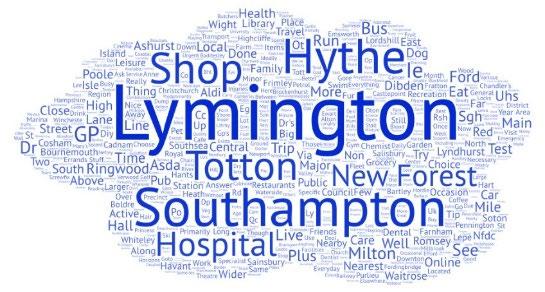
Independent deliberative engagement commissioned from Thinks Insight & Strategy found that “most New Forest residents see the New Forest as their local area, including towns in the area such as Lymington, Lyndhurst and New Milton. While many travel to Southampton to access services and amenities, people are reluctant to identify it as part of their local area.”
In summary, Option 1 is rooted in what communities have asked for. It:
• Builds on community consensus around boundaries, identity and local delivery.
• Supports people’s connection to rural life and distinctive places.
• Recognises and empowers market towns and their surrounding settlements.
• Strengthens collaborative working with town and parish councils.
• Reflects lived experience and patterns of movement across Mid Hampshire.
It is not just a configuration that works on paper, it is a model shaped by people, place, and local ambition.
Criteria five: New unitary structures must support devolution arrangements.
Mid Hampshire is well-positioned to support future devolution. Its size, strategic coherence, and delivery capability make it an ideal partner for taking on devolved powers and functions, ensuring that decisions are made at the most appropriate level, aligned to the needs and aspirations of communities and businesses.
The region already demonstrates the capacity and credibility required to operate at a devolved level:
• Major regeneration leadership at Andover and Winchester, driven by local ambition and strong delivery capability.
• Strategic influence on the Solent Freeport Board, particularly through New Forest’s Waterside sites with successful working through the Waterside Steering Group ensuring the business case delivers for local residents for example co -producing the New Forest Skills Plan.
• Collaborative housing and environmental planning, including joint solutions to challenges like nutrient neutrality and sustainable land use, with projects such as Whitehill & Bordon in East Hampshire exemplifying landscape -led regeneration and a proactive planning approach to Solent Freeport tax sites including Solent Gateway and Fawley Waterside.
• Successful attraction and deployment of Levelling Up Fund, UKSPF, Homes England, and DEFRA investment across all four districts, including targeted rural and market-town interventions in Petersfield and Alton.
In particular, the transformation of Andover, led by Test Valley through a nationally recognised co - design process, demonstrates Mid Hampshire’s readiness to lead place-based change. The emerging health and wellbeing campus integrates health, planning, and infrastructure in a way that exemplifies the area’s ability to align local innovation with regional priorities.
A Mid Hampshire unitary authority would also be well placed to maximise the economic and environmental opportunities available across Hampshire and the Isle of Wight. Its geography connects high-potential growth corridors with exceptional natural capital assets, such as the New Forest and South Downs National Parks, Sites of Special Scientific Interest, and internationally renowned chalk rivers. These areas are not only environmental treasures but economic engines: supporting land-based enterprise, eco -tourism, and green innovation.
The scale and coherence of Mid Hampshire enable it to act as a strategic delivery vehicle, harnessing this natural capital to drive inclusive, environmentally responsible growth. This includes:
• Sensitive delivery of housing and infrastructure in protected and constrained landscapes.
• Investment in sustainable transport and clean energy.
• Stewardship of ecosystems and biodiversity in ways that also support economic resilience.
Option 1 ensures that this unique blend of landscape and economy is governed in an integrated, place-sensitive way, aligning environmental responsibility with productivity and growth.
As a partner within the MSA, Mid Hampshire would provide geographic and functional balance. It complements more urban unitary areas by representing the rural and town perspective, ensuring strategic priorities, such as housing, health, and net zero, are delivered across a full spectrum of places. Its presence would help shape a more balanced regional offer, grounded in diverse strengths and shared ambition.
In summary, Mid Hampshire including the New Forest:
• Has the scale and leadership maturity to absorb devolved powers.
• Offers a strategic geography that links coastal, rural, and inland economies.
• Maximises the potential of natural capital to deliver green growth.
• Supports balanced, inclusive regional development in partnership with the MSA.
• Keeps governance rooted in place, while aligning delivery with national policy.
• This is not just a unitary proposal, it is a ready-made platform for meaningful devolution, designed to unlock the full potential of the area and contribute to the prosperity and sustainability of the wider South East.
Criteria six: New unitary structures should enable stronger community engagement and deliver genuine opportunity for neighbourhood empowerment.
Mid Hampshire councils are national exemplars in neighbourhood-based engagement. Their democratic and community development models go beyond consultation, they are embedded in how places are shaped, and services are delivered. This collaborative, neighbourhood-first approach strengthens local democracy, resilience, and ownership, and provides a robust platform for future innovation.
Crucially, Option 1 builds on the strength of having well- established parish and town councils across the entire geography. These structures already provide a direct, trusted link between residents and governance, especially in rural areas. Under this model, Neighbourhood Area Committees would be established to bring together representatives from the new unitary authority and existing town and parish councils. This approach ensures continuity of local representation, while enhancing capacity for coordinated, responsive delivery.
This configuration maintains people’s connection with rural life and supports the distinctiveness of market towns, which often require a different service focus from more urban centres. Rather than imposing a one-size-fits-all model, Option 1 enables locally bespoke governance that reflects the diversity of communities across Mid Hampshire, empowering residents to shape solutions that meet their unique needs.
Option 1 fulfils the LGBCEs requirement for effective and convenient local government. A unified governance model ensures coherent service delivery, environmental regulation, and planning policy, all of which would be compromised by fragmentation. For example, in ecological stewardship the Waterside forms a vital corridor between the Forest and the Solent. Fragmenting governance would disrupt biodiversity management and climate resilience strategies. In terms of planning for the area the Waterside Vision, A326 upgrade, and Freeport development are coordinated through cross-agency partnerships rooted in the New Forest context. Across the geography, councils are already empowering communities to shape their futures and Option 1 brings together place-based partnership delivery:
• Test Valley’s Andover Vision and Romsey Future partnerships are long-standing, community-led programmes that shape regeneration priorities and build consensus across sectors.
• Winchester’s neighbourhood forums support the development of new communities by giving voice to residents, ensuring new places are shaped from the ground up.
• The Totton Regeneration Partnership in the New Forest exemplifies collaborative place-shaping involving councillors, residents, and local organisations.
• East Hampshire District Council, through the Whitehill & Bordon regeneration, has engaged residents via community forums and placemaking governance schemes, ensuring public input shaped health infrastructure, environmental design, and sustainable master planning.
These initiatives have been enhanced through award-winning engagement methods, such as citizens’ assemblies and digital consultations, which reach a broader and more inclusive audience. Winchester’s lockdown- era consultation won two national awards for its impact and reach, while Test Valley has built a national reputation for deliberative public engagement.
In addition to engagement, formal governance structures are already close to communities. Ward-level funding, area-based planning committees, and dedicated community support teams extend the council’s presence and visibility on the ground. In New Forest, councillor budgets along with a £350,000 annual grants scheme enables residents to lead on local priorities. In East Hampshire and Winchester, community governance is adapted to reflect the needs of growing settlements and new developments.
The new Mid Hampshire unitary authority would not only maintain these structures, but it would also scale and strengthen them, combining the local accountability of parish and town councils with the strategic capacity of a larger, financially resilient UA. The introduction of Neighbourhood Area Committees would enhance joined up working across tiers of governance and deepen the reach of local democracy.
In summary, Option 1 empowers local communities, protects local identity, and reinforces the structures that already support responsive, democratic governance. It delivers on the Government’s ambitions for neighbourhood empowerment by rooting decisionmaking in place and extending trust and influence on the communities themselves.
Leaders’ and other key stakeholder endorsements
Cllr Jill Cleary, Leader, New Forest District Council
“Option 1 delivers reorganisation that works for the whole of Hampshire and the Isle of Wight, creating a governance model that is efficient, locally responsive, and positioned to maximise our shared economic and environmental potential.
“The district of the New Forest is more than a location, it is a connected community with a shared identity and a clear sense of direction. Our residents have told us they want governance that reflects that reality. And our communities have spoken with clarity and conviction, speaking up for governance that feels rooted in who they are, where they live, and how they connect with one another. For the New Forest, Option 1 builds on existing partnerships, aligns areas with complementary priorities, and creates the conditions for stronger, more resilient public services.
“This is about building on the very best of what we have; harnessing the Waterside’s economic potential within the wider region, championing the Forest’s role in environmental leadership, and ensuring a strong voice in decisions that shape our future.”
“Option 1 is the only configuration that can deliver LGR with community backing, regional coherence, and the credibility to make it work. It unlocks the full potential of Hampshire and the Isle of Wight while keeping the Forest whole.”
Cllr Phil North, Leader, Test Valley Borough Council
“Our communities are very supportive of Option 1. Whilst nobody is claiming that Mid Hampshire is a single place, its communities and economies share many similar characteristics. Ultimately it is very different to the mainly urban communities in the rest of mainland Hampshire.
“As a result, it will provide the conditions for public service reform to succeed and offers hope of a sustainable future for all our communities. It will ensure a well-balanced mayoral combined authority where all strategic interests are represented.”
Who supports the option?
Basingstoke and Deane Borough Council
New Forest District Council
Test Valley Borough Council
Conclusion: Why Option 1 offers the strongest path forward
Option 1 presents the most coherent, deliverable, and future-ready model, with a coherent and strong Mid Hampshire unitary authority at its centre. It builds on existing boundaries as building blocks, bringing together similar areas currently governed by councils with aligned priorities, shared delivery models, and a strong culture of place-based innovation, creating the right conditions for better services, stronger communities, and long-term financial sustainability for all councils.
It brings forward a geography that reflects commonality, ensuring a rural voice in strategic decisions and avoiding placing a predominantly rural area into a governance structure designed around a city. It is designed to support an effective Mayoral Strategic Authority, bringing together two National Parks to provide environmental leadership across the region.
Crucially, Option 1 is the only configuration that both preserves the integrity of the entire New Forest district, including the Waterside, and retains it within a coherent Mid Hampshire geography. This ensures that rural identity, operational coherence, and environmental stewardship remain intact, vital in one of the UK’s most sensitive and nationally significant landscapes. It produces coherent and effective local governance and builds on local identity, two key principles for shaping council boundaries.
Option 1 avoids both disruption and compromise. It offers:
• No boundary change, making it the least disruptive and most immediately deliverable option.
• Continuity in public service delivery, building on strong cross-sector partnerships already in place across health, housing, environment, and community services.
• Economic strength and connectivity, rooted in a high-performing £18.2bn GVA economy, key national infrastructure, and growing innovation clusters.
• Balanced population and tax base, enabling resilience and fair contribution within the MSA.
• A strong public mandate, reflecting resident and partner preferences for identity, coherence, and local empowerment.
Option 1 meets every one of the MHCLG criteria, not just on paper, but in practice. It supports national policy goals, aligns with how people live and work, and provides a credible, low-risk foundation for transformation. It is the option that delivers reform with consent, not disruption; a model that strengthens Mid Hampshire and contributes fully to the success of the wider Mayoral Strategic Authority.