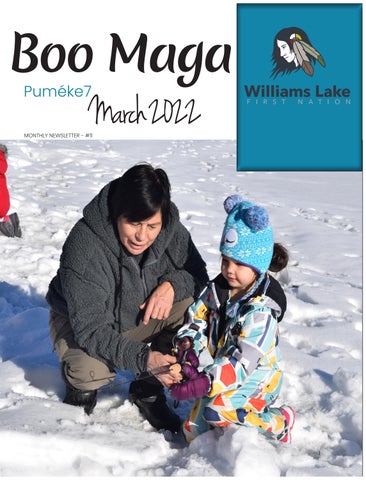
Boo Maga Puméke7
March 2022
MONTHLY NEWSLETTER - #11
1
Contents Councillor’s Message
4
Chris Wycotte provides commentry on the local Wildlife and fish
Welcome to the Boo Maga (puméke7), which translates to “drum stick”.
The Osprey Nest
6
WLFN’s new and exciting project coming soon!
Student Highlight
8
Danikka
Murphy
is
studying Secewpemctsin Language
NDIT Intern Year Review
10
Jia takes us through all she has experienced in the last year!
Staff Member Highlight
12
Check in with Alyssa Alphonse in
who
the
Education
Council Meeting Highlights Take a look at what your Council have been discussing over the past month!
Contact us: shannon.skeels@wlfn.ca 250-296-3507 ext.185
works
Department
14
Got an idea or story for future editions?
General Inquiries: lisa.camille@wlfn.ca 250-296-3507 ext.103 Facebook: Williams Lake First Nation www.wlfn.ca
2 BOO MAGA - MARCH 2022
Councillor’s Message Wetkp xwexweytp: I thought I ‘d focus this month’s report on Wildlife and Fish. Most members probably know and understand how important wildlife and fish are to our culture and practices. Historically, we had no reason to worry whether we’d have these resources available to us going into the future. I remember in my younger days all the families in the community had their own hunting and fishing areas. These areas were chosen by the families, and they would return to these sites on an annual basis to hunt and process their meat supplies for the up-coming months. Similarly, fishing areas were treated the same way. It would eventually become common knowledge that certain areas would be the main hunting or fishing camps of specific families. During our 1995 - 1997 Traditional Use Study interviews, many interviewees would identify specific areas as this or that family’s hunting or fishing camp. However, while the general practice was to recognize family areas, the areas would remain open to
other members to use through protocols or family ties. The use of the camping areas was not automatic but was based on our laws of respect. If someone wanted to use another family’s camping area, the right way to approach this was to get permission from that family. The main reason for recognizing these areas as a family area is that it took a lot of time and effort to establish the sites as a hunting or fishing camps. Sometimes a cabin would be built along with corrals, drying racks, and sweat lodges etc. Another important law that was practiced was ‘sharing”. At one time, our community members shared everything, and this
practice was important to our survival. I remember in my younger days multiple families getting together to go to their hunting camps or other harvesting areas like Quesnel and Horsefly lakes to hunt, pick berries and gathering other plants for medicines. They would camp out for two to three weeks at a time or however long it took to get what they needed. The group would work together to harvest enough game or fish to ensure that everyone had enough to get them through the winter. Today, because of major changes in our lifestyle and priorities like work and changes to our mode of travel. Vehicle use makes it a lot easier to do day trips and we are no longer going to our hunting or fishing camps. Therefore, we are BOO MAGA - MARCH 2022 3
spending less and less time using our territory like we use to, and our footprints on the land are getting smaller and smaller. This, in a lot of ways, has opened our territory for other users to use at their will. There are many nonSecwepemc First Nations people living in Williams Lake from neighboring nations and across Canada. When they want to exercise an aboriginal right to hunt and fish, they don’t go back to their own territories to exercise these rights. Most assume that they have a legal right to exercise these rights wherever they reside. However, this assumption is wrong, Secwepemc laws state that access to our territory is based on permission or other protocols. Further,
4 BOO MAGA - MARCH 2022
the courts have decided that an indigenous person’s aboriginal right to hunt or fish does not extend into another First Nation’s territory. They can exercise an aboriginal right to hunt or fish outside their territories, but they must follow the protocols of the First Nation whose territory they are in or provincial hunting regulations. Canada and the Province are beginning to understand and recognize that Indigenous people had laws and protocols that governed access to their territories prior to contact. Both levels of governments have expressed a willingness to work closely with First Nations to begin recognizing and reconciling First Nations laws and protocols.
I recognized in the mid-1990s that the uncontrolled access to our territory by other First Nations was becoming a big issue, especially with the growing population of Non-Secwepemc First Nation people moving into Williams Lake. This has placed extra pressure on the wildlife and fish resources within our territory. The decline in moose and salmon populations are good examples of how the negative impacts are being felt by our people. Overharvesting by other First Nations is not the only reason for the decline but WLFN must have a greater role in managing our territory. In 2002, I developed a hunting permit system for WLFN. The idea was to work with
the Conservation Office in Williams Lake to establish some control over who hunted in our backyard. I was hoping that they would see the benefit of our permits and develop a policy that if Non -Secwepemc First Nation hunters were caught harvesting game in our territory without our permit they would be charged. At that time, the Conservation Office had no interest in recognizing or respecting our permits. I kept issuing the permits anyway knowing that we have an aboriginal right to do so. Our hunting permits have been in place going on 20 years now. On a positive note, there has been some positive changes within the Conservation Office recently. In 2020, the Conservation Office approached WLFN with a proposal to sign a Memorandum of Understanding. The proposal was discussed at a Council meeting and then brought to the community for further discussion and input. We liked the idea of providing better enforcement within our territory, but we were not satisfied with the language being proposed. We finally agreed to sign an interim Enforcement Agreement with the understanding that we will have the opportunity to review and revise the agreement to include language that would better meet our interests. There were some resistance
from the CO representatives but they agreed to take this into consideration. This agreement may be short lived anyway as we are having some serious discussions at the treaty table regarding our laws, jurisdiction, management, and control over our territory. We have a lot of work to do in this area, but I am confident that we will get there. The purpose of developing the hunting permits in 2002 might be finally getting some traction. On the January 15th weekend, a pickup was pulled over on Redeau Lake Road by Conservation Officers as a road check. Three men were in the truck: a First Nations man from a neighboring Nation and two non-indigenous men. Two moose, a cow and a calf, were found in the back of the pickup. Not knowing what to do about the situation, the COs called our office, our law enforcement staff went to the scene and recommended that charges be filed. Our staff met with me and other council members early in the week to confirm whether
the recommendation was the right one. We agreed that it was. As far as I know charges against the individuals are pending. The moose was confiscated along with other property. The moose was given to WLFN for processing and distribution. One last point I’d like to make before closing off my report. There have been several elk sighted on our Reserve #1 lands. I am honored that they chose our lands to return to and, in my mind, they are looking for our protection. The Elk have been gone from our territory since approximately 1921. They moved out when the moose moved in. With the high decline in moose numbers, the Elk seem to be moving back in. We must look after the Elk that are coming back. So, lets protect these animals and let their numbers grow so we can go back to hunting Elk in the future.
Chris Wycotte Councillor Chris Wycotte BOO MAGA - MARCH 2022 5
The Osprey Nest - coming soon! Williams Lake First Nation has
public about our plans. This
major projects in and around
recently announced plans for
building will truly be a game-
Williams Lake. These units will
a new mixed-use development
changer for our region. It
also provide options for locum
on San Jose Indian Reserve
will consist of a stunning
physicians,
#6, near the intersection of
2000 square foot restaurant
others who we are attempting
South MacKenzie Avenue and
space with nearly a thousand
to
Borland Street in Williams
square feet of outdoor patio
There will really be nothing
Lake.
development,
space overlooking the lake
comparable
which has been given the
and Scout Island. There will
temporary
project name “The Osprey
be some incredible features
in and around Williams Lake.”
Nest” consists of a café and
like
mezzanine
WLFN IR#6 is also the site of
gathering space on the main
providing an intimate area
Unity Cannabis and Sugar
floor and four separate open
for private meetings, and an
Cane Cannabis. The 7,000
concept lofts on the second
outdoor rooftop patio. The
square
floor.
second floor will be high-end
Cannabis building, which in
“We conducted a membership
open concept loft spaces with
January received its Health
engagement session,” states
a total of eighteen feet of
Canada cultivation license, is
WLFN Chief, Willie Sellars, “and
height. The views from these
British Columbia’s first seed-
the feedback was extremely
spaces will be amazing. We
to-sale cannabis facility. Doors
positive.
to
expect to utilize these lofts
to the Sugar Cane Cannabis
now be able to provide some
to provide accommodation
Discovery Centre are expected
information to the general
to professionals working on
to open to the public in March,
The
We’re
excited
6 BOO MAGA - MARCH 2022
an
indoor
teachers,
attract
to in
this
and area.
terms
of
accommodations
foot
Sugar
Cane
with retail sales commencing in May. “We’ve
proven
that
WLFN
projects are top-notch and cutting
edge,”
adds
Chief
Sellars. “This project will be a spectacular addition to the region, and we want its quality and character to reflect its indigenous
ownership.
The
entire building will be accessible to those who are mobility challenged. It will generate numerous jobs, both during and after construction, create
we hope to really showcase
McNaught of m2 Architecture,
opportunities
what
general contractors Lauren
for
capacity
the
Cariboo
has
to
development, and provide a
offer. We’re currently having
Brothers
space for our community to
discussions with a number
and interior designer Rena
gather in proximity to the lake.
of parties with respect to the
Johnson of the Rusty Bucket.
The outdoor patios are truly
management and operation of
Construction of the Osprey
unique and offer something
the restaurant portion of the
Nest is slated to commence in
you can’t find anywhere else
building and we’re still open to
Spring of 2022 and is expected
in the city. There are exciting
talking to others.”
to complete within one year of
possibilities in terms of farm-
The Osprey Nest project team
project commencement.
to-table at the restaurant, and
consists of architect Michael
Construction,
BOO MAGA - MARCH 2022 7
Post-Graduate Student Highlight: Danikka Murphy Weytkp xwexweytp! Danikka Murphy ren skwekwst. Te Texelc ell Xeni Gwet’in re st7e7kwen. Ec re mumtwen ne Yucwt. Ell ec re e7elkstwen re school district 27 Secwepemc language and culture lleqmelten. Ren kike7ce Sheila Williams, te Texelc ell Xeni Gwet’in re ste7e7kwes. Ell ren qeq7etse le Ken Murphy, te Toronto re ste7e7kwes. Kukwstsetselp. Hello everyone! My name is Danikka Murphy. I come from WLFN and Nemiah Valley. Right now I live in Williams Lake. And now I work for School District 27 as the Secwepemc language and culture teacher. My mom is Sheila Williams, she comes from WLFN and Nemiah Valley. My dad is theh late Ken Murphy, and he comes from Tornoto. Thank you all. 8 BOO MAGA - MARCH 2022
I am a mother to three beautiful children, and a wife to Patrick Lulua. Life gets pretty busy around here, but I try to make time for my sewing, knitting, beading, painting, any craft really. I enjoy learning new hobbies. Currently, I am studying to obtain my Secewpemctsin Language Proficiency Certificate. It is a full time course, and
I am loving everything about it. I get a sense of belonging learning Secwepemctsin. It is my goal to teach our next generations to come. I want everyone to feel and know the joy and power when speaking Secwepemctsin. I see myself teaching our language for many more years. Kukwstsetselp. Thank you all!
WLFN Post-Secondary Bursary Recognitions Williams Lake First Nation would like to offer a huge congratulations to the following students who have been awarded the following bursaries. We wish you well as you continue further in your studies. Geraldine Bob:
Elders Bursary – Cecilia Michel, Clotilde Thomas, Tommy Wycotte Sr, Agnes Anderson Shuswap Traditional Bursary – Josephine Bob
Lori BillyBoy:
Business Administration Bursary – Isabelle Stobie
Roderick Sandy:
War Veteran Bursary – Johnny Alphonse Sr, William Moore
Michaela Gilbert:
Bachelor of Arts Degree Bursary – Joan Sellars
Savanna Sandy:
Chief George Abbey Bursary Trades Bursary – Pierro Sandy
Trinity Sure:
Bachelor of Science Bursary – Kara Michel, Ron Martell
BOO MAGA - MARCH 2022 9
NDIT Intern: Jia Zhang a year in review! Williams Lake First Nation hosted Jia as our First Nation Government Intern this pas year, and will be hosting another for the third consecutive year in 2022-2023. Weyt-kp
xwexweytep,
skwekwst
Jia
Zhang
ren (Hello
populated Uyghur
with
Indigenous
everyone, my name is Jia Hui
people…”
Zhang)! I am the NDIT First
It wasn’t easy for me
Nations Government Intern
to come to abroad
for Williams Lake First Nation
to study and work,
(WLFN). I have been studying
but luckily, I made
and working in Canada for
it. I am very thankful
around
to
seven
years
now,
have
had
the
after I left my hometown--
chance to come to
XinJiang Uyghur Autonomous
Canada
Region, China. I’m sure other
had this opportunity
international graduates feel
to work with T’exelc
similarly,
and
but
I
sometimes
and
explore
now
the
feel answering questions like
community.
Since
“where are you from” is truly
I
WLFN
storytelling.
last summer, I spent lots
not only helped me to gain a
“I came from Surrey, Vancouver,
of my spare time to learn
better understanding of a First
Prince George, and originally
basic Secwepemc and feel
Nation government structure,
Northwest China.”
connected
Shuswap
management and operations,
“So you are from China, but
cultures with my traditional
but also has strengthen my
where exactly?”
cultures. It reminds me of
determination
“Well, I can try and make it
the extended relationship we
about Indigenous values and
sound brief: A mountain region
share with family and friends.
community
10 BOO MAGA - MARCH 2022
joined
with
This Internship program has
in
learning
planning.
My
internship experience has been
Investigation,
open,
training
engaging,
supportive
completed
and
and fascinating. I would like
with
to say a huge thanks to my
department,
mentors and colleagues! This
land use planning and survey
experience has been incredibly
initiatives, and contributed
valuable for an intern with
to
very little practical experience
pursuit of special project
in Indigenous governments.
fundings. My current role for
Although the expectations of
the rest of the internship is
me is not incredibly difficult,
to provide capacity support
I still experienced a learning
for the Housing department.
curve due to this being my
The opportunity for me to
first
I
support Housing will allow
appreciated that WLFN and
me to experience additional
my mentors support me at
key program deliverables for
work and my professional
an Indigenous government.
development wherever they
Sustainable housing is the
can.
key
During the first few months
and wellness for all WLFN
of my internship, I assisted
members, I am very excited to
the
promote on-reserve housing
internship
St.
program.
Joseph’s
Mission
the
accreditation WLFN helped
grant-writing
to
Lands with
and
community
programs
the
health
with
my
supervisor to enhance members’ lives. As an urban planning practitioner,
my
observation
of
an
Indigenous community comes from members’ voices
and
public
participations.
It’s
about
to
all
listening
the
voices
and
analysing those voices to make appropriate recommendations. I
mean,
to
really
listen, not just to hear. To learn and practice indigenous community planning, I have three main approaches: to read literature, to participate in ceremonies, and to talk with Elders and knowledge holders. Moving forward, I will be continuing to ask for feedback from my peers, mentors, and colleagues, and to focus on elements of self-awareness to drive ideal outcomes for the
organization
professional
and
my
development
goals. I look forward to using my to
planning promote
background the
priorities
of the WLFN Housing and contribute more and more to the community after my internship!
BOO MAGA - MARCH 2022 11
Staff Member Highlight: Alyssa Alphonse Q: What is your role at WLFN & what are your job duties? A: I am the administrative assistant in the Education Dept. Q: My job duties include day to day administration duties, keeping files up to date, providing assistance to team members and management for special
A: The hardest part is sticking to my schedule. It
projects including research & providing
is easy to get sidetracked from tasks with other
reports and documents when required.
tasks.
I also process purchase orders and other
Q: Do you have any memorable stories from
payments within the Education department
your time working here?
to finance, which includes Post Secondary,
A: I was a chaperone for a high school student
Extracurricular, and keeping the Purchase
field trip to UBC Kelowna Campus and TRU
Order log up to date.
Kamloops which was exciting. I also love
Q: What does a regular workday look like
scheduling the tours and activities. I also took
for you?
the lead drafting on the LEA agreement with
A: I am usually updating files and our
SD27. It was a huge learning experience seeing
expense sheets, or if we have meetings I will
how much work goes into them.
join and take minutes.
Q: What’s the one thing you can’t live without?
Q: What is the best part of your job?
A: My vehicle and my phone to keep in contact
A: I love being able to learn about this side
with my family.
of education!
Q: What do you enjoy doing outside of work?
Q: What is the most challenging aspect of
A: When I’m not working, I am usually spending
your job?
time with my family, or I am doing my beadwork.
12 BOO MAGA - MARCH 2022
Staff Birthdays and Anniversaries
Lisa Camille Senior Manager, Member Services 20th Anniversary
Mavis Skerry Early Childhood Educator Happy Birthday!
Samantha Dick Housing Advisor Happy 1st Anniversary
Dylan Sellars Special Projects Coordinator Happy Birthday!
Maggie Berns Executive Assistant Happy Birthday!
Chanel Wynja Special Education Teacher Happy Birthday!
Nishitha Singi Referrals Coordinator Happy Birthday
Andrea Kobza Special Education Assistant Happy Birthday
Lillian Alphonse Language Teacher Happy Birthday!
BOO MAGA - MARCH 2022 13
Council Meeting Highlights
March
WLFN Council hosted a member engagement session during the January 13. 2022 Council meeting to discuss a loan of up to $4.3 million for new capital projects from the First Nation Finance Authority (FNFA). Council later passed a motion to proceed with the borrowing.
Council was introduced to James Bos, the incoming RCMP Indigenous Policing (IPS) Constable designated to support the WLFN community. The Council heard a staff presentation on CommuniKit, a dynamic mobile application with Apple and Google compatibility that could provide new communication options with membership. Council supported the development of the app and looks forward to rolling it out to members on and off reserve.
Council shared energetic support for the upcoming Elders’ trip to Kamloops to see the Kamloops Blazers WHL hockey team. WLFN has rented a private suite box seating for up to 40 people. The CAO announced that WLFN was successful in being appointed a host Nation with the Northern Development Initiative Trust (NDIT) First Nation Government Intern program. A competitive process will be hosted by NDIT to appoint a recent university graduate to join WLFN for a 12-month paid internship to support WLFN’s government in the areas of Finance and Human Resources.
Council hosted a signing ceremony with Taseko Mines Limited (Gibraltar Mine) to endorse a new Participation and Cooperation Agreement between Gibraltar and Williams Lake First Nation. The agreement will provide WLFN with additional funding, training opportunities, and enhanced environmental oversight.
Sugar Cane Development Corporation and WLFN hosted a member’s open house on February 9, 2022, at Sugar Cane Cannabis, WLFN’s farm-to-gate cannabis cultivation facility on IR6 in Williams Lake. Chief Willie Sellars and Councillor Chris Wycotte travelled to Kamloops, BC with senior staff to meet with the Honourable Patty Hajdu, Minister of Indigenous Services Canada to discuss several of WLFN’s key priorities. 14 BOO MAGA - MARCH 2022
Controlled Burn Scheduled for March Spring is on its way, and with the arrival of warm weather comes the increased risk of wildfire. The suppression of traditional burning in BC for many decades has created large amounts of vegetative fuel surrounding the Sugar Cane community and the city of Williams Lake. This has the effect of increasing wildfire intensity and the chances of wildfires harming structures and people, as well as obstructing the movement of wildlife. Beginning in March, Williams Lake First Nation will be undertaking an effort to reduce fuel levels in these areas using prescribed burning. Our goal is to reduce fuel levels during cool weather when fire is more controllable, instead of during the summer when fire can quickly become out of control. By calculating the different factors of weather conditions, fuel types and landscape features, we can determine the best way to safely and efficiently remove wood, grass and other natural debris from the lands surrounding our communities. This means that
when wildfire season begins, any approaching fire won’t find as much fuel to sustain it. Wildfire intensity is reduced, meaning wildlife habitat will remain largely intact instead of being completely incinerated. When paired with increased FireSmart activities around buildings, the chances of damage occurring to homes and businesses during fires decreases. This spring, the Natural Resources Department of Williams Lake First Nation in conjunction with Borland Creek Logging will be conducting grassland burning in the fields between the Sugar Cane community and Pioneer Log Homes. Support in the form of technical expertise and material assistance is being provided by BC Wildfire Services, Sugar Cane Fire Hall, and the 150 Mile House Volunteer Fire Department. Grass fuels will be safely burnt over the course of two weeks using hand tools. We will be advertising our exact date of burning when we are reasonably sure of proper venting and fuel conditions,
however we estimate the date to be around the beginning of April. In the future, we are planning to enhance the grassland habitat of endangered species like badger and Lewis’s woodpecker to the east of Sugar Cane through prescribed fire. This will re-vitalize habitat for endangered species and the plants and animals they interact with. We are also performing an understory burn after a thinning treatment is performed by hand in forested areas to the south of Sugar Cane. This will enhance woodland habitat next to grasslands while reducing wildfire risk and is scheduled to occur this fall. Removing excess fuel in the forests surrounding Sugar Cane will improve wildlife habitat and make it more resilient to wildfires. Burning will revitalize the grassland, reducing dead plant matter and converting it into nutrients for living plants, and benefitting other parts of the grassland ecosystem that have evolved over thousands of years, influenced through fires set by First Nations. By protecting the space around our own homes, we can also protect and improve the habitat of countless wildlife species adapted to the presence of carefully managed fire. BOO MAGA - MARCH 2022 15
MARCH 2022
International Womens Day
Daylight Savings Starts
First Day of Spring
St. Patricks Day
World Water Day
Stay up to date on all of our events by following our Facebook page: Williams Lake First Nation 16 BOO MAGA - MARCH 2022