NAV I G AT I N G SP E C I AL E DU C AT I O N NE E DS FO R PARE NTS AND S CH O O LS
SEN DSATI ON A L F U T U RES.COM
Autumn 2026
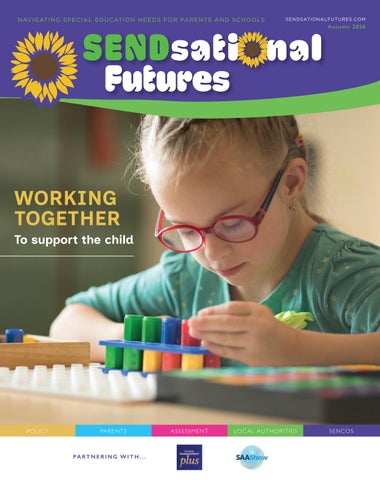
WORKING TOGETHER
To support the child
BPUORLSIA CRYS
PA R E N T S
PA R T N E R I N G W I T H . . .
ASSESSMENT
L O C A L AU T H O R I T I E S
SENCOS
EDITOR Dorothy Lepkowska editor@sendsationalfutures.com EDITORIAL ADVISORY BOARD Lee Boyce CEO, Barking and Dagenham School Improvement Partnership Claire Dorer OBE CEO, National Association of Special Schools Andrew Lewer MBE Former MP for Northampton South, and independent school governor, writer and consultant Nicola Maher Senior education leader and SEND specialist Hayley Mintern Partner, Anderson Quigley Sophie Mustoe-Fairplay Speech and Language Therapy Manager, Speech and Language Link Andrew Thraves Chair of Big Education Trust, non-executive director of Academies Enterprise Trust and board member at The Confederation of School Trusts Hugh Viney CEO and founder, Minerva Virtual Academy DESIGN & PRINT Fellows Media Ltd The Gallery, Southam Lane, Cheltenham GL52 3PB 01242 259241 hello@fellowsmedia.com ADVERTISING Alice Ireson alice.ireson@fellowsmedia.com 01242 259249 PUBLISHER William Clarence Education Ltd DISTRIBUTION (Print & Digital) This issue of SENDsational Futures is being distributed at the Schools and Academies Show October 2026); to all UK special schools and to independent school SENCOs.
Foreword
H
ello and welcome to this, our third print edition of SENDsational Futures magazine. There is plenty to think about as schools embark on a new school year, and we have tried to reflect on some of the issues that are likely to crop up in the coming months. For Year 11 students, for example, there will be a strong focus on GCSEs (and A levels for those in Year 13) in the runup to next summer – which will be here before we know it! Stephanie Smith shares her school’s preparations for mocks and how tackling the anxiety and uncertainty of the exam season can begin to be eased now for neurodivergent and all SEND candidates (page 26). One of the threads running through this issue is the importance of schools and families working together for the good of the child. On page 14, Jane Lambert offers medical advice on injuries sustained at school and how pupils with sensory issues may need a different approach to the usual medically correct responses. Using her own experience as a parent, Jane outlines how schools and families can collaborate on ensuring that an already traumatised child is not made more uncomfortable by first aid treatment. Meanwhile, on page 18, Hannah Cooper stresses that listening to the observations of the childminder can support parents in identifying a potential SEND, while Nicola Maher examines how teachers and families can often view the same child differently, and how the two can meet in the middle. Her article is on page 33. We also have our regular features, including the profile piece which features Matthew Lees from the Wales International School in Abu Dhabi, page 6, and our look at what is going on in local authorities, focussing on a new hub in Bury for children whose medical needs make school attendance difficult, page 8. Our next print issue will be out in the winter but, in the meantime, you can keep up-to-date with the news and views from the SEND sector on our website, sendsationalfutures.com. I hope you enjoy this issue. Dorothy Lepkowska, Editor editor@sendsationalfutures.com © William Clarence Education No part of this magazine may be reproduced without the permission of the publisher. The information contained in SENDsational Futures has been published in good faith and every effort has been made to ensure its accuracy. All liability for loss, disappointment, negligence or damage caused by reliance on the information contained within this publication is hereby excluded to the fullest extent permitted by law.
Autumn 2026
CONTENTS
IN THIS ISSUE SENCO CORNER 6
Profile: Matthew Lee
LOCAL AUTHORITIES 8
Boosting attendance among pupils with medical needs
THE SCHOOL EXPERIENCE
8
11
11
Rethinking behaviour support for SEND children
HEALTH AND WELLBEING 14
Taking the fear out of first aid for children with SEND
EARLY YEARS 18
Listening to the childminder
FOCUS ON 22
26 SCHOOL MANAGEMENT PLUS
NAVIGATING SP E C IAL E DU C ATION NE E DS FOR PAR E NTS AND SC H OOL S
SENDSATIONALFUTURES.COM
Autumn 2026
WORKING TOGETHER
The leading source of news, opinion, features and jobs for all professionals working in independent and international education. To support the child
BPUORLSIA CRYS
PA R E N T S
ASSESSMENT
L O C A L AU T H O R I T I E S
SENCOS
CPD AND TRAINING 24
SENDsational Futures is aimed at everyone involved in supporting children with special educational needs. A new and growing online and print publication, it offers a wealth of advice and information on working in – and navigating – this challenging but vital part of the education system. Our content includes topical news articles, opinion pieces and school profiles.
PA R T N E R I N G W I T H . . .
@ International School News @SchoolManagementPlus @SchoolManagementJobs @SchoolAdmissionsPlus @ISM_Plus @schoolmanagementplus5799
4
SENDsational Futures | Summer 2026
Oracy: Every child’s voice matters
If you’re a school or MAT leader, Senco, teacher, SEND expert/consultant or parent who wants to contribute to our coverage, please get in touch: editor@SENDsationalfutures.com
SENDsational Futures
Building staff wellbeing through apprenticeships
ASSESSMENT 26
Using mocks to help autistic students to succeed
ADVERTORIALS 16
Apetito
28
Speech and Language Link
30
Alder
A PARENTS PERSPECTIVE 33
When school and home see a different child
Find us at sendsationalfutures.com and @SENDFutures Check in regularly on our website, follow us on LinkedIn and look out for our future print issues being published later this year.
Autumn 2026 | SENDsational Futures
5
Profile
Matthew Lee - Vice Principal (Wholeschool), and SEND specialist at the Wales International School, Abu Dhabi
PROFILE:
were proud to win the TES Award for Inclusion and become the first international school to achieve the UK’s Inclusion Quality Mark. I’ve also helped set up specialist units specifically for SEND in multiple countries and designed inclusive provision across four continents. Alongside running inclusion, I have always felt it important to take leadership roles with academic and pastoral responsibilities, and I have been a school inspector, where having a strong background in SEND is helpful.
What strategies or initiatives have you introduced in your school?
I have implemented a wide range of strategies in some diverse areas, from strategic expansion to accreditation management, including our work as a pilot school for the UAE’s previous inclusion policy, and our critical feedback procedures to the government, which related to aspects which were unworkable. This has led to a revision of the policy, and we are excited to see how it will function in its new form. The government in the UAE is very supportive of SEND and has an ambition to increase enrolment of all children. Our school has increasing numbers of students who previously would have been in specialist provision, and I get the opportunity to work closely with our excellent inclusion teams to ensure our provision for these students meets their needs in the best possible way.
Matthew Lee Matthew has worked with SEND pupils for 15 years and has been instrumental in improving provision and inclusion in the UAE. How did you come to have your current role and what does it involve?
My current role includes line managing the heads of secondary and primary schools and specialising in inclusion. I ensure strategic design and integrity across our school systems, so that everything works to the best of its ability. Prior to this, I was a deputy head responsible for inclusion in an international school which had 55 staff across ten departments, including a specialist wing. We 6
SENDsational Futures | Autumn 2026
What have you done in your role that makes you feel particularly proud of your own work, or that of your team? Primarily, I am proud of how responsive everyone is in supporting the most challenging needs, and the willingness to adapt and change practices to ensure every child can access the school.
Profile My PhD included a section on how international schools use entrance processes to exclude children, and it is a joy that Wales International School does not do this in any way. Secondly, I am very proud of how our new head of inclusion and her team are so committed to supporting all the students in the school and skilled in modifying the curriculum and assessments to meet students’ needs. We have achieved our strongest ever set of results this year, both internally and externally, and it is a product of the whole team’s efforts. It is really key that the inclusion department is kept at the forefront of all decision-making.
How does working in an international school differ from the UK, and why did you choose such a school?
Working in an international school does bring many unique challenges, typically with an increased staff turnover, differing cultural attitudes and, for some staff, of separating their personal and professional lives. In the UK, most people have support networks outside of their schools, whereas this is less common in the international scene. There are also very different attitudes towards inclusion between staff and parents – although that was also common in the UK! I chose Wales International School as I wanted to work in a school that had strong leadership, a clear ability to grow and perform better, and enabled me to continue growing professionally and to learn Arabic. Having a bilingual wife and son, that has become a priority, so I wanted a school with a strong Arabic department to help me get better. It is important for international teachers to embrace the culture they work within, and that includes learning the language.
How do you relax when you're not working? I worked for two years in an international school on a mountain in Kenya, which had no internet, so I do enjoy the simple luxury that is being able to call my parents and friends online. It is important to develop this habit if moving internationally, otherwise people can drift away. A lot of my time goes into studying Arabic, and I enjoy tutoring Masterslevel students undertaking an MA in Special Needs and Inclusion in the UK. My son
has just turned three, and I try to spend as much time as possible with him and as a family, although I’m not sure raising a child can be described as relaxing!
If you hadn't gone into teaching, what might you have done instead?
When I went into teaching, I went straight into educating SEND students as I wanted that to be my contribution to the field. Looking back, I should have taken at least one gap year, learned some life skills by becoming an electrician, a builder, or a car mechanic, and if I was to consider a completely different career then something in finance would probably have resulted in more money. It is so important to have practical skills and the ability to utilise them at will so that you can make money for yourself, and as AI continues to disrupt sectors, these skills seem even more useful, practical and irreplaceable.
If you had 10 minutes with the education secretary, what advice would you give her?
I had the opportunity to do some government advisory work before I left the UK and have strong relationships with governments in multiple countries. I would always advocate going beyond the vague promises of inclusion and SEND support and instead invest in practical solutions.
It is important for international teachers to embrace the culture they work within, including learning the language I’m a strong advocate for hybrid models with SEND specialist sections within mainstream schools, and a focus on growing integration and community building. There is so much that can be learnt from the specialist sector, and I find many Sencos are ignorant to the actual practices which go on within SEND schools, so are unable to meet students’ needs when transitioning. As part of training for all SEND specialists, they should spend time within a dedicated SEND setting, and all teachers should be required to complete a placement in one.
Local authorities
Team effort
to bolster attendance among pupils with medical needs Council leaders in Bury set up ‘vital lifeline’ to help vulnerable children remain in education
A
n inability to access education can leave many children vulnerable and missing out on learning. But education leaders in Bury hope to be able to address some of those challenges with the recent opening of the council’s Aspire and Achieve Hub. The specialist provision, jointly being delivered by Bury Council’s school attendance team and Cloughside College, a specialist hospital school, will support young people whose
8
emotional wellbeing and other medical problems affect their ability to attend school. Admitting around 20 young people at any one time – 10 in the morning and 10 in the afternoon – the hub will deliver personalised and collaborative approaches, with a focus on rebuilding confidence, reducing anxiety, strengthening resilience and will enable pupils to re-engage positively with learning. Referrals are carefully considered to ensure that places are allocated to
SENDsational Futures | Autumn 2026
children who would otherwise be unable to access suitable full-time education, rather than being provision for those who are persistently absent from school. Schools can make a referral where there is clear evidence that a child’s medical condition is preventing them from attending their usual school. The aim is to ensure that children continue to receive a high-quality education whilst also supporting their wellbeing, maintaining routines and helping them successfully return to school or progress into their next stage of education when appropriate. The success of the venture will therefore be
measured not by attendance statistics, but rather by the outcomes achieved for individual young people. These can include maintaining engagement with education, improving wellbeing and confidence, preventing pupils from becoming isolated from learning, supporting reintegration into school where appropriate and enabling pupils to continue making academic progress despite significant health challenges. Bury Council said the Hub would provide a 'vital lifeline for young people', giving 'some of our more vulnerable learners the support they need to thrive, regardless of the challenges they are facing'.
Placements
The Hub aims to provide a safe and supportive environment where children and young people aged 1116 years can continue with schoolwork, while developing
Local authorities
Sharing good practice
The partnership enables the sharing of good practice and provides reassurance to families and schools that pupils are benefiting from expertise that has been developed specifically to support children whose health has impacted upon their education. Such a collaborative approach will ensure that some of Bury's most vulnerable learners continue to receive highquality education and support during what can often be a very challenging period in their lives. Paul O’Reilly, the Hub’s deputy head, said: "The Hub represents the power of partnership and shared vision. By bringing together schools, local authority services, families and professionals, we have created a place where young people can rebuild confidence, reconnect with learning and realise their potential. “This is more than a building. It is a commitment to removing barriers, creating opportunity and offering hope for the future."
We have created a place where young people can rebuild confidence, reconnect with learning and realise their potential socially and emotionally, in preparation for a return to their school. Placements are typically for 12 weeks, during which learners take part in a personalised programme that is tailored to their individual needs and circumstances. This can include core curriculum subjects such as English, maths and science, alongside a wide range of enrichment and wellbeing activities including art, cooking, therapeutic support, gardening and physical activity. All activities are delivered in small groups, creating an environment where young people can learn at a pace that is right for them.
The Hub's approach recognises that every child's journey is different. For example, for some pupils, the focus may be on rebuilding confidence and routines, while for others it may be developing strategies to manage a medical condition alongside their education. Where appropriate, the overall aim is to support a successful return to mainstream school. Throughout the placement, the Hub works closely with families, schools and other professionals to help children maintain their connection to education and plan for their next steps.
For some young people, particularly those with more complex health needs, alternative pathways may also be considered to ensure they continue to receive a suitable education.
Specialist collaboration
By teaming with Cloughside College, the Hub will enable staff to draw on the expertise of colleagues who already have significant experience of working with young people with medical barriers to learning. The specialist hospital school has extensive experience in supporting children and young people whose education has been affected by physical health conditions, mental health needs, anxiety and other medical issues. By working together, staff hope they can ensure that young people receive the
right educational, emotional and wellbeing support, helping them build confidence, maintain progress in their learning and work towards their individual goals. Janet Lloyd, school attendance, exclusion and communities manager, said: "The Aspire and Achieve Hub represents an important step forward in our efforts to support children and young people whose emotional wellbeing is impacting their school attendance. “By working in partnership with Cloughside College, we have created a provision that not only helps young people reconnect with education but also builds the confidence and resilience they need to succeed."
Maggie Todd is a freelance journalist
Autumn 2026 | SENDsational Futures
9
10
SENDsational Futures | Autumn 2026
The School Experience
From compliance to connection Why we should rethink behaviour support for SEND children
B
ehaviour has always been a central focus in schools. As trainee teachers, we're taught behaviour management strategies almost from day one. I remember starting out myself wondering: what if I lose control of the class? Looking back, that word, control, is at the heart of the problem. For generations, many of our behaviour systems have been built around compliance. When children struggle to comply, we often respond with sanctions, isolation or exclusion. Yet there is another approach, often overlooked in mainstream education: a relational approach grounded in regulation rather than control. A stressed brain cannot learn, yet every morning we ask children to arrive at school, put aside whatever has happened before 9am, ignore anxiety, sensory overload or difficult home circumstances, and immediately settle into learning. For many children, particularly those with SEND or adverse childhood experiences, that simply isn't how the brain works.
Behaviour is communication
A meltdown, shutdown or child running from the classroom is rarely the product of a calm, reasoning brain. These are signs of a nervous system in fight, flight or freeze. When the brain's threat response is activated, the areas responsible for reasoning, problem-solving and impulse control become far less accessible. This is where co-regulation is imperative. This is particularly relevant for neurodivergent
Regulation is a culture that starts with the adults and ripples through the whole school community children, who may experience the school environment as overwhelming long before adults notice any change in behaviour. By the time a child lashes out, withdraws or refuses, their nervous system has often been working overtime to cope. As schools prepare for the proposed SEND reforms and the introduction of inclusion bases, this understanding becomes even more important. These spaces have the potential to become places where children can regulate, reconnect and return to learning but, if the culture inside them mirrors traditional isolation rooms, we risk simply rebranding exclusion. A different name means very little if children still experience embarrassment, shame or punishment. A relational approach doesn't mean lowering expectations or removing boundaries. It asks us to replace the question, 'how do I stop this behaviour?' with 'what is this child trying to tell me?' Last year, I took this approach into my own mixed-age classroom with no teaching assistant. It wasn't built around rewards or sanctions, but around creating a culture where children felt safe enough to learn, to make mistakes and to understand themselves. Four principles made the biggest difference: Autumn 2026 | SENDsational Futures
11
The School Experience
Be the regulated adult. Children co-regulate from the adults around them. If I became stressed, they reflected it back. If I stayed calm, that calm spread too. When I got things wrong (and I did) I modelled what repair looked like by regulating myself first, apologising and moving forward together. Children don't need perfect adults; they need adults who show them how to recover. Create predictability and trust. We began each day with a short check-in and grounding activity. Together, we created our classroom expectations, used an anonymous worry box and trusted children with simple freedoms such as toilet passes. That trust was rarely abused. Teach children to understand themselves. Regulation is a skill. We talked openly about emotions, body signals and what different kinds of overwhelm felt like. Children had simple ways to communicate their needs before they reached crisis point; a visual scale, a quiet word, a movement break or time in a calm space. The aim wasn't for children to depend on adults forever, but to develop the language and confidence to recognise and express what they needed. For many neurodivergent children, learning to advocate for themselves is as important as any academic outcome. Offer meaningful choice and celebrate mistakes. During independent work, children could choose how they worked; on the floor, wearing ear defenders, with a hood up or listening to quiet music. Rather than creating chaos, these choices built self-awareness and independence. We also celebrated 'marvellous mistakes'. We talked about how our brains are designed to find challenge uncomfortable because that's where growth happens. Mistakes became something to notice, discuss and even celebrate rather than something to hide. Children became more willing to take risks because they no longer feared getting things wrong. The classroom stopped feeling like a place where behaviour was managed and became a community that children helped build. They weren't simply following rules imposed on them; they were shaping an environment they felt responsible for. Empowering children doesn't remove adult authority, it helps them develop responsibility, empathy and self-advocacy. None of this removes the need for boundaries or accountability. Dangerous behaviour still has to be managed, and parents remain essential partners in supporting children. 12
SENDsational Futures | Autumn 2026
A relational approach isn't permissive, it simply recognises that consequences are most effective when they exist within relationships where children feel understood, safe and respected.
Teachers need to regulate, too
Funding and staffing pressures are real, and no single teacher can solve every challenge. Most teachers are working within systems they didn't create, doing the very best they can with the time and resources they have. Yet we also haven't done enough to teach teachers about regulation, not just for children, but for themselves. Too often, burnout is worn like a badge of honour; we celebrate the teacher who works through lunch, answers emails late into the evening and always puts everyone else first. But we know from everything we've learned about child development that a dysregulated brain struggles to think clearly, stay patient and respond with curiosity. If we want teachers to co-regulate children, we have to create schools where teachers can regulate too. The same is true for adults. That means creating psychologically safe staff cultures and leaders who understand that looking after staff is fundamental to looking after children. Regulation is a culture that starts with the adults and ripples through the whole school community. True inclusion isn't another room at the end of the corridor. It's a culture where children feel safe enough to learn, safe enough to struggle, safe enough to be different and, ultimately, safe enough to become themselves.
Rachel Naylor is an education consultant, writer and the founder of K’nnekted (theknnekted method.co.uk). With over 20 years in education spanning teaching, leadership and college lecturing, she delivers CPD on emotional regulation and relational practice for schools.
Autumn 2026 | SENDsational Futures
13
Health and wellbeing
Taking the fear out of first aid for children with SEND Standard responses to medical emergencies might trigger sensory overload
E
very school has a first aid protocol, and most of the time it works exactly as intended: a child gets hurt, an adult cleans the wound, applies a dressing, and the child goes back to their day a little more cautiously. But for many neurodivergent children, particularly those with sensory processing differences, which are common in autism, ADHD and AuDHD, this straightforward sequence can become a second, entirely separate ordeal layered on top of the original injury. I saw this firsthand recently when my own daughter burned her chest. The injury itself was frightening enough. But what followed taught me something I think a lot of schools and even some healthcare settings still don't fully grasp: for a sensory-sensitive child, the treatment can feel every bit as distressing as the injury, and sometimes more so.
Why standard first aid can backfire
The recommended first aid for a burn is to cool it under cold running water for around 20 minutes. It's sound medical advice – cooling reduces tissue damage and pain. But when I tried to get my daughter under the shower, she couldn't do it. Not wouldn't – couldn't.
The sensation of cold water hitting an already sensitised area of skin was, for her nervous system, unbearable. It wasn't defiance or a lack of understanding that this would help her. Her body was registering the water as a genuine threat, on top of the burn itself. Then came the dressing. Standard practice is to cover a burn to protect it from infection and further damage. But the pressure, the texture and the adhesive of a plaster or dressing were, again, simply intolerable to her. She wasn't being fussy. For a child whose sensory system processes touch differently, an adhesive dressing can feel like a constant, inescapable irritant, not a minor inconvenience, but something closer to a low-grade alarm that doesn't switch off. This is a genuinely common experience for sensory-sensitive children, and it puts schools in a difficult position: the medically 'correct' response and the response the child can actually tolerate are sometimes in direct conflict.
A challenge for schools
This creates a specific dilemma for teachers and first aiders, who are trained to follow standard protocols and are understandably cautious about deviating from them. A few tensions come up again and again: Duty of care versus distress. Staff have a responsibility to treat the injury properly, but forcing a child through a process their body is telling them is intolerable can cause genuine trauma, and can badly damage trust between the child and the adults trying to help them.
Health and wellbeing
Documentation and safeguarding pressures. Schools are rightly cautious about anything that looks like inadequate first aid, which can make staff feel they have no choice but to insist on the 'correct' procedure exactly as trained, even when it's clearly distressing the child. Lack of individualised guidance. Most first aid training doesn't cover sensory processing differences at all, so staff are often improvising in the moment, without a plan and without confidence that what they're doing is defensible. The child's inability to explain in the moment. A child in pain and sensory overload often cannot articulate what they need. What looks like a tantrum or non-compliance is frequently a nervous system in genuine distress, not a behavioural choice.
What teachers and first aiders can do
• Slow down before you act. Where the injury isn't life-threatening or requiring emergency treatment, take a breath before reaching for water or a dressing. A few seconds of calm assessment often prevents a much longer struggle. • Offer control wherever possible. Ask the child if they'd like to hold the cloth themselves, choose which hand does it, or count down before contact. Even small amounts of control can turn an intolerable sensation into a manageable one. • Adjust the method, not the medical goal. If a direct stream of cold water is unbearable, a cool, damp cloth held gently against the area, or trickling water more slowly, can sometimes achieve similar cooling with far less sensory intensity. If a standard adhesive dressing can't be tolerated, non-adhesive alternatives, or a loosely wrapped bandage rather than a plaster, may work far better. • Narrate what's happening, simply and calmly. Sensory distress is often worsened by unpredictability. Short, clear, warning-based language, 'In three seconds, I'm going to touch your
The medically ‘correct’ response and the response the child can actually tolerate are sometimes in direct conflict arm with the cloth', gives the nervous system a moment to prepare rather than being caught off-guard. • Don't mistake distress for defiance. A child screaming, pulling away, or refusing outright is not being difficult. Recognising this shifts the adult's response from frustration to genuine problem-solving. • Have an individual healthcare plan in place before an injury happens. For children with known sensory sensitivities, work with parents in advance to agree specific alternatives - approved dressing types, preferred cooling methods, comfort items, or a specific trusted adult who should be called. Having this agreed and written down removes the guesswork and the liability anxiety in the moment. • Call in the parent or a school nurse for anything beyond minor injuries. Sensory sensitivities don't override the need for proper medical treatment. If a wound genuinely needs professional cleaning or dressing and the child cannot tolerate it, involve parents and, where necessary, a GP or minor injuries unit who may have more time, a calmer environment and
additional strategies available. Standard responses aren’t always appropriate. My daughter's burn healed. What stayed with me was how much harder the healing process became not because of the injury, but because the standard response to it didn't account for how her body experiences the world. That's not a flaw in her. It's a gap in how first aid is typically taught and applied.
Being flexible
Schools don't need to abandon proper medical protocol to get this right. They need flexibility, a willingness to adjust the method while keeping the medical goal and enough understanding to recognise that a child refusing treatment is very often communicating something real, not being awkward. A little preparation, and a genuine partnership with parents who know their child's sensory profile, can turn a frightening, painful experience into one where the child feels safe, not further traumatised, by the people trying to help them.
Jane Lambert is founder and CEO at ECG Healthcare Group and the Makewell Clinic, a private clinic focused on ADHD and autism assessments. Go to: ecghealthcare. co.uk and wemakewell.co.uk
Autumn 2026 | SENDsational Futures
15
Advertorial
B
Revolutionising Catering at Dee Banks School
ased in Chester, Dee Banks School has 145 pupils, aged 2 to 19 years with Severe Learning Difficulties (SLD) or Profound and Multiple Learning Difficulties (PMLD). Dee Banks prides itself on being a school where every student matters, but for years the school had been unhappy with their local authority catering provider, which had left them struggling to achieve the variety and quality needed to cater to their pupils’
16
important needs. However, finding a new catering provider proved to be quite the challenge explains Business Manager Kate Hubbard: “Being a school that has a wide age range of pupils, we were struggling with everything from portion size to nutrition. The quality, consistency and menu choice were extremely poor, and it was really apparent that the children weren’t enjoying the meals. Having
SENDsational Futures | Autumn 2026
profoundly disabled children, it was difficult to make sure they were getting meals suitable for their dietary requirements and for years they were just stuck with a jacket potato for lunch. Every week, it was a different issue and even getting the really simple things right was difficult for them.”
Finding a Solution with apetito
Switching meal provider is a big step for schools to take
and the transition to a new supplier can be daunting but it was a step the school were ready to take says Kate: “We desperately wanted and knew we needed a change, but we had been struggling for years to look for a different catering provider. Because we are quite a small school lots of catering providers wouldn’t even consider taking us on because they’d be working at a loss, so we found we were always hitting a brick wall.”
Advertorial
As the UK’s first premium pre-prepared school meals solution, apetito provides schools with high-quality, nutritious pre-prepared frozen dishes, which can be easily cooked and served in-house. “We first heard of apetito through a flyer in the post and in July 2024, after meeting with apetito, we agreed to a trial, and it was just amazing. What stood out to us was the ease, variety and quality. When it came to introducing apetito, the whole process ran smoothly. The passion from the apetito team reassured us that they would be with us every step of the way.” “The pupils now love lunchtimes. We now find it so much easier to cater for all
the pupils’ needs. Everyone is enjoying the food. In the first week we served salmon tagine, and the kids devoured it. Our children have sensory and texture issues, but there is something to suit every child’s palette. “The consistency of the meals from apetito is also a real benefit. Our pupils like to have things the same. They rely on that, and it makes them feel safe. The dishes taste and look the same every single time. Having that same quality every time they have that meal helps our children and encourages them to eat. “With such a wide range of ages being able to ensure portion sizes meet the needs of our pupils was important to us. We are now easily able to cook enough food, so the pupils can even come up for seconds “Pam, our account manager gave us training on the ordering platform and now we find the creation of menus one of the bests bits of partnering with apetito. The beauty of it is we have been able to change and tweak as we go. “Another advantage of apetito is that many of our pupils prefer to have the different elements of their food not touching. With apetito each element of the meal is packaged and cooked individually, which means it is easy for catering teams to serve food in a way that suits every individual child’s needs.”
“One of the most significant impacts of our partnership with apetito is that our profoundly disabled pupils who need it can eat apetito’s texture-modified range. Before, they didn't enjoy the food, now they get to taste lots of different flavours and try a real variety of dishes.” “Cooking and serving the meals is a simple process to follow and if we ever have any questions or issues, Pam is on hand to help. She’s also trained us on how to cook and the serve the meals, so we no longer worry if kitchen staff are off sick and you find that no matter who's in the kitchen, you still get the same consistency of quality.”
important to us” says Kate. “The quality and choice of food with apetito is really good. I would recommend apetito to other specialist schools. It is a simple catering option that provides really good quality meals and accommodates the needs of a variety of pupils within a SEND setting. Everyone now looks forward to lunch time because apetito has gave us a real range of consistent and tasty meals to offer our pupils. We’re now able to cater for all our students’ requirements with ease. Simply put, it just takes a headache out of catering.”
A Real Partnership
“The pupils really enjoy the food and that’s what is Discover how apetito can transform your school’s catering by visiting apetito.link/ SENDFutures or contacting 0117 463 3563.
Autumn 2026 | SENDsational Futures
17
Early years
Listening to the childminder W
Early years professionals are often the first to spot signs of a SEND
hen we talk about early identification and intervention for children with SEND, we quite rightly consult parents, health visitors, Sencos, nursery practitioners, teachers, therapists and other professionals. But there is another practitioner whose voice needs to be heard. The childminder. Childminders navigate mealtimes, school runs, toddler groups, parks, friendships, transitions and all the ordinary moments in between. And those ordinary moments can tell us an extraordinary amount about a child. A childminder might notice that certain noises make a child cover their ears. That they communicate confidently one-to-one but withdraw when other children join them. That leaving the house is becoming increasingly difficult. Or simply that something has changed. These observations are not a diagnosis but together they might tell us something important. If we're serious about identifying children's needs early, then we need to listen to the people who are there early enough to notice.
An important part of the picture
Parents know their child in a way nobody else ever will. Health professionals bring specialist knowledge. Teachers and nursery practitioners see children within their own environments. The childminder holds another piece of that picture. They don't simply see whether a child can do something. They 18
SENDsational Futures | Autumn 2026
Observing doesn't mean sitting with a clipboard watching for everything a child can't do often see when something becomes difficult, what was happening around them at that time and what makes a difference when things go well. They know what draws that child in, who they connect with and what makes their whole face light up. Because understanding what helps a child thrive can tell us just as much as understanding what they find difficult.
A childminder’s responsibilities
Childminders have responsibilities around SEND and inclusion. Children with additional needs have the same right to belong, participate and access opportunities as their peers, and childminders need to make reasonable adjustments where required. For those delivering funded early education, the SEND Code of Practice is also an important part of that picture.
But having responsibilities doesn't mean being expected to do everything. A childminder isn't there to diagnose autism, decide whether a child has ADHD or to become a therapist. Noticing something doesn't mean putting a label on it. Their role is to know the child, notice, listen, adapt, work alongside their family and recognise when somebody else may need to be brought into the conversation.
Pause and reflect
There are moments in childminding when something simply makes you pause.
Early years You might not know what it means – you don't need to. Sometimes the most important thing you can do is stay curious and ask: ‘what might this child be trying to tell me?’ What are you seeing? When does it happen? What helps? What makes things harder? And what are they already doing well? Observing doesn't mean sitting with a clipboard watching for everything a child can't do. Think about the ordinary moments you share every day. Was it noisy or unfamiliar? Were they tired or overwhelmed? Was something being asked of them that they couldn't quite understand or communicate? But notice those lovely moments too. When are they happiest? What draws them in? What makes their whole face light up? Over time, those little observations begin to build a much fuller picture.
When the smallest change matters
Sometimes, supporting a child begins with noticing what they're finding difficult and wondering, 'what could I change here to make this easier for them?' It could be moving somewhere quieter or showing rather than telling. It might be waiting a few seconds for an answer or changing an activity. We might call these strategies reasonable adjustments or targeted support. And surely that's where inclusion begins.
Difficult conversations
How do you tell a parent that something has made you pause, when you don't want to tell them, ‘there's something wrong with your child?’ Start with what you know, not what you think it might mean. ‘I've noticed this a few times recently. Have you noticed anything similar at home?’ Then listen. It isn't about convincing a parent
that you've spotted something they haven't. It's two people who care about the same child putting what they know on the table and asking: ‘what can we understand better, together?’
Don’t overcomplicate
That conversation doesn’t have to end with an answer. Sometimes it ends with ‘yes, we've noticed that too’. You may agree on one or two little things to try. Sometimes you simply keep an eye on things together. Support doesn't have to begin with a referral, specialist or written plan. It can begin tomorrow morning by making a small change and seeing what happens. Did it help? If it did, perhaps you could do more of it. If it didn't, maybe try something else. There is a formal name for this: the graduated approach – assess, plan, do, review. Formal language can make it sound far removed from ordinary childminding when your observations take place around kitchen tables, in playrooms and on walks to the park. It’s no less professional because it happened naturally.
When a child needs more support
Sometimes, despite those changes, that niggle remains. That's when the question changes from ‘what could I change?’ to ‘who else might we need alongside us?’ There isn't one referral route that works the same way in every location and for every child. The next conversation might involve a local SEND or inclusion team, the health visitor, GP, speech and language service or another relevant professional. The council's local offer should also
explain SEND support available locally. And while you're waiting for advice, a referral or assessment, the child's needs don't go on hold. You keep observing, adapting, talking with their family and making sure that child knows they belong. Perhaps the wider SEND conversation needs to do some noticing too. What might we be missing when we don't hear the childminder? A childminder's observations don't replace those of a parent, therapist, health visitor, teacher or Senco, but when we consult the early years workforce, childminders need to be in the room. When local SEND services design referral pathways, training and support, somebody needs to ask whether those pathways actually work for the professionals caring for children from their own home. And when a childminder says ‘I've been noticing something…’ we need to listen and ensure these professionals are properly recognised, supported and heard.
Hannah Cooper is the founder of The Childminder's Consultant, offering practical, realistic and reassuring support specifically for childminders. Hannah@ thechildmindersconsultant.co.uk; thechildmindersconsultant.co.uk
Autumn 2026 | SENDsational Futures
19
20
SENDsational Futures | Autumn 2026
Autumn 2026 | SENDsational Futures
21
Focus
Focus on...oracy
Every child’s voice matters Improved oracy breaks down barriers to learning, friendships and independence
C
ommunication is the foundation of learning. Before children can explain their ideas, answer questions, write stories or solve problems, they need to understand language and feel confident expressing themselves. But communication is about so much more than talking. It includes listening, understanding, taking turns, asking questions, explaining ideas and learning new vocabulary. Some children communicate using speech, while others use signing, symbols or augmentative and alternative communication (AAC). Whatever the method, every child deserves to be listened to and given meaningful opportunities to communicate throughout the school day.
Speech, language and communication needs are among the most common difficulties experienced by children. Around 7% of children have developmental language disorder (DLD), which is around two pupils in every classroom. DLD affects a child's ability to understand and use language, and can make learning, social interaction and literacy much more challenging.
about communication support is that it only happens during therapy sessions. In reality, the biggest difference is often made in the classroom. Every lesson offers opportunities to develop language, and many of the strategies recommended by SLTs benefit all learners, not just those with identified communication needs.
Early identification
There are a number of strategies we can use to improve children’s communication skills: • Giving children the words to succeed. Vocabulary development is one of the most powerful ways to support learning – in the classroom and beyond. Children cannot understand new concepts if they do not understand the words used to explain them. Rather than assuming children will pick up new vocabulary naturally, teachers can
Because children with DLD often appear to understand more than they do, their needs can easily be overlooked. Speech and language therapists (SLTs) play an important role in identifying these difficulties early and working alongside schools and families to ensure children receive the right support. One of the greatest misconceptions
Putting oracy into practice
Focus introduce words before a lesson. This is known as pre-teaching and they will repeat the word lots of times and support the child to use it, understand it and explain its meaning. Words can then be revisited regularly across the week. Seeing new words displayed visually, hearing them used in different contexts and having opportunities to use them in conversation all help children learn new vocabulary. Children also benefit from hearing the adults around them model rich language. Instead of simply correcting an answer, teachers (and parents) can expand what a child says. For example, if a child says, "the plant grew", an adult might respond, "yes, the plant grew because it absorbed water and sunlight". This gentle modelling introduces more sophisticated vocabulary and sentence structures without putting pressure on the child. • Developing confidence through conversation High-quality classroom talk is equally important. Children need opportunities to think aloud, explain their reasoning and discuss ideas with others. Simple strategies such as 'think, pair, share' give every child time to organise their thoughts before speaking to the whole class. Talking with a fellow pupil often feels less intimidating than answering in front of everyone and allows children to rehearse language before sharing it more widely. • The power of effective questioning Asking questions can deepen communication. Rather than relying solely on questions with one correct answer, teachers can encourage children to explain how they reached an answer, predict what might happen next or justify their opinions. These conversations help develop reasoning alongside language skills.
Targeted support for children with additional needs
Working with speech and language therapists
SLTs work closely with teachers to make these strategies part of everyday classroom practice. We help schools identify language barriers within lessons, recommend vocabulary to pre-teach, advise on adapting classroom language or support the introduction of AAC where appropriate. SLTs also work with families so that communication strategies can be reinforced at home, creating consistency across different environments. Parents obviously have a critical role to play. Everyday conversations during meals, shopping trips or bedtime routines help build vocabulary and confidence. Reading together, talking about new experiences and encouraging children to explain their thinking all support language development. These activities do not need to feel like formal teaching; the richest language learning often happens through ordinary interactions. Families can also model asking for help and demonstrating to their children when they find something hard. Ultimately, supporting oracy is about creating classrooms where every child can understand, participate and be heard. Whether a child is developing new vocabulary, learning to organise their ideas, using AAC or building confidence to speak in front of others, communication should be woven through every subject and every school day. When teachers, SLTs and families work together, communication becomes everyone's responsibility. By valuing every child's voice and providing the right support, it’s easier to improve educational outcomes, help children build relationships, develop self-confidence and discover that what they have to say truly matters.
For children with language difficulties, the way adults give instructions can make a significant difference. Breaking instructions into smaller steps, using simple language and supporting spoken information with pictures or written prompts can improve understanding. Giving children extra processing time before expecting a response is another strategy frequently recommended by SLTs. Some children need several additional seconds to understand a question, plan their answer and express it successfully. Visual supports are valuable across all age groups. Timetables, diagrams, word banks, story maps and colour coding reduce the language demands of learning and help children organise their thinking. These approaches are particularly helpful for children with DLD, autism and other communication differences, but often improve learning
for the whole class. Taking an inclusive approach to language development also means recognising that not every child communicates through speech. Some children use AAC, such as communication books, symbol systems or speech-generating devices. These children should have the same opportunities to answer questions, contribute to discussions and share their ideas. Allowing sufficient time for AAC users to compose messages, and ensuring communication systems are available throughout the school day, shows that every child's contribution is valued.
Emily Kirchin is a consultant speech and language therapist, and managing director of London Speech Therapy
Autumn 2026 | SENDsational Futures
23
CPD and training
Building wellbeing the apprenticeship way
On-the-job training routes can help to strengthen and embed health and wellbeing support in your setting
E
vidence that wellbeing support has a major impact on the attendance, attainment and behaviour of children and young people, especially those classified as SEND, continues to mount. Thrive has helped to build that picture with two recent major research reports measuring the impact of its wellbeing support and identifying the challenges
the sector needs to overcome to make it a reality for every pupil. A Thrive impact evaluation report with ImpactEd, released in the spring, pointed to Thrive supporting improvements in pupil wellbeing, particularly for pupils with SEND. It showed that average SEND wellbeing scores in our schools increased by around
Knowing that behaviour is a communication of unmet need has made me look at things in a completely different way 24
SENDsational Futures | Autumn 2026
5% over one academic year, despite wider national declines in pupil wellbeing. Later that spring another report, again with ImpactEd, highlighted the challenges that stand in the way of this wellbeing
support being as effective as possible. Based on an early 2026 survey of 1,018 education professionals across all phases, most of them with specific inclusion and wellbeing responsibilities, the report showed that fewer than a quarter of school leaders felt they had enough time to put inclusion and wellbeing expectations into practice. The report also revealed that more than two-thirds of those surveyed said the demands of supporting inclusion and wellbeing put significant strain on staff wellbeing and retention. When asked in their own words to name the most significant barriers their setting faced in delivering inclusion and wellbeing, one in three – 34% – cited funding – almost three times more frequently than any other theme. Slow access to specialist services was cited by 12%, too few staff, 12%, and limited training and CPD, 11%, formed the next tier. Asked what would most help their setting deliver effective inclusion and
CPD and training wellbeing in practice, 68% of respondents chose increased funding for inclusion/ wellbeing staffing, 43% said more time for staff to plan and deliver interventions, and 35% opted for high-quality, practical training for all staff. The question remains of how schools and trusts under continuous budgetary and recruitment and retention pressures, as those highlighted in the report, can access that training and support in a more costeffective way. Apprenticeship is an increasingly popular, funded route to upskill staff and one which we have supported with a successful wellbeing apprenticeship for teaching assistants.
The Southwater experience
In February 2025, Amy Trice, pastoral lead and cover supervisor at Southwater Infant Academy, in West Sussex, began her journey on the Thrive Wellbeing Specialist Teaching Assistant Apprenticeship. Already a HLTA and newly appointed to her pastoral role, Amy saw the programme as crucial to her ongoing professional development. “It was the next step in my career to enhance my knowledge in this key area of my role,” she explained. “I was especially keen to become a Thrive licensed practitioner, so I was really hopeful I’d be accepted onto the apprenticeship.” The impact of her learning became clear just
months into the programme. “The first three modules helped me to really understand the need for reflective practice and how important it is for professional development,” she said. “Reflecting on my practice, particularly after managing incidents of distressed behaviour, has helped me to think more clearly about what went well and what I could do differently next time.” Amy found that understanding the theory behind the Thrive Approach, especially the link between trauma and behaviour, helped her to see things in a new light. “I’ve gained so much from delving into child development and how children learn,” she said. “Knowing that behaviour is a communication of unmet need has made me look at things in a completely different way.” This shift in perspective has already improved the way Amy supports children at her setting. She has implemented the Thrive Approach when supporting children who are showing distressed behaviour, helping her to reflect, adapt her approach and provide more meaningful support. The apprenticeship has also boosted Amy’s confidence. “I’m much more confident supporting children when they become distressed. I now know that being a calm, positive role model an help children regulate and feel safe.” She also sees long-term professional benefits.
Need to know: Level 5 Wellbeing Specialist Teaching Assistant Apprenticeship This 18-month apprenticeship, delivered in partnership with Best Practice Network, combines a Level 5 Specialist Teaching Assistant apprenticeship with Thrive Licensed Practitioner training. Designed for teaching assistants and classroom support staff, the programme is suitable for attendance mentors, behaviour leads, HLTAs, learning mentors, wellbeing assistants, SEND staff and learning support colleagues. Apprentices learn to plan and adapt activities, work collaboratively with teachers, families and external agencies, and advocate for pupils’ needs. This helps pupils thrive both personally and academically. Alongside the apprenticeship, Thrive Licensed Practitioner training equips apprentices with evidencebased strategies to build pupils’ confidence, resilience and independence, leading to improved wellbeing, behaviour, attendance and learning. The apprenticeship is funded through the Growth and Skills Levy, which replaced the Apprenticeship Levy in April 2026. This means that there is typically no cost to your setting. If your setting doesn’t pay into the apprenticeship levy then a small co-investment fee will apply.
“Becoming a Thrive licensed practitioner and specialist teaching assistant will be an invaluable addition to my qualifications,” said Amy. “It’s already supporting me in my new role and will continue to do so in the future.”
Further information is available at: www.thriveapproach. com/apprenticeships/ wellbeing-specialistteaching-assistantlevel-5
Tom Preston is Director at Thrive. For over 30 years, it has equipped educators with the knowledge, confidence and evidence-based tools to support pupils’ social, emotional and mental health (SEMH). Schools, trusts and local authorities across the UK use Thrive’s training, apprenticeships and digital tools to embed SEMH practice at the heart of school culture - empowering staff, supporting young people and helping whole communities flourish. www.thriveapproach.com
Autumn 2026 | SENDsational Futures
25
Assessment
Using mock exams to help autistic students succeed Preparing well ahead can remove some of the stress and anxiety before the real thing
T
his year’s GCSE results paint a of any assessment can include sensory stark picture of the challenges overwhelm, unfamiliarity and uncertainty, facing SEND students in England. and inconsistent application of While 65% of students achieved a access arrangements. Grade 4 or higher in their English and All of these can contribute to maths GCSEs, just 13% of students who increased feelings of anxiety, which we have an EHCP achieved the same. all know can impact a student’s overall We know that autism is the most performance. The upcoming mock exam common primary need amongst period offers a valuable opportunity students with an EHCP, which indicates to help overcome these barriers in that many autistic students are leaving readiness for formal exams. key stage 4 without achieving a standard pass rate in English and maths – despite Start planning in their ability, and desire, to succeed. key stage 3 As a result, fewer autistic students Effective preparation reach A Level study, have lower point needs to start well scores and, by aged 19, are around five in advance of the A Level grades behind their peers. mock exam period: Similar attainment gaps can be seen suitable arrangements in the results for those should be in place by Year students who have pursued 10 for autistic students. What Level 3 vocational routes While every child is works including BTECs, although different, we know that best for a they are smaller. autistic children produce Yet, exam results don’t 42% more information student is as reflect the full picture of at rest compared to individual as personal and academic their neurotypical peers, they are, so achievements and, for so additional time for many autistic students, processing is essential to use the mock simply sitting these exams avoid information overload. exam period is a significant milestone. Executive function to identify As such, it is clear that the challenges are also system needs to evolve common in autistic strategies to provide neurodivergent children, who can often children with the same opportunities struggle with planning, as their peers to succeed. organising, recall and Some of the biggest barriers impulse control. to success that these A prompter can be helpful to students face ahead draw their attention back to a task
26
SENDsational Futures | Autumn 2026
and keep them on track. Handwriting can also be difficult for autistic students, especially over long periods of time due to fine motor skill challenges. In this case, a word processor or a scribe can help them to focus on the task rather than trying to overcome discomfort and pain. Identifying access arrangements as early as possible and applying to the Joint Council for Qualifications (JCQ) will allow you to integrate these into your students' mock exams so that they become familiar with them.
Build familiarity with the exam process
Preparing for exams extends beyond providing suitable accommodations, though. Building familiarity around the exam process will reduce feelings of anxiety, breaking down one of the biggest barriers that autistic students face when approaching any form of exam. At The Cavendish School, our approach to exams is rooted in a tiered approach that aims to make assessments less daunting for our students. This starts with smaller weekly and end of unit tests and builds up to mock exams before students sit entrylevel qualifications, GCSEs and BTECs. Not only does this allow them to gain experience of the challenge, language and environment of exams, it also allows them to feel a sense of achievement. If you can, show your students the exam room in exam conditions so that
Assessment they can familiarise themselves with the environment. If not, can you show them a photo of last year’s arrangements? Explaining where to go, where to sit, what happens if they need the bathroom or if there is an emergency will help to reduce feelings of uncertainty. For students who struggle with executive function, a checklist of what they need to bring can be helpful and they can practice this during their mock exams. What works best for a student is as individual as they are, so use the mock exam period to identify the strategies that will be most helpful in their formal exams.
Identify sensory needs and plan accordingly
During the mock exam period, autistic children will often experience sensory processing differences, which can be challenging in the exam environment. These experiences can heighten anxiety or cause intense discomfort, which naturally impacts their cognitive processing ability. Chewing provides useful sensory feedback for some of our students. So, we provide simple, easily digestible snacks that they can enjoy before their exams or during their rest breaks; this can also be helpful during the revision period. After all, any period of intense concentration expends energy so replacing this helps to support regulation and concentration. You should also work with your students to ensure that the exam environment meets their needs. Dean Beadle, autistic advocate and speaker, recommends completing a sensory checklist with your students to assess any sensory challenges they are facing at school to identify what changes need to be made. This approach, led by the student,
helps to give them agency and control over an unfamiliar situation and can alleviate feelings of anxiety.
Make rest and revision time explicit
Balancing revision and exams with hobbies and rest breaks is also important, and it can be helpful to work with families on ways to incorporate them into their child’s day. Visual, structured timetables that also include dedicated time for snacks, meals and exercise can be helpful: Chris Bonnello, an autistic former teacher, recommends blocking time for ‘rest breaks’ into revision timetables to make this explicit.
Decode the language of exams
Language plays an important role in how all students perform in their exams, and autistic children may be more likely to interpret exam questions literally. By reviewing past papers and ‘translating’ what questions mean, you are setting them up to succeed. As an educator, you can review past papers to identify common terminology and themes to plan how your students can interpret these. Using visual supports such as pictures, videos or flashcards can be useful to help scaffold understanding while practising papers helps to embed it. The upcoming mock exam period presents an opportunity for both parents and educators to work together to reduce and remove the potential barriers that autistic children will face in their exams. Not only will this give students the best chance to achieve their personal and academic aspirations but, more importantly, it will ensure that they emerge from the exam period without experiencing further emotional trauma.
Stephanie Smith is head of The Cavendish School, in Cambridge, and executive director of SENDV at Eastern Learning Alliance
Autumn 2026 | SENDsational Futures
27
Advertorial from Speech and Language Link
How do you make SEND reform work for you? Put speech, language
I
f the phrase 'SEND reform' currently makes you want to quietly close your laptop, make another cup of tea and lay your head on your desk, you're definitely not alone. Across the country, Sencos are getting to grips with national standards, digital Individual Support Plans (ISPs), additional inclusion funding and a new layered model of support, all while keeping up with the wonderfully unpredictable nature of school life. The reforms are ambitious and, understandably, they're provoking a mixture of excitement and uncertainty. With so much to think about, you may be wondering where to focus first. As a speech and language therapist, I would suggest starting with speech, language and communication.
Really? Isn’t that just one area of SEND among many? It’s a fair question. However, speech, language and communication provide the foundation for much of what happens in school. They influence how children develop knowledge, their literacy, how they build relationships, how they regulate their emotions, how they understand
and communication at the heart of it
expectations and how they participate in school life. Think about the average school day: children are listening, talking, questioning, explaining, negotiating and interacting throughout. Every one of these activities relies on communication. When communication becomes difficult, a child’s entire school experience can suffer.
That's quite a compelling argument. What should I do?
Here are five practical places to start as soon as you can. 1. Give your Universal Offer a communication health check SEND reform places huge emphasis on inclusive practice, and a great way to boost inclusion is by ensuring communication is accessible. So, take a walk around your setting with this question in mind:
How do we become more communication-friendly? Is key vocabulary being taught explicitly? Are there useful visuals on display? Do staff give enough thinking time before expecting an answer? Do seating arrangements optimise listening? These are all valuable things to consider. 2. Don't rely on observation alone We've all met the child who seems to cope: they appear engaged, are compliant and no one is particularly concerned about them. Then, suddenly, they're in Year 4 or Year 8, or even beyond, and someone realises (often the child themselves) that they've been really struggling the whole time. SEND reform talks about early detection. With speech, language and communication being foundational to
Advertorial from Speech and Language Link learning, detecting difficulties in these areas is crucial and the earlier issues are identified the better. But it can be tricky; for instance, detection of language understanding difficulties via observation alone is incredibly difficult. For example, how do we know whether a pupil’s receptive vocabulary skills are okay for their age, or something that they need to work on? Using screening tools, for example, those by Speech & Language Link are a good way to go. 3. Focus on the practical aspects of the children’s lives One of the most refreshing elements of the proposed reforms is the shift of focus towards functional skills and outcomes. Whilst considering targets for our children, it is essential that we consider what exactly we want them to achieve. So, let’s take a pupil saying “yeaf” instead of leaf. The speech sound irregularity might immediately catch your attention. But say that same child only has around 30 words in total, doesn’t follow instructions and gets upset when he can’t express what he wants or needs. Functionally, what would benefit him the most to work on? Which areas should be prioritised? 4. Build staff confidence The future success of SEND reform hinges on a great workforce. Skilled adults who are aware of what to look for, know what to do next – and perhaps most importantly – believe they can make a difference. What does your dream team look like? Teachers who instinctively adapt their communication for every child, teaching assistants brimming with ideas, and not just managing a mix of personalities, but intuitively knowing how to get them to gel? I bet you can pinpoint your wonderfully talented staff, and many others with fantastic potential, within your setting. And given the right speech and language knowledge, their
confidence can skyrocket when interacting with pupils – and then who knows what you can achieve. So, research the apprenticeships, consider training schemes and build your dream team. 5. Families and local partners hold vital pieces of the puzzle Whilst you might see a pupil who appears painfully shy at school, a family may see one who never stops talking. A parent might have developed brilliant ways of supporting their child’s communication at home that they are eager to share. Or they might not know where to start to help and feel overwhelmed with uncertainty. Maybe they’ve not come to terms that their child might have communication difficulties. SEND reforms emphasise the importance of relationships with families. It’s worth reviewing how you communicate with your families about speech and language skills and needs, and share information from reliable sources, such as our award-winning, therapist-created Parent Portal. Local partners are another piece of the puzzle, so strengthen those links with local speech and language therapy services and get to grips with the Experts at Hand offer.
The bottom line
If you're still reading this, then perhaps the SEND reforms feel a bit less overwhelming than they did a few minutes ago. The good news is that many of
the most important changes aren’t about doing something new; small adjustments to existing practice can make the world of difference. Better still, you don’t need to wait for the SEND reforms to be finalised to start making these improvements to speech, language and communication. By powering up your provision now, you’ll feel prepared for the new system. And those you work with – the children and young people at the heart of all of this – will begin to reap the benefits. So, why not begin by asking a simple question: How effectively are speech, language and communication needs identified, understood and supported in your setting? The answer may reveal your next steps and your biggest opportunities for impact.
Yin Collighan is a specialist speech and language therapist at Speech and Language Link
Are you looking for a fuss-free way to strengthen your speech and language support? Our award-winning screening and intervention packages help you get rid of the guesswork. With therapist support at your fingertips, you can feel confident you are doing the right thing, at the right time. Let’s help you become SEND Reform-ready by signing up for a free, no-obligation trial at speechandlanguage.link/free-trial/
Autumn 2026 | SENDsational Futures
29
Advertorial, Alder
Being sensitive about safeguarding Competing pressures require clear processes and communication from school leaders
I
t isn’t uncommon for emotions to run high in response to a safeguarding incident, and understandably so. Clear and compassionate communication which is sensitive to people’s anxieties can give both pupils and families something particularly valuable at a very difficult moment. However, while safeguarding incidents will often engage internal protocols or legal and regulatory processes, what is less prescribed is the way in which schools should communicate and engage with those involved in incidents. There may be competing pressures when handling a safeguarding incident; it can therefore be useful to have a clear sense of both the priorities and traps so that communication facilitates rather than hinders resolution.
Explain the process
A key consideration is process. When a child has become involved in a serious safeguarding matter, parents are unlikely to be familiar with what happens next. Terms such as DSL 30
(designated safeguarding lead) and LADO (local authority designated officer) may be commonplace within education but completely unfamiliar to a parent suddenly encountering them at a moment of considerable distress. Depending on the circumstances, there may also be police, social care or other agencies involved, creating further processes over which the school itself has limited control. One of the most useful things a school can therefore do at the outset is explain, in straightforward language, what is going to happen. Parents should understand what the school can deal with itself, whether another body has become involved, what immediate measures are being taken, what the next decision point is likely to be and who their principal contact at the school will be. Where possible, they should also be told when they can expect to hear from the school again. This last point is easily overlooked. An investigation may take days or weeks, during which there is genuinely very little a school can say. From the family's
SENDsational Futures | Autumn 2026
perspective, however, silence can look like an attempt to kick matters into the long grass. Equally, schools should resist the From the family's temptation to perspective, offer premature silence can look like an reassurance. Phrases such as attempt to kick matters ‘I'm sure this is all a into the long grass misunderstanding’ or ‘nothing like this has answering them may reveal happened before’ may be highly sensitive information intended to calm a situation about another child. but can subsequently cause Privacy and confidentiality considerable confusion if the should not be invoked as facts turn out to be different. a blanket response to shut down all queries. What parents are looking for is Managing families' reassurance, and there is an concerns important difference between Peer-on-peer incidents saying, ‘we cannot tell you can be particularly anything due to privacy challenging to manage, and considerations’ and ‘I cannot there is an obvious limit to discuss another child's what either family can be told personal circumstances, about the other child, given but I can explain what we the duties to privacy that will are doing to safeguard likely be engaged. your child'. This distinction becomes Think about setting out the particularly important where school’s own responsibilities SEND is involved. A parent and safeguards, such as may ask whether the other supervision arrangements in pupil had an EHCP, whether place, how risk is assessed, they had displayed similar what measures have now behaviour previously, what been introduced and whether their diagnosis is or why they the incident has prompted a were in a particular class. review of procedures. However understandable It can also help to those questions may be,
Advertorial, Alder media attention, the same principles apply; however, additional professional support may be required.
Conclude the process
nominate a single point of contact and keep a simple record of what families have been told and what has been promised. Few things undermine confidence faster than receiving different accounts from the headteacher, DSL, Senco and local authority, or being told that somebody will call on Friday and hearing nothing.
SEND isn’t the story
An individual incident involving a SEND pupil can sometimes become a proxy argument about inclusion itself. Schools should be extremely careful not to reinforce that framing themselves. A safeguarding incident involving a SEND pupil is not evidence for or against inclusive education, and schools should avoid letting the two conversations merge. The safeguarding investigation concerns the particular incident; any allegation about a wider failure of provision, supervision or policy should
be addressed through the appropriate process. Specialist settings face the inverse communications risk. Where staff routinely support children with complex behaviours, there can sometimes be a temptation to regard incidents as simply part of the setting's everyday work. Families should never be left with the impression that harm to their child is being treated as less significant because challenging behaviour is familiar to the school.
Control speculation
Safeguarding incidents can quickly become topics of staff or parent gossip. School leaders should never feed speculation – indeed, in trying to reassure parents, leaders sometimes volunteer too much information and risk breaching duties of privacy and confidentiality. Staff communication therefore requires as much thought as parent communication. Those who need
information to keep children safe obviously need to receive it. That does not mean every employee needs the detail of an allegation. Staff should know what practical arrangements affect them, what they should do if approached by a parent or pupil, where they should direct questions and, importantly, that speculation about the children involved is unacceptable. A similar principle applies if rumours spread more widely within the school community. Sometimes, saying nothing is appropriate. Where speculation is escalating, a short communication may be warranted to remind people of the principles that govern the school’s approach to privacy. If an incident attracts media or significant social
The principle behind sensitive communication is relatively simple. In the middle of a safeguarding incident, families may be frightened, angry and trying to understand an unfamiliar process while protecting their child. They need clear information about what is known, what happens next, what the school is doing and when they will hear from it again. Therefore, communication should not simply stop when the immediate investigation does. Where possible, families should be told that the process has concluded, what it means for their own child, what support remains available and whether the school has identified any lessons or changes to practice. There may still be information that cannot be shared, but failing to close down a process effectively can undo much of the confidence built up. Good communication after a safeguarding incident means explaining the process, protecting privacy without hiding behind it, and closing the loop once it concludes.
Jack Myers is associate director at Alder, a reputation risk and crisis advisory firm. He advises schools and other organisations on communication during safeguarding incidents and other high-sensitivity situations. Go to: alder-uk.com
Autumn 2026 | SENDsational Futures
31
32
SENDsational Futures | Autumn 2026
A parent’s perspective
When school and home see a different child Children thrive when parents and teachers bring their expertise together
I
t’s a familiar moment for many families. You sit at parents’ evening listening to teachers describe a child who is ‘coping’, ‘managing’, ‘doing well’. Meanwhile, at home, evenings are filled with meltdowns, shutdowns, refusals or exhaustion. Part of you feels relieved that your child can hold it together in school. Another part despairs. If school sees a child who is managing so well, what does that say about the chaos unfolding at home? The mismatch can feel quietly shaming, as though the chaos at home is a reflection of your parenting rather than the child’s depleted capacity. And because the school version of your child seems so definite, many parents feel unable to ask for help with the version at home who is clearly not coping. Yet both versions of the child are true, and both need to be understood if the child is to thrive.
The child who holds it together Behaviour always tells us something. Every environment places different demands on a child’s sensory, emotional and cognitive systems, so children often present differently depending on where they are. Some children: • mask intensely in school, using enormous effort to appear regulated
• experience overwhelming sensory load during the school day • use all their executive functioning simply to get through • release distress at home because it is the place where they feel safest A child who sits silently through lessons may appear calm, while internally working at the absolute edge of their capacity. Another may cope beautifully within the predictability of classroom routines, only to unravel during lunch, transitions or the journey home. What adults see externally is not always a reliable measure of what the child is experiencing internally. A child who collapses at home is often not 'fine at school'. They are exhausted.
What adults see externally is not always a reliable measure of what the child is experiencing internally The weight families carry
Imagine a child arriving at school with a small backpack. From the outside, it looks light enough. But if you could unzip it, you’d see the real weight they’re carrying. Often, school sees the backpack.
Families see the burden and pressure inside it. Yet opportunities for families to communicate this reality can feel surprisingly limited, particularly when parents fear: • being judged for not producing the same calm child • needing to justify what happens at home • being seen as overreactive • hearing again that their child is ' fine in school' Many families are already managing enormous levels of pressure. Modern family life is rarely the serene picture we once imagined: soft-focus evenings straight out of Little House on the Prairie, with everyone gathered peacefully around the table. The truth is more like a nightly gladiatorial contest of getting dinner cooked, homework done and football kit located, all while mediating a full-scale diplomatic crisis over who gets the window seat. Most parents are balancing work, logistics, emotional labour and exhaustion whilst trying desperately to do the right thing for their children. The dream was prairie-calm; the reality is more domestic carnage with snacks. And somewhere in the middle, Autumn 2026 | SENDsational Futures
33
A parent’s perspective we wonder what we’re getting wrong. Families are often doing their best without access to the strategies, understanding or support that might genuinely help. Sleep, routines, emotional co-regulation, predictability and recovery time all matter, yet many parents are left grasping in the dark for guidance. At the same time, schools also hold important expertise about child development, resilience and learning. Feeling anxious before an exam or a performance is part of normal human development. Sometimes understandable parental protectiveness can make it difficult to distinguish between healthy discomfort and more significant distress. This is precisely why trusting relationships matter so much.
What schools see – and what they may miss Schools can only respond to what they observe, and this can be a child who appears engaged, compliant or successful. But appearances can be misleading. A quiet child may be in a state of
What helps
constant hypervigilance. A child completing work may be doing so at significant emotional cost. A pupil thriving within highly structured lessons may still be struggling profoundly with unpredictability, sensory demands or social navigation. Calm behaviour does not always mean a calm nervous system. If we rely only on visible behaviour, we risk misunderstanding the child’s actual experience. Schools are experts in learning and development. Families are experts in their child and their wider context. Children thrive most when those two forms of expertise work together rather than against each other.
The mismatch is a clue, not a conflict The difference between the child seen at school and the child seen at home is not a contradiction to resolve. It is valuable information. It tells us about: • sensory load • emotional effort • executive functioning demands • recovery time
Small changes can make an enormous difference. If you are the school, or teacher: • listen carefully to what families tell you • avoid assumptions about family context • reduce cognitive load through predictable routines and visual scaffolds • build recovery time into demanding days • observe children during transitions and unstructured moments • align behaviour systems with SEND understanding • track energy and fatigue, not just behaviour • maintain regular, low-pressure communication with families • celebrate small successes • include the child’s voice wherever possible Small adjustments often prevent much bigger crises later, and help children feel understood, without having to mask in one place and unravel in the other. A shared picture doesn’t just help adults work better together; it gives the child the relief of being understood in both of their worlds, without having to mask in one and unravel in the other. And when adults share the truth of a child’s experience, the child no longer has to carry the weight alone.
34
SENDsational Futures | Autumn 2026
• masking • safety Most importantly, it helps us understand where a child feels able to release the strain of holding everything together. When we stop treating the mismatch as a dispute about whose version is 'correct', we begin to see the whole child more clearly.
Building a shared picture
The most important ingredient is trust. Unfortunately, the main opportunities for communication are often brief parents’ evenings or conversations held at moments of stress. Ten-minute meetings rarely create enough space for genuine reflection or curiosity. Instead, schools and families need conversations shaped by enquiry: • ‘Help us understand what you’re seeing at home’ • ‘When does the day seem hardest?’ • ‘What helps them recover?’ • ‘What do you think they wish adults understood?’ These conversations build trust and allow the child’s full story to be understood with accuracy and compassion. And crucially, they shift the focus from who is right, to what the child needs.
Nicola Maher is an experienced educator, senior leader and SEND specialist, and works with schools and families to strengthen SEND provision.
Autumn 2026 | SENDsational Futures
35
36
SENDsational Futures | Autumn 2026