T H E MAGAZ I NE FO R I NTE RNATIO NAL E DUCATO RS
I N T E R N AT I O N A L S C H O O L STO DAY.CO M
International
Autumn 2026
School Magazine
Focus on Vietnam
Where did the fun lessons go?
COULD YOU TEACH IN UKRAINE?
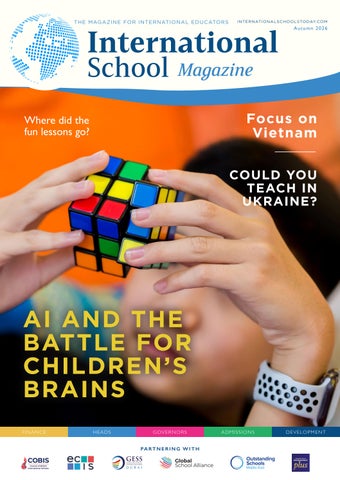
AI AND THE BATTLE FOR CHILDREN’S BRAINS FINANCE
HEADS
G OV E R N O R S PA R T N E R I N G W I T H
ADMISSIONS
DEVELOPMENT
Assess for success with Cambridge Insight baseline assessments “
We have found Cambridge Insight data helps us develop informed teaching and learning interventions before the start of each Cambridge course. This has led to better results in Cambridge exams.
Jackline Aming’a, Head of School, Oshwal Academy Mombasa, Kenya
www.cambridge.org/insight 2 | International School | Autumn 2026
”
Autumn 2026
CONTENTS
NEWS
4 The new advisory board supporting International School Magazine.
EDTECH
6 Brett Penny asks how young people can learn to use AI without sacrificing their brain development.
SEND/WELLBEING
8 Gràinne O’Reilly explores the worrying phenomenon of ‘looksmaxxing’.
EXPERIENCE
10 Carly Barber examines how visiting speaker programmes can enrich learning.
6
LEADERSHIP AND MANAGEMENT
12 Louise Salmond Smith explains her leadership lessons from Haileybury Malta. 16 James MacDonald goes in search of leadership certainties in a world of change.
COMMERCIAL
18 Linh Nguyen delves into one of Asia’s fastest-growing international school markets.
10
24
schoolmanagementplus.com
Our School Management Plus online platform offers a wealth of information to keep education professionals up to date, including: • latest news, regular features and opinion • monthly newsletter and jobs to your inbox • the chance to contribute your own ideas and opinion • the chance to join our webinars and round-table discussions. We are the leading opinion platform for those running a modern international school. We are always keen to hear about the issues that matter to you most, so get in touch to have your school’s voice heard. editor@schoolmanagementplus.com
HOW WE DID IT
22 Michael Strachan explains how he set up an ambitious new international school sixth form.
CLASSROOM
24 David Tuck asks why teachers aren’t having more fun in the classroom.
SCHOOL SPOTLIGHT
26 Anna Azarova asks British teacher Nicholas Trott about life teaching at the British International School, Ukraine.
THE INTERVIEW
30 Dorothy Lepkowska, speaks to Joanna Povall, principal of Wales International School, Abu Dhabi.
ASK THE RECRUITER International School News The leading source of news, opinion, features & jobs for all professionals working in independent and international education. @ International School News
@SchoolManagementPlus
@SchoolManagementJobs
@SchoolAdmissionsPlus
@ISM_Plus
@schoolmanagementplus5799
33 Hayley Mintern asks why founding headteachers need a different skillset.
THE MAGAZINE
FOR INTERNATIONAL
EDUCATORS
International I N T E R N AT I O N A
L S C H O O L STO DAY.CO
Where did the fun lessons go?
Focus on Vietnam COULD YOU TEACH IN UKRAINE ?
ON THE COVER AI does not have to mean atrophy. page 6
AI AND THE BATTL E FOR CHILD REN’S BRAIN S FINANCE
HEADS
G OV E R N O R S PA R T N E R I N G W
ADMISSIONS
M
Autumn 2026
Schools Magazine
DEVELOPMENT
ITH
Autumn 2026 | International School | 3
News
The new
advisory board A host of wise and experienced minds will offer their perspectives on international education to International School Magazine and our website International Schools Today.
N
ow that International School Magazine has its own dedicated website – International Schools Today – we have recruited an outstanding group of people to support us in our publishing endeavours. Our new editorial advisory board will support the publications and help us leave no stone unturned when it comes to covering the ever-expanding world of global education. The board includes representatives who are working at the international education chalkface, school leaders and consultants, representatives from key organisations and those involved in the commercial world. We are proud to present our editorial board, including:
Dr Helen Wright is an internationally recognised educationalist, consultant and former school leader. She spend two decades in UK independent schools where she was appointed president of the Girls’ Schools Association and vice chair of the Independent Schools Council.
David Tuck is head of history and politics at Harrow International School Hong Kong and has worked across UK independent schools and international education for over 25 years.
International educator and commentator Rob Ford is principal of the British International School, Ukraine. Rob was previously director of Heritage International School in Moldova.
Dr Denry Machin is an education consultant specialising in international school start-ups and development. He was head of upper school at Harrow Bangkok before moving into group development, working on feasibility, planning and new Harrow International school projects across Asia.
James MacDonald is an international educator with over 25 years of
Mike Lambert is global director of
experience across Canada, Asia, the Middle East, and Europe. From 2027, he will become head of college at the 6,000 student UWC South East Asia in Singapore.
education at Inspired Education Group. Previously, he was principal of Dubai College for 10 years and also enjoyed a career at some of the UK’s top independent schools.
4 | International School | Autumn 2026
News
supporting International School Magazine John Forsyth is the founder and CEO of Forfar Education, a growing international family of independent schools.
Carly Barber is head of college at Brighton College Vietnam in Hanoi. Before joining Brighton College Vietnam, she was head of senior school at Brighton College Bangkok and previously head of senior school at Southlands International School in Rome.
Our new editorial advisory board will support the publications and help us leave no stone unturned
Mark Leppard MBE has been headmaster of The British School Al Khubairat in Abu Dhabi since 2015. In 2027, he will begin his role as CEO of Tanglin Trust School in Singapore.
Ian Hunt, a former head and international education consultant, has been executive chair of Haileybury schools in Kazakhstan and continues to consult on overseas projects for UK independent schools.
Andrew Lewer MBE is an independent education consultant and writer, specialising in school placement, design and build, school mergers and partnerships and governance.
We look forward to working with the board and creating international education publications that serve, inspire and entertain a broad spectrum of people across this thrilling sector. ◆ Colin Bell, who has been CEO of the Council of British International Schools since 2010.
If you think you have something that might work well on the site or the magazine do get in touch now on the usual editorial email: editor@schoolmanagementplus.com
Autumn 2026 | International School | 5
Edtech Pic: ‘Neify/Shutterstock’
AI doesn’t have to mean atrophy Brett Penny asks how young people can learn to use AI without giving away the thinking that helps them grow
W
e were halfway through a school hike last term when a Grade 8 student caught up alongside me and offered the clearest description of AI’s real risk I have heard in years. “If I wanted to get in shape,” he said, “but I had someone
else do all the exercise for me, I wouldn’t be better off. I’d be worse off.” He was reflecting on learning more broadly. Yet the analogy felt remarkably relevant to many conversations taking place in education today, and I have returned to it many times since.
Something has been shifting in education over the past two years. At At Americal International School of Budapest (AISB), teachers began noticing that students were often arriving at strong answers more quickly than before, while the thinking behind those answers sometimes remained less visible. Answers arrived without the intermediate steps. Some students could produce polished work, but found it
“Some students could produce polished work, but found it harder to explain the reasoning underneath it.” 6 | International School | Autumn 2026
harder to explain the reasoning underneath it. That is the part of the AI conversation that feels most urgent to me. Not whether students will use the technology. They will, and they should. The question is whether they will use it in ways that strengthen their thinking, or quietly hand the thinking over.
Cognitive offloading
A 2025 study by Michael Gerlich, published in Societies* put numbers to what many educators have been observing. Based on research, it found that higher AI tool use correlated with lower critical-thinking scores, particularly among younger participants. The tool was getting the workout. The student was not.
Edtech
“’The real learning lives in the wrong turns, the assumptions that had to be discarded, the moment something finally clicked.” thinking rather than a substitute for it, is what we are trying to teach. The challenge is that the path of least resistance has never been shorter. Every stage of reasoning can now be delegated. So we have to be more deliberate about protecting productive struggle: grappling with a problem and working it through, where understanding and critical thinking are built. The parallel to physical exercise holds. Progress often comes from working through a challenge rather than around it. Lev Vygotsky described learning as occurring when a task is beyond what a student can do independently but achievable with the right support. Our job is to keep students in that zone, not lift them out of the difficulty on their behalf.
“During our studentled AI panel, students were honest about the shortcut temptation.” AI also offers real opportunities when used thoughtfully. When our high school students led a candid panel discussion on AI in March, they described using it as a “logic-unlocker”, a way to get unstuck in real time rather than waiting for the next lesson. I saw the positive version at home: one evening, my daughter was stuck on a maths problem. She used AI not to retrieve the answer, but to work backwards until she found where her thinking had gone wrong. Then she put the tool aside and finished the problem herself. That version of AI use, as a scaffold for the
Real world examples
In practice, this does not always mean introducing something new. Sometimes it means paying closer attention to moments where thinking is already visible. One example sits inside something as familiar as a maths lesson. In a number talk, students are asked not just to solve a problem but to explain, out loud, how they got there. A student calculating 7 x 8 might say: “I know that 5 x 8 is 40, and 2 x 8 is 16, so I added them together.” Another student might identify where a classmate’s reasoning slipped: “I think you forgot that this1
stands for a ten, not a one.” The answer matters, of course, but it is not the only thing the teacher is listening for. What matters is the thinking underneath it. When students articulate their reasoning rather than just produce a result, maths becomes an exercise in understanding.
Getting things wrong
The same principle applies when I visit student project presentations. My first question is always: “If you started this project again, what would you do differently?” The answers are usually where the real learning lives: the wrong turns, the assumptions that had to be discarded, the moment something finally clicked. Conversations about AI must also remain a two-way dialogue. During our studentled AI panel, students were honest about the shortcut temptation. They also asked that if we were setting expectations about their AI use, we should be equally transparent about how teachers use it, too. That perspective continues to inform our review of AI practices. We have not solved this. We are watching, adjusting, and still working out what good practice looks like. But we are no longer passive. The habit of thinking things through does not build by accident. It has to be chosen, often against the grain of what AI now makes easy.
The students who do well with these tools will not be the ones who compete with them, or the ones who hand over the thinking entirely. They will be the ones who keep doing the workout themselves, then use the tool to go further. In an age of instant answers, that may be one of the most important lessons a school can protect. *AI Tools in Society: Impacts on Cognitive Offloading and the Future of Critical Thinking https:// tinyurl.com/mvddvnsv. ◆
“’We are watching, adjusting, and still working out what good practice looks like.”
Brett Penny is director of the American International School of Budapest (AISB), where he leads the school’s strategic vision with a focus on innovation, student agency, wellbeing and futureready learning. Originally from New Zealand, Brett has spent more than two decades in international education, holding leadership positions in Thailand, Switzerland and Hungary.
Autumn 2026 | International School | 7
SEND/Wellbeing
Dangerously handsome Pic: MJTH/Shutterstock
Mirror, mirror...
Sparser support networks can make boys in international schools more vulnerable to the potentially damaging trend of ‘looksmaxxing’, writes Gràinne O’Reilly
L
ooksmaxxing – we’ve been hearing about it now for some time. However, the phenomenon has become increasingly prominent in the last few years with the rise of personalities such as Clavicular (Braden Peters), Dillon Latham, Oscar Patel, Mike Mew and Ronan Androgenic. These young men, and many others, dominate a number of social media sites, often continuously live-streaming, posting frequently and wielding tremendous influence over many boys and young men. Some of the young men I have spoken to about the looksmaxxing phenomenon
8 | International School | Autumn 2026
have been somewhat scornful and dismissive of this trend and, indeed, these influencers. This initially cheered me significantly, before I saw that Clavicular alone has three million followers combined across three major platforms. In addition, the youngsters with whom I spoke were all popular, well-adjusted boys and young men from open-minded families who regularly talk about their feelings. They enjoy school, sport and the world at large. In the main, they feel that they
“At its most benign, looksmaxxing is about making the absolute most of one’s appearance.”
are navigating and surviving adolescence and early adulthood well. Not all boys and young men are this privileged.
Out of the Manosphere
For those of you who do not feel you are up to date on this topic, the looksmaxxing world arose out of the “Manosphere” community on the internet. Many of the top influencers take great offence at the suggestion that their work can be traced to the world of incels, but it is pretty clear that this has its origins in that community. Fundamentally, and at its most benign, looksmaxxing is about making the absolute most of one’s appearance: face, hair, teeth, body, weight, height and musculature. What of it, one might ask? Surely we already know, especially women and girls, a world overly concerned with appearances negatively turbocharged by the internet? Isn’t this just boys and young men hopping on the bandwagon and wising up to how important grooming,
SEND/Wellbeing
“Boys are finding it harder and harder to navigate their way through what the world expects of them today.” physical health, hygiene, diet, height and appearance are in both their personal and professional lives? My concern is whether this is really understood by schools. I would posit that it is not. Even through the most benign and positive lens, this movement has deep, dangerous, life-affecting and damaging effects, both physically and psychologically. My concern (among many) is whether this is really understood by schools. I have a particular concern in my sector, that of the world of international schooling – and whether parents are receiving the support and information that they need to help their children through this.
Sparse support networks
International schools have an onerous responsibility with regard to safeguarding and child protection, as in many cases they are the child’s only community and support network outside of the family. This is the case not only for the pupils themselves, but for their parents. Living overseas, whilst wonderful in so many ways, is often deeply isolating and can be challenging for all involved. Separated across oceans from trusted family and close friends, trying to settle in a new culture and often adrift with regard to daily communication, with little understanding or fluency in the language of the country – that is the daily reality for so many families overseas. One of the areas of safeguarding and child protection that we observe and must respond to in international schools is that of affluent neglect. So many of our children and young people appear to have so much on the surface, but may, in the main, be raised on a daily basis by staff. As hard as these trusted individuals work, they are not the children’s parents or extended family, and so many of these children, particularly as they get older, slip through the cracks and become vulnerable to the world of online influencers. At first glance these appear to offer simple
answers to complex problems with no judgement and immediate satisfaction.
Pic: Stock Photo Directors
Pressure on boys
Boys are finding it harder and harder to navigate their way through what the world expects of them today. We seem to expect them to be all things to all people now. So why wouldn’t they look to attractive, successful, popular young men who have it all, who look fabulous, who have the world (and women) at their feet and who are ultra-successful financially? Throw in the vocabulary that is used and, again, we think at first that it is just the vernacular of youth. Each generation has its own unique approach to language – why should we be concerned? Mewing, mogging, ascending, descending, chads, bone smashing, PSL Scale, Sub5, slaying… Do you know what each of these words means, and do you understand their implications? The damage caused by pseudoscience and the pressure placed on boys and young men who have not yet finished puberty are seriously damaging their wellbeing. Of course, there is also the wider issue of the sexist and misogynistic attitudes and stereotypes encouraged by this intense focus on appearance and looks, which is another serious concern.
Schools
Are you up to date and knowledgeable about this arena? Do you understand the implications of immersion in this world? Do you have support and effective resources at hand to combat the effects of this?
Leaders and DSLs
Do your staff understand these issues and, more importantly, do they understand that they are the responsibility of all? Every
An intense focus on looks
single staff member needs to be informed, aware, alert and responsive.
Parents
Are you aware of your children’s knowledge of or forays into this world? Do you understand their self-doubt or the pressures they feel they may be under? Do you have an understanding of this arena, how it might affect your child and how you might prevent or mitigate this? Will your child’s school support you with this – and do they have access to appropriate resources? I am not here to provide all the answers. I hope, however, that I have raised some salient questions. There are so many superb professionals involved and qualified in this area, and I would particularly recommend: • Victoria Raynor – Global safeguarding and child protection expert. • Leading Your International School (LYIS) – Mentoring and support for international school leaders. • George Peterkin, Mind Your Health – Wellbeing and mental health training for schools. • Sue Atkins – Parenting expert and guide. • Eugene O’Reilly, EOR Safeguarding – Resources for schools. ◆
Gràinne O’Reilly is global head of leadership consultancy at Leading Your International School.
Autumn 2026 | International School | 9
Experience
Windows on the world A varied programme of visiting speakers has helped students understand the world around them in a way that academic study never could, writes Carly Barber
W
e always tell the pupils in our school that they are a part of society rather than apart from society. A school should not exist in isolation from the world. No school is an island and, in an international school in particular, I think that principle matters enormously. It is surprisingly easy for schools to become inwardlooking. The immediate concerns of school life can dominate the experience of young people: lessons, examinations, university applications, friendships, activities and the next deadline. All of these things matter, but they are not the world. As school leaders, one of our responsibilities is to make sure that pupils have opportunities to look beyond the relatively safe and familiar environment of school and engage with the much more complicated world around them.
The world beyond the school gates
That was the thinking behind establishing our Distinguished Lecture Series at Brighton College Vietnam. We wanted to deliberately open the
10 | International School | Autumn 2026
Hien Dao, chairwoman from Golden Path Academics Vietnam
school to the world beyond its gates, while also making greater use of the extraordinary community around us. The premise is straightforward. We invite interesting people from our local and international community to come into school and share something they know, have experienced or care passionately about. The sessions are open to pupils, staff, parents and the wider community, and are held in the evenings so that they feel like community events rather than another extension of the school day. The range has deliberately been broad. We have explored the history of the Third Reich; listened to diplomats talk about their careers and the realities of international relations; considered Brexit and its implications for trade; and welcomed representatives from the British Chamber of Commerce to explore the history and contemporary relationship between British trade and Vietnam. We have heard about the work of UNFPA with women and girls in Vietnam and around the world, considered how societies should respond to the rise of fake news, including through contributions from colleagues at the British University of Vietnam, and heard from charities working to address food poverty. There is no attempt to make these talks fit neatly into the curriculum and actually, I think that is one of their strengths. There is enormous value in curriculum content, but there is also a danger that young people experience global issues primarily as topics to be studied rather than as things that are actually happening around them. Students at Brighton A diplomat talking about College Vietnam international relations can
Experience
Dr Moon Nguyen, lecturer from British University Vietnam
give a pupil a very different insight into what negotiation and international cooperation actually involve. Someone working in international trade can make economics feel considerably less abstract, while hearing directly from people working with misinformation raises questions about how young people decide what they believe and assess what they encounter online.
H.E Kees van Baar, Dutch ambassador in Vietnam
“The world around us is full of people with stories, expertise, ideas and experience that we cannot replicate ourselves.”
Why it matters in international schools
For an international school, that wider exposure is particularly important. Our pupils are growing up in a world where climate change, migration, conflict, technological change, inequality, trade and the movement of information cross national boundaries. Being internationally minded is not simply about having lived in different countries or speaking several languages. It requires curiosity about the world, an ability to listen to perspectives that may be different from our own and the confidence to engage with difficult issues. Being based in Hanoi gives us access to an extraordinary range of people working in diplomacy, business, higher education, international organisations and charitable organisations, alongside Vietnamese and international professionals with a huge range of exper tise. We have tried to make the school a place where those people can come in, share their experiences and become part of our community. In return, our pupils and families gain access to perspectives that we could never recreate within the classroom. I have particularly valued the way the audience brings different parts of the community together. A pupil may be sitting alongside a parent, a teacher or a business leader. A parent may stay behind after a lecture to continue a conversation with the speaker. A member of staff may make a connection which becomes useful for their teaching or for a pupil. These interactions are difficult to plan, but they are an impor tant par t of what it means for a school
to be genuinely connected to the community in which it operates. The series has also become an important part of our Scholars Programme. We wanted our scholars to think beyond academic attainment and develop a stronger understanding of their place in the world. Hearing from people whose experiences are very different from their own, and having the opportunity to ask them questions, helps pupils broaden their understanding of what is possible and engage with ideas beyond their immediate experience. For me, the purpose of bringing people into school in this way is much bigger than another enrichment activity. It is about the kind of school we want to be: one where global issues are discussed seriously, where pupils encounter different perspectives and where the boundaries between school and the wider community are deliberately porous. The world around us is full of people with stories, expertise, ideas and experience that we cannot replicate ourselves. One of the most valuable things a school can do is make sure its pupils have the opportunity to meet them. ◆
Carly Barber is head of college at Brighton College Vietnam in Hanoi. Previously, she was head of senior school at Brighton College Bangkok and head of senior school at Southlands International School in Rome.
Autumn 2026 | International School | 11
Leadership & Management
Forget your assumptions Going from a UK prep school headship to setting up an all-through international school taught Louise Salmond Smith about what really matters in school leadership
F
or almost a decade, I would describe myself as a prep school head. It was an accurate answer. I had spent much of my career in preparatory education, although sometimes within 4-18 schools where the prep school was one component of a larger organisation. In such settings, prep heads commonly sit on the whole-school senior leadership team, contributing well beyond their own phase and learning from senior colleagues, just as those colleagues benefit from expertise in the younger years. Effective whole-school leadership depends on that balance of experience. Four years ago, however, I became founding head of Haileybury Malta, a new 3-18 international school. Since then, we have progressed from 50 pupils on a temporary campus to several hundred, opened our nursery and sixth form, celebrated our first Cambridge IGCSE results, and achieved accreditation to deliver the International Baccalaureate Diploma Programme. All this and we have moved into our newly restored permanent campus: an imposing former Royal Naval Hospital dating from the early twentieth century. It has been an extraordinary education in leadership. Perhaps the most interesting lesson, though, has been how little the age of the pupils has mattered. When I first moved from prep school headship to leading an all-through school, I assumed that extending the age range would represent the greatest professional adjustment. There was, unquestionably, much to learn. Leading education to 18 requires an understanding of different qualifications, curriculum structures and pastoral considerations.
12 | International School | Autumn 2026
“I assumed that extending the age range would represent the greatest professional adjustment.”
Leadership & Management
“We should be wary of allowing age specialism to become hierarchy.” Yet knowledge can be gathered and acquired. The more interesting discovery was how readily the fundamental skills of leadership transferred. I have found that the bedrock of effective school leadership is remarkably consistent across different phases of education. Establishing a strong culture, recruiting good teachers, managing resources, working constructively with governors, communicating with parents and making difficult decisions are
Haileybury Malta Louise Salmond Smith with students
not confined to any particular age range. Strategic planning does not suddenly become a different discipline because a school is helping with university entry rather than phonics and mark-making. Indeed, the more significant transition for me was not from prep to all-through leadership at all. It was from leading an established institution to building and nurturing a brand new one. In an existing school, much of the organisational architecture is already present. Systems, traditions and expectations have evolved over decades, sometimes centuries. A new head inherits them and decides what should be preserved, improved or changed. A founding head inherits considerably less. When Haileybury Malta opened in 2024, one year after I star ted my role, our tiny staff team had the oppor tunity, and indeed responsibility, to create almost everything from the outset. Policies had to be written, curricula established, staff recruited and families persuaded to place their trust in a school without generations of alumni or decades of examination results behind it. Traditions had to begin somewhere.
Hard hats
At the same time, the practical dimensions of founding a school have broadened my understanding of educational leadership in ways I could never have predicted. Over the past four years, conversations about F Autumn 2026 | International School | 13
Leadership & Management
“I have spent an improbable amount of time in a hard hat discussing matters that featured nowhere in my teacher training.” teaching and learning have sat alongside discussions about admissions, marketing, interior decor, regulation, procurement, technology and estates. Our move this year to a major heritage campus added another dimension. I have spent an improbable amount of time in a hard hat discussing matters that featured nowhere in my teacher training. During one site visit, a prospective parent doublechecked whether I really was the head because, he explained, I appeared to know rather a lot about drainage gradients, cabling, and stonework. Leading a start-up school requires a phenomenal tolerance for ambiguity. Decisions frequently have to be made long before every variable is known. Leaders must be able to move between the strategic and the operational, sometimes instantly, whilst ensuring that immediate problems do not obscure the community they are trying to build. It has also reinforced for me the importance of professional curiosity. Moving into all-through education did not require me to pretend that years of prep school leadership had somehow made me an expert in every aspect of sixth form education. It required me to recognise Haileybury Malta
14 | International School | Autumn 2026
where expertise already existed, appoint excellent people, ask good questions, and listen properly to their judgement.
Hierarchy
Schools rightly value specialist knowledge. An outstanding Early Years practitioner possesses expertise that a sixth form specialist may not, and vice versa. We should be wary, however, of allowing specialism to become hierarchy. There remains, sadly, a tendency within education to attach assumptions about professional capacity to the age of the pupils somebody teaches or leads. My own experience has increasingly persuaded me that leadership potential is better understood through a different set of questions. Can someone create and articulate a compelling vision? Can they build effective teams and a healthy organisational culture? Can they understand data, manage resources and make sound decisions? The list goes on. The years of founding an international school have stretched me professionally
more than I anticipated. They have taken me from a small opening cohort through rapid organisational growth; from primary classrooms to public examinations and careers; and from a temporary school site to the opening of a heritage campus. Each stage has required new knowledge, but the leadership infrastructure beneath it has remained staggeringly consistent. Perhaps, then, I should describe my career differently now. I was never only a prep school head, just as I am not now only an international or all-through head. Those descriptions tell us something useful about context and experience, but relatively little about leadership itself. The fundamental responsibility remains constant: to create the conditions in which pupils can flourish, staff can do exceptional work, and a school community can develop a genuine sense of purpose and belonging. The age of the pupils, I have come to realise, was never really the point. ◆
Louise Salmond Smith is head of Haileybury Malta. Previously, she was head of the Prebendal School in Chichester, UK.
Autumn 2026 | International School | 15
Leadership & Management
Constant craving
In a world fraught with change, school leaders should look towards what is certain, writes James MacDonald
T
his summer I left the International School of Brussels after six wonderful years. Ahead lies a year-long sabbatical before I move to Singapore to become head of college at UWCSEA and its 6,000 students in August 2027. Sabbaticals offer the rare opportunity to pause and reflect. As I do, I realize that our team in Brussels navigated, among other things, a global pandemic, war in Europe, and the rise of AI. These were all reminders that even in relatively stable regions the outside world shapes our leadership agenda. My career has now taken me across four continents, and I have watched the future become increasingly difficult to predict. These experiences have led me reconsider how I think about the future. Earlier in my career, I was fascinated by what was coming next. That thinking led me to complete an MBA two decades ago because I believed combining educational leadership with business acumen would better prepare me for senior leadership. In hindsight, it was a good
decision. Today, however, I find myself asking a different question. Borrowing an idea from Jeff Bezos, I have become convinced that one of the defining strategic questions of our age is not, “What will change?” but “What will not change?” What follows are five brief reflections on this question.
Critical choices
To begin, international education faces a choice. It can become another niche of the education sector competing for market share or reclaim its original moral purpose. Many international schools now position themselves as the best local independent school brand. For example, some overseas British schools succeed by becoming “more British than schools in Britain,” while IB schools promote their academic results with less reference to international understanding. Yet international education was founded on a much bigger idea: bringing culturally diverse young people together could create a more peaceful world. Our collective mission has
“Rapid change has also made everything feel urgent.”
never been more relevant. My first answer, then, is that international educators need to become even more idealistic, and a little more inspiring.
The human element
Second, education is fundamentally about people. AI is compelling us to rethink education, so I believe the best approach is a return to first principles. We know learning has always been highly social, and education is people shaping people. This won’t change. International education has always sought to develop curiosity, empathy, intercultural understanding, and a sense of global responsibility. What must change, however, is the way we prepare students. For example, consider the timeless skill of collaboration. To thrive now, students must work effectively with AI and other complex systems (not just other humans). Our curriculum and rubrics need updating to reflect this change, and an international education should go beyond global citizenship and produce navigators of complexity with the disposition to make the world around them better.
Discerning leaders
Rapid change has also made everything feel urgent. Every semester seems to bring
“Even in relatively stable regions the outside world shapes our leadership agenda” another crisis. Social media echo chambers and ideological divisions exacerbate things. My third reflection is that the need
Leadership & Management
for leaders with discernment and judgement will not change. When war broke out in Ukraine, some in Brussels predicted our enrolment would fall sharply. But the war meant our diplomatic community expanded. I have learned that when there is a lot of anxiety, being calm is a leadership superpower because it relaxes others and helps you think more clearly. Sometimes we may feel surrounded by the educational equivalent of economists who have successfully predicted twenty-three of the last three recessions. Genuine risks require action, but nowadays leadership needs high levels of strategic discernment to distinguish the proverbial signal from noise and direct energy towards the right priorities.
Pic: Aapsky/Shutterstock
‘Choose your pain’
Fourth, for educational leaders, context remains king. Every school is unique, but there are often predictable leadership pressures. As one head of school friend beautifully put it to me in his burly Eastern European accent: “You have to choose your pain.” For example, in Asia, it is often examination pressure; in the Middle East, the realities of for-profit schooling; in Europe, labour relations. Start-up schools face different challenges from established ones, just as large schools differ from smaller schools. Honouring the context and adapting your leadership accordingly will continue to be timeless advice for maximizing your leadership impact.
Ask questions
If there is one overarching lesson I am taking from six years in Brussels, it is this: the faster the world changes, the less useful prediction becomes. This is not a call to resist innovation. Quite the opposite. I believe selective stability can create the adaptive capacity to plan and respond to other changes.
So, the next time you set priorities for your school (or plan out your personal professional development), start with the simple but powerful question: What will not change? Which brings me to my fifth and final point, and the one of which I am most certain: great leaders ask great questions. That will never change. ◆
James MacDonald was director of the International School of Brussels from 2020 to 2026. He will become head of college at UWCSEA in Singapore in August 2027.
It can be hard to find the level ground in a world of change.
Advertorial
Oxford’s new admissions tests: what international school counsellors should plan for?
T
his October brings a significant change in UK admissions testing. For the first time, Oxford applicants will sit tests owned and managed by UAT UK, replacing the University’s own assessments such as the PAT, MAT and TSA. Oxford will use the ESAT for engineering, physics and biomedical sciences, the TMUA for mathematics and computer science, and the TARA for courses including PPE, Economics and Management, and History and Politics. In doing so, Oxford now shares its tests with Cambridge, Imperial, LSE, UCL and Warwick, which already use one or more of them for selected courses.
For counsellors in mainland Europe, the practical implications are immediate. The tests are computer-based and delivered through Pearson VUE’s network of test centres, so the school is no longer the natural venue. Students book individually, and booking for the October sitting closes on 28 September. Oxford and Cambridge applicants must sit the test between 12 and 16 October, the same week as the UCAS deadline of 15 October, so any
18 | International School | Autumn 2026
student who hasn’t yet secured a place should do so now. The academic implications matter more. The TMUA and ESAT reward fluency and speed under timed conditions that school assessment rarely demands. Students taking IB Mathematics: Analysis and Approaches at Higher Level are well placed, but those in national systems such as the Abitur, the Matura or the Baccalauréat may meet topics in a different order from the one the test specifications assume. In the weeks that remain, timed practice with official materials is the most valuable preparation. The TARA deserves particular attention. It combines 22 critical thinking questions, 22 problem-solving questions and a writing task of up to 750 words, chosen from three prompts. Because it requires no subject knowledge, students often underestimate it. For applicants whose academic writing has developed in another language, a timed essay in English is a distinct challenge, and one that improves only with deliberate practice.
Results won’t be released until 16 November, after applications have been submitted, so students can’t use their score to decide where to apply. That decision must rest on an honest assessment of readiness now. This first cycle also holds lessons for the cohort behind. Course decisions for Oxbridge candidates need to be settled by the end of the penultimate year, since the test follows from the course.Test preparation belongs in the spring and summer before application, not in September alongside personal statements and references. Counsellors should also confirm local centre availability and access arrangements well ahead of the booking window. The move to shared tests brings clarity. A student preparing for the TMUA is now preparing for Oxford, Cambridge and several other leading universities at once. That efficiency will reward the schools that build preparation into their academic planning, rather than treating it as a late administrative task. www.crimsoneducation.org/uk ◆
Pic: Vietnam Stock Images/Shutterstock
Commercial
Vietnam’s next chapter Linh Nguyen explains how one of Asia’s fastest-growing international school markets is becoming more competitive and selective
I
n recent years, Vietnam has emerged as one of Asia’s fastest-growing international school markets. Rising household incomes, rapid urbanisation and a strong cultural commitment to education have fuelled sustained demand, attracting both established international operators and domestic education groups. Today, as the country enters a new phase of economic development, its international school sector is also entering a new stage of maturity. This article explores how the market has evolved over the past five years, where opportunities now lie, and what will
be needed to navigate the landscape successfully in the years ahead.
“For school leaders, growth opportunities will require greater strategic focus than in the past.”
Fast expansion
Over the past five years, Vietnam’s international schools market has expanded at an exceptional pace. According to ISC Research data, the number of international schools has increased by 24 per cent since 2020. Following the post-pandemic recovery, new schools opened rapidly across the country, particularly in Hanoi and Ho Chi Minh City. Tuition fees have also continued to rise, with the highest annual fees now approaching F Autumn 2026 | International School | 19
Commercial
“The continued arrival of British independent schools…reflects growing confidence in Vietnam’s long-term potential.” USD 38,000. As a result of both enrolment growth and higher fee levels, annual fee income across the sector has risen by 60 per cent since Covid. As the sector has expanded, its structure has become increasingly sophisticated, with international operators expanding alongside a growing number of domestic providers targeting Vietnam’s expanding middle class. The continued arrival of British independent schools such as Brighton College, Rugby School and King’s College reflects growing confidence in Vietnam’s longterm potential.
Rising expectations
At the same time, these globally recognised brands are raising parents’ expectations and intensifying competition, particularly in Hanoi and Ho Chi Minh City. This rapid expansion has shifted the market from one driven primarily by demand growth to one increasingly shaped by competition and parent choice. Despite rapid growth, Vietnam’s international school market is not entirely immune to global economic uncertainty. Speaking to ISC Research, schools report that Korean students, traditionally the largest expatriate nationality in many international schools, have declined slightly as Korean multinational companies repatriate staff or reduce dependent education allowances. Although expatriate communities continue to contribute to enrolment, Vietnamese families have become the principal driver of market demand. This shift has fundamentally changed the market.
Home grown students
Rather than relying on expatriate demand, schools are increasingly competing to attract Vietnamese families. However, economic uncertainty has heightened price sensitivity, making local families look beyond tuition fees alone. Increasingly, they are comparing schools and expecting clear evidence of educational quality, university progression outcomes and the flexibility of their curriculum pathways to provide security should family circumstances change. While there is no doubt that Vietnam is a growth market, expansion is becoming increasingly targeted. Premium international provision in central Hanoi and Ho Chi Minh City is now widely regarded as saturated, with school leaders describing intense competition 20 | International School | Autumn 2026
among schools serving similar catchment areas.
Local competition
Domestic education groups are also expanding rapidly. Vinschool continues to open new campuses within Vingroup residential developments, while EQuest is growing through acquisitions and school partnerships. Focused largely on the bilingual market, these providers are increasing competition with international operators and demonstrating the growing sophistication of Vietnam’s domestic education market. For operators considering expansion, opportunities are expected to shift towards suburban districts, newly developed residential communities and rapidly industrialising provinces surrounding the two major cities.
Greater strategic focus
These locations offer strong long-term potential, supported by expanding transport infrastructure, large-scale residential developments and continued inflows of foreign direct investment. Industrial corridors attracting multinational manufacturers are creating demand not only from expatriate professionals but also from increasingly affluent Vietnamese families seeking international education closer to where they live and work. Vietnam’s long-term fundamentals remain strong. Continued economic growth, infrastructure investment and government reforms to expand English-medium education are expected to sustain demand for international schooling over the coming decade. For school leaders, however, growth opportunities will require greater strategic focus than in the past. As competition intensifies and parents become more discerning, success will increasingly depend on careful location selection, a deep understanding of local family expectations, and a clearly differentiated value proposition centred on educational quality, internationally recognised curricula, and clear progression pathways. With Vietnam’s international school sector working to rebuild confidence following a series of highprofile school closures over the past two years, strong governance, financial stability and accreditation will be critical to earning parents’ trust and sustaining longterm growth. ◆
Linh Nguyen is a senior research manager at ISC Research, specialising in international school market intelligence across East Asia.
For more information, visit widgit.com
Create, translate, print and share symbol materials online Classroom Com
nds Washing Ha ﻏﺳل اﻟﯾدﯾن
ea Role Play Ar
ﻣﻧ طﻘﺔ ﻟﻌب اﻷدوار
Water Play
اﻟﻠﻌب ﺑﺎﻟﻣﺎء
I /me
tap on اﻓﺗﺢ اﻟﺻﻧﺑور
Sand Play
أﻧﺎ
science
palms ﺑﺎطن اﻟﯾد
اﻟﻠﻌب ﺑﺎﻟرﻣل
ﻋﻠوم
fingers اﻷﺻﺎﺑﻊ
g Mark-Makin
plan
ﯾﺧطط
Station back of hands ظﮭر اﻟﯾدﯾن
وﺿﻊ اﻟﻌﻼﻣﺎت
ﻣﺣطﺔ
create
rinse اﺷطف
ﯾﺑﺗﻛر robotics
dry ﺟﻔف
اﻟروﺑوﺗﺎت
tap off اﻗﻔل اﻟﺻﻧﺑور
ﺗﻛﻧوﻟوﺟﯾﺎ
help
evaluate
ﻟﯾس go
ﯾﺳﺎﻋد
ﯾذھب
STEM
ﯾﻘﯾم
رﯾﺎﺿﯾﺎتﯾﺳﺄل
not
ST أﻛﺛرEM
ﯾﺣﺳن
ask maths
ﯾﺣبرﯾﺎﺿﯾﺎت
more
art
observe
ﻓﻛرة
solution
yes
ﺣل
ﻧﻌم
دراﺳﺎت اﻹﺳﻼﻣﯾﺔ اﻟ
imagine english
إﻧﺟﻠﯾزيﯾﺗﺻور hat
راﻗبhungr ﯾy modify ﺟﺎﺋﻊ
no
ﻻ
too hot
too cold
ﺳﺎﺧن ﺟد ًا
ﻗﺑﻌﺔ
ﺻﻣﯾمthirst ﺗy test ﻋطﺷﺎن
lunchtime
playtime
playground
وﻗت اﻟﻠﻌب
ﻣﻠﻌب
drink
ﻏرﻓﺔ اﻟﺻﻼة
tired
home time
اﻟﻌودة إﻟﻰ اﻟﻣﻧزل
اﻣﺗﺣﺎن something else
ﺷﻲء آﺧر
Support multilingual learners in 80+ languages with our dual language feature.
Access our Hub, with training and support to help you get the most from Widgit Online.
Save time with over 350 ready-to-use templates.
Collaborate, share and access resources across your school.
Unlock exclusive materials, including our Getting Started with Symbols Dual Language Pack.
Choose a plan that works for your school:
For international schools and organisations.
For larger international schools and organisations.
Up to 50 users
Up to 150 users
Start a 30-day free trial Autumn 2026 | International School | 21
ﻻ
something else
ﺷﻲء آﺧر
prayer room
ﺷرب
Create visual learning and communication resources using over 100,000 Widgit Symbols.
Pro Subscription
no
اﻟﻔﺻل اﻟدراﺳﻲ
With Widgit Online Plus or Pro, you can:
Plus Subscription
ﻧﻌم
classroom
وﻗت اﻟﻐداء
ﻣرھق
yes
ﺑﺎرد ﺟد ًا
design ﻓن
ﯾُﻌدﱢل ideate
Islamic Studie s
STEM
maths like
ﺟﯾد ھﻧدﺳﺔ
improve
اﻟﺑوﻟﻲ إﯾﺛﯾﻠﯾن
STEM
ﻗف
engineerin good g
PE
ﻣﺎﺟﺳﺗﯾر ﻋﻠوم اﻟﺣﺎﺳوب
stop
ت ِ أﻧ/ َأﻧت
technology
MSCS
ﯾرﯾد
you / your
soap ﺻﺎﺑون
munication Boa rd ﻼﻧﺎت اﻟﻔﺻل اﻟدراﺳﻲ ﻟوﺣﺔ إﻋ
want
وﻗت
bathroom
ﺣﻣﺎم finish
ﯾﻧﮭﻲ
How we did it
Michael Strachan outlines the courage, imagination and difficult conversations required to set up a brand new international school sixth form
Sixth form dreaming “A
ll of Year 10 are leaving after IGCSEs” is not a sentence you want to hear as a newly appointed headteacher. In the honeymoon period after accepting the role but before taking up post, I met with every single member of staff. During these meetings there seemed to be concerns surrounding the launch of the 6th form the following year. Their main fear was, would there be any students to actually teach? When it came to launching the 6th form at Arcadia British School in Dubai, there was a completely blank canvas. Nothing had been planned. There was an empty floor at the top of the school but nothing else. Everything had to be decided upon from the furniture for the classrooms to the subjects we would offer. Even having the right staff to teach the students was on the “To do” list as the school had, until very recently, just been offering KS3 classes.
First things first
I started with the curriculum, as based on what we offered we would then have a clue as to the facilities needed and we would also have a clear steer on staffing needs. Although I had a blank canvas, I did not have a blank cheque, so making sure we kept finances in mind when making decisions was paramount, as well as being sure we could justify spending to the board. Once we had settled on the A-level 22 | International School | Autumn 2026
and BTEC pathway, we then set about looking for ways to add value. Having had significant exposure to the International Baccalaureate, I believe in a well-rounded approach to subject choices so we decided to start students on four A-levels to ensure breadth. We also wanted to have the best curriculum aspects of the IBDP, so we timetabled a lesson for the Duke of Edinburgh’s International Award, with its focus on community service and skills development, and enrolled all students on the programme. The Extended Project Qualification was also added to allow students who wanted to pursue deeper study the ability to really “drill down” into areas of interest. As an inclusive school it was important to us to keep progression routes clear so we also added a BTEC pathway to allow access for all. Rather than deciding on the A-level subjects offered by default or timetabling convenience, we surveyed the students and asked them which subjects excited them: psychology and economics were two subjects we had not offered at IGCSE and would be entirely new to the school. For me, it was important that the students were heard and felt listened to; however, expanding staffing to accommodate these desires was a calculated risk. Students made their option choices in December which then fed into the recruitment cycle in January, but if the
students did not return in the new academic year, I would have been left with specialist staff without students to teach. To manage this risk, we held regular check-ins with the students and monitored progress and their plans for next year carefully.
Holistic education and wellbeing
Alongside the examined parts of the curriculum we spent a good deal of time thinking about enrichment and built our own general studies programme with a variety of future-proofing courses ranging from the intellectual (artificial intelligence and Mandarin), to the practical (personal finances and university cookery). Wellbeing had to be at the centre of the environment that we created for our students. And we wanted a blend of modern and classic with an aspirational thread running through the whole space. The classroom design was meant to bridge the space between school and university. We invested in mixed-level seating with versatile furniture allowing for a variety of arrangements, alongside writable walls and soft furnishings as opposed to traditional desks and chairs. For the shared area we asked the students what they wanted for their common room. As always, the students were keen to share their views which were for a modern and very grown-up coffee shop, alongside recreational activities like PlayStations, table football, and ping-pong.
How we did it
We even allowed a personal grooming station. The students were very clear that looking good was an important part of who they were, so a mirror with surround lighting was a great way for them to check themselves before leaving. At the other end of the spectrum, we wanted a place for quiet work and study. We created a dedicated space, The Cloisters, for students to work during study periods. We also committed to staffing this at all times to ensure that the environment was conducive to study.
Inspiring decor
The corridor can often be an afterthought when designing a new suite of rooms. We commissioned a timeline of learning, where academic faculty across the school suggested important events in their subject area going back hundreds of years. As a subconscious nod towards the sorts of institutions we wanted the students to consider we decorated the student lockers on the corridor with silhouettes and logos of the world’s leading universities. On a similar aspirational tip, we installed a large map of the world as a wall display at the entrance to the 6th form centre
with prestigious universities marked on it. The long-term vision though was that this wall would be filled with our inspirational alumni in years to come.
Staffing
Once we had a firm idea of “what” and “where” the challenge shifted to the “who”. As always, the human element is the hardest to get right. In some cases, it meant recruiting for experienced staff who came at a premium and who also took much longer to find. In other cases, which were much more challenging, it was about recognising that some of the current staff were not right for teaching at A-level and helping them continue their careers elsewhere. The key thought I kept at the front of my mind during these difficult conversations was always “is this in the best interests of the students?”. Now, three years after the initial conversation, we are looking back at our first-ever graduation ceremony. Last month 21 students walked across the stage to receive their certificates at a gala ceremony, held at the landmark Museum of the Future in Dubai. They
will be moving on to undergraduate courses at some of the world’s leading universities and taking up places on competitive subjects like medicine, law and architecture. The 6th form grew from 0 to 63 in the space of two years and is likely to reach 100 next academic year. So, as it turns out not all the year 10s left after all. ◆
Michael Strachan is a veteran educational leader and author with extensive experience driving academic standards across British and international schools in the UK and Middle East. Having held senior leadership roles across three schools, he currently serves as head of secondary in Dubai, specialising in sixth form development and school improvement.
Are you assessing multilingual applicants equitably? Password and international admissions Research shows proficiency in English language is a key predictor of attainment for learners with EAL. Schools only using tests of academic potential designed for monolingual English populations may inadvertently put multilingual pupils at a disadvantage. Password’s community of partner schools embrace equity, access and inclusion for English language learners by using our reliable test of academic English, to enhance or replace cognitive ability test data.
Password Pupil tests at a glance Cost-effective 60 minute online test with instant results Optional writing component Designed by language acquisition experts Aligned to international standards Informative results data
w h ne Wit ting r o rep res! tu fea Password Pupil English
Test of academic English language for students aged 14+ (CEFR aligned A2 – C1)
"As a school it’s very easy for us to recommend working with Password. Their tests provide a really clear baseline that we are able to use to assess students against before they even arrive at the school.” Thomas David Blower Head of EAL, King Henry VIII College, Malaysia
Password Pupil English Younger Test of academic English language for students aged 10+ (CEFR aligned A1 – C1)
Password Pupil Maths Test of maths designed for learners with EAL
www.englishlanguagetesting.co.uk | contact@englishlanguagetesting.co.uk
.
Autumn 2026 | International School | 23
Classroom
Teachers should want to have fun Total immersion in history is fun.
Games, role-play and making are not the enemy of academic learning, argues David Tuck from Harrow Hong Kong
A
fter a Key Stage 3 lesson observation last year, my colleague at Harrow International Hong Kong, Sheriza Samtani told me, with characteristic directness, that I was too obsessed with written work. “They need to have fun. Loosen up a bit.” I wanted to push back, until I remembered that my first head of depar tment, Marilyn Kelly, had said exactly the same thing to me in the late ‘90s. Some lessons take a while to land. At Harrow International School Hong Kong, we have been rethinking our Key Stage 3 history curriculum from the ground up, asking a simple question: where are the moments that will make students genuinely excited to walk into a history lesson? That thinking was sharpened by Mary Wyatt, whose book KS3: The Ambitious Years argues that these middle years deserve serious ambition in their own right, not merely as a runway for GCSE. It
connects naturally to our wider work on the Harrow Essential Skills, and to a question that should matter to every senior leader: not just what is being taught, but what habits of mind, character, and collaboration are being built alongside it. The academic literature backs this up. A meta-
24 | International School | Autumn 2026
“Where are the moments that will make students genuinely excited to walk into a history lesson?”
Classroom
“Where are the moments that will make students genuinely excited to walk into a history lesson?”
Pic: Soloviova Liudmyla/Shutterstock
Crime scene history
analysis by Kim and Castelli on gamification calculated a significant positive effect size, demonstrating that game mechanics directly boost engagement and academic achievement across diverse age groups. With that in mind, here is some of what our Key Stage 3 students can expect next year.
• Was Henry II truly responsible for the murder of Thomas Becket, or can the blame be spread more widely? • Were the Gunpowder Plotters genuine conspirators, or were they entrapped and framed by Robert Cecil? • And was General Haig the callous butcher of the Somme, or has history judged him unfairly? We are turning these questions into crime scenes. Kristi Sutter’s research on problem-based learning demonstrates that framing primary sources as clues to be investigated sharply raises both reading comprehension and critical thinking. As detectives, students weigh evidence carefully, challenge one another’s reasoning, and construct arguments from incomplete information. These are serious intellectual habits, and the enjoyment students take in building them is not incidental but integral.
Lights, camera, history
We are also getting students filming using digital video. Asking a class to write and perform a TV commercial explaining the causes of the First World War, or the significance of Magna Carta, forces them to understand the material well enough to translate it into something compelling. In practice, students are scripting, arguing about content, dividing up roles, and presenting to their peers, and the historical discussion that comes out of it is often surprisingly rich.
involved connects directly to cultural competency, one of our Harrow Essential Skills.
Fun and rigour are not enemies
Research by Lam and Yunis suggests that writing and performing a script positions students as the protagonists of their own education. The activity demands creativity and communication in equal measure, and student leadership tends to emerge not as something taught, but as something the task simply requires.
Building and doing
I will confess that this is the section that fills me with the most personal dread. I am not a man who makes things, yet the evidence to experiment is compelling. José Gómez Galán has described such activities as strategic empathy: students are not memorising history, they are inhabiting it. This year, students will be building a Roman aqueduct, a medieval castle, and a cross-section of a First World War trench. To build an aqueduct is to grapple with the engineering logic of an empire; to construct a trench is to confront the desperate reality of a First World War soldier. Galán’s research demonstrates that active re-enactments complement rather than replace traditional approaches, and the perspective-taking
None of this means abandoning written work. Extended writing, source analysis, and essay technique remain essential, par ticularly as students move towards GCSE and A-level. The argument is simply that the techniques we have been discussing are powerful facilitators of that rigour. A student who has reenacted Hastings, built a castle, and filmed a concept commercial is not a weaker essay writer for it. The intention is that they emerge better equipped, having encountered the material from multiple angles and genuinely understanding what they are writing about. Sheriza was right to challenge me. The preoccupation with written work at Key Stage 3 was narrowing my students’ experience of history without meaningfully deepening their understanding. Mary Myatt’s work reminds us that students deserve access to a rich and ambitious curriculum, and that is precisely the spirit in which these changes are made. They are not a retreat from academic rigour. They are a considered response to the evidence, and a genuine commitment to developing the whole student. ◆
David Tuck is head of history and politics at Harrow International School Hong Kong and has worked across UK independent schools and international education for over 25 years.
Autumn 2026 | International School | 25
School Spotlight
The teacher who chose Ukraine Anna Azarova asks British teacher Nicholas Trott about life teaching at the British International School, Ukraine
T
eaching children in wartime. What could be more defiant, more hopeful, more deeply human? This is education at its most essential. Not simply the transfer of knowledge, but the daily act of telling a child: you matter, the world is still worth building. In Ukraine, four and a half years into a full-scale invasion, that act takes extraordinary courage. Air raid sirens disrupt lessons. Missiles reshape skylines overnight. Winter blackouts plunge classrooms into darkness at minus twenty. And yet, when a child walks into school and sees their teacher at the board, something powerful happens. Routine returns. Hope holds. Who are these people who make it possible? At The British International School, Ukraine (BISU) a dedicated community of Ukrainian and international educators show up – every day, on-site – not merely to teach, but to anchor children in something steady and true. They go beyond curriculum. They build resilience. They nurture the leaders Ukraine will need when the war is over and the rebuilding begins. One of them is Nicholas Trott. A British educator who arrived in Kyiv in August 2024. His story is not simply about teaching. It is about what it means to choose to be present when presence itself is an act of courage. Nicholas Trott teaching at BISU.
26 | International School | Autumn 2026
Motivation and role What motivated you to join BISU and to teach on-site in Ukraine at this particular time? Ukraine had already become personally meaningful to me before I moved here. While still in the UK, I had begun learning Ukrainian, and through the language I developed a real love for the country, its people and its culture. Teaching on-site in Ukraine felt like a way to
“Daily life carries on in a way that is both ordinary and extraordinary at the same time..” turn that interest into something practical and worthwhile. I wanted to be part of a school that was not only providing education, but doing so with purpose, resilience and commitment during an incredibly important period for Ukraine. The opportunity to teach here, in person, felt both professionally exciting and personally meaningful.
School Spotlight
others. It was challenging, but it also showed me very clearly the strength of the BISU community and the way people look after one another here.
Nicholas Trott with students and staff celebrating the start of the school year.
What are your current roles and responsibilities at BISU? I am both a primary teacher and the school’s drama teacher, working with pupils across BISU to support their learning, confidence and creativity. Although I am based mainly in Kyiv, I also work with the Dnipro school through hybrid online teaching and occasional visits to teach there in person.
How does teaching in Ukraine right now differ from teaching in a school in the UK? BISU is a smaller school than many schools in the UK, and class sizes are notably smaller, which means you can get to know the students very well and support them more personally. At the same time, the ongoing conflict is part of daily school life. Lessons are sometimes disrupted by air alarms, and we move to the underground car park and continue learning there as calmly as possible. That creates a very different atmosphere from teaching in the UK, but it also shows the students’ resilience. There is a real sense here that education matters, and that keeping school life going is important in itself.
“Being in this country, at this time, felt genuinely important to me.”
Have you taught in international schools before? If so, where? No, before joining BISU I had only taught in the UK. I did not come to Ukraine simply because it was another international school opportunity. I came because being here, in this country, at this time, felt genuinely important to me. Teaching at BISU is something I see as much more than a job; it feels like a vocation and a privilege. Could you briefly share your family and career background? I was born in Nottingham, but grew up and went to school in Wales. I later studied history at the University of Wales Trinity Saint David, before completing a master’s degree and spending seven years working as an actor. After that, I trained as a teacher in York and began teaching in Yorkshire. It was during that period that I first started learning Ukrainian. What began as an interest in the language gradually became something much bigger: a connection with Ukraine, its people and its culture, which eventually led me to BISU.
Experience at BISU What has been the most challenging aspect of working here due to the ongoing conflict? The most challenging period was definitely the winter. For two months, after a local thermal power station was attacked, I was left without heating during temperatures of around minus 20 degrees. And on most days during this time, power outages could last up to 22 hours, which made even ordinary daily life feel very difficult. During that time, I had to rely heavily on the school, charging my power banks at work and accepting the goodwill and support of
How would you describe BISU students in terms of their character, attitudes, and strengths? BISU students are some of the most resilient young people I have ever met. What stays with me most is their ability to keep smiling, to keep learning and to keep being children, even in circumstances that would test many adults. There are mornings when we arrive at school after a night of air alarms and explosions, when many of us have slept very little. And yet the students still come in with smiles on their faces, ready to learn, ready to talk, ready to take part and try again. That kind of strength is difficult to put into words. Their resilience genuinely inspires me. They are kind, brave, thoughtful and full of life, and I am deeply proud of them. What struck you most when you first arrived in Ukraine, and how has your perception of the country evolved? It was the remarkable fact that life continues. When I first crossed the border, I naturally felt some trepidation. I had just entered a country at war, and that is not something you can take lightly. But very quickly, I saw that Ukrainians continue to live their lives with courage, warmth and dignity. The country is vibrant, the people are genuinely kind, and daily life carries on in a way that is both ordinary and extraordinary at the same time. My perception of Ukraine has only deepened since arriving. I already loved the country before I came, but living here has given that love much more weight and meaning. Every day, I am motivated by the resilience of the people around me. F Autumn 2026 | International School | 27
School Spotlight
What has been your most memorable experience at BISU so far? One of my most memorable experiences has been seeing drama begin to take root at BISU. Coming from a background in acting, it has meant a great deal to me to introduce students to performance, confidence, voice and creativity. There have been moments when pupils who were initially shy or unsure suddenly began to take risks, speak more freely, perform in front of others and enjoy being seen. For me, those moments are incredibly special, because drama is not only about performance; it is about helping young people find confidence in themselves.
“I was left without heating during temperatures of around minus 20 degrees.”
Life in Ukraine How do you find life in Kyiv and Dnipro – the people, atmosphere, food, and everyday life? Life in Kyiv and Dnipro is never dull. Kyiv is a busy city, but there is always something to do, and my knowledge of Ukrainian has definitely helped me feel more connected to everyday life here. The atmosphere can be vibrant, calm, resilient and reflective all at once. One of the things that has stayed with me most is the minute of silence at 9am each morning. Whatever people are doing, everything stops for a moment to remember those who gave their lives in service of the country. It is a small daily act, but a very powerful one. The people are some of the nicest I have ever met. I have found people to be warm, friendly, kind and very ready to help. And the food is genuinely some of the best I have ever tried. I particularly love deruny — Ukrainian potato pancakes. How do you usually spend your free time outside of school? Outside of school, I try to make the most of being in Ukraine. I have Ukrainian lessons twice a week, which has made a big difference, not only practically, but also in helping me feel more connected to the country and the people around me. I also spend a lot of time with friends and colleagues, whether that is going out for food and drinks, playing tabletop games, or simply just enjoying a relaxed afternoon together. Kyiv is a great city for finding things to do. I go to the gym, eat out now
and then at some genuinely excellent restaurants, and sometimes travel to other cities to see Ukrainian musicians I admire. Life here is busy, social and rarely boring.
What aspects of Ukrainian culture might surprise incoming international teachers? I think the biggest surprise for foreigners will be seeing how ordinary daily life can feel. Before arriving, you naturally see the news about attacks and the danger is, of course, very real, but what may surprise people is how much life continues. People go to work, meet friends, go to restaurants, take their children to school and try to live as fully as possible. Other aspects of Ukrainian culture include the fact that there is real warmth here. There is also a strong sense of dignity and national pride, especially around language, culture, music and dress – be prepared to purchase a vyshyvanka in your first month here! What qualities do you think are essential for teachers joining BISU? I think the most important quality is a genuine love for Ukraine. BISU is not simply another international teaching post; it is a school serving children and families during an incredibly difficult time. Teachers who come here need to feel connected to the country and willing to stand with it, not only when things are easy, but when things are challenging too. Flexibility is also essential, because plans can change very quickly, sometimes overnight. Teachers need to stay calm, adapt, and keep creating a sense of stability for the students. Is there anything else you would like to share with prospective teachers considering joining BISU? I would say that BISU is a very special school, in a genuinely incredible country. It is not always easy, and anyone coming here needs to understand the reality of the situation, but the work matters deeply.You are teaching children who deserve stability, opportunity, joy and hope, and you are doing that alongside colleagues who care very much about what they do. ◆
Anna Azarova is communications lead for the British International School, Ukraine.
THE PROFESSIONAL DEVELOPMENT PLATFORM BUILT TO SHOW IMPACT The Great Teaching Toolkit is a whole-school professional development platform trusted by teachers and leaders worldwide. Aligned to the Model for Great Teaching, the Great Teaching Toolkit provides every teacher with a guided path to great teaching.
POLICIES CHANGE, BUT GREAT TEACHING IS TIMELESS. A GUIDED PATH TO GREAT TEACHING The Great Teaching Toolkit gives every teacher a structured, personalised pathway to deepen teaching expertise. Development Cycles provide a dedicated space to set goals, build pedagogical understanding, strengthen teaching skills, and embed lasting habits, all aligned to the Elements of Great Teaching.
TURN INSIGHT INTO ACTION WITH 360° FEEDBACK Set meaningful goals by triangulating insight from a suite of feedback tools – learner surveys, self-reflection survey and peer feedback survey, all providing feedback against dimensions and elements of the Model for Great Teaching. Highlight gaps and agreement between perceptions, to set specific goals and next steps.
DEEPEN UNDERSTANDING. MAXIMISE IMPACT Equip staff with hundreds of evidence-informed resources, courses, video examples of classroom practice and techniques to build the expertise that underpins and powers great teaching. Access a library of 60+ techniques filmed in a real classroom.
GET BETTER, TOGETHER Great Teaching happens every day in every school. Leverage the expertise in your school with collaboration that turns shared experience into collective expertise. Great Teaching Teams give teachers the space, structure and support to reflect, challenge and improve – together. Because when teachers grow as a team, the whole school moves forward.
The Great Teaching Toolkit has been central to creating a culture of continous teacher growth. It is a resource that supports teacher development in multiple ways. To find out more, scan the QR code or visit evidencebased.education
Autumn 2026 | International School | 29
The Interview
Joanna Povall, principal of Wales International School, Abu Dhabi Leading international principal Joanna Povall talks about the lessons that shaped her career and attitude to leadership
I
t was early motherhood, while still at university, that led Joanna Povall to pursue teaching and eventually resulted in a successful career in school leadership. “I have to be honest, I was not a career teacher,” she says. “When I was still at university, my husband and I had our daughter, and I had to consider my options. “At that
Joanna Povall, principal of Wales International School Abu Dhabi.
moment in time I thought teaching would be a wonderful career to have when you have children. So, after university I did a PGCE.” After an early stint as an RE teacher at a school in Manchester, the family moved to the North East of England so that grandparents could help with childcare. Two years later, they moved to
France where Povall became the deputy head of an international school for 15 years. Her time here proved to be a turning point and led to Povall writing her book Kind Leadership: Leading Schools with Empathy, Honesty and Impact. Although she doesn’t elaborate, she admits that “France went a bit wrong” because of “issues at the school”. “I was prompted to write the book because of the unkindness I went through, and because I came close to having a breakdown,” she explains.
“In terms of workload, teachers probably have it easier here than in the UK.” “I’ve seen some incredibly kind leadership in schools but also some very unkind leadership. “I don’t understand how adults who have chosen a profession that should be one of the kindest in the world, where you care
30 | International School | Autumn 2026
The Interview
for and nurture people and help them to grow, then preside over a toxic workplace. “I don’t want that. If I can reach just one person in one school to make them consider a kinder way, then I will have fulfilled my aim.” The publication of her book has led to speaking and conference invitations. In it she outlines that five points in her model for kindness: communication, honesty, accountability, self-esteem and managing ego – under the acronym CHASE. “I’ve been blown away by people’s reactions to it. At one
school life, such as compliance, literacy or health and safety. “It’s strict, but as long as you’re doing what you’re supposed to do, then it’s nothing to worry about.” The school, which has 1,500 students aged three to 18 years, is unusual in that it is an international school that attracts an overwhelming majority of local students. More than nine in ten pupils are from the UAE and come from families that value and specifically want a British education. However, a high proportion of staff are from the UK – 70
“It is significant to me that my husband is a classroom teacher… I see the role from his perspective.” event a school leader told me they would now think carefully about the decisions they had made the previous week.” Six years ago, after the difficulties in France, Povall and her husband moved to Abu Dhabi where she now heads the Wales International School. “We decided that if we were going to go anywhere after France then it would be the UAE,” she said. “My husband’s father had worked there in the 1960s and 70s so it was somewhere we knew. “Of course, there is conflict in the region at the moment, but the quality of life here is phenomenal and it’s otherwise a safe place to live and work. “We’ve got good job security and in terms of workload, teachers probably have it easier here than in the UK. “We have inspections that occur more often than Ofsted visits in the UK, but they are focused on specific aspects of
per cent in the primary phase and 40 per cent in secondary – with the rest from Ireland or South Africa. One of the biggest challenges of working in the UAE is the high staff turnover. “Obviously, it’s a buyers’ market out there and a lot of people want to come and work in the UAE,” Povall explains. “There are schools with more money than we have who can offer higher salaries, but I tell applicants that we’re a lovely place to work. “If you want to be somewhere that cares about your mental health and wellbeing, then this is the place to be.” Povall operates an “open door policy” making herself available to staff to have a professional dialogue about any problems, with a 30-minute forum once a week attended by the whole school workforce.
“At these sessions we go “Sometimes, he’s sitting around the room and point there marking and planning his out all the positive things that lessons and he’ll turn to me have happened that week and then discuss any problems “There are schools and challenges who can offer higher and how we might address these. salaries, but I tell “In this way everyone has a say applicants that we’re a and we are working lovely place to work.” as a group.” Povall admits that her career as a school leader has and say, ‘I’m working really hard been enhanced by Kevin, here – what are you doing?’ her husband, who is also in “And I respond, ‘I’m thinking the profession. Although because I haven’t had the he began his own career in chance to think and I need to industry, he later retrained as sit here and just think about the a physics teacher. problems that have happened “We’ve always moved during the day and how I’m because of my career, and I going to work them out’. am grateful to him for that,” “So, it’s really interesting Povall says. having that dynamic “It is significant to me that between us.” he is a classroom teacher, When she’s not working, albeit not in the same school, Povall enjoys reading “books because I see the role from about murdering people” and his perspective. true crime documentaries on “I see the pressures the TV. She has two grown up job causes and what happens daughters aged 32 and 26, who when you send an email to both live in the UK with the a member of staff at 10pm eldest following her parents on a Sunday and ask for into teaching. something to be done by “It’s the job that gets me up the following morning. in the morning as I’m a total
“I’ve seen some incredibly kind leadership in schools but also some very unkind leadership.” “I see how this ruins his weekend and frustrates him and it makes me mindful not to do that with my staff.
workaholic,” she says. “This isn’t always a healthy thing, but I love my job and I love my school.” ◆
Dorothy Lepkowska is a freelance journalist specialising in education. She is editor of our sister website SENDsational Futures.
Autumn 2026 | International School | 31
32 | International School | Autumn 2026
Sponsored Content
Ask the Recruiter
Founders keepers W
hen we talk about recruiting a founding head, there is a natural tendency to start with what we already know makes a great school leader: educational credibility, a clear vision for teaching and learning, strong communication, the ability to build culture, and an unwavering focus on pupils. All of those things matter, but increasingly, through our work with new schools and education projects, I have become convinced that the skill set required of a founding head is materially different from the one required to lead an established school. It is something we have seen through our executive search, but we have also seen it in the workshops we have been running as we develop out educational leadership competency framework, AQ Insights. When we brought together boards, investors, operators and education leaders and asked them what a founding head actually needs to deliver, a distinctive leadership profile started to emerge.
Building before leading
An established school comes with infrastructure – there are pupils, staff, policies, systems, traditions, a timetable, a reputation and usually an established relationship with parents and the wider community. The leadership challenge can be considerable, particularly where transformation is required, but there is something tangible to lead. A founding head arrives to something very different – there may be a building site rather than a school, the senior leadership team doesn’t yet exist, and so many
“The ability to deal with ambiguity, solve problems and keep moving forward becomes critical.”
Hayley Mintern considers why founding headteachers need a different skillset
other key aspects uncertain. Parents are buying into a promise rather than an established track record. All this requires a leader who is comfortable building while simultaneously leading. In our international work, we see founding and transformational leadership as combining organisation design, founding team development, executive recruitment and the creation of the capability required to make a new institution work.
Mobilisation is a leadership competency
We also need to talk more explicitly about mobilisation. It is a term that is much more familiar in infrastructure, commercial and investment environments than it is in education, but it describes an increasingly important element of founding school leadership. Opening a school requires someone to take a vision and turn it into an operating institution, often against an immovable deadline. A founding head needs to move comfortably between the strategic and the highly practical – one moment they may be discussing educational philosophy with a board, the next they are reviewing recruitment numbers, admissions, furniture, safeguarding processes and so on. There is an important psychological dimension to this too. Founding leaders have to make decisions without having all the information they would ideally like. They need to establish priorities, create momentum and maintain confidence when the organisation around them is still incomplete. The ability to deal with ambiguity, solve problems and keep moving forward therefore becomes critical.
Independence without isolation
The ability to operate independently is also key. Established heads will normally inherit experienced leadership colleagues and institutional knowledge, a founding head may initially have neither; they have to be confident making decisions, establishing structures and creating clarity where there is no precedent to follow. Independence should not be confused with autonomy without accountability. In many new school projects, the stakeholder environment is actually more complex than in an established school. A founding head may work simultaneously with a board, governors, investors, developers, operators and an established F Autumn 2026 | International School | 33
Sponsored Content
Hayley Mintern is a partner at Anderson Quigley executive talent search.
“Opening a school requires someone to take a vision and turn it into an operating institution, against a deadline.” education brand – each brings a different perspective. An investor will understandably be interested in admissions, financial sustainability, delivery milestones and return on investment. Governors will focus on educational quality, safeguarding, risk and accountability. A brand partner may be deeply concerned with protecting ethos and reputation. Parents want confidence that the school they were promised is the school their children will experience. The founding head sits at the centre of those relationships, which requires considerable emotional intelligence, but also commercial awareness and judgement. The strongest founding leaders can understand different stakeholder perspectives without losing sight of the educational purpose of the institution.
From educational leader to organisational architect
Perhaps the biggest shift is that we should think about the founding head not only as the first educational leader of the school, but as its organisational architect. They are creating the culture before there is a culture, so every early appointment sends a message, every policy establishes an expectation, every interaction with the first cohort of parents begins to define the school’s reputation. Founding heads need to be exceptional people builders. They need to recruit individuals who are attracted by possibility rather than certainty, create a leadership team where none existed previously and develop cohesion quickly, and articulate the educational vision repeatedly until it becomes something that staff can translate into everyday behaviours. Our wider search work consistently demonstrates the value of looking beyond narrow definitions of previous experience. We have seen organisations deliberately seek leaders with broader organisational, commercial, governance, finance and risk capabilities 34 | International School | Autumn 2026
alongside educational credibility. I think the same principle is particularly important when appointing founding heads.
Selecting differently
This has implications for how boards and investors recruit - if the job is different, the assessment process needs to be different too. Rather than simply asking, “Has this person successfully led a good school?”, we should be testing a broader set of questions, such as Can they build something that does not yet exist? Can they recruit and mobilise a team? Can they make good decisions with incomplete information? Can they manage competing priorities and an immovable opening date? Some exceptional heads thrive because they are brilliant custodians and developers of established institutions. Others are entrepreneurs at heart, energised by the blank sheet of paper, comfortable with ambiguity and excited by creating something new. Neither profile is inherently better, they are simply different - that distinction matters. At Anderson Quigley, our approach to leadership search has always started with understanding the particular organisation rather than assuming there is a standard leadership profile. Our search methodology deliberately explores leadership, resilience, strategic mindset, emotional intelligence and cultural alignment, with the brief shaped around the organisation’s specific challenges. AQ insights, our educational leadership competency framework, is reinforcing that philosophy. ◆
Autumn 2026 | International School | 35
SCHOOL TRIPS TO UK, EUROPE & BEYOND Head to the UK...
York
London
Walk in Shakespeare's footsteps, visit iconic UK landmarks and discover centuries of British history
Stratford-upon-Avon
Isle of Wight
Disneyland® Paris
Kraków
Head to Europe...
Paris
Geneva
Tried, Tested & Trusted by Teachers
01384 398 893 info@theschooltravelcompany.com www.theschooltravelcompany.com 36 | International School | Autumn 2026