Winter 2026
I N T ERNAT IONAL
e n i z a SCHOOL mag T H E M A G A Z I N E F O R I N T E R N AT I O N A L E D U C AT O R S
SCHOO
LMANA
NTP GEME
LUS.
COM
How schools are embedding wellbeing
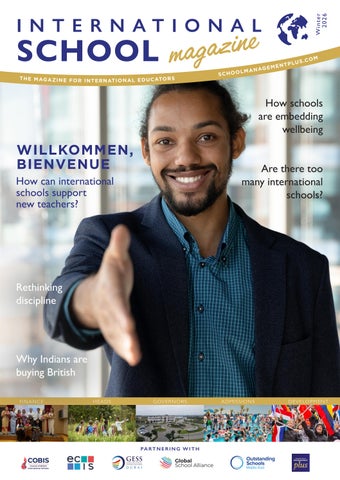
WILLKOMMEN, BIENVENUE
Are there too many international schools?
How can international schools support new teachers?
Rethinking discipline
Why Indians are buying British FINANCE
HEADS
G OV E R N O R S
PA R T N E R I N G W I T H
ADMISSIONS
DEVELOPMENT
Everything you need, all from one place. For over 40 years, Mallory has been the trusted partner for schools, universities, and colleges worldwide. We make procurement simple, fast, and stress-free — delivering the best global educational resources straight to your door. With a vibrant team speaking 20+ languages and working across the globe, we connect your institution with the books and materials you need, exactly when you need them.
What Makes Us Different We don’t just source — we understand you. Every institution is unique, and our personalised solutions are designed to support your success. Email: sales@malloryint.co.uk
2 | International School | Winter 2026
www.malloryint.net
Winter 2026
CONTENTS
Edtech 4 An unreliable electricity supply has led to an unusual – but ultimately rewarding – approach to technology at One World International School in Yangon, writes Jarlath Madine Wellbeing 6 Adam Gray-Sims explores how international schools are evolving their approach to pupil and staff wellbeing and embedding lasting change SEND 8 A ‘radical reimagining’ of discipline is at the moral centre of truly inclusive international education, writes Dr Nigel J Winnard
13
Experience 10 Schools are seeing the importance of allowing young people to have direct experience of the natural world, writes John Cannings
Why India’s Buying British
Editor’s Choice 13 Dominic Tomalin explores why families in India are finding international education increasingly attractive
26
When the Power Goes Out
School Spotlight
schoolmanagementplus.com
Our School Management Plus online platform offers a wealth of information to keep education professionals up to date, including: • latest news, regular features and opinion • monthly newsletter and jobs to your inbox • the chance to contribute your own ideas and opinion • join our webinars and round-table discussions. We are the leading opinion platform for those running a modern international school. We are always keen to hear about the issues that matter to you most, so get in touch to have your school’s voice heard. editor@schoolmanagementplus.com
20 New teachers need a warm welcome and plenty of support, but schools should reject ‘firehose’ techniques, writes George Scorgie The Interview 23 German opposition to international schools meant Jamie Perfect had to spend five years fighting to retain state subsidies for his school School Spotlight 26 Joseph Berglöw Kenneway delves into the fascinating history – and impressive present – of a leading international school in Sweden
International School News The leading source of news, opinion, features & jobs for all professionals working in independent and international education. @ International School News
@SchoolManagementPlus
@SchoolManagementJobs
@SchoolAdmissionsPlus
@ISM_Plus
@schoolmanagementplus5799
Sponsored Feature 28 Hayley Mintern from Anderson Quigley looks at how the right recruitment techniques can have a longlasting impact on international schools INTERNATIO
NAL
SCH OOL magazine T H E M AG
ON THE COVER Supporting new Teachers, page 20
AZINE FOR
I N T E R N AT I O N A L E D U C AT O R S
SCHOOLMA
Winter 2026
4
Leadership & Management 16 Dr Denry Machin asks why, despite seemingly overflowing markets, announcements of new international schools seem to keep coming
N AG E M E
NTPLU
S .C O M
How schools are embedding wellbeing
WILKOM MEN, BIENVE NUE:
How can international schools support new teachers?
Are there too many international schools?
Rethinking discipline
Why Indians are buying British FINANCE
HEADS
G OV E R N O R S
PA R T N E R I N G W
ADMISSIONS
DEVELOPMENT
ITH
Winter 2026 | International School | 3
EdTech
When the power goes out An unreliable electricity supply has led to an unusual – but ultimately rewarding – approach to technology at One World International School in Yangon, writes Jarlath Madine
A
nother power cut. Nobody flinches. The students shuffle their chairs, the teacher grabs a marker, and the lesson carries on. In Yangon, this happens several times a day. It used to frustrate me. Now, I see it as part of our rhythm,
a quiet reminder of what education is really about. At One World International School, our goal isn’t just to prepare students to pass exams, but to prepare them for life. That’s the heart of what I call the ACE Approach – Academic Excellence, Character Development,
Classwork at One World International School, Yangon and Engagement. It shapes everything we do here. Even in assembly, when the power cuts and the hall falls into darkness, the students simply sit and wait. No noise,
“When the power cuts and the hall falls into darkness, the students simply sit and wait.” Celebrations at One World International School, Yangon
4 | International School | Winter 2026
no phones, no fuss, just patience until the generator kicks in. In that silence, you can almost feel character developing: resilience, calmness, and respect.
That’s education in action, even without electricity. I’ve worked in schools across three regions with every digital system imaginable. Years ago, at my son’s grammar school in Kent, a teacher apologised that his computer wasn’t working and said he couldn’t show me any data about my son’s progress. He didn’t even seem to know who my son was without the screen. That moment stuck with me. Technology is brilliant, but it should never replace the human connection at the heart of good teaching. Here in Yangon, the reality is very different. Power cuts are frequent, wi-fi is patchy, and not every student has their own device. There’s no
single Google Suite licence, so students use whatever they can, some make slides on their phones, others create Classwork at One World posters, write by hand, or International School, Yangon draw on a whiteboard. And that’s fine. The important thing is that they’re learning and Ironically, in a place where communicating, not which electricity can’t be guaranteed, platform they’re using. our students are becoming It’s forced truly us all, future-ready. teachers They can and students switch from “Technology alike to think screen to is brilliant, on our feet. sketchbook, Every day from Google but it should reminds us Docs to pen never replace that while and paper, technology is without the human a wonderful hesitation. connection at tool, it can’t They be the only the heart of good understand plan. When it that progress teaching.” fails, creativity doesn’t takes over. depend That’s where on tech, it the ACE depends Approach really comes alive: on effort, collaboration, and • Academic Excellence means mindset. using tech smartly, but also At my last school, when thinking independently. parents discovered ChatGPT, • Character Development their emails changed overnight, grows every time something suddenly they read like they’d doesn’t go to plan. been written by barristers or • Engagement thrives when professors. When I phoned a lessons stay active and few to discuss their concerns, meaningful, power or not. several had no idea that was
what they’d written. Impressive and surreal in equal measure, it showed how quickly technology can take over our voices – even when we don’t mean it to. Here, many parents still prefer the traditional way of doing things. A printed notice, a short conversation, or a friendly chat at pick-up time often means more than an online form. It’s not resistance to progress; it’s a reminder that trust and connection are still best built face-to-face. When the power goes out, the conversation rises. Curiosity replaces clicking. Students talk, draw, and imagine. The classroom
becomes alive again, not because of the technology, but because of the people in it. Preparing students to pass exams will always matter. But preparing them for life, for uncertainty, change, and challenge , matters even more. Opened in 2023, One World International School Yangon delivers the British curriculum from Early Years through to Year 11. The school aims to provide a calm, nur turing environment where academic progress, character and engagement go hand in hand, with students moving into IGCSEs and eventually A-levels as the school grows. ◆
Jarlath Madine is principal of One World International School in Yangon, Myanmar. He has led schools in a wide range of cultures and contexts, including the UK, Middle East and South East Asia, from new openings to established international communities.
Winter 2026 | International School | 5
Wellbeing
Beyond wellbeing weeks Adam Gray-Sims explores how international schools are evolving their approach to pupil and staff wellbeing and embedding lasting change
I
n international schools, wellbeing has become a defining theme of the decade. What began as a pastoral concern has evolved into a strategic priority, shaping how schools recruit, teach, and lead. But as the global conversation matures, one question now dominates: how can schools move beyond isolated initiatives to embed wellbeing as part of their identity? According to ISC Research’s recent white paper on wellbeing in international schools, the most impactful change happens when wellbeing stops being treated as a series of interventions and becomes a shared mindset across the whole school community.
From awareness to action
The international school environment presents unique wellbeing challenges. Students navigate transitions between countries, languages, and curricula; staff face demanding workloads, relocation pressures, and high parental expectations. Leaders, meanwhile, are tasked
6 | International School | Winter 2026
with maintaining consistency across diverse and mobile communities. Addressing these pressures individually through wellbeing weeks, mindfulness sessions, or after-school clubs can help in the short term but rarely delivers lasting cultural change. The research indicates that schools making the most progress are those building sustainable frameworks that embed wellbeing into culture, curriculum, and systems of evaluation.
The cultural foundation
Wellbeing has the greatest impact when it is modelled, not mandated. In several schools studied by ISC Research, the shift began when leaders reframed wellbeing from a standalone programme to a shared responsibility. At Light International School Mombasa, this meant opening up wellbeing discussions beyond the staffroom and inviting both parents and students to help shape
Wellbeing
policies and training. The result was a stronger sense of community ownership, and a reduction in the tension often felt between academic and emotional priorities. This cultural shift requires visible leadership. Heads and senior teams need to prioritise wellbeing not only in student-facing initiatives but in their own actions, from communication tone to workload management. As one school leader told ISC Research, “Culture isn’t a statement on a wall. It’s what people see in the corridors every day.”
This data-led transparency has transformed how the school community talks about mental health, helping to normalise the conversation and ensure support reaches those who need it most.
Curriculum as a conduit
A shared responsibility
Embedding wellbeing into the curriculum is another powerful signal of intent. Strothoff International School in Germany, for example, recognised that one-off wellbeing lessons weren’t enough to build lasting skills. Instead, the school redesigned its curriculum to integrate social-emotional learning (SEL) and resilience into daily learning. Students are encouraged to reflect, collaborate, and explore topics such as empathy and digital balance within regular subject lessons. The change, while subtle, has reframed wellbeing as a fundamental life competency rather than an optional add-on, and one that parents and alumni now credit as central to student development.
Measuring what matters
A recurring challenge in international schools is how to measure wellbeing without reducing it to another performance metric. Yet evidence-based practice is crucial. At Transylvania College in Romania, wellbeing data is collected through regular student and staff surveys, enabling the leadership team to identify trends and respond proactively. Importantly, this information is not kept behind closed doors. Insights are shared openly with staff and students to encourage honest dialogue and to demonstrate that wellbeing is everyone’s concern.
Images courtesy of ISC Research.
The findings highlight a common thread: lasting wellbeing cannot be owned by any single department. Schools that succeed in embedding wellbeing do so by treating it as a structural pillar of school life, as essential to performance as teaching quality or safeguarding. That means investing in leadership training, redesigning staff induction and transition processes, and using wellbeing data to inform strategic planning. It also means recognising that wellbeing for students and staff is interconnected: a culture that enables teachers to thrive inevitably benefits learners.
The next chapter for international schools
The post-pandemic era has accelerated this transformation. Families are seeking schools that nurture both academic and emotional growth, and staff are choosing workplaces where they feel valued and supported. For international schools competing in a global market, wellbeing is becoming a marker of quality. ISC Research’s white paper, How International Schools Are Prioritising Wellbeing for Staff and Students, explores these developments in depth, with evidence and case studies from schools worldwide. ◆
Adam Gray-Sims is the communications specialist at ISC Research and is also the editor of International School Leader Magazine.
Winter 2026 | International School | 7
Behaviour: Knocking on closed doors A ‘radical reimagining’ of discipline is at the moral centre of truly inclusive international education, writes Dr Nigel J Winnard
E
arly in my career, I honestly believed behaviour management was straightforward. Punishments, consequences, and detentions offered a tidy toolbox to manage “problem” students. It felt practical, clear-cut, even a bit reassuring. But, as is often the case in education, reality proved far more complex and, often, unsettling. These traditional punitive approaches not only fell short in effectiveness but, I came to realise, were ethically dubious. Education must be about much more than maintaining order. It should foster growth, justice, and genuine inclusion. Twenty years of leadership within international schools have profoundly reshaped this understanding. Generation Alpha (born since 2010), have exposed the inadequacy of punitive disciplinary models. These children are wired for authenticity and fairness. Their resistances, whether withdrawal, disruption, or defiance, are not merely boundary-testing but attempts to knock on doors long closed by outdated disciplinary legacies.
Meaningful connection
Generation Alpha cares deeply about social justice and the environment. While adept at digital communication, they hunger for meaningful human connection.Token gestures no longer suffice; they demand sincerity and respect. Despite these clear signals, schools persist with punitive sanctions that feel increasingly out of step with their students’ needs. International schools present unique challenges because of their inherent transience. 8 | International School | Winter 2026
SEND
Students, families, and staff cross cultural, linguistic, and national boundaries with regularity, creating fluid, fragmented communities. Relationships cluster around language and culture as adaptive strategies, including among staff. Despite porous narratives of diversity, many schools sustain informal hierarchies that exclude those unfamiliar with tacit social codes, leaving them knocking on numerous closed doors. There is a line in The Demonologist, a novel by Andrew Pyper, that has been recently nagging at me: “Sometimes people close a door because they’re trying to figure out a way to get you to knock.” Generation Alpha’s behaviour echoes this sentiment precisely. Their withdrawal and resistance are invitations, not blocks, signalling a fundamental desire for recognition and belonging amid fragmented, alienating spaces. Misinterpreting these signals as mere misbehaviour is one of education’s most serious failings.
Psychological needs
Central to young people’s engagement are three fundamental psychological needs identified by Ryan and Deci’s Self-Determination Theory: autonomy, competence, and relatedness. In the volatile world of international mobility, these needs are precarious. Disruptive behaviour often signals attempts to regain control, connection, or acknowledgment. Traditional disciplinary systems, fixated on conformity and control, further fray these fragile ties. Restorative justice emerges as a vital alternative. Rooted in indigenous customs and now globally adapted, it shifts focus from punishment to repairing harm and rebuilding relationships. Schools embedding restorative practices, such as restorative circles, mediated dialogue, and community-building, turn disciplinary moments into opportunities for accountability and healing. Systematic reviews highlight restorative practices’ effectiveness in improving school climate, reducing suspensions and exclusions, and fostering social-emotional skills like responsibility and empathy. Yet restorative justice is not a simple fix. Its success depends on whole-school cultural change supported by sustained professional development and culturally responsive pedagogy. For host country
“While adept at digital communication, Generation Alpha hungers for meaningful human connection.” nationals negotiating local identity and dominant global culture, restorative methods provide crucial space for authentic cultural recognition and challenge internal marginalisation.
Managing transitions
International schools are defined by transitions. Arrivals, departures, or internal moves from grade level to grade level, stand out as particularly vulnerable moments. Mishandled transitions amplify behavioural challenges and undermine belonging. Research from Safe Passage Across Networks and others shows that what matters most during these times is strong, consistent relationships – not just following operational procedures. For the successful management of transitions, we must pay attention to relationship-building to ensure people feel secure and supported, as well as basic operational matters. Trauma-informed and restorative frameworks can become token exercises without deeper integration into school ethos. Everyone must be involved in the coversation around behaviour and accountability shared, far beyond the pastoral sphere. Psychological safety is foundational. It must be developed intentionally through training in relational competence, cultural fluency, and conflict resolution. Educators must evolve from enforcers to facilitators of restoration and connection. Students labelled “challenging” are barometers of relational health. Their behaviour silently asks, “Do you see me?” The answer requires humility and relentless commitment from the institution. Rates of change are encouraging. Accreditation standards from the Council of International Schools and British Schools Overseas now embed inclusive
and restorative practices firmly in their criteria, mandating evidence of traumainformed leadership, restorative discipline, and community engagement. This external pressure drives schools beyond superficial inclusion toward systemic transformation. Programmes such as Team Teach, which emphasises respect, prevention, and de-escalation, demonstrate that practical alternatives to punishment exist and yield tangible benefits, improving school climate and reducing exclusions. At its core, international education transcends academic achievement. It must nurture identity, belonging, and compassionate community amid global mobility. Restorative justice provides an ethical framework to transform rupture into repair, disruption into dialogue. This challenging work demands patience and courage. We need to knock persistently and empathetically on those closed doors because our students deserve nothing less. It is well past time that we engaged in a radical reimagining of discipline as the moral centre of truly inclusive education. ◆
Dr Nigel J Winnard is an international school leader with 30 years’ experience across four continents, including 19 years as a head in Sudan and Brazil. He holds an Ed.D. in Educational Leadership from the University of Southern California, where his research focused on teacher retention and motivation in demanding contexts.
Winter 2026 | International School | 9
Experience
Back to nature W
hy has exposure to nature become such an important issue in helping students make sense of the world they live in? One of the realities of modern living is that many young people are growing up without regular, meaningful contact with the environment around them. Their understanding of nature is often second-hand, filtered through a screen. Animated films such as Madagascar may be entertaining, but they present animals as exaggerated characters with human behaviours. While enjoyable, these portrayals can blur the line between reality and fiction, leaving children with a distorted sense of how ecosystems actually function. Beyond film, the dominance of digital devices has created another barrier. It is increasingly common to see children walking to school with their eyes glued to a phone, barely noticing what is happening around them. Their awareness of traffic, pedestrians, or even friends beside them is limited, and when headphones are added to the mix, the surrounding sounds of life – birdsong, wind in the trees, the voices of others – are almost entirely shut out. It’s as if many young people are living in a digital bubble, cut off from the sensory richness of the natural world. Schools, often unintentionally, can reinforce this separation. A friend of mine who worked in China once described how administrators tried to create a “safer” school environment by sanitising it. Natural grass was replaced with artificial turf, which not only caused painful burns when children fell but also removed the
10 | International School | Winter 2026
subtle sensory experience of walking or playing on living ground. Wooden climbing frames were replaced with brightly coloured plastic, and teachers were asked to remove potted plants from classrooms. What struck me most about this story was not just the physical changes but the shift in perception they caused. Many of the children came to believe that nature was something “out there” – found in zoos, parks, or faraway forests – not a daily reality to be lived with and cared for.
Why is experiential, naturebased learning so powerful?
At the heart of this discussion lies the idea of experiential learning. Unlike traditional classroom methods that rely heavily on abstract concepts, experiential learning emphasises direct engagement. It is about doing, feeling, observing, and then reflecting – turning experience into lasting understanding. When learners are actively involved – whether planting a seed, hiking a trail, or working alongside others in their community – they are not only acquiring knowledge but also developing the attitudes and values that shape who they become.
Why does this matter so much?
In my own teaching journey, I have seen again and again how powerful experiential learning can be. As a geography teacher, I found that nothing could substitute for fieldwork. Discussing river systems in a classroom is one thing, but standing on a riverbank, feeling the current, noticing the erosion, and talking with local people who depend on it brings the
Schools are seeing the importance of allowing young people to have direct experience of the natural world, writes John Cannings concept alive in ways that no textbook or diagram ever could. The conversations that followed these trips were often deeper and more meaningful because students had a shared, lived reference point to reflect upon. My experience with the IB’s CAS programme reinforced this belief. CAS requires students to engage with their communities through creativity, activity, and service. For many, it is their first experience of stepping outside their immediate routines and interacting with people in ways that challenge their assumptions. I have seen students discover empathy through working with disadvantaged groups, build resilience through outdoor projects, and develop responsibility by committing to long-term initiatives. These are not just academic skills – they are life skills, the kind that help young people grow into thoughtful and compassionate adults. And, importantly, students remember these experiences and have meaningful memories.
Looking ahead
Encouraging young people to connect with nature is not just about environmental awareness. It is about cultivating a mindset of care, curiosity, and responsibility. When students learn through direct contact with the natural world, they begin to see themselves as part of it rather than separate from it. They start to understand sustainability not as a distant ideal but as a
Experience daily practice shaped by the choices they make. In an age where digital distractions and artificial substitutes are everywhere, the task of reconnecting young people with nature is both urgent and essential.
costs of popular leisure activities and what “sustainability” really means in practice.
How can educators create these opportunities in urban or resource-constrained settings?
For students to really understand sustainability, they need to see how three things connect: social justice, environmental balance, and economic needs. Of these, environmental balance is best understood through direct experience. It’s not enough to read about ecosystems – students need to spend time in nature, observing and interacting with it. Indigenous communities around the world show us how important this connection can be.Their survival often depended on living in harmony with their environment rather than taking too much from it.
Even in cities, students can engage meaningfully with the environment. A few ideas include: • Green mapping: Charting trees, grasy areas, or waterways in the neighborhood. • Light pollution studies: Observing where stars and the moon can be seen, and why visibility changes with artificial lighting. • Classroom habitats: Raising caterpillars on nettles and watching them transform into butterflies (always a lively moment when they emerge). • Everyday ecology: Searching for spider webs around the school and comparing where they are found.
What kinds of experiences help shift students’ thinking?
How do we move students from awareness into action?
Why should students ‘do work in and with nature’?
Children are naturally curious, and early experiences with the environment can have a lasting impact. School gardens, nature walks, or visits to nearby streams and forests all give students the chance to explore, question, and connect. One example is a primary school class that visited a local forest. A forester explained how trees support life – not only by providing habitats but also by holding soil in place on slopes. Students began to see the positive roles insects and trees play in the balance of the ecosystem. Older students can benefit from fieldwork and more in-depth questioning. In Switzerland, for instance, we studied the impact of downhill skiing on pastures and forests. This sparked thoughtful discussions about the
Learning about issues like climate change can feel overwhelming. Students need help making the link between their everyday choices and the bigger global picture. Teachers and mentors play a key role in guiding them toward action – showing that small, local steps can be meaningful contributions to larger challenges.
What examples show students making this connection?
At the International School of Geneva, the Innovate programme gives Year 9 students the chance to research local problems, connect with experts, and work on practical solutions. At the British School in Jakarta, CAS students worked with their local community to register children with the
authorities, making it possible for them to attend school and access healthcare. They also helped design a simple school building using bamboo and steel. In doing so, students connected local action to global issues such as poverty and access to education.
Embedded in school life
The most effective way for students to grasp the meaning of sustainability is when it is woven into every aspect of school life – philosophy, governance, leadership, curriculum, and daily operations. Schools that embrace this holistic approach, such as those in the international Green Schools Alliance, place sustainability not just in lessons but at the very heart of their culture and practices. One inspiring example, though not part of the Alliance, is The Roong Aroon International School on the outskirts of Bangkok, Thailand, where the campus itself reflects this philosophy. Centered around a pond, it features classroom suites made from locally sourced wood, designed to blend seamlessly with the natural surroundings.The school operates on a zero-waste policy: students clean classrooms daily, sort materials for reuse or recycling, and compost food scraps from lunches to nourish the gardens beside rice paddies and a canal.
Conclusion
Exposing children to the natural environment is vital for helping them grasp the meaning of sustainability, but this alone is not enough. We can no longer treat sustainability as a side topic or confine it to one discipline – it must be embedded across education as a systemic, justicecentered pursuit. If we fail to create these conditions, we risk raising a generation unprepared for the interconnected crises they will inherit. ◆
John Cannings is an experienced educator with a diverse international background. He has taught in Australia, the UK, and Switzerland, primarily within the IB system as a geography teacher and in experiential education. He is also involved in various projects promoting sustainability in schools.
Winter 2026 | International School | 11
Advertorial
The Biggest Mistake Students Make in University Applications and How Counsellors Can Fix It
F
or guidance counsellors in international schools, one of the most important developments in university advising is the shift towards strategic, data-driven application planning. Acceptance rates for the most recognisable UK & US universities continue to tighten, and supporting students to adopt a more tactical, evidence-based approach can dramatically improve their chances of receiving strong offers. The goal is not to limit ambition, but to help students construct lists that reflect both aspiration and strategy. In the UK, the competitiveness of certain courses speaks for itself. PPE at Oxford and Economics & Management at Cambridge both admit only 8% of applicants. In the US, selectivity is even more extreme; acceptance rates at top universities such as Harvard, MIT and Stanford are consistently sub 4%, and at leading business schools like Wharton, the figure is around 4.5%. This hyper-selectivity creates an important opportunity for counsellors to redirect the conversation. When students understand how narrow these entry windows really are, they become far more open to looking beyond
the shiny headline courses. Counsellors can then guide them towards equally rigorous degrees at other top universities, often providing a better fit, stronger support, and, crucially, higher odds of securing an offer. Fortunately, there is a wide network of specialist universities offering exceptional academic outcomes for students aiming for the most popular courses. For Computer Science, Carnegie Mellon, Georgia Tech, and the University of Illinois Urbana-Champaign remain globally respected alternatives with strong industry pipelines. While not all are ranked in the top 20 overall, they consistently outperform many Ivy League universities in graduate outcomes and employer reputation. In the UK, Russell Group unis Edinburgh, Southampton, and Warwick deliver rigorous training in areas such as AI, informatics and cybersecurity. For PPE and related social sciences, Durham, Warwick, Exeter, and York offer high-quality interdisciplinary degrees with strong teaching quality and pastoral environments. In the
US, the University of Chicago (ranked 6th nationally) offers an exceptional option for students drawn to political theory, analytical reasoning and intensive seminar discussion. Engineering students often thrive in institutionally distinctive environments. Purdue, Texas A&M, and Virginia Tech remain among the strongest applied engineering ecosystems in the US, while Bath, Bristol and Sheffield in the UK are renowned for industry partnerships and hands-on project work. Business & Economics students benefit from exploring programmes that combine academic theory with significant employer engagement. Warwick, Manchester, Nottingham and Bath provide strong professional pathways. In the US, UC Berkeley (ranked 15th nationally) provides world-class economics and an entrepreneurial ecosystem that sits at the heart of the global technology sector. Competitiveness data helps counsellors reframe the admissions conversation. When families understand acceptance rates in context, applications naturally become more strategic, more balanced and far better targeted. Encouraging students to explore a wider landscape of specialist universities not only increases the likelihood of multiple strong offers, but also helps them identify environments that will stretch, support and ultimately bring out their best. www.crimsoneducation.org/uk ◆
The world’s leading university admissions consultancy
1,340 382 Offers to Ivy League universities
Offers to Oxford & Cambridge
7,400 3,500 Offers to the US Top 50 universities
12 | International School | Winter 2026
Offers to the UK Top 10 universities
Shrewsbury International School
Editor’s Choice
Why India’s buying British Dominic Tomalin explores why families in India are finding international education increasingly attractive
B
ritish schools have been slow to open campuses on the Indian sub-continent. But now they are queuing up to access a country that is obsessed with education. Leading brands include the school where I am founding head, Shrewsbury International School India, but Wellington and Harrow also have footholds on the subcontinent, with others to follow. This comes at a pivotal time when its economic renaissance has created a burgeoning and increasingly affluent middle class that is keen to see its children prepared for a rapidly changing world. As ISC Research data shows, the number of international schools in India has risen to 972 in January 2025, up 10 percent in five years. This growth is not confined to the biggest cities: Tier 2 and Tier 3 cities are now adding British and IB curriculum schools. Parents are no longer content with simply sending kids into the professions their own generation inhabited. They realise that the world has changed: automation and AI are displacing traditional careers, and the luxury once afforded by formal degrees no longer guarantees lifelong security. In response, many seek a genuinely holistic education.
“Parents realise that the world has changed.”
What Indian parents are looking for
From our conversations with Indian families, several recurring priorities emerge: • Global access: Many want their children to attend top universities abroad. A British curriculum is a clear pathway. • Holistic development: Beyond exam scores, parents prize adaptability, resilience, and emotional intelligence. • Future readiness: In a world increasingly shaped by machines, they value lifelong learning, curiosity, and the tenacity to navigate an uncertain future. • Social contribution: There is growing awareness that we are social beings in a fragile world; parents want their children to develop empathy, a sense of purpose, and a desire to contribute to collective well-being. Put simply, Indian parents are not just buying a school; they are investing in a future. F Winter 2026 | International School | 13
Editor’s Choice
“There is growing awareness that we are social beings in a fragile world.”
Why a curriculum isn’t enough
Dominic Tomalin is headmaster of Shrewsbury International School India, he was previously principal of CATS Cambridge, an international college in the UK.
Many schools claim to offer a “holistic British education”. But differentiation lies not in marketing, but in design – staffing, pedagogy and culture. India’s National Education Policy (NEP) has made progress, but implementation lags. Teacher training is uneven, and many educators lack experience with inquiry-based or socio-emotional learning. Without strong training, even the best curriculum becomes superficial. Shrewsbury International School India, based in the city of Bhopal in the state of Madhya Pradesh was launched in August 2025. It offers small classes (about 1:8 teacher-student ratio), continuous professional development for staff rooted in modern pedagogy, and a school culture that prizes real dialogue between adults and children. We deliberately engineer time and space for meaningful conversations – mentorship, reflection, feedback – so students can explore where their talents lie. Facilities are central: science labs, art studios, performance spaces, mentorship pathways, and mastery programmes. These are not extras, but core to the mission of enabling students to flourish. Boarding, too, is not a mere convenience. We cultivate a familial atmosphere – warm, personal, rooted in care – that many Indian parents find deeply reassuring.
A common tongue, cultural dissonances
On paper, a British curriculum in India feels intuitive. The medium is English; the assessments (IGCSE, A-levels) are globally recognised. But in practice, there can be jarring cultural dissonances. Indian students may speak in the same words as their Anglo-Saxon teachers, but meaning diverges. Respect and deference, deeply embedded in Indian communication, can feel at odds with a British teacher’s call for questioning
14 | International School | Winter 2026
and debate. Thus, even when there is a shared language, there is a gap: one of tone, of expectation, of relational norms. This cultural chasm can hinder learning. If an Indian child is accustomed to indirectness or nonconfrontation, they may hesitate in Socratic dialogues; if a teacher is unfamiliar with how hierarchical respect plays out in Indian homes, they may misread quietness for disengagement. Bridging this divide demands more than linguistic fluency – it requires pedagogical empathy.
Competing in a crowded field
Competition is intensifying. Legacy Indian schools, elite CBSE and ICSE institutions, and newer Britishcurriculum chains are all vying for the same parents. But few combine a robust educational philosophy with finely tuned pedagogy, small scale, and deep cultural empathy. Our advantage lies in clarity: a coherent vision, a sharply defined model, and pedagogical depth – not simply replicating other schools but doing something distinctive.
Land of opportunity
India is changing with remarkable speed: projected to become one of the world’s largest economies, with an increasingly global mindset. And yet, its institutions, including many schools, are not always practised in change. That’s where the paradox lies – and where the opportunity stands. In a country of contradictions, nimble, purposedriven educators can make a difference. For those willing to take the long view, there is a window now: to build a British international school that truly adds up – not just in terms of status, but substance. ◆
Assess for success with Cambridge Insight baseline assessments “
We have found Cambridge Insight data helps us develop informed teaching and learning interventions before the start of each Cambridge course. This has led to better results in Cambridge exams.
Jackline Aming’a, Head of School, Oshwal Academy Mombasa, Kenya
”
www.cambridge.org/insight Winter 2026 | International School | 15
Leadership
Saturation point? Dr Denry Machin asks why, despite seemingly overflowing markets, announcements of new international schools seem to keep coming
C
ast even the briefest glance at social media and barely a day goes by without another new international school being announced. As of August 2025, ISC Research counts around 15,000 international schools educating 7.7 million students, with school numbers up 8 per cent and enrolments up 13 per cent over the last five years. Take the Gulf Co-operation Council states (GCC:) about 42 new international schools were expected to open during 2023-24. Dubai alone welcomed 10 new campuses in 2024-25 and has plans for 100 more by 2033. Asia is
keeping up the pace too, and Europe isn’t far behind. International schooling is once again hot property, not least for investors. It’s no surprise, then, that amid all this growth, people – teachers and school leaders especially – are asking if their market is saturated. Or rather, with so many newcomers, they’re wondering why it seemingly isn’t. With so much supply, can demand keep up? Some light economics provides something of an answer.
Perfect competition
From the chalkface of any individual school, international schooling can
16 | International School | Winter 2026
feel fiercely competitive – in economic terms, almost perfectly competitive. Pick up an economics textbook and you’ll see perfect competition described as a market where: • There are many buyers and many sellers • Products are undifferentiated; buyers see the goods as identical • Barriers to entry and exit are low for both buyers and sellers • Buyers have perfect
information on price, with no costs when switching suppliers. Intuitively, that fits many international school markets: plenty of willing parents and ever more schools, despite a school taking two to three years to open and requiring millions in capital expenditure. Offerings are very similar – one British-branded school often looks much like another – for example. Parents can also compare schools and fees online with ease and
“New schools don’t need to be full to survive.”
Leadership
International schools may look similar, but they find their niche
switching between schools is fairly straightforward. Taken together, these factors make the market feel saturated. We see the numbers, the announcements, the student churn, and it feels (perfectly) competitive. So why, at least in some markets, do so many new schools keep coming?
Monopolistic competition
In reality, in any given location, there isn’t one market of identical schools; there are multiple markets of similar ones. Economists call this monopolistic competition: small differences give each school local power, offset by local rivalry. So, yes, there might be lots of schools, but: Location: In congested cities, travel time constrains catchment areas. Schools beyond a feasible commute aren’t real competitors. New roads or metro lines can shift this, but in many locations, geography fragments demand. Multiple viable schools can
exist across a country, city or region because, individually, each is the “best” option for a given family within a given commute-constrained catchment area. Differentiation: Schools compete on curriculum, language, timetable, cocurriculars, pastoral care, results, facilities, brand – even the principal’s personality. An IB, spor ts-heavy school isn’t the same as a traditional British boarding one. A school may be the only IB option in its catchment area, or simply the best cultural fit for a family. Varieties of approach, style and culture create positional space – differing parental demands are met by a range of differing supply – even where location may overlap. Imperfect information: Despite abundant online content, families rarely have perfect information about schools. True quality is hard to compare, even for educators. Parents rely on signals such as accreditation, university destinations, inspections
and word-of-mouth. These information gaps create, in turn, market gaps for schools. Whether it’s true or not, a claim to be “the best at X” attracts parents looking for that precise thing. Effective marketing: both create and find their way into those spaces. Perception, whether it reflects reality or not, and whether created by marketing or not, segments the market. Switching costs: Even if parents can bear the financial costs of switching such as non-refundable application and registration fees, in practice, emotional ties to a school, new syllabi, new peer groups, new commute patterns, and non-financial costs are not desirable. Once families commit to a particular international school, it can be hard to move partway through a child’s education. That friction adds to each school’s local market power; enrolment is “sticky”, which, perhaps paradoxically, both protects incumbents and attracts newcomers who,
“The right micromarket can still deliver a return before the competition catches up.” when they’ve captured market share, also want to enjoy the benefit of “protected” longterm revenues. Price tiers: Price further segments the market; two schools can offer similar propositions at different price points, sometimes even on the same street. At the premium end, demand is often price-inelastic with families prioritising prestige and outcomes over cost. F
Winter 2026 | International School | 17
Leadership
With price bracketed out to some degree, premium schools can cluster in the same areas, such as Jumeirah in Dubai, thriving because of other differentiators. So, whilst price obviously matters, in many markets there are sufficient price points, and enough parental demand across those price points, for market space to exist and for competitors to coexist.
The bottom Line
New schools don’t need to be full to survive, they just need to hit a viable occupancy threshold. In Dubai, for example, a mid-sized international school with 1,200 capacity and AED 60k average fees needs around AED 43 to 50 million in annual revenue to cover staff, facilities, and debt. That’s roughly 720 to 850 students paying full fees, 60 to 70 per cent of capacity. KHDA data shows that many new schools average 50 per cent use by their third year and, by year seven, approximately 80 per cent.
That’s why investors keep backing new campuses. Budget schools may reach profitability earlier (lower overheads, faster local intake), while ultrapremium ones can take longer (higher fit-out costs, selective branding), but the right micro-market can still deliver a return before the competition catches up. Even in busy markets such as Dubai or Bangkok, schools can still earn healthy profits in the short to medium term if differentiated enough – and profit attracts new players.
Crowded, not full
The answer to the question, then, is that whilst a given market may feel “full”, it may still be able to absorb new schools. What looks like perfect
competition at city scale is often monopolistic competition at school level. Micro-markets – defined by location, offer, information, switching costs, and price – leave room for new entrants. For incumbents and newcomers alike then, the task isn’t to out-shout everyone, it’s to own a micro-market. If you are the least substitutable choice for a defined set of families and you have a strong market position or own a niche…or just the right location, the numbers are just noise. At the risk of oversimplifying, you only need to watch your nearest competitors, those offering a similar proposition at a similar price in your atchment area.
Of course, this all assumes sustained demand. And that’s not a given. In Vietnam, for example, ISC Research has reported that “premiumfee schools are facing enrolment pressures”. Geopolitical tensions, trade pressures, regulation shifts, or currency shocks can shrink the pie fast. In some markets, localisation (preferring local employees over expatriates) is accelerating amid global headwinds – the highly paid expatriates whose children populate some international schools are not immune from job losses. So, demand may not exist to fill supply forever; the latest gold rush will end at some point. For now, though, in many markets, new schools keep
“There isn’t one market of identical schools; there are multiple markets of similar ones.”
Is the market too full?
opening because they’re not filling the whole market; they’re filling niches within it. That’s why the announcements keep coming. That’s why so many new schools keep opening. That’s why many markets are “full”, but not yet “saturated”. ◆
Dr Denry Machin is a consultant, author, and university lecturer. He specialises in international school starts-ups and project management.
18 | International School | Winter 2026
Are you assessing multilingual applicants equitably? Password and international admissions Research shows proficiency in English language is a key predictor of attainment for learners with EAL. Schools only using tests of academic potential designed for monolingual English populations may inadvertently put multilingual pupils at a disadvantage. Password’s community of partner schools embrace equity, access and inclusion for English language learners by using our reliable test of academic English, to enhance or replace cognitive ability test data.
Password Pupil tests at a glance Cost-effective 60 minute online test with instant results Optional writing component Designed by language acquisition experts Aligned to international standards Informative results data
Password Pupil English Test of academic English language for students aged 14+ (CEFR aligned A2 – C1)
"As a school it’s very easy for us to recommend working with Password. Their tests provide a really clear baseline that we are able to use to assess students against before they even arrive at the school.” Thomas David Blower Head of EAL, King Henry VIII College, Malaysia
Password Pupil English Younger Test of academic English language for students aged 10+ (CEFR aligned A1 – C1)
Password Pupil Maths Test of maths designed for learners with EAL
www.englishlanguagetesting.co.uk | contact@englishlanguagetesting.co.uk
.
Winter 2026 | International School | 19
Leadership
New teachers need a warm welcome and plenty of support, but schools should reject ‘firehose’ techniques, writes George Scorgie
Willkommen, bienvenue: Supporting new teachers
I
nternational schools are an expanding global juggernaut. With over 15,000 globally, a combined fee income approximating $67 Billion USD, and powered by an estimated 800,000 teachers as of January 2025, this education revolution shows no immediate signs of slowing. While recruitment is the first high-stakes decision school leaders must make, the second, but likely more important, high stakes
“Plants don’t grow when drowned under a year’s worth of water at one time.” 20 | International School | Winter 2026
issue then becomes how best to support those teachers to be as successful as possible in their new working and living environment. Starting with the end in mind consequently yields the question of what a secure and fully prepared teacher looks like, and allows leaders to extract the roadblocks that may inhibit this. Consequently, three threats to new teacher success become immediately evident: new country stressors, school stressors and classroom stressors.
Intentional and curated
Thorough onboarding begins at recruitment, though once a new teacher signs their contract the process of scaffolding their success truly begins. New teachers will have questions about housing, phones, childcare, curriculum, amongst many other things related to their first days. Many schools have group chats and buddy systems and, critically, these have
been shown to work particularly well when a teacher’s buddy or mentor is from the same department or grade, and be especially powerful when children of new teachers are likewise paired. The key aspect of these systems is that they are intentional and curated, focused on creating a sense of belonging that reduces the new teacher’s sense of otherness before their physical arrival. Many school leaders know the drill of meeting new arrivals at airports at all hours, and the importance of this can’t be overstated. The old adage of “first impressions” rings particularly true for new teachers, with the first 72 hours identified as critical for shaping impressions that subsequently influence engagement, satisfaction and ultimately staff retention.
Less is more
Belonging and psychological safety form in these embryonic stages and ignoring small
Leadership In the classroom
It’s important to support all new international school teachers
details like welcome packs, internet and ready-made beds demonstrably increases incidences of new hires feeling lost, overwhelmed and alone. Transitions trigger human threat awareness mechanisms and it’s the smallest details that can assuage these, setting new arrivals up for success before oncampus programmes commence. Onboarding programmes manifest in a multitude of formats globally with the most effective of these sharing the common ground of less is more. Legacy onboarding models have variously seen new teachers asked to survive the exhaustion-inducing ordeal of a week of sessions on every policy and process. Coupled to this is the familiar feeling of being woefully underprepared for the classroom and wondering where all the time went. The shortest way of appraising these
programmes is to say plainly that they embody the least effective approach. High cognitive loads reduce sense making, lower early performance, increase threat perception and are, frankly, unnecessary. New teachers are not best supported by knowing how reports that are due in eight weeks are uploaded, don’t need lessons on student centred learning, and are not best served by immediately setting goals ahead of distant appraisals. These are all important, but literature cautions against using a firehose and advises instead to drip feed. After all, plants don’t grow when drowned under a year’s worth of water at one time. If you think mission critical systems only: safeguarding, rhythm of the day, key processes required for the immediacy of week one, then you are setting new hires up for success, not to be overwhelmed.
Class readiness, the remaining roadblock to early success, throws up systems stressors – how do I take attendance or navigate school software, what are the non-negotiable administration tasks; and curriculum stressors – am I ready to teach my class from day one? Groundwork for success, from both a curriculum and systems perspective can commence even before arrival by matching an incoming teacher with an existing returning teacher. Systems stressors can be further alleviated with structured buddy and department time and can be supported with a checklist: does my teaching buddy know how to do the following things? The last thing new teachers want is to appear incompetent in the opening weeks, so avoiding fire-hosing them but instead providing structured time that helps address each potential class readiness stressor is a great place to begin. However, many new teachers may experience extended settling in times and support that clarifies expectations, focuses on belonging, and specifically aims to lower cognitive loads is critical here.
Support without stigma
It’s important to note that this doesn’t mean lightening class loads or removing responsibilities as these public markers may heighten new teachers fears of being seen as incompetent by their peers, compounded further if that load is perceived as being shifted to others. In this instance a useful mantra becomes support without stigma: regular, low stakes, mentor check-ins, specific task guidance, and a focus on lowering the teacher’s cognitive load by normalising support (“We always support our new teachers like this”). In this regard, effective support is not only instructional, but also political and psychological, strengthening competence whilst protecting status and reputation. ◆
George Scorgie is the dean of student activities at Robert College, Istanbul, and has previously worked and led in schools in Zambia, the UAE, China and Uzbekistan. He holds a PhD focusing on school leadership and culture building and a masters in educational leadership.
Winter 2026 | International School | 21
SCHOOL MANAGEMENT THE HOME OF INDEPENDENT AND INTERNATIONAL SCHOOL
plus JOBS AND CAREERS
Recruit the best teaching talent with us ONLINE INDEPENDENT AND INTERNATIONAL JOB BOARD
PO
PU
PU
FEATURED
45,000+ independent & international professionals
Standard listing PLUS
Featured listing PLUS
Premium listing PLUS
Featured listing at the top of the Careers Section
Free listing if the vacancy is not filled
Advertising alongside relevant content throughout the site
Included on magazine digital distribution to 150,000 readers
Unlimited job listings throughout the year to our audience
15,000 social media reach accross six channels Included in weekly jobs newsletter
LA
ATTRACT THE BEST STAFF WITH THE LEADING DIGITAL PLATFORM FOR INDEPENDENT AND INTERNATIONAL SCHOOL PROFESSIONALS WORLDWIDE
R
PREMIUM
PO
STANDARD LISTING
LA
R
Included in school directory Listing experience hosted on Kampus24
Exposure and features on your school in main careers section Print adverts for your listings each term
The first 100 schools to sign up will receive 20% off a year’s unlimited package
• Social following of 15k across 6 channels • 60% annual growth in web traffic • Core readership of Heads, Senior Leaders, Heads of Department, Bursars and Finance managers, Marketing and Admissions, and Development across the sector
office@schoolmanagementplus.com
WWW.SCHOOLMANAGEMENTPLUS.COM/JOBS/
22 | International School | Winter 2026
Newsletter presence every month for your school
Listing experience hosted on Kampus24
School Management Plus is the leading print, digital and social content platform, for leaders, educators and professionals within the independent and international education sector worldwide. Our readership spans every stakeholder within fee paying education worldwide from Heads, Governors, Bursars, Admissions, Marketing, Development, Fundraising and Educators – to catering, facilities and sports. Our jobs & careers center is the natural meeting point for those already in the sector, aspiring to join it, or hiring from within it.
UNLIMITED
The Interview
Jamie Perfect
Director, International School of Bremen German opposition to international schools meant Jamie Perfect had to spend five years fighting to retain state subsidies for his school
W
ith VAT on fees and a host of other pressures, it has not been easy to be a British independent school leader in
recent years. In the state sector too, the doom scroll of underfunding and teacher recruitment woes have made work harder than ever. It might, therefore, be easy to imagine that working in an international school overseas is a nice way to avoid politics, pressure and the threat of financial meltdown. However, as Jamie Perfect explains, international outings can be just as fraught – at least initially – as anything educators face back home. Jamie left Britain for Germany in 2018, to take the lead at the International School of Bremen (ISB), realising a long-held ambition to work abroad. With a background in state education, he had been made redundant from the academy he was running after it shifted from one MAT to another, so the time seemed right. “It was literally after the vote for Brexit so I thought, if you’re going to go abroad, now is the time to do it. It was a perfect storm that led me here.”
“We’re very very involved in the community as well… we’re not just this elite school sitting there.”
And it was into a perfect storm that he walked. With echoes of the VAT on fees situation in the UK, political antipathy to private and international education meant he had to spend the next five years arguing the case for the funding the non-profit school receives from the state. Only a few months into his tenure, the state audit commission published a 200-page report criticising the Bremen local government’s spending policy. And the International School of Bremen, which was receiving just under €1m in financial support, was singled out. “That just made the headlines and got splashed across every newspaper. I had a bit of an existential crisis to deal with when I got here with that…It was quite a thing to walk into”, says Jamie. There followed a “Five-and-a half-year discussion” – involving lawyers on both sides – where Jamie battled for the school to retain its status as an “Ersatzschule” – meaning it had full equivalent status to German state schools. This ensured it could receive par t of the state funding for every student that came from Bremen. His arguments echoed those used by independent schools in the UK: “The fundamental thing we were discussing is how good we can be for the economy, because these schools can bring in talent from outside for research, development…it was bringing real kudos to the city”. Eventually, in 2023, the powers that be were convinced. The student body is now 30 to 40 per cent German. Non-profit, non-selective, with 25 per cent of students on bursaries, it is as inclusive as F Winter 2026 | International School | 23
The Interview
Mini CV: Jamie Perfect 2018-present: Director, The International School of Bremen. 2017-2018: Secondary lead, Outcomes First Group – Setting up and running New Barn Secondary School for students with SEMH needs and in residential care. 2007-2017: Vice principal/acting principal, Everest Community Academy, Basingstoke. an international school can be. Its diverse student body includes 22 boarders from around the world and the children of Phd students at the University of Bremen, which is on the same campus. With the political and funding tussle behind him, Jamie is now focused on taking the school forward – developing boarding and internationalism while also ensuring that the school is, and is seen to be, embedded in the wider city of Bremen.
VAT on fees boost?
He has already taken the school from 266 pupils to 370 but this number is expected to rise, partly due to VAT on fees in the UK. Boarding fees at ISB are around £15,000 a year cheaper than a typical British school, Jamie says, something that could prove attractive to parents looking to lower costs. “When we saw the VAT [being imposed] we
24 | International School | Winter 2026
were in the second year of running boarding, so we thought why not do some social media campaigns? “We only had a small budget so it only had a small impact but we started to see real interest.” Parents who were straining to pay the higher fees, he says, were intrigued by the prospect of sending their children to Germany. “We thought, will they look at a European alternative and the answer is, yes, they will.” The school already has one British boarder and three Germans who have moved from British boarding schools – and he expects the trend to continue. He says: “A lot of people who are sending their children to a British boarding school who are British are looking for stability for the child because they are mobile themselves, so does it really matter where that centre of stability is?” The only block at the moment, he believes, is Brexit and how there is a perceived “gulf ” between Britain and Europe that doesn’t really exist. “I didn’t really realise how much of a [mental] block Brexit has become,” he says. “There’s an education piece to do there, I probably have to work with some more European schools to get that out there.”
Culturally embedded
Along with these efforts to internationalise further, Jamie is taking care to ensure that the school is part of its community and celebrating German, as well as other cultures.
The Interview The tradition of Einshulung, where children starting school for the first time are given cones of sweets and presents, is celebrated, alongside the Laternelaufen pageant, for example. The school’s eye-catching website has been redesigned around the concept of “the city as our campus”, with photographs of the old town hall, where the school holds its graduation ceremony, the university and the modern science museum. The menu is a map of the river Weser that runs through the city. The school has also formed STEM partnerships with other schools in the city and also its neighbour, the University of Bremen. “We’re very very involved in the community as well… we’re not just this elite school sitting there,” says Jamie. He also wants to develop the curriculum to ensure it genuinely gives students the skills they need in the future. Currently the school teaches the International Primary Curriculum, the Cambridge Lower Secondary Curriculum, IGCSE and the International Baccalaureate (IB).
Championing the IB
As chair of the 22-school Association of German International Schools, Jamie and colleagues have had to “work very closely” with the federal government to ensure the IB – used by 120 schools in
Germany – has equivalency to the German Abitur high school certificate. A huge supporter of the IB, he regards it as “the best preparation for university” and provides a more broad and balanced approach than A-levels in terms of subject matter and assessment. Moving to Germany and running an international school has clearly been a big challenge for Jamie. But ultimately, it has been a rewarding experience. The Norfolk native also says the working culture in Germany is not as fraught and pressured as the UK. He has a little more time for his hobbies of rugby, cricket, vinyl collecting and art. His wife is close by too – she teaches maths in the same school while his son is studying marketing at Middlesex University in the UK. “The works council is very protective of teachers’ rights, so we tend not to send emails at certain times of night, certainly not over the weekend,” he says. “Germany feels like Britain was 30 or 40 years ago, the shops are closed on Sundays, for families to have family time together… it’s a very ordered country. The people have been great and very welcoming,” he says. “I like the European culture, and I’ve always considered myself European not just British – the café culture, everything you get in Europe, I really enjoy.” Despite the bureaucratic dramas, it seems, working overseas might be a pretty good option after all. ◆
Irena Barker is editor of International School Magazine and digital editor of School Management Plus.
International School of Bremen, Germany
Winter 2026 | International School | 25
I
n post-war Europe, Gisela Dietze and her husband fled from Leipzig as the Soviets consolidated their presence in Germany. Taking refuge in Stockholm, Mrs Dietze soon encountered other foreign nationals who all shared the desire for a school suited to the needs of their non-Swedish children. So, in 1951, Gisela Dietze founded Stockholm International School – named the English School when it was established. At the end of its first year, it had 58 students from 15 countries enrolled, and seven full-time and two parttime teachers. Almost 75 years later, SIS has grown to become a centrepiece of international education in the Stockholm region. Today, SIS comprises around 800 students, originating from over 60 countries. It stands as Stockholm’s leading Englishspeaking IB continuum school, offering education from Early Years to Grade 12. The school’s primary school campus is situated on Johannesgatan, adjacent to St Johannes Church in central Stockholm. It’s an interesting historical fact that SIS moved
A whole-school gathering to celebrate UN Day
Spotlight on a School
Stockholm International School, Sweden Joseph Berglöw Kenneway delves into the fascinating history – and impressive present – of a leading international school in Sweden 26 | International School | Winter 2026
School Spotlight
An archived photo from September 1967, when Sweden swapped from driving on the left to the right hand side of the road.
“Students have access to museums, libraries, and cultural institutions.” to this campus on September 3 1967 – on the very day that Sweden changed from driving on the left to driving on the right. You can imagine the chaos. Just a few minutes walk away, the landmark Norra Latin building on Drottninggatan, houses the middle and upper school sections. The Norra Latin site has a fascinating history: It was built as a state-of-the-art school in the 1880s, but almost a century later, the demand for school places in the centre of Sweden’s capital city had abated and the school was closed. The building became a conference centre for the next 30 years. On acquiring the lease in 2023, SIS began a whirlwind renovation project to repurpose Norra Latin as a school once more. For that to happen, the building had to conform to modern regulatory requirements for schools – acoustics, light, air quality, heating and so on – while having
necessary IT infrastructure installed too. Throughout, the building’s heritage needed to be protected. After nine intensive months of work, Norra Latin opened to the SIS secondary school, winning plaudits from local architecture bodies for achieving a “high-quality” renovation in an “impossible” time. While we are proud to have brought the building up to date, we were also proud to preserve the past: Among the murals on the walls of the Norra Latin campus are two painted by Crown Prince Eugen – who was among dignatories present at the inauguration of the building in 1882. With both campuses centrally located, SIS benefits from proximity to numerous educational resources in
The galleried lobby space in the atrium of Norra Latin, Stockholm International school
Stockholm. Students have access to museums, libraries, and cultural institutions, enriching their learning experiences and fostering a deeper connection with the city’s rich heritage. SIS is an authorised IB World School, delivering the full IB continuum: the Primary Years Programme for ages 3-12, the Middle Years Programme for ages 11-16, and the Diploma Programme for ages 16-19. Alongside academic rigour, the school emphasises personal development, resilience, and critical thinking, supporting students to achieve their full potential in an atmosphere that embraces diversity and internationalism. Accommodating the needs of individual learners in this context is central to the school’s approach. SIS’s commitment to academic excellence is evident in its IB Diploma results. In 2025, the school’s pass rate was 97 per cent, surpassing the global average of 81.25 per cent. The average score was 34 points, compared to the global average of 30.5, with the highest score achieved being 44 points out of 45.
Not-forprofit status
SIS operates as a not-for-profit institution, reinvesting any surplus funds into enhancing educational programmes, facilities, and student services. This model ensures that the focus remains on providing high-quality education, aligning with the school’s mission to serve the educational needs of the international community in Stockholm. Indeed, in keeping with the founder principal’s vision, community lies at the heart of SIS. The school partners with an active parent community to organise events that make entire families feel welcomed and readily able to create friend networks in the city. With this holistic view, Stockholm International School stands as a beacon of international education in Sweden’s capital. With its rich history, comprehensive IB curriculum, central location, and diverse student body, SIS offers a nurturing environment where students are equipped to excel academically, become responsible global citizens, and continue to thrive in life after school. ◆
Joseph Berglöw Kenneway is leadership and development communications officer at Stockholm International School.
Winter 2026 | International School | 27
Sponsored Feature
The ‘British approach’ to sustainable leadership recruitment
Hayley Mintern from Anderson Quigley looks at how the right recruitment techniques can have a long-lasting impact on international schools
I
n the international schools sector, leadership is no longer defined simply by titles or tenure – it is defined by legacy; the ability to build environments where students, staff and communities can thrive long after a leader has moved on. Sustainable leadership is now the cornerstone of successful schools worldwide, and its importance continues to grow as school communities become more complex, more diverse, and more demanding of stability and excellence. But there’s a dimension to this conversation that’s often overlooked – the recruitment process; how leaders are identified, supported, and appointed is one of the most powerful levers for creating sustainability. And increasingly, a “British approach” to leadership is proving to be a stabilising force in international contexts.
More than a buzzword
International environments can be transient – families relocate, teachers move frequently, and competing educational philosophies are constantly at play. Sustainable leadership provides the anchor, ensuring a school’s ethos is not reinvented every few years but refined, reinforced, and strengthened. This is certainly the case for British-based brands that have exported internationally.
You can’t achieve sustainable leadership without a sustainable recruitment strategy – there needs to be a balance between the traditional and speed. This is what sustainable leadership means to me: • Consistency in vision, even as teams evolve • Stability for staff, reducing turnover and reinforcing culture
“How leaders are identified, supported, and appointed is one of the most powerful levers for creating sustainability.” 28 | International School | Winter 2026
• Strategic succession planning, so leadership is never left to chance • A focus on wellbeing, ensuring leaders are supported to stay and succeed • A long-term impact, not quick wins or superficial fixes.
Hidden engine of sustainability
You can’t achieve sustainable leadership without a sustainable recruitment strategy – you must ensure time is factored into the process to both find potential candidates, and then fully assess them using different assessment methods. Areas that should be considered include: Clarity of vision before the search begins is paramount; the school must really challenge their thinking on what a good leader would look like, the values
Sponsored Feature
they must align to, and understand the top skills needed to deliver on their strategic vision. This will ensure they find a leader committed to the school’s longterm development. Rigorous, values-led assessment, beyond qualifications, schools must assess leadership integrity, adaptability, cultural intelligence, and the willingness to invest in community rather than career-hopping. A partnership approach, as sustainable recruitment is not transactional, it involves ongoing dialogue, careful matching, and
post-placement support that helps leaders settle and thrive. Succession planning should be at the heart of every appointment, and key to sustainability, preparing future leaders before the need becomes urgent.
Why a distinctly ‘British Approach’ strengthens sustainable leadership
The “British approach” in international education does not refer to nationality, it refers to a leadership philosophy rooted in the UK’s long-standing educational tradition: clarity, professionalism, child-centred practice, and an unwavering focus on safeguarding and whole-school culture. British school leadership typically emphasises long-term planning, structured
“British-trained leaders are accustomed to multicultural classrooms and multilingual communities.” systems, and calm, consistent decisionmaking. International schools benefit enormously from this steadiness especially in fast-changing cultural landscapes. Sustainable leadership starts with safe leadership. British-trained leaders bring a deeply ingrained safeguarding mindset, ensuring schools build structures that protect students, staff, and the wider community for the long term. The UK leadership model values certification and commitment to professional standards –ongoing professional development, reflective practice, and robust accountability – all essential for sustainable school growth. At its heart, British pedagogy remains relentlessly focused on the child. In international contexts where pressures from parents, boards, and cultural expectations can be intense, this keeps the school anchored in what matters most – the needs of the child. A respect for cultural diversity is very important. British-trained leaders are accustomed to multicultural classrooms and multilingual communities. This helps them adapt swiftly and sensitively to international school environments, creating stability through emotional intelligence as much as operational skill. When applied to recruitment, the British approach reinforces sustainability even further. Schools benefit from: • Thorough, transparent selection processes • Holistic candidate profiling that looks beyond the CV • Clear communication and trust-building with candidates • Supportive onboarding and mentoring recommendations • A culture of professional dialogue, not transactional hiring. This ensures that schools attract leaders who not only understand sustainable leadership, but live it.
Why this matters now
The average tender for head in the UK is eight years compared to two years internationally. With international schools expanding rapidly, this has created urgent demand for high-quality, committed leaders. Without sustainable leadership, schools risk instability, inconsistent vision, and high turnover. The cost of poor recruitment is high financially, culturally, and emotionally – families, staff and students will all feel it. A sustainable, “British-informed approach” to leadership recruitment helps schools: • Build long-term continuity • Strengthen their professional culture • Reduce turnover cycles • Protect wellbeing • Improve educational outcomes • Preserve their identity. Ultimately, it helps international schools become places where leaders stay to make a difference, and where their impact lasts even longer. Sustainable leadership isn’t accidental. It is carefully cultivated through clarity, integrity, and a recruitment process that values long-term alignment over short-term convenience. A distinctly “British approach” brings structure, stability and child-centred professionalism to this process, making it one of the strongest frameworks. When leadership is sustainable, everything else becomes possible. ◆ If you’d like to discuss best practice recruitment processes with a sustainable approach, contact Hayley Mintern at Anderson Quigley at hayley.mintern@andersonquigley.com
Hayley Mintern is a partner at Anderson Quigley executive talent search.
Winter 2026 | International School | 29