Alice Ireson, Fellows Media alice.ireson@fellowsmedia.com | 01242 259245
PUBLISHER
William Clarence Education Ltd
The William Clarence Education Group is a leading education publisher and provider of admissions, recruitment and careers solutions for parents, leaders and schools across the world.
DISTRIBUTION
Print and digital copies of Independent School Management Plus are distributed to headteachers, principals, bursars, marketing, development and admissions leads in every independent school in the UK, plus British international schools overseas. The magazine is published four times a year.
FOREWORD
As the 2025-26 academic year draws to a close, many school leadership teams will be preoccupied by planning major works taking place across the summer holidays and nalising budgets for next year’s key areas of expenditure.
The partnership between educational suppliers and the schools they work with are some of the most important relationships within our sector. Naturally, and correctly, every school community’s main focus is on delivering an exceptional education to its students, but it should never be overlooked that these outcomes would not be achieved without reliable suppliers.
When most of us are asleep as dawn breaks on a winter’s morning or, perhaps more immediately, sunning ourselves on Mediterranean beaches, it is our suppliers who we rely on to keep our schools fully equipped and running e ciently. Fleets of vans and armies of workers come and go 365 days per year; yet how many of us –at least outside the bursar’s department! –remember them when celebrating our successes.
...let’s work in partnership with these critically important stakeholders
In our ‘Supplier Focus’ in this edition of Independent School Management Plus, we hear directly from an eclectic mix of suppliers and service providers about how they work with, and support, a myriad of schools in our sector. Innovative and far-sighted, many of the businesses featured have much to o er when budgets are tight and greater e ciencies a shared goal.
2026-27 is likely to prove as challenging as the past year as the turbulence in our sector persists; our business is as important to our suppliers as their support is to us – so, let’s work in partnership with these critically important stakeholders to ensure our limited resources achieve the best possible ‘bang for our buck’.
No part of this magazine may be reproduced without the permission of the publisher. The information contained in Independent School Management Plus has been published in good faith and every effort has been made to ensure its accuracy. All liability for loss, disappointment, negligence or damage caused by reliance on the information contained within this publication is hereby excluded to the fullest extent permitted by law.
Able, Interesting and Distinctively Different
Projects’ scholarship programme for students from
Why food and nutrition
at the heart of boarding
Our School Management Plus online platform o ers a wealth of information. Keep up to date and get involved:
• latest news, regular features and opinion
• monthly newsletter and jobs to your inbox
• contribute your own ideas and opinion
• join our webinars and round-table discussions.
We are the leading opinion platform for the successful running of a modern independent school. We are always keen to hear about the issues that matter to you most, so get in touch to have your school’s voice heard. editor@schoolmanagementplus.com
leading source of news, opinion, features and jobs for all professionals working in independent and international education. @ International School News @SchoolManagementPlus @SchoolManagementJobs @SchoolAdmissionsPlus @ISM_Plus @schoolmanagementplus5799
The power of a thriving community
growing importance of major donors in schools
chance to reshape how we support independent schools
ABLE, INTERESTING AND DISTINCTIVELY DIFFERENT
HMC’S SCHOLARSHIP PROGRAMME FOR STUDENTS FROM CENTRAL AND EASTERN EUROPE
Ben Vessey explores the work of the HMC Projects programme, which provides scholarships to UK independent schools for less-advantaged young people from the former Eastern Bloc.
After 31 years on the front line of independent education, and 12 years as Head of Canford, in July 2025 it was my privilege to put on the mantle of Director of HMC Projects in Central and Eastern Europe. Hopefully
many of you are aware of the work this amazing charity has done over the past 35 years but, if not, I will enlighten you in this article. For those who are ‘in the know’ and have been fortunate enough to work closely with HMC Projects Scholars, I will deepen your insight and a rm the value of that connection for all involved.
HMC Projects
‘HMC Projects in Central and Eastern Europe’ – a clunky title perhaps which I will shorten to ‘HMC Projects’ – has a purpose and mission which are crystal clear. It is a charitable trust which organises scholarship programmes targeted at talented young people from non-a uent backgrounds in Central and Eastern European countries, so that they can come to study in the Sixth Form in UK boarding schools.
We aim to identify very able, interesting and distinctively di erent young people who, in turn, bring an enormous amount to the schools which host them. Student quality and philanthropy (on the part of the host schools) – along with a commitment to the countries of Central and Eastern Europe – lies at the heart of the programme which fosters bonds of understanding and friendship between young people across Europe.
Founded after the fall of the Soviet Union, it has supported well over 2,000 young people through UK boarding school scholarships, which have proved transformational for the scholars, and incredibly valuable to the school communities they have been part of.
of others, then control solely belongs to dynasties, to nepotism, cronyism and doing favours, which place one’s existence largely in the hands of others. Encouraging a bene cent spirit among the able youth is one of the responsibilities that should be accepted in a democratic system.”
A rewarding investment
… a combined nancial commitment in excess of million over the next two ears …
Continued relevance
Whilst some have questioned the on-going relevance of the connection with these former Soviet bloc countries given the length of time since the Soviet Union collapsed, I think we should all recognise from our understanding of the current geo-political and economic landscape that building understanding and engagement with this crucial region is more critical than ever. I won’t deliver a history or politics lecture here, but I hope you all ‘buy into’ my reasoning in this regard.
We work very closely with colleagues in each of the 13 countries where we operate, who all give so generously of their time and e ort for very little material reward. When I asked our co-ordinator in Montenegro why she and her husband work so hard for HMC Projects for a tiny stipend she said, “Simply expressed, if those whose family circumstances critically constrain their potential cannot have those barriers lifted so as to play their part, with a chance of themselves becoming generous with their time for the bene t
Thankfully, there are many of you out there who are well tuned into the value of this programme for the young people involved; value for your school communities, for society and for our world more broadly. For September this year, we have placed 84 scholars into more than 40 di erent schools. Those 84 were chosen from over 250 shortlisted candidates, all of whom were interviewed by our experienced team of interviewers, and those 250+ were selected from several hundred initial applicants. Given the current pressures on independent school nances that is an impressive level of support and represents a combined nancial commitment in excess of £6 million over the next two years from those
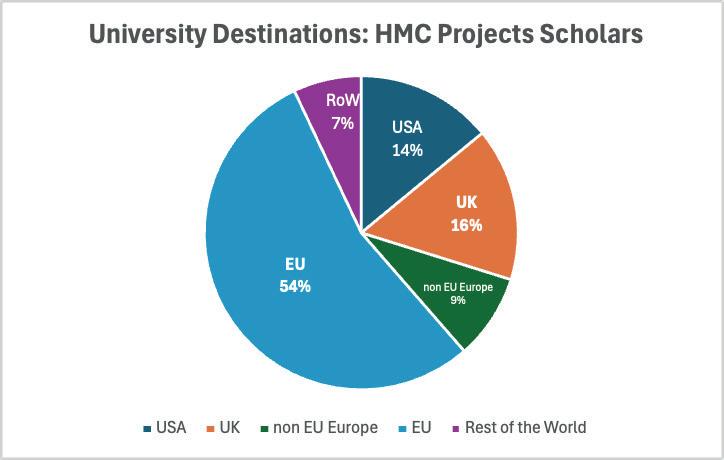
schools who have taken on HMC Projects scholars in the September 2026 cohort. Is that nancial investment, and the educational and pastoral time and e ort which goes with that engagement, worth it? There is quantitative data which indicates that the HMC Projects scholars contribute very successfully to academic outcomes through their A Level (and IB) results. This is all the more impressive when one considers they have to adjust to so many new things – both academically and otherwise – in a very short space of time. The average UCAS score across the cohort in the period 2022-25 is 134.4 points, roughly AAB. Those countries with the best average scores, including Ukraine, are very close to AAA equivalence. Many individual scholars score straight As and A*s. Scholarship students’ higher education journeys are also very successful, if varied, post-Brexit, given most cannot a ord to study in the UK and require scholarships to continue to university. HMC Projects provide close support to scholars and schools for Higher Education decisions through pro bono work from The University Guys team, the founder of which, David Hawkins, is a trustee of the charity.
In human terms, it is a truly ful lling part of this role, as it is for all educators, to see those young scholars move forward on their journeys.
Qualitative contribution
The stories of Anna and Karolina included with this article are helpful in showing part of what the HMC Projects scholars can contribute academically to any school which welcomes them. However, the reality is that the qualitative contribution they make is so much greater than academic results, both in terms of intellectual enrichment and in creative, physical and other wider aspects of school life.
To make that point, a couple of extracts from school leaders who have this experience says much. One Head stated: “I’ve been fortunate to see at rst hand how the HMC Projects programme changes lives – not only the lives of the scholars but also of those around them, including mine. Inspiration comes in many forms, but to see young people so determined to make the most of their educational opportunity, despite having to operate in an entirely unfamiliar context, is truly motivating for everyone around them. In wider societal terms, the
To say I am happy would be an understatement.
promotion of values such as tolerance, mutual understanding and international collaboration has always been vital and is a key focus of this incredibly valuable programme which has now been running for over 30 years.”
Another Head was equally as warm: “HMC Projects has an enormous impact on the scholars who join us – not just academically, but socially and culturally, too. They are immersed in British schools, discovering new ways of learning and thinking. They make friends for life, too. But it is not only the scholars themselves who bene t; their peers are exposed to di erent cultures, languages and ways of thinking. So often the scholars, who are invariably incredibly determined and hardworking, inspire their contemporaries to think big and bold, too.
Teachers, too, have told me how inspiring they nd these young people – they are intellectually curious and ask searching questions, having a genuine interest in learning. The programme provides a springboard to university and beyond; instilling a quiet con dence in the recipients, which has led many to become leaders not only back in their own country, but in the UK and around the world.”
The HMC Projects scholars recognise the true value of what they have been given by the schools they join and are invariably wholly committed to that partnership, giving back not just on the academic front, but also in such a wide variety of other ways whether that be through co-curricular involvement or simply by bringing di erent world views and perspectives to broaden insight and understanding of our world for all whose lives they touch.
REDUCING CATERING COMPLEXITY WITHOUT COMPROMISING QUALITY
The ability of schools to deliver consistent, high-quality meals is increasingly under pressure. Rising costs, tightening budgets and sta shortages are making school catering one of the most operationally vulnerable parts of the school day – impacting on meal uptake and, ultimately, pupil health and wellbeing.
Traditional catering models can be demanding, requiring skilled kitchen sta time-intensive preparation and complex procurement processes, all while meeting strict nutritional standards and supporting varied dietary needs. This leads to mealtimes becoming vulnerable to disruption when sta ng levels uctuate.
Our State of the Nation Report, launched in partnership with ISA in 2025, found that 70% of schools identi ed labour shortages as a key challenge, with 40% reporting a direct impact on their catering operations.
Given the crucial role that school meals play in
supporting pupils and giving them the fuel needed for learning, these challenges pose a signi cant concern.
Rather than adapting around growing complexity, many schools are now rethinking how their catering is delivered and seeking approaches that reduce operational strain whilst protecting the quality of food and nutritional standards.
Simpli ed catering solutions, such as utilising pre-prepared meal o erings, are increasingly emerging as a practical solution. By removing labour-intensive preparation and streamlining kitchen processes, these models can signi cantly reduce day-to-day pressures while maintaining consistency and compliance. This not only supports more e cient operations but also builds resilience and enables schools to continue delivering high-quality meals even during periods of sta shortage or absence.
The bene ts extend beyond the kitchen. A more streamlined approach can
reduce the need to redeploy teaching or support sta into catering roles, helping schools maintain focus on their core priority: supporting pupils.
Importantly, simplifying operations does not mean compromising on quality. With the right approach, schools can continue to provide nutritious, appealing meals without carrying the full burden of complex inhouse production.
In practice, this shift is already delivering tangible results. For example, utilising apetito’s pre-prepared provision reduces schools sta ng requirements by up to 50%, while still delivering nutritious meals that pupils enjoy. By removing the reliance on skilled chefs and reducing operational complexity, schools are better protected from labour market volatility and can ensure
As pressures on school catering continue to grow, simplifying catering operations will be essential to maintaining both nutritional standards and pupil wellbeing.
At apetito, our expert chefs, dietitians and nutritionists have developed a huge range of delicious, nutritious meals for schools to choose from, and our dedicated team are on hand to guide you through every step, from menu planning to sta training. ●
To learn more about apetito’s service, please visit apetito.link/ISMP greater consistency in their catering o er.
Student voices
Gratitude, recognition and commitment shines brightly in the feedback I receive from applicants who have been o ered scholarships. I am sharing a few such responses, and remember behind these words are young lives full of hope and aspiration, often coming from very challenging contexts.
A scholar from Ukraine said: “I am writing to you with gratitude and I am honestly overwhelmed with emotion. To say I am happy would be an understatement. Since the very beginning of this journey, I have dreamed of such an opportunity, but seeing it become a reality feels like a miracle. After researching my new school, I realised it is an absolute perfect match for me. Its atmosphere, traditions and values are exactly what I have always searched for… I truly believe that this experience will change my life forever, and I am incredibly grateful for this chance to grow, learn and represent Ukraine in such a distinguished environment…Thank you for making my dream come true. “
A scholar from Romania writes: “I would like to express my sincere gratitude for the opportunity to be part of the HMC Projects scholarship programme. I am deeply thankful for the confidence placed in me and for the guidance provided throughout the application process. It was a genuine pleasure to take part in the selection process. In addition to being academically stimulating, it offered me valuable insight into the principles that lie at the heart of the programme, such as dedication and intellectual openness.
“I hope to uphold these qualities as I continue my education and shape my future decisions…Thank you once again for this exceptional opportunity and for the commitment you and your colleagues show in supporting students across Central and Eastern Europe. I am truly grateful and look forward to beginning this next chapter of life.”
Of course these expressions of commitment are understandable in
the excitement of receiving the o er of such an opportunity. The fact is that those who then take up their scholarships do ful l those promises.
Giving back
As a historian, I am a lover of stories; especially those which are based on
historical facts and realities. Over the years, HMC Projects alumni have gone on to do many amazing things. The Moldovan Education Minister, Dan Perciun, is an alum of the HMC Projects programme, and a great supporter of the programme. Many others have given back their expertise and experience to their
Scholars’ Stories
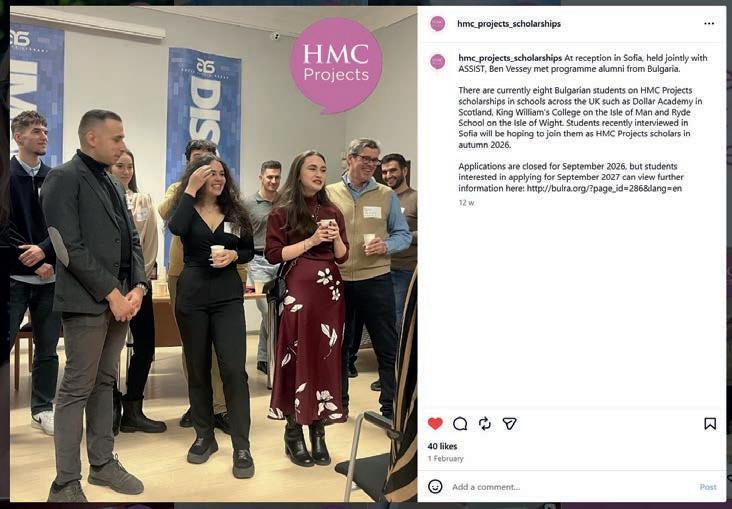
To provide some colour alongside the dry statistics, here are a couple of recent stories from HMC Projects’ Instagram showcasing a couple of our scholars’ achievements.
KAROLINA from Slovakia
Congratulations to HMC Projects Scholar Karolina from Slovakia who has been appointed as a Governor at Dollar Academy in Scotland. Karolina was awarded a HMC Projects scholarship in 2020 to study at Dollar Academy.
ANNA from Ukraine
Congratulations to HMC Projects scholar Anna, who will be studying at Dartmouth College, USA, next academic year.
Anna from Ukraine, who is currently studying at Frensham Heights School, is planning to major in lm & media studies and economics.
Regarding the HMC Projects scholarship opportunity, Anna says: “Little can be achieved without genuine dedication, but some opportunities really do change the direction of your life. I am so grateful to HMC Projects for giving me the chance to study in the UK and for opening doors I once could only dream of. This scholarship has meant more to me than I can fully put into words, and it is something I will never take for granted. More than anything, it has taught me how important it is to use every opportunity wisely and with a purpose beyond myself.”
Karolina says, “My two years at Dollar were lovely, although we spent half of the time in lockdown (2020-2022). It allowed me to get to know pupils in the boarding house and then explore activities o ered by Dollar Academy when the school opened, such as the musical, sur ng or alpaca clubs – something I would not be able to do in my school in Slovakia.
“Being appointed into the Board of Governors brings a unique opportunity to represent the pupils as a recent graduate with the addition of personal growth and knowledge. Being back at Dollar means so much to me and brings back all the good memories.”
At the end of her studies at Dollar Academy, Karolina was awarded the Rector’s Medal for her fundraising e orts, totalling over £2,300 for a humanitarian charity in Ukraine at the start of the con ict.
Karolina is currently in the last year of her architecture undergraduate studies at the University of Edinburgh, hoping to pursue a career in architecture and urban design.
own countries. On my recent travels to the region I was so fortunate to meet a number of truly impressive young people who are making a real di erence in so many ways.
The HMC Projects scholars are changemakers and they have had an impact around the world as a consequence of the opportunity the programme has given them.
In a recent exchange, one alum said: “The HMC Projects programme has been truly life changing for me – and it’s not a hyperbole. After Headington, I studied at UCL and nished with a Master’s in theoretical physics. I have been living in the US (in San Francisco) over the past 10 years, working as a data scientist for a number of Silicon Valley companies.”
Turning on the light
I will close by sharing the thoughts of the country co-ordinator in Moldova who sums up the value and bene t of the HMC Projects programme beautifully: “At its heart, the programme recognises a simple truth: education must go beyond information – it must inspire.
“This is, in many ways, the essence of HMC Projects – an initiative that, over generations, has encouraged young people to broaden their perspectives, strengthen their sense of self, and
engage more con dently with the world around them.
“There often comes a quiet but de ning moment – when a student begins to trust their voice, to feel capable, to imagine more. Uncertainty gives way to curiosity, and the world begins to feel less overwhelming, more open. Many students describe it simply: ‘It felt like someone turned on a light inside me’. Once that light is on, it builds con dence, strengthens identity, and nurtures a lasting sense of purpose.
Both Rachel Owens (our Chair of Trustees) and I very much hope that more schools will consider making an o er of a place (or places) for scholars on a full scholarship or, if that is not possible, then at least a reduced fee (partial) scholarship, for the autumn term of 2026. Put simply, in the case of a full scholarship, the tuition and boarding fees are waived entirely by the school. Those students eligible for a full scholarship have to show a combined family net income of £30k or less per annum. For a reduced fee scholarship these fees are normally reduced by between 75% and 90% to make them a ordable to applicants whose combined family net income is between £30k-50k per annum. Many schools involved combine both full scholarship and reduced fee o ers as a package.
You can sign up to our Instagram account via the link below which shares stories of some experiences and many achievements of current and recent HMC Projects scholars.
‘Action this day’ as Winston Churchill
… it is not only the scholars themselves who bene t their peers are exposed to different cultures, languages and ways of thinking.
“This is the di erence HMC Projects scholarships make. They do not simply inform – they shape outlooks, attitudes and aspirations. They encourage young people to move beyond hesitation and recognise their capacity to contribute meaningfully to the world.”
Embrace the opportunity
I hope you have found this piece uplifting and engaging on a number of levels. Thank you so much to those schools which have supported HMC Projects over the years,:it would be splendid if others are tempted to embrace this wonderful opportunity to enrich their school communities by welcoming HMC Projects scholars in the future.
used to state in bold red writing to those with whom he worked as he sought to exhort them to make a di erence. Should you wish to know more about the programme and how to get involved, please do contact me on director@ hmcprojects.org.uk and we can arrange to talk about how the programme works in more detail. ●
BEN VESSEY is Director of HMC Projects. He was formerly Head of Canford. director@hmcprojects. org.uk; instagram.com/hmc_ projects_scholarships
MUSIC EDUCATION
A POINT OF DIFFERENTIATION
Music is one of the great features of an independent school education, building a sense of community and providing students with an opportunity not only to perform but also engage with other musicians. Andrew Lewer investigates.
From HMC Chair Philip Britton’s staunch advocacy of the English sacred choral tradition attaining UNESCO Living Heritage status to Warwick Schools Foundation’s hosting of this year’s Music Teachers’ Association Conference, support and advocacy for music at the highest level of the independent education sector is plain for all to see.
The President of the Cathedral Music Trust, Harry Christophers CBE, states: “…to gain UNESCO Living Heritage recognition would ensure that the music, both written in the past and the present, continues to be celebrated and sustained for centuries to come, alongside the many choirs, organists, directors of music and all who make this world-class tradition possible in their pursuit of excellence.” This statement, I believe, makes it clear how indispensable a vibrant independent school sector is to the chances of a successful bid.
Similarly, the Music Teachers’ Association holding their conference at
the Warwick Schools Foundation shows how vital to their work the independent education sector is, not least given the very special and indeed ‘independent’ nature of music tutors within the educational ecosystem.
Quality and quantity
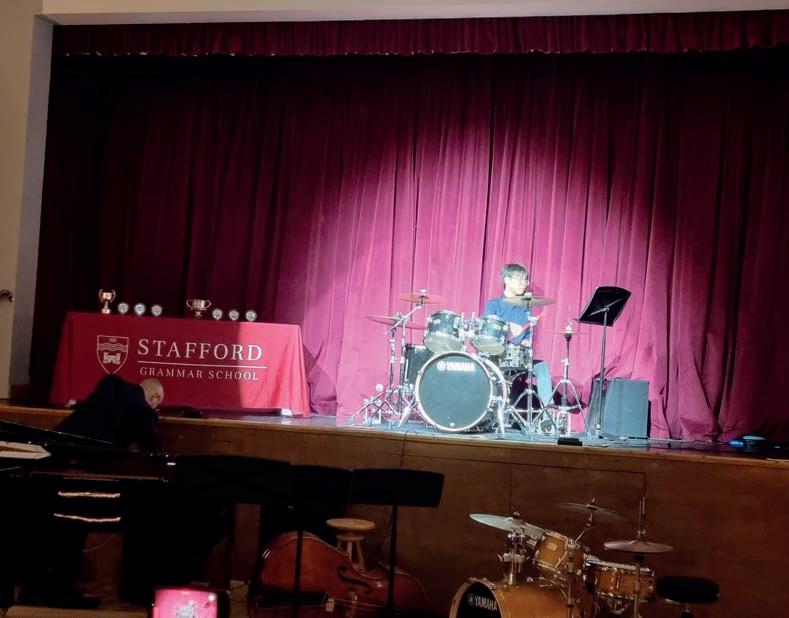
The sheer quantity as well as quality of music education which our sector undertakes never ceases to amaze. For example, Sta ord Grammar School – a smaller school with fewer than 400 pupils – o ers, every single week, 200+ individual music lessons, 20+ ensemble rehearsals and 20+ di erent instruments being mastered, leading to over 100 successful music exams annually, plus over 40 concerts a year and national awards for performing arts.
some common themes there are some particularly exciting ‘ri s’ in certain schools that bring the statistics about music education and performance to life.
Music and learning challenges
At More House School in Frensham, music education is central to their work with SEND learners, allowing for connections across learning challenges that lead to remarkable results.
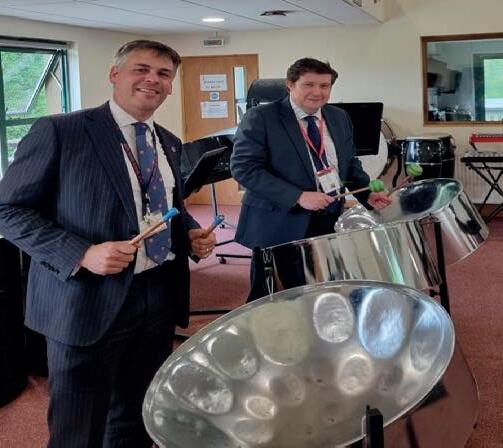
Over the past 20 years, music has come to be at the heart of the work the school does with the boys. The More House Steelpan Band is particularly well known and it – together with the school’s jazz band – are now vital parts of the Frensham Village Fayre. As More House School music teacher Elizabeth
I saw the power of whole-class singing …
Of course, many independent schools across the country could demonstrate such wonderful output. However, just like a great jazz recording, within
Hetherington put it recently: “As music teachers, we are given exclusive insights into the world of a SEND learner. Music is a universal language and can and should be a way to connect with some of our most challenged and challenging pupils. SEND learners really need to trust… and time should be spent nurturing the relationship between teacher and pupil.”
Deeper appreciation
A tradition of powerful academic and sporting prowess over many decades at Repton School is now being enhanced and strengthened by a growing reputation for musical excellence under the Director of Music, Katie Staggs. Well-established symphony orchestras, chamber ensembles, brass and jazz bands are now being bolstered by programmes to broaden access. This allows those for whom music may not be their main focus to nevertheless participate, with gospel, pop, musical theatre and a fusion of multiple genres all featuring.
An example of how this has drawn pupils into a deeper appreciation of music was the way in which the complex harmonies needed in the school’s production of ‘Sister Act’ were rendered even more meaningful when a performance of those gospel songs took place in Repton’s church, with its incredible eighth-century origins.
Repton’s musical output has helped the school to connect with the local community, such as with the recent performance of ‘Messiah’, involving pupils, sta and many local residents and choir members. Repton has also drawn in ‘ORs’ (Old Reptonians) through their musical output and touring activities. Repton has a very sophisticated development function, and so it is natural that the opportunity to involve alumni has formed part of the thinking around the school’s wider musical activity.
Fugues and plainchant
– a practical, creative subject but also a humanity, a study of where we have come from and where we are going as a civilisation. ” This is a vision which aligns with the breadth and inclusivity of what is o ered at Stamford, including a strong emphasis on classroom singing and participation.
Classroom singing
Over at Stamford there are similar themes – but with their own ri s – to be seen under the direction of Alex Osiatynski, the school’s hugely experienced and thoughtful Director of Music.
While most independent schools pride themselves on a broad music o er, at Stamford this extends to fugues and plainchant – as well as blues, pop and classical. The technical support work and creative processes around music are equally important at Stamford, ful lling Alex’s compelling vision that music can be “both a skill and a cultural artefact
Making music – and singing in particular – part of daily life at school prevents the build-up of any sense of embarrassment among young people about participating, which is no trivial issue for the age group. Classroom singing is one of the best examples of just how central music is to the mission of high-quality education, fostering a sense of being part of a team where the sum is greater than the parts. What more profound a lesson could there be?
I saw the power of whole-class singing when I visited Heritage School in Cambridge recently and it is clear to me that it is something many other schools would bene t from.
Fostering talent
Team building through music starts right away at Dean Close School where the ‘House Shout’ in September sees newly arrived pupils join with their peers in song, creating a sense of common purpose and, literally, a sense of harmony. Here again is a good example of a school o ering both breadth and depth. In this instance the depth extends to the worldrenowned Carducci Quartet leading the school’s strings department, which I viewed recently with Director of External
Relations – and musician! – Dominic Neville. No wonder, therefore, that pupils go on to perform in some of the greatest of orchestras and ensembles.
The School makes impressive use of the talent it fosters to work with other local schools, with a particular highlight being the ‘Singing From The Same Hymn Sheet’ event, featuring 175 children learning and performing together in the School Chapel. A notable feature of Dean Close’s music work is its close relationship with Tewksbury Abbey. This in many respects echoes the relationship between cathedral schools and their cathedrals, but without some of the potential – small ‘p’ –political and bureaucratic complications – not to mention the challenging hours and dates (Christmas and Easter etc.) that a school providing a cathedral choir must contend with.
Resilience
Nevertheless, schools draw strength from their cathedral connections. At Lich eld Cathedral School, the resilience of the choristers – both in terms of the hours when they must perform and the high-level choral skills they develop at an early age – is an example to the
Good music provision is expensive and thus under pressure, but it ought to be one of the very last things any school looking to survive and indeed thrive should compromise upon.
rest of the school. (On Ascension Day, for example, the choristers were singing in the Cathedral just after 7am and again just before 6pm, with a school day in-between!)
There is a strong culture of experimentation in music teaching at Lich eld, leading to a high level of takeup of some of the less ‘popular’ instruments. Equally, there are plenty of opportunities to study the technical aspects of musical production and to gain practical experience. Headteacher Susan Hannam has been keen to support community outreach through music. In Lich eld’s case, this takes the form of ‘MusicShare’. This programme is a joint e ort between the School, the Cathedral itself and The Music Partnership (Sta ordshire), which ‘teaches the teachers’ in group singing techniques at up to 150 schools around the West Midlands. This culminates in a mass choir performance (with the School’s choristers to the fore) at either Lich eld Cathedral or another large venue.
A phoenix and rare beasts!
The last, but by no means least, of the super six schools I have used for ri s on the theme of musical educational excellence is May eld School in East Sussex. Director of Music Theo Frazer has built upon the established strong musical foundations at the School to ensure that the proven neuro-scienti c bene ts of music learning are experienced by every girl at the school. To that end, he has created the Pheonix Orchestra to complement, not supplant, the existing elite performer orchestra. This means that those who just want to experience the thrill of being part of an orchestra performance can do so without it having to be their central school activity. Ensuring less popular instruments are taken up comes through the ‘rare beast’ programme. May eld School’s performances, as we have witnessed elsewhere, facilitate engagement with ‘Old Cornelians’ (old girls of May eld School) and the local community, notably via the famous biennial May eld Festival, the summer open house ‘Come & Sing’ event and
the Orchestral Day. All of them draw in children from both local state schools and feeder prep schools.
The co-curricular o ering of independent schools is regarded by many as the deciding factor in many parents’ decision to spend their money on an independent education. It also strongly in uences which school they go on to choose. Music is clearly at the heart of many of those decisions.
The appeal of music
Music’s appeal is to be seen in the decision of Hereford, Worcester and Gloucester to launch their new independent school partnership as the ‘Three Choirs School Group’. It is illustrated by the six case study schools featured in this article. Good music provision is expensive and thus under pressure, but it ought to be one of the very last things any school looking to survive and indeed thrive should compromise upon. ●
ANDREW LEWER MBE is an independent school governor and works with a number of independent education businesses. As an MP, he founded the AllParty Parliamentary Group for Independent Education 2017-24.
– IN CONVERSATION WITH –JEANETTE COCHRANE
A Damascene moment
Four months into her role as Chief Executive O cer of the Girls’ Schools Association, Jeanette Cochrane is brimming with the kind of enthusiasm that comes with knowing you’re in exactly the right place at the right time.
She describes her initial reaction to the advertised role of CEO as ‘a Damascene moment’:
“I trained in a girls’ school in Belfast. I have worked in co-ed throughout my career in high-performing co-ed schools, notably Sir Henry Floyd Grammar School from 2010 to 2023. As a Head Teacher, I was always comparing where our girls’ results were in contrast to girls in all-girls’ schools. After completing my MBA in Executive Leadership I was looking to ful l a CEO role. As a woman, as someone who has always been conscious of empowering girls and being a really strong female role model for the girls in my schools, I’ve always worked to empower
Zoe MacDougall talks to Jeanette Cochrane, the new CEO of the GSA, about the value and importance of an all-girls’ education as a continuing option for parents with daughters and explains the support which her Association provides to its member schools.
female leaders. When I saw a job like this one, I couldn’t resist applying. When I got it, there were some signi cant tears of happiness shed.”
A single-sex choice in the national educational landscape
Representing girls-only education in both the maintained and independent school sectors, Jeanette feels that GSA schools are “a crucial part of the educational landscape”. She explains the importance of a girls’ single-sex o er nation-wide: “The element of choice for girls-only education is really strong. I’ve been in post for four months and I’ve been visiting our schools and seeing what they do on the ground. When you look at what girls’ schools do, to take that choice away from girls and their parents would be a travesty. I really believe that the o er in girls’ schools is so strong for girls, particularly today, that it’s a crucial part of the educational landscape.”
The joys of girls’ schools
The GSA’s role as an advocate for girls-only education is something that Jeanette embraces with joy. She’s delighted to share her insights from recent school visits: “Spending all my time visiting girls’ schools at the moment, the climate for learning that I see is absolutely exemplary. The way that teachers engage students because they are speci cally designing their curriculum for those girls, at their stage, not constrained by age boundaries, is inspiring. I was in a Year 3 classroom last week where they were
conducting science experiments, dissecting owers and looking at photosynthesis. That’s phenomenal. I’m not a scientist, but I was blown away. It shows what you can do when you have the independence to do it.
“I visited Oxford High School GDST last week and the Year 9 students were as eloquent and informed as many Sixth Formers that I’ve met. I was also at Headington Rye School, speaking to a Sixth Former in the Head Girl team. Her range of subjects showed a real lack of constraint – English Literature, Maths, Economics and Music. The breadth of the o er in our schools allows girls to follow their passions without the limitations of social bias about subject choices. Sixth Formers have also talked to me about seeking careers with a social purpose, such as in sustainable economics.
“GSA schools have completely smashed the gender gap in sciences and STEM subjects for girls. These are girls who know what the real world is. They don’t exist in a girls-only vacuum but are shaped by a curriculum that’s designed especially for them. That’s so powerful. The results speak for themselves.”
The bene ts of GSA membership
Membership of the GSA is open to all girls-only schools in the UK. Jeanette explains the bene ts to members: “We are a membership organisation, working primarily with heads and senior leadership. We keep our members abreast of Department for Education consultations, making sure they have their voices heard. We’ll also represent our members by responding to consultations ourselves. We’ve recently had a review of Independent School Standards and we did an analysis for our members of the di erences being presented. We did an inspection update from this. We make sure our members are kept informed about what’s happening on the national landscape. We provide networking opportunities and we have regional committee meetings where we share best practice.
“Member schools bene t from what we provide. Last week, we were running a Deputy Heads and Senior Leadership conference, preparing future school leaders for the complex role of headship. We talked about nance, marketing, the nuts and bolts of what you actually need to know to run a school –something which isn’t part of the NPQH. We talked about what it’s like to be an interim Head, a role which Deputy Heads can be asked to step into.
“Some of our cluster groups are for support sta in schools. We have an admissions group and an inclusion group.
“We also o er opportunities to shine a light on the brilliant work that the girls can do. Our writing competition has just closed; I’m really excited to read some of those entries. We had a football competition recently. There are lots of national competitions for girls in our girls’ schools.”
And there’s more. The GSA Go Bold events programme is designed to ignite courage and curiosity in girls, who can look forward to opportunities to engage in the Girls’ Human Rights Hub summer programmes and a Kickstart Your Career in Accountancy event in the near future, in partnership with Moore Kingston Smith.
GSA research is another key bene t for members. Recent publications include The Academic Attainment and Representation of Girls in Stem, March 2026; Girls’ Schools and Positive Post-16 Destinations, December 2025; and Sport Participation in Girls’ Schools, November 2024. The GSA Research Library also gathers together reports from other sources, providing data, analysis and insights in the eld of girls-only education.
Girls’ Schools Association
The GSA is a membership organisation, made up of senior leadership in all-girls’ schools in the state and independent sectors across the UK.
Founded in 1874 by Francis Mary Buss and Dorothea Beale, its pioneering purpose was to ensure that education for girls included the full range of academic subjects, from Maths and Physics to Latin and Greek, hitherto only available to their brothers. Today, GSA schools educate and inspire over 90,000 students across 127 settings, from Nursery to Sixth Form.
Jeanette Cochrane is Chief Executive O cer of the GSA.
Partnerships
The GSA works alongside other member associations in the educational landscape, in the UK and beyond.
Jeanette highlights some of the GSA’s collaborative work: “All the Girls’ Day School Trust (GDST) schools are members of the GSA and all the chief executive o cers of membership associations such as us are part of the Independent Schools’ Council. One of our schools is hosting a Boarding Schools’ Association (BSA) event, which I’ll be attending next month. We recently had a conference for junior school Head Teachers with the Independent Schools’ Association.”
Globally, the GSA engages with the International Coalition of Girls’ Schools (ICGS), to whom Jeanette feels deeply connected: “We have many members in common and we share absolutely the same goals and values.” The 2026 ICGS Conference in Toronto, which Jeanette attended, provided fascinating opportunities for learning, sharing and networking through pre-conference workshops, exceptional presentations from keynote speakers and passionate debate in structured break-out sessions.
A challenge shared
school numbers, whilst SEND provision is struggling to nd funding, despite impending changes to its organisation and administration. The independent school sector is facing up to closures in the era of VAT on school fees and there is a trajectory of girlsonly schools merging to become co-ed due to nancial pressures.
Jeanette “mourns the loss of any girls’ school” and sums up what she sees as the immediate challenges in the national educational landscape: “I’d say there are signi cant factors at the moment which all schools are grappling with. Finances are a complex issue – it’s a huge challenge for all schools to do more with less.
Then, educating children to navigate AI and mis-information is going to require curriculum development. And in girls’ schools, in particular, we’re also preparing girls for work that has a social conscience, where they feel that they can make a di erence. That’s an important element of their future job satisfaction.”
The national press leaves us with no doubt that education across all sectors faces economic and societal threats. The falling birth rate is a ecting prep
In a rapidly changing world, where decisions need to be made about questions that school leaders haven’t previously needed to ask so intently, perhaps there really is safety in numbers. The GSA provides a platform for knowledge, a forum for debate and a supportive umbrella under which leaders in girls-only education can come together. Jeanette is excited to drive this agenda forward. ●
is an educational commentator with extensive teaching experience in both the maintained and independent school sectors.
ZOE MACDOUGALL
WHAT HAPPENS TO IT WHEN SCHOOLS ARE INTEGRATED? ARE
School mergers, acquisitions, and group expansion are a familiar part of the independent school landscape. While the strategic and nancial considerations often take centre stage, the technology implications can be just as signi cant.
Bringing schools together means far more than connecting networks. Di erent management information systems, cloud platforms, cybersecurity controls, reporting structures, and operational processes must be aligned without disrupting teaching, administration, or the wider school community.
For leadership teams, the challenge is maintaining continuity while building a technology environment that can support future growth. Decisions made during integration often have long-term
consequences for e ciency, security, compliance, and the overall experience of sta , pupils, and parents.
This is where strategic technology leadership becomes essential.
MSP LAB works exclusively with independent schools, providing executive-level technology leadership through its Retained Counsel and Virtual IT Director services. Acting as a trusted advisor to bursars, senior leaders, governors, and IT teams, MSP LAB helps schools navigate periods of signi cant change while ensuring technology remains aligned with institutional objectives.
A recent example is MSP LAB’s work is with Rugby School Group during a period of growth and acquisition. As multiple sites and systems were brought together, MSP LAB worked alongside Pieter van der Walt, Director of IT, to assess the existing technology landscape, identify risks and opportunities, and develop a roadmap for centralising infrastructure in a secure, scalable, and e cient way.
The result has been a clearer understanding of the group’s technology estate, stronger governance, and a strategic
foundation capable of supporting continued expansion.
Similar support has been provided across the sector. At Eton College, MSP LAB delivered interim IT leadership during a leadership transition, maintaining stability and momentum at a critical time. At Exeter School, MSP LAB acted as Virtual IT Director before supporting the recruitment of a permanent Head of IT. Many engagements, including work with Marlborough College, have developed into long-term strategic partnerships. Periods of organisational change inevitably create complexity. The schools that navigate them most successfully are those that treat technology as a strategic enabler rather than simply an operational function.
As mergers, acquisitions, and leadership transitions become more common across the sector, ensuring the right technology leadership is in place can make the di erence between disruption and sustainable growth.
MSP LAB - The IT Authority for Independent Schools Retained Counsel | Virtual IT Director | Digital Strategy | Strategic Projects | Cyber Security | IT Discovery Assessments ●
Join the MSP LAB Community for expert insights, sector discussions, customer success stories, and exclusive events for independent school leaders.
THE NEW RECRUITMENT REALITY
Louise Brenlund explores the practical implications of the changes to recruitment practices recommended following the recent employment rights legislation.
With e ect from 1 January 2027, the Employment Rights Act 2025 (ERA 2025) reduces the qualifying period for unfair dismissal claims from two years to six months. In addition, the statutory cap on unfair dismissal compensation will be removed, meaning there is no limit on the compensatory awards that tribunals may make. This is expected to generate approximately 3,000 additional tribunal claims per year, representing the largest expected impact on the tribunal system of any measure in the ERA 2025. This fundamental change requires independent schools to adopt more rigorous interview and recruitment processes, ensuring discriminatory practices are avoided and appropriate documentation is maintained in order to minimise the risk of getting employment decisions wrong in the rst instance, and thereby face potentially costly claims with unlimited compensation. Adherence will ensure that you put yourselves in the best position to defend a claim.
Implications for probationary periods
This fundamental change requires independent schools to adopt more rigorous interview and recruitment processes...
This is likely to have signi cant implications for probationary periods. If you use a standard six-month probation period for senior leaders or other management, then, at the end of that period, if an employee is deemed not to have met the relevant requirements of the role, they will have already gained unfair dismissal rights. Therefore, you will need to build into your processes su cient time to assess performance throughout the probationary period and, if necessary, complete the end-ofprobation process, for any dismissal to take e ect before the employee gains unfair dismissal rights. Schools should bear in mind the statutory minimum one-week notice period for sta with less than two years' service. Where
no notice is given or a payment in lieu of notice is made, this must be added onto the date of dismissal which will extend the e ective date of termination for the purposes of calculating qualifying service. This means that an employer cannot dismiss in the last week of the rst six months of employment to try to circumvent the employee gaining unfair dismissal rights as, in those circumstances, they still would.
It is important to ensure that regular reviews take place during the probationary period with a clear record held of the last date by which you may be able to dismiss before unfair dismissal rights are gained.
Avoiding discrimination during the interview process
The Equality Act 2010 (EqA 2010) prohibits discrimination and harassment in relation to nine protected characteristics: age, disability, gender reassignment, marriage
Practical Recommendations
Schools should: Review and update their recruitment policies and procedures in advance of 1 January 2027. This may include reducing standard probationary periods to allow su cient time for assessment and, if necessary, dismissal before the six-month unfair dismissal qualifying period is reached.
Ensure interview panels receive comprehensive training on equality law, unconscious bias and the speci c requirements of the EqA 2010 All interviewers must understand that interview questions should be prepared in advance and be based on the job description and person speci cation. They must also recognise that the same core questions should be asked of all candidates using a structured format with objective scoring criteria.
Establish clear policies regarding the retention and secure destruction of DBS information and other recruitment documentation, balancing the need to defend potential claims with data protection obligations.
Put in place clear documentation practices that create an objective paper trail demonstrating nondiscriminatory decision-making throughout the recruitment process while being mindful that all interview notes and scoring sheets may be disclosed in tribunal proceedings.
and civil partnership, pregnancy and maternity, race, religion or belief, sex, and sexual orientation.
An interview is likely to be the decisive stage of the selection process but also the stage when it is easiest to make judgements about a candidate. If assumptions about the capabilities or characteristics of individuals with a protected characteristic are made, this could lead to an unlawful discriminatory selection decision.
Training for interview panels
Our schools should ensure that sta undertaking interviews and selection are trained in any appropriate policies such as equality and recruitment and are familiar with the EHRC EqA 2010 Code of Practice which must be considered by tribunals and courts where relevant. The right training will ensure that sta can recognise when they are at risk of making stereotypical assumptions about people and apply a scoring method objectively based on prepared questions grounded in the person speci cation, the job description and the information provided in a candidate's application form or CV. This in turn will help them to avoid questions
that are not relevant to the requirements of the job.
Schools have a duty to ensure recruitment follows the processes of ‘safer recruitment’…
It is important to be clear to avoid questions at interview that could relate directly to protected characteristics, such as about childcare arrangements, living arrangements or plans to get married or to have children. Where such information is volunteered, selectors should take particular care not to allow themselves to be in uenced by that information. In Corus Hotels Plc v Woodward and another UKEAT/0536/05, the employer was ordered to pay £4,000 for injury to feelings to a prospective female employee based on questions at interview which implied that she would not be able to hold down the job because she had children, nding the interview had been conducted in a ‘crassly sexist manner’.
Training is also part of ensuring
that you can rely on the ‘reasonable steps’ defence if a job applicant argues that you are vicariously liable for the discriminatory conduct of those responsible for carrying out the exercise. Training should be given on an ongoing basis. Schools should review the training records of those involved in a recruitment exercise and, where necessary, provide refresher training before the exercise begins.
Safeguarding and DBS checks
Schools have a duty to ensure recruitment follows the processes of ‘safer recruitment’ set out in KCSIE. This includes verifying identity and ensuring that all members of sta in regulated activity have received an enhanced DBS and barred list check before their appointment is con rmed or as soon as is practically possible following their appointment.
Pre-appointment checks should be recorded on the single central record; for independent schools this includes all members of the proprietor body. You should remove details of an individual from the SCR once they leave the school.
Those involved in recruiting must have had appropriate safer recruitment training, the substance of which should, as a minimum, cover the content of part three of KCSIE. Any decision not to appoint because of a conviction should be clearly documented and be in line with school policy. The explanation from the applicant should be taken into consideration.
Information about criminal convictions collected during the recruitment process should be deleted once it has been veri ed, with a record only of whether the result of the check was satisfactory or unsatisfactory. DBS certi cates should not usually be kept for longer than six months. In exceptional circumstances, the information can be kept on le where it is relevant to an ongoing employment relationship.
Creating a paper trail
Schools should ensure that they document the recruitment process so that there is a paper trail in the event of any complaint, data subject access request or litigation. It should be remembered that these documents, which should re ect the decisionmaking process in relation to the particular applicant, will be disclosed in any tribunal proceedings and consequently they should be written clearly and objectively.
Your records should assist you to justify each decision and the process by which it was reached. They should show that decisions were based on objective evidence of the candidate's ability to do the job satisfactorily and meet the relevant job and person speci cations, and not on assumptions or prejudices about the capabilities of certain groups of people sharing protected characteristics. During interviews, managers may scribble down handwritten notes or observations on interview papers, often giving little thought to what they are writing. These annotated papers will be subject to disclosure in the event of litigation and, as a result, managers should generally be discouraged from informal annotation of interview papers.
Data protection considerations
Schools must not keep information for longer than they need to. Data protection law does not specify timescales for keeping recruitment records so you should
… managers should generally be discouraged from informal annotation of interview papers.
carefully consider how long you need to keep this information; usually periods will be set out in a retention policy.
Retaining recruitment records may be necessary in case a school needs to defend itself against claims of discrimination or other legal actions arising from recruitment. While statutory limitation periods in place for bringing claims vary, the possibility that a person may bring a legal claim does not mean that recruitment records must be kept inde nitely. In general, schools should not keep information beyond the statutory period in which a claim can potentially be brought, usually no longer than six years following termination.
Once a recruitment process has been concluded and an appointment has been made, it is unlikely that an employer will need to keep all of information it has acquired for the purposes of recruitment and selection. An employer may need to keep some details about the successful candidate and must carefully select what information is needed for the employment relationship. Information that is no longer relevant once the candidate becomes an employee must be securely destroyed in accordance with the employer's retention and disposal policy. However, if records about any of the candidates are destroyed too quickly, it may be more di cult for the employer to prove that its end-to-end process is transparent, fair and accountable. ●
LOUISE
BRENLUND
is a Partner and Head of Employment at Warners Solicitors.
A MARKET RESET? THE IMPORTANCE OF STRATEGIC VISION
Charley Torr explores the key building blocks underpinning successful school marketing strategies in the current operating climate and identifies tools and systems schools should be considering wrapping into their budget planning for the year ahead to support delivery.
The independent school sector is entering a period of signi cant structural change. Demographic contraction, rising operational costs, increased parental price sensitivity and heightened competition are reshaping the landscape rapidly. In this environment, simply ‘doing more marketing’ is no longer enough. Schools that thrive are likely to be those operating with strategic clarity, organisational alignment, robust systems and a clear focus on demonstrating value.
Marketing departments must therefore evolve beyond communications functions into strategic growth operations, with a carefully considered budget and robust supplier relationships to ensure they have the resources and tools required to succeed.
The shift from activity to strategy
One of the greatest risks facing schools currently is confusing marketing activity
with strategic progress. Posting regularly on social media, holding Open Days, redesigning brochures or increasing advertising spend may create visible activity, but without a clear strategic framework these e orts can become fragmented, reactive and di cult to measure. The schools gaining traction are those asking more fundamental questions around audience, positioning, value, budget allocation and measurable success.
Increasingly, marketing leaders operate at board and executive level, contributing to organisational strategy, nancial sustainability and long-term positioning, not simply communications output. The most e ective marketing strategies now sit at the intersection of brand, admissions, retention, customer experience, commercial development and data intelligence.
Retention strategy: The most important recruitment tool
Historically, many schools have focused heavily on acquisition: attracting new enquiries, increasing website tra c and generating leads. However, in a more competitive and nancially pressurised market, student retention is becoming one of the most commercially important strategic priorities.
Every pupil retained protects future fee income, stabilises community con dence and reduces pressure on acquisition costs. Losing pupils unnecessarily has a signi cant nancial impact when viewed through the lens of customer lifetime value.
Ownerships of schools’ retention strategy, therefore, can no longer sit solely within pastoral or academic teams. It must become a whole-school strategic priority supported by marketing, admissions, leadership and operations.
Schools successfully retaining students are increasingly focusing on:
• strong transition management
• parent engagement and communication
• delivering an exceptional customer experience
• co-curricular di erentiation
• wellbeing and belonging
• personalised engagement
• demonstrating pupil outcomes and progress.
Importantly, retention is also closely linked to reputation. Parents who feel informed, valued and connected become advocates, referral sources and ambassadors for the school. In many ways, the strongest marketing strategy begins with delivering and communicating an exceptional experience to existing families.
Admissions and CRM systems: From enquiry handling to funnel optimisation
Many schools still operate with fragmented enquiry processes, inconsistent follow-up and limited visibility across the admissions funnel. In a market where enquiries may be harder won and parental decision-making cycles longer, this creates major commercial risk. Schools must now think much more strategically about admissions and customer relationship management (CRM). The admissions funnel should not simply be viewed as an operational process, but as a conversion ecosystem requiring data, personalisation and continuous optimisation. The deployment of the most appropriate CRM system and excellent supplier relationships are crucial.
Key issues school marketing teams should be examining could include: how quickly enquiries are responded to; where prospects are dropping out of the funnel; the percentage of visits which convert to registrations; the marketing channels which deliver the strongest conversion rates; the cost per enrolment and whether retention is being tracked alongside acquisition.
Schools with e ective CRM and admissions processes are able to maximise opportunities from existing demand rather than simply spending more to generate additional enquiries.
• Are we articulating student outcomes clearly enough?
• Is our proposition future-focused?
• Are we truly delivering what we say ‘on the tin’?
Successful schools are increasingly building clearer narratives around:
Brand strategy and value proposition: Clarity matters more than ever
...simply ‘doing more marketing’ is no longer enough.
• automated yet personalised communication journeys
• timely follow-up processes
• Open Day conversion pathways
• taster experiences and ‘school in action’ events
• lead scoring and segmentation
• ‘parent behaviour’ tracking
• consistent reporting and pipeline visibility.
CRM systems are increasingly important in enabling this approach, giving schools better visibility over the full customer journey.
In an increasingly crowded and competitive market, schools often need to become much clearer about who they are and what they stand for. Some independent schools still rely on broad, generic messaging that could apply to almost any school: excellent pastoral care, strong academic outcomes, wide co-curricular provision and nurturing environments. While important, these messages alone are no longer enough to di erentiate one school from another. Parents are increasingly evaluating independent education through the lens of value, outcomes and future readiness, making strong brand strategy more important than ever.
Schools could usefully be asking:
• What is our genuine point of di erence?
• What emotional space do we occupy?
• What type of family are we best suited to?
• Does our messaging consistently re ect our reality?
• character development
• leadership and con dence
• future employability • holistic development • individual transformation
global outlook • innovation and adaptability
• belonging and community • pathways and destinations. Importantly, brand strategy must extend beyond visual identity. It should shape communications, admissions, sta culture, pupil experience and strategic decision-making. Emotional equity should also feature within brand guidelines, ensuring schools de ne not only how they look and sound, but how they want families to feel. Authenticity is critical. Parents are highly adept at identifying super cial marketing language. Schools that communicate with clarity, consistency and credibility are more likely to build trust.
Digital marketing: A videofirst, story-led approach
Digital marketing remains central to independent school recruitment, but audience expectations are evolving rapidly. Parents increasingly expect authentic, emotionally engaging and content-rich digital experiences. Static brochures and highly polished corporate messaging alone are losing effectiveness. Schools are therefore moving towards more agile, contentled and video-first strategies.
These can include:
• short-form video content
• day-in-the-life storytelling
Parents ultimately want to know whether their child will thrive within the school community.
• pupil and parent voices
• sta pro les
• classroom and co-curricular content
• behind-the-scenes authenticity
• student success stories and alumni outcomes
• thought leadership.
The most e ective campaigns communicate connection, warmth and lived experience. Parents ultimately want to know whether their child will thrive within the school community.
Alongside a content strategy, schools also need strong digital performance management.
This includes robust approaches to:
• SEO and discoverability
• paid social advertising
• Google advertising
• website conversion optimisation
• retargeting
• analytics and attribution
• landing page performance
• audience segmentation.
Digital marketing should now operate as a measurable growth engine rather than a standalone communications channel.
Strategic partnerships and community engagement
Another increasingly important strategic priority is wider engagement beyond the school gates. Schools operating in isolation may nd themselves more vulnerable in challenging markets. Those building meaningful partnerships and alliances often strengthen both reputation and sustainability.
Strategic outreach can include university partnerships, sports and arts collaborations, alumni engagement, corporate alliances, community outreach, feeder school relationships, and shared facility usage. These partnerships can support multiple objectives simultaneously, including recruitment, brand visibility, experiential opportunities for pupils, commercial income and scholarship and bursary applications.
Importantly, partnerships should be strategic rather than transactional. Schools are well-advised to consider how alliances reinforce their broader positioning and long-term objectives.
International strategy: Beyond traditional recruitment models
For schools seeking international students, marketing strategies must also evolve. Traditional approaches centred purely around agent relationships and overseas travel events are becoming less e ective in isolation. International families increasingly conduct extensive digital research before engaging directly with schools. Localisation and platform relevance therefore matter more than ever.
Schools should consider:
• local-language microsites
• country-speci c content strategies
• regionally relevant advertising channels
• international SEO
• local social media platforms
• parent ambassadors and alumni networks.
For example, schools targeting China need to understand platforms such as WeChat, Baidu and Little Red Book rather than relying solely on Western channels. International strategy, of course, requires cultural understanding, local insight and digital sophistication.
Data, ROI and organisational alignment
Perhaps the biggest shift is the growing expectation that marketing strategies are measurable, commercially informed and aligned with wider organisational goals. Marketing, admissions, nance, academic leadership, commercial operations and senior leadership teams must increasingly
work together around shared objectives. This requires stronger reporting frameworks and clearer KPIs.
Schools making the strongest strategic decisions are typically those combining qualitative insight with robust data. Ultimately, the future independent school marketing department is not simply creative or promotional. It is analytical, commercially aware, strategically integrated and organisationally in uential.
Opportunities
The independent school sector is undoubtedly entering a more demanding and competitive era. However, periods of disruption also create opportunities for schools willing to evolve strategically.
The most successful schools over the next decade are unlikely to be those simply increasing their marketing output. They will be those aligning recruitment, retention, reputation, relationships, revenue and ROI into a coherent strategic model supported by strong systems, compelling storytelling, data-informed decision-making, future-focus and organisational alignment.
In this environment, schools that move from reactive activity towards planned strategic growth are likely to place themselves in a far stronger position to navigate the challenges, and opportunities, ahead.
As highlighted throughout my paper on the future of the UK independent school market, the schools which are most likely to thrive are not necessarily the largest or most historic, but those willing to adapt strategically, communicate their value clearly and operate with greater clarity, agility and alignment. The sector is changing rapidly. The question for schools is no longer whether change is coming, but whether they are strategically prepared and have budgeted e ectively to deliver on their vision. ●
CHARLEY TORR is a strategic marketing consultant, coach and trainer. She was previously Marketing & Communications Director at Taunton School. thestrategystudio.uk
DESIGNED FOR GIRLS, BY DESIGN WHAT THE LATEST STEM DATA REVEAL ABOUT SINGLE-SEX EDUCATION
Recent GSA research demonstrates the impact of an allgirls’ education on the numbers taking up STEM subjects and carrying them through into post-school life.
There is a tendency, when discussing girls and STEM to default to the language of de cit; girls being ‘underrepresented, not choosing or put o by’.
The newest research from The Girls’ Schools Association (GSA) points in a di erent direction. The Academic Attainment and Representation of Girls in STEM draws on the latest Department for Education datasets alongside UCAS application data, and a survey of GSA alumnae to reveal information that will be of interest to every school leader.
Closing the gender gap
In girls’ schools, the gender gap in STEM subjects has e ectively been closed. Girls in single-sex Sixth Forms are 2.9 times more likely to take Further Maths at A Level than girls in co-educational settings. They are 2.2 times more likely to take Physics and 2.1 times more likely to take Computer Science. Uptake of Maths is 86% higher; Chemistry, 78%, and Biology, 38%. These are not marginal variations.
The Computer Science nding is particularly notable: year-on-year entries among girls in girls’ schools have risen by 16.4% in a subject where female participation nationally has been notoriously slow to shift. The modelling in these classrooms is working and working faster than in the wider system.
University and beyond
Beyond school, the same holds true. According to GSA’s UCAS analysis of
member schools, girls from all-girls’ Sixth Forms are more than four times as likely to apply for mathematics degrees; twice as likely to apply for the physical and biological sciences, and 40% more likely to apply for engineering. The alumnae data further extends the picture into careers with half of the respondents having worked in a STEM-related eld against a national gure of around 8% of working women in STEM overall. Attainment data also tells a complementary story. Girls in girls’ schools post higher Attainment 8 scores than girls in co-educational settings, with stronger results in both Maths and English. At Key Stage 5, students in single-sex schools outperform their coeducational peers on average. And the gap is consistent and visible across both state and independent schools.
Positive outcomes
• Who is visible in STEM? Audit corridor displays, the practical demonstrations, the role models. Whose work do girls see?
• Where does participation narrow? Track girls’ STEM participation from Year 7.
• How are you collaborating with alumnae? Sustained use of mentoring with female role models is a powerful signal for girls.
• How do you invite girls’ STEM success at your school with current and prospective students?
In girls’ schools, the gender gap in sub ects has effectivel been closed.
The longitudinal trend, particularly the year-on-year acceleration on Computer Science, suggests that the structural makeup of girls’ schools leads to these positive outcomes.
Jeanette Cochrane, Chief Executive of the GSA, says: “While the rest of education is still working out how to get girls into Physics and Computer Science, girls’ schools are already achieving this. The data are clear. These aren’t marginal di erences, they represent
a fundamentally di erent relationship between girls and STEM, built over decades of knowing exactly what a curriculum designed for girls can achieve. Girls’ schools create environments where curiosity, ambitions and leadership aren’t the exception – they’re the expectation. This report is further proof that when you design education around girls –they excel.” ●
Read the full report and other GSA research on the GSA website: gsa.uk.com/research-info/gsaresearch/
WHY FOOD AND NUTRITION SIT AT THE HEART OF BOARDING LIFE
Ahead of the Government’s latest consultation on improving school food standards in England, there is an even greater emphasis for schools to reduce sugar, salt and highly processed foods.
Balanced, nourishing meals
Boarding schools occupy a uniquely important position when it comes to nutrition. Unlike day schools, they are responsible for feeding children and young people across the entirety of the day, from breakfast through to supper and evening snacks. This means that schools have both an opportunity and a responsibility to ensure that pupils are receiving balanced, nourishing meals that support not only physical health, but also concentration, energy levels, emotional wellbeing and academic performance. Research consistently highlights the connection between nutrition and learning. A healthy, balanced diet rich in wholegrains, fruit, vegetables, protein and essential nutrients supports cognitive development, memory retention and sustained energy. For children and teenagers, whose bodies and brains are still developing, access to good-quality
In any boarding school, food is far more than fuel. It is a daily ritual, a source of comfort and one of the strongest threads binding a community together. David Walker explains.
food is not simply desirable; it is fundamental.
Food can become part of the emotional fabric of their school experience.
Shared food experiences
Yet nutrition in boarding schools is so much more than a balanced diet. From the bustle of communal breakfasts to the comforting smell of toast drifting through the common room at break times, shared food experiences help create a sense of structure, routine and belonging that is so essential to boarding life. For many pupils, especially those living away from home for the rst time, food can become part of the emotional fabric of their school experience.
This was abundantly clear during a recent visit to a school in Malaysia. The term ‘makan’ means simply ‘to eat’ but also symbolises the joy of sharing meals and the deep sense of togetherness it can bring. I was invited to join the boarders to share a celebratory meal and the warm welcome, alongside the sense belonging and friendship, was tangible.
The best boarding environments understand that food provision is closely linked to pastoral care. A thoughtfully prepared menu that accommodates di erent dietary needs, cultural backgrounds and personal preferences sends a powerful message to pupils that their wellbeing matters.
Lifelong healthy eating
Crucially, schools also play a role in helping young people build lifelong healthy eating habits. Boarding pupils may develop independence around food choices earlier than many of their peers. By providing balanced options and encouraging positive relationships with food, schools can help equip students with the knowledge and habits they will carry into adulthood.
That’s where BSA’s brand new Nutrition Champions scheme comes in. The initiative, supported by food procurement specialists, allmanhall, aims to help schools showcase and promote outstanding nutritional standards. By becoming a certi ed BSA Nutrition Champion, schools demonstrate their commitment to providing the highest-quality food for their boarding communities, aligned with the latest nutritional standards. In doing so, they reinforce an important truth: that excellent boarding education must include excellent nourishment, both for body and for community spirit. ●
DAVID WALKER is Director, BSA. Registrations are open for the BSA Nutrition Champions scheme via boarding. org.uk/nutritionchampions/
THE POWER OF A THRIVING COMMUNITY
Oliver Smith believes conferences are a catalyst for building relationships, sharing ideas and securing practical outcomes, and he urges colleagues to sustain the connections they make during professional gatherings.
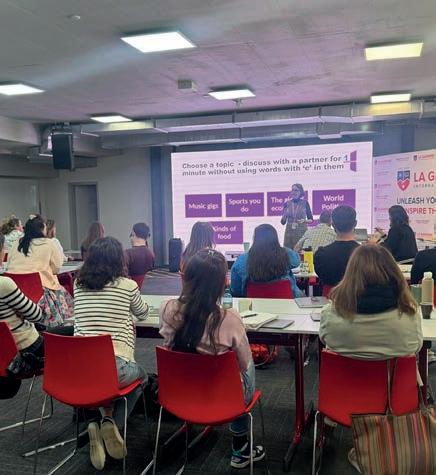
I’m writing this after hosting the AMCIS 2026 Annual Conference, where feedback included words such as ‘buzz’, ‘energy’, ‘re-connecting’, ‘taking time out’, ‘a spring in my step’ and ‘a renewed sense of purpose’. Above all, one phrase stood out: ‘we are a community’.
Personal and professional bonds
At the heart of any thriving community are the people. Conferences bring people together in a way that stimulates both personal and professional bonds, creating spaces for sharing insights and experiences as well as support. Yet it takes more than a few days together to sustain that sense of belonging. A community thrives when its members actively choose to engage, contribute and learn from one
Collective support is invaluable – particularly in times of uncertainty or change, when reassurance and collaboration can ma e all the difference.
another. Collective support is invaluable – particularly in times of uncertainty or change, when reassurance and collaboration can make all the di erence.
As AMCIS Chair, Melanie Burke, puts it: “ nd your people”. Every sector faces its own set of challenges – perhaps better framed as ‘puzzles’. While ours are unique, they often mirror those in the wider economy: understanding our audiences, staying innovative and delivering excellence. When we approach these as a community, individual problems become shared puzzles, lighter to carry and easier to solve together. Staying connected beyond an event is key to maintaining momentum. While the buzz of
a conference naturally fades, the relationships built during those few days need not. Digital platforms, local meetups and continued professional development opportunities all help to keep the conversation alive and the community engaged.
Catalyst
Connection also cultivates accountability and inspiration. When we keep in touch, we are more likely to follow through on the ideas and commitments sparked during a conference. We see how our peers are implementing new strategies, overcoming di culties, and achieving success. This creates a ripple e ect that motivates others to do the same. In this way, community becomes not just a support system, but a catalyst for continuous improvement.
Ultimately, the true measure of a conference’s success lies not only in the quality of its programme or attendance gures, but in the strength of the community it nurtures. At AMCIS, we are certainly seeing that legacy in the ‘buzz’, ‘energy’ and renewed purpose carried back into schools.
So, stay connected with your people throughout the year, ask the ‘what do you think?’ and ‘have you ever?’ questions – or simply take 20 minutes for a co ee together. That small moment of connection might be the very boost you both need. ●
OLIVER SMITH is CEO of AMCIS, the association for admissions, marketing & communications in independent schools. AMCIS has approximately 600 schools in membership. amcis.co.uk
THE GROWING IMPORTANCE OF MAJOR DONORS IN SCHOOLS
WHAT LEADERS NEED TO KNOW
Louise Bennett considers the increasing importance that major donors play in successful school fundraising programmes.
Across the independent schools’ sector, the fundraising landscape is shifting, and philanthropy can no longer be seen as a peripheral activity. Evidence from IDPE benchmarking demonstrates a clear and accelerating trend: major donors are becoming the cornerstone of successful school fundraising strategies.
For schools seeking long-term nancial resilience – whether to fund bursaries, partnership work or capital projects –understanding and responding to this shift is critical.
The rise of major giving IDPE’s latest benchmarking highlights the scale of change. In schools raising over £500,000 annually, major gifts account for around 70% of philanthropic income, a trend that is re ected across the wider charitable sector in the latest CAF UK Giving Report
High-net-worth individuals are giving more, and doing so in more intentional, strategic ways. For schools, this presents both an opportunity and a challenge. The opportunity lies in transformational giving; the challenge is that such support requires a more sophisticated, relationship-led approach than traditional fundraising models.
What’s changing in donor behaviour?
Major donors today are not simply passive supporters; they are active partners.
• More strategic giving:
Donors are increasingly focused on impact, alignment with values and long-term outcomes.
• Higher expectations: They expect clarity of vision, strong leadership engagement and meaningful stewardship.
• Evolving motivations: Donors are giving more intentionally, with a stronger focus on social impact and a deeper connection to mission, values and long-term outcomes. For school leaders, this means fundraising cannot sit solely within a development o ce. Success depends on whole-school alignment, with governors, bursars and Heads playing an active role in building and sustaining relationships.
Leadership is the differentiator
One of the clearest and consistent messages from IDPE benchmarking is that schools that invest strategically in fundraising, and align leadership behind it, perform signi cantly better. Development programmes that are supported at board and senior leadership level are more
sustainable and more successful over time. Importantly, this includes recognising the nature of major gifts. These gifts rarely follow annual cycles; they are driven by relationships, which means forwardthinking schools need a long-term, campaign-led approach to fundraising.
How IDPE supports school leaders
To respond to these sector shifts, IDPE o ers a range of support designed to build capability across the whole school community:
• Fundraising for School Leaders Programme: This programme equips Heads and Deputy Heads with the strategic understanding needed to lead fundraising e ectively.
• Fundraising for School Bursars Programme: This programme supports bursars to understand fundraising as a strategic income stream and explores how to integrate philanthropy into longterm nancial models.
• Fundraising for Governors Support Service Governors are key to enabling and sustaining fundraising success. This support service helps boards to understand their role in philanthropy. Together, these programmes re ect a core principle: successful fundraising is a shared responsibility.
Looking ahead
The evidence is unequivocal: major donors have the potential to re-shape the future of school fundraising. As expectations rise and giving becomes more strategic, schools that embrace this shift will be best placed to thrive. For school leaders, the question is no longer whether to engage with development, but how e ectively they can lead it. ●
LOUISE BENNETT is the of . o find out more about IDPE’s support for school leaders, contact Louise on, ceo@idpe.org.uk.
HOW TO ELEVATE GLOBAL UNIVERSITY ADMISSIONS OUTCOMES FOR YOUR SCHOOL
The conclusion of the 2026 global university admissions cycle highlights a rapidly shifting landscape for independent school leadership. While celebrating remarkable pupil achievements, headteachers have also navigated unprecedented market volatility. Academic excellence alone no longer secures entry to elite institutions; instead, admissions criteria have grown increasingly complex.
In the UK, the structural evolution of UCAS personal statements demands veri able supercurricular depth. Concurrently, top US universities have raised the bar. The Common Application now incorporates dedicated research sections and video veri cation, designed to scrutinise the absolute authenticity of
a candidate’s pro le. For bursars and governors, maintaining exceptional outcome metrics remains vital to preserving institutional prestige and satisfying parental expectations.
Navigating these multifaceted global requirements places considerable operational strain on internal careers departments. To mitigate this, forwardthinking schools are embracing strategic partnerships, integrating highly specialist mentors and former admissions o cers to provide bespoke application support. This collaborative approach ensures pupils achieve a de nitive competitive advantage, whether targeting Oxbridge or the Ivy League.
1,732
4,011
4,484
Supporting institutions in delivering these stellar outcomes remains a core priority. In this latest cycle, Crimson Education assisted students in securing 72 Oxbridge o ers and 927 places at top 10 UK universities. Alongside 1,046 o ers to top 20 US universities and 387 to the Ivy League, with 95 to the University of Pennsylvania alone. By augmenting traditional school provision with targeted external expertise, senior leadership teams can con dently future-proof their institutional reputations. www.crimsoneducation.org/uk ●
A CHANCE TO RESHAPE HOW WE SUPPORT INDEPENDENT SCHOOLS
Richard Harman sets out his thinking on the planned merger between AGBIS and ISBA.
AGBIS and ISBA have recently announced a proposed merger, due to take e ect on 1 January 2027. Much work remains to be done, but in the interim nothing will change for members and schools. The opportunity now is to build a more joined-up, more e ective model of support for a sector facing increasing complexity.
Complex and challenging
Independent schools are operating in a far more complex and challenging environment than they were even a few years ago. Pressures that might once have been managed separately now arrive all at once: tighter budgets, greater regulatory scrutiny, rising expectations around sustainability, sta ng pressures and a sharper need for long-term resilience. That changing reality is exactly why AGBIS and ISBA have announced our proposed merger.
This is not about organisational tidiness for its own sake, nor is it driven by fear. It is about recognising that governance, nance, risk, compliance and strategy increasingly intersect in the day-to-day life of schools. A school facing nancial pressure may also be
reviewing governance structures, reassessing risk, considering sta ng implications and asking di cult questions about a ordability, value and future direction. Schools need advice that re ects that reality, not siloed support divided by old institutional boundaries.
Important conversations
We have been clear that this is a proposed merger and that much work remains to be done before then. There is due diligence to complete, design and branding questions to resolve and important conversations still to have with members and stakeholders. That honesty matters.
In the interim, nothing will change for schools in terms of the support, advice, events and relationships they rely upon. We continue to plan our training and events for the next academic year. What has changed is that we are now openly setting out a direction of travel that we believe can better serve the sector.
Exciting opportunity
For me, the most important point is that the proposed merger creates an exciting opportunity not simply to
… we can preserve specialist expertise while creating something even more coherent, more responsive and more valuable for members.
The opportunity now is to build a more joined-up, more effective model of support for a sector facing increasing complexity.
bring two associations together, but to rethink how sector bodies can work more e ectively alongside one another in support of schools. If we get this right, we can preserve specialist expertise while creating something even more coherent, more responsive and more valuable for members. In a period of sustained uncertainty, volatility and complexity, that is not just desirable; it is essential. ●
RICHARD HARMAN is Chief Executive of AGBIS.
UNIVERSITY ADMISSIONS A Q&A WITH JAMIE BEATON OF CRIMSON EDUCATION
Crimson Education’s Jamie Beaton addresses some of the key issues of concern to students preparing to submit applications to US universities.
Q Do you see any shifts in students’ approach when it comes to building compelling applications?
There’ve been some major shifts. The rst thing is that AI tools enable students to crank out capstone projects, apps and other initiatives that would previously have taken six months in only three weeks. This means that the top students who are really entrepreneurial can do more with their time, which means the standard competition at the high end is going up.
Crimson students are dominating this trend. This year, we got 53 kids into Stanford, and 380-plus kids into the Ivy League. Our kids are really thriving because we can help teach them a lot of these AI-native skills so
they can actually launch all these di erent projects. Even if you’re doing podcasts, you’re thinking about interview questions for hosts, or if you’re doing cold email outreach, then the students who have more AI savviness can be more e cient per unit of time. The second thing is that research is becoming very mainstream. 90% of our admits to Harvard and MIT this last year had research papers, and schools like Yale and Columbia now require research papers on the application. It’s optional, but optional means compulsory. These research papers enable students from the humanities pathway, like Sociology and all the way to Astrophysics, to show their technical domain knowledge and academic curiosity.
QWhatare your top tips for students aiming for standout appeal to admissions o cers at top-tier universities?
First thing is nail the basics; crush your academics. So, start as early as you can. Try to get nines at GCSE, try to get extra A Levels. You don’t have to follow your school’s guidelines around how many subjects you should take, because a lot of the top applicants will
self-study extra A Levels. One of the reasons I got into all the schools I applied to was that I took 10 A Levels.
Secondly, standardised testing. Even though schools are test-optional, don’t listen to that. Train hard on the ACT/SAT, get a high score. My average student who went to Harvard or Stanford last year scored 1560. My average Ivy League student scored 1540.
Schools are looking for early indicators of entrepreneurial success.
Beyond academics, next up would be honours. A lot of students coming through schools don’t naturally get honours. You’ve got to compete in a range of online competitions and other activities early on, and work up to winning these awards.
Thirdly, a lot of students fail to launch innovative leadership projects, but top schools like Stanford are trying to nd entrepreneurs who will do these types of initiatives when they’re in high school. Schools are looking for early indicators of entrepreneurial success. Don’t be afraid to get out there and launch some initiatives. It’s much easier to build your own leadership role than to get a leadership role.
QWhat trends has Crimson Education noticed over the past year in students’ choice of subject areas?
Right now, the most dominant majors are AI, Business, Pre-Med, Pre-Law, Economics, and Entrepreneurship. This is because of the rise of AI. There are a lot of people who wish to learn AI, machine learning, mathtype related skills, and also a lot more students want to go on to direct entrepreneurship. On the whole, students are very return-on-investment focused. They’re choosing majors they think will give them good job outcomes, and that’s driving a lot of this.
Probably the most notable trend is that Environmental Science is less common than it was ve or ten years ago. Also, Computer Science directly is not as common as it was ve years ago, partially because of the availability of AI tools. More students are looking at pure engineering subjects – like Electronic Engineering – or at Applied Math. I would say some of the smartest students that I see are typically doing Applied Math, Data Science, Statistics, Economics or AI if they have a STEM background, as they tend to be the majors that lead to some of the highest-paying jobs.
QHow are admissions o cers distinguishing between a polished AI-assisted essay and a truly authentic student voice?
I’m actually at Columbia Journalism School right now, and it’s been very interesting studying with some of the best journalistic minds, like New York Times writers. Even with the best AI voice, you can still tell it doesn’t have the quality of a true human writer. AI can’t help you brainstorm winning application topics. A lot of the time, topic selection is a big part of what makes a great essay, with some of that personal air, which is hard to capture through AI alone.
Using AI is quite risky in the application process because a lot of schools have AI plagiarism tracking tools. If they suspect the use of AI, for example if there are gaps between your SAT English score and the quality of your English essay submitted to college, you might get declined right there. So even though AI might save a bit of time, it’s going to result in a worse outcome, typically, and it’s going to put the whole application at risk.
QWe’ve seen a big surge in early action and early decision applications and the introduction of new early rounds; is applying early now the baseline requirement for a realistic shot at the US top 20?
Yes. These days, applying only in a regular round is a bit crazy because the admission levels are three to four times higher. You don’t want to go ‘Hunger Games’ with just the regular round; it’s much better to have a good early strategy. All our applicants at Crimson are always applying across the early rounds.
Using AI is quite risky in the application process because a lot of the schools have AI plagiarism tracking tools.
QHow
have students adapted to the new three-question format for the UCAS personal statement, and does that change what admission teams are looking for?
The UK is taking a page from the US playbook by breaking the traditional, free-form personal statement into three speci c prompts. This directly addresses a long-standing issue in that the old format was too vague. By providing clearer guidance, UCAS is ensuring students actually answer with what universities want to hear.
This also levels the playing eld for underresourced applicants by giving them more clarity as to what they should be writing about. But ultimately, this hasn’t changed what admissions o cers are looking for; the new questions are still asking for the same information that was always expected previously. ●
USING AI TO SUPPORT FINANCIAL MANAGEMENT AND
USING A PEER TO PEER COMMUNITY
TO ANSWER YOUR QUESTIONS.
Katie Hutton talks to Thomas de Nooij about the benefits of using to support finance functions ithin a school, and illustrates ho orum members can share information and pro ide support to each other.
The FD Forum is a peer-to-peer community for those working within Finance, HR and Estates Management, solely in education. It provides a unique opportunity to learn and share ideas from those working in the sector day-in day-out. Topics are wide ranging, from budgeting, telephone switchover, absence insurance, SSP and
casual workers to recommendations for sports hall oor maintenance, signage and gym equipment. Set up in 2007 at the beginning of the Academies programme, it still has some of the original members; over 90% of its membership comes from referrals and organic growth and it has a consistent membership renewal rate. A key topic at the moment amongst
members is the bene ts and drawbacks of using AI to assist nancial reporting and planning. We delved into this further and here are answers to some of the questions we hear being asked.
QWhat are the bene ts of AI to school nance?
AI does time-consuming, repetitive tasks quickly and accurately, avoiding sta using their time on data entry. It provides a clear, well-structured draft budget narrative based on actual gures with the writing and calculations happening automatically. To see how it would work for you, take your most recent board report, ask an AI tool to redraft the narrative section from your gures and take a look at what comes back.
QDoes a school need dedicated AI software?
Free tools won’t connect to your school’s systems, meaning you will have to re-input the information for each task. You need software that’s permanently connected to your live gures. Dedicated platforms have AI built into your nance work ow and it therefore automatically works from your current gures. It monitors your spending throughout the year, alerts you to potential overspending and produces regular reports without any manual input of gures.
Q
What does AI-assisted budget planning look like in practice?
Instead of having to work across multiple spreadsheets requiring manual input, a dedicated platform can produce a solid working draft automatically, drawing on your school’s own nancial history. You then start reporting from a reliable informed base rather than a blank page, enabling focus on budget decisionmaking rather than data entry. For school groups, this is very valuable as AI can produce draft budgets across several schools simultaneously and then provide a comparison.
can offer genuine practical bene ts for the nance function in schools, but it is wise to use dedicated platforms.
The important word here is draft; you will still need to have an overview of the document.
QHow does AI help with reporting throughout the year?
There are two clear areas in which AI can help:
• Monitoring – gures running above budget will be immediately agged.
• Reporting – For those writing explanations on budgeting changes who come from a non- nance background, the task can take time. AI can quickly draft an explanation in a style that ts your tone but is designed to help readers understand the situation being reported on.
The latter is an issue discussed on the FD Forum when members are trying to explain a complex nancial situation to governors and trustees in a way that will enable them to have clear conversations.
Q
What about accuracy – can you trust what AI produces?
AI is a tool only; it works from the information it is given, so it can make mistakes. Everything it produces should be read and checked. However, it does add a level of monitoring that can otherwise be missed. It will ag gures that look out of place, spot inconsistencies and alert you to gures that don’t match with budgets.
QIs this a ordable for schools where budgets are already tight?
AI, used correctly, will result in freeing up sta time/ nancial resource from data inputting and report writing. Putting a realistic cost on that time, and the case for investing in better tools, will show if it holds value.
Before making any nancial decision, try the free tools rst. Ask the views of
your peers – such as those within the FD Forum – and you’ll receive honest views from those who have their own experiences, and they will be relevant to the sector. Finally, ask for a ‘no obligation’ demonstration from suppliers.
QWhat happens to the school’s data – and what about GDPR?
With a reputable dedicated platform, your data is stored securely. Check where the servers are based, and if all information is encrypted both when it’s being transmitted and when it’s being stored. Access to the data is controlled carefully, so only the people who should be able to see your school’s nancial information can. You decide who has control and access, not the software provider. In a well-designed platform, AI works with nancial totals and budget gures – not with anything that identi es individuals. This is one of the important di erences between a purpose-built school nance platform and a general-purpose AI tool. Anything involving identi able sta or pupil information should not be put into a free online tool. From a GDPR perspective, a dedicated platform operates
as a data processor. It handles your data on your behalf under a formal written agreement, and in accordance with UK data protection law. That agreement should be in place before you share any data, and any reputable provider will have this as standard.
A tool not a replacement
AI can o er genuine practical bene ts for the nance function in schools, but it is wise to use dedicated platforms. However, it should be treated as a tool, not a replacement for professional judgement. Before embarking on its use, trying a free version is a good idea as it gives an understanding on the basics and allows for the development of ideas on how it would best t your needs.
If AI is going to become part of your systems, ensure that you use a reputable provider and, before committing, consult your peers for rst-hand experiences following any supplier demonstrations. ●
KATIE HUTTON, Director of the FD Forum, was in discussion with homas de ooi , CTO and Founder at Anago.
If you have any questions having read this article, please get in touch with the FD Forum and they can respond with information collected from their members or find out the ans er for you.
The FD Forum also holds a series of ‘Lunch and Learn’ webinars during the year covering topics relating not only to the running of schools but also personal development.
For more insights from the FD Forum and to become part of this knowledgeable community, contact katie@thefdforum.co.uk or visit thefdforum.co.u
DEVELOPING LEADERS AND INSPIRING READERS
Reading mentorship develops communication and confidence across age groups Bookmark Reading Charity explains more.
On a weekday afternoon, a SixthForm student logs on to nd a primary school pupil looking back at them on screen, hesitant at rst, then growing in con dence as the session unfolds. The child reads aloud, sounding out unfamiliar words, while the older student celebrates small successes. Over time, what begins as a structured activity becomes something more powerful: a relationship built on encouragement, consistency and trust.
This is the foundation of Bookmark’s One-to-One Reading Programme - a model that supports schools in both literacy and student development through reading volunteers.
Supporting pupils
Bookmark Reading Charity works with primary schools to support pupils at risk of falling behind in reading. Through its structured reading programme, trained volunteers, including pupils aged 14–18, are paired with a child for regular one-toone reading sessions. Delivered weekly, each 30-minute session blends reading, conversation and simple literacy activities, designed to build not just skill but con dence and enjoyment.
The need for such interventions remains clear. Across the UK, one in four children does not reach the expected standard in reading by the end of primary school, limiting access
to the wider curriculum. At the same time, engagement with reading often declines as children progress through school, making early, consistent support particularly important.
Teachers consistently highlight the impact of regular, one-to-one attention, with strong evidence of improvements in both reading con dence and progress. What distinguishes Bookmark’s reading programme is that it combines direct impact for children with structured personal development for the mentor.
Student mentors
At Haileybury, students volunteering as reading mentors quickly found that the experience shaped their own development in meaningful ways. “Pupils thoroughly enjoyed taking part as reading mentors,” says Giovanna Iorio, Head of Service. They “valued the opportunity to support younger readers and took pride in their responsibilities.”
Over time, subtle but signi cant changes emerged. Mentors displayed personal growth through their interactions with younger pupils. As Iorio observes, “many pupils demonstrated increased con dence, patience, and communication skills over the course of the programme.”
The programme also deepened students’ sense of purpose. “We also noticed a positive impact on pupils’ engagement
with reading and their sense of leadership and social responsibility,” she adds. Mentors began to see themselves as role models, with “several pupils expressing an interest in continuing similar volunteering opportunities in the future.”
Outcomes
These outcomes align closely with the wider aims of independent education. Programmes like this provide a structured and purposeful way for pupils to engage in service, while developing leadership, empathy and a broader understanding of educational inequality.
At Haileybury, “the onboarding and setup process was clear, well organised and easy to follow,” while “communication throughout the programme was excellent… responsive, supportive and proactive.”
Younger pupils receive targeted, highquality reading support at a critical stage of development. Older students gain meaningful opportunities to lead and contribute. Schools, in turn, strengthen their community engagement while enriching their co-curricular provision.
In a sector increasingly focused on both academic outcomes and social impact, such models o er a compelling way to achieve both. They demonstrate that improving literacy is not only about teaching skills, but about building relationships – ones that can have a lasting impact on everyone involved. ●
Schools interested in becoming a Bookmark Reading Mentor chool can find out more at bookmarkreading.org/mentoring
CAUGHT IN THE MIDDLE
SUPPORTING COMPLEX HEALTH NEEDS IN A WORKFORCE UNDER STRAIN
AWe consider how HR managers can navigate the rising tide of mental health challenges and neurodiversity in the workplace.
t Hessington Health Limited – a rapidly growing UK occupational health provider with a particular interest in complex cases, including those involving overlapping mental health and neurodevelopmental presentations – we see the pressures HR teams now face every day supporting colleagues who feel under strain. The wider data tells the same story.
UK workplaces are under unprecedented pressure. CIPD data shows average sickness absence has reached 9.4 days per employee: the highest in over 15 years and a 62% jump on pre-pandemic levels. The ONS reports 148 million working days lost to ill health in 2025, costing the economy around £141 billion. Mental ill health is now the leading cause of long-term absence at 41%, and the HSE recorded 964,000 workers su ering from work-related stress, depression or anxiety in 2024-25, a 24% rise on the previous year and the highest gure since records began in 2001.
diagnosis. The implication for HR is clear: complex, overlapping conditions are becoming the day-to-day reality of absence and return-to-work management.
Recommendations – and the limits of reasonable adjustment
Mental health is now the leading cause of longterm absence …
Layered onto this is a sharp rise in neurodevelopmental presentations. NHS England estimates around 2.5 million people in England have ADHD, with 562,450 open referrals for assessment at the end of December 2025; over 60% of adults on those lists have been waiting more than a year. Autism, dyslexia and combined neurodivergent pro les are increasingly disclosed at work, often without formal
The employee in our case study was deemed t to return to and engage in formal proceedings, subject to a structured package, including: a fourweek phased return; protected periods to reduce cognitive overload; increased written communication and advance notice of meetings; additional time for administration; temporary reduction of nonessential duties; a green/ amber/red wellbeing monitoring system; and a workplace crisis plan. A trusted person attended consultations to support information processing, subject to a con dentiality undertaking given the personal data involving others.
This is where the legal balancing act sharpens. The employee’s trauma symptoms and suspected ADHD were likely to fall within the scope of the Equality Act 2010; though, as Woodhouse notes, that is ultimately a legal rather than an OH determination. The duty to make reasonable adjustments is real, but it is not unlimited. Following an OH report, the employer
must consider the extent to which the recommendations can be accommodated, with speci c regard to the e ect on colleagues and pupils. In a school context, shorter working hours and protected periods carry additional weight because of safeguarding and supervision obligations; the longer adjustments are required, the more acute those considerations become. Woodhouse highlights the broader tension: in the current climate, employers must support employees with health challenges while complying with Equality Act duties and the duties owed to other sta and, in a school context, pupils.
Balancing these obligations is challenging, particularly when an individual is focused on their own situation and, due to their condition, may not have full regard to obligations owed to others. The position becomes harder still when an individual requires support beyond OH recommendations, or where employers cannot reasonably accommodate what has been advised. The obligation is to obtain and consider appropriate medical input but employers can, and should, weigh operational requirements and duties to others against any recommendations.
Key considerations for HR managers
Drawing the threads together, the following points should sit front-of-mind
when managing complex absence and return-to-work cases:
Treat overlapping conditions as a single picture. Trauma, anxiety and neurodivergence amplify one another. Adjustments must address the combined impact, not each diagnosis in isolation.
Act early to break the absence catch-22. Prolonged absence often worsens the symptoms that caused it.
Structured re-engagement usually beats inde nite leave.
Invest in trust and procedural fairness. Previous poor handling, real or perceived, can derail engagement. Transparent processes, written communication and informed consent are part of compliance, not courtesy.
Assume Equality Act 2010 protection may apply. Where health impairments are likely to be long-term and substantial, proceed on the basis that the duty to make reasonable adjustments is engaged.
Reasonable does not mean unlimited. OH recommendations are advice, not instruction. Assess feasibility, impact on colleagues and service users, and any safeguarding implications, and document that reasoning.
Plan for the long term. Review phased returns, protected time and crisis plans on a de ned schedule. The longer adjustments persist, the more proportionality and operational sustainability must be revisited.
A teacher’s return to work
A recent case illustrates the multilayered challenge HR teams now face. A teacher had been absent for four months with worsening stress and anxiety alongside symptoms suggestive of an undiagnosed neurodevelopmental condition. The school needed guidance on their colleague’s tness to return to and engage in formal meetings, including a grievance process.
An Occupational Health (OH) assessment identi ed symptoms consistent with Complex PostTraumatic Stress Disorder (CPTSD): intrusive thoughts, hypervigilance and disrupted sleep alongside longstanding concentration and processing di culties and noted a formal ADHD assessment was pending.
Critically, the absence itself was worsening the underlying conditions; loss of routine had increased a sense of isolation and eroded resilience, creating a clinical catch-22 in which workplace di culties had driven the absence, while the absence was
Train line managers. Only 29% of UK organisations train managers to support mental health. Early, con dent managerial response is the single most cost-e ective intervention available.
The pressures on HR teams will not ease. With absence at a 15-year high and a generational shift in neurodivergent
now intensifying the symptoms preventing return.
The interaction between trauma and suspected ADHD signi cantly ampli ed functional di culty. Hypervigilance further reduced already limited cognitive capacity; unpredictable, fast-paced classroom environments intensi ed both cognitive overload and emotional distress. Adjustments needed to address the combined impact, not each condition separately.
Matters were further complicated by mistrust. The employee reported signi cant inaccuracies in a previous OH report and felt earlier processes had been progressed without their full knowledge or consent. Considerable clinical input was needed to rebuild engagement.
As Gemma Woodhouse, observes, this groundwork is not optional: it is critical to ensuring the employer has met its legal obligations and identi ed steps that genuinely assist the individual. Alex Rhind
disclosure, the cases reaching HR desks will keep getting more complex.
The organisations that fare best will combine clinical curiosity with legal discipline and the willingness to hold the employee’s needs and the wider workforce’s interests in the same conversation. ●
DR HARJEEV RAI CEO/Medical Director: hrai@hessingtonhealth.com
MRS TINA SIPPÉ OH Nurse Specialist and Governance Lead: tina.sippe@hessingtonhealth.com
MR ALEX RHIND OH Nurse Specialist and Complex Case Manager: alex.rhind@hessingtonhealth.com
HESSINGTON HEALTH LIMITED; Occupational health perspective and case analysis. A UK provider of bespoke occupational health services with extensive experience in the education sector and complex case management. hessingtonhealth.com
EAL DATA THAT DRIVES DECISIONS,
PROVISION AND PROGRESS
EAL provision doesn’t begin in the classroom – it begins with the admissions decision. What follows depends on the data gathered to inform that decision and how this is used. Dr Helen Wood explains.
Assembling entrance assessment data is timeconsuming; the information can be disjointed, and often di cult to interpret. Perhaps a CEFRrelated language test score sits alongside multiple in-house exams, or a CAT4 assessment. Sometimes, all three are being used. Once learners arrive, many busy Heads of EAL write their own termly assessments or perhaps utilise the highly respected but administratively burdensome Bell Framework to judge pupil progress. No simple, coherent system for tracking, from entry onwards, seems to exist. It is therefore worth asking some honest questions about what our current EAL learner data is actually achieving.
What does our admissions data allow us to plan for?
The most useful question in relation to learners with EAL is ‘What kind of academic and linguistic support will this student need in order to thrive?’ since language pro ciency is the most signi cant predictor of their attainment. Assessment data that does not help answer that question leaves schools making provision decisions on partial guesswork – with unfolding consequences in terms of curriculum access, sta expectations and whether a student ourishes or struggles.
Are we measuring the right kind of English?
There is a considerable di erence between the social English needed for daily life and the academic English required to write a history essay or read a science text. Put simply, EAL learners who can hold con dent conversations may still struggle, particularly with
the language demands of public exams. To support them, we need to know about their academic language pro ciency.
What
are we asking learners with EAL to manage when they arrive?
These learners are simultaneously navigating new skills in academic disciplinary literacy and often unfamiliar expectations around teaching, learning and participation. Schools that recognise this tend to be more inclusive by design. However, this requires everyone to understand their learners and the strategies that will support them. Language awareness is not just for the EAL team. It cannot be addressed in supplementary tuition once a week.
Why
does this matter?
All this means EAL provision has come under increasing scrutiny from ISI inspection teams. They want to see the impact EAL provision has on language pro ciency and how this contributes to longer-term attainment. Heads of EAL tell me that evidencing this from the pick and mix data they have is challenging. It is a problem I have been working to address through more coherent, school-friendly reporting systems, including EAL cohort overviews, diagnostic pro les and progress tracking, which can be interpreted by all and positively in uence teaching and learning school-wide.
ecru tment enefits
More coherent data doesn’t just help meet the needs of EAL learners or the demands of inspection teams; it brings recruitment bene ts. Earlier this year, I co-presented a COBIS webinar with Matthew Norbury of King’s Ely. Together, we explored the use of data to plan e ective pathways of EAL support for a wider range of language abilities on entry. Matthew calls this the ‘power of the yes’. In a challenging recruitment climate, schools that have EAL data that works harder for them are better placed than those relying on instinct and an entry score. ●
DR HELEN WOOD is Head of School Partnerships at Password | English Language Testing. englishlanguagetesting.co.uk
SCHOOL CATERING COSTS STRATEGIES FOR REVIEWING AND REDUCING EXPENDITURE
apetito’s Rupert Weber explores how schools can reduce catering costs without compromising on quality.
Last year, in collaboration with the Independent Schools Association (ISA), apetito embarked on a research project to better understand the challenges that independent schools are currently facing in their kitchens. The results of our research were telling. Over 90% of schools cited costs as one of their top three concerns, and a striking 85% reported anxiety over the rapidly escalating price of meals. Furthermore, 70% of schools indicated that cost plays a decisive role in choosing a catering service.
To further explore these issues, we organised a roundtable discussion with ISA to share their perspectives and practical approaches for managing and reducing catering costs. The outcome was a set of clear strategies that any school can adopt to ensure their catering provision remains sustainable and e ective.
Cost-saving initiatives
The rst step in any cost-saving initiative is to gain a comprehensive understanding of your current expenditure. It’s essential to break down the catering budget into its core components – meal allowances, labour costs and any additional charges such as management fees or compliance-related expenses. For those schools running in-house operations, a careful review of system costs, particularly those related to safety and compliance, is vital. This approach not only clari es where funds are being allocated but also highlights realistic opportunities for savings.
Benchmarking your catering provision against similar schools in your area is another key strategy. By understanding what others o er, you can set realistic service levels and avoid unnecessary spending on extras that might not be valued or required. This comparative analysis ensures that your school remains competitive without stretching the budget unnecessarily.
Importantly, catering management should not be an isolated decision. It deserves a spot on the senior leadership team’s agenda, where the broader implications and opportunities can be explored. Leadership discussions should de ne what quality and consistency look like for your school, determine the appropriate level of service for your community, and consider the range of
food o ered daily. Such conversations lay the groundwork for sustainable cost management and reinforce the school’s commitment to providing a high standard of meals.
Alternative models
Schools are increasingly exploring alternative models beyond the traditional in-house or fully outsourced options. Flexible and hybrid systems, perhaps combining di erent catering methods or integrating prepared meal solutions, may o er practical ways to reduce both labour pressures and overall costs. While not every model suits every school, a willingness to consider new approaches can unlock signi cant e ciencies. However, it is crucial to resist the temptation of short-term savings at the expense of reliability. A low-cost solution that falls short on consistency or quality will ultimately undermine trust and satisfaction among pupils and parents. Maintaining dependable service standards should always be at the forefront of any changes.
Maintaining dependable service standards should always be at the forefront of any changes.
Long-term sustainability
Ultimately, reducing costs in school catering is not about cutting corners. It’s about making informed, strategic decisions. By thoroughly understanding existing costs, engaging school leadership, benchmarking against peers and considering exible models, schools can nd meaningful savings while ensuring their students continue to bene t from nutritious, high-quality meals. The focus must remain on longterm sustainability, ensuring that every penny spent delivers real value to the school community. ●
RUPERT WEBER is General Manager for apetito’s Education Division.
WHY BECOME A MEMBER OF THE FD FORUM?
hared challenges. hared solutions. eal benefits for your school.
The FD Forum is a trusted peer community for Finance, HR and Estates Management professionals within education. With over 20 years of experience and over 90% of our members coming through recommendations it enables you to speak to others who have faced the same challenges and gives you the opportunity to stay ahead in a sector that is continually evolving.
Whatever questions you are facing today, the answer is held by members of The FD Forum. Real answers for real problems, from those working day in day
out in the sector. Not theory, not policy, just what worked, what didn’t and what to watch out for.
We don’t provide conferences, we aren’t an advisory body telling you what to do, we don’t provide certi cates but what we do brilliantly is provide our members with a candid, con dential conversation with someone who has already faced exactly
For further information
what you are dealing with right now and will tell you honestly and without prejudice what they found. It is a trusted space for school professionals - built by the people who use it, for the people who use it and by those who truly understand the realities of running schools. That is why members call it invaluable and stay for years. ●
To join this progressive, supportive community, email katie@thefdforum.co.uk or visit www.thefdforum.co.uk and follow us on LinkedIn: The FD Forum.
FEE INCOME UNCERTAINTY CAN MODERNISING FEE PAYMENTS REALLY HELP?
Fee income uncertainty has become one of the most significant strategic risks facing independent schools. Drawing on a decade of Australian experience, in this article Lucy Foster of Edstart outlines how modernising school fee payments can help reduce this risk and Neil Roskilly, former CEO, ISA, considers how these learnings can offer real, practical benefits to schools and families across the UK.
Independent schools have always operated with a degree of nancial uncertainty. Pupil numbers shift, bursary commitments grow and unexpected costs arise. At the core of every school’s nancial model, however, is one critical factor: whether fee invoices are paid in full and on time.
This is not merely an administrative problem; it is a strategic one. Financial decisions are harder to make with con dence when they rely on projected income that may not materialise as planned.
The impact of the increased nancial pressures on schools over the last 18 months has already led many to adapt
operationally but, with over 16,000 pupils leaving the sector in 2025, and at least 100 schools announcing plans to close, according to the ISC, they are still under signi cant pressure. Add to this the rising cost of living – which continues to squeeze household nances at the same time as families are trying to absorb the increased cost of independent education – and the fees challenge for our schools is clear.
Australian independent sector: similar pressures, shared learnings
Independent schools in Australia
experienced a similar, signi cant increase in nancial pressures a few years earlier, triggered by reductions in government funding, higher operating costs and fee increases that outpaced in ation. They needed to adapt and many chose to modernise their fee payment process to become more nancially resilient, while also meeting the changing needs and expectations of parents.
Whilst the Australian and British school sectors are not identical and the speci c pressures each are navigating are distinct, they do share many similarities; not least being asked simultaneously to do more with less, maintain parent con dence and protect pupil retention.
Our work with over 700 schools in Australia over the last decade, as well as nine years of data from our annual Schools Insights Report, has shown that modernising fee payments, when done well, can provide a real, measurable bene t to how a school manages fee risk. Not because it is a silver bullet, but because it addresses cash ow, administrative burden and the parent experience.
A guaranteed fee payment model improves how schools can plan
Data from Australian schools show that the most signi cant operational change was not in how fees were collected, but what schools could do with the certainty that replaced the previous unpredictability. Under the schools’ previous models, that risk sat entirely with the school. However, the shift to a model where the school received guaranteed full fee remittance on agreed due dates, regardless of individual parent payment behaviour, had measurable e ects that extend well beyond cash ow management.
Bursary allocation decisions, previously hedged against potential income shortfalls, became more consistent. Capital investment decisions that had been deferred due to income uncertainty could now proceed.
The administrative burden is a hidden cost rarely measured 92% of schools saw a reduction in time spent on administration. Data from across the schools shows they experienced a 75% reduction in fee-related admin tasks, saving approximately two days per week within the rst year of modernising their payment process. In schools with smaller nance operations, where one or two sta manage the entire function, the proportional impact was greater still. Time previously spent chasing late payments, managing ad hoc instalment requests or having di cult conversations with families could be redirected to tasks the same sta had not previously had capacity for, such as strategic nancial planning, process improvement and governance preparation.
ee e l ty mpro es pupil retention
Traditional payment infrastructures, which require parents to pay at the start of each year or term, act as a lter that excludes some families; not through unwillingness but through timing. Families who genuinely wanted to remain in independent education were leaving
because the requirement to produce a large lump sum at the start of each term did not always align with when money was available.
A shift to more exible payment plans helped improve retention rates, with 90% of schools seeing an increase in retention.
When payment plans are properly structured, with clear terms and a dedicated, professional family support process, default rates fall. Families who would previously have struggled with a termly invoice – and potentially stopped paying or withdrawn – instead engaged with a manageable plan and stayed.
Another learning
Financial decisions are harder to ma e with con dence when the rel on pro ected income that ma not materialise as planned.
connected to fee exibility is that parents are starting to expect it, with four in ve parents now choosing an automated payment method, with the exibility to select weekly, fortnightly or monthly payments as best suits them. This better aligns school fees with how other household bills are being paid and helps families manage their budgets. It also improves the customer experience, and we’ve seen how this can be a factor when choosing a school or even choosing whether to leave a school. Focusing on that experience can reduce the role fees play as a trigger point for leaving.
What this means for UK independent schools
The challenges facing UK schools may be di erent in their precise shape, but the underlying dynamics are the same and the advantages still relevant: all fees upfront at the start of term, guaranteed cash ow, aged debtors e ectively disappearing, huge savings in time spent chasing, and happier parents. That last point is worth considering further, as content parents are often a school’s biggest marketing asset and friction between a school and its parents over fees spills over into dissatisfaction with the school as a whole, no matter where any blame lies.
It shouldn’t be underestimated how much time nance departments spend on chasing fees, and that this is becoming more demanding. There’s quite some cost to that activity of course, not only in terms of sta hours but also in relation to the ‘opportunity cost’ potential of that time were it to be used more e ectively, for example, for strategic and valueadded work – activities which provide a competitive advantage and turn the nance department into a strategic resource. Modernising fee payments alone isn’t going to resolve the nancial challenges facing the UK independent sector – but the learnings from Australia show us that the right fee management technology can be a very important nancial resilience tool in a school’s toolbox. ●
LUCY FOSTER is the UK General Manager of Edstart, a school fee management specialist that has worked with more than 700 schools across Australia over the past decade. Edstart launched its UK platform in 2026.
NEIL ROSKILLY is an education consultant and former Chief Executive of the Independent Schools Association. He serves as a board adviser to Edstart.