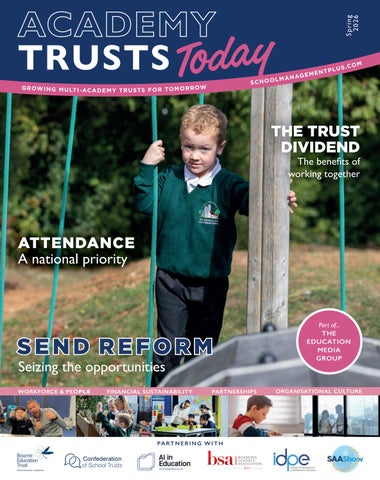
William Clarence Education Green Park House, 15 Stratton Street, Mayfair, London W1J 8LQ
Tel: +44 (0)207 412 8988 williamclarence.com
EDITOR
David Moncrieff david@williamclarence.com
EDITORIAL ADVISORY BOARD
Ann Mroz
Former Editor, Times Educational Supplement (TES)
Louise Bennett
CEO, The Institute of Development Professionals in Education (IDPE)
Alex Russell CEO, Bourne Education Trust
Samuel Skerritt
Director of Public Affairs and Policy, Confederation of School Trusts (CST)
Andrew Thraves
Chair, Big Education Trust
David Walker
Director, BSA Group
Dr Helen Wright
Educational Consultant and Coach
Steve Price
Chief Executive, Tudor Park Education Trust
DESIGN & PRINT
Fellows Media Ltd
The Gallery, Southam Lane, Cheltenham GL52 3PB 01242 259241 hello@fellowsmedia.com
ADVERTISING
Alice Ireson 01242 259249 alice.ireson@fellowsmedia.com
PUBLISHER
William Clarence Education Ltd
The William Clarence Education Group is a leading education publisher and provider of admissions, recruitment and careers solutions for parents, leaders and schools across the world. williamclarence.com
DISTRIBUTION
(Print & Digital)
Academy Trusts Today is distributed as follows: all UK Single and MAT Trusts; Schools & Academy Show, NEC. Quarterly print reach: 5,000; digital reach: 65,000; social reach 25,000.
FOREWORD
2026
is shaping up to be a consequential one for England’s school system. Questions about the value of multi-academy trusts (MATs) have resurfaced, even as concerns over stubbornly weak postpandemic attendance intensify. Both issues feature in this spring edition of Academy Trusts Today, newly retitled to reflect a shifting landscape.
More significant still is the long-awaited publication of the Government’s Schools White Paper, Every Child Achieving and Thriving. Presented, inter alia, as a ‘radical expansion’ of provision for pupils with special educational needs and disabilities (SEND), it marks an important waypoint in a reform agenda that has been years in the making. Leaders across MATs are now considering its implications.
Advocates of the reforms see clear advantages. Standardised Individual Support Plans (ISPs) promise earlier intervention and a reduction in the bureaucratic delays associated with Education, Health and Care Plans (EHCPs). A stronger emphasis on mainstream inclusion could improve social outcomes while easing pressure on specialist provision. National standards, if properly enforced, may reduce longstanding regional disparities. Better coordination between education, health and care services, meanwhile, is intended to make support more coherent. Just as importantly, proponents argue that funding could be deployed more efficiently, extending support to a wider cohort of pupils.
THE ONUS SHIFTS TO MAT LEADERS TO TRANSLATE ASPIRATION INTO PRACTICE.
Yet scepticism remains. Critics warn that replacing EHCPs with less legally enforceable plans may weaken parental rights and reduce accountability. There are fears that pupils with less acute needs could receive patchier support. Concerns about underfunding, workforce constraints and the system’s capacity to implement change persist. To some, the reforms appear driven as much by fiscal pressures as by educational ambition.
Even so, contributors to this edition are cautiously optimistic. With the direction of policy now clearer, they argue, the onus shifts to MAT leaders to translate aspiration into practice – embedding a genuinely inclusive approach to SEND across their organisations.
No part of this magazine may be reproduced without the permission of the publisher. The information contained in Academy Trusts Today has been published in good faith and every effort has been made to ensure its accuracy. All liability for loss, disappointment, negligence or damage caused by reliance on the information contained within this publication is hereby excluded to the fullest extent permitted by law.
REFORMING SEND
THE GOVERNMENT’S WHITE PAPER PROPOSALS
Rochelle Richmond welcomes the Government White Paper’s proposals for the reform of SEND and urges senior leaders to prepare for the planned changes and seize the opportunities they represent.
I2025–26, with investment deliberately front-loaded ahead of legislation. A proportion of this investment will flow directly to schools through the Inclusive Mainstream Fund, and schools will be expected to demonstrate how this funding is being used to improve inclusion.
LAYERS OF SUPPORT
n February 2026, the Government published two landmark documents, the SEND Reform consultation paper, Putting Children and Young People First, and the Schools White Paper, Every Child Achieving and Thriving. The Government’s diagnosis is unambiguous. The current system is failing, and the ambition is now one inclusive education system, not two running in parallel.
Education, Health and Care Plans (EHCPs) have doubled since 2014, high needs spending has risen by 87 per cent over six years, yet attainment gaps for pupils with SEND have not narrowed and too many families report fighting for basic support. To address this, the Government has committed an additional £7 billion compared to
The proposed reforms establish a universal offer as the baseline for all mainstream settings, with three layers of additional support above it. The universal offer is built on high-quality adaptive teaching, a broad curriculum, inclusive environments and a statutory Inclusion Strategy, which schools would be required to publish annually. Above this offer sit three layers: 1. Targeted: structured interventions for children with commonly occurring needs.
IN TIME, EVERY SECONDARY SCHOOL IS EXPECTED TO HAVE AN INCLUSION BASE, WITH EQUIVALENT PLACES ACROSS LOCAL PRIMARY SCHOOLS.
UNLIKE EHCPS, ISPS WILL NOT REQUIRE A STATUTORY ASSESSMENT, MEANING SUPPORT
CAN BE PUT IN PLACE WITHOUT DELAY.
2. Targeted Plus: for children who need more specialist input than their school can provide alone. Support could include the Experts at Hand offer, which brings education and health professionals directly into mainstream settings, and access to an Inclusion Base within the child’s own school. It may also involve short-term placements in Alternative Provision (AP) or specialist settings to assess needs and support reintegration.
3. Specialist: for children with the most complex needs, where mainstream support alone is not sufficient. Mainstream and specialist settings will work in close partnership to deliver support, underpinned by nationally defined Specialist Provision Packages (SPPs), designed by experts and tested with parents. Only children requiring one of these packages will be entitled to an EHCP.
In time, every secondary school is expected to have an Inclusion Base, with equivalent places across local primary schools, offering bespoke learning environments and flexible access to specialist education and health support.
INDIVIDUAL SUPPORT PLANS (ISPS)
ISPs will replace the current system of SEND support plans, creating a consistent, digital record for every child at the targeted layer and above. Schools will have a statutory duty to produce an ISP covering a child’s barriers to learning, provision, reasonable adjustments, intended outcomes and evidence of parental involvement. Unlike EHCPs, ISPs will not require a statutory assessment, meaning support can be put in place without delay.
These reforms represent a significant shift in accountability for SEND provision. Where responsibility has previously been closely tied to the local authority through the EHCP process, schools
will now hold greater direct accountability for the support they provide. The consultation also proposes replacing the current four areas of need with five new areas of development: Executive Function; Motor and Physical; Sensory; Speech, Language and Communication; and Social and Emotional, moving away from the categorisation of children towards a framework that helps educators identify and respond to barriers to learning. The SEND Code of Practice will be updated following legislation to reflect the new system.
THE SPECIALIST SECTOR
The consultation sets out clear expectations for the specialist sector. Special schools will be expected to share expertise, coach mainstream colleagues and contribute to joint professional development. Although the focus is on mainstream, the impact on special schools should not be underestimated. Independent special schools are directly and specifically addressed in this consultation. Legislation is proposed to ensure local authorities pay a reasonable price for placements, with fees expected to be lower in cash terms from 2028–29. Admissions duties will be brought into line with those of state-funded special schools, placements will be required to align with Specialist Provision Packages and new financial
THE SCALE OF WHAT IS REQUIRED IS SIGNIFICANT, AND THE TIME TO ACT IS NOW.
transparency obligations will apply. For some, these changes will create significant financial pressure, and some may find the new funding bands unviable. This reduction in independent sector capacity, if it occurs, is likely to increase demand on state special schools, at the same time as they are being asked to take on expanded outreach and partnership roles.
AP carries a distinct remit, a three-tiered model of outreach, time-limited placements for assessment and reintegration, and longer-term placements where an SPP is needed. Access to quality AP is already uneven across many local authorities, and the reforms place significant new demands on a sector that is already stretched.
BOURNE EDUCATION TRUST RESPONSE
Ahead of legislation, we have structured our response around three strategic areas, with significant work already underway.
PEOPLE AND PRACTICE
Investing in SENDCO leadership development at all levels across the Trust and ensuring every SENDCO has the time, seniority and support to lead reform. Embedding adaptive teaching across all Trust schools is a core priority, underpinned by a structured training offer for staff.
SYSTEMS AND STRUCTURES
We are developing Trust-wide frameworks to drive consistency and quality across all our schools. This includes work on SEND paperwork automation to streamline processes, standardising documentation and ensuring that our systems are ready well ahead of the statutory requirements.
RESOURCES AND CAPACITY
We have established our own outreach practitioner service and begun commissioning our own educational psychology provision, giving our schools direct access to specialist expertise. We are also exploring models to address gaps in AP locally, and will consider how the suggested pooling of a limited amount of Inclusive Mainstream Funding might support this work.
Underpinning all of this is our commitment to mainstream and special schools as equal partners. Our special schools are developing as innovation hubs, sharing specialist knowledge across the Trust, while our mainstream schools bring proven strength in inclusive practice and adaptive teaching. Together, they are the foundation of our response.
Legislation is not expected until September 2029, but the direction is set. The proposed reforms are an opportunity to build an inclusive system that delivers, in practice, in every classroom. The scale of what is required is significant, and the time to act is now. Schools and trusts that build their response ahead of legislation will be better placed to meet the needs of their most vulnerable pupils and to shape what these reforms look like in practice. ■
ROCHELLE RICHMOND is Education Director and Trust SEND Lead at the Bourne Education Trust
HELPING SCHOOLS SAVE:
APETITO LAUNCHES
NEW GUIDE ON DELIVERING COST-EFFECTIVE SCHOOL MEALS
According to the Office for National Statistics, food inflation remains at 4.4% as of January 2026 [1] continuing a trend that has stretched catering budgets to breaking point. While these figures reflect the broader economic landscape, the impact on schools is especially severe. As funding levels remain largely frozen, school meal services are struggling to keep pace with inflation and absorb rising operational costs.
years, while overall food and labour costs together
The financial strain is further illustrated by recent comments from Brad Pearce, Chair of The School Food People. He noted that labour costs in school kitchens have jumped by 28% in just a few years, while overall food and labour costs together have risen by more than 50%. To make matters worse, employers’ National Insurance contributions have increased by an additional 19%, piling further pressure onto budgets that are already stretched to their limits [2]. This aligns with findings from the organisation’s Cost of Living and Supply Chain Survey, which show that only 19% of respondents are able to provide a school food compliant meal within the current £2.61 funding rate. With meal prices having risen 26.5% since March 2020 [3], the funding gap continues to widen, leaving many schools facing significant deficits in their meal provision budgets.
shortages, school meal services are being pushed towards breaking point. If schools are expected to continue delivering nutritious, safe, and appealing meals for every pupil, they need practical, realistic support to navigate these growing challenges.
It is in this context that apetito is launching a comprehensive and entirely free guide designed to help schools better manage, control, and reduce their catering costs.
their catering costs. full of practical advice, covering everything
Helping Schools Save: A Guide to Delivering Cost-Effective School Meals provides schools with a toolkit full of practical advice, covering everything from reviewing catering costs and restructuring staffing models to reducing waste and increasing student engagement.
The guide goes beyond broad recommendations. It provides actionable steps that schools can take immediately. This includes practical guidance on meal planning, labour efficiencies, menu engineering, food waste reduction, and methods to ensure that catering remains both compliant and cost effective.
Rupert Weber, General Manager for Education at apetito, emphasised why this
guide is so urgently needed:
“Anyone working in a school knows that kitchens are facing unprecedented challenges, and the last few years have been some of the most turbulent in recent memory. Rising food prices, increasing staffing costs, and additional financial pressures across the independent school sector mean that many catering teams are being asked to do more with less, all while trying to maintain the high standards that pupils deserve.
“Good nutrition is fundamental to a child’s ability to focus, learn and thrive in the classroom, so compromising on quality simply isn’t an option. That’s why we felt it was essential to create this new guide, which aims to give schools clear, practical and genuinely actionable steps they can take to control costs without reducing the standard of meals they serve.
“Our aim is to empower school leaders and catering teams with the tools, insights and confidence they need to deliver a high quality, cost effective meal service that makes a meaningful difference to pupils every single day.” ■
With rising costs, frozen funding, supply chain pressures and national labour
References: 1. Office for National Statistics (2026). Consumer price inflation, UK. [online] Available at: https://www.ons.gov.uk/economy/ inflationandpriceindices/timeseries/ccyy/mm23. 2. The School Food People. (2026). School food leaders investigate ways to improve funding model in England | The School Food People. [online] Available at: https://www.theschoolfoodpeople.co.uk/news/school-food-leadersinvestigate-ways-improve-funding-model-england [Accessed 2 Mar. 2026]. 3. LACA (2025). LACA Cost of Living survey highlights 3 key challenges facing school caterers [online] Available at: https://laca.co.uk/news/laca-cost-living-survey-highlights-3-key-challenges-facingschool-caterers [Accessed 23 Dec. 2025].
A NEW DIRECTION WHAT THE PROPOSED CHANGES TO SEND MEAN FOR TRUSTS
With the recent publication of the Department for Education’s long-awaited schools White Paper, Emma Wigmore explores what the proposed radical changes to the special education needs and disabilities (SEND) system mean for trusts and whether implementation conditions will match ambition.
The Government’s White Paper, Every Child Achieving and Thriving, was finally published towards the end of February. When its release was postponed in October 2025 to allow further cocreation with families, it heightened expectations across the sector. But in the meantime, leaders, local authorities and families alike have continued to live with a system under sustained pressure. Rising need, cumulative deficits and stretched workforces are a daily reality in schools across the country, so the White Paper has been anticipated not simply as another piece of reform, but as a critical reset. Reading it in full, I am cautiously optimistic this is what the Government is aiming for.
There is certainly a sense that the additional time has brought depth and
clarity, not least in its clear commitment to workforce expansion and specialist capacity. In fact, the scale of the ambition, combined with a multi-billionpound investment in services – including £1.6 billion for mainstream inclusion, £1.8 billion for specialist outreach and £200 million for workforce development – represents one of the most substantial investments in SEND reform.
Those of us in frontline education have known for some time that the system needs to evolve. This White Paper acknowledges that openly, recognising that children’s needs are changing and that, crucially, our structures must change with them.
What I particularly welcome is its moral direction. The Paper places children, not paperwork, at the centre of reform.
THE PROPOSALS – AND THE SIGNIFICANT FINANCIAL COMMITMENT BEHIND THEM – ARE REFRESHING.
It signals a shift from narrow compliance towards broader expectations of inclusion, engagement and belonging for every child. As with all reform, however, the true test will be implementation.
WHAT THE WHITE PAPER SETS OUT
The proposals suggest a shift towards earlier, more consistent support in mainstream settings to be delivered through new legal entitlements, additional funding and clearer expectations on schools.
Key measures in Every Child Achieving and Thriving
• All schools will be required to create an Individual Support Plan (ISP) for every child with SEND, clearly setting out the support the child will receive and how progress will be reviewed.
• Education, Health and Care Plans (EHCPs) will be improved, offering a wider legal entitlement beyond the ISP for more intensive or complex support than schools can routinely provide.
THE PAPER PLACES CHILDREN… AT THE CENTRE OF REFORM.
• A phased transition:
o Children with a special school place in 2029 will keep it until they finish education, if they choose.
o Children with EHCPs in mainstream schools will not move to ISPs before 2030, and only at natural transition points (such as primary to secondary).
o ISPs will be in place before any transition to ensure no break in support.
• Additional funding from a £1.6 billion inclusion grant will improve access to services such as speech and language therapy and small group teaching.
• Establishment of SEND Inclusion Hubs will bring together specialist expertise to support mainstream schools, strengthen outreach and reduce unnecessary escalation to specialist placements.
• Introduction of an ‘Experts at Hand’ model, backed by £1.8 billion, will provide mainstream schools with rapid access to more support like educational psychologists.
• Expanded SEND content within teacher training and workforce development will strengthen inclusive practice across the system, backed by £200 million of investment.
IMPLEMENTATION: THE CRITICAL PHASE
For trusts, three practical considerations now come into focus:
Time and space
Leaders need time to embed reforms meaningfully. Implementation layered onto already stretched accountability expectations risks superficial compliance rather than cultural shift.
Alignment with accountability
Inspection frameworks and attendance measures must align with inclusion goals. If metrics contradict reform intentions, leaders will be pulled in competing directions. For trusts, Ofsted’s emerging Multi-Academy Trust (MAT) inspection framework presents an opportunity, but only if inclusion, workforce development and equitable provision are recognised as indicators of strength rather than treated as secondary considerations.
Sustainable funding
Short-term injections are welcome. Long-term clarity is essential. Multi-year funding will allow trusts to invest in workforce development with confidence.
• Clearer national expectations will aim to reduce postcode variation and improve consistency of provision.
The announcement of a new legal right for children with SEND is particularly welcome. The language here alone feels like a meaningful step forward for parents, carers and teachers who have too often felt they were fighting simply to be heard. However, some elements of these proposals do need to be examined under a magnifying glass. It is not yet clear, for example, how eligibility for EHCPs will be defined in practice; what will ‘those with the highest needs’ look like on the ground, and how consistently will that threshold be applied?
Ultimately, the proposals – and the significant financial commitment behind them – are refreshing. But meaningful reform will not be achieved through structural change or short-term funding alone. It will require sustained, long-term investment in outcomes.
FROM ‘WHAT CAN WE AFFORD?’ TO ‘WHAT OUTCOMES ARE WE AIMING FOR?’
What is apparent in Every Child Achieving and Thriving is its repeated emphasis on outcomes over process. For years, too much of the SEND conversation has revolved around paperwork; thresholds, assessments, timeliness measures, compliance. This White Paper signals a conscious shift. It’s about children achieving and thriving, meaningful engagement and support to belong in mainstream settings wherever possible.
The introduction of ISPs for every child with SEND has the potential to reframe provision around clearly defined outcomes and impact, rather than being driven by paperwork and process. If implemented well, an ISP should answer a simple but fundamental question – what does support look like for this child?
Similarly, the proposed SEND Inclusion Hubs and the Experts at Hand model are designed to improve impact. Rapid access to specialist advice, speech and language support, or targeted intervention is only
meaningful if it improves participation, progress and confidence for the child in front of us. This is where leadership mindset matters.
When systems are under pressure, often the question becomes: What can we afford? What fits within the current allocation? But what if we shift this internal conversation to: ‘What outcomes are we aiming for, and what provision most effectively delivers them?’.
This isn’t to say that the financial reality should be ignored, but it changes the starting point. Inclusion is not simply about where a child is placed. It is about whether they are learning, participating and developing alongside their peers. If ISPs, Inclusion Hubs and expanded workforce training genuinely strengthen that daily experience, then the reform will succeed.
Specialist expertise, whether in speech and language, educational psychology or behaviour, should be accessible, timely and embedded within local systems, not something schools have to fight to access. In my experience, most leaders are not reluctant to be inclusive. The challenge often comes down to confidence and capacity.
LEADERSHIP PRINCIPLES FOR OUTCOMES-LED INCLUSION
Be clear about what you’re trying to achieve Every decision should begin with the child.
The White Paper gives us a framework that supports this way of thinking. The task now is to ensure that accountability, funding flows and local implementation keep outcomes at the centre, not allow process to creep back in.
WORKFORCE INVESTMENT
The Government’s commitment to invest in the workforce is one I am particularly passionate about as a trust leader. Expanded teacher training, strengthened SEND CPD and a multi-agency Experts at Hand model represent significant steps in building the capacity our schools need.
When leaders feel equipped, supported and able to draw on specialist advice quickly, the difference for both staff and pupils is tangible. And this extends to managing budgets. I am a strong advocate of training and coaching school leaders to have a full understanding of budgeting, confidently align resource to impact, and articulate the reasoning behind their decisions. School leaders who understand the full architecture of their budgets are far better placed to make values-led decisions under constraint.
I have seen this first-hand. When I took on the role of CEO at Vine Schools Trust in 2019, half of our schools were judged to be at risk. Today, the vast majority are securely good. A huge part of this improvement came from investing in leaders: strengthening their confidence, their financial literacy and their ability to connect resource decisions directly to outcomes for children.
THE ANNOUNCEMENT OF A NEW LEGAL RIGHT FOR CHILDREN
WITH SEND IS PARTICULARLY WELCOME.
This is also why the commitment to expand SEND content within teacher training and workforce development is so significant. If inclusion is to become embedded across the system, it cannot sit solely with SEND coordinators (SENDCOs) or specialist teams. It must be understood and owned by every teacher. ■
Support
Headteachers with day-to-day financial decision-making
Headteachers make the daily decisions that affect how resources are used. Giving them the confidence to understand their budgets ensures spending choices are purposeful and rooted in impact.
Pool for equity
Strategic General Annual Grant (GAG) pooling can reduce postcode variation within a trust. Pooling allows the redistribution of resources according to need, ensuring more consistent and equitable access to high-quality provision.
Lead with relationships
Clear, honest communication with staff and families builds trust. Inclusion works best when people understand why decisions are being made.
EMMA WIGMORE is CEO of the Diocese of Chelmsford Vine Schools Trust, with over 20 years’ teaching experience. In 2024, she was named CEO of the Year at the MAT Excellence Awards.
THE FOUNDATIONS OF SUCCESS
WHY ATTENDANCE MUST BE A NATIONAL PRIORITY
Attendance numbers have not recovered since COVID and now represent a material challenge for school leaders. Sue Nardoni examines the reasons underlying the current, unacceptable position and considers how the issue should be tackled, warning that unless active measures are taken there is a risk that today’s pupils may experience a decade of disrupted education.
Regular school attendance plays a pivotal role in a child’s academic achievement, wellbeing and long-term life outcomes. A growing body of evidence consistently shows that sustained engagement in education supports not only academic progress but also children’s social development, mental health and future economic security. Schools provide structure, stability and opportunities for positive peer relationships – factors that significantly enhance wellbeing and resilience. Despite this, attendance levels across England have yet to return to those seen before the COVID-19 pandemic. While the national picture is slowly improving, progress remains far too slow for the children currently in our schools.
POST-PANDEMIC ATTENDANCE TRENDS
Persistent absence rates for the 2024–25 academic year (autumn and spring terms) stand at 17.6%, an improvement from 19.23% in the previous year. However, the picture is starkly different for pupils from disadvantaged backgrounds: persistent absence in this group remains significantly higher at 31%, down from 33%, but still 19 percentage points above their non-disadvantaged peers. Although the downward trend is encouraging, children cannot wait for incremental change. By the time national attendance rates return to pre-pandemic levels, today’s pupils will have lived through nearly a decade of disrupted education. Attendance challenges are now a key driver
behind some of England’s most entrenched issues – including stagnating attainment and the rise in young people not in education, employment, or training.
GOVERNMENT EFFORTS TO TACKLE ABSENCE
In response, the Government has introduced a series of initiatives aimed at improving attendance:
•2021: Launch of the first Attendance Hubs and national DfE messaging on the importance of attendance.
•2022: Expansion of the Attendance Hubs programme.
•2023: Additional funding and guidance for schools joining the hubs.
•2024: Hubs extended into London and a £15 million programme rolled out to provide direct support for families of persistently absent pupils.
•2026: RISE Teams and New Behaviour Hubs: Now mobilising nationally to support schools with attendance and behaviour challenges.
UNDERSTANDING THE BARRIERS
For each child struggling with consistent attendance, there
is typically a multifaceted set of contributing factors. These may include reduced access to creative subjects, cuts to SEND provision, challenges in teacher recruitment and retention, bullying, anxiety, or unmet emotional needs. The rise in Emotionally Based School Avoidance (EBSA) further illustrates the emotional and psychological barriers many pupils face.
AN INCLUSIVE APPROACH TO IMPROVING ATTENDANCE
Improving attendance is not solely about tracking absences – it is about creating the conditions in which every child feels they belong, every family feels supported and every member of staff understands their role in promoting daily school engagement.
BUILD A SHARED VISION AND COLLECTIVE RESPONSIBILITY
Inclusive attendance begins with a clearly articulated vision, set of values and ethos that are understood by everyone: leaders, teachers, governors, families and the children themselves. Attendance is everyone’s responsibility, and shared ownership lays the foundation
for a supportive, proactive attendance culture.
Communications with families about attendance should be timely and regular and rooted in partnership, highlighting to parents the number of sessions or days a child has missed, key learning missed and any patterns in their absences.
USE EVIDENCE-BASED UNDERSTANDING TO UNCOVER BARRIERS EARLY
Improving attendance cannot rely on assumptions. Schools must adopt a rigorous, evidence-informed approach to understanding the risk and protective factors that influence each child’s ability to attend. Early identification and tailored interventions transform attendance work from reactive troubleshooting into strategic prevention.
ACTIVE LEADERSHIP AND A
POSITIVE
SCHOOL CLIMATE
Leadership behaviour sets the
tone. Leaders must be united, impact-focused and actively drive attendance; teams must collaborate effectively and model a culture of high expectations and relational support. A consistent message needs to reach staff, families and pupils: attendance matters because every child matters.
A school’s climate significantly affects attendance. Children attend when they feel safe, valued, supported and connected. Improvements may involve strengthening relationships, embedding trauma-informed practice, or enhancing school environments.
TRANSITIONS
It is important to ensure transitions are seamless, supportive and predictable. Effective transitions – whether daily or between phases –ensure children feel secure and connected. Predictable, nurturing routines deepen pupils’ sense of belonging and support sustained attendance.
EARLY IDENTIFICATION AND TAILORED INTERVENTIONS TRANSFORM ATTENDANCE.
YEAR 6 TO YEAR 7
The transition from Year 6 to Year 7 represents one of the most critical junctures in a pupil’s educational journey, and its impact on engagement and attendance is both immediate and longlasting.
According to the largestever national study of over 100,000 students in England, more than one in four pupils begin to disengage during Year 7, with most never fully regaining their previous levels of engagement throughout secondary education. This decline is mirrored in pupils’ enjoyment of school, which drops sharply from an average of 6 out of 10 in Year 6 to just 3.8 in Year 7, continuing to fall into Year 8 and beyond. Early disengagement of this kind is closely linked to reduced attendance, making the transition period a vital window for targeted intervention.
The Department for Education now provides secondary schools with Year 6 attendance data in the summer term, enabling early identification of pupils who may be at heightened risk. It is essential that these pupils – particularly those with low prior attendance –are prioritised from the very start of the autumn term.
Effective transition discussions must include the sharing of
previous interventions, a clear understanding of individual barriers to attendance, and a coordinated approach to ensuring continuity of support as pupils enter the secondary phase.
STRENGTHEN MULTI-DISCIPLINARY SUPPORT AND SHARED DECISION-MAKING
Some children require specialised support. A robust multi-disciplinary system, combined with meaningful family involvement and shared decision-making, helps children overcome complex barriers to attending school.
The link between inclusion in education and an inclusive approach to attendance is significant as it ensures that all children, regardless of their background, have equal opportunities to learn and participate.
Attendance reflects the relationships, culture and systems within a school. When schools commit to shared responsibility, evidence-based practice and compassionate leadership, attendance improves because pupils feel they want to attend. ■
SUE NARDONI is Headteacher, Pyrcroft Grange Primary School
THE TRUST DIVIDEND
REASONS TO BE PROUD ADVOCATES
With the Schools White Paper setting out the Government’s view that all schools should be in a highquality trust, old arguments about the benefits of the school trust model are resurfacing. As more schools become academies, school and trust leaders can be proud advocates for the trust dividend, says James Goffin from the Confederation of School Trusts.
The arguments about who should run schools have rumbled on for decades. Forty years ago, grant maintained schools saw some schools becoming independent of their local councils, with funding straight from central government and more control for people closer to the classroom than the council chamber.
A SMOOTH RIDE?
Since then, we have seen the concept of City Technology Colleges morph into various forms of academies, free schools
and university technical colleges. Today, more than half of pupils in England attend an academy, but it is fair to say that it has not always been a smooth ride. Ideas and models intended for a small number have flexed to encompass more than 11,000 schools. Parallel sets of rules and processes operate for those schools that continue to be linked to local authorities – which themselves have changed in many areas beyond recognition, with a muddled map of mayors, unitary councils and two-tier authorities.
The decision by the Government announced in the White Paper that all schools should join a high-quality trust is a welcome move towards a clear, unifying direction, but for some of those sceptical of school trusts the response has been more reactionary. As we’ve heard repeatedly over the years, this is antidemocratic, quasi-privatisation and asset stripping. And anyway, academies don’t work – or so they say.
The truth is somewhat different. Proving the success or otherwise of one model of schooling is extremely tricky. This is not an area where you can stage blind trials, placing one of two twins in a different type of school and seeing who does best. Exams and inspection frameworks change over time, making long-term comparisons tricky too.
It’s also worth being clear that there is nothing inherently wrong with schools being part of local government. There are many great maintained schools, and lots of dedicated people working in them,
A SHORT HISTORY OF EDUCATION IN ENGLAND
Education in England has evolved across the centuries. The first cathedral school was established in 597, and education remained closely associated with the church for several centuries, along with charity and private schools.
Perhaps the first state system was established by Edward VI, whose free grammar schools largely provided for the more well-off students, with others seeking a trade. Most education remained based on philanthropy or smallscale private tutoring for centuries to come.
In the mid-nineteenth century, Parliament agreed to pay for building schools for the poor and gave grants to voluntary bodies to run them subject to satisfactory inspection – perhaps an early version of academies.
Elected school boards were set up to run fee-paying schools from 1870, with primary education becoming compulsory in 1876 and the state paying fees from 1891. Special schools began in 1893.
and in the authorities that support them.
Local education authorities were established in 1902, raising local taxes to pay for education. The 1944 Education Act established much of the current system for maintained schools, with 1965 seeing the introduction of comprehensive education.
In 1988, grant-maintained schools were created with the ability to opt-out of the LEA and the National Curriculum was introduced. City Technology Colleges, an early form of academy, were also established.
From 2000, the move towards academies gained pace, with the approach seen as a key tool in school improvement.
UNIQUELY FOCUSED
But the crux – and the reason why we think school trusts offer a better model –is that they are focused uniquely on one thing: education. Unlike local authority senior staff, the organisation’s leaders are not distracted by portfolios that range from bin collection through urban planning to social housing.
It also offers more protection for children if things go wrong, and where systems rely on people, however well meaning, mistakes can happen. The trust model means the success of a school, and the support it receives to do well, is not a postcode lottery – whereas in an area with a failing local council, perhaps focusing on other services, it is not always possible to provide the support that children deserve. With academies, if the right support is not
usually with just one council-nominated member – are responsible for what goes on in the corridors, not councillors. Local authority education staff can and do encourage schools to work together, but they don’t hold the governance, financial, or management levers to really make it happen. Trusts do.
PERFORMANCE
That is why research by FFT Education
Datalab found that all but seven of 142 previously failing schools studied improved to Ofsted ‘good’ or ‘outstanding’ after joining high-performing trusts.
The Sutton Trust found that the bestperforming trusts consistently deliver better Progress 8 scores for disadvantaged students than the national average. These high-performing trusts also demonstrate that it is possible to close attainment gaps while achieving improvements across entire cohorts.
There are far fewer failing schools in England than a decade or so ago, and evidence from international tests shows children in England have risen up the rankings and are now among the highest performing in the western world. As we said earlier, comparisons against counterfactuals are difficult in education, but the increasingly school trust-led
THE DECISION BY THE GOVERNMENT ANNOUNCED IN THE WHITE PAPER THAT ALL SCHOOLS SHOULD JOIN A HIGHQUALITY TRUST IS A WELCOME MOVE TOWARDS A CLEAR, UNIFYING DIRECTION.
forthcoming, Ofsted and the Department for Education can call in another trust that can help.
That is real accountability. For all the talk of democratic accountability in maintained schools, council elections are not won or lost on whether a particular school is ensuring its pupils make the best progress. A school’s governors –
system in England has outperformed our neighbours in Wales and Scotland, which don’t have academies.
TRUST STRUCTURE AND CULTURE
These better outcomes for pupils are the most compelling trust dividend, and they come about in large part because
THE INCREASINGLY SCHOOL TRUSTLED SYSTEM IN ENGLAND HAS OUTPERFORMED OUR NEIGHBOURS IN WALES AND SCOTLAND, WHICH DON’T HAVE ACADEMIES.
the structure of the trust encourages the behaviours that can make it happen. It is not that some of these behaviours do not feature in other types of schools, but that trusts by their nature make them easier to achieve.
Take subject networks for teachers. These are not new inventions by trusts. But meeting up with teachers from other maintained schools can mean organising cover for time off. Its value depends on those other schools being aligned with what you’re doing, perhaps using the same exam board. It probably relies on a few energetic individuals making it happen, and if they change roles things fall apart.
Trusts can embed that culture of sharing and cooperation much more readily, offering deep and purposeful collaboration. Shared leadership, shared goals and shared resources can mean much of the friction listed above falls
away. It is still hard work – teaching is difficult and professional development takes effort and time – but the barriers are fewer.
Being part of a trust gives resilience in many forms: structural, educational and financial. Trusts can combine budgets to employ specialist expertise – whether a subject teacher or a HR leader or an estates expert – in ways that a standalone school could never afford, and with a clear purpose that bought-in services can struggle to match. These all go towards better outcomes for pupils, and support for staff.
GOVERNANCE
Trusts have also been behind a revitalisation of the approach to governance in schools. School governors are the biggest volunteer group in the country, with thousands of people lending expertise to their local schools. In trusts, the split between members, trustees and local committees can help provide sharper focus and assurance at each level. The role of the governance professional is gaining more stature in trusts, ensuring that volunteers are well supported and advised. Next-gen governance is promoting increased diversity of thought and representation on boards and committees and
THE TRUST DIVIDEND
A group of schools working together in a single organisation can do much that it is harder for stand-alone schools to do:
• Teachers work and learn together to improve the way they teach.
• Schools share practices that make a difference to the quality of teaching.
• Teachers and leaders work together on issues such as curriculum and assessment.
• Failing schools improve: only one in 10 schools that were required to join a trust were judged good or outstanding before they converted, compared with almost seven in 10 inspected after they joined a trust.
• Teachers and leaders encounter fewer barriers to working across schools to help improve the quality of education for everyone.
• There are more opportunities to work more efficiently, allowing more money to be released to be invested in supporting pupils.
leading a fightback against ‘fluffload’ –replacing tickbox work with real challenge and assurance.
Trusts won’t always get things right and will continue to evolve. Their evolution and innovation are a strength of the system and part of the trust dividend we have already seen delivered. With all schools in a trust, more children and more colleagues can benefit too. ■
JAMES GOFFIN is Head of Communications at the Confederation of School Trusts
LEADER PROFILE
PHIL HARRISON
PHIL HARRISON
Phil Harrison was appointed as Executive Headteacher for Derby City Council in 2007. He stepped out of school leadership to explore Ofsted roles from 2014-2020, gaining invaluable experience in inspection processes as an HMI and, latterly, a Lead Inspector.
From 2016, Phil took on various leadership roles at Shaw Education Trust, including: Chief Operations Officer; National Director of Education: Specialist; and Chief Specialist and Innovation Officer, supporting the growth of the Trust from three to 32 schools. In 2024, Phil moved to Manor Hall Academy Trust, where he is Chief Executive Officer. He also has extensive experience of governance and trusteeship.
Shaw Education Trust includes 32 primary, secondary and specialist schools in locations from Birmingham to Bury. Manor Hall Trust incorporates 16 specialist provisions including three Pupil Referral Units.
Zoe MacDougall talks to Phil Harrison of the Manor Hall Academy Trust about leadership and specialist provision, and celebrates a man who clearly loves his job and relishes the opportunities he believes the SEND reforms will present.
ON FINDING JOY
In conversation with Phil Harrison, what becomes immediately apparent is how much he loves his job, which he describes as ‘joyous’. It’s a delightful way to open our discussion about Phil’s role as Chief Executive Officer of Manor Hall Trust, and his wider commitment to specialist education within mainstream, SEND and Post-16 provision. He attributes his overwhelmingly positive perspective to the inherent flexibility which characterises the specialist sector:
“I’ve never felt compromised by any policy or direction of travel nationally. I’ve always felt like I’ve been able to do what’s right by children and teenagers. Every day, walking out of a school, whatever role I’ve been in, I’ve always felt that we’ve done good things for very unique young people.”
Phil’s joy doesn’t stop there. The MAT sector as a whole is built on the concept of sharing and collaborating, something he embraces wholeheartedly: “There’s something special about the relationships between the staff and the children and their families. It’s joyous to work with people to achieve things together, rather than do things on your own. Collaboration is key.”
Within the MAT sector, Phil has found his professional home in the role of CEO at Manor Hall Trust. His job satisfaction is unarguable; as he explains: “About ten years ago, I came to the conclusion that it wasn’t important what sector I was working in. It was more about helping people. I get a lot of joy out of enabling people to be the best they can be, whether that’s children or adults, families or partner professionals. My job is such a privilege.”
Phil’s uplifting perspective provides an alternative narrative to the continual accounts of SEND challenges in the press. Phil is keen to set the story straight: “I acknowledge the SEND crisis but it’s also important to recognise that, within that narrative, there’s some really amazing practice going on across the country within the world of SEND, whether that’s in specialist or mainstream provision. There are good people doing good things in what is, at times, a challenging financial scenario.”
ON THE ROLE OF THE CEO
Having established a framework of joy in the job, Phil goes on to share his top tips for fulfilling the role of CEO in the MAT sector. He prioritises equity, as he explains: “Having equity through a range of key performance indicators across the Trust is vital. I don’t think success is purely measured by Progress 8 or SATs outcomes, with everything else as a weak second or third to that data. There are loads of indicators about success that can be difficult to measure, but we should try to do so.
“We have 107 Key Performance Indicators across our organisation and I always say each of those are equal. They cover everything from health and safety, parental satisfaction and staff satisfaction to attendance and exclusions – and not one thing is more important than another when it comes to building an organisation.”
ON MULTI-SECTOR MATS
I GET A LOT OF JOY OUT OF ENABLING PEOPLE TO BE THE BEST THEY CAN BE, WHETHER THAT’S CHILDREN OR ADULTS.
ON POST-SCHOOL SEND PROVISION
As MATs continue to grow in size, Phil is keen to explore the opportunities presented by multi-sector trusts, drawing on his experience at Shaw Education Trust, which includes primary, secondary and specialist academies. He cites an equity of outcomes as one of his unifying core values: “Working at Shaw Education Trust, the mixed model was really exciting for me. Having worked in specialist education, I was really interested to see how we could bleed the expertise between the sectors. My aspiration for Manor Hall is that it doesn’t stick to just specialist provision in the future. One person’s PhD is another child’s ability to eye-point for a piece of food. Everyone’s outcomes are equal.”
At Manor Hall Trust, Phil feels ready to explore a multi-sector model: “We’re likely to convert our first mainstream academy in our Trust. There’s a narrative about special schools joining mainstream MATs, but actually we see the benefits of mainstream schools joining specialist MATs.”
Phil’s commitment to multi-sector provision and innovation includes Post-16 Education and Training. Whilst a college setting doesn’t fall within the legal realm of a MAT, Phil found that it was possible “to set one up at arm’s length.” He explains why this area of his work is so important to him:
“When I first started working in special schools, there was a narrative that everyone falls off the edge of a cliff at the end of education, health and care plans. So, I decided to do something about it. One of the great joys of the last 28 years is that I’ve set up two specialist colleges, one in Derby (from a blank piece of paper) and one in Stoke on Trent. It’s about kicking back at the narrative: we can ramp up to really exciting life outcomes for young people with complex needs. Those colleges have separate challenges in terms of funding policy and commissioning policies, but we’ve managed to navigate those things in order to allow loads of young people to get great outcomes.
“In Derby, Transition2 opened in 2012, with the strapline ‘Start with the end in sight’. It’s a statemaintained college, under Derby Adult Learning.
Young people aged 18-25 go there for a very specific purpose. If they want to work towards voluntary roles, or build up a package around leisure activities, whatever they want to do, the provision meets their needs. They go there for one, two or three years. Phil describes the initiative as "holding the hand" of the young people – and their families –through that transition from school to adulthood. “At the time of opening, that was really pushing boundaries. We were described as pioneers.”
expensive. We employ 952 people and cater for around 1,500 children and we have £48m going through the books.
But the outcomes are fantastic for our young people; we need to make sure that doesn't get lost in the wash with any reforms.
“In my last Trust, we had a third mainstream secondary schools,
WE’RE ALL GOING TO GO ON THIS QUEST TOGETHER.
Additionally, Phil describes the work of Newfriars College in Stoke on Trent, an Independent Specialist Day College set up in partnership with Shaw Education Trust, for young people aged 16-25 with learning difficulties and disabilities: “There’s about 200 young people at Newfriars now, from children with profound and multiple learning difficulties who are accessing sensory courses to young people working towards employability outcomes. It needs to be a bespoke curriculum. You’ve got flexibility in the special school world anyway, and even more flexibility in the college world, which allows for this personalisation of provision.”
ON THE SCHOOLS WHITE PAPER
The recent publication of the Schools White Paper heralds significant changes in SEND provision nationally. Phil’s views endorse his values of flexibility, innovation and cross-sector collaboration: “What I’ve been trying to advocate recently is that inclusive mainstream specialist provision is absolutely needed and really important. But to survive, it will need to be built on the principles of specialist education provision rather than making mainstream provision more flexible. We need to accept the brilliance of the specialist sector and consult with people who are passionate about it.
“We don’t know yet how the details of the White Paper will impact on funding mechanisms in mainstream provision. There’s a move to make specialist provision more standardised. I welcome that nationalisation and the move it represents away from the postcode lottery of funding under different local authorities. Specialist education is, by its very nature, need
a third mainstream primary, and a third special schools. The people in the mainstream were just as brilliant as those in the special schools, but I always felt they were hamstrung by policy and Progress 8 and SATS and accountability. If we re-engineered the accountability system a bit and funded things better, we might not even need to do all the reforms because people would have more flexibility of thought and more licence to do well."
ON THE FUTURE OF THE MAT SECTOR
Looking ahead, Phil is excited by opportunities for mixed models and multi-sector MATS, which he feels may be possible through mergers. Phil welcomes the prospect of Ofsted inspection of MATs as an opportunity to highlight strong practice, but he also acknowledges that “there are some schools across MATs that need to be held to account”.
Spiritedly, Phil’s final words about the future feel like a call to follow him into action: “I’ve been in MAT leadership roles for ten years and I’ve never been able to plan the next step. Some of the feedback I had when I started at Manor Hall was that it’s a really exciting time but we’re not sure where we’re heading. So, I replied, instead of me lying to you by presenting you with a perfect, linear route map for ten years, I’m calling our future a quest. And we’re all going to go on this quest together.” ■
ZOE MACDOUGALL is an educational commentator who has taught in both the maintained and independent sectors.
THE LANGUAGE OF SUPPORT SLCN, THE WHITE PAPER
AND YOUR TRUST
Pete McLeod explores the Schools White Paper’s approach to speech and language.
What does the phrase 'speech and language' mean to you in a school context? It’s often used as if it were interchangeable with Speech, Language and Communication Needs (SLCN), boxed off as a specialist area of SEND. But this narrow interpretation misses the wider reality. Key phrases from the DfE’s messaging around the 2026 Schools White Paper – ‘sidelined to included', ‘withdrawn to engaging’ – signal an ambitious move away from treating SEND as something that sits apart. The topic of ‘speech and language’ illustrates why this matters: these skills influence every aspect of learning, belonging and participation, and they cannot be addressed effectively from the margins.
THE BUILDING BLOCKS
One in four pupils receiving SEN support have SLCN as their primary need, a prevalence that makes the case for
change unmistakable. From sidelined to included: supporting SLCN effectively means shifting from a model where needs are managed at the margins to one where they are fully included in everyday teaching and school life.
Speech and language skills are the building blocks of:
• Oracy: The Oracy Skills Framework highlights that key oracy abilities are built on listening, vocabulary, speech (or other AAC), interaction skills and grammar.
• Literacy: Literacy grows out of oral language, and oral language begins with children’s understanding of spoken language.
• Reading: Reading comprehension develops from vocabulary and language comprehension
• Friendships: Active listening, turntaking, collaborative talk, confidence in speaking, awareness of others – children who struggle with these often find
it hard to enter play, share ideas and resolve conflicts
There will be a continuum of ability in both the language skills acquired and rate of acquisition. Yet, where development is not keeping pace with demand, additional support should be put in place. This is the basis of the tiered levels of support referenced in the White Paper. This is not a new concept: the idea of applying Universal, Targeted and Specialist levels of speech and language support has been with us for many years.
Universal provision is the essential starting point for meeting SLCN effectively. The White Paper reinforces this: speech and language are not specialist extras but the foundations that determine whether pupils can access teaching, participate socially and engage with learning. Without that universal layer, SLCN is pushed back to the margins, and the system ends up compensating for gaps it could have prevented.
SURPRISES AND CORRELATIONS IN SLCN
When speech, language and communication needs go unrecognised, development falls out of step with the demands of school, and the consequences spread far beyond communication itself. SLCN describes any difficulty with understanding, using or processing language that requires support, and these needs are far more widespread than formal diagnoses capture. While 7 to 8% of children will have lifelong conditions such as Developmental Language Disorder, many more experience significant language vulnerabilities that remain unidentified. These unmet needs show up across the system:
• Social, emotional and mental health: 81% of children presenting with SEMH have co-occurring, often unidentified, SLCN (Hollo et al., 2014).
• Behaviour and exclusion: A large proportion of pupils displaying challenging behaviour, and those at risk of exclusion, have underlying language difficulties (Curtis et al., 2018).
• Youth justice: Over 60% of young
people in contact with the youth justice system have undiagnosed SLCN (RCSLT, 2018).
• Belonging and attendance: Unsupported SLCN increases the risk of friendship difficulties, bullying and subsequent non-attendance (RCSLT, 2023). These patterns make clear that untreated SLCN is not a niche issue but a driver of wider educational inequity.
A NEW MODEL OF SUPPORT?
Let’s review the four tiers of support in the context of speech and language and then consider some important caveats in relation to current practice.
Universal support
For speech and language, universal support means simple, consistent adjustments across classrooms, including:
• clear, concise instructions
• visual supports
• predictable routines
• vocabulary-rich teaching
• communication-friendly environments
• training for teachers to recognise early SLCN.
Targeted support
Where a child is seen to be struggling, Targeted support is the next step. This includes:
• small group or one-to-one language interventions (e.g. vocabulary groups, narrative programmes)
• pre-teaching of key language or curriculum vocabulary
• adjusted teacher talk, additional modelling and scaffolded communication tasks
• an Individual Support Plan (ISP), which will clearly record the SLCN profile, strategies, outcomes and progress.
Targeted plus
For pupils who need support beyond the targeted level with specialist input:
• Access to the ‘experts at hand’ service – such as speech and language therapists (SaLTs).
• Continued use of the ISP, refined with specialist advice.
AN AMBITIOUS MOVE AWAY FROM TREATING SEND AS SOMETHING THAT SITS APART.
• Access to an inclusion base or timelimited alternative provision.
The stated aim is to ensure pupils with persistent SLCN receive timely, evidencebased specialist strategies without navigating lengthy and adversarial pathways.
Specialist support – EHCP level
For severe and complex SLCN:
• Described as reserved for the small minority whose SLCN is complex enough to require a statutory Education, Health and Care Plan (EHCP).
• A fully redesigned, more standardised system with nationally consistent expectations.
• Specialist placements (e.g. speech and language resource bases, special schools) when needed.
The mechanisms for delivering good practice may have evolved – and the will and funding to support it may be growing
– but the substance of what constitutes good practice has not changed:
• universal support
• a consistent, school-wide approach
• early identification
• additional training for teachers and classroom support staff
• evidence-based intervention
• consultation with SaLTs where indicated
• referral to specialist speech and language services where required.
PREVIOUS CAVEATS
STILL
APPLY
The focus on early identification and appropriate training for all staff has always
been the aim of those working in the sector. The importance of specialist support when needed has always been highlighted.
Early identification
Difficulties understanding language are particularly hard to spot early. Many children become adept at masking their needs until classroom demands exceed their ability to compensate, making it easy to miss an underlying language need. When that happens, the resulting challenges are often misread as behaviour or learning issues.
The training proposals in the White Paper are very welcome, but robust early identification will still require a standardised language screening assessment applied universally at school entry. With language, hitting early milestones is not a guarantee of reaching the later ones; hence, screening should ideally be repeated at key transition points: infant to junior and junior to secondary.
Appropriate training
There is little or no SLCN-related training in traditional Initial Teacher Training (ITT). The White Paper’s intention to target the existing workforce with the mandatory training is a strong first step; however, an appropriate focus on SEND within ITT will be needed to properly embed long-term change.
Specialist support
The shortage of SaLTs means the concept of a specialist hub has an appeal. Within the White Paper, the specialists from these hubs are envisaged as being involved at the Targeted-Plus level and above. The implication is that school staff will make the decision as to when targeted plus is required. This places high expectations on school staff and the training they will receive and is a key point at which they could feel unsupported. ■
PETE MCLEOD is Managing Director of Speech & Language Link.
‘IT TAKES A VILLAGE TO RAISE A CHILD’
WORKING IN PARTNERSHIP
WITH OUR NEIGHBOURS
Christina Astin believes that the benefits of cross-sector partnerships become even more compelling in troubled times, and urges leaders from every part of the UK’s dynamic education system to drive improvement by seeking out opportunities to work with their neighbouring schools.
Picture the scene: one hundred Year 12 students trading metal, money and manufacturing, in a school hall in west London. Lots of shouting, head-scratching, peer-to-peer explaining, running, huddled strategy conversations and laughing. The girls and boys come from several schools, differing slightly by uniform if you look closely at the badges, but united by their study of economics. United, too, by their complete ignorance of the game and the rapid learning needed to compete successfully in their mixed-school teams. And also united by the need to overcome any shyness and communicate volubly with their teammates, strangers only minutes before.
IF WE LOOK OUTWARDS AND FACE THE STORM TOGETHER WITH OTHERS, WE CAN FORGE A WAY FORWARD.
This event, one of many projects run by the West London Partnership, has multifaceted outcomes. Add in the follow-up careers talk, and the students’ learning covers trading, economics and post-18 pathways. But perhaps the biggest impact comes from interacting with their peers from different schools, backgrounds and postcodes. They develop their confidence, listening and oracy skills. And all the richer for the fact that these schools span different sectors.
PLACE-BASED
PARTNERSHIPS
The Government’s White Paper, Every Child Achieving and Thriving, suggests that partnerships offer part of the solution to ensuring that ‘every child achieves and thrives’. They propose putting collaboration at the heart of the system through school trusts, including those established by local area partnerships.
In our experience of helping schools to work better together, we know that place-based partnerships can drive school improvement. Especially when those partnerships are planned strategically, aligned with values and development plans, and have the goal of addressing identified needs to make a measurable difference.
And, just as a diverse team makes better decisions, so a diverse group of schools can contribute their own expertise to bring more creative solutions to problems. So, let’s look at the special richness of cross-sector educational partnerships and the solutions they can bring in these pressured times.
‘RESOURCES
MAY BE UNEQUAL BUT EXPERTISE IS UNIVERSAL’
What is your school’s superpower (and where are your gaps)? Some schools manage behaviour successfully, even with large classes. Others have busy enrichment programmes. Some schools have first-rate sporting
“Essentially, we all want the same for our children, whichever sector their school: to feel as confident at an event at No. 10 Downing Street as they would on the No. 10 bus.” Nicki Mattin, former Principal of a Kent academy with high levels of disadvantage. facilities or coaches. Others are adept at using data to stretch and support students. When we appreciate our strengths and learn from each other, everyone improves.
Partnerships can also be effective (and easier to initiate) at teacher level through shared CPD, cluster groups and teacher exchanges. Issues such as online assessment are common to all schools, so why not put our heads together to find even better solutions? Critical friendship across schools can also strengthen leadership or governance, steering a partnership and anchoring it in the community.
Whichever sector, all schools have something to contribute to and something to gain from being in partnership with others. The rewards are mutual, even if not symmetrical. The best partnerships co-create projects together so that the whole community benefits: after all, 'you can’t whistle a symphony – it takes a whole orchestra to play it' (H E Luccock).
WHY NOW, MORE THAN EVER?
There are many reasons for promoting cross-sector partnership working now: SEND provision; the mental health crisis; a strained economy; curriculum change; AI proliferation; employment prospects; mobile phone use; post-COVID attendance; climate emergency – and now war.
The internal and external challenges facing school leaders threaten a perfect storm. And when a storm hits, many batten down the hatches, turning inwards to try to find solutions internally. Time is at an all-time premium, budgets are stretched and leaders have neither the bandwidth nor the will to look beyond immediate priorities.
And yet, if we look outwards and face the storm together with others, we can forge a way forward.
The Government’s response to the ongoing Curriculum and Assessment Review exhorts us to bolster the curriculum, with creative arts, sports, culture and civic engagement given more priority. Specific recommendations referring to students’ entitlement to dance, DT, triple science and
languages, for example, are going to be tough challenges for some schools, but maybe their neighbouring schools will have existing expertise or facilities that can be shared?
Young people who can talk comfortably with those of differing lived experiences, who can exercise ethical judgement, think creatively to solve problems, who possess the courage and grit to see change through and bring optimism where pessimism reigns, will be more likely not only to succeed but to be happier.
Can this be achieved without going beyond the school gates?
BUT WHAT ABOUT THE BARRIERS?
Building bridges from two opposite banks involves some tricky engineering: sometimes they don’t meet in the middle, even with the best of intentions. The outwardfocused leader sees huge potential in partnering with the school down the road, but her or his colleagues might feel they have little in common. Some are wary of cultural differences; others point to practical issues such as transport bottlenecks or timetable misalignment, And, especially when we’re talking about state and private schools, stereotypes abound.
Dame Alison Peacock, CEO of the Chartered College of Teaching, has often remarked that there are far more similarities between schools than differences. Perhaps it’s just easier to see the differences, at least until we get to know each other.
We always suggest that you start by spending time in each other’s schools, listening with humility. Margaret Hunnaball from the School Partnerships Alliance points out that “building relationships costs very little”. Start small, pilot something together. Identify the impact and learn from what worked well. Most of the large city-wide or regional partnerships started in this way.
Philip Britton, Head of Foundation at Bolton School, reminds us of the universal aim of teaching. He says: “We are all educating the 19,000 children of Bolton.”
It is said that ‘it takes a village to raise a child’; let’s question our assumptions and look to what more we can achieve in partnership with our neighbours. ■
CHRISTINA ASTIN advises schools, businesses and charities on their educational partnerships and outreach. astinconsulting.com
ASK THE RECRUITER
MAT LEADERSHIP THROUGH MERGERS AND GROWTH
KEY CONSIDERATIONS, AND THE LEADERSHIP ROLES EMERGING
Hayley Mintern shares insights and perspectives gained from supporting a growing number of trusts through periods of expansion, many of them complex, fast-moving and emotionally demanding.
As the MAT sector continues to evolve, mergers and growth are increasingly a feature of the system rather than an exception to it. Financial pressures, sustainability concerns, regional strategies and improvement imperatives are all contributing to a landscape in which scale is often positioned as both solution and safeguard. What becomes clear very quickly, however, is that growth is not simply a structural exercise. It is a test of leadership maturity, organisational design and cultural clarity.
GROWTH FUNDAMENTALLY CHANGES THE WORK OF LEADERSHIP
One of the most significant challenges for MAT leaders is recognising that growth –
particularly through merger – changes the nature of leadership itself.
In smaller trusts, leaders are often close to schools, people and decisions. As organisations grow, leadership becomes more mediated, more strategic and more dependent on others. Decision-making takes longer, communication requires greater discipline and the consequences of misalignment are amplified.
Boards that navigate growth well tend to ask not ‘Can we grow?’ but ‘Are we designed to grow?’ That distinction matters. Growth that outpaces leadership capacity creates fragility rather than resilience.
EXECUTIVE CAPACITY, NOT INDIVIDUAL HEROES
A consistent theme we see across growth scenarios is a
AS TRUSTS GROW IN SIZE AND COMPLEXITY, WE ARE SEEING A CLEAR EVOLUTION IN LEADERSHIP STRUCTURES.
CULTURE: THE MOST UNDERESTIMATED RISK
While financial and educational due diligence enquiries rightly dominate merger discussions, culture remains the most underestimated risk.
Cultural misalignment rarely shows up immediately. It emerges over time in inconsistent decision-making, erosion of trust, resistance to change and ambiguity around autonomy and accountability.
Leaders navigating mergers need to understand: •how power and influence operate in practice •where decisions genuinely sit •what schools believe the trust ‘stands for’.
From Anderson Quigley’s experience, the most effective leaders approach merger not simply as integration of systems, but as relationship work. Visibility, listening and consistency of behaviour matter as much as strategic intent.
Hayley Mintern.
move away from reliance on a small number of individuals carrying disproportionate responsibility.
As trusts expand, sustainability comes from depth, not individuals. This has led to:
•greater investment in executive capacity
•clearer role definition and ownership
•more intentional succession planning at both executive and senior levels.
Increasingly, boards are recognising that leadership risk
the COO role has broadened significantly. Beyond estates and compliance, COOs are often responsible for organisational design, operational risk, infrastructure planning and long-term sustainability.
Deputy CEO/Executive Director
roles
These roles provide strategic depth and delivery capacity, often with responsibility for education, transformation or trust-wide strategy. They also play a critical role in succession planning.
DISTRIBUTED LEADERSHIP, WHEN DONE WELL, STRENGTHENS DECISIONMAKING
sits not just in performance, but in over-dependence. Distributed leadership, when done well, strengthens decision-making and builds organisational confidence during periods of change.
THE EVOLUTION OF LEADERSHIP STRUCTURES AND ROLES
As trusts grow in size and complexity, we are seeing a clear evolution in leadership structures. These changes are not cosmetic; they reflect a more sophisticated understanding of what system leadership requires.
ROLES INCREASINGLY SEEN INCLUDE:
Chief Operating
Officer (COO)
Now common in larger trusts,
Directors of Education or School Improvement
These are increasingly systemfacing roles, accountable for performance across multiple schools or regions rather than individual institutions.
Regional or cluster leadership roles
Designed to bridge the gap between the centre and schools, these post holders are responsible for maintaining local intelligence while ensuring consistency and accountability at scale.
People, culture and talent roles
These are some of the most notable growth areas in leadership roles. Trusts are increasingly recognising that recruitment, retention, leadership development and culture require dedicated, specialist leadership.
WHAT THIS MEANS FOR INDIVIDUAL LEADERS
Periods of growth often prompt reflection for individual MAT leaders. Roles evolve, expectations shift and the skills required at scale are not always the same as those needed earlier in a trust’s journey.
We are seeing more leaders asking:
•Where do I add the greatest value now?
•Am I energised by scale and complexity, or drained by it?
•Do I want to lead through others, or remain closer to schools?
Importantly, we are also seeing highly credible leaders make deliberate decisions to step into redefined or newly created roles within growing trusts. These are not sideways moves, but strategic responses to a changing system.
BOARDS ARE RECRUITING DIFFERENTLY
It is also clear that boards’ expectations have shifted. In growth scenarios, recruitment conversations focus less on an individual’s profile and more on leadership capability in context.
Boards are increasingly prioritising:
•system leadership experience
•comfort with ambiguity and change
•the ability to build and lead teams
•emotional intelligence, judgement and credibility Experience of merger, integration or organisational transformation is fast becoming a differentiator at senior level.
OPPORTUNITY AND HONESTY
Growth within the MAT sector brings opportunity, but it also demands honesty: about leadership capacity, about organisational readiness, and about the difference between ambition and capability the trusts that navigate this well are those that view growth not as an end in itself, but as a catalyst to professionalise, strengthen and future-proof their leadership.
For leaders and boards alike, in many situations the question is no longer whether growth will come but whether the organisation is truly prepared for what growth requires. ■
GROWTH THAT OUTPACES LEADERSHIP CAPACITY CREATES FRAGILITY.
HAYLEY MINTERN is Partner and Schools Lead at Anderson Quigley. If you’d like to discuss any of the points made above, pose questions, or if you require support with your staff recruitment, you can contact her at hayley.mintern@andersonquigley.com.
Academies and schools are uniquely people-centred organisations. They combine the complexity of employment relationships with heightened safeguarding duties and intense public accountability. Leadership teams may be faced with challenging situations where they are required to have discussions with staff about a range of sensitive issues, which may extend to conducting exit conversations. This article addresses the legal considerations for schools and their leadership teams when navigating these complex scenarios.
WHAT IS A DIFFICULT CONVERSATION?
A difficult conversation is defined by the Chartered Management Institute (CMI) as a discussion that is potentially contentious, sensitive or emotional, often resulting in anxiety or avoidance. These, include addressing underperformance, delivering bad news or managing conflict, where strong emotions make the interaction hard to control.
Research by CMI found that 57% of respondents would do almost anything to avoid a difficult conversation! So, it’s no wonder these conversations get pushed to the bottom of the to-do list! But the costs of avoiding them are high, and can impact staff morale, pupils and wider school experience. It is therefore important that they are addressed.
DIFFICULT CONVERSATIONS WITH EMPLOYEES
THE LEGAL CONSIDERATIONS
Louise Brenlund looks at how to conduct the difficult and challenging discussions with colleagues which all employers will encounter.
THE LEGAL AND REGULATORY CONTEXT
Safeguarding duties
Schools have a statutory duty to safeguard and promote the welfare of children.
Keeping Children Safe In Education (KCSIE) sets out expectations around safer recruitment, managing allegations against staff, low-level concerns and maintaining a culture of vigilance.
Where a staff issue could impact pupils, leaders must prioritise safeguarding processes to include:
•consulting the Designated Safeguarding Lead (DSL)
•considering Local Authority Designated Officer (LADO) referral
•assessing whether suspension or alternative duties are necessary
•ensuring accurate record-keeping.
Teachers’ Standards/ Headteachers’ Standards
All teachers must act with honesty and integrity and follow the Teachers’ Standards, which define the minimum level of practice expected by teachers in England and sets out the personal and professional code of conduct which applies to teachers.
Headteachers are also expected to follow the Teachers’ Standards but in
addition must meet the high expectations of the Headteachers’ Standards, which includes the standards and responsibilities of headship, ethical and professional conduct, and behaviours expected. You should consider whether these Standards are applicable to the conversation that needs to take place.
Nolan Principles
The Seven Principles of Public Life (also known as the Nolan Principles) includes all those appointed and/or working in the education sector. The Nolan Principles include selflessness, integrity, objectivity, accountability, openness, honesty and leadership. These ensure meaningful outcomes of good governance are achieved and are integral to the governance and leadership of schools and academies, so may also be a relevant consideration when having conversations.
Employment law considerations
School staff are employees with statutory rights, including protection from unfair dismissal (if over two years' continuous employment but likely moving to six months from January 2027), discrimination, harassment and victimisation. Key legal principles include:
•procedural fairness (following a fair and transparent process)
•consistency
•proportionality
•confidentiality
•compliance with contractual terms and policies.
Where capability or conduct processes are triggered, leaders must ensure policies reflect current employment legislation and are applied correctly.
Governance and financial oversight
The Academy Trust Handbook (ATH) places clear expectations on trusts regarding regularity, propriety and value for money, including oversight of staffing decisions and severance payments. Any settlement agreement must comply with trust approval frameworks and, where relevant, reporting obligations to the Education and Skills Funding Agency (ESFA).
EFFECTIVELY MANAGING CONVERSATIONS
Difficult conversations can often be resolved early with clarity, empathy and professionalism. Key to this approach is being prepared, which can be assisted by having a framework to your approach. There are various frameworks available. Strategies will differ depending upon the circumstances and individual. A general approach for leaders or managers dealing with these situations:
•Review policies and legal framework.
•Gather facts: what’s happened, how often, and what’s the impact?
•Clarify your outcome: what change are you hoping to see?
•Plan the logistics: choose a private, neutral space, and allow enough time. Decide who should attend (e.g. HR, DSL).
•Rehearse your points: practise tone and body language.
•Anticipate reactions: think through how the employee might respond.
•Schedule follow-ups: change rarely happens overnight, support and checkins matter.
•Stay calm and compassionate but focus on facts not feelings.
Do:
•Use open questions and listen actively.
•Acknowledge the employee’s feelings.
•Summarise key points and agree on actions.
•Always follow up.
Do not:
•Interrupt or rush the conversation.
•Get derailed by emotions.
•Go in unprepared.
•Forget to recognise improvements, it matters.
KEY DIFFICULT MATTERS THAT MAY ARISE
Workplace relationships
Relationships between colleagues are not unlawful in themselves. However, they may become problematic where:
•mood changes
•smell of drink/regular hangovers
•unkempt physical appearance
•weight gain or loss
•moody, volatile, unpredictable
•disappears for periods of time.
Leaders must balance safeguarding, welfare and capability considerations.
Key steps include:
•assessing immediate risk to pupils
•removing staff from duties if safety is compromised
•referring to occupational health where appropriate
•distinguishing between misconduct (e.g. attending work intoxicated) and underlying health issues.
Addiction can constitute a disability in some circumstances, potentially engaging
SENSITIVE STAFF ISSUES ARE AN INEVITABLE PART OF LEADERSHIP IN INDEPENDENT SCHOOLS.
•there is a power imbalance (e.g. line manager and direct report)
•safeguarding risks are identified
•conflicts of interest arise
•professional boundaries are compromised.
Schools should have clear policies requiring disclosure of close personal relationships between staff where there is a potential conflict, some schools even ban this. Leaders should:
1. Meet privately and calmly.
2. Focus on professional impact rather than moral judgement.
3. Clarify expectations around boundaries.
4. Record discussions appropriately.
5. Review reporting lines where necessary. Concerns relating to inappropriate conduct with pupils is not addressed in this article as we are focusing on staff.
Substance misuse – drink and/or drugs
Substance misuse may present as:
•repeated lateness or absence
•reduced performance
equality legislation. A supportive and reasonable-adjustments approach may be required, alongside clear expectations about professional standards.
Personal presentation, dress and hygiene
Conversations about hygiene or dress are often among the most uncomfortable for leaders. However, they may be necessary where:
•presentation impacts safeguarding or health and safety
•it undermines professional standards
•it causes concern among colleagues, pupils or parents.
Best practice includes:
•ensuring policies are clear and non-discriminatory
•avoiding gendered or culturally biased assumptions
•holding the discussion privately and respectfully
•framing the issue around professional expectations, not personal criticism
•allowing space for underlying health or wellbeing explanations and being aware of possible medical issues.
Sensitivity is crucial. Some issues may relate to mental health, financial hardship or medical conditions which again could mean that an individual is considered disabled under equality legislation, meaning they will have appropriate protection and a need to consider reasonable adjustments.
It is important to have clear policies and procedures within a dress code that you can rely on when having any discussions. Any rules should be applied equally but also taking into account potential for discrimination such as in relation to specific religious requirements.
Key principles for school leaders
Across all scenarios, the following principles should guide decision-making:
1. Safeguarding first.
SETTLEMENT AGREEMENTS IN SCHOOLS AND TRUSTS
2. Fairness and consistency.
3. Professional boundaries.
4. Clear documentation.
5. Lawful process.
6.Board oversight where required.
7. Dignity and respect.
CONDUCTING 'WITHOUT PREJUDICE' AND PROTECTED CONVERSATIONS
Exit discussions can be appropriate where employment relationships have broken down or where capability processes are unlikely to succeed. It is important to consider whether your conversation might be covered by these principles or not.
Understanding 'without prejudice'
A ‘without prejudice’ conversation generally applies where there is an existing dispute between the employer and employee. Communications made in a genuine attempt to settle
In summary, settlement agreements are legally binding contracts under which an employee waives certain claims in exchange for compensation.
If a settlement agreement is being proposed, we strongly recommend that you obtain legal advice first.
To be valid, they must:
•be in writing
•relate to particular complaints
•confirm the employee has received independent legal advice
•identify the adviser and confirm insurance
•state statutory conditions are satisfied
•you should follow the ACAS Code of Practice on Settlement Agreements,
ACAS also provide a guide that will assist you in planning your meeting and timings.
Governance considerations
Under the Academy Trust Handbook,
trusts must consider whether:
•payments made under an agreement represent value for money
•they are not being used to mask poor governance
•there is proper authorisation
•relevant disclosures are made in financial statements where required.
Trust boards should:
•scrutinise the rationale
•ensure safeguarding and regulatory reporting obligations are met
•ensure the avoidance of confidentiality clauses that prevent lawful whistleblowing or safeguarding disclosures.
that dispute is inadmissible in most tribunal proceedings. However, protection does not apply if there is no existing dispute and/or the conversation involves unambiguous impropriety.
Protected conversations
Under section 111A of the Employment Rights Act 1996, employers can have 'protected conversations' about ending employment on agreed terms, even where no formal dispute exists.
Important limitations:
•Protection applies only to ordinary unfair dismissal claims.
•It does not protect discriminatory or automatically unfair dismissal claims.
•Improper behaviour (e.g. undue pressure, bullying, misleading statements) removes protection. Leaders should always seek specialist HR or legal advice before initiating such discussions.
Safeguarding implications in exit situations
Confidentiality agreements must never override safeguarding duties. KCSIE is clear that settlement agreements cannot prevent appropriate referrals ad payments should not be made where there are such concerns.
OPEN AND HONEST
Sensitive staff issues are an inevitable part of leadership in schools and academy trusts and leaders must balance empathy with accountability and legal compliance. Handled correctly, difficult conversations do not weaken a school culture, they strengthen it. Open and honest communication is crucial for any successful workplace. Although it may be tempting to avoid a difficult conversation, any issues will only become more intractable, impacting both your team and your school’s wider success. ■
LOUISE BRENLUND is a Partner and Head of Employment at Warners Solicitors.
BUILDING A STRONGER, KINDER, MORE FLEXIBLE SCHOOL SYSTEM COVID’S LEGACY
Steve Price believes that COVID taught schools many valuable lessons which should be woven into postpandemic daily practices in order to build a stronger, more resilient and more responsive education system for young people.
When COVID-19 swept across the UK in early 2020, schools closed their doors almost overnight, sending millions of children home and disrupting education on a scale few could have imagined. For many pupils, particularly those with special educational needs, limited access to devices or challenging home environments, the shift to remote learning exposed deep inequalities. The sudden loss of play, socialisation and familiar routines took a significant toll, and its emotional and academic impact continues to echo through classrooms today.
THE IMMEDIATE CHALLENGE
As leaders and teachers across our Trust, we saw these challenges from every angle. In the early weeks, staff travelled through eerily quiet streets to supervise small groups of vulnerable pupils who continued to attend in person, while coordinating remote learning for hundreds of others. The Trust stepped in to provide essential support: issuing laptops to students who lacked devices at home, carrying out regular welfare checks and ensuring that every pupil remained safe, supported and connected. Teams spent hours interpreting rapidly changing guidance on
social distancing, staff safety and testing protocols. Constant revisions to the exam system created additional pressure for students, families and staff. At home, family life changed dramatically for many of us. Households with teachers juggled online lessons with the needs of their own children, many of whom were navigating the uncertainty surrounding GCSEs and A Levels. Amid the wider disruption, some families rediscovered routines that provided calm and stability, such as evening walks, shared activities or time for new hobbies or interests.
Throughout this period, our Trust community demonstrated an extraordinary capacity to adapt. Teaching is a profession that evolves constantly, and the pandemic reinforced an important lesson, that adaptability is essential. Collaboration, compassion and a sharp focus on student wellbeing shaped every decision we made. Our Trust culture, rooted in kindness and care, supported both students and staff, ensuring that no one felt isolated during the most challenging moments.
CHILDREN’S RIGHTS SIDELINED
The UK COVID-19 Inquiry has since confirmed what many in education suspected. While national leaders often insisted they were ‘following the science’, the Inquiry found that children’s rights, wellbeing and equality were too often sidelined. School closures were reactive. Communication with young people lacked consistency. The impact on vulnerable learners was underestimated. For school and trust leaders, these findings reinforce what we already knew: education is about much more than academic outcomes. Schools are social lifelines, safeguarding hubs and stabilising forces in young people’s lives. Future crisis planning must place children at the centre, not on the periphery.
Four years on, staff across our Trust have reflected on what worked during lockdown and what must guide the future of education.
… THE SHIFT TO REMOTE LEARNING EXPOSED DEEP INEQUALITIES.
DIGITAL TECHNOLOGY
One of the clearest successes was digital innovation. Flipped learning, pre-recorded videos and shared digital lesson templates helped students develop greater independence. Live online lessons, supported by tools such as polls and chat functions, kept pupils engaged from kitchen tables and bedroom desks.
Google Classroom became the core of learning across the Trust, offering consistent access to materials, quick feedback and efficient selfmarking quizzes. Issuing laptops helped narrow the digital divide and ensured learning continuity.
that had previously shaped school life. Departments across our Trust and our neighbouring schools strengthened collaboration through shared resources, joint planning and cross-school support. The pandemic accelerated a culture of partnership that continues to benefit staff and students today.
At the same time, staff emphasised a key principle: technology cannot replace face-to-face interaction. The social, emotional and relational elements of schooling remain irreplaceable. The challenge ahead is to balance the flexibility and accessibility of digital platforms with the community, connection and practical learning that occur only in classrooms.
Support for students with additional needs was more complex. Some pupils, including EAL learners, benefited from being able to translate slides or review material in advance. Digital formats made it easier to personalise scaffolding. However, others struggled with limited access to technology or missed the inperson support they relied on. Regular welfare checks became indispensable, enabling staff to identify students at risk of falling behind and provide timely pastoral or academic support.
Trust-wide communication also transformed. Daily digital bulletins, online meetings and streamlined messaging systems improved access to information and reduced the clutter
The rapid expansion of AI presents new opportunities and challenges. AI can support personalised learning, automate routine tasks and provide real-time feedback. However, teachers across the Trust are clear that new technologies must complement, not replace, traditional methods. Critical thinking, discussion, debate and collaborative problem-solving remain central to schooling and must be protected.
FLEXIBILITY
Staff wellbeing also shifted during the pandemic. Teachers valued the flexibility of completing planning or curriculum work from home, as well as the reduction in unnecessary meetings. Our Trust’s focus on wellbeing, pastoral support and flexible working helped maintain morale and retain staff during an exceptionally difficult period. These experiences continue to inform national debates about flexible working and workload reduction, including conversations about four-day
weeks or greater autonomy over working patterns.
Many operational innovations introduced during the pandemic are now woven into daily practice. Online parents’ evenings, remote CPD and streamlined digital administrative systems have made schools more efficient and more accessible for families. Although newer staff did not experience the rapid shift to online systems in 2020, ongoing training ensures the whole workforce remains agile, confident and digitally capable.
Across the Trust, one message echoes clearly: flexibility works. Lockdown proved that learning does not always require four walls and desks. However, digital tools and AI should enhance, not replace, human relationships or traditional pedagogy. Achieving the right balance will be central to creating resilient, inclusive and futureready schools.
SHAPING FUTURE PRACTICES
This autumn, we revisited these themes with staff, reflecting on how the positive developments of the pandemic continue to shape our practice. The insights shared across the Trust, including collaboration with our neighbouring trust school, form a strong foundation for future improvement. They remind us that the digital agility, strengthened communication and heightened understanding of wellbeing developed during lockdown were not temporary fixes but long-term gains.
The challenge for schools now is to blend the best of both worlds: the innovation and agility of the lockdown period; the connection and community of the classroom; the opportunities of AI; and the grounding of traditional learning. If we can sustain this balance, supported by a culture of kindness and a commitment to staff wellbeing, our Trust will continue to build a stronger, more resilient and more responsive education system for the young people we serve. ■
STEVE PRICE is Chief Executive, Tudor Park Education Trust.
STANDARD LISTING
45,000+ independent & international professionals
15,000 social media reach accross six channels
Included in weekly jobs newsletter
Recruit the best teaching talent with us
Standard listing PLUS
Featured listing at the top of the Careers Section
Advertising alongside relevant content throughout the site
STAFF
School Management Plus is the leading print, digital and social content platform, for leaders, educators and professionals within the independent and international education sector worldwide.
Our readership spans every stakeholder within fee paying education worldwide from Heads, Governors, Bursars, Admissions, Marketing, Development, Fundraising and Educators – to catering, facilities and sports. Our jobs & careers center is the natural meeting point for those already in the sector, aspiring to join it, or hiring from within it.
PREMIUM
Featured listing PLUS
Free listing if the vacancy is not filled
Included on magazine digital distribution to 150,000 readers
Included in school directory
Listing experience hosted on Kampus24
ONLINE INDEPENDENT AND INTERNATIONAL JOB BOARD
UNLIMITED
Premium listing PLUS
Unlimited job listings throughout the year to our audience
Newsletter presence every month for your school
Exposure and features on your school in main careers section
Print adverts for your listings each term
Listing experience hosted on Kampus24
The rst 100 schools to sign up will receive 20% o a year’s unlimited package
•Social following of 15k across 6channels
• 60% annual growth in web tra c
• Core readership of Heads, Senior Leaders, Heads of Department, Bursars and Finance managers, Marketing and Admissions, and Development across the sector
MANAGING RISK
IDENTIFYING AND MITIGATING POTENTIAL CHALLENGES
Rachel Barrett considers the key risks confronting MATs this year and explains how these can be mitigated through the operation of robust internal audit processes designed to provide leadership teams with the key data required to respond effectively.
As always, the education sector continues to face many uncertainties and the landscape is as dynamic as ever. A combination of evolving regulatory expectations and economic pressures present a number of risks to academies, meaning that effective risk management is essential.
The Kreston Academies Benchmark Report 2026 reveals that academy trusts consider their top three risks to be financial sustainability and funding, pupil numbers and demographics, and staffing. These familiar challenges, combined with new risks that are continuing to emerge, mean that the ability to anticipate and respond effectively is crucial for trusts of all sizes.
Strong assurance is a necessity and, because of this, we have seen the continued evolution of internal audit across academy trusts to manage the full spectrum of risks.
So, what should academies be prioritising in their internal audits? And how can they be used to help academies manage their biggest financial risks?
FINANCIAL SUSTAINABILITY AND FUNDING
Unsurprisingly, financial sustainability and funding was identified as the greatest risk to academies in the report.
Over the last few years, trusts have grappled with government funding not keeping pace with inflation. Rising costs in areas such as estate repairs, utilities and SEND provision are also a concern, as well as the ability to meet team members’ expectations for pay rises.
These risks, combined with depleted reserves, cashflow challenges and financial deficits, do not paint a positive picture for academies this year. However, trusts can use internal audits to ensure their financial reporting is compliant. Accurate and comprehensive financial data and forecasts for the year ahead can be used to identify areas for improvement and inform decision-making, helping trust leaders to plan strategically in an environment of uncertainty.
PUPIL NUMBERS AND DEMOGRAPHICS
According to the report, many trusts are experiencing or forecasting a decline in pupil numbers, particularly in primary academies. Trusts are also experiencing increased competition for sixth form places, which is having a direct impact on admissions.
Demographic changes such as local population shifts and declining birth rates are behind this, and fewer pupils means less funding for individual schools. Whilst there might be a small windfall of students entering the academy system from independent schools at the moment, this will not benefit many
HUMAN RESOURCES (HR) SHOULD BE A KEY FOCUS FOR INTERNAL AUDITS.
trusts and will by no means makes up for the drop in pupils nationally.
However, the picture is not uniform – London schools are particularly hard hit by demographic changes, whilst some regions are still seeing small rises in pupil numbers; consequently academies in different regions will need to react accordingly.
Pupil numbers and demographics is therefore a key area to consider in internal audits. Whilst it may not be possible to fully mitigate this risk due to external factors, internal audits can still add value by sharing insights, experiences and approaches from other trusts, helping to strengthen overall risk management practices.
WORKFORCE CHALLENGES
With the financial outlook for academies not being an overly positive one, it’s no surprise that many see staffing costs as one of their biggest risks. Rising salaries, agency fees and the impact of the National Minimum Wage increase all put extra pressure on the bottom line – and these are costs that cannot be avoided.
But it’s not just costs that are a concern in this area. Academies also see recruitment and retention as a key risk, with many experiencing difficulties in attracting and retaining high-quality people for teaching and cover support, as well as trustees and senior leaders. Excessive workload is a contributing factor here, leading to burnout and causing team members to leave, resulting in further recruitment and retention challenges.
Succession planning also comes into play, with some academies experiencing various challenges around succession for leadership and governance roles. This leads to an over-reliance on other key individuals and leaves academies in a vulnerable position.
To mitigate these risks, human resources (HR) should be a key focus for internal audits. Effective HR processes underpin team member performance and retention, so academies should consider issues such as payroll administration, recruitment, team member wellbeing, training and contract management in their internal audit reviews.
What’s more, to increase resilience against people leaving leadership and governance roles with no succession planning, trusts should also consider governance in their audits, focusing on issues such as board effectiveness, compliance and schemes of delegation. Strong governance and risk management frameworks are essential for accountability, compliance and strategic oversight, so they’re vital elements to consider in internal audit reviews.
ACADEMY
TRUSTS CONSIDER THEIR TOP THREE RISKS TO BE FINANCIAL SUSTAINABILITY AND FUNDING, PUPIL NUMBERS AND DEMOGRAPHICS, AND STAFFING.
CYBER SECURITY
Cyber security is a top concern for academy trusts across the UK, with hacking, data breaches and IT system failures being some of the most prominent risks. The Kreston report reveals that there are often inadequate or inconsistent IT systems across trusts, creating risks related to GDPR and data protection.
With this being such a prominent and topical issue, it would be remiss of trusts not to consider cybersecurity in their internal audits. With increasing digitalisation and cyber threats, trusts should be prioritising the security and resilience of their digital processes. Review topics should include data protection, GDPR, user access management and privileges, and leavers’ system access revocation.
If they haven’t already done so, trusts should be setting a cybersecurity budget and investing in protection that includes support for breach recovery. Other recommendations include using multi-factor authentication, updating software regularly and training team members to spot anything suspicious.
In the dynamic and unpredictable landscape that academy trusts are navigating, internal audits are a great tool to provide assurance on their ability to mitigate the most significant risks - both financial and non-financial. They are critical to long-term success, giving trusts a renewed focus on resilience, readiness and adaptability. ■
RACHEL BARRETT is Head of Academies at Duncan & Toplis. duncantoplis.co.uk
THE WHITE PAPER:
ENRICHMENT AND BELONGING
The Schools White Paper identifies enrichment as a key area of activity for MATs; Andy Ireland considers the importance of an enrichment programme in promoting a sense of belonging among students.
Every school and trust leader is acutely aware of how engagement in education has deteriorated since the pandemic. This is evidenced in rates of attendance, persistent and severe absenteeism all comparing negatively to 2020 coupled with the current very high levels of school suspension and exclusion. The causes of this are multiple and complex, with a disproportionate impact on disadvantaged communities.
A POSITIVE EXPERIENCE
Schools, MATs and wider partnerships are deploying a range of strategies to tackle this issue, often under the umbrella of ‘belonging’. In other words, providing a positive experience through the curriculum, pastoral support and wider enrichment, engendering a stronger sense of value and affinity to a school identity. MATs are well placed to drive belonging through their academies either on an individual basis or collaborative programmes.
Enrichment of learning through meaningful experiences within and beyond the curriculum are critical in driving belonging and hence attendance and engagement. School leaders with well-established and wide-ranging enrichment provision often describe the positive impact it has on creating an inclusive and ambitious school culture. Adults often identify trips, experiences and wider activities as some of the most
influential parts of schooling alongside academic achievement.
ENRICHMENT FRAMEWORK
The recently published White Paper identifies enrichment as a key area and indicates the forthcoming publication of a national Enrichment Framework against which schools will be inspected and, therefore, held accountable. There is a societal inequality in the life experiences of young people both within and across schools. For example, opportunities to travel, engage in sports and culture at home correlate with circumstances, background and outlook. Sometimes, the most disadvantaged young people will only have these opportunities if they are offered them through school, and if they are encouraged and supported to participate.
MATs can utilise their inherent partnership, internal structures and the strengths of individual academies to meet the ambition that all young people can access a meaningful enrichment offer, including collaboration with peers from a wider sphere than their immediate community. Also, if well planned with appropriate impact measurement, MATs will be in a good position to access additional funding as part of the National Youth Strategy.
However, even when working to scale across a trust, leaders will foresee obstacles in cost, staff capacity and
workload. These challenges can be significantly reduced when MATs and schools work with well-structured and connected external partners in the development and implementation of enrichment programmes.
WORKING AT SCALE
For example, in Liverpool, ESL works with and across schools to identify and implement best-value programmes of individual and collaborative activities which has, to date, reached over 9,000 young people. Working at scale has achieved an impactful offer with wide participation which has demonstrated savings in costs and staff workload. Leaders will be concerned that enrichment, as defined in the White Paper, will be yet another accountability measure under the inspection framework. Conversely, there will be an almost universal desire to develop programmes of enrichment, particularly for disadvantaged young people. MATs and wider partnerships are best placed to utilise the enrichment ambitions of the White Paper to meet the important and urgent priority of attendance and engagement through belonging. ■
ANDY IRELAND worked for 32 years in Sheffield schools, with the last 16 years in headship in both LA maintained and academy schools.
Meaningful MAT-Wide Enrichment, Activities and Trips
ESL partners with MAT leaders and leading academy activity providers to design and deliver trust-wide high quality, cost e ective and impactful enrichment. Activities are aligned to trust priorities and phase of education to drive engagement and belonging. A partnership with ESL means more a ordable trips and enrichment for pupils and a reduced workload burden for sta across the MAT.
Trust-Wide Consistency
• Same highquality o er across every school
• Built around trust priorities
A ordable Trips & Experiences
• UK and international trips
• Resilience, culture and aspirationbuilding experiences
Less Sta Workload
• No additional burden for Heads, SLT, or trip leads
• Sourcing, logistics, and admin support
Impact Measurement
• Central reporting across academies and trust
• Clear evidence of impact
Built for MATs
• Trust-wide rollout
• Central support
• Aligned to inspection readiness
“We could never have achieved the volume or variety of activities and trips without support from ESL”
– Simon French, CEO, Alpha Academies trust
A 20-minute strategy discussion to explore how this could work across your trust. www.EnrichSchools.co.uk/MATs