Fall 2026
VOLUME 14 • ISSUE 3
the journal of the mounta in hunter a nd committed conservationist
WINTER 2013/14 ~ WILD S HEEP 3
OWN THE C OLD NEW HYPERDOWN COLLECTION S E T T I N G N E W S TA N DA R D S I N WARMTH AND LIGHTWEIGHT P A C K A B I L I T Y. A RIPSTOP FACE FABRIC PROVIDES ADDED PROTECTION FROM RUGGED GLASSING TERRAIN.
SEE THE HYPERDOWN C O L L E C T I O N AT SITKAGEAR.COM
FALL 2026 ~WILD S HEEP® 1
The Travel Insurance You’re Looking For Isn’t Insurance. Travel insurance policies protect your wallet. A Global Rescue travel membership protects you.
The most trusted travel services provider for hunters and adventurers worldwide. 2 WILD S HEEP® ~ FALL 2026
info.globalrescue.com/wildsheepmagazine
Fall 2026
®
CONTENTS the journal of the mountain hunter and committed conservationist
Departments: 10 14 16 18 20 28 34 36 40 156 164 168 170 172 174 178 184 190 194 200 204 209 212
President’s Message Chair’s Corner Biologist’s Corner North America Biologist’s Corner International Sheep Stats Today, Tomorrow, Forever Legislative Affairs Awards One More For Four Board Election Candidates Basecamp Dispatches Chapters & Affiliates List Chapters & Affiliates Banquets Women Hunt® Culinary Corner Conservation Education Sheep Shorts Adventure Profiles <1 Club® Kicked Out Last Sheep Camp Travel & Gear Advertiser’s Index On the Adventure Trail
Features:
Like Father, Like Daughter by Dustin Roe
46
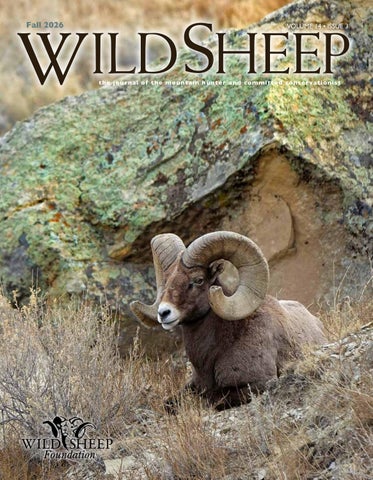
On the Cover: Photo: Victor Trujillo Colorado is home to thousands of bighorn sheep, spread across numerous herds from the Front Range to the western mountains and canyon country. For the past five years, I have had the pleasure of photographing and videoing this magnificent ram. I’ve affectionately named him “Sleepy” because the majority of the time I’ve seen him, he’s had his head resting on the ground like he was simply too tired to keep it up.
Two peas in a pod form a lasting hunting legacy.
56
Mountain Goat Mysteries by Chester Moore
Searching for answers in the high country.
56
66
The Anniversary Ram by Jaime Wisley
Celebrating a true marriage of passions.
66
78
What Food Should You Eat At High Elevation MtnTough Fitness Lab
The right foods in the right place at the right time.
78
88
Start With Eurogoats by Craig Boddington
Special Sections: 120 Convention Sponsors 123 2027 Auction Preview 144 Conservation & Service Awards 148 Annuli Photo Essay
46
88
Concerned about mountainflation? Eurasia might be your next hunt.
102
A Passion Worth Passing On by Chester Moore
102
How major gifts are helping secure the future of wild sheep.
110
Lucky Sevens
by Wayne Van Zwoll
110
From 1892 they reached stardom in the 1960s. Now fresh, frothy 7mms win at long range and on the hill. FALL 2026 ~WILD S HEEP® 3
®
the journal of the mounta in hunter a nd committed conservationist
Official publication of The Wild Sheep Foundation
WSF World Headquarters: 412 Pronghorn Trail • Bozeman, MT 59718 • 406-404-8750 Cody Office: 1285 Sheridan Avenue, Suites 260/275 • Cody, WY 82414 • 406-404-8750
OFFICERS AND DIRECTORS
INTERIM CHAIR: Kyle Stelter • kstelter@wildsheepfoundation.org....................... Term Expires 2028 SECRETARY: Jann Demaske • demaskes@msn.com.............................................. Term Expires 2026 TREASURER: Larry Jacobs • lljacobs4@aol.com....................................................Term Expires 2027 Clint Bentley • sheepspotr@aol.com.........................................................................Term Expires 2027 Bralli Clifford • bclifford@wildsheepfoundation.org.................................................. Term Expires 2028 Sam Cunningham • scunningham@wildsheepfoundation.org.....................................Term Expires 2027 Kevin Kehoe • kkehoe@wildsheepfoundation.org...................................................... Term Expires 2028 Larry Johns • ljohns@wildsheepfoundation.org......................................................... Term Expires 2028 Emilio Rangel W. • emiliorw@me.com • rangel@wildsheepfoundation.org.................Term Expires 2027 Logan Richard Young • loganyoung270@gmail.com............................................... Term Expires 2026
PRESIDENT & CEO Gray N. Thornton • gthornton@wildsheepfoundation.org
STAFF Gray N. Thornton • gthornton@wildsheepfoundation.org • Bozeman HQ PRESIDENT & CEO - EDITOR IN CHIEF, WILD SHEEP ® MAGAZINE:
Corey Mason, Chief Operating Officer & Executive Vice President of Conservation Certified Wildlife Biologist® cmason@WildSheepFoundation.org Carrollton, TX Kim Nieters, VP of Operations - Auction Director knieters@WildSheepFoundation.org Cody, WY Terry Ziehl, Finance Director tziehl@WildSheepFoundation.org Cody, WY Keith Balfourd, Director of Marketing & Communications keith@WildSheepFoundation.org Bozeman, MT Julie Tripp, Awards & Publications Director jtripp@wildsheepfoundation.org Lolo, MT Paige Culver, Development Manager pculver@WildSheepFoundation.org Bozeman, MT Maddie Richards, Membership Manager/ <1 Clubs Manager mrichards@WildSheepFoundation.org Bozeman, MT Karlie Slayer, Visual Communications Manager kslayer@WildSheepFoundation.org Missoula, MT Justin Phillips, Graphic Arts & Design Jphillips@wildsheepfoundation.org Cody, WY Megan Costanza, Banquets & Events Manager mcostanza@WildSheepFoundation.org Reno, NV
Mike Aiazzi, Expo & Exhibits Manager maiazzi@wildsheepfoundation.org Reno, NV
Pat Cummings, DNWR—NTTR Project Lead Patrickcummings1002@gmail.com Las Vegas, NV
Dr. Ryan Brock, Youth Education Coordinator rbrock@wildsheepfoundation.org Reno, NV
Paul Fuzinski – Content & Social Media pfuzinski@wildsheepfoundation.org Toledo, OH
Bill Jex, Thinhorn Sheep Program Lead RPBio BC bjex@wildsheepfoundation.org Smithers, BC
Ken Nowicki, Field Editor Chester Moore, Writer Ashley McEnroe, Writer Wayne van Zwoll, Contributor
CONTACT THE PUBLICATION
Aibat Muzbay, Central Asia Specialist – International Programs amuzbay@wildsheepfoundation.org Karaganda, Kazakhstan
GRAND SLAM® is a registered trademark of Grand Slam Club/Ovis. Used with permission.
Shane Mahoney, Special Conservation Consultant shane@conservationvisions.com St. John’s, Newfoundland Chester Moore, Content Creator chester@wildsheepfoundation.org Orange, TX
Steve Rosenstock, Grant Writer Certified Wildlife Biologist® steve@wildsheepfoundation.org Flagstaff, AZ
Greg Schildwachter, Columnist Morrison Creative Company, Inc. Magazine Design/Production
Advertising & Editorial Submissions Wild Sheep Foundation Headquarters 412 Pronghorn Trail, Bozeman, MT 59718 ATTN: Editor
Contributing photos, articles, stories, and research pertaining to wild sheep or the interests of the members of WSF are always welcome. Contributed material will be published at the editor’s discretion. Please include a selfaddressed stamped envelope if you wish materials to be returned. For more information on submission guidelines, meetings and convention information, and service, conservation and hunting award criteria, please visit our website at www.wildsheepfoundation.org. All membership dues include $28/year for a subscription to Wild Sheep® magazine.
PUBLISHED QUARTERLY BY THE WILD SHEEP FOUNDATION OF BOZEMAN, MONTANA, IN CONJUNCTION WITH MORRISON CREATIVE COMPANY, INC. OF LIVINGSTON, MT.
4 WILD S HEEP® ~ FALL 2026
DISCLAIMER While Wild Sheep Foundation strives to attract quality advertisers and donors, it cannot be responsible for the ultimate quality of the products which they may present to our members and buyers. Neither the Wild Sheep Foundation nor its Officers or Directors is a guarantor of your satisfaction with the products it makes available to you. Our dedication is to the wild sheep of the world and not to policing our advertisers or donors. We cannot, under the law, reject an advertiser or donation simply because of a prior complaint from a dissatisfied consumer. We will strive to make available quality merchandise and hunts, but without warranty or guarantee.
Scott Morrison, Editor & Designer, Wild Sheep® magazine scott@morrisioncreative.com Livingston, MT
Ashley McEnroe, Staff Writer aoliverio@gmail.com Big Sky, MT
Kevin Hurley, Vice President of Conservation —Emeritus Certified Wildlife Biologist® khurley@WildSheepFoundation.org Boise, ID Greg Schildwachter, Lobbyist greg@watershedresults.com Washington, DC Charlie Booher, Lobbyist Associate Wildlife Biologist® charlie@watershedresults.com Missoula, MT Kurt Alt, Conservation Director— International Programs altwildlife@yahoo.com kalt@wildsheepfoundation.org Bozeman, MT & Brussels, Belgium
The tradition began on a November weekend at Mt. Horeb, Wisconsin, in 1974. Thirteen wild sheep enthusiasts passed the time by sharing stories about their encounters with the majestic mountain creatures. After realizing how fortunate they were to have all shared such incredible experiences, they decided it was time to give something back. They forged FNAWS so men and women everywhere could get more involved in the positive management of wild sheep. It was incorporated as a non-profit corporation in Iowa on September 14, 1977, and began accepting paid memberships in 1978 as more people joined the cause. The commitment and noble spirit of FNAWS quickly helped the foundation become the fastestgrowing wildlife conservation organization of its kind.
WILD SHEEP FOUNDATION®, WSF, FOUNDATION FOR NORTH AMERICAN WILD SHEEP®, <1 CLUB®, <1 ICLUB, CHADWICK RAM SOCIETY®, MARCO POLO SOCIETY®, MOUNTAIN ROYALTY SOCIETY, LEGENDS SOCIETY, PINNACLE SOCIETY, TODAY, TOMORROW, & FOREVER FOR WILD SHEEP, FNAWS, CHRIS KLINEBURGER MOUNTAIN HUNTER HALL OF FAME AWARD®, PUTTING AND KEEPING WILD SHEEP ON THE MOUNTAIN®, SHEEP SHOW®, SHEEP WEEK®, SHEEP FEVER®, TAKE ONE PUT ONE BACK®, THE SHEEP SHOW®, RAM LAY-AWAY PROGRAM®, WILD SHEEP® MAGAZINE, COME FOR THE SHEEP, STAY FOR THE PARTY®, FULL CURL®, WIHI®, WOMEN HUNT®, WH®, WOMEN IN HUNTING®, WOMEN IN HUNTING INITIATIVE® and their respective logos are Registered trademarks and cannot be used, commissioned, or otherwise displayed without permission of the Wild Sheep Foundation.
Kevin Martin, USFS & BLM Planning Kevindmartin63@gmail.com Pendleton, OR
CONTRACT & CONSULTANTS
PRODUCTION STAFF Gray N. Thornton, Editor in Chief Julie Tripp, Editor Scott Morrison, Art/Design Director Justin Phillips, Graphics/Design
Maureen Jefferson, Conservation Permits Jm_hullinger@sbcglobal.net Las Vegas, NV
Jaime Teigen, E-Commerce & Office Administrator jteigen@wildsheepfoundation.org Bozeman, MT Rebecca Anne Tuthill, Assistant (PT) rrebrovich@wildsheepfoundation.org Bozeman, MT Margie Forster, Registration Assistant (PT) mforster@wildsheepfoundation.org Reno, NV Morgan Stuart, Development Asst. & Program Coordinator (PT) mstuart@wildsheepfoundation.org Bozeman, MT
The Wild Sheep Foundation’s mission is to enhance wild sheep populations, promote scientific wildlife management, and educate the public and youth on sustainable use and the conservation benefits of hunting while promoting the interests of the hunter.
Wild Sheep® (ISSN: 2329-7891), USPS Publication #009-460, is published quarterly for $28 a year by Wild Sheep Foundation, 412 Pronghorn Trail, Bozeman, MT 59718. Periodical Postage Paid at Bozeman, MT and at additional mailing offices. POSTMASTER: Send address correction to Wild Sheep Foundation, 412 Pronghorn Trail, Bozeman, MT 59718.
IT JUST KEEPS HAPPENING. NO MATTER THE HUNTER, DISTANCE, CARTRIDGE OR ANIMAL, THE TERMINAL ASCENT™ STORY ALWAYS ENDS THE SAME.
15 Yards 85% Weight Retention 300 Win. Magnum Moose
160 Yards 96% Weight Retention 6.5 PRC Whitetail Deer
400 Yards 91% Weight Retention 7mm Rem. Magnum Elk
997 Yards 99% Weight Retention 300 Win. Magnum Oryx
CONSISTENTLY TERMINAL
©2026 Federal Ammunition
NOW AVAIL ABLE IN
T HE MO S T A DVA NC ED 7MM C A R T R IDGE
BUY NOW AT F E D E R A L P R E M I U M . C O M FALL 2026 ~WILD S HEEP® 5
MISSION STATEMENT Vision Our desired future state
To be the best managed, most respected, influential, and relevant conservation organization benefitting wild sheep worldwide.
Purpose Why we exist
To Put and Keep Wild Sheep on the Mountain.
Mission What we do
We enhance wild sheep populations and their habitats, promote scientific wildlife management, and educate the public and youth on sustainable use and the conservation benefits of hunting while promoting the interests of the hunter.
Values The principles that guide us
Honesty Integrity Respect for Others
Teamwork Positive Attitude Respect for Wildlife Hunting Ethics
Accountability Stewardship Loyalty
Putting and Keeping Wild Sheep on the Mountain Since 1977 6 WILD S HEEP® ~ FALL 2026
Photo: Travis Foell
BRIKSDAL MTN SF GORE-TEX ® ~
Vibram®
~
FLEX
5
See the full CRISPI® mountain boot lineup at CRISPIUSA.COM
HANDMADE IN ITALY ~ PROVEN IN NORTH AMERICA FALL 2026 ~WILD S HEEP® 7
Only at KUIU
LIFETIME WARRANTY ON ALL OUR GEAR
BASE LAYERS | INSULATION | OUTERWEAR | PACKS | SLEEP SYSTEMS | FOOTWEAR | ACCESSORIES
8 WILD S HEEP® ~ FALL 2026
FALL 2026 ~WILD S HEEP® 9
PRESIDENT’S MESSAGE by Gray N. Thornton President & CEO
F
THE 50TH IS SOON UPON US
all brings a number of changes, the turning leaves, the cooling weather, the rut in many locales, bighorn seasons in many jurisdictions, and a full-on focus towards the next Sheep Show®. Admittedly, WSF staff and our volunteers have been hard at it for the 50th Anniversary Wild Sheep Convention for more than a year now and the early preparation is paying off. Our 50th is shaping up to match the hype and with the anticipated member support it will surpass all expectations and all our previous conventions to date. Registration went live in midAugust and we will sell out for our banquets soon. Please do not delay in registering online—we want you to attend and enjoy your 50th celebration! Click on the code below to bring you to the registration portal.
The 50th imagery, graphics and short films will be a reflection of 50 years of wild sheep conservation, restoration, advocacy, the FNAWS/WSF family, as well as those who built it to what it is today. But as we celebrate and recognize the past, we will also focus 10 WILD S HEEP® ~ FALL 2026
on the future of wild sheep and the Wild Sheep Foundation itself and how we can ensure the health of both of their futures. WSF exhibitor, donor, and sponsor generosity thus far has been exceptional and demonstrative of the 50th celebration. Our auction line-up will be best-in-class, and as I noted in the summer issue, the Sheep Show® Raffle this year is unmatched as the Ultimate Mountain Hunter’s
Raffle with thirteen sheep and goat/ibex offered to date. Check out the promotion on page 85 of this issue. Many will sell out, so don’t delay. You can reserve your tickets by calling our offices to ensure you’re in the drawings. Over the summer, the board of directors approved a fiscal year budget which includes nearly $5 million in Grant In Aid, education, outreach, and advocacy mission programs in our operations
budget. Added to our anticipated $7 million dollars directed to our state, provincial and tribal agency partners through 2027 convention conservation permit sales, WSF will direct more than $12 million in Mission Program Funding this fiscal year. A milestone our founders in 1977 could have never dreamed of reaching. Our founders also could not have dreamed of how we would support that level of conservation funding. Without question the success of our convention over the past decade-plus has enabled a great deal of this funding support. However, two additional areas of fundraising focus, our development activities, including our giving societies and major gifts, and our conservation grant solicitation from partners have more than equaled the annual convention in our ability to fund at best in industry levels our purpose to Put and Keep Wild Sheep on the Mountain®.
Our recent 2025-2026 fiscal year set two new records. Our 2026 Sheep Show® set an all-time record for WSF convention fundraising. And equally impressive, we set a new record for non-convention related fundraising (development and grants) at an incredible 1.5 times our record 2026 convention net. Why is this significant? It ensures that WSF is not a onetrick pony and does not solely depend on the annual convention for our ability to fund mission programs. It gets WSF that much closer to my stated goal to our leadership 18 years ago to “endow” the foundation, just like a university. And finally, it fully ensures WSF is fiscally strong to keep funding the wild sheep conservation and hunting heritage preservation programs our membership expects, at levels not seen anywhere else in our industry, not only Today, and Tomorrow, but Forever. In this issue, WSF’s award
winning writer Chester Moore interviewed five altruistic wildlife philanthropists, Lee Anderson, Matt Tomseth, Jimmy John Liautaud, Kevin Rinke and Stanford Atwood who collectively have given an exceptionally generous $9 million to WSF and WSLF to help endow our ability to fund conservation now and forever. It is their hope that their generosity will inspire other WSF members, and other wildlife philanthropists, to follow their example and lead. Enjoy this issue of Wild Sheep® and good hunting this fall. WS
Gray N. Thornton President & CEO, Wild Sheep Foundation Editor-in-Chief, Wild Sheep® magazine Marco Polo Society® Member Summit Life Member Chadwick Ram Society® Member Legacy Society Member Summit Life Member
FALL 2026 ~WILD S HEEP® 11
Pair with MYSTERY RANCH GAMEBAG
CONQUER THE PACKOUT
LOADHAULING PACKS Built on our Guide Light MTTM Frame, these packs allow you to push the weight limits of what’s humanly possible on any packout. explore more at:
mysteryranch.com 12 WILD S HEEP® ~ FALL 2026
FALL 2026 ~WILD S HEEP® 13
CHAIR’S CORNER by Kyle Stelter Chair
T
MAKING CONNECTIONS
his is the time of year when our conservation staff, supported by our professional resource advisory board, are working hard behind the scenes reviewing roughly forty requests totalling nearly $4 million in Grant in Aid submissions. Earlier this month, your board of directors approved our budget, with $2 million going to Grant in Aid and a further $200,000 allocated to out-of-cycle GIA requests where wild sheep need our help outside our normal intake window. We are calling this our Conservation Impact Fund, and it is an exciting new opportunity to support the wild sheep resource. This time of year, is also special for me, as many of our members and supporters are spending time out on the landscape. I leave on a Stone’s sheep hunt tomorrow, and this is always an opportunity for me to disconnect from the grind of dayto-day life and reconnect with the natural world. That connection is what brought me to our wild sheep family. Seeing that first ram, lamb, and ewe feeding in a high-elevation bowl is the kind of experience that keeps me focused on ensuring we do all we can to support something incredibly important to me and to each of our 11,000 members. Our 50th anniversary is now only months away, and the entire Wild Sheep Foundation community is hard at work ensuring Sheep Show® 2027 is one for the books. Fifty years is no small feat, and we 14 WILD S HEEP® ~ FALL 2026
should celebrate it. While we look back on our past and the many accomplishments achieved along the way, for me this milestone is even more about the future. I am thinking about the next fifty years and what we will need to do to ensure wild sheep are stronger than ever. When we look back, bighorn sheep populations were struggling in the 1960s, with estimates suggesting fewer than 25,000 existed in North America. Today, data shows that number exceeds 85,000. One could argue we are doing a pretty good job. But can we do better? I believe we can, and I believe we should. I want to challenge each and every one of our 11,000 members to join me in that effort. If there was ever a time for reflection and for collectively putting our shoulder to the wheel, our 50th is it. Imagine the impact if each of us made one small contribution to the greater good of wild sheep: recruiting one member, making a modest contribution, volunteering our time, or helping in some other way. Small contributions add up to something very big. As a collective, we are incredibly impactful, and together we can take wild sheep conservation to the next level. I also want to recognize those who consistently go the extra mile for wild sheep. We have a cadre of dedicated volunteers who show up day in and day out in support of our mission: our directors, professional resource advisory board members, Sheep Show®volunteers, Wild Sheep Legacy Foundation Trustees,
committee members, and countless others you may rarely see, but who are always there Putting and Keeping Wild Sheep on the Mountain®. Wild Sheep Foundation staff are also at the heart of this organization, executing on our mission 365 days a year. We have an incredibly dedicated, hardworking team of professionals who ensure we are effective in delivering on that mission. I cannot thank them enough for their commitment to wild sheep and for showing up day after day in support of our goals. You may have heard me speak before of one family, one mission, and the future of wild sheep. We are a family, and we are deeply missionfocused. I am asking all of us to come together as we celebrate fifty years of wild sheep conservation. Sheep Show® 2027 is going to be one for the books, but let’s remain focused on what connects us: the wild sheep themselves. That ram, lamb, or ewe on the ridgeline needs us, and together we have made, and can continue to make, a difference. As we reflect on the many successes of the past fifty years, let’s also turn our minds to the next fifty. What are we willing to do? I doubt our thirteen founders could have envisioned what the foundation would become when they started this great organization. What might it look like fifty years from now? What we do today will help determine the answer. WS
Kyle Stelter
©KENETREK, LLC 2026
• 10” Tall Premium Leather Uppers • 400 Grams Thinsulate Insulation or Non-Insulated • Waterproof/Breathable Membrane • High Traction K-Talon™ Outsoles
WWW.KENETREK.COM
VISIT US ON SOCIAL
Built for unyielding traction, support and comfort in the most rugged terrain and weather. Thick leather uppers wrap around supportive nylon midsoles, on top of high traction outsoles. Bottom line: They make it possible to get anywhere you need to go in total comfort.
800-232-6064
WWW.KENETREK.COM 15 W S FALL 2026 ~
ILD HEEP®
BIOLOGIST’S CORNER - NORTH AMERICA by Kevin Hurley WSF Vice-President of Conservation – Emeritus WSF Grant-in-Aid (GIA) Coordinator
YET ANOTHER TRIP AROUND THE SUN
A
s I’ve written in this column before, in the wildlife world, patterns and cycles are welldocumented and often predictable. Some, you might be able to set your watch to. Sea turtles dragging themselves up a far-off beach to lay and bury their eggs. Sandhill cranes making their way toward northern latitudes, singing and dancing along their route. Bull elk bugling to the world, emphatically announcing they are the toughest and most desirable stud in the woods. In the wild sheep conservation NGO world, there are patterns and cycles, as well. For the Wild Sheep Foundation, every August, our conservation staff and our professional resource advisory board (PRAB) repeat our traditional grantin-aid (GIA) process, reviewing and evaluating wild sheep conservation funding requests from around the globe. This past spring, WSF refreshed our Conservation Vision 2025 to a new version, aptly titled Conservation Vision 2030. Concurrent with that refresh, WSF also updated our GIA Priorities document to help guide wild sheep conservation projects that address our mission and purpose, and truly “move the needle” for wild sheep. During July 2026, 40 proposals from around the globe and 16 WILD S HEEP® ~ FALL 2026
throughout North America were electronically submitted via our Good Grants portal. Promptly after midnight July 31st, WSF conservation staff downloaded these funding requests, then disseminated them internally not only to WSF staff but also to our PRAB members and made them available to the WSF Board for their review. Almost $4 million was requested in GIA applications this cycle, double the $2M available. Tough choices on which projects would receive funding had to be made, again. As I write this column in early September, more than 15 WSF folks have done their deep dive into these funding requests. By mid-September this year, our all-volunteer WSF Board will have made their decision on which wild sheep conservation projects received WSF funding. By the time this issue of Wild Sheep® magazine hits your mailboxes, another batch of wild sheep conservation projects will have been funded. Once the WSF Board made their final funding decisions, grant recipients were promptly notified so they could move forward with project planning, including ordering and programming GPS radio-collars, lining up storage tanks for guzzler builds/renovations, scheduling helicopter flight time and net-gun capture crews, obtaining necessary laboratory supplies, soliciting and securing volunteers to assist wild sheep managers with a variety of tasks, and
ordering the equipment/materials needed to implement their projects, on far-flung mountain ranges and in labs around the globe. The pattern continues; the cycle spins. When you sign up as a WSF member, upgrade your membership level when possible, drag a friend or two to the Reno Sheep Show®, buy a handful of raffle tickets, throw your hand up at one of our exciting auctions, or take a youth outdoors with you as you enjoy conservation/ hunting experiences, you help keep this GIA funding cycle spinning. Without our generous members, donors, volunteers, exhibitors, wild sheep conservation stakeholders, agency/ministry partners, private landowners, tribal/First Nation reps, students (from grade school to grad school!), and untold supporters, the Wild Sheep Foundation “top” would simply stop spinning. Thinking back to my high school physics classes, a famous quote from Sir Isaac Newton says “…a body in motion tends to stay in motion unless acted on by an outside force.” Also known as the Law of Inertia, Newton’s First Law of Motion is also applicable to WSF’s Mission and Purpose. Thank you all for providing the energy, funding, and support to keep our wild sheep conservation world spinning. As we approach our 50-year mark, the Wild Sheep Foundation will keep moving forward, with your help. WS
FALL 2026 ~WILD S HEEP® 17
BIOLOGIST’S CORNER - INTERNATIONAL by Kurt Alt Conservation Director and Aibat Muzbay, Central Asian Specialist, International Programs
A NEW FUTURE FOR KAZAKHSTAN’S WILD SHEEP
H
igh in Kazakhstan’s mountains and across its windswept steppe, one of the world’s most impressive wild animals still roams—argali. With its massively-curled horns and remarkable ability to survive in some of Central Asia’s toughest landscapes, the wild sheep is an enduring symbol of the region’s natural heritage. Now, a new partnership aims to help secure its future. The Committee of Forestry and Wildlife of the Ministry of Ecology and Natural Resources of the Republic of Kazakhstan and the Wild Sheep Foundation (WSF) have signed a memorandum of understanding to strengthen cooperation on wild sheep conservation, scientific research and wildlife management. The agreement brings together Kazakhstan’s wildlife authorities and WSF’s international conservation expertise around a shared goal: ensuring that wild sheep populations—and the mountain ecosystems they depend on—remain healthy and resilient for generations to come.
Science Meets Conservation
The partnership will focus on practical conservation backed by modern science. Researchers and wildlife managers plan to use tools such as satellite telemetry, GIS mapping, remote sensing and standardized field surveys to better
18 WILD S HEEP® ~ FALL 2026
understand how wild sheep move, where they live and what pressures they face. These technologies will reveal migration routes, population trends and habitat changes that are difficult to observe from the ground. They can also help scientists understand genetic diversity and identify the factors most important to the long-term survival of wild sheep. Among the most ambitious ideas is the development of an argali relocation project—the first initiative of its kind in Central Asia—to expand the distribution of Karatau argali (Ovis ammon nigrimontana) beyond its current range to ensure its long-term survival. By carefully applying scientific knowledge and international experience, the project will become an important model for wildlife conservation for Central Asia.
Investing in People
Conservation depends as much on people as it does on technology. The agreement will encourage exchange visits, field training and professional mentorship between specialists from Kazakhstan and the United States. Wildlife managers, researchers and conservation-area staff will have opportunities to share experience and develop new skills. The goal is to strengthen the capacity of the people responsible
for studying and conserving wildlife on the ground. Modern monitoring tools and better data are valuable, but their greatest impact comes when trained professionals can turn information into effective action.
Finding Long-Term Support Another major challenge is funding. Wildlife conservation requires sustained investment in research, monitoring, habitat management and professional training. The central idea is simple: successful conservation needs reliable, long-term financial support. The memorandum commits to developing and implementing reliable funding mechanisms including carefully regulated, science-based sustainable-use, including conservation permits where permitted by law and consistent with conservation goals. The parties also intend to explore support from international grants, charitable foundations and other lawful funding sources.
Facing a Changing Landscape
Wild sheep today face a changing world. Climate change, habitat degradation, fragmented landscapes and the spread of disease across borders can all place additional pressure on wildlife populations. Conserving a species also means protecting its habitat, understanding its movements and responding to new threats as they emerge.
That is why the partnership emphasizes adaptive management —using scientific evidence to guide decisions and adjusting conservation strategies as new information becomes available.
Looking Beyond the Mountains
The partnership also recognizes that wildlife conservation extends beyond scientists and government agencies. Future cooperation will include environmental education, public outreach and the involvement of local communities. People who
live and work with wildlife play a critical role in protecting the landscapes around them. For the first five years, the memorandum will focus on the goals outlined above. Once these objectives have been achieved, WSF and Kazakhstan will jointly define new priorities to ensure the long-term health, conservation, and sustainable management of wild sheep populations, while further strengthening cooperation between the two parties. For Kazakhstan, home to some of Central Asia’s most important mountain ecosystems,
WSF’s Legacy Society recognizes individuals, families and foundations making testamentary bequests or contributions of major gifts, gift annuities or other charitable-giving instruments. Since inception of the Ensuring the Future of Wild Sheep (ETFOWS) campaign, 54 Legacy Society members have been recognized through WSF’s Legacy Society for contributions or pledges of future gifts. Bequests made through the New Beginnings Campaign* or other bequests may be recognized through the Legacy Society by contacting WSF. For more information on the Legacy Society or Estate Planning resources available through WSF, please contact: Paige Culver - 406.404.8758 pculver@wildsheepfoundation.org Gordon L. Nelson, CPA, CFP® - 435.213.9986 giftplanning@wildsheepfoundation.org
the partnership represents more than a formal agreement. It is an opportunity to combine local knowledge, modern science and international cooperation in support of one of the region’s most remarkable species. The argali has survived for centuries in some of the harshest terrain on Earth. The challenge now is to ensure that, in a rapidly changing world, it continues to thrive. With science, collaboration and long-term commitment, Kazakhstan and the Wild Sheep Foundation hope to help make that future possible. WS
Anonymous Anonymous Lee & Penny Anderson Jack, Jr. & Cindy Atcheson Derek Blake Derek W.O. Berry Mike Borel Cabela’s Outdoor Fund David W. Campbell Rick & Heather Carosone Dr. Robert W. & Cynthia Cassell David & Sona Combs Monty & Becky Davis Howard & Mary Deters Doug & Patty Dreeszen Buddy DuVall Tom Grimes Eric & Sue Hansen Robert & Arlene Hanson John Harris Dr. Paul F. & Kathy J. Havey Zach & Amber Higgins Craig & Janet Johnson John R. & Mary Ann Justus Kevin & Eileen Kehoe Blair A. & Victoria M. Kenewell Robert M. Martin, Jr. Robert and Lisa Mays Roger McCosker Shannon & Kim Meadors
Kyle & Joanne Meintzer Chuck Middleton David Mode Gordon Nelson John & Leslie Pearson Brad R. Plaga Robert L. & J.P. Puette Kevin & Janine Rinke Lanny Rominger Louis & Pauline Rupp SCI Foundation - Hunter Legacy Fund (HLF-100) Roger Segebrecht Kasie and Jason Sheridan Tim & Roxane Shinabarger Steve & Sue Skold Curt & Marcia Thompson Steve & Carrie Thompson Gray & Renée Thornton Jim Travis Tim & Ruth Van Der Weide The Estate of Robert B. Johnson Zachary Walton Wayne W. Webber The William H. Donner Foundation, Inc *New Beginnings Campaign was the FNAWS Capital Endowment Campaign conducted 1998-2003. FALL 2026 ~WILD S HEEP® 19
SHEEP STATS RANGE-WIDE STATUS OF BIGHORN AND THINHORN SHEEP IN NORTH AMERICA In this installment of Sheep Stats, we’ll be covering three states—Montana, Nebraska, and South Dakota, which all hold Rocky Mountain bighorn populations. To accommodate magazine page counts some charts and graphs are not shown. Click on the QR code above to download the complete 2025 Range-wide Status of Bighorn and Thinhorn Sheep in North America PDF.
NEBRASKA
Nebraska isn’t the first place that comes to mind when you think of wild sheep—but it should be. Before bighorns were extirpated in the early 1990s, about 1,000 bighorns, thrived in the Pine Ridge and Wildcat Hills of the Nebraska Panhandle. Unregulated harvest, habitat loss, and disease led to their disappearance. Today, thanks to Nebraska Game & Parks and partners including the Wild Sheep Foundation, Iowa FNAWS, Nebraska Big Game Society, and Midwest WSF, bighorns are back. Through multiple translocations from Montana and Alberta, herds are growing once again. 20 WILD S HEEP® ~ FALL 2026
Scan code to listen to Sheep Fever Episode 89 where Gray N. Thornton sits down with Todd Nordeen to discuss Nebraska’s bighorn history, the comeback, ongoing challenges, and the path forward to return to 1,000 animals—while also diving into source stock, captive breeding at Ft. Robinson State Park, and future disease management efforts.
NEBRASKA
Rocky Mountain Bighorn Sheep Populations
The Rocky Mountain bighorn sheep (RMBS) population consists of 5 herds totaling approximately 226 (2024) sheep in two separate regions (Pine Ridge and Wildcat Hills) of western NE. After a nearly 100-year absence to the state, 1981 marked the first of five reintroductions to establish bighorn sheep into their historic habitats. Over the past 10 years, RMBS numbers have declined by about 40% (Figure 1). From 1981 to present, Nebraska has conducted five translocations of approximately 175 RMBS. One internal translocation was conducted in 2014. Other translocations are being considered in unoccupied habitats as RMBS become available for transplant.
greater lamb recruitment in some regions. More recently, bighorn sheep captures took place in Sep 2022 and Feb 2023-2025 experimenting and evaluating three different Mycoplasma ovipneumoniae (MOVI) detection
methods. These included the standard lab tests through the Washington Animal Disease Diagnostic Laboratory (WADDL) as well as the Biomeme field testing unit and Working Dogs for Conservation. While there
Licenses and Harvest
Since 1998, 38 rams have been harvested in Nebraska with a success rate of 100%. Permits typically consist of one auction permit and one Nebraska resident lottery permit. Any sheep (ram or ewe) is allowed for harvest but only rams have been taken thus far. In, 2025, a management hunt was implemented with two rams that were half-curl or less harvested.
Test & Remove
Over the past few years, the test and remove method has been implemented in three of the five herds showing some initial positive results with FALL 2026 ~WILD S HEEP® 21
Figure 1. Bighorn sheep population estimates.
Table 1. Percentage of bighorn sheep that tested positive for MOVI (WADDL PCR on nasal swab) and percentage seropositive for MOVI (WADDL cELISA); Pine Ridge and Wildcat Hills regions of Nebraska, USA, 2022-2025. 2025 data include captures and two harvested rams at Cedar Canyon.
was not a 100% percent match between methods, having infield results with possible MOVI detections did allow for more immediate management decisions to be made. Initial plans to transplant some of these captured sheep from this previously clean herd were put on hold until further evaluations can be made. Below are comparisons amongst 22 WILD S HEEP® ~ FALL 2026
WADDL and the Biomeme unit from the Hubbard’s Gap and Cedar Canyon herds in Nebraska’s southern panhandle. Dr. Kate Huyvaert, Washington State University, conducted Biomeme testing and results analysis. Evaluation from the Working Dogs for Conservation is ongoing. In 2024, comparisons continued to be made but
additional Biomeme restrictions limited its use. Disease testing will continue with each herd through future helicopter captures, darting, and mortalities, along with plans to fill unoccupied habitats with RMBS sheep from clean herds. WS — Todd Nordeen, Nebraska Game & Parks Commission
Figure 1. Distribution of RMBHS within MT state jurisdiction and associated hunting districts.
MONTANA
Rocky Mountain Bighorn Sheep Populations
Rocky Mountain bighorn sheep (RMBHS) in Montana suffered widespread population reductions during the late 19th and early 20th centuries. Subsequently, various conservation measures were initiated and RMBHS populations stabilized with estimates by 1950 at approximately 1,200 sheep throughout the state. Beginning in the middle part of the 20th century and continuing over the next several decades, significant translocation and management efforts were completed to help re-establish and/or improve population levels and increase distribution (Figure 1). To date, approximately 3,000 RMBHS
Figure 2. Population estimates are derived via professional biologist data and judgment and not a rigorous, statistical enumeration process. Prior to 2010, statewide population estimates include all known wild sheep within the boundaries of the state (including Glacier National Park). Beginning in 2010/2011, estimates include sheep within only MT state jurisdiction. Beginning in 2018, population estimates are completed every other year. Long-term average is calculated using data from 2010-2024 for ram harvest percentages and 2012-2024 for ewe harvest percentages. FALL 2026 ~WILD S HEEP® 23
Figure 3. Cumulative number of applicants for limited either-sex/legal ram/any ram license types and associated annual percent successfully drawn.
have been translocated in MT (including out of state transplants) to augment and/or re-establish populations. Montana currently completes statewide population estimates every two years and as of 2024, RMBHS population estimates comprises just over 4,700 sheep (Figure 2). The recent average (2010 to present) estimated state population is just under 5,500 sheep.
Licenses and Harvest
Montana has 36 RMBHS hunting districts (HDs) providing
opportunity for limited either-sex/ legal ram/any ram, unlimited legal ram (quota areas), and adult ewe license permit types. Montana’s primary bighorn sheep hunting seasons include a limited archeryonly season in early September (excludes three unlimited areas) and a general season (archery or rifle) that is open September 15 through the last weekend in November. For 2024, 79 limited either-sex or legal ram licenses were allocated. Recent average (20102024) statewide limited eithersex/legal ram license drawing
Figure 4. Montana bighorn sheep ram and ewe license allocation and subsequent harvest, 2010 – 2024. 24 WILD S HEEP® ~ FALL 2026
success rates is 0.56% and 0.13% for residents and nonresidents, respectively (Figure 3). On a statewide level, there continues to be increased interest for this hunting opportunity yet cumulatively maintained or decreased license allocation (variety of reasons), ultimately leading to decreased odds of drawing over time (Figure 3). This is especially true for the 2024 hunting season in which cumulative limited either-sex/ any ram licenses allocated were the lowest in many years (Figure 4). Decreased drawing odds is especially true for resident applicants (nonresidents are capped at a constant allocation rate of not more than 15% of licenses available). For example, in the 2014-2016 period, just over 19,000 residents vied for an average of 114 available limited licenses compared with over 30,000 applications for 73 licenses in 2024 (Figure 3). A reduction from 0.59% to 0.24% drawing success rate. Similarly, applications for adult ewe hunting opportunities continue to increase while statewide license allocation has become more limited. In 2016 (the peak of recent statewide adult ewe license allocation levels), 599 residents vied for 183 available limited adult ewe licenses compared with 802 applications for 47 licenses in 2024. A reduction from 33% to 6.5% drawing success rate. Average annual statewide either-sex limited license harvest success rates are over 95%. Five HDs in Montana provide unlimited legal ram hunting opportunities managed through individual quotas. 2024 harvest data portray a 3.6% harvest success (all five HDs combined) for these license holders (n=387 via drawing). The annual statewide average age of harvested rams is consistently a little over seven
years old. Limited adult ewe hunting opportunity is currently available in five HDs with a total of 50 licenses that were available for the 2024 season. Recent annual average statewide harvest success rates for adult ewe licenses are just under 56% (Figure 4). Adult ewe hunting opportunity is an ongoing balance correlated with other population/distribution control measures where necessary (i.e., translocation work).
Disease and Herd Health
Respiratory disease outbreaks involving RMBHS within state of Montana jurisdiction is an ongoing concern among several populations. There are several herds that continue to recover from more recent disease and dieoff episodes over the last decade or more, with some herds (not all) showing improved progress towards population stability and/ or recovery. As such, several RMBHS herds in Montana are below population objective. For many of these areas, monitoring and/or recently completed or ongoing research is occurring to better understand and inform future management direction. The following are more specific and most recent health related concerns for a few of Montana’s RMBHS populations: • During the winters of 2020 and 2021 a total of 84 bighorn sheep were translocated within Montana from near the Missouri River to the Little Belt Mountains. Sheep began presenting respiratory disease (pneumonia) symptoms in April 2021 and a total of 14 were confirmed to have died. Other translocated sheep exhibited symptoms but later recovered. The exact degree to which subsequent lamb survival was impacted is unknown, but biologists have observed successful lamb recruitment
during 2022, 2023, and 2024. All translocated sheep were fitted with GPS collars, and no commingling of BHS and domestic sheep was detected prior to the disease outbreak. Predation, primarily by mountain lions, remains the predominant cause of mortality in this reintroduced herd. • A disease event occurred in bighorn sheep subherds within the Upper Yellowstone drainage during winter 20232024. Thirteen carcasses were detected and sampled. Although necropsies appeared to show some classic pneumonia symptoms, detection of MOVI was inconsistent and only found in a single animal. Approximately 3-4 additional carcasses were found during the spring by members of the public; these animals likely died in December/January and may have also been involved in the disease event. Lamb and ewe numbers remained relatively robust in spring 2024 and no additional disease has been observed since. • A pneumonia event occurred in January-February 2025 in the Mill Creek herd, an unhunted population that winters on the east side of Paradise Valley. At least 13 mortalities occurred, primarily within a ram subherd. MOVI was detected in some, but not in all the mortalities that were examined. Additional test results and population monitoring are pending. Currently it appears that most of the ewes and lambs were unaffected. • The easternmost population of bighorn sheep in the Missouri River Breaks Complex of Montana has had a major die off. During the Winter 2024 survey, 121 total sheep were observed during aerial winter surveys producing 43 lambs/100 ewes, 25% below the long-term average
but not indicative of collapse. However, sheep hunters reported seeing 88% fewer sheep during the fall of 2024, and harvested rams were in noticeably poor condition. Lung samples from harvested sheep indicated respiratory disease and a nasal swab from a harvested ram tested positive for MOVI. In March 2025, only five rams were observed during an aerial survey. One of which died during observation. Lab results for that ram are still pending, but it had obvious signs of severe respiratory disease. On March 31, 2025, the Fish and Wildlife Commission closed all hunting in this bighorn sheep hunting district for the upcoming fall season. In winter of 2023/2024, Montana Fish, Wildlife & Parks formally began new statewide research projects aimed at 1) better understanding how various management regimes influences RMBHS population dynamics within select herds across the state and 2), improve our understanding of the factors that influence the probability of wild and domestic sheep/goat contact, and to use that information to further explore tools to maintain effective separation and prevent disease-related issues for both wild and domestic animals. These projects are large collaborative efforts with the University of Montana, Montana State University, Montana Woolgrowers Association, Montana Wild Sheep Foundation, private domestic sheep producers, private landowners and others. Through fall 2024, a suite of data has been collected from 25 domestic sheep/ goat producers and six RMBHS study herds. Both projects are scheduled to take place over a fiveyear period (through 2028).
Test and Remove
Currently, the Highland Mountains RMBHS population is FALL 2026 ~WILD S HEEP® 25
undergoing a multi-year research effort to better understand ongoing impacts of disease and general herd health since their initial die-off 30 years ago. A before-after analysis of ewe and lamb survival and/ or MOVI prevalence is being employed where the pre-removal monitoring (years 1-3) consist of pre-treatment testing of individuals to identify chronic shedders (two or more consecutive positive test
results for MOVI), estimate vital rates and cause-specific mortality. The first round of chronic shedder removals occurred in during winter 2024/25 (two died from natural causes and five were removed in fall, 2024) and correlations to lamb survival and overall population performance will be evaluated. The project is currently in year four and further monitoring and any necessary removals is proposed to
occur over the next two to three years. A total of 62 more sheep were heli-captured and tested in winter 2024/25. Lab results from this winter’s sampling are pending. Removal of additional chronic shedders will occur as needed in late summer 2025. WS — Submitted by Brent Lonner, Montana Department of Fish, Wildlife and Parks
SOUTH DAKOTA Rocky Mountain Bighorn Sheep Populations
The Rocky Mountain Bighorn Sheep (RMBS) population consists of six herds totaling approximately 282 sheep scattered throughout western SD. Bighorn sheep were numerous on the prairies of western SD and the Black Hills before their extirpation in the late 1890s. United States Senator Peter Norbeck orchestrated their reintroduction in the early 1920s, and this began a conservation success story where bighorn sheep once again occupied their native habitats in SD. Unfortunately, bighorn sheep populations have fluctuated greatly since their reintroduction in the 1920s, most likely due to pneumonia-related mortality (Figure 1).
Licenses and Harvest
Going back to 1978, licenses offered have varied from 2 to 11. Harvest since 1978 has been at a success rate of 100%. Permits typically consist of one auction permit and several South Dakota resident random draw permits. Rams are only allowed for harvest. Ewe hunts can be implemented when deemed necessary.
Test & Remove
Unfortunately, researchers in
26 WILD S HEEP® ~ FALL 2026
Figure 1. 2014-2025 bighorn sheep population estimates.
SD have documented bighorn sheep disease die-offs in five populations related to pneumonia from MOVI since 2004. To recover these populations SD has implemented the test and remove method in all five populations. In two of the populations (Custer State Park and Rapid City herds) this method has successfully removed the MOVIpathogen and allowed lamb survival to recover to normal levels. In the most recent population (Hell Canyon),
test and remove was just initiated in 2024. The test and remove method was important in reducing pneumonia related mortality in both adults and lambs and allowed recovery in two populations (Garwood et al. 2020, Ensrud 2022, SDGFP unpublished data). WS — Chad Lehman, South Dakota Department of Game, Fish, and Parks
FALL 2026 ~WILD S HEEP® 27
TODAY, TOMORROW, FOREVER FOR WILD SHEEP ®
by Paige Culver WSF Development Manager
THE NEXT 50 YEARS: THE POWER OF TRANSFORMATIVE GIFTS
T
“Our responsibility, and our opportunity, is to make sure our future conservationists inherit something extraordinary.”
here’s something about a 50th anniversary that makes you stop and think. Where did we start? How did we get here? Who helped us along the way? But lately, I’ve found myself thinking less about the last 50 years and more about the next 50. As the Wild Sheep Foundation prepares to celebrate this incredible milestone, we have a lot to be proud of. What started with a relatively small group of people who cared deeply about wild sheep has grown into an organization with a reach and impact I’m not sure those early members could have imagined. And none of it happened overnight. It happened one project at a time. One partnership at a time. One mountain range at a time. And, very often, one generous person at a time. Throughout our history, people have stepped forward when something needed to be done. They funded real work. They helped put sheep back on mountains. They invested in habitat, disease research, and education and advocacy. They believed in ideas before anyone knew for certain how those ideas would turn out. Some gifts helped us accomplish something important. Others changed what was possible. To me, that is what makes a gift transformative. It isn’t necessarily a dollar amount. It’s what happens
28 WILD S HEEP® ~ FALL 2026
because someone was willing to give. A transformative gift might allow us to answer a question that biologists have been wrestling with for years. It might put sheep back on a mountain where they haven’t existed for generations. It might give a young person an experience that eventually leads them to a career in wildlife conservation. And sometimes, it simply gives us the ability to say “yes” when an extraordinary opportunity presents itself. I’ve also been thinking a lot about the word “legacy”. We talk about legacy with our members and donors all the time. What do you want to leave behind? What do you want your life’s work and success to mean beyond your own lifetime? What do you want to make possible for people you may never meet? But here’s the thing: those aren’t questions just for our donors. We should be asking them of ourselves, too. What is the Wild Sheep Foundation building right now that will still matter 50 years from now? What are we putting in place that the next generation of conservation leaders can pick up, carry forward and—hopefully—make even better? That’s our legacy. Our job isn’t simply to address the conservation challenges sitting in front of us today. It’s also to leave the next generation with more than
we had. More knowledge. Better science. Stronger partnerships. Greater resources. A stronger organization. And maybe even a few problems they don’t have to solve because we had the courage to solve them first. I love the idea of imagining the Wild Sheep Foundation’s 100th anniversary. Think about that for a minute. What will wild sheep populations look like? What diseases will we have learned to manage—or maybe even overcome? What landscapes will have sheep on them again because of decisions being made today? What technology and science will exist that we can’t even imagine yet? And who will be leading this organization? Some of them may be kids attending YWCE today. Some may be young biologists just starting their careers. Some haven’t even been born yet. We’re building something for them. That’s what makes this moment feel so important. The people who built the Wild Sheep Foundation didn’t know exactly what their work would become. They couldn’t have known what WSF would look like in 2027. They simply cared enough about wild sheep to build something they believed was worth carrying forward. We are the beneficiaries of that belief. Now it’s our turn.
There’s a quote I keep coming back to:
“The purpose of life is to discover your gift.The work of life is to develop it.The meaning of life is to give your gift away.” Maybe that’s part of what makes giving so powerful. A transformative gift certainly changes what an organization can accomplish. But I believe it can do something for the giver, too. It gives permanence to the things we care about. It takes the work, success, experiences and passions of a lifetime and allows them to keep doing good long after we’re
gone. And that doesn’t have to be a somber idea. I actually think it’s a hopeful one. Fifty years from now, most of us won’t be sitting around a table deciding what comes next for wild sheep conservation. Someone else will. Our responsibility, and our opportunity, is to make sure they inherit something extraordinary. So, as we celebrate 50 years of the Wild Sheep Foundation, I hope we spend some time looking back. There are remarkable people and accomplishments worth celebrating. But I hope we spend just as much time looking forward. Because the question that excites me most isn’t simply, “What have we accomplished in 50 years?” It’s this: What can we put in motion today that people will still be talking about 50 years from now? WS For more information—or to join today—contact Paige Culver, WSF Development Manager. Ph: 406-404-8748 Email: pculver@ wildsheepfoundation.org FALL 2026 ~WILD S HEEP® 29
FOR THE FULL LIST OF CRS DONORS SCAN ME
LIST UPDATED QUARTERLY
FROM MEMBER TO DONOR. FROM DONOR TO LEGACY.
BECOME A CHADWICK RAM SOCIETY DONOR AND HELP WSF PUT AND KEEP WILD SHEEP ON THE MOUNTAIN FOR GENERATIONS TO COME. In 2013 the Wild Sheep Foundation (WSF) launched a legacy campaign, Ensuring the Future of Wild Sheep, that includes tax and estate planning opportunities, counsel and advice, major gifts, and giving societies to raise the funds required to ensure the future of the wild sheep resource by directing even more dollars to wild sheep restoration, repatriation and conservation. Our vision is to build a series of funds from which a targeted annual offtake of ~4% will allow WSF to direct 100% of our convention fundraising to mission programs. Our goal is $5 to $6 million annually in mission focused Grant-In-Aid and other funding to “Put and Keep Wild Sheep on the Mountain.” With your help we can achieve this vision and goal. The Marco Polo Society was established in 2008 as WSF’s premier giving society. To compliment the Marco Polo Society and expand this giving concept to ALL WSF members and wild sheep advocates, WSF created a new giving society in the fall of 2013 – the Chadwick Ram Society with five benefactor
levels enabling tax-deductible, donor directed gifts from $250 to $5,000 per year to mission areas of the donor’s desire. Donations can be made to the WSLF Endowment Fund, WSF Conservation Fund, our annual Convention and/or Area of Greatest Need to fund specific programs and initiatives. Chadwick Ram Society members are recognized with a lapel pin displaying their Copper, Bronze, Silver, Gold or Platinum benefactor level. Members may also “upgrade” their benefactor levels within the Chadwick Ram Society as well as to the Marco Polo Society. For more information on the Chadwick Ram Society, Ensuring the Future of Wild Sheep campaign, or the Keep Climbing Campaign contact WSF President & CEO, Gray N. Thornton, Development Manager, Paige Culver, or visit our website. We cordially invite you to join the Chadwick Ram Society and help Ensure the Future of Wild Sheep!
The Chadwick Ram Society®, Marco Polo Society®, Putting and Keeping Wild Sheep on the Mountain®, The Sheep Show® and Sheep Week® are registered trademarks of the Wild Sheep Foundation
30 WILD S HEEP® ~ FALL 2026
WSF SALUTES
THE 2026 NEW/UPGRADED CHADWICK RAM SOCIETY DONORS ®
CRS MEMBERS ARE LISTED IN ALPHA ORDER BY BENEFACTOR LEVEL (January 1, 2026 - Press Time)
PLATINUM - $50,000
Eyas Foundation (WY) Jeffrey & Leanne Lusk (AK)
GOLD - $25,000
Bralli & Greg Clifford (WY) Paul Greene (CO) Loren Keisling (AK) Donald Martin (CA) Greg & Marjorie Pope (WY) Adam Ratner (ID) Zachary Walton (CA) Jim & Paula Wilson (NJ)
SILVER - $10,000
Sandra Fields (FL) Joel Tavera (FL)
BRONZE - $5,000
Darren Boudreaux (LA) Jeffrey Davis (TX) Ken Jones (AK)
Sheep Family Snapshots
COPPER - $2,500
Doug Bennett (VA) John Bowman II (VA) Montegomery Brewer (NV) B. Joe Coy (WY) The Cuthbertson Family (WY) Clayton DeLong (ID) Nicholas & Celeste Fantanarosa (PA) Shane Gilthvedt (AK) Jerry Herrod (AK)
When you invest in WSF, you are fueling one of the greatest wildlife restoration triumphs in history. Through sheer grit, translocations, and science-backed habitat work, they have helped wild sheep populations more than triple from their historic lows.
There is a unique magic found only where the air thins and the horizon opens up. To look across a windswept ridge and spot a wild ram standing on the edge of the sky is to witness the very definition of freedom. They navigate country that breaks lesser creatures, living as monuments to resilience. That is why I support the Wild Sheep Foundation (WSF)—because a world without wild sheep on the mountain is a world that has lost its edge.
Elizabeth Hildreth (AK) Bryan Johnson (SD) JRP Enterprises LLC DBA Expresso Lube (WY) Andy & Stephanie Kelso (WA) Amanda Kenney (AK) Fred Kuykendall (AK) Josh Leaders (AK) Mary Mason (AZ) Bryan & Kendra McGregor (WY) Terry Mehlhaff (NV) Mike Milton (WY) Kim Nieters (WY) Steve Osminski (MI) Jeremy & Mindy Schaad (WY) David Scott (AK) Gerry Shanahan (AK) Ryan & Adele Showalter (MD) Morgan & Mark Stuart (MT) Charles Trett (NY) Adam Uhl (IN) Tim & Pat Uhl (IN) Dominique Watts (AK) Liz Wurdinger (OR)
William (Kip) & Roxanne Kochevar (CO) Leverett & Meredith Lunceford (VA) Patrick & Shelby Mansfield (ID) Janner & Shannon Morgan (AK) Clark Olsen (AK) Henry and Amy Noss (PA) John M. Pestorich (CA) Mark Riether (NJ) Matt Riether (NJ) Paul & Shannon Schultheis (CA)
My commitment, however, runs deeper than an annual membership. I am proud to actively serve as a board member with the Alaska Wild Sheep Foundation, working directly on the ground to manage and protect our local populations. By also stepping up to the national Chadwick Ram Society, I am helping lay the bedrock for the future of these iconic species on a grander scale across mountain ranges everywhere. The Chadwick Ram Society is where passion translates into immediate, tangible impact. Every dollar we commit goes directly
“back on the mountain”—funding crucial disease mitigation, securing clean water infrastructure, and protecting vital migration corridors. For me, this is ultimately about legacy. I support this mission so that the rugged, untamed spaces we love remain intact for future generations. More than anything, I want my daughters to grow up knowing the thrill of the high country, ensuring they have the same opportunity to pursue these magnificent animals across the peaks just as we do today. It is a promise to the wilderness itself, ensuring that when our children look up at the highest peaks, they will still see that majestic silhouette against the sky. —Becky Gerritsen (AK)
To Join/Upgrade contact: Morgan Stuart • 406.309.6926 • mstuart@wildsheepfoundation.org
FALL 2026 ~WILD S HEEP® 31
32 WILD S HEEP® ~ FALL 2026
Keep Climbing™ Campaign: A giving vision you can ascend
PINNACLE ($500,000)
Lee & Penny Anderson (FL) Stanford & Pamela Atwood (TX) Tommy & Patricia Lang (FL) Jimmy John Liautaud (TN) Kevin & Janine Rinke (MI) Matt Tomseth (OR) Tim & Ruth Van Der Weide (IA)
LEGENDS ($250,000)
John & Jane Babler (MN) Oscar & Val Carlson (MN) Gary Romain & Jude Siddall (WA) Doug & Shelly Sayer (ID) Kip & Sue Slaugh (UT)
Keep Climbing campaign society members may direct gifts to where they feel it is needed most, consistent with our Today, Tomorrow, and Forever for Wild Sheep conservation focus. However, to ensure wild sheep conservation and the Wild Sheep Foundation succeeds in perpetuity, 33% of all Keep Climbing Society gifts will be directed to the Wild Sheep Legacy Foundation Endowment Fund.
WE INVITE YOU TO KEEP CLIMBING WITH US TO PUT AND KEEP WILD SHEEP ON THE MOUNTAIN® TODAY, TOMORROW AND FOREVER
PLEDGES ARE CURRENT AS OF 7/19/26
DIAMOND ($200,000)
Peter & Wendy Burchfield (PA) Bryan Judge (MI) Robert Hall & Jane Link (FL) Terry & Ginger Rathert (TX) Mike Snider (MI)
EMERALD ($150,000)
Mike & Roz Borel (CA) Wayne & Denise Lennington (TN) Kevin Hurley & Connie Sturdavant (ID)
RUBY ($125,000)
Derek & Harbor Blake (AK) Scott & Jackie Callaghan (VA) Darin & Tonya Fiedeldey (OH) Zach & Amber Higgins (ID) Hank Raats (NV) David B. Reed (TX) Christopher Ring (TX) Michael Samson (AK) Jason Soulliere (MI)
For more information contact: Paige Culver • 406.404.8758 • pculver@wildsheepfoundation.org
ANNULI COLLECTIVE - Steven Drake
FALL 2026 ~WILD S HEEP® 33
LEGISLATIVE AFFAIRS by Greg Schildwachter, WSF Lobbyist & Delia Jones, Watershed Results
C
SAFE HIGHWAY CROSSINGS
ongress is considering the permanent extension of the 2021 nationwide Wildlife Crossings Pilot Program to build safe highway crossings for wildlife. Wild Sheep Foundation and our partners support this effort. Highway crossings are bottlenecks in the long-distance movements of wild sheep and other big game. Losing an animal at a crossing, or having it turn back, defeats the purpose our habitat projects along travel routes. (For the habitat work, we continue to support bills in Congress to extend and expand the Interior Department’s Secretary Order 3362 to include wild sheep.) Crossings also improve safety for motorists and reduce insurance costs. The combined benefits to people and wildlife have drawn bipartisan support for the program during an otherwise polarized political era. WSF has firsthand experience advocating safe wildlife crossings. Alongside California WSF, we recently helped secure approval for three overpasses of the Brightline West high-speed rail line connecting California and Nevada. Interstate 15 from Las Vegas to the greater Los Angeles area traverses the California desert between Death Valley National Park and Mojave National Preserve. On this route, the California Department of Fish and Wildlife has identified several bighorn sheep crossings where sheep habitat lies on higher ground either side of I-15’s double- and triple-lane roadways and the wide median that divides
34 WILD S HEEP® ~ FALL 2026
them. Risky as these points are, they would have been sealed entirely by the walls that will protect the highspeed rail line. Construction of the rail line is beginning now. The I-15 crossings were more difficult to secure than they would have been had the Highway program been available. We had to persuade Brightline to build the overpasses with its own project funds—which made sense anyway for a privately funded project. Don Priest, California WSF, and partners at the National Parks Conservation Association led the years-long effort. Eventually, the California Department of Fish and Wildlife, the California Department of Transportation, and Brightline West agreed the crossings would be built, but failed to guarantee that Brightline would pay for them. U.S. Senators Dianne Feinstein and Alex Padilla insisted, as did California Assembly committee chairs Luz Rivas and Laura Friedman. Senator Josh Newman proposed Senate Bill 145 to require funding, which Governor Newsom signed in 2023. Meanwhile, Congress was debating the first federal fund for crossings. In a major achievement for wildlife, WSF and our many national partners succeeded in supporting it. That program has made possible the planning and construction of 35 projects in 29 states and five tribal nations in the years since. Crossings vary from deterrents (e.g., fences, lights) to large culverttype underpasses to substantial fence works funneling to bridges
supporting the soil and plants of adjacent habitat. Overpasses are our priority as wild sheep prefer higher ground. The development of this year’s Highway Bill renewal is behind schedule for meeting the September 30, 2026, deadline. The House Committee on Transportation and Infrastructure has passed its version—the BUILD America 250 Act—including new crossings, and this now awaits approval by the full House. The Senate has not yet introduced its version, but two “marker” bills to reauthorize the crossings program have been introduced to demonstrate support. One is sponsored by Chairman Kevin Cramer (ND-R) and Ranking Member Angela Alsobrooks (MDD) of the Senate Subcommittee on Transportation and Infrastructure —a strong sign of committee support. The other bill is led by bipartisan senators who do not sit on the committee—showing support from the rest of the Senate. Other issues remaining to be resolved include how much funding to provide, cost-share to require, and technical assistance to arrange for states, tribes, and localities. Project proposals over the last five years show that demand for crossings exceeds the $350 million provided initially. Congress will consider an extension of the renewal deadline this fall, and Wild Sheep Foundation will continue advocating for a strong, permanent extension of the Wildlife Road Crossings program in the eventual highway bill. WS
WSF CENTURION CLUB
100+ RAMS. ONE STANDARD. “WSF Centurion Club” for hunting, the term “Centurion” in the wild sheep community is designed for an elite hunter, guide, or outfitter who has successfully harvested 100 or more wild sheep rams under fair chase conditions. If you are a professional guide/outfitter or hunter seeking to join this 100+ elite club and milestone, please apply today.
1. WSF Membership Requirement
• Active WSF Membership: All applicants must be a Lifetime member of the Wild Sheep Foundation.
4. Peer Review and Nomination
2. Professional Guide/Outfitter Qualification
• Letters of Recommendation: The applicant is required to provide letters of recommendation from (1) reputable outfitter, (1) fellow guide, and (1) past client who can attest to their professionalism, ethics, and extensive experience.
3. Experience and Success Threshold
• Review Board: A review board composed of established conservationists and experienced WSF members will verify credentials.
• Primary Guide/Outfitter Role: The applicant must have served as the primary guide/outfitter or lead guide/outfitter on the hunts, directly responsible for the client’s success and experience.
• 100+ Successful Hunts: The core criterion is documentation of 100 or more successful guided hunts for wild sheep. A “successful hunt” is defined as a client legally and ethically harvesting a ram/sheep under fair chase conditions.
Submission Deadline: December 1, 2026 (For recognition at the February 2027 Sheep Show®).
• Species & Location: The hunts should ideally focus on North American wild sheep (Bighorn, Dall’s, Stone’s, Desert Bighorn). • Ethical Review: All hunts must have been conducted under strict adherence to the principles of fair chase and all applicable hunting laws and regulations.
Submission Deadline: October 1, 2026 (For recognition at the January 2027 Sheep Show®). Josh Martoglio - Founder/Chairman - shoshonelodgeoutfitters@gmail.com Kim Nieters - Vice President of Operations & Auction Director 307.899.4134 - knieters@wildsheepfoundation.org
FALL 2026 ~WILD S HEEP® 35
AWARDS by Dave Turchanski Chair, Ram Awards Committee
WHERE SHEEP SEASON TAKES US
R
eflecting back, it was just a scenes) have prepared for the short from this new perspective. Like few short months ago when, season to make dreams come true. any business, we often only see the writing my last message, I These are the people who make it a surface of what is going on, but I’ve was talking about opening day for reality and help create stories that will witnessed the details of what makes sheep season somewhere in North last forever. And we can’t overlook the wheels turn and the endless hours America—and here we are, in full the horses—they are the best allthat make the outfitting world a swing today. As I write this article, I terrain vehicles in the mountains. great success. am fortunate enough to be looking As a resident hunter in my home Let’s not forget it’s WSF’s 50th at sheep on the mountain in the province of British Columbia, I have Anniversary in 2027, and we are well vast wilderness of northern British taken the time this year to work on underway in preparing for the best Columbia. “the other side of the fence” and year yet at the Awards Luncheon. To those of you who have already get hands-on experience from the Also, a reminder to get your sheep had hunting success this year, outfitter’s side of the business. What and goats entered into both the congratulations, and to those of you an eye-opener it has been for me, North American Ram Awards still on the mountain, good luck. To and I look forward to finishing up and the International Mountain those who have put in the grueling the year with some great experiences Monarch Awards. Whether it’s your 10–14 days (or longer) sheep first Ram Award or your 10th, hunting and still had no enter your trophies for “The memories, the stories, the new please luck, there is always next the well-deserved recognition friends, and the beauty and vastness of of a great trophy taken. All year. While the ultimate the mountains will last forever.” goal was not achieved, the entries must be submitted by memories, the stories, November 1, 2026. the new friends, and the See the following pages for beauty and vastness of all the details on submitting the mountains will last your Hunt Reports for the forever. Ram Awards, Mountain The commitment to Monarchs, and FNAWS experience a sheep hunt recognition. anywhere in the world is a In closing, I want to say huge one, both financially good luck to all my sheep and physically (and we hunting friends—shoot cannot forget the time straight! We look forward to spent away from our seeing everyone in Reno for families). You have trained the celebration of 50 years of diligently to be physically the Wild Sheep Foundation able to experience the in February 2027. WS country where these majestic animals live, even if only for a short time. The outfitters, guides, wranglers, cooks, and Scan to log pilots who fly you into in and submit these remote areas (and all your WSF Hunt those involved behind the Report today. 36 WILD S HEEP® ~ FALL 2026
2027 FNAWS RECIPIENTS: May – August 2026 JERRY ALLRED FIRST FNAWS
2027 FNAWS RECIPIENTS
These hunters have completed their FNAWS and will be recognized at the 2027 Awards luncheon. This installment includes FNAWS that have been awarded from May 2026 – August 2026. These members will be recognized at the Ram Awards Lunch scheduled for Thursday, February 4, in Reno, Nevada, at the 2027 Sheep Show ®.
JEFF FURSTENAU SEAN DOHERTY
FIRST FNAWS - ARCHERY
FIRST FNAWS
Listed alphabetically, not a complete list.
ADAM MILLBURN
FIRST FNAWS
STAN HENDERER FIRST FNAWS
THOMAS LA GRASSA
FIRST FNAWS
HAL MARTIN
SECOND FNAWS
RICK PARKER FIRST FNAWS
CARL WALSH
FIRST FNAWS
JIM RUWOLDT
FIRST FNAWS
JOSEPH SEAGLE FIRST FNAWS
FALL 2026 ~WILD S HEEP® 37
THE A HUNT LIVES ON Every Ram Has a Story. Every Achievement Deserves its Place in WSF History 2027 RAM AWARDS LUNCHEON
The 2027 Ram Awards Luncheon will be held Thursday, February 4, from noon to 2:00 p.m. in the Mt. Rose Ballroom at the Reno-Sparks Convention Center during Sheep Show. If you haven’t already submitted your entries, now is the time to do so. All entries must be received by November 1, 2026. Entries can be submitted in several ways: complete an online Hunt Report through the WSF website; email a completed Hunt Report PDF along with a copy of your
sheep hunt may last only a few days, but the accomplishment—and the story behind it—can last a lifetime The Wild Sheep Foundation Hunting and Trophy Awards celebrate those stories in many forms: exceptional North American rams and mountain goats, outstanding international trophies, young hunters beginning their journey, and members who have completed the Four North American Wild Sheep. But recognition begins with one simple step: submit your Hunt Report. Every report becomes part of your hunting record with WSF. For qualifying trophies, it can also lead to recognition through the Ram Awards, Mountain Monarchs, Youth Awards, or FNAWS. Whether it marks your first ram, your fourth, or a once-in-a-lifetime trophy, make sure the hunt becomes part of the record. The 2027 Awards submission deadline is November 1, 2026. Review the eligibility dates, requirements, and submission details below—and keep your hunting story alive.
score chart and field photograph; or mail your Hunt Report, official score chart, and field photograph.
RAM AWARDS
ELIGIBILITY DATES
North American sheep taken between August 30, 2024, and August 30, 2026, that have not previously received an award are eligible. RULES & REGULATIONS n Hunters entering a ram or
mountain goat must be WSF members in good standing when they submit their Hunt Report. Membership prior to the harvest is not required.
OF F I C I A L WS F S COR ING PART NERS
38 WILD S HEEP® ~ FALL 2026
n North American rams must be
scored by an official Boone and Crockett Club or Pope and Young Club measurer. Only official 60day dry scores will be considered. SCI score charts and green scores will not be accepted. n Official score charts must include all measurements and the final score, along with the date and location information, and must be signed by the official measurer. n A field photograph of the sheep must accompany the entry. n All entries must include the names of outfitters and guides, if used. n California bighorn sheep must have certification from the appropriate Fish and Game Department identifying the ram as a “California Bighorn.”
KELLY REYNOLDS
YOUTH AWARDS
Youth Awards recognize WSF members under 18 years of age who have legally and ethically harvested North American sheep in a freerange environment, regardless of whether the ram meets the required minimum score. If a ram harvested by a youth exceeds the minimum score, it will also be eligible for a Ram Award; however, an official score chart is required. To be eligible, youth must either have their own WSF membership or be listed on a family membership.
MOUNTAIN MONARCHS ELIGIBILITY DATES
International sheep and goats taken between August 30, 2023, and August 30, 2026, are eligible. See the complete list of eligible categories on the WSF website. RULES & REGULATIONS n Awards will be presented only
for outstanding trophies. The International Awards Committee will annually determine minimum qualifying sizes based on the record book of WSF’s international scoring partner, Safari Club International. n A completed SCI score sheet is required. The score must be certified by the hunter’s signature; certification by an official SCI measurer is also encouraged. n A completed WSF Hunt Report is required. n A high-quality field photograph must accompany the entry.
FNAWS RECOGNITION
Wild Sheep Foundation FNAWS recognition honors members who have harvested the Four North American Wild Sheep. The submission deadline for recognition at the 2027 Sheep Show® is November 1, 2026. ELIGIBILITY
To qualify for FNAWS recognition, a WSF member must have legally and ethically harvested all four North American wild sheep in a free-range environment. Each sheep harvested must be recorded with WSF using the WSF Hunt Report and must include a photograph, preferably a field photo. There are no minimum score requirements, and official score charts are not required for FNAWS recognition.
AWARD RESOURCES
Scan the QR code at right to go directly to the Awards page on the WSF website. There you’ll find complete program details, eligibility information, links to the online Hunt Report, and a downloadable PDF version. If you have additional questions, please contact: Julie Tripp Awards & Publications Director jtripp@wildsheepfoundation.org 406.602.8138
RAM AWARD CATEGORIES AND MINIMUM SCORES DALL’S SHEEP
160 B&C points (rifle) 120 P&Y points (archery)
STONE’S SHEEP (FANNIN) 160 B&C points (rifle) 120 P&Y points (archery)
CALIFORNIA BIGHORN* 165 B&C points (rifle) 140 P&Y points (archery)
DESERT BIGHORN
165 B&C points (rifle) 120 P&Y points (archery)
ROCKY MOUNTAIN BIGHORN 175 B&C points (rifle) 140 P&Y points (archery)
ROCKY MOUNTAIN GOAT 47 B&C points (rifle) 40 P&Y points (archery)
*California bighorn sheep are not recognized as a species in record-keeping by either B&C or P&Y, therefore the minimum scores are established by the WSF Awards Committee.
MOUNTAIN MONARCH CATEGORIES
Argali Mouflons Urials Mouflon & Urial Hybrids Northeastern Asian Thinhorn Sheep Pseudo Sheep Wild Goats Markhors Ibex & Relatives Chamois Tahrs Takins
Awards based on up-to-date rankings with SCI Records Book.
IMPORTANT DATES SUBMISSION DEADLINE November 1, 2026
AWARDS LUNCHEON RAM AWARDS OUTFITTER SPONSORS
Thursday, February 4, 2027 Noon – 2:00 p.m.
SCAN FOR MORE DETAILS ABOUT THE WSF AWARDS PROGRAM. FALL 2026 ~WILD S HEEP® 39
That’s how many members in a room of 2,200+ qualified to win One More for Four last year. Only 1 of them won. THIS YEAR, COULD IT BE YOU?
The following pages contain the current list of members with three qualifying hunt reports on file.
Find your name. Get to Reno. Be in the room.
ONE MORE FOR FOUR CORY KITTLE
THREE DOWN. ONE TO GO.
40 WILD S HEEP® ~ FALL 2026
L I ST IS CU RRE N T AS O F SE PT E M B E R 1 , 20 26 .
ONE MORE FOR FOUR | THREE DOWN. ONE TO GO.
IS YOUR NAME ON THE LIST?
These WSF members are one ram away from completing their F.N.A.W.S.—and one of them could win the hunt to make it happen. Your odds are better than you think. But you have to qualify. And you have to be in the room.
SATURDAY BANQUET 2025: 117 qualified. 2026: 73 qualified. One hunt awarded each year!
TO QUALIFY
n Be a current WSF member n Have hunt reports on file
for three of your four North American wild sheep n Hold a Saturday Night Banquet ticket* n Be present to win
THREE DOWN? ONE TO GO...
Scan to learn more, submit missing hunt reports, and make sure you’re on the list.
*Tickets are limited for the Saturday Banquet. Seating will be first come, first served.
Dale Ableidinger – Yakima, WA: Bighorn Brent Adams – Parkland County, AB: Desert Bighorn Jacob Adams – Bend, OR: Desert Bighorn Joseph Adams – Butte, MT: Bighorn John Alexander – Big Piney, WY: Desert Bighorn Janet Amos Holcomb – Brownsburg, IN: Bighorn Ed Anderson – West Sacramento, CA: Stone’s Sheep Kelby Anderson – Friday Harbor, WA: Bighorn Robert Anderson – Corpus Christi, TX: Stone’s Sheep Ron Andrews – Emporium, PA: Desert Bighorn Dave Aranguena – Winnemucca, NV: Dall’s Sheep Jamie Arnett – Calgary, AB: Desert Bighorn Steve Arnett – Sedgewick, AB: Desert Bighorn John Arnold – Zionsville, PA: Bighorn John Arnoldi – Rock Springs, WY: Bighorn Jacobo Artee – Nogales, AZ: Desert Bighorn Austin Atkinson – Cedar City, UT: Stone’s Sheep Jim August – Portland, OR: Desert Bighorn Mike Baer – Henderson, NV: Desert Bighorn Brian Bailey – Roswell, NM: Bighorn Jim Barbour – St. Helena, CA: Bighorn Chris Barker – LadySmith, BC: Desert Bighorn Bob Barlow – Story, WY: Stone’s Sheep FJ Barrett – Central Point, OR: Desert Bighorn William Barrickman – Anchorage, AK: Stone’s Sheep Gary Bartsch – Houston, MN: Stone’s Sheep Brad Baryenbruch – Spring Green, WI: Bighorn Steve Bate – Cascade, ID: Desert Bighorn Daniel Baugher – Taneytown, MD: Desert Bighorn William Becker – Buffalo, MN: Desert Bighorn John M. Bedlion – Las Vegas, NV: Bighorn John Behrns – Wabasha, MN: Bighorn Bruce Berger – St. Louis, MO: Desert Bighorn Duane Bernard – Rainier, OR: Desert Bighorn TJ Best – Black Forest, CO: Desert Bighorn Paul Bianchi – Loomis, CA: Desert Bighorn Jim BIllingsley – WINNEMUCCA, NV: Bighorn Carl Black – Rozet, WY: Desert Bighorn Amy Blackstone – Aberdeen, SD: Bighorn Joe Bloomquist – Wolf Creek, MT: Desert Bighorn Mike Bouton – Chaska, MN: Desert Bighorn Alan Brock – alpharetta, ga: Stone’s Sheep David Bull – Pocatello, ID: Desert Bighorn Dick Callahan – Downers Grove, IL: Desert Bighorn Pete Carlson – Maple Plain, MN: Bighorn Cassidy Caron – Tata Creek, BC: Desert Bighorn Scott Carter – Darwell, AB: Desert Bighorn Kevin Cheng – Redwood City, CA: Dall’s Sheep Alex Cherian – Ketchum, ID: Desert Bighorn David Clark – Albion, ID: Desert Bighorn Scott Clark – Colorado Springs, CO: Bighorn Kirk Cleland – Grosse Pointe Woods , MI: Bighorn Marvin Clyncke – Boulder, CO: Desert Bighorn Jerrell Coburn – Fort Worth, TX: Desert Bighorn Calem Coleman – Ft. Steele , BC: Desert Bighorn Jon Cordova – Sparks, NV: Bighorn Dallas Cota – Red Deer, AB: Desert Bighorn John Coulter – Tracy, MN: Desert Bighorn Nathan Cropper – West Plains, Mo: Bighorn Larry Currey – Washington, WV: Desert Bighorn Joe Curry – Boise, ID: Desert Bighorn Richard Dahm – Mead, WA: Desert Bighorn Farley Daniels – College Station, TX: Bighorn Steve Davie – Bezanson, AB: Desert Bighorn Kelly Davis – Spirit Lake, ID: Bighorn Marvin Davis – Reno, NV: Stone’s Sheep Alisha Decker – Juneau, AK: Bighorn Scott DeMars – Red Lodge, MT: Desert Bighorn Terry Dieren – Rock Rapids, IA: Bighorn Rick Dignan – Dallas, TX: Desert Bighorn Brian Dillemuth – Cranberry Township, PA: Bighorn Doug Dolph – Billings, MT: Desert Bighorn Mathew Dominy – Mesa, AZ: Bighorn Mark Dunham – Meadview, AZ: Desert Bighorn
Michael Edall – Okanagan Falls, BC: Desert Bighorn Charles Eddy – Solgohachia, AR: Desert Bighorn Richard Edelen – Thornton, CO: Desert Bighorn Kurt Eisenach – Sheridan, WY: Desert Bighorn Jim Elder – Eagle, ID: Desert Bighorn Russell Elms – Baker City, OR: Desert Bighorn John Eyster – Seven Valleys, PA: Desert Bighorn Joel Faestel – PARKER, CO: Desert Bighorn Murray Fain – Surrey, BC: Bighorn John Fear – Big Piney, WY: Desert Bighorn Keith Fine – East Greenwich, RI: Stone’s Sheep Jerry Fischer – DENTON, NE: Stone’s Sheep JD Fitterer – Spokane, WA: Desert Bighorn Dylan Forsyth – Sparwood, BC: Desert Bighorn Ryan Foutz – North Salt Lake City, UT: Bighorn Steve Fowler – Boiling Springs, SC: Bighorn David Frasher – Oak Grove, MO: Bighorn Mike Frings – Tulare, CA: Bighorn Roger Froling – Ionia, MI: Desert Bighorn Ron Frugoli – Rigby, Id: Bighorn Jim Gabrick – Fountain City, WI: Desert Bighorn Scott Gahringer – Rathdrum, ID: Bighorn Rod Garland – Antioch, IL: Desert Bighorn Sandy Gelzer – Litchfield, AZ: Desert Bighorn Dustin Gilbertson – Lamoille , NV: Bighorn Colton Giles – West haven , Ut: Bighorn Mike Gleason – Morgan, UT: Bighorn Dwight Gochenaur – York Springs, PA: Desert Bighorn Marcus Gores – Oregon City, OR: Desert Bighorn Tony Grabowski – Whitehorse, YT: Desert Bighorn TJ Grantham – Haines Junction, YT: Desert Bighorn John Green – Oxford, MS: Bighorn John Greer – Salmon, ID: Bighorn Tom Grimes – Sheridan, MT: Desert Bighorn Harold Grinde – Rimbey, AB: Desert Bighorn Paul Grundman – Rio Dell, CA: Bighorn Patrick Hall – Munich, ND: Bighorn Johnnie Hamilton – Model, CO: Desert Bighorn Terry Hansen – Moses Lake, WA: Desert Bighorn Bradley Hanson – Westminster, CO: Desert Bighorn Garth Hardy – West Jordon, UT: Bighorn Joe Hardy – Soldotna, AK: Desert Bighorn Lee Hart – Gallatin Gateway, MT: Desert Bighorn Jeremy Hatala – Rimbey, AB: Desert Bighorn David Heft – Mayhill, NM: Desert Bighorn Ron Heidemann – Hayden, ID: Bighorn Dennis Henderson – Bargersville, IN: Desert Bighorn James Henderson – Hattiesburg, MS: Desert Bighorn Wayne Henderson – Lodgepole, SD: Desert Bighorn John Hendrix – Anchorage, AK: Bighorn Willie Hettinger – Harlowton, MT: Desert Bighorn Dana Hodges – Belding, MI: Desert Bighorn John Holbrook – Yuma, AZ: Desert Bighorn Scott Homrich – Maybee, MI: Stone’s Sheep Brian Hope – Bragg Creek, AB: Desert Bighorn Ralph Hope – Red Deer, AB: Desert Bighorn Don Horne – Odem, TX: Desert Bighorn Robert House – Parker, CO: Desert Bighorn Bryce Hubbard – 711 havillah rd, WA: Desert Bighorn Shad Hulse – Elk Ridge, UT: Bighorn Eric Hunt – Wickenburg, AZ: Stone’s Sheep Stacey Hunt – Ritzville, WA: Bighorn Nathan Ingram – Caldwell, ID: Bighorn Tyler Ingram – Elko, NV: Stone’s Sheep Scott Jankowski – Mancos, CO: Stone’s Sheep Kent Jeffries – Gillette, WY: Stone’s Sheep William Jensen – Wellsville , UT: Bighorn Travis Jessop – Sparks, NV: Stone’s Sheep John Jobe – Hood River, OR: Desert Bighorn Ed Johnson – Bozeman, MT: Desert Bighorn Harvey Kadlec – Turtle Lake, WI: Desert Bighorn Anthony Kafouros – Carmichael, CA: Desert Bighorn Don Kasner – Cranbrook, BC: Desert Bighorn Todd Kaufman – Coeur d’Alene, ID: Bighorn
FALL 2026 ~WILD S HEEP® 41
L I ST I S C U RRENT AS OF SEP TEMBE R 1, 2026.
ONE MORE FOR FOUR | THREE DOWN. ONE TO GO. Robert Kellogg – Longview, WA: Desert Bighorn Bryan Kemble – Carbondale, KS: Desert Bighorn Mike Kemery – Clearfield, IA: Desert Bighorn Glenn Kennedy – Odessa, TX: Desert Bighorn Mark Kenny – Pittsburgh, PA: Bighorn David Kidder – Hesperia, MI: Bighorn Blaine Kitzul – Vernon, BC: Bighorn Steve Kline – Superior, MT: Desert Bighorn Craig Kling – LaPorte, CO: Desert Bighorn Glenn Koch – Fairfield, ID: Stone’s Sheep Tim Koerner – Coeur d’ Alene, ID: Desert Bighorn Terry Koski – Calgary, AB: Desert Bighorn Dan Krause – Pardeeville , WI: Desert Bighorn Lance Kronberger – Eagle River, AK: Desert Bighorn Deryk Kuny – Calgary, AB: Desert Bighorn David Lakich – Richfield, WI: Desert Bighorn Chuck LaMar – Rockport, TX: Desert Bighorn David Lancelot – Weston, FL: Desert Bighorn Edward Lande – Yakima, WA: Bighorn Karl Lansing – Creston, BC: Desert Bighorn Mike Larson – Rexburg, ID: Desert Bighorn John Legnard – Conifer, CO: Desert Bighorn Michel Letourneau – Bristol, CT: Desert Bighorn Jeff Lewis – kingsville, ON: Dall’s Sheep Jeff Lindgren – Semora, MN: Bighorn Marty Loring – Prince George, BC: Desert Bighorn Stephanie Lough – Ponoka, AB: Stone’s Sheep Leverett Lunceford – Athens, GA: Desert Bighorn Gary Lundstrom – Rapid City, SD: Stone’s Sheep Chris Lyon – Nicholasville, KY: Bighorn Shawn MacDonald – Cranbrook, BC: Desert Bighorn Tim Magness – Billings, MT: Desert Bighorn Richard Manly – Evans, GA: Bighorn Mike Marinelli – Alpharetta, GA: Bighorn Jim Marshall – Basalt, CO: Desert Bighorn Robert Marshall – Sheridan, WY: Desert Bighorn Randy Martin – North Logan, UT: Stone’s Sheep Josh Martoglio – Cody, WY: Bighorn Chris Maxwell – Okotoks, AB: Desert Bighorn Nathan McElroy – Rimbey, AB: Desert Bighorn Jim McEnroe – Big Sky, MT: Desert Bighorn Quenton McEntee – Sioux Falls, SD: Bighorn George McGhee – Cranbrook, BC: Desert Bighorn Kyle McGovern – Bozeman, MT: Stone’s Sheep Brooklyn McMahon – Ardrossan, AB: Desert Bighorn Ron McMillen – Ames, IA: Desert Bighorn Jeffrey McNerney – Hood River, OR: Bighorn Mark McVeigh – Reno, NV: Stone’s Sheep Jeff Mees – Denver, CO: Desert Bighorn James Miller – Sparks , NV: Desert Bighorn Ty Miller – Boise, ID: Bighorn Matt Mitchell – Sedro Woolley, WA: Desert Bighorn Paul Mitchell – Tupper Lake, NY: Desert Bighorn Richard Mitchell – Mechanicsville, IA: Bighorn Craig Mitton – Pleasant View , UT: Stone’s Sheep Dan Montgomery – Wasilla, AK: Stone’s Sheep Noel Moore – Central Point, OR: Desert Bighorn Thomas Moore – Lancaster, OH: Desert Bighorn Kenneth Moran – Tuba City, AZ: Bighorn James Morehouse – Tucson, AZ: Bighorn William Morris – Canon City, CO: Desert Bighorn Mark Morton – Muleshoe, TX: Desert Bighorn Kevin Muir – New Meadows, ID: Desert Bighorn Barry Musil – Sparwood, BC: Desert Bighorn Robert Musser – Aspen, CO: Bighorn Robert Naugle – Visalia, CA: Bighorn Scott Newman – Petersburg, AK: Desert Bighorn Colin Niedmeyer – Telkwa, BC: Desert Bighorn
Loren Nielsen – Casper, WY: Bighorn Blaine Nimer – Honeyville, UT: Stone’s Sheep Ken Nowicki – Cranbrook, BC: Desert Bighorn Billy Obeid – Wilkes-Barre, PA: Desert Bighorn Timothy Odum – WALTERBORO, SC: Dall’s Sheep Aaron Olson – Bismarck, ND: Desert Bighorn Thomas Opre – Columbia Falls, MT: Bighorn Chase Oswald – Dawson Creek, BC: Desert Bighorn Andy Otte – Randolph, MN: Desert Bighorn John Ottman – Missoula, MT: Desert Bighorn William Padilla – Cheyenne, WY: Desert Bighorn David Paganucci – Fresno, CA: Desert Bighorn Greg Pallister – Charlie Lake, BC: Desert Bighorn David J. Palmer – Green River , WY: Desert Bighorn Armen Papazyan – Calgary, AB: Desert Bighorn Rick Parker – Crescent City, CA: Desert Bighorn Dave Parten – West Fork, AR: Desert Bighorn Derrick Passey – Prince George , BC: Desert Bighorn Bill Pastorek – Canyon, BC: Desert Bighorn Blake Patton – Tomball, TX: Bighorn Eric Pawlak – Sidney, NE: Desert Bighorn Brian Pelczar – Billings, MT: Desert Bighorn Mike Perchetti – Lamoille, NV: Bighorn Will Peterson – Heber City, UT: Desert Bighorn Kevin Petovello – Sparwood, BC: Desert Bighorn William Pettett – Hart, MI: Bighorn Earl Petznick – Paradise Valley, AZ: Bighorn Jim Philipzyk – Fruitvall, BC: Bighorn Terry Phillips – Kerrville, TX: Desert Bighorn Sal Piazza – Dalton Gardens , ID: Bighorn Ken Pierce – Hailey, ID: Desert Bighorn Jason Pierson – Cambridge, MN: Stone’s Sheep Jim Pinello – Falcon, CO: Stone’s Sheep Todd Pitsenberger – Churchville, VA: Desert Bighorn Clayton Podrasky – Sparwood, BC: Desert Bighorn Richard Ponterio – Spring Valley, CA: Desert Bighorn Marcel Powell – Wasilla, AK: Stone’s Sheep Tom Powers – Stevensville, MT: Desert Bighorn Evan Pritchett – Johns Creek, GA: Bighorn Earl Pulliam – Phoenix, AZ: Desert Bighorn Taylor Raats – Las Vegas, NV: Bighorn Chad Rattenbury – Langley, BC: Desert Bighorn Thomas Rea – Berthoud, CO: Desert Bighorn Steve Reincke – Las Vegas, NV: Stone’s Sheep Allan Reishus – Craig, CO: Desert Bighorn Daniel Reynolds – Dawson City, YT: Desert Bighorn JH Rhea – Roswell, NM: Desert Bighorn Gerald Ricci – Fernley, NV: Bighorn Dave Rivers – Kimberley, BC: Desert Bighorn Doug Roth – Paso Robles , CA: Bighorn Jim Rough – Port Coquitlam, BC: Desert Bighorn Marc Rue – Fargo, ND: Bighorn Diana Rupp – Fort Collins, CO: Desert Bighorn Tom Saad – Glendale, AZ: Stone’s Sheep Nathan Saar – Red Deer County, AB: Desert Bighorn Michael Salomonson – Loveland, CO: Desert Bighorn Bill Samuelson – Anchorage, AK: Stone’s Sheep Lance Schneider – Drayton Valley, AB: Desert Bighorn Paul Schultheis – Clovis, CA: Bighorn Mark Schwartz – Montrose, CO: Desert Bighorn Wayne Selby – Cranbrook, BC: Desert Bighorn Thomas Sellin – Eagle, ID: Stone’s Sheep Gary Sessions – Flora Vista, NM: Desert Bighorn Alexander Sharif – Calgary, AB: Dall’s Sheep Tim Shinabarger – Billings, MT: Desert Bighorn Cody Shoman – Hardwood, ND: Bighorn Kyle Shoman – West Fargo, ND: Desert Bighorn Larry Shuey – Annville, PA: Desert Bighorn
Flint Simpson – Canmore, AB: Desert Bighorn Ray Sindlinger – Fort Dodge, IA: Desert Bighorn Don Sitton – Rockport, TX: Desert Bighorn Neal Skinner – Sun Lakes, AZ: Bighorn Houston Smith – Kings Mountain, NC: Desert Bighorn Doug Speight – Kemp, TX: Desert Bighorn Edward Spies – Watertown, SD: Desert Bighorn Larry Spillers – Ennis, TX: Bighorn Jon Stanek – McMurray, PA: Desert Bighorn Lance Stapleton – Salem, OR: Desert Bighorn Jerry Stefanitsis – Bronx, NY: Desert Bighorn Anton Stewart – Big Valley , AB: Desert Bighorn Barry Stewart – Cranbrook, BC: Desert Bighorn Donald Stogdell – Scottsdale, AZ: Stone’s Sheep James Stormer – Ridgeway, WI: Desert Bighorn Ronald Strathearn – Ashcroft, BC: Desert Bighorn David Swank – Paxinos, PA: Desert Bighorn Darryl Sword – Canal Flats, BC: Desert Bighorn Jason Teeples – Lander, WY: Desert Bighorn Darren Thomson – Okotoks, AB: Desert Bighorn Angelo Tiberti – Las Vegas, NV: Bighorn Troy Tidwell – Bellevue, WA: Desert Bighorn Scott Tilzey – Reno, NV: Bighorn Charlie Todd – San Jose, CA: Desert Bighorn Eric Torgerson – Ethridge, MT: Bighorn Joseph Toy – Vincennes, IN: Desert Bighorn William Treichel – Green Valley, AZ: Desert Bighorn Justin “Bo” Tripp – Reno, NV: Bighorn Ken Trudell – Green Bay, WI: Desert Bighorn Brandon Turley – Redmond , OR: Desert Bighorn Kurt Turner – Burleson, TX: Bighorn Derek Tymchyna – Cranbrook, BC: Desert Bighorn Dave Van Belleghem – Calgary, AB: Desert Bighorn Thomas Van Diepen – Baker City, OR: Stone’s Sheep Andre Van Hilten – Nanton, AB: Desert Bighorn Kyle Van Valkenburg – Cora, WY: Desert Bighorn Joe Vander Poel – Pixley, CA: Desert Bighorn Dave Vanderhoff – Klamath Falls, OR: Desert Bighorn Jared VanLanen – Greenville, WI: Bighorn Bern Vetter – Kaysville, UT: Desert Bighorn Waylon Vipond – Pouce Coupe, BC: Desert Bighorn Richard Vogl – Huntington Beach, CA: Bighorn Adrian Vos – Rimbey, AB: Desert Bighorn Les Wall – Coaldale, AB: Desert Bighorn Brian Walter – Dallas, TX: Desert Bighorn Zachary Walton – Rocklin, CA: Bighorn Lyle Warner – Cody, WY: Desert Bighorn Triston Warner – Firth, ID: Desert Bighorn Remi Warren – Reno, NV: Stone’s Sheep Rodger Warwick – Billings, MT: Desert Bighorn Stanley Wasserfall – Dix Hills, NY: Desert Bighorn Darwin Watson – Hudson Hope, BC: Bighorn Gerrick Weakley – Vancouver, WA: Bighorn Adam Weatherby – Sheridan, WY: Desert Bighorn Scott Widdifield – Calgary, AB: Desert Bighorn Kelly Wiebe – Nanton, AB: Desert Bighorn Joseph Wiggs – Wenatchee, WA: Desert Bighorn Dillon Williams – Hillcrest Mines, AB: Desert Bighorn Dan Witthuhn – Appleton, WI: Desert Bighorn Kenneth Womack – Fallon, NV: Bighorn Edd Woslum – White Bird, ID: Desert Bighorn Kris Wrathall – Delta, BC: Desert Bighorn Rocky Yardas – Lander, WY: Stone’s Sheep Mark Young – Augusta, MT: Bighorn Gary Younkin – Hume, VA: Desert Bighorn Dave Ziehlke – Medford, WI: Stone’s Sheep Gary Zunino – Spring Creek, NV: Bighorn
Help Make One More Possible
Each year, Bernie Fiedeldey matches up to $25,000 in sponsor contributions to help send one fellow WSF member on the hunt that could complete his or her F.N.A.W.S. $25,000 FROM SPONSORS + $25,000 BERNIE FIEDELDEY MATCH = $50,000 FOR ONE MORE
42 WILD S HEEP ~ FALL 2026 ®
GERVASIO NEGRETE 2027 CONKLIN AWARD WINNER
Proud Partner of Conklin Foundation
Gervasio Negrete has shared a passion for hunting and
the outdoors since childhood, beginning with air rifle hunting around 11 years old. Over the years, that passion evolved into bow hunting, spearfishing, and eventually international big game hunting beginning in the 1980s. A proud dual citizen of Mexico and Spain, Gervasio currently lives in Austin, Texas, with his wife, Astrid Chavez. They have been married for 23 years and have three children: Malaika (17), Iker (14), and Kiana (11). Gervasio has hunted across all continents and achieved 39 different Ovis and 36 different Capra worldwide. For Gervasio, the most important part of hunting has never been simply pursuing species, but truly enjoying every step of the journey, the friendships, the adventure, and the memories created along the way. In the early 2000s, Gervasio inspired his brother Eduardo Negrete to begin hunting after years of passionately sharing stories and adventures from the field. Today, his most loyal hunting partner is his son, Iker Negrete, continuing the family tradition into the next generation.
The Conklin Foundation would like to gratefully acknowledge and thank the following businesses and individuals for their generous donations. The support of donors makes it possible for the Conklin Foundation to continue its efforts to educate youth about hunting. • Canadian High Arctic Adventures • Vidale Safaris • Lake Albert Safaris, LTD. • Link’s Wild Safaris Global • Andre Zaika • Safari Outfitters
• Iberian Hunters • Salvaforcaza • Spanish Mountain Hunts • Brilliant Stars • Baranof Jewelry • Rowland Ward Foundation
• Buena Vista Hunting • Canada North Outfitting • River Camp Morocco • Legelada Safaris • Alan & Barbara Sackman • Deron & Suzie Millman FALL 2026 ~WILD S HEEP® 43
SOME LEGACIES LAST LONGER.
44 WILD S HEEP® ~ FALL 2026
For many of us, wild sheep are among them. Including the Wild Sheep Foundation in your estate plans is one way to pass that passion forward—helping conserve wild sheep and wild places for people you may never meet. It doesn’t have to be complicated. A charitable provision in a will or trust, beneficiary designation, or other planned gift can make a lasting difference.
Your hunt has a story. Let your legacy have one too. Let’s have a confidential, no-pressure conversation about what makes sense for you.
Visit WSFLegacy.org Or contact us today: Gordon L. Nelson, CPA, CFP® giftplanning@wildsheepfoundation.org
MITCH MCPHERSON
SOME HUNTS LAST A LIFETIME.
There are places, animals and experiences we never forget.
“Monarch is the culmination of my thirty years of blood, sweat, and tears in the taxidermy and hunting industries. I have brought together what I believe is the most well-rounded taxidermy team in the country. We have several taxidermy specialists under one roof, allowing us to be a one-stop shop for the traveling hunter. We are USDA approved, experienced with import and export, and have knowledge of every huntable species the world over.”
Stuart Farnsworth President / Taxidermist / Sculptor
www.monarchtaxidermyinc.com
(406) 449-2991
Helena, Montana
@monarchtaxidermy
FALL 2026 ~WILD S HEEP® 45
LIKE FATHER, LIKE DAUGHTER AS TOLD BY DUSTIN ROE PHOTOS BY STEVEN LAUGHTER
FIRST sheep r u o y in w to p sign u
hunt!
$MU2S5T
T-shirt) entr y (includes t en join or be a curr ER V & E N SF member of W R am ild w a d harveste Club members given to two .<1 , NV be ill w nt hu p sino Reno nnin shee st rra Resort & Ca . A Dall’s and Fa 2013 Grand Sie
Please support our generous sponsors
t Sun Outfitting igh Lt idn
d.
M
ry 1 Drawing Februa
YUKON
fitting.com midnightsunout
minox.com
m mysteryranch.co
az facebook.com/L
kenetrek.com
46 WILD S HEEP® ~ FALL 2026
yJBarO
sitkagear.com
m ftwoutfitters.co
D
ustin Roe has guided weemsi sheep hunts in Baja California for almost two decades. This January he took his 12-year-old daughter Nevaeh. Here, he recalls what it means to watch your child cross over into a world you’ve spent your life in. She didn’t make a sound when the brush thinned, and we stepped out onto the open rock. Neither did I. Three weemsi rams on a ledge, 65 yards away, not yet aware of us—the kind of encounter that takes years of desert sheep hunting to produce
and about three seconds to lose. I looked at Nevaeh. She was already looking at the rams. Twelve years old, standing completely still, reading the situation. I picked up the rifle and handed it to her. I’d been thinking about that moment for months before it happened. She’s hunted with me since she was old enough to keep quiet on a hillside. I started her on a .22 in the backyard when she was seven, worked up through grouse and gophers, put her on her first whitetail with a .243. For her 10th birthday we went stone sheep hunting in BC, backpacking into mountain country most adults never see. She didn’t get a sheep on that trip. She had a goat tag and we got within range of a good animal, and she turned to me and said she didn’t want to shoot it because then she wouldn’t get a
sheep. I told her we might not get a sheep. She said she was happy just to be out there with me. That’s Nevaeh. People who know us well say we’re two peas in a pod, and they’re not wrong. We think the same way, we read situations the same way, and we’ve always been able to have conversations that go deeper than you’d expect between a father and a 12-yearold. On the mountain there’s no schedule pulling us in different directions, no school run or gymnastics drop-off or work call that needs answering. It’s just the terrain and the glass and the silence between us, and in that silence we’ve talked about things that matter—what she wants her life to look like, what the business means, what it costs to do something properly and why it’s worth it. Those conversations don’t happen at
FALL 2026 ~WILD S HEEP® 47
the dinner table. They happen at altitude, when you’re tired and there’s nothing left to do but be honest with each other. The weemsi—Ovis canadensis weemsi—lives along roughly 650 miles of the southern Baja Peninsula and nowhere else on earth. Total population estimated below 1,000. Mexico’s environmental agency SEMARNAT lists the subspecies under special protection, and only around 20 permits are issued annually across the entire range. I’ve been guiding this hunt since 2009, buying my permits directly from the local ejido whose members hold the territorial rights from the Mexican federal government—so the revenue goes back into the community, funds the wildlife monitors who patrol the range year-round, and gives local families a financial reason to protect their sheep. Twenty permits for the 48 WILD S HEEP® ~ FALL 2026
whole species. I don’t take that lightly. I’ve never taken Nevaeh on a hunt she wasn’t ready for. We flew into Loreto and drove toward a wall of volcanic rock that drops straight to the Sea of Cortez. In January there’s no water in those canyons—we carried every drop on our backs, packs pushing 60-plus pounds in heat that climbs to the mid-90s Fahrenheit by midmorning. Nevaeh is a competitive gymnast, training three nights a week and heading into provincial
competition this month, and the fitness showed. She moved well on the terrain, held her composure in the heat, didn’t complain. She rarely does. Desert sheep hunting is almost entirely an optics game. We ran Leica APO-Televid spotting scopes and Geovid Pro 10x42 rangefinder binoculars; Nevaeh had her own pair of Geovids around her neck, the new ones with the bright orange accents. On day one we glassed a big ram high on the
mountain and spent the better part of two days trying to find a climbable route through the cliffs, getting cliffed out each time where old floodwaters had worn the rock glass-smooth. On the second attempt we came around a bend and found three rams we hadn’t known were there. I ranged them at 390 yards at the closest —beyond what I wanted Nevaeh shooting, especially early in the hunt with time still on our side. We sat on them for a couple of hours until they fed around a corner. Then we kept climbing. I run Backcountry BC & Beyond across British Columbia, the Yukon, and northern Mexico— close to 125 clients a season, 96 horses across the BC and Yukon outfits, another 27 in Alberta. Nevaeh has grown up inside this operation. She’s been coming to the Wild Sheep Foundation show in Reno since before she could read, knows the clients by name, and we’ve been having real conversations about the business— FALL 2026 ~WILD S HEEP® 49
She settled behind the gun and I watched her breathing slow. Everything she’s been taught since she was seven, compressed into that stillness.
pricing, client management, what separates a great guide from a poor one—since she was old enough to sit at the table and ask the right questions. She wants to take over the outfit one day. When I watch her on a mountain I can already see the guide she’s going to be —patient, instinctive, hard to rattle, and with the rare advantage of having grown up understanding what the client is feeling, because she’s been on that side of things too. We pushed uphill through thick brush—the kind where you can’t see the cliffs above you. Then the brush thinned, and we stepped out, and the rams were right there on the ledge. Sixty-five yards. My mind ran through the decision in about two seconds. Nevaeh was composed. The rams hadn’t moved. This was a gift. The rifle I handed her was not 50 WILD S HEEP® ~ FALL 2026
the one she’s used to. Her .243 is a gun she knows the feel of from years of backyard shooting. This was my seven SAUM Gunworks— bigger, more capable at distance, noticeably more recoil. I hadn’t let her shoot it before the trip, and I’d made that call deliberately. Take her to a bench rest before we left, have her shoot an unfamiliar gun that kicks harder than she’s used to, and the unknown gets inside her head. Or trust her shooting ability, which is excellent, and let the adrenaline of the mountain dissolve any hesitation. I’d seen it work that way before. I knew my
daughter. I handed her the rifle. She set the backpack on the ground as a rest. I pointed out the ram I wanted her to take— the one with the lamb tips still showing on the horns, a clean, striking animal. She settled behind the gun and I watched her breathing slow. Everything she’s been taught since she was seven, compressed into that stillness. Watch it till it goes down. If you need to reload, reload. She flipped the safety off. Took the first shot. The ram turned and looked at us. She reloaded, calm, fast, and took the second.
It tumbled down the cliff face. The two guides jumped to their feet. There was cheering. And then Nevaeh turned around and ran into me, and I held on to her for a long time. I’ve guided a lot of sheep hunts. I’ve been in the field for the moments that are hard to put into words—when a long pursuit in difficult country finally comes together and the weight of all the days before it hits you at once. I know what that feels like. What I wasn’t prepared for was what it felt like to watch my daughter have it. All the years of early FALL 2026 ~WILD S HEEP® 51
mornings and patient instruction and conversations about what hunting really means, all of it paid back in the few seconds it took her to reload and take the second shot—calm, deliberate, exactly as she’d been taught. I’ve never been prouder of anything in my life. That’s a different thing entirely. We took a lot of photographs. I had secretly packed a Wild Sheep Foundation “less than one club” t-shirt in my pack—the black shirt sheep hunters wear until they take their first sheep, then cross out with red tape. What I hadn’t 52 WILD S HEEP® ~ FALL 2026
known was that Nevaeh had packed her own. She didn’t tell me. We were overprepared. She put the shirt on, crossed it out, and stood there grinning in the afternoon light of the Baja desert with a weemsi ram at her feet. That image is going to stay with me. We gave the meat to our local guides and packed out the skull and horns. That night we camped in a dry riverbed under an open sky, sleeping bags on the ground, no tent. Nevaeh lay on her back and found the Big Dipper and the Little Dipper, and I don’t think
either of us wanted to sleep. The pack-out the following morning was five hours in the heat. Two of my guides from Canada had driven out to meet us with cold drinks and a chocolate cake, because she’s 12 and we weren’t celebrating with beer. She had one piece, sat quietly in the truck with a Gatorade, and didn’t say much at all. She’d done enough. What I’ve tried to give her through these hunts —through all the hours behind glass and the long climbs and the conversations that happen when there’s nothing else to do but walk and talk—is an understanding of what this work actually is. The kill is a small part of it. A client can come home without an animal and still feel that the trip was the best thing they’ve done in years, if you’ve done your job right. Nevaeh understands that already, intuitively, in the way that some people just do. She competes in gymnastics, she goes to school, she has a nine-year-old sister named Sadie who was very proud of her when we got home. Our lives are full of ordinary things. But I keep coming back to that image of her standing in the afternoon light of the Baja desert with a weemsi ram at her feet, grinning at me, the red X still fresh on her shirt. Two peas in a pod —that’s what people say about us, and on that mountain it was truer than it’s ever been. Somewhere in the volcanic mountains above the Sea of Cortez, on a ledge with a rifle she’d never fired, my daughter became a sheep hunter. I was there. I gave her the gun. WS To find out more, visit: backcountrybcandbeyond.com. KIT BAG Optics used on this hunt: Leica APO-Televid 65mm and 82mm spotting scopes Leica Geovid Pro 10x42 rangefinder binoculars
PROTECT YOUR INVESTMENT. HUNT WITH A GOABC MEMBER.
ASK US
ACCOUNTABLE
As a professional association, we hold our members accountable for being fair, ethical, and professional. GOABC members sign a Code of Conduct and follow Best Practices in regards to hunting ethics and fair chase. Hunt deposits are protected with outfitters who are covered by GOABC’s insurance policy.
SUSTAINABLE Guide outfitters have a rich tradition of sustainable hunting practices and are conservative in their wildlife conservation principles.
KNOWLEDGEABLE Through the association, GOABC members stay current on the latest laws, policies, and requirements affecting guide outfitting. Association members are generally more experienced and are often more deeply involved in the industry. All GOABC members are bonded and carry liability insurance.
UNITED GOABC members work together and understand the importance of being united, always striving towards the betterment of the guide outfitting industry.
STEWARDSHIP Wildlife First TM. Defined territories ensure that GOABC members take a long-term perspective on wildlife management.
Professionalism. Integrity. Passion. Family. 604.541.6332 | info@goabc.org
WWW.GOABC.ORG FALL 2026 ~WILD S HEEP® 53
LUKE CARRICK
THANK YOUR GUIDE / OUTFITTER
Thank your Guide/Outfitter for a job well done in the Winter issue of Wild Sheep Magazine.® This generates business for them and shows how appreciative you are! AD REQUEST FORM
FOR MORE INFO CONTACT: Terry Ziehl 406.404.8765 • tziehl@wildsheepfoundation.org 54 WILD S HEEP® ~ FALL 2026
www.wildsheepfoundation.org/About-WSF/WILD-SHEEP-Magazine
SUPER PATRONS Who doesn’t enjoy witnessing the excitement of one of our brothers and sisters winning their first sheep hunt at the <1Club reception or having their name called at the Life Member Breakfast for a desert sheep hunt, or seeing world-class animals recognized at the RAM Awards, or the Wild Sheep Ladies making their own noise and memories at the Ladies Luncheon? If you’ve attended any of these events, you know the vibe is contagious. Now you can be more than an attendee and help WSF make these events even more special for everyone. As a Super Patron ($3,000), you’ll be supporting all four events: • Life Member Breakfast and desert sheep hunt drawing • RAM Awards buckle sponsor • < 1 Clubs Reception and hunt giveaways • Ladies Luncheon Patron
PLUS, Super Patrons receive an exclusive Super Patron
gold lapel pin, a custom MKC Magnacut Blackfoot 2.0 knife, recognition at the events, and are eligible for the Life Member Breakfast Patron’s raffle drawings. Life Members receive an extra chance in the desert sheep hunt drawing. Or, you can choose to be a part of individual events. • Like Member Breakfast ($1,000) • RAM Awards Buckle Sponsor ($1,000) • < 1 Club ($500) • Ladies Luncheon ($500)
Individual Patrons also receive special recognition and chances to win.
IF YOU’RE INTERESTED IN BECOMING A SUPER PATRON OR SPONSORING ANY OF THE INDIVIDUAL EVENTS, PLEASE CONTACT: Maddie Richards • Membership Manager & <1 Clubs Manager 406.404.8750 mrichards@wildsheepfoundation.org
FALL 2026 ~WILD S HEEP® 55
MOUNTAIN GOAT MYSTERIES: SEARCHING FOR ANSWERS IN THE HIGH COUNTRY BY CHESTER MOORE
A
mountain goat knows how to strike a pose. Perched on a rocky outcrop with a wall of peaks behind it, white coat glowing against dark stone, a mature billy can look less like an animal than a monument to the high country. Nannies and kids scattered across an alpine slope create the kind of scene wildlife photographers travel thousands of miles hoping to encounter. Few animals look more perfectly designed for where they live. Yet behind that image is a growing mystery. For an animal so closely associated with some of North America’s wildest landscapes, there is a surprising amount we still do not know about mountain goats. Even answering seemingly basic questions about what is happening to populations across their range h
56 WILD S HEEP® ~ FALL 2026
can become complicated when the animals live in country that is notoriously difficult and expensive to monitor. A major assessment published in the Wildlife Society Bulletin in 2026 provides perhaps the clearest look yet at that mystery. The paper, Abundance, Trends, and Challenges Facing Mountain Goats Throughout Their North American Distribution, led by Richard B. Harris, brought together information from wildlife agencies, national parks, and indigenous managers across the species’ range. Respondents identified 203 populations where counts were conducted, or abundance was otherwise estimated. What emerged was a picture that should get the attention of anyone who cares about these iconic game animals.
Mountain goats sure know how to strike a pose. Photo by Faith Moore FALL 2026 ~WILD S HEEP® 57
Mountain goats thrive where few creatures can survive. Photo by Faith Moore
A View From British Columbia
Bill Jex, Thinhorn Sheep Program Lead for the Wild Sheep Foundation (WSF) and a coauthor of the paper, spent much of his wildlife career in British Columbia, including working extensively with mountain goats. His experience provides an important perspective on one of the fundamental questions raised by the study: How do wildlife managers recognize a decline when the animals themselves can be extraordinarily difficult to monitor? British Columbia is one of the great strongholds of mountain goats in North America. Yet its vast and often remote landscape makes extensive monitoring difficult, and the realities of funding and access can leave substantial gaps in what managers know. “Any of the jurisdictions that have any larger populations or larger distributions, they just don’t have the money to invest to do the work,” Jex said. A decline can therefore unfold
58 WILD S HEEP® ~ FALL 2026
over years without attracting much attention. Jex described situations where winter recreation increases while goat numbers fall. “You have, you know, high snowmobile winter recreation and the goat population went from 10 down to two, but over the span of a number of years. Nobody really tracks it,” he said. “Ten years later, somebody goes back to look for mountain goats, and it’s like, wow, there’s no goats left here,” Jex said. The broader numbers give Jex’s concern some context. Among 152 assessments of native mountain goat population trends in the Harris paper, 38% were reported as declining slightly or substantially, compared with 13% reported as increasing. For the remaining 49%, researchers reported either no detectable trend or insufficient information to identify one. Monitoring also differed substantially among jurisdictions. Population estimates were updated on average every four years, with intervals ranging from one
to 24 years. Among populations averaging fewer than 100 animals, smaller populations tended to be surveyed less frequently. The challenge is therefore not simply determining why goats decline. In some places, it is detecting the decline early enough to begin asking that question.
Searching for the Drivers
Recognizing that some mountain goat populations are declining is one thing. Determining why is considerably more difficult. The Harris assessment examined a range of potential influences, but what emerged was not a single explanation that could be applied across the species’ range. The reasons appear to be more complicated, and in many places, the information needed to understand them remains limited. Kendrick Chittock, Operations Director for the Rocky Mountain Goat Alliance (RMGA), a WSF affiliate, sees filling that gap as one of the routes to understanding what is happening.
Hunters, photographers, researchers and people who care enough to count are all able to contribute observations. For a species for which reliable knowledge can be difficult and expensive to obtain, that matters. “Mountain goats just have a lack of scientific data, particularly when you compare it to other ungulate or big-game species,” Chittock said. Funding is part of that equation. Among managers of native populations responding to the study’s funding question, 13 characterized funding for routine surveys as insufficient, compared with eight who considered it sufficient or better. “If we don’t have the baseline information, if we don’t have their population estimate, you know, what’s their life history, what’s
their range, all that kind of stuff, it’s difficult to make good management decisions,” Chittock said. That is one area where RMGA has focused its conservation work, helping fund mountain goat-specific research designed to answer questions managers can use on the ground. “When we see declines in the way that we’ve seen through this study, we have to have information to make the best management decisions,” he said. “A key part of that North American Model of Wildlife
Conservation is that it’s sciencebased,” Chittock reminded. RMGA provided financial support for the abundance assessment and continues to raise money for mountain goat conservation. At the 2026 Sheep Show®, the Colorado Statewide Mountain Goat License was auctioned through RMGA, with proceeds helping support its mountain goat work. Chittock believes broadening the community that cares about mountain goats will be important to generating the
Faith Moore photographed this goat on a trip to Mount Blue Sky and the family turned in the collar number to Colorado Parks & Wildlife. This revealed fascinating info about the life of this mature nanny. Photo by Faith Moore
FALL 2026 ~WILD S HEEP® 59
resources the species needs. “If you imagine trying to fund an entire species from just mountain goat hunters, it’s just not going to happen,” he said. For Chittock, that means reaching beyond mountain goat hunters and building support among sheep and other mountain hunters and wildlife enthusiasts who may never hunt a goat but enjoy seeing them on the mountain.
A Species With Little Room to Move
Part of the challenge comes from the specialization that makes mountain goats extraordinary. They do not simply need mountains. They need the right mountains. “They need enough forage and food,” Chittock said. “Then they also need to have areas where they can cool down, where the snowpack lasts longer into the spring.” Escape terrain is equally
important. It allows mountain goats to use their remarkable climbing ability to elude predators and find security. Chittock noted that this combination of requirements does not exist everywhere, even within alpine country. Environmental change adds another complication. “The alpine habitat is shrinking,” Chittock said. “You can’t just all of a sudden say, ‘Oh great, we’re just going to move the mountains upward.’ That unique habitat that they require is shrinking.” Forests can be managed, grasslands manipulated and water sometimes added to dry landscapes. Alpine habitat comes with different limitations. There is only so much mountain. The clues may not come from mountain goats alone. Another way of understanding what is happening in the high country is to look at other animals living within the same specialized environment.
Clues From the Pika
Mallory Lambert has spent four summer field seasons studying mountain goats and American pikas in Utah’s La Sal Mountains, giving her a perspective on two very different animals sharing the same broader alpine environment. One connection is habitat. Pikas are closely associated with talus slopes, often near alpine meadows, while mountain goats can use portions of that same high-country landscape. Lambert noted that this can create areas of overlap among pikas, mountain goats and other alpine species. That overlap has made Lambert think more broadly about what changing alpine conditions could mean for the animals living there. “It feels like the stability of the alpine region is at risk of climate change,” Lambert said. She said particularly heavy or poor snow years make her think about the different species sharing that environment. “Whenever things like this
Mountain goats and marmots both rely on alpine habitat. Scientists are examining a variety of species in these habitats to learn how changes in climate and human activities impact their high-country domain. 60 WILD S HEEP® ~ FALL 2026
Pikas have declined in some areas raising concern about overall health of the alpine habitats they share with mountain goats. Public Domain/ National Park Service Photo
happen, whether it’s a really huge snow year or really poor snow year, I think about mountain goats and marmots and pikas and how they kind of have to really feel the effects of these extremes,” Lambert said. Research Jex pointed to adds another piece to the picture. Chris Ray and Jasmine Vidrio examined roughly four decades of American pika data from Colorado’s Niwot Ridge and concluded that recruitment appeared to have declined by more than 50 percent. They did not identify a precise cause but said climate change remained a hypothesis warranting further investigation. A separate 2025 Molecular Ecology study examined genomic data from 363 American pikas across western North America. Researchers identified temperature during the warmest month as an important climatic influence and projected some of the highest genomic offset in the Northern Rocky Mountains, while cautioning that genomic offset is not a straightforward forecast of population loss. None of this means what happens to pikas will necessarily
happen to mountain goats. The species have different biology and life histories. But they share portions of the same highelevation world, and studying how different species respond to changing conditions may provide a larger view of what is happening across alpine environments. That may be where the real value of the pika connection lies. Mountain goats can tell researchers one part of the story, while pikas and other alpine specialists can reveal another. Looking across species may help scientists recognize changes in the high country that would be harder to see by studying any one animal alone.
Avalanche!
Some threats develop over decades. Others come roaring downhill. Jex pointed to a small, isolated mountain goat population near Cranbrook, British Columbia. “There was a small isolated population that only had 10 goats in it,” he said. “Eight of them died in one year in an avalanche. It can be pretty
catastrophic at local scales.” Avalanches are a natural part of mountain goat country, but their impact can be devastating. Losing eight animals has very different consequences in a population of 10 than in one numbering hundreds, and in a small herd, a single event can erase years of recruitment. Research cited in the Harris assessment also raises concern that changing winter conditions could alter avalanche risk. Scientists have suggested that greater variability in winter precipitation and more frequent rain-on-snow events could increase avalanche occurrence, lethality, or both. However, those effects are expected to vary by region and remain uncertain. Avalanches can remove a large portion of a small population in a single event. Predation can work differently, taking animals from a herd one at a time and, in some cases, repeatedly removing the young animals needed to replace those losses. Mountain goats have the advantage of escape terrain, where steep cliffs can provide refuge from many predators. But they are FALL 2026 ~WILD S HEEP® 61
not beyond their reach. Jex said wolves can take multiple goats when the animals move onto flatter terrain, while golden eagles and wolverines can exert a more persistent pressure, particularly on kids and juveniles. “What we see with eagles and wolverines is just a persistent, you know, every week or whatever, 10 days, they just take another one,” Jex said. “They target those that are recruiting. The kids and the juveniles are cropped out before they ever get a chance to reproduce.” An avalanche may strike suddenly, while predation can remove animals incrementally. Either can have outsized consequences when a mountain goat population is already small.
When Recreation Reaches the Refuge
Historically, rough terrain gave mountain goats a degree of separation from people. Technology has steadily reduced that separation. “Human activity for mountain goats has been huge as well,” Jex said. Snowmobiles, snow bikes and helicopters allow people to penetrate country that once provided seasonal refuge. Jex said the cumulative effect can be easy to overlook. “People don’t make those connections about, ‘Oh, I went up here one day,’” he said. “Well, that’s you, right? 50,000 other people also go up there for one day.”
More Eyes on the Mountain The mountain goat mystery ultimately comes back to what managers know and what they
62 WILD S HEEP® ~ FALL 2026
don’t. Researchers cannot explain a decline they have not detected, and managers cannot respond effectively without knowing what is happening at the population level. That is one reason RMGA has invested in research and citizenscience efforts designed to put more eyes on the mountain. RMGA’s citizen-science goat counts are part of that effort, giving hunters an opportunity to work alongside other wildlife enthusiasts who share an interest in mountain goats. Chittock said roughly half the participants in a recent count had never hunted, creating an opportunity to build additional support for mountain goat research and hunter conservation. “We are going to have to grow that funnel for funding to be able to get these animals the focus that they need,” Chittock said. I received a small lesson in the value of those additional eyes on Colorado’s Mount Blue Sky. During a trip with my wife, Lisa, and daughter, Faith, we photographed a nanny wearing an ear tag and GPS collar and later reported the identifying information to Colorado Parks and Wildlife. The goat turned out to be Ear Tag #1128. She had been captured and fitted with the collar in October 2016, nearly nine years before we photographed her. The GPS unit stopped transmitting just three months after it was deployed, yet there she was. One photograph provided another piece of information about an animal technology had lost track of years earlier. Citizen science does not replace professional surveys or wildlife biologists. But where goats can be difficult to find even from an
aircraft and some populations go years between surveys, an extra set of eyes can matter. The Harris assessment notes that citizen volunteers have been used in repeated ground counts to help estimate mountain goat abundance, while noting the limitations of those efforts. There is something hopeful in that. The same animal that can disappear into nearly inaccessible country also can bring people into its conservation. Hunters, photographers, researchers and people who care enough to count are all able to contribute observations. For a species for which reliable knowledge can be difficult and expensive to obtain, that matters.
Answers in the Alpine
Mountain goats are built for hard country. They survive steep terrain, brutal winters and short alpine growing seasons, but that specialization also ties their future closely to changes occurring in mountain environments. The next time a mountain goat steps onto a rocky ledge and turns broadside against the skyline, it will still make the perfect photograph. Behind that image, however, is a much more complicated animal tied to a narrow band of habitat and affected by forces that can differ from one mountain to the next. Its future may depend in part on managers and conservationists knowing enough to recognize when something is going wrong. Mountain goats may look as if they own the high country. In reality, they depend on it completely. And that may be the most important thing they are telling us. WS
hat is it that is so special about mountain hunting? Why do we subject ourselves to the rigors, the exhaustion, the biting wind, the deep freeze, the predator dangers and the sheer physical demands of it all? Why are we drawn to such unforgiving terrain, places where mistakes are costly, where game is scarce, and where the hunter is always a visitor and never truly in control? These are questions that have long occupied my mind. And although I may never have a single answer, the pursuit of that understanding is part of what keeps me returning to the mountains. For many of us, our hunting journey begins in our childhood,
most probably introduced to us through family members and at times through friends. We generally start with small game, chasing birds or rabbits and typically accompanied by our peers. These experiences teach us patience, awareness, respect for life, and the importance of earning our success. As we grow older and our physical capabilities expand, so will our ambitions. We typically graduate to big game, sometimes driven by the desire for putting meat into the freezer and sometimes for bagging a trophy, but more often, for the sheer challenge. However, for a particular breed of hunters—those with a love for high places—the
call of the mountains becomes irresistible. Whether their backgrounds involve climbing, skiing, scrambling, or alpinism, the marriage between hunting and mountaineering becomes inevitable. Let’s be honest; the raw appeal of mountain sheep and goat hunting is not just in the animal itself, but in the arduous process of reaching them and penetrating their comfort zone. The late Jack O’Connor romanticized this phenomenon on several of his books and articles. In this sense, mountain hunting becomes not just an evolution of a skill, but a transformation of the soul. As we mature, our motivations also evolve. It is no longer about simply filling a tag or claiming a FALL 2026to ~W ILD S HEEP trophy. We begin question as® 63
RPS Bancard LLC is the preferred merchant services provider for the Wild Sheep Foundation, and proud participating partner of the WSF WE GIVE Program. RPS provides Retail and E-Commerce businesses with ultracompetitive rates for credit/debit card processing. RPS will help minimize your company’s merchant services fees while maximizing your support of WSF, as RPS donates a percentage of your processing fees to the WSF Conservation Revolving Fund. Join RPS in supporting the WSF WE GIVE Program, and support our shared passion for “Putting and Keeping Wild Sheep on the Mountain®”.
PAYMENT INNOVATIONS FOR A CHANGING WORLD.
For more information or to receive a no obligation rate review please call: RPS BANCARD LLC JUSTIN WISE | WSF SUMMIT LIFE MEMBER Office: 541.326.8984 • Justin@rpsbancard.com www.rpsbancard.com
64 WILD S HEEP® ~ FALL 2026
“The Best Mountain Shooting Facility in the World”
Luxury Accommodations • Shooting & Hunting Courses • Private Training • ProShop Near Grand Junction, Colorado | Call or Text 970-456-6506
www.BrandedRockCanyon.com
FALL 2026 ~WILD S HEEP® 65
The
Anniversary
am R BY JAIME WISLEY
66 WILD S HEEP® ~ FALL 2026
“I am 13 years old and my heart is pounding out of my chest. She is within range and I’m waiting on the right moment to press the trigger. I take a deep breath and exhale slowly, waiting on that calmest of all moments at the bottom of my breath cycle, in between heartbeats. With eyes closed I send it. I have before me in the next instant either a heart-breaking miss or a connection better than anything I have experienced in my life...”
M
y wife Janice and I have been to the Sheep Show® every year since 2013. We began attending because of an invite from Jim and Leann Craig. Jim is a legend in the sheep hunting world and I remember telling him when he asked us to go, “We don’t have the money to go sheep hunting.” He said it didn’t matter because the Wild Sheep Foundation is a family, with people from all different walks of life. At that time, I had no idea how right Jim would turn out to be! After three years as attendees, we began volunteering as auction transport assistants to Kim Nieters. Now our kids Kate and Luke are helping as well. We have been so blessed by the friends and “family” we’ve gotten to know over the last 14 years.
FALL 2026 ~WILD S HEEP® 67
My target in the opening paragraph was Janice. It was March 18th, 1989. We met when we were 10 and had become best friends. As we sat on a bus, riding home from a youth group trip, I got the courage to attempt to take her hand. Luckily, she was thinking the same thing I was, and the rest is history. We were married in August of 1996. While I have been hunting and shooting for most of my life, Janice did not grow up in a hunting family. She did, however, get to experience some of the fun with me. We found that, although we couldn’t “date” at our young starting age, our parents would let us go to the woods with a gun to look for squirrels, rabbits, or even walnuts. Needless to say, we hunted every chance we could! Janice killed her first turkey in 2001, shortly followed by a whitetail deer. That was the start of something special! We have been on several hunts together since then. I was able to harvest a Dall’s sheep in ’23 with Stan and Helen Stevens at Mackenzie Mountain Outfitters. Janice was right beside me filming as I shot the ram that kicked me out of the <1 Club®. She took an awesome velvet-antlered caribou a few days later. At the completion of that 68 WILD S HEEP® ~ FALL 2026
hunt, we booked a sheep hunt for Janice with Stan and Helen for ’26. As anyone who has “sheep fever” knows, the cost of sheep hunting has gone up unbelievably in the last five years. If someone had asked me what my dream hunt was, I would’ve said Stone’s sheep without hesitation. I believe they are the most beautiful and majestic animal God has created. But as we were
leaving Reno at the completion of the ’25 show I told Janice that, after her upcoming hunt, we were probably done sheep hunting. It is getting so expensive we wouldn’t be able to justify spending that much money on one experience. I was going to have to let go of my dream of hunting Stone’s, and also the outside thought of a FNAWS. Little did I know what was to happen a few months later. As I mentioned earlier, one of the greatest things about the Wild Sheep Foundation is the feeling that everyone you meet is family. We met Brandon and Rena Ponath in 2013 at our first show. They own and operate Fire Mountain Outfitters out of Atlin, BC. I have hunted with them twice and was able to take a mountain goat, moose, and caribou. Janice hunted with them in ’23 without me, and killed a huge moose (larger than any of mine!).
I am 50 years old and my heart is pounding out of my chest. He is within range and I am waiting on the right moment to press the trigger. Brandon, Rena, their daughter Taylor, Janice, and Kate were all in on the hunt. The Ponath’s have become more than friends and we truly see them as family. In late May of ’25 Brandon called, and after the normal greetings and pleasantries, he changed our lives forever! He had a cancellation on a Stone’s sheep hunt and wondered if I wanted to take the spot. We were sitting on our front porch swing and I remember being so emotional I could hardly talk as I tried to explain to Janice what Brandon had just said. With prices on Stone’s hunts being what they are, I knew if I was every going to go, a cancellation hunt was my best chance. After some quick prayer and consideration, we decided to go for it! I laid awake for hours that first night, in shock and disbelief that I was actually going to get to hunt a Stone’s. Janice was going along as well. Brandon said the hunt started on Aug 11th which meant we were to leave home on Aug 9th, our 29th wedding anniversary. We flew to Vancouver and stayed in the Fairmont attached to the terminal. What a great way to celebrate our 29th! Also, what an amazing wife I have, who would rather go sheep hunting on our anniversary than do anything else! We arrived in Whitehorse the next day and Rena picked us up for the drive to the ranch. Once there, we settled in and worked on our gear in anticipation of our flight into the back country the next morning. We woke to soggy skies with low cloud cover and a light but steady rain. At breakfast, Brandon told us the plane was delayed due to a FALL 2026 ~WILD S HEEP® 69
battery issue but he didn’t think we would be flying anyway because of the weather. However, the airline radioed that the Beaver was in the air, so we went to the lake to be ready just in case. Fortunately, the plane arrived, so we loaded our gear and took off in the rain. It was supposed to be a quick flight to our drop off point but after 25 minutes in the air we hit a cloud bank that 70 WILD S HEEP® ~ FALL 2026
stopped us dead in our flight path. We were seven minutes from our destination, but after trying three different canyons and running into the same cloud bank, it looked like we were headed back. The pilot said we could try one more route but it would take us another 30 minutes in the air. Sure enough, he found a canyon with a high enough ceiling we could make it in. Bush pilots in
the North country don’t get enough credit for what they do to get us in the mountains! After we landed, still in the rain, we met Liam, our guide for the hunt. We also re-connected with Frank, a friend of ours and the Ponath’s, who was going to accompany us on the hunt. We had a five-hour ride on horseback to our sheep hunting area, but due to the steady rain, we decided to stay at the cabin for the evening. Unfortunately, the weather wasn’t much better the next morning. We mounted our horses and rode in the rain for most of the trip. Once we arrived at our hunting cabin, we set up camp and then rode 30 minutes up the trail to glass for sheep. Almost immediately we spotted a ram that looked decent. Not bad to see a ram in the first 10 minutes of glassing! As we watched him from a couple miles away, something didn’t look quite right. He was definitely a nice ram but appeared to have something around his neck. After a long time on the spotter, Liam said it was a collared ram. I had never seen one before and thought our luck in finding a nice ram that quickly was for naught. He explained that it was legal to shoot a collared ram, but I felt a little uneasy about that idea and so did he and Frank. We watched him for a while longer, but because of the distance we couldn’t determine his age. The next morning, we glassed from behind the cabin but were only able to locate two grizzlies, no sheep. We rode back to where we had spotted the collared ram the previous evening and found him again. He still looked like a pretty good ram so, in spite of the collar, we decided to close the distance for a better look. We rode across the willow choked valley, with me thanking my horse Reg, every step he took. Willows don’t look like much from a distance but for a person on foot they are brutal!
Once across the valley we tied the horses and began climbing up a drainage, gaining elevation with every step and constantly alert for the ram or the bears we had spotted from below. We were spaced out in a drainage with about 50 yards between us when Liam motioned that he had spotted the ram, but it had seen us, too! We hit the ground right where we were, thinking we would wait a few minutes for him to move out of sight. All we could see was the top of his horns and his eyes. He stood watching us from 700 yards away, absolutely still, for over an hour. I have heard of people being “pinned down” by a sheep but this was my first time. We laid there in the drainage, baking in the sun for three hours, before he finally dropped out of sight off the back of the ridge. We raced to the top and moved along the ridge toward where we
had last seen him, only to spook a younger ram perched right on top of the mountain. He ran toward where we thought the larger ram was and we feared we had blown them out of the country. Thankfully, we located them again, on the back side of the same mountain, bedded down at 525 yards. Now we had time to really study them with the spotter. We determined the smaller ram was seven and the larger one was eight, did have a collar, and was legal. He had beautiful horns and a lighter than normal cape for sheep in that area. We discussed it for a while and then Liam said what I knew was coming, but dreaded to hear. “He is legal but we’re going to leave him where he is.” I was apprehensive about leaving a legal ram. What if this is the only ram we find? What if the weather changes and we are socked in for days? What
if…? Finally, sensing my hesitation, Janice leaned over and whispered, “He isn’t the one”. When you hunt with top notch outfitters and guides (and a wife who understands sheep hunting way beyond her experience), you have to know there are times you will be asked to leave a legal ram on the mountain because it is the right thing to do. The right thing for the sheep. If “Putting and Keeping Wild Sheep on the Mountain®” is a way of life and not just a slogan, this was the moment to prove it. However, that didn’t make it easy to walk away from a shootable ram, especially for someone like me, who will probably only get to hunt Stone’s once in his life! I got set up and dry-fired a few times for practice. Then we walked away… As we hiked back down to the horses, I wondered if I would regret not pushing Liam more to let
FALL 2026 ~WILD S HEEP® 71
me shoot. However, in my heart I knew we had made the right decision. I really wanted a Stone’s with a classic dark coat too, so that made it easier. I put it behind me, thanked God for a great day on the mountain, and looked forward to more time hunting in the most beautiful place on earth, with Janice and the A-Team! We arrived back at the cabin and while Frank prepared supper, Liam and I glassed a new mountain to the north. After only a few minutes Liam said “Guys, guys, guys!!! More rams!” He had spotted four new rams and one of them looked heavy and appeared to have a darker coat! Frank, ever the optimist, said matter-of-factly, “We are not going to complicate it. We are going to go up there in the morning and kill him. We’re just gonna do it!” We were up early the next morning, on the trail to the mountain with the new rams. After riding as far as we comfortably could, we started the climb straight up the mountain, trying to gain the summit for visibility. Frank’s words from last night were in my mind: “We’re just gonna do it!.” I still couldn’t quite believe I was hunting Stone’s sheep, let alone believe we might actually get it done. I am not a pessimist, more of a realist, and I know how sheep hunting can go. It can be complicated! Liam made it to the top first, and he immediately turned and motioned that the rams were there. We climbed up beside him and watched the four rams that were feeding towards us, but still about 800 yards away. We decided to cut the distance by moving down and to the right. Three of the rams were legal, with two of them being eight while the largest was at least nine, and had a beautiful dark coat. Once we got set up, I thought we had plenty of time as they slowly fed below us. Suddenly, they switched direction and Frank said “We had better hurry or they 72 WILD S HEEP® ~ FALL 2026
are going to drop over the edge and out of sight!” At this point, Janice was behind me filming with her phone, with Frank and Liam to my left. Frank said, “Smoke him!” Liam, ever calm, says to take my time and wait on the right moment. The distance was 395 yards with a strong cross wind. I dialed the yardage on my scope and hold for eight inches of wind drift… I am 50 years old and my heart is pounding out of my chest. He is within range and I am waiting on the right moment to press the trigger. I take a deep breath and exhale slowly, waiting on that calmest of all moments at the bottom of my breath cycle, in between heartbeats. With one eye open I send it. I have before me in the next instant either a heart-breaking miss or a connection better than anything I have
experienced in my hunting life… My first shot is a definite hit, but he stayed on his feet. I sent two more rounds and he stumbled a few yards and bedded down. He still had his head up, so I started to think the wind may be affecting my shots more than I accounted for. I reloaded and pressed the trigger again, with more of a wind hold than I had on the first shots. This time he immediately slumps over, dead! There is no way to put into words what that moment means. Only fellow sheep hunters can know that feeling. Sheep are so special, and Stone’s are in a class by themselves. We all hugged, high-fived, and congratulated each other. I wasn’t able to talk for a few minutes because of the emotions. Janice and I embraced for a long time and I thought about what a journey our
BUILT ONE AT A TIME FOR UNSURPASSED FIT, FINISH AND PERFORMANCE. SECOND TO NONE.
The rifle is just awesome!!! Lifelong customer and have told many about how much I love my rifle. - Chris Lyon STEVE BOSWELL • 301.739.3632 • boswellscustom@yahoo.com • www.boswellscustomrifles.com
FALL 2026 ~WILD S HEEP® 73
life together has been. We have come full circle from where we started at 13 years old, shooting at walnuts and squirrels in the woods of Indiana. Hunting has always been a large part of our lives and to be together for that moment, is something I can’t describe. We hiked down the mountain and I put my hands on my ram! After lots of photos we processed the ram and loaded our packs for the long hike back to our horses. It began to rain and I remember thinking to myself it sure would be nice if the rain would stop. I may have even complained a little bit in my mind. Then I turned and saw the most magnificent rainbow I have ever seen. It started at the valley floor below us, reached high into the sky, and then disappeared behind the mountain to our left. I felt a twinge of guilt for complaining about the rain after having just accomplished my ultimate hunting goal, and then a thought hit me: without the rain there would be no rainbow. What a lesson for life as well as for sheep hunting! Without suffering and trials there would be no satisfaction in success. If I ever have any doubts that 74 WILD S HEEP® ~ FALL 2026
God is real and loves us more than we can understand, I just think about what we see in nature and my doubts are instantly gone. I believe
God created this world for us to enjoy because He loves wild places and wild animals as much as we do. This amazing planet we live on is no more random than God’s plan for Jesus as our Savior. Without His suffering, and death on the cross, we would have no hope of eternal success. I thank Him every day for both of these things! Thank you to Liam for an incredible hunt and to Frank for sharing this experience with us. Also thank you to Brandon and Rena for their friendship and the offer of a once-in-alifetime opportunity. The next day, as we were working on the cape and relaxing at the cabin, Frank said “You should call this the Anniversary Ram!” So, there it is. If everything goes according to plan, we will be chasing Dall’s in NWT for Janice on our 30th! WS
TRADITIONAL HUNTS & EXPEDITIONS
embrace the adventure
GUIDED BY INUIT ARCTIC EXPERTS
knowledge that runs deep
EXPERIENCE A RICH CULTURE
of history, creativity and tradition
JOIN US ON THE ULTIMATE ARCTIC PURSUIT canadanorthoutfitting.com sblack@canadanorthoutfitting.com
tmudd@canadanorthoutfitting.com FALL 2026 ~WILD S HEEP® 75
76 WILD S HEEP® ~ FALL 2026
Experience the Highest Quality Capra and Ovis Hunts in Turkey & Asia with Ekenler Brothers
JOIN US AT
TTHA OUTDOORS EXTRAVAGANZA | Jan. 8 - 10, 2027 | Booth 1837 SCI CONVENTION | Jan. 20 - 23, 2027 | Booth 2529 WSF 50TH SHEEP SHOW® | Feb. 4 - 6, 2027 | Booth 829
SCI #4 HIGH ALTAI ARGALI
MONGOLIA
RECORD BUKHARAN MARKHOR
TAJIKISTAN
SCI #3 ASTOR MARKHOR
PAKISTAN
TIM PASK'S GIANT HIGH - ALTAI ARGALI, MONGOLIA
SCI #10 MARCO-POLO
TAJIKISTAN
CONTACT US TO BOOK YOUR 2027/2028 HUNT
Email: info@wildhuntingagency.com • Web: www.wildhuntingoutfitters.com • US: +1.726.239.6132 • TR: +90.532.614.5599
Visit us and explore our world-class hunting expeditions across Türkiye and Asia. FALL 2026 ~WILD S HEEP® 77
What Food Should You Eat At High Elevation? MTNTOUGH FITNESS LAB
78 WILD S HEEP® ~ FALL 2026
IN THE MOUNTAINS, YOUR BODY NEEDS FUEL THAT WORKS JUST AS HARD AS YOU DO. WHEN YOUR PACK WEIGHS AS MUCH AS YOUR AMBITION, CARRYING ALL THE SUSTENANCE FOR THE JOURNEY, NUTRITION CAN’T BE AN AFTERTHOUGHT.
M
aking the right food choice can feel like a game of balancing priorities, but three fundamentals should guide your basic food planning for high elevation. At high elevations, you should eat food that contains energy-boosting carbohydrates, muscle-repairing lean proteins, and hydration. Complex carbs, like legumes, slowrelease energy while lean proteins aid recovery without stressing your digestion. Certain foods can rehydrate and restore electrolytes. Those are the bare essentials: eat a mix of foods that sustains energy, rebuilds muscle, and hydrates your body. Of course, nutrition’s a tricky beast, and it can get even trickier the higher up you go. Meet Kyle Kamp from Valley to Peak Nutrition who specializes in nutrition coaching for outdoors enthusiasts. He’s the perfect advisor for no-nonsense tips and for cutting through the complexity of high elevation nutrition, separating the facts from the fluff. He’s kindly lent many years of experience to making this guide as helpful to your mountain nutrition planning as possible. By the end of this article you’ll have the tools and know-how to pick the right foods for high elevations.
IDEAL FOODS FOR HIGH ELEVATION
Hydration is key in high elevation environments too, where dry air and exertion increase your water loss. Sure, drink enough water. But beyond that, certain foods like
bananas and spinach can help you maintain fluids and restore your electrolytes. We asked Kyle what top three foods he would recommend someone bring on a week long hunt in the mountains, and he was expecting it, saying, “Many folks are looking for direct answers to this—you should bring “XYZ” food—that’s not necessarily true.” Instead, Kyle recommends three different categories of occasionsatisfying foods, including:
1. Something You Can Suck on and Digest Easily:
There are many ways to absorb the nutrients you need, and sometimes, you don’t have to gulp down a three-course meal to get everything you need to maintain your fuel levels. Kyle points out that “Multiple studies show that athletes have improved performance just by swishing and spitting high carb drink mixes.” He goes on to share, “Being at higher elevation dramatically increases the risk of your appetite going into the gutter. Being unable to eat something is a very high probability at some point. Having something like gummies, fruit snacks, jolly ranchers, or similar to suck on is a great way to give yourself some fuel as you continue to press deeper into the hunt or expedition.” So even throwing a hard candy or something small enough to suck on while you hike, can help keep your tank full in between meals and snacks. This approach leverages FALL 2026 ~WILD S HEEP® 79
2. Something Hot:
Here’s one that rarely gets accounted for, although it should be an obvious factor in your food and hydration planning—that’s right—your warmth. Kyle puts it plainly as, “The greatest metabolic enemy that demands energy from you is the cold. You not only have the demand of your daily calorie needs to pump blood and move, but you have a multiplier added when you’re asking your core to stay warm on top of that. So, how do you counter this? Simple: “Hot foods, drinks, etc., can be a huge asset in combating a higher energy demand. Tip: bring a full canister of fuel—not one of those half-full cans you have left from September.” A hot meal or drink does more than warm your hands—it signals your body to conserve energy that would otherwise go toward thermoregulation. In cold, highelevation conditions common in Montana’s backcountry or Himalayan expeditions, this can prevent unnecessary calorie burn. Practical options include instant oatmeal packets fortified with nuts, dehydrated chili with beans, or simple hot cocoa mixes blended with powdered milk for added calories and comfort. Planning a full fuel canister ensures you can melt snow for hydration and heat food without rationing, a common pitfall that leads to under-fueling.
the mouth’s ability to absorb simple sugars quickly through the mucous membranes, providing a rapidbut-gentle energy top-up when gastrointestinal function slows. For backcountry hunters or alpinists grinding out long days above treeline, these portable options minimize stops and reduce the risk of nausea that often accompanies solid food intake at elevation. 80 WILD S HEEP® ~ FALL 2026
3. Something You Can Drink with Carbs or Electrolytes/Sodium:
While calories and nutrition are standard planning for going into high elevation environments, especially if it’s cold, they often overshadow hydration planning. “Each time we exhale, we lose water.” Kyle goes on to explain, “If you’re at a higher elevation, you’re at an even greater risk of losing water as your blood vessels get smaller as a response to the
elevation and cold conditions. This results in the need to pee more often…which means even more water loss. Throw in the fact that cold air can also mean dry air and it becomes easy to see where all of you could lose a lot of water over the course of the day.” Respiratory water loss can increase dramatically—up to 1,900 mL per day or more in men at moderate elevations—combined with diuretic effects from hypoxia and cold. Electrolyte drinks or carb-infused mixes (like those with sodium, potassium, and magnesium) help retain fluids and support nerve and muscle function. Examples include powdered recovery drinks, broth packets, or DIY mixes with salt, lemon powder, and dextrose. For hunters glassing for hours, sipping on these prevents the subtle performance drops from even mild dehydration.
Test Before You Ascend
Perhaps the best advice for making sure you’re taking the right food for high elevation is to test before you ever get there. Kyle advises, “A person could violate every rule I have in here and feel great. Another could abide by every one and feel absolutely terrible. People are very different and trying what you want to take on an expedition or long hunt ahead of time is imperative.” Individual responses vary due to genetics, fitness level, acclimatization rate, and prior exposure. Simulate conditions on training hikes: carry your planned menu, note energy levels, digestion, and mood at different elevations and exertion points. Adjust based on real data—some thrive on higher fat, others need strict carb focus.
Is It Harder To Digest Food At High elevation?
Yes, digesting food at high elevation can be more challenging,
becoming slower and more difficult due to reduced oxygen levels affecting metabolism. Athletes should focus on consuming small, frequent, and easily digestible foods like carbohydrates and stay wellhydrated to aid digestion. Kyle breaks it down as a result of oxygen and what you consume, stating, “Higher elevations means less oxygen. Less oxygen means less blood flow to the gut as your active legs take preference. That, combined with a load of fiber, fat, and protein, can wreak havoc on the system at high elevations.” Hypoxia redirects blood flow to working muscles and vital organs, slowing gastric emptying and intestinal absorption. High-fiber foods (e.g., raw veggies or bran) or heavy fats can sit undigested, causing bloating or discomfort. Prioritize easily digestible carbs like white rice, bananas, or maltodextrins over complex, fibrous options during peak effort. Small, frequent feedings (200-400 calories every hour while moving)
maintain steady energy without overwhelming the system.
WHAT ARE THE NUTRITIONAL NEEDS AT ELEVATION? At high elevations, nutritional needs focus on increased carbohydrates for energy, moderate protein for muscle repair, and ample hydration. This balanced approach supports energy levels and greater muscle function, and aids in acclimatization to thinner air conditions. While there’s a clear need for basic nutrition, Kyle also points out a few other needs that should be tackled at high elevation.
Core Temperature Warmth:
“The heat piece is huge—making sure you keep the core warm, but this also includes eating in general. The body is a furnace and calories are logs being thrown in the fire. No logs, no fire. Not eating, no internal metabolic ‘burn’ taking place.” FALL 2026 ~WILD S HEEP® 81
quotients for better oxygenation. Fats provide dense calories for basecamp or lower-intensity days but shouldn’t dominate during hard pushes. A typical split: 55-65% carbs, 20-25% fat, 15-20% protein, adjusted for total needs of 40-70 kcal/kg body weight depending on activity.
TOP 7 HIGHELEVATION NUTRITION TIPS FOR MOUNTAIN ATHLETES 1. Prioritize Adequate Caloric Intake
Consistent caloric intake fuels not just movement but basal heat production. Neglect this, and shivering or reduced performance follows quickly in sub-zero alpine starts.
Moderate Protein Reuptake:
“You do not need a load of protein to recover the muscle. The protein needs are different between GROWING a muscle and RECOVERING one. Most folks are trying to consume amounts for the former vs the latter, which is what we really want.” Aim for 1.2–1.6 g/kg body weight daily, focusing on quality sources spread across meals rather than
82 WILD S HEEP® ~ FALL 2026
mega-doses. This supports repair without taxing digestion.
Calories from Fat vs Carbs:
“Everyone has read about many backcountry skiers drinking olive oil to keep the furnace stoked. Contrary to popular belief, calories from fat do not create a greater thermic effect (energy created from digestion)...protein does. Carbohydrates provide nearly 85100% of fuel for the active muscle when intensity is high, so keep that in mind as well.” Carbs are preferred at elevation because they yield more ATP per oxygen molecule consumed and help maintain higher respiratory
At high elevations, your metabolism shifts into overdrive, demanding more calories to power your body. To sustain your energy and keep the furnace burning, load up on frequent, calorie-dense foods—nuts, dried fruits, energy bars—they’re compact yet packed with the calories to stay sharp and strong on the mountains. Energy deficits are common due to suppressed appetite (anorexia of elevation), yet expenditure rises from increased basal metabolic rate and thermoregulation. Track intake proactively; aim to match or exceed sea-level needs plus 10-30% for elevation demands.
2. Focus on CarbohydrateRich Foods
Carbohydrates are your main fuel, especially at high elevations where your body relies heavily on them. Include foods like whole grains, fruits, and starchy vegetables in your meals to activate a slow release of energy over time. Planning your meals throughout the day, your carb intake might include an oatmeal in the morning, whole grains at lunch, and quinoa or brown rice with dinner. Target 6-10+ g/kg during active days. This spares glycogen, improves oxygen efficiency, and can mitigate some acute mountain sickness symptoms.
3. Ensure Sufficient Protein Intake
Protein is the building block for muscle recovery and maintaining strength in the unforgiving highelevation environment. Focus on incorporating protein-rich foods like lean meats, eggs, and legumes into your diet. These not only aid in muscle repair but also provide the stamina needed to conquer the mountains. Portable options like elk jerky or protein bars are simple, but effective for muscle maintenance. Moderate intake prevents catabolism during energy deficits while avoiding digestive overload.
4. Don’t Neglect Healthy Fats Fat is not the enemy; it’s essential fuel up high. In fact, fats are crucial in a high-calorie diet, and counts even more at higher elevations. Sources like nuts, seeds, avocados, and olive oil provide energy and help in nutrient absorption. Plus, they’re easy to pack and don’t weigh you down, giving you the
FALL 2026 ~WILD S HEEP® 83
like spinach, lentils, and red meat to your diet. Iron supports hemoglobin production crucial for elevation adaptations; low stores blunt erythropoiesis.
6. What Should You Not Eat In High Elevation? Foods to Avoid:
At high elevation, you should mainly avoid eating food that disrupts digestion and hydration. Heavy, fatty foods and excessive alcohol at high elevations can impair digestion and worsen elevation sickness symptoms. Foods high in salt and sugar, along with caffeine, can also dehydrate and disrupt sleep. So choose your meals wisely to avoid gastrointestinal discomfort. Some foods are more trouble than they’re worth at elevation; high-fiber and caffeinated foods, for instance, might disrupt your digestive system. Choose what you eat smartly to avoid stomach troubles. Go for what’s easy to digest and energyefficient. Limit gas-producing items (beans in excess) or very greasy fare until acclimatized.
7. Hydration Strategies
power you need while still staying light and agile. Use them for satiety and density in basecamp meals, but shift toward carbs for summit days.
5. Iron and Other Essential Micronutrients
Iron, along with micronutrients like magnesium, zinc, and B12, play an important role in your high-elevation nutrition plan. They keep your blood oxygenated and energy flowing. Keep an eye on your iron levels and consider supplements if necessary. For a natural supplement, add foods
84 WILD S HEEP® ~ FALL 2026
Water is your silent ally in high places. Dehydration sneaks up on you, so it’s crucial to stay on top of your fluid intake and increase it to maintain optimal performance. Carry a hydration pack and set regular reminders to drink water throughout your activities. In addition to drinking water consistently throughout the day, include hydrating drinks like electrolyte-infused drinks. Stay hydrated, keep your energy up, and your body in peak condition. Monitor urine color (aim for pale yellow) and pre-hydrate before ascents. Total needs often exceed 4-5+ liters daily.
Plan Nutrition for Needs and Likes Your body needs a balanced
intake of carbohydrates, proteins, and fats for sustained energy. But if there’s one takeaway that Kyle could impart, it’s to follow a simple mantra: “...Build a plan with carbs as the foundation and frame of your house. Allow proteins and fats to furnish it as you tolerate/enjoy...” This also comes with a dose of reality. “ Don’t get hung up on the planning…bring things you like because you’ll be FAR more likely to eat those than you would something you feel ‘meh’ about after 10 days in the mountains.” Sample Daily Framework for a 80kg Hunter/Climber (Active Day ~4,000-5,000+ kcal): • Breakfast: Oatmeal with nuts, dried fruit, and powdered milk (carbs + fats for sustained start). • Snacks (hourly): Gummies/ jerky/fruit leather + electrolyte drink. • Lunch: Tortilla with cheese, salami, and avocado (balanced, packable). • Dinner (hot): Dehydrated rice/ beans with tuna or jerky + broth. • Recovery: Hot cocoa or carbprotein shake. Experiment with brands like Mountain House, or homemade dehydrated meals. Include variety— sweet, savory, crunchy—to combat menu fatigue. Getting your nutrition ready for the heavy demands of high elevation is one thing, but your body has to be just as ready. To get you there, commit to functional fitness programming designed specifically for mountain athletes. Dive into the MTNTOUGH Backcountry Hunter Series and other performance programs built for the demands you face. For expert nutritional guidance tailored to these environments, check out the in-app resources led by Kyle Kamp himself—practical, fieldtested advice you can put to work immediately on your next trip into the thin air. Fuel smart, move strong, and summit safely. WS
EXPERIENCE THE YUKON
GET TICKETS HERE
YOUR NEXT EPIC ADVENTURE WITH
TWO TAGS IN YOUR SADDLEBAG MOUNTAIN CARIBOU + GRIZZLY
Hunt the spectacular YUKON backcountry with Tombstone Outfitters. A 10-day, 1-on-1 fully guided horseback hunt • August 20-31, 2027. Tickets $50 • Bundle Discounts Available
ALSO ENTER TO WIN: A $10,000+ ULTIMATE GEAR PACKAGE BROWNING • VORTEX • SITKA • LEICA • KENETREK STONE GLACIER • YETI • PEAX EQUIPMENT • BRIDGER WATCH • ROKMAN
WSF OCTOBER RAFFLE
FALL 2026 ~WILD S HEEP® 85
Rowland Ward Rowland Ward proudly accepts qualifying trophies from around the world, continuing a global tradition established in 1892.
AFRICAN SAVANNA ELEPHANT, BOTSWANA 105 and 101 pounds Zachary Atkinson
NILE CROCODILE, MOZAMBIQUE 17 feet and 4 inches Roger Key
Enter your trophy now for inclusion in the 31st edition of Rowland Ward’s Records of Big Game, to be published late next year.
Entry forms can be found at
rowlandward.org Available now:
Rowland Ward’s Records of Big Game, 30th Edition Africa Established in 1892 in London, Rowland Ward’s Records of Big Game is the oldest record-book series in the world.
$150.00 Hardcover Trade Edition
Accurate Measurements and Fair-chase Hunting
86 WILD S HEEP® ~ FALL 2026
BORN IN THE MOUNTAINS... BOTTLED IN KENTUCKY.
MAKERS OF FINE BOURBON, VODKA, RYE & GIN
NEW! FULL CURL SHEEP SKULL POURERS JOIN US FOR SHEEP SHOW 2027 – CELEBRATING WSF 50 YEAR ANNIVERSARY!
NEW! full curl custom leather items, silversmith items, tee shirts and other logo'd items
Wood Presentation Boxes/Etched Glasses
profits from each bottle sold are donated to the conservation of wild sheep
FULLCURLBRANDS.COM Follow Us
@
FullCurlBrands
FALL 2026 ~WILD S HEEP® 87
CONCERNED ABOUT MOUNTAINFLATION?
START WITH EUROGOATS BY CRAIG BODDINGTON
88 WILD S HEEP® ~ FALL 2026
H
ere in North America, permits by drawing are a great example of the democracy of hunting, a key tenet of our North American Model of wildlife management. In turn, guided sheep hunts with guaranteed permits are one of the world’s greatest examples of market economy. I started early enough that, at current prices, I can
now add two zeros to the cost of my first Stone’s sheep hunt. I’d love to do that one again, but it’s not in my cards. We can’t blame outfitters for selling their hunts for what the market will bear, but the current round of “mountainflation” has left many of our hopes and dreams in the dust. Since we mountain hunters are compelled to hunt mountains,
there’s good news: There are other mountains, and North America doesn’t have a monopoly on mountain game. Which, for this discussion, I will define as sheep and goats. Here in North America, traditionally we had our four wild sheep. Thanks to the splitters, we’ve added California bighorn, Fannin sheep, and we now separate the four races of
FALL 2026 ~WILD S HEEP® 89
desert bighorns. Still just one native goat, Oreamnos americana. I love our North American hunting, but there is awesome opportunity elsewhere, often still affordable. Let’s look at the great land mass of Eurasia, home to the majority of the world’s sheep and goats, each family into the dozens. If you agree with my premise that mountain hunters are compelled to pursue mountain game, then I am always surprised that so many experienced American hunters haven’t explored the mountains of Eurasia. As a society, we are xenophobic (fear of foreigners), with one of the lowest percentages of passport holders in the Western world. There’s a joke that encapsulates
this: “A person who speaks three languages is called trilingual. A person who speaks two languages is bilingual. What do you call a person who speaks one language? An American.” Not the handicap this once was. English is growing as a universal language, and trust me, on the mountain it doesn’t matter so much. All hunters speak “Big Ram 101.” If you aren’t among the wealthy and are compelled to pursue mountain game, you might want to get past this and consider distant horizons. For unknown reasons, goats have long been considered secondclass citizens to the sheep they share their mountains with. There are exceptions, but this
applies everywhere, including here at home. Like all else, costs have escalated, but guided, guaranteed-permit hunts for our Rocky Mountain goat are still a fraction the cost of sheep hunts. Sometimes in the same mountains, always a similar experience. Over here or over there, goats are sometimes more difficult, because ideal goat country starts where sheep country stops.
EUROGOATS
We’ll look to Asia in another issue, but let’s start with Europe. Like much of the world, Europe was cheated in wild sheep. Only the European mouflon, which is not a creature of high mountains.
Time to tie up the horses in Spain’s huge Gredos Reserve, on foot from here. The Gredos ibex is found in tall, steep, rocky country. Often reached on horseback, the Gredos ibex offers one of Europe’s most classic mountain hunts. 90 WILD S HEEP® ~ FALL 2026
Craig and Donna Boddington at the beginning of a chamois hunt in the French Pyrenees. The skies aren’t looking good, and it just got worse. This hunt got rained and fogged out, one of few unsuccessful European hunts for either Boddington.
Naturally, they are denizens of forests and hills. Mouflons are beautiful but usually don’t offer a real mountain hunt. Instead, Europe was blessed with two diverse families of native wild goats, chamois, rock-goats, genus Rupicapra; and ibex, true goats, genus Capra, with several varieties of each. Some are widespread, others highly localized. Some are visually distinct, others lookalikes (where the splitters held sway). All offer challenging mountain hunts, and wonderful cultural experiences. Europe developed a long time ago. Europe has 44 independent countries. 27 in the EU (European Union), which simplifies things a bit. Hunting traditions are often shared among countries, especially those with
common languages, but each country in Europe has its own distinct hunting culture, with its own history and tradition. Unlike our “New World,” in Europe that history and those traditions go back many centuries. Throughout those centuries, European game management evolved. It is far different from ours, but history has proved it effective. Not without casualties. The last known aurochs (European wild ox) was killed in Poland in 1627, and the wisent (European bison) almost became extinct during WWII. Ibex vanished from numerous areas, have been widely reintroduced. In general, despite thousands of years of human development, Europe has a lot of wildlife.
Traditionally, European wildlife was owned by the nobility. Today, wildlife is often owned and managed by current governments, sometimes by landowners. Hunting is carefully monitored and, unlike our North American Model, harvested game is a crop, sold to an eager market. Management is intensive, conducted by professional gamekeepers. Management goals are paramount, quotas often set by age class to ensure healthy herds. Although this varies by country, species, and land ownership, permits are sometimes very specific: Not only sex, but age or size. The latter is usually in accordance with CIC (International Council for Game and Wildlife Conservation), using their classifications of “nonFALL 2026 ~WILD S HEEP® 91
Unlike a lot of wild goats, chamois often come down into the timber, especially in late fall and winter. So, how much climbing is required depends on time, place…and luck.
medal” or Bronze, Silver, and Gold medal classes. Like most Americans, I have little knowledge of this system. That doesn’t matter so much. The onus is on the guide or gamekeeper, and visiting hunters are expected to follow their guidance. This level of specificity is unfamiliar to many North Americans, and across Europe, trophy or “medal class” animals are typically priced by size. If you’re after “gold,” you may not find an animal big enough. That’s normal: Any hunt for only the biggest and best might fail. The reverse problem is more vexing. If your permit calls for, say, a silver medal ibex, some of the billies you see may be too big. Let’s be honest: That can be a come-on for an upgrade. However, the few gold medal animals may be spoken for. European hunters grow up 92 WILD S HEEP® ~ FALL 2026
with this system and understand it. We do not, so when booking a European hunt, understand exactly what you will be allowed to take, at the price you are agreeing to. Ideal is to plan a hunt that offers the most latitude possible. Since chamois are more common, widespread, and less costly than ibex, it isn’t unusual to head up a mountain looking for the best chamois you can find, whatever that might be. With ibex, few hunts allow “any male ibex” with no size limitations. Rather than medal-specific, better to shop around for hunts that offer “up to bronze” or “up to silver.” You may still see billies that are too big, but chances for success are much higher. Experienced European guides are amazing judges of age and horn quality—because they must be—but I’ve always found the system fair, and there is usually
some discretion…provided you follow directions. When planning distant hunts, we must always pick certain dates. Hunting seasons in Europe are much longer than ours, sometimes six months or more. With any species, some months are better than others. Another wrinkle in European hunting: Especially on government reserves, permits are often good for just a few days. With mountain game, you’re always banking on the weather, but, in such situations, this makes it especially important to do your homework and plan to be there at a good time, both for animal movement and for averagefavorable weather. Although European hunting is different, these little quirks mustn’t scare you off. Thanks to those centuries of intensive management, European hunting
As it usually goes in Europe, I think all my chamois hunts have been successful. is highly successful, usually for the type and class of animal sought. Gamekeepers, guides, and outfitters know what they have, know more or less where to look, and even those short windows are usually enough.
CHAMOIS
European hunters love their rock-goats. So do I, a classy little animal offering a classic mountain hunt. Like our Rocky Mountain goat, males and females grow similar horns. Nanny horns are often longer, the horns of the males usually thicker with more hook at the tips. It takes an experienced eye
to tell the sexes apart and, unlike chamois (but also like our Rocky Mountain goat), in many situations both sexes are legal. Depending on place and time of year, chamois often range far down into lower forests but are often found near the tops. In my experience, hunting chamois is often more physical, and done at higher altitude, than hunting European ibex. The good news: A huge chamois might weigh 100 pounds, so packing them down the mountain isn’t a major chore. Unlike true goats, chamois meat is tender and mild, often seen on restaurant menus in countries that host them.
The several races of chamois are similar in appearance. Summer coats are tan to reddish, the winter coat very dark. Neck, front of face, and rump are white, with a dark face mask. Especially in winter, the chamois isn’t big or imposing but is especially beautiful. When I started hunting over there, we identified five races of European chamois (plus two in Asia). Most plentiful and widespread is the Alpine chamois, found throughout the Alps and hunted primarily in Austria, France, Germany, Italy, Slovenia, and Switzerland. The rest have smaller ranges, and are
Boddington’s first chamois was taken 40 years ago, at the top of Austria’s Alps, far above treeline. This is a good male of the most widespread Alpine race, taken in November in full winter coat. FALL 2026 ~WILD S HEEP® 93
A nice chamois in dark winter coast crosses a rockslide far up in the Balkans.
identified by specific mountain ranges: Balkan, Cantabrian, Carpathian, and Pyrenean. Today most hunting groups add the Tatra chamois of Poland and Slovakia, and the Chartreuse chamois of the Chartreuse massif in southeastern France. Few of us could tell them apart, but there are slight differences. The Cantabrian chamois of northwestern Spain is the smallest, and lightest in color, often with a lot of gold in the coat, even in winter. The Balkan and Carpathian races are the largest of the European chamois, with the best animals having the longest horns. As might be expected, the chamois that are most limited in rage and more limited are costlier but, in general, chamois are common game in Europe, hunts are not expensive. Think: Decent North American whitetail hunt. Unless you are driven to hunt them all, there are lots of great places. My first, nearly 40 years ago, was an Alpine chamois at the
top of the Alps in western Austria. My most recent was also an Alpine chamois, in the Swiss Alps, with Mont Blanc, Europe’s highest mountain, in the distance. In between, many great chamois hunts. Not always easy. On the Spanish/French border, we climbed to the top of the steep Pyrenees, then I made things more difficult by missing a fine male, shooting almost straight down. As it usually goes in Europe, I think all my chamois hunts have been successful. Also in the French Pyrenees, hunting with Donna, we got completely rained-out and fogged-out. It was a tough hunt and she never got one. It happens but is not common in European hunting. My toughest chamois hunt was in the Balkans of Macedonia, one of the great places. The hunt was set for early November, a good time. Not knowing much about Macedonia, on the plane over I was reading up and I read, “northern mountains famous for heavy snowfall.” My friend Saso Ivanov met me at
Donna and Craig Boddington and Tony Tonchev with Donna’s big Balkan chamois, taken in September in Macedonia. Pleasant time to hunt, still up in high meadows in pale summer coat. 94 WILD S HEEP® ~ FALL 2026
Headed up into the Swiss Alps. Europe’s mountains have been inhabited for centuries, and hiking is a popular pastime; much goat country is accessible by good hiking trails.
Alexander the Great airport in Skopje, and we checked a rifle quickly under graying sky. The snow began before we reached those northern mountains. The blizzard lasted 48 hours, dumping two feet on the tops. We hunted, but it was impossible until it started to melt. That permit didn’t have a short shelf life; I got a nice Balkan chamois on my last day. Years later we went back in September, hunted in glorious weather. Donna shot awesome male, the only one we’ve taken in pale summer coat. It doesn’t really matter where or when you hunt chamois. You will probably get a nice one, and you will have a marvelous and enjoyable mountain hunt.
IBEX
Europe holds six ibexes, four in Spain, the Alpine ibex, and the Cretan ibex or kri-kri, introduced (or reintroduced) into Greece and Macedonia. Although all are of the Capra genus, these represent three distinct species. Spanish ibexes are C. hispanica, a mediumsized goat with lyre-shaped horns. The Alpine ibex is C. ibex, the type specimen, a big, robust goat, rectangular horns in cross-section with thick knobs on the front surfaces, like the ibex of Central Asia. The kri-kri is the smallest
Donna Boddington with an exceptional southeastern Spanish ibex. Smaller than the Beceite or Gredos races, this ibex is typically lighter in color. Although horns vary, these are typical, curving out and back in with little twist.
of all ibexes, and is C. aegagrus, horns triangular in cross-section, knobs on the leading edge. The kri-kri looks like the Bezoar goat of Turkey, except in miniature. With Eurasian ibex, Spain is the place to start. It depends on the day, your luck, and how picky you
are (and how straight you shoot), but Spain probably offers the easiest of all ibex hunting. Today, Spain has a big ibex population. Also, a lot of Spanish mountains have roads at least partway up. And horses are often used. I suppose it depends on whether FALL 2026 ~WILD S HEEP® 95
The kri-kri or Cretan ibex is much the smallest of all ibexes. This is the SCI world record free-range kri-kri, taken on the Greek island of Sapienza, just above the Aegean Sea, taken with outfitter Christos Liatos. Neither rifled barrels nor scopes were allowed. Hunting by himself, Boddington got a lucky shot at 110 yards.
you’re a lumper or a splitter, but it’s a stretch to say there are four distinct and unique races of ibex in a country the size of Spain. However, there are distinct regional trends among the four. Gredos and Beceite are the largest. Beceite billies tend to have widely flaring horns, while the Gredos tends toward more of an upright lyre shape. More different than the average animals are the hunts. The Gredos ibex is found in northcentral Spain, a classic mountain hunt in tough, rocky ridges. The Beceite country in northeastern Spain is lower, ibex typically glassed in wooded hills. The southeastern Spanish ibex is smaller and lighter in color, found in various ranges in southeast Spain, including the tall, steep, arid Sierra Nevadas. To my mind, this 96 WILD S HEEP® ~ FALL 2026
is sort of a desert adaptation, with smaller horns that tend to curve out and up with less flare. The southeastern ibex can offer a tough hunt but, of the four, my toughest was the Ronda ibex. Partly my fault because I went early, in October, when it was still very hot, not much movement. To me, the Ronda ibex isn’t distinctive in color or horn shape, but it is easily the smallest of the four, with the smallest horns. It is the southernmost and westernmost of the Spanish ibexes. The Spanish ibex is a wonderful conservation story. By the 1940s only remnant populations remained. When I was young, ibexes were still scarce, permits almost impossible. With protection and care, wild goats are hardy and prolific. It took time, but today
Spain hosts about 50,000 ibexes and prices have remained stable. My first was a Gredos ibex, early Nineties. It’s wise to shop around, and of course big males are costlier than smaller, but with increased availability, today’s hunts aren’t much more expensive than 30 years ago, And, as numbers go up, so has trophy quality! The big Alpine ibex is hunted today in Austria, Slovenia, and Switzerland. With sharply limited availability, the Alpine ibex is one of the exceptions: A costly wild goat (though, not nearly so costly as any North American wild sheep). For many years, Canton du Valais in Switzerland had sort of a drawing (really more of a waiting list) for foreign hunters. I drew back in the Nineties, and Donna drew in 2019. Great mountain
NEW
Customizable HUD CRF MAX
Know Where You Stand And Where to Go.
Integrates With
Meet Leica CRF MAX—the compact rangefinder that changes the game. With pro-grade ballistics, GPS target marking, the brightest, fastest display, unrivaled optics, and onX integration all packed into one product.
Discover more — visit your authorized dealer to explore leicacamerausa.com/sport-optics
@leicahuntingusa
FALL 2026 ~WILD S HEEP® 97
The author and friend Saso Ivanov with a nice Balearian boc from Spain’s island of Majorca. Although the horns are like feral goats, the dark undersides and red coat are unique to this goat.
hunts, but this was a situation where size mattered. Size of horn and size of wallet. The base price for a nice ibex was modest, rapidly escalating by the centimeter. When I went, we saw a huge billy, likely the world record. I knew I couldn’t afford it, but I tried to get them to tell me what it might cost. Eventually we gave up; they’d never seen an ibex like this. Whatever, it was above my pay grade. We walked away, went on to take the nice ibex I had in mind. When Donna drew, the base price was still modest for a respectable Alpine ibex, paid months in advance. On arrival, veteran guide Phillipe Dubois met with us, went over the ascending cost, showed us some photos. His goal, which I greatly appreciated, was to know where our budget ended. Next morning, 98 WILD S HEEP® ~ FALL 2026
she shot an awesome old ibex, right at our set budget. Shortly, a combination of Europe’s green movement and local Swiss hunters shut off the Valais program for visitors. Lack of revenue crippled that excellent game department. Permits are again available…but I suspect prices have increased. There is argument whether the Cretan ibex (kri-kri) ever actually existed on the European mainland. Nevertheless, they are hunted and considered free range on several Greek islands. In 2006 I hunted them on Sapienza, off the coast of what was Sparta. I can’t call it a true mountain hunt. Although rugged and brushy, Sapienza is a low island. Still, it was one of my most memorable hunts for mountain game. The law was shotgun only,
no rifled barrels, no scopes. I used a Remington M870 pump gun with factory iron sights, a rifled choke tube giving a modicum of accuracy. I was incredibly fortunate, got a monster. Always better to be lucky than good. That’s not where I would start, but hunting is still available. And we mustn’t forget the Balearian boc or Majorcan wild goat, in appearance like feral goats (which are found in various parts of Europe), but consistently reddish with dark undersides and bladed, flaring horns. Common on Majorca, it is not a difficult hunt, but unique to Spain’s Balearian Islands, mountain hunters consider it a separate Capra variety. Like all of Europe’s wild goats, they are hunting in a beautiful place, another of Europe’s many hidden gems! WS
TOTAL DOMINATION Built to meet the needs of the big game hunter, the VX® -6HD GEN 2 riflescope delivers unmatched light transmission and clarity, competitiongrade adjustments, and ultra-durable construction.
INTEGRATED THROW LEVER
VX-6HD
SPEEDSETTM ELEVATION DIAL
GEN 2
ILLUMINATED RETICLES WITH MOTION SENSOR TECHNOLOGY (MSTTM) PROFESSIONAL-GRADE OPTICAL SYSTEM
FALL 2026 ~WILD S HEEP® 99
Asia’s Preferred Outfitter Invites You to Hunt the Largest Capra and Ovis Species Asia’s Preferred Outfitter Invites You to Hunt the Largest Capra and Ovis Species
57” Bezoar Ibex 57” Bezoar Ibex 100 WILD S HEEP® ~ FALL 2026
shikarsafaris
57” Bezoar Ibex
PERFORMANCE B E A U T I F U L LY D E S I G N E D The SL3 is a distinctive shotgun within Beretta’s premium portfolio, in which design elegance meets superior Beretta technology. Beautifully crafted in Gardone Val Trompia by master gunsmiths, the SL3 features a superior locking system, an exceptional firing mechanism, and a beautiful design. Discover how craftsmanship, passion, and the pursuit of perfection lead to outstanding performance in the field.
For more information contact one of our Premium Dealers or the Beretta Galleries BERETTA GALLERY NY
BERETTA GALLERY DALLAS
718 Madison Avenue
41 Highland Park Village
New York, NY
Dallas, TX
212 319-3235
214 559-9800
FALL 2026 ~WILD S HEEP® 101
A PASSION WORTH
PASSING ON How major gifts are helping secure the future of wild sheep. BY CHESTER MOORE
102 WILD S HEEP® ~ FALL 2026
Ask enough sheep hunters what draws them back, and eventually the conversation moves beyond the ram. They talk about the country. They remember horses trekking their way through rough terrain before daylight, long climbs above timberline, desert ranges shimmering in the heat and places so remote that simply getting there was an element of the adventure. They talk about guides, hunting partners and friendships created in places few people will ever see. And, of course, they talk about the sheep. There is something about wild sheep that inspires a remarkable level of devotion. Years spent pursuing them can deepen appreciation not only for the animals but also for the places they inhabit and the conservation work that makes those experiences possible. A lifetime of pursuing wild sheep can leave a person with far more than memories and trophies. There is appreciation for the opportunities, respect for those who helped create them and, eventually, a sense that something should be passed forward. For some, that takes the form of a major gift. The Wild Sheep Foundation (WSF) members featured here have made significant financial commitments to wild sheep conservation through major gifts, endowments and conservation impact funds. Those commitments are significant, but the numbers alone don’t explain them. Behind each is something personal—a first hunt, an early influence, conservation success witnessed firsthand, trust earned over time or concern about who will carry the work forward. That is at the heart of legacy giving: taking something that has mattered deeply during a lifetime and giving it the means
to endure beyond it. For one hunter, it started with a dollar.
KEVIN RINKE: A DOLLAR AND A DREAM
At nine years old, Rinke mailed a dollar to legendary Alaska outfitter Bud Branham and asked him to keep it as a deposit on a future hunt. He kept sending money he earned from chores, sometimes another dollar, sometimes five or six, and Branham kept track of it. Years later, after Rinke graduated from college, Branham sent a Western Union message. “I figure with principal and interest, you’ve earned your first hunt in Alaska,” Branham told him. The hunt would be for Dall’s sheep. Rinke arrived in Alaska
with far more enthusiasm than preparation. He had blue jeans, tennis shoes and a credit card with a $60 limit. During the hunt, he got scoped badly enough that his guide stitched the wound with a needle and thread. Eventually, Rinke took a 39-inch ram. The pursuit quickly became an important part of his life. Rinke remembers living with his parents and putting 30% to 40% of his income toward his next sheep hunt. They couldn’t quite understand why he would work all year to spend two weeks hunting sheep. “Well, of course. What else would you do?” Rinke recalled thinking. Years of hunting were accompanied by deeper involvement in wild sheep conservation. Rinke served on the WSF board, including as vice chairman, and helped establish an endowment for the FALL 2026 ~WILD S HEEP® 103
organization. What began as a desire to experience sheep country eventually became a desire to help others experience it. “When you can go multiple times, for me, it just seems like, how do you give back? How do you offer the opportunity to other people because it’s so special to you?” Rinke said. Rinke’s influence has extended beyond his own giving. WSF Development Manager Paige Culver said he has helped bring new members and donors into the organization while encouraging greater emphasis on building its endowment. “Kevin has been a major influence in bringing new members and donors to the WSF family over the years,” Culver said. “He deeply believes in not only our mission but also our potential as an organization. His efforts helped us put a stronger focus on securing a better future for WSF through endowment growth.” That influence has extended beyond Kevin and Janine Rinke’s own commitment, with Rinke helping encourage others to become part of WSF and strengthening the organization’s focus on building resources for the future. Decades after mailing a dollar toward a sheep hunt he could only dream about, Kevin and Janine Rinke have made a major commitment to WSF. What began with a boy saving for the chance to hunt a wild sheep has become a commitment to helping ensure wild sheep remain part of someone else’s future.
different direction. He had never hunted when, in 1992, longtime family friends, the Links, invited him to Alaska. They told him to buy a rifle, learn to shoot and get the equipment he would need. Liautaud trusted them and went. Before long, he was traveling by float plane and Super Cub, backpacking through wild country and getting an accelerated education in hunting. It changed the course of his outdoor life.
numbers between his earlier and later hunts was extraordinary. He also points to habitat, water and other conservation work in North America. For Liautaud, giving is about keeping that progress moving. He wants to build on the conservation successes he has witnessed and help ensure that the momentum continues. “I want to help build the population. If not me, who? And if not now, when?” Liautaud said. His giving also comes from
JIMMY JOHN LIAUTAUD: CONTINUING THE MOMENTUM
Sheep hunting eventually took Liautaud around the world. Along the way, he became convinced that hunters willing to invest heavily in conservation can make a difference. He points to places he has hunted more than once, including Tajikistan, where he believes the difference in sheep
gratitude. Liautaud remembers when he was young and did not have the resources he has today. Other people were already investing in wild sheep conservation, including Lee Anderson and others whose commitments helped create opportunities he would later enjoy.
Jimmy John Liautaud came to sheep hunting from a very
104 WILD S HEEP® ~ FALL 2026
“It was because of those guys that bought those tags that allowed me to do what I’m doing now. So, I’m doing the same,” Liautaud said. The Jimmy John Liautaud Conservation Impact Fund carries that philosophy forward. Others invested in wild sheep before Liautaud was in a position to do so. Now he is helping provide that same opportunity for those who follow. WSF President and CEO Gray N. Thornton said Liautaud’s approach captures what he considers the essence of wildlife philanthropy: putting resources to work when they are needed. “Jimmy John does not wait until tomorrow to take action, and his Jimmy John Liautaud Conservation Impact Fund does just that, directing funds into WSF Grant-in-Aid projects that make an impact today,” Thornton said. “In its first year he has funded water projects and translocations in southern Nevada and Utah directly benefiting the desert bighorn resource in those two states.” Thornton said Liautaud also takes a personal role in deciding where that support goes. “He is hands-on and personally chooses the projects annually he wants his impact fund to support. We welcome this level of engagement as wild sheep need our support today, and through the Liautaud Conservation Impact Fund, they’re receiving it,” Thornton said.
“That always brought my interest,” Atwood said. That childhood fascination became a lifelong passion for sheep hunting. It also gave Atwood years to watch conservation efforts unfold, particularly in California, where wild sheep hold special meaning for him.
Passion may inspire a major gift but trust ultimately determines where it goes. “I trust the wisdom of their investments,” Atwood said. That confidence has been earned over years of watching WSF’s leadership put conservation dollars to work. Atwood points
That connection to wild sheep conservation became something Stanford and his wife, Pamela, shared through their longtime involvement with WSF.
particularly to support for sheep restoration and population growth in California, where he has personally enjoyed opportunities created in part by years of
STANFORD ATWOOD: TRUST EARNED OVER TIME
Stanford Atwood’s connection to wild sheep reaches back to childhood. His uncle was an accomplished sheep hunter, and Atwood was only eight or nine when accounts of those adventures began capturing his imagination.
FALL 2026 ~WILD S HEEP® 105
conservation work. “It’s very rewarding. I’ve seen it over the years, and WSF has done a remarkable job, continues to do a remarkable job. And because of that, I was encouraged to support it with some money,” Atwood said. He sees evidence beyond his home state as well, pointing to water developments and other projects throughout the West as examples of sustained conservation investment. What encourages Atwood most is that the work has produced results despite the pressures facing wild sheep habitat. In California, he said the populations are more robust than he remembers. “It is inspiring,” he said. For someone deciding where to place a major gift, that history matters. Atwood’s commitment is rooted not simply in what he hopes WSF will accomplish, but in what he believes it has already accomplished. Culver said the Atwoods’ long relationship with WSF makes their commitment particularly meaningful. “The Atwoods are a legacy name around here. They’ve been part of our core membership for a long time. It makes us very proud that they’ve chosen to continue to support WSF for so many years and now, with this kind of major gift, their legacy has become a huge part of the WSF legacy,” Culver said. Pamela Atwood passed away as this story was being prepared, giving the word legacy an especially poignant meaning in the Atwoods’ case. Their commitment to WSF represents something Stanford and Pamela built together and something intended to continue far into the future. WSF President and CEO Gray N. Thornton’s friendship with Stanford and Pamela Atwood reaches back more than three decades. “My friendship with Stan and Pamela goes back more than 106 WILD S HEEP® ~ FALL 2026
three decades and their impact on our hunting and conservation community spans multiple organizations and species,” Thornton said. Thornton described their commitment as extending well beyond financial support. Through the years, the Atwoods devoted themselves to wildlife, habitat and preserving hunting heritage as hunters, volunteers and conservation leaders. In describing their involvement, Thornton called them “on the ground volunteers, leaders, and generous donors.” Their commitment also reflected a desire to ensure that wildlife and wild sheep would have resources well into the future. “Their $750,000 gift to establish the Stanford & Pamela Atwood Conservation Endowment within the WSF Endowment Fund will help ensure wild sheep worldwide will have the financial resources to remain on the landscape and mountains forever,” Thornton said. Together, Stanford and Pamela Atwood made a major commitment to WSF, ensuring that the conservation work they supported will continue into the future.
LEE ANDERSON: WHO WILL CARE NEXT?
Lee Anderson’s relationship with WSF reaches back roughly half a century. He knew many of the people who helped build the organization and has watched it develop across generations. His own sheep hunting began about 40 years ago and eventually took him around the world, but his connection to WSF has become about considerably more than hunting. “It’s something special about Wild Sheep, and I like Gray Thornton, and I like everything that’s going on there now. I’m a real believer,” Anderson said.
Those words carry the perspective of someone who has been around long enough to remember much of WSF’s history. Anderson has watched the organization evolve, and he credits its current leadership and team with continuing to move it forward. He specifically pointed to WSF’s conservation initiatives and the professionalism with which the organization presents its mission and raises support for its programs. But ultimately, Anderson’s confidence comes back to work itself. He points specifically to restoring sheep to areas where populations have suffered from disease, along with efforts to educate young people about wildlife and the outdoors, as priorities that resonate with him. “I think our program about putting sheep on the mountain and trying to repopulate areas that have suffered from disease, so forth—I really enjoy that. I think that’s one of the major things that we’re doing,” Anderson said. Yet when Anderson talks about what matters for the future, the conversation quickly turns toward people. “I think one of my real passions is getting young people involved with the wildlife and the sheep association,” Anderson said. For Anderson, those two priorities cannot really be separated. Conservation requires maintaining the resource, but its future also depends upon developing people who value it enough to assume responsibility for it. “You’ve got to catch them young. We’ve got a great story to tell,” Anderson said. That is where Anderson’s philosophy of conservation becomes particularly clear. After decades of involvement, he sees perpetuating wild sheep and perpetuating the constituency that cares about them as two sides of
the same responsibility. “You’ve got to have the people to care about the resource, but you’ve got to keep the resource on the mountain, too. So, you’ve got to work on both sides of it, I guess,” Anderson said. That long view is reflected in the Lee & Penny Anderson Conservation Fund, created to
support wild sheep conservation in perpetuity. The Andersons’ major commitment gives their legacy giving a practical purpose: creating conservation resources intended to continue working far into the future. Culver said the Andersons’ generosity and long relationship with WSF have had a significant impact on the organization.
“Lee & Penny are two of the most generous people I know. I was moved to hear them speak so fondly of what it means to be part of the WSF family this year. It’s clear they have a heart to give back and it’s humbling, with all the deserving organizations they work with, that they consider WSF’s work worthy of supporting. Their gifts have certainly changed the future of WSF,” Culver said. The Andersons’ support for WSF reaches much further back than their latest commitment. Thornton said Lee and Penny helped launch the former FNAWS Endowment Fund roughly 25 years ago and were among the first members of the Marco Polo Society. Their support continued through the years with involvement in the Chadwick Ram Society and additional major gifts. “Humble, passionate, dedicated, visionary, kind, compassionate and generous beyond comparison all define Lee and Penny Anderson,” Thornton said. “Ever humble and never one to ‘toot his own horn,’ Lee desires that their gift and their endowment will inspire other WSF members to create their own endowed or conservation funds.” Thornton said that influence is already being seen, with other WSF members making major commitments of their own to support wild sheep conservation. For Lee, the commitment comes after decades of watching WSF grow from an organization whose early leaders he knew personally into the organization he supports today. His major gift is rooted not simply in a lifetime of hunting wild sheep, but in confidence that WSF can turn that commitment into conservation long after the gift is made. There must be wild sheep for future generations to value, but there must also be future generations who value wild sheep enough to conserve them. FALL 2026 ~WILD S HEEP® 107
MATT TOMSETH: PUT IT TO WORK NOW Matt Tomseth’s connection to wild sheep developed later. A manager at the company where he worked drew a northeastern Oregon sheep tag and returned with photographs. Tomseth began applying and, about three years later, drew the same tag. That hunt opened the door to more. His first Dall’s sheep hunt lasted 10 days without him ever chambering a round. Stone’s sheep and other adventures followed, bringing horses, remote country, difficult conditions and the challenge that became such an important part of the attraction. “Sheep hunts just—it’s hard to explain. It was just the challenge,” Tomseth said. As Tomseth gained experience, he found another reward in helping others have theirs. He has supported youth hunting opportunities, including hunts involving children facing serious illnesses, and has seen what happens when someone encounters that world for the first time.
108 WILD S HEEP® ~ FALL 2026
“They bring back the kid in you again,” Tomseth said. He also worries about whether young people will have comparable opportunities in the future. Tomseth remembers having places to roam when he was young. Today, he sees rising costs, changing land ownership and access challenges that make participation harder for ordinary hunters. Those concerns helped shape a remarkably direct philosophy of giving. “I’d rather do it now, and I don’t want to do it after I’m dead. I’d rather donate money, and they have the cash. It goes to work now. It goes to programs,” Tomseth said. The Matt Tomseth Youth Education Impact Fund represents both sides of that philosophy. Tomseth wants resources working now, but he also wants his gift to help educate future conservationists and hunters in perpetuity. WSF President and CEO Gray N. Thornton said Tomseth’s commitment directly supports one of the Foundation’s core missions: educating young people about hunting and conservation. “WSF’s youth programs are a
key component of our mission to ‘educate youth and the general public on the conservation benefits of hunting’ and as such help us with our strategic efforts to perpetuate hunting into the future,” Thornton said. Thornton said Tomseth’s $1 million gift will help ensure WSF’s youth programs continue in perpetuity, carrying those opportunities forward to future hunters and conservationists. Culver described the impact from another perspective. “The word that comes to mind is ‘transformational,’” she said. “As staff, we are mindful that sheep need urgent help now but we also have a heart for the future. Who will be carrying the message and doing the work of conservation after we are gone? Matt’s gift meets both of those needs in a real and lasting way. We are truly grateful.” Ryan Brock, WSF’s Youth Education Coordinator, understands the practical difference that kind of support can make. He spends considerable time securing funding for youth expos, Learn to Shoot clinics and opportunities to take young people on their first hunts—time that otherwise could be devoted directly to creating experiences for young people. “When a donor steps forward and makes a significant contribution to a program like the Shooting, Hunting & Ethics Education Program (S.H.E.E.P.), it can have a tremendous impact,” Brock said. “It allows us to reach more kids, provide more opportunities and hold more events. It really is that simple.” Brock said major support can ultimately expand the number of young people WSF is able to introduce to shooting, hunting, conservation and the outdoors. That is the larger vision
behind Tomseth’s commitment: helping open the door for more young people to experience hunting, conservation and the outdoors, and giving them the opportunity to develop the same kind of connection that shaped his own life. His decision to make a major gift also comes with confidence in the organization responsible for putting it to work. “I have trust in them that it’s going to go to a good cause,” Tomseth said. For Tomseth, legacy giving is not something reserved for a far-off future. He wants to see conservation resources working during his lifetime while building something capable of continuing that work long after.
WHAT WE CAN ACCOMPLISH
Major gifts are measured in dollars because dollars are measurable. Their greater importance lies in what those dollars make possible: conservation work undertaken today, opportunities created, young people introduced to wildlife and resources that will still be available when challenges appear years from now that no one can anticipate today. Each of the commitments represented here grew from a different experience with wild sheep. Some were shaped over decades of hunting and conservation involvement. Others grew from a desire to create opportunities for young people,
put resources to work immediately or ensure that conservation organizations have the financial strength to meet challenges far into the future. Together, they demonstrate what can happen when a passion for wild sheep becomes an investment in their future. For those fortunate enough to have experienced wild sheep, the question may eventually become not simply what those experiences have meant to them, but what their success, resources and influence might accomplish for wild sheep in return. For these conservation philanthropists, giving back is not the conclusion of a lifetime with wild sheep. It extends their impact far into the future. WS
A Lasting Investment in Wild Sheep The commitments behind these stories represent a remarkable investment in the future of wild sheep. Through endowments and Conservation Impact Funds, these WSF members are putting resources to work today while helping ensure conservation funding remains for generations to come.
Lee & Penny Anderson: $5 million
The Andersons have made a $5 million pledge to the Lee & Penny Anderson Conservation Fund, structured at $1 million annually for five years, creating an enduring source of support for wild sheep conservation.
Matt Tomseth: $1.25 million
Tomseth made a one-time $1.25 million gift in August 2026. Of that gift, $1 million established the Matt Tomseth Youth Education Impact Fund, with an additional $250,000 providing immediate support through Keep Climbing.
Jimmy John Liautaud: $1 million
Through the Jimmy John Liautaud Conservation Impact Fund, Liautaud has committed $1 million ($200,000 annually for five years) to support WSF Grant-in-Aid conservation projects.
Kevin & Janine Rinke: $1 million
The Rinkes have committed $1 million to the WSF Endowment, adding lasting support to the conservation work that has meant so much to their family.
Stanford & Pamela Atwood: $750,000
The Atwoods’ $750,000 commitment to the WSF Endowment will help provide long-term support for wild sheep and the conservation work necessary to sustain them. Together, these commitments represent $9 million invested in the future of wild sheep. FALL 2026 ~WILD S HEEP® 109
TOOLS OF THE TRADE
LUCKY SEVENS
FROM 1892 THEY REACHED STARDOM IN THE 1960S. NOW FRESH, FROTHY 7MMS WIN AT LONG RANGE AND ON THE HILL!
BY WAYNE VAN ZWOLL Remington’s 7mm Magnum gave elk hunters cross-canyon reach without the recoil of .30 magnums.
H
aving failed 15 times to pull a sheep-hunting permit, Tim bought one ticket to enter the Rocky Mountain Bighorn Society’s raffle for Colorado’s donated tag. Against all odds, his number came up! The license was good for any unit open to sheep hunting; but early in his scouting that summer, Tim sighted an exceptional ram near Walsenburg. Two days before the hunt, he and his father and a pal hiked into the mountains, pitching camp on the cusp of a storm. Over the next 29 days Tim scoured rough steeps in cold, sometimes freezing rain. He glassed until his eyes ached and
110 WILD S HEEP® ~ FALL 2026
collapsed in wet clothes over freezedried suppers. The hunters’ perseverance paid when in a tumble of talus they spied the ram Tim had seen weeks before. He eased closer to steady his rifle on an outcrop at 325 yards. The shot staggered the animal. It ran a few steps, then wilted. Its massive horns would tape just shy of 40 inches, easily scoring into the Boone and Crockett Club’s all-time records. Tim’s rifle was “a 7mm”—in all likelihood Remington’s popular 7mm Magnum, introduced with the company’s Model 700 rifle in 1962. At the time of his hunt, it rivaled the .30-06 in sales to
western hunters. On the other hand, sheep had fallen to other sevens over a century… Spain adopted Paul Mauser’s rifle of 1892 in its debut year, but soon supplanted it with the 1893 model, thereafter called the “Spanish Mauser.” Both were barreled to the 7x57 (7mm) Mauser cartridge. During the Spanish-American War, U.S. troops in Cuba took a beating from those rifles, fed by stripper clips. Our ordnance officers hurried development of the 1903 Springfield. British sportsmen would take up the 7x57 in 1907 as the .275 Rigby. India-based tiger hunter Jim Corbett used a .275
The U.S. entered the 1920s with no 7mm of its own. The 7x57 was widely loaded and appealed to hunters of international experience, but few appeared in whitetail camps. (a Mauser rifle by Rigby) to dispatch man-eating cats. On Africa’s ivory trail W.D.M. Bell brained elephants with the .275’s 173-grain full-jacketed bullets. The cartridge’s mild report
caused less alarm among herds than would a big-bore “Express.” Its modest recoil let Bell fire from a ladder over tall grass. Later, hunters on safari after plains game found the 7x57 endearing.
After a sprint to shrink the distance, a Ruger No. 1 barreled to 7mm WSM killed this elk at 330 yards.
Spunkier 7mms followed. England’s .280 Ross, designed by F.W. Jones for Eley and Sir Charles Ross, appeared in Canadian Ross straight-pull infantry rifles in 1906. At 2,900 fps, its first 160-grain softnose bullets upended thin-skinned game. Ross bullets were .288 in diameter, not .284 per 7mms now. So too those of Jeffery’s .280, a necked-down .333 circa 1915. Holland & Holland introduced its .275 Belted Rimless Magnum Nitro about 1912. It had the .532 head of the .375 H&H, also new that year; but its case was .35 shorter so didn’t beg a magnum action. It fired .284 bullets, as did the 7x64, developed by Germany’s Wilhelm Brenneke in 1917. The U.S. entered the 1920s with no 7mm of its own. The 7x57 was widely loaded and appealed to hunters of international experience, but few appeared in whitetail camps. WW I had cast a pall over many things Teutonic. Sitll, the 7x57 made the list of charter chamberings in Winchester Models 54 and 70 bolt rifles. Sales of 7x57 sporters were modest, while the new, ballistically superior .270 went on a tear. Jack O’Connor followed his first .270, a Model 54 in 1925, with a second-hand Mauser in 7x57 nine years later. He paid Bill Sukalle $75 for this nimble 7-pound rifle. It had a Lyman 1A cocking-piece aperture under a German Girard scope. Jack used the Lyman with the gold bead up front to claim a double on mule deer and his first two desert bighorns. Later, with a 4x Noske scope, that rifle took another ram. Unabashedly the .270’s most vocal advocate, O’Connor declared in 1952 that “it’s time someone FALL 2026 ~WILD S HEEP® 111
TOOLS OF THE TRADE
Paul Mauser’s 7x57 cartridge determined the length of his Model 1892 and (here) famous ’98 actions.
The 7x57, a German cartridge, is loaded as the .275 Rigby in Great Britain – and now in the U.S. too. 112 WILD S HEEP® ~ FALL 2026
said a kind word for the fine little 7mm Mauser.” He saw it going the way of the useful, but obsolete, .256 Newton. Five years on, hospitalized for injuries suffered in an auto accident, he was delighted when his “favorite gunmaker” Al Biesen presented him with a lovely 7x57 built on what he said was the last Model 70 barreled action Winchester produced in that chambering. Soon O’Connor got another 7x57. In 1951 ace metalsmith Tom Burgess modified a Czech VZ24 Mauser action and fitted a 22-inch barrel. Spokane stocker Russ Leonard added fine walnut. When Jack’s wife Eleanor took a shine to it, he had the stock shortened to fit her. She used it with a 3x Leupold scope to earn a Boone & Crockett medal for a Dall’s ram with 44-inch horns. In Africa the “little seven” toppled her 17 animals with 19 shots. Like Jack, Field & Stream shooting editor Warren Page was an English professor with an abiding interest in firearms. A Bench Rest competitor, he played a key role in the founding the National Shooting Sports Foundation. Hunting, he liked the Mashburn 7mm Super Magnum, from .300 H&H brass trimmed to 2.635-inches. His 175-grain bullets clocked 3,050 fps from the 24-inch barrel of “Old Betsy,” a Mauser built for him in Art Mashburn’s Oklahoma shop and scoped with a 4x Redfield. In 1953 Page wrote to R.T. Davis of M.G.S. Bullets that he’d further explored the potential of his 7mm: “I’ll probably have to [re-visit loads] with 160- and 195-grain bullets [and gather] data on 180- and 200-grain slugs.” In that day such heavy 7mm bullets would have been deemed impractical. Now shooters use them to bang steel at extreme ranges. Page’s Super Magnum would influence the design of Remington’s 7mm Magnum. Stateside between the World
Wars, wildcatters tapped a variety of cases to fashion “better” 7mms. Few went commercial; but Western Cartridge briefly loaded the .276 Dubiel, necked for .288 bullets from modified .300 H&H brass. Shortly after WW II Phil Sharpe and Dick Hart came up with the 7x61 Sharpe & Hart on an experimental 7mm French military case. In 1953 Norma began loading the belted 7x61 for the Danish Schultz & Larsen rifle. The 2.40inch S&H case is .1 shorter than that of the 7mm Weatherby, a 1944 development on a trimmed .300 H&H hull. In 1956 German gunmaker E.A.Vom Hofe designed the 7x66 Vom Hofe Super Express. Stoeger imported rifles so bored in 1962. Loaded by D.W.M., this rimless cartridge hurled 140-grain bullets at a claimed 3,350 fps, 175s at 3,000 (impressive speeds, perhaps courtesy Europe’s habit of chronographing from very long barrels). Vom Hofe also made 7x73 belted and 7x75R rimmed Super Express cartridges. Forty years after Brenneke’s 7x64, Remington fielded its .280. Essentially a necked-down .30-06, the .280 (briefly re-named the 7mm Express) behaves so much like the .270, they’re peas in a pod. Give the theoretical edge to the .280s, its 160-grain bullets trumping 150s from the .270. But in 1957 the .270 had charmed hunters for 32 seasons; the .280 has yet to catch up in sales. Keen to field a truly new but useful hunting cartridge, Remington reviewed Winchester’s recent short belted magnums —the .458 in 1956, the .338 and .264 to follow. Absent were bullet diameters more popular with hunters. Weatherby had its fine .270 and 7mm Magnums; but they were proprietary, factorychambered only in Weatherby rifles. Norma’s .308 Magnum of 1960 was cursed by a dearth of rifles and ammunition. It sold stateside only
An instant hit with hunters at its 1962 debut, the versatile 7mm Remington Magnum is still a star!
in Browning’s Begium-built High Power rifle; and Norma cartridges trailed brass by months. Remington might well have produced a short belted .300. But Page, with Idaho gun-writer Bob Hagel and Wyoming outfitter Les Bowman, drew the
company’s focus to a belted 7mm. No hunting cartridge since 1960 has eclipsed the utility or the instant popularity of Remington’s 7mm Magnum, announced in 1962 with a new Model 700 rifle, an upgrade of the 721/722 FALL 2026 ~WILD S HEEP® 113
TOOLS OF THE TRADE
A charter chambering in Winchester’s Model 54, the 7x57 repeated in the later 70. Ditto the .270.
This lass used her lightweight Remington rifle in .280 in Africa. It’s also an excellent mountain rifle!
series of 1948. It was essentially Winchester’s .264 Magnum with a bullet .020 greater in diameter. Bowman pitched this new 7mm in ads, leaving the impression it shot as flat as a .270, kicked like a .30-06 and struck almost as hard as a .300 Magnum. While Winchester loaded the .264 with 100- and 140-grain bullets and hawked it as a firebreathing deer/varmint cartridge, Remington gave its 7mm 150- and 175-grain bullets, to bounce deer but also handily take elk. In 1963 a Model 700 BDL in 7mm Magnum listed at $154.50. This frothy 7mm met expectations—perhaps not so much because it out-performed the .30-06 but because few hunters killed game as far as they imagined. The “Magnum” label imparted confidence; and spared the flinchinducing kick of big .30s, hunters shot better. Core-Lokt bullets delivered lethal damage. The comparison below (Figure 1) might have brought Remington’s 7mm helpful exposure in 1963. Thoughtfully, Remington soon added 160-grain Nosler Partitions and Swift A-Frames to bullet options. The blunt 175-grain CoreLokts in initial loads (“because we had them on hand”) gave way to pointed 175 C-Ls. Oddly, Remington’s current catalog does not include 160-grain loads. Once, after descending toward the bellows of an elk in an Oregon canyon, I heard rocks clatter behind a screen of brush. My only option was to flop prone on a slight rise, snug the sling
Figure 1
Cartridge
Bullet weight/velocity
Recoil (8-lb rifle)
200-yard energy (Core-Lokt)
7x57 7mm Rem. Mag. .30-06 .300 Win. Mag.
140-grain @ 2,660 fps 150-grain @ 3,110 fps 165-grain @ 2,800 fps 180-grain @ 2,960 fps
13.5 ft-lbs 20.6 ft-lbs 19.2 ft-lbs 25.9 ft-lbs
1,533 ft-lbs 2,197 ft-lbs 1,910 ft-lbs 2,465 ft-lbs
114 WILD S HEEP® ~ FALL 2026
Save Money, Hunt More An A-Z, one-point-of-contact after your hunt, taking responsibility of your trophies, until they are home. We guarantee saving you money, so you can hunt more.
Founded by the Publisher of the African Hunting Gazette
www.taxidermytrophysolutions.com
FALL 2026 ~WILD S HEEP® 115
TOOLS OF THE TRADE and hope the bull would exit on a trail snaking up a rim. He did, and paused just before hooking out of sight. Settling the crosswire high on the shoulder, I triggered my 7mm Remington Magnum. Its 160-grain Swift tumbled the elk to the canyon floor. On game, a bonded 160-grain bullet wrings most of what a 7mm has to offer. Winchester released its .284 in the shadow of Remington’s 7mm Magnum. The .284’s “fat” hull and rebated rim gave it the capacity of the .280 but suited it to Winchester’s short-action 88 lever rifle and 100 autoloader, also Savage’s 99. Necked to form the 6.5/284, it served bolt guns in 1,000-yard matches. The 7mm/08 Remington was so logical that its 1980 debut can seem tardy! Frisky 140- and 150-grain loads bring 1,500 ft-lbs of energy 400 yards, out-performing the longer 7x57. Still, an eight-pound rifle dishes out less than 13 ft-lbs of recoil. The 7mm-08 feeds smoothly through any short action also barreled to .308. I’ve found most factory ammo very accurate. Better options for sheep hunters are scarce indeed. The 1980s left us the 7-30 Waters on .30-30 brass for traditional lever rifles and the 7mm Dakota, a .30-06-length magnum on the .404 Jeffery case. The next 40 years would belong to “long-range” 7mms. After the 8mm Remington Magnum sired the 7mm STW and belted cases lost favor, Remington fielded its giant 7mm Ultra Mag. When the rush to add powder capacity stalled, magnums configured for short rifle actions appeared—the 7mm Winchester Short Magnum (WSM) and Remington Short Action Ultra Mag (SAUM) in 2001 and 2002. Later that decade Hornady’s 6.5 Creedmoor would show what bullets of high ballistic coefficient could achieve from even smaller cases. 116 WILD S HEEP® ~ FALL 2026
In 2008 Nosler began loading for P.O. Ackley’s .280 Improved. Its steep-shouldered, minimum-taper case held enough powder to pull it from the .280’s orbit into that of the 7mm Remington Magnum. Then in 2015 Nosler announced a spunkier 7mm: the 28. Second in a series that began with the 26, the 28 has a 2.59-inch hull with a 35-degree shoulder and “magnum” .534 head. It holds about 12
grains more water than the 7mm Remington Magnum and sends162grain bullets over 200 fps faster. Newest 7mms at this writing are Hornady’s 7mm PRC (Precison Rifle Cartridge), introduced in 2023, and Federal’s 7mm Backcountry, released early in 2025. The 7mm PRC’s 2.28-inch case is longer than the 6.5 PRC’s, shorter than the .300 PRC’s. Based on the .375 Ruger, all three PRCs have 30-degree shoulders set
Weatherby’s elegant 7mm Magnum of 1944 edges Remington’s ballistically. An undersung champ!
FALL 2026 ~WILD S HEEP® 117
TOOLS OF THE TRADE
Gunwerks, of Cody, Wyoming, builds hunting-weight rifles that excel at distance. Here: a 7 mm PRC.
Hornady’s 7mm PRC is better designed for long-range bullets than is the 7mm Remington Magnum. 118 WILD S HEEP® ~ FALL 2026
back for use with “high-BC” bullets. Savage was early among gunmakers to sell rifles in 7mm PRC. Its 6-pound Model 110 Ultralight has a Proof carbonfiber barrel rifled 1-in-8 to stabilize long pointed bullets. Savage’s intelligently shaped Accustock helps mitigate the jolt from launching 160-grain bullets at 3,000 fps. The 24-inch barrel of my Gunwerks rifle in 7mm PRC adds velocity and reduces bounce. Hornady catalogs three hunting loads for the 7mm PRC. The 154-grain SST, 160-grain CX and 175-grain ELD-X. All, and a variety of hunting handloads, have shot accurately for me from the Savage and Gunwerks rifles. A trio of 139-grain Hornady Spire Points driven at 2,955 fps with 71.5 grains H1000 cut a knot that mic’d under .2 inch. Credit good fortune for that one. Hornady is currently the only source for factory-loaded 180-grain match bullets. They hold up well at distance, passing 500 yards at 2,400 fps! A Christensen rifle introduced me to the 7mm Backcountry. Save for neck diameter, it mirrors the profile of its .30-06 parent. Its “Peak Alloy” steel case holds 73 grains water and is designed to brook the 80,000 psi pressure that thrusts 170-grain bullets at 3,000 fps from 20-inch barrels. My Garmin Xero C1 Pro verified this claim with close readings averaging 3,015 fps (add 150 fps for 24-inch barrels). Federal touts the hull as reloadable. First sold with Federal’s 170-grain Terminal Ascent bullet, 7mm BC ammo now includes a 155-grain TA at 3,150 fps, a 168-grain Barnes LRX at 3,000, a 175-grain Fusion Tipped at 2,975, a 195-grain Berger Elite Hunter at 2,727. Like 7mm Weatherby and Remington Magnums, the 7mm WSM and 7mm PRC, the 7mm BC should excel as an all-around big game
cartridge. Like other fast-stepping 7mms of its generation, it has more power and greater reach than is ordinarily needed to topple wild sheep. Now, 134 years after its
debut, a 7x57 sending a140-grain pointed softpoint at 2,700 fps still brings 1,000 ft-lbs 400 yards. With a 200-yard zero, it lances ram vitals with a top-of-the-back hold at 300.
Those are long pokes. On the other hand, some sheep can be hunted in combination with goats, moose and grizzlies—beasts that beg harder hits with heavier 7mm bullets. WS
Sevens for the high country 7x57 140-gr. Remington Core-Lokt (Remington)
Muzzle
100 yds.
200 yds.
300 yds.
400 yds.
velocity, fps 2660 2435 2221 2018 1827 energy, ft-lbs 2199 1843 1533 1266 1037 arc, inches -1.5 2.2 0 -9.3 -27.1
7mm-08 140-gr. Remington Core-Lokt Tipped (Remington)
Muzzle
100 yds.
200 yds.
300 yds.
400 yds.
velocity, fps 2860 2670 2490 2314 2146 energy, ft-lbs 2542 2216 1924 1664 1431 arc, inches -1.5 1.7 0 -7.3 -21.1
.280 150-gr. Hornady ELD-X (Hornady
Muzzle
100 yds.
200 yds.
300 yds.
400 yds.
velocity, fps 2950 2763 2607 2455 2309 energy, ft-lbs 2849 2543 2263 2007 1775 arc, inches -1.5 1.5 0 -6.7 19.1
7mm SAUM 160-gr. Nosler AccuBond (Nosler)
Muzzle
100 yds.
200 yds.
300 yds.
400 yds.
velocity, fps 2850 2676 2508 2347 2191 energy, ft-lbs 2885 2543 2235 1957 1706 arc, inches -1.5 1.7 0 -7.7 -20.7
.280 Ackley Improved 160 Nosler AccuBond (Nosler)
Muzzle
100 yds.
200 yds.
300 yds.
400 yds.
velocity, fps 2950 2770 2597 2430 2269 energy, ft-lbs 3091 2725 2395 2097 1829 arc, inches -1.5 1.5 0 -6.7 -19.3
7mm Rem. Mag., 162-gr. ELD-X (Hornady)
Muzzle
100 yds.
200 yds.
300 yds.
400 yds.
velocity, fps 2975 2827 2682 2542 2406 energy, ft-lbs 3183 2874 2588 2324 2082 arc, inches -1.5 1.4 0 -6.3 -17.9
7mm Backcountry, 168-gr. Barnes LRX (Federal)
Muzzle
100 yds.
200 yds.
300 yds.
400 yds.
velocity, fps 3150 2958 2774 2598 2428 energy, ft-lbs 3701 3264 2870 2517 2199 arc, inches -1.5 1.2 0 -5.8 -16.6
7mm PRC, 175-gr. ELD-X (Hornady)
Muzzle
100 yds.
200 yds.
300 yds.
400 yds.
velocity, fps 3000 2861 2727 2597 2470 energy, ft-lbs 3497 3181 2890 2620 2371 arc, inches -1.5 1.4 0 -6.0 -17.2 FALL 2026 ~WILD S HEEP® 119
SPONSORS ARE CURRENT AS OF PRESS TIME
WSF SALUTES OUR 2027 CONVENTION SPONSORS WE ENCOURAGE YOU TO PATRONIZE THOSE WHO SUPPORT THE WILD SHEEP FOUNDATION
PRESENTING SPONSORS
NORTHERN NEVADA TOYOTA DEALERS
DIAMOND SPONSORS
120 WILD S HEEP® ~ FALL 2026
PLATINUM +
ROHRER BEARCAMP
HUNT SPONSORS
KEVIN & TUESDAY SMALL JEFF & JANN DEMASKE DOUG & SHELLY SAYER WAYNE & DENISE LENNINGTON DERON MILLMAN
PLATINUM Eastern Chapter Wild Sheep Foundation
GOLD MESSARA FAMILY FOUNDATION
SILVER
COPPER GRAY & RENÉE THORNTON
SUPER PATRONS ROBERT WALLOCK
LIFE MEMBER BREAKFAST PATRONS Vince Bloom
Paul Greene
Angela Cain
Martin Hendrix
Angela Cain
André Van Hilten (Willow Creek Outfitters)
Dale and Donna Gaugler
PETE BURCHFIELD
WAVE SPONSORS
Andy Wood FALL 2026 ~WILD S HEEP® 121
W I L D S H E E P F O U N D AT I O N
GEAR UP FOR FALL WSF SHEEP SHOP CLIFF DWELLERS CREW SWEATSHIRT
$45 ⊳
PONCHO WSF GUNNISON LONG SLEEVE SHIRT (ALSO AVAILABLE IN SHORT SLEEVE)
⊳ $105
WSF ▶ CANVAS HAT
$25
PUTTING AND KEEPING WILD SHEEP ON THE MOUNTAIN ®
Visit the Sheep Store at: www.wildsheepfoundation.org ®
122 WILD S HEEP ~ FALL 2026
WSF ▶ YETI JUNIOR RAMBLER
$32
⊳
Your purchases not only show your support wild sheep conservation, the proceeds actually help WSF enhance wild sheep populations, promote scientific wildlife management, educate the public and youth on sustainable use and the conservation benefits of hunting while promoting the interests of the hunter.
CHADWICK RAM SILK TIE
$40
CURRENT AS OF PRESS TIME
R E N O, N V | F E B R U A R Y 3 -6 , 2 0 27 | W I L D S H E E P F O U N DAT I O N FALL 2026 ~WILD S HEEP® 123
ART/BRONZES
A1
A2
A1
TOM MANSANAREZ SIGNED FNAWS PRINT SET DONOR: Jim Hoeffler & Karyn Warner Value: $1,200 | 100% FULLY DONATED A2
“ONE WITH THE MOUNTAIN” CHADWICK RAM BUST & SOLID OAK PEDESTAL BY RICK TAYLOR DONOR: Alberta WSF & The Estate of Randy & Marilyn Ward Value: Priceless | 100% FULLY DONATED
A3
A4
A3
“INDOMITABLE SPIRIT: WARRIOR OF THE RIDGE” ORIGINAL ART DONOR: Lasha Fine Art Value: $4,500 | 100% FULLY DONATED A4
“ACORN RIDGE” BRONZE SCULPTURE DONOR: Summit Life Member: Tom Grimes Value: $1,900 | 100% FULLY DONATED A5
“METAL ART - STONE’S SHEEP SCENE” METAL ARTWORK DONOR: Montana Plaques Value: $5,500 | 100% FULLY DONATED
SAMPLE OF WORK A5
A6
A7
A6
“THE KING” ORIGINAL OIL PAINTING DONOR: Kevin Alderson-Smith Value: $10,000 A7
“CONCUSSIONS” ORIGINAL CHARCOAL OF 2 RAMS FIGHTING DONOR: Derek Stevenson Art Value: $10,000
SAMPLE OF WORK A9
A8
“TIME TO LEAVE” ORIGINAL OIL PAINTING DONOR: Kevin Alderson-Smith Value: $8,000
A10 A8
A9
ONE-OF-A-KIND LOST WAX ORIGINAL BRONZE: CUSTOM SCULPTURE DONOR: Justin Young Fine Arts
100% FULLY DONATED A10
“TAHOE BEAR” LIMITED EDITION BRONZE DONOR: Joshua Tobey Studios Value: $2,000 | 100% FULLY DONATED A11
“A LEAGUE OF EXTRAORDINARY GENTLEMEN” BIGHORN SHEEP BRONZE DONOR: Karl Lansing Studio - Wilderness Images Value: $2,000 124 WILD S HEEP® ~ FALL 2026
A11
B2
B1
B1
STONE’S SHEEP BRONZE & PAINTING DONOR: Craig Phillips Originals Value: $7,000 B2
FNAWS” SERIES 1980-1983 W/STAMP DONOR: Jim & Paige Jeffress Value: $2,000 B4
BIRD HUNTS B3
3-DAY TURKEY HUNT: WASHINGTON DONOR: Hills and Highwater Adventures Value: $1,500 | 100% FULLY DONATED
B3
B4
B5
5-DAY UPLAND GROUSE HUNT: ONTARIO DONOR: Kap River Outfitters Value: $4,000 B5
2-DAY/2-NIGHT UPLAND BIRD HUNT W/ LICENSED FALCONER HUNT DONOR: The Peregrine Fund Value: $3,000 | 100% FULLY DONATED B6
B7 B6
5-DAY WATERFOWL HUNT & WINE TASTING ADVENTURE: NEW ZEALAND DONOR: Blackstone Outfitters NZ Value: $10,000 B7
3-DAY/3-NIGHT DOVE HUNT: ARGENTINA DONOR: Norte Hunters Value: $4,720 | 100% FULLY DONATED B8
B9
3-DAY WATERFOWL & SANDHILL CRANE HUNT: ALBERTA DONOR: Ameri-Cana Value: $3,250 | 100% FULLY DONATED B9
8-DAY MIX BAG SMALL GAME HUNT FOR 1 HUNTER & 1 NON-HUNTER (ducks, dove, pigeon, partridge, and 1 blackbuck): ARGENTINA DONOR: Rancho Salvaje Safari Value: $9,840 B8
FALL 2026 ~WILD S HEEP® 125
FIREARMS
C1
C1
JACK O’CONNOR CUSTOM TRIBUTE RIFLE 270 WIN DONOR: Travis Jenson
C2
C2
HOWA M1500 SUPER LITE MM-08 REM RIFLE PACKAGE DONOR: Legacy Sports International
100% FULLY DONATED
C3
C4
C5
C6
C7
C8
C9
C10
FISHING TRIPS C3
COASTAL SALMON & HALIBUT FISHING: BRITISH COLUMBIA DONOR: Hook’n Them Up Fishing Charters Value: $4,905 | 100% FULLY DONATED C4
6-DAYS IN ZIHUATANEJO, MEXICO WITH 4-DAYS OF FISHING FOR 1 ANGLER: MEXICO DONOR: Lad Shunneson Adventures & Ken Wilson Consultant Value: $5,350 | 100% FULLY DONATED
INTERNATIONAL HUNTS C5
5-DAY IBERIAN MOUFLON, RED DEER, OR FALLOW DEER HUNT: SPAIN DONOR: Spanish Mountain Hunts & The Conklin Foundation | Value: $12,700 C6
5-DAY SPANISH BIG GAME HUNT FOR 2 HUNTERS AND 2 NON-HUNTERS DONOR: The Iberian Hunting Experience Value: $12,700 C7
4-DAY MOUFLON OR FALLOW DEER HUNT: SPAIN DONOR: Huntinspain Value: $11,160 C8
3-DAY IBERIAN MOUFLON HUNT: SPAIN (<1 ICLUB) DONOR: Herederos Hunting Value: $6,900 | 100% FULLY DONATED C9
5-DAY KUDU BULL HUNT: SOUTH AFRICA DONOR: Chasseurs de Moçambique Value: $6,450 | 100% FULLY DONATED C10
5-DAY BULL TAHR HUNT: NEW ZEALAND (<1 ICLUB) DONOR: Blackstone Outfitters NZ Value: $11,000 | 100% FULLY DONATED 126 WILD S HEEP® ~ FALL 2026
FIFTY YEARS. ONE MISSION.
F
ew pursuits demand more from a hunter than sheep hunting. Steep terrain, unforgiving weather, and the pressure of a once-in-a-lifetime opportunity have forged a tradition of carrying firearms worthy of the challenge. As the Wild Sheep Foundation celebrates its 50th Anniversary, we’re honoring that tradition in a way befitting this historic milestone. Introducing Guns of the 50th—an extraordinary collection of custom, one-of-akind firearms created exclusively for Wild Sheep Foundation by some of the most respected gunmakers in the world. Each piece is a masterwork of craftsmanship, built to commemorate five decades of conservation success, hunting heritage, and the unwavering commitment of the wild sheep community.
MASTERWORKS BY THE WORLD’S FINEST GUNMAKERS
In the coming issues of Wild Sheep magazine will feature these exceptional firearms and the stories behind their creation. Every gun in the collection will be offered through live auction or raffle during the 50th Sheep Show® in Reno, providing collectors, hunters, and conservationists a rare opportunity to own a truly unique piece of Wild Sheep Foundation history.
BID. WIN. CONSERVE. World Record Dall’s Ram 189 6/8” B&C Harry L. Swank 1961
Photo Courtesty of:
CURRENT AS OF PRESS TIME
FALL 2026 ~WILD S HEEP® 127
INTERNATIONAL HUNTS
D1
D2
D3
D4
D5
D6
D7
D8
D9
D10
D1
3-DAY BALKAN CHAMOIS HUNT FOR 2027 <1ICLUB DONOR: Wild Instinct Hungary Value: $11,990 D2
10-DAY MULTIPLE SPECIES COMBINATION HUNT FOR 1 HUNTER & 1 NON-HUNTER DONOR: Cazatur-Spain Value: $12,000 D3
3-DAY MOUFLON HUNT FOR 1 HUNTER & 1 NON-HUNTER DONOR: SpainSafaris Value: $10,150 D4
8-DAY (4-DAYS/HUNTER) SOUTHEASTERN IBEX & IBERIAN RED DEER OR FALLOW DEER FOR 2 HUNTERS DONOR: SMC Spain Hunting Ibex The Conklin Foundation Value: $23,200 D5
4-DAY IBERIAN ROE DEER HUNT FOR 2 HUNTERS & 2 NON-HUNTERS DONOR: Iberian Hunters Value: $15,540 D6
5-DAY SPANISH BIG GAME HUNT FOR 2 HUNTERS & 2 NON-HUNTERS DONOR: The Iberian Hunting Experience Value: $12,700 D7
7-DAY FREERANGE ALTAI IBEX IN MONGOLIA FOR 1 HUNTER DONOR: Caprinae Safaris of Turkey Value: $19,500 D8
5-DAY HYBRID KRI-KRI IBEX HUNT FOR 1 HUNTER AND 1 NONHUNTER: MACEDONIA DONOR: Safari International Macedonia VALUE: $15,000 D9
5-DAY EUROPEAN MOUFLON SHEEP HUNT FOR 2 HUNTERS DONOR: Safari International Macedonia VALUE: $19,300 D10
5-DAY EUROPEAN BROWN BEAR HUNT FOR 1 HUNTER AND 1 NON-HUNTER: BOSNIA DONOR: Safari International Macedonia VALUE: $27,000
128 WILD S HEEP® ~ FALL 2026
E1
E3
MERCHANDISE E1
WSF 50TH ANNIVERSARY FLINT & FLAME CLEAVER DONOR: Flint & Flame, LLC Value: $500 | 100% FULLY DONATED E2
INSULATED STATIC V LUXE SL SLEEPING PAD DONOR: KLYMIT Value: $160 | 100% FULLY DONATED E2
E3
SINGLE SHEEP HEAD CHANDELIER DONOR: WYO Backcountry Decor Value: $4,500 E4
E5
E4
E6
DALL SHEEP HORN VASE DONOR: WYO Backcountry Decor Value: $1,000 E5
KNITTED REX BLANKET DONOR: Alaska Fur Gallery Value: $3,000 E6
LYNX VEST W/FOX DONOR: Alaska Fur Gallery Value: $4,800 E7
E7
THE GLAMPING EXPERIENCE — HARD TOP LUX WAGON DONOR: Conestoga Wagon Company Value: $95,000 E8
KNITTED RABBIT VEST W/FINN RACCOON DONOR: Alaska Fur Gallery Value: $900 E9
CASHMERE CAPE W/MINK COLLAR DONOR: Alaska Fur Gallery Value: $2,200 E10
E8
E9
E10
TROPHY CLEANING FOR HOME OR OFFICE DONOR: Old Wolf Taxidermy Cleaning & Repair Value: $5,000 | 100% FULLY DONATED
FALL 2026 ~WILD S HEEP® 129
MERCHANDISE CONT.
F1
F2
F1
TROPHY ROOM CLEANING & RESTORATION PACKAGE DONOR: Headhunter Trophy Care LLC Value: $4,250 | 100% FULLY DONATED F2
CUSTOM COLOR PACK HORSE PACKAGE DONOR: Custom Pack Rigging Ltd. Value: $2,250 | 100% FULLY DONATED
F3
F3
THE TACTICAL T-4-16-HD CUSTOM SERIES DONOR: TACTICAL HEARING Value: $4,000 F4
CUSTOM NA WILD SHEEP REPLICA DONOR: WYO Backcountry Decor Value: $3,000
F4
F5
3-YEAR ELITE ZERO OUTFITTER FEES MEMBERSHIP DONOR: Diamond Outfitters / Zero Outfitter Fees | Value: $2,991 F5
F6
REVERSIBLE SHEARED MINK & LAMBSKIN STROLLER DONOR: William Furs | Value: $5,000
F7
DEMI-BUFF MINK SWING STROLLER DONOR: William Furs | Value: $5,000
F8
F6
F7
F8
F9
NATURAL RANCH MINK & FOX STROLLER DONOR: William Furs | Value: $5,000
F9
CRYSTAL FOX SECTIONED JACKET DONOR: William Furs| Value: $5,000
F10
FULL-LENGTH SHEARED NUTRIA COAT DONOR: William Furs | Value: $4,000
N. AMERICAN HUNTS F11
5-DAY ARIZONA COUES DEER HUNT FOR 4 HUNTERS: ARIZONA DONOR: Diamond Outfitters Value: $45,000 F12
MEXICAN FIGHTING BULL & EXOTIC SAFARI: MEXICO DONOR: El Milagro Ranch Value: $15,000 | 100% FULLY DONATED 130 WILD S HEEP® ~ FALL 2026
F11
F12
F10
G1
G2
G1
12-DAY SPRING KODIAK ISLAND BROWN BEAR HUNT: ALASKA DONOR: Rohrer Bear Camp Value: $40,000 G2
10-DAY SPRING GRIZZLY BEAR & WOLF HUNT: ALASKA DONOR: Midnight Sun Safaris Value: $28,000 G3
G3
G4
G5
5-DAY/4-NIGHT BLACK BEAR AND SHRIMP EXPEDITION: PRINCE WILLIAM SOUND DONOR: Enchantress Expeditions Value: $30,000 G4
10-DAY COASTAL BROWN BEAR HUNT: ALASKA DONOR: Bushwhack Alaska Value: $32,500 G5
G6
G7
5-DAY BLACK BEAR HUNT: ONTARIO DONOR: Kap River Outfitters Value: $5,000 G6
10-DAY FALL MOUNTAIN GOAT HUNT: BRITISH COLUMBIA DONOR: Kildala Adventures, Ltd. Value: $25,000 G7
7-DAY ROCKY MOUNTAIN ELK HUNT: BRITISH COLUMBIA DONOR: Mountain Rain Adventures Value: $15,000 | 100% FULLY DONATED G8
G9
G8
ALASKA YUKON MOOSE BACKPACK HUNT: NORTHWEST TERRITORIES DONOR: Nahanni Butte Outfitters Value: $36,000 G9
ELK HUNT WITH A MISSION - 370”+ BULL ELK HUNT: NEW MEXICO DONOR: Four Daughters Ranch Value: $50,000 G10
G10
G11
5-DAY COUES DEER HUNT: ARIZONA DONOR: Let’er Rip Outfitter & Guide Service | Value: $6,000 G11
5-DAY TIMBERWOLF HUNT: ONTARIO DONOR: Kap River Outfitters Value: $6,000
FALL 2026 ~WILD S HEEP® 131
NORTH AMERICAN HUNTS CONT.
H1
H2
H3
H4
H5
H6
H7
H8
H9
H10
H1
3-DAY/2-NIGHTS AMERICAN ALLIGATOR HUNT: FLORIDA DONOR: God’s Country Outfitters Value: $10,100 | 100% FULLY DONATED H2
7-DAY SITKA BLACKTAIL DEER AND SEA DUCK HUNT: KODIAK ISLAND DONOR: Enchantress Expeditions Value: $30,000 H3
10-DAY LA PALMOSA DESERT SHEEP HUNT: MEXICO DONOR: La Palmosa - Hunting Outfitter Value: $80,000 H4
10-DAY ALASKA-YUKON MOOSE HUNT: ALASKA DONOR: Freelance Outdoor Adventures Value: $50,000 H5
13-DAY STONE’S SHEEP HUNT: BRITISH COLUMBIA DONOR: Scoop Lake Outfitters Value: $110,000 H6
12-DAY DALL’S SHEEP, WOLF & WOLVERINE HUNT: NORTH WEST TERRITORY DONOR: Gana River Outfitters Ltd. Value: $65,000 H7
5-DAY ARIZONA MOUNTAIN LION HUNT WITH HOUNDS: ARIZONA DONOR: Diamond Outfitters Value: $9,000 H8
6-DAY MOUNTAIN LION HUNT: ARIZONA DONOR: Dieringer Outfitters, LLC Value: $8,500 H9
3-DAY WHITETAIL DEER HUNT: KENTUCKY DONOR: Jeff Lindgren and Kevin Rinke Value: $8,500 H10
7-DAY ARIZONA ARCHERY MULE DEER HUNT: ARIZONA DONOR: Big Chino Outfitters Value: $12,500
132 WILD S HEEP® ~ FALL 2026
I1
I2
I1
5-DAY MULE DEER, WHITETAIL, WOLF AND COYOTE HUNT: ALBERTA DONOR: Garrett Bros Outfitters Value: $14,000 I2
6-DAY BLACK BEAR HUNT & FISHING TRIP: BRITISH COLUMBIA DONOR: Mountain Spirit Outfitters Value: $10,450 I3 I3
5-DAY COLUMBIA BLACKTAIL DEER & COASTAL BLACK BEAR HUNT: OREGON DONOR: Spoon Creek Outfitters Value: $10,500 | 100% FULLY DONATED I4
I4
10 - DAY DALL’S SHEEP/ ARCTIC GRIZZLY/BARREN GROUND/ CARIBOU HUNT FOR 1 HUNTER IN ALASKA’S ARCTIC NATIONAL WILDLIFE REFUGE DONOR: Alaska Outfitters Unlimited VALUE: $45,000 I5
3-DAY TROPHY BISON HUNT: CALIFORNIA DONOR: Conservation Game Management Value: $26,000 I6 I5
I6
4-DAY MULE DEER HUNT FOR 2 HUNTERS DONOR: Shoshone Lodge Outfitters & Trails West Outfitters Value: $12,000 I7
I7
I8
4-DAY HUNT FOR 2 AXIS, 2 PIG (with knife & dog) AND 2 DAYS OF OCEAN FISHING IN HAWAII DONOR: Conservation Game Management Value: $20,000 I8
10-DAY ELK HUNT IN BRITISH COLUMBIA DONOR: Horseshoe Creek Outfitters, Ltd. Value: $32,000 I9
I9
I 10
5-DAY IN THE RUT ELK HUNT FOR 1 HUNTER: IDAHO DONOR: Shepp Ranch VALUE: $15,000 | 100% FULLY DONATED I 10
4-DAY COUES DEER HUNT FOR 1 HUNTER: MEXICO DONOR: Alcampo Hunting Adventures VALUE: $8,500 | 100% FULLY DONATED
FALL 2026 ~WILD S HEEP® 133
TAXIDERMY
J1
J1
LIFE-SIZE FNAWS - (4) WILD SHEEP W/HABITAT DONOR: Cedar Mountain Taxidermy, LLC Value: $37,440 J2
LIFE-SIZE WILD SHEEP MOUNT WITH HABITAT AND BASE: WYOMING DONOR: Deer Creek Wildlife Value: $11,100 J3
LIFESIZE SHEEP TAXIDERMY W/HABITAT BASE DONOR: Zimmerman Wildlife LLC Value: $9,800 J4
SHOULDER MOUNT PEDESTAL FOR 2027 <1CLUB DONOR: Prairie Mountain Wildlife Studios /Brush Country Studios Value: $4,800 | 100% FULLY DONATED J5
J2
J3
LIFE-SIZE NORTH AMERICAN SHEEP MOUNT DONOR: The Wildlife Gallery Value: $6,500 | 100% FULLY DONATED
J4
134 WILD S HEEP® ~ FALL 2026
J5
K1
K2
TRIPS K1
EXCLUSIVE 4-DAY/3-NIGHT ADVENTURE AT LA PALMOSA FOR SIX: CUARTO CIÉNEGAS, MEXICO DONOR: La Palmosa Value: $14,500 | 100% FULLY DONATED K2
K3
EXCLUSIVE 5-DAY/5-NIGHT “BIG 5” PHOTO SAFARI: SOUTH AFRICA DONOR: Matthew Greeff Safaris Value: $7,700 K3
2-DAY ARAPAIMA FISHING & TROPHY ALLIGATOR HUNTING FOR ONE: FLORIDA DONOR: Bienvenue Outdoors VALUE: $6,500 | 100% FULLY DONATED
K4
K4
5-DAY/4-NIGHT GLACIER TOUR: PRINCE WILLIAM SOUND DONOR: Enchantress Expeditions Value: $30,000
PERMITS ALASKA AFOGNAK BROWN BEAR GOVERNOR’S PERMIT Alaska Outdoor Council
ALASKA CHUGACH DALL’S SHEEP CONSERVATION PERMIT Alaska Department of Fish & Game Alaska WSF
ALBERTA MINISTERS SPECIAL BIGHORN CONSERVATION PERMIT Alberta Professional Outfitters
FALL 2026 ~WILD S HEEP® 135
BLACKFEET NATION MOOSE CONSERVATION PERMIT Blackfeet Nation
BLACKFEET NATION MULE DEER CONSERVATION PERMIT Blackfeet Nation
BLACKFEET NATION PRONGHORN CONSERVATION PERMIT Blackfeet Nation
COLORADO BIGHORN CONSERVATION PERMIT Colorado Division of Wildlife & Rocky Mountain Bighorn Society
CONFEDERATED TRIBES OF WARM SPRINGS CA BIGHORN CONSERVATION PERMIT Confederated Tribes of Warm Springs
IDAHO BIGHORN SHEEP CONSERVATION PERMIT (HELLS CANYON) Idaho Department of Fish and Game
136 WILD S HEEP® ~ FALL 2026
MONTANA BIGHORN SHEEP CONSERVATION PERMIT Montana Fish, Wildlife & Parks
MONTANA ROCKY MTN GOAT CONSERVATION PERMIT Montana Fish, Wildlife & Parks Rocky Mountain Goat Alliance
NAVAJO NATIONS DESERT BIGHORN CONSERVATION PERMIT (2 FOR 2027) Navajo Department of Fish & Wildlife
NEBRASKA BIGHORN CONSERVATION PERMIT Nebraska Game & Parks Commission Iowa FNAWS
NEVADA NELSON DESERT BIGHORN CONSERVATION PERMIT Nevada Dept of Wildlife Fraternity of the Desert Bighorn
MONGOLIA ALTAI ARGALI CONSERVATION PERMIT Mongolian Ministry of Environment and Climate Change Mongolian Wildlife Association Mongolian Outfitters Consortium
FALL 2026 ~WILD S HEEP® 137
OREGON BIGHORN SHEEP CONSERVATION PERMIT Oregon Depart of Fish & Wildlife
ROCKY MOUNTAIN GOAT PERMIT Xeni-Gwentin Nation of British Columbia
TAOS PUEBLO BIGHORN CONSERVATION PERMIT Taos Ecology Programs Division
TEXAS DESERT BIGHORN SHEEP PERMIT Texas Parks and Wildlife Department
UTAH CA BIGHORN CONSERVATION PERMIT Utah Division of Wildlife Utah Wild Sheep Foundation
WASHINGTON CA BIGHORN CONSERVATION PERMIT Washington Dept of Fish & Wildlife
138 WILD S HEEP® ~ FALL 2026
FALL 2026 ~WILD S HEEP® 139
ULTIMATE MOUNTAIN HUNTER RAFFLE RAFFLE ITEMS ARE CURRENT AS OF PRESS TIME
7 HUNTS: 1 for $200 • 3 for $500 • 7 for $1,000
BC
Alberta
12-Day Stone's Sheep Hunt
Sonora,MX
10-Day Bighorn Sheep Hunt
Yukon
10-Day Dall's Sheep Hunt
10-Day Desert Bighorn Hunt
Yukon
Tajikistan
10-Day Fannin Sheep Hunt
5-Day Marco Polo Hunt
5 HUNTS: 1 for $100 • 6 for $500 • 13 for $1,000
Nepal Pakistan
3 - Day Sindh Ibex Hunt
Kyrgyzstan
8-Day Tien Shan Ibex Hunt 140 WILD S HEEP® ~ FALL 2026
Mongolia
13-Day Blue Sheep Hunt
Gobi Ibex Hunt
AK
Turkey
7 - Day Rocky Mtn. Goat Hunt - AK
3 - Day Bezoar Ibex Hunt - Turkey
BOSWELL RIFLE IS A SAMPLE OF WORK
BOSWELL CUSTOM RIFLE • 6.5 PRC 1 for $100 • 6 for $500 • 13 for $1,000
50 GUN RAFFLE
26 CONFIRMED SO FAR - WITH MORE TO COME 1 for $20 • 6 for $100 • 40 for $500
1.
MarK V Accumark 6.5 CMR
13. Sauer 100 Calssic XT .223 REM
2.
MKV Apex LH 270 WBY
14. Sauer 100 Classic 7mm REM MAG
3.
307 Adventure SD 243 WIN
15. Sauer 100 Altacam 6.5 PRC 1/2x26
4.
307 Alpine CT 6.5-300 WBY
16. Sauer 100 Classic XT .270 WIN
5.
307 Range XP 308 WIN
17. Saure 100 Classic XT 6.5 PRC
6.
270 Win VGD, Badlands Threaded
18. Sauer 100 Classic 9 3x62
7.
30-06 SPR, VGD, Badlands Threaded
19. Sauer 100 Classic XT 30.06
8.
VGD Obidian 7mm REM
20. Sauer 100 Classic XT 308 WIN
9.
Watherguard BRZ 7mm-08 REM
21. Sauer 100 Veil Cumbre 243 WIN
10. Orion 12 Gauge 26" O/U
22. M18 Savanna 27 WIN THRD 1/2x28
11. Element 2 synthetic 20 Gauge 28"
23. M18 Savanna 6.5 Creed
12. Sorix Shadow Grass 30" 12 Gauge
24. S100 Pantera 6.5 Creed 25. K95 American Package .243 26. K95 American Package .308
NEED NOT BE PRESENT TO WIN • DRAWING DATE FEBRUARY 6, 2027 - RENO, NV
TO PRE-ORDER TICKETS CALL WSF: 406.404.8750 FALL 2026 ~WILD S HEEP® 141
THE
SHEEP SHOW TURNS
1977–2027 | Fifty Years of Wild Sheep, Wild Places & the People Who Make It Possible
For 50 years, hunters, conservationists, outfitters, guides, and outdoor enthusiasts have come together around a shared passion. In 2027, THE SHEEP SHOW ® celebrates a milestone five decades in the making—and you’re invited to be part of it. The SHEEP SHOW ® is the West’s premier mountain game hunting and conservation expo, bringing together nearly 500 exhibitors across 100,000 square feet. Meet some of the world’s finest guides and outfitters, discover bucket-list hunting and outdoor adventures from North America and around the globe, and check out the latest gear and equipment built for wherever your next adventure takes you.
®
50! WARNING:
Attend THE SHEEP SHOW® once, and missing the next one gets a whole lot harder.
You can’t see it all in three days. But you can sure try.
Register HERE!
Come for the Sheep. Stay for the Party.
142 WILD S HEEP® ~ FALL 2026
THE SHEEP SHOW® IS MORE THAN AN EXPO.
It’s a hunter’s show. Everyone is family ELEVATE YOUR 50TH ANNIVERSARY SHOW EXPERIENCE WITH OUR LINEUP OF DAYTIME SPECIAL EVENTS TAKING PLACE THROUGHOUT THE WEEK! SHEEP WEEK DAY AT THE RANGE
FREE
RAM AWARDS LUNCHEON
<1 CLUB BEER RECEPTION
FREE
Wednesday 10 AM – 4 PM - Washoe County Range Join us for this inaugural free public event featuring top firearms, optics, and gear exhibitors. Test the latest equipment, meet industry experts, and compete for prizes.
Thursday 12 PM - RSCC, Mt. Rose Ballroom Join us as we recognize our Ram Awards, Mountain Monarchs, and FNAWS winners. Includes a FREE luncheon, door prizes, and an exclusive raffle. All are welcome!
Friday 4PM - 6PM - RSCC, Mt. Rose Ballroom Join us for free beer and our annual sheep hunt drawings! Open to all; must be a current WSF Member, <1 Club or <1 iClub member to be entered in the drawings.
BERETTA SPORTING CLAY SHOOT
LADIES BRUNCH & AUCTION
LIFE MEMBER BREAKFAST
Friday 8AM - 3PM - Capitol City Gun Club Join us at the Capitol City Gun Club for a day on the range! Your registration includes the clay shoot, ammunition, and lunch.
Friday 10:30 AM - Peppermill Tuscany Ballroom Join us for our annual themed brunch. Enjoy a lively banquet followed by both silent and live auctions. Come participate in the “Fur, Frings & Feathers” theme and fun!
Saturday 7:30 AM - Peppermill Tuscany Ballroom Celebrating our Summit and Life Members at this exclusive breakfast featuring a keynote speaker, live auction, raffles, and an annual desert sheep hunt drawing.
LEGENDARY SHEEP SHOW RAFFLE
TOUGH SHEEP WORKOUT
Thursday - Saturday - RSCC Exhibit Hall Don’t misss the Ultimate Mountain Hunter’s Raffle at Sheep Show for 12 premier sheep and goat hunts and 50+ guns celebrating WSF’s 50th anniversary.
Friday & Saturday - RSCC Foyer The TOUGH SHEEP Workout is back for its third year. Complete the challenge and earn your chance to win a desert bighorn sheep hunt in Mexico.
Come celebrate 50 years with us.
FALL 2026 ~WILD S HEEP® 143
W I L D S H E E P F O U N D AT I O N
CONSERVATION AND SERVICE AWARDS EXCELLENCE, DEDICATION, AND COMMITMENT DESERVE TO BE RECOGNIZED.
W
ild Sheep Foundation gives various recognition awards annually. Due to the tremendous participation we receive from our members, the prestige and popularity of these awards continue to grow each year. Nobody knows potential candidates for our nominated awards better than those who have shared camps with these individuals or know firsthand their passion and commitments to wild sheep, our hunting heritage, and the Wild Sheep Foundation. These genuinely are awards for sheep people from sheep people. Each year, WSF pays tribute to those often-unsung heroes who have made the world a better place for wild sheep to thrive. These awards encompass sweeping categories, including outstanding work in conservation and leadership at the state, federal and international level by government officials who advance wild sheep conservation. Artemis Outstanding Woman Conservationist Award Frank Golata Outstanding Outfitter Award n G.C.F. Dalziel Outstanding Guide Award n Chris Klineburger Mountain Hunter Hall of Fame n
You can submit nominations for these awards in several ways. 1) Log in to your member dashboard and you’ll see an Alert And Reminder section that directly links you to the online nominations forms. 2) Visit the landing page for the specific award and download a fillable PDF that you can return to the Awards department. See codes at right. 3) Send a detailed email to jtripp@wildsheepfoundation.org with the award, nominee’s name, and details why you wish to nominate them.
BOB STRONG | ANNULI PHOTO CONTEST
n
NOMINATION DEADLINE: OCTOBER 15, 2026 WSF also recognizes members for the following awards. Email nominations are welcome – jtripp@wildsheepfoundation.org n Gordon Eastman Grass Roots Award n Outstanding Achievement Award(s) n Outstanding Conservationist Award(s) n State, Federal, and International Statesman Award n Townsend Youth Conservation Award 144 WILD S HEEP® ~ FALL 2026
SCAN TO LEARN MORE ABOUT ALL WSF AWARDS
ARTEMIS OUTSTANDING WOMAN CONSERVATIONIST AWARD
SCAN TO LEARN MORE AND SUBMIT YOUR NOMINATION
The purpose of this award is to recognize an outstanding WSF woman leader and mountain hunter who has made significant contributions to WSF, the wild sheep and other mountain game resource. According to Greek Mythology, Artemis was the great Olympian Goddess of hunting, wilderness, and wild animals and was often depicted carrying a bow and arrow. She was a protector of all wildlife and wildlands.
FRANK GOLATA OUTSTANDING OUTFITTER AWARD
SCAN TO LEARN MORE AND SUBMIT YOUR NOMINATION
Established in 1996, the Frank Golata Award recognizes a North American outfitter, who outfits primarily for mountain game, whose entire career has exemplified the honor and dignity of the proud profession of outfitting. Past awardees are long time outfitters who have shown a high-level of dedication and commitment to WSF and its mission and purpose, contributing financially and personally volunteering time.
G.C.F. DALZIEL OUTSTANDING GUIDE AWARD
SCAN TO LEARN MORE AND SUBMIT YOUR NOMINATION
The G.C.F. Outstanding Guide Award is presented annually to a North American guide (one who is not an outfitter). The winner shall have been nominated for the award by a current member of WSF, and selected to receive the award by a committee that includes past recipients and has been designated by the WSF Board of Directors. Preference shall be given to a sheep guide. This Award is made possible through the sponsorship of Life Members Arlene And The Late Bob Hanson.
CHRIS KLINEBURGER MOUNTAIN HUNTER HALL OF FAME
SCAN TO LEARN MORE AND SUBMIT YOUR NOMINATION
The majesty of the world’s alpine ranges and the unique creatures of those high countries have gripped the adventurous since the very first reports of them reached civilization. Grand mountain ranges epitomize freedom and fortitude, which, then and now, is the living spirit of the mountain game hunter. This is WSF’s most prestigious award. The award is reserved for those select few who are recognized as icons in the sheep hunting community.
WWW.WILDSHEEPFOUNDATION.ORG/WHAT-WE-DO/AWARDS FALL 2026 ~WILD S HEEP® 145
WIN YOUR FIRST SHEEP HUNT
10-DAY DALL’S SHEEP HUNT
5
SHEEP HUNTS TO WIN! FOR WSF MEMBERS WHO HAVE NOT TAKEN A WILD SHEEP RAM
KEVIN & TUESDAY SMALL DOUG & SHELLY SAYER JEFF & JANN DEMASKE DERON MILLMAN WAYNE & DENISE LENNINGTON BRIDGER WATCH HUNT UNDERWRITERS
10-DAY SONORA
GEAR DONORS
DESERT SHEEP HUNT
LOGAN YOUNG
12-DAY
DALL’S SHEEP HUNT
146 WILD S HEEP® ~ FALL 2026
12-DAY HORSEBACK DALL SHEEP HUNT
HUNT
DRAWINGS HELD:
FRIDAY FEBRUARY 5, 2027
SIGNUP DEADLINE:
WIN YOUR FIRST INTERNATIONAL
NOON, FEB. 5
SHEEP OR GOAT HUNT
HUNTS TO WIN! FOR WSF MEMBERS WHO HAVE NOT TAKEN AN INTERNATIONAL WILD SHEEP RAM OR GOAT UNDER FREE RANGE/FAIR CHASE CONDITIONS
SIGN UP HERE RULES AND REGS
WATCH
<1 BEER RECEPTION MT. ROSE BALLROOM RENO-SPARKS CONV. CENTER SHEEP SHOW® - BE THERE!
406.404.8750 www.wildsheepfoundation.org
GEAR DONORS
3-DAY
BALKAN CHAMOIS HUNT
5-DAY
BULL TAHR HUNT
3-DAY IBERIAN MOUFLON HUNT
FALL 2026 ~WILD S HEEP® 147
PHOTO ESSAY
Selections from the 38th Duncan Gilchrist Photo Contest The Wild Sheep Foundation’s Annuli Photo Contest continues to showcase the remarkable places, wildlife, and people connected to wild sheep conservation. Each year, we receive an incredible volume of submissions—far more outstanding images than we can possibly recognize through the contest alone. The depth and quality of those photographs inspired this new photo feature in Wild Sheep® magazine, giving us the opportunity to share more of the compelling moments captured by our community in the field. Looking ahead to next year’s contest, we’ve
148 WILD S HEEP® ~ FALL 2026
refined the categories to better reflect the stories behind the images. Photographers can submit to Live Sheep and Goats (North American and international), Hunter in the Field (packing in or out, camp life, and field photos), Sheep Country (mountain hunting scenery and landscapes), and Wildlife (species other than wild sheep and goats). The 39th Duncan Gilchrist Annuli Photo Contest is now open—scan the QR code on the top of this page to submit your images and share the landscapes, wildlife, and experiences that define your time outdoors. WS
SPONSORED BY
MORGAN WESTBY – LIVE SHEEP CATEGORY This photograph was taken on a brisk winter morning, when the canyon was quiet and cold. Three Rocky Mountain bighorn sheep pause high above the canyon floor, seemingly surveying the vast valley below. Against the weathered rock, their presence is a reminder of the resilience of wildlife—and of the success that can come from giving a species a second chance in the wild. Here, above Lamoille Canyon, they aren’t simply surviving the mountains. They belong to them.
FALL 2026 ~WILD S HEEP® 149
150 WILD S HEEP® ~ FALL 2026
ANTHONY MONTOYA – HUNTER IN THE FIELD CATEGORY High in Nevada’s Ruby Mountains, archery hunter Anthony Montoya pauses his pursuit, not for the hunt, but for the view. Surrounded by rugged peaks and endless wild country, moments like this have a way of putting everything into perspective. The hunt may be what brings you into the mountains, but it’s the silence, the solitude, and the beauty found along the way that stays with you long after you’ve returned home.
FALL 2026 ~WILD S HEEP® 151
LUKE CARRICK – OPEN CATEGORY This photo was taken at the end of July 2025 during a pre-scouting trip with pilot Jordy McAuley, owner of Finlay River Outfitters. We took an early morning flight in Jordy’s Cub aircraft to catch the good weather, flying above the rugged mountains of British Columbia to look for a new area to adventure into for the upcoming Stone’s sheep hunts. There is no better way to learn a new area than to fly high above the mountains before putting on your backpack and boots to disappear into vast, untouched country in search of the elusive Stone’s sheep.
152 WILD S HEEP® ~ FALL 2026
FALL 2026 ~WILD S HEEP® 153
154 WILD S HEEP® ~ FALL 2026
STEVEN LAUGHTER – HUNTER WITH TROPHY CATEGORY
James Cruickshank, a guide for Backcountry BC and Beyond, is leading his horse “Buckshot” through Northern British Columbia after another successful archery moose hunt. FALL 2026 ~WILD S HEEP® 155
YOUR WILD SHEEP FOUNDATION’S 2026 BOARD OF DIRECTORS ELECTION A
IN ALPHABETICAL ORDER BY LAST NAME
ttention WSF Members, soon you will have the opportunity to exercise your right as a member to help us select four new directors for the WSF Board of Directors in an upcoming fall election. Four current directors’ terms expire on April 30, 2027. Candidates for the four open director positions were reviewed by the Director Candidate Evaluation Committee and approved by the 156 WILD S HEEP® ~ FALL 2026
Nominating Committee before being placed on the fall ballot. Candidate biographies are included here for your review. These will also be mailed and emailed to WSF members with their ballot and will be on the WSF website. The 2026 election will include both email and paper ballots. Voting will open on October 15th and close on December 15th. Successful candidates elected by the membership
will serve a three-year term commencing May 1, 2027, and expiring April 30, 2030. As a special thank you to all WSF members who vote in this fall 2026 election, our independent election vendor, YesElections, will randomly draw one name to win a $5,400 WSF Weatherby Orion SxS 12 gauge shotgun. Thank you for participating in this year’s election. Wild sheep matter. Your vote matters. WS
YOU COULD
WIN
ORION SxS 12 GA. SHOTGUN
JACOBO ARTEE Jacobo Artee Freaner was born on September 14, 1977, in Hermosillo, Sonora, México. He holds a bachelor’s degree in industrial and systems engineering from ITESM Campus Sonora Norte and a Master of Business Administration from Universidad Pontificia Comillas in Madrid, Spain. Over more than three decades of professional career, he has successfully combined high level business leadership with a deep and genuine commitment to wildlife conservation in the Sonoran Desert. The third of four sons of Javier Artee—pioneer of hunting organization in northwest Mexico and founder of Alcampo Hunting Adventures in 1976—Jacobo grew up in a family culture where respect for nature and the sustainable use of wildlife are fundamental principles. That upbringing shaped his lifelong conviction that conservation and the responsible use of natural resources are not only compatible, but mutually dependent. Today, as Administrative Director of Alcampo, he carries that legacy forward alongside his father and
three brothers. In 2016, Jacobo established Sierra El Álamo, a wildlife management unit of approximately 100,000 acres in the heart of the Sonoran Desert, from which he has built one of the most significant desert bighorn sheep repopulation programs in North America. Beginning with an initial release of 23 animals in March 2017, the program has reached a cumulative population of over 400 bighorn sheep translocated and released in the area by 2026. The program
is complemented by an ambitious habitat improvement plan that includes the construction of wells, solar-powered pumping systems, dams, and water catchments strategically distributed across one of the most arid and demanding ecosystems on the continent. In 2017, Jacobo founded the Sonora Wildlife Foundation (Fundación de Vida Silvestre en el Estado de Sonora A.C.), which in 2018 became the only Mexican organization formally affiliated with the Wild Sheep Foundation of FALL 2026 ~WILD S HEEP® 157
the United States. That same year, he was appointed Vice President of the Mexico Council for the Conservation and Sustainability of Desert Bighorn Sheep, a collegiate body comprised of Mexican WSF members across the states where the species is present. Jacobo co-leads the Binational
clint bentley Born and raised in Parowan, Utah, I attended both Utah State University and Southern Utah University before serving four years of active duty in the United States Navy. For the past 54 years, I have lived and worked in Southern Nevada. I am happily married to my wife, Cindy Alexander. Professionally, I was the president and owner of ICI Contractor, a commercial general contracting company that operated throughout Nevada, Utah, Arizona, and California. Over a 30-year career, I built and managed projects across the Southwest while developing strong leadership, business, and organizational skills. Throughout my life, I have remained committed to conservation, public service, and supporting the mission of “Putting and Keeping Wild Sheep on the Mountain®”. My experience in business, leadership, and wildlife conservation has prepared me to continue serving various conservation groups and members with dedication and integrity towards wild sheep. WS
158 WILD S HEEP® ~ FALL 2026
Desert Bighorn Sheep Research Program (2022–2026) in partnership with Texas A&M University and Universidad Autónoma Agraria Antonio Narro, applying GPS satellite collar technology and video monitoring to evaluate movement patterns, behavior, and adaptation of reintroduced animals.
In October 2025, he was invited as a speaker at the IUCN World Conservation Congress, reaffirming his standing as an international reference in conservation, rural communities, and the sustainable use of wildlife. +52 (331) 346 3734 · jacoboartee@prodigy.net.mx WS
SAM CUNNINGHAM I was born and raised in the Texas Panhandle where being in the outdoors is just a part of life. It started with my grandfather who instilled in me the respect and admiration for wildlife that I carry today. Hunting has always been a part of me, as it has been to be an ethical hunter and good steward of wildlife and wildlands. Since my early childhood, I have been an avid hunter. I cannot think of any place I would rather be than hunting and outdoors. I have completed a FNAWS of wild sheep. I have hunted in the US, Mexico, Canada, Africa, and Mongolia. No matter where I hunt, my most cherished hunting is in North America, specifically sheep hunting. I received a BS in Microbiology from Texas Tech University, attended the Graduate School of Biomedical Sciences at the University of Texas Medical Branch, and received a PhD in Molecular Biology. I then completed medical school
and residency training in Otolaryngology/Head and Neck surgery at UTMB. I live in Amarillo, Texas with my wife Tracy where I am in private practice in Otolaryngology. I have been involved in many
conservation organizations, but none are as important to me as the conservation of wild sheep. As a Life Member/Sustaining Member, past president and current Vice President of the Texas Bighorn Society I have coordinated and acquired funding for and participated in translocations, water projects and research projects. I have collaborated with private landowners, Texas Parks and Wildlife, universities, and other NGOs for the betterment of DBS and their habitat in Texas. As a Life Member and Marco Polo Society member I have a deep commitment to WSF. Three years ago, the WSF membership bestowed me great privilege and responsibility by electing me as a director. This is a responsibility I have not taken lightly. I serve as current Vice Chair of the Board and on several committees, including Chair of the Chapter and Affiliates Committee. If reelected, I will continue to work tirelessly to “Put and Keep Wild Sheep on the Mountain®.” WS
EMILIO ESPINO Emilio Espino is a Mexican businessman, conservationist, and hunting advocate with a strong commitment to wild sheep restoration through sustainable use conservation. He is co-owner and director of La Palmosa, a desert bighorn sheep conservation and hunting program in Coahuila, Mexico, recognized for its work in wildlife recovery, habitat management, and the successful reintroduction of desert bighorn sheep. Today, that population serves as a source for future restoration efforts in other mountain ranges. Through La Palmosa, Emilio has worked closely with private landowners, state and federal FALL 2026 ~WILD S HEEP® 159
agencies, and conservation organizations to promote sciencebased wildlife management and long-term conservation partnerships. Under his leadership, La Palmosa has fully donated ten premier desert bighorn sheep hunts, along with numerous additional conservation fundraising packages, helping organizations such as WSF, B&C ADBHSS, SCI, DSC, NBU, and various state chapters generate significant support for conservation across North America. As a Mexican conservationist and outfitter, Emilio brings a unique international perspective to wild sheep conservation and a strong understanding of the regulatory, cultural, and operational
TRAVIS JENSON Travis Jenson was born and raised in Salt Lake City and now calls Woodland, Utah home; a small mountain town in the northeast corner of the state that suits his active, outdoors-driven lifestyle. A graduate of Westminster College with honors, earning a B.S. in Biology with minors in Chemistry and Economics (1995), Travis spent two decades building and operating a successful merger and acquisition consulting firm, rising to president. That business acumen, strategic growth, fiscal accountability, and partnership building, has translated directly into his conservation leadership. He credits his father as his greatest mentor in life, business, and the field. The outdoors has been constant for Travis. Introduced to hunting and adventure at an early age by 160 WILD S HEEP® ~ FALL 2026
challenges of conservation work in Mexico. He believes collaboration between conservation organizations, governments, and private landowners is essential for the future of wild sheep restoration throughout North America. Emilio holds an MBA from Columbia University, as well as degrees in finance and law, and brings financial and business experience from roles at PriceWaterhouseCoopers and Fitch Ratings. He currently serves as CEO of Ecumene Desarrollos, a real estate investment company based in Monterrey, Mexico. Emilio has hunted on four continents, including hunting a Marco Polo ram in Tajikistan, and
is scheduled for a Stone’s sheep hunt in British Columbia in 2026. Over the years, he has personally guided or assisted close to 100 hunters in successfully harvesting desert bighorn rams, giving him extensive firsthand experience in sheep hunting, wildlife management, and working directly with hunters in the field. Emilio and his wife are raising their three children with a strong appreciation for hunting traditions, conservation, and the outdoors. He is passionate about helping develop the next generation of conservationists through youth engagement and the long-term preservation of wildlife habitat and sustainable hunting. WS
his parents, he developed a deep love for archery mule deer hunting, waterfowl, and above all, wild sheep. His first sheep hunt came in 1991, accompanying his mother when she drew a coveted tag in Utah’s North San Rafael unit. He harvested his first ram, a Rocky, in 1998, and after 27 years of applying, Travis completed his FNAWS in 2015. He has since harvested nine sheep, including a Dall’s taken with archery equipment, embodying the hunting heritage WSF works to protect and expand.
As President of the Utah WSF since 2018, Travis has put its mission into action at scale: growing annual fundraising from $600K to over $2.3M, doubling conservation permit revenue to $1.29M, and tripling the chapter’s endowment fund. He has personally participated in more than 20 wild sheep transplants, helping restore over 400 animals to suitable habitat across Utah, directly advancing WSF’s core goal of “Putting and Keeping Wild Sheep
on the Mountain®” A Summit Life Member of WSF and Life Member of nearly every wild sheep chapter and affiliate, his commitment spans both the hunting and conservation sides of the mission. For Travis, “passing it forward” is a responsibility. As a proud father of two, his greatest motivation is ensuring the next generation inherits the same wild places, healthy populations, and hunting opportunities he has been fortunate to know. WS
CHARLIE KELLY
been among the most rewarding experiences of my life. Now that I am feeling much more like my old self, I have decided to seek one final three-year term on the WSF Board of Directors. With the 50th Anniversary Wild Sheep Convention only a few months away, I recognize that there is still much work to be done—not only to protect and enhance wild sheep
populations, but also to strengthen and position our organization for the next 50 years. I believe I have made meaningful contributions to the foundation over the past six years, and I would be honored to have the opportunity to continue serving on the WSF Board of Directors for one final term. Thank you for your consideration and support! WS
The year 2026 has been one of the most challenging of my life. After facing several health issues early in the year, I made the difficult decision to resign as Chair of the WSF Board after nearly six years of service as a director. Since then, I have focused on my health, working to regain my strength and stamina with the goal of returning to an active lifestyle and continuing to contribute to wildlife conservation. Recently, after applying for nearly 30 years, my son Danny was fortunate enough to draw a 2026 Arizona desert bighorn sheep tag. That milestone prompted me to reflect on the many sheep hunts I have been blessed to experience, as well as the opportunities our family has shared through tags drawn by my daughter Amanda, my wife Linda, and myself here in our home state of Arizona. Like so many fellow sheep hunters, I understand that the opportunity to pursue such a magnificent animal exists only because of the dedication and hard work of organizations like the Wild Sheep Foundation, along with its Chapters and Affiliates, that work tirelessly to conserve and protect this iconic species. The decades I have devoted to wildlife and bighorn sheep conservation have
FALL 2026 ~WILD S HEEP® 161
KEVIN MARTIN I have worked in natural resource management for over 45 years. In 2020, I became the president of the Oregon Chapter Wild Sheep Foundation (OR WSF). I served as the president for five years. I participated in the development of the Idaho, Oregon and Nevada (ION) Partnership and continue to facilitate the development of the annual projects, including the Wild Sheep Foundation Grant-In-Aid proposals. I am a founding member of the Oregon Chapter, established in 1998, then as the Oregon Chapter Foundation for North American Wild Sheep (OR FNAWS). I was asked by the Wild Sheep Foundation (WSF) to work with and assist Corey Mason, WSF Executive Vice-President for Conservation, and other WSF wild sheep conservation assets (e.g., WSF Staff, WSF Professional Resource Advisory Board, WSF Chapters & Affiliates, WSF [Watershed Results] lobbyists, and others). My task is to investigate proposed USFS Forest Plan Revisions and/or BLM Land Use & Resource Management Plan Revisions, and associated analyses that may have possible impacts or implications on wild sheep conservation and management. I am currently president and have been a board member for the local Blue Mountain Chapter of the Oregon Hunters Association and have been an Oregon Hunters Association member for many years. I worked for the US Forest Service for 37 years, most recently 162 WILD S HEEP® ~ FALL 2026
as the Director of Fire, Fuels and Aviation for the Pacific Northwest and Alaska Regions and prior to that I was the Forest Supervisor of the Umatilla National Forest for 10 years. I was a wildlife biologist for over 15 years on multiple ranger districts, lastly on the three northern districts of the WallowaWhitman National Forest where I was involved in the development of
the Hells Canyon Bighorn Sheep Initiative following an all-age dieoff of bighorn sheep in 1996. I grew up on our family farm and enjoy spending as much time as possible on our amazing public lands. I have a BS in Entomology and BS in Animal Ecology from Iowa State University and a BS in Wildlife Management from Oregon State University. WS
Every ticket funds the herd One ticket could fund your hunt
Terminus Stone Sheep 13 Days. $200 X 800.
Rohrer Brown Bear and Black Tailed Deer. $150 X 500.
McKinnon Black Bear Hunt for 2 People. $50 X 300.
Weatherby 250th Mark V #5 of 250. $50 X 250.
Putting and Keeping Wild Sheep on the Mountain Proceeds Fund Wild Sheep Conservation and Management FALL 2026 ~WILD S HEEP® 163
BASECAMP DISPATCHES NEW LIFE MEMBERS William Andersen Rick Angel Nathan Bailey William Berry Bruce Broadbent Michael Carroll Kelly Christianson Matthew Cichocki Dan Clifton Shaun Cofer James Copper Charles Cornelius Taylor Craigen Danica Cullins John Culpepper Paige Deason Jake Dentoni Ken Dionne Dakota Dovel Darin Dunlop Roger Early Dallas Eckhardt Cory Edwards Jim Filipowicz Joe Filipowicz Billy Finissi Susan Fitzgerald Tut Fuller Erick Glass Robert Greene James Gupton Marshall Haynes
Hines Trinity Regina Uvalde Highland Brasstown Lusk Golden Casper Lapel Monroe Sneads Ferry College Station Chandler College Station Floresville Clements New Boston Glenwood Wheatland County Villanova Goodland Gillette Great Falls Great Falls Raymond Orange Cove Dubuque Phoenix Pine Grove Loveland McCall
OR NC SK TX UT NC WY CO WY IN TN NC TX AZ TX TX CA NH IA AB PA KS WY MT MT OH CA IA AZ PA CO ID
USA USA CAN USA USA USA USA USA USA USA USA USA USA USA USA USA USA USA USA CAN USA USA USA USA USA USA USA USA USA USA USA USA
Chad Aurentz B Joe Coy Taylor Craigen Darin Dunlop Casey Garey Tim Garey Kathy Hill Patrick Howard Ed Jarrin
Anchorage AK Cody WY College Station TX Wheatland County AB Cleburne TX Cleburne TX Bonney Lake WA Newland NC The Colony TX
USA USA USA CAN USA USA USA USA USA
Ben Henk Shawnee Trevor Herb Forest Grove Michael Holsapple Bedford Randy Hoose Cooperstown Patrick Howard Newland Kate Huyvaert Pullman Ed Jarrin The Colony Rob Keck Edgefield Craig Kergen Crossfield Nicole Kriz Eagle River Tristan Kuhn Red Lion Jordan Laine Begrade Willow Laine Belgrade Brice Larrick Johnstown Scott Limmer Livermore Alejandro López-Gasco Madrid John MacPeak Garland Matt Maddock Ft Worth Dale Madsen Mountain View Glen Majors Manhattan Todd Maki Minnetrista Kyle Marsh Ennis John Matejek Yoakum Michael Mcelevey Tigard Roy Medina Mesa Robert Mitzner Livingston David Monson Townsend Todd Mushovic Katy Garret Newcomer Lincoln Brian Norge Richmond Jeremiah Oldenkamp Bakersfield Keith Packer El Paso
KS USA OR USA IN USA NY USA NC USA WA USA TX USA SC USA AB CAN AK USA PA USA MT USA MT USA CO USA CO USA SPAIN TX USA TX USA WY USA MT USA MN USA MT USA TX USA OR USA AZ USA MT USA GA USA TX USA NE USA VA USA CA USA TX USA
Shane Pardy Lonnie Piper Chuck Priestley George Rambour Matthew Ray Dean Rehbein Brendon Rosales Scott Russell Jory Schmeling Brian Schreier Gregory Schultz Dennis Seamanik Erik Seng Matthew Smith Aaron Smith Rory Sower Peter Spear Steve Spors Curtis Spraggins Ian Stewart Kris Thorson Michael Tipton William Trapp Tilden Tucker James H VanSteenhouse Kevin Wells Justin White Burnice Wilson Kris Wrathall Rob Yule
Belgrade Gillette Tofield Columbus Jacksonville Missoula Socorro Mandan Coeur d alene Quakertown Glenwood High Point Midland Stilwell Sutter Creek Erda Tilton Ettrick Bartonville Seattle Bozeman Dyersburg Daniel Bandera Leland Cheyenne Lamoni Beaumont Delta Bennington
MT WY AB NE NC MT NM ND ID PA IA NC TX KS CA UT NH WI TX WA MT TN WY TX MI WY IA TX BC NE
USA USA CAN USA USA USA USA USA USA USA USA USA USA FRA USA USA USA USA USA USA USA USA USA USA USA FRA USA USA CAN USA
Red Deer County Coeur d alene Alturas Cranbrook Grantspass Lodi Marrietta
AB ID CA BC OR WI GA
CAN USA USA CAN USA USA USA
NEW SUMMIT LIFE MEMBERS
A
John MacDonald Matt Maddock Mark Mcalister Ty Miller Keith Packer Matthew Ray Dean Rehbein Brendon Rosales Scott Russell
Portland Ft Worth Medford Boise EL PASO Jacksonville Missoula Socorro Mandan
OR TX OR ID TX NC MT NM ND
USA USA USA USA USA USA USA USA USA
Nathan Saar Jory Schmeling Scott Swasey Shane Tymchyna John Ware Ryan Weir Doug Wilson
WE GIVE CAMPAIGN UPDATE
t the request of WSF supporters and consistent with the 2% for Conservation program of which WSF is a Founding Partner, we have launched the WSF Conservation Revolving Fund “We Give” campaign. Watch for WSF “We Give” partners who proudly include the “We Give” logo in their advertisements and/or promotions as those advertisers, exhibitors and businesses give a percentage or portion of their sales to the WSF Conservation Revolving Fund. 100% of WSF Conservation Revolving Fund contributions are directed to initiatives benefiting wild sheep and the habitat they call home. Proceeds are tax deductible to the full extent allowed by law and are directed to Grant In Aid and other specific conservation projects to Put and Keep Wild Sheep on the Mountain.
164 WILD S HEEP® ~ FALL 2026
Participants to date include:
1. Jack Atcheson & Sons 2. The Journal of Mountain Hunting 3. The Wildlife Gallery 4. Backcountry BC and Beyond, Ltd. 5. Stone Glacier 6. RPS Bancard, LLC 7. YETI 8. SITKA Gear 9. Benchmade Knives 10. Kenetrek 11. Full Curl Spirits 12. RMP Rifles 13. 5.11 Tactical 14. Best of the West/Huskemaw Optics 15. Clarke—“1% For Tomorrow” 16. Brown Precision 17. Diamond Outfitters of Arizona 18. Black Rifle Coffee 19. Eventgroove 20. iHunt Apparel
For more information and to become a part of the “We Give” team, please contact Gray N. Thornton at 406-404-8750 or gthornton@
wildsheepfoundation.org
Win a Dream Hunt for a Trophy Red Stag in NZ with Premier Outfitter Glen Dene Tickets: $100/each (400 to be sold)
7 Day Black Bear Hunt for 2 hunters in New Brunswick Canada $50/ticket (350 Tickets to be Sold)
2027 Raffles!
All winners to be drawn at the 2027 ECWSF Expo Saturday Night Gala on Saturday, February 27, 2027, in Lancaster PA. *Need Not Be Present To Win For Purchased Raffle Tickets Purchased Early Bird Full Registration Packets for the 2027 Expo come with (2) chances to win an Elk/Mule Deer Hunt with Baldy Mt. Outfitters. Additionally, Life/Pinnacle Life members of ECWSF are eligible for a chance to win a Dall sheep hunt with NorthCurl Outfitters. *Must be present in the room to win.
Alaska Yukon Moose Hunt in the Wrangell Mountains $100/ticket (only 500 tickets to be sold)
Trophy Stone Outfitting
10-Day Horseback Hunt for One, Aug 11-22, 2027 in the Canadian Yukon for the Stone Sheep Hunt of a Lifetime! $200/Ticket FALL 2026 ~WILD S HEEP® 165
BASECAMP DISPATCHES by Chester Moore
F
MORE THAN A HUNTING LICENSE
or decades, the Texas Bighorn Society (TBS) has been at the forefront of conserving Texas’ desert bighorn sheep populations. This summer, it expanded that mission by investing in the next generation of Texans who may someday carry that work forward. At this year’s Roundup, held at the Kalahari Resort in Round Rock, TBS awarded lifetime Texas hunting licenses to 32 Texans ages 16 and younger. “At a cost of about $1,000 apiece, we felt like it was worth the investment, and it certainly caused a lot of excitement,” TBS President Clay Brewer said. Despite not having a Texas desert bighorn sheep tag to auction this year, Brewer said TBS still celebrated a record-setting Roundup while also looking beyond today’s conservation challenges to the people who will one day meet them. “We set a new record for gross receipts, and so we really had a good fundraiser,” Brewer said. “And we made an effort to energize the crowd and start taking steps toward recruitment for the future.” Originally, TBS planned to award 30 lifetime licenses. When 32 young Texans signed up however, TBS officials decided to ensure every eligible participant received one. “Texas Parks and Wildlife Department License Manager Mike Hobson, Jr. was a big help in all of this,” Brewer said. Shortly after the Roundup, Hobson confirmed that all 32 lifetime licenses had been processed and thanked TBS for its partnership in making the effort possible.
166 WILD S HEEP® ~ FALL 2026
While it’s impossible to know where those 32 lifetime hunting licenses will lead, I have a pretty good idea of how one can change a life. Three decades ago, I stood on a stage in Austin as a high school senior after winning a Texas Parks and Wildlife Department
essay contest on hunting and conservation. My prize was a lifetime Texas hunting and fishing combination license, presented by Hall of Fame pitcher Nolan Ryan during the inaugural Texas Wildlife Expo. Receiving the award was unforgettable. As a teenager who
dreamed of writing about wildlife and conservation, it seemed like a door had opened. But it was what happened the next morning that would influence my future even more. I arrived early for the opening of the inaugural Texas Wildlife Expo, walking through the exhibit hall while exhibitors were still putting the finishing touches on their displays. Almost immediately, one booth caught my attention. Standing there was a magnificent full-body mount of a desert bighorn sheep beneath a banner that read “Texas Bighorn Society.” I spent the next several minutes talking with volunteers about desert bighorn sheep, wildlife conservation and the remarkable effort to restore one of Texas’ most iconic native animals to their historic range. Before I left that day, I joined the first conservation organization of my life. That weekend, I accepted a lifetime hunting and fishing license from Texas Parks and Wildlife and joined the Texas Bighorn Society. Looking back, it’s hard to separate those two moments. Together, they became an invitation into a conservation community that believed investing in young people mattered. They showed me there was a place for someone like me among hunterconservationists and gave me the confidence to pursue what eventually became my life’s work. Over the decades that followed, I’ve been blessed to spend my career writing about wildlife, conservation and hunting. I’ve covered desert bighorn restoration efforts, traveled alongside biologists and conservationists, told stories of successful wildlife recoveries, and worked to inspire young people to
discover the outdoors as I did. Today, I find myself writing about the organization that first set me on the path to conservation while also working as a regular writer for the Wild Sheep Foundation. That’s why TBS’ vision resonates so profoundly with me. They continue investing heavily in the restoration of desert bighorn sheep through research, habitat work and partnerships with TPWD, WSF and other organizations. Those projects remain at the heart of the TBS mission, but this summer’s initiative recognized another important truth. Healthy wildlife populations ultimately depend on people who are willing to dedicate themselves to the cause. Every desert bighorn sheep standing on a rugged West Texas mountainside today is there because someone years ago chose to invest their time, talent, and resources into restoring the species. Tomorrow’s restoration
successes will depend upon another generation making that same commitment. One of those 32 young Texans may someday become a biologist, a game warden, an outdoor writer or simply a hunter-conservationist who passes a love for wildlife and the outdoors on to the next generation. Looking back, it’s remarkable how one investment in a young person can echo across a lifetime. I know because someone once made that investment in me. This summer, the Texas Bighorn Society made that same investment 32 more times. If that vision comes true for even one of those young Texans, the return on that investment won’t be measured in dollars. It will be measured decades from now in the high desert, where the next generation will carry on the work of keeping desert bighorn sheep where they belong—on the mountains of the Trans-Pecos. WS
2027 ANNUAL MEMBERSHIP MEETING NOTICE
Notice is hereby given for the 2027 Wild Sheep Foundation Annual Membership Meeting to be held Friday, February 5, 2027 at 9 a.m. in Room A1 of the Reno-Sparks Convention Center in Reno, Nevada. All members are welcome and encouraged to attend. FALL 2026 ~WILD S HEEP® 167
CHAPTERS & AFFILIATES NOTE: bold/italics font denotes a joint WSF membership Chapter/Affiliate. Membership in these chapters and affiliates include membership in Wild Sheep
FOR COMPLETE CONTACT INFORMATION GO TO: www.wildsheepfoundation.org/memberships/chapters-and-affiliates
CHAPTERS: ALASKA WSF Kevin Kehoe, President 907-441-6323 president@akwildsheep.org
OREGON WSF Craig Foster, President (541) 219-9202 clfoster219@gmail.com www.oregonfnaws.org
Blackfeet Fish & Wildlife Gerald “Buzz” Cobell, Director 406-338-7207 gcobell@blackfeetnation.com http://blackfeetfishandwildlife.net/
Navajo Nation Department of Fish & Wildlife Jeff Cole, Wildlife Manager jcole@nndfw.org 928-871-6595
Molly McCarthy-Cunfer, Executive Director 907-615-2104 executivedirector@akwildsheep.org
SOUTHEASTERN WSF Jesse Riggleman, President 919-358-4483 jlriggleman4@gmail.com
Cody Country Outfitters and Guides Association Lee Livingston 307-527-7416 Livingston@tctwest.net
Nebraska Big Game Society Jim King (402) 430-6566 jim@glsbinc.com www.nebiggame.org
WSF ALBERTA Mike Smith tel:403-700-7746 mike@wsfab.org www.wsfab.org
UTAH WSF Travis Jenson, President 801-641-5453 tjenson@xmission.com www.utahwsf.org
Colorado Outfitters Association Kelly Nottingham, Office Manager 970-824-2468 office@coloradooutfitters.com www.coloradooutffiters.org
Nevada Bighorns Unlimited Evan McQuirk, DVM, President 775-224-5264 emcquirk@hotmail.com www.nevadabighornsunlimited.org
WSF ALBERTA Chapter Office Deena Arychuk, Chapter Staff info@wsfab.org 403-845-5544
UTAH WSF Admin Russell Casey, Executive Director 435-840-8154 Russellcasey93@gmail.com www.utahwsf.org
Crow Tribal Fish and Game Ryan Fitzpatrick 406-679-0395 Emerson_bc@hotmail.com www.crow-nsn.gov/fish-and-game-comm.html
Nevada Bighorns Unlimited, Fallon Jay Lingenfelter, President jay.lingenfelter@cccomm.co 775-427-1254
CALIFORNIA WSF Donald C. Martin, President 310-766-3921 Don-martin@earthlink.net
WASHINGTON WSF Garrett Grant, President grant16garrett@hotmail.com www.washingtonwsf.org
Custodians of Professional Hunting & Conservation—South Africa Adri Kitshoff-Botha +27 0 83 6500442 ceo@cphc-sa.co.za www.thecustodians.co.za
CALIFORNIA WSF Chapter Office Beverly Valdez, Chapter Staff 650-472-3889 forthesheep@gmail.com www.cawsf.org EASTERN CHAPTER WSF Henry Noss, President Noss-s.mt.redbones@olive.com 610-223-8798 EASTERN CHAPTER WSF Chapter Office Bill Carter, Office Manager info@ecwsf.org and bill@ecwsf.org 814-656-1831 www.ecwsf.org IDAHO WSF Triston Warner, President Live2hunt13@hotmail.com 208-604-2244 Tracy Rowley, Chapter Staff 208-345-6171 info@idahowildsheep.org www.idahowildsheep.org IOWA FNAWS Craig Nakamoto, President 402-650-1383 nakamoto01@sbcglobal.net iowafnaws@gmail.com www.iowafnaws.org WSF—MIDWEST CHAPTER Al Holland, President 651-492-2985 caholl@msn.com www.midwestwildsheep.com
WYOMING WSF Bralli Clifford, President 307-438-2043 bralli@wyomingwildsheep.org Wyoming WSF Chapter Office Katie Cheesbrough, Executive Director 307-399-4383 katie@wyomingwildsheep.org www.wyomingwildsheep.org YUKON WSF Spencer Wallace, President 867-689-2074 yukonwsf@gmail.com www.yukonwsf.com
AFFILIATES: 2% For Conservation Jared Frasier, Executive Director 406-221-3102 contact@fishandwildlife.org www.fishandwildlife.org Alaska Professional Hunters Association Deb Moore, Executive Director 907-929-0619 Deb@alaskaprohunter.org www.alaskaprohunter.org Alberta Outfitters Association Kevin Stanton, President 403-762-5454 aoa@albertaoutfitters.com www.albertaoutfitters.com Alberta Professional Outfitters Society Jeana Schuurmaan, Executive Director 780-414-0588 jeana@@apos.ab.ca www.apos.ab.ca
WSF—MIDWEST CHAPTER Mike Bouton, Executive Director 612-940-1979 mikeboutonmidwestwsf@gmail.com Argali Wildlife Research Center www.midwestwildsheep.com Bamgalanbaatar Sukh, Game Biologist and head of “Argali Wildlife Research MONTANA WSF Center” Alex Russell, President +976-99176580 406-570-7121 amgalanbaatarsukh@gmail.com alex@montanawsf.org Ty Stubblefield, Executive Director Arizona Desert Bighorn Sheep Society, Inc. 406-696-3003 Sam Gorton, President ty@montanawsf.org 480-285-7155 www.montanawsf.org Samgoar15@hotmail.com MONTANA STATE UNIVERSITY admin@adbss.org STUDENT CHAPTER OF WSF Association of Mackenzie Mountain Janessa Kluth, Chapter contact Outfitters 208-420-4240 Tavis Molnar, President montanastatewsf@gmail.com 867-633-4934 facebook.com/MSUWSF info@arcticred-nwt.com NEW MEXICO WSF Bear Trust International Bryan Bartlett, President Logan Young, Executive Director (575) 635-3499 406-595-6583 BartleBC@yahoo.com logan@beartrust.org newmexicowildsheep@gmail.com www.beartrust.org
168 WILD S HEEP® ~ FALL 2026
Elko Bighorns Unlimited Cory Mahan, Vice President 775-397-4465 cmahan@ram-enterprise.com European Federation for Hunting and Conservation (FACE) David Scallan 00353-879504563 David.scallan@face.eu www.face.eu Fraternity of the Desert Bighorn Patrick Cummings, President Patrickcummings1002@gmail.com www.fraternityofthedesertbighorn.com Fundacion De Vida Silvestre En Sonora, A.C Jacobo Artee, President 011-52-662-212-5510, 011-52-662-217-4119 jacoboartee@prodigy.net.mx Grand Slam Club/Ovis Jason Price, Executive Director 903-466-2195 gsco@wildsheep.org www.wildsheep.org Guide Outfitter Association of BC Scott Ellis, CEO 604-541-6332 ellis@goabc.org www.goabc.org Ilbirs Fund Zairbek Kubanjchbekov, Director +996 558271081 zkubanychbekov@ilbirs.com www.ilbirs.org International Caribou Foundation Cheryl Lind, Executive Director 406-404-1297 cheryl@internationalcariboufoundation.org www.internationalcariboufoundation.org
Northern BC Guides Association Craig Kiselbach, President terminusmtn@gmail.com 250-442-7103 Northern Nevada SCI Chapter Gavin Chodera, President 916-960-8518 gchodera@nnsci.com www.nnsci.com Northwest Guides & Outfitters Association Colin Niemeyer, President 250-306-8624 hunting@kawdyoutfitters.com Northwest Sportsman’s Club Nate Perrenoud 509-994-6795 www.northwestsportsmansclub.com Purkersdorfer Jagdklub Gunther Tschabuschnig, Vice President 011-43-676-496-6691 info@jagdklub.eu www.jagdklub.eu Pyramid Lake Paiute Tribe Donna Noel, Director of Natural Resources 775-574-0101 Ext: 17 www.plpt.nsn.us Rocky Mountain Bighorn Society Ben Ramaker (785)760-1374 benramaker@hotmail.com www.bighornsheep.org Terry Meyers, Executive Director 970-640-6892 meyers.terry@gmail.com Rocky Mountain Goat Alliance Marvin Kwiatkowski, Chairman marvin@goatalliance.org www.goatalliance.org Contact: Kendrick Chittock, Fundraising Coordinator kendrick@goatalliance.org info@goatalliance.org
Safari Club International International Professional Hunters’ Association 520-620-1220 Rob Kern, President info@safariclub.org 540-336-6359 www.safariclub.org rob@huntcon.com Sheep Hunters of the World (SHOW) https://internationalprohunters.com/ Billi Carey, Administrator Lubbock Sportsmans Club, Inc. 480-292-1674 Dan Boone, President www.sheephunters.com 806-733-0590 Shoshone & Arapaho Fish and Game dfb@sonoramfg.com Arthur Lawson, Director Mongolia Wildlife Association lawson@windriverfishandgame.com Magsarjac Erdenebat, Executive Director www.windriverfishandgame.com mongolwildlife@gmail.com Society for the Conservation of Montana Outfitter & Guides Association Bighorn Sheep Will Israel, Executive Director Steve Marschke, President 406-449-3578 310-339-4677 info@mogamt.org info@sheepsociety.com www.montanaoutfitters.org www.desertbighorn.org National Bighorn Sheep Center Amanda Verheul, Executive Director 307-455-3429 amanda@bighorn.org www.bighorn.org
Spanish Professional Hunters Association Bruno Rosich 346-559-01611 Bruno@TrophyHuntingSpain.com www.spanishprofessionalhunters.com
Tahltan Guide Outfitters Association Rudy Day, President 250-235-3395 Dayrudy84@gmail.com Taos Pueblo Michael Martinez, Hunt Manager 575-758-7410 hunting@taospueblo.com Texas Bighorn Society Clay Brewer, President 325-792-4177 Claybrewer1@outlook.com www.texasbighornsociety.org TBS Administrator Kathy Boone, Treasurer O: 806-745-7783 C: 806-438-3939 kboone@osoreserves.com The Confederated Tribes of the Warm Springs Reservation of Oregon (CTWS) Camille Brooks 541-553-2029 Camille.brooks@ctwsbnr.org https://warmsprings-nsn.gov The International Council of Game and Wildlife Conservation (CIC) Sebastian Winkler office@cic-wildlife.org https://www.cic-wildlife.org/ Wildlife Stewardship Council John Henderson, President sirjohn55@gmail.com wildlifestewarship@gmail.com www.wildlifestewardshipcouncil.com Wild Sheep Society of British Columbia Greg Rensmaag, President 604-209-4543 Rensmaag_greg@hotmail.com Wild Sheep Society of British Columbia Office & Staff Kyle Stelter, CEO 250-619-8415 kylestelter@gmail.com www.wildsheepsociety.com Hana Erikson, Executive Assistant 604-690-9555 exec@wildsheepsociety.com Wyoming Outfitters & Guides Association Jeff Smith, President 307-265-2376 wyoga@wyoga.org www.wyoga.org Yukon Outfitters Association Mac Watson, President 867-668-4118 (Office) info@yukonoutfitters.net www.yukonoutfitters.net Yukon Outfitters Association Staff Shawn Wasel, Executive Director 780-213-4301 (Cell) swasel@mcsnet.ca Brenda Stehelin, Office Manager info@yukonoutfitters.net
TECHNICAL/ ADVISORY AFFILIATES: Northern Wild Sheep and Goat Council Kevin Hurley, Executive Director 307-899-9375 info@nwsgc.org www.nwsgc.org Desert Bighorn Council Patrick Cummings, Chair Nevada Department of Wildlife (Retired) (702) 486-5127 patrickcummings1002@gmail.com www.desertbighorncouncil.com
FALL 2026 ~WILD S HEEP® 169
CHAPTERS & AFFILIATES
2027 BANQUET DATES NOTE: Dates noted are as of press time. Please check C&A websites for updates. Sheep Week® Range Day.............. February 3rd ......................Reno, NV Sheep Show®................................... February 3-6.......................Reno, NV Icons of Conservation Gala..............April 21-23..............Sea Island, GA WSF C&A Summit .............................June 17-19.......Salt Lake City, UT WSSBC Jurassic Classic...................... Aug 20-22..............Chilliwack, BC
WSF CHAPTERS: Chapter
Date
Location
Date
Location
Alaska WSF......................................................... April 9-10.............................Anchorage, AK California WSF........................................................... May 1............................ Santa Rosa, CA Eastern Chapter WSF....................................... Feb. 26-27................................ Lancaster, PA Idaho WSF.............................................................March 27........................................Boise, ID Iowa FNAWS........................................................April 2-3............................ Des Moines, IA Midwest Chapter WSF.................................March 19-20..........................Minnetonka, MN Montana WSF......................................................... March 6............................... Bozeman, MT New Mexico WSF .............Conservation Permit Raffle Oregon WSF.......................................................... April 17.......................................Bend, OR Southeastern Chapter WSF...................................... TBD Utah WSF.................................................................. April 3........................Salt Lake City, UT Washington WSF.................................................March 13................................. Tacoma, WA WSF Alberta....................................................... March 5-6................................Red Deer, AB WSF Alberta – Yellowhead.................................. April 16...................................... Edson, AB Wyoming WSF....................................................May 7 & 8...................................Casper, WY Yukon WSF................................................................... TBD
WSF AFFILIATES: Affiliate
Arizona Desert Bighorn Sheep Society....................May 15..................................Scottsdale, AZ Elko Bighorns Unlimited...................................................Feb 6.............................................Elko, NV Fraternity of the Desert Bighorn...............................May 15....................................Las Vegas, NV National Bighorn Sheep Center ......................Nov 7, 2026...................................... Dubois,WY Nebraska Big Game Society...............................February 27........................................Lincoln, NE Nevada Bighorns Unlimited......................................... April 2...........................................Reno, NV Nevada Bighorns Unlimited - Fallon.............................. TBD..........................................Fallon, NV Nevada Bighorns Unlimited - Midas ............................. TBD..........................................Midas, NV Northern Nevada SCI Chapter.................................. Feb 20...........................................Reno, NV Rocky Mountain Bighorn Society.................................May 1................................... Loveland, CO Rocky Mountain Goat Alliance........................................TBD Society for the Consv. of Bighorn Sheep.......................N/A Texas Bighorn Society........................................................ TBD.................................................... TBD Wild Sheep Society of BC – The Experience.......May 1-2......................... Prince George, BC WS Society of BC – Salute to Conservation....Feb 26-27................................... Penticton, BC
NOTE: No date listed = Date not yet determined or provided by C&A 170 WILD S HEEP® ~ FALL 2026
NEW TOYOTA. HUNTS DOMESTIC AND INTERNATIONAL. FISHING TRIPS. CUSTOM RIFLE. VACATION PACKAGES. TAXIDERMY. SHOPPING SPREE FOR OPTICS. GUNS. GEAR. AND MORE!
SPRING FALL 2026 ~WILD S HEEP® 171
WOMEN HUNT® by Chester Moore
Sue Skold with her first Dall’s ram in the Mackenzie Mountains of Canada’s Northwest Territories. The 10½-year-old ram capped a demanding hunt through days of rain, fog and high winds.
F
A FRIENDSHIP IN SHEEP COUNTRY
or three days, Sue Skold waited for the Mackenzie Mountains to open up. Early in the hunt, rain struck the tents, fog engulfed the peaks, and gale-force winds swept across this remote corner of Canada’s Northwest Territories. Guide Rachel Ahtila said their camp went from a “dry mountaintop to oceanfront property.” She estimated they collectively made fewer than 100 steps outside their tents each day.
172 WILD S HEEP® ~ FALL 2026
Skold was far from home in Iowa. Guiding her was Ahtila, a friend she had come to know through the Wild Sheep Foundation’s Women Hunt® Committee. Skold was an experienced hunter, but this was her first backpacking big-game hunt and her first big-game adventure without her husband, Steve. She had come north primarily for mountain caribou, one of the final pieces she needed for a Caribou Slam, but shortly before the hunt
she asked about adding a Dall’s sheep tag. Skold and Ahtila, along with veteran guide Kelly Wiebe, had found rams early in the hunt, but the wind was blowing straight toward them. Rather than risk pushing the band out of the country, the guides backed away. That night the rain started. For the next three days, the mountains kept them pinned down. On the third morning, it was still pouring. They ate breakfast and
drank coffee inside their vestibules, periodically poking their heads out to check the weather. Finally, the rain gave them an opening and a west wind arrived. They headed back toward the country where they had last seen the rams. The footing had changed. Wet moss and lichen turned the boulder field into what Ahtila called “slippery marbles.” Fog rolled through the mountains as they worked their way back toward the sheep. At times peaks appeared through the clouds and disappeared again. They reached the area where they had last found the rams and began glassing. Mist rolled across the valley, thick enough that they pulled on rain gear. Then it began to lift. A couple thousand yards away, white bodies appeared. Through the spotting scope, they could see that the band had fed down and around into a huge basin. The rams were still there.
The Road to the Mackenzies
Skold and Ahtila had met years earlier, but Ahtila said their friendship grew when they began serving together on the Women Hunt® Committee. “As women do, we start doing girl math on how we can hunt together and where we can go,” Ahtila said. Skold was working toward her Caribou Slam, and Ahtila had spent part of her career in the Northwest Territories. When Skold began looking for a mountain caribou hunt, Ahtila recommended NWT Outfitters Ltd., operated by the Lancaster family. Skold booked with Jim and Clay Lancaster with one important
Guide Rachel Ahtila, foreground, with Sue Skold and her Dall’s ram and veteran guide Kelly Wiebe in the background. The hunt brought together friendship, experience and a shared connection through the Wild Sheep Foundation’s Women Hunt® program.
request: She wanted Ahtila as her guide. The women approached the Lancasters in spring 2024 and waited two years for the hunt to come together. At 65, Skold had hunted plenty, but she had never tackled a backpacking big-game hunt like this without Steve. “It was something so extreme that was out of my wheelhouse,” she said. So she prepared. Skold bought a
women’s Mystery Ranch backpack and carried 25 to 30 pounds while walking her dogs. She practiced shooting on the family farm and climbed what she jokingly called Iowa’s “baby hills.” Ahtila saw that preparation. “I think that’s the biggest blessing any guide or outfitter can really pray for is a hunter that’s excited to be there, that’s done the preparation. And I was really, really excited to share the FALL 2026 ~WILD S HEEP® 173
WOMEN HUNT® mountain with Sue because she brought all that,” she said.
Inside 100 Yards
With the rams located across the valley, finding them was no longer the problem. Getting to them without being seen or scented was. The hunters had to backtrack nearly to their tents and make a wide approach to protect the wind. What followed was an hourand-a-half stalk through country that became far more imposing once they were in it. Rocks that appeared a foot and a half high from a distance turned out to be three and a half to four feet tall, while depressions folded through the basin deeply enough to hide a standing ram. A ewe and lamb pinned the hunters down for 35 to 40 minutes before they could resume picking their way through the broken country. Then a caribou came through and scattered most of the rams. One stayed behind. Wiebe had guided a ram in that country before, and his experience gave them somewhere to start. The three eased forward, trying to relocate a sheep that could disappear simply by bedding down. Then an unlikely advantage came into play. Wiebe stood four inches taller than Ahtila, and those extra inches mattered. “Right below you, right below you,” he said.
Ahtila stretched onto her toes and caught only the very tops of the ram’s horns against the rocks. She slowly sank back out of sight. They were inside 100 yards. What followed became a cat-and-mouse game, with Ahtila catching little snippets of the ram through the broken terrain but never enough to get the full look she needed. For nearly four hours they remained there. Bugs bit them, and wind pounded the mountainside. Ahtila still wanted a better look at the sheep before making the final call, while Wiebe kept watch around them. Eventually, the pieces came together. Skold settled into the grass behind a pack. The ram was roughly 150 yards away. In her hands was an MG Arms 7mm08 Ultra Light, the rifle she had practiced with on the family farm. Skold settled the rifle and fired. “It was an amazing shot. Her first shot hit right in the boiler room,” Ahtila said. The ram stayed on his feet for an instant. Skold was already thinking about another round when he took one step and rolled over. Her first ram was down, and he was 10½ years old. Tears came quickly, followed by high fives. “I was hugely ecstatic and so grateful that I had Rachel and Kelly with me because of their wealth of knowledge,” Skold said. For Ahtila, watching her friend
Meet the Wild Sheep Foundation’s Women Hunt® and RMBLF Committees: Bios and photos at: www.wildsheepfoundation.org/WhatWe-Do/Women-Hunt/ Women-Hunt-Committee-Members 174 WILD S HEEP® ~ FALL 2026
make the shot was something special in its own right. “That’s one thing I love about female hunters. They are rock solid, stone cold,” she said.
A Hunt Shared
Taking her first ram was the culmination of Skold’s hunt, but who was beside her when it happened mattered, too. “It’s amazing to hunt with another woman,” Skold said. The friendship that had grown through Women Hunt® had carried Skold and Ahtila into the Mackenzies together. For Ahtila, that experience also spoke to the value of women seeing other women in the field. “Just other women being in the field in some way, shape, or form inspires women to know, ‘Well, I could do that too,’” she said. Skold still has unfinished business in the North. The Caribou Slam remains a goal, and the mountain caribou she came north to pursue is out there. She also expects this will not be the last hunting adventure she shares with Ahtila. But there will never be another first ram. Skold had gone north chasing one dream and came home carrying another. For three days, she had waited for the mountains to give her an opening. When they finally did, she was ready.WS
Women Hunt® wants to hear from you! https://www.wildsheepfoundation.org/ What-We-Do/Women-Hunt womenhunt@wildsheepfoundation.org @womenhunt
@women_hunt
CONNECT WITH WOMEN HUNT
AT THE 2027 SHEEP SHOW ®! Beer & Bubbly Social Hour
Thursday 5-6 pm Enjoy a drink with your friends, win cool prizes, celebrate Women in Hunting! Generously sponsored by New Mexico WSF.
Mtn Tough Wave sponsored by Women Hunt
Friday @ 7:30 am 1 in 30 chance to win an FTW/SAAM precision rifle course valued at $5,950!
Women Hunt Booth
Thursday, Friday and Saturday Reno-Sparks Convention Center • Meet members and learn more about our programming! • Spend $100+ in merchandise, be entered to win a MKC knife! • Check out the Ignite Podcast! • Exclusive Raffle - win an awesome hunt! • Daily Outdoors Unscripted Sessions - win a MKC knife! • Full Curl Brands Giveaway – win exceptional spirits and more!
SPARKING ADVENTURE, CONNECTION AND INSPIRATION! Download, listen and follow every Tuesday for a new episode!
JOIN THE WOMEN IN HUNTING COMMUNITY!
E
nter starting October 15! Open to women of all ages, and to the men who want to brag on the ladies in their lives! Join the Women in Hunting community by uploading your photos and short story doing what you love in the outdoors (hunting, shooting, scouting, fishing, camping, hiking, cooking game meat, working on a wildlife conservation
project, anything that aligns with our shared love of wildlife and the wild places they inhabit!) Deadline is January 15, 2027, to be entered to win one of our spectacular prizes and have your photos featured at the 2026 Sheep Show® on the big screens in the Tuscany Ballroom foyer during our Beer & Bubbly Social Hour, held Thursday evening from 5-6 pm.
2027 PRIZES • Weatherby Firearm • YETI Prize Package • Eberlestock Pack Prize Package • Special Edition Belt Buckle • Fur, Jewelry, Handbag and Spa Package
Scan here to find out more!
FALL 2026 ~WILD S HEEP® 175
CULINARY CORNER by Joshua Schwencke WSF & Women Hunt® Executive Chef in Residence
FROM THE HIGHLANDS TO THE HEARTH: WILD SHEEP SHEPHERDS PIE
O
n the scratched and scarred bar tops of Irish pubs across the globe sits a staple of Highland comfort food. Bubbling beneath a beautifully browned crust in a warm stoneware gratin dish is a casserole that remains a delicious tribute to making the most of what you have. Though it goes by several names—including Cumberland Pie, Pâté Chinois, and even Cottage Pie—Shepherd’s Pie has long captured the hearts of ale-loving patrons and hungry barflies alike. Growing up, this alchemy of leftover goodness made regular appearances on the Schwencke family dinner table, although ours was more accurately a Cottage Pie. Ground beef replaced the traditional lamb or mutton, but the spirit of the dish remained the same. Leftovers from previous meals were layered into a ceramic baking dish, covered with mashed potatoes, and baked until the flavors melded into something far greater than the sum of their parts. The arrival of the potato from the Americas during the sixteenth century forever changed the cuisine of Ireland. By the 1700s, potatoes had become one of the country’s most important staple crops, finding their way into nearly every household meal. Their importance became tragically clear during the Great Famine of the mid-1800s, when the failure of the potato crop devastated the Irish people and forever shaped the country’s history. Cooking with leftovers during
176 WILD S HEEP® ~ FALL 2026
this time was never a clever life hack—it was survival. Historically speaking, Shepherd’s Pie wasn’t made with fresh ground meat. More often, it consisted of diced leftover lamb or mutton, simmered with onions, carrots, herbs, and rich gravy made from the drippings of the original roast. The mixture was then topped with mashed potatoes and baked until the surface developed a beautifully crisp crust. The generous layer of shredded cheese many of us grew up enjoying is a much more modern adaptation. It almost goes without saying that this Irish classic feels perfectly suited to the sheep hunter. With a little planning, it belongs in a mountain camp just as naturally as it does on the family dinner table. Today, most hunters process at least a portion of their harvest into ground meat, whether at home or through a trusted processor, making Shepherd’s Pie one of the easiest and most rewarding ways to celebrate a successful hunt. Preparation is everything if you intend to enjoy this hearty meal in
sheep camp. Mashed potatoes can be prepared ahead of time, while vegetables and aromatics can be diced before leaving home. Layered into a cast-iron Dutch oven over a bed of glowing coals, the pie becomes a comforting reminder that good food has always been part of the hunting tradition. While the original recipe was born from necessity and relied upon leftovers, don’t let tradition stop you from browning fresh ground wild sheep specifically for this dish. Building the filling from the ground up allows the onions, herbs, tomato paste, and Worcestershire sauce to develop together, producing a richer and more balanced result than simply reheating leftover meat. The recipe that follows at right is a blend of history, tradition, and a few influences from my own upbringing. Like many of my favorite recipes, it respects where the dish came from while embracing the realities of today’s kitchens and hunting camps. A successful sheep hunt does not end when camp is packed and the mountain fades into the rearview mirror. Our obligation as hunters continues until every possible part of the harvest has been honored and shared. There is something deeply satisfying about gathering family and friends around the table, serving a meal that tells the story of the hunt, and raising a pint of Guinness to both the adventure and the animal that made it possible. In many ways, that may be the finest ending any hunt can have. WS
Scan here for the Mountain to Plate Video Series with Chef Josh Schwencke
Wild Sheep Shepherds Pie Ingredients
2½ pounds ground or finely diced wild sheep 2 tablespoons Irish butter or beef tallow 1 large yellow onion, diced 2 large carrots, small dice 2 celery stalks, small dice 3 cloves garlic, minced 1 cup frozen English peas 2 tablespoons tomato paste 2 tablespoons Worcestershire sauce 1 tablespoon Dijon mustard 2 tablespoons all-purpose flour 2 cups rich beef or wild game stock ½ cup Guinness stout (optional) 2 teaspoons fresh thyme 1 teaspoon chopped rosemary 2 bay leaves 2 tablespoons chopped parsley Kosher salt and freshly cracked black pepper
For The Potato Topping
3½ pounds Yukon Gold potatoes 8 tablespoons Irish butter ½ cup heavy cream ½ cup whole milk 1 egg yolk 1½ cups shredded sharp white Irish cheddar Salt and white pepper
For Finishing
½ cup additional shredded white Irish cheddar Melted butter for brushing
Method
Begin by peeling the Yukon Gold potatoes and cutting them into evenly sized pieces. Cook them in generously salted water until completely tender. Drain thoroughly and allow the steam to escape for several minutes before mashing. Incorporate the butter, warm cream, milk, egg yolk, and the shredded white cheddar until smooth and creamy. Season with salt and white pepper, then set aside while preparing the filling. Heat the butter or beef tallow in a heavy Dutch oven over medium-high heat. Brown the wild sheep thoroughly, allowing it to develop deep caramelization before removing it from the pan. Add the onions, carrots, and celery, cooking until softened and lightly golden. Stir in the garlic and cook for another minute before adding the tomato paste. Continue cooking until the paste darkens slightly and develops a richer flavor. Sprinkle the flour over the vegetables and stir to coat. Deglaze the pan with Guinness, if using, allowing it to reduce by roughly half. Add the Worcestershire sauce, Dijon mustard, stock, thyme, rosemary, bay leaves, and the browned wild sheep. Simmer gently for approximately twenty minutes, or until the filling has thickened enough that a spoon leaves a trail across the bottom of the pan. Fold in the peas during the final few minutes of cooking. Remove the bay leaves and adjust seasoning as needed. Transfer the filling into a buttered 9 × 13-inch baking dish or individual stoneware crocks. Spread the mashed potatoes evenly across the top, sealing the filling to the edges. I use a pipping bag with a open star tip to pipe the mashed potatoes, adding a culinary forward accent to the end result. Sprinkle the remaining cheddar lightly over the potatoes and brush the surface with melted butter. Bake in a preheated 400°F oven for 25–30 minutes. Finish under the broiler for two to three minutes until the potato peaks are deeply golden with bubbling edges. Allow the pie to rest for ten minutes before serving.
FALL 2026 ~WILD S HEEP® 177
CONSERVATION EDUCATION by Ryan Brock, Ph.D. WSF Youth Education Coordinator
THE NATIONAL ENVIRONMENTAL EDUCATION ADVISORY COUNCIL
J
une revealed some exciting news for the Wild Sheep Foundation, as it presented an opportunity for WSF’s youth education coordinator to serve at a national level to guide environmental education. The U.S. Environmental Protection Agency has a special 11-member committee that compose the National Environmental Education Advisory Council. In June, Ryan was notified that he was selected to serve as a special government employee representing the primary and secondary education perspective. This three-year voluntary position will employ sound science in EPA’s pursuit of resolutions to a broad range of environmental issues, with committee member’s expertise playing critical roles in the success of the agency’s approach to environmental education. The NEEAC is an independent advisory committee to the EPA Administrator. Its job is to give advice and recommendations on national environmental education needs, especially as they relate to schools, universities, state agencies, nonprofit organizations, business/ industry, and the public. EPA describes it as a committee that advises the Administrator on environmental education needs of schools, universities, state departments of education and natural resources, and educational organizations.
178 WILD S HEEP® ~ FALL 2026
How it started
The council was created by the National Environmental Education Act of 1990, signed on November 16, 1990. The Act’s purpose was “to promote environmental education,” and it required EPA to provide national leadership to increase environmental literacy. That same law created several pieces of EPA’s national environmental education structure: the Office of Environmental Education, environmental education grants, teacher/ professional training programs, environmental education awards, the National Environmental Education Advisory Council, a federal interagency task force, and what became the National Environmental Education Foundation. In 1991, EPA was just beginning to implement the new law. An EPA Journal article from that year said the Act’s provisions gave the EPA authority “for the first time” in its 20-year history to launch a broad initiative supporting environmental education and environmental educators. The same article said EPA was creating a formal advisory council to “assess the national scene” and help guide EPA’s work.
Environmental Education provides staff support to the council. Congress also required NEEAC to report to Congress within 24 months of the Act and then biennially afterward. Those reports were supposed to assess the extent and quality of environmental education in the United States, describe EPA activities under the Act, identify obstacles, recommend improvements, and look at education/training needs for future environmental problems.
Membership Structure
NEEAC has 11 members, appointed by the EPA Administrator after consultation with the Secretary of Education. The membership is designed to represent several sectors: two from primary/secondary education, including one classroom teacher; two from colleges and universities; two from nonprofit environmental education organizations; two from state education/natural resource departments; two from business and industry; and one representing
senior Americans. Members generally serve three-year terms.
Major Work Over Time
One of NEEAC’s early major products was the 1996 Report Assessing Environmental Education in the United States and the Implementation of the National Environmental Education Act of 1990. That report, prepared by NEEAC with assistance from the North American Association for Environmental Education, had three main goals: describe the status of environmental education, update Congress on EPA’s implementation of the Act, and offer recommendations for strengthening environmental education at national, state, and local levels. EPA’s current NEEAC reports page says one of the council’s primary duties is to provide independent recommendations to the EPA Administrator to inform EPA’s strategic vision and improve environmental education activities. EPA currently lists
What Congress wanted NEEAC to do
The law gave NEEAC a very specific advisory role: it is to advise, consult with, and make recommendations to the EPA Administrator on EPA activities, functions, and policies under the National Environmental Education Act. The law also says the Office of FALL 2026 ~WILD S HEEP® 179
the 2015 Report of the National Environmental Education Advisory Council as its most recent past report on that page.
Current Status
NEEAC continues to exist as a federal advisory committee. Its current charter was renewed in 2026. EPA issued a Federal Register notice in February 2026 inviting nominations for NEEAC members, with nominations due in March of 2026. After applying in the spring, Ryan was invited in June to join the committee. With a strong background in both the formal world of education, serving 28 years in the elementary classroom, along with 15 years in non-formal education as the Wild Sheep Foundation’s youth education coordinator, Ryan aims to bring those expertise to Washington to further strengthen environmental education for the nation. Strong environmental education matters today because students are growing up in a world where environmental issues are no longer distant or abstract. Water availability, wildfire, wildlife
180 WILD S HEEP® ~ FALL 2026
habitat, energy use, public-land management, invasive species, climate, and human development all affect their communities. Good environmental education helps students understand those issues through science, observation, evidence, and problem-solving rather than slogans or opinions. Top quality environmental education teaches people to weigh different sides of an issue through critical thinking, problem-solving, and decision-making—not as promoting one required viewpoint. These are all high quality values when solving all the complex issues associated with “Putting and Keeping Wild Sheep on the Mountain®” Wildlife conservation depends on an informed public. If students only hear about wildlife through screens, politics, or simplified social media messages, they may never understand the complexity of habitat, disease, water, predation, migration corridors, hunting, funding, and science-based wildlife management. A strong program can help students see that conservation is not just “protecting animals”; it is understanding ecosystems, making informed decisions, and recognizing
the responsibility people have in managing natural resources. For the Wild Sheep Foundation, this appointment represents more than a seat on a national advisory council. It is an opportunity to ensure that the voice of sciencebased wildlife conservation, outdoor education, and hands-on learning is part of the national conversation about environmental education. WSF has long understood that conservation does not happen by chance. It happens when people are taught to understand landscapes, wildlife, habitat, disease, water, public lands, and the difficult decisions required to sustain them. Through the Shooting, Hunting & Ethics Education Program (S.H.E.E.P.), the Youth Wildlife Conservation Experience (YWCE), and youth outreach across North America, WSF has helped thousands of young people move beyond simply seeing wildlife as something to admire. These programs help students understand wildlife as part of a larger system— one that requires knowledge, stewardship, funding, partnerships, and public support. That same
philosophy will guide Ryan’s service on NEEAC: environmental education should be accurate, balanced, engaging, and rooted in real-world experience. As environmental challenges grow more complex, the need for thoughtful, informed, and conservation-minded citizens has never been greater. For wild sheep, and for all wildlife that depends on healthy landscapes, the future will be shaped by the students sitting in today’s classrooms. WSF’s involvement in national environmental education is one more way to help ensure that the next generation has the knowledge, curiosity, and commitment needed to keep wild sheep on the mountain. WS
Shooting, Hunting & Ethics Education Program: Yearly Update
This past fiscal year proved to be a successful one for WSF’s youth education program. When looking at our impact we’ve narrowed it down to eight major categories of involvement. These include learn to shoot archery clinics, learn to shoot firearm clinics, youth expos, learn to hunt opportunities, school teacher kits, wild sheep specific education, and chapter and affiliate banquet youth involvement. Archery continues to be a driving force in exciting youth and their families about outdoor hobbies. It often is a gateway sport that can lead to further involvement with other shooting sports, outdoor
hobbies, and even conservation. One aspect involves larger “learn to shoot” clinics designed for first-timers or those with little experience. Often times this involves School Archery Nights where 20 or so students from the same elementary school show up to learn the basics of archery. They use Genesis compound bows and spend an hour with the basic fundamentals. A second level involves our WSF “archery team”. These 15 youth have shown more dedication to attending several clinics and are invited to bimonthly practices to learn how to shoot using sights and releases. The team meets during the entire school year. In all, 30 clinics took place impacting 2,259 youth. Our firearm clinics focus on smaller groups of students, for safety as well as more involved personal instruction. These often involve .22s for initial training and then advancing to more powerful calibers. Many of the youth this past year who were involved with the five shooting clinics were in the track to also go on their first hunt with a WSF hunting event. Four “learn to hunt” opportunities took place this past year. One chukar/pheasant hunt occurred in California where participants received trap practice and then headed to the fields in small groups to pursue planted birds using dogs. A three-day Texas pig took place where youth learned how hunting tries to control the population of pigs near Caddo, TX, and gave each participant opportunities to harvest pigs as well as fish for bass off a pontoon boat. A two-day whitetail hunt took place in Missouri and a European sheep hunt occurred in California. The Wild Sheep Foundation has several teacher kits with curriculum and hands-on items to excite and educate youth about wild sheep. Teachers check out the kits for a week at a time. This past year 25
schools participated, impacting 1,109 youth. Aligning strongly with our mission, we were involved with 22 wild sheep specific educational experiences. This could include visiting a school and doing an assembly on wild sheep, attending a Boy Scout or Cub Scout meeting and educating about sheep and conservation efforts, or even being invited to talk to a cohort of STEM teachers in Las Vegas who were being trained on ways to involve conservation into their units. Many chapters and affiliates involve a youth area as part of their banquet in the spring or early summer. The WSF was directly involved with eight chapters or affiliates in bringing excitement to the who attended their banquets. The final category was more of a “catch all” one that involved events that didn’t fit these other topic areas. For example, several early teenagers who had gone through several aspects of our programs were invited to present at the Women’s Wildlife Conservation & Sportswomen Mentorship Event. They presented to the audience about how they got involved into the outdoors through WSF’s youth programs. In all, the Wild Sheep Foundation was involved with 136 different events this past fiscal year, having impacts on at least 22,622 youth. The numbers tell only part of the story. Behind every clinic, hunt, classroom presentation, and banquet activity is a young person discovering a new passion for the outdoors, developing safe and ethical hunting practices, and gaining an appreciation for wildlife conservation. By investing in these experiences today, the Wild Sheep Foundation is helping cultivate the next generation of hunters, conservationists, volunteers, and advocates who will carry our mission forward for decades to come. WS FALL 2026 ~WILD S HEEP® 181
EXPERIENCE THE HFA DIFFERENCE. SINCE 1996, WE’VE BUILT THE MOST EXPERIENCED TEAM of Hunt Advisors in the world. Our reputation of excellence has been earned through providing hassle-free adventures you can count on. The difference? We listen. We then match YOU with a proven outfitter to ensure you the memory of a lifetime.
YOUR
DREAM HUNT
STARTS HERE
CONTACT A BOOKING ADVISOR
CALL (435) 865-1020 OR VISIT US AT HUNTINFOOL.COM/ADVENTURES 182 WILD S HEEP® ~ FALL 2026
FALL 2026 ~WILD S HEEP® 183
SHEEP SHORTS
Photo: Duncan Gilcrest
By Chris Hoffman, WSF Life Member
A LEGACY WORTH PROTECTING: DESERT BIGHORN AT JM LUTICH RANCH
W
hen I read the auction description for the JM Lutich Ranch hunt at the Iowa FNAWS banquet, I knew within a few lines that I had to bid. It wasn’t just the ram. It was the ground itself. JM Lutich Ranch, in the Sierra Diablo range of West Texas, is where Scott and LeLois Roosevelt reintroduced desert bighorn sheep to Texas in the 1970s, and where Texas Parks and Wildlife sold and filled the state’s very first desert bighorn tag back in 1982. Every hunter who has taken a Texas desert ram since has followed a trail the Roosevelts cut fifty years earlier. I arrived expecting a great hunt. I left with a much deeper appreciation for what conservation looks like when it’s a lifelong commitment instead of a talking point. On our first evening, I asked Scott a question I’d been curious about since I bid on the tag: had he ever harvested a sheep on his own ranch? He didn’t hesitate. “I’ve never harvested a sheep here,” he said. No embellishment, no story behind it, just the fact. For a man who has spent decades rebuilding a population of desert bighorn from nothing, and who could take a ram off his own mountain any day he
184 WILD S HEEP® ~ FALL 2026
wanted, that one sentence told me everything about why the herd exists at all. Scott built this population in the name of conservation, not to keep it for himself. Our group was a good one. Craig Nakamoto, president of Iowa FNAWS, made the trip with us, and two brothers, Eduardo and Francisco Canett, joined from the Baja Peninsula in Mexico, where they outfit desert bighorn hunts. The Canett brothers had arrived
days ahead of me to start scouting, and their eyes on the mountain made all the difference in finding the right ram. Each night we came off the mountain to LeLois’s cookhouse, where she put out meals that had no business being that good in the middle of West Texas ranch country. The evening conversation was nearly as good as the hunting itself. The hunt itself did not take long to get interesting. On the first
morning, shortly after arriving to the ranch a ram showed himself roughly 300 yards below the top of the mountain. The Canett brothers had glass on him immediately, and the read came fast: 10 to 11 years old, broomed hard on both sides, a mature ram that had clearly run his mountain for a long time. It was exactly the kind of ram you hope for and rarely get on day one. We didn’t overthink it. And shortly thereafter, my first sheep was down, on the same mountain where Texas bighorn hunting began. That night, still stunned at how quickly it had come together, I told Scott I couldn’t believe we’d closed on a ram like that on day one. He just laughed, the way a man does after watching a hundred sheep hunts unfold. “Chris,” he said, “this is sheep hunting, and we should accept all the easy hunts we can get. There’s no shortage of
tough ones.” I’ve thought about that line every time I’ve booked something harder since. I haven’t hunted another sheep yet, but I’ve got Dall’s, Stone’s, and California bighorn booked in the years ahead, with my next stop a
Stone’s sheep hunt this September. If Scott’s right, easy days like that one are the exception, not the rule. Scott and LeLois Roosevelt didn’t just rebuild a species in Texas. They built a culture around it, one that shows up in how they host, how they talk about the animal, and how they’ve chosen never to point a rifle at their own success. This hunt will be auctioned again through Iowa FNAWS, and whoever wins that bid should know what they’re getting: a mature, well-managed ram on historic ground, hosted by two people who have given more to desert bighorn conservation in Texas than almost anyone. I can’t recommend it strongly enough. It isn’t just a hunt. It’s a chance to stand where Texas bighorn conservation began, guided by the two people who started it. WS
FALL 2026 ~WILD S HEEP® 185
SHEEP SHORTS
Photo: Duncan Gilcrest
By Grant Winn
F
orty-three years. That’s how long I had been applying for a Montana bighorn sheep tag before my name finally came up in 2025 for unit 121— the rugged country in northwest Montana between Plains and Thompson Falls. I grew up in Plains, and every Sunday on the drive to church in Thompson Falls we’d slow down where the cliffs drop straight into the Clark Fork, hoping to spot those white dots high on the rock. Those childhood glimpses planted a seed that never left me. Over the decades I served more than ten years on the board of directors of the Montana Wild Sheep Foundation, giving back to the resource I loved. The year I termed off the board, Montana Fish, Wildlife & Parks rewarded that lifetime of patience with the tag I never thought would come. This sheep herd—the iconic Thompson Falls/Clark Fork population that inhabits Unit 121 and surrounding areas— was started in 1959 with 19 animals transplanted to the area. Populations boomed in the decades that followed, reaching as many as 400 animals at its peak and averaging around 200 from the 1990s to 2009. I spoke with Zach, the wildlife biologist
186 WILD S HEEP® ~ FALL 2026
43 YEARS
for the district, and he said recent aerial surveys over 2023 and 2024 averaged about 100 animals. With persistent mortality from highway and railroad collisions along the Clark Fork corridor, FWP decided to cautiously increase ram tags in Unit 121 from one to two for 2025, providing a bit more opportunity while prioritizing conservation. Montana Fish, Wildlife & Parks, the Montana Department of Transportation, and the Montana Wild Sheep Foundation are actively
collaborating on solutions to reduce those vehicle strikes—they’ve already installed fencing in key spots, electrified road mats to deter crossings, and flashing signage to warn drivers of sheep on the road. In March of 2025 I was working the Montana Wild Sheep Foundation banquet in Bozeman like I had so many years before. While I was selling raffle tickets my friend Ryan Speikermeier walked up grinning ear to ear. Ryan lives smack in the middle of unit 121.
He pulled out his phone and started flipping through photos and spotting-scope shots of some absolute giants he’d been watching through the previous hunting season—deep curls, heavy bases, the kind of rams that make a grown man weak in the knees. Only one ram tag had been issued in 121 the year before. Something about those pictures hit me square in the chest. I looked at Ryan and said, “I’m putting in for 121 this year.” He just laughed and said, “You better. Somebody’s got to get the tag.” I learned I’d drawn the tag a couple months later while fishing the Snake River on a walleye trip with my wife Mara and a handful of friends. I snuck away from camp to check the FWP website on my phone, saw my name, and let out a whoop that rattled tents all the way to the boat ramp. Everyone thought I’d hooked a 30-inch walleye. Nope—just a sheep tag. Unit 121 is no gentle place. It’s a maze of steep timbered draws, avalanche chutes, and granite spines that guard high alpine basins. That summer my dog and I logged more than 120 miles of scouting, missing only two weekends. We climbed to several lakes, topped out on peaks that don’t bother with trails, and learned the country the hard way—one boot print at a time. The rams were playing hide-andseek, bunched up in dark timber, slipping out only when no one was looking. We heard rumors— good rams here yesterday, big one there last week—but every time we arrived, only fresh tracks in the dirt. One July day in particular stands out. We left the truck an hour before daylight and headed for Priscilla Peak—five miles and 4,300 vertical feet to the top. It was already pushing sixty when the sun cleared the ridge. I sucked my three-liter bladder dry while eating a sandwich on the summit, then started down. By midday the temperature hit ninety. Heat
exhaustion crept in fast: dizziness, chills, the whole ugly package. I found a scrap of shade, lay down for thirty minutes, and tried to keep my core from cooking. On the descent I was so thirsty I dug a fist-sized rock out of a wet spot on the trail, waited for the hole to seep full of rusty water, and drank it like it was Dom Pérignon. My dog just looked at me like I’d lost my mind. Come September I moved my camper onto a private lot right on the Clark Fork River, thanks to my buddy John McNulty putting me in touch with the owner. Three months of hookups and a short drive to the mountains—pure luxury in sheep country. After hunting every weekend starting with archery season and a few more days here and there, I left for the opening week of the general elk season. I had drawn a tag in area 700. I was fortunate to get a bull opening morning that was my personal best. A beautiful six point scoring over 370 points. With the help of my buddy Dave Hotchkiss we had him loaded up and heading to the butcher the next morning. I dropped my elk off at Lolo Locker and headed back to sheep camp. Then one afternoon my phone rang. My friend Richard McDonald was telling me that the other tag holder had killed a ram and there was another ram with him that I should look at. We glassed until dark, found the second ram, but Richard shook his head. “I think there is a bigger one.” The next dawn Richard, his wife Crystal, and I were back on the mountain, binoculars up at first light. Three hours in, Richard and Crystal slipped up a side road to answer nature’s call. Ten minutes later they came skidding back. “We got him. Big one, come have a look.” I followed them to the spot and settled the spotting scope. There he was, tending to a ewe on top of a cliff, the sun lighting up horns
that never quit. Massive bases, deep curls that carried their weight all the way to the tips—one side broomed off square, the other curling high above his nose. Fortythree years collapsed into that single moment. I knew. He was on the opposite side of the river so I had to drive down to the bridge and back up the other side. After hiking up the ridge I spotted him again. I settled in, found the crosshair behind his shoulder, and squeezed. At the shot he staggered, took two stumbling steps toward the edge he’d been following the ewe on and pitched forward off a hundred-foot granite wall. I heard the sickening crack of those heavy horns smashing into rock after he fell out of sight, a sound that still echoes in my head. For a long second the mountain was dead silent except for the beat of my own heart and the blood pulsating in my veins. When I finally reached him, he was wedged between two boulders at the base of the cliff, neck broken from the fall, but he still had his horns intact, although they were a little beat up. I knelt there in the scree, hand on those battered but still magnificent curls, and let fortythree years wash over me. This was the ram I’d been chasing since I was a kid riding to church in the back of my parents’ motorhome. I brought him to the FWP office in Missoula the next day and had him plugged and they green scored him at 191. Unit 121 gave me a challenging and memorable sheep hunt. I earned every blister, every swallowed mouthful of trail-seep water, every sunrise spent freezing on a windswept ridge. Forty-three years of applications, a lifetime of loving wild sheep, and one perfect November morning on a northwest Montana mountain. Some dreams are worth waiting for. Mine wore full-curl horns, answered on the first try, and left this world with one hell of a bang when he hit the rocks. WS FALL 2026 ~WILD S HEEP® 187
SHEEP SHORTS
Photo: Duncan Gilcrest
By Alan Means, Summit Life Member
I
A RAM WORTH THE JOURNEY
n September 2025, we traveled to Uzbekistan in search of a Severtzov argali with our good friend and world-renowned outfitter Vladimir Treshchov of National Hunting Service. I’ve hunted with Vladimir for more than 35 years, sharing sheep adventures across Russia and just about every country ending in “stan.” Getting there was an adventure in itself. From Reno to Los Angeles, Istanbul, Tashkent, a lengthy rifle clearance, and finally a five-hour drive to base camp, nearly 45 hours passed before we climbed aboard our small Asian horses. From there, we rode another six hours, gaining roughly 4,500 vertical feet before reaching a high mountain camp. After a quick meal and settling into my one-man tent well after dark, sleep came easily. Before daylight the next morning, we were back on the mountain. After hiking for about an hour, we waited for enough light to continue toward a massive canyon carved nearly 2,000 feet below us. For hours we glassed its steep walls, picking apart benches and ridges. We found several groups of sheep, but nothing worth pursuing. Eventually, we settled onto a rocky ledge overlooking a small bench about 325 yards below.
188 WILD S HEEP® ~ FALL 2026
My guide suddenly motioned excitedly toward the slope. It took me several moments to find the ram, but when I did, I understood his excitement. A tremendous Severtzov argali was feeding quietly on the narrow bench. Getting into position required what I can only describe as a Houdini act, twisting my aging body between the boulders supporting me. Once settled, I dialed the scope, steadied the crosshairs, and squeezed the trigger. The ram disappeared instantly. Unsure of the outcome, I could only wait. What felt like an eternity later, our head guide appeared on a nearby pinnacle with a huge smile and an outstretched hand. His video confirmed the hit, and another guide positioned across the canyon radioed the same report. Recovering the ram proved almost as challenging as finding him. The guiding team carefully descended the cliffs, but quickly realized there was no practical way to bring the ram back up. Instead, they skinned and quartered him before following the creek to the valley floor while Vladimir and I rode around the mountain to meet them. When the team finally emerged from the dense trees at the base of the canyon, everyone knew we were looking at something special. Handshakes turned into photographs, and excitement spread through the entire camp. Back at camp, Vladimir and I took preliminary measurements and realized the ram might be extraordinary. With no official SCI scorer in Uzbekistan, we had to wait until the trophy could be exported. In July 2026, the ram officially measured 155 5/8 SCI points— potentially establishing a new world record for Severtzov argali. After more than three decades of hunting sheep with a trusted friend across some of the world’s wildest mountains, it was a fitting highlight to an unforgettable adventure. WS FALL 2026 ~WILD S HEEP® 189
ADVENTURE PROFILES
Adam Fish
Adam Millburn
I took a cancellation hunt with only six weeks to prepare, including a 10-day family vacation. After packing in as far as the horses could take us, it still took six grueling hours to cover the final mile. Rain was a constant companion. The first day we found nearly 60 sheep where we planned to camp and eventually saw more than 150 before deciding to move. That evening, I was fortunate to harvest a grizzly. After several days of climbing without finding a legal ram, I was completely exhausted and content just to have experienced my first sheep hunt. Then my guide, Chris, spotted a ram 1,100 yards away. While watching him, we discovered another ram bedded just 238 yards below us. One well-placed shot anchored him. In an instant, every ounce of misery was forgotten.WS
This was my fourth attempt at a Stone’s sheep. At 56 years old, I honestly didn’t know if this was my last attempt or not. The highlight was being able to hunt with my son as well as the wonderful team of people we had join us on this hunt. The best part was finding a beautiful legal ram in the early morning hours of the first day of the season. A perfectly-placed bullet from 318 yards ended my long journey to complete my FNAWS. WS
Species: Dall’s Sheep Outfitter: Alaska Outfitters Unlimited Guide: Chris Method: Rifle Location: Alaska
190 WILD S HEEP® ~ FALL 2026
Species: Stone’s Sheep Outfitter: Folding Mountain Outfitters Guides: Hamish Armstrong Method: Rifle Location: British Columbia
Boyd Wilson
Species: Stone’s Sheep Outfitter: DIY – self guided Method: Rifle Location: British Columbia This was a 10-day backpack hunt in BC’s Cassiar Mountains with two of my friends. It was by far one of the toughest hunts I’ve been on! We hiked over 120 kilometers (roughly 75 miles) carrying heavy packs and had to do a lot of bushwhacking along the way. We found rams on day six and were able to close the deal on the eighth day of the hunt. WS
Darin Dunlop
Edward Receski
Nathan Andersohn
September 3 began with a horseback ride into sheep country. We soon spotted nine rams on a distant slope, rode around them, and started our stalk with a favorable crosswind. Partway in, we unexpectedly encountered a young grizzly. My son Connor reached for his rifle, but it jammed. Fortunately, the bear turned and disappeared, leaving both us and the sheep undisturbed. Our first approach revealed only non-legal rams, so we circled lower while Otto guided us from an opposite ridge. As we eased over the next rise, Brody whispered, “Get down.” We crawled across the open while a young ram watched us, followed by his memorable advice: “Don’t even move your eyeballs.” Soon we were within 125 yards of nine rams, including one unmistakable shooter. Resting on a rock slab, I waited for him to stand. At 3:00 p.m., one wellplaced shot dropped the ram, ending an unforgettable stalk. After packing him three miles back to the horses, we returned to camp tired, sore, and grateful for an incredible day in sheep country. WS
This ram was taken from a bachelor group of nine rams which we followed over four days in the rugged Mackenzie Mountains of Northwest Territories. Throughout my hunt we saw as many ewes and lambs as we did rams. WS
A fun adventure in New Zealand hunting the Himalayan tahr with a longbow. The people were friendly and the terrain reminded me of my home state of Colorado. Late May was a perfect time to experience the rut. After a missed shot on the second day, I had to dig deep to climb the Southern Alps for four more days before it all came together. My hardworking guide helped me close the deal with a great tahr at close range in very steep terrain. WS
Species: Dall’s Sheep Outfitter: Mervyns Yukon Outfitting Guides: Brody Mohorich, Otto Freisen Method: Rifle Location:Yukon Territory
Photo: Karl Schroeder
Species: Dall’s Sheep Outfitter: Keele River Outfitters Ltd Guides: Kyle Richardson Method: Rifle Location: Northwest Territories
Species: Himalayan Tahr Outfitter: Real Kiwi Hunting, Ltd. Guide: Mike Biemond Method: Longbow Location: South Island, New Zealand
FALL 2026 ~WILD S HEEP® 191
ADVENTURE PROFILES
Henry “Moss” Crosby
Species: Gredos Ibex, Iberian Mouflon, and Beceite Ibex Outfitter: Guiseppe and Curro Carrizosa Guide: Curro Carrizosa Method: Rifle Location: Spain Spain was everything I hoped it would be. My adventure began in the Gredos Mountains, where a crisp
evening and a shifting wind tested our patience. After relocating a herd of ibex, the Carrizosa family put me in position for an old, mature billy and a successful start to the trip. Next came mouflon. We hunted hard for two days, finding rams scattered from the valleys to the mountainsides. After passing younger animals and staying patient, we finally located four mature rams. A quick setup and a perfect shot made the effort worthwhile. Curro and the team never stopped working to find the right ram.
Patrick Hall
Species: Dall’s Sheep Outfitter: Bonnet Plume Outfitters Guides: Adam Stillar Method: Rifle Location: Northwest Territories This was a hard hunt but definitely worth the outcome! The area and the people I shared this experience with was awesome. My hunt started with couple days fog that kept us in camp. When it finally cleared we headed out. It was a lot of hiking and for a flatlander from North Dakota like
192 WILD S HEEP® ~ FALL 2026
The final challenge was a Beceite ibex. With scabies impacting the local population, mature billies were difficult to find. Late in the day, we spotted a band of 13 males more than 1,000 yards away and hurried into position before sunset. As we crested the final ridge, a young ibex spotted us. Knowing our opportunity was slipping away, I quickly found the mature billy and made the shot. The perfect ending to an incredible Spanish adventure was celebrating with a fine meal, a glass of red wine, and memories I’ll never forget. WS
me it was tough! When we spotted the two rams on the mountain side things got real in a hurry. It was was one of the nicer mountains to climb compared to others on the trip. When we got to the top the rams appeared and with one shot it was over, just like that. I really appreciated my guide Adam Stillar for his patience and the packer who helped out a lot and special thanks to Bonnet Plume—they are the real deal for Dall’s sheep. WS
FALL 2026 ~WILD S HEEP® 193
OFFICIALLY KICKED OUT! ep yousrignFuIRST she
The following <1 Club® or <1iClub® members have LOST their membership status by taking their first wild sheep rams! Congratulations!
hunt!
patience was key. We waited out these rams to feed, play and move closer to us for about five hours—and I’m so your FI RST sh glad we did. As the weather moved in, the rams started eheirpt)hun p hunt! moving, closing the distance between us. Quinn, my -s ee T sh es ST t d R u ! FI cl n ur (i entr y up to win yo sign n t e guide, and I started moving along with them, crawling at rr u c a e b r o join M T-shirt) entr y ( entry (includes t 5 2 times to make sure we weren’t seen. in $ a curren FemU&bSeTr join or be aclucudes T-shirt)MUS T join orFbe & NEVER A Dall’s member of WSm WS of er mb I made my final setup and made a perfect shot at 250 of WSF me rrent and Fa had d Ram r vR & esta harvested a wil nnin sh ed a wil edm a wild R NEVER st e e Club members e yards. Filling my tag on my first day of the hunt was a rv <1 p o Dh tw rawa h to en a u m ing Feb nt will will be giv ruary 1 sheep hunt be give A Dall’s and Fannine rs e b 2013 . G m n m litter bittersweet with the buildup of the hunt. However, b t o rand Sie lu <1 tCwo <1 Club rra Ro to tw esort & n e iv g e C m b l a S u t n si h il e . O g with every aspect falling into place perfectly, I couldn’t n i m w o u t bers tfit . eno, NV NRV p hun Midn tin Casino Reno, & t or es R ra er . ask for a better experience. I’m not sure how we got so Si 1st 2013 Grand lucky, but I feel very fortunate to be successful with this ase supp or generous t beautiful, 10-year-old ram. nsors YUK utfittin midn ightsun ON gL Prior to pulling the trigger, it started to rain, and it outfittin t g.com facebo didn’t stop until it turned to snow. We got to experience ok .com /LazyJB arO our first Canadian snow day at 6,500 feet! We even had a nox .co m mystery grizzly sighting and caribou too! ranch.c om kenetre k .com Shout out to my husband, Christopher, for always sitkagea r.com ftwoutfi being my favorite adventure partner! So many firsts for tters.co m azyJBarO ON facebook .com/L m us on this trip: First trip to Canada. First helicopter ride. co g. in tt utfi First ram hunt. Thank you again, Raven’s Throat crew, for Ella Bliss — Dall’s sheep the unforgettable trip, great food and even better It is a complete understatement, but I’m s.com to say fittergoing r.com ftwout agea sitkan m conversation. I hope to experience this again someday. it anyway, this hunt was experience-of-a-lifetime. .co ek tr ne ke m er yranch.coIt’s Special thanks to: difficult to put into words how truly amazing this Guides, Quinn and Zack, for making the experience hunt was. Just like the pictures, words don’t do this easy with their positive attitudes, guidance, and all the experience justice. laughs. It’s safe to say Raven’s Throat set the bar high The Mackenzie Mountains are beautifully rugged and enough that I’m not sure it can be beat. a sight to see. The lodge at Raven’s Throat is a dream. Griz and Ginger, for all the help planning, Quiet enough to enjoy the beauty and a sense of calm coordinating and most of all for creating a place such that only comes with the vast outdoors. Welcoming as yours! enough to feel like old friends. Jeff & Jann Demaske, for underwriting such an The day started out with intentions of putting in some incredible hunt! miles to see what rams we could dig up. As luck would Wild Sheep Foundation and the <1 Club®— have it, we wouldn’t have to go far. We trekked about real people, real winners, real life-changing a half of a mile when we located a band of four rams experiences. WS feeding towards our camp. So, we turned around and Ella, it only takes a day to get Kicked Out! relocated a short distance from our tents. This is where
p to win
$MU2S5T
$25
NEVER
st
. o, NV & Casino Ren
t Sun Outfitting igh Lt idn
d.
M
. Sierra Resort y 1st 2013 Grand Drawing Februar
td. gL
Please support our generous sponsors
YUKON
d.
minox.com
194 WILD S HEEP® ~ FALL 2026
fitting.com
midnightsunout
m mysteryranch.co
azyJBarO facebook.com/L
kenetrek .com
sitkagear.com
ftwoutfitters.com
Keia Holm — Stone’s sheep
MY FIRST WILD SHEEP The ram I walked away from—a Stone’s sheep story of patience, persistence and coming full circle. Stripes was the ram I chose to walk away from—and, one year later, the ram who gave me the privilege of becoming a wild sheep hunter. My husband, Mike, introduced me to hunting and to the demanding, beautiful world of wild sheep. I was not raised in this lifestyle, but I quickly fell in love with the mountains, the animals and the responsibility we carry as hunters. On my first sheep hunt in 2025, we found a Stone’s ram with a distinctive dark stripe down his side. We called him Stripes. After watching him for a full day, I aged him at seven years old. He was over the nose and legal, but I did not feel completely certain. Walking away was difficult, yet I knew it was the right decision. I hoped he would survive the season and earn another year on the mountain. The following winter, surgery kept me from training for nearly three months. Once I was able, I worked hard to rebuild my strength and prepare for sheep country.
As the 2026 season approached, I kept thinking about Stripes. I told Mike that if we found him again, I wanted another look. Two days into our hunt in Northern British Columbia, Mike spotted a group of sheep. Looking through the spotting scope, he said one ram looked good and was broomed on his right side. I answered immediately, “Stripes is broomed on the right.” I pulled up a photograph from the year before. Mike compared it to the ram through the spotter, and we realized it really was him. He had survived, grown another year older and somehow crossed our path again. Finding him did not mean the hunt was over. Two full days passed before the mountains and circumstances finally gave us an opportunity. On August 2, the day after the season opened, I harvested Stripes—my first wild sheep and my first Stone’s ram. A dream I had worked toward for years became real in a rush of gratitude, disbelief, sadness and pride. Walking up to him is a moment I will carry forever. There was joy in what we had accomplished, but also humility and the heaviness that comes with taking the life of an animal you deeply respect. This was the ram I had watched walk away the year before. He had lived another year in those mountains, and now he had become part of my story forever. Having Mike beside me brought the journey full circle. He had been there when we first found Stripes, when I chose to let him walk, through every conversation about whether he had survived and finally when we found him again. There was no one else I would have wanted to share that moment with. The hunt still demanded everything from us. We carried approximately eighty-pound packs for twenty kilometres, hiking from early morning until evening. Every hard step was part of the privilege. I am also deeply grateful to our family, who cared for our children, home and animals while we pursued this dream. Being kicked out of the <1 Club® is something I will always treasure, but harvesting Stripes has only strengthened my commitment to wild sheep. These animals deserve our respect, restraint and willingness to protect them and their habitat. Success is not measured only by a harvest. Sometimes it is measured by the decision to wait, the work required to return, and the gratitude carried home when the mountain finally says yes. Stripes will always be more than my first ram. He reminds me to trust my instincts, honour the animal and never stop believing in what may be waiting beyond the next ridge. Proudly kicked out of the <1 Club®!. WS Keia, you earned your Stripes and you are Kicked Out! FALL 2026 ~WILD S HEEP® 195
t! un h p
e New “Kicked Out” Miniseries Launches on the sSheep Fever Podcast he ) irt sh Tes ent d s clu urr R er (in a c VE mb E try be ® me en n or & Nm b F a lu joi WS ld R 1 C o, NV f wi < T o n o e tw . R US er a M mb ted to sino t) me arves givenort & Ca r i h h -s e es es T ll b ra R wi Sier clud rrent n nt rand i ( u u .G y c ph 3 om entr or be a rO ee t 201 s.c Ba er sh y 1s yJ s fitt r az ut e L o join SF & m anninFebruar utfim / L g t b d . ttin ftw om k.c fW R a F ing mun Oe om oo r.c er o a wild l’s and DrawClub eb ea b ag fac k m l 1 t a si < , NV me vested A D two m no m .co har .co n to asino. Re ing e rek KO fitt v t U i e Y g n ut &C ke no ll be esort tsu igh m t wi d Sierra R n dn .co rt i u o h p c m sup us p h 3. Gran ran ase ero ry hee Ple r gen rs ste ou onso my in s ary 1st 201 n sp n a ru nd F g Feb om x.c l’s a Drawin tfitting Ltd no n Ou mi . Dal
T RS
The Wild Sheep Foundation is excited to announce the launch of a brand-new tr !FISheep Fever podcast miniseries, “Kicked Out.” n u u Hosted by WSF Membership Manager, Maddie Richards, Kicked Out spotlights of the <1 Club who have officially h yo members eepwinand 25 conversations dive deep into what it h s been “kicked out” after harvesting their first wild sheep ram. These intimate inspiring $ o ST up t IRto means to chase a dream that often takes years, or even decades, achieve. F n r u sig define a sheep hunt. From the first spark of inspiration to o y Each episode offers a front-row seat to the trials iand triumphs that n w Kicked Out captures the emotion, R toram, the moment a hunter lays hands on their ufirst determination, and respect that makes EVE p N T sheep hunting unlike any other mountain S sign pursuit. MU Listeners will hear firsthand how preparation and perseverance come together on the mountain and how these stories fuel the passion that drives our conservation mission forward. The series also shines a light on the strength of the <1 Club® community and the shared bond that connects every sheep hunter, whether they’re still sigtheir chasing tag or celebrating a lifelong dream fulfilled. n upfirst to w in yWSF Through Kicked Out, educate, and celebrate the people who make our continues FI ST Aits mission to inspire, Su tand h wild sheep conservation possible R - one story, hunter, one at a time. rO sheeirone pt)hunt! RgST sheep humountain a nt! h -s T yJB es d u FI cl n ur Laz (i Sheep siFever Listen to Kicked Out onythe and wherever you to win yoavailable on Apple Podcasts,k.cSpotify, entr om/ gn uppodcast: om oo rs.c rrent get your podcasts. join or be a cu aceb fitte f out t) hir w T-s e des ft n clu (in tr y (inc MU 25T joientnryor YbeUKaOcurNfittreningt .com m $US MUST ludes R r.co joE in V Fem&bSeT N agea or bE e a curr T-shirt)M A Dall’s member of WSm sitk out VER of WSFsu&nNE er r mb o me f WSF ent and Fa had ghtd Ram port vested n aiwil r vR am este .com nnin sh ed a wil id d a wild & NEVE Pleaseesnueprouhar trek ers eep ene <1 Club memb D ar vest Rg s m Midn igh tS
$25
N
Mid ni
$25
$25
hrawing Februar
R am hunt w our snt rs l be given to two . Reno, NV ill be giv on o wil nin sheepphu Casino y 1 st 20 . om A Dall’s and Fan February 1sts 2013 . Grand Sierra Resort & 13 Gra en to ch.c Drawing nd Sierr t ran w o <1 Clu a Resort ter y s y m bm & ht Sun Out un O eutfittingbLt ers .R dnig fitt . CasinoN eno, NVidnight S m V Mi in om Casino Reno,
ers
st
Please su our gene pport ro sponsors us
M
. Grand Sierra
td. gL
13 February 1 20
t Sun Outfitting midnightsun igh outfittin Lt g.com idn minox. com
d.
emb two <1 Club m to n e iv g e b l il in sheep hunt w Resort & Please support our generous sponsors
YUK ON
d.
M
nt! u h p e e h s T S R I o win your F
facebo ok .com /Lazy
YUKON
ox .c min
tting.com midnightsunoutfi
minox.com
m mysteryranch.co
azyJBarO facebook.com/L
kenetrek .com
JBarO
mystery ranch
YUKON
ing.com nightsunoutfitt
com mysteryranch.
.com
kenetre k .com
sitkagea r.com ftwoutfi tters.co m
az facebook .com/L
kenetrek .com
yJBarO
sitkagear.com
Kevin Taylor — Dall’s sheep
ftwoutfitters.com
On July 24, 2026 we stepped out of the tents at 0400. We made a big pull to a glassing location for the day and picked up a new band of rams right away. Being a few miles away we decided to cut the distance to see what we were looking at. After a grueling seven-hour
196 WILD S HEEP® ~ FALL 2026
k
push, we finally picked up the rams again and found one we wanted! We were on some severe rockslides and steep crevices, and it took another few hours to work into range. By this time, we had dropped our packs and worked onto a small outcropping to wait for them out as our target ram was bedded with no shot opportunity. As we waited, the weather turned with the snap of a finger. Gusty winds, sideways downpour rain, and a severe drop in temperature—we were stuck in the open with nothing but our regular clothes on. Protecting the scope from water with the bill of my cap, it felt like hours as I watched the beads of water run off the brim. Finally, we were so cold, my guide Nathan Aasen and I agreed we had to get him to stand. Nathan howled and our target ram stood. I made the shot and the celebration was on! The hunt was not over yet, however. By the time we reached this magnificent ram the rain had turned to snowflakes the size of ping pong balls and the temperature was below freezing. We couldn’t get a tarp to hold due to the wind and heavy snow accumulation and we were soaking wet. At this point both of us were shivering severely and having difficult conversations about how we were going to get warm for the night as we believed we couldn’t make it back to the tents under these conditions. Whoever says the word hypothermia in July anyway? We made the right decision and decided we needed to get to dry clothes no matter what it took. Nine hours after the recovery we reached the tents that were covered in 18 inches of snow. What an incredible experience. I’m so very thankful for Nathan and Ravens Throat Outfitters for allowing me into their beautiful paradise. WS Well Kevin, you are warm now, but Kicked Out!
sitkagear.com
ftwoutfitters.com
SPRING FALL 2026 ~WILD S HEEP® 197
Helping you pursue your financial goals since 1890. Equities | Mutual Funds | Retirement Plans | Unit Investment Trusts Managed Accounts | Annuities | Financial Planning | Estate Planning
Joshua J. DeLong
Vice President/Investments
(208) 401-2023 main | (855) 299-8675 toll-free delongj@stifel.com www.dhwealthadvisors.com 800 W. Main Street, Suite 1260 | Boise, Idaho 83702
Stifel, Nicolaus & Company, Incorporated | Member SIPC & NYSE | www.stifel.com
198 WILD S HEEP® ~ FALL 2026
LET THE WILD SHEEP WORLD KNOW ABOUT YOUR BUSINESS OR SERVICE IN WILD SHEEP® MAGAZINE!
he one thing that is certain (outside of death and taxes) is that nothing in life is static. It is ever changing. The Wild Sheep Foundation witnessed the winds of change along with the rest of the world this spring. We have done our fair share of bemoaning while remaining cautiously optimistic. While we know that things will eventually normalize, we have always been aware that the change 2020 brought us has no foreseeable end. Thanks to sound leadership and our staff’s willingness to pivot quickly, we have been able to adjust our sails. As soon as the world “shut down,” each staffer at the Wild Sheep Foundation was commissioned with the task of rethinking and retooling efforts within our respective departments to ensure that we will continue being a leader in the world of conservation. As one example, we launched a pilot run on a new fundraising platform called Classy. It is a digital platform that allows for crowdfunding, peer-to-peer II fundraising, team fundraising, and virtual events. We wereIIexcited to add this new tool to our IIarsenal and we are even more thrilled in the incredible success we saw from the outset. On October 22, we released a campaign to help PROUD SPONSOR fund two bighorn reintroduction
PROUD SPONSOR PROUD SPONSOR
BECAUSE WE ARE PASSIONATE ABOUT CONSERVATION, AND WINE... BECAUSE WE HUNTING ARE PASSIONATE ABOUT
BECAUSE WE ARE PASSIONATE ABOUT CONSERVATION, HUNTING AND WINE... CONSERVATION, HUNTING AND WINE...
JOIN US !
JOIN JOIN US US !!
BECOME A CELLAR FOUNDER AT
www.cervantesfamilyvineyards.com BECOME A CELLAR FOUNDER AT BECOME A CELLAR FOUNDER AT
www.cervantesfamilyvineyards.com ANDY ERICKSON XAVIER CERVANTES www.cervantesfamilyvineyards.com WINEMAKER PROPRIETOR XAVIER CERVANTES XAVIER CERVANTES PROPRIETOR PROPRIETOR @cfv_napavalley
@cfv_napavalley @cfv_napavalley
ANDY ERICKSON ANDY ERICKSON WINEMAKER WINEMAKER 707-287-0553
707-287-0553 707-287-0553
FALL 2026 ~WILD S HEEP® 199
LAST SHEEP CAMP
Justin Farrell
Doing what he loved with who he loved, Justin Farrell (“Jersey” or “Rooster”) passed away unexpectedly two days short of his 40th birthday. His life’s path was just as unique as his life’s ending— taken much too soon by a lightning strike atop a mountain ridge while bowhunting with his love, Kyndel. Justin was truly skilled. At every stage of life, he excelled at taking on new hobbies and passions. From soccer and skateboarding as a kid
to ranching, hunting, and fishing as an adult, Justin embodied what it means to hone a craft. Being outdoors away from the rest of the world was where Justin felt the most at peace. Not many people can say they made time in their lives to do what made them truly happy, but Justin certainly did. He got to see his country and all its natural beauty in a way that very few get to, especially as a kid originally from New Jersey. Justin’s spirit was made for adventure. From skateboarding backwards down a flight of stairs inside of his middle school to taking on rugged Alaskan hunts and roping bears cowboying in Montana, Justin wasn’t afraid of anything. Like nature, Justin was strong, but he also had a gentle side. He had a special ability and patience to teach others. Justin loved deeply and showed that love by taking care of the people around him. He was steady, loyal, protective, and he knew how to
Kyle Murray Meintzer
Kyle Murray Meintzer, 77, died peacefully on August 14, 2026. Kyle was born September 13, 1948, in Fargo, North Dakota, to Wade Meintzer and Dorothy Kyle Meintzer. He spent most of his childhood in Sioux Falls, South Dakota. Kyle attended Utah State University, where he majored 200 WILD S HEEP® ~ FALL 2026
make the people he loved feel safe. Justin was born in Ridgewood, New Jersey on August 16, 1986, but he called Arco, Idaho, and Elko, Nevada home. He is survived by his girlfriend Kyndel Sterling and her two children, Grecian (“G”) and Lux; his mother and father, Leslie and James Farrell; his sister, Chelsea Farrell, brother-in-law, Patrick O’Neill, and soon to be earthside niece, Mae Farrell O’Neill; and his sister, Sarah Farrell and her boyfriend, Trevor Quist. Justin was fortunate to have found his home away from home at Champagne Creek Ranch in Arco, Idaho, where he is survived by Monte and Anne MacConnell, and their four daughters who he saw as his little sisters too—Montana and her husband Teddy Ertel, Josie, Hadley, and Justin’s goddaughter, Scarlett. Justin also leaves behind countless aunts, uncles, cousins, mining coworkers, hunting buddies, and many more. WS in political science. His interest in politics remained with him throughout his life, and he always enjoyed a lively political discussion. He was also a lifelong Utah State fan and faithfully followed the university’s basketball and football teams. Kyle proudly served his country in the United States Air Force from August 1970 through June 1975,
attaining the rank of captain. Following his military service, Kyle built a career in financial planning and worked as a financial planner for Lincoln Financial until his retirement. An accomplished longdistance runner, Kyle competed in numerous marathons and endurance events. Among his proudest achievements were his ten appearances in the Western States Endurance Run, the legendary 100-mile race through California’s Sierra Nevada. He completed the race in under 24 hours at least four times. His best performance came in 1991, when he finished 27th overall in approximately 20½ hours. The Western States belt buckles and plaques he earned over the years remained treasured reminders of the determination and endurance that characterized this important part of his life. Kyle also had a lifelong love of hunting and the outdoors. He hunted throughout North America and was especially passionate about wild sheep hunting. Few things excited him more than learning that he had drawn a coveted wild sheep tag. His enthusiasm for wild sheep and their conservation also led to his active involvement with the Wild Sheep Foundation. Kyle married Joanne O’Toole in 2009. He is survived by Joanne; his stepson from his first marriage, Christopher Dobbins; his stepchildren through Joanne, Sean O’Toole and Karen O’Toole Muhlethaler; and his grandchildren, Max Muhlethaler and Kamryn Muhlethaler. Kyle was preceded in death by his parents, Wade and Dorothy Meintzer, and his sisters, Moira and Maureen. WS
Pamela Atwood
The Wild Sheep Foundation (WSF) family is deeply saddened by the passing of Pamela Suzanne Atwood, a dedicated WSF Marco Polo and Lifetime Member whose passion for adventure, conservation, and the outdoors inspired everyone around her.
Randy Brooks
Randy Charles Brooks passed away peacefully in his sleep at his home in Mona, Utah, on August 27, 2026, at the age of 77. Randy was born February 22, 1949, in American Fork, Utah, to Charles Robert “Bob” Brooks and Beverly Jean Graff. His mother said he walked early, but he really didn’t walk, he ran everywhere. His mind was always in “GO” speed, and that continued throughout his life. Randy met Coni at the Hi-Spot while they were attending American Fork High School. Randy graduated in 1967 and Coni in 1968. In 1968, Randy enlisted in the U.S. Army and successfully
Pamela was a true international huntress. Her quest for big game and bird hunting took her around the world, with her husband Stan, where she embraced the challenges of the world’s most rugged terrains. Beyond her achievements in the field, Pamela was deeply committed to the WSF mission, Sables with SCI, advocating tirelessly for the conservation of wild sheep and the preservation of our hunting heritage. Her vibrant spirit, dedication, and companionship on and off the mountain will be profoundly missed. Pamela leaves behind a lasting legacy within the hunting and conservation community, and she will be dearly missed by her WSF Family.WS completed the rigorous training to become a Green Beret. He later transferred his service to the Colorado Army National Guard, 19th Special Forces Group (Airborne) in Grand Junction, Colorado, where he completed his military obligation and received an honorable discharge in 1972. They were engaged for 14 months, with Randy’s family continually asking when he was going to marry that girl. They were married in American Fork on February 21, 1970. For more than 56 years, Randy and Coni were a team who magnified one another’s strengths. Randy and Coni began married life in a little 24-by-24-foot home on one-third of an acre in American Fork that they purchased for $3,500. When Jessica was four months old, they moved to Grand Junction, Colorado, in the fall of 1971, where Randy managed the dairy farm owned by his uncle Bill and aunt Barbara Graff. He also did custom handloading and gun trading on the side. Chandra was born in the fall of 1972, and the family moved to Ramah, New Mexico, shortly after, FALL 2026 ~WILD S HEEP® 201
where Randy made custom saddles with his uncle, learned to make Zuni Indian jewelry from a Zuni friend, and began team roping. The family returned to American Fork in 1974, moving back into the little home they had kept and rented while living out of state. That same year, a gunsmith friend in Grand Junction told Randy about a small bullet business for sale. The company had originally been called Barnes Bullets but was then operating as Colorado Custom Bullets. Randy and Coni took a two-week crash course in bullet making, bought the business and its old equipment, and set up shop in the basement of their home. About a year later, Fred Barnes suggested Randy change the name back to Barnes Bullets because of the
John J. LoMonaco
John J. LoMonaco, who passed away at his home in Darby, Montana on April 2, 2026, at the age 95, lived a life defined by passion, ambition, discipline, and a deep connection to the natural world. As a successful businessperson, John began working for Daltile in 202 WILD S HEEP® ~ FALL 2026
reputation behind the Barnes name. Randy’s most significant contribution to the shooting industry began with a problem he couldn’t leave alone. While hunting brown bear in Alaska in the fall of 1985, not completely satisfied with lead-core bullet performance, he pondered how he might improve upon what was currently available to hunters. As he and his guide and friend, Bill Stevenson, sat glassing a hillside for bear, Randy asked a simple question: “Why not take the lead out?” When he returned home, he went to work on the idea. Using a die, a hammer and a specially-designed punch, Randy began making prototype all-copper bullets. He created grooves inside the nose cavity that allowed the nose to peel back into four petals on impact,
forming the distinctive X that would eventually give the bullet its name. The Barnes X Bullet was introduced commercially in 1989 and changed what hunters could expect from a big game hunting bullet. Randy continued refining the concept for the next two decades, leading to the development of the TSX, Tipped TSX, LRX, and other all-copper designs. There really aren’t words big enough to sum up Randy’s life or the hole his absence leaves in his family. He worked hard, played hard, loved his family fiercely, and packed more living into 77 years than most people could fit into several lifetimes. He made sure his family knew he loved them, and they loved and admired him beyond measure. WS
1967, a small but growing ceramic tile manufacturer and distributor based in Dallas. Through his business acumen and charismatic leadership, John led the company to global success. As an executive, he not only cultivated and sustained relationships but also mentored countless others, paving the way for their own success stories. When he departed in 1991, Daltile had become the largest tile company in the U.S. Over the course of more than seven decades, John pursued a lifelong love of hunting that took him across North America, to 33 countries, and to some of the most remote regions of the world. His experiences were thoughtfully captured in his book, A Hunting Lifetime, a reflection not only on the pursuit of game, but on the meaning, patience, and respect that defined his approach to the outdoors. John was known for his intentionality and restraint, valuing the quality of each experience over quantity. Whether in the quiet stillness of a waterfowl blind
at sunrise or traversing rugged mountain terrain in search of sheep and ibex, he approached each hunt with focus, humility, and reverence for the land and wildlife he encountered. Beyond the adventure, John cherished the traditions and relationships that hunting fostered. He found great joy in sharing these experiences with others and in passing along an appreciation for the outdoors, leaving a legacy grounded in respect, perseverance, and a profound love of nature. John’s wife Robin accompanied him for the past 26 years on countless hunts and became a talented and prolific hunter in her own right. As a father, John encouraged his children to learn, grow, and overcome obstacles, demonstrating by example the importance of tenacity, and hard work. His personal motto, “Excelsior!” aptly embodied his own commitment to constant striving and moving ever upward. A celebration of life will be held at a later date. WS
THE BEAR HUNTER
A FILM BY JACK EVANS
PRODUCED BY LOGAN YOUNG
FEATURING MIKE EVANS
ANOTHER WORLD ENTIRE
WATCH THE FILM HERE
IF YOU ARE INTERESTED IN FUNDING OR PRODUCING FUTURE EPISODES CONTACT: BTI EXECUTIVE DIRECTOR LOGAN YOUNG 406.595.6583 • logan@beartrust.org PRESENTED BY BEAR TRUST INTERNATIONAL & ANOTHER WORLD ENTIRE PRODUCTIONS IN MEMORY OF A.C. SMID
2027 ALBERTA
MINISTER’S
SPECIAL LICENCES EXCLUSIVE ALBERTA LICENCES AVAILABLE FOR: BIGHORN SHEEP MULE DEER ROCKY MOUNTAIN ELK WHITETAIL DEER CANADA/SHIRAS MOOSE PRONGHORN COUGAR TURKEY Scan for more information on Alberta MSL, and how the proceeds help wildlife in Alberta.
@ComeHuntAlberta
info@apos.ab.ca
COME
HUNT ALBERTA
MONSTERS EXIST. COME HUNT ALBERTA. AlbertaMSL.ca FALL 2026 ~WILD S HEEP® 203
PLAN YOUR NEXT ADVENTURE
TRAVEL & GEAR
204 WILD S HEEP® ~ FALL 2026
Canada, Alberta Sign up Over 40 years of Arctic experience.
Hunt the Largest Species of Musk Ox in the Canadian Arctic! Spring Musk Ox dates available for 2027 & 2028. 5 Day Barren Ground Musk Ox Hunt based out of Kugluktuk (Coppermine), Nunavut. Highest success in the Arctic with many Record Book Bulls taken.
Barren Ground Grizzly
Available in the Fall of 2026 and Spring or Fall 2027 & 2028. Can be combined with Musk Ox in the Spring.
780-469-0579
ameri-cana.com
Like us on Facebook
ameri.cana@shaw.ca Follow us on Instagram americanaexpeditions
LET THE WILD SHEEP WORLD KNOW ABOUT YOUR BUSINESS OR SERVICE IN WILD SHEEP® MAGAZINE! Photo: Tim Shinabarger
ADVERTISE IN WILD SHEEP® MAGAZINE!
ALBERTA CANADA André van Hilten P: 403.652.6655 info@willowcreekoutfitters.com www.willowcreekoutfitters.com
Backpack Hunts for Bighorn Sheep
Also offering hunts for mule deer, whitetail, moose, elk and black bear
CANMORE ARCHERY BIGHORNS Michael Simpson
3 Generations Specializing in Bow Hunting Bighorn Rams
Michael Simpson 403-715-1961
Rocky Mountain Bighorn Sheep Canadian Moose Tibourn Island Desert Bighorns Sheldoni Mule Deer Riie & Archery
canmoresleighs@gmail.com www.canmorearcherybighorns.com
WWW.GUINNOUTFITTERS.COM - (403) 688-1321 - KANANASKIS, ALBERTA
FALL 2026 ~WILD S HEEP® 205
Canada, Alberta
ONE GREAT TEAM, TWO GREAT AREAS COME EXPERIENCE THE STONE AND FOLDING MOUNTAIN ADVANTAGE!
Blair & Rebecca Miller Box 7630 Mile 428 Alaska Highway | Toad River, BC V0C2X0 Phone: 250.232.5469 | E-mail: info@foldingmtn.com Website: www.foldingmtn.com
Canada, British Columbia We believe in providing exceptional service and unequalled opportunity on all our hunts... featuring not only a premier area for sheep, but exceptional opportunity for large Canadian moose, mountain caribou and mountain goat.
GUNDAHOO RIVER OUTFITTERS INC. MUNCHO LAKE, BRITISH COLUMBIA
WE HUNT: Stone Sheep, Moose, Goat, Caribou, Elk, Black Bear & Wolf WE FISH: Lake Trout, Bull Trout, Arctic Grayling, Dolly Varden, Northern Pike, Rainbow Trout & White Fish
Darwin, Wendy & Trina Cary 5615 Deadpine Dr, Kelowna, BC V1P 1A3 Tel: 250-491-1885 | Cell: 250-681-1147 Email: scooplakeinfo@gmail.com | www.scooplake.com
Canada, Northwest Territories
Recent Trophies
For information contact:
Quintin & Hailey Thompson BOX 2941 ROCKY MOUNTAIN HOUSE, ALBERTA T4T 1P2 CANADA TOLL FREE 1-866-GRO-HUNT (476-4868) 1-403-391-7879 Quintin cell
www.gundahoo.com / info@gundahoo.com
206 WILD S HEEP® ~ FALL 2026
Mackenzie Mountain Outfitters Stan Stevens Phone # 250-719-8340 www.mmo-stanstevens.com mmostanstevens@gmail.com Facebook Mackenzie Mountain Outfitters
Canada, Northwest Territories
RS
way 522
South Nahanni
COMMITTED TO EXCELLENCE Hunts Offered
OUTFITTERS LTD.
River raft and heli-assisted back pack hunts for:
Alaska/Yukon Moose, Dall Sheep, Mountain Caribou,
Wolf, Wolverine
GRIZ & GINGER TURNER are excited to offer exceptional
service, with personal, high quality hunts in over 6,000 sq. mi. of
PRISTINE, NORTHWEST TERRITORIES WILDERNESS.
COM
Dall Sheep • Mt. Goat • Mt. Caribou • Alaska -Yukon Moose
Backpack Hunts enjoyed by all – using Bushplanes and Helicopters Phone: (867) 399-3194 Werner and Sunny Aschbacher Whitehorse, Yukon, Canada
www.huntnahanni.com NORTHWEST TERRITORIES – CANADA
GREG ‘GRIZ’ & GINGER TURNER PO Box 58, Whitehorse, YT Y1A 5X9 867-332-RAVN(7286) | hunts@ravensthroat.com
www.ravensthroat.com Canada, Yukon
hies des dge unts
Dall Sheep | Alaska Yukon Moose | Mountain Caribou Wild Wood Bison (U.S. Importable) | Grizzly Horseback & Backpack Hunts | Fishing | Trail Rides
N
G
HORSE OR BACKPACK HUNTS
DALL SHEEP • MOUNTAIN CARIBOU • MOOSE • WOLF • WOLVERINE
Ryan & Mary Faehmel Box 124 Montney BC V0C 1Y0 Cell: 250 262 5827 • Home:250 827 3424 Email: ganariver@pentnet.net • Web: www.ganariver.com
‘The Mervyn Family’ 867 633 6188 | myo@yukonsheep.com | www.yukonsheep.com FALL 2026 ~WILD S HEEP® 207
Alaska HUNTING ALASKA WITH DAVE MARSH Master Guide – Outfitter
(859) 338-4710
www.biggamebigcountry.com dave@biggamebigcountry.com
Wyoming
ALL PHOTOS FROM 2025
“Specializing in quality custom hunts” Meade & Andrea Dominick Cody, WY | Outfitter: WY BG -122 307.899.1490 or 307.587.9885 www.7dranchoutfitting.com meadedominick@hotmail.com
BIG HORN HUNTING IS OUR PASSION
LET THE WILD SHEEP WORLD KNOW ABOUT YOUR BUSINESS OR SERVICE IN WILD SHEEP® MAGAZINE! Jimmy 307.259.7072 Jozie 307.272.2045 • lostcreekoutfitters.com JAMES (JIMMY) OWENS • Licensed / Insured Outfitter Lic. #BG281 27 Jim Mtn. Dr., Cody, WY 82414 • lostcreekoutfitters307@gmail.com
® ® ~ FALL 2026 208 W ILD HEEP 178 SSHEEP ~ FALL 2019 WILD
Advertiser’s Index 2% For Conservation (F&W Volunteers). . . . . . . . . . . 197
Leupold . . . . . . . . . . . . . . . . . . . . . . . . . . . . . 99
7D Ranch . . . . . . . . . . . . . . . . . . . . . . . . . . . 208
Lost Creek Outfitters. . . . . . . . . . . . . . . . . . . . . 208
African Hunting Gazette . . . . . . . . . . . . . . . . . . . 115
Mackenzie Mtn. Outfitters. . . . . . . . . . . . . . . . . . . 206
Alberta Professional Outfitters Society. . . . . . . . . . . . 203
Mervyn’s Yukon Outfitting. . . . . . . . . . . . . . . . . . . 207
Ameri-cana Expeditions. . . . . . . . . . . . . . . . . . . . 205
Midway USA. . . . . . . . . . . . . . . . . . . . . . . . . . 63
Amigos Guides & Outfitters . . . . . . . . . . . . . . . . . 198
Monarch Taxidermy . . . . . . . . . . . . . . . . . . . . . . . 45
Bear Trust International . . . . . . . . . . . . . . . . . . . . 203
Mule Shoe Outfitters, LLC . . . . . . . . . . . . . . . . . . 208
Beretta. . . . . . . . . . . . . . . . . . . . . . . . . . . . . 101
Mystery Ranch. . . . . . . . . . . . . . . . . . . . . . . . 12, 13
Big Game Big Country . . . . . . . . . . . . . . . . . . . . 208
Raven’s Throat Outfitters . . . . . . . . . . . . . . . . . . . 207
Boswell’s Custom Rifles. . . . . . . . . . . . . . . . . . . . . 73
Rocky Mountain Bighorn Society . . . . . . . . . . . . . . . 139
Branded Rock Canyon . . . . . . . . . . . . . . . . . . . . . 65
Rowland Ward. . . . . . . . . . . . . . . . . . . . . . . . . 86
Browning . . . . . . . . . . . . . . . . . . . . . . . . . . . . 27
RPS Bancard, LLC. . . . . . . . . . . . . . . . . . . . . . . . 64
Canada North Outfitters. . . . . . . . . . . . . . . . . . . . 75
Scoop Lake Outfitters, LTD. . . . . . . . . . . . . . . . . . 206
Canmore Archery Bighorns. . . . . . . . . . . . . . . . . . 205
Shikar Safaris. . . . . . . . . . . . . . . . . . . . . . . . . . 100
Caprinae Safaris. . . . . . . . . . . . . . . . . . . . . . . . 117
Shoshone Lodge Outfitters. . . . . . . . . . . . . . . . . . 208
Cervantes. . . . . . . . . . . . . . . . . . . . . . . . . . . 199
Sitka Gear. . . . . . . . . . . . . . . . . . . Inside Front Cover
Chadwick Ram Society ®. . . . . . . . . . . . . . . . . . . 30, 31
South Nahanni Outfitters, LTD. . . . . . . . . . . . . . . . 207
Conklin Foundation. . . . . . . . . . . . . . . . . . . . . . . 43
Stifel. . . . . . . . . . . . . . . . . . . . . . . . . . . . . . 198
Crispi. . . . . . . . . . . . . . . . . . . . . . . . . . . . . . . 7
St. James Sporting Properties. . . . . . . . . . . . . . . . . 183
Dallas Safari Club (DSC). . . . . . . . . . . . . . . . . . . . 32
Stone Glacier. . . . . . . . . . . . . . . . . . . . . . . . . . 17
Epic Outdoors. . . . . . . . . . . . . . . . . . . . . . 210, 211
Stone & Folding Mountain Outfitters. . . . . . . . . . . . . 206
Federal. . . . . . . . . . . . . . . . . . . . . . . . . . . . . . 5
Vortex Optics. . . . . . . . . . . . . . . . . . . . . . . . . 215
Full Curl Spirits. . . . . . . . . . . . . . . . . . . . . . . . . 87
Weatherby . . . . . . . . . . . . . . . . . . . . . . . . . . . 1
Gana River Outfitters, LTD . . . . . . . . . . . . . . . . . . 207
Weatherby Foundation . . . . . . . . . . . . . . . . . . . . 193
Global Rescue. . . . . . . . . . . . . . . . . . . . . . . . . . 2
Wild Hunting in Turkey & Asia . . . . . . . . . . . . . . . . . 77
GOABC. . . . . . . . . . . . . . . . . . . . . . . . . . . . . 53
Wildlife Gallery . . . . . . . . . . . . . . . . . . . . . . . . . 76
Guinn Outfitters. . . . . . . . . . . . . . . . . . . . . . . . 205
Willow Creek Outfitters. . . . . . . . . . . . . . . . . . . 205
Gundahoo River Outfitters. . . . . . . . . . . . . . . . . . 206
WSF California . . . . . . . . . . . . . . . . . . . . . . . . 169
Hilleberg Tents. . . . . . . . . . . . . . . . . . . . . . . . . 216
WSF Centurion Club . . . . . . . . . . . . . . . . . . . . . . 35
Hornady . . . . . . . . . . . . . . . . . . . . Inside Back Cover
WSF Eastern. . . . . . . . . . . . . . . . . . . . . . . . . . 165
Huntin’ Fool. . . . . . . . . . . . . . . . . . . . . . . . . . 182
WSF Idaho. . . . . . . . . . . . . . . . . . . . . . . . . . . 171
Jack Atcheson & Sons, Inc. . . . . . . . . . . . . . . . . . . 189
WSF Legacy. . . . . . . . . . . . . . . . . . . . . . . . . . . 44
Keele River Outfitters. . . . . . . . . . . . . . . . . . . . . 206
WSF Sheep Shop . . . . . . . . . . . . . . . . . . . . . . . 120
Keep Climbing Campaign. . . . . . . . . . . . . . . . . . . . 33
WSF Super Patrons. . . . . . . . . . . . . . . . . . . . . . . 55
Kenetrek Boots . . . . . . . . . . . . . . . . . . . . . . . . . 15
WSF Thank Your Guide/Outfitter. . . . . . . . . . . . . . . . 54
Kuiu . . . . . . . . . . . . . . . . . . . . . . . . . . . . . . 8, 9
WSF Wyoming. . . . . . . . . . . . . . . . . . . . . . . . 163
Legacy Society. . . . . . . . . . . . . . . . . . . . . . . . . . 19
Zimmerman Wildlife Studios . . . . . . . . . . . . . Back Cover
Leica. . . . . . . . . . . . . . . . . . . . . . . . . . . . . . . 97 FALL 2026 ~WILD S HEEP® 209
TAKE THE HASSLE OUT OF DRAWING TAGS
Scan to sign up in less than 15 minutes.
License Application Client Shane Kirkland with his Arizona Sheep —Tag Drawn by Epic Outdoors
Take advantage of our custom application strategies. Don’t risk missing a deadline or applying for the wrong unit!
Logan Bongio Tag Drawn by Epic Outdoors
Mike Carpinito Jr. Tag Drawn by Epic Outdoors
Mark Balcos Tag Drawn by Epic Outdoors
Eric Allan Tag Drawn by Epic Outdoors
Jake Jovanovich Tag Drawn by Epic Outdoors
For more information scan the QR code or call 435-263-0777
210 WILD S HEEP® ~ FALL 2026
BECOME ONE OF OUR SUCCESSFUL CLIENTS Tim Fischer, NV Antelope
Colin McDermotte CO Rocky
Josh Butcher, AZ Mule Deer
Joe Wishcamper, CO Moose
Aaron DeRose, WY Bison
Brian Beisher, ID Cal. Bighorn
Mac Plymale, MT Bighorn
Charles Ireland, ID Cal. Bighorn
Robert Nakken, AZ Elk
Marco Paredes, AZ Desert Bighorn
t
D E D AD ec L 31 sINE
EPICOUTDOORS.COM Join Now and You Could Win a pair of NL Pure Binoculars OR a Carbon Rage Rifle. Sign up for at least 3 states by Dec 31st and be entered to win. Call 435-263-0777 for details. FALL 2026 ~WILD S HEEP® 211
ON THE ADVENTURE TRAIL by Ken Nowicki
TINKER BELL
If you go down to the woods today Your’e sure of a big surprise,
Today’s the day the teddy bears have their picnic. — Henry Hall
I
ran from my truck into Ruby’s Café. The clock said three, but thank goodness my old pals were still lounging over coffee. They spend a lot of time chewing the fat and talking about the old days. Lead-On Highfee and Packtrain MacNammee always sit with a stool between them and I crashed into that seat, gasping for air. I coughed out my message. “Guys, the rams are sick. I just saw some with hair slipping on them—ewes too.” I had to gulp again, and swallow. “There up Delint Creek. They’re sick for sure.” Both of them just stared, blank faces and never said a word (poor old guys are losing it I think). “I got pictures,” and I pulled out my phone. “Here’s a ram with Psoropsis for sure.” I thrust my phone at Packtrain. “Look,” I implored. “His whole side is matted up and his tail too.” No reaction, so I said, “I better call the biologist at SRD. I’m sure I am the first person to notice it,” I puffed my chest a bit. “But I thought I’d let you guys know first.” (I felt pretty good doing my part for wild sheep conservation, even if it was terrible news). Packtrain started sniggering. Lead-on joined in and said, “The Boy’s got a whistle, HAHA.” He reached out and twisted the string
212 WILD S HEEP® ~ FALL 2026
around my neck. “His throat’s sore too. He’s been hollering. Get him a soother. (HAHAHA)” “Where’s your tinker bell?” Now they were doubling over. (HAHA HAHA). Both of them showered me with spittle and chew. I started to get a red face and felt real hot. They wouldn’t stop. “He’s so sceered of bears he probably carries two cans of bear spray.” “And an air horn, HAHA.” “Here bear, There bear. Everywhere a bear, bear. He’s got a sore throat from shouting.” They were causing a scene and everyone was staring in the Café until Ruby walked over and started swishing her towel back and forth real slow. She had been known to splat people in the face. “What’s it going to be fellows?” She looked serious. “More coffee for them. Maybe some pie,” I stammered. She sashayed off to get the pot. “Get your pack, Boy.” Lead-on said it like Gus MaCrae in Lonesome Dove when they caught the horse theefs. “Get the rope. We are going to hang’um.” “Fetch it over here so we can see what’s in it?” I had to slink out to the truck and they kept watch. I had no choice but to show them.
But why shouldn’t I have adequate supplies? After all, it was the first week of July. June was dry and hot and the berry crop was failing. Fires were a constant danger. Bears were mauling hikers in BC, Alberta, Montana and Alaska. Even a black bear had killed folks in Saskatchewan. I had every right to take precautions. The old Outfitters pawed my pack like opening a sock on Christmas Day crowing and chortling with every surprise. “He’s got a church bell.” “Here’s his bear spray.” “Here’s his skeetor repellant.” “Hand cleaner.” “Wet Ones?” Harharhar. You got some tender skin, Boy? And here’s some Moleskin for your little feet.” “And a new fangled satellite InTouch-With-Momma. GPS included. You must get lost easy.” “I cut that Delint Trail with an axe string fifty years ago,” Packtrain said. “A blind man could jog that trail.” (In my defence I almost said that there is skunk cabbage six foot high and alder so thick the rabbits need chain saws, but I kept my tongue) “I didn’t carry no bear bangers in those days,” sneered Packtrain. “They weren’t invented.” “Shoot, there’s picnic tables at the pass,” chuckled Lead-On. “That’s
where he was going. Look at the chow in this pack.” “Here’s his big Swizzer armed knife. You can chop brush when you is running from those bears.” More laughing. “You got the hunt regulations too. You gonna sooner-shoot something, Boy?” “I’m just training for the fall. I just carry a camera. No gun. This stuff is just weight in my pack.” They stared. “Well, sometimes I blow the whistle. I don’t want to surprise a cow moose with a calf.” “Or a big teddy bear neither. Right Boy? You holler a bunch too I bet.” “He’s afraid of his own shadow.” I needed to change the subject. “Do you think there’s still some big rams on the top end of Delint Creek on Saturn Mountain?” “All the commotion you make you won’t see any rams. They hear you a mile away. I’m surprised you got a picture of anything.” “Look at this picature you got,” pointed Packtrain. That’s just a ram shedding winter hair. He ain’t got psoriasis.” It’s psoropsis, “I corrected him. “A deadly infection sheep can get. It could wipe out the herd.” Packtrain bristled. I run stock all my life Boy. I seen ticks and shingles and warbles and scales and mange —name it.” “You seen a few bed-bugs too,” giggled Lead-On. “You spent enough time in them. Hey, how many times you been hitched?” (Yikes, will these guys ever let up? I’ve seen them start swinging at the drop of a hat.) Packtrain ignored the jibe and continued. “I know all about these sheep diseases. I didn’t need to FALL 2026 ~WILD S HEEP® 213
be lectured on that.” (I did notice Packtrain was scratching a red welt on his arm. It might be psoriasis I thought. I almost hoped it was.) “Rams and ewes have to shed winter hair. They can easy be moulting in the first week of July. Usually they is hitting the salt licks hard, Boy. They need minerals for growing the winter coats and big horns.” He gurned. “I thought they needed salt licks for growing strong bones and hardening teeth,” I said. “Like, don’t they have osteoporosis in the spring?” “No they ain’t pike Boy,” he frowned. “Ewes need the salt to nourish the lambs. Rams need calcium for horn growth. And for all that new hair.” (I notice he ran his hand over a balding pate, almost unconsciously), “Sheep use the licks year round.” “You should pack some salt into the mountains,” added Packtrain. Make sure it contains selenium. That is a proven fact that it makes big horns grow on rams. Them 214 WILD S HEEP® ~ FALL 2026
sheep come back regular once you get them licks developed. When I was outfitting Stone’s sheep I took a lot of salt into the mountains. That’s one reason I took the biggest rams.” He puffed up and leered at Lead-On. “Hey, I wonder if you could give me the locations and I’ll try and get some salt into them,” I said. I figured I might just get a good tip on where to look for rams. They ignored me, then Lead-On said, “I used to take salt into my camps for the horses. Best bait you can use to catch a wild horse is a salt lick.” He gave Packtrain a sly look and a raised eyebrow. I caught the look and realized I just needed to find some old licks to locate big rams. It would be easy hunting to sit and watch them. “Hey, let me see that picture,” Lead-On said and grabbed my phone with his horny hand and I struggled to keep it. I had a horrifying realization, but too late, he had it. “Lookee here! The Boy took
these on the side of the highway. Them’s the sheep by the hatchery licking road salt. I seen ewes and rams there last week. He ain’t been training very hard.” “HAHA!” He scrolled through the bunch and handed them to Packtrain. “He can blow his truck horn to scare them bears he always sees, HAHAHA.” “He should get some exercise and run them sheep off the road. Lots get killed on that pavement by trucks every spring. That would be doing some good.” “Here Boy, have some pie. You can get all haired up for winter.” Both of them were giving me a noogie on the head. Why do they have to be so childish? “Hey look, he’s shedding.” “He sure can squeal,” they were guffawing again and saying it again and again. “Yessir, he’s a porker, HARHAR!” They must think it gets funnier every time they repeat it. My face was burning again, and my scalp. “He better pack a lot of salt this summer if he wants to find a ram.” Now they were poking me in the ribs. I had about enough and wolfed my pie and gathered my gear and my pack and headed for the door. I did pay as usual. And I guess I learned some more about sheep and I was happy about that. WS Editor’s Note • Nowicki reports that he is trying to raise funding to purchase salt blocks for distribution through the mountains far from the highways where mortality is high on the sheep who come to the road salt. He is looking for volunteers to lug the 50-pound blocks of mineral into remote locations. He hopes to develop a slide show on sheep licks for presentation to the Wild Sheep community attending the 50th Anniversary Wild Sheep Convention in Reno, 2027. WS
FALL 2026 ~WILD S HEEP® 215
I choose Hilleberg tents. John Barklow Dedicated bow hunter, survival expert, and gear aficionado with over 20 years of military experience. Has taught thousands how to thrive in uncompromising wilderness situations. Sleeps outside 80 nights a year, including at least 30 nights during the wintertime. Has endured vicious blizzards from Alaska to Montana. Wants to live with the mountains on his terms, not Mother Nature’s. Trusts his life to Hilleberg tents, including the Soulo.
“
i’ve trusted hilleberg tents for three decades while roaming the remote
backcountry. Shelter is the number one survival priority, so it’s crucial to choose wisely. Hunting mostly solo, I’ve come to appreciate the versatility and uncompromising performance of the Soulo. It has plenty of space and storage room so I can easily ride out any storm, which positions me to take advantage of the hunting opportunities that often follow.
”
order a free catalog:
216 WILD S HEEP® ~ FALL 2026
hilleberg.com
1-866-848-8368
800 -338 -3220 | HORNADY.COM
ADVENTURE
®
AWAITS
Loaded with the advanced CX® bullets with Heat Shield® tip.
No hunt is too wild. No location too extreme. From its watertight nickel-plated cases to its rugged CX® bullets, it’s the ammo for any adventure.
SCAN TO LEARN MORE
NO MATTER WHERE ADVENTURE TAKES YOU, RELY ON OUTFITTER® AMMUNITION. WINTER 2013/14 ~ WILD S HEEP 5
2 WILD S HEEP ~ WINTER 2013/14