WILDLIFE CONSERVATION INTERNATIONAL
IMPACT REPORT 2022 - 2023
Wildlife Conservation International is the umbrella organisation of The Orangutan Project, International Elephant Project, International Tiger Project and Forests for People.
CONTENTS
2
Message from our Founder
3
Our strategic approach
4
Our impact by the numbers
6
Funds to conservation projects
10
Legally protect forest
12
Secure, restore and patrol
14
Rescue, rehabilitate and release
18
Educate and empower
24
Financial report
28
International and chapter partners
31
Our leadership team
32
How you can support us
35
WILDLIFE CONSERVATION INTERNATIONAL IMPACT REPORT 2022-23
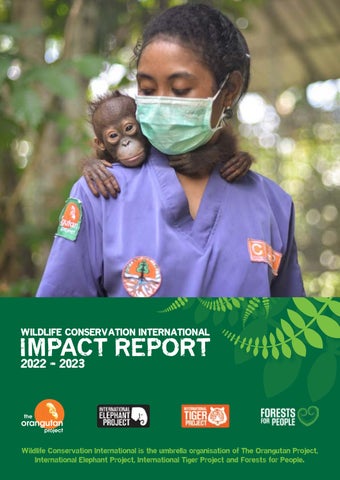
ABOVE: Infant orangutan Mabel receiving medical care at our BORA Rescue & Rehabilitation Centre in Berau, East Kalimantan, following her rescue in November 2022. FRONT COVER: Infant orangutan Mabel with veterinarian Theresia at the BORA Rescue & Rehabilitation Centre in Berau, East Kalimantan.
A MESSAGE FROM OUR FOUNDER This year marks 25 years since I started The Orangutan Project. Over that time we have added three sister projects – the International Elephant Project, International Tiger Project and in June this year, Forests for People. Together these four projects, which sit under the umbrella of Wildlife Conservation International (WCI), encompass our holistic approach to conservation that works to ensure that no species, including humans, is left behind in the extinction crisis. Our vision has always been about creating a better world for all species, biodiversity, indigenous communities and future generations. In fact, I do not believe that we can create a viable future for orangutans, or any other species, unless we consider all living beings, as we are all interconnected on this finite and fragile planet. The manifestation of this vision is to create rainforest ecosystems of the right type, shape and size, so they may be environmentally sustainable, as well as being suitable to hold sustainable populations of megafauna, such as orangutans, elephants and tigers. This opportunity is only available in this, the most important decade in human history. If we lose this window of opportunity, while rainforests and orangutans, tigers and elephants may still exist, their populations and the ecosystem they depend on will eventually collapse. There will never be a more important time than now to make meaningful change for the entire planet! The good news is we are well on the way to supporting the establishment of seven vital ecosystems at this time across Borneo and Sumatra. We are also working with wonderful partners and indigenous communities to develop sustainable agricultural ecosystems under the rainforest canopy to ensure these ecosystems are not only environmentally sustainable, but also economically sustainable. As I reflect on the past 25 years, I am extremely grateful and humbled by the support of the many thousands of donors from around the world who have shared in our vision. Together we have contributed over $26 million to conservation projects in Indonesia, each year increasing our impact for Critically Endangered orangutans, tigers and elephants and local forest communities. While we still have a lot of work to do to ensure these precious beings survive this extinction crisis, knowing we have a legion of donors supporting our cause empowers us to push further and harder to achieve our vision. A big thank you to all our supporters, donors, staff and volunteers that have been a part of our family over the past 25 years. Only through working together, combining our capital, labor, knowledge and skills can we achieve meaningful change. Fortunately, I have been blessed by a wonderful team that allows us, in a time of crisis, to move from success to success!
Leif Cocks OAM
Founder, Wildlife Conservation International
In April this year I had the honour of having my portrait entered into the prestigious Archibald Prize by talented artist Murray Charteris (@murraycharterisart). The painting, titled Reflections of Humanity, was inspired by my book Finding Our Humanity, which presents a philosophical approach to gaining a higher understanding of what it means to be human and our connection with nature.
Order a copy of my book here: theorangutanproject.org/shop 3
OUR VISION ALL ORANGUTANS, ELEPHANTS AND TIGERS WILL LIVE IN THEIR NATURAL HABITAT IN SECURE AND VIABLE POPULATIONS, ALONGSIDE PROSPEROUS AND EMPOWERED INDIGENOUS COMMUNITIES.
OUR MISSION TO ENSURE THE SURVIVAL OF ALL ORANGUTAN SPECIES, ASIAN ELEPHANTS AND TIGERS IN THEIR NATURAL HABITAT, AND PROMOTE THE WELFARE OF ALL INDIVIDUALS WITHIN RAINFOREST ECOSYSTEMS, HUMAN AND NON-HUMAN.
OUR STRATEGY
Click here to view our Conservation Strategy online
Our approach to conservation supports a wide range of critical projects that address the holistic problem facing Critically Endangered orangutans, Asian elephants and tigers, and indigenous communities - including fighting deforestation and habitat loss at the highest levels. 1. Legally Protect Forest • Legally change the land status of high conservation value forests to protect wild orangutans, elephants and tigers and introduced populations of ex-captive orangutans. • Legal support cases • Scientific advice • Local community representation 2. Secure, Restore and Patrol Habitat • Lease and manage as much land as possible, in and around large intact forest areas. • Restore degraded forest fragments adjacent to intact areas. • Resource Wildlife Protection Units to patrol the habitat. 3. Rescue, Rehabilitate and Release Orangutans, Elephants and Tigers • Rescue, rehabilitate and release as many orphaned, ex-captive and displaced orangutans as possible into protected habitat. • Treat and release injured and sick elephants and tigers. 4. Educate and Empower Local Communities and Indigenous People • Through community engagement, education and support - provide local people the knowledge, resources and power they need to be guardians of their own forest resources.
4
WILDLIFE CONSERVATION INTERNATIONAL IMPACT REPORT 2022-23
OUR STRATEGY IN ACTION SISTER PROJECTS
JOINT ORGANISATIONS
OUR PARTNERS
FUNDING SUPPORT PROVIDED
WILDLIFE CONSERVATION INTERNATIONAL IMPACT REPORT 2022-23
5
2022-2023 ACHIEVEMENTS FOR ORANGUTANS
$5M
LEGALLY PROTECT FOREST
FUNDS CONTRIBUTED
TO CONSERVATION PROJECTS IN 2022-2023
12
COMMUNITY
LEGAL SUPPORT CASES
AGAINST DEFORESTATION
SECURE HABITAT
94 1,659,891 11,893 191 ACRES
THOUSAND ACRES
WILDLIFE PROTECTION RANGERS
WILD ORANGUTANS NOW PROTECTED OF RAINFOREST LEASED
162
OF RAINFOREST NOW PROTECTED
EMPLOYED
RESCUE, REHABILITATE & RELEASE
ORANGUTANS
9
ORANGUTANS
75
ORANGUTANS
ORANGUTANS
CARED FOR IN RESCUE CENTRES
SUCCESSFULLY RELEASED OR RELOCATED
RESCUED RELEASED ARE BEING MONITORED
16
ORANGUTAN CARING SCHOLARSHIPS
6
40
EDUCATE & EMPOWER
100
+
SCHOOLS &
25+
COMMUNITY
COMMUNITIES
DEVELOPMENT
GIVEN EDUCATION CLASSES, THOUSANDS OF PEOPLE BEING REACHED
IMPROVING SUSTAINABILITY AND YIELDS IN AGRICULTURE
WILDLIFE CONSERVATION INTERNATIONAL IMPACT REPORT 2022-23
PROJECTS
Memo is one of eleven orangutans who were released from our BORA Rescue & Rehabilitation Centre this year. Prior to her rescue in 2011, Memo was often forced by her keepers to ride a motorbike every day for entertainment. After spending many years of extensive rehabilitation to learn how to ‘be an orangutan’, Memo was successfully released onto the Bawan (pre-release) Island and then finally to her permanent home in the Busang Ecosystem in May 2023.
WILDLIFE CONSERVATION INTERNATIONAL IMPACT REPORT 2022-23
7
2022-23 ACHIEVEMENTS FOR TIGERS
6
TIGERS RESCUED, TREATED OR RELEASED
70
WILDLIFE PROTECTION RANGERS EMPLOYED
906,875
ACRES OF HABITAT NOW PROTECTED
125
WILD INDIVIDUALS
PROTECTED 8
WILDLIFE CONSERVATION INTERNATIONAL IMPACT REPORT 2022-23
2022-23 ACHIEVEMENTS FOR ELEPHANTS
74
ELEPHANTS RESCUED, TREATED OR RELEASED
80
WILDLIFE PROTECTION RANGERS EMPLOYED
918,954
ACRES OF HABITAT NOW PROTECTED
554 WILD INDIVIDUALS
PROTECTED WILDLIFE CONSERVATION INTERNATIONAL IMPACT REPORT 2022-23
9
FUNDS TO CONSERVATION PROJECTS PROJECTS YOUR DONATIONS SUPPORTED 2.0% Forest restoration
1.8% Research
8.4% Community education and support
29.4% Rescue, rehabilitation and release
10
WILDLIFE CONSERVATION INTERNATIONAL IMPACT REPORT 2022-23
58.4% Habitat protection
FUNDING PROVIDED TO CONSERVATION PROJECTS IN 2022-2023 PROJECTS AND ORGANISATIONS WE FUND
FUNDING (AUD)
Borneo Orangutan Survival Foundation
$3,000.00
Communities for Sumatran Forests (KHS)
$186,574.72
Conflict Response Unit Tangkahan
$6,990.00
Elephant Acoustic Monitoring Research
$77,486.69
Elephant Conservation Centre
$64,710.00
HUTAN
$45,000.00
International Animal Rescue- Indonesia
$140,000.00
Orangutan Conservancy
$10,000.00
Orangutan Foundation
$95,000.00
Project Monitoring, Support and Evaluation
$320,424.47
Pro Natura
$17,500.00
PT Reki
$9,579.00
Scorpion / Wildlife Trade Monitoring Group
$12,500.00
Sumatran Orangutan Conservation Programme
$40,000.00
Sumatran Ranger Project
$10,000.00
Sustainable Green Sumatra
$48,246.53
Tesso Nilo National Park
$31,273.00
Wildlife Ambulance and Veterinary Care
$202,825.26
TOTAL
$1,321,109.67
ORGANISATIONS WE PARTNER WITH
FUNDING
Borneo Nature Foundation
$493,600.00
Centre for Orangutan Protection
$1,038,848.14
Forest Nature and Environment Aceh
$202,178.64
Frankfurt Zoological Society
$606,249.23
Leuser Conservation Forum
$452,240.00
Orangutan Information Centre
$105,000.00
Orang Utan Republik Foundation
$111,056.30
PT Alam Bukit Tigapuluh (PT ABT)
$352,596.95
PT Harapan Orangutan Perlindungan Ekosistem (PT HOPE)
$2,885.00
PT Saman Seudati Lestari (PT SSL)
$113,714.57
Sumatran Rescue Alliance
$237,871.14
TOTAL
$3,716,239.97
$5,037,349.64 CONTRIBUTED TO OUR
CONSERVATION PROJECTS
IN 2022-2023
WILDLIFE CONSERVATION INTERNATIONAL IMPACT REPORT 2022-23
11
LEGALLY PROTECT FORESTS Securing high conservation value rainforest to permanently protect viable populations of orangutans, elephants and tigers.
ECOSYSTEM RESTORATION CONCESSIONS An integral part of our holistic vision is to secure highconservation areas of the right type, shape and size that will support Critically Endangered populations of orangutans, tigers and elephants. This is critical lowland and riverine forests. Together with our project partners we have established ecosystem restoration companies that can legally apply to lease and manage forest concessions from the Indonesian Government.
BUKIT TIGAPULUH ECOSYSTEM Through the company PT Alam Bukit Tigapuluh (PT ABT), formed with our partners the Frankfurt Zoological Society and WWF-Indonesia, we are leasing and managing 38,665 hectares comprising two separate blocks in the buffer zone of the Bukit Tigapuluh National Park in Jambi Province, Sumatra. In addition, we are also supporting the health, education and economic prosperity of the local Talang Mamak people through our School Food Project (see page 25) and through helping to develop sustainable agriculture systems to provide for food security and a sustainable income.
EAST LEUSER ECOSYSTEM Together with our partner Forum Konservasi Leuser, we are working to secure critical lowland habitat in the Leuser Ecosystem through our joint company PT Saman Seudati Lestari (PT SSL).
hectares in Aceh Province. Once secure, the plan is to reforest degraded areas within the concession to restore and expand orangutan habitat.
BUSUNG ECOSYSTEM Formed in 2021 with our partner the Centre for Orangutan Projection and Indonesian business partners, PT Hutan Orangutan Perlindungan Ekosistem (PT HOPE) is in the process of securing 100,000 hectares in the Busang Ecosystem in East Kalimantan, Borneo for orangutan reintroduction.
SOUTH-WEST LEUSER ECOSYSTEM In February 2023 we launched an ambitious new campaign, in partnership with Forum Konservasi Leuser, to secure 4,643 hectares of critical orangutan habitat in the south-west Leuser Ecosystem, home to the densest population of Critically Endangered Sumatran orangutans. As well as being an important area for orangutan conservation, the area is also one of the largest peatland swamps in Sumatra, making it an important carbon sink for regulating climate change. Steady degradation of unprotected land along the river edge is threatening this fragile ecosystem and its orangutan population. Our goal, over the next five years, is to raise $3 million to purchase land along the edge of the river and to create a defensible boundary.
PT SSL has been in negotiations with the Indonesian Ministry of Environment and Forestry to secure 90,000
12
WILDLIFE CONSERVATION INTERNATIONAL IMPACT REPORT 2022-23
BELOW: Securing land in the Rungun River Ecosystem under the Social Forestry scheme is supporting the local Dayak Nagju people while also safeguarding the forest for conservation.
RUNGAN RIVER ECOSYSTEM At 174,000 hectares, the Rungan River Ecosystem is one of the largest intact lowland rainforests remaining in Borneo, supporting the largest unprotected population of Bornean orangutans. The forest also holds great cultural significance for the Dayak Ngaju people who have lived off the land for generations. Despite its importance, the Rungan Forest is at risk of agricultural conversion and encroachment. With our partner, the Borneo Nature Foundation, we have been working with the Dayak Ngaju people, government and industry stakeholders to protect the forest under the national Social Forestry Scheme, engaging in the continued management of these forests through sustainable livelihood initiatives such as permaculture, aquaculture, honey production and ecotourism. Our overall objective is to secure the protection of 100,000 hectares of the Rungan Ecosystem, while helping companies meet their sustainable development goals and empowering communities to manage and benefit from their natural resources. To date, 18 Social Forestry permits have been granted covering 17,081 hectares with six more permits currently under development.
13
SECURE RESTORE & PATROL Safeguarding critical rainforest habitat through managing ecosystem concessions, restoring degraded areas, and resourcing Wildlife Protection Units to patrol protected habitat areas.
PROTECTING BUKIT TIGAPULUH ECOSYSTEM The Bukit Tigapuluh (BTP) Ecosystem encompasses one of the largest remaining lowland forests in central Sumatra. The area provides important habitat for an estimated 150 Critically Endangered Sumatran elephants, 30 Critically Endangered Sumatran tigers, and a lifeboat population of over 200 re-introduced Critically Endangered Sumatran orangutans. Together with the Frankfurt Zoological Society and World Wildlife Fund Indonesia, WCI manages two Ecosystem Restoration Concessions in the BTP Ecosystem totalling 38,665 hectares. Despite being protected under law, these concessions, and the surrounding National Park, are under constant threat from illegal activities such as poaching, encroachment and logging. The Ecosystem Monitoring Unit (EMU) is a speciallytrained subunit of the Wildlife Protection Unit, tasked
with the monitoring, reporting and deterring of illegal activities within the concession area and the surrounding National Park. The unit consists of ten rangers split into two teams - Team Alpha and Team Bravo. Using SMART (Spatial Monitoring and Reporting Tool) applications, rangers document illegal activities which is then relayed onto forest police for further investigation where sufficient evidence is found. On occasion, forest police will jointly patrol with the EMU, detaining perpetrators or issuing fines directly on the spot. In 2022-23, 362 cases of illegal activities were detected including 61 illegal snares (which were dismantled and destroyed), 107 encroachment sites and 194 illegal logging sites. While the number of cases seems high, the ongoing presence of the EMU over the last ten years has been instrumental in reducing the number of illegal activities detected year-on-year.
In 2022-23, rangers from the Ecosystem Monitoring Unit dismantled 61 illegal snares in the Bukit Tigapuluh Ecosystem.
14
WILDLIFE CONSERVATION INTERNATIONAL IMPACT REPORT 2022-23
RESTORING SEBANGAU NATIONAL PARK The Sebangau National Park (SNP) in Borneo is the largest remaining area of lowland rainforest in Borneo, supporting the largest extant population of Critically Endangered Bornean orangutans, with an estimated population of 6,900 individuals. Underlying the forest is an expansive network of peat-swamps, storing an estimated 2.3Gt of carbon, making it one of the world’s largest terrestrial carbon stores. Drainage canals, dug illegally to remove timber and to develop plantations, has caused large areas of the peat-swamp to dry out, fuelling annual forest fires which destroy thousands of hectares of habitat and release tonnes of toxic gas into the atmosphere. To conserve Sebangau’s forest cover, peatland resource and large orangutan population, WCI, through The Orangutan Project, has been working in partnership with the Borneo Nature Foundation to restore the natural hydrological conditions of the ecosystem to prevent seasonal wildfire events. The Sebangau Peatland Restoration Project takes a holistic and innovative approach to addressing the causes of wildfires by empowering local communities to protect remaining peatlands through constructing dams to block canals and keep water within the peatland. Simultaneously, the project works to tackle fire impacts by improving local fire-fighting capacity, while delivering educational programs to support long-term behavioural change, promote peat-friendly livelihoods and strengthen local capacity to manage and restore peatlands.
In 2022-23, 15 dams were constructed to block four canals along the Koran River situated at the northeast edge of the SNP, bringing the total number of dams built since 2010 to 804. A new community firefighting team was established in Sebangau Kuala sub-district, bringing the total number of community firefighting teams supported to eight (total of 129 community firefighters). And five new community nurseries were established bringing the total number of community nurseries supported to 15. Seedlings propagated are used to restore degraded areas of peatland while providing sustainable livelihood opportunities for local communities. Between July and December 172,435 trees were planted across three sites in the northern region of the SNP spanning 194 hectares.
15
WEST SUMATRA TIGER TEAM EXPANDS
SAFEGUARDING TIGERS IN LEUSER As their rainforest habitat continues to diminish, through legal and illegal deforestation, Critically Endangered Sumatran tigers have been forced into closer contact with humans, leading to incidents of human-tiger conflict that has resulted in death and injury to both tigers and humans. To protect their livelihoods, farmers have resorted to using snares and baited carcasses. WCI, through its International Tiger Project, supports the Sumatran Tiger Conflict Mitigation and Adaptation Program run by grassroots organisation Sumatera Hijau Lestari (SHL). Operating across four villages on the fringe of the Gunung Leuser National Park (GLNP), SHL are working with local farmers to put in place measures to protect livestock and mitigate the risk of human-tiger conflict. In 2022-23, SHL helped to construct 10 tiger proof enclosures with farmers in Bukit Mas Village to keep cattle safe at night. Each enclosure measures 10 x 10 metres and almost three metres high and is made of wood, bamboo and wire. The team also actively patrols the GLNP and the forest edge, monitoring and patrolling areas to anticipate and prevent tiger conflicts. Another key component of their work is to socialise with, and educate local farmers and community members about tiger conservation and how to reduce the likelihood of attacks. Throughout the year, the team met with 80 residents across the four villages.
16
In February 2022, WCI, through its International Tiger Project, established the West Sumatra Tiger Team with long-term partner the Centre for Orangutan Protection (COP). The team is responsible for safeguarding a population of approximately 40 Critically Endangered Sumatran tigers in the Nagari Sontang Forest. The team has since been renamed to APE Protector to align with COP’s other APE teams - APE meaning Animals, People & Environment. There are five APE teams in total, each of which focus on a different aspect of wildlife conservation and welfare across Borneo, Sumatra and Java. The APE Protector team is tasked with routinely patrolling the forest to look for signs of illegal activities including logging and poaching, installing camera traps to record biodiversity and assess tiger populations and movements, educating local school children on tiger conservation and safety, and assisting with local law enforcement. In April 2023, the APE Protector team was expanded to include a new patrol team in Nagari Panti Selatan, West Sumatra, after assessing tiger conflict in the area. Ten local rangers are employed consisting of nine men and one woman; our first female tiger ranger.
SAFEGUARDING ELEPHANTS IN LEUSER The Gunung Leuser Ecosystem in North Sumatra contains the largest remaining population of Critically Endangered Sumatran elephants, with an estimated population of 500 individuals. With deforestation limiting their movement range and access to adequate food supply, elephants have been left with little choice but to rely on local plantations along the buffer zone leading to frequent incidences of human-elephant conflict (HEC).
MONITORING ELEPHANTS IN NAM PUOY Camera traps are an important tool for elephant conservation, used to facilitate the remote monitoring of herds as they traverse the landscape. Data collected provides important information on population status, seasonal movement patterns, habitat use and social group composition. Together with traditional field surveys and ranger patrols, these tools allow us to better understand and protect at-risk elephant populations. Since 2019, WCI, through our International Elephant Project, has been supporting the Elephant Conservation Centre in Laos to monitor and safeguard elephants residing within the Nam Pouy National Protected Area (NPNPA). This area boasts the second-largest wild elephant population in the country, estimated to be between 40-60 individuals. Funding provided by WCI supports two highly trained ranger teams to patrol the protected area to deter illegal activities and mitigate any incidences of human-elephant conflict, as well as to undertake biodiversity monitoring. Between October and December 2022, ranger teams installed 49 camera traps to better understand the broader biodiversity of the park, as well as to identify suitable candidates for GPS collaring to assess the size and demographics of elephant populations. Footage captured at least 52 individuals; a group of 24 females and two adult males in the north-west and a group of 25 females and one adult male in the east.
To protect their crops, some local plantation owners have resorted to setting snares or poisoned baits causing injury and death to elephants. Humans too have been injured, or even killed, as they defend their crops and homes. In partnership with Forum Konservasi Leuser, WCI, through our International Elephant Project, supports three Elephant Patrol Teams in the Gunung Leuser Ecosystem who conduct onthe-ground monitoring of elephant herds, HEC mitigation activities, as well as documenting and dismantling any baits and snares found on patrol. Two teams are deployed in Aceh Timur and one in Aceh Tenggara, in the south-western part of the Leuser Ecosystem. In 2022-23 the teams conducted 26 patrol missions, with each patrol averaging 19 days in the field. Over 6,000km of habitat was covered with 13 snares and traps dismantled. Throughout the year, the teams responded to 188 HEC cases, working with farmers to put in place measures to protect their crops and property, including providing them with deterrents such as boom sticks and fireworks. By tracking elephant herds through GPS collars, the teams are able to give early warning to communities to prevent and mitigate incidences of HEC.
It was rumoured by local people in the south of Nam Pouy that only one breeding age male was present in the whole of the 200,000 hectare NPNPA. The discovery of three breeding-age males in two separate herds, along with three sub-adult males has dispelled this rumour and underscores the vital role that camera traps play in comprehending the size and demographics of elephant populations. 17
RESCUE REHABILITATE & RELEASE Securing the survival of Critically Endangered orangutans, elephants and tigers through the rescue, rehabilitation and release into protected habitat.
ORANGUTANS RESCUED Funding provided by WCI in 2022-23, through our project, The Orangutan Project, supported the rescue of nine orangutans – two by International Animal Rescue Indonesia, two by the Orangutan Information Centre and five by our Bornean Orangutan Rescue Alliance (BORA).
Mabel was rescued in November 2022, having been kept illegally as a pet for three months. Severely malnourished, she was estimated to be around four months of age. It was later determined that her age was closer to eleven months, her malnourishment causing her normal growth development to be inhibited. Mabel is now recovering well at our BORA Rescue & Rehabilitation Centre in Berau.
MABEL Astuti arrived at our BORA Centre in January 2023, following her rescue from the island of Sulawesi in June 2022. It is believed she was enroute to be traded internationally. Her rescue journey was arduous, involving six hours in transit to Makassar (South Sulawesi), two flights from Sulawesi to Borneo, and a 20-hour road trip in Kalimantan to our BORA Centre.
ASTUTI Jasmine & Sayir, a mother and son pair, were reportedly victims of a conflict in a mining location in East Kalimantan. The pair were emaciated and hungry when they arrived at our BORA Centre in March 2023. After spending two months in care, the pair were released into the Busang Ecosystem in May 2023.
JASMINE & SAYIR Harapi was rescued by our BORA Rescue Team, together with the Ministry of Environment and Forestry, in June 2023. Estimated to be around 10-months old, Harapi was being kept illegally as a family pet. When found he was dressed in baby clothes and wearing a necklace. Harapi has settled in well at our BORA Centre.
HARAPI 18
WILDLIFE CONSERVATION INTERNATIONAL IMPACT REPORT 2022-23
ORANGUTANS REHABILITATED
ORANGUTANS RELEASED
Following rescue, orphaned and displaced orangutans require care and rehabilitation before release back to the wild. For some, this may only be temporary, while for others, particularly for orphaned infants, the process can take many years. In the wild it can take up to seven years for an infant to become independent from their mothers. Through attending Jungle School, human carers take on the role of mothers, ensuring that orphaned orangutans learn the necessary skills to survive in the wild.
Every orangutan that is rescued, rehabilitated and returned to the wild helps to further bolster the population and secure the future survival of this Critically Endangered species. Funding provided by WCI in 2022-23, through our project, The Orangutan Project, facilitated the release of 40 orangutans including eight from our BORA Rescue & Rehabilitation Centre.
WCI, through our project, The Orangutan Project, and our on-ground partners, help manage two rescue and rehabilitation centres - the Sumatran Orangutan Rescue Alliance† (SRA) Rescue & Rehabilitation Centre in North Sumatra and the Bornean Orangutan Rescue Alliance‡ (BORA) Rescue & Rehabilitation Centre in East Kalimantan, Borneo. In 2022-23, 30 orangutans were cared for across the two facilities. In addition, WCI provided funding to support the care and rehabilitation of a further 45 orangutans at various facilities across Borneo and Sumatra. †SRA is a partnership between WCI, the Centre for Orangutan Protection and the Orangutan Information Centre. ‡BORA is a partnership between WCI and the Centre for Orangutan Protection.
ANTAK
HERCULES
Antak & Hercules were moved from Bawan (pre-release) Island to their permanent home in the Busang Ecosystem, Borneo, in October 2022. Rescued from a zoo in 2010, the pair had undergone many years of rehabilitation to gain their freedom. Their release was made possible thanks to the Indonesian Ministry of Forestry granting us 20,000 hectares of forest within the Busang Ecosystem.
UCKOWATI
MUNGIL
Uckowati & Mungil are a mother and a daughter pair who were translocated from the Wildlife Rescue Centre (WRC) in Yogyakarta in April 2021. Rescued from an amusement park in 2011, Ucokwati later gave birth to Mungil while in care at the WRC. After 18-months at our BORA Centre, the pair were released into the Busang Ecosystem in October 2022. 19
ORANGUTANS MONITORED Following release, orangutans are closely monitored to ensure they are adapting to their forest environment. Trackers collect key data such as feeding patterns, resting, moving, and nest building, to ensure they are capable of surviving on their own.
ROCKY
NATALEE
Rocky & Natalee are two orangutans that were part of our Orangutan Adoption Program. After being surrendered by his owner in 2012, Rocky spent ten years at the International Animal Rescue Rescue Centre in West Borneo before his release to the Bukit Baka Bukit Raya National Park in December 2022. A victim of the illegal pet trade, Natalee was repatriated from Thailand in 2020 and taken to the Open Orangutan Sanctuary in Bukit Tigapuluh Sumatra run by our partner the Frankfurt Zoological Society. After successfully mastering the required forest survival skills at Jungle School, she was released into the surrounding National Park in September 2022.
KOLA Kola was one of the first orangutans to be repatriated from Thailand, where she was born in 2009. Surrounded by humans while in captivity, Kola had developed the unusual behaviour of walking upright with her arms folded. After four years at our BORA Centre, Kola was moved to Bawan (prerelease) Island in January 2023 where she has the opportunity to develop her forest skills. She is being closely monitored.
20
MEMO Memo arrived at our BORA Centre in 2015 after being rescued from an eco-tourism centre where she had been forced to ride a motorbike for entertainment. Following extensive rehabilitation she was released initially to the Bawan (prerelease) Island and then finally to her permanent home in the Busang Ecosystem in May 2023.
WILDLIFE CONSERVATION INTERNATIONAL IMPACT REPORT 2022-23
Funding provided by WCI in 2022-23, through our project, The Orangutan Project, supported the post-release monitoring of 162 orangutans at three release sites in Sumatra and Borneo. At the Sumatran Orangutan Reintroduction Centre (SORC) in Bukit Tigapuluh, run by project partner the Frankfurt Zoological Society, 143 post-release orangutans were actively monitored. Since the reintroduction program commenced in 2002, over 200 orangutans have been released into Bukit Tigapuluh, with a further 17 wild births confirmed. With the population here having previously gone extinct in the 1830s, the re-establishment of this life-boat population gives hope to the future of the Critically Endangered Sumatran orangutan. At Camp Rasak in the Lamandau Nature Reserve Borneo, run by our friends at the Orangutan Foundation UK, we supported the post-release monitoring of 10 orangutans, plus one wild-born offspring. And through our Bornean Orangutan Rescue Alliance (BORA) with the Centre for Orangutan Protection, eight orangutans are being monitored in the Busang Ecosystem - Nigel, Hercules, Antak, Ucokwati and daughter Mungil, Memo, and Jasmine and son Syair.
Staff from the Sumatran Orangutan Reintroduction Centre in Bukit Tigapuluh closely monitor released orangutans to ensure they are adapting to their forest environment.
NEW WILDLIFE CLINIC Lamandau Nature Reserve is a wildlife sanctuary in Central Kalimantan, where our friends at the Orangutan Foundation UK carry out orangutan reintroduction and biodiversity protection. In collaboration with the Conservation Agency BKSDA, the team rescues orangutans, and other wildlife, from conflict and illegal trafficking situations. After being rescued, these animals require immediate veterinary assessment and care. With no medical clinic on site, the Orangutan Foundation UK reached out to WCI to help fund the construction of a wildlife clinic. Opened in October 2022, the clinic is staffed by two veterinarians who have been kept very busy treating a wide array of animals including cockatoos, parrots, a cassowary, a tortoise, a sun bear and gibbons. In November 2022, the team treated a mother and infant orangutan found near a village and oil palm plantation. Following medical assessment and treatment at the Wildlife Clinic, the pair were released into the Lamandau Nature Reserve.
BELOW: A King cockatoo receives treatment for an eye infection. The cockatoo was part of a shipment of illegal wildlife from Papua New Guinea confiscated by the Local Conservation Agency BKSDA.
WILDLIFE CONSERVATION INTERNATIONAL IMPACT REPORT 2022-23
21
TIGERS RESCUED & RELEASED Funding provided by WCI, through our International Tiger Project, assisted with the rescue, treatment and release of six tigers during 2022-23. In August 2022 our project partner Forum Konservasi Leuser in Sumatra found a female tiger caught by her foot in a sling snare trap near Sangir Village, in Aceh. Estimated to be around two years of age, it was thought that the tiger had been entangled in the snare for up to three days. Named Putri Siti Mulya Reko, the tiger was transferred to a wildlife authority holding facility in Blangkejeren for further treatment, and then released to a protected forest area near Sangir Village in October 2022. Also in August 2022, our friends at Sumatera Hijau Lestari rescued a three-year-old tiger, named Bestie, who was found injured near Halaban Village in the Besitang subdistrict, North Sumatra. Bestie was treated for several days at Medan Zoo before being transferred to the Barumun Nagari Wildlife Sanctuary in North Sumatra. After three months she was successfully released into the Gunung Leuser National Park.
22
WILDLIFE CONSERVATION INTERNATIONAL IMPACT REPORT 2022-23
ABOVE: Rangers carefully remove a snare from the foot of a female tiger before she is transferred for further treatment. BELOW: It was estimated that the tiger had been entangled in the snare for up to three days.
The Wildlife Ambulance provided treatment for an elephant calf injured by a rope snare in the Aceh Bener Meriah regency of the Leuser Ecosystem.
WILDLIFE AMBULANCE WCI, through our International Elephant Project (IEP), has been supporting the Wildlife Ambulance, run through the Veterinary School at Syiah Kuala University in Banda Aceh, since 2017. Headed by IEP Senior Veterinarian Dr Christopher Stremme, the Wildlife Ambulance provides critical support for sick, injured or trapped elephants and other wildlife across Sumatra, as well providing welfare checks for elephants in rehabilitation centres. In 2022-23, the Wildlife Ambulance attended to the treatment of 68 elephants including undertaking 59 regular healthcare checks of captive elephants, providing medical assistance for the GPS collaring of four elephants, and providing in-the-field treatment for five elephants. In April 2023, the Wildlife Ambulance assisted the Aceh Conservation Agency (BKSDA) with the treatment of a wild elephant calf injured by a snare. The two-year-old female elephant had been caught by a nylon rope snare around the carpal joint of her left front foot. The snare had cut through the skin, and skin had already regrown over the rope snare enclosing it in the joint, indicating that the injury must have occurred at least three months prior. With the snare limiting her mobility, the elephant was found to be dehydrated and in poor nutritional condition. Following removal of the snare and treatment of her wound, the elephant was guided back into the forest where it was hoped she would join with a wild elephant herd in the area. The calf was last reported on her own, but is in good condition with her wound all but healed.
The snare had become embedded under the skin, severely limiting her mobility causing her to become malnourished and dehydrated.
23
EDUCATE & EMPOWER Providing local people with the knowledge, resources and power to be guardians of their own forest resources through community engagement, education and support.
SECURING FORESTS FOR PEOPLE In June 2023, WCI launched its new project, Forests for People, to support indigenous communities to live and prosper sustainably within the last remaining viable rainforest ecosystems. While WCI has been supporting a range of humanitarian projects for the past twenty-five years, the establishment of Forests for People opens up the door for individuals and organisations to specifically support the humanitarian aspects of our work. The projects supported by Forests for People address the United Nations Sustainable Development Goals that aspire to end poverty, improve health and education, reduce inequality, and spur economic growth, all while tackling climate change and working to preserve rainforests and their biodiversity. Addressing the humanitarian issues impacting on indigenous communities will, in the long run, support our holistic vision for a sustainable future where all species can thrive and live harmoniously.
Find out more at forests4people.org
CLOSING THE GENDER GAP A new project launched in July 2022 by Yayasan International Animal Rescue Indonesia (YIARI), with funding support from WCI, is helping to close the gender gap for local women by providing employment and encouraging them to take on leadership roles in conservation. The Power of Mama (PoM) is an all female-led fire prevention team based in the Ketapang Regency in Borneo. The area, known for its peat substrates, is a hotspot region for forest and land fires. The PoM program aims to prevent and mitigate the risk of fires by promoting local women as protagonists in environmental management and protection. Currently 81 women are enrolled in the program with ages ranging from 15 to 55. In the first 12-months, the PoM teams have undertaken 271 days (1,084 hours) of active monitoring in fireprone areas and have assisted in extinguishing over 58 forest and land fires. In addition, the PoM team also carried out 148 socialisations with 178 landowners and families, educating them on the risk of fires and the importance of sustainable agricultural practices that does not involve slash and burn methods.
24
BREAKING THE POVERTY CYCLE Equipping children with knowledge and skills gives them greater access to opportunity, and the chance to end the cycle of disadvantage. Through our joint company, PT Alam Bukit Tigapuluh (PT ABT), WCI manages two Ecosystem Restoration Concessions in the Bukit Tigapuluh Ecosystem, home to a community of 210 Talang Mamak people in the Simerantihan hamlet. Funding provided by WCI is helping to improve the socio-economic conditions of the community by supporting and incentivising education for local children through the Talang Mamak School Food Project. In 2022-23, 47 students attending the local elementary school were provided with daily breakfast and lunch to encourage their attendance, as well as to support their physical and mental growth. The long-term objective is to build a future educated community that will be empowered and prosper through a sustainable wildlife friendly economy, developed under the rainforest canopy. Now in its fourth year, data collected including attendance rate, academic performance, and key health and physical indicators is demonstrating the positive impact that the project is having on elevating the standard of education and health of the children in the community.
WILDLIFE CONSERVATION THE ORANGUTAN INTERNATIONAL PROJECT : ANNUAL IMPACTREPORT REPORT2019 2022-23 – 20
25
NURTURING THE NEXT GENERATION The key to securing a sustainable future for Indonesia’s wildlife and precious ecosystems lies in nurturing the next generation of Indonesia’s conservationists. Higher education and awareness about environmental and sustainability issues affecting their communities empowers young Indonesians to make positive change and be strong advocates for the conservation of forests and their inhabitants. WCI has been supporting the Orangutan Caring Scholarships program, run by our USA partner, Orang Utan Republik Foundation, since 2006. Scholarships are provided to Indonesian students undertaking university studies in biology, forestry and veterinary science, with the long-term aim of empowering them to make positive change and be strong advocates for the conservation of forests and wildlife. Since inception, 274 scholarships have been awarded, with many graduating students successfully gaining employment in the conservation and sustainability fields within the private, nonprofit and government sector. In 2022-23, funding provided by WCI supported a further 16 scholarships, bringing the total number of scholarships supported by WCI to 127.
26
WILDLIFE CONSERVATION INTERNATIONAL IMPACT REPORT 2022-23
Students from the University of Palangka Raya in Central Kalimantan receiving their Orangutan Caring Scholarships from the President of the Orang Utan Republik Foundation and WCI Advisory Board Member, Gary Shapiro, (centre front).
PROVIDING FOR FOOD SECURITY Deforestation for monoculture plantations has forced indigenous communities to relinquish traditional hunting and slash and burn farming and turn to new forms of sustainable agriculture to provide for food security. Rangkong Farm is a sustainable agricultural project run by Yayasan International Animal Rescue Indonesia (YIARI), with support provided by WCI. Located on 79 hectares of degraded land adjacent to YIARI’s orangutan sanctuary in Sungai Awan, Borneo, the aim of the project is to cultivate the land to provide food for the orangutans housed at the sanctuary, as well as for local staff and community. Additionally, from planting to harvest, the Rangkong Farm will become a centre for training on sustainable agriculture. Between January and May 2023, one hectare of land was successfully cleared of grass and weeds and seven mounds planted with crops including gamal root, sugar cane, odot grass, lemongrass, ginger, sweet corn, spinach and bananas. A total of 32 local people participated in the planting including 20 women from the Power of Mama, students from Muara Pawan Vocational School, and staff from YIARI.
WILDLIFE CONSERVATION THE ORANGUTAN INTERNATIONAL PROJECT : ANNUAL IMPACTREPORT REPORT2019 2022-23 – 20
27
FINANCIAL OVERVIEW FOR THE YEAR ENDED 30 JUNE 2023
WHERE YOUR MONEY WENT
68% Funds to conservation
28
WILDLIFE CONSERVATION INTERNATIONAL IMPACT REPORT 2022-23
8% Administration
24% Investment to generate future income
INCOME AND EXPENDITURE STATEMENT INCOME
AMOUNT (AUD$)
Donations/Fundraising Income
$4,382,639
Grants Income
$442,202
Donations/Fundraising Income - International Chapters Other
$2,613,535 $574,913
TOTAL INCOME
$8,013,289
EXPENDITURE
AMOUNT (AUD$)
Administration
$19,104
Accountant/Audit Fees
$5,800
Bank Fees and Charges
$1,053
Insurance
$25,935
Investment to generate future income
$1,522,589
Legal Fees
$2,724
Printing, Stationery and Office Equipment
$625
Provision for Annual Leave
-$9,594
Provision for Long Service Leave
$15,011
Salaries - Ordinary
$394,629
Subscriptions
$6,621
Superannuation
$41,436
Meetings/AGM Costs
$3,490
Funds spent on International Projects
$4,367,965
TOTAL EXPENDITURE
$6,397,389
PROFIT FROM ORDINARY ACTIVITIES BEFORE INCOME TAX
AMOUNT (AUD$)
Profit from Ordinary Activities before Income Tax
$1,615,900
INCOME TAX REVENUE RELATED TO ORDINARY ACTIVITIES
$1,615,900
TOTAL CHANGES IN EQUITY OF THE ORGANISATION
$1,615,900
Opening retained profits
$8,858,498
NET PROFIT ATTRIBUTABLE TO THE ORGANISATION
$1,615,900
CLOSING RETAINED PROFITS
$10,474,398
WILDLIFE CONSERVATION INTERNATIONAL IMPACT REPORT 2022-23
29
ASSETS AND LIABILITIES CURRENT ASSETS Cash and Cash Equivalents Accounts Receivable and other debtors
$5,124,986 $16,041
Financial Assets
$5,497,100
TOTAL ASSETS
$10,638,127
LIABILITIES
AMOUNT (AUD$)
Trade Creditors
$11,460
PAYG Withholding Payable
$23,078
Credit Card
-$2,137
Clearing Account
$500
Deposits (Refundable)
$100
Provision for Annual Leave
$53,706
Provison for Long Service Leave
$77,022
2023-2024 Projects Commitment
$5,214,674
TOTAL LIABILITIES
$163,279
Land Trust
$5,095,995
NET SURPLUS ASSETS
30
AMOUNT (AUD$)
WILDLIFE CONSERVATION INTERNATIONAL IMPACT REPORT 2022-23
$0
FUNDS RAISED BY INTERNATIONAL CHAPTER PARTNERS FUNDS RAISED (IN LOCAL CURRENCY) Wildlife Conservation International Ltd. (Australia)
$5,716,099 WCI Canada Foundation (Canada)
$92,207 Stichling Wildlife Conservation International (Netherlands)
€85,568 Forests for People (New Zealand)
$19,425
Borneo Nature Trust (United Kingdom)
£193,085 Orang Utan Republik Foundation Inc. (United States)
$230,329 Wildlife Conservation International (United States)
$1,301,751
31
OUR LEADERSHIP TEAM Wildlife Conservation International consists of many regionally registered charities that are supported by a highly skilled Advisory Board who volunteer their time and passion to provide overall governance and to ensure that fundraising activities are coordinated to help best achieve our Vision and Mission. Our conservation projects are overseen by Leif Cocks, our Conservation Project Manager Kylie Bullo and our Field Managers, Hardi and Alex, based in Indonesia.
Leif Cocks OAM Founder & CEO
Troy Kenah Development Director
Clare Campbell Advisory Board
Kylie Bullo Project Manager
Rebecca Wright Advisory Board
Dr Gary Shapiro Advisory Board
Hardi Baktiantoro TOP Field Manager
Dr Alexander Moßbrucker IEP Field Manager
Scott Gilbert Director
Lauren Gilbert Director
Nikko Konyk Director
Matthew Douglas Director
Alasdair Douglas Director
Anitha Rao-Robinson Director
Michele O’Brien Director
Alex Koeman Director
32
Amy Robbins Director
Noeline Holt Director
WILDLIFE CONSERVATION INTERNATIONAL IMPACT REPORT 2022-23
Click here to read more about our leadership team
WCI LEGAL ENTITIES AUSTRALIA
NEW ZEALAND
Wildlife Conservation International Reg. Charity No. ABN 92 607 879 345
Forests for People Reg. Charity No. CC52147
CANADA
UNITED KINGDOM
WCI Canada Foundation Reg. Charity No. 7799635537 RR 0001
Borneo Nature Trust Reg. Charity No. 1142870
EUROPE
UNITED STATES
Stichting Wildlife Conservation International RSIN: 862663313
Wildlife Conservation International Reg. Charity 501(c)3 EIN: 84-1899559 Orang Utan Republik Foundation Inc. Reg. Charity501(c)3 EIN: 26-0880405
WCI DIRECTORS International Advisory Board Leif Cocks Kylie Bullo Clare Campbell Matthew Douglas Troy Kenah Nikko Konyk Gary Shapiro Rebecca Wright Wildlife Conservation International Ltd (Australia) Leif Cocks Kylie Bullo Troy Kenah Wildlife Conservation International (USA) Lauren Gilbert Scott Gilbert Troy Kenah
WCI Canada Foundation (Canada) Alasdair Douglas Matthew Douglas Nikko Konyk Anitha Rao-Robinson Stichting Wildlife Conservation International (Netherlands) Leif Cocks Troy Kenah Alex Koeman Michèle O’Brien Forests For People Ltd (New Zealand) Leif Cocks Noeline Holt Troy Kenah Amy Robbins
WILDLIFE CONSERVATION INTERNATIONAL IMPACT REPORT 2022-23
33
Januil with veterinarian Theresia at the Bornean Orangutan Rescue Alliance (BORA) Rescue & Rehabilitation Centre. Januil is one of 28 orangutans to be cared for at our BORA Centre over the past year.
34
WILDLIFE CONSERVATION INTERNATIONAL IMPACT REPORT 2022-23
YOUR SUPPORT There are many ways you can contribute to the protection and conservation of Critically Endangered orangutans, elephants and tigers.
MAKE A DONATION You can make a donation to support our conservation priorities, or you can join our monthly giving program to maximise your benefit and provide continuity on our conservation projects. Donations are tax-deductible in Australia, USA, Canada, United Kingdom, New Zealand, and the European Union. Visit our website for more information.
ADOPT AN ORANGUTAN, ELEPHANT OR TIGER Through our adoption program you can provide care and support for orphaned orangutans undergoing rehabilitation at our rescue centres in Sumatra and Borneo, and help fund vital elephant and tiger protection projects. You’ll receive quarterly updates updates on your chosen adoptee (orangutans and elephants only). Visit our website for more information.
LEAVE A GIFT IN YOUR WILL Leaving a Gift in your Will is one of the most effective and enduring ways you can help safeguard the future of Critically Endangered orangutans, elephants and tigers, and their rainforest habitat. Your gift, no matter how small, can help create a lasting conservation legacy for your loved ones and for future generations. Contact bequests@wildlifeconservationinternational.org for more information.
PARTNER WITH US Our profile and reputation as a leading conservation organisation presents unique opportunities for businesses and organisations to partner with us to deliver meaningful conservation outcomes. Support may include cash donations, event sponsorship and/or workplace giving. For more information contact partnerships@wildlifeconservationinternational.org.
For further information on how you can make a difference for Critically Endangered orangutans, elephants and tigers, and support indigenous forest communities, visit our website at:
theorangutanproject.org
internationalelephantproject.org
forests4people.org
internationaltigerproject.org
WILDLIFE CONSERVATION INTERNATIONAL IMPACT REPORT 2022-23
35
TOGETHER WE CAN MAKE A DIFFERENCE
www.theorangutanproject.org
www.forests4people.org
www.internationalelephantproject.org
www.internationaltigerproject.org
CALL: 1300 RED APE
AUSTRALIA:
Wildlife Conservation International | Reg. Charity No. ABN 92 607 879 345
+61 892 988 016
CANADA:
WCI Canada Foundation | Reg. Charity No. 7799635537 RR 0001
EMAIL: help@orangutan.org.au
EUROPE:
Stichting Wildlife Conservation International | RSIN: 862663313
MAIL: PO Box 1414,
NEW ZEALAND:
Forests for People | Reg. Charity No. CC52147
South Perth WA 6951 Australia
UNITED KINGDOM: Borneo Nature Trust | Reg. Charity No. 1142870 UNITED STATES:
Wildlife Conservation International | Reg. Charity 501(c)3 EIN: 84-1899559 Orang Utan Republik Foundation Inc. | Reg. Charity501(c)3 EIN: 26-0880405