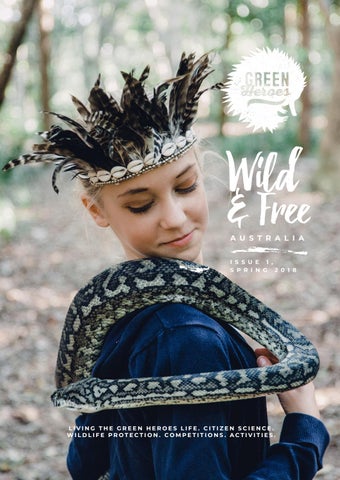
Wild
& Free A U S T R A L I A I S S U E 1 , S P R I N G 2 0 1 8
LIVING THE GREEN HEROES LIFE. CITIZEN SCIENCE. WILDLIFE PROTECTION. COMPETITIONS. ACTIVITIES.
1
Professional images by Byron Loves Fawn http://www.byronlovesfawn.com/
Subscribe
Stumbled across this copy of Wild & Free by chance? To receive an annual subscription of Wild& Free straight to your inbox or mailbox go to: www.greenheroes.org.au/shop/
Follow us
to stay up to date with the latest news, articles and events: facebook.com/greenheroes.org.au facebook.com/greenheroes.org.au
@beagreenhero
mailing list go to: www.greenheroes.org.au/subscribe visit us: www.greenheroes.org.au
2
Hello everyone! Welcome to Spring and to our very first edition of Wild & Free magazine! This Spring, we hope to hear a lot from you as you head outdoors and connect with the beautiful natural world we live in. Here are my top 5 favourite activities for Spring. Plant some native flowers. Not only do they look and smell great, they will welcome precious bees into our garden too! Join a citizen science project. In this edition we give the details for the annual Aussie Bird Count, the Wild Pollinator Count and the National Waterbug Blitz. Build a fort or a den in your garden, on the beach or playground. Create a water feature in your garden in time for summer. Then sit back and watch the wildlife come in for a drink! Take charge of planning a picnic or day trip to a nearby national park, waterfall, beach or reserve. Choose some waste free snacks and drinks and take your family out for the day! I look forward to hearing from you with your stories and photos as spring unfolds.
Sarah Jantos Founder, Green Heroes wildandfree@greenheroes.org.au
3
Table of contents 14
What's on the calendar this spring.
08
Meet Peanut, a rescued sugar glider and find out what we can do to protect these beautiful little natives.
06
Spotlight on the marsupial Mole.
30
Meet the Green Heroes team.
25
16
Activity. Creating Habitats in your back yard.
What’s Next – Summer Edition
22
The Journey Stick.
20
Competition.
4
thank you from Rue! Meet Rue, the Southern hairy-nosed wombat who is in care at Wildlife Victoria after he was orphaned by the roadside in late August. Rue says ‘thank you’ to the Green Heroes who made and decorated these pouches.
To discover more about our Pouches for Joeys project and how you can help make a difference, turn to Page 11
5
The Marsupial Mole The Southern marsupial mole or Itjari-itjari lives a secret, solitary life below the spiky spinifex and burning sands of Central Australia. 6
It is about 10cms long and has 'scoops' for paws.
Did you know? Paws are equipped with spade-like claws that force the sand beneath the mole's body as it moves forward, backfilling as it goes with its hind feet.
This golden furred marsupial has no visible eyes or ears. Want to see this little guy move? Go to www.smh.com.au/video/video-news/videowa-news/marsupial-mole-caught-on-camera20160614-4gh9b.html
(Notoryctes tphlops)
7
Sugar Glider Rescue Story A phone call often means there is an orphaned or injured animal needing rescue. On this particular night - it was ‘Peanut’, sadly orphaned after his mother was attacked by a cat late at night. Peanut was frightened and cold when he arrived into care. He weighed in at 20 grams (about the weight of one pencil). He needed to be fed every four hours - day and night - and kept at a monitored, stable temperature in layers of fabric pouches. Over the weeks that followed two more young sugar gliders came into care and quickly bonded with Peanut who was ever so grateful for the company and the warmth he received f rom the new arrivals. Months later and now nearly 70 grams, the little trio were getting restless and in need of more space. With thick fur now covering their bodies, they were ready to go outdoors into a large aviary where they could practise gliding and foraging for natural foods. Of course this food came f rom me and required long walks through the bush each day looking for sugar glider favourites such as native flowers, soft bark, grubs, insects and sap which we would deliver to the hungry three each night. Sometimes Peanut would hide f rom me until I walked into the aviary at night. Then he would drop straight onto my head. I would close my eyes and smile while he leaned right over my forehead to reach my eyelashes. He loved my eyelashes.
8
I would let him play there for a few minutes before encouraging him to eat. Just like any mother - love and good food is what I usually had on offer for my baby. I also gave Peanut and his new brothers a beautiful hollow tree branch to live in - similar to the kind they would need when they returned to the wild. The time to return to the wild came after several months of care and a transfer to yet another enclosure on a suitable, well forested property. From here - these joeys - now teenagers - would find their way into the real world. After months of care - I have grown to love these gentle, social and cheeky little animals. But as always I must remember that Peanut is a wild animal that wants to be free. And my aviary needs to be f ree for the next little joeys to come along. Goodbye and goodluck peanut! I love you. The greatest threats to glider species are feral and domestic cats, dogs and habitat loss. The best thing we can do to protect these animals is to responsible pet owners. Cats and dogs need to be kept indoors or in enclosures that protect our precious native animals. The loss of hollow bearing trees is also an enormous problem. We must all do our part to protect old native trees that house and feed many Australian animal species.
FUN FACTS
15,000. 20. the number of hours a koala sleeps each day
The number of termites an adult numbat will eat in a day.
zzzzzz
97% of Australian history. wiped out in the last
200 years
native plant and
animal species
4.6 million. The number of kids in Australia (who have the power to change the country!)
9
Green Heroes News Meet Frisbee the Squirrel Glider We received a wonderful response to our Green Heroes/ Bocchetta Plush Toys squirrel glider naming competition. There were so many imaginative suggestions, including Frisbee. Congratulations to Lucas from Wallum Community Preschool, who chose the winning name. Lucas and all the children in his class received Frisbee the new Bocchetta squirrel glider.
Parties for the Planet Green Heroes is here to support you in making a wildlife friendly choice for your next birthday party or event. We are working in partnership with wildlife rescue organisations, including Ballina Byron Sea Turtle Hospital and The Numbat Project to give you the chance to host a birthday party that supports endangered Australian animals. We can help with custom designed invites and waste f ree party supplies. Last but not least, you will also receive an official certificate and a small gift from us!
To find out more about hosting a Party for the Planet, go to: www.greenheroes.org.au/parties-for-the-planet
10
Keeping Rescued Joeys Warm in Winter This winter, Green Heroes donated 350 handmade fabric joey pouches to wildlife carers attending the Australian Wildlife Rehabilitation Conference, as a special thank you for looking after our precious native animals. The pouches were made by our Green Heroes volunteer team and lovingly decorated by pre-school and primary school students from Kingscliff Mini School, Wallum Community Preschool, St Andrews Lutheran College and Somerset College. The Green Heroes ‘Pouches for Joeys’ initiative is part of our Sharing Planet Earth Early Education Program, which empowers young children to make meaningful contributions to wildlife conservation.
To find out how more about the program and how you can become involved, please visit www.greenheroes.org.au/pouches-for-joeys
11
Featured Green Heroes TREE FORCE. Meet “Tree Force” - a band of super heroes on a mission to find - and tag - the most ‘vaulable’ trees for the community to see. The Tree Force - make calculations and measurements using i tree to find out which tree can store the most carbon, produce the most oxygen and store the most harmful pollution. With the help of local council, who developed tree tags, they have been able to tag many trees in their local community. Watch their short film to see the ‘winning tree’ and to learn more about this fantastic project. From here on Tree Force will expand their project to other local areas such as the popular Palmwoods Heritage Tree Trail, QLD.
Our project will cost approximately $50 per tree tag. The money would be spent on printing the tree tags to place on the trees and to help with the consultancy fee to use the i-Tree app eco program. Tree Force has one great environmental wish for the future: That people would truly come to see how valuable our trees are - not just in an economic sense, but in all the different ways that they contribute to our planet. The community can get involved by asking their local councils to consider using tree tagging on significant trees in their parks to draw attention to the mighty work our trees do. Locals on the Sunshine Coast could walk the Heritage Tree walk and take photos with the tree tags and further spread the word about them. They might even consider donating funds to help us put more tree tags on all the trees on the trail. To support this project please contact us wildandfree@greenheroes.org.au To receive a small grant for your project and to feature in our next edition, please email Shelli wildandf ree@greenheroes.org.au
12
$110
$201
Felix, age 7
Billy, 5
Michael, 13
We’ve been learning about bees at school and why they’re becoming extinct and what we can do about it. I’d really like to build a bee hotel for our yard to give the bees a safe place to hang out and do what they need to do. I’d also like to build bee hotel’s for my family and friends. Bees are so important because without them we will all die. They give us food and help make our food.
Billy loves the ocean. His dream is a clean healthy ocean that is safe for marine animals to live in. But that is not all. After watching the documentary “A plastic Ocean”, Billy has come up with a design for a lightweight plastic trawler that can easily be attached to any boat to collect surface debris.
'Australian animals face so many threats to survival’ says Michael, ‘the least we can do is keep our cats in at night’.
“Stop using pesticides on your gardens and don’t eat all the bees hard earned honey!” I hope in the future the government realises all the bad things that are happening and actually does something to stop them. One day I will be Prime Minister of Australia and I will make big changes. I love Green Heroes!
This idea is for the sea conscious person who is happy to help keep the oceans clean while out having fun on their boat. “We could sell them at BCF for $10!” says Billy. Billy is seeking community support for his project through engineering innovation and funds.
Michael's Cat Camera Project aims to put small ‘cat cams’ on roaming domestic cats (with permission) to create awareness and a short film about the negative impact neighbourhood cats have on Australian wildlife. Michael is currently looking for cat owners on the Gold Coast who would be willing to participate in this project. Cats and cat owners will remain anonymous.
13
Your Date with Nature 9 Sept 2018
Spring 2018 National Waterbug Blitz, Spring 2018 https://www.waterbugblitz.org.au
17 Oct 2018 National Ride to Work Day. October 17 www.bicyclenetwork.com.au/ridesand-events/ride2work/ride2work-da y/?gclid=EAIaIQobChMIy4TfgMim3 QIVg6uWCh0cjg8JEAAYASAAEgKOvD_BwE
14
National Bilby Day, September 9 https://savethebilbyfund.com
22-28 Oct 2018 Annual Aussie Backyard Bird Count 22-28 Oct 2018 https://aussiebirdcount.org.au
11-18 Nov 2018 Wild Pollinator Count 10-18 November 2018 https://wildpollinatorcount.com
12-18 Nov 2018 National Recycling Week. November 12-18 recyclingweek.planetark.org
15
Water for Wildlife During the hot summer months in Australia we can often forget that wildlife feel the heat too! Very hot days can burn little feet and paws and cause severe dehydration. By adding a mini pond, or water bowl to your garden you will help save native wildlife. Here are some simple tips to help you design the best water source in your garden.
16
1. Create two or three different water sources in your garden. Wherever possible, choose locations that offer some protection from the sun and are safe from predators such as domestic cats and dogs or birds of prey. 2. Consider the depth of the water. If your pond is deeper than a shallow dish, consider placing wooden planks or rocks into the water to allow small birds or animals to climb out after a bath or drink. 3. Place water at different levels to cater for different species - for example, water on the ground will serve lizards, echidnas or frogs, while water sources that are off the ground or hanging f rom trees will serve birds, possums or gliders. 4. Keep water refreshed and clean. 5. Enjoy watching the wildlife come to your garden.
We would love to show off your wildlife friendly water sources in our next edition! Share your photos with us on Facebook and Instagram #beagreenhero
17
pick up your camera CAPTURING SPRING Every quarter we are on the hunt for feature photos. With a little help from our green heroes we are sure to catch the best of spring for our next edition. Head outdoors to snap a shot of wildlife and send your submissions to wildandf ree@greenheroes.org.au by the 31st of October, 2018.
Terms and conditions. - This photography competition is conducted by Green Heroes Ltd. - All photos must be submitted by the 31st of October 2018 - Submit photos to hello@greenheroes.org.au with name & contact details... The winner will be contacted by email and will be published in the next magazine. - Green Heroes photo competition is open to any children between the ages of 3 and 16 years of age, residing within Australia. - Kids must have parent or guardian consent to enter. - all copyright remains with the photographer/ entrant - if Green Heroes uses any images through website or social media channels the photographer/entrant will be credited.
18
Shop
Bamboo Straws, $11.95, THE CLEAN COLLECTIVE Insulated Lunch Bag, $34, SEED & SPROUT Slow & Mindful Practice Board, $65, WHOLEBEINGS Piki, $39, OLLI ELLA Earthling Tee, $39.95, CHILDREN OF THE TRIBE Mini Mattress, $125, YOLI & OTIS Personalised Etched Flower Press, $50, ZILVI Tribal Teepee Set, $110, HAVE A NICE DAY
19
Colours of Spring Take a moment to explore the changes occurring in nature all around you and without interrupting its precious journey, collect loose and fallen items to place on the colour wheel.
Image credit: www.playfullearning.net
20
You Belong Amongst the Wildflowers Colour in your photo then collect fallen nature (flowers, sticks, grass, leaves etc) and get creative! You may like to glue your pieces down once you have determined how you would like to decorate your character.
s
MOTHER
NATURED
Connecting kids with nature
Environmental impact Please be mindful of and reduce your impact on the environment when collecting nature. Please also use sustainably sourced paper and avoid laminating.
Share! If you have friends of family who might like this printable, please direct them to mothernatured.com, where they can sign up to our email list to get all the the free printables available to them. That way they get to enjoy all the other benefits of the Mother Natured Community too.
Nature Head
MotherNatured.com For non commercial use only.
Share your pictures with us on Facebook and Instagram #beagreenhero
21
Bee Friendly Help save the bees by planting a bee friendly garden this Spring and keeping a water source available. Include a variety of native plants and flowers in your garden or in pots for smaller spaces.
22
A Conversation about Conservation Could keeping native animals as pets be the answer to their survival? If it ever became legal in Australia to keep native animals as pets - the Eastern Quoll would probably be one of the first. Many noteworthy Australians argue for and against this proposal. For this argument is the idea that quolls could replace domestic cats as pets - decreasing the number of cats and increasing the quoll population to guarantee their survival. "just as dogs and cats are no threat of dying out - the same would be true if native animals are owned" says senator David Leyonhelm. According to some, quolls can be domesticated, can enjoy cuddles and even be toilet trained to use a kitty litter tray. Against this argument is the idea that these native animals will more than likely not receive correct diets, habitat and care, dwindling them into a less robust and healthy species. Native animals have special needs and will not thrive in a confined domestic environment. Be brave. Share your thoughts and start a conversation that matters. Email wildandfree@greenheroes.org.au Your comments will be published in our summer edition. Please include: Your comments (one or two sentences), your first name, age, suburb and state you live in.
23
Journey Stick Journey sticks have a long and beautiful history in Australia. First Australians would keep a long walking stick, and gather natural materials during passage through country. Elements of nature would be tied onto sticks in chronological order. In this way, they were able to create a navigation tool and re-tell a story. For example, bark would indicate passing through a forested area, or carvings could record weather patterns and events that took place. Creating your own journey stick is a fun way to incorporate memories from your holiday travels, camping trips and outdoor expeditions. A journey stick can inspire creativity and retelling the story of your adventures. By using verbal and visual maps, we can more easily recount our days and hold onto precious memories that may otherwise be forgotten. Journey sticks can also strengthen your connection to the natural world as they intertwine person, place and time. Finding the perfect stick will be the first part of your adventure. Once your have found your treasure use strings, fallen feathers, sea glass, stones, bark and grasses and other fallen materials to record your expedition. These can be tucked under coloured strings and embellished with carvings or paintings. Be kind to the earth on your adventure. Be mindful not to hurt natural places by removing living things or ecologically sensitive materials. Enjoy your journey! Written by Sarah Barnes
Share your Story! We would like to publish your journey stick in the next issue! Send us a photo and a brief paragraph about your journey. Share your photos with us on Facebook and Instagram #beagreenhero
24
Oh, The Places You'll Go ~ Dr Seuss
25
SENT IN BY OLIVER.
Raspberry Bliss Balls INGREDIENTS: • 1 cup f rozen raspberries • 10 medjool dates, seeds removed • 1 cup raw cashews • 2 cups desiccated coconut • 1 teaspoon vanilla extract • pinch of salt
METHOD: Place the ingredients into your food processor and pulse at high speed until the mixture is broken down, well combined and sticking together. Use your hands to shape the mixture into balls. Either leave the balls as they are or roll in coconut or cacao or cocoa or drizzle with melted dark chocolate. Place in the f ridge to set. Eat and enjoy.
Have a yummy recipe to share? wildandfree@greenheroes.org.au
28
Wild Defenders Club coming soon! Check ou t our Summer Edition for all the details
29
Spring 2018 THE NATIONAL WATERBUG BLITZ IS AUSTRALIA'S FIRST NATIONWIDE WATER MONITORING EVENT!
GET THE WATERBUG APP
proudly supported by
30
22-28 October 2018 MAKE EVERY BIRD COUNT. REGISTER AT AUSSIEBIRDCOUNT.ORG.AU
DOWNLOAD THE AUSSIE BIRD COUNT APP
proudly supported by
31
Tally Sheet Your name (or group): ………………………..… Email address: ………………………………… Email is optional but it enables us to contact you if we have any queries about your sightings.
Date and time: The time you started your 10-minute observation ……………………………………. The location of your observation
Postcode is essential so we can contribute useful records to national biodiversity data. If your postcode applies to multiple localities, please also specify your suburb/town.
Suburb or town …………………………………………………… Postcode: …………………… Location/address: (optional) ……………………………………………………………………………. The name of the plant (common or scientific) you observed and the details of your observation site. E.g. quantity of flowers observed etc. E.g. silver wattle: 30 x 30 cm window of flowers; magnolia tree: 1 flower Please include this detail – your observation will be more useful if we can match it to a plant variety.
………………………………………………………………………………………………………….. Is the plant
native
or
exotic (introduced)
or
unsure?
This information helps us to build a picture of the flowers that pollinator insects are visiting. If you aren’t sure you may like to take a photo or ask someone.
Sightings For each of the categories of pollinator insects below, please enter the number you observed.
Pollinator category BEES - European honey bees - Blue-banded bees - Other bees BEETLES - Ladybird beetles - Other beetles BUTTERFLIES or MOTHS FLIES - Hoverflies - Other flies WASPS - European wasps - Other wasps OTHER / unsure / uncategorised observations TOTAL pollinators observed
32 Please turn to next page
Add your tally or notes here
Totals
If you saw an insect you can't name, please describe it here and tell us how many you saw (please also include it in the ‘other’ category). ……………………………………………………………………………………………………….. ………………………………………………………………………………………………………... Add any other details about your observations. If you recognised different species/family groups, please give an abundance breakdown for the categories above, or any other wild pollinator category not listed. Be as detailed as you can. You can also note if you saw evidence of pollination occurring. ………………………………………………………………………………………………………………. ………………………………………………………………………………………………………...……. ………………………………………………………………………………………………………………. ………………………………………………………………………………………………………...........
Would you like to receive news about the Wild Pollinator Count, including the results and reminders for future events via email (if you are not already on our email list)? Yes please
No thanks
Already receiving
Thank you! Please submit your observations via our online form: http://wildpollinatorcount.com/submit-observations/ You can share photos with us by email or by including a link in your online submission. Or connect with the pollinator counting community by using the #OzPollinators hashtag on twitter, facebook or instagram. We welcome feedback about the count and any suggestions you may have for the event in future.
33
Contributors Aleisha Aleisha shares her love of nature with her family and promotes curiosity in her children for all things living, protecting what we have and leaving things better than we found them. She uses her passion and background in creative design to contribute to Green Heroes in hope of inspiring more children to love, appreciate and protect the natural beauty of the world in which we live.
Spencer Spencer is a gentle soul who naturally prefers being amongst nature and has a passion for protecting animals. He regularly conducts fundraisers for animals in danger of becoming endangered or extinct and aspires to travel to Africa one day, having spent his entire childhood saving for it.
Shelli Shelli has a deeply held passion for sustainability, and the drive to know where food and product comes f rom has inspired her to join the team at Green Heroes. Her family s equally as passionate, gardening, recycling and making environmentally f riendly choices at every opportunity. Shelli believes that living green is an easy change to make and everything and everyone benefits.
Sarah J Sarah has worked for over 12 years as a wildlife carer, rescuing, rehabilitating and releasing hundreds of native birds and marsupials. Inspired to share her love of wildlife and conservation with her own children and the broader community Sarah began work on Green Heroes in Feb, 2016. Before this, Sarah worked as a Registered Nurse for several International Aid organisations in The Solomon Islands, Vanuatu, Kenya, China, Iraq, and closer to home in the Kimberley and Northern Territory.
34
Contributors Ruby Jay Ruby Jay is an active member of the local environmental community and self-confessed turtle nerd. She loves sharing her passion for nature with others and engaging younger children in the conservation and protection of wildlife.
Julia Julia loves the natural world through the lens of her camera. She is dedicated to conservation and creating visually rich stories that share Australias natural beauty.
Charlie Charlie has spent his childhood helping to care for injured wildlife at home. He loves time spent outdoors and will happily share his knowledge of Australian birds with you! Charlie hopes that by working together with Green Heroes, others will learn about Australian native wildlife and how we can best preserve and protect them.
Tilly Tilly is a devoted conservationist. She employs her time to researching low impact living and sharing her knowledge with her f riends and teachers. She loves turtles and hopes to steer the world away from plastic use in an effort to conserve the oceans and the health of marine animals.
35
Stumbled across this copy of Wild & Free by chance? To receive an annual subscription of Wild & Free straight to your inbox or mailbox go to: www.greenheroes.org.au/shop/
36