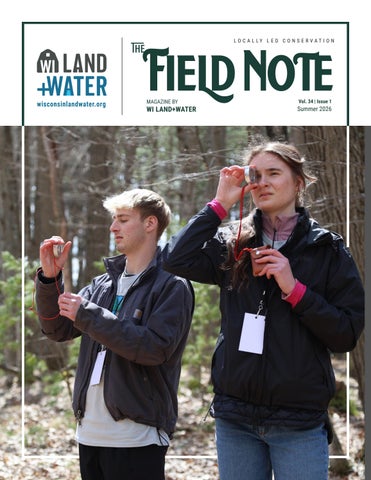
FIELD NOTE L O C A L LY L E D C O N S E R V AT I O N
The
wisconsinlandwater.org
MAGAZINE BY
WI LAND+WATER
Vol. 34 | Issue 1
Summer 2026
1
THE FIELD NOTE
2
WI LAND+WATER
“OUR CONSERVATION COMMUNITY”
A
s a communications professional and former college writing instructor, I spend much of my time thinking about words. From the meaningful messages we use to greet our newest members to the passionate phrases we use to tell the story of their work. One of the phrases that you’ll no doubt hear us use quite often is “our conservation community”—and if you’re reading this then you are a part of it. But what does that really mean, and is it more than just a nice alliteration? Well, according to my old friend Mr. Webster, there are many ways to define community. We can think of its straightforward definition—“a unified body of individuals with common interests”—or, of its more biological definition—“an interacting population of various kinds of individuals (such as species) in a common location.” Perhaps my favorite definition is “a state or feeling of caring about and wanting to interact with others in a group.” It’s this understanding that I see motivating my colleagues here in our organization. Our community exists because not only do we share our common interest in Wisconsin’s natural resources, but we also care deeply about each other and value our time spent together. The pages of this issue reflect just how much joy we find during the times we’re together. Whether it be our annual conference, the prairie chicken blind, or a grazing workshop, our members know that coming together to share ideas not only builds our sense of community, but it builds stronger landscapes and cleaner waters. We also know that our members really want to be together. We’re proud when we hear that our conference has become a “can’t miss event” for our conservation community. We have dozens of volunteers, students, and teachers traveling across the state for the Wisconsin Envirothon. Some of us are even willing wake up at 3:00am to sit together and watch birds. Behind the camera, I get to see the true smiles and laughter that spread throughout a space when our folks gather. The job of defining the multifaceted work of county conservation is one that I think would give Webster a run for his money. It’s my pleasure to spend so much time thinking about the words to tell the incredible story of locally-led conservation in Wisconsin. As you read through these pages, I’ll also ask you to consider a few words: advocate, convene, engage, and educate. These words are the pillars of our strategic plan, and while I’ll spare you more definitions, I hope the stories and photos shared here show what those words—and our members—mean to us.
Kristin Teston, Communications Director
3
CONTENTS 06.
14.
24.
VALUE OF CONSERVATION
POSTER & SPEAKING CONTEST
WI ENVIROTHON
A partnership with UW-Stout looks to figure out a dollar amount.
View our winning 2026 results and read about our contests.
View the results from this year’s ultimate science competition.
08.
16.
28.
ANNUAL CONFERENCE RECAP
CONSERVATION AWARDS
LCC TRAININGS
Hear from attendees about their favorite events.
Meet our dedicated conservation stewards from around the state.
We welcomed new and returning LCC members across the state.
10.
19.
32.
CONFERENCE PHOTOS
CONFERENCE SPONSORS
WI GRAZING ACADEMY
Revisit the moments that make our conference a “can’t miss” event.
See the generous sponsors who support our annual event.
Learn more about our new initiative to support grazing training.
13.
20.
CONFERENCE FUNDRAISERS
ON THE LEK
Learn about the raffle and silent auction results.
Take a journey with our staff into the prairie chicken blind.
20.
4
24.
WH O ’S N EW ( S ) ? T H I S S U MMER, W E’RE W ELC OM I NG NEW S TAF F I N A NEW OF F I CE
ASHLEY BECKER STEELE
CLIMATE & ENERGY PROGRAM MANAGER Ashley has always had an interest in conservation. She grew up on a farm in eastern Iowa where she learned to appreciate the land and became curious about how land management could support environmental goals, a question she carried into college. Ashley earned a BS in Biology and Behavioral Neuroscience from St. Ambrose University and an Environment and Resources MS and PhD from UW-Madison. Her graduate research aimed to help reimagine agriculture to better work for people and the environment by understanding environmental impacts of agriculture and how to support conservation adoption. In her free time, Ashley loves to curl up with a good fiction book, take walks around the lake, or try new restaurants, especially if they have tasty desserts.
OUR NEW OFFICE ADDRESS 301 S. BLOUNT ST. #302 MADISON, WI 53703
We spent the last week of May moving into a new office. We’re still located in the heart of downtown Madison in the Harvester Plaza. This historic warehouse was built in 1898 for McCormick Harvesting Machine Company and later served as a dealership for International Harvester from 1902 to 1954. Our new space comes with parking for our staff and visitors, plenty of natural light, and a layout designed for the collaborative work that drives our organization. We’ve even got a pair of nesting peregrine falcons that we can watch from our Conference Room— check out the live chick cam to see Honey & Monarch. We can’t wait to welcome you in person to the new home of WI Land+Water!
5
ADVO CAT E
THE VALUE OF COUNTY CONSERVATION A partnership with UW-Stout starts to put a dollar on the value of county conservation departments
6
E
very budget season, we face the same challenge when advocating for county conservation staffing: how do you put a dollar value on work that’s built on relationships, trust, and outcomes that take years to show up? We’ve been asking that question on behalf of our members, and we’re starting to get answers. UW–Stout Professor Tina Lee and her colleagues had already built a track record of economic and social impact research through the LAKES Research Experience for Undergraduates (REU) program, so we reached out to explore a question we had long struggled to answer: what is the return on the state’s investment in county conservation staff? UW–Stout developed sophisticated economic models that measure indirect economic impacts, helping to connect conservation staffing, environmental outcomes, and local economic value. This initial project focused on understanding the data inputs needed for the model, assessing how existing data from the DATCP Annual Survey aligned with those needs, and identifying additional information required to produce the most accurate results. Ultimately, the project aimed to move us one step closer to understanding the state’s return on investment through Soil and Water Resource Management (SWRM) staffing grants. Under Professor Lee’s leadership, seniors Helayna Brown and Ella Kemp spent the fall semester evaluating available data, primarily from the DATCP Annual Survey. Because the survey was not designed for economic modeling, the students supplemented
the data through focus groups and interviews with county conservation staff before incorporating the information into the modeling process. While they were able to fill important gaps in a handful of counties that participated in additional data collection, the results do not reflect a full, statewide assessment. However, because of the student’s work, we better understand the data needed to improve the accuracy and completeness of future assessments. Key Findings » Staffing capacity is limited and may be overstated. County conservation departments averaged five full-time employees in 2024. However, the available data does not distinguish between staff turnover and structural growth, which may overstate actual increases in staffing capacity » Indirect work is substantial yet often unreported. Staff reported spending only 37% of their time on fieldwork. The majority of their time is devoted to administrative responsibilities, coordination, technical assistance,
relationship-building, and other activities that are critical to successful conservation outcomes but are often underrepresented in state reporting. » Conservation investments generate significant economic returns. Based on an estimated $28.85 million in direct investment, conservation practices support approximately $43.8 million in total economic output and generate an estimated $1.9 million in statewide tax revenue. Because certain staffing activities and indirect benefits could not be monetized within the scope of this project, these figures are likely conservative. With additional data collection and surveying, we hope to develop a more complete picture of the economic benefits generated by local conservation programs. This information will help demonstrate to local communities and legislators the value of investing in conservation staff in every county and provide a stronger understanding of the return on public investment in conservation.
7
CONVENE
CONFERENCE CONFLUENCE
o
nce a year, nearly 500 people who spend most of their working days spread across Wisconsin’s 72 counties—out in streams, behind county office desks, in the field with landowners—end up in the same room at the same time. The hallways of Chula Vista Resort in Wisconsin Dells filled with that energy this March at our 73rd Annual Conference. The conference opened with student speakers from elementary through high school, who had researched local conservation issues and competed in their home counties, stepping up to present during the 69th Annual Speaking Contest. Watching kids stand in front of 500 working conservationists and talk
8
about what’s happening to the land and water in their own backyards is a reminder of what’s actually at stake and who inherits the work. It’s hard to think of a better way to open a conference. Doug Duren followed with the first keynote. Owner of Lone Oak Interests and manager of the Duren Family Farm near Cazenovia, where he has farmed, hunted, and managed land for over 45 years, Duren brought the kind of grounded, long-view perspective that only comes from working the same ground across decades. That evening, the conference shifted gears with Conservation Trivia, which gave attendees a chance to connect over something other than work, the kind of low-stakes, high-laughter format
that tends to produce exactly the friendly conversations that don’t fit on an agenda. Thursday carried its own momentum as we continued our forty breakout sessions, with more than 100 presenters covering soil science, grazing, data analysis, climate change, and the harder-to-quantify skills, like outreach and public speaking. A fan favorite session on what to do when something goes wrong always draws a crowd. “It was a great exercise in learning and sharing,” said Susan Mockert, Conservation Grants Supervisor at DATCP, whose team also came home talking about sessions on data centers, grazing, AI, and advocating for conservation, a range that reflects how much our members are
being asked to juggle at once. Then came lunch and an extraordinary keynote from one of our very own. Serge Koenig, a Sauk County natural resource professional with over thirty years on the job, took the room somewhere unexpected. Koenig walked through photographs from his childhood in Madagascar, using his own experience of adaptation as a lens for the conservation profession. New food, language, weather, culture, school. The parallels to field work, to meeting landowners where they are, to reinventing your approach when the situation demands it, landed quietly and stuck. “Serge embodied the need to build trust and rapport with the landowners who own the land where we implement conservation,” said Matt Hanewall, Conservation Manager at La Crosse County DLC. Tina Barone, Conservation Planner at Dunn County LWCD, felt inspired by Serge’s talk. “With all the hurdles to conservation, Serge provided the words of encouragement that I needed.” Katie Nicholas, a Conservation Specialist with Dane County LCD, came away with something broader. “We can get so focused on the current individual landowner projects we’re working on,” she said. “It’s good to take a step back and reflect on the larger picture.” That evening, the awards banquet, hosted by Marathon County Conservationist, Kristie Heidenreich, recognized our members from across the state for their dedication to our natural resources. The day as a whole, from Serge’s talk to colleagues celebrated by name that evening, reminded attendees that we’re in this together. From our conference, we hope that learning continues to translate into
plans that help counties get more conservation on the ground. Hanewall intends to bring tree-ring data from a climate session into his county’s Climate Action Plan. Kevin Seng, a Conservation Technician with Dane County LCD, enrolled in NRCS Soil Mechanics training after a soils investigation session sharpened his awareness of a gap in his own skills. “Soils investigation is something I’ve identified that I am weak in and is an area where I am actively working to improve,” he said. He also left with a new goal: introducing himself in person to engineering staff who had only ever known him by email. “That way they can put a face to the name and we can build a working relationship of trust and respect.” For Susan Mockert, the conference does something specific at the state level. “Learning more about what is impacting our county partners gives us a starting point for problem solving and how to get resources where they are most needed,” she said. That narrowing of distance between state agency and county office is part of what makes the gathering worth the trip. MaryJo Gingras, Ashland County Conservationist, has made that trip
for nearly twenty years. “I continue to be inspired at every single conference,” she said. “The planning committee integrates new and emerging topics, re-occurring favorites, amazing keynotes, and fun events intermixed.” She came home with something concrete too — leadership strategies she’s been applying to her department, learning more about staff personalities and communication styles. Kevin Butteris, an Iowa County LCC attending on a member scholarship, offered a case for showing up: “This conference is especially great for new LCC members, or people working on specific projects. It helped me better understand and promote the work the LWCD does.” By Friday afternoon, those 500 people were traveling back to their home counties, but our hope is that they carried new techniques, renewed connections, and in some cases a to-do list that didn’t exist three days earlier. The students who opened the conference show who the work is for—the rest of the week and beyond is making sure the work continues.
9
DAY 1: WEDNESDAY The conference began with our Board of Directors meeting, student speeches, and was followed by afternoon of breakout sessions, and an evening out on the town or conversation trivia.
10
DAY 2: THURSDAY On the second day of our event, LCC members gathered for breakfast and conversations. During our keynote we traveled from Madagascar to the Midwest. We continued our breakout sessions, and ended the evening with celebrating our conservation champions.
11
DAY 3: FRIDAY The last day of the conference featured plenty of smiles during our morning breakout sessions. Our Annual Business meeting closed out the three day event. We heard from committee chairs, reviewed the organization’s success, and discussed the future of state wide conservation efforts in Wisconsin.
12 PAGE .02
$2,995
DAN O’CONNELL RAFFLES SCHOLARSHIP FUND Between the Raffle sales and the 50/50, a little over $2,995.00 was raised to support land conservation department staff and committee members who attend trainings that advance their professional and leadership goals. This was an increase of over 24.8% from last year raised to support the Dan O’Connell Member Training Scholarship Program. Up to $350.00 is available to counties that meet eligibility requirements. Contact Mitch McCarthy, Member Scholarship Coordinator, or learn more at wisconsinlandwater.org/members-hub/scholarships
$8,993
SILENT AUCTION SUPPORTS YOUTH EDUCATION Each year our counties continue to show up with amazing local items to auction off at our annual Silent Auction. Last year our counties donated 190 items for the silent auction and this year 231 items were donated, which was an increase of 21.6%. Not only did we have more items to bid on but the amount of money raised to support our Youth Education programs increased by 32.25% bringing in a whopping $8,993.00. This year Ashland County had the highest retail value of items, earning them the “Kicking it For the Kids” trophy. “The support from our counties allows the Youth Education Committee to reach more kids and engage them in our Youth Conservation programs across the state. A big thank you to our Youth Education Committee and all who donated or bid on an item,” said Kim Warkentin, Youth Education Director.
13
69 TH ANNUAL CONSERVATION AWARENESS POSTER & SPEAKING CONTEST
B
efore most of the conference attendees have even arrived, thirteen students have already delivered their speeches, answered judges’ questions, and settled in to wait for the results. The students who place first will deliver their winning speeches again-–this time in front of nearly 500 conservation professionals from across the state at the opening lunch. The Conservation Awareness Speaking and Poster Contests have been part of our Conference for 69 consecutive years, and the goal hasn’t changed: encourage students to find conservation issues that matter to their community, learn about the topics, and share that knowledge with others. This year’s winning speeches focused on microplastics, data centers, and recreational boats on Wisconsin lakes. “These are some of the conservation issues facing the new generation,” noted Youth Education Director Kim Warkentin, “These are questions students are watching play out in their own backyards right now.” This year’s emcee was Thelma Heidel-Baker, a soil conservationist with USDA NRCS who also runs Bossie Cow Farm, a diversified organic dairy in southeast Wisconsin. She holds
14
a PhD in entomology and has worked across academia, nonprofits, and federal service. “We want students to see a variety of experiences and know that being able to articulate a message is so important for every type of career,” added Kim. The poster contest drew entries across five age divisions under this year’s theme, “Soil. Where It All Begins.” Students were challenged to illustrate the relationship between healthy soil and thriving ecosystems, and the results showed just how creatively Wisconsin’s youth can express a conservation message. Entries advanced from local contests to the conference floor, where attendees voted on which best captured the theme. From our conference, the first place winners travel to compete at the national level. Earlier this year, Pierce County’s Claire Miller earned second place nationally in the Grades 79 division at the NACD National Poster Contest, announced at NACD’s 80th Annual Meeting. While the topics might change, what’s being practiced stays the same. Students are learning to care about a place, and then finding the right words to express it. To view full size posters and results, visit wisconsinlandwater.org/contests.
NATURE MAGAZINE
ELEMENTARY DIVISION - FIRST PLACE
JUNIOR DIVISION - FIRST PLACE
Ainsley Pitlik, Oneida County
Sutton Pitlik, Oneida County
“Surf Smart: Protecting Wisconsin Waters”
“Ugghh! Plastic”
SENIOR DIVISION - FIRST PLACE Leah Gorsuch, Sauk County “The Ground We Stand”
15
2025 CONSERVATION AWARDS
T
16
he awards banquet is one of those evenings in conservation where the work finally gets its moment. Hosted this year by Kirstie Heidenreich, Marathon County Conservationist, the night opened with a crowd-sourced question on the screen: In your opinion, what is the best part about conservation work? The answers came in from across the room— county staff, farm families, partner agency colleagues, retirees—reminder of just how much experience was packed under one roof. “This room represents thousands of conversations with landowners, countless hours in meetings and in the field,” Kirstie told the crowd. “Tonight is about recognizing the people and partnerships who exemplify the very best of that work.” Every nominee starts at the county level. Land and water conservation departments across Wisconsin put forward the people they think deserve recognition, and from there the Professional Improvement Committee reads through the nomination materials and selects the winners. This year’s pool was deep — nearly two dozen professionals were nominated for six awards. “It’s a genuinely hard committee assignment, in the best way,” said Matt Krueger, WI Land+Water’s Executive Director. “We want to thank every county that submitted a nomination this year. Even for the nominees who didn’t take home an award, their work was seen and appreciated by a panel of their peers, and that matters.”
This year’s winners include: »
Conservation Farm Family of the Year: Gunderson Grain Farms — This Racine County family has farmed the same land for eight generations, modeling what soil health and water quality stewardship can look like across decades of change.
»
Friend of Conservation: Paul Dietmann — A fixture at WI Land+Water’s Annual Conference, Dietmann has made farm financial literacy a staple of Wisconsin’s conservation conversation, giving county staff the confidence to talk money with producers at the kitchen table.
»
Conservation Legacy Award: Serge Koenig — Sauk County’s honoree has spent more than 30 years earning the trust of landowners one conversation at a time, and has nearly single-handedly converted 6,000 acres to rotationally grazed pasture.
»
Outstanding Conservation Employee, Administrative Assistant: Mayme Keagy — Iowa County’s honoree is, as her colleagues put it, “the heart of the office” — and brings professional-grade design, photography, and native plant expertise on top of it.
»
Outstanding Conservation Employee, Technician/Planner: Blake Schuebel — Shawano County’s honoree has spent more than three decades doing whatever the job requires, and has trained four new staff members in the past six years alone.
»
Outstanding Conservation Employee, County Conservationist: Scott Frank — Also of Shawano County, Frank has built youth programs, led a nationally recognized organization, and earned a nickname from the campers who know him best: “Ranger.”
Before the evening wrapped, Kirstie left the crowd with a final thought, “The challenges facing Wisconsin’s land and water aren’t getting easier, but nights like this remind us that the people doing the work are capable, committed, and creative.” To read the full stories behind each award, visit us at wisconsinlandwater.org/awards.
17
2026 Conservation Farm Family
GUNDERSON GRAIN
18
The Gundersons have farmed the same land near Waterford, WI long enough to watch conservation science evolve around them, and they’ve kept pace with every decade. Brian Gunderson has farmed full-time since age 18, first alongside his father Dave, and now with his daughters Kora and Ashley, who will carry the farm into its eighth generation. Gunderson Grain Farms is recognized for being among the first in their region to adopt no-till farming. After running side-by-side comparisons of no-till and conventional tillage in the 1970s, the family made the full switch by the mid-1980s — farming as many as 5,000 acres at their peak. In 2004, they enrolled 43 acres of grassed buffers into the Conservation Reserve Enhancement Program, protecting more than a mile of perennial streams. By 2018, they had added cover crops to the mix, and Brian says the soil is in better condition today than it has ever been. As a founding member of the Watershed Protection Committee of Racine County, Brian and his family have turned their farm into a living classroom, sharing what they’ve learned with neighboring farmers working to improve soil health and water quality across the region. A short film telling their story will be produced and released this fall.
CONFERENCE SPONSORS
29
SPONSORS SUPPORTED OUR CONFERENCE
The generous support of our sponsors allowed us to provide attendees with a rich and diverse program filled with engaging presentations, interactive sessions, and networking opportunities. We want to express our deepest thanks for their support and for being a part of this exciting event. For a complete list of
sponsors, visit wisconsinlandwater.org/conference.
Gold Sponsor
NRCS offers voluntary programs to eligible landowners and agricultural producers to provide financial and technical assistance to help manage natural resources in a sustainable manner. Through these programs the agency approves contracts to provide financial assistance to help plan and implement conservation practices that address natural resource concerns or opportunities to help save energy, improve soil, water, plant, air, animal and related resources on agricultural lands and non-industrial private forest land.
Silver Sponsors
19
ENGAGE | EDUCATE
BLINDS & BOOMERS Members of our staff awoke early to spend the morning with prairie chickens and the people who protect them.
A
long with my WI Land+Water colleagues Kristin Teston and Carl Wepking, I recently had the unique chance to join Tracy Arnold and Shawn O’Connell of the Portage County Land Conservation Department for a chance to experience one of Wisconsin’s most charismatic and rare birds, the greater prairie-chicken (GRPC), performing one of nature’s most interesting mating rituals “on the lek.” This was special on several fronts. First, it’s not a very common bird species. GRPC was once extensive in the prairies, oak savannas, and meadows of Wisconsin, and was found in every county of the state
20
following European settlement. However, its population has substantially declined since then and is now on the State of Wisconsin threatened list, limited to populations in only a few areas of Central Wisconsin. It was also special as Tympanuchus cupido is simply a unique species of bird. Tympanuchus, Latin for “holding a drum,” and cupido, meaning “desire, longing, passion” (if that wasn’t obvious) is really something to behold. Similar to other upland birds like turkeys and grouse, males become very territorial and perform elaborate mating rituals during the breeding season to attract the attention of a mate. For GRPC, that behavior entails exposing a bright orange eyebrow and inflating an orange throat sac and raising “pinnae” feathers like antennae on its head as it dances around, hunched over, on its mating grounds, or lek. And the booming! Males produce a distinctive “boom” sound that can supposedly be heard from a mile away. There’s also a very unique county conservation aspect tied to these Central Wisconsin birds, related to the Portage County LCD, and its history of
stewardship of GRPC habitat in and around the Paul J. Olson and Buena Vista wildlife areas. Creation and protection of GRPC habitat was a passion of the late Dan O’Connell, and his legacy is carried on today through the work of Tracy and his son Shawn. Furthermore, present-day protection of GRPC is a joint effort between the Portage County LCD and the farmers they partner with, who are excited about and invested in seeing their numbers recover. “The unique partnership between the Farmers of the Mill Creek Watershed Council, Portage County Land Conservation and WI DNR is just as unique as the Greater Prairie-Chicken species themselves,” said Tracy. “The partnership coordinates the WI Prairie Chicken Festival, Paul J Olson Wildlife Area habitat workdays, educational presentations, producer-led incentives and reserving viewing blind spots.” If all of this wasn’t enough to have me excited to see these birds, as a self-admitted “bird nerd,” I had seen them in Wisconsin previously, but never on their lekking grounds, and it was on my bucket list. Our morning started in the darkness of the wee
21
TAKE A LISTEN Click here to hear the prairie chicken “booming” sound.
22
hours, in order to make our 4 am meetup near the lekking grounds. Our group of a dozen or so people sucked down coffee while getting a brief rundown from Tracy and Shawn. After that, we split into two groups and headed out to the blinds, positioned adjacent to the leks. We had time to stargaze and chat quietly before we were prompted to begin listening for booming. Having never heard it firsthand before, I wasn’t quite sure what a “boom” sounded like; but once you hear it, there is no mistaking it for anything else. In the faint dawn light, we heard first one boom, then another, followed by more. It was a sound that was seemingly everywhere and nowhere in particular all at the same time (though I’m sure this isn’t a problem for the birds). I can only describe it as some sort of rhythmic undulation, almost like a
slowed-down singing saw, interrupted by sporadic, otherworldly laughter. I marveled at how effective the sound carried across the landscape, and wondered how evolution had possibly arrived at this particular sound. Over the course of a very eventful morning, our group of six was treated to plenty of GRPC activity, with a total of eight displaying males and four apparently disinterested females (which provided plenty of anthropomorphized commentary and quiet chuckles from the blind as we watched) on the lek. Males postured in front of females, and sometimes even sparred, rising into the air and striking each other with their legs. Occasionally a harrier would cruise through, tamping down activity for a bit. After several hours, the birds moved off into the nearby marsh. It was a memorable experience, not only for the
avian spectacle of it, but for the reminder of the myriad wonderful and unique species—birds and otherwise—that inhabit the world we share with them, which benefit from our conservation work, and that of our partners. Sometimes it requires awakening in the dead of night and posting up on one particular spot on the landscape to behold these species, but all the better for the experience, if you ask me. I am grateful to Tracy, Shawn, and partners at the Prairie Chicken Project Wisconsin for allowing us to be part of this quintessential Central Wisconsin spring experience. And highly recommend GRPC viewing as part of the annual Wisconsin Prairie Chicken Festival, next spring!
23
EDUCATE
WISCONSIN ENVIROTHON
More than 150 high school students gathered to test put their environmental science skills to the test.
T
his spring, 29 teams of 155 middle and high school students shared their improvement plans for the fictional town of Prairie Lake–imagined to exist around a small Chain of Lakes that has struggled with poor water quality and algae blooms during the summer swimming and boating season. While this community might be a made up place, the chain of lakes, the runoff draining into the watershed, the algae blooms plaguing the swimming beach, and fish kills after a long winter are very real problems. Ben Uvaas, Water Resources Management Specialist and Agricultural Nonpoint Source Implementation Coordinator for the Wisconsin DNR, knows these issues and wrote this year’s Current Issue scenario for the 2026 Wisconsin Envirothon. The fictional community of Prairie Lake, he says, is a classic case. “This is something I work with every day, but also something I experienced growing up in northeast
24
Wisconsin.”Uvaas hoped his Current Issue scenario would help students connect their own lived experiences and the mechanism used to address NPS pollution. Each year, Envirothon teams spend three weeks researching a single pressing environmental challenge before presenting their findings to a panel of expert judges on competition day. Past topics have ranged from soil health and invasive species to climate change and recreational impacts on natural resources. The format is closer to a consulting exercise rather than a traditional classroom presentation. Teams of four or five middle or high school students analyze the issue, develop a plan, and defend it under questioning from professionals who deal with the same problems for a living. Uvaas’ scenario dropped students into Prairie Lake, a fictional but entirely plausible Wisconsin
community. The imagined Chain of Lakes—71 acres, an average depth of seven feet, a watershed covering more than 18 square miles—sits in the middle of a landscape that’s 60% agricultural. Because of a combination of dairy operations, row crops, and a developed shoreline, there is almost no natural buffer left. The DNR has listed the lakes as impaired for phosphorus. Algae blooms have been shutting down the beach. And this spring, after the ice melted, residents found a fish kill. Their task: develop a lake improvement plan. Identify pollution sources and their relative contributions. Propose management strategies, and figure out how to pay for them. Design a monitoring program to track whether any of it is working. And then figure out how to bring the community along with their ideas. The latter task especially mattered to Uvaas and the judges. “I wanted the current issue to provide students with several direct leads in developing their response, but not direct them towards any specific resolution,” he said. The scenario pointed toward pollution sources, management options, monitoring methods, and community outreach. Uvass and other conservation professionals served as judges for the Current Issue presentations at this year’s competition, and by the time the competition wrapped, something exciting had happened for the judges. “There are times when any of us can feel drained or burnt out from the work we do,” Uvass said. “You could really feel the enthusiasm in the current issue presentations. That gave us all a boost.” The strongest teams, he noted, did three things well. They built a genuine technical understanding of the problem—not just naming phosphorus as a pollutant but tracing where it was coming from and why. They researched solutions and made defensible choices about which ones to prioritize. And then they explained all of it clearly, to a room full of professionals who were ready to push back. That last piece is harder than it sounds, and it’s the part Uvass thinks is the most valuable.. His wife, Lindsey, teaches high school English. They talk often about where their work overlaps. “We talk a lot about how important it is to be able to clearly explain technical material to a broad audience,” he said. “What makes the current issue presentation unique and important is its focus on communication.” The Current Issue is just one part of the multi-station competition. Students also spend time in the field by climbing into a soil pit, measuring a variety
25
of trees, identifying invasive plants along the water’s edge, and interpreting wildlife data. The exams and station activities are written and staffed by local natural resources professionals from county land and water departments, the DNR, NRCS, DATCP, Pheasants Forever, and UW-Stevens Point. After the competition, those same professionals sit down with students to walk through the results, explain their thinking, and answer questions about their own careers. For many students, it’s their first real conversation with a wildlife biologist or conservation technician. “These are the kinds of real-world conservation problems that natural resources professionals face every day,” said Kim Warkentin, Youth Education Director for WI Land+Water. “The students are thinking about the same questions that land and water professionals address in their own local communities. That’s an extraordinary thing for students to understand and experience.” Middleton High School took the top spot in the high school division and will represent Wisconsin at the National Conservation Foundation Envirothon this summer in Starkville, Mississippi, competing against teams from across the United States, Canada, China, and Singapore. Sun Prairie East High School earned top honors as the FFA team, and Fox River Academy Middle School FFA took the middle school title. Envirothon is one of the few places where conservation staff can see the next generation in action. Uvaas came to Rosholt as a judge, and he left re-energized by a room full of students who’d spent three weeks thinking hard about problems he works on year-round. Turns out a day at the lake, even a fictional one, does the trick.
26
NCF- ENVIROTHON The National Conservation Foundation Envirothon is the international championship of the Envirothon program, drawing the top high school team from each competing state, province, and country. This year’s event took place on July 19-25 at Mississippi State University in Starkville, where Middleton High School represented Wisconsin against teams from across the United States, Canada, China, and Singapore. Students will continue to identify NPS sources in both urban and rural settings, conduct their own watershed surveys, and explore mitigation strategies ranging from individual choices and responsible consumption to community-level work like watershed planning and water quality testing. To see more of their journey south, check out our next issue or connect with the WI Envirothon on Facebook at facebook.com/wienvirothon.
27
CONVENE | ENGAGE
WELCOMING NEW LAND CONSERVATION COMMITTEE MEMBERS New and returning LCC members gathered to learn more about our organization and their role as officials.
28
T
his June, our staff once again hit the road to welcome new and returning Land Conservation Committee (LCC) members to their roles. Building on the success of our 2024 events, where we took a new approach and developed a training that was meant to engage attendees in group discussions and peer learning, we held five regional sessions, bringing conservation orientation and networking opportunities directly to LCC members and Land and Water Conservation Department (LWCD) staff across the state. This approach allowed us to tailor content to local needs, ease travel burdens, and create space for neighboring counties to connect and learn from one another. This year’s training series drew over 175 total attendees representing 52 counties and 2 state agencies. We extend gratitude to Winnebago, Lincoln, Sawyer, Jackson, and Dane counties for hosting these events in Oshkosh, Merrill, Hayward, Black River Falls, and Madison, respectively. Attendees shared a diversity of knowledge and experience that ranged from a handful of days in their role to over 40 years. For many new LCC members, the trainings offered a first real introduction to the structure and purpose of their role. One attendee, new to their committee, shared via our event evaluation that even
the drive to the training was a part of the learning experience, writing “even carpooling here with my staff [representative] was extremely helpful in opening lines on communication. This program was incredibly useful for newbies like myself.” Other attendees pointed to the value of hearing directly from peers in other counties. One participant wrote that they “really enjoyed the time for interaction with my own county and with another county. I learned a lot!” while another noted simply that it was “valuable to hear examples from other counties.” The interactive format was a recurring theme in the feedback that we received. As one attendee put it, they were “glad this was not just a sit and get, but included interactive and collaborative activities and opportunities,” adding that they came away impressed with the collaboration between counties, municipalities, and state organizations. Another called the training “a great first stop for a new supervisor on LCC” with “lots of useful [information].” Several attendees also singled out the 2026-2028 edition of our LCC handbook as a resource they will keep coming back to. LWCD staff echoed the enthusiasm. “Nice job making it interactive!” one wrote in their feedback, while another appreciated “the opportunity to learn
from other areas and counties which are dealing with some of the same issues.” Others were grateful simply for the chance to connect and noted that the engaging format was “much more valuable than [a lengthy statutory review]” – a sign that the shift toward interactive, discussion-based learning is resonating with staff as well as the committee members. Momentum from this year’s series is already shaping what comes next. Building on the informal “LCC Coffee and Conservation” webinars that were introduced after the last LCC training events, we are planning upcoming virtual events centered around topics pulled directly from this year’s evaluations – and we’re always open to additional topic suggestions. We’re also looking to update our library of LCC video resources, as well as explore additional resources for committee members who may not have been able to attend an in-person event. We’re continuing to develop and refine our broader LCC onboarding process to make sure every new LCC member starts their term with the tools and context they need. Our time spent with members at these June events has shown us that members are eager to get engaged, ask questions, and learn from one another. We look forward to building on that energy in the months ahead.
29
THE FIELD NOTE
EDUCATE
WISCONSIN GRAZING ACADEMY As the interest in grazing practices increases across the state, our newest training program ensures conservation professionals can meet that demand.
30 30
O
n a warm May morning, more than thirty people gathered in a room filled with conservation professionals eager to learn more about grazing. Some were fresh to the work, while others had written the plans, walked the pastures, or seen first hand what happens when farmers actually use those tools. Adam Abel, the Wisconsin State Grazing Land Specialist, stood at the front and asked a simple question: What’s your “why” for attending? The answers filled the room. A county conservation department staffer who’d managed grazing systems a decade but no longer had funding for certification. A younger farmer-consultant wanted to know where how to help beginning farmers get started start. An agency partner who’d watched producers ask for help with rotational grazing and had nowhere to send them. One participant, Tim Mika, Agricultural Technician from Ashland County, attended the event on Dan O’Connell Member Training Scholarship that helps county staff and committee members access training they
otherwise couldn’t afford. Despite various personal motivations, one thing brought them all together: the demand for grazing systems in Wisconsin is outpacing the technical service providers who can write the plans. Farmers are increasingly interested in adopting grazing practices, and counties see the conservation payoff—healthier soil, better water infiltration, and more resilient pastures. But there simply aren’t enough people with the expertise to make it happen. The Wisconsin Grazing Academy exists to change that. Built on momentum from Grassland 2.0 Academy, this new partnership between Wisconsin Land+Water, UW-Extension, and NRCS launched its first cohort of 30 professionals this May. The Grazing Academy combines webinars and field days, and a multiday retreat in August. The cohort will learn more about grazing benefits, and leave the program knowing how to write a grazing plan. The Wisconsin Grazing Academy began it’s first meeting with the foundations, as Abel walked through why grazing
plans matter—the science, the structure, the thinking that separates a plan someone will actually use from one that sits in a drawer. Laura Paine, UW-Extension agricultural outreach educator, and Patrick Bula, conservation specialist and farmer, took them deeper into the more technical elements. A panel of active grazing planners and farmers who’ve lived with these plans also shared what worked and what didn’t. Mika noticed how much the field has changed since he’d last written plans. “There are many of the same documents being used now, but the layout is more uniform across grazing planners,” he observed. “Previously, grazing planners had more flexibility in how they provided the information. This new process makes very good sense and was well thought out.” And this standardization isn’t bureaucracy for its own sake. It’s about making a tool that actually works on a farm. “Grazing plans are designed for farmers to use like another tool in the shop,” Mika said. “If the farmer cannot understand it or doesn’t see the value of using it, then the plan is not effective.”
31
THE FIELD NOTE
By the end of that first day, excitement filled the room. “It was amazing to see that the grazing world is alive and well,” Mika said. “I was able to make some connections to some former professionals in the industry along with network with some new and younger professionals.” Putting principles into practice is central to the Academy’s approach. On an overcast June morning, the cohort worked on plant identification. Grasses proved a welcome challenge — many participants wanted to sharpen their grass ID skills, knowing how tricky it can be for even seasoned professionals once the seed heads are gone. They had Bula’s Pleasant View Farm in Baraboo as their classroom, a spot that lives up to
32
its name with its rolling hills and abundant grasses. Skill-building continued with pasture condition scores, in-field soil health assessments, and forage quantity estimates using grazing sticks. Each skill matters for writing grazing plans and communicating with producers, and there’s no substitute for hands-on experience alongside peers. But not all the learning happens in the field. The Wisconsin Grazing Academy also offers asynchronous content that lays the groundwork for writing strong plans. In her new role with us, Ashley Becker-Steele has taken on building these self-paced modules with guidance from grazing experts, work that combines her experience in teaching and science
communication with her interest in well-managed grazing systems, both of which she explored in graduate school and can now put to use. “Managed grazing isn’t a niche practice anymore—it’s economically viable for producers while building soil, supporting biodiversity, and improving water retention,” explained Becker-Steele. Interest in the Academy exceeded capacity this year, and applications for the next cohort open at the end of 2026. “Farmers want these plans, and our program is designed to make sure there are enough people trained to meet that need.”To learn more, visit us online: wisconsinlandwater.org/grazing/ wisconsin-grazing-academy
SUMMER 2026
LOOKING FOR FREE TECHNICAL TRAINING? Silvopasture Fundamentals - September 4 If you advise land managers and are ready to learn about silvopasture, then this training is for you! Silvopasture is the intentional integration of forages, trees, and livestock, which can help increase the productivity and health of both farm and forest systems. Alley Cropping Fundamentals - September 24 Are you a service provider in the agriculture, conservation, or forestry sectors looking to learn how to design and implement alley cropping? Now is your chance! Alley cropping involves intentionally integrating trees with crops, where agricultural or horticultural plants are grown in the alleys between rows of trees. This agroforestry practice offers numerous benefits, including diversified farm income, increased crop production efficiency, and enhanced ecosystem functions. Join us for a day-long workshop to learn how to effectively plan and implement this valuable practice.
This was a great day of learning for me but more than that, it was amazing to see that the grazing world is alive and well. Conservation Works! Grazing Works! - Tim Mika, Ashland County 33
Locally led conservation, statewide impact. Since 1953, Wisconsin Land and Water Conservation Association (WI Land+Water) has championed the work of county conservation professionals across Wisconsin. As a nonprofit organization, we support more than 800 county staff in land and water conservation departments (LWCDs) and county officials on land conservation committees (LCCs). Our members work in every county of the state, delivering boots-on-the-ground support that protects our natural resources and strengthens local communities.
ADDRESS
CONTACT US
SOCIAL MEDIA
301 S. Blount St. #302 Madison, WI 53703
(608) 441-2677 info@wisconsinlandwater.org
Facebook & Instagram @wisconsinlandwater