WIKI / ERGOGEAR BUYER’S FIELD GUIDE / NOVEMBER 2026
Best Under Desk Footrests Find a stable support height without crowding your desk
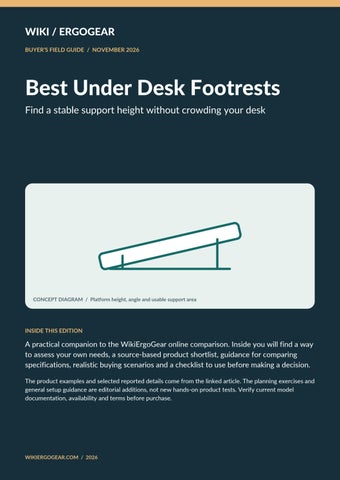
CONCEPT DIAGRAM / Platform height, angle and usable support area
INSIDE THIS EDITION
A practical companion to the WikiErgoGear online comparison. Inside you will find a way to assess your own needs, a source-based product shortlist, guidance for comparing specifications, realistic buying scenarios and a checklist to use before making a decision. The product examples and selected reported details come from the linked article. The planning exercises and general setup guidance are editorial additions, not new hands-on product tests. Verify current model documentation, availability and terms before purchase.
WIKIERGOGEAR.COM / 2026
WIKI / ERGOGEAR • FIELD GUIDES
SEATING
Start with the chair and the floor A footrest is useful when the floor does not provide a comfortable support surface at the chair height needed for work. For example, a short person at a fixed desk may raise the chair to reach a keyboard and then find that the feet no longer rest securely. Lowering the chair again may solve one problem while creating another. An appropriate footrest can fill the difference without requiring a new desk. Start with the chair adjusted to a position that suits the work surface. Sit with the backrest positioned according to its instructions and observe whether the feet can rest without pressing against the chair edge. If the chair is too deep or its minimum height is inappropriate, a footrest alone may not be the right solution. Consider the complete seated geometry, including room to move the feet. There are several styles of support. A rigid platform provides a defined surface, a foam cushion may feel softer, and a tilting or rocking design allows some movement. A suspended hammock changes the location and character of the support. These are not interchangeable devices: someone who wants a reliable place to set both feet may prefer a stable platform over a moving sling. Decide what kind of support you need before comparing the advertised features.
WIKIERGOGEAR.COM / NOVEMBER 2026
02 / 08
WIKI / ERGOGEAR • FIELD GUIDES
SEATING
Measure the space and target height With the chair positioned for the desk, determine the approximate gap between the floor and the level where you want the feet supported. An unloaded foam cushion may compress noticeably, so its listed height is only a starting point. A rigid platform has a more predictable surface height, but an angled design places the front and back of the feet at different elevations. Check the usable height where your feet will actually rest. Measure the open space underneath the desk. Include any horizontal support rails, drawers, computer tower, cable tray or storage bin. A footrest should not force the knees into the underside of the worktop or prevent a comfortable change in leg position. Measure the width needed for both feet and whether there is sufficient front-to-back room for shoes. If you work barefoot, consider the material and surface texture as well. For a hammock, inspect the attachment area on the desk and the available space for the straps. The clamp must fit an approved location and the desk must be suitable for that attachment. Do not use a sling for standing or to pull yourself toward the desk. If an attachment does not fit, choose a floor-based support rather than improvising with a modified clamp or makeshift fastener.
WIKIERGOGEAR.COM / NOVEMBER 2026
03 / 08
WIKI / ERGOGEAR • FIELD GUIDES
SEATING
Compare the five source options The online review covers foam, suspended, tilting plastic, adjustable platform and wooden designs. These examples illustrate the difference between a fixed support and one that permits changes in angle or height. The source's figures are published product information, not independent measurements for this edition. Check the actual platform area, adjustment method and cleaning instructions before making a final choice. Use the table as a shortlist rather than a universal ranking. MODEL
REPORTED FEATURE / SPECIFICATION
ComfiLife Memory Foam
17.5 x 12 x 6 in; reverses for rocking
iMissiu Foot Hammock
Desk-clamp suspended design
Fellowes 48121
Two height settings, tilting platform
HUANUO HNFR3-C
4.3–6.7 in height settings
COREMINDED Foot Stool
Wood design, seven angle positions
Source: WikiErgoGear online comparison. Confirm the exact model and current specifications.
Decision worksheet Make a simple drawing of the space below the desk from the side. Mark the floor, underside of the worktop, seated knee position and the support level at which your feet can rest comfortably. Record how the available height changes when you wear different shoes. Next, sketch a top view showing the chair base, desk legs and any storage objects. Compare the dimensions of prospective platforms with that usable rectangle. If the support is angled, check both the near and far edges against the clearance under the desk. For a foam design, keep in mind that compression changes the final working height. For a hammock, draw the intended clamp locations and ensure there is room for both straps. Keep a short list of two or three models that fit the space and provide the desired kind of support. Assess cleaning and ease of repositioning as practical tie-breakers, rather than buying the most adjustable or thickest product automatically.
WIKIERGOGEAR.COM / NOVEMBER 2026
04 / 08
WIKI / ERGOGEAR • FIELD GUIDES
SEATING
Select a surface you can live with Foam designs are often appealing in a home office where shoes are not always worn. The softness can vary with construction and temperature, and a cushion may compress differently under different users. Look for a surface that remains comfortable without excessive sinking or shifting. A washable cover can be useful if the product is used frequently, but follow the care label so the inner material is not damaged. Rigid platforms may be preferable for shared workspaces where different users need a repeatable height. A tilting mechanism can permit small changes in foot angle, but the useful range depends on how the platform behaves when you rest your feet. Test whether it remains sufficiently stable during ordinary use. If the design is intended to rock, ensure there is enough clearance from desk legs and nearby objects. Wooden platforms can suit a particular decor and may offer a firm surface. Check edge finish, grip and whether the adjustment mechanism remains secure in the selected position. A platform that slides on a smooth floor may be frustrating even if its dimensions are correct. Choose compatible floor protection and avoid placing a support on an uneven or loose surface. Product appearance should not outweigh a stable and comfortable working arrangement.
WIKIERGOGEAR.COM / NOVEMBER 2026
05 / 08
WIKI / ERGOGEAR • FIELD GUIDES
SEATING
Plan for two common situations A person working at a fixed dining-height table may need to raise the office chair to reach the keyboard comfortably. A footrest with multiple height options provides a practical way to experiment with the resulting leg position. Measure the required support after adjusting the chair, not before. If the knees rise too close to the underside of the table, the workstation itself may need a different solution. A second person may already have a good chair and desk but prefer occasional small movements while reading. A rocker or tilting platform may be a useful accessory, provided it does not demand continuous balancing or slide out of reach. If the feet need to be supported firmly during concentrated typing, choose a design that meets that requirement rather than one marketed mainly for motion. A narrow desk with a computer tower can change the priorities. A wide platform may not fit, while a suspended design might obstruct a support bar or cables. Draw the available area and the space needed to move the chair in and out. If an accessory makes ordinary entry, exit or cleaning more difficult, it may not be worthwhile. The smallest option is not automatically best; the usable support area needs to be sufficient for the person using it.
WIKIERGOGEAR.COM / NOVEMBER 2026
06 / 08
WIKI / ERGOGEAR • FIELD GUIDES
SEATING
Evaluate the fit over a working week Place the footrest in a clear area and set the height or angle according to the manufacturer's directions. Begin with a normal task and note how your feet rest, whether you are sitting back in the chair and whether you can move your legs freely. If you notice pressure at the seat edge, consider adjusting the chair or the support rather than adding more height automatically. Move the footrest when necessary to allow a different comfortable position. An accessory should not prevent ordinary movement breaks. Keep shoes, bags and cables out of the immediate area so it does not become a trip hazard when you stand. Follow the product instructions for cleaning and inspect any adjustment joints or straps periodically for wear. Record the setting that you prefer and the reasons for it. Is the surface large enough for both feet? Does it slide on your floor? Is the selected height compatible with the desk clearance? These observations help you decide whether to keep the product within its return period. Persistent pain, numbness or a health condition needs appropriate professional advice; a footrest is a workstation accessory, not a medical treatment or a substitute for clinical assessment. Read the full comparison on WikiErgoGear
WIKIERGOGEAR.COM / NOVEMBER 2026
07 / 08
WIKI / ERGOGEAR • FIELD GUIDES
SEATING
Before you buy Use this checklist to record the measurements and decisions that matter for your own workspace. Keep the exact product model and applicable instructions; treat unspecified requirements as open questions rather than confirmed features. Set the chair for the work surface. Measure required support height and space. Check footrest width, depth and floor grip. Compare adjustment and surface materials. Confirm attachment limits for suspended designs. Test normal use before the return window ends.
Frequently asked questions Is a taller footrest better? No; choose a height compatible with your chair and desk.
Can foam height be measured accurately before use? The published dimension may differ from loaded height.
Can I stand on a footrest? Only if explicitly designed for that purpose; most are seated supports.
Is a hammock equivalent to a platform? No; a sling offers a different kind of support and requires compatible attachment. SOURCE AND FURTHER READING
See the original product comparison, selection criteria and buying information: https://wikiergogear.com/best-under-desk-footrests/ Disclosure: WikiErgoGear is reader-supported and may earn affiliate commissions. General product information only; no new testing or medical outcome is claimed.
WIKIERGOGEAR.COM / NOVEMBER 2026
08 / 08