WIKI / ERGOGEAR BUYER’S FIELD GUIDE / NOVEMBER 2026
Best Reclining Office Chairs with Footrests Evaluate the recline mechanism, leg support and room clearance
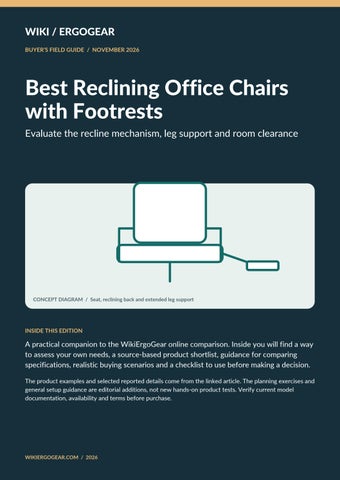
CONCEPT DIAGRAM / Seat, reclining back and extended leg support
INSIDE THIS EDITION
A practical companion to the WikiErgoGear online comparison. Inside you will find a way to assess your own needs, a source-based product shortlist, guidance for comparing specifications, realistic buying scenarios and a checklist to use before making a decision. The product examples and selected reported details come from the linked article. The planning exercises and general setup guidance are editorial additions, not new hands-on product tests. Verify current model documentation, availability and terms before purchase.
WIKIERGOGEAR.COM / 2026
WIKI / ERGOGEAR • FIELD GUIDES
SEATING
Separate working and resting positions A reclining office chair with a footrest combines a seated workstation with a position intended for breaks. These functions place different demands on the chair. During keyboard work, the user needs convenient access to the desk and input devices. During a reclined break, the body may move away from the work surface while the leg support extends forward. A chair that appears comfortable when fully reclined may still be a poor choice for typing if its upright seat geometry does not fit. Before comparing angles, decide how frequently the footrest will be used. An occasional break in a roomy home office is different from a chair positioned in a narrow aisle or a shared room. The mechanism needs enough clearance for the intended movement without blocking another person or striking furniture. A design with an integrated footrest may be convenient when no separate support can be stored, but it also introduces another moving component to inspect and maintain. Recline is not a single characteristic. A tilt mechanism can move the seat and backrest together; another mechanism may alter their relative angle. Locking positions, tension adjustment and the way the chair returns upright vary. Review the exact mechanism and the manufacturer's intended use rather than assuming that a maximum angle describes every intermediate position. A larger angle does not establish better comfort or safer support.
WIKIERGOGEAR.COM / NOVEMBER 2026
02 / 08
WIKI / ERGOGEAR • FIELD GUIDES
SEATING
Measure the chair in every position Record the available depth behind the chair and between the seat and the desk. A chair can occupy much more room when its back is reclined and its footrest is extended. Use the manufacturer's dimensions for the complete operating envelope if available. Draw the extended outline on a floor plan, leaving an unobstructed access route. Consider wall outlets, a cabinet, a wastebasket or cables that may be in the path of a moving component. Measure the seat height, usable depth and the width between armrests. In the upright position, the feet should have appropriate support and the keyboard should be accessible. Evaluate the position of the headrest and lumbar support in both the working and reclined configurations. A footrest cannot correct a seat pan that is fundamentally too deep or narrow for the user. The leg support itself needs to fit the person. Compare the extension range, usable pad area and the instructions for deployment and retraction. A pad positioned under the lower legs may feel very different from a full-length support. Do not use it as a step, seat or lifting handle unless the manufacturer explicitly permits that use. Verify whether separate limitations apply to the footrest, recline mechanism or overall chair.
WIKIERGOGEAR.COM / NOVEMBER 2026
03 / 08
WIKI / ERGOGEAR • FIELD GUIDES
SEATING
Compare the six published models The source review distinguishes mesh models, heavily upholstered designs and a larger-capacity chair. It reports several different recline locking systems. The table is a source-based selection snapshot, not a test of hinge strength or footrest loading. Confirm how the angle is defined and the intended use of each position in the actual manual. A maximum angle and an overall user rating are not enough to establish suitability for every use of a movable leg support. MODEL
REPORTED FEATURE / SPECIFICATION
GABRYLLY with Footrest
90/110/135 degree lock positions; 300 lb rating
ELABEST X100
Adjustable lumbar and 18 in footrest
MALOL Mesh with Footrest
Mesh option in the source shortlist
BOWTHY Reclining
Up to about 150 degrees
EXCEBET Big and Tall
400 lb rating; 135-degree recline
amseatec Reclining
90–135 degree locking range; upholstered seat
Source: WikiErgoGear online comparison. Confirm the exact model and current specifications.
Decision worksheet Prepare a two-position worksheet. In the first column, record the upright seat height, seat depth, keyboard reach and arm clearance. In the second, record the maximum usable reclined position in your own room, the intended footrest extension and the free space around the chair. Add a separate note about how the manufacturer instructs you to move from one position to the other. If an extended component would occupy the entrance to a room or prevent another user from passing safely, reconsider the layout. Compare the footrest's location against your lower-leg length rather than relying on a photograph of someone using it. Ask for the exact model's capacity information when it is unclear whether a limit applies to the full chair or a moving part. Keep the model manual accessible after assembly. A chair that provides a convenient short break should still function as a suitable upright office chair for the majority of your tasks.
WIKIERGOGEAR.COM / NOVEMBER 2026
04 / 08
WIKI / ERGOGEAR • FIELD GUIDES
SEATING
Inspect the moving components A retractable footrest typically needs an extension mechanism beneath the seat. Check whether the support is intended to be pulled out before or after reclining and how it is secured for normal use. Keep hands and loose objects away from moving joints. If you cannot operate the mechanism comfortably and as directed, consider a different design. Do not modify stops or use an unsupported extension to obtain additional reach. Recline locks may use a small number of preset positions or a range of locking angles. A mechanism with several intermediate settings can be helpful if a person wants different positions for reading and resting. Compare the instructions on returning upright, especially if tension adjustment is provided. The chair must be used within its intended limits, and the base needs to remain on a suitable level surface. Check the warranty separately for the recline mechanism, footrest, gas lift and upholstery. Additional mechanisms may increase the number of parts that require service. If a footrest fails, determine whether the manufacturer supplies an approved replacement. Evaluate service and returns before ordering a bulky chair. A long advertised warranty is less useful if you cannot confirm what is covered for the exact version.
WIKIERGOGEAR.COM / NOVEMBER 2026
05 / 08
WIKI / ERGOGEAR • FIELD GUIDES
SEATING
Plan a compact office and a larger office Consider a small office in which the chair backs up to a wall. A model with a deep recline may look attractive in a product photo but be unusable in the available area. The more relevant figure is the clearance needed at a position you can actually use. If the chair cannot recline without contacting the wall, consider a conventional task chair and a separate resting area instead of forcing an unsuitable configuration. In a larger home office, a person might use the chair upright for computer work and recline for short reading breaks. Compare the headrest, lumbar contact and leg-pad position at both angles. A design that is comfortable during a break may be inconvenient if it requires several difficult adjustments to return to normal typing. Evaluate the entire transition, not just the two end positions. For a buyer who needs a larger seat or higher rated capacity, confirm usable width and depth before comparing the footrest. Read the instructions for the complete system, and ask the seller to clarify any unspecified limits. Do not infer that a high overall rating automatically means every movable part can support that load in isolation. The most useful option is one that fits the body, the workstation and the intended break routine.
WIKIERGOGEAR.COM / NOVEMBER 2026
06 / 08
WIKI / ERGOGEAR • FIELD GUIDES
SEATING
A safe evaluation routine Assemble the chair according to its instructions, verify the parts and inspect each connection. Begin by using it upright with the footrest stowed. Check that the feet can be supported, the arms clear the desk and the backrest is comfortable. Learn the controls before attempting a reclined position, and follow the manufacturer's sequence for deployment and return. Try a short break with the chair in an approved reclined setting. Keep the surrounding area clear and avoid using the footrest to push yourself into or out of the chair. Note whether the lower legs are supported where intended and whether the position is comfortable without forcing the head or shoulders forward. If the mechanism moves unexpectedly, binds or seems unstable, discontinue use and consult the manufacturer. Return the chair to its working configuration and assess the ease of the transition. Reinspect the footrest and recline connections as instructed, especially if the chair is moved or shared. Keep a record of any unusual noise or play. Persistent pain, numbness or other symptoms require appropriate healthcare advice; the availability of a reclining position does not turn an office chair into a medical treatment. Read the full comparison on WikiErgoGear
WIKIERGOGEAR.COM / NOVEMBER 2026
07 / 08
WIKI / ERGOGEAR • FIELD GUIDES
SEATING
Before you buy Use this checklist to record the measurements and decisions that matter for your own workspace. Keep the exact product model and applicable instructions; treat unspecified requirements as open questions rather than confirmed features. Measure upright fit and extended footprint. Verify recline lock and return controls. Check the intended footrest use and extension. Confirm overall and component load limits. Read coverage for moving parts. Test transitions in a clear area.
Frequently asked questions Does a deeper recline make a better office chair? Not necessarily; upright fit, clearance and intended use matter.
Can a footrest support standing weight? Do not assume that; use it only as instructed.
Is the chair capacity also the footrest limit? Check the exact product's documented limits separately.
Do I need space behind the chair? Yes, account for its full approved operating envelope. SOURCE AND FURTHER READING
See the original product comparison, selection criteria and buying information: https://wikiergogear.com/best-reclining-office-chairs-with-footrest/ Disclosure: WikiErgoGear is reader-supported and may earn affiliate commissions. General product information only; no new testing or medical outcome is claimed.
WIKIERGOGEAR.COM / NOVEMBER 2026
08 / 08