WIKI / ERGOGEAR BUYER’S FIELD GUIDE / NOVEMBER 2026
Best Office Chairs Without Wheels Fixed bases, swivel seats and stationary office layouts
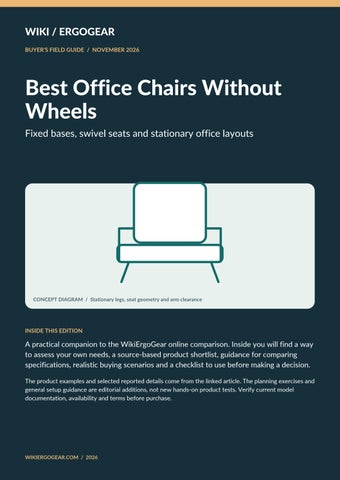
CONCEPT DIAGRAM / Stationary legs, seat geometry and arm clearance
INSIDE THIS EDITION
A practical companion to the WikiErgoGear online comparison. Inside you will find a way to assess your own needs, a source-based product shortlist, guidance for comparing specifications, realistic buying scenarios and a checklist to use before making a decision. The product examples and selected reported details come from the linked article. The planning exercises and general setup guidance are editorial additions, not new hands-on product tests. Verify current model documentation, availability and terms before purchase.
WIKIERGOGEAR.COM / 2026
WIKI / ERGOGEAR • FIELD GUIDES
SEATING
Why remove the wheels? An office chair without casters changes the way a person approaches a workstation. Rather than rolling the chair inward and outward, the user may turn the seat, reposition the entire chair or step around it. A stationary base can suit a room with a small working area, a meeting table or a particular floor finish. The decision is about both furniture and movement. If you frequently roll between drawers, a printer and two desks, a fixed chair could make ordinary tasks less convenient. There are several configurations to consider. A conventional four-leg chair tends to have a simple structure and a fixed seat height. A sled base distributes contact along its runners and may offer gentle movement in a design intended for that purpose. A swivel chair on fixed feet allows the user to turn without rolling. Some stationary swivel models retain height adjustment, so the absence of wheels does not necessarily imply the absence of all adjustment. Start with the reason for changing your chair. If the objective is to protect a floor, an approved floor mat or compatible casters might also help. If the user needs more predictable movement, compare stable stationary options and ensure that entry and exit are practical. No furniture design should be assumed to solve balance or mobility concerns without evaluating the user's needs and seeking appropriate advice where necessary.
WIKIERGOGEAR.COM / NOVEMBER 2026
02 / 08
WIKI / ERGOGEAR • FIELD GUIDES
SEATING
Measure fixed seat geometry A stationary chair may provide fewer opportunities to alter its dimensions than an adjustable task chair. Record the seat height that allows your feet to rest comfortably and your knees to clear the work surface. Measure usable depth from the front of the seat to the backrest contact point. A deep seat may prevent a shorter user from sitting back, while a very shallow seat may feel inadequate for a taller user. The advertised overall chair depth includes features that do not necessarily support the body. Check the width between fixed arms and the space beneath the desk. A chair that cannot be placed sufficiently close to the keyboard may encourage reaching. Flip-up arms can be useful where the manufacturer provides that adjustment, but fixed arms may work well if they fit the desk and the user. For an armless design, consider whether the desk surface provides appropriate access to your normal tasks without relying on an armrest. Measure the route into the chair position, particularly in a small room. A chair that must be lifted or dragged repeatedly can be inconvenient. Check whether its feet or glides are compatible with the floor, and never assume that a fixed chair can safely accept a different base or an unapproved replacement part. Choose a product intended for the desired configuration.
WIKIERGOGEAR.COM / NOVEMBER 2026
03 / 08
WIKI / ERGOGEAR • FIELD GUIDES
SEATING
Compare the stationary options The published guide includes five different approaches: padded stationary seating, mesh sled bases, a wide swivel chair and an armchair-style swivel design. The table summarizes reported characteristics, not independent durability measurements. In a fixed-height design, the published seat height deserves particular attention. A static capacity specification is not interchangeable with a different test method; confirm the manufacturer's instructions and the intended use of the exact model. MODEL
REPORTED FEATURE / SPECIFICATION
Flash Furniture HERCULES
Fixed arms; 24.5 x 21 in seat; 500 lb static rating
Flash Furniture Mesh Sled
18 in seat height; flip-up arms
Sweetcrispy C-6130-1P
Sled-style guest chair
OrangeFactory Criss Cross
Armless swivel; adjustable height; 300 lb rating
EALSON Swivel Desk Chair
Splayed legs and arms; 300 lb rating
Source: WikiErgoGear online comparison. Confirm the exact model and current specifications.
Decision worksheet Use a floor plan that includes the entire chair outline as well as the desk opening. Mark the route you normally take into and out of the seat. Compare a fixed four-leg design with a swivel model by drawing the space that would be occupied while turning. For a sled base, record the contact area on the flooring and the required clearance at the front. Then create a fit table with usable seat width, depth, height and arm clearance for each prospective chair. If an option does not provide a dimension, leave the cell blank until you can confirm it. A fixed-height chair should not be selected solely because it is the right visual size for the room. Finally, evaluate whether other household members or colleagues will also use it. A stationary seat that suits one person's work position may be poorly matched to another. Choose a configuration with realistic access and fit rather than treating the lack of wheels as the only requirement.
WIKIERGOGEAR.COM / NOVEMBER 2026
04 / 08
WIKI / ERGOGEAR • FIELD GUIDES
SEATING
Compare comfort and room use A fixed chair used for short consultations may serve a different purpose from a chair occupied throughout a workday. A reception-style chair can look suitable at a desk, yet its seat height and backrest may not match a sustained typing task. Consider how long you expect to sit, whether you regularly stand up and how you access the keyboard and documents. If the geometry does not fit, a chair with more adjustment may be worth considering. A sled-base design can make a room feel less cluttered than a large rolling base. Its contact points and floor glides still need to suit the flooring, and the available space must allow the intended motion. Inspect the manufacturer's floor-care guidance. A stationary foot that grips on one surface may behave differently on another. Avoid adding unapproved pads that alter stability or interfere with a base's function. A swivel chair can be helpful when you need to turn between a screen and a side table. Check the actual mechanism and how the chair behaves when you enter or leave. A wide armless design may allow a variety of seated positions, but confirm that the user can reach the desk and change position without relying on unstable movements. Treat the seat shape and mechanism as separate decisions from its appearance.
WIKIERGOGEAR.COM / NOVEMBER 2026
05 / 08
WIKI / ERGOGEAR • FIELD GUIDES
SEATING
Two scenarios to consider For a small bedroom office with a fixed desk, a swivel chair without wheels may be appealing because there is little room to roll. First measure the seat height range and compare it with the desk height. Draw the base and seat footprint on the floor plan. Check that the chair can rotate without the corners of the seat striking a cabinet. If the room requires frequent repositioning, the absence of wheels may be more limiting than expected. For an office meeting room, stationary chairs may make sense because people generally enter, sit and leave rather than adjust the entire workstation. A range of users may require different seat widths and heights, however. Compare the manufacturer's intended use and the ability to accommodate those users instead of selecting a uniform chair based only on its color. Make sure that the room layout leaves an appropriate access route around each chair. For an existing chair that you are tempted to convert, first consult the manufacturer. Replacing casters with glides may change seat height or stability, and an apparently compatible fitting is not proof of suitability. If the manufacturer does not approve the conversion, consider a purpose-built stationary chair instead. The goal is a reliable configuration, not simply the removal of a part.
WIKIERGOGEAR.COM / NOVEMBER 2026
06 / 08
WIKI / ERGOGEAR • FIELD GUIDES
SEATING
Make a practical trial After assembling the chair, inspect the base, fasteners and floor-contact surfaces. Follow the instructions for any swivel or height mechanism. Try approaching the desk, sitting down, turning toward a side surface and standing up. Notice whether the chair remains where you expect it to remain and whether the available space permits normal movement. A design that is awkward to enter or leave may not be a good everyday choice. Use the chair for an ordinary work task. Check foot support, contact with the backrest and the ability to reach the keyboard without leaning forward repeatedly. If the chair cannot be adjusted, it may be necessary to evaluate the desk height or choose another chair rather than trying to correct all of the mismatch with cushions. Recheck the width and depth once you have sat in the chair rather than relying only on measurements from a listing. Inspect the floor periodically for marks and check the glides for wear. Stop using the chair if the frame appears damaged or a connection becomes unstable. Keep the model information and instructions for replacement parts and service. A stationary chair can be a useful furniture choice, but it is not a guarantee of improved posture, comfort or safety for every individual. Read the full comparison on WikiErgoGear
WIKIERGOGEAR.COM / NOVEMBER 2026
07 / 08
WIKI / ERGOGEAR • FIELD GUIDES
SEATING
Before you buy Use this checklist to record the measurements and decisions that matter for your own workspace. Keep the exact product model and applicable instructions; treat unspecified requirements as open questions rather than confirmed features. Record seated height and usable seat depth. Check arms and desk clearance. Draw the turning and access area. Confirm weight rating and intended use. Verify floor-contact materials. Trial sitting, working and standing within return period.
Frequently asked questions Are fixed chairs more stable? They do not roll in the same way, but stability depends on design, surface and use.
Can a stationary chair swivel? Yes, if it has an approved swivel mechanism.
Can I replace casters with glides? Only when the chair manufacturer approves that configuration.
Are guest chairs good for daily typing? Check the dimensions, intended use and adjustments rather than assuming suitability. SOURCE AND FURTHER READING
See the original product comparison, selection criteria and buying information: https://wikiergogear.com/best-office-chairs-without-wheels/ Disclosure: WikiErgoGear is reader-supported and may earn affiliate commissions. General product information only; no new testing or medical outcome is claimed.
WIKIERGOGEAR.COM / NOVEMBER 2026
08 / 08