WIKI / ERGOGEAR BUYER’S FIELD GUIDE / NOVEMBER 2026
Best Mesh Office Chairs Compare mesh construction, support and long-term fit
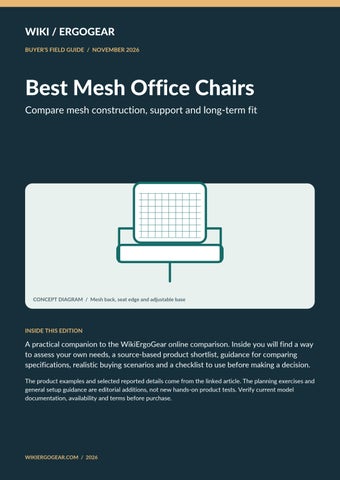
CONCEPT DIAGRAM / Mesh back, seat edge and adjustable base
INSIDE THIS EDITION
A practical companion to the WikiErgoGear online comparison. Inside you will find a way to assess your own needs, a source-based product shortlist, guidance for comparing specifications, realistic buying scenarios and a checklist to use before making a decision. The product examples and selected reported details come from the linked article. The planning exercises and general setup guidance are editorial additions, not new hands-on product tests. Verify current model documentation, availability and terms before purchase.
WIKIERGOGEAR.COM / 2026
WIKI / ERGOGEAR • FIELD GUIDES
SEATING
Understand what mesh changes Mesh office chairs are frequently chosen because an open textile surface can allow air to move through a backrest or seat. That may be appealing in a warm room or for a person who dislikes the feel of heavily upholstered seating. The construction also changes the contact between the body and the chair. A stretched mesh surface, the surrounding frame and the degree of tension can feel quite different from foam on a rigid seat pan. A breathable material does not automatically make a chair suitable for every body. There is an important distinction between a mesh-back chair with an upholstered seat and a design with mesh on both surfaces. A mesh back can provide ventilation while retaining the feel of a padded seat. A full-mesh design may be attractive when airflow under the seat is important. Compare how the seat edge is constructed: a firm border can affect the usable area and may matter more than the overall seat width listed online. Start by deciding which issue you want a different chair to address. Heat, seat fit, backrest position and ease of adjustment are separate concerns. A chair that addresses one of them may not address the others. If you already have a suitable chair, changing room temperature, clothing or the workstation arrangement may be another option. A product purchase is only one possible step toward a more usable work environment.
WIKIERGOGEAR.COM / NOVEMBER 2026
02 / 08
WIKI / ERGOGEAR • FIELD GUIDES
SEATING
Fit the frame and seat Measure your current chair's usable seat width and depth, then note what feels too large or too small. Mesh frames can have raised or curved edges, so a width measured across the outside of the frame may not describe the space available for sitting. Check how the front edge meets your thighs and whether the backrest can be reached without sliding forward. If the candidate has an adjustable seat pan, confirm the usable depth range for the exact version. Record the seat height required at your desk with your usual footwear. Check the minimum and maximum height, including how the seat surface behaves under normal load. Compare the arm height and spacing with the desk opening. Arms that adjust vertically or move out of the way may make it easier to place the chair near a keyboard. Verify which adjustment directions are actually available instead of relying on shorthand labels. The lumbar element also needs to be considered separately. A support that moves vertically can be positioned differently from one that also varies its depth. A prominent fixed support may feel intrusive to a person whose body shape differs from the intended fit. Evaluate whether the backrest and seat work together. Adjustability is useful when the available range fits the person, not simply because a mechanism has several controls.
WIKIERGOGEAR.COM / NOVEMBER 2026
03 / 08
WIKI / ERGOGEAR • FIELD GUIDES
SEATING
Review the reported candidates The source comparison includes six mesh or mesh-back office chairs, from task seating to models with several adjustable components. The table uses published specifications and distinctions; it does not imply that this field guide has independently measured mesh tension or durability. Compare the exact product configuration and warranty in the manufacturer's current documents. If a model is sold in several versions, check that the adjustments shown on the listing belong to the version you intend to buy. MODEL
REPORTED FEATURE / SPECIFICATION
Staples Dexley
Mesh seat and back; 275 lb rating
ELABEST X100
Height/depth lumbar adjustment; 300 lb rating
Steelcase Series 1
Premium chair in source comparison
SIHOO M57
330 lb rating; 3-year warranty
Duramont Ergonomic Mesh
Lumbar adjustment in two directions
Hbada E3 Pro
Seat-depth adjustment; up to 140-degree recline
Source: WikiErgoGear online comparison. Confirm the exact model and current specifications.
Decision worksheet Separate your shortlist into two columns: mesh-backed chairs with a padded seat and chairs using mesh on the seat itself. In each column, note the usable seating width, the position of any firm frame border and the seat-depth range. Add a row for the lumbar mechanism: fixed, height adjustable or height and depth adjustable, using the documented controls rather than the appearance of a product image. If you have a chair available to try, observe the way the front edge feels during normal work and whether the mesh surface permits comfortable movement. Keep a note of room temperature, clothing and the task, because these can change the experience independently of the chair. Check the specific fabric care instructions and whether a worn component can be replaced. The final selection should meet body fit and intended use first; ventilation, style, price and extra features can distinguish the models that remain. Store the relevant service documents with your purchase record.
WIKIERGOGEAR.COM / NOVEMBER 2026
04 / 08
WIKI / ERGOGEAR • FIELD GUIDES
SEATING
Examine materials and serviceability Mesh textiles vary in stretch, texture and construction. Photographs cannot reliably demonstrate how they will feel after sitting for an hour. If you are sensitive to fabric texture or frame contact, a trial or a clear return policy is valuable. Check whether the chair has instructions for cleaning the mesh and whether there are restrictions on cleaning products. A suitable material should be compatible with the way you actually maintain your furniture. Inspect how the mesh is attached to the frame and whether replacement parts are available. The existence of a long warranty does not necessarily mean every fabric or moving part is covered for the same period. Read exclusions and the process for reporting a defect. If a chair is for a shared or commercial workspace, verify that the warranty and intended usage conditions apply to that setting. Compare the overall cost of ownership, including potential shipping and service. A headrest or tilt mechanism may be attractive, but evaluate its role in a normal task. Some users prefer an unobstructed upper back while typing, while others may appreciate an adjustable headrest during a reclined break. Confirm that the support does not push your head forward in your preferred position. A large number of features is not necessarily more useful than a smaller set of well-fitting adjustments.
WIKIERGOGEAR.COM / NOVEMBER 2026
05 / 08
WIKI / ERGOGEAR • FIELD GUIDES
SEATING
Work through two buying scenarios Imagine a person working in a warm room who finds a padded chair uncomfortable during summer. A full-mesh chair is an obvious category to investigate, but the seat border and tension should be tested if possible. If the front frame presses against the thighs, a mesh-back model with a padded seat might offer a better compromise. Record the preferred seat dimensions before comparing backrest materials. A second buyer shares a workstation with another adult. Here the priority may be quick and repeatable seat height, arm and lumbar adjustment. Compare the available ranges for both people. A model with a comfortable fixed backrest for one user may not fit the other. Keep a brief setup card with each user's preferred settings, and choose a chair whose controls can be accessed in accordance with the instructions. For a premium purchase, consider whether you are paying for a particular fit, a service network, replacement components or a longer applicable warranty. Ask for written documentation when a specification is not clear. Do not use the product's price as a substitute for an actual fit assessment. A less expensive chair that matches the user's geometry may be more practical than a premium one that does not.
WIKIERGOGEAR.COM / NOVEMBER 2026
06 / 08
WIKI / ERGOGEAR • FIELD GUIDES
SEATING
Adjust and observe in actual use Begin with the seat height, depth if available, and backrest position. Place the keyboard close enough that you do not repeatedly reach forward, and adjust the arms according to the manual. Set the tilt resistance and lock only as intended by the manufacturer. Try a short seated task, then observe the comfort of the seat edge, the backrest contact and the ease of changing position. During the next sessions, change one adjustment at a time. Keep a record of what you altered and what became easier or harder. A lumbar support that feels strong at first may need a different position; do not force an uncomfortable contact point simply because it is marketed as supportive. Use ordinary movement breaks and avoid holding a single posture indefinitely. After the trial, inspect the mesh, attachment points and base for anything unexpected. Follow the care instructions and stop using the chair if there is damage or instability. If you have ongoing pain or numbness, consult a qualified healthcare professional. Mesh is a seating material, not a medical intervention, and neither the source comparison nor this publication guarantees a health outcome. Read the full comparison on WikiErgoGear
WIKIERGOGEAR.COM / NOVEMBER 2026
07 / 08
WIKI / ERGOGEAR • FIELD GUIDES
SEATING
Before you buy Use this checklist to record the measurements and decisions that matter for your own workspace. Keep the exact product model and applicable instructions; treat unspecified requirements as open questions rather than confirmed features. Decide between mesh-back and full-mesh seating. Measure usable width, depth and height. Check frame edge and lumbar contact. Confirm arm adjustment and desk clearance. Read fabric and mechanism warranty terms. Evaluate fit during an ordinary work session.
Frequently asked questions Is a mesh seat cooler than foam? It can allow airflow, but actual comfort depends on construction and the user.
Are all mesh chairs fully mesh? No, many combine a mesh back with a padded seat.
Does adjustable lumbar guarantee fit? No; verify the usable adjustment range and contact.
How should I clean mesh? Follow the exact manufacturer's care directions. SOURCE AND FURTHER READING
See the original product comparison, selection criteria and buying information: https://wikiergogear.com/best-mesh-office-chairs/ Disclosure: WikiErgoGear is reader-supported and may earn affiliate commissions. General product information only; no new testing or medical outcome is claimed.
WIKIERGOGEAR.COM / NOVEMBER 2026
08 / 08