WIKI / ERGOGEAR FIELD GUIDE / NOVEMBER 2026
Best Lumbar Support Pillows Fit, foam, firmness and chair compatibility
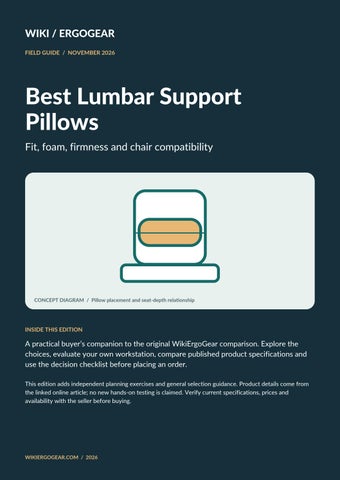
CONCEPT DIAGRAM / Pillow placement and seat-depth relationship
INSIDE THIS EDITION
A practical buyer’s companion to the original WikiErgoGear comparison. Explore the choices, evaluate your own workstation, compare published product specifications and use the decision checklist before placing an order. This edition adds independent planning exercises and general selection guidance. Product details come from the linked online article; no new hands-on testing is claimed. Verify current specifications, prices and availability with the seller before buying.
WIKIERGOGEAR.COM / 2026
SEATING / BUYER’S FIELD GUIDE
Identify the gap before buying A lumbar pillow is a removable accessory that occupies space between the user and the lower part of a chair back. It can change how the backrest contacts the body, but it also changes the effective depth of the seat. This second effect is easy to overlook when choosing a cushion from photographs. A product that fills a gap comfortably in a deep executive chair may push a person too far forward in a compact task chair. Begin by evaluating the chair without an accessory. Sit back in a comfortable position, with the feet supported. Notice where the backrest already makes contact and where there is a gap. If the chair has an adjustable lumbar mechanism, explore its range first. A built-in adjustment may address the problem without reducing the seat area or adding another item to maintain. Define the specific purpose of the pillow. Are you seeking a more pronounced contact point, a softer surface against a firm back, or a portable accessory for a second chair? Those needs should not be treated as identical. If the current chair is unstable, too large or too small, a pillow is unlikely to solve the structural or dimensional problem. Evaluate the basic chair fit before spending money on an accessory.
WIKI / ERGOGEAR • FIELD GUIDES
02 / 08
SEATING / BUYER’S FIELD GUIDE
Thickness is a functional dimension Pillow thickness affects the position of the pelvis and the distance from the user to the front edge of the seat. A thick cushion may reduce the usable seating surface even after it compresses. Measure the current seat from the backrest to the front edge, and consider how much support remains for the thighs if the cushion moves you forward. A shallow chair deserves particular caution. Compare a thin, flexible insert against a deeper contoured pillow. The thinner option may preserve more seat area and work with an existing curved backrest. A deeper insert may be worth considering on a flat chair with ample room. However, the advertised thickness is usually the uncompressed size; two pillows with the same stated dimension may behave differently under load. Do not assume the number translates directly to the occupied geometry. Check whether adding a cushion changes your access to the arms and desk. Moving forward can put fixed arms behind your preferred elbow position or make the chair fit differently under the desk. If the cushion changes the way you sit, revisit keyboard and screen placement. A better local contact point is not a successful outcome if the rest of the workstation becomes less usable.
WIKI / ERGOGEAR • FIELD GUIDES
03 / 08
SEATING / BUYER’S FIELD GUIDE
Compare materials and contours The six products in the source guide illustrate multiple approaches to back support. Some use relatively thick foam, another uses a firm contour, and another uses a flexible grid. Their contact feel, ventilation and ability to fit an existing backrest may differ. A material name alone does not predict comfort: density, construction, cover and compression all matter. When choosing between them, consider the environment. A person who works in a warm room may prioritize airflow and a removable cover. Someone who moves the pillow between chairs may care more about size, strap flexibility and portability. A user with a narrow seat may choose to prioritize a shallow profile rather than the greatest advertised support. A soft pillow that compresses may feel different after an extended session than when first placed against the chair. The following details reflect the source guide’s published product information. They are useful for initial screening, not as measured performance results. Confirm the current dimensions, care instructions and guarantee for the exact version you plan to buy. MODEL
PUBLISHED SPECIFICATION SNAPSHOT
ComfiLife Back Pillow
Memory foam; 4.7 in thickness; lifetime warranty stated
Everlasting Comfort Original
Medium-firm foam; two extendable straps
Cushion Lab Extra Dense
Firm foam; zoned contour
Purple Back Cushion
GelFlex Grid; 2.5 in thickness
Samsonite SA5243
Compact foam; adjustable strap
BYMECOST
Foam; strap extenders; mesh cover
Source: WikiErgoGear online comparison. Specifications are as reported there; confirm the current model.
WIKI / ERGOGEAR • FIELD GUIDES
04 / 08
SEATING / BUYER’S FIELD GUIDE
Straps, placement and cleaning A pillow should remain where the user places it. Check the path available for the strap around the backrest: a tall, wide or strongly curved chair may not offer the same anchoring point as a narrow mesh chair. Measure the approximate circumference along that path, not only the width of the chair viewed from the front. Confirm the strap’s intended range with the seller if it is unclear. Position the pillow so that its contour meets the intended area of the lower back without forcing a pronounced or uncomfortable arch. Sit all the way back and evaluate whether the pillow migrates upward or downward during ordinary movement. If it does, check the strap and compatibility rather than continually resetting it. Avoid using improvised fasteners that could damage the chair or create a snagging hazard. Read the cleaning instructions for the cover and core separately. A removable fabric cover does not mean the internal foam can be placed in a washing machine. Let components dry as directed and inspect straps and seams periodically. In shared workspaces, a removable and cleanable cover may be an important practical consideration. If the accessory loses its shape, tears or no longer stays in place, reconsider its use.
WIKI / ERGOGEAR • FIELD GUIDES
05 / 08
SEATING / BUYER’S FIELD GUIDE
Three examples of chair compatibility Consider a deep executive chair with a flat padded back. The user has ample thigh support and wants a more defined lower-back contact point. A thicker pillow is a plausible candidate, but only if its straps fit the wide backrest and the user can still reach the armrests. A short trial can reveal whether the extra thickness actually improves the contact pattern or merely moves the person away from the chair. Now consider a small mesh task chair with an existing lumbar curve. A thick insert may eliminate too much depth. The better starting point is to adjust the original mechanism, then assess whether a thinner accessory would change only the area that needs attention. Mesh construction may require careful placement to prevent sliding. Finally, imagine someone who uses a desk chair during the week and a different chair for occasional travel. Portability matters, but the same pillow may not work equally well in both places. Measure both chair backs and evaluate strap fit independently. Do not use an accessory in a vehicle if it interferes with seat belts, head restraints, airbags or the vehicle manufacturer’s seating instructions. A single product can be convenient without being suitable for every seat.
DECISION NOTE
A useful experiment is to compare your existing backrest with the prospective cushion profile using a simple measurement sketch. Record how much usable seat depth you can afford to lose and where the current backrest meets your body. A seller’s listed dimensions are not the same as the compressed dimensions, so keep the return option open. Do not stack multiple cushions to compensate for a chair that is fundamentally the wrong size. The goal is a stable and comfortable contact point within a usable workstation.
WIKI / ERGOGEAR • FIELD GUIDES
06 / 08
SEATING / BUYER’S FIELD GUIDE
Evaluate the accessory without changing everything Make one change at a time. Record your usual seat height, chair adjustments, keyboard position and the length of a typical work session before adding the pillow. Then introduce the accessory and repeat a familiar activity. Notice whether you remain in contact with the backrest, whether the feet stay supported and whether the seat still provides enough thigh support. At the end of the session, record whether the pillow has shifted and whether the cover feels comfortable against your clothing. If the contour feels too pronounced, reposition it within its intended range or compare a different profile. Avoid forcing a position that feels uncomfortable. A return policy can be valuable because the right thickness and firmness are difficult to determine from a specification alone. If the chair has more fundamental issues, a different chair may be a more sensible investment than multiple stacked accessories. A stable seat, sufficient height adjustment and a usable backrest form the foundation. Persistent discomfort, pain radiating into the leg or numbness are reasons to seek professional advice rather than repeatedly changing pillows. This guide explains product selection, not diagnosis or treatment. Read the complete online comparison at WikiErgoGear
WIKI / ERGOGEAR • FIELD GUIDES
07 / 08
SEATING / BUYER’S FIELD GUIDE
Before you buy Use this checklist to turn your research into a decision. Record the measurements and keep the documentation for your final choice. If a requirement is not met or remains unclear, leave that model off your shortlist until you can verify it. Measure usable seat depth and backrest dimensions. Test existing lumbar adjustments first. Compare uncompressed thickness and contour. Check strap length, routing and stability. Read core and cover care instructions. Confirm return terms and evaluate fit during a normal task.
Frequently asked questions Will a lumbar pillow reduce seat depth? Usually it occupies some space; compression and the existing backrest determine how much.
Is firm foam always better? No. The shape, fit and feel matter more than a universal firmness preference.
Can I wash the whole pillow? Follow the separate instructions for the cover and the core.
Can it treat sciatica or other conditions? Do not assume that. A medical condition requires appropriate professional evaluation.
SOURCE & FURTHER READING
Full product comparison, methodology and current buying links: https://wikiergogear.com/best-lumbar-support-pillows/ Disclosure: the linked website is reader-supported and may earn affiliate commissions. This publication offers general product information, not medical advice or a guarantee of suitability.
WIKI / ERGOGEAR • FIELD GUIDES
08 / 08