WIKI / ERGOGEAR FIELD GUIDE / NOVEMBER 2026
Best Executive Office Chairs A practical guide to upholstery, fit and adjustments
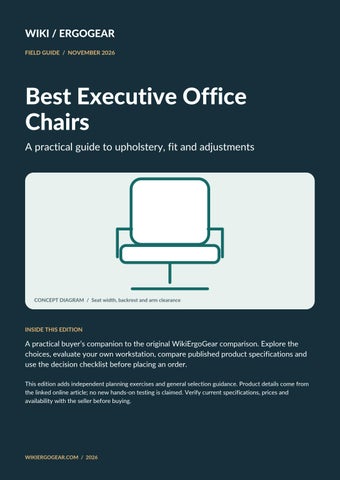
CONCEPT DIAGRAM / Seat width, backrest and arm clearance
INSIDE THIS EDITION
A practical buyer’s companion to the original WikiErgoGear comparison. Explore the choices, evaluate your own workstation, compare published product specifications and use the decision checklist before placing an order. This edition adds independent planning exercises and general selection guidance. Product details come from the linked online article; no new hands-on testing is claimed. Verify current specifications, prices and availability with the seller before buying.
WIKIERGOGEAR.COM / 2026
SEATING / BUYER’S FIELD GUIDE
Define executive comfort in practical terms Executive seating is often selected as part of the overall appearance of an office. A high back, generous upholstery and a polished frame can create a distinctive look. Yet the activities carried out in the chair remain ordinary work: reading, typing, calls, meetings and periods of concentrated screen use. The chair must accommodate those tasks, not simply look appropriate behind a large desk. Start by considering how many hours the chair will actually be occupied and which tasks are most common. A chair used primarily for occasional meetings may have different requirements from a chair used for continuous typing. During computer work, arm clearance and the ability to position the body close to the keyboard may matter more than a dramatic backrest or thick padding. Treat appearance as a preference that follows functional fit. Select a group of chairs that meet the user’s dimensions, rated capacity and workspace constraints; then compare the styles within that group. If no suitable executive-style model offers the required adjustments, a conventional adjustable task chair may be the more useful option. The category name describes a general style rather than a guarantee of ergonomic features.
WIKI / ERGOGEAR • FIELD GUIDES
02 / 08
SEATING / BUYER’S FIELD GUIDE
Understand upholstery and everyday care The visual appearance of leather-like surfaces can be similar in an online photograph even when their construction is quite different. Bonded leather, polyurethane-coated fabric and vinyl are separate materials. Read the exact product description rather than assuming that an unqualified use of the word leather means a particular grade of hide. If the description is ambiguous, ask the seller for clarification. A smooth upholstered surface can be convenient in a room where occasional spills or dust are a concern, but the material’s comfort depends on room temperature, clothing and the length of each work session. A heavily padded chair may feel warm after extended use. A mesh or fabric design may be preferable if ventilation is a higher priority than a traditional executive appearance. Consider cleaning before purchase. The maintenance instructions should state which products and techniques are appropriate for the finish. Avoid cleaners that the manufacturer has not approved. Check common contact areas such as arm pads and seat edges for construction quality. If appearance is important in a meeting room, think about how the chair will look after repeated use rather than judging it solely from a new-product photograph.
WIKI / ERGOGEAR • FIELD GUIDES
03 / 08
SEATING / BUYER’S FIELD GUIDE
Use the published shortlist as a screening tool The original comparison presents six examples with different visual styles, upholstery descriptions and rated capacities. The seat depth varies considerably, which is a useful illustration of why the executive label alone cannot identify a chair that fits. The width of some seats is not specified. Ask for the missing dimension when it affects your decision. Examine the form of the arms in addition to the seat dimensions. An enclosed arm shape can limit usable width and make it difficult to approach a desk with a thick front edge. Removable or adjustable arms may offer more flexibility, but verify that the manufacturer approves the configuration you intend to use. Do not infer adjustment features from a product image. The table records selected specifications from the online guide. It is a starting point for comparison rather than an independent laboratory evaluation. Upholstery, capacities and warranty terms may differ by model revision. Confirm the exact version with the current seller and consult the instructions before assembling or modifying any chair. MODEL
PUBLISHED SPECIFICATION SNAPSHOT
Office Star EC Series
Bonded leather; 275 lb; 20.75 in seat depth
Furmax High Back
PU leather; 300 lb; 17.52 in seat depth
La-Z-Boy Bradley
Bonded leather; 250 lb; 22 × 22 in seat
Amazon Basics Executive
Bonded leather; 275 lb; seat dimensions unspecified
Modway Jive
Vinyl; 330 lb; 19.5 × 19.5 in seat
YFO Leather Executive
Leather type unspecified; 300 lb; 22 × 20 in seat
Source: WikiErgoGear online comparison. Specifications are as reported there; confirm the current model.
WIKI / ERGOGEAR • FIELD GUIDES
04 / 08
SEATING / BUYER’S FIELD GUIDE
Fit the seat, back and armrests together Measure your seated hip width and the distance from your lower back to the bend of your knee. Compare these with the documented usable seat dimensions. A seat that is too deep may prevent contact with the backrest unless the person slides forward or raises the legs. A shallow seat can provide less thigh support. Padding changes the occupied dimensions, so a trial or a practical return option is particularly valuable for this category. Set a target seat-height range based on your body and desk. A useful adjustment allows the feet to be supported and the keyboard to remain within a comfortable reach. Consider the chair and desk as a pair: fixed arms may strike an apron or drawer, leaving the keyboard too far away. Measure from the floor to the underside of the desk and compare with the arm height at your intended seat position. Check where the backrest and headrest contact your body. A tall backrest can look supportive without matching the position of your shoulders or head. If the chair lacks a lumbar adjustment, decide whether the existing shape is comfortable before planning to add an accessory. A cushion may reduce usable seat depth and change the entire fit.
WIKI / ERGOGEAR • FIELD GUIDES
05 / 08
SEATING / BUYER’S FIELD GUIDE
Compare value beyond the purchase price Executive chairs can differ substantially in the terms of their warranties. Coverage for a stationary frame may last longer than coverage for a mechanism or upholstery. Read the conditions carefully and confirm whether the intended environment, such as a commercial office, is permitted. A long headline warranty does not necessarily cover every component for the same period. Think about the floor. Wheel materials and floor finishes interact, and the casters supplied with a chair may not be ideal for every surface. Ask the chair and flooring manufacturers which combinations are approved. A compatible mat may protect the floor and change the rolling feel. Do not replace wheels or other structural parts without confirming the compatibility of the replacement. Calculate the practical cost of ownership, including delivery, assembly, floor protection and any accessories. If the chair needs to be returned, check whether the original packaging must be retained and whether return shipping is charged. In a room that must be furnished quickly, access to replacement parts and responsive service may be more important than decorative details. Compare those costs and conditions alongside the chair’s appearance.
DECISION NOTE
Use two separate scores when you compare final candidates: one for functional fit and one for style. Reject any chair that fails a mandatory fit or capacity requirement before calculating an appearance score. Look at the seat edge, arm geometry and occupied depth instead of judging the padding from photographs. If you are shopping for several employees, individual adjustment and return arrangements matter more than making all chairs look identical. Keep a note of each chair’s material and service terms.
WIKI / ERGOGEAR • FIELD GUIDES
06 / 08
SEATING / BUYER’S FIELD GUIDE
A buying exercise for two offices Imagine a private office with a large desk and frequent visitor meetings. Visual appearance may matter, but the owner also uses the chair for several hours of typing. A roomy upholstered model is a plausible candidate only if the seat depth matches the user and the arms fit beneath the desk. Compare it against a more adjustable task chair with a quieter visual profile rather than assuming that executive furniture must use a single upholstery style. Now imagine a compact home office with hard flooring, a narrow desk opening and warm afternoon temperatures. A large padded back may occupy more space than necessary. Floor-compatible casters, ventilation and arm clearance could determine the shortlist. A slimmer model might look less substantial but make the daily workspace more practical. For either office, test the delivered chair during a representative work session. Check whether you can approach the keyboard, move away from the desk and change position without obstruction. Note any persistent discomfort and avoid forcing a fit. If there are ongoing symptoms, consult a qualified healthcare professional. The purpose of this buying exercise is to match furniture to real work, not to infer medical benefits from styling or padding. Read the complete online comparison at WikiErgoGear
WIKI / ERGOGEAR • FIELD GUIDES
07 / 08
SEATING / BUYER’S FIELD GUIDE
Before you buy Use this checklist to turn your research into a decision. Record the measurements and keep the documentation for your final choice. If a requirement is not met or remains unclear, leave that model off your shortlist until you can verify it. Measure occupied seating area and desired seat height. Compare arm height with desk clearance. Confirm exact upholstery material and care instructions. Check the manufacturer’s weight rating and warranty. Match the caster type to the flooring. Keep packaging and test the chair during ordinary work.
Frequently asked questions Does executive mean ergonomic? No. Check the actual seat dimensions and available adjustments.
Is bonded leather the same as full-grain leather? No. Confirm the material construction in the exact listing.
Are fixed arms a problem? They can be suitable if they fit the user and do not obstruct the desk.
Should I buy based on warranty duration? Read which parts are covered and the applicable exclusions before comparing durations.
SOURCE & FURTHER READING
Full product comparison, methodology and current buying links: https://wikiergogear.com/best-executive-office-chairs/ Disclosure: the linked website is reader-supported and may earn affiliate commissions. This publication offers general product information, not medical advice or a guarantee of suitability.
WIKI / ERGOGEAR • FIELD GUIDES
08 / 08