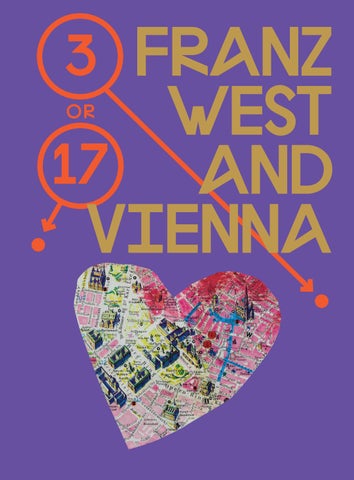
3 OR
17
Friedl Kubelka Portrait of Franz West, 1969
3 oder 17 (3 or 17), 1992 Adaptive (Passstück): plaster, iron, mollino 3 or 17 pedestals: particleboard, dispersion Variable dimensions
TAKE THIS SCULPTURE INTO YOUR HANDS AND PLACE IT ON A DIFFERENT PEDESTAL There are two versions of this work. One with three pedestals (viewers in the know will sway between a scarcely veiled image of the dialectical movement and a somewhat hapless remake of the foundation pillars of this world. Placing a hand on the object, which they recognize as a sculpture, is enough to let them experience the third dimension of the work—it is clearly inviting to be touched. Take the object and carry it from pedestal to pedestal. Without this tender gesture, the theatrics, brashness, or elegance of which you can modulate entirely as you please, it remains the equivalent of a want. Hence, take hold of it. No stranger’s eyes will be secretly watching you. The consummation of being is in your hands.) and one with 17, since my studio is located in the 3rd district, but I sleep in the 17th. — Franz West, Axel Huber
Franz West on the Stubenbrücke, Vienna, 2006
franz west And Vienna 3 or 17 Verlag der Buchhandlung Walther und Franz König, Cologne
Franz West And Vienna: 3 or 17 Franz West and Vienna: 3 or 17 explores the role the city played in the life and work of Franz West (1947–2012). For West, Vienna was much more than the city where he was born and worked. It inspired and challenged him in equal measure, serving not just as a backdrop but as raw material for his art. Its people, history, art, and social fabric were woven into his work from the very beginning. To mark what would have been Franz West’s eightieth birthday on February 16, 2027, the Wien Museum is mounting an exhibition that places his life story at its center. It begins with his family background and childhood at Karl-Marx-Hof in postwar Vienna before following him into the art scene of the late 1960s and early 1970s—to the galleries, bars, and artists he gravitated toward as a young, self-taught artist. The Viennese avant-garde was a small scene shaped by strong personalities and cliques, and West initially struggled to find a place within it. In 1974, he developed the Adaptives (Passstücke) as his own response to the dominance of the Vienna Actionists, radically yet subtly challenging the traditional hierarchy between artist, artwork, and viewer. In the 1980s, West turned increasingly to Vienna’s cultural past. In searching for a “legitimate” form of sculpture that did not rely on direct physical interaction, he drew on Sigmund Freud, Ludwig Wittgenstein, and Viennese Modernism. This book takes its subtitle from West’s 1992 installation 3 oder 17 (3 or 17), one of many works in which the circumstances of his life in Vienna became artistic material. Its seemingly enigmatic title is typical of West’s work, with its multiple layers of meaning. The clue lies in West’s own words: “My studio is in the 3rd district, but I sleep in the 17th.” The Wien Museum and the Franz West Privatstiftung collaborated on the exhibition Franz West and Vienna and this accompa-
nying book. The book also incorporates research from Franz West and the Memory of his Artistic Environment, a collaborative project involving the Austrian Academy of Sciences, Archiv Franz West, and the Franz West Privatstiftung. As part of the project, Georg Traska interviewed people who had known West about their memories of the artist, and their recollections have informed this publication. The essays by Michaela Obermair, Judith Nicka-Stöckl, Eva Badura-Triska, Stefanie Graf, and Vincent Weisl shed new light on West’s life, early work, and Viennese milieu, drawing on recent research. The book closes with Friedl Kubelka’s 1976 photographic series One-Day Portrait Franz West, which brings us unusually close to the artist over the course of a single day. — Judith Nicka-Stöckl, Vincent Weisl
18
Ordinary Language “I don’t invent anything new; it’s a reproduction, in keeping with its time […].” Quotations by Franz West, collaged by Michaela Obermair
40
Common Threads A Family History Judith Nicka-Stöckl
56
Pictures from the Hundertwasser Studio Franz West and Manfred Scheer’s Galerie 10 in Vienna Eva Badura-Triska
82
THE AVANT-GARDE AND THE ESTABLISHMENT Vienna’s Art Scene in the 1970s Stefanie Graf
110
Notes on Franz West’s Early Exhibition Posters Vincent Weisl
125
WORKSPACE/WORKCITY A look at the spaces where Franz West made his art and how they inspired his work Michaela Obermair
142 143 144 145
Authors Lenders and Collections, Image Credits Acknowledgments Publication Details
147
One-Day Portrait Franz West Friedl Bondy
One Might Perhaps Say a Few Words About It 52 I don’t think that in art you have to do reportages of reality. It is not really necessary to be truthful, one should just invent stories.53 It is in the nature of play to create a reality of your own, allowing you to move beyond practical action and utilitarian thought. That would be the space of art—outside the realm of utility.54 Note on the English translation The German text collages statements by Franz West drawn from a range of Germanand English-language sources. For the English version, published English translations have been used where they were available and could be incorporated without altering the structure of the German collage; other passages have been translated from the German. A particular exception concerns passages drawn from Franz West schrieb. Texte von 1975–2010 for which published English versions are available in Franz West Notes: Writings 1975–2011. fig. 9 Franz West with Schnorre (Beggy) outside the Paulusgasse studio in Vienna’s 3rd district, 2008
fig. 10 Franz West, Heidulf Gerngross, Gerngrosssäule (Gerngross Column)
24
52 Ibid., 175. 53 Franz West and Sarah Lucas, “A Five Page Talk,” in Franz West. Displacement and Condensation (London, 2006), 8. 54 West and Probst, “Ludwig Wittgenstein zwickt mich ins Knie,” 170.
Cast concrete Column: 546 cm; egg: 50 cm Rahlgasse in Vienna’s 6th district, 2007
Gebrauchsanleitung im Aktionismusgeschmack (Instruction for Actionist Style), c. 1974 Black-and-white photocopy altered with pencil and colored pencil, collaged with paper dots and adhesive tape 21 × 15 cm
Werkstudie im Aktionismusstil (Study in the Actionist Style), c. 1974 Black-and-white photocopy altered with pencil and colored pencil, collaged with colored paper 21 × 14.8 cm
25
interwar Red Vienna, the city’s socialist era between the two world wars. In February 1934, it was a major battleground in clashes between the Republican Schutzbund and the Austrofascist government of Engelbert Dollfuss. For this reason, following the Anschluss, numerous families were evicted and replaced by staunch Nazi supporters. West grew up in this toxic social environment, which persisted after World War II. In conversations, he repeatedly mentioned the “old Nazis” at the Karl-Marx-Hof and spoke of how much he hated living there.5 Although it became clear early on that art might offer a way out of this situation, it took West until 1970 to decide to actively pursue that path. His family background certainly provided a basis for such a move, and West himself had taken steps in that direction from an early age. Both of his parents were highly educated and had a strong interest in art, and their library contained books on the subject. His uncle had been a distinguished Viennese art dealer who, after emigrating to London, founded and ran one of the city’s leading galleries. West’s half brother Otto Kobalek, his father’s son from an earlier relationship, was a former actor and poet—though he wrote
Untitled, 1972 Watercolor, ink on paper 15 × 21 cm
60
5 Conversations between Franz West and the author, 1993–96. 6 In conversations with the author, West recalled attending the Fest des Psychophysischen Naturalismus (Festival of Psychophysical Naturalism) on June 28, 1963. His friend Wanda Wessely, who accompanied him, also recalled the event (conversation between Wanda Wessely and the author, November 24, 2025). See also the interview with Alexander Braun in Schlebrügge and Turian, Gesammelte Gespräche, 40. West also recalled that he had wanted to attend the Zock-Fest (Zock Festival) on April 21, 1967, at which the Vienna Actionists performed alongside other
Viennese artists, including his half brother Otto Kobalek. He was unable to do so, however, because he was in prison at the time.* He further recalled being in the audience on June 7, 1968, at the event Kunst und Revolution (Art and Revolution), the most radical manifestation of Vienna Actionism, which went down in history as the “Uniferkelei” (“University Obscenity”). He also discussed this in an interview with Markus Weiland; see Schlebrügge and Turian, Gesammelte Gespräche, 48. 7 In conversations with the author, West dated this encounter only approximately to the mid-1960s (see Eva Badura-Triska, “Franz West – Chronology
very little—who was regarded as a “Viennese original” and moved in the avant-garde circles of the Vienna Group and Vienna Actionism. (West himself, however, always maintained a certain distance from the latter, even though he attended their events.) 6 From an early age, he also frequented Vienna’s museums and galleries and, while still in school, spent time in places where artists gathered. At Café Sport, one such place, he met Elias Fuchs, known as Elis, in 1962,7 and the two became close friends. Elias was the eldest son of Ernst Fuchs, a painter who rose to prominence in the 1960s as one of the leading figures of the Vienna School of Fantastic Realism. At the time, Elias lived alone in a modestly furnished attic apartment on Johann-Strauss-Gasse in Vienna. This was probably also where the two painted together, as West recalled in a résumé he prepared for Manfred Scheer in 1972 (p. 65, fig. 35). It would of course be extremely interesting if any of these works by West from the 1960s were known, but none have survived, and it remains unclear whether by “together” he meant working side by side with his friend or on the same support. What we do know is that Elias did not follow in his father’s footsteps. After initially working figuratively, he turned to abstraction, using
Untitled, 1972 Watercolor, pencil on paper 15 × 21 cm
61
mouths are generally shown frontally even when the face itself is in profile. They almost become separate elements, seeming to detach themselves from the body and take on a life of their own while still remaining connected to it (figs. 36 and 37)—much like the later Adaptives (Passstücke). The motif of a disproportionately large or even detached mouth continued to play a role in West’s work, appearing in the 1974 relief Der Kuß (The Kiss) (fig. 38) and later, for example, in the Lemur heads. On a quite different level, West also anticipates aspects of his later practice in this group of works, using them to subvert the art system and the art world. His gallerist, Manfred Scheer, proved a remarkably willing accomplice here. He was prepared to advertise the works under the deliberately ambiguous description “Pictures from the Hundertwasser studio.” On March 1, 1972, the daily newspaper Kronen Zeitung published an article offering them for sale inexpensively at the blaue galerie, together with works by Fred Jellinek, who claims to have come up with the idea for this “prank”: “The eleven watercolors fig. 36 Untitled, 1972 Watercolor, ink on paper 18 × 12.5 cm
model for Hundertwasser. The false claim was in fact published, much to Gröller-Kubelka’s embarrassment. 15 Even years later, in 1978, when her daughter Luise was born, West gave Gröller-Kubelka a large work on wrapping paper featuring the dome motif. 16 The voyeur is another theme that reappears in West’s later work.
fig. 37 Untitled, 1972 Gouache, ink on paper 16 × 13 cm
66
by the young painters Franz West and Alfred Jellinek, as well as by other emerging talents, cost just 100 schillings” (p. 72, fig. 39). A press release dated April 17 was even more brazen—and certainly inaccurate: “Once again, Fritz Hundertwasser has allowed the young painter Franz West to paint in his Vienna studio. The result is ten highly original watercolors, which will be sold on April 19, 1972, at 10:00 a.m. at the blaue galerie […] for 100 schillings apiece” (p. 72, fig. 40). On June 9 and 29 as well as on December 6, these “originals from the Hundertwasser studio by Franz West” were again offered for sale in press releases for 100 schillings. After that, the Scheer gallery archive contains no further references to the episode; indeed, West disappears from the gallery’s press releases altogether. West himself told the author, with some amusement, that Hundertwasser had called fig. 38 Der Kuß (The Kiss), 1974 Papier-mâché, plastic, steel 65 × 78 × 18 cm
67
fig. 50 Gustav Klimt, poster for the first exhibition of the Vienna Secession, final drawing, 1898 Ink, pencil on paper 129.8 × 78.8 cm
fig. 49 Alfred Roller, poster for the 14th exhibition of the Vienna Secession, 1902 Color lithograph 203 × 80 cm
118
fig. 51 Gustav Klimt (executed by Albert Berger, 1900), poster for the first exhibition of the Vienna Secession, censored version, 1898 Color lithograph 97 × 70 cm
fig. 52 Poster Design (FZ West Ausstellung [FZ West Exhibition]), c. 1971 Felt pen on paper 34 × 16.4 cm
fig. 53 Poster Design (Graz L’Eqipe), 1971 Felt pen on paper 34 × 16.5 cm
119
Shop
Have we sparked your interest?
Click here to order your copy online. shop.wienmuseum.at