JOHANN STR AUSS
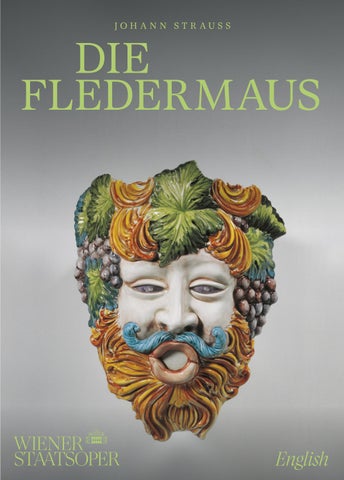
DIE FLEDERMAUS
DIE FLEDERMAUS
SYNOPSIS All the principal characters seem to be drawn as if by a magnet to Prince Orlofsky’s ball, with the exception of the tenor Alfred, who makes fleeting appearances on the sidelines of the action. Adele, a housemaid, is invited (or so she thinks) by her sister Ida and has to make up a heartrending story about a bedridden aunt in order to be given the night off. Her employer Eisenstein, a gentleman of ample means, is persuaded by his friend Dr. Falke to enjoy himself at Orlofsky’s instead of starting a spell in prison to which he has been sentenced for insulting an official. In doing so Falke is pursuing a plan of his own, for on one occasion Eisenstein had made him look a fool in public by getting him drunk at a masked ball and then letting him find his way home dressed as a bat. Now is Falke’s chance for revenge. He therefore also invites Eisenstein’s wife Rosalinda to the ball. Rosalinda is in a flurry because as soon as Eisenstein has gone off, a former admirer of hers named Alfred turns up, pays court to her, and is then arrested by the governor of the prison, Frank, in mistake for Eisenstein. Preening himself over making this arrest, Frank too goes to the ball. All Dr. Falke’s schemes go smoothly. Eisenstein comes upon his housemaid Adele, who stoutly denies who she is. Then he makes friends with Frank, and finally falls in love with his own wife disguised as a Hungarian countess. The third act brings the customary dénouements. It opens in a prison cell made even more murky by the antics of the jailer Frosch, who is never sober. At one time or another all the characters find their way here: first Frank, with a shocking hangover; then Adele, who is on the lookout for a patron to develop her talent for the stage, together with her sister Ida; and then Eisenstein, who learns to his astonishment that he has been in prison all night. When Rosalinda appears on the scene and makes an appointment with Alfred, still under arrest, to visit a lawyer, Eisenstein impersonates the lawyer Dr. Blind and thus finds out what really happened the night before. Fortunately, he is eventually persuaded that it was all part of Dr. Falke’s plan of revenge, and all is well in the end, especially as Adele finds an enthusiastic and wealthy patron in the person of Prince Orlofsky.
4
Previous pages: SCENE, ACT 2 KS ALFRED ŠRAMEK as FRANK
A LIT TLE EXPERIMEN T WITH DIE FLEDERMAUS
Just as in Paris, on the Wien River everyone was meant to recognise themselves on the stage. However, that plan went against tradition, because operetta depends on costumes, on distance, on unreality, on tall tales. However, this time the unreality was not represented by the milieu, but in the “present day” milieu by the actors (“Happy is the person who forgets”) as a way of life. There are many Austrian parallels of this attitude in literature, from Grillparzer’s A Dream is Life to Hofmanns thal’s The Difficult Gentleman which shows an Austria that did not exist, but with which contemporaries could nevertheless – or perhaps precisely because of that – identify. This was the idea when Die Fledermaus was written. The outlines of the world being depicted already existed. People could acknowledge it. But when Die Fledermaus was performed for the first time, there was no imaginary bridge between the audito-
rium and the stage; instead there was a chasm. A catastrophic Black Friday changed the world, the stock exchange crash, which triggered an economic crisis, general uncertainty, unease and social unrest. The no-man’s land of intoxication, illusion, playful lies and good living without work was drowned. Intoxication is followed by a hangover. Now, although the costumes were still appropriate, this operetta too showed a distant, fairy-tale milieu. The world of yesterday was transformed into a lost paradise of which the tough new era dreams, that the subsequent present day could long for, regardless of the realisation that the coronation of His Majesty Champagne was indirectly paving the way for the dethronement of the Habsburgs and that the path from the merry prison via the Central European catastrophe of 1873 had led to the “breakdown of the values” of our century.
24
KS EDITA GRUBEROVA as ADELE
HEINZ ZEDNIK
VIENNESE SOUND STYLE? Austria, frequently called the “Land of Music” with an internationally lauded unique music tradition: does it really exist? Can it even exist in an interconnected world, in a Europe that is growing ever closer together? Or, to put it differently: Do the Viennese really play the Vienna waltz with more Viennese flair than anyone else? I believe the answer is: yes. That little bit of slapdash, the particularly sweet-sounding violin, the upbeat delayed just a hair: all these things make up the typical style that derives from the Bohemian, Hungarian and Jewish style of making music! Our great Viennese orchestras follow this tradition that without question gives them very specific character and colour, a tradition that they treasure and pass on to this day. Unfortunately, there is a trend around the world that is not detri mental resulting from styles of musicianship being matched. The sharp lines between local characteristics are becoming increasingly blurred. Orchestras, instrumentalists and singers are starting to sound more and more like each other. Specific styles are being lost, and we are moving increasingly towards a “world sound” that can be heard in all the major centres of music. There are several reasons for this. First, naturally artists today have the possibility of travelling all over the world. The fixed ensemble of singers that we were bound to for many years is now almost non-existent. When you look at casts, a handful of singers sing the same roles at all the major houses. Today in Tokyo, tomorrow New York – that has not presented a problem for a long time.
36
VIENNESE SOUND STYLE?
In addition, directors and conductors also travel extensively. This makes it difficult for opera houses to develop their own tradition. And even orchestra educators have become mobile, with the result that the orchestras they maintain all have a very similar sound. Earlier it was easy to distinguish between a French, a German and an American orchestra. But today? It is seldom possible! Only individual personalities, such as James Levine at the Met and Zubin Mehta with the Israel Philharmonic Orchestra, still nurture their own sound style. Vienna too – and I am especially pleased about this – is another exception. Furthermore, Vienna has a fantastic State Opera Orchestra where the majority of the musicians of the Wiener Philharmoniker are engaged. That is truly a privilege in our Vienna opera world!... Especially for a singer, making music with one another and responding to each other is particularly important! To know that you can depend on an orchestra in tricky situations is by no means something to be taken for granted. That is the unique thing about the Wiener Staatsoper Orchestra , this ability to get along together; it is something I have not experienced anywhere else in the world. But to come back to international sound culture. Apart from extensive travel, the CD market has also led to standardization is playing style. The widespread distribution of recordings promotes the development of certain standards that determine the market and shape listening habits. Audiences accordingly expect exactly what they know from their recordings in the concert hall or on the opera stage. They are no longer willing to accept idiosyncrasies but prefer “ready-made” items. Unfortunately I have the feeling that these days it is more about the event and less about the enjoyment of hearing an opera or going to a play. I have no idea whether that will change in the medium or long term or even whether that will be beneficial to the development of opera. But I do believe that we should have the courage – I have been a staunch supporter of a united Europe from the outset – not to hide our regional identities and should also be just a bit proud of what it is that makes us what we are.
37