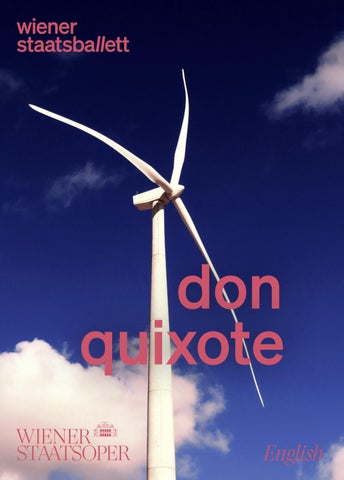
don quixote
about today’s performance Published in two parts in 1605 and 1615, Miguel de Cervantes’ famous story about the hidalgo Alonso Quijada – an impoverished descendant of the lower nobility, who pursues his dreams of knighthood and finally sets out into the world on his rickety horse Rosinante and accompanied by his squire Sancho Panza to fight against social ills – is more than just a fascinating store of knowledge about the world of the Siglo de Oro. To this day, the adventures of the »Knight of the woeful countenance« are a collision of ideal and reality and the draft of a social utopia that never existed outside the world between two book covers. And to this day, reflection on Don Quixote has not ceased – not even on the ballet stage, which took an early interest in the material: already in 1740, Franz Hilverding produced a Don Quixote ballet in Vienna, which Jean-Georges Noverre then presumably referred to in 1768 in his Viennese choreography about the knight from La Mancha. Further works followed by Charles Didelot in 1808 in St. Petersburg, Paul Taglioni in 1839 at the Berlin Court Opera and Salvatore Taglioni in 1843 at the Teatro Regio in Turin. Finally, in 1869, Marius Petipa, in his first collaboration with the composer Ludwig Minkus, brought out his version at Moscow’s Bolshoi Theatre, which – revised for St. Petersburg two years later – is preserved today only in the numerous rewritings Petipa’s work underwent. Among these Rudolf Nureyev’s Don Quixote stands out, created in 1966 for the Ballet of the Vienna State Opera and until 1985 on the repertoire at the Haus am Ring in Barry Kay’s set and costume design, regularly with Nureyev himself in the role of Basil. In 2011, Manuel Legris brought the piece back to the place of its creation, now with Nicholas Georgiadis’ design: Nureyev’s opulent and highly virtuoso ballet comedy, in which the story of Don Quixote only forms the framework for the turbulent and colourful love intrigue about the young couple Kitri and Basil and a dream vision in the tradition of romantic »ballet blanc«.
ABOUT TODAY’S PERFORMANCE
2
Zsolt Török (Don Quixote)
synopsis Prologue In Don Quixote’s house Don Quixote, a country gentleman, believes himself to be a valiant knight straight out of the country romances which are his favourite reading. As he dreams, Dulcinea, the heroine of these stories and his vision of the ideal woman, appears to him. But his neighbour Sancho Panza, chased by servants from whom he has stolen a chicken, enters and disturbs his day-dreams. Don Quixote decides to make Sancho Panza into his knightly companion, and together they leave to take on the world.
Act 1 A public square in Barcelona Kitri, the daughter of Lorenzo, the innkeeper, searches in the crowd for her beloved, Basil the barber. Her joyous dancing is interrupted by her father who, wanting her to marry the rich and noble Gamache, repulses Basil. Kitri determinedly refuses this proposed marriage, but the arrival of Don Quixote and Sancho Panza puts an end to their argument. Lorenzo offers his hospitality to the knight and invites him to his inn. Sancho Panza is a little too attentive to the girls and is teased and manhandled by the young people until Don Quixote comes to his rescue. When Don Quixote sees Kitri, he believes her to be his adored Dulcinea. Gallantly, he offers her his arm for a minuet. Gamache is furious. Kitri and Basil take advantage of the confusion to flee.
Act 2 Scene 1: The »gypsy«* camp Basil and Kitri refuge in a windmill. They are discovered by a group of »gypsies«, who try to rob them. However, the »gypsies« soon realise the poverty of the young people, and decide to help them when they witness the arrival of Lorenzo and Gamache, followed
SYNOPSIS
4
by Don Quixote and Sancho Panza, who eventually find their hiding place. The »gypsies« try to set Don Quixote against Lorenzo and Gamache. To this end, they install a puppet theatre where the story of the thwarted love of Basil and Kitri is played out. Caught up by the story, Don Quixote tries to come to the puppet lover’s aid, and destroys the theatre. Suddenly, he finds himself facing the windmill, which he attacks, believing him to be a gigantic enemy. He is caught up by the spokes of the windmill and thrown to the ground. The »gypsies«, disguised as ghosts, attempt to frighten the knight. Basil and Kitri manage once again to escape.
Scene 2: Don Quixote’s dream Don Quixote, wounded and half fainted, dreams that he is transported to an enchanted garden as a reward for his courage and fidelity. The Queen of the Dryads takes him to Dulcinea, to whom he dares to declare his love. But the dream evaporates.
Act 3 Scene 1: An inn Basil and Kitri, happy to have escaped their pursuers, celebrate their success with friends at an inn. Lorenzo, Gamache, Don Quixote and Sancho Panza lose no time, however, in rejoining them. Lorenzo is absolutely decided that Kitri should marry Gamache. In desperation, Basil resorts to subterfuge and pretends to commit suicide. Kitri implores Don Quixote to help them, and the knight obliges Lorenzo to allow Kitri to marry the »dying« Basil. But as soon as her father has given his blessing, Basil jumps up gaily. Provoked beyond endurance by the trick played upon him, Gamache challenges Don Quixote to a duel, and is beaten.
Scene 2: The wedding In the midst of the great rejoicing at the marriage of Kitri and Basil, Don Quixote and his faithful servant leave in search of new adventures.
* »Zigeuner« (engl. »Gypsy«) is a foreign designation that has been used in the German-speaking world since the 15th century. Three classifications can be distinguished: Designation of an ethnic group with an independent culture, a nomadic, marginal and delinquent way of life, an »unattached«, non-settled way of life. The foreign designation is usually used in a racist discriminatory way. In literature, music, the visual and performing arts, there is also a romanticised depiction of the »Zigeuner«, as in Nureyev’s Don Quixote. Since the 1980s, the ethnic groups use the terms Sinti and Roma as self-designation. Since these cannot be equated with the meaning of the historical term in the context of Don Quixote, »Zigeuner« is explicitly used as a source term in the context of the Vienna State Ballet’s production.
5
SYNOPSIS
Elena Bottaro & Aleksandra Liashenko (Kitri’s girlfriends), Davide Dato (Basil), Liudmila Konovalova (Kitri), Ensemble
ludwig minkus: in service of dance ALFRED OBERZAUCHER
The feelings with which the over 70-year-old Ludwig Minkus contacted the directorship of the Vienna K. k. Court Opera in 1897 are unknown. He had approached the Directorate to submit a new ballet. Minkus must have thought it was worth a try, even though the composer Gustav Mahler, who had just taken over the direction of the house, had certainly been described as hard-to-reach, especially in the field of ballet. But Minkus had nothing to lose. On the contrary, encouraged by his extensive theatre experience and the awareness of having been the Imperial Russian Theatres’ ballet composer for decades – a position in which he had mostly in collaboration with Marius Petipa brought out some 20 ballets –, Minkus, after settling (again) in Vienna in the mid-90s, had now offered the one-act divertissement Tanz und Mythe oder ein Maskenfest. He played the work to Mahler, but the reaction was – as was to be expected – negative: »The music of the work was found to be appropriate, but the plot is so undemanding and the subject so outdated that acceptance of the work cannot be requested« (signed Gustav Mahler). This put an end to the composer’s dream of following up his Russian successes in his homeland. He would probably have liked to return to the city where he had studied and achieved his first successes. Minkus was born in Vienna on 23 March 1826 and studied violin at the Vienna Conservatory. As Louis Minkus, he also gave his first concerts here, in which he already
LUDWIG MINKUS: IN SERVICE OF DANCE
34
played his own compositions. In 1845, a reviewer described him as »the most talented young artist, who in the past season has earned the honourable appreciation of art connoisseurs and critics here in Vienna, both as a player and as a composer«. From 1853 Minkus worked in Russia, initially for two years as a »Kapellmeister« in the serf theatre of Prince Jussupov in St. Petersburg. In 1861 he accepted the position of concertmaster at the Moscow Bolshoi Theatre, in 1862 he became inspector of ballet music and composed his first ballet for this theatre. At the same time, he worked as a teacher at the Moscow Conservatory. However, Minkus also composed for the Paris Opera. Testimony to this is the ballet La Source by Arthur Saint-Léon, premiered in 1866, to which Minkus contributed the first and last pictures, and Léo Delibes the second and third. In 1872 he succeeded Cesare Pugni as composer of ballets at the Imperial Theatres in St. Petersburg and continued his collaboration with Marius Petipa, begun in Moscow in 1869 with Don Quixote. This and the ballet La Bayadère, premiered in 1877, can be seen as the highlight of this now legendary partnership. In 1886 the position of ballet composer at the Imperial Russian Theatres was abolished and Minkus received a small pension after leaving the theatre. In 1891, his last ballet written for St. Petersburg was finally premiered. In 1895 he reappeared in Vienna as Alois Minkus. Here he was also no stranger as a ballet composer. In 1868, a ballet by him was given for the first time – still at the Kärntnertortheater. It was Fiamma d’amore by the French choreographer Arthur Saint-Léon, which had premiered in 1863 at the Bolshoi Theatre in Moscow under the title The Embers of Love, or The Salamander. The ballet, which was also successful in St. Petersburg (as Fiametta) and in Paris (as Néméa), was added to the repertoire of the »Haus am Ring« in 1871. Seven years later, Minkus’ ballet La Source, created in collaboration with Delibes in Paris in 1866, entered the repertoire of the Court Opera under the title Naila, the Source Fairy; the choreographer was Carl Telle. In 1907, the name Minkus appeared once again on the programme notes of the Court Opera in connection with Carl Godlewski’s ballet Rübezahl, for which some numbers from La Source were reused. It was not until 1966, almost 50 years after his death – Minkus died of pneumonia in Vienna at the age of ninety-one on 7 December 1917 – that the composer reentered the Viennese repertoire with Don Quixote in Rudolf Nureyev’s version. At this time, in 1966, the Don Quixote production had been celebrated as a huge success, but not a few had raised their voices against the score, dismissing it as »too simple«, »uninspired«, even »inferior«. In contrast, the German musicologist Thomas Steiert writes of the music of Minkus, whom he sees above all as a craftsman, as the »ideal of 19th century ballet music«. According to Steiert, the negative image of ballet music is »not due to its supposed lack of quality, but to the inadequacy of the criteria by which it has been judged ever since. Ballet music cannot be understood without its original context: Its claim is not that of independent music; its specific character is only revealed in connection with ballet’s other components, such as choreography and scenic action. [...] It must leave space for dance, enter into a connection with dance and must not claim independence in any way.«
35
LUDWIG MINKUS: IN SERVICE OF DANCE
don quixote chapter 19
... in which is related the adventure of the enamoured shepherd, together with other truly droll incidents. MIGUEL DE CERVANTES SAAVEDRA
»If you, sir knight, have no fixed road, as it is the way with those who seek adventures not to have any, let your worship come with us; you will see one of the finest and richest weddings that up to this day have ever been celebrated in La Mancha, or for many a league round.« Don Quixote asked him if it was some prince’s, that he spoke of it in this way. »Not at all«, said the student; »it is the wedding of a farmer and a farmer’s daughter, he the richest in all this country, and she the fairest mortal ever set eyes on. The display with which it is to be attended will be something rare and out of the common, for it will be celebrated in a meadow adjoining the town of the bride, who is called, par excellence, Quiteria the fair, as the bridegroom is called Camacho the rich. She is eighteen, and he twenty-two, and they are fairly matched, though some knowing ones, who have all the pedi grees in the world by heart, will have it that the family of the fair Quiteria is better than Camacho’s; but no one minds that now-a-days, for wealth can solder a great many
DON QUIXOTE – CHAPTER 19
40
flaws. At any rate, Camacho is free-handed, and it is his fancy to screen the whole meadow with boughs and cover it in overhead, so that the sun will have hard work if he tries to get in to reach the grass that covers the soil. He has provided dancers too, not only sword but also bell-dancers, for in his own town there are those who ring the changes and jingle the bells to perfection; of shoe-dancers I say nothing, for of them he has engaged a host. But none of these things, nor of the many others I have omitted to mention, will do more to make this a memorable wedding than the part which I suspect the despairing Basilio will play in it. This Basilio is a youth of the same village as Quiteria, and he lived in the house next door to that of her parents, of which circumstance Love took advantage to reproduce to the word the long-forgotten loves of Pyramus and Thisbe; for Basilio loved Quiteria from his earliest years, and she responded to his passion with countless modest proofs of affection, so that the loves of the two children, Basilio and Quiteria, were the talk and the amusement of the town. As they grew up, the father of Quiteria made up his mind to refuse Basilio his wonted freedom of access to the house, and to relieve himself of constant doubts and suspicions, he arranged a match for his daughter with the rich Camacho, as he did not approve of marrying her to Basilio, who had not so large a share of the gifts of fortune as of nature; for if the truth be told ungrudgingly, he is the most agile youth we know, a mighty thrower of the bar, a first-rate wrestler, and a great ball-player; he runs like a deer, and leaps better than a goat, bowls over the nine-pins as if by magic, sings like a lark, plays the guitar so as to make it speak, and, above all, handles a sword as well as the best.« »For that excellence alone«, said Don Quixote at this, »the youth deserves to marry, not merely the fair Quiteria, but Queen Guinevere herself, were she alive now, in spite of Launcelot and all who would try to prevent it.« »Say that to my wife«, said Sancho, who had until now listened in silence, »for she won’t hear of anything but each one marrying his equal, holding with the proverb ›each ewe to her like‹. What I would like is that this good Basilio (for I am beginning to take a fancy to him already) should marry this lady Quiteria; and a blessing and good luck – I meant to say the opposite – on people who would prevent those who love one another from marrying.« [...] It grew dark; but before they reached the town it seemed to them all as if there was a heaven full of countless glittering stars in front of it. They heard, too, the pleasant mingled notes of a variety of instruments, flutes, drums, psalteries, pipes, tabors, and timbrels, and as they drew near they perceived that the trees of a leafy arcade that had been constructed at the entrance of the town were filled with lights unaffected by the wind, for the breeze at the time was so gentle that it had not power to stir the leaves on the trees. The musicians were the life of the wedding, wandering through the pleasant grounds in separate bands, some dancing, others singing, others playing the various instruments already mentioned. In short, it seemed as though mirth and gaiety were frisking and gambolling all over the meadow. Several other persons were engaged in erecting raised benches from which people might conveniently see the plays and dances that were to be performed the next day on the spot dedicated to the celebration of the marriage of Camacho the rich and the obsequies of Basilio. 41
DON QUIXOTE – CHAPTER 19
General sponsors of Vienna State Opera