

WE ARE AIKOWANIA
CULTURE AND COMMUNITY GUIDE FIVE INDIGENOUS STUDENT-ATHLETES AS THEY GROW THROUGH THE GAME 18
{ VOL. 19 | ISSUE 2 | SPRING 2026 }
Wider Horizons is Lethbridge Polytechnic’s community and alumni magazine, which is dedicated to educating, engaging and delighting our readers through compelling stories and images about our people, places, ideas and experiences.
Wider Horizons is mailed to alumni and friends of the institution, distributed in the community and available on campus.
Readers who would like to receive an e-version of the magazine, comment on a story, change their address or remove their name from our mailing list should email the editor at WHMagazine@lethpolytech.ca.
Alumni looking to connect with the polytechnic can email alumni@lethpolytech.ca.
Lethbridge Polytechnic’s vision: PREPARING LEARNERS. SHAPING COMMUNITIES.
Publisher: Dr. Brad Donaldson
Editor: Tina Karst
Art director/designer: Dana Woodward
Cover photo: Rob Olson
Photographers: Lexi Barclay, Spencer Nelson, Rob Olson, Shawn Salberg
Writers: Stacey Andrews, Melanie Fast, Randy Jensen, Sam Sasse
Proofreader: Jennifer Yanish
Distribution: Amy Taylor
Polytechnic employee contributors: Taylor Bourret, Quinn Campbell, Kristy Clark, Leeanne Conrad, Ryan Hammell, James Harrison, Melissa Johnson, Greg Kruyssen, Lawrence Krysak, Lanae Morris, Pam Purnell, Derek Rischke, Stephanie Savage, Connolly Tate-Mitchell, Tonya Woolford
Located on the traditional lands of the Blackfoot Confederacy, Lethbridge Polytechnic is committed to honouring the land from a place of knowing. We invite you to watch our territorial land acknowledgement online at lethpolytech.ca/indigenous
}
I was eavesdropping (with permission!) on an interview being done on campus a few months ago.
Culinary Arts student Alex Masson was speaking to Food Tourism Strategies about his program, local food sourcing and making connections in industry (see p. 14), and something he said resonated so deeply that I’m still thinking about it.
When asked what had made his time at Lethbridge Polytechnic so special, he answered without hesitation: “the people.”
Then he elaborated. “I’ve made a ton of friends here. Sometimes you feel like you’re the only nerd about food, especially with your friends from high school. When you come to culinary school, you meet all these other people who are nerds about food.”
I instantly related – not because of food, as I am seriously lacking in the technical details of fine dining, but because of that feeling you get when you find your people. The folks who are just as nerdy about the same things you are, who care deeply about the work and who cheer you on when you get excited about it.
For me, it’s always been writing. Certainly, very few grade school classmates were as enthusiastic as I was to be assigned an essay on symbolism in To Kill a Mockingbird, but I couldn’t help it. I love researching new things, hearing people’s stories and writing about them. And it wasn’t until I enrolled at the polytechnic that I found others who truly enjoyed those things as much as I did.
When I joined the polytechnic’s Communications team, I naturally found more kindred “word nerds.” They introduced me to the ins and outs of Canadian Press (CP) Style, and, though perhaps unwillingly at first, I eventually became a “CP Style nerd,” too. Now, memorizing a mix of logical and utterly perplexing rules is not only a personal mission but a professional requirement.
In September, in a Calgary banquet room full of exceptional writers, editors, photographers, illustrators and more, I once again felt the warmth of this community. The Alberta Magazine Publishers Association hosts an amazing conference each year full of innovative and practical ideas that we can implement in our own publications. I have been fortunate to attend twice, and each time I’ve left feeling inspired and energized about my work.
To top it off, Wider Horizons was named Magazine of the Year for our Fall 2024 and Spring 2024 issues. Our talented photographer Rob Olson also won gold in the Photography: People and Portraiture category for his work on the Spring 2024 cover story, “Sanctuary.” To receive these awards from a panel of our peers – people who care just as much as we do about journalism, great storytelling or a stunning photo – is deeply rewarding.
I am so grateful for my ever-growing community of “word nerds” – the friends, colleagues, mentors and peers who continuously raise the bar, encourage each other and advocate tirelessly for what we all love. And I feel that same sense of shared passion throughout this issue: people who care deeply about what they do, and who are better for having found their people along the way.
Thanks for reading, and I hope you enjoy this issue.
Tina Karst Editor
SEEN ON CAMPUS
by Spencer Nelson
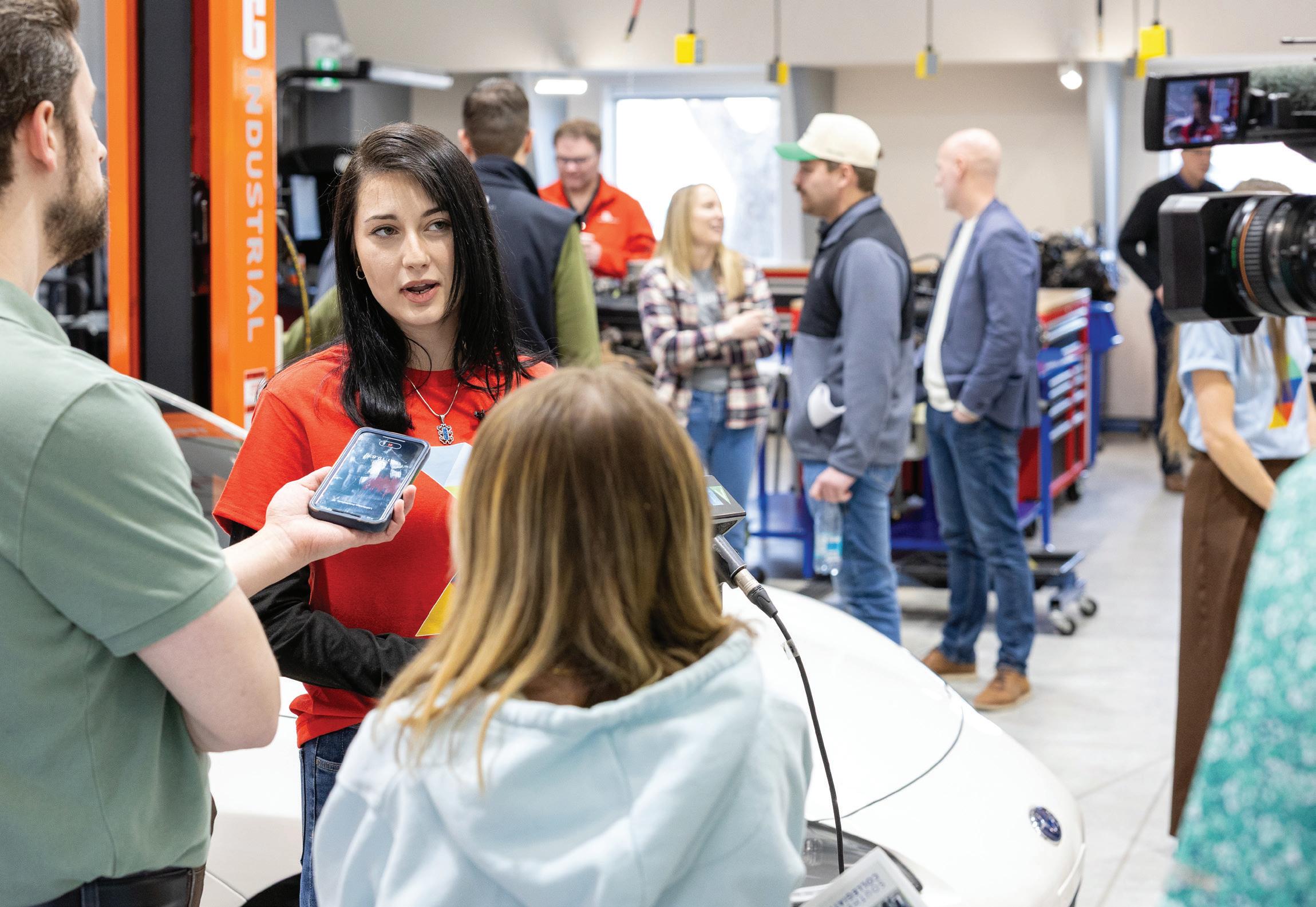
Cyra Graf, a former dual credit student, speaks to reporters at the grand opening of the Southern Alberta Collegiate Institute (SACI) on Feb. 6. A partnership between Lethbridge Polytechnic, seven southern Alberta school divisions, career support organizations and local industry, SACI delivers pathway programs for middle and high school students in trades, agriculture and health care.
How students, alumni and instructors are helping shape southern Alberta’s vibrant culinary community.
Instructors in Industry
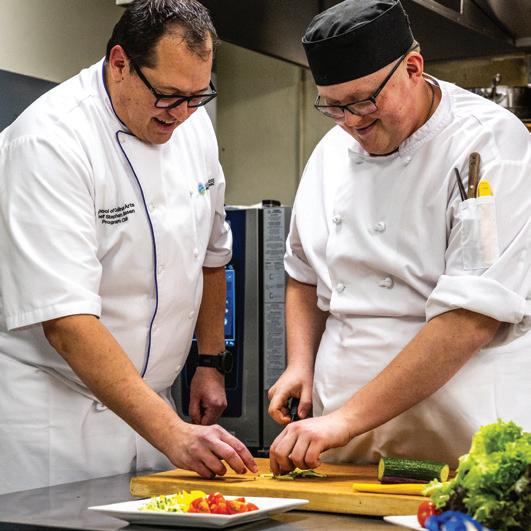
Meet eight polytechnic instructors whose ongoing industry work shapes the way they teach and mentor students.
From our Kitchens
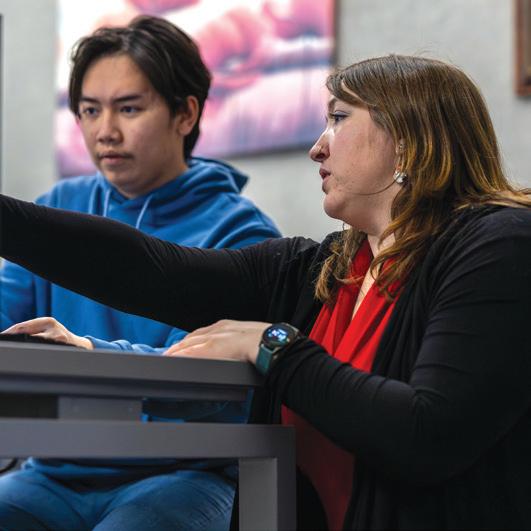
Chef Amara Goodsell shares a family favourite recipe – honey soy butter glazed salmon.

Photo
THERE’S ALWAYS AN OPPORTUNITY
PARALYMPIC HOPEFUL RYAN STRASCHNITZKI TALKS
HEALING, HARD DAYS AND GIVING BACK
Ryan Straschnitzki measures resilience with early mornings at the gym, long hours on the basketball court and the steady work of building both body and mind. His focus isn’t just on overcoming a life-altering moment, but on what comes next: setting new goals, leaning into challenges and helping others do the same.
The former Humboldt Bronco and Paralympic wheelchair basketball hopeful brought that perspective to Lethbridge Polytechnic’s 2026 speaker series March 4. Presented by Bruce McKillop, and in partnership with Excite Lethbridge, Straschnitzki hosted two sessions at the Lethbridge Trade & Convention Centre – one for postsecondary students, and one for alumni and community members.
“I think it’s nice when I speak to audiences because a lot of people don’t know where most of us are today,” Straschnitzki says of his 2018 teammates – survivors of the bus crash that left him paralyzed from the chest down. “I think
we’ve all developed as people, and we’ve done our best to move past the whole accident and create a life for ourselves. So, for me, I want people to know where I’m at, and because of their support, where I’m able to go in the future.”
Where he hopes to go is the Paralympic Games as a member of the Canadian National Wheelchair Basketball Team.
“Trying to learn a completely new sport and learn the ins and outs and the tricks, is something that takes a lot of time and a lot of games,” he says, adding he trains four days a week in the gym in addition to attending practices, tournaments and camps. “I’m in the national pool, so at any point if I start improving, I could be selected for the senior men’s team.”
He says he would love to crack the roster for the 2028 Paralympic Games in Los Angeles, but ultimately, his “biggest goal” is to be a starter and play every game at the 2032 Paralympics in Brisbane, Australia and “hopefully win that gold medal.”
As someone whose life “revolved around sport and being physically active,” Straschnitzki turned to adaptive competition soon after the Humboldt accident, first pursuing para-ice hockey before shifting to wheelchair basketball four years ago. Along the way, he met
other athletes with similar Paralympic goals, and he began to see how often cost became a barrier to them continuing in sport.
“I WANT PEOPLE TO KNOW WHERE I’M AT, AND BECAUSE OF THEIR SUPPORT, WHERE I’M ABLE TO GO IN THE FUTURE.”
Ryan Straschnitzki
“Adaptive sport equipment is so expensive,” he says. “A sport chair for basketball can range anywhere from $5,000 to $15,000 – on top of medical costs, playing community programs and travelling for tournaments – it adds up.”
Wanting to remove some of those financial barriers, Straschnitzki established the Straz Strong Foundation in 2022. Through the foundation, he raises money to help cover the cost of equipment and other expenses associated with adaptive sport for young Canadian athletes – regardless of their level of competition.
“At the end of the day … I just want them to have that sense of joy and the sense of belonging that I had growing up,” he says.
In addition to providing financial support, the Straz Strong Foundation has produced short documentaries, the RISE | DEFY Film Series, shared on social media and YouTube. The series features athletes who have received equipment through the foundation, highlighting their personal journeys, the transformative power of adaptive technology and how community support helps them pursue their goals.
The stories shared through the series reflect the same strength that shapes Straschnitzki’s path – resilience built through small, everyday moments.
“For me, living in a wheelchair, it’s just getting up every day,” he says. “You can’t sit back and let life take the wheel – you have to take control, and it starts with just getting out of bed.”
That approach also led Straschnitzki to place a stronger focus on mental health – a message he now shares with audiences as an essential part of overall well-being.
“Reaching out to a therapist, finding ways to take care of your mind and your body at the same time is something that’s so crucial and has really changed my life,” he says. “Something as simple as enjoying the sunrise or getting off my phone for a day – those little things that we take for granted go a long way.”
Straschnitzki says that mindset, along with a well-known saying his father shared with him at age 13 – when one door closes, another one opens – helps him lean into challenges and remain focused on his goals. And it’s a way of thinking he hopes audiences will carry with them long after his speaking engagements end.
“No matter what you’re going through in life, there’s always an opportunity,” he says. “You just might have to work hard for it.”
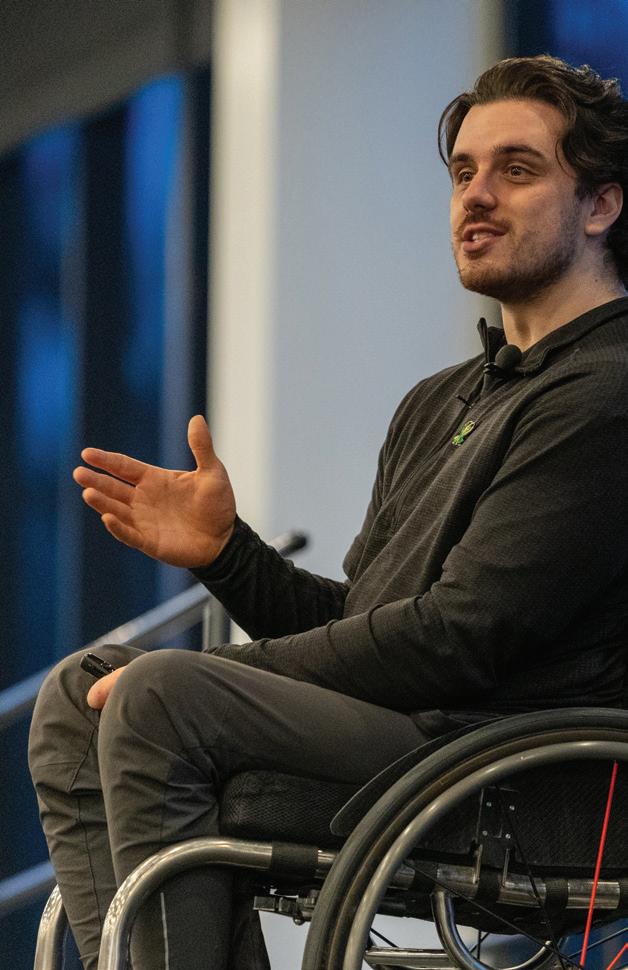

presented two speaker series sessions – an afternoon with students and an evening with polytechnic alumni and community members –March 4 at the Lethbridge Trade & Convention Centre.

Story by Tina Karst
Photos by Shawn Salberg and supplied
Former Humboldt Bronco Ryan Straschnitzki
TOP TEN FROM THE DEN
Wider Horizons turned to the people who know the ins and outs of campus best – Lethbridge Polytechnic employees – to pick the top news stories from the past six months. Here’s what they had to say.

NEW PRE-VETERINARY MEDICINE PROGRAM ANNOUNCED
Applications opened in March for the polytechnic’s new Pre-Veterinary Medicine diploma program, launching September 2026. The program builds a strong science foundation for veterinary medicine and careers in animal science. It also holds a transfer agreement with the University of Calgary’s Faculty of Veterinary Medicine.
Research (CPSAR) in partnership with VRCORE, a Calgary-based augmented reality educational provider who also provided $112,500 in funding. VRCORE will aid in development of the experiences, CPSAR researchers will consult with multiple policing services across the province, conceptualize scenarios and collect, analyze and review data.
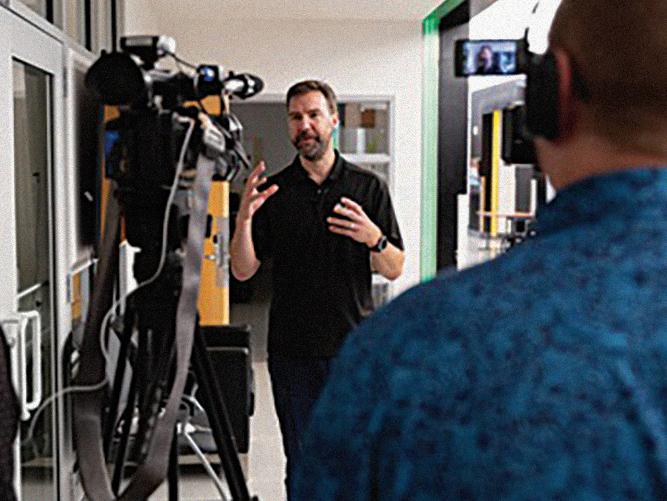
RESEARCH USING VIRTUAL REALITY TO IMPROVE PUBLIC SPEAKING
NEW MEMBERS APPOINTED TO POLYTECHNIC BOARD OF GOVERNORS
The Government of Alberta appointed five new members to Lethbridge Polytechnic’s Board of Governors: public members, Dave Jackson, Tyson Kwasney and Janet Bradley; and student members, Divine Ezeh and Chika Iheji. “The diverse expertise of this group arrives at a crucial moment as we navigate evolving challenges,” says Janene Moch, board chair.
LETHBRIDGE POLYTECHNIC HOSTS IRRIGATED CROP PRODUCTION UPDATE
Lethbridge Polytechnic, in partnership with industry, government and academic partners, hosted the 2026 Irrigated Crop Production Update on Jan. 22 at the Lethbridge Trade & Convention Centre. The one-day conference brought producers together to explore irrigation outlooks, water security, pest management and crop strategies. Featuring expert presentations, a farmer panel and networking opportunities, the update highlighted collaboration and innovation to support a resilient and sustainable irrigation sector in southern Alberta.
Five student researchers in the Digital Communications and Media and Multimedia Production programs helped their peers reduce publicspeaking anxiety using virtual reality. Supported by Scholarship of Teaching and Research grant recipient Kris Hodgson-Bright, the instructor-led project used Ovation VR to simulate real-world speaking scenarios. Early results show students felt less anxious over time as they practised, received feedback and tracked progress, building confidence and essential communication skills.
FESTIVE SPIRIT ALIVE AT WINTER FEST
Lethbridge Polytechnic welcomed students, alumni and the community to Winter Fest, presented with CocaCola, on Nov. 27. The free, familyfriendly event featured a hot chocolate bar, a bonfire, photos with Santa and Mrs. Claus and the Coca-Cola Holiday Caravan. Attendees also picked up takehome Holiday Cheer Challenge kits.
LETHBRIDGE POLYTECHNIC PARTNERS WITH VR INDUSTRY TO DEVELOP PUBLIC SAFETY CAREER EXPERIENCES
Lethbridge Polytechnic received $450,000 from the Natural Sciences and Engineering Research Council of Canada for an applied research project to develop virtual reality experiences for youth interested in public safety careers. The research initiative is led by the Centre for Public Safety Applied
HEALTH RESEARCH AT LETHBRIDGE POLYTECHNIC OPTIMIZING THERAPEUTIC RECREATION
An instructor-student research team published findings on optimized leisure and recreational activities for older adults with moderate dementia. Rena Walker, an instructor in the polytechnic’s Centre for Health and Wellness, and recent graduate Geraldine Torres Gonzales (Therapeutic Recreation – Gerontology 2024) conducted a pilot study to determine the optimal length of
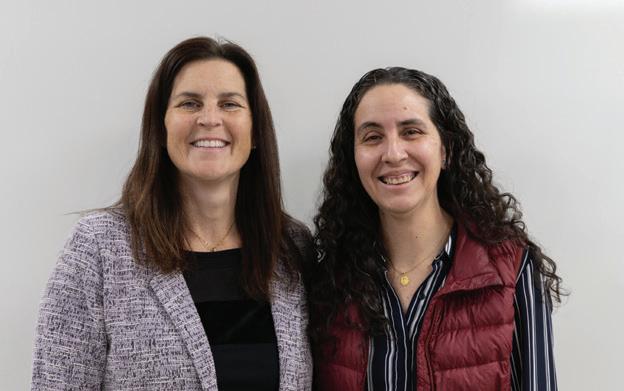
time to engage clients in therapeutic recreation. “Based on the data from our observations of recreation therapy activities, we saw clients maintain engagement for an average of 38 minutes before we saw decline,” says Torres Gonzales, who now works in the industry.
3
TECCONNECT CHALLENGE GIVES STUDENTS REAL-WORLD EXPERIENCE
A real client with a real business challenge anchored a hands-on learning experience for Lethbridge Polytechnic students in February as teams from the Multimedia Production and Digital Communications and Media programs participated in the 11th annual Tecconnect Challenge. Students had five hours to build creative pieces and assemble a presentation to address pain points identified by an entrepreneur in the Tecconnect environment. Students then presented their final pitches to the client, along with a panel of local entrepreneurs, marketing specialists and business advisors.
2
FRUGAL FEASTING: POLYTECHNIC CHEF OFFERS TIPS FOR SMART HOLIDAY MEALS
In December, Chef Mark Dieser, manager of Food Services and the School of Culinary Arts, shared tips to help families enjoy festive, budget-friendly holiday meals. He encouraged thoughtful planning, seasonal ingredients and creative alternatives to costly centrepieces to keep food costs down. From smaller cuts of meat to simple sides and classic desserts, the advice emphasized that meaningful holiday meals don’t require premium ingredients, just smart choices and time spent together.
1
NATURAL RESOURCE COMPLIANCE STUDENTS CONTRIBUTE TO LOCAL BIODIVERSITY DATABASE
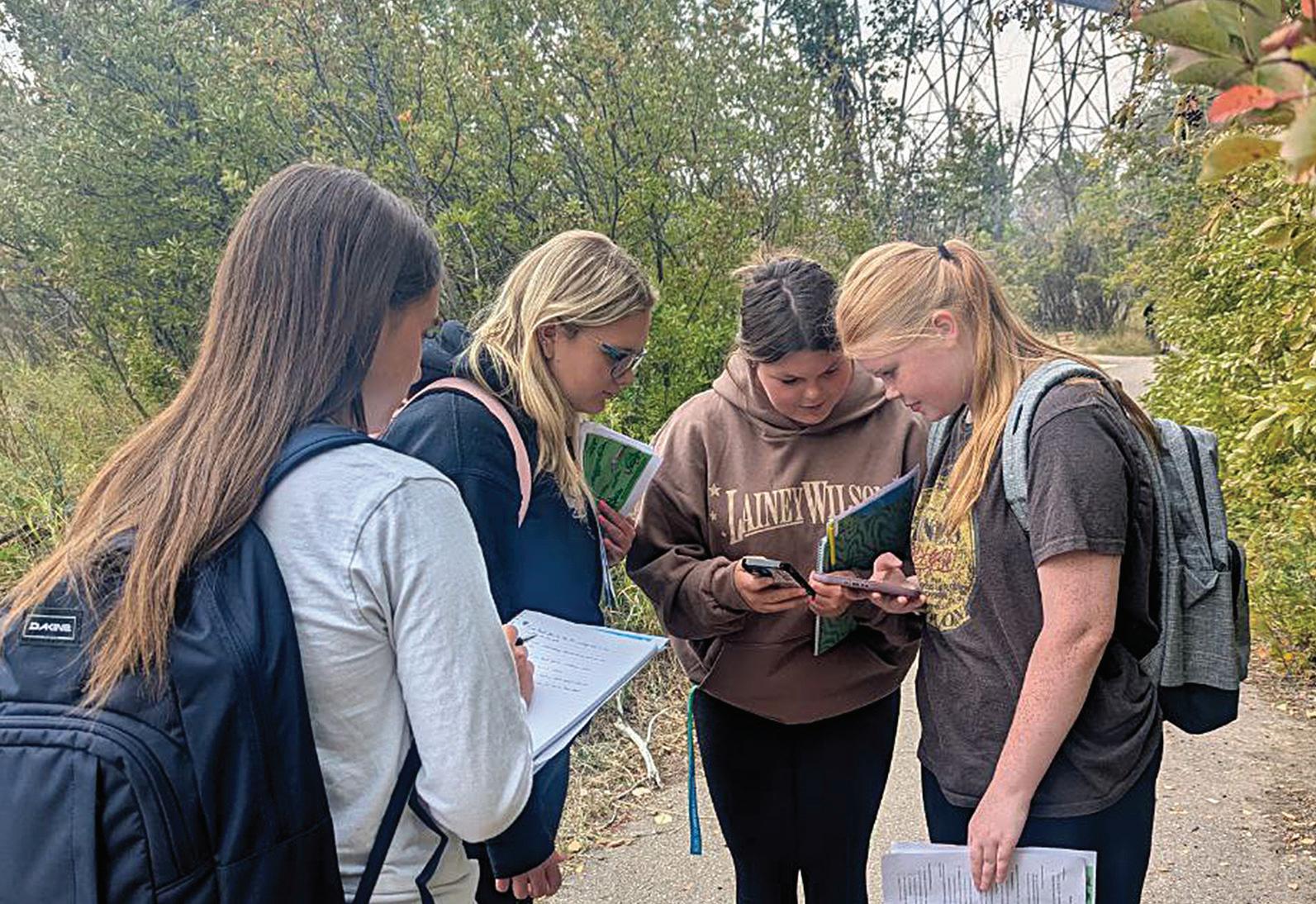
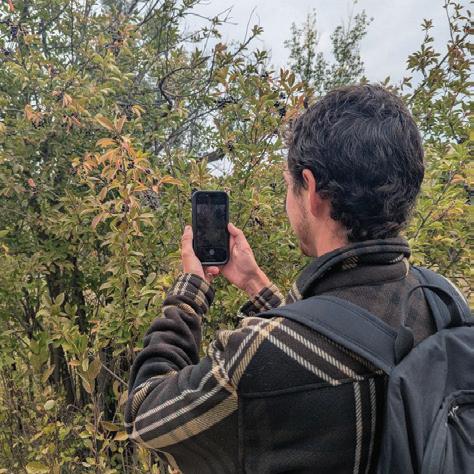
More than 70 first-year students in the polytechnic’s Natural Resource Compliance program traded their classroom for the coulees in September and contributed hundreds of plant and animal observations to a growing community database. The field lab, in partnership with the Helen Schuler Nature Centre, introduced Ecology students to the area’s unique ecosystems and the iNaturalist app, a global citizen science tool that helps identify and track plants, animals and other organisms.
You can read all of these stories and more at lethpolytech.ca/news.
Thanks to our polytechnic colleagues who helped shape this list!
by Dr. Brad Donaldson
The President’s View
Each year, Stone Pipe Days reminds us of something essential about who we are and who we are striving to become: a polytechnic community grounded in respect, learning and relationship.
Lethbridge Polytechnic is also known as Ohkotoki’aahkkoiyiiniimaan, Stone Pipe, for our place in sharing knowledge for the betterment of people. Our campus is situated on lands the Blackfoot people have traditionally inhabited and acknowledging that truth carries a responsibility. It calls on us not only to recognize where we are, but also to deepen how we live, learn and work on Blackfoot Territory.
This week-long celebration brings students, employees and the broader community together to honour the
Siksikaitsitapi, the Blackfoot people, and to celebrate culture and heritage. This year’s theme “coming together in a holistic way” is both an invitation and a challenge. It reminds us that learning is more than what happens in a classroom. It is also relational and cultural. It happens when we listen with humility, show up with care and make space for perspectives and traditions that expand our understanding.
For me, this is also a moment to reflect on the work we do all year to foster connection, Kakyosin, through ongoing, reciprocal relationships with Indigenous partners and through the supports that help Indigenous learners feel welcomed, respected and able to succeed while being fully themselves on campus.
Lethbridge Polytechnic and the Blackfoot Confederacy recently signed a Memorandum of Understanding,
than what happens in the classroom.
strengthening the relationship between our institution and the Blackfoot Nations. This agreement reflects a shared commitment to continue learning from one another and to create opportunities for Blackfoot learners and communities. It also represents something hopeful. It represents a future where Blackfoot knowledge continues to shape learning at Lethbridge Polytechnic and where our work together continues to grow in meaningful ways. I’m grateful to the Indigenous partners, Elders, Knowledge Keepers, community members, students and employees who contribute to this work.
Stone Pipe is not simply a name we carry; it is a commitment we live, strengthened each time we deepen relationships and honour Blackfoot Territory for the betterment of people.
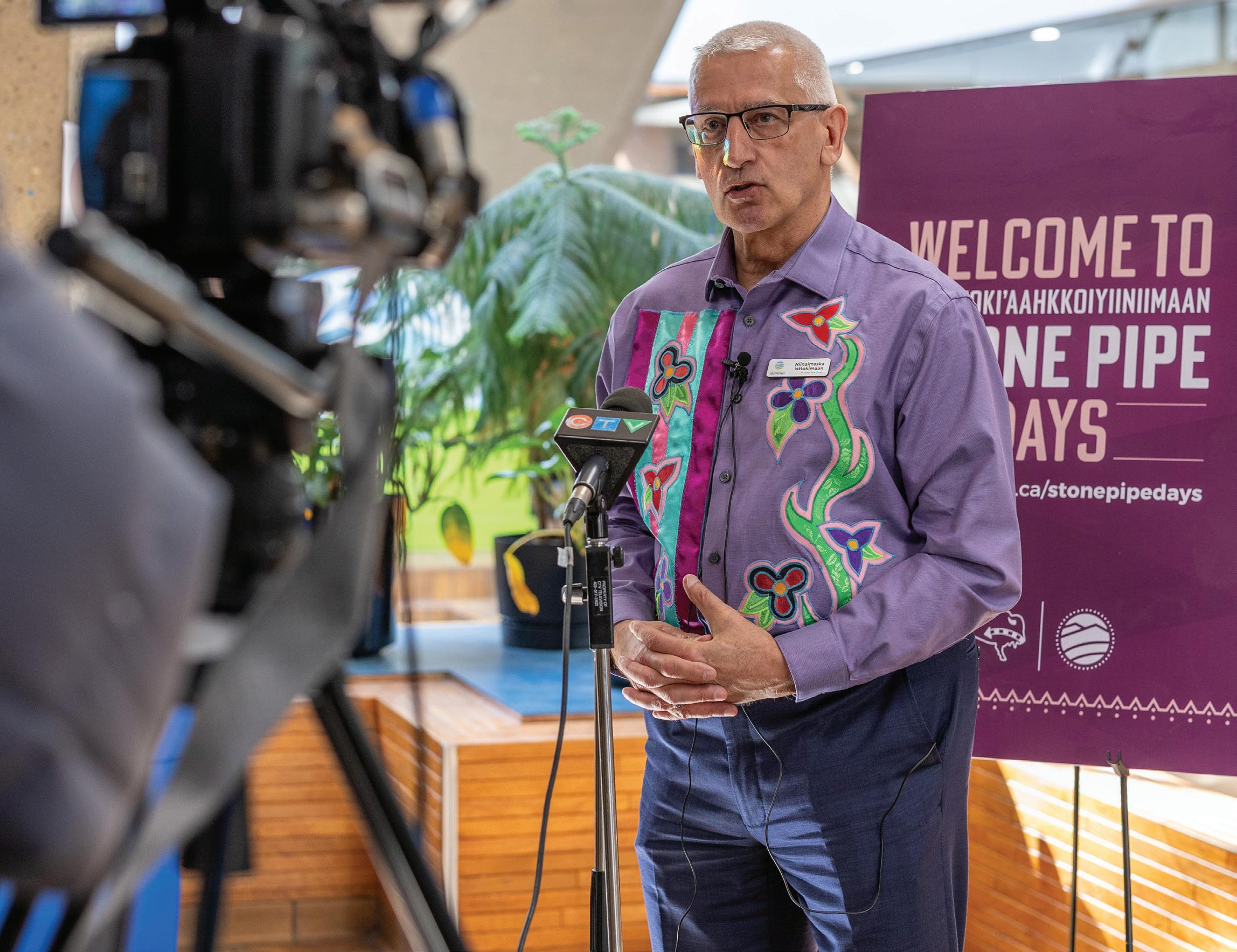
Dr. Brad Donaldson speaks with media during the Stone Pipe Days opening ceremony March 23. He says the week-long celebration is a reminder that learning is more
Photo by Shawn Salberg
Polytechnic celebrates Employee Excellence
Lethbridge Polytechnic’s annual Employee Recognition Event, held each February in the Garden Court Dining Room, celebrated outstanding service across campus and recognized retirees from 2025. The following individuals and groups were recognized with Employee Excellence Awards.
SERVICE AND INNOVATION
• Brian Hlushko, consultant, Occupational Health and Safety
• Carrie Allinson, manager, Business Systems
• Paige Thornborough, manager, Youth Initiatives
• Quentin Boehr, academic co-ordinator, Centre for Business, Arts and Sciences
• Be Fit for Life team
• AI Chatbot Project team
• Procurement team
• Sara Bond, executive assistant, vice-president – academic and research
LEADERSHIP AND CREATING COMMUNITY
• Carmen Guenther, manager, Wellness Services
• Lexi Schaerz, manager, Learning Experience Design, Centre for Teaching, Learning and Innovation
• Paul Krizan, manager, Strategic Planning, Analytics and Reporting
• Community Integration Through Art –Pissatsinaskssini research team
CONGRATULATIONS, RETIREES!
Thank you to the following retirees for their years of service to the polytechnic community: Todd Bowden, Lewis Callahan, Lorne Deimert, Dave English, Kathie Ervin, Rob Fath, George Gallant, Darryl Godwin, Deb Hadley, David Haight, Jeff Hamilton, Wendy Hart, Dawn Keith, Bev Kunz, Terry Luoma, Estela Mayen, Isabel Morales, Ronald Papp, Jim Pinches, Barry Robinson, Nancy Russell, Ken Sauter, Bill Smienk, Linda Sprinkle, John Steenbergen, Robert Tomkinson, Jody Tyssen, Cindy Warner and Frank Zappone.
Congratulations to the following Lethbridge Polytechnic community members for making a difference in their work and communities:
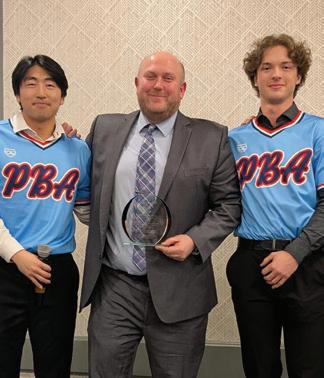
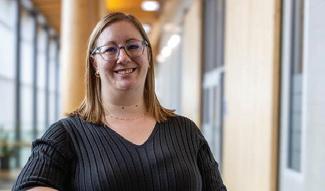

Greg Gibos, Liberal Arts and Life Sciences instructor and Kodiaks men’s volleyball coach, was named Professor of the Year by the Prairie Baseball Academy for the second year in a row. The student-nominated award is given to one educator from Lethbridge Polytechnic and one from the University of Lethbridge each year.
Lethbridge Polytechnic Faculty Association/Students’ Association award winners were: Karl Rejman, General Studies instructor, who won the Teaching Excellence Award; and Emily Van Dasselaar, Engineering Design Technology instructor, who was named Rookie of the Year.
Sandra Moreno, distance instructor, Criminal Justice, represented the City of Edmonton at the United Nations Headquarters in New York for a global conversation marking the International Day for the Prevention of Violent Extremism as and when Conducive to Terrorism. In addition to her role as a polytechnic instructor, Moreno also works as a strategic project advisor, currently supporting the City of Edmonton on the implementation of its Anti-Racism Strategy.
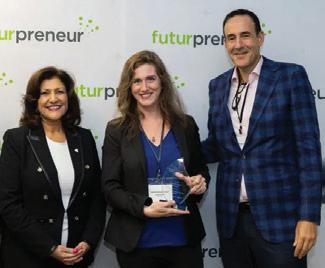
Kristine Wilson, Environmental Sciences instructor, won a $10,000 Youth Entrepreneur award through Futurpreneur to support a budding sustainable agriculture enterprise that utilizes aquaponics to produce premium, naturally grown leafy greens.
Polytechnic renews land lease with PROVINCE
In January, Lethbridge Polytechnic announced a 20-year land lease renewal agreement with the Government of Alberta for its 395-acre research farm.
“The Lethbridge Polytechnic Research Farm is central to our agriculture research operations, supporting innovative projects while providing world-class opportunities for researchers and students alike,” says Dr. Kenny
Corscadden, vice-president – academic and research. “Thanks to our partnership with the provincial government, we look forward to enhancing our capacity for student-focused, industry-connected agricultural research.”
“Alberta’s government is proud to support applied agricultural research that delivers real-world solutions for producers while creating hands-on learning opportunities for students,” says Minister of Agriculture and Irrigation RJ Sigurdson.
CAMPUS KUDOS
CAMPUS NEWS
“I AM NOT YOUR TYPICAL AG STUDENT BECAUSE I DON’T COME FROM A FARM, SO TO GRADUATE AT THE TOP OF THE CLASS IS QUITE AN ACHIEVEMENT FOR ME.”

Agronomy student named spring 2026 valedictorian
Agriculture Sciences – Agronomy student Paul Skretting was named valedictorian for Lethbridge Polytechnic’s Spring 2026 Convocation class.
“I was shocked,” says Skretting, when he heard he had been selected. “I am not your typical Ag student because I don’t come from a farm, so to graduate at the top of the class is quite an achievement for me.”
Growing up in Lethbridge and graduating from Catholic Central High School, Skretting says he chose to attend the polytechnic because it was
close to home and offered the hands-on experience he needed to succeed.
When it came to his decision to pursue the Agriculture Sciences – Agronomy diploma, Skretting says he was inspired by his grandfather.
“My grandpa was a farmer, and he was the first person I ever worked for,” he says. “It kindled a joy and a yearning for knowledge in this industry. I have fond memories of spending weekends as a kid branding, fixing fences and freezing my fingers feeding cows in the winter.”
Since working for his grandfather, Skretting has gained experience in the
Exercise Science grad SHARES research
Tyler Duffy (Exercise Science 2025) was in London, Ont. in October presenting at the Canadian Society for Exercise Physiology (CSEP) national conference. There, he shared his research that explored the physical and cognitive demands placed on firefighters.
“[We] looked at simple cognitive tasks, like reaction times and processing speed, as well as complex tasks, like decision making,” says Duffy. “These are vital for first responders who find themselves in highly tense situations without the ability to fully process their surroundings, all while being close to dangerous environments.”
industry as an agriculture mechanic and, more recently, as an agronomist – a career he plans to continue in after completing the polytechnic’s Bachelor of Agriculture Science PostDiploma Degree.
While Skretting may not consider himself a “typical” agriculture student, he says his polytechnic journey shows there’s no single path into the industry – something he hopes future students remember.
“Shoot for the moon,” he says. “You’ll never know if you enjoy it unless you give it a try.”
Duffy attended the conference alongside Dr. Simon Schaerz, an instructor in the polytechnic’s Centre for Health and Wellness, who guided him through the research process. Schaerz says seeing students present at this level is a testament to their drive and dedication to applied learning at the polytechnic.
“Tyler possesses a genuine curiosity that drives him to dig deeper than the surface level of physiology,” says Schaerz. “Watching him take that enthusiasm from the classroom to a national platform like CSEP is why we value applied research, as it empowers students to realize their work has real-world impact.”
10 years of Black History Month celebrations
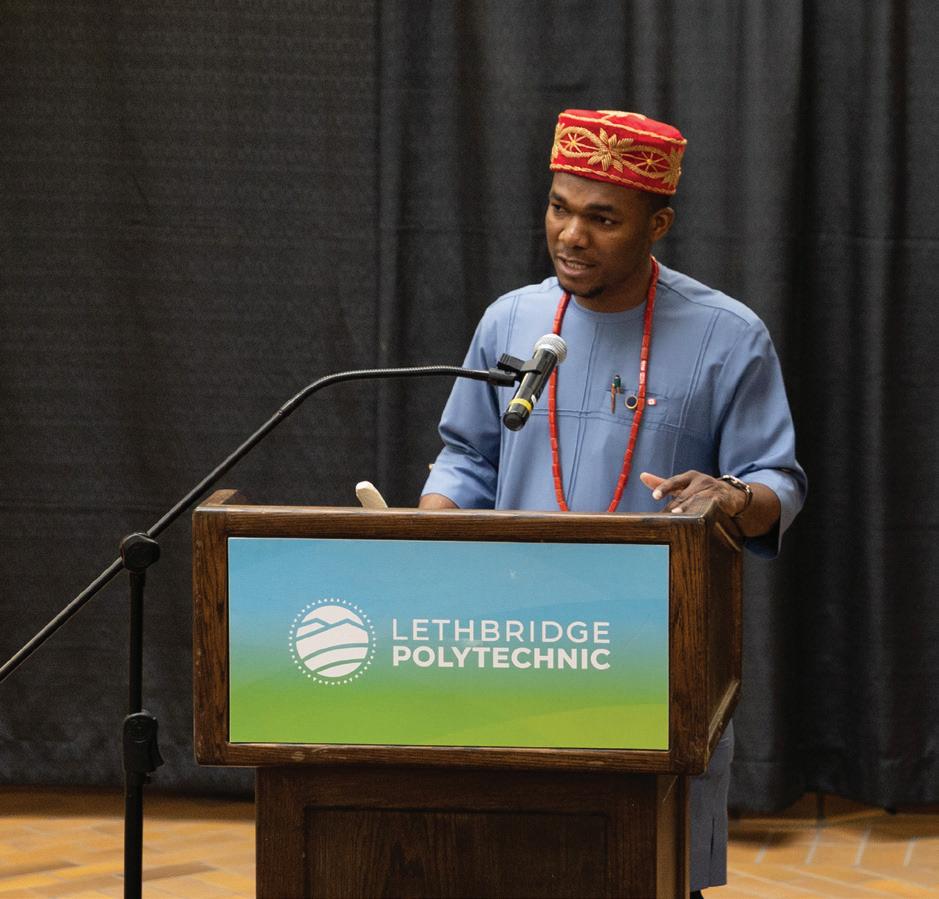
Several powerful speeches kicked off Black History Month in February as Lethbridge Polytechnic celebrated its 10th consecutive year of organized activities. Among the speakers was Divine Ezeh, a second-year Bachelor of Nursing student and president of the Lethbridge Polytechnic Students’ Association.
“When I first arrived in Canada and started my journey here as a student, I carried both excitement and uncertainty,” he said at the opening ceremony. “I remember walking into classrooms wondering if people would understand my accent, if I would fit in, if I truly belonged. There were moments I felt small or invisible. But then something simple changed everything – someone asked about my culture, someone listened to my story, someone made space for me at the table.”
Ezeh encouraged the polytechnic community to participate in Black History Month events, listen to others’ stories, ask questions, speak up when they see injustice and to support changes that make the campus safer and more equitable for everyone.
“There’s a Nigerian proverb that says, ‘if you want to go fast, go alone; if you want to go far, go together,’ and going far – together – is exactly what community means,” he said.
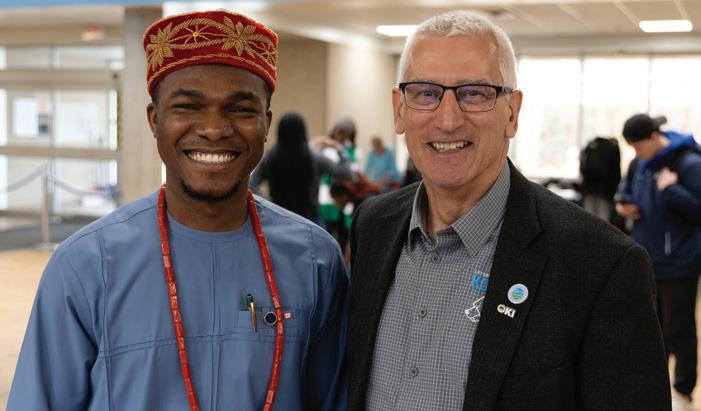
Black History Month activities also included music, trivia, Nigerian jollof rice meal kits, a cultural fashion show and a panel discussion on the experiences of Black parents living in Canada.
“THERE WERE MOMENTS I FELT SMALL OR INVISIBLE. BUT THEN SOMETHING SIMPLE CHANGED EVERYTHING – SOMEONE ASKED ABOUT MY CULTURE, SOMEONE LISTENED TO MY STORY, SOMEONE MADE SPACE FOR ME AT THE TABLE.”
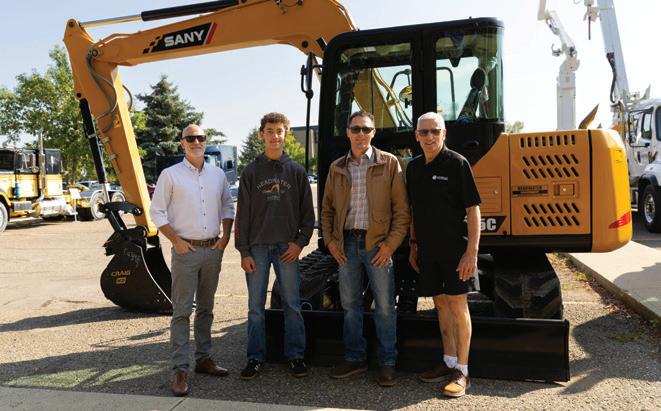
Headwater Equipment donates excavator
Last fall, Headwater Equipment donated a 2022 Sany SY75C excavator for use in the polytechnic’s Agriculture and Heavy Equipment Technician program. It was on display in the Big Truck Zone at Coulee Fest where visitors got to check it out up close.
Matt Stringer, Headwater Equipment Sales, says the idea behind the donation stemmed from an instructor-led tour of the trades labs he took with his daughter.
“One thing that stood out to me, was there were no excavators for students to learn on,” he says. “It struck me as an opportunity to provide the school with something that is needed as well as helping our apprentices learn on the machines they will be working on once they are done with school. It will be an added bonus for Headwater that, for many years going forward, the polytechnic is going to be training mechanics that will now be familiar with the Sany brand.”
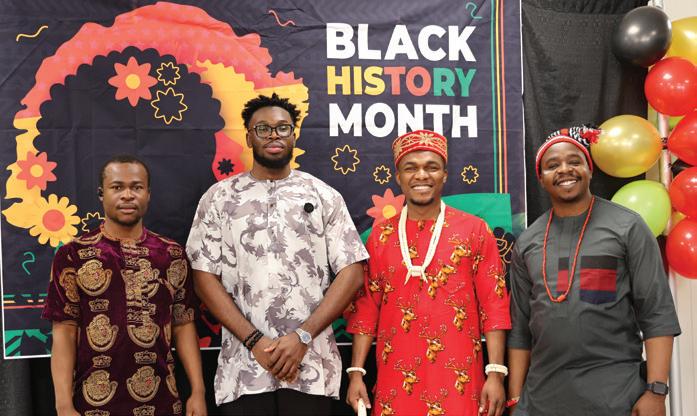
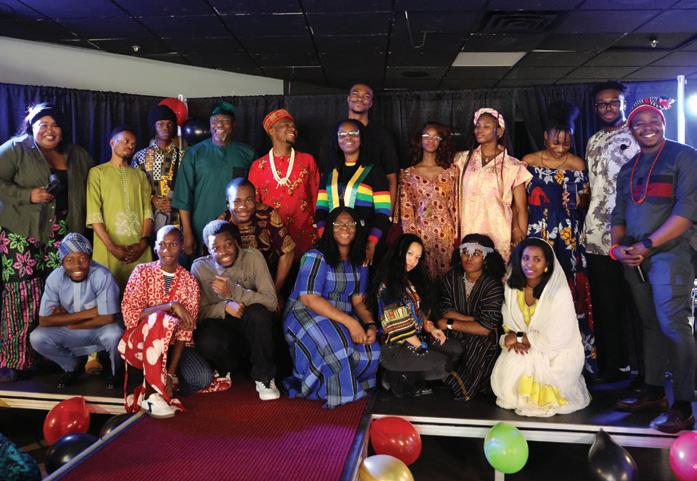

Bachelor of Nursing student Divine Ezeh speaks at the Black History Month opening ceremony. Activities in February also included music, meal kits and a cultural fashion show (right).
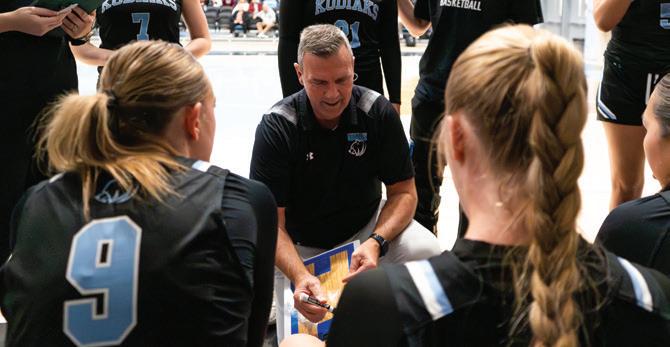
Coach Ken McMurray announces retirement
After five seasons guiding the Kodiaks women’s basketball team, head coach Ken McMurray is stepping away.
Since taking over in 2021-22, McMurray guided the Kodiaks to 43 wins and was named Alberta Colleges Athletic Conference (ACAC) South Coach of the Year in his first season.
“Basketball has given me so much, from my days as a player to more than 40 years of coaching,” McMurray says. “Finishing my career with the Kodiaks women’s program has been especially meaningful.”
Assistant coach Deanna Simpson, who stepped down as head coach prior to McMurray’s appointment, will once again lead the program.
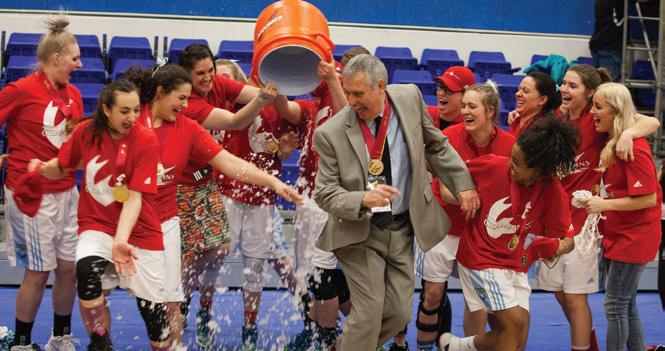
Kodiaks’ perfect season honoured in Hall of Fame
The Kodiaks 2016-17 women’s basketball team was inducted into the Lethbridge Sports Hall of Fame May 8 –recognizing a dream season where they went 21-0 in league play, followed by conference and national championships. Including tournament wins in the U.S. against Division II and junior college competition, the Kodiaks were 38-0 on the season.
“There were a lot of things that made this team special,” says thenhead coach Brad Karren, who capped off his post-secondary coaching career that season with the titles. “I had most of these players for a few years
Hosannah lets his game do the talking
and we were building towards the point of winning.”
Karren was named Alberta Colleges Athletic Conference (ACAC) and Canadian Collegiate Athletic Association (CCAA) coach of the year while Sunder West was named to the ACAC first all-star team, the ACAC championship most valuable player, CCAA championship MVP and to the CCAA All-Tournament Team. Teammate Logan Moncks was named ACAC regular season MVP and to the CCAA All-Tournament team while Emma Lowry was named a first-team all-star in the ACAC regular season, ACAC championship and to the CCAA All-Tournament team.
Rounding out the Kodiaks’ roster were assistant coaches Deanna Simpson, John Lowry and Ali Cameron, and players Jaclyn Heggie, Leah Ekubazgi, Amanda Lee, Shantaya Strebel, Jinan Daqqa, Rebecca Lowry, Shayna Mathison, Brianne Hergott, Amy Arbon and Vienna Tamminen.
gokodiaks.ca
Nathaniel Hosannah doesn’t need to be the loudest voice in the gym to make an impact.
Since joining the Kodiaks men’s basketball program last summer, the second-year Business Administration – Management student from Tacoma, Wash., has brought quiet leadership and a consistent, high-motor presence on both ends of the court.
He says his approach to the game is grounded in accountability and perspective –values shaped early in life by his mother Desiree. She was adopted at a young age and raised in Brooklyn, N.Y. From there, she forged her own path, becoming a lawyer, running her own firm and serving as a judge.
“She made her future 10 times better than what her past was,” Hosannah says. “That’s inspiring.”
Growing up in predominantly white school environments, Hosannah says his mother was clear about what it would take to succeed. “You have to do the same work as everybody else and then do more to be seen,” she told him.
Hosannah says that advice gave him “a work ethic that could never be replaced.”
Now, with a strong season behind him – that included ACAC South Second Team All-Conference honours, being named an ACAC Tournament All-Star and later to the CCAA All-Tournament team, finishing top five in scoring, third in rebounds and leading the national tournament in steals – Hosannah is focused on continuing his development. He plans to train with United Prep Canada this summer.


Medal momentum
Kodiaks shine at championships
It was a spring season full of hardware for the Lethbridge Polytechnic Kodiaks.
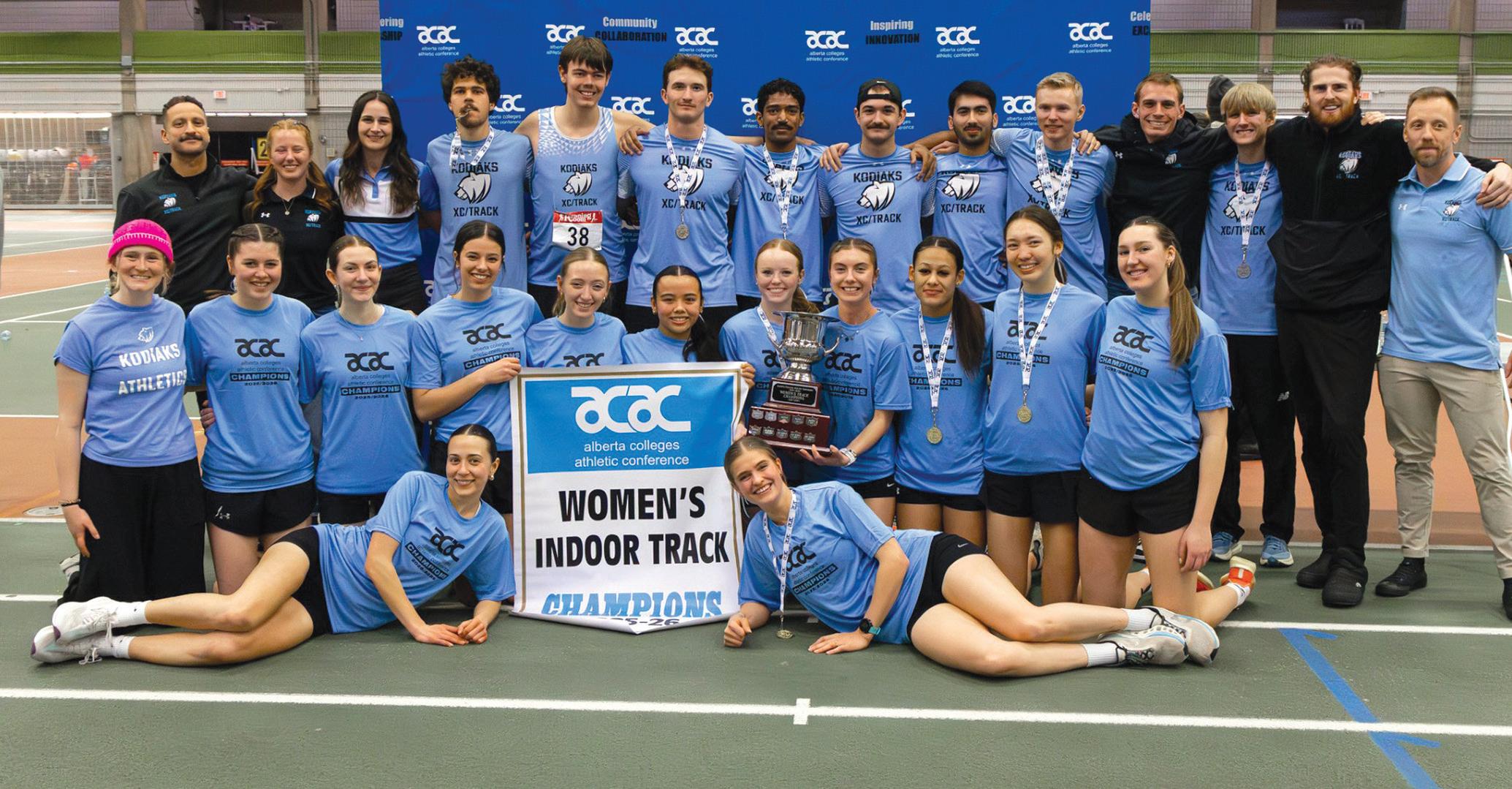
The indoor track team delivered a historic performance at the 2026 Alberta Colleges Athletic Conference (ACAC) Indoor Track and Field Championship March 7-8 in Edmonton. The Kodiaks women captured the ACAC team championship with 73 points, marking the first indoor track championship banner in women’s program history, while the men’s team finished fourth overall with 52 points in a competitive field.
The Kodiaks also medaled in several individual competitions, including: gold for Hallee Pilling, Hana Oikawa, Paighton Kumson and Hazel Baumbach in the women’s 4x200-metre relay; gold for Pilling, Oikawa, Katrina Michel and Kate Block in the women’s 4x400-metre relay; silver for Kumson and bronze for Oikawa in the women’s 300 metre; bronze for Khloe Jankowiak in the women’s 3,000 metre; silver for Owen Boucher, Wayne Bauluck, Shaun Geusebroek and Ethan
Grasmeyer in the men’s 4x400-metre relay; silver for Boucher in the men’s 50 metre; and bronze for Grasmeyer in both the men’s 1,500- and 3,000-metre races.
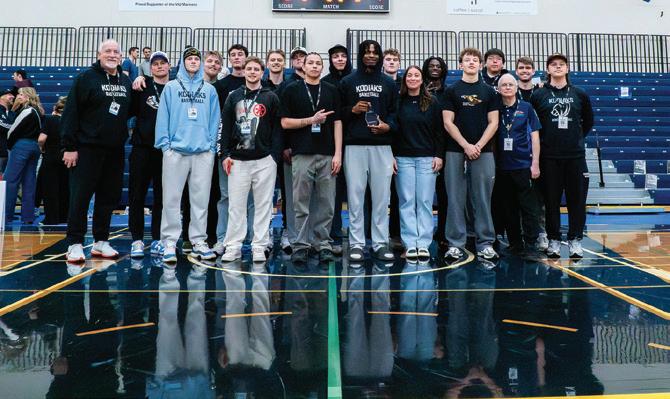
The Kodiaks men’s basketball team put together an impressive run at their conference championship that same weekend, opening with a 75-61 comeback win over NAIT before knocking off host and top North Division team Lakeland 86-67 in the semifinal. In the gold medal game, the Kodiaks battled back from an early deficit and traded runs with Keyano but ultimately fell just short, 86-79, to earn silver. Levi Balderson led all scorers at the tournament. He and Nathaniel Hosannah, who played every minute, were named ACAC Tournament AllStars. The Kodiaks’ strong showing also secured a wild-card berth to the Canadian Collegiate Athletic Association national championship March 18-21 in Nanaimo, B.C. where they finished fifth.
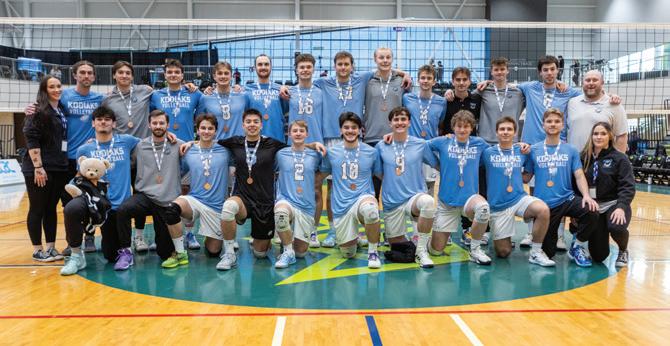
The men’s volleyball team made program history on Feb. 28, battling past the Northwestern Polytechnic Wolves in five sets to earn an ACAC bronze medal. The Kodiaks men’s volleyball team has previously celebrated a silver-medal
finish. Following the bronze medal match, Ben Dyck was recognized for his outstanding weekend performance, earning Tournament All-Star honours. And the men’s and women’s futsal teams punched their tickets to the ACAC championship with strong finishes at the final South Regional tournament of the season. The women rebounded from an opening loss with back-to-back wins, scoring 16 goals across their final two matches. The men remained unbeaten on the weekend, earning two wins and a draw. Both teams capped their seasons with competitive showings at championships in Medicine Hat March 20-22, highlighted by midfielder Khloe Jankowiak earning South All-Conference honours for the women’s team.
APPLIED RESEARCH LEADS TO APPLIED LEARNING
HOW LETHBRIDGE POLYTECHNIC IS BRINGING STUDENTS, INDUSTRY AND COMMUNITY TOGETHER TO ADDRESS REAL-WORLD CHALLENGES
Research has always been part of the learning process, but at Lethbridge Polytechnic, applied research turns ideas into practical solutions, addressing real-world challenges in partnership with students and industry.
“The heart of applied research is to be responsive to industry and community needs,” says Dr. Andrew Dunlop, associate vice-president – research. “Times change, priorities shift and economies grow – we work to be at the forefront of that.”
Lethbridge Polytechnic has a rich history of applied research, starting in 1989 with aquaculture trials. In 2003,
operations expanded into aquaponics and controlled environment agriculture, reflecting the evolving needs of southern Alberta’s growing agriculture sector.
More recently, the Centre for Applied Research, Innovation and Entrepreneurship (CARIE) has expanded research to encompass five themes: agriculture, food and environment; business and technology; health and wellness; justice and public safety; and sciences, social sciences and humanities.
Each theme serves a public need, with research teams and student research assistants solving emerging problems in collaboration with their respective industry and community partners.
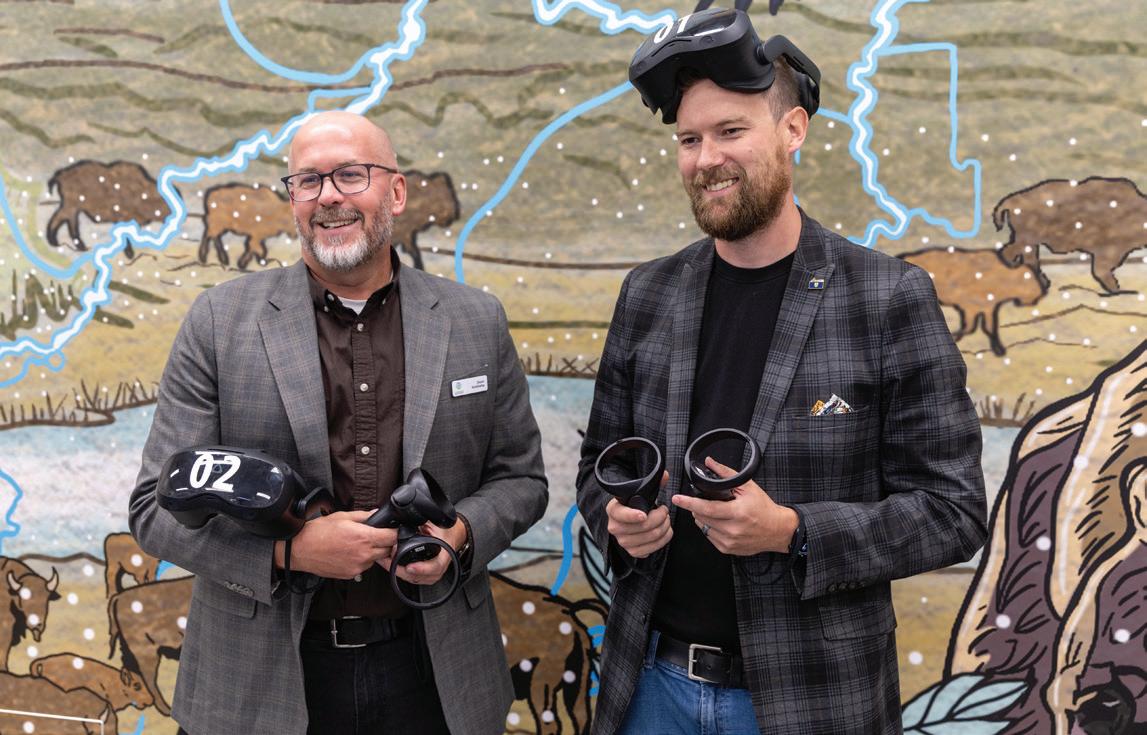
Within CARIE, the Centre for Public Safety Applied Research is collaborating with Calgary-based VRCORE on developing virtual reality (VR) experiences for youth aged 15 to 24, showing what a career in public safety looks and feels like.
VRCORE Founder and President Jason Van Hierden says in those formative years, having a comprehensive look at career options is vital.
“Our goal is to take the guesswork out of deciding what career path someone should pursue,” he says. “We want to guide them toward what speaks to their passions and interests.”
“Attitudes around public safety have shifted in recent memory,” says Dean Kolebaba, principal researcher and program chair in Lethbridge Polytechnic’s School of Justice Studies. “It’s not about chasing bad guys and making arrests; it’s about conversations and de-escalation. We want to change perceptions and show youth what a real career in public safety looks and feels like.”
Like public safety, the agriculture, food and environment research theme is evolving to meet the needs of an everchanging agricultural sector.
The polytechnic is home to the Integrated Agriculture Technology Centre’s (IATC) 10,000-square-foot controlled environment agriculture research greenhouse. Here, Dr. Seyed Hashemi, research scientist, is part of a public-facing applied research, consultation and problem-solving resource for producers in southern Alberta and beyond.
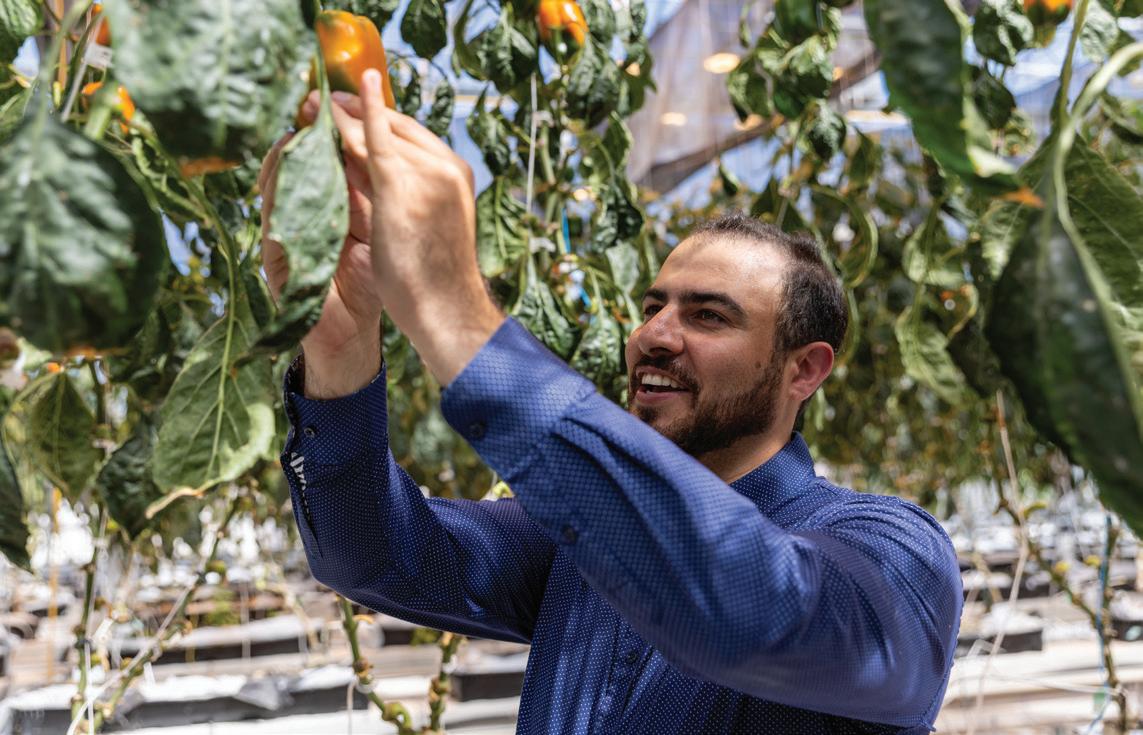
“Commercial greenhouses are an incredibly valuable agricultural resource, enabling year-round growing for all sorts of plants, particularly fruits and vegetables, here in southern Alberta,” says Hashemi.
Hashemi is part of a team researching light optimization for greenhouses, comparing different types of LEDs and industrial lighting on cucumbers, tomatoes and bell peppers. Preliminary results for the cucumber trials have been published and peer reviewed, with four greenhouses in Alberta already adopting their results.
For polytechnic students, applied research opportunities also provide a balance between classroom learning and hands-on experience.
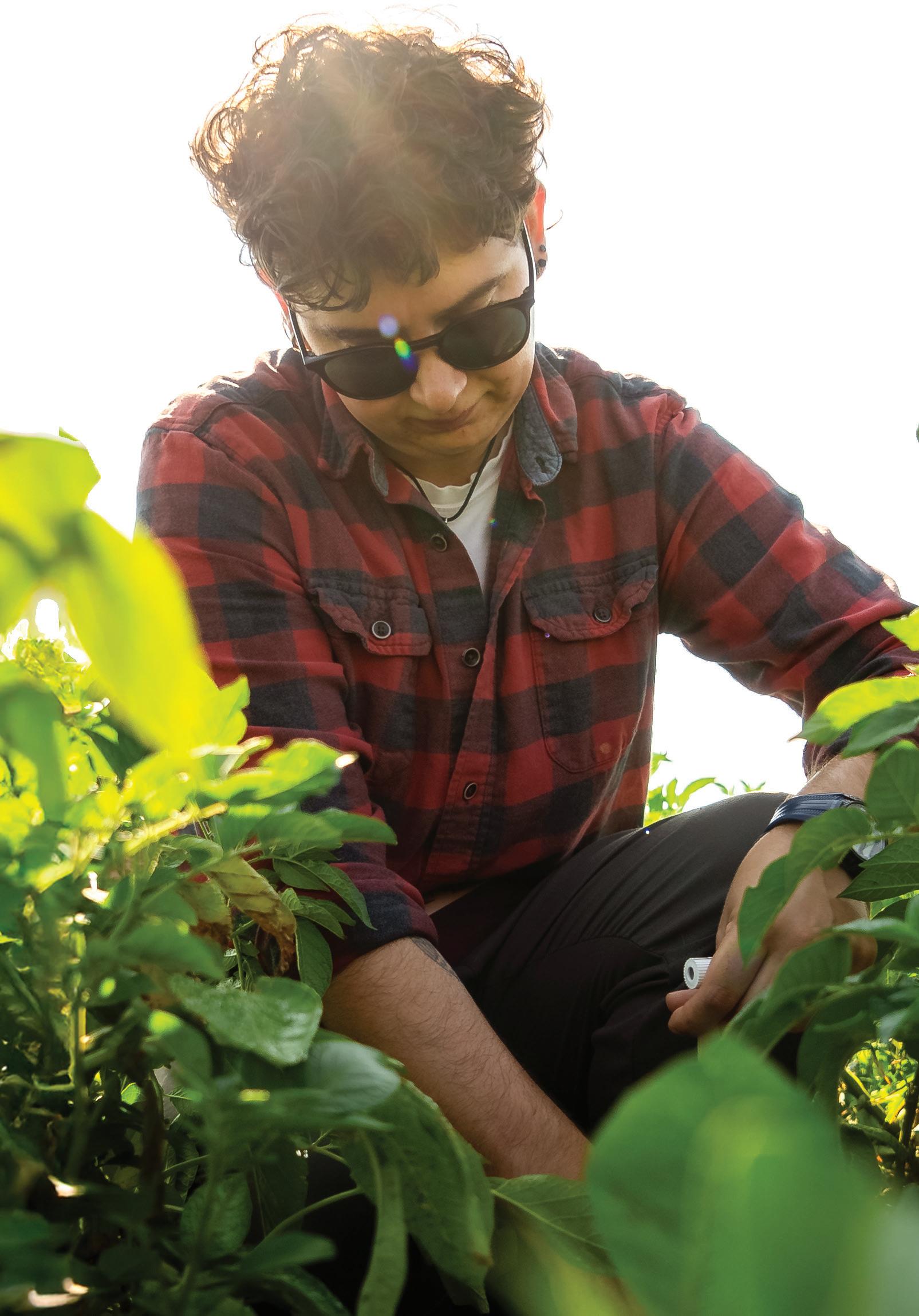
Aleksandra Calic, a fourth-year Bachelor of Ecosystem Management student, and Sierra Stumborg, a third-year Bachelor of Criminal Justice student, spent last summer working as student research assistants. From fertilizer emissions to a multi-year study developing an arts-based social-recreational peer support program, both Calic and Stumborg spent time collecting and processing data, engaging with stakeholders and learning about themselves.
“I love the mix of lab and field work,” says Calic. “Using equipment like atmospheric sensors and drones keeps each day engaging and different. I’ve learned how vital agricultural research is to southern Alberta, and this experience will support my future in environmental conservation.”
“I want to become a police officer, and I’m learning that the role is about much more than enforcement,” says Stumborg. “It’s about community engagement and building relationships. It’s incredibly rewarding, and this is where I want to be.”
As applied research continues to expand at Lethbridge Polytechnic, recognition of this work is being noticed beyond southern Alberta. Last fall, Research Infosource Inc., a Canadian source of research intelligence, ranked Lethbridge Polytechnic ninth among the top 50 research colleges (and polytechnics) in Canada, up from 10th in 2024 and 11th in 2023.
Additionally, the Natural Sciences and Engineering Research Council of Canada renewed a five-year, $1.75 million grant to maintain the IATC as a federally designated applied research, consultation and problem-solving hub for producers across Canada.
“For 37 years, Lethbridge Polytechnic has diversified its research capabilities, strengthened relationships with stakeholders and leveraged researcher expertise to compete consistently at the national level,” says Dunlop.
“When students and world-class researchers work side by side on real-world challenges, it leads to meaningful solutions that benefit both industry and the communities we serve.”
Story by Sam Sasse
Calic (right) gets hands on with field work, inspecting plants at the polytechnic’s research farm.
Opposite: Kolebaba (left) and Van Hierden show off integrated VR headsets. Hashemi inspects an orange bell pepper in the IATC, which is home to more than 500 plants throughout the year.
THE COMMUNITY OF FOOD
CONNECTING STUDENTS WITH SOUTHERN
ALBERTA’S CULINARY INDUSTRY
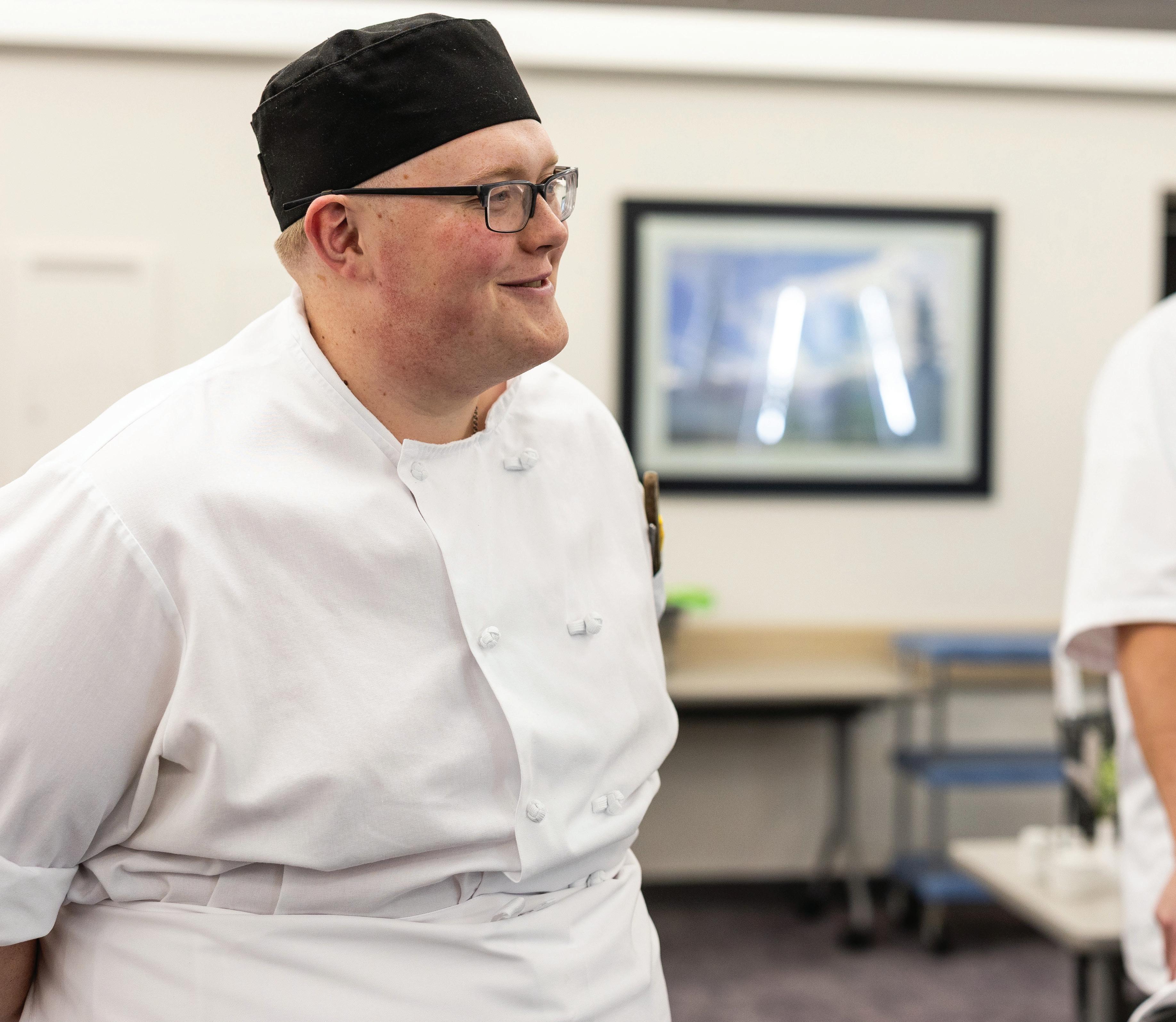
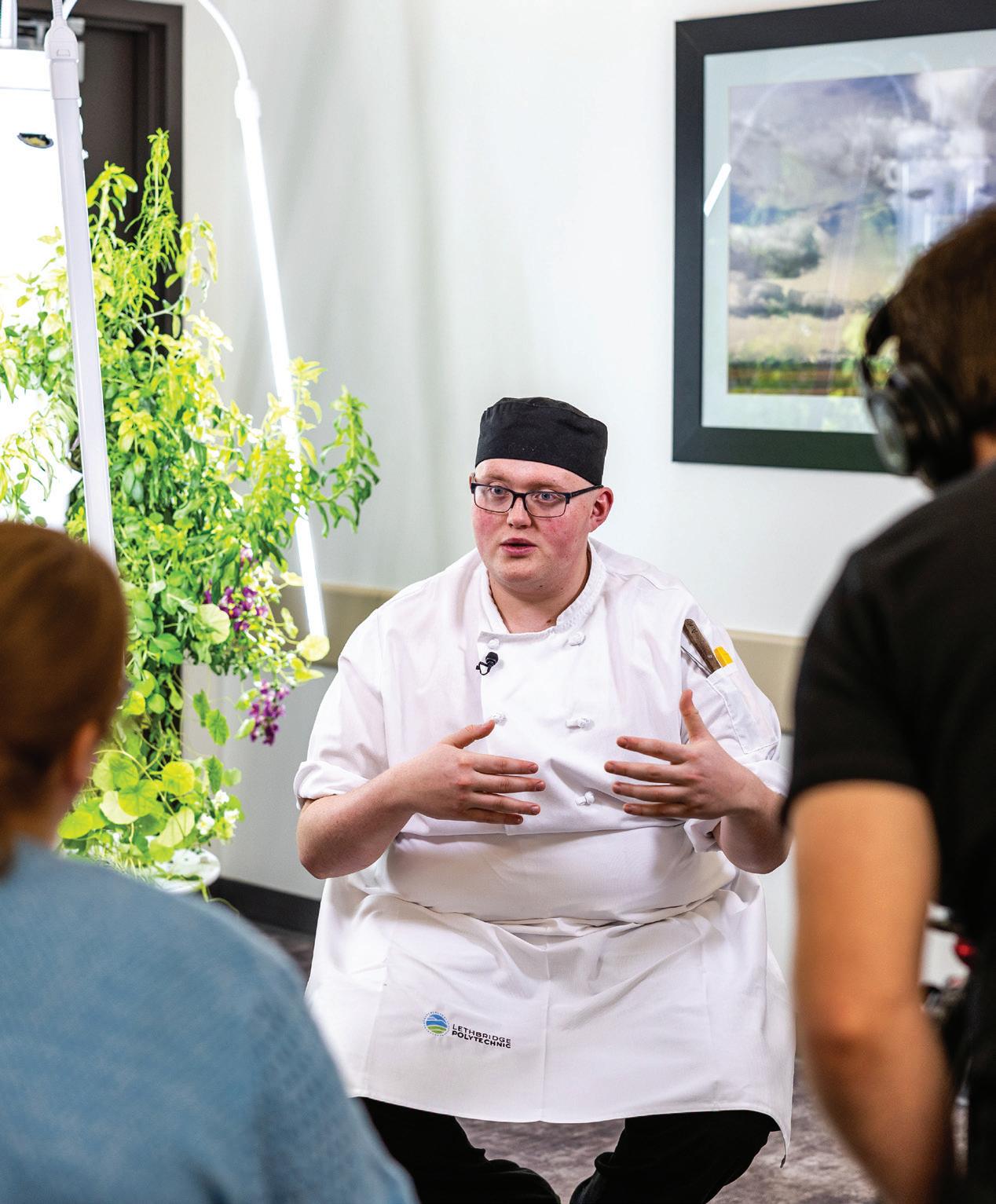
In a quiet corner of the Garden Court Dining Room at Lethbridge Polytechnic, long after the lunch rush has ended, sits second-year Culinary Arts student Alex Masson. A wireless mic peeks from the front of his chef whites, and bright lights frame the shot as he fixes his gaze at the interviewer just off camera. While he’s far from his comfort zone – the rhythm of the kitchen – Masson has agreed to be quizzed on his program, his future goals and how the polytechnic is providing him invaluable connections to the local food industry.
It’s all part of a video project facilitated by Alberta on the Plate and the Alberta Hospitality Association to spotlight the vibrant food systems that shape the province’s culinary landscape. The first episode in the short-form series Alberta’s Food Story: From Soil to Service premiered in February for Canada’s Agriculture Day. Each video aims to reconnect
viewers with the origins of their food, celebrate the people behind it and inspire conscious choices that support local economies and ecosystems.
“Lethbridge Polytechnic is deeply woven into southern Alberta’s food community,” says Rheannon Green, director of Finer Details at Food Tourism Strategies. “The Culinary program doesn’t just teach skills – it connects students directly with local producers and restaurants, grounding them in the relationships that will shape their careers and strengthen the region’s food system. Many alumni have gone on to open restaurants and build their careers locally, continuing to mentor students and contribute to a vibrant, resilient food community in southern Alberta. These connections made Lethbridge Polytechnic’s story one that absolutely needed to be shared.”
Story by Tina Karst | Photos by Spencer Nelson and Rob Olson


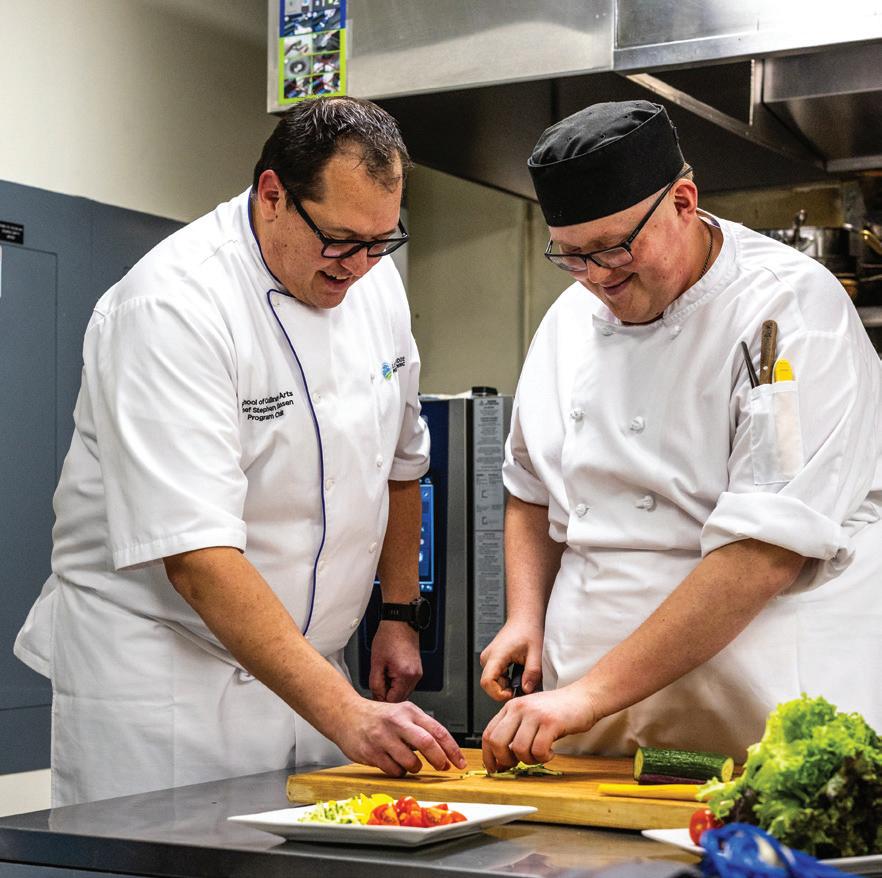
Culinary Arts student Alex Masson (right) speaks to Rheannon Green of Food Tourism Strategies for a shortform film series facilitated by Alberta on the Plate and the Alberta Hospitality Association. Opposite: Masson and Chef Stephen Klassen in the polytechnic’s Garden Court Dining Room prior to filming interviews.
The institution’s video, “Learning in the Landscape: Growing Community at Lethbridge Polytechnic,” was released on March 10 and highlights the experiences of three individuals: Masson; Chef Stephen Klassen (Culinary Careers 2001, Professional Cooking 2000), chair of the polytechnic’s School of Culinary Arts; and Chef Kristy Olsen (Baker Apprenticeship 2023, Cook Apprenticeship 2015, Culinary Careers 2013), owner of Eden Restaurant in Raymond, Alta.
In their interviews, they all describe the connectedness of the food community and how the polytechnic’s hands-on learning, industry partnerships and real-world collaborations have molded them into the chefs they are and the chefs they aspire to be.
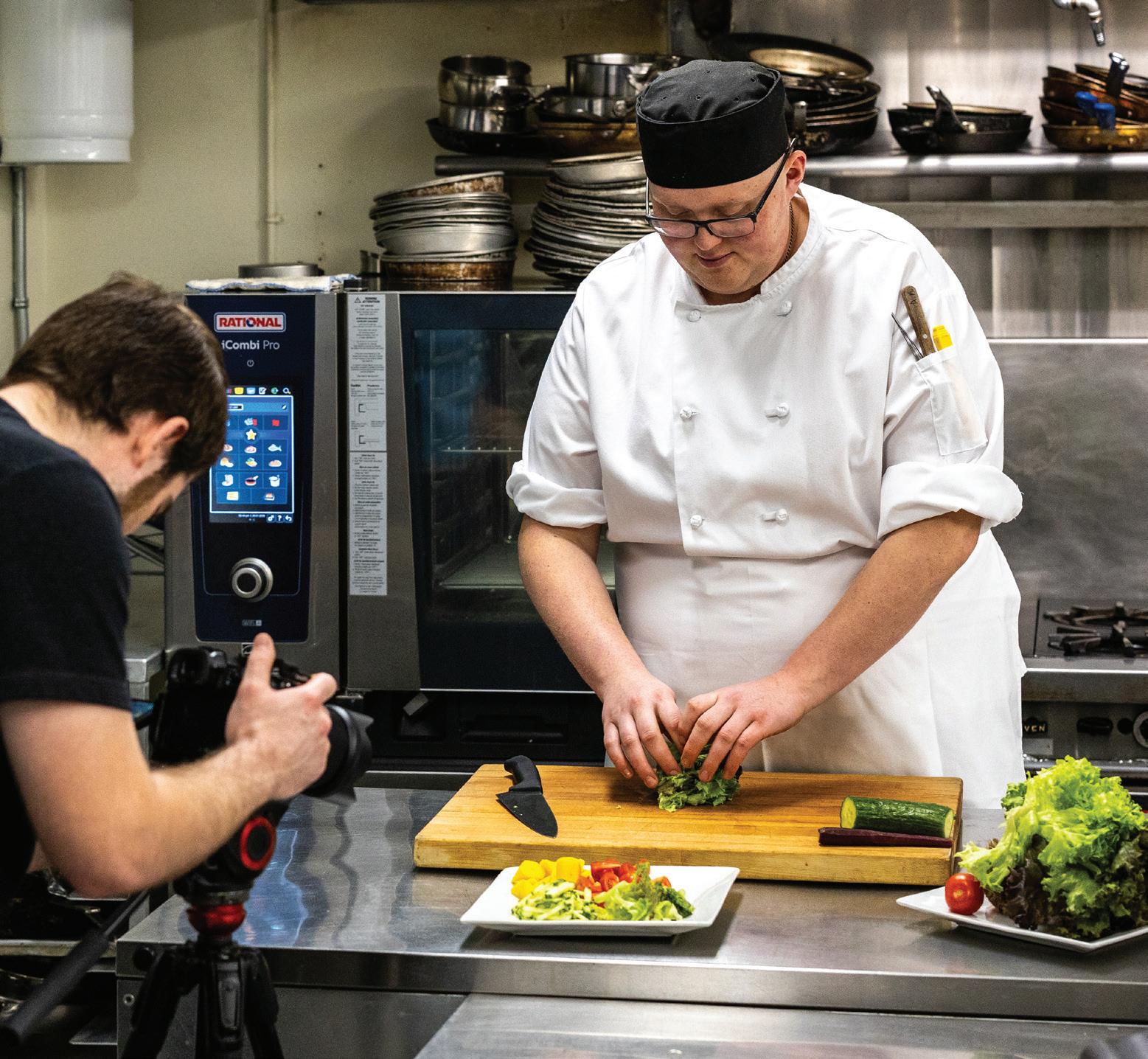
From mastering meat cutting and sweet and savoury techniques to serving hundreds in the Food Court, Culinary Arts students at Lethbridge Polytechnic experience every side of the industry. In the Garden Court Dining Room, they craft fine dining meals, and across campus, they help cater a variety of events – from small lunches to 500-person banquets –gaining hands-on experience at every turn. And it all happens in the heart of Alberta’s food community.
“We have a strong tie with our local producers here in Canada’s Premier Food Corridor, especially in our dining room,” says Klassen. “We like to use local producers so the students can see where the food comes from. Sometimes, we do field trips so they can actually meet the producers and see how they harvest, or how they grade their crop and then they bring it back and serve it in the dining room.”
That community connection takes centre stage each April, when the polytechnic hosts – in partnership with Economic Development Lethbridge and Canada’s Premier Food Corridor – the Local Producers Dinner Gala. The event features a trade show with regional agricultural producers followed by a curated, elevated multi-course buffet dinner prepared by Culinary students that highlights local ingredients. The gala showcases the region’s agricultural talent and provides an invaluable opportunity for students to prepare and execute a menu for the occasion.
“I think a lot of people don’t realize where food comes from, that it just magically shows up at the grocery store and they don’t realize it comes from southern Alberta,” Klassen says.
“I’M LEARNING HOW TO BECOME A BETTER CHEF FROM PEOPLE WHO HAVE LEARNED MORE … AND THEY’RE SETTING THIS INCREDIBLE EXAMPLE FOR HOW WE CAN WORK LOCALLY AND HOW WE CAN SUPPORT LOCALLY.”
Alex Masson
“There’s so much in southern Alberta – from south of Calgary to the B.C. and Saskatchewan borders – all that food comes from our little area here, so showcasing that and educating people on what’s here is huge.”
And students don’t have to look far to apply the farm-totable philosophy in their day-to-day learning. Some of their freshest local ingredients come directly from the campus greenhouse in the polytechnic’s Integrated Agriculture Technology Centre.
“It was kind of breathtaking,” Masson recalls of his first trip to the greenhouse, just a short walk south of the Trades, Technologies and Innovation Facility. “There’s so much there – you would think it’s just a local little greenhouse, and then you see rows of bins filled with peppers, cucumbers, zucchinis and eggplants.”

FEAST OF EDEN
When Chef Kristy Olsen appeared on the cover of Wider Horizons in spring 2023, we detailed her journey through Lethbridge Polytechnic’s kitchens, her deep family roots in the culinary industry and the leap she took to open Eden Restaurant at the beginning of a global pandemic.
To read more about her path from student to restauranteur – and the experiences that still influence her work today – revisit “Yes, Chef” at lethpolytech.ca/wider-horizons/spring-2023/yes-chef.
Chef Kristy Olsen (above) participated in the film project as a polytechnic alumni and local restaurateur. Opposite: Masson and Klassen work in the Garden Court kitchen. All three credit the program’s commitment to hands-on learning, industry partnerships and real-world collaborations for helping graduates succeed in industry.
Researchers grow vertical rows of produce for their own data-gathering purposes and then donate the bounty to Culinary students, the Lethbridge Polytechnic Students’ Association Food Bank and any employees interested in taking some of it home. It’s a small but tangible example of the community food can create – at any scale.
These lessons around building community and local sourcing have stayed with Olsen long after graduation. She carried them into kitchens all over Canada and abroad, and eventually back home to Raymond at her 124-year-old manorturned-restaurant.
Eden Restaurant offers a private, five-course dining experience tailored to small groups of six to 18 guests and thoughtfully crafted menus that feature luxury ingredients and seasonal, local produce.
“I grew up on a farm around here,” Olsen shares. “Now, [with my restaurant], I get to highlight a lot of ingredients and farmers and ranchers that I grew up around.”
Another perk of being back home, and close to her alma mater, Olsen says, is getting to engage regularly with Culinary students. She has a full-time sous chef, Sue Cahoon (Cook Apprenticeship 2025), who is also a second-year Baker Apprentice, while other students visit the restaurant on various days to interact and learn.
Olsen is also president of the Culinary Federation –Lethbridge branch. Several polytechnic instructors,

including Klassen and Chef Amara Goodsell (see “From Our Kitchens” on p. 34), are board members as well.
“I can’t imagine not having a relationship with everybody in there,” Olsen says. “It’s a very comforting thing to just walk up to chefs and see what’s going on. They’ll tell you about the students … they’re so proud of what they’re learning and how they’re growing and evolving, and they can’t wait to share stories and let you know who to watch out for.”
That emphasis on personal connections between students, instructors and industry reflects the close-knit southern Alberta food community of which they are all a part.
“We build personal relationships with all of our students while they’re here, getting to know who they are,” says Klassen. “We work with them one-on-one every day, and then when they’re done and when they’re graduated and successful, we still hold that relationship with them as colleagues and peers.”
And that effort isn’t lost on students.
“You learn how [our instructors] want to change the industry,” says Masson. “I’m learning how to become a better chef from people who have learned more … and they’re setting this incredible example for how we can work locally and how we can support locally.”
Watch “Learning in the Landscape: Growing Community at Lethbridge Polytechnic” by visiting AlbertaOnThePlate.com.
CULTURE AND COMMUNITY GUIDE FIVE
AIKOWANIA


STUDENT-ATHLETES AS THEY GROW THROUGH THE GAME
AIKOWANIA


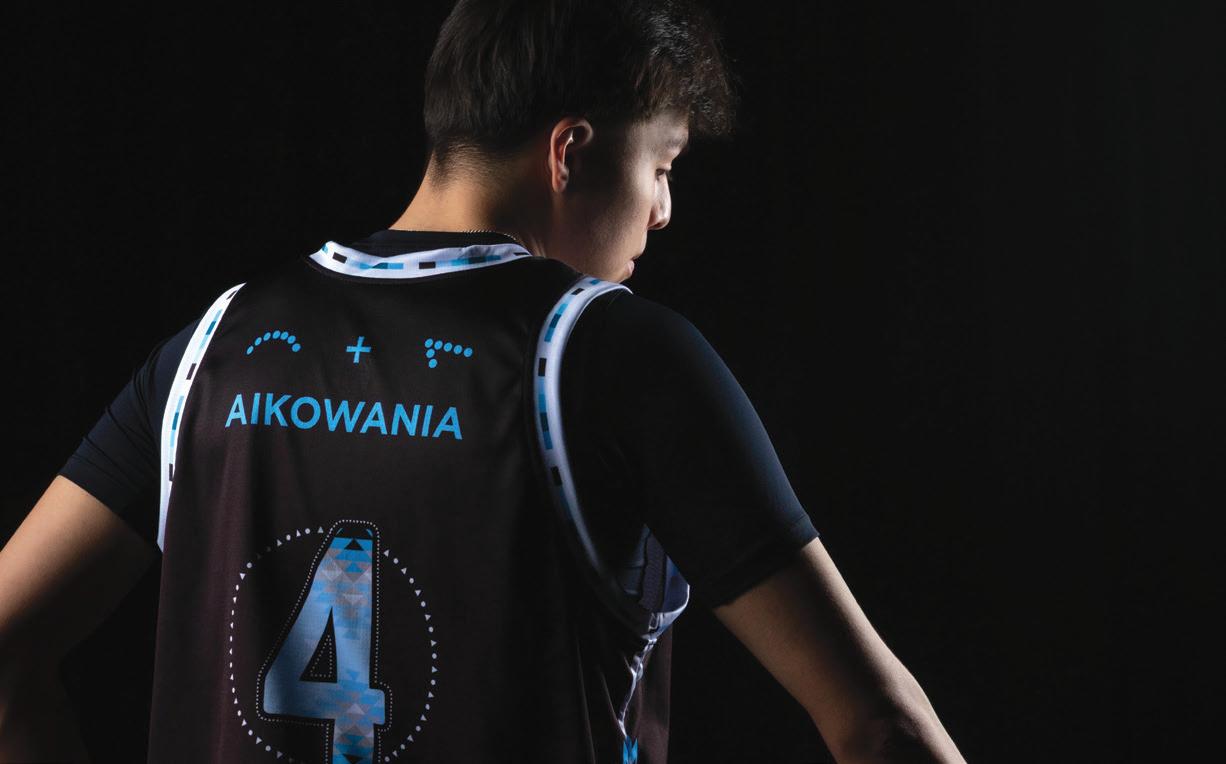
he sights and sounds of a Kodiaks basketball game are unmistakable: the sharp echo of a ball snapping against hardwood, shoes squeaking as players pivot, a whistle slicing through the air, jerseys flashing across the floor. On the home court, the Blackfoot word Aikowania –the essence of readiness – is painted in bold letters.
From the stands, these are ordinary rhythms of the game. But for five Indigenous student-athletes, each bounce, pass and whistle – and the words beneath their feet – carry a deeper meaning: a reminder of family, community and the personal growth fostered by being part of the Kodiaks program.
The path to Lethbridge Polytechnic looks different for each of them. Zachary Many Grey Horses (English) was born and raised in Lethbridge but honed his skills playing spring club basketball on the Blood Reserve. Others, like Cash Red Crow and Memphis Gambler-Yellowknee, transferred schools in their teenage years to face tougher competition – riding buses to larger towns or moving between cities.
Mylynn Lewis speaks openly about joining the Kodiaks to start fresh and build a healthier life. Chase Wells-Creighton took time off to have her daughter after COVID-19 disrupted her 2020-21 season. She now balances motherhood with practices, games and coursework.
(Clockwise from top) Chase Wells-Creighton, Memphis Gambler-Yellowknee, Mylynn Lewis, Cash Red Crow and Zachary Many Grey Horses.
Story by Tina Karst and Randy Jensen | Photos by Rob Olson and Lexi Barclay
For these student-athletes, stepping onto the court in a Kodiaks jersey is about more than wins and losses. It reflects the decisions, sacrifices and determination that brought them to the polytechnic – and their readiness to keep moving forward.
FINDING THEIR PATH
For many Indigenous student-athletes, the road to postsecondary sport rarely follows a straight line. Opportunities can be limited in smaller communities, and pursuing higher levels of competition often means transferring schools.
“As a kid, I would go around with my dad to basketball tournaments, which sparked my interest,” says Lewis, who grew up on the Onion Lake Cree Nation in Saskatchewan. “I started playing in seventh grade, but it wasn’t my favourite sport, to be honest. I was more of a softball-badminton kid.”
In Grade 11, Lewis says she made a move not many players from the reserve make; she transferred to Lloydminster Comprehensive High School just across the border in Alberta.
“I remember my dad telling me when he was younger he was asked to do the same thing, but he wasn’t given the right opportunities,” she says. “My dad probably could have played college, too, but he didn’t have the right support, so I decided to take what was given to me.”
Red Crow faced a similar decision during his high school years. A member of the Kainai First Nation in southern Alberta, he started at Saipoyi Elementary School in Standoff on the Blood Reserve and later attended middle school in Cardston. He spent a couple of years at Kainai High School before transferring again, this time to Magrath.
“There’s not a lot of players who leave the reserve to play high school basketball,” Red Crow says. “It was a little complicated for me because I had to travel on the bus for half an hour and then I wasn’t able to play for Magrath until I moved there.”
Gambler-Yellowknee’s journey also involved several moves. He spent his early years on the Bigstone Cree Nation in northern Alberta before his family relocated to Grande Prairie and later to Leduc, where basketball became a larger focus.
After graduating high school, he played a year of prep basketball in Calgary with United Prep Canada but didn’t receive any interest from post-secondary schools.
“My buddy who I played club basketball with, Hayden Many Grey Horses, played with the Kodiaks last year and he got me in contact with (head coach) Ryan Heggie,” he says. “He wanted me, but I decided to play another year of prep at Western Canada Prep Academy in Edmonton.”
That lasted for half a season, then he decided to take up welding. “I was trying to decide whether or not I wanted to play college [basketball] or pursue my welding,” Gambler-Yellowknee explains, though he ultimately chose to become a Kodiak.

CARRYING COMMUNITY
The distance from home varies between the five athletes, but all say family and community remain close to their heart.
“My culture and family help keep me emotionally regulated on the court,” Lewis says. “I’m not a person who talks a lot to the other team and there are players who do that, so my culture keeps me grounded because I’m representing them.”
Many Grey Horses and Red Crow say they feel that responsibility as well.
“The Blackfoot culture is a big part of me, even though I was born and raised in Lethbridge,” says Many Grey Horses.

“BEING BLACKFOOT HAS HELPED ME A LOT BECAUSE THERE’S NOT A LOT OF HOOPERS WHO GET TO PLAY POST-SECONDARY, SO IT MAKES YOU WANT TO WORK HARDER AND KEEP ON PLAYING AS LONG AS YOU CAN.”
Zachary Many Grey
Horses
“PLAYING FOR THE KODIAKS HAS BEEN MORE THAN I THOUGHT IT WOULD BE. I DIDN’T KNOW WHAT TO EXPECT AND I’VE NOTICED MY CONFIDENCE GOING UP AND I’VE NEVER FELT SO SECURE ABOUT MYSELF.”
Mylynn Lewis

“Being Blackfoot has helped me a lot because there’s not a lot of hoopers who get to play post-secondary, so it makes you want to work harder and keep on playing as long as you can.”
“My culture has been pretty big in the sport and where I come from,” adds Red Crow. “There’s always fans at the games, always showing love.”
Community support is also a constant for Wells-Creighton thanks to the polytechnic’s proximity to the Blood Reserve. She says her relatives attend nearly every home game.
“When I see them, they’ll tell me they’re proud of me, that it’s really good that I’m in school and playing basketball and they want their daughters to do the same thing.”
As a student-athlete and mother, she also leans on the support of her Kodiaks family.
“[My teammates and coaches] understand there might be times I miss practice because of my daughter maybe having a birthday or a doctor’s appointment,” she says. “They’ve never treated me differently. Right away I took her to practice, and everyone loved her; everyone is her auntie, basically.”
GROWING THROUGH THE GAME
While basketball provides competition and opportunity, the transition to post-secondary life has also brought personal growth.
For Lewis, enrolling at Lethbridge Polytechnic marked a turning point in how she manages her mental and physical well-being.
“Since coming here I’ve changed my lifestyle,” she says. “I’m working toward sobriety, and before it was hard for me to do that. I would use alcohol to cope with things because I didn’t have it too easy growing up, especially on the reserve.”
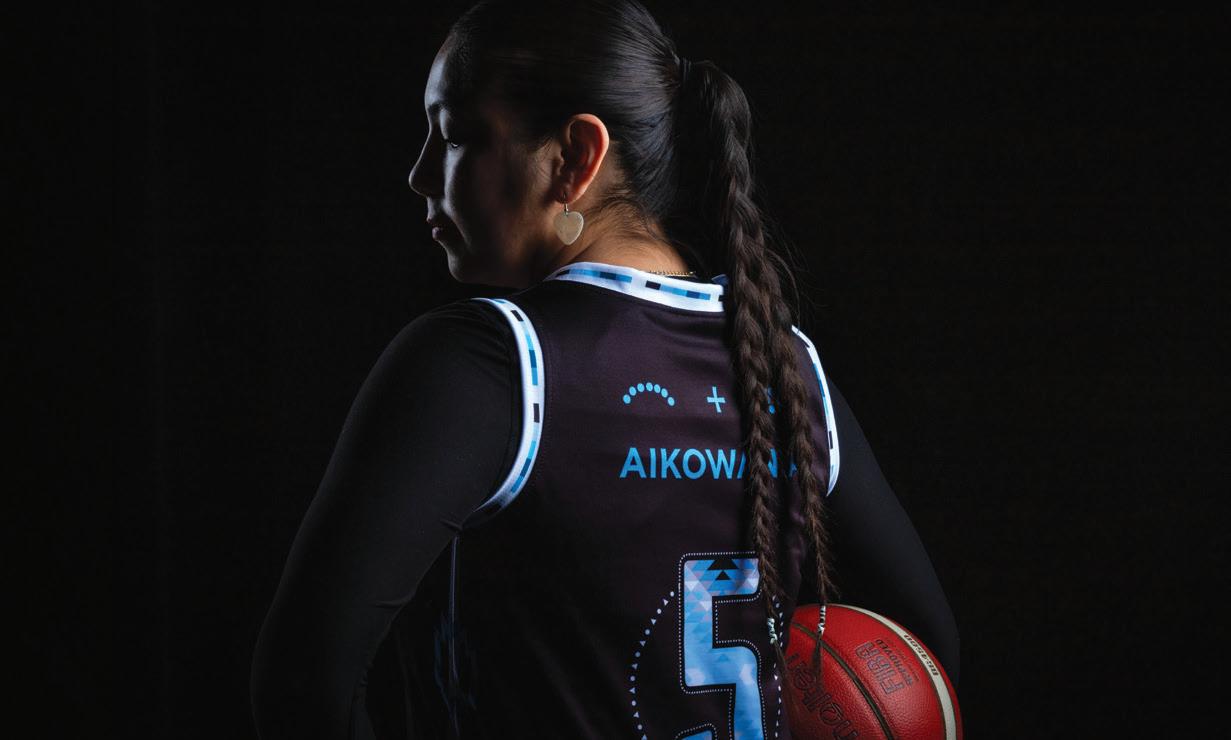
She says staying busy with school and basketball and accessing new supports has helped her move forward.
“Playing for the Kodiaks has been more than I thought it would be,” she says. “I didn’t know what to expect and I’ve noticed my confidence going up and I’ve never felt so secure about myself. Coming here has definitely helped me a lot.”
Many Grey Horses experienced a different kind of adjustment when he first arrived in the Kodiaks program. After trying out and redshirting his first year, he says he needed time to find his place.
“Last year was kind of rough,” he says. “It took me a while to get close to the guys, but this year is way better. Other players have made me realize I fit in.”
And now that he’s got more playing time in, he says he understands the high expectations.
“Playing post-secondary is definitely more competitive,” he says. “You’ve just got to work way harder than you did before.”
LOOKING AHEAD
For each of these student-athletes, basketball is only one part of a much larger journey.
Gambler-Yellowknee says he wants to see how far basketball can take him while keeping other career options open. WellsCreighton plans to move on to the University of Lethbridge to earn a degree in kinesiology. Red Crow is exploring business or social work, inspired by his mother’s career on the Blood Reserve. Many Grey Horses is considering the polytechnic’s Business Administration program while continuing to develop as a player. And Lewis is looking to return to the polytechnic next year before moving on to university in Lethbridge or Calgary.
“My goal is to earn a bachelor’s degree and hopefully a master’s degree in psychology,” she says. “That’s what I want for myself.”

KODIAKS AT A GLANCE
Five players. Five paths to Kodiaks basketball. No two stories are the same, but all are tied together by a shared commitment to school, sport and the people who continue to support them along the way. Here’s a closer look at the individuals behind the jerseys: where they come from, what they’re studying and what basketball means to them.


MYLYNN LEWIS
First year, General Arts and Science
Position: Centre
Height: 6’0”
Hometown: Onion Lake, Sask.
Nation: Onion Lake Cree Nation
“Basketball has always been an outlet –a place to go when I feel like I have no other way to express myself. I find that once I step onto a court, everything else seems to go away for a while, and everything feels lighter. Basketball has always been a place for me to learn and grow, and not just within the sport. As we say it in my language, Plains Cree, ninanāskomon (I am grateful).”

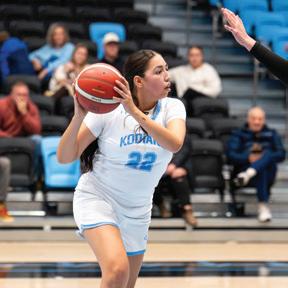

CHASE WELLS-CREIGHTON
Second year, Exercise Science
Position: Guard
Height: 5’10”
Hometown: Standoff, Alta.
Nation: Kainai First Nation
“Basketball, to me, means family. It’s being part of something bigger than yourself and being surrounded by people who treat you like family on and off the court. I’ve built lifelong friendships and learned lessons that I carry with me every day. My daughter inspires me the most to keep playing, because I want to show her that anything is possible as a Blackfoot woman … that she can achieve anything because ‘Mommy’ was able to do it.”

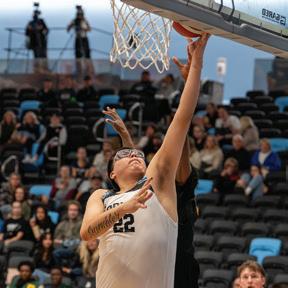
MEMPHIS GAMBLERYELLOWKNEE
First year, Open Studies
Position: Centre
Height: 6’6”
Hometown: Leduc, Alta.
Nation: Bigstone Cree Nation
“Basketball has given me opportunities and taken me places that I didn’t think were possible before. I’ve been able to travel across Canada to play basketball, and my mom always reminds me that I’ve done so much more than her at this age. The Indigenous youth who look up to me inspire me to keep going. I want to show them that their passions can take them far, if they dare to put in the work.”


ZACHARY MANY GREY HORSES
First year, General Arts and Science
Position: Guard
Height: 6’3”
Hometown: Lethbridge
Nation: Kainai First Nation

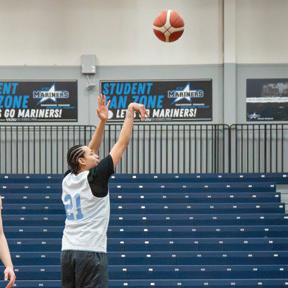

CASH RED CROW
“I feel like basketball has given me a purpose and something to look forward to. My two cousins, they’re like my brothers, and my actual brother –they inspire me to push it every day. My two cousins play, and my brother used to play. It makes me want to work harder because I feel like there aren’t a lot of Indigenous athletes out there.” 21 4 22
First year, General Arts and Science
Position: Point guard
Height: 5’10”
Hometown: Magrath, Alta.
Nation: Kainai First Nation
“Basketball means a lot to me. Growing up, I loved the sport. My whole family pretty much played basketball. My dad played, my uncles played, my grandpas played – it’s in the bloodline and I’ve kept it going. My family, and especially my mom –my biggest fan – support me in getting me where I need to be.”
BRINGING REAL-WORLD EXPERIENCE TO THE CLASSROOM
INSTRUCTORS IN INDUSTRY
Story by Stacey Andrews and Tina Karst |
THE MOST MEANINGFUL LESSONS OFTEN COME FROM EXPERIENCE –AND AT LETHBRIDGE POLYTECHNIC, INSTRUCTORS HAVE PLENTY TO SHARE.
From treating athletes in actionpacked pro rodeo arenas and picking up nursing shifts at recovery centres, to volunteering in Ugandan medical clinics, developing video games and
running their own businesses, these instructors give students a front-row view of the industries they’re preparing to enter. Whether it’s sharing a client story, discussing the latest industry advancements or filming an on-the-job plumbing tutorial, they draw on current, hands-on experience to better prepare students for success after graduation.
And the benefits of teaching are often reciprocal. While instructors bring real-world industry experience into the classroom, engaging with students helps them stay sharp and current. Massage Therapy instructor Taylor Quan says teaching has sharpened his clinical skills, while Scott Gillespie, a sessional
instructor in Agriculture Sciences, adds “teaching helps me keep up on the latest interests of the students and to know where the industry will be going as they move into the workforce.” Edward Motycka, Primary Care Paramedic instructor, agrees: “It helps me brush up on my knowledge and skills so I can always be the subject matter expert, regardless of if I’m at the polytechnic or at an emergency.”
In the following pages, you’ll meet eight more polytechnic instructors whose ongoing industry work is not only shaping the way they teach and mentor but also keeps them learning alongside the next generation of professionals.
“IT HELPS ME BRUSH UP ON MY KNOWLEDGE AND SKILLS SO I CAN ALWAYS BE THE SUBJECT MATTER EXPERT, REGARDLESS OF IF I’M AT THE POLYTECHNIC OR AT AN EMERGENCY.”
{ EDWARD MOTYCKA, PRIMARY CARE PARAMEDIC INSTRUCTOR }
Photos by Spencer Nelson and submitted
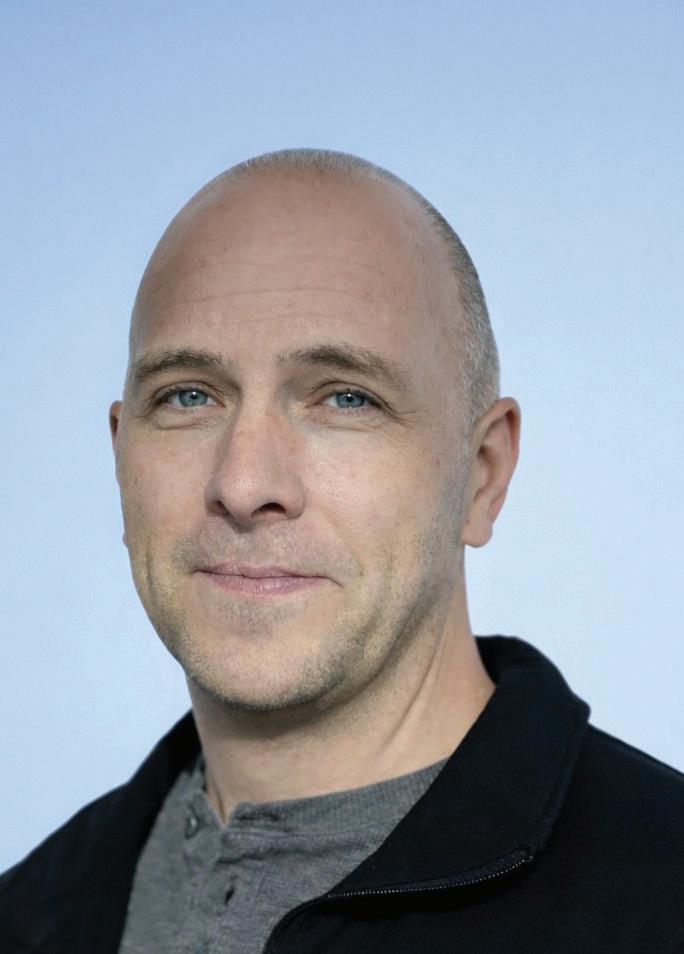

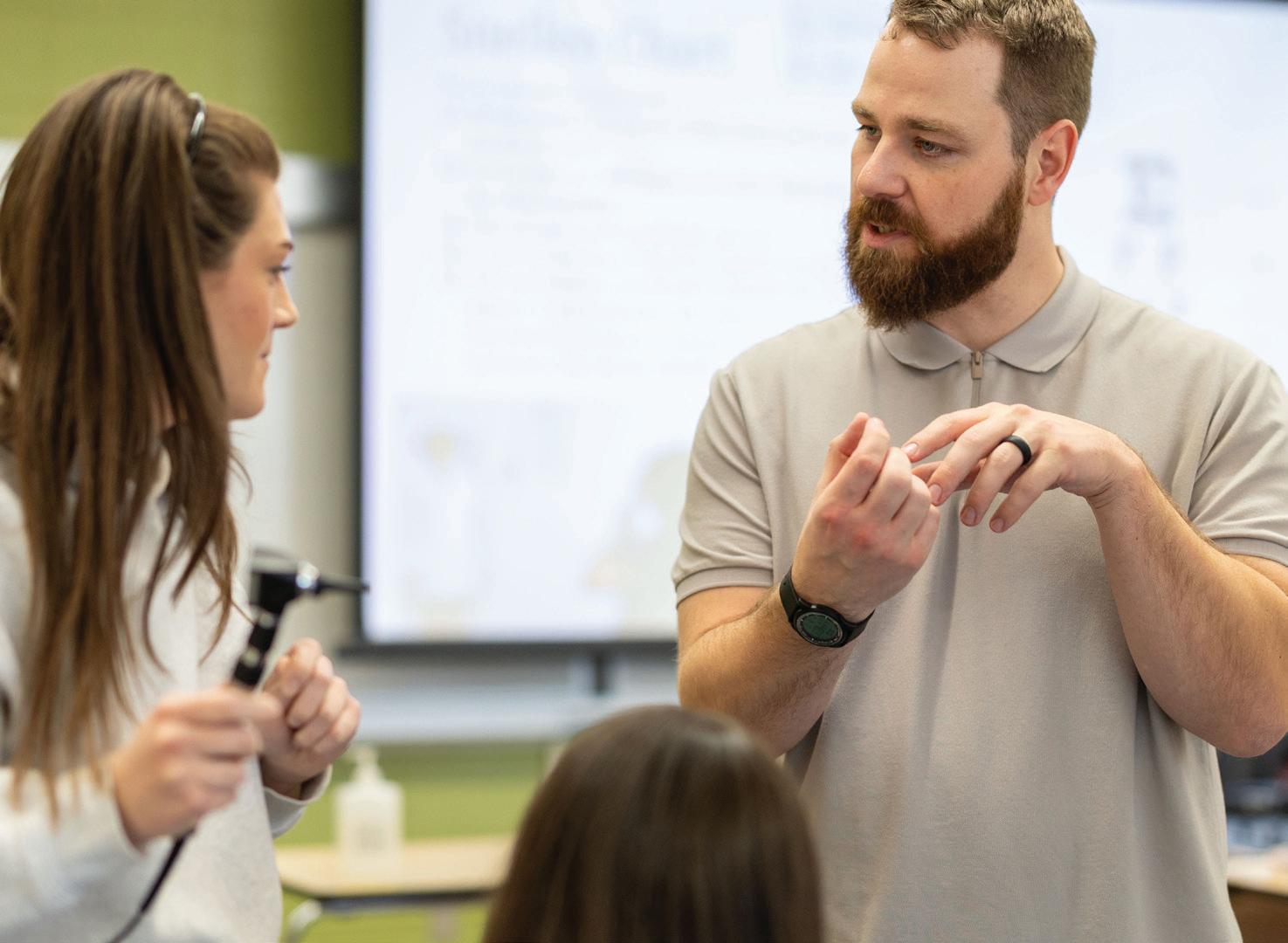
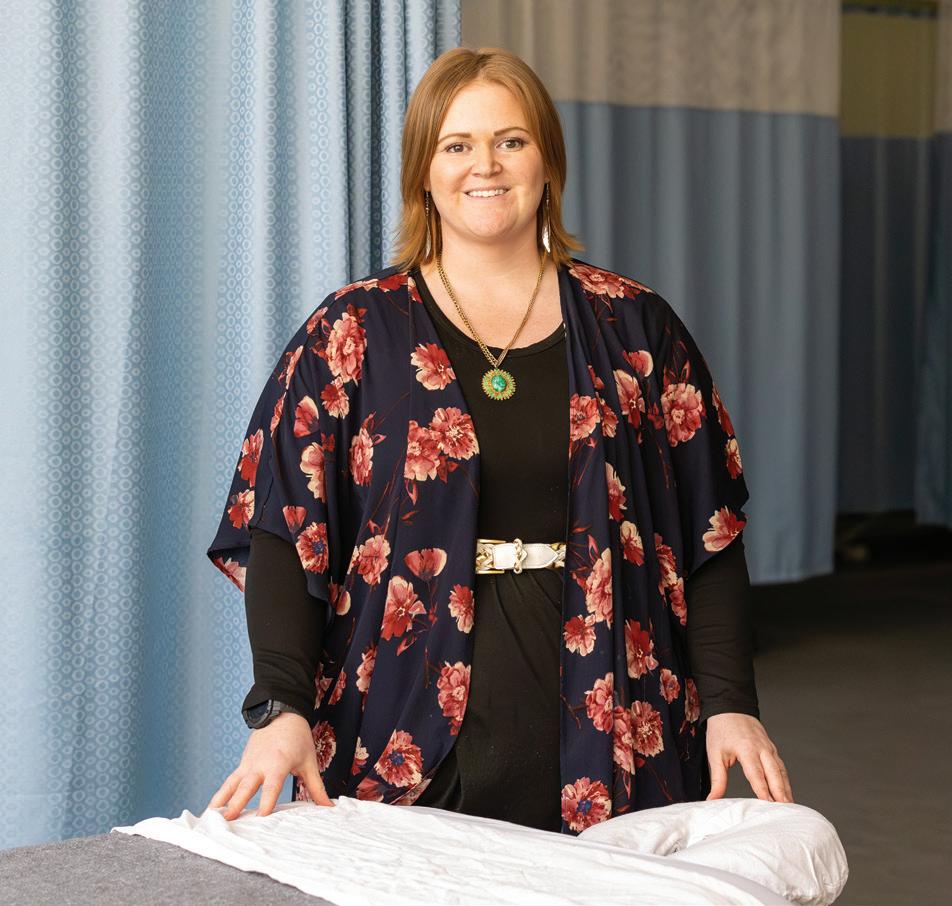
EXPLORE MORE profiles highlighting instructors’ real-word experience and how it shapes teaching at Lethbridge Polytechnic by visiting lethpolytech.ca/widerhorizons.
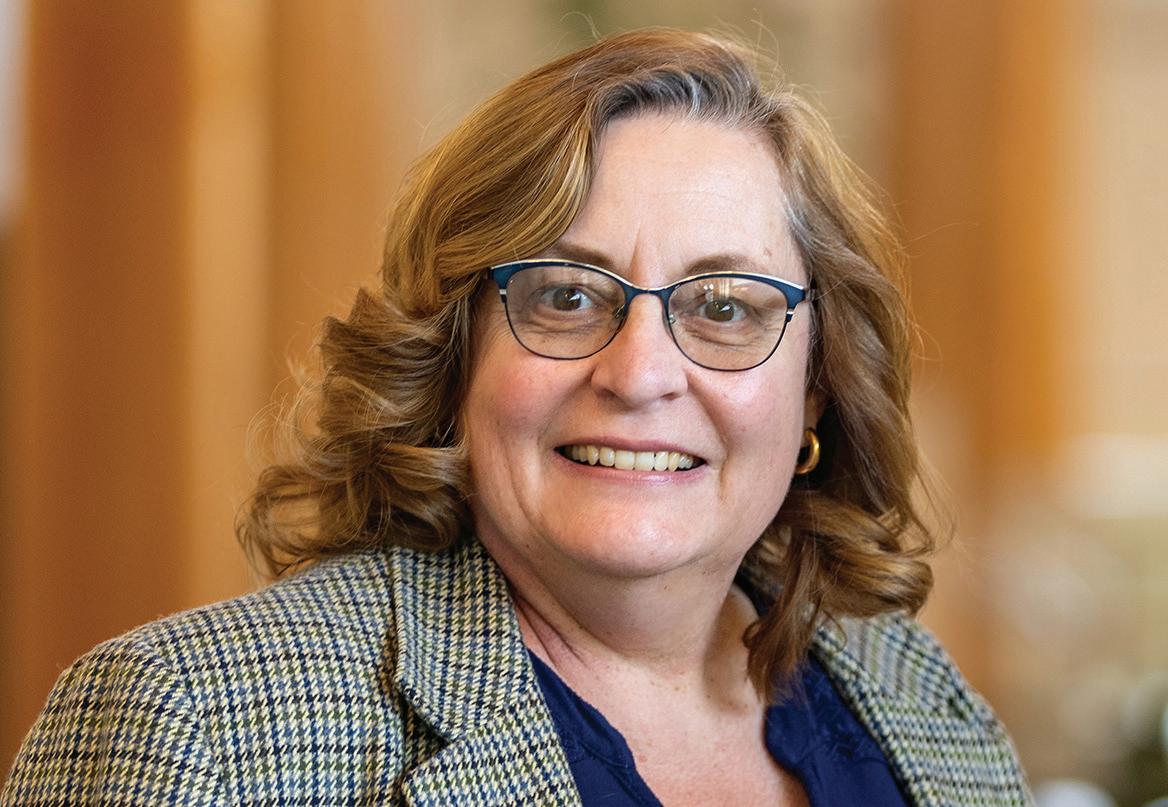
COLE GILMER
INSTRUCTOR, BACHELOR OF NURSING
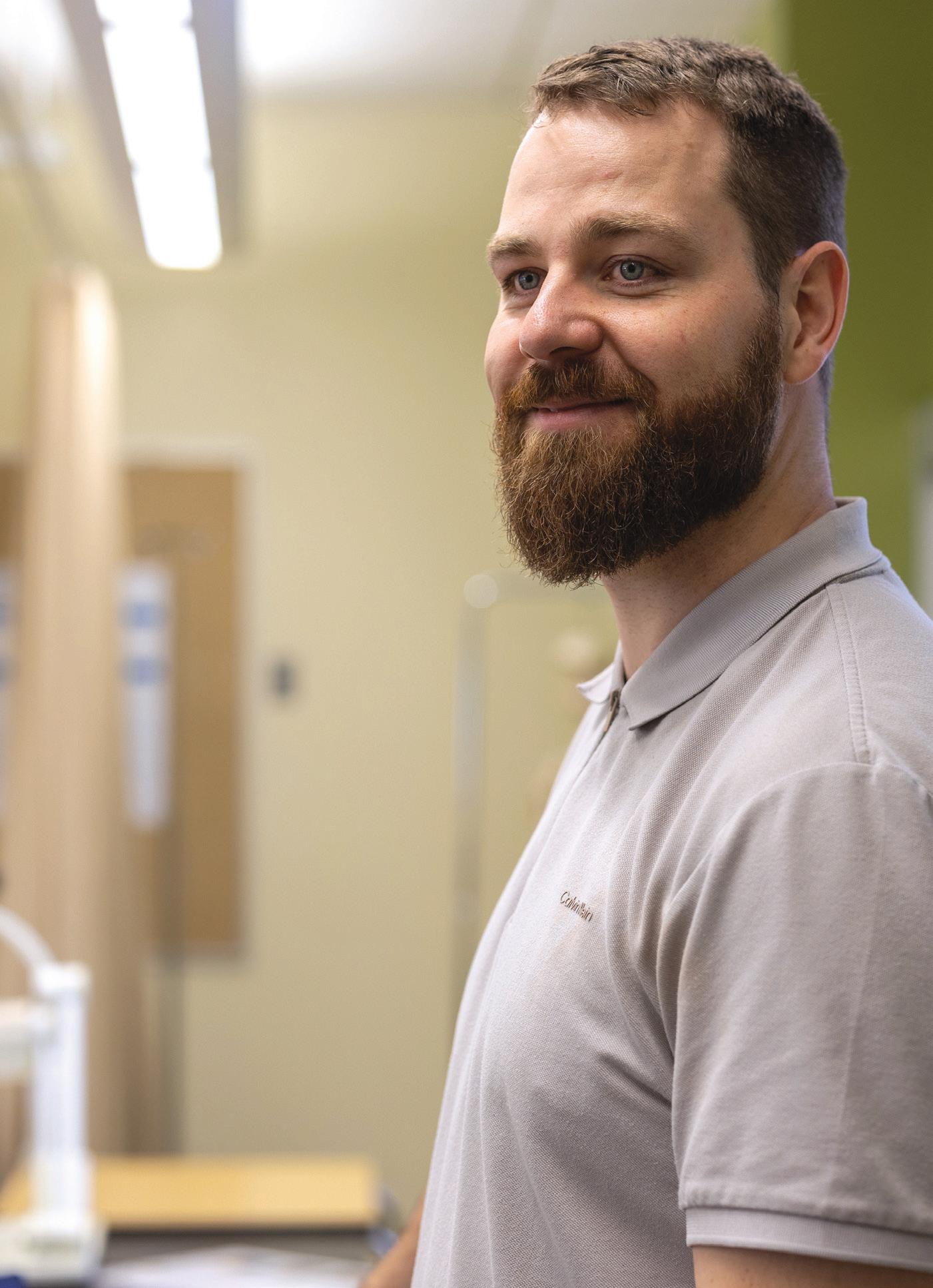
DID YOU KNOW?
From Practical Nurse to Primary Care Paramedic, the polytechnic has a number of pathways for anyone looking to make a difference with a career in health care. lethpolytech.ca/health
FOR COLE GILMER (BACHELOR OF NURSING 2015), NURSING AND TEACHING ARE DEEPLY CONNECTED.
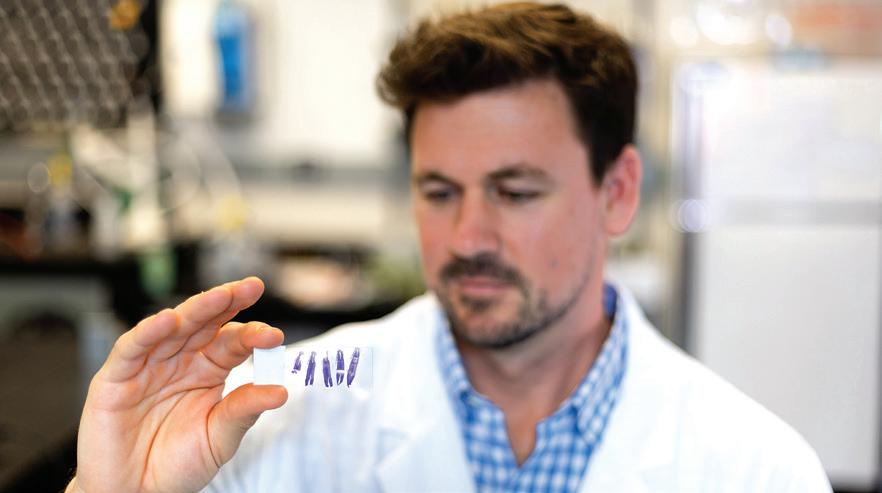
While ongoing clinical work preserves the hands-on skills and human connections that first drew him to a career in health care, it also keeps his instruction grounded in the real-life patients and decisions his students will soon encounter. From supporting individuals in recovery to expanding students’ perspectives through global health experiences, Gilmer brings current practice directly into the classroom.
What drew you to teaching, and how did your professional (or educational) background shape that decision?
I have enjoyed teaching and working with patients in my different capacities as a nurse. Working in the hospital setting, I have viewed education as a way to empower patients in their health and conditions, so they are able to achieve their best outcomes. But it was getting the experience of working with nursing students on my unit that really showed me how much I enjoyed the opportunity to teach nurses.
“I WANT TO BE ABLE TO TELL STUDENTS ABOUT THE ASSESSMENTS AND ACTIONS I DO AS A NURSE CURRENTLY AND NOT ONCE UPON A TIME.”
{ COLE GILMER }
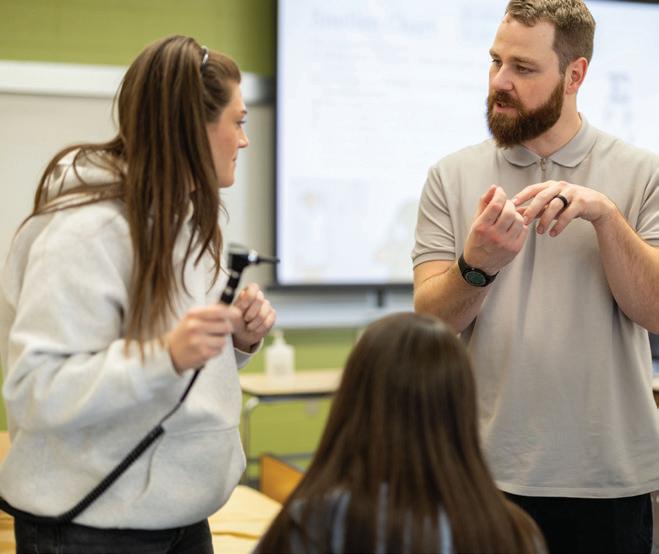
Describe the work you do outside of the classroom and how it complements what you teach at the polytechnic.
I work as a casual registered nurse, picking up [shifts] when my schedule allows at the Lethbridge Recovery Centre. Working in detox helps me to keep up to date and current in my nursing skills and assessments. At this current stage, I want to be able to tell students about the assessments and actions I do as a nurse currently and not once upon a time.
I have also been involved with, and am taking nurses this year to work with, a clinic in southeastern Uganda called Amuka Twende which is part of Bridges of Hope (here in Lethbridge). That work has helped me keep my perspective broad and recognize my role as a global citizen, while encouraging students to utilize their nursing skills in various settings beyond the traditional options.
Can you share a moment when your professional work directly benefited your students –or vice versa?
My professional work helps to give clear examples that I can use to illustrate course concepts for students, so they understand better. And working with students has helped me understand how to better communicate with my patients so that I can help them understand and partner in their health goals.
Is there anything about your career path or professional work that might surprise students?
Multiple jobs in my professional history came about from me reaching out to people to express my interest and growing in that direction. One of those [opportunities] was teaching. I [showed interest] in teaching clinical. That decision eventually got my foot in the door here at the polytechnic and working in the area I am now.
What’s the greatest lesson you’ve learned that you would share with students?
That your career path may not necessarily move how you initially intended, but always growing and taking advantage of the opportunities provided [to you] can create directions you didn’t know were possible.
ROSEMARY SHANNON
INSTRUCTOR AND PROGRAM CHAIR, MASSAGE THERAPY
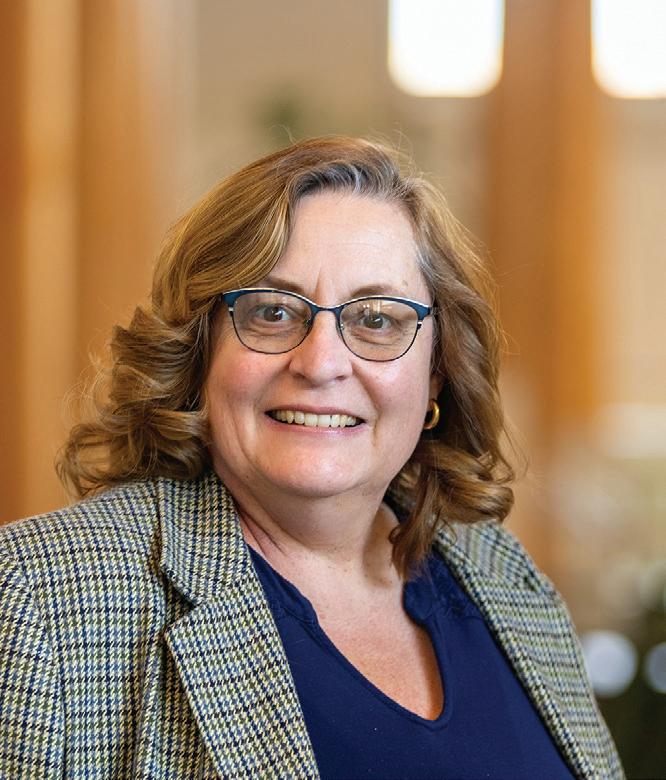
Rosemary Shannon says she can still remember an advertisement in the Lethbridge Herald looking for instructors in the polytechnic’s new Massage Therapy program. At the time, she had only been working as a massage therapist for two years, but she says she applied for a position “because I wanted students to have a better entry into the professional world than my training had provided me.”
Shannon says her massage training was excellent on a technical level, “but it really lacked in how to develop and maintain relationships with clients.”
She has always maintained a massage practice outside of the classroom and just last fall she opened a wellness spa, offering massage therapy and esthetics services.
“I try to incorporate my realworld experiences into my teaching,” she says. “I utilize storytelling in how I approach my lectures – I embellish what I have encountered in the field and align it with the course outcomes.”
And Shannon says both worlds – teaching at the polytechnic and remaining active in the industry –benefit each other.
“Truly, for me, one does not exist without the other,” she says.
AMY-LYNN REED
STUDENT MASSAGE CLINIC CO-ORDINATOR
AMY-LYNN REED
BRINGS A UNIQUE
PERSPECTIVE TO TEACHING – ONE SHAPED AS MUCH BY RODEO ARENAS AS BY CLINICAL SPACES.
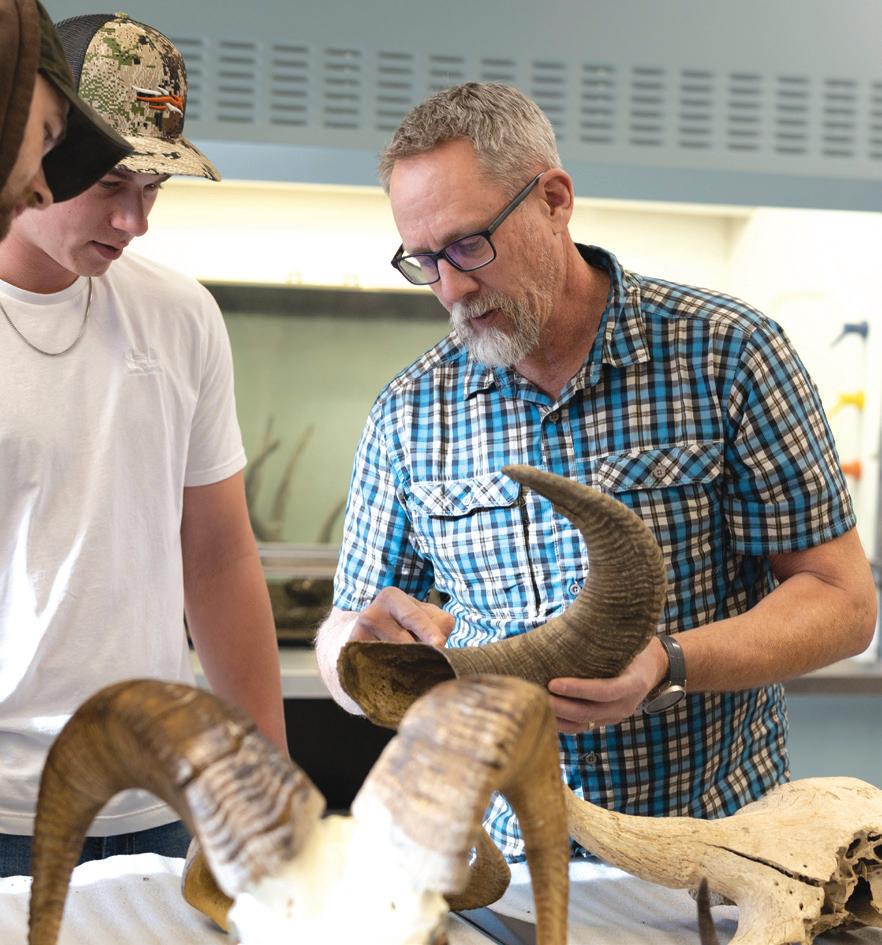
Through her work with the Canadian Pro Rodeo Sport Medicine Team, she supports athletes in fast-moving, unpredictable environments – realworld experiences that benefit students in the polytechnic’s Massage Therapy Clinic. Combined with years of instructing scuba divers and mentoring learners of all ages, Reed says her curiosity, adaptability and a commitment to learning from every person and situation continue to shape her work on campus and off.
What drew you to teaching, and how did your professional (or educational) background shape that decision?
I have always been someone who loved to teach and mentor students. From 2005 to 2015, I taught whitewater kayaking all over Alberta and since 2007, I have been a scuba diving instructor who has been blessed to live in many places in the world. There is nothing more rewarding than a light bulb moment for a student.

Describe the work you do outside of the classroom and how it complements what you teach at the polytechnic. Teaching scuba allows me to work with all ages and learning styles. I also work with the Canadian Pro Rodeo Sport Medicine Team and travel with the team to rodeos and professional bull ridings. What a wild world to work with pro athletes – keeping them going with all the injuries they have sustained. I work on cowboys pre- and post-ride. If they get injured in the arena, we all have Sports First Responder [certification] and we go in and make sure the cowboy gets out safely and help [determine] whether a hospital visit is necessary or not.
How does that work influence what or how you teach students day to day?
I have a very unique perspective that I bring to the table. I work with chiropractors, athletic therapists and sport medicine doctors which really allows me to see all different sides of the treatment that these athletes get and I
also get direct feedback on injuries, and we can really pinpoint recovery.
What motivates you to stay professionally active alongside teaching?
I am passionate and curious; this allows me to ask questions, learn new techniques and be humble enough to learn something from anyone.
Can you share a moment when your professional work directly benefited your students –or vice versa?
Professional bull riding comes to Lethbridge each year and I bring a different student each year to shadow and see the unique working environment.
Is there anything about your career path or professional work that might surprise students?
There are times when my working conditions are not always inside – a lot of bull ridings are outdoors and we have to set up in a barley field and work wherever the events take us. I have worked in hailstorms, torrential downpours, sweltering heat and freezing cold.
What’s the greatest lesson you’ve learned that you would share with students?
Everyone you meet has a different story and the best way to connect is to be curious.

JEREMY BRIDGE
INSTRUCTOR, PLUMBER APPRENTICESHIP
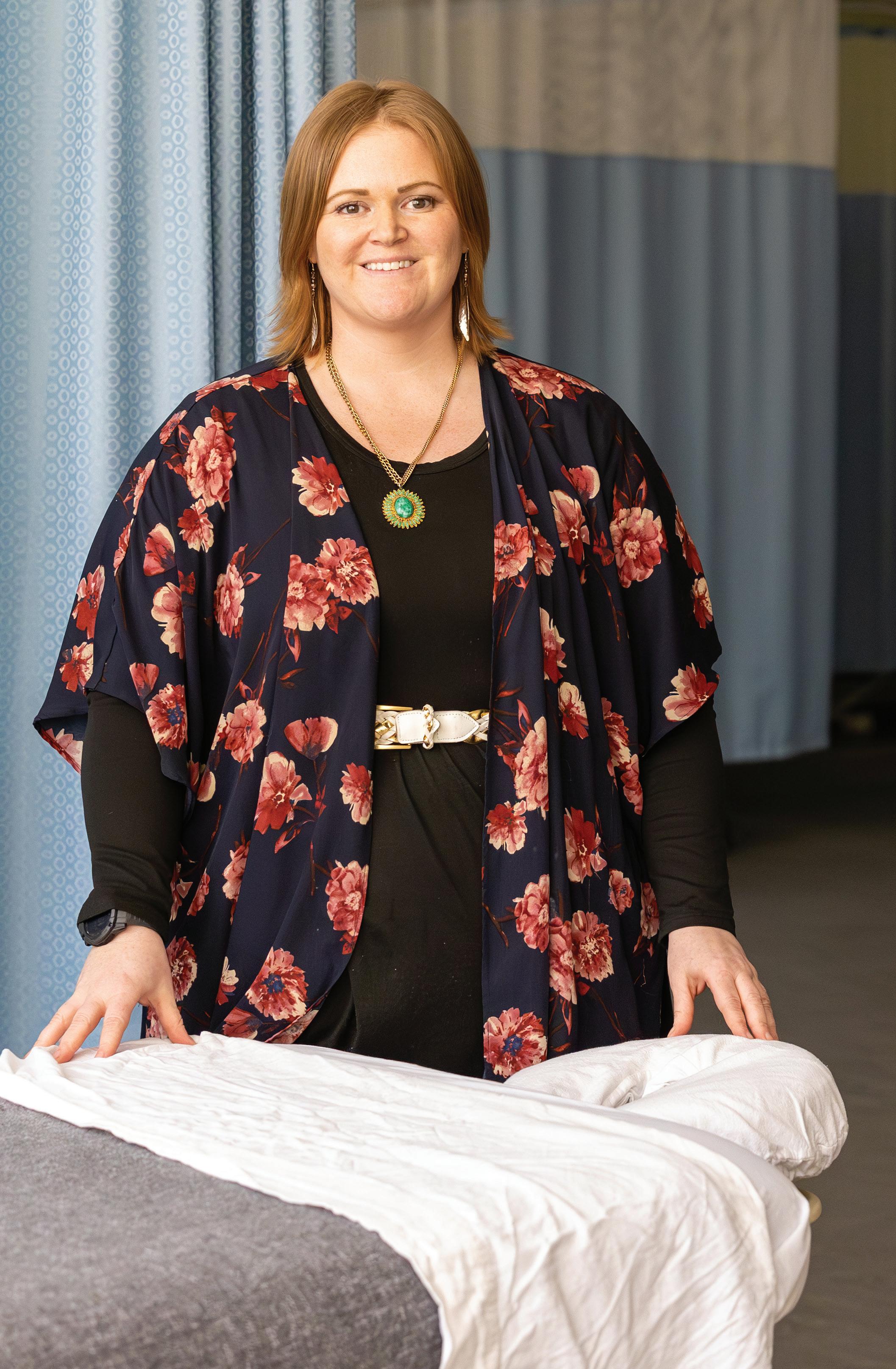
Jeremy Bridge has always enjoyed teaching and helping people become better at what they do, both on the job and in the classroom.
He didn’t start working in the trade until he was 25 years old. By 30, he had established his own plumbing company, which he still owns and operates today.
On the job site, Bridge is always learning, whether it’s new methods, tools or technologies.
“Students appreciate when I can discuss these topics with them and integrate real-life experiences into the classroom setting,” he says.
Sometimes, Bridge says he’ll see an opportunity to take a video at his jobsite and bring it into the classroom to help him better explain a concept.
“It’s fun to show them real-life examples that I’ve seen rather than relying on some other unknown person making a video on YouTube,” he says.
DID YOU KNOW?
Our massage program is accredited by the Canadian Massage Therapy Council for Accreditation and led by dedicated instructors who will guide you as you complete 2,200 hours of required training.
While Bridge integrates as much knowledge as he can, he says students don’t need to know it all once they’ve finished the program.
“You’re never done learning,” he says. “You will continue to sharpen your skills and expand your knowledge as you work in an industry that you are passionate about.”
MIRANDA HUBBARD
DID YOU KNOW?
You can bring your ideas to life in one of our media and design programs. lethpolytech.ca/create
INSTRUCTOR, SCHOOL OF MEDIA AND INFORMATION TECHNOLOGIES
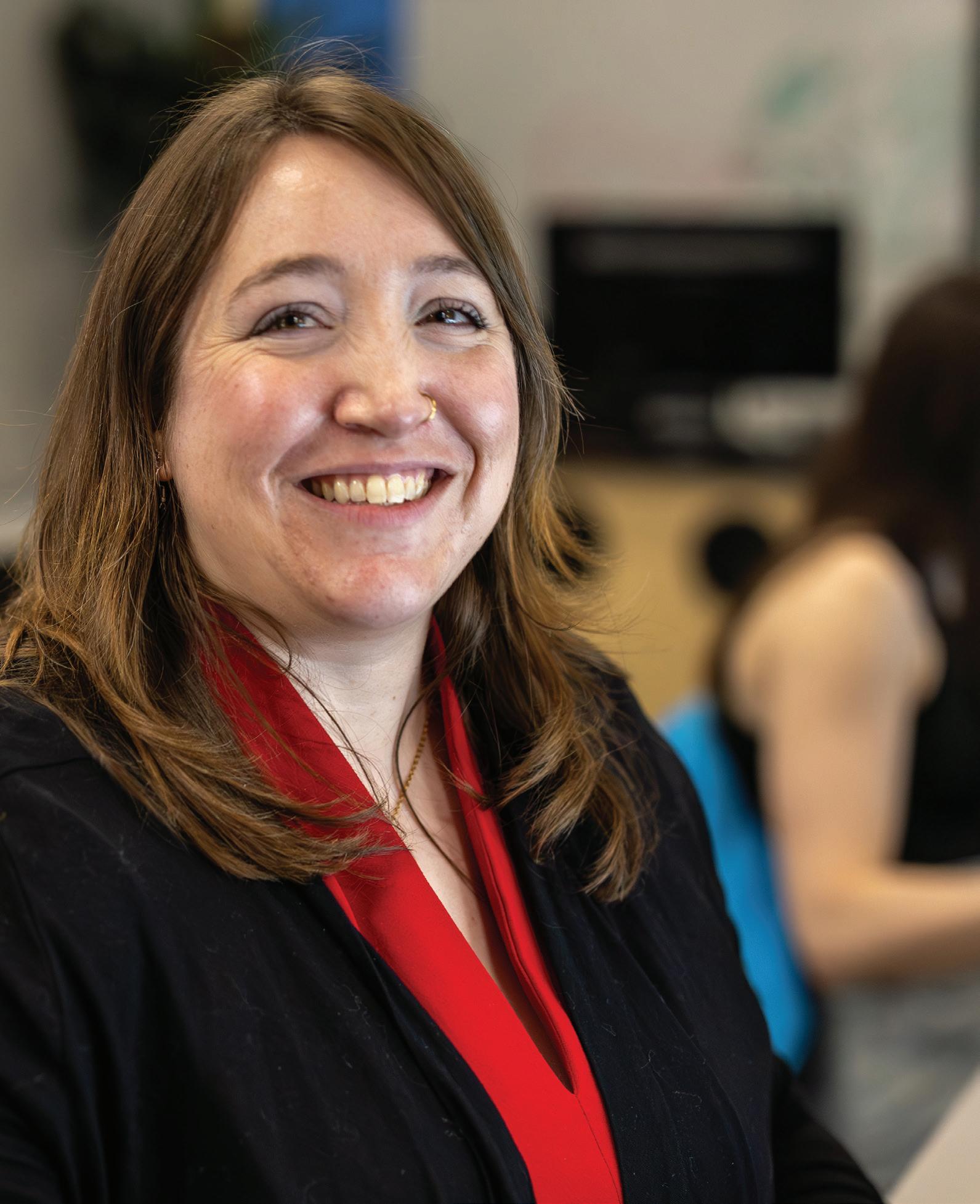
A TWO-TIME LETHBRIDGE POLYTECHNIC GRADUATE, MIRANDA HUBBARD (MULTIMEDIA PRODUCTION 2020, COMMUNICATION ARTS – BROADCAST JOURNALISM 2012) SAYS SHE FELL INTO HER CURRENT FIELD COINCIDENTALLY.
While enrolled in General Studies, Hubbard says she often helped a friend with broadcasting homework and technical issues. That experience inspired her to switch her program to Broadcast Journalism – a decision that would change the entire direction of her career.
What drew you to teaching, and how did your professional (or educational) background shape that decision?
Educating others has always been something I was interested in. Until I got hired to be an instructional assistant for Multimedia Production (MMP) and Digital Communications and Media back in 2020, I didn’t realize how much I loved it. Seeing students come in, willing and ready to learn, struggling with something and then seeing that spark when they get it. The smile of pride they get on their face when what they have created comes together how they envisioned brings so much joy. The students come in from so many different experiences and
“MY STUDENTS HAVE BEEN ABLE TO TAKE ADVANTAGE OF MY PAST WORKING RELATIONSHIPS TO FIND INTERNSHIP PLACEMENTS, VOLUNTEER OPPORTUNITIES AND PAID JOBS.”
{ MIRANDA HUBBARD }
backgrounds that I end up learning from and being inspired by them. I love hearing about them going out and pursuing their dreams and seeing what they make. Before getting into teaching, I worked in the broadcast industry for various companies like Feature Productions, Breakfast Television and Miracle Channel for 10 years. I decided to come back to school for the MMP program to explore virtual reality and health care. Showing my classmates at the time this whole other world they didn’t know about ignited a spark in me to keep it going, to keep showing and teaching others the infinite possibilities within technology and creativity, and how it can help others.
Describe the work you do outside of the classroom and how it complements what you teach at the polytechnic.
Outside of teaching, I currently work with two game development companies, Simulacrum Interactive (SI) and Mikan House Inc. With SI, I act as their art lead – doing 3D modelling, texturing and level design while also helping with our internship students. With Mikan House, I help with marketing and social media.
I also recently just wrapped up two exciting projects. A podcast, Indie Quest: In The Prairies, is all about game development in southern Alberta with a focus on Lethbridge. It was funded through TELUS STORYHIVE and will be aired on TELUS/Rogers, YouTube and Spotify. The other project is a game

development documentary called Little Pixels on the Prairies which is funded through the Canada Media Fund.
How does that work influence what or how you teach students day to day?
By staying active in industry, I can communicate and pass on to students the most current information possible to help facilitate a smooth transition from school to industry. I adjust my lessons to make sure they get the most relevant information.
Can you share a moment when your professional work directly benefited your students –or vice versa?
My students have been able to take advantage of my past working relationships to find internship placements, volunteer opportunities and paid jobs. Years ago, I was contacted by a company to work on Amazing Race Canada and was able to pull in some students to help with production. I can’t share much due to a non-disclosure agreement, but I will say it was an amazingly fun time.
JUDI
DORMAAR
INSTRUCTOR,
BUSINESS ADMINISTRATION
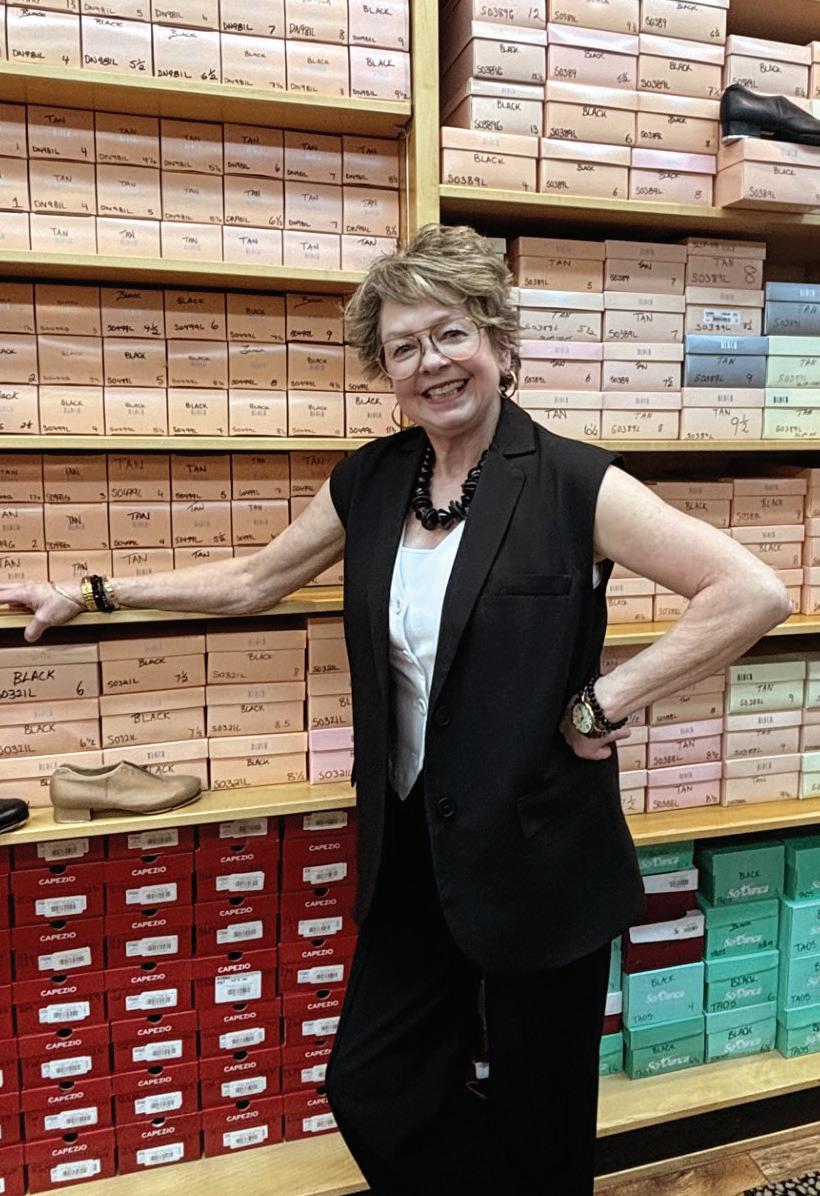
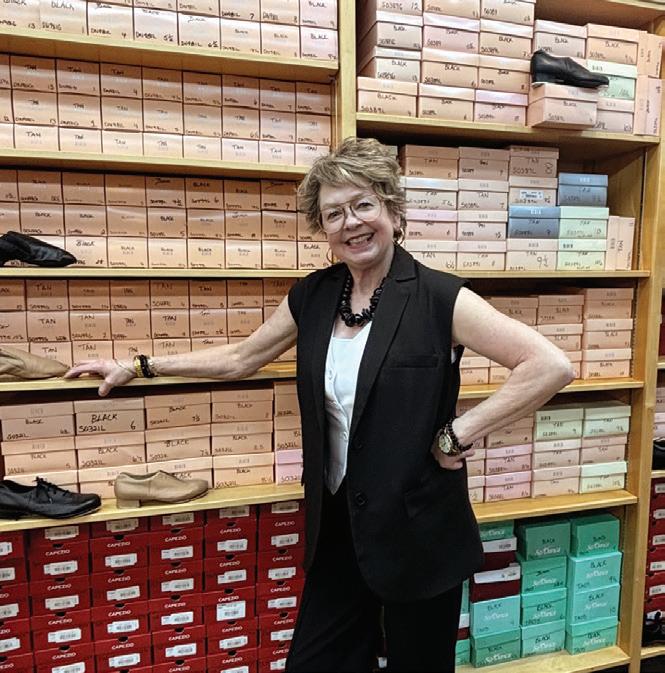
Rooted in strong family values of education and giving back, Judi Dormaar knew she wanted to teach at Lethbridge Polytechnic – and got the chance in 1999. By then, she had already owned Classique Dancewear in downtown Lethbridge for about four years and was just finishing up her master of education degree. Believing her education would complement her business knowledge, Dormaar saw teaching as a great way to share her expertise with students.
“I believe owning a business and being an entrepreneur has hugely influenced how I teach,” Dormaar says. “I am able to give them real-life knowledge alongside the classroom lectures.”
Dormaar adds she’s always taken the time to understand business, meet other business owners and stay up to date with changing technologies. The result is providing students with reallife knowledge, including how to navigate the highs and lows of entrepreneurship.
“When I look at the young students before me in the classroom, I see how passionate they are about becoming future business owners and entrepreneurs,” she says. “It motivates me to keep my instructional and business skills up to date.”
GORDON COX
INSTRUCTOR AND PROGRAM CHAIR, SCHOOL OF ENVIRONMENTAL SCIENCES
GORDON COX (BACHELOR OF APPLIED CONSERVATION ENFORCEMENT 2003) SAYS HIS STUDENTS MAY BE SURPRISED TO KNOW HE WAS RELATIVELY LATE TO THE FIELD, DECIDING AT THE AGE OF 26 TO PURSUE A CAREER IN CONSERVATION ENFORCEMENT.
What he discovered, however, was a lifelong passion for protecting the environment and teaching the next generation. After several years with Environment Canada, Cox remains involved in the profession through conservation enforcement functions and his work with the North American Game Warden Museum – experience he brings directly to the classroom.
What drew you to teaching, and how did your professional (or educational) background shape that decision?
After graduating from what was then Lethbridge Community College, I worked for Environment Canada. During my time there, I fell in love with the training aspect. I became a certified firearms instructor and provided animal and plant identification training to the Canada Border Services Agency and provincial agencies. I also visited several school classrooms with our exhibits to help educate students on endangered species.
Describe the work you do outside of the classroom and how it complements what you teach at the polytechnic.
My most direct connection to industry is the North American Game Warden Museum where I am a board member. As a past officer and current educator, I have a unique viewpoint to offer. I also attend various conservation enforcement functions such as the North American Wildlife Enforcement Officers Convention and Alberta Game Warden hockey tournaments. It keeps me current in my discipline and provides vital contacts.
Less directly, I coach a U16A ringette team, act as assistant coach for the University of Lethbridge Pronghorns ringette team and am president of the Lethbridge Ringette Association. I find real synergy with coaching and teaching, where I can bring experiences from one to the other. Both provide a dynamic environment that challenges me to evolve my teaching style and content.
How does that work influence what or how you teach students day to day?
Staying current in the industry allows me to provide the best information to students. I can get relevant examples despite being out of the field for 11 years. Staying engaged with the industry also means industry staying engaged with Lethbridge Polytechnic. Seeing our industry partners’
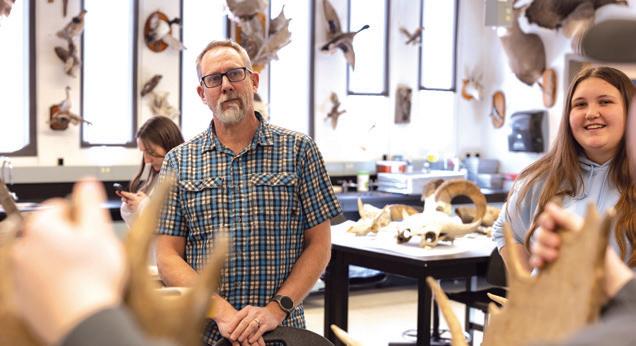
examples and knowledge woven into lessons gives them a lot of pride. Being knowledgeable about current trends also helps my credibility in the classroom; it tells students I care about the job and am invested in providing the best education possible.
What motivates you to stay professionally active?
A large part of it is the friendships I developed, but [it’s also] the passion that led me to become an officer in the first place. I didn’t leave the field because I was unsatisfied; quite the opposite, I easily could have done another 20 years. But, after trying teaching for a year I just knew it was the right choice for me. Staying connected and educating future officers makes me feel like I am still making a difference in the protection of our environment and watching students go on to their careers doing great things only confirms that.
What’s the greatest lesson you’ve learned that you would share with students?
There are many ways to explore your passions; don’t be afraid to change course and go after them.
DID YOU KNOW?
Lethbridge Polytechnic’s Conservation Enforcement –Bachelor of Applied Science program is the only degree of its kind in Canada.
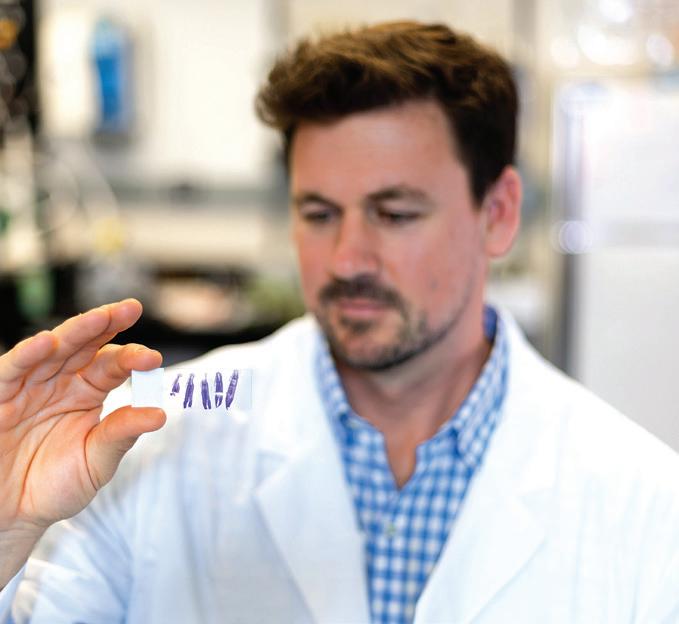
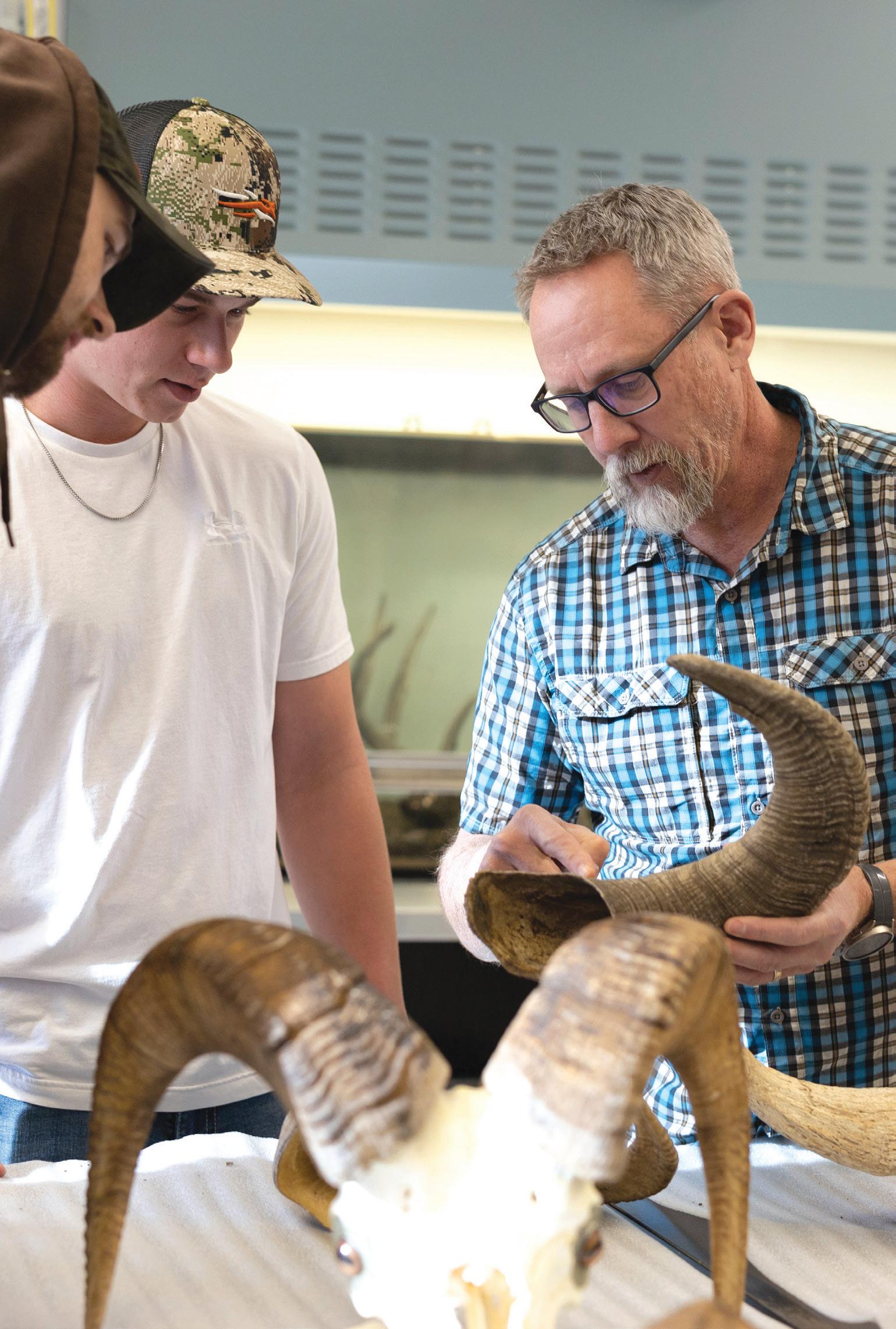
EVERETT HANNA
INSTRUCTOR, SCHOOL OF ENVIRONMENTAL SCIENCES AND FACULTY LEAD OF THE WILDLIFE ANALYTICS LAB
Dr. Everett Hanna (PhD, PBiol, CWB®) knows firsthand that wildlife careers are rarely linear and that opportunities often arise unexpectedly. It’s a lesson he encourages his students to embrace with an open mind.
“Early on, my goal was to become a conservation officer in Ontario, largely because it was the most visible wildlife career path at the time,” he says. “It wasn’t until after I was exposed to research and applied fieldwork that wildlife biology emerged as a realistic and viable profession.”
Hanna says his interest in teaching was strongly influenced by his own experience as a student, thanks to several exceptional professors who intentionally connected coursework to professional practice and took an interest in student development.
“Teaching offers the opportunity to engage students at a pivotal stage, when they begin to see themselves as emerging wildlife professionals,” he says.
In addition to teaching, Hanna’s professional work includes applied wildlife consulting, collaborative research projects and leadership of the polytechnic’s Wildlife Analytics Lab, which provides analytics and training in cementum-based age determination and emerging technologies – work that supports wildlife agencies, Indigenous communities, non-governmental organizations and industry partners.

INGREDIENTS

Chef Amara Goodsell (Culinary Careers 2006) began her post-secondary education at SAIT about 20 years ago. But, upon hearing “really good things about a smaller school” with a “great reputation” and “better opportunities for growth,” she made the switch and never looked back.
Since graduating, Goodsell’s career has been both diverse and progressive, spanning nearly every corner of the industry.
“I gained experience across multiple sectors, including catering, fine dining, institutional kitchens, food distribution and private chef work,” she says. “These roles allowed me to build a strong operational foundation and adapt to a wide range of culinary environments.”
As her career developed, Goodsell’s focus shifted toward leadership, education and mentorship. Today, she is an instructor for Level 2 and 3 Culinary diploma programs at Lethbridge Polytechnic, where she combines real-world industry experience with teaching, curriculum delivery and student coaching. Goodsell also serves as a mentor and coach for polytechnic students competing in Skills Canada.
“The best part of my current role is the opportunity to shape the next generation of culinary professionals,” she says. “I enjoy helping students build strong technical skills while also developing professionalism, confidence and adaptability.”
In her own kitchen, Goodsell isn’t focused on competition or curriculum, but on feeding her family. A favourite at home, and a recipe she has chosen to share with Wider Horizons readers, is her honey soy butter glazed salmon. She says she often skips the red pepper flakes at her daughter’s request (“it’s too spicy, Mom!”) and likes to garnish the dish with black sesame seeds, chives and a coral tuile.
Story by Tina Karst | Photos by Rob Olson
METHOD
340 g skinless salmon fillets
1 tbsp. sesame oil
2 tbsp. unsalted butter
FOR THE HONEY SOY MARINADE
4 cloves garlic, minced
2 tsp. fresh ginger, minced
¼ tsp. red pepper flakes (optional)
⅓ c. low-sodium soy sauce
⅓ c. ....................................................................................... honey
1 tbsp. rice vinegar
¼ c. brown sugar
¼ tsp. paprika
Kosher salt and black pepper to taste
To enjoy the cooking of Chef Goodsell’s students in the fall, make a reservation at the Garden Court Restaurant by calling 403-320-3230. Bon appétit!
1. Place the salmon fillets in a resealable plastic bag or shallow dish.
2. In a small bowl or measuring cup, whisk together all marinade ingredients until smooth and well combined.
3. Pour half the marinade over the salmon, turning to coat evenly. Reserve remaining marinade for the sauce.
4. Cover and refrigerate for at least 10 minutes, but no more than 30 minutes.
5. Heat the sesame oil and butter together in a medium skillet over medium heat until the butter is melted.
6. Remove the salmon from the marinade. Set marinade aside – do not discard. Add the salmon to the pan and cook for two to three minutes on one side.
7. Flip the salmon, pour the reserved marinade into the skillet and simmer. Spoon over salmon constantly and cook for an additional two to three minutes, or until just cooked through – when it becomes slightly opaque and begins to flake. Remove from the pan and set aside.
8. Simmer the remaining liquid, stirring occasionally, until reduced to a glossy, sauce-like consistency.
9. Spoon the glaze over the salmon and serve immediately. Pair with rice and vegetables. Enjoy!

{ Chef Amara Goodsell }
HONEY SOY BUTTER GLAZED SALMON
Where are they now?
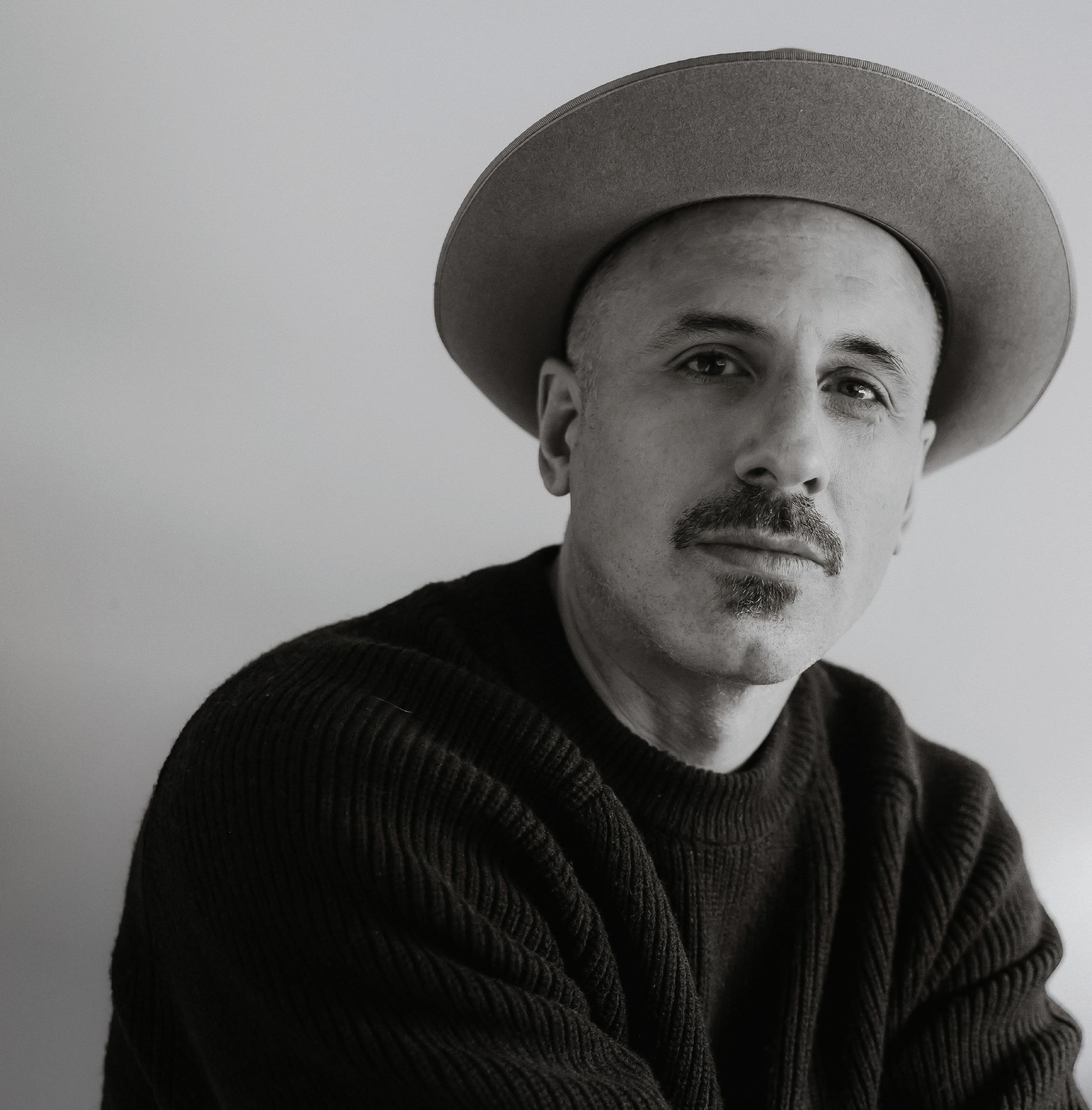
Makers, Doers and Thinkers
Celebrating the Lethbridge Polytechnic alumni who are building community and making their mark in memorable ways.
FEATURING:
David Guenther
Communication Arts –Print Journalism 2006
Story by Melanie Fast Photos submitted by David Guenther
SHARING THE SUCCESSES OF OUR ALUMNI IN THEIR CAREERS AND THROUGHOUT THEIR LIVES
Picture this. Traffic is halted in downtown Los Angeles; streets are closed and cameras are rolling. In the centre of it all stands David Guenther (Communication Arts – Print Journalism 2006), quietly realizing just how far he’s come – from a hobbyist photographer to directing large-scale commercials for major automotive brands in North America. But even amidst the chaos of the city streets, Guenther hasn’t lost sight of why he started.
From his early days in the Communication Arts program, his passion was simple: telling stories about people and experiences – a focus that still guides every shot he takes.
“I wanted to be a writer, I just wanted to tell stories,” he recalls of his decision to switch to the polytechnic from a fine arts degree at the University of Lethbridge. At the time, he was keeping a personal travel blog, and the Print Journalism program appealed to his passion for storytelling. “It just seemed like the right fit for me and could lead me to where I wanted to go. As soon as I got into it, I fell in love with what we were doing and what we were learning about.”
But it was when the program dove into photojournalism (as one of the first classes to have access to digital cameras) that Guenther discovered a new way to tell stories.
“I realized I could combine the visual arts with my desire to be able to tell a story and convey the way I saw the world,” he says.
After graduating in 2006, Guenther moved to South Korea for a year, where photography became central to documenting his daily life and soon evolved into his full-time profession. With the rise of social media, he was able to share his stories with a larger audience while also monetizing his work. He began reaching out to travel and lifestyle brands for work until he found his sweet spot in the automotive industry.
“I kind of dipped my toes in that world, and it was a really good fit,” he says. “It’s not like I always told myself I want to shoot car ads or direct car commercials. But this idea of storytelling, that I had always been interested in, developed itself.”
Leaning on his journalism lessons from his time at the polytechnic, Guenther approaches commercial photography the same way he would a news story – by staying concise,
trusting his instincts and understanding his audience. Even when the subject is a vehicle, Guenther is thinking about how it fits into the world around it and how the composition and angles will affect the way people feel when they look at the image. He knows even a few centimetres can make a difference. But he also knows to trust his gut above all else.
“A lot of times it’s just a feeling that I get when something is right,” he says.
As the commercial landscape shifts across platforms, Guenther continues building what’s next alongside his agent and production team in Los Angeles. Though he travels internationally for his shoots, he remains based in Lethbridge with his wife and kids.
“You don’t necessarily know what’s around the corner and you just trust that if you stay true to who you are as an artist and as a storyteller, the work will keep coming.”
Whether he’s battling dust storms in the 40 °C Arizona heat or lining up the perfect shot atop a mountain in -30 °C, his goal today is the same as his first day as a student: tell the story. The medium may have changed, but the storyteller remains.
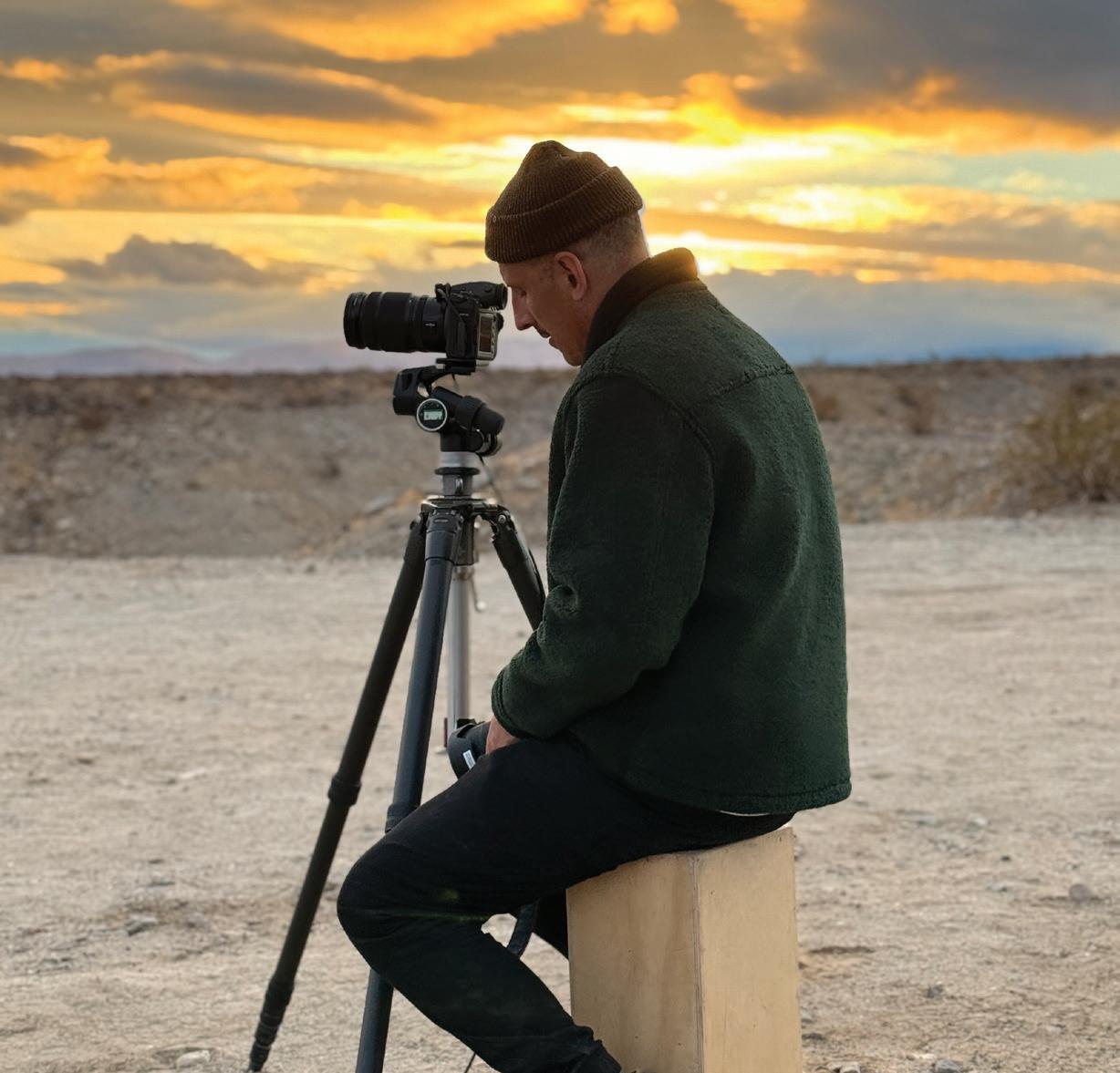
ALUMNI UPDATES
We love hearing from Lethbridge Polytechnic alumni! You can find additional updates online at widerhorizons.ca .
Alyssa Sinclair
Renewable Resource Management
Alyssa is working for the Government of Alberta in the Environment and Protected Areas department.
Brock Strate
Digital Communications and Media
Brock says, “I became a freelance photographer in the automotive industry. I take photos at racing events, car meets and for private interests.” See Brock’s photos at www.thebrocklens.pixieset.com.
2024
To submit your news to share with your classmates and the campus community, drop us a note at WHMagazine@lethpolytech.ca.
2025
Grace Dingreville
Medical Device Reprocessing
Grace is orientating as a surgical processor at Lethbridge’s Chinook Regional Hospital. She says she is “so excited for this career and the journey it’ll take me on!”
Ashley Ford
Educational Assistant
Ashley got a job with Edmonton Public Schools. She says, “I know I have worked extremely hard to get to this point in time, but I am so happy to be done with homework!”
Devina Nagewadia
Interior Design Technology
Devina says, “Currently I’m working as an architectural technician, but I’m hoping to continue gaining knowledge in the interior design industry through ongoing e-learning and practical experience. I also hope to gain further knowledge on sustainable practices to help better the world of design for both humans and the environment.”
Melissa Duggan
General Arts and Science, Child and Youth Care 2023
Melissa says she is “working at a groundbreaking online school that puts mental wellness at the forefront of learning –Ignite Centre for E-Learning.”

Kariza Manychief
Business Administration –Management
Kariza shared her journey as an entrepreneur on Episode 56 of the Pow Wow Pitch Podcast late last year. The founder of Night Owl Games spoke about the power of creating educational resources for language revitalization and cultural preservation. She also explored the richness of Blackfoot culture, the importance of building strong support networks and her vision for the future of language-based games. Visit www.powwowpitch.org to listen to the episode.
Gavin McKinnon
Renewable Resource Management
Gavin is the director and tour leader at Meadowlark Birding Tours in Calgary. He recently published a new guidebook, A Field Guide to the Birds of Alberta, which can be purchased through the Meadowlark Birding Tours website.
2023
Janell Lewis
Bachelor of Criminal Justice, Criminal Justice – Policing 2021
Janell is a full-time non-presiding justice of the peace/senior judicial clerk in the Alberta Court of Justice Criminal Division. She says, “the program I took at Lethbridge Polytechnic, formerly Lethbridge College, set me up to be very successful in my career. I highly recommend taking the Justice Studies program.”
2022
Cassy Schultz
Criminal Justice – Policing
Cassy is working for the Ministry of Social Services in Saskatchewan and is enrolled in the master of public administration program at the University of Saskatchewan.
2021
Ashley Bodell
Culinary Careers
Ashley is working the early morning shift in the cafeteria at Southland Trailers in Lethbridge.
Cole Filatoff
Bachelor of Criminal Justice, Correctional Studies 2014
Cole is a correctional peace officer with the Calgary Youth Attendance Centre. He assists with surveillance of youth on probation orders and helps youth complete their community service hours. He is also a community peace officer with Alberta Health Services, specifically helping adults reintegrate into the community after being in psychiatry hospital units.
Polytechnic celebrates
Distinguished Alumni • Darryl Jarina
Darryl Jarina (Renewable Resource Management 1999) grew up in Sparwood, B.C., hunting, fishing and exploring the Elk Valley. After graduating from Lethbridge Polytechnic, he earned a bachelor of science degree in zoology from the University of Calgary. Darryl began his career with Alberta Sustainable Resource Development as a wildlife biologist in 2006 before establishing Bear Tracks Environmental later that year. In the past 20 years, his firm has grown to 25 full-time employees, guided by responsible consulting and the long-standing relationships he considers the backbone of success.
CAREER VIRTUOSO • David Muryn
David Muryn’s (Business Administration – Accounting 1999) journey from student-athlete to regional leader reflects his dedication, discipline and community commitment. Raised in Medicine Hat, he came to Lethbridge to pursue baseball and academics at the Prairie Baseball Academy and polytechnic. He later earned a bachelor of science degree in business administration from Wayne State College. Joining MNP in Lethbridge in 2001, David earned his Chartered Accountant designation a few years later, became partner in 2009 and regional managing partner in 2020. He continues coaching youth baseball, mentoring young athletes in the community.
COMMUNITY LEADER • Tristin Mercer
Tristin Mercer (Business Administration – Management 2011) is a community builder, advocate and co-founder of a charitable organization whose work has redefined what support looks like for southern Alberta families facing childhood cancer. After graduating from Lethbridge Polytechnic, Tristin continued her studies at the University of Lethbridge and has spent the past 16 years with ATB Financial. After the tragic loss of her young daughter to a malignant rhabdoid tumour, Tristin, alongside her husband, established Kinley’s Quest Foundation. The organization is dedicated to ending pediatric cancer and empowering affected families through awareness, research funding and compassionate support.
RISING STAR • Ivan Djomegni
Ivan Djomegni’s (Computer Information Technology 2019) journey into technology began in Yaoundé, Cameroon with the computers in his mother’s cyber café. After moving to Canada to study at Lethbridge Polytechnic, he transformed curiosity into a career. Ivan began his professional journey as a programmer before steadily advancing into leadership roles focused on cloud architecture and digital transformation. Today, he serves as a cloud solutions architect and senior DevOps engineer. Ivan also mentors students through initiatives including the Black Youth Mentorship and Leadership Program.





2020
Brianna Fowlow
Criminal Justice – Policing
After graduation, Brianna completed her bachelor of arts degree in justice studies at Royal Roads University, earning the President’s Scholar Award in 2022. She spent four years supporting specialized federal Royal Canadian Mounted Police files, volunteered with Foothills Victim Services and even took time to travel through Europe.
Now, she is pursuing her juris doctor at the University of Alberta while volunteering with the Women’s Law Forum Sexual Assault Awareness Committee and Student Legal Services (Criminal and Emergency Protection Order divisions) as she continues to learn, serve and advocate for her community.
Brianna says the polytechnic’s Criminal Justice program gave her the confidence and foundation she needed to pursue her goals in law.
“I always felt supported by faculty and classmates who genuinely cared about my success,” she says. “This program shaped both my career path and who I am today.”
Brianna also stays connected to the next generation of polytechnic Criminal Justice students as a project mentor.

2019
Lucas Barsi
Criminal Justice – Policing
After graduation, Lucas completed his bachelor of arts degree in justice studies at Royal Roads University, where he was recognized as a President’s Scholar. He then received the Law Foundation of Nova Scotia scholarship to attend the Schulich School of Law at Dalhousie University, where he earned his juris doctor and worked as a research assistant with professors Robert Currie and Dr. Stephen Coughlan on criminal and international law.
Lucas is studying at Leiden University in the Netherlands, completing an advanced master of laws degree in public international law with an international criminal law specialization. He also continues to pursue his passion for research, working with Dr. Cecily Rose as a research assistant.
Karen De Leon Ortega
Child and Youth Care
Karen is working at Lethbridge Therapeutic Riding Association as the people and program co-ordinator.
Amanda Roth
Practical Nurse
Amanda is living in Cold Lake, Alta. and works in the rural hospital at full scope within medical-surgical, emergency room, endoscopy and day surgery. She also works for a not-forprofit organization recovery program for individuals recovering from
substances, specializing in fetal alcohol spectrum disorder and substance use while pregnant.
2017
Ryley O’Connor
Civil Engineering Technology
Ryley was named one of Rock to Road magazine’s Top 10 under 40 winners for 2025. The list celebrates individuals who are making waves across the aggregates and roadbuilding industry. Ryley, from Whitehorse, Yukon, began working for Castle Rock Enterprise (CRE) as a teenager during summer breaks – a business his father and grandfather founded in 1995. Ryley told Rock to Road, “Construction has always been a big part of our family. My dad inspired me to pursue this path. I grew up watching the work ethic, pride and dedication it takes to build something lasting, and I knew early on that I wanted to be part of it.” Ryley is currently the CRE quarry and land treatment facility manager.
2016
Caylee Vogel
Business Administration – General Business, Exercise Science 2014 Caylee is a sessional instructor at Lethbridge Polytechnic and manager of the Be Fit for Life Centre on campus.
Meagan Williams
Digital Communications and Media

Meagan tells the Alumni office: “Since graduating in 2016, I’ve had the privilege of working for some fantastic organizations like TSN, CTV (Bell Media) and the University of Lethbridge. Ultimately, public service was where I found my passion, and I’ve now been working for the City of Lethbridge for the past seven-plus years. I love getting to work for the community my family and I call home. Getting the opportunity to earn the trust, respect and confidence of my friends, family and neighbours every day is the biggest privilege and one I take great pride in.”
2015
Alyssa Borix
Communication Arts – Broadcast Journalism, Communication Arts –Advertising and Public Relations 2013
Over the past decade, Alyssa has built a career in communications and event management, and she is currently working at Red Deer Polytechnic as a communications and events specialist. Her role focuses on planning and delivering major institutional events, developing clear and audience-focused communications and supporting crosscampus initiatives. Alyssa has also expanded into strategic marketing work and project management, which she says has helped her take on more complex, multi-stakeholder projects.
Anthony Eagles
Conservation Enforcement, Natural Resource Compliance 2014
After graduation, Anthony was hired by the B.C. Conservation Officer Service. He has served nine years with the agency.

2014
Melissa Turner
Communication Arts –Print Journalism
Melissa is currently the director of Community Relations for the Town of Coalhurst. Covering corporate communications, media relations, event planning and council meetings, she enjoys every aspect of municipal work, especially getting to know community members and volunteers.
Building a career in criminal law
Brittany Hnatiuk
Bachelor of Criminal Justice 2021, Correctional Studies 2019
During her undergraduate years, Brittany worked as a full-time legal assistant with Connolly Shurtz Law in Lethbridge, where she gained firsthand experience in the complex world of criminal defence law. Working closely with seasoned defence lawyers, she immersed herself in court proceedings, case preparation and the essential elements of legal advocacy.
Her quest for knowledge led her to enrol in Law School at Bond University, a prestigious Australian University. Despite the global pandemic shifting her studies online, she balanced her educational commitments with a full-time role at Connolly Shurtz Law. Relocating to Australia for her final year, she dedicated herself to part-time work and volunteered extensively in law clinics, gaining invaluable insights into family and civil law. In August 2023, Brittany graduated from the juris doctor program with a class 2 distinction.
Upon her return from Australia, she continued her career at Connolly Shurtz Law, working as a traffic agent before commencing her articles in August 2024. She was called to the bar in September 2025 and is now an associate lawyer at Connolly Shurtz Law, where she practices criminal defence.
Brittany’s former instructors, Dr. Ibrahim Turay (below left), Gord Ryall (below right) and Aaron Eyjolfson all attended her bar call ceremony.


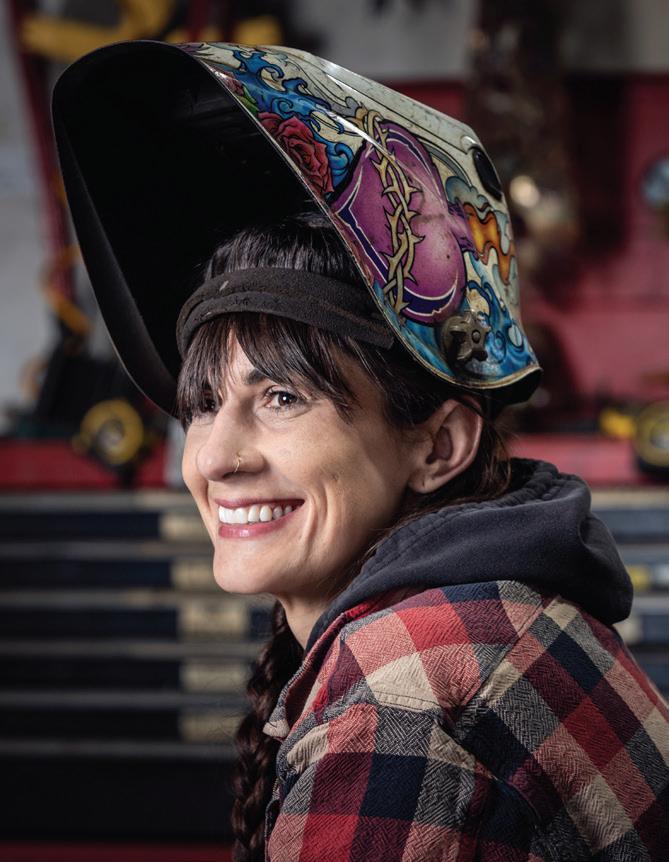
2013
Tarryn Forai
Welder Apprentice
The welder and metal artist was featured in the fall 2025 issue of WELD Magazine – the leading Canadian technical welding magazine in the industry. The profile article entitled “Where Steel Meets Soul: Tarryn Forai’s Journey in Metal Art” highlights her path from a childhood shaped equally by artists and tradespeople to her career today as a Red Seal welder and metal artist based in the Crowsnest Pass.
2012
Kirsten McLevin
Business Administration – Accounting Kirsten began her accounting career in 2016 when she joined OK Tire in Edmonton as an accounts payable administrator. She says working within a three-store operation introduced her to inter-company accounting and sparked a passion for solving complex financial challenges. In 2019, she joined Taurus Projects Group in Fort Saskatchewan as an accounting administrator, and she was promoted to financial controller in 2023. Following Taurus Group’s acquisition by an American company, the Bartlett Group, in 2025, Kirsten was named senior accounting manager of Bartlett Group Canada.
Jurrai Nadeau
Criminal Justice – Policing
Jurrai says, “I work with the Government of Saskatchewan, Ministry of Correction, Policing and Public Safety. I am a team lead in the Community Corrections office in Prince Albert, Sask. within the Custody, Supervision and Rehabilitation Division.”
2010
Blair Livingston
Environmental Assessment and Restoration
Blair worked as an environmental consultant for 10 years in Alberta and is now an environmental advisor for The Miller Group in Ontario.
2008
Collin Smith
Computer Information Technology
Collin is working for Parks Canada as the IT system administrator for Waterton Lakes National Park.
2006
Tonya Woolford
Communication Arts –Broadcast Journalism
Tonya’s post-graduation career began in local radio, where she worked for several years before moving into the non-profit sector as executive director of the Lethbridge Food Bank and later, outside sales with Digitex and Xerox Canada. In January, she joined Lethbridge Polytechnic’s Marketing, Communications and External Engagement team as a development officer. Tonya says she
is excited for her new chapter at the polytechnic and credits her natural curiosity and “unnatural lack of fear of trying new things and talking to anyone” for shaping her career path and relationships in the community. She has two grown children (and one grand pup named Harry), as well as two dogs and four chickens of her own.
2005
Joe McFarland
Communication Arts –Broadcast Journalism
Joe was named the recipient of the 2025 Bob Elliott Media Recognition Award by Baseball Canada in December, which recognizes outstanding contributions to Canadian baseball storytelling. Through Alberta Dugout Stories and Alberta Dugout Stories: The Podcast – platforms he co-founded with business partner Ian Wilson – Joe has built a reputation for in-depth, grassroots coverage of the game across Alberta and Western Canada. In announcing the award, Baseball Canada praised Joe’s ability to shine a spotlight on players, teams and communities often underrepresented in mainstream sports media, with stories spanning amateur leagues, collegiate baseball, the Western Canadian Baseball League and the province’s growing female baseball scene.
2003
Barry Gergel
Computer Information Technology
Barry is a senior product manager at Curtiss-Wright | Farris Engineering Services, which develops engineering software related to pressure relief systems. He has been with the company since 2012.
Ryan Tunall
Communication Arts –Broadcast Journalism
Ryan is co-owner and operator of the Burki Tunall Real Estate Team at INITIA Real Estate. He is also the community development co-ordinator at United Way Lethbridge & South Western Alberta.
James Witbeck
Nursing
James shared this update with our Alumni office: “I am still an RN over 22 years later and have worked for all of my career in southern Alberta. I work at the Chinook Primary Care Network here in Lethbridge. Primary care is the largest part of our health-care system and as our healthcare system undergoes some significant changes, we hope this is more recognized and supported. Five of six people in my family are alumni from [Lethbridge Polytechnic] – myself, two nurses, a master’s student at the [University of Lethbridge] in neuroscience and a graphic designer. I’m quite a proud papa.”
2001
Shannon Koller
Office Administration
Shannon says, “I have the best days ever working with Grade 6, 7 and 8 students at Senator Joyce Fairbairn Middle School!”
1998
Sharon Lawson
Information Specialist
After graduation, Sharon spent 11 years in the Advancement Office at [Lethbridge Polytechnic], supporting the fundraising group, before making the move over to the University of Lethbridge. She has been in the Dean’s Office in the Faculty of Health Sciences ever since and is looking forward to retiring in the next year or two.
1989
Wanda Luchia
Recreation Management
Wanda says she is “happily retired” from the City of Calgary’s Parks and Recreation department.
Mark Miyanaga
Agricultural Technology –General Agriculture
Mark says he continues to work on the farm with his two cousins. They grow processing potatoes, sweet corn and grains. He is also a public member of the Irrigation Council of Alberta.
1988
Dawn Sugimoto
Communication Arts
Dawn shared this update with the Alumni team: “I retired from Lethbridge Polytechnic after nearly eight years on the Marketing, Communications and Web Services team. I had a great career, including 20 years at the Lethbridge Herald where I served as managing editor, communications for a K-12 school system, and then coming full circle
to Lethbridge Polytechnic, where I wrapped up my time as Communications manager. At every stop, I worked with great people and had a lot of laughs. My days as a full-time employee are over but I’m still likely to find other projects. I serve as president of the Lethbridge and District Japanese Garden Society and volunteer at the Lethbridge and District Humane Society. There is always something to do!”
Leading innovation in health care
Tyler Tamayose
General Arts and Science 2008
Tyler is the founder and president of Banyan Strategies Inc., a boutique consultancy helping modernize health and life-sciences across Canada.
From his days as a student-athlete, Tyler has carried forward the lessons of adaptability and resilience into a 20-year career in health care. He has worked in a variety of areas, including hospital operations, primary care, digital health, quality improvement, innovation and boardroom strategy.

Through Banyan Strategies Inc., he has helped governments, health systems, universities and startups turn bold ideas into real change, leading one of Canada’s largest clinical information systems through multiple launches, supporting one of Alberta’s busiest hospitals through the pandemic response and mentoring more than 100 health startup founders.
Today, Tyler also serves as a board member and strategic advisor for the Glenrose Hospital Foundation, Health Cities, the Canadian College of Health Leaders and the Canadian Rural Community Wellness Institute, and he has previously supported Special Olympics Alberta and the Canadian Cancer Society.
“Since [my time as a student-athlete], I’ve put my hand up for some of the hardest initiatives, challenges and projects in health care,” he says. “Launching my own consultancy, Banyan Strategies, and being named to Edmonton’s Top 40 Under 40 are big milestones, but they’re built on lessons I first learned during those formative years at Lethbridge Polytechnic. That’s where I found my footing. And I’m still building from there.”
Alumni at Work – Varsteel Ltd.
Founded in 1953 as a small scrap metal operation in Lethbridge, Varsteel Ltd. has grown into an international company that provides steel products and services, with more than 30 locations across Canada and the United States.
Despite its growth, Varsteel continues to operate with the heart of a family business – and Lethbridge Polytechnic alumni are a big part of that success. “Having more than a dozen alumni on the team isn’t just a coincidence,” says Corporate Inventory Manager Matt Bourret (Business Administration – Accounting 2011), who specializes in bridging the gap between high-level financial health and operational efficiency. “It’s a strategy. The polytechnic produces graduates who are industry ready from day one.”
Controller Andrew Hemmerling (Business Administration – Accounting 2011), who manages the accounting and financial responsibilities for the company, agrees.
“While I am from the Business Administration stream, we have employees who took Criminal Justice and Computer Information Technology,” he says. “Varsteel respects the education [students] gain from the polytechnic and knows [grads] will be ready for the workforce.”
“The relationship between Varsteel and Lethbridge Polytechnic is a perfect ecosystem,” adds Bourret. “The polytechnic provides the talent, and Varsteel provides the arena for that talent to build a career.”
Hemmerling also stays connected to the institution, not only through fellow alumni colleagues, but by volunteering on the Business Program Advisory Committee and keeping in touch with his former teammates on the men’s volleyball team.
“Even after all these years, the [polytechnic] is still a part of my life, which is something to be proud of,” he says.
Pictured left to right are: Matt Van Braak (Computer Information Technology 2025), Brandi Deboer (Business Administration – Management 2016), Andrew Hemmerling (Business Administration – Accounting 2011), Kyle Martens (Criminal Justice –Policing 2018), Matt Bourret (Business Administration – Accounting 2011), Nathan Shearer (Computer Information Technology 2006) and Jordan Barnett (Business Administration – Management 2003).
1984
Maureen Buday Rehabilitation Services
Maureen says, “After graduating from LCC, I worked as an educational assistant for 20 years in the Prairie Rose School Division. While working, I obtained a degree through Athabasca University. I then continued my education at Medicine Hat College and received an education degree (U of A). Presently, I teach in the Prairie Rose School Division.”
1967
Terry Grover Merchandise Administration
In the second year of his program, Terry says he landed an evening and weekend job with local radio station 1090 CHEC AM, which also operated 100.9 FM. He also completed 90 hours of work experience at the Lethbridge Herald He shares with the Alumni office, “Someone at the Herald gave me an official-looking press card sticker which I proudly stuck to the lower left of my car front window. I was always in a hurry to make class and the card worked well enough, allowing me to use visitor parking. Then a commissionaire saw me park, leave the car and run up the back stairs to a second-floor classroom, and as they say, the jig was up.”
Terry worked at two other radio and TV stations before moving into telecom in 1974. That career took him to SAIT, NAIT and Athabasca University in addition to workplaces across Canada and in 37 U.S. states. He also got married, raised a family of three and retired in 2002.
IN FOCUS
The HATCH Family
For Ranae Hatch (Special Needs Educational Assistant 2016) and her four children – TJ, Austin, Devany and Brittan – Lethbridge Polytechnic is more than a shared connection; it’s where each family member had the opportunity to pursue their own path, explore interests and gain skills that continue to shape their careers.
Ranae’s path began while working as an educational assistant (EA) in the Westwind School Division. She says a presentation on distance learning sparked a desire to deepen her understanding of the work she was already doing.
“[I thought], if I was going to do this job well, I needed to know as much as possible about the subject,” she says.
Her oldest daughter Devany Sparks (General Arts and Science – Psychology and Sociology 2019) also has an EA background, having worked for the Lethbridge School Division and Horizon School Division. Devany says her initial plan was to become a learning support teacher by first enrolling at the polytechnic and then completing her education at the University of Lethbridge.
“I wanted to have experience working in the schools just to make sure that is where I wanted my life to go,” she says of becoming an EA after graduating from the polytechnic. “I mostly worked one-on-one with students who have high needs or behavioural plans. In the
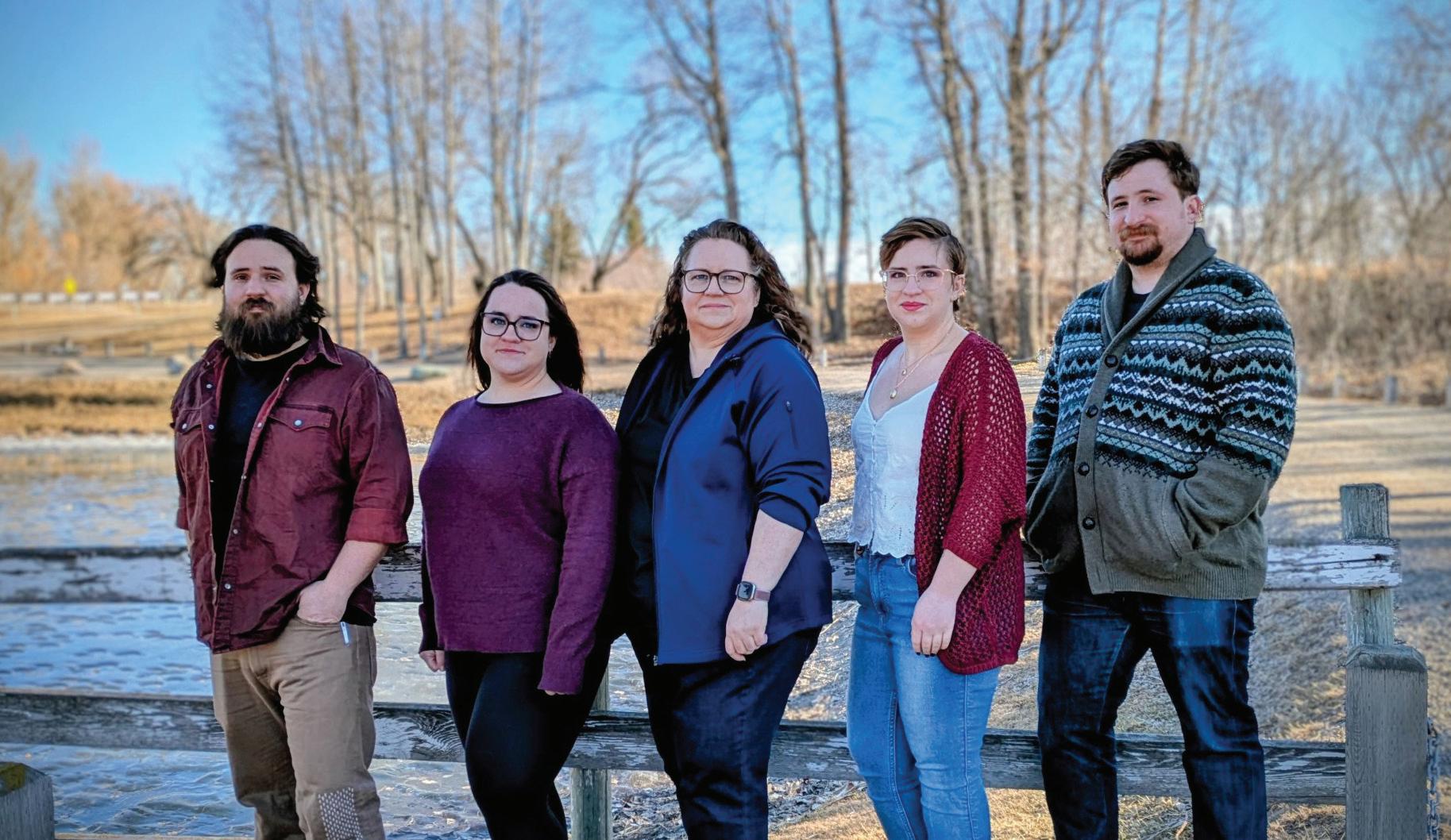
evenings I would work as an at-home respite and care aide as well.”
After the pandemic, Devany became a community resource worker and then shifted career paths entirely. She is now a certified Canadian optometry assistant at a clinic in Taber. “I may not be using my education, but I have something that I am still interested in and skills that I can still use,” she says. “I can always change my mind again and go back to my original goal, or I can go back to school … that’s the great thing about education –it’s limitless.”
After beginning his post-secondary journey with a desire to work in character and environment design in the video game industry, Austin Hatch (Virtual and Augmented Reality 2022, Multimedia Production 2018) cultivated a passion for emerging technologies. He now works as a junior developer in the polytechnic’s Spatial Technologies Applied Research and Training Centre.
As the youngest to attend Lethbridge Polytechnic, Brittan Hatch (Business Management – Accounting 2022) had a unique advantage: family tour guides. “I got to have my siblings show me around and find all of my classrooms,” she says.
After graduation, Brittan transferred to the University of Lethbridge where she earned a bachelor’s degree in business management accounting. She’s been working at an accounting firm in Lethbridge since last April and is currently enrolled in the Chartered Professional Accountants (CPA) program.
TJ Hatch’s connection to the polytechnic took a different route. After briefly enrolling in Multimedia Production before transferring to the University of Lethbridge to complete a bachelor’s degree in new media, he later returned to the polytechnic campus in a professional role. Today, he works in Testing Services as an invigilator, supporting students through full-class exams.
The Hatch family’s shared connection to Lethbridge Polytechnic also reflects a common theme: a belief in lifelong learning.
“Our family has always put a high value on education – something that started with my mother’s parents,” Brittan says. “My mother instilled in us the same value for education and wanted us to have the opportunity to pursue whatever life we wanted, and the polytechnic was a great place to figure that out.”
Are you a multi-generational Lethbridge Polytechnic family? If at least three members across one or more generations attended Lethbridge Polytechnic , let us know by emailing WHMagazine@lethpolytech.ca . We’d love to profile you.
Story by Tina Karst | Photo supplied
The Hatch family: (from left) Austin Hatch, Devany Sparks, Ranae Hatch, Brittan Hatch, TJ Hatch.
explore camps
BEAT SUMMERTIME BOREDOM BEFORE IT BEGINS!
Register your explorers, builders and gamers for a Lethbridge Polytechnic summer camp. There are dozens of fun, hands-on experiences to choose from that will keep your kids and teens active this summer while they learn new skills, make new friends and explore potential career paths.
RETURN UNDELIVERABLES TO:
Lethbridge Polytechnic Communications Office
3000 College Drive S.
Lethbridge, AB T1K 1L6