{ A PUBLICATION OF LETHBRIDGE POLYTECHNIC }
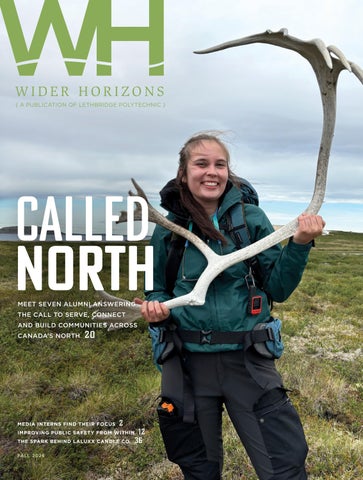
CALLED NORTH MEET SEVEN ALUMNI ANSWERING THE CALL TO SERVE, CONNECT AND BUILD COMMUNITIES ACROSS CANADA’S NORTH
20
MEDIA INTERNS FIND THEIR FOCUS
2
12 36
IMPROVING PUBLIC SAFETY FROM WITHIN THE SPARK BEHIND LALUXX CANDLE CO. FA LL 2 02 6
Editor’s message
Part of what I love most about my role on { VOL. 20 | ISSUE 1 | FALL 2026 }
Wider Horizons is Lethbridge Polytechnic’s community and alumni magazine, which is dedicated to educating, engaging and delighting our readers through compelling stories and images about our people, places, ideas and experiences. Wider Horizons is mailed to alumni and friends of the institution, distributed in the community and available on campus. Readers who would like to receive an e-version of the magazine, comment on a story, change their address or remove their name from our mailing list should email the editor at WHMagazine@lethpolytech.ca. Alumni looking to connect with the polytechnic can email alumni@lethpolytech.ca. Lethbridge Polytechnic’s vision:
PREPARING LEARNERS. SHAPING COMMUNITIES. Publisher: Dr. Brad Donaldson Editor: Tina Karst Art director/designer: Dana Woodward Cover photo: Sophie Clark Illustrator: Gillian Goerz Photographers: Lexi Barclay, Chris Colbourne Spencer Nelson, Rob Olson, Shawn Salberg Writers: Melanie Fast, Sam Sasse, Connolly Tate-Mitchell Proofreader: Jennifer Yanish Distribution: Amy Taylor Polytechnic employee contributors: Quinn Campbell, Leeanne Conrad, Greg Goodwin, Ryan Hammell, James Harrison, Melissa Johnson, Greg Kruyssen, Lawrence Krysak, Pam Purnell, Derek Rischke, Stephanie Savage, Tonya Woolford
{
Located on the traditional lands of the Blackfoot Confederacy, Lethbridge Polytechnic is committed to honouring the land from a place of knowing. We invite you to watch our territorial land acknowledgement online at lethpolytech.ca/indigenous.
}
Lethbridge Polytechnic’s Communications team is hearing about student success stories, their hands-on learning opportunities and all the ways they get to experience their chosen industry before they even graduate. Flip through this issue and you’ll find it’s filled with notes about student competition winners – in business and in trades – international research presentations, national media internships and an unforgettable practicum placement for Multimedia Production graduate Olivia Eagle Speaker (p. 30). These stories were so fun to write, and they had me reflecting on my own practicum experience in the spring of 2005 with then-Q14 Country radio in Stettler, Alta. Now I’ll be the first to admit, I’m a perfectionist. I always have been and at this point, I probably always will be. When I make a mistake, or someone thinks I made a mistake, it haunts me. So, you can imagine my devastation when one of my cassette tape interviews (technology has come a long way!) got caught in playback, unravelled and was unusable. Worse yet, the news director docked me points on my practicum evaluation under the “care and use of equipment” column. I still can’t let it go. That said, I learned a lot in those three weeks: how to handle a lost interview, how to stay awake on the drive to work at 4 a.m., how to shake off a rough news read and reset for the next one, and most importantly, how to adapt to whatever the day might throw at you. While the tools and technology have changed over the past two decades, the value of learning through experience hasn’t. In “Shared Success” on p. 2, Digital Communications and Media grads Jody-Ann Smikle and Patience Omeruo recount their Troy Reeb Internships in Toronto and Ottawa, and what they learned along the way. Smikle discovered a strong interest in podcasting and marketing, while Omeruo gained confidence in knowing she has the skills and knowledge to hold her own in a major-market newsroom. These realizations are invaluable. Equally important is discovering what doesn’t interest you. During my 15 years at CJOC radio in Lethbridge, we hosted several practicum students from Alberta post-secondary institutions. Day after day of covering court and running from story to story had a few students opting for a different career after graduation, and they have been very successful. It goes to show how transferable your skills can be once you’ve built a solid foundation – something I only realized after switching careers and joining the polytechnic. Another great example is Carly Frew (Electrician Apprenticeship 2011) who is highlighted in our Makers, Doers and Thinkers profile on p. 36. She credits several of the skills she learned in her years in the trades for helping her launch and manage her business, Laluxx Candle Co. My career has taken turns I never expected, but the foundation I built through hands-on learning at Lethbridge Polytechnic has remained constant. And, as the stories in this issue demonstrate, real-world experiences – practicums or otherwise – shape futures, build confidence and open doors we may not even know exist yet. Thanks for reading. I hope you enjoy this issue!
Tina Karst Editor | FALL 2026
Have a practicum story to share? Email WHMagazine@lethpolytech.ca.
SEEN ON CAMPUS Photo by Shawn Salberg Students participating in the polytechnic’s Culinary Boot Camp take a photo break with Chef Tyler Ivey (Cook Apprentice 2012), a culinary instructional/production assistant (back right). The summer program helps youth ages 12 to 17 learn basic cooking techniques in a professional kitchen.
2 News and Notes 4 Top Ten from the Den
6 The President’s View 34 From our Kitchens
36 Makers, Doers and Thinkers 38 Where Are They Now?
Fifty Years and Growing
The Art of Connection
Fall Valedictorian
Lethbridge Polytechnic’s most foundational portfolio of programs celebrates its golden jubilee.
Multimedia Production grad Olivia Eagle Speaker explores IndigenousUkrainian ties through art and animation.
For Sarah Watters, the Therapeutic Recreation – Gerontology program was a natural fit.
14
30
45
1
News and notes
SHARED SUCCESS FROM CLASSMATES AND ROOMMATES TO NATIONAL INTERNSHIP RECIPIENTS, TWO DCM GRADS FIND FRIENDSHIP AND SUCCESS FAR FROM HOME
Story by Tina Karst | Photos by Rob Olson
A little more than two years ago, Jody-Ann Smikle and Patience Omeruo left their hometowns in Jamaica and Nigeria and travelled thousands of kilometres to study Digital Communications and Media (DCM) at Lethbridge Polytechnic.
Over the course of their program, they gained confidence, found friendship and developed a shared passion for storytelling – one that propelled each of them to prestigious national internships in back-to-back years. Now, as graduates, they’re setting their sights on the future, ready to navigate an ever-evolving media landscape. “Jody and I met during DCM orientation and clicked right away,” recalls Omeruo. “We became roommates in summer 2025, but we sat together in almost every class before that.” Routinely paired together on projects – either by choice or their proximity in class – Smikle says working with Omeruo was convenient and easy because they got along so well, and because they’re “both nerds.” “More than anything, we’ve just always shown up for each other,” Omeruo adds. “Moving far from home is hard, and having someone in your corner who checks in, cheers you on and celebrates your wins makes a real difference.” And they had some big wins to celebrate. In April 2025, Smikle became the 20th recipient of the Troy Reeb Internship. Co-ordinated and sponsored by Troy Reeb (Broadcast Journalism 1988, Distinguished Alumni 2003,
Honorary Degree 2019), the internship provides one DCM student per year an opportunity to learn the ropes in two of Canada’s major market media centres. For the winning submission, Smikle leaned into her years of financial experience back home in Jamaica, focusing on financial literacy and its impact on Canadian post-secondary students’ quality of life. “I look at young people who struggle to manage their finances and do not understand how it may impact them now and in their future,” she says. “There are gaps in financial education in high schools that we should be fixing.” As part of her internship, Smikle spent 14 days with Global News and Corus Radio teams in Toronto and Ottawa. She got to sit in on meetings with the marketing and podcast teams, was in studio during filming of The Morning Show and worked on Parliament Hill with the Ottawa bureau of Global National leading up to, during and following the federal election. “The experience ignited my passion for radio, marketing and podcasting going into my second year of the DCM program,” Smikle says. “I saw what possibilities existed based on choosing various paths.”
Jody-Ann Smikle (left) and Patience Omeruo were each awarded the prestigious Troy Reeb Internship during their time in the Digital Communications and Media program – Smikle as a first-year student and Omeruo as a second-year.
2
| FALL 2026
A year later, it was Omeruo’s turn. She, too, submitted a deeply personal piece about studying in Canada as an international student – exploring not only the financial pressures but everything that comes with attending post-secondary so far from home – and was selected for the internship. “I wasn’t surprised when Patience was shortlisted and won,” says Smikle. “She’s a dedicated and hardworking person by nature and it shows in her work.” For Omeruo, who previously worked in Nigerian media, the experience was just as memorable. “My first day happened to be the installation ceremony when [The Right Honourable] Louise Arbour was sworn in as Canada’s 31st Governor General,” she says. “It was interesting to see the city buzzing and it was a striking way to start my internship.” Omeruo also covered a peaceful demonstration on Parliament Hill, took part in media scrums, sat in on a parliamentary session and got a real, first-hand look at political reporting while also attending the Prime Minister’s Media Garden Party where she met Prime Minister Mark Carney. “I’m glad I have photo evidence because I’m not sure anyone would have believed me otherwise,” she says. “It was truly an honour to meet him.” As far as working in a major newsroom, Omeruo says the internship experience has given her the confidence to pursue a journalism career, knowing she has what it takes to succeed. “Of course, the studios were bigger, there were more monitors, the pace was faster, but the core process matched what we’d been taught in the DCM program almost exactly,” she says. “I remember sitting beside a producer thinking, I can do this.” While both Smikle and Omeruo are excited about the opportunities ahead, they also know the media industry they are entering looks very different from the one that existed even a few years ago. “I foresee a greater influence of podcasts and social media,” says Smikle.
“The greatest challenge may be finding a job in a media house that doesn’t cling to the past of more traditional media.” Omeruo agrees adaptability will be key. “Today’s digital broadcast journalist is writing, filming and editing to meet deadline all in the same day,” she says. “Staying ahead of new platforms and shifting audience habits, instead of just keeping up with them, is going to be the real challenge.” That said, both graduates are optimistic about where the changing media landscape can take them. Smikle would like to find a marketing or communications job in a field that “excites” her and eventually mentor young people, while Omeruo has her sights set on returning to Ottawa to work on Parliament Hill. “My internship gave me a real taste of that world and it’s the environment I’d most love to build a career in.”
Routinely paired together on projects – either by choice or their proximity in class – Smikle says working with Omeruo was convenient and easy because they got along so well, and because they’re “both nerds.”
“MY INTERNSHIP GAVE ME A REAL TASTE OF THAT WORLD AND IT’S THE ENVIRONMENT I’D MOST LOVE TO BUILD A CAREER IN.” Patience Omeruo
3
News and notes
TOP
TEN FROM THE DEN
Wider Horizons turned to the people who know the ins and outs of campus best – Lethbridge Polytechnic employees – to pick the top news stories from the past six months. Here’s what they had to say.
10 COMMUNITY GATHERS FOR PRIDE FLAG RAISING
A decade-long tradition continued at Lethbridge Polytechnic in June with employees, students, alumni and community members raising the Progressive Pride Flag in a show of support for the 2SLGBTQIA+ community. “Our Pride Flag raising event is one I look forward to every year,” says Adrianna Smith, student development co-ordinator, Student Experience. “It’s a chance for us to show the power of speech, allyship and collaboration to advocate for positive change where people are free to be their most authentic selves.”
4
| FALL 2026
9
6 POLYTECHNIC AND ULETH CO-HOST NURSING SCHOOLS CONFERENCE
SOUTHERN ALBERTA HIGHER EDUCATION RELATIONSHIP CREATES SHARED VISION
The Southern Alberta Higher Education Relationship – a formal Commitment to Work Together – united Red Crow Community College, Lethbridge Polytechnic, Medicine Hat College and the University of Lethbridge in a partnership to enhance higher education in southern Alberta through collaborative efforts. The alliance’s Blackfoot name, Innakotsiiysinni (Respect for Others), reflects the shared goals and mutually supportive nature of the agreement.
8
START CENTRE SIGNS DEVELOPMENT AGREEMENT WITH VIRTUALWARE
Lethbridge Polytechnic’s Spatial Technologies Applied Research and Training (START) Centre signed a collaborative agreement with Virtualware to develop and showcase extended reality demonstrations and environments on a proprietary platform called VIROO. Based in Bilbao, Spain, Virtualware is a global pioneer in 3D-driven enterprise software with operations in Hamilton, Ont.
7
BOARD OF GOVERNORS APPROVES BALANCED BUDGET
In May, the Lethbridge Polytechnic Board of Governors approved a balanced operating budget for 2026-27 and reviewed projected balanced budgets for 2027-28 and 2028-29. “We have moved through a period of challenge and into one of stability,” says President and CEO Dr. Brad Donaldson. “It has not been easy, but the pressures of the past two years have ultimately strengthened our focus, helped clarify our priorities and reinforced our commitment to students, employees, partners and our community.”
Lethbridge Polytechnic and the University of Lethbridge joined forces to host the 2026 Western North-Western Region Canadian Association of Schools of Nursing conference in April. The conference was an opportunity to showcase nursing scholarship and research, provide participants with experience in presenting, networking and professional engagement, strengthen collaboration among Western Canadian nursing programs and highlight Lethbridge as a host community committed to health-care education and workforce development.
5
BUSINESS PROGRAM STRENGTHENS PARTNERSHIP WITH CPA ALBERTA
Lethbridge Polytechnic’s School of Business received an $11,000 grant from the CPA Education Foundation in May. The funding will support the continuation of the popular Accounting Advantage Dinner as well as provide opportunities for students to participate in accounting-focused competitions. In addition to the grant funding, the Business Administration – Accounting major was once again formally recognized by Chartered Professional Accountants Alberta.
4
POLYTECHNIC STUDENTS PLACE AT LAUNCHPOINT PITCH COMPETITION
Two Lethbridge Polytechnic students placed in the top three at the 2026 LaunchPoint Pitch Competition held in March at the polytechnic. Patricia Wannamaker, a first-year Criminal Justice – Policing student, pitched Park My Pet – supervised pop-up kennel stations that offer dog owners a safe alternative to leaving their pets in vehicles alone – and placed second overall. Gavin Warmink, a first-year Business Administration – Accounting
student, collaborated with University of Lethbridge biology student Kiana Jans to present Southpaws Rescue, a centralized adoption platform that helps prospective pet owners and resource organizations connect by consolidating adoption listings in southern Alberta into one platform. Their idea earned them a third-place finish.
3
WILDLIFE ANALYTICS LAB SECURES FUNDING FOR AI-DRIVEN AGE ANALYSIS
Lethbridge Polytechnic’s Wildlife Analytics Lab secured more than $130,000 in funding for year one of a new applied research initiative integrating machine learning and artificial intelligence into wildlife age analysis. The initiative will focus initially on mule deer, a key species for monitoring chronic wasting disease and will involve digitizing thousands of archived tooth samples and developing machine learning models for imagebased age estimation.
2
ACCOUNTING STUDENTS PLACE SECOND AT WESTERN CANADA COMPETITION
Five Business Administration – Accounting students celebrated a second-place finish – and a $1,500 cash prize – thanks to their stellar performance at a prestigious accounting competition in April. Grace DeJong, Heather Moysey, Rebeka Unger, Sarah Silkin and Yooshilen Anasamy, along with their faculty coaches, James Reimer and Nicole Freeman, participated in the 3rd Annual Western Canada Accounting Case Competition at Bow Valley College March 27 and 28. The competition featured schools from across British Columbia, Alberta and Manitoba.
1
EXERCISE SCIENCE STUDENT RESEARCHERS PRESENT FINDINGS IN SWITZERLAND Two student researchers were selected to present their projects alongside a Lethbridge Polytechnic instructor at the European College of Sports Science annual conference in Lausanne, Switzerland in July. Hallee Pilling, secondyear Exercise Science student, and alumni Hannah Smith (Exercise Science 2025, Administrative Office Professional 2023), each explored a topic that analyzed physical activity. Pilling’s research examined the relationship between movement competency and executive function in youth while Smith explored how menstrual cycle phases relate to well-being and performance in college runners.
You can read all of these stories and more at lethpolytech.ca/news. Thanks to our polytechnic colleagues who helped shape this list!
5
News and notes
The
President’s View by Dr. Brad Donaldson
Dr. Brad Donaldson (far right) with students (from left) Patience Omeruo, Kayana Robinson and Jeniffer Orajekwe at the polytechnic’s Celebrating Generosity BBQ in June.
Photo by Shawn Salberg
Throughout the year, I have the opportunity to speak with students, employees, alumni, families, community leaders and many others who simply want to connect with Lethbridge Polytechnic. Those conversations take place in many settings, and are often informal, but they are important. They remind me that Lethbridge Polytechnic is not separate from the community. We are part of it. That is why Deliberate Community Connections is one of the four imperatives in our strategic framework. The word deliberate matters. Strong relationships do not happen by accident. They are built by listening, showing up, contributing and finding meaningful ways to work together. 6
| FALL 2026
We engage with our community in many ways and at many levels. Community events allow us to welcome people to our campus and strengthen personal connections. Program advisory committees bring employers and industry representatives together with faculty and academic leaders to ensure our programs remain current, relevant and responsive. Our alumni also play an important role. They connect our past, present and future by sharing their experience, mentoring others and demonstrating the impact our graduates have across the region and beyond. Some relationships lead to entirely new opportunities. Our work with local school boards helped create the Southern Alberta Collegiate Institute. By working together, we are creating clearer pathways for junior high and high school students to explore careers, gain
practical experience, earn dual credit and see themselves succeeding in postsecondary education. These connections differ in scale, but they share a common purpose. Each helps us understand our community more fully and allows our community to help shape our institution. Community connection is also reciprocal. It is not only about what others contribute to Lethbridge Polytechnic, but also about the value we provide in return through education, applied research, workforce development, community leadership and shared problem-solving. Our vision is: Preparing Learners, Shaping Communities. We can only fulfill that promise by remaining visible, engaged and responsive and by continuing to build relationships that create value for our students and contribute to the future we are shaping together.
CAMPUS NEWS
Polytechnic community members named Top 40 Under 40 The Lethbridge Chamber of Commerce named several alumni to its Top 40 Under 40 list in June. The award recognizes young leaders, innovators, entrepreneurs and changemakers who are helping shape the future of southern Alberta. Alumni recipients include: Kirby Bartz (Fashion Design and Merchandising 2008); Taylor Bourret (Business Administration – Accounting 2018); Joshua Day Chief (Environmental Restoration and Assessment 2013); Billy Friesen (Child and Youth Care 2016); Mitch Lawson (Communication Arts – Advertising and Public Relations 2013); Audrey Leavitt (Nursing 2007); Tristin Mercer (Business Administration – Management 2011); Joanne Setla (Early Childhood Education 2009); and Bradley Wynder (Nursing 2018). Greg Gibos, head coach of the Kodiaks men’s volleyball team, also made the list. Congratulations to all!
Taxidermy donation bolsters Hubbard Collection
In May, Robert “Bob” and Marion Logan of Calgary extended their generosity to Lethbridge Polytechnic by gifting eight lifesize taxidermy specimens to enrich hands-on student learning experiences. The pieces: a polar bear, two Alaskan brown bears, a cougar, lynx, bobcat, African leopard and North American ringtail are now part of the polytechnic’s Hubbard Collection. Bob Logan is well known in the Alberta sheep-hunting community, and he has spent decades curating a diverse collection. Pieces of the Logans’ collection have found homes at museums and educational institutions across Western Canada, creating opportunities for students, researchers, wildlife enthusiasts and the public to better understand animal biology and the complex relationships between humans and the natural world. To arrange a tour of Lethbridge Polytechnic’s Hubbard Collection, email envisci@lethpolytech.ca.
CAMPUS KUDOS
Congratulations to the following Lethbridge Polytechnic community members for making a difference in their work and communities: Dr. Everett Hanna, chair, Environmental Sciences, and scientific lead of the Wildlife Analytics Lab, appeared in The Path Forward, a documentary produced by Wild Origins Canada for the Alberta Professional Outfitters Society to highlight its Alberta Mule Deer Collaring Project. Hanna contributed his expertise in cementum aging and also supports the project as a technical committee member. Lori Harasem, health promotion co-ordinator, Wellness
Services, received a 2026 YWCA Women of Distinction Bridge Builder Award in May. The awards recognize women in Lethbridge who, through their own initiative, ability and effort, have made exemplary achievements in their fields.
Don Huxley, driver/receiver/assistant buyer, Procurement Services, and his son Alex Huxley (Computer Information Technology 2025), Financial Services Support, Accounting Services, won several medals at the 2026 Taekwondo International World Cup in Lethbridge in July. Alex won gold in the continuous sparring division, silver in points sparring and bronze in patterns while Don took home silver in patterns.
Dr. Adriana Morrell, School of Agriculture Sciences instructor and scientific lead in the Mycology Lab shared her expertise at two talks in the community this spring. She discussed mushroom cultivation and how to reuse food waste as substrate or as supplements to enhance your yield and productivity at the Lethbridge Public Library’s main branch and the Helen Schuler Nature Centre.
Members of the Registrar’s Office and Student Experience team joined forces in June for the Coulee Cactus Crawl. They covered the 32-kilometre trail through the Lethbridge coulees as a five-runner relay with each teammate tackling approximately six kilometres. Together, they took home a third-place finish in their mixed teams age category. Congratulations to Leslie Kramer (Office Administration 2003), Cam Reimer, Kelsey Tasker, Eloise Therien and Tom Virag (Business Administration – Management 2010).
7
News and notes
Dr. Kenny Corscadden given Blackfoot name Dr. Kenny Corscadden, Lethbridge Polytechnic’s vice-president – academic and research, was honoured with a Blackfoot name this spring. The name Itsspioh’kitopi (Rides Amongst) was presented by Blackfoot elders and members of the polytechnic’s Indigenous Services team Betty Ann Little Wolf (Anatsi’piiksaakii/Pretty Bird) and Maurice Little Wolf (Iinak’aapi’si/Little Wolf) at the Stone Pipe Days powwow March 26.
Itsspioh’kitopi refers to the many years Corscadden has worked in education “riding amongst” the campus community, creating paths and guiding people in their post-secondary journeys. It also acknowledges his support and sensitivity to students over the years. “It is such an unexpected surprise to be gifted a Blackfoot name, and I am very appreciative and humbled by the honour that Maurice and Betty Ann have bestowed upon me,” Corscadden
says. “I enjoy working with our students and the broader Lethbridge Polytechnic
community and look forward to continuing this work now with the additional privilege of a Blackfoot name.”
Betty Ann Little Wolf says this naming
was a “long time coming.” She adds it
was important to have students be part of the ceremony, helping wrap the Pendleton blanket and put on the
moccasins presented to Corscadden.
Apprenticeship student wins silver at Skills Canada in Toronto Second-year Heavy Equipment Technician Apprenticeship student Brandon Slingerland placed second in the Heavy Vehicle Technology category at Skills Canada in May. Slingerland, who works at Prairie Truck Centre in Picture Butte, says he always knew mechanics would be his future. “I was born and bred to be a mechanic. My dad, brother and brother-in-law are in the industry, and it felt right to follow that path.” 8
| FALL 2026
He says going through training and competitions has changed how he works for the better. “I take more time on my mental plan of attack and find myself being more efficient and faster – even without judges grading me every day,” he says. And Slingerland already has his sights set on next year. “I have two more years of age eligibility, so I’d like to do more Skills [competitions],” he says. “Next year is a World Skills eligible year, which would be a huge opportunity.”
Knud Petersen serves as Whoop-Up Days Honorary Parade Marshal Long-time philanthropist, community supporter and Kodiaks superfan Knud Petersen (Honorary Degree 2013) led the Whoop-Up Days Parade in August as the 2026 Parade Marshal. Petersen is a founding member of the Lethbridge Polytechnic Kodiaks Association and the Kodiaks women’s soccer program. He also helped Alvin Tietz coach the women’s team to a national championship in its 1994 inaugural season. Petersen is the first marshal to be selected through Excite Lethbridge’s new community nomination program. Photo supplied by Excite Lethbridge.
9
News and notes
KODI Awards KODIAKS CELEBRATE 2025-26 SEASON WITH
The KODI Awards in April brought together teams, employees, polytechnic leadership, friends of the Kodiaks and sponsors to celebrate the athletic and academic achievements of student-athletes throughout the 2025-26 season.
The women’s indoor track team went home with the Best Championship Performance of the Year and the Val and Flora Matteotti Kodiaks Team of the Year, which they shared with the women’s cross-country team. Khloe Jankowiak (women’s soccer, futsal, indoor track) was named Tim Tollestrup Female Leadership Student10
| FALL 2026
Athlete of the Year and Levi Balderson (men’s basketball) took home the Tim Tollestrup Male Leadership Student-Athlete of the Year Award. Taren Hayward (women’s indoor track) took home the inaugural Coulee Glass and Aluminum Ltd. Assistant Coach of the Year award and Ryan Heggie (men’s basketball) earned the Electrical Solutions Inc. Kodiaks Coach of the Year award. The women’s basketball team won the Comeback of the Year award for its performance against the Briercrest Clippers on Jan. 23. Facing an 18-point deficit late in the fourth quarter, the Kodiaks locked in defensively and chipped away at the Clippers possession by possession, building momentum with every stop before erupting on a 24-0 run, taking the lead with just over a minute remaining and holding firm down the stretch to complete an unbelievable comeback victory.
For a full list of KODI Award winners, or to watch the awards ceremony in its entirety, visit gokodiaks.ca/kodi-s.
Student-athletes Lauren Barker, Ethan Grasmeyer, Nathaniel Hosannah and Chase Wells-Creighton were named winners of the Calgary Flames Harley Hotchkiss Leadership Award, which recognizes student-athletes who excel in leadership, community involvement and academics – the “unsung heroes” of Kodiaks Athletics.
63
student-athletes received CCAA National Scholar recognition in the 2025-26 season
KODIAKS EXCEL IN THE CLASSROOM
The Kodiaks continued to shine in the 2025-26 athletic and academic season, with 63 student-athletes receiving Canadian Collegiate Athletic Association (CCAA) National Scholar recognition. To be named a National Scholar, studentathletes must earn a grade point average of at least 3.3 and be enrolled for the full academic year while also competing for a sponsored athletics team. See the full list of CCAA National Scholars at gokodiaks.ca.
gift that goes the distance
Photo courtesy of Hamistolen by Frederik Dahl
Kodiaks alum named Libero of the Year in Denmark Matthew Primrose (General Arts and Science 2019, General Studies – Canadian Studies 2018) has earned one of Denmark’s top volleyball honours, being named Libero of the Year in the Danish VolleyLigaen following his first professional season in Europe. After previous international experiences in Australia and the United States, Primrose signed with the Ikast Volley Rams in Ikast, Denmark, for the 2025-26 season. “It was always a dream of mine to play professionally in Europe,” he says. “When the opportunity presented itself, I knew I had to take it.” The Libero of the Year award is voted on by league coaches and team captains, and teams cannot vote for their own
players. Primrose says being recognized by his opponents made the honour especially meaningful. “It serves as a reminder of what it took to be successful in such a competitive environment,” he says. “At the same time, I’m proud to have been part of an amazing group that achieved success together.” Ikast Volley captured bronze medals at both the Danish Cup and the VolleyLigaen championships. In addition to the rigours of professional volleyball, Primrose spent the season in Denmark planning a wedding (he was married Aug. 8!) and completing his master’s degree online. Now, he has his sights set on what’s next: reuniting with the Kodiaks men’s volleyball team as an assistant coach. “I’m so excited for this new chapter in my life to take place,” he says.
For more than 20 years, Dr. Calvin “Cal” and Anne Stewart have quietly supported Kodiaks student-athletes through a cross-country running award in memory of their sons. Gerry and Brian Stewart, both track athletes and University of Alberta medical students, passed away in 2003 while mountain climbing in Russia. Since 2005, their dedication to sport, teamwork and perseverance has shaped the spirit of the Gerry and Brian Stewart Memorial Award at Lethbridge Polytechnic while inspiring the students who receive it. This year, the Stewarts re-established the award as a permanent endowment thanks to a generous $50,000 gift, matched dollar for dollar through the Board of Governors Endowment Matching Program. Going forward, two student-athletes – one from the women’s and one from the men’s cross-country or indoor track teams – will each receive $1,200 in financial support, more than double the previous award value. To learn more about the Board of Governors Endowment Matching Program or student awards and scholarships, visit lethpolytech.ca/give.
Kodiaks to host Volleyball Championship The Lethbridge Polytechnic Kodiaks are set to host the 2027 Alberta Colleges Athletic Conference (ACAC) Men’s Volleyball Championship Feb. 24 to 27. The ACAC has established itself as one of the premier men’s volleyball leagues in the country, producing some of the top collegiate talent in Canada while also holding the most Canadian Collegiate Athletic Association national titles in the sport. The strength of the conference has been on full display in recent years, with the ACAC champion going on to win the national title in each of the past three seasons. “It’s a privilege to be selected to host such an incredible collegiate championship,” says Todd Caughlin, Athletics and Recreation Services director. “It’s not only an opportunity to showcase the level that collegiate men’s volleyball is being played at in the conference, but it’s also a chance to highlight the polytechnic and Lethbridge community. This will be some of the best men’s volleyball played in the country.” The last time Lethbridge Polytechnic hosted the ACAC Men’s Volleyball Championship was during the 2019-20 season. Since then, the Kodiaks have continued to establish themselves as one of the top programs in the ACAC, consistently competing among the conference’s elite and earning national rankings.
11
News and notes
CHANGE FROM THE INSIDE OUT HOW ONE RESEARCHER IS WORKING TO IMPROVE PUBLIC SAFETY IN AND OUT OF THE CLASSROOM Few careers require the level of dedication, passion and empathy as those in public safety do, but the payoff is worth it for many – including Dr. Jami Albright-Tolman (Natosii Apaniimstakyakii/Sun that Breaks through the Storm Lady), an instructor in Lethbridge Polytechnic’s Centre for Justice and Human Services and researcher in the Centre for Public Safety Applied Research. With nearly 20 years of experience in Canada’s correctional and parole systems, she’s a strong advocate of offender rehabilitation, and she uses her deep industry experience to improve the public safety sector.
“Canada has a decent criminal justice system, but we can almost all agree that there is room for improvement,” says Albright-Tolman. “To achieve institutional change, you need to push from both inside and outside. I believe that begins in the classroom, with skills like critical thinking and research.” She began her public safety journey at Coast Mountain College in Prince Rupert, B.C., earning a general studies diploma and then a bachelor of arts degree in sociology from Thompson Rivers University in Kamloops in 2002. After graduating, AlbrightTolman worked as a correctional officer at a medium security men’s federal penitentiary in Abbotsford with Correctional Service Canada (CSC), in addition to being a full-time mom. “My goal was to be a parole or probation officer and becoming a corrections officer was the quickest way into the system,” she says. “Having worked both inside and out, corrections is a whole different world – as officers, we are the first responders to everything: first aid, firefighting, firearms, investigative techniques and conflict resolution. I was in uniform for about a year before becoming a parole officer. That’s when I felt like I was able to make a difference.” 12
| FALL 2026
In 2015, Albright-Tolman transferred to Lethbridge with CSC and in 2016, she began teaching sessionally at Lethbridge Polytechnic. In the fall of 2016, a presentation at an industry conference became a turning point. The speaker – a former inmate convicted of gang offences who was pursuing a master’s degree – explained the limits of probation methods, particularly the negative impacts of trying to help people who are not ready to change. “This individual, who had gone through the criminal justice system and was an example of successful rehabilitation and reintegration after being convicted and serving a sentence, just took control of that room in how they explained that you can’t force someone to change,” she says. “I knew firsthand that parole officers can’t work miracles, but it was there I decided to try to be the change I sought in the criminal justice system, beginning with higher education.” Shortly after that conference, Albright-Tolman resumed her education at the University of Lethbridge, earning a master of arts degree in cultural, social and political thought in 2019 and then a PhD in population studies in health, with a concentration in diversity, disparities, inequalities and social determinants of health in 2024. At Lethbridge Polytechnic, her dual roles – instructor and researcher – complement one another. In one, she teaches research, criminology and addictions and mental health to students in the Criminal Justice – Corrections, Criminal Justice – Policing and Bachelor of Criminal Justice programs. In the other, she designs and conducts research projects in close partnership with local and regional public safety and criminal justice organizations, helping them with the data and information they need to pursue meaningful change at the ground level. One project, in collaboration with Aurora Sexual Assault Centre in Lethbridge, looks to use anonymous online surveys to measure the prevalence of technology-facilitated gender-based violence among youth aged 14 to 25. Because respondents are more candid with anonymous platforms, Albright-Tolman’s research yields reliable aggregate data, including demographics, methods, trends and patterns that can improve targeting of prevention programs, interventions and victim supports while leading to more funding opportunities for the organization. Other projects she’s involved with include police officer wellness, improving public safety interactions for people with perceived mental illness and sexual violence restorative justice programming with local community groups. “For lots of public safety professionals, it can be difficult for them to wrap their heads around the complexities of the system while being the change they want to see in the industry,” Albright-Tolman says. “I always encourage my students, young and mature, that continuing to learn ensures you don’t feel trapped doing the work you love, especially in an industry full of mental and physical tolls. The more we can do to inform and educate new recruits, the more we’ll see change in our system – because we’re all still trying to get it right.” Story by Sam Sasse | Photo by Spencer Nelson
“
TO ACHIEVE INSTITUTIONAL CHANGE, YOU NEED TO PUSH FROM BOTH INSIDE AND OUTSIDE. I BELIEVE THAT BEGINS IN THE CLASSROOM, WITH SKILLS LIKE CRITICAL THINKING AND RESEARCH. Dr. Jami Albright-Tolman (Natosii Apaniimstakyakii/Sun that Breaks through the Storm Lady)
”
Dr. Jami Albright-Tolman combines teaching and research at Lethbridge Polytechnic, preparing future criminal justice professionals while partnering with public safety organizations to support evidence-based change in communities.
13
FIFTY YEARS O GROWING AND THE CENTRE FOR BUSINESS, ARTS AND SCIENCES 1976-2026
LETHBRIDGE POLYTECHNIC’S M O S T F O U N D AT I O N A L PORTFOLIO OF PROGRAMS C E L E B R AT E S I T S GOLDEN JUBILEE
14
| FALL 2026
OF LEARNING, D EXPLORING Story by Sam Sasse | Illustrations by Gillian Goerz
T
he year 1976 feels like a different planet now. Bell-bottoms were in style, the Montreal
Olympics had all eyes on Canada, Microsoft was just a startup in Albuquerque, N.M. and 53 million kilometres away, NASA’s Viking 1 was snapping the first close-up photos of Mars, proof that the drive to explore and learn never goes away. Closer to home, and on a slightly smaller scale, a shift in the post-secondary student experience at Lethbridge Polytechnic was beginning.
15
THE POLYTECHNIC, WHICH OPENED IN 1957 AS LETHBRIDGE JUNIOR COLLEGE, H A S A L WAY S BUILT UPON A F O U N D AT I O N O F E X P E R I M E N TAT I O N , RESEARCH AND I N N O VAT I O N .
Over a storied 69-year history, that foundation has held firm as student needs changed and economies shifted. The Centre for Business, Arts and Sciences (CBAS) is the central space for most students, providing postsecondary learning opportunities to those looking to enter the workforce. CBAS has evolved over the years, but within, the General Studies (GNS) program has remained one of the longest-running program offerings at the institution.
A PATHWAY TO SUCCESS
I
nitially organized by instructors Robin Goates, Doug Wells and Richard Stevenson in the School of Applied Arts and Science, GNS was created to meet evolving student needs of a growing student population that wanted to explore learning and vocational opportunities before committing to a program.
“The General Arts and Science program is recognized for its flexibility for students who wish to acquire a broad education in the arts and sciences in preparation for employment, or pathways for entry or transfer to other post-secondary programs,” says Dr. Kevin Smith, dean, Centre for Business, Arts and Sciences. “What is often overlooked is that the individual courses developed for the program have also become integral core courses in other programs at the institution, underpin dual credit offerings for high school students and have university transfer credit in their own right, making the program a critical contributor to student pathways and academic success.” Throughout the late 1970s and into the early 1990s, the
GNS certificate and diploma programs were cornerstones at the institution. As time went on, more students used the program to change direction or explore new opportunities rather than finishing it outright. Though low completion rates were an institutional concern, enrolment kept climbing – and GNS was meeting students’ needs. “When I joined [the polytechnic] in the early ‘90s, the diploma meant something different than it does now,” says Kelly Oikawa, chair, School of Academic Upgrading. “It went from a document showing you went to school to one that got you into the program you were meant to be in.” Over the years, as student needs shifted, so too did the educational landscape at the institution. “I always prided myself on keeping up with technology for teaching and learning,” says Fred Neale, a retired sociology instructor now living
“THE GENERAL ARTS AND SCIENCE PROGRAM IS RECOGNIZED FOR ITS FLEXIBILITY FOR STUDENTS WHO WISH TO ACQUIRE A BROAD EDUCATION IN THE ARTS AND SCIENCES IN PREPARATION FOR EMPLOYMENT, OR PATHWAYS FOR ENTRY OR TRANSFER TO OTHER POST-SECONDARY PROGRAMS.” Dr. Kevin Smith, dean, Centre for Business, Arts and Sciences
16
| FALL 2026
in Ottawa. “But it wasn’t just the change from chalkboards to PowerPoints, rather we introduced more diverse and interactive teaching methods, drawing on increasingly varied personal experiences to meet the evolving needs of students as demographics became more heterogenous over time.” Alongside advancements in technology came changing realities in the student experience. In 2006, the GNS certificate program was cut due to low enrolment and completion, and the diploma requirements were reduced from 72 to 60 credits, reflecting four fewer classes over the two-year program to better align with national standards. In 2007, in conjunction with the institution’s redesignation from Lethbridge Community College to Lethbridge College, four separate majors were introduced to encourage student growth: English, Psychology and Sociology, Canadian Studies and Cultural Studies.
“ONCE I STARTED WORKING AT THE LETHBRIDGE CAMPUS, IT WAS VERY SATISFYING TO SEE FORMER STUDENTS AND THEIR FAMILIES ON CAMPUS, AS WELL AS A GROWING POPULATION AND INCREASED ACADEMIC LEVELS OF INDIGENOUS STUDENTS FROM ALL OVER CANADA.” Fred Neale, retired sociology instructor
EMBRACING DIVERSITY
I
“Once I started working at the Lethbridge campus, it was very satisfying to see former students and their families on campus, as well as a growing population and increased academic levels of Indigenous students from all Students took a common first term, then chose from a over Canada.” “To replace the FNMI number of career pathways, Career Pathway, CBAS has earning guaranteed added new Indigenous admission into a program Studies courses that offer upon completion. While students the chance to courses in Indigenous Studies engage in land-based began in 1991, this certificate learning which builds led to increased enrolment, relationships and encourages retention and laddering learning through observation into other programs and participation with place, offering new opportunities language and storytelling,” previously unavailable. says Jessica Fox, instructor, “My first role with the CBAS. “The Indigenous institution was teaching life Studies courses bring vital skills programs at Red Crow teachings and history to the Community College on the General Arts and Science Blood Reserve for roughly program, and I think it is five years,” says Neale.
n 2012, the institution launched the First Nations, Metis and Inuit (FNMI) Career Pathway certificate to help Indigenous students overcome entrance requirement gaps.
wonderful to see students’ increased interest in these courses.” That growth wasn’t just limited to Indigenous learners, as the polytechnic’s student body diversified in the 2000s and 2010s with mature learners, international students and high-school students pursuing dual-credit opportunities. The program became a place for students figuring out where they belonged, whether establishing a foundation to transfer into a specialized program, laddering into a diploma or simply building their academic footing. It’s a role GNS continues to play today, one that also extends beyond the classroom and into the world of athletics. 17
ATHLETIC ACADEMICS
“GIVING STUDENTS AND OUR GREATER
T
COMMUNITY THE CHANCE TO HEAR FROM SOME
he Prairie Baseball Academy (PBA) partnered with the institution in 1995
INCREDIBLE PEOPLE HAS GROWN A NECESSARY
combining varsity athletics with academics, often the GNS program. Its unique university transfer programs have sent student-athletes to further studies throughout North America. “Lethbridge Polytechnic has been a huge supporter of the PBA for more than 30 years, serving as a great stepping stone for our athletes moving on to other Canadian and U.S. institutions,” says Todd Hubka, head coach, PBA. “The diploma they receive helps our players stay on track to graduate into many different fields while they continue to play ball.” Since 2008, the polytechnic has also partnered with the Lethbridge Hurricanes of the Western Hockey League, offering in-person courses each semester that meet learning requirements while accommodating players’ practice, games and travel schedules.
Greg Goodwin (Business Administration – Management 2012), alumni engagement co-ordinator, Lethbridge Polytechnic
DIALOGUE OF CONSIDERING FACTS, OPINIONS AND EXPERIENCES.”
CELEBRATING PERSPECTIVES
T
orientation,” says Neale. opinions and experiences,” says Greg Goodwin, (Business “I encouraged critical thinking Administration – Management with my students and, while sometimes conversations 2012), alumni engagement ruffled feathers, it was never co-ordinator at Lethbridge about pushing an agenda; Polytechnic. “While the it’s about teaching students polytechnic takes a practical to reflect on their opinions, approach to education, the biases and evidence. GNS was Speaker Series offers a a program for students to chance for debate, insight figure out who they are and and open mindedness to The series has featured a where they want to go.” differing opinions, from number of guest speakers, As student demographics, adversity and strength to including David Frum, expectations and learning politics and AI.” political commentator and environments continued While the Speaker Series speechwriter for President to evolve, the program George W. Bush; Jill Heinerth, provides a community-wide forum for these conversations also adapted to significant renowned Canadian deeptoday, Neale recalls fostering changes in how education sea diver; David Usher, was delivered. The rapid shift the same spirit of inquiry Canadian musician and AI to online and hybrid learning and open dialogue in the entrepreneur; and, most experiences reshaped the classroom decades earlier. recently, Ryan Straschnitzki, post-secondary experience “Throughout my time, I former Humboldt Bronco for many instructors and surveyed students regularly and wheelchair basketball students. Flexible delivery and I witnessed shifts in Paralympic hopeful. models also led to expanded attitudes and opinions to a “Giving students and our dual-credit offerings for greater community the chance greater awareness of social high school students, giving to hear from some incredible justice and an openness them a head start before they people has grown a necessary around topics such as even graduated. dialogue of considering facts, gender, race and sexual
o further embrace pathways and explore liberal arts, the GNS program organized and supported the polytechnic’s first Speaker Series, presented by local philanthropist Bruce McKillop, to celebrate diverse stories and perspectives.
“DESPITE GOING FOR FIVE DECADES, THE PROGRAM REMAINS LARGELY FOCUSED ON THE SAME GOAL OF DRIVING STUDENTS TO DISCOVER THEIR CALLING.” Marda Schindeler, associate dean, CBAS
18
| FALL 2026
A FLEXIBLE FUTURE
I
n 2020, General Studies was renamed General Arts and Science to better reflect the diploma program and courses offered, underpinning liberal arts and sciences and enhancing the potential for university transfer.
More recently, new certificates and diplomas were introduced in CBAS to offer prospective students more opportunities to explore career options in health care through health sciences, kinesiology, psychology, sociology and pre-veterinary medicine. “Despite going for five decades, the program remains largely focused on the same goal of driving students to discover their calling,” says Marda Schindeler, associate dean, CBAS. “What’s changed is the world around us, with students navigating more information, pressure and choice than ever before.” “What drew me to the GNS program was the learning environment – smaller class sizes, amazing instructors
and foundational skills like writing, research and communications that I found myself reflecting on as my workload became more demanding in law school,” says Hotira Balkhy (General Studies – Canadian Studies 2016), associate, Davidson and Williams LLP. “General Arts and Science is a great option for students who want to pursue post-secondary education. Rather than feeling locked into one path, it gives you the flexibility to find the one that’s right for you.” That flexibility matters now more than ever. As career paths become less linear and industries continue to evolve, students increasingly need opportunities to explore before committing to a direction. GNS was built on that idea, and five decades later, the General Arts and Science program remains committed to the students it was designed to serve: those who might not know their next step but are ready to take it.
SINCE 1976, MORE THAN 3,600 STUDENTS HAVE MOVED THROUGH THE GNS OR GENERAL ARTS AND SCIENCE PROGRAM, BENEFITING FROM THE FLEXIBILITY THAT HAS DEFINED IT SINCE DAY ONE.
Lethbridge Polytechnic turns 70 next year and we want your help celebrating! From concerts at The Barn to the first convocations, every moment since 1957 is important in the story of this institution and your post-secondary journey. Share your memories with the Wider Horizons team for a chance to be featured in a future issue! Reach out at: WHMAGAZINE@LETHPOLYTECH.CA.
“WHAT DREW ME TO THE GNS PROGRAM WAS THE LEARNING ENVIRONMENT – SMALLER CLASS SIZES, AMAZING INSTRUCTORS AND FOUNDATIONAL SKILLS LIKE WRITING, RESEARCH AND COMMUNICATIONS THAT I FOUND MYSELF REFLECTING ON AS MY WORKLOAD BECAME MORE DEMANDING IN LAW SCHOOL.” Hotira Balkhy (General Studies – Canadian Studies 2016)
19
SHAPING
NORTHERN COMMUNITIES
20
| FALL 2026
C
anada’s northernmost regions are often defined by their vast landscapes, dark winters and remote towns. But, if you ask the people who live there what defines their home, they’ll all point to the same thing: community.
No two paths to the north are the same.
and proving they’re not simply working
Some are answering a call for adventure;
in the north; they work because of the
others are returning to the place they’ve
north. Whether they’re responding to
always called home. These remote regions
emergencies, providing health care,
require people who are adaptable when
protecting the environment or keeping
resources are limited, resilient when the
people connected, their jobs reflect the
weather changes best-laid plans and,
unique needs of Canada’s northern regions.
above all, know that connecting with their
And, they’re using the hands-on education
community is essential to everyday life.
they received in the classroom to become
We talked to seven Lethbridge Polytechnic
the next generation of leaders from the
alumni who are shaping these communities
heart of the Yukon to the tip of Nunavik.
Story by Melanie Fast | Photography by Chris Colbourne and submitted
21
BUILDING A COMMUNITY
W
hen Sidney Jones (Therapeutic Recreation – Gerontology 2019) left Lethbridge in late November 2021 it was 11 C. When she got off the plane a few hours later in Whitehorse, Yukon, it was –43 C. Coming from a small town in central Alberta, Jones had a lot of adjustments to make – snowbanks up to her hips being just one of them – but she’d had her sights set on the move long before that first chilly welcome. “I think even when I was in college and university I always talked about living up north and working up north,” she says. “That was something I was really fixated on.” Although her mother was born in Whitehorse, Jones had never lived there herself. But she says she has always been drawn to the area and liked the challenge of living somewhere with limited resources. Her classmate, Lydia Langille (Therapeutic Recreation – Gerontology 2019) recalls being skeptical when she’d hear Jones talk about moving to the Yukon after graduation.
“She said, ‘I’m going to move up there and work in rec one day’ and I was like ‘you’re crazy, I don’t know why you’d want to do that,’” laughs Langille, who would find herself eating her words only a few years later. After Jones settled in Whitehorse, she encouraged another classmate, Nicole Buss (Therapeutic Recreation – Gerontology 2019), to join her in the north and from there, the two convinced Langille to try it out. “They both were like, ‘Lydia, you will love it up here,’” she recalls. “I thought, OK fine, I’ll come try it for a bit. I said I’d come up here for one year and that was two and a half years ago.” With Jones working as an unofficial ambassador for the Yukon, she’s recruited several alumni to join the growing Lethbridge Polytechnic community up north and together they now work as recreation therapy assistants across the three long-term care homes in Whitehorse. Having a close-knit group of friends who are experiencing the same lifestyle changes and
I THINK EVEN WHEN I WAS IN COLLEGE AND UNIVERSITY I ALWAYS TALKED ABOUT LIVING UP NORTH AND WORKING UP NORTH. Sidney Jones
SIDNEY JONES Therapeutic Recreation – Gerontology 2019
22
| FALL 2026
WE’VE GOT THIS WILDLY DIVERSE GROUP OF PEOPLE UP HERE AND EVERYBODY STILL WELCOMES EVERYBODY. Lydia Langille
LYDIA LANGILLE Therapeutic Recreation – Gerontology 2019
the challenges of being far from family has helped them adjust to the area, but they all point to the larger community as the reason they stay. “I think people underestimate the sense of community that comes with living in the north,” says Colby Knight (Therapeutic Recreation – Gerontology 2024) who joined his fellow alumni in Whitehorse this year. His family lives a 24-hour drive away in Red Deer, Alta., making it the furthest he’s ever lived from them, but he’s found a second home up north. “Although Whitehorse is the biggest city in the Yukon, I have felt a strong sense of community and belonging since moving up here,” he says. Like Jones, Knight says he always dreamed of living in the Yukon. His love of the outdoors, specifically the fishing and hiking opportunities, drew him in – something he’s spent every weekend exploring since he arrived. “Pursuing a career in the north was my way to be able to explore everything the Yukon has to offer,” he says. Langille and Jones say there’s always something to do in Whitehorse, touting the many ways residents can stay connected with each other from paddle boarding to slow pitch to taking in the thriving arts community. They say it can be easy to feel isolated during the dark winter months when the sun rises at 11 a.m. and sets just a few hours later at 5 p.m. But
that’s when the community pulls together the most – whether that means checking in on someone broken down on the side of the road or gathering for a round of radio bingo on Fridays. “I’m from a small town of only about 2,500 people, and you do end up being very close to people, but it’s not even comparable to Whitehorse,” says Jones. “Even though Whitehorse has almost 40,000 people who live here, it still feels almost closer knit than my hometown. We really pride ourselves on being Yukoners and being north of the ordinary. There’s a huge collective of very eccentric people who spend time together and so it does make it a very colourful, wonderful place to live.” Langille echoes that sentiment, noting visitors are often surprised at the diversity of Whitehorse residents who co-exist and look out for one another. “It’s this little remote town that has the life and diversity of Toronto or Vancouver,” she says. “It’s not just a bunch of people who like to adventure; we’ve got this wildly diverse group of people up here and everybody still welcomes everybody.” The same sense of belonging that drew them to Whitehorse now shapes the work they do every day. Through recreation programs for seniors, Jones, Langille and Knight are helping seniors stay active and connected to the community. Activities
23
RECREATION THERAPY IN THE YUKON IS CLOSELY ALIGNED WITH THE LIFESTYLE THAT EACH RESIDENT LIVED PRIOR TO LIVING IN A LONGTERM CARE FACILITY. THIS RESULTS IN MEANINGFUL RECREATION, OFTEN OUTDOOR-BASED LEISURE ACTIVITIES SUCH AS FISHING, CAMPFIRES AND GARDENING. Colby Knight
like fishing and moose calls can spark memories and conversations with residents about experiences that were once central to their lives. “Recreation therapy in the Yukon is closely aligned with the lifestyle that each resident lived prior to living in a long-term care facility,” says Knight. “This results in meaningful recreation, often outdoor-based leisure activities such as fishing, campfires
Through recreation programs, Langille and Jones help seniors stay active, share stories and strengthen connections with their community.
24
| FALL 2026
and gardening. In an urban setting there would be increased barriers to accessing outdoor leisure opportunities.” Long before the three arrived in Whitehorse, they had already experienced many of the situations they would encounter on the job. They credit the experiential learning opportunities at the polytechnic that closely mirrored realworld scenarios with not only preparing them for their careers but also giving them practical experience that sets them apart in the workplace. For example, Therapeutic Recreation – Gerontology (TRG) students often work closely with Practical Nurse students on training scenarios, giving them a unique perspective on caring for seniors. “In school, the nursing students would put us in an overhead lift so we knew what that would feel like as one of our residents,” explains Langille. “We talk to our occupational and physical therapists from across the country, and they said they were never even able to do that. So, we’re very fortunate that we got to do all those things before getting into the field.” As the acting therapeutic services supervisor at Whistle Bend Place in Whitehorse, Jones has done most of the hiring for vacant positions over the past few years. She says the TRG program’s focus on geriatrics gives Lethbridge Polytechnic grads a leg up in these roles. “I’ve noticed a huge difference in the grads who come from Lethbridge Polytechnic versus grads from other programs,” she says. “I just find they’re more prepared and a little bit more ready for the challenges that come with working in geriatrics.”
BRADY BILLARD Bachelor of Criminal Justice 2020, Criminal Justice – Policing 2018
SERVING A COMMUNITY
O
n the other side of Canada’s great north, on the eastern coast of Nunavik, Brady Billard (Bachelor of Criminal Justice 2020, Criminal Justice – Policing 2018), has come to understand community from a different perspective. As a constable for the Nunavik Police Service (NPS), the people he serves are often the same people he relies on for everyday life. Billard is currently one of three constables in Tasiujaq, a village home to fewer than 400 people, so he understands the importance of maintaining relationships with his fellow residents. Born and raised in Red Deer, Billard knew from a young age he wanted to be a police officer. Wanting an edge in his future career, he moved to Lethbridge after high school to pursue a bachelor’s degree in Criminal Justice.
Like the group in Whitehorse, Billard says his time at Lethbridge Polytechnic made him well versed in various aspects of the criminal justice system, but he says the most transferable skill he gained wasn’t taught in a policing class at all. He says the English classes taught him how to clearly organize information that tells a story – something he now relies on when writing police reports. “The thing about [the Criminal Justice program] is you get a broad perspective of the whole criminal justice system from policing to the courts, and then afterwards in corrections, parole and probation,” he says, adding the experienced backgrounds of his instructors gave him context to the system that others might not get. “I’m not wondering why this happens, I have that knowledge… and getting taught law from a crown prosecutor is a lot different than getting taught law from a police officer.” 25
IF A POLICE VEHICLE IS BROKEN, IT’S NOT LIKE YOU CAN JUST DRIVE A NEW ONE INTO TOWN; IT HAS TO COME UP BY SHIP IN THE SUMMER WHEN ALL THE ICE MELTS. SO, WHEN YOU RELY ON GUYS YOU’VE ARRESTED TO FIX YOUR TRUCK OR EVEN COME INTO YOUR HOUSE TO DO REPAIRS … YOU WANT TO TRY AND MAINTAIN A MUTUAL RESPECT. Brady Billard
26
| FALL 2026
After graduation, Billard spent a year teaching English in South Korea before moving back home to find a job in policing, which is when he came across an opening in Nunavik. “I showed it to my friend who was already a police officer in a remote community in northern Alberta,” recalls Billard. “He said that type of policing is a great experience and it’s very hands-on. So, I trusted him and that’s where I ended up.” Nunavik is the northernmost region of Quebec and is made up of 14 villages, all served by the NPS. The populations of each village range from 250 to 4,000, none of which are accessible by road, meaning residents must rely on one another every single day. With no running water in Tasiujaq, people count on water and sewage trucks to fill and empty tanks in their homes. Groceries must be flown into each village, but poor weather can delay shipments and water trucks can break down, leaving residents to ration their supplies. Those same realities shape policing in the region. In communities where everyone knows one another, and essential services are limited, Billard can’t simply leave his work at the end of a shift. “If a police vehicle is broken, it’s not like you can just drive a new one into town; it has to come up by ship in the summer when all the ice melts,” he says. “So, when you rely on guys you’ve arrested to fix your truck or even come into your house to do repairs … you want to try and maintain a mutual respect.” Adding to that, without a remand centre in Nunavik, individuals who are arrested and detained stay in holding cells at the local station while they await court appearances. While initial appearances can be done via a phone or video call, hearings must wait until a fly-in court arrives from the south. These courts only visit the villages for a week at a time every two to three months – depending on weather – before flying out. Individuals who are remanded into custody are flown more than a thousand kilometres to the nearest detention centre in Amos, Que. Until then, Billard and his colleagues are responsible for their care and facilitating court appearances. The challenges are compounded by the volume and severity of incidents officers respond to. The 2024 Statistics Canada Crime Severity Index reported Nunavik’s Violent Crime Severity Index at 2,046.04, compared with the national average of 99.87. The result is a level of familiarity that’s not typical in larger centres, where officers may only have brief interactions with the people they arrest. Billard’s work doesn’t end with an arrest – it continues through the court process and into daily life in the community. “When I arrest a person, and then I see them from the time of their arrest through their entire court process, and then their release, like, I know that person now,” he says. “I know if they’ve been released with conditions, if it’s a full house arrest or if it’s a curfew … the east coast of Nunavik does not have dispatch services so there’s no way I can run somebody’s name, so I really have to know them.”
RETURNING HOME
F
or Christine Dunbar (Bachelor of Ecosystem Management 2022, Renewable Resource Management 2020) and Brandon Walz (Computer Information Technology 2017), the Northwest Territories have always been home. Their time at Lethbridge Polytechnic helped prepare them for careers that are now shaping the community they grew up in. For Walz, that meant returning to Yellowknife to build a career with the Government of Northwest Territories where his work as a content suite administrator within the Department of Finance spans everything from database management and system analysis to user support and records management. He’s part of a growing group of northerners who head south to pursue their education before returning home with new skills and expertise. “I didn’t want to end up in a big city where it was too big of a change for me,” he says. “I surprisingly had a ton of people in my [high school] grad class and friends of mine going to school in Lethbridge so that made it an easier choice for me.” Other than his two years in Lethbridge to attend the polytechnic, Walz has lived in Yellowknife his entire life, and it was important to him to go back to be close to his family and friends.
His job has given him a unique perspective on the challenges of connectivity in the north. When the main fibre line connecting the Northwest Territories to the south was severed a few years ago, the entire region was without internet access for two days. The outage served as a reminder that technology in the region isn’t something residents take for granted. “People couldn’t go to the bank machine and take money out so they couldn’t buy things, couldn’t buy groceries,” he recalls. “It really makes you appreciate that there’s this one little wire that’s connecting you to the rest of the world.” While distance and connectivity can create challenges, Walz says their smaller teams – he’s the only one in his role – allow them to be more agile and adapt to changing needs. “Our government records program is actually ahead of the curve compared to most of Canada,” he says. “Being smaller, it’s a lot easier to move forward on those kinds of things.” Walz credits the lessons in “learning how to learn” as proving the most valuable in his career. While his education provided a strong technical foundation, the ability to keep pace with an industry that’s constantly evolving has continued to serve him in his role.
I DIDN’T WANT TO END UP IN A BIG CITY WHERE IT WAS TOO BIG OF A CHANGE FOR ME...SO THAT MADE IT AN EASIER CHOICE FOR ME. Brandon Walz
BRANDON WALZ Computer Information Technology 2017
27
CHRISTINE DUNBAR Bachelor of Ecosystem Management 2022, Renewable Resource Management 2020
W
hile Walz wanted to keep his community connected through technology, Dunbar returned home to strengthen a different kind of connection – one rooted in the land, wildlife and Indigenous knowledge systems. She recently finished her master’s of integrative biology thesis that studied the seasonal detections of muskoxen in Thaıdene Nëné Indigenous Protected Area and she’s now working as the wildlife laboratory/field technician for the Government of Northwest Territories. “There’s a very big Indigenous presence here and living off the land and living with wildlife is really important to a lot of people, and I grew up in that culture,” she says. “A lot of the hunters we work with are Indigenous and this is their livelihood. They just know how the land works.” Today her work involves examining wildlife samples, investigating animal deaths and supporting research that helps biologists monitor the health of wildlife populations across the territory. With limited resources, Dunbar’s work relies on a small team that sends thousands of samples to labs and universities in the south – something that is costly
28
| FALL 2026
and not without months-long delays – and the First Nation communities who provide a deep knowledge of the wildlife populations in the north. Specifically, Dunbar worked with the Łutsël K’é Dene First Nation for her master’s thesis and with various Indigenous groups for her job. “We couldn’t do the work that we do without them,” she says. “I learned a lot about muskoxen from them because they’ve been hunting and studying these animals for thousands of years. I go to them just as much as I would go to my supervisor.” Her time at Lethbridge Polytechnic was spent much as it is now – in the field. Dunbar says most of her classes took her on field trips throughout southern Alberta and British Columbia where her and her classmates learned things hands-on, rather than in the classroom. “I worked as a summer student with the forestry division here, and it just felt completely the same as what I learned from Brent Seeley [Environmental Sciences instructor],” she says. “It was kind of funny because I was with my friends and I said, ‘this is exactly what we learned in class, and now we’re seeing it in person.’”
A COMMON THREAD Though their journeys north have all been different, each alumni found the same thing waiting for them: a community that welcomed them, challenged them and gave them a reason to call it home. In return, they’re using their skills to shape these northern communities to ensure they continue to thrive and stay connected. And, along the way, they’ve proven the north isn’t defined by its distance, but by the people who choose to build their lives there. “There’s just a very different kind of community here that I’ve never felt anywhere else,” says Langille. “It’s just unmatched.”
I WORKED AS A SUMMER STUDENT WITH THE FORESTRY DIVISION HERE, AND IT JUST FELT COMPLETELY THE SAME AS WHAT I LEARNED FROM BRENT SEELEY [ENVIRONMENTAL SCIENCES INSTRUCTOR]. IT WAS KIND OF FUNNY BECAUSE I WAS WITH MY FRIENDS AND I SAID, ‘THIS IS EXACTLY WHAT WE
MEET THE PHOTOGRAPHER:
CHRIS COLBOURNE
When Chris Colbourne (Communication Arts – Print Journalism 1999) arrived in the Yukon in 2007, he had already spent nearly a decade honing his skills as a journalist and photographer. After graduating from what was then Lethbridge Community College, Colbourne worked at various weekly newspapers and freelanced for daily newspapers before meeting a National Geographic photographer and talking his way into a job at his home office in the Yukon. Now, working as the editor of What’s Up Yukon, Colbourne spends his time sharing unique stories of the people who call the Yukon home. “I remember falling in love with journalism and the aspect of storytelling on the first day of classes,” he says. “It really opened my eyes to what good journalism was.” Immersing himself in studying journalism, he says, helped him open up and learn how to connect with people – something that has stayed with him after 27 years in the industry. Living in Whitehorse, Colbourne relies on these skills to create strong connections to his tight-knit community. “People all shop at the same stores, they all go to the same events ... there is a strong, unspoken bond among many Yukoners. So, as a journalist, I see the very same people I interview or photograph in the community every day.” To see more of Colbourne’s work, visit his Instagram account @colbourne_creative.
LEARNED IN CLASS, AND NOW WE’RE SEEING IT IN PERSON.’ Christine Dunbar
29
THE ART OF CONNECTION OLIVIA EAGLE SPEAKER EXPLORES INDIGENOUS-UKRAINIAN TIES THROUGH ART AND ANIMATION Story by Tina Karst | Illustration by Olivia Eagle Speaker, photos by Spencer Nelson
IN DON’YA UKRAINE’S KITCHEN, IN THE HEART OF EDMONTON, EMPLOYEES PROUDLY DONNED BRIGHTLY COLOURED, FLORAL-PATTERNED KOKUM SCARVES FOR NATIONAL INDIGENOUS PEOPLE’S DAY ON JUNE 21. KOKUM IS CREE FOR “YOUR GRANDMOTHER,” AND THE SCARVES SERVE TO HONOUR FEMALE ELDERS AND MATRIARCHAL STRENGTH.
This year, the celebration at DON’YA also included something new: a vibrant 83-second animation created by Olivia Eagle Speaker, a new Multimedia Production (MMP) 30
| FALL 2026
graduate. Starring DON’YA’s branded Ukrainian girl character – dressed in blue and yellow with a red vinok flower wreath – the short film highlights the rich shared history between Indigenous peoples and Ukrainian immigrants. When Eagle Speaker signed up for a practicum placement with DON’YA this spring, she says she expected to build a few animated marketing pieces “to share through their platforms” and supplement her portfolio. What she got instead was a deeply meaningful experience and a beautiful living story of resilience, friendship and co-operation. “I really loved working with [Olivia], and I feel so lucky to have had this opportunity,” says Janice Krissa, co-founder and CEO of DON’YA Ukraine’s Kitchen. “It’s really busy and we’re just starting to expand across Canada, but I’m so grateful I took that chance, took the time, because it ended up meaning so much more.”
Olivia Eagle Speaker (Multimedia Production 2026) was tasked with creating three short animations for DON’YA Ukraine’s Kitchen as part of her 120-hour practicum course.
W
hile Lethbridge Polytechnic’s MMP program helps students develop skills in several emerging creative technologies like web design, interactive programming and video and audio editing, Eagle Speaker says it was the 2D and 3D animation aspects that interested her most. “I have loved to draw since I was very young,” she says. “The thing that got me to pursue higher education was going through the polytechnic’s website and seeing the Multimedia Production program and all the forms of creation that were possible, specifically animation.” Another valuable component of the two-year program is its 120-hour internship course overseen by Kris Hodgson-Bright, a School of Media and Information Technologies instructor. “Olivia was connected to her client through Gary Hughes, the local development specialist for Sobeys, Safeway and IGA,” he says. “Once Gary learned about the internship course
I was leading, he got me in touch with his client list [that included DON’YA].” Krissa, who used to work in education before she “quit to sell perogies,” says she jumped at the chance to partner with a polytechnic student to tackle one of her bucket list items.
“THE THING THAT GOT ME TO PURSUE HIGHER EDUCATION WAS GOING THROUGH THE POLYTECHNIC’S WEBSITE AND SEEING THE MULTIMEDIA PRODUCTION PROGRAM AND ALL THE FORMS OF CREATION THAT WERE POSSIBLE, SPECIFICALLY ANIMATION.” Olivia Eagle Speaker
31
“I really wanted to do an animation project,” she says. “Olivia reached out to us, and then I told her our story and the synergies between Ukrainian and Indigenous cultures. She really embraced it.” Eagle Speaker was tasked with creating three short animations that brought to life the girl featured in a mural at DON’YA’s, painted by a newcomer from Ukraine. Through the series, she explored Ukrainian words, cultural connections and history, including a dedicated piece on Kokum scarves.
“OLIVIA REACHED OUT TO US, AND THEN I TOLD HER OUR STORY AND THE SYNERGIES BETWEEN UKRAINIAN AND INDIGENOUS CULTURES. SHE REALLY EMBRACED IT.” Janice Krissa
Being Blackfoot, Eagle Speaker says she had some research to do before she could write the script. “It was a learning experience for me, because I personally don’t know much about Cree [history],” she says. “There’s a connection there, where they have always kind of worked together through times of hardship, famines and such. It was really cool to see how far back this bond between two communities goes.” In fact, the bond dates back to the 1890s when the first wave of Ukrainian immigrants arrived in Canada. The settlers worked closely with Indigenous peoples as they began their new lives on the Prairies. To thank Indigenous women for their help and friendship, Ukrainian women gifted them bright, floral-patterned head scarves called huskas or babushkas. More than 130 years later, these scarves are still worn by Indigenous women to honour not only their matriarchs but also the bond they share with Ukrainian-Canadians.
RELIEF EFFORT TO RETAIL SUCCESS
D
ON’YA Ukraine’s Kitchen began in 2022 as an Edmonton donation centre to support Ukrainian refugees displaced by war. “We were the biggest donation centre in Canada,” Krissa says. “We partnered with MacEwan University to run it, and we had a lot of volunteers from Ukraine, so when Canadians were dropping off goods, they started to ask for Ukrainian food or if volunteers would be interested in making it.” In response, Krissa and her daughter Jorgia Lindquist, DON’YA co-founder and COO, launched a small online ordering platform. After 17 orders quickly came in, the pair realized a commercial kitchen would be needed to keep up with demand. That’s when Lindquist, who was also working part-time at Cook County Saloon, suggested utilizing the space during off-hours.
32
| FALL 2026
“The chef [Matthew Potts] is First Nations [from Samson Cree Nation] and of course he didn’t speak any Ukrainian and none of our staff spoke English,” Krissa recalls. “He was saying how he didn’t know Cree, and said, ‘please tell them to never stop speaking Ukrainian.’ It was a big moment. He welcomed them into the kitchen, and he still mentors them and works with them to this day.” In the first 30 hours of business, DON’YA received more than $30,000 in orders, and the online ordering platform had to be shut down temporarily. “[The orders] would have gone even higher,” says Krissa, “but we just couldn’t keep up.” The overwhelming response to authentic Ukrainian cuisine was a sign of things to come. Today, DON’YA is a thriving network of cafés with products available in more than 20 retail locations throughout Alberta.
“I’ve been told by several First Nations people that they were the only culture to offer bread and salt when [Ukrainians] arrived in Canada,” Krissa says. “I’m so fortunate to be here on this land and be safe, and how beautiful is it that [my ancestors] were welcomed.” Now, Krissa – through her business – is welcoming individuals and families fleeing the ongoing war in Ukraine. DON’YA Ukraine’s Kitchen employs more than 25 Ukrainian newcomers who help prepare and serve authentic Ukrainian dishes including handmade varenyky (perogies), holubtsi (cabbage rolls) and borshch (beet soup). Through this work, she’s gotten to know Ky, a university student originally from Kharkiv, Ukraine who agreed to provide a voice for Eagle Speaker’s animations. “Janice overheard me talking to my cat, Pipo, and that was what sparked her interest in my voice,” she says. “She said she wanted the voice to be authentically Ukrainian, so I seemed to be a good fit!”
In the process, Ky also learned about the historical significance of Kokum scarves. “By working on this voiceover, I learned a lot about the strong connection Ukrainians have to the Indigenous community and I feel like my personal connection to it grew stronger as well.” While they never met in person, Eagle Speaker says she was grateful for such a special collaboration. “Ky did a great job with the scripts, and I couldn’t ask for a better voice actress,” she says. “I’m just so excited and happy to have been able to help bring [the story] to life.” “I got a little teary-eyed when I saw these two young women working together,” Krissa adds. “They don’t know each other, and it was a tough subject, yet they made this beautiful animation together. It was really moving.” To view Eagle Speaker’s Kokum scarf animation, visit DON’YA Ukraine’s YouTube channel @ukraineskitchen.
Inspired by a mural (opposite) in the Edmonton restaurant, Eagle Speaker’s animations brought to life DON’YA’s branded Ukrainian girl character.
33
From our kitchens
Since retiring from Lethbridge Polytechnic last year, former Culinary Arts instructor and program chair Chef Doug Overes, CCC (Professional Cooking 1987, Distinguished Alumnus 1992), has remained deeply involved in the industry. Earlier this year, he was elected president of the Canadian Culinary Federation (CCF), a three-year role that will see him and a dedicated board guide the organization’s vision for chefs, cooks and bakers across the country. As CCF president, one of his goals is to continue supporting people entering the profession while helping build a strong, unified Canadian culinary identity. For those considering a career in the industry, Overes suggests a “student for a day” test-run first. “Students will know in four hours whether it’s a good fit,” he says. “If the student has a passion for food, it is an incredible start, but this trade is grueling. You must love hard work, people, the desire to create and the energy/chaos that kitchens bring. The greatest chefs possess discipline and great professionalism and pride in their craft.” Reflecting that same commitment to craftsmanship – along with a memorable story – is the recipe Overes has chosen to share with Wider Horizons readers: Caramelized Carrot and Green Dhal Curry Ragout. He made the side, paired with a pan-seared Arctic char and lobster, mint and pea shoot sausage, with a creamy saffron/yuzu beurre blanc for his Chef de Cuisine certification. “It is so yummy and paired very well with the dish,” says Overes, “even though one of my old instructors from SAIT – who was one of three tasting judges – said it was ‘too Hollywood.’” Story by Tina Karst | Photos by Rob Olson
INGREDIENTS
METHOD
1 tsp.............................................................................fresh thyme 1 tsp................................................................grated lemon peel 1 tsp..............................................................grated fresh ginger 1 tsp...............................................................black peppercorns ¼ c. ......................................................................unsalted butter 2 ........................................................................ shallots, minced 2 .............................................................. garlic cloves, minced 3 slices..........................................bacon, crisp and crumbled 150 g.............................carrots, roasted and medium diced 1 tbsp. ...................................................... vindaloo curry paste (or any curry paste, based on preference) 2 c. ................................................................... green dhal lentils (or any lentils, based on preference*) As needed............................................................. chicken stock As needed.........................................................salt and pepper As needed ...................................................... cilantro, snipped
YOU WILL NEED: • A 15x15-cm square of cheesecloth • About 20 cm of butcher twine
To enjoy the creations of Lethbridge Polytechnic chefs, make a reservation at the Garden Court Restaurant by calling 403-320-3230. Bon appétit!
34
| FALL 2026
1. Using the cheesecloth and twine, make a sachet of thyme, lemon, peppercorns and ginger. 2. In a skillet, heat butter and bacon to render off some of the fat. 3. Sauté shallots, garlic and carrots. 4. Once it starts to caramelize, stir in curry paste and lentils. 5. Add sachet and stock. 6. Stir well and simmer until lentils are tender. 7. Adjust consistency until it resembles ragout/stew by adding increments of more stock and/or paste. 8. Remove sachet and adjust seasoning with salt, pepper and lemon juice. 9. Garnish at service time with fresh cilantro. * If using lentils that are larger than green dahl, you will need more stock and a longer cooking time.
{ Chef Doug Overes, CCC }
CARAMELIZED CARROT AND GREEN DHAL CURRY RAGOUT
35
Where are they now?
Where are they now? Makers, Doers and Thinkers Celebrating the Lethbridge Polytechnic alumni who are building community and making their mark in memorable ways.
FEATURING:
Carly Frew Electrician Apprenticeship 2011
Story by Tina Karst Photos submitted
36
| FALL 2026
SHARING THE SUCCESSES OF OUR ALUMNI IN THEIR CAREERS AND THROUGHOUT THEIR LIVES Whether she’s wiring a job site or creating a custom scent, Carly Frew (Electrician Apprenticeship 2011) never does anything “in a little way.”
Since launching Laluxx Candle Co. in 2022, Frew has balanced
her career as an electrician with creating custom fragrances and candles designed to evoke memories, tell stories and help people connect with the moments and people that matter most. While the work may seem worlds apart, Frew says the same problem-solving skills, attention to detail and craftsmanship she developed in the trades continue to shape the way she approaches her business. That foundation was built years earlier when Frew enrolled in Selkirk College’s Skilled Trades Exploratory Program (STEP) for Women and opted to pursue an electrician apprenticeship. She completed her pre-apprenticeship in Nelson, B.C. and then – at the encouragement of her new apprenticeship friends – moved to Lethbridge to continue her training through the polytechnic. “[As a woman in trades], I literally got laughed at by every single person except for one business,” she says. “It was so deterring and heartbreaking … there were next to no females at that time.” Frew says Dorren Electric gave her a chance, which turned into seven years on staff. During that time, she completed her apprenticeship, earned her journeyperson ticket and eventually ran her own crew. In 2014, tired of the physicality (and cold weather) involved with wiring new builds, Frew joined South-Alta Communications Inc. installing fibre optics, phone systems, security systems and cameras. While she enjoyed the change of scenery, she also felt a call to explore more of her creative side – one rooted in storytelling and a lifelong love of scent. “Scent has always been something I’ve been drawn to,” she says. “Perfume was the thing I collected, the thing people knew me for, and something that has always created memories and emotions for me.” A few years later, Frew started experimenting with candle making and – because she doesn’t do anything “in a little way” – she also created a brand for herself and began entering markets. The name Laluxx combines her love of light (lux meaning light in Latin) and her connection to Lethbridge, Alta.
For Frew though, the business has never really been about candles; it’s about creating connection through scent. She says helping people reconnect with a person, place or moment through custom scents has become one of the most rewarding aspects of her business. “Scent is such a powerful thing,” she says. “Being able to create something that can bring someone back to a memory is honestly one of my favourite parts of what I do.” Every Laluxx scent name and blend is intentionally crafted to tell a story while also reflecting Frew’s personality. “The brand is elevated and emotional, but there is also humour, personality and a little bit of edge,” she says. “I love pushing boundaries and creating something unexpected. I honestly think a lot of that comes from my years in the trades. You learn to laugh, think differently, problem solve and not take yourself too seriously.” While her trades career remains a huge part of who she is, Frew says Laluxx has given her an opportunity to express her creativity and, after years in a very masculine environment, build something that feels authentically her. “I didn’t leave [the electrician] part of myself behind,” she says. “I just found another way to use it.”
To shop Frew’s collection, visit laluxxcandleco.ca or find her on Instagram @laluxxcandleco.
37
Where are they now?
ALUMNI
UPDATES We love hearing from Lethbridge Polytechnic alumni! You can find additional updates online at widerhorizons.ca.
Kaitlin Kiefuik General Arts and Science – Psychology and Sociology Kaitlin is attending the University of Lethbridge to earn a bachelor of arts degree in psychology. She says she plans to work toward her master’s degree.
Avery Lane
Conservation Enforcement, Natural Resource Compliance 2023 Avery is working for the Government of British Columbia.
Roselle Allets Matarong To submit your news to share with your classmates and the campus community, drop us a note at WHMagazine@lethpolytech.ca.
Business Administration – Business Operations Roselle Allets is working as a real estate manager for a large law firm in Lethbridge.
2023
Nash Epp Child and Youth Care Nash shared this update with the Alumni office: “After graduation, I worked at Wood’s Homes in Lethbridge as a youth employment counsellor. I was able to share my story of growing up in Child and Family Services care, and how this guides my practice with young people and drove me into the field of child and youth care. From there, I worked as a case manager with the Lethbridge Housing Authority, supporting some of our city’s most vulnerable. This work gave me the strength and confidence to seek leadership roles. I am now the manager for all child and youth programs at the YMCA. Total full circle moment!”
2024
Courtney Dickenson
2026
Susan Greer Therapeutic Recreation – Gerontology Susan is pursuing further learning opportunities to enhance her skills in recreation therapy. She tells the Alumni office she is currently volunteering at a long-term care facility while she looks for work, and she’s helping her son Gerry Campbell-Greer (General Arts and Science 2023), while he pursues a degree at the University of Lethbridge.
2025
George Joseph Jr. Agriculture Sciences – Agronomy George is a Field Technician under Farming Smarter’s Field Tested program. He works directly with farmers to conduct trials to find solutions that specifically meet their needs, and he also enjoys helping other departments and learning new things. George is working to complete his credentials to become a certified crop advisor. 38
| FALL 2026
Medical Device Reprocessing Courtney says, “we lost our house in a fire, rebuilt and then my husband and I had another healthy baby girl. So currently enjoying my summer on maternity leave with my two kids.”
Sarah Fleming
Therapeutic Recreation – Gerontology Sarah is working as a disability support worker and has a casual job working in recreation therapy. She says she’s going to the University of Lethbridge to get her bachelor’s degree in therapeutic recreation.
Kolbie Poitras
Child and Youth Care Kolbie is currently working at Opokaa’sin Early Intervention Society as an early childhood educator. She works with Indigenous children and families, and says, “I enjoy being able to work in an environment that connects children, youth and families to their culture, values and traditions!”
Muneer Nazam General Arts and Science – Psychology and Sociology Three months after graduating, Muneer returned to the polytechnic as international student support coordinator. He now works as a student transition specialist in the Recruitment Office. He says his program provided a strong foundation in human behaviour, communication and social systems – skills he uses every day. Outside of work, Muneer enjoys photography and spending time in nature, often exploring the coulees or walking along Henderson Lake with his camera. He also serves on the board of the Lethbridge Muslim Association and volunteers whenever possible to support newcomers to the community.
Amy Stolz Bachelor of Nursing Following graduation, Amy worked in Alberta Health Services Mental Health and Addictions for a year, went on maternity leave and relocated to Saskatchewan. She is now working as a community mental health nurse covering the entire South East 7 Zone independently. She is planning to return to Lethbridge to complete her master’s degree in counselling psychology or advance into a psychiatric nurse practitioner to provide readily available mental health support in rural areas.
2022
Meaghan Heller Bachelor of Nursing After previously working as a recruiter at Lethbridge Polytechnic, Meaghan made the decision to enrol in the Bachelor of Nursing – After Degree program. Joking about how she “recruited herself,” she completed her program in October 2022. With a background in public health and a desire for a new challenge, Meaghan says the program’s condensed two-year format, experienced instructors and small class sizes made it the perfect fit. She even balanced life as a student-athlete, playing for the Kodiaks women’s soccer team which proves, as she puts it, “you’re never too old to chase new goals.” Completing the program during the COVID-19 pandemic also pushed Meaghan in ways she didn’t expect. She says it strengthened her resilience and time-management skills while reinforcing the importance of teamwork and adaptability. From simulation labs to
Advancing wildlife conservation
2022
Ashlyn Herron Bachelor of Ecosystem Management, Renewable Resource Management 2020 Since graduating from Lethbridge Polytechnic, Ashlyn has gained experience working with non-governmental conservation organizations and in the environmental consulting industry, building a well-rounded career in conservation biology. She is currently a wildlife biology PhD student at the University of North Dakota. Ashlyn says she always knew she wanted to work with wildlife and was drawn to the polytechnic’s hands-on learning approach, which combines field methods, practical skills, theoretical learning and research. “That balance is what makes the Environmental Sciences programs so special,” she says. One of the biggest lessons Ashlyn took from her time at the polytechnic is that learning doesn’t stop in the classroom. She credits the program with reinforcing the importance of adaptability and being well-rounded to make a meaningful impact in the field, a mindset that continues to guide her career. “I would not have had the educational and career opportunities I’ve experienced in conservation biology without the foundation I built at the [polytechnic],” she says. Outside of work and research, Ashlyn enjoys hunting, fishing, reading, baking and birdwatching.
clinical learning, the program provided a strong foundation in critical thinking, patient care and collaboration. These are all skills she now relies on every day in her role as a registered nurse in the Neonatal Intensive Care Unit at Chinook Regional Hospital. Life outside of work is just as full. As a new mom, Meaghan stays busy with her growing family, while still making time for soccer, futsal and the outdoors with her dogs, Leo and Lily.
Meghan Kramer
Interior Design Technology Meghan is in her fourth year doing design and drafting work at a local
construction company – the same one that hosted her practicum. She says she’s “currently enjoying life with my boyfriend in our newly renovated home with our two adopted kittens, and I recently became an aunt to a precious baby boy!”
Carollynn Lemky
Ecosystem Management, Renewable Resource Management 2019 Carollynn works with Agriculture Financial Services Corporation as a crop adjuster, “meeting with growers and helping them with whatever perils affect their growing season so they can stay in business.” 39
Where are they now?
2021
Hayley Henderson Interior Design Technology Hayley works as a senior visual merchandising co-ordinator with EQ3, designing their showrooms across Canada.
2020
Ryan Green-Seipp Therapeutic Recreation – Gerontology Ryan works as a recreation therapy assistant for Assisted Living Alberta and runs “an awesome horticulture program.”
Tessy Weatherald Agriculture Sciences – Plant and Soil Sciences, Agriculture Sciences – Animal Science 2018 Tessy, who grew up on an 850-sow farrow-to-finish operation, has been working alongside her family full-time for the past six years. She recently joined the Alberta Pork Board of Directors, works as an evaluator for the Green Certificate Program and volunteers at the Calgary Stampede swine display.
Crystal Campbell Bachelor of Ecosystem Management, Environmental Assessment and Restoration 2017 Crystal is a research technician at the Lethbridge Research and Development Centre, working in the dry bean breeding program.
Ashlee Fath
Practical Nurse, Rehabilitation Services 2006 Ashlee is working as a licensed practical nurse and as a clinical instructor for the Practical Nurse program at Lethbridge Polytechnic.
Cameron Windle
Sara Won
Victoria Nelson Bachelor of Criminal Justice, Criminal Justice – Policing 2018 Victoria earned a master of human rights degree from the University of Manitoba this spring. Her master’s paper examined the overlooked violations of human rights in correctional facilities: punitive patterns and systemic failures. During her time at Lethbridge Polytechnic, Victoria participated in the International Post-Graduate Course on Victimology, Victim Assistance and Criminal Justice at the University of Dubrovnik in Croatia. She says the experience truly inspired her to continue down the path of human rights. 40
| FALL 2026
Massage Therapy Since graduation, Sara has been a selfemployed registered massage therapist at Well Vitality Health Clinic, where she supports clients through hands-on care. In January 2023, she also returned to Lethbridge Polytechnic as a casual instructional assistant in the Massage Therapy program, helping support the next generation of students entering the field.
2019
Lauren Arp Criminal Justice – Policing Lauren sent this update to the Alumni office: “I have quite the story to share. After completing my Criminal Justice studies in 2019, I was diagnosed with a cavernoma and underwent a nine-hour brain surgery in February 2022. I was told I would never walk again. I have since proven otherwise. I now train recreationally in boxing and recently completed my first memoir, The Body’s Cold Case, which I am currently querying literary agents for. It’s a story about using my criminal justice training to investigate my own recovery like a cold case.”
Digital Communications and Media When he enrolled at Lethbridge Polytechnic, Cameron says he envisioned a career in film. Instead, he discovered a passion for advertising and marketing that continues to shape his work today. After gaining experience with the Lethbridge Hurricanes, freelancing in the Okanagan and serving as marketing manager for Davis Auto Group, Cameron co-founded Inmotion Media with business partner Connor Derry (Business Administration – Accounting 2015). As co-owner, he says he draws on the skills he developed as a student, helping businesses grow through creative marketing, branding and print solutions while building strong client relationships.
2015
Ashley Boisvert Conservation Enforcement – Bachelor of Applied Science, Natural Resource Compliance 2013 Ashley is working for the RCMP as a data quality analyst.
Ian Coombes
Massage Therapy Since graduation, Ian has established his own practice in Lethbridge and recently completed his studies at the Manual Osteopathic College of Canada, graduating with honours.
Creating safe spaces for children
2017
Tannis Bassett
Serena Van Dyk Parts Technician Apprenticeship Serena currently works at Vanee Farm Centre as a parts technician where she supports customers by answering phones, selling parts and helping keep daily operations running smoothly. She says one of the things she enjoys most about her job is the people she works with and the variety the role offers. “With agriculture parts, the customer’s needs are constantly changing from season to season,” she says.
2014
James Walshe Civil Engineering Technology James tells the Alumni office that the polytechnic’s Civil Engineering Technology diploma program gave him the real-world experience and confidence he needed to step directly into the industry. After a decade-long career at Associate Engineering, James moved into his current role with MPE, a division of Englobe, in 2025. He says with so many disciplines in civil engineering to explore, he’s constantly learning, growing and taking on new challenges.
Child and Youth Care After graduating from the polytechnic, Tannis continued her studies at MacEwan University where she earned a bachelor’s degree in child and youth care in 2021. Over the past decade, Tannis has worked in licensed daycare, out-of-school care and youth programs in various leadership roles, allowing her to support children, families and communities. Today, Tannis is the program director of Discovery Kids Out of School Care, a new program in Calgary focusing on creativity, connection, exploration and providing a place where children feel safe to be their true, authentic selves. Tannis also enjoys staying connected with the Child and Youth Care program at Lethbridge Polytechnic. She has returned to campus to reconnect with former instructors and has been invited back as a guest presenter for the Foundations and Roles of Child and Youth Care course.
CELEBRATE OUR AMAZING ALUMNI NOMINATIONS ARE NOW OPEN!
LEARN MORE AT
lethpolytech.ca/honouringexcellence
41
Where are they now?
Jennifer Melsted Fish and Wildlife Technology, Renewable Resource Management 2013 Jennifer says, “I have been working in the environmental sector for over a decade now. I recently left the Canadian Wildlife Service after five and a half years where I worked in protected areas and waterfowl management. I was fortunate to have opportunities to band ducks and geese, conduct bird surveys, work in unique landscapes and travel across the country. I had an opportunity to teach a Wildlife Techniques course at Lakeland College this winter, and I am now working in environmental consulting.”
2010
Colby Hayward Communication Arts – Broadcast Journalism After graduation, Colby entered the local radio industry, taking on a variety of roles including creative writer, producer, swing announcer and, finally, creative director for Pattison Media Lethbridge. In June 2022, Colby returned to the polytechnic in the role of recruiter. As a recruiter, he utilizes his public speaking skills, which he learned during his time as a student, every day in his presentations and when hosting tours. Colby says his experiences in marketing, advertising and creative writing provided him with a solid base and a better understanding to present the polytechnic’s student viewbook and other marketing materials. In his spare time, Colby says you can find him hiking, fishing and “hitting Lethbridge’s finest establishment – The Movie Mill.”
42
| FALL 2026
2007
Christina Rogers Business Administration – Accounting, Office Administration 2006 Christina says, “I’ve been working at the Regional Municipality of Wood Buffalo since 2008. I started as an accounts payable analyst and then moved into IT. I’ve been a senior business analyst for 15 years now.”
2004
Victoria Arndt Communication Arts – Advertising and Public Relations Victoria shares she is “just being a mom and starting to look for work again after a long break raising my kids.”
spending time with his wife and two daughters, travelling, cheering for the Maple Leafs and the Lethbridge Hurricanes and exploring a new hobby: hunting.
2000
Tryntje Kerkhoff Agricultural Technology – General Agriculture Tryntje tells the Alumni office she started her own business this year as Big Red Ag Ltd., helping growers across southern Alberta.
Shayne Dahl
General Arts and Science Shayne, an assistant professor in Anthropology and Archaeology at the University of Calgary, published his first book, The Secret World of Shugendō: Sacred Mountains and the Search for Meaning in Post-Disaster Japan, in late 2025.
2001
Stephen Klassen Culinary Careers, Professional Cooking 2000 Stephen has dedicated his career to shaping the next generation of chefs as a program chair and instructor in Lethbridge Polytechnic’s School of Culinary Arts. He also serves on the Alumni Advisory Council as a way to give back to the community that helped him grow. Outside of work, he enjoys
1999
Annette Fox-BruisedHead Renewable Resource Management Annette (Naato’saaki/Sunwoman) was named the University of Lethbridge’s new vice-provost, Iniskim Indigenous Relations in June. After graduating from the polytechnic, she completed a bachelor of science in environmental sciences, a bachelor of education in secondary science education and a master of education in general education from the U of L. She spent several years as an educator and in school leadership and most recently served two years as principal of Lethbridge Collegiate Institute. In the news release announcing her appointment, Annette said she is “so honoured to be offered the opportunity to be part of the ongoing work of reconciliation at Iniskim.”
1997
Jason Decore Communication Arts – Advertising and Public Relations Since graduation, Jason has had a long career in the post-secondary sector. He says, “I have been an academic advisor at MacEwan University, a recruiter at SAIT, worked as a communications specialist at SAIT and Bow Valley College and worked as the executive director of the Students’ Association of Bow Valley College. Currently I am an associate registrar, Student Services at Red Deer Polytechnic.”
Building community connections
2007
Quinn Campbell Communication Arts – Broadcast Journalism After nearly 20 years with Global News Lethbridge – where she worked as an editor, videographer, producer, reporter and anchor – Quinn returned to the Lethbridge Polytechnic campus in April as the External Engagement team’s events and engagement co-ordinator. She says it’s great to see how intertwined the polytechnic and broader community are, and how many alumni are running local businesses or working as community leaders. “It really does show how far-reaching the polytechnic is,” Quinn says. “And I think it’s a testament to the foundation [students] get when they’re here that they can then go into the community and put down those roots.” Quinn says hearing those stories and meeting people in the community has been one of the most rewarding parts of the role so far, adding she is excited for both her future and the future of the institution.
“IT REALLY DOES SHOW HOW FAR-REACHING
1996
Michelle (Kowch) Stegen Communication Arts – Advertising and Public Relations, Communication Arts – Print Journalism 1995 Michelle submitted this update to the Alumni office: “I loved my time at Lethbridge Community College so much, I started working there as a student residence assistant in 1994 and never left. After graduating with two diplomas, I spent the first half of my career as marketing co-ordinator at what was then LCC and was part of the team involved in transitioning the institution to Lethbridge College in 2007. I later spent two years as a career advisor, administering the Myers-Briggs Type Indicator (MBTI) and Strong Interest Inventory assessments for current and prospective students, before accepting my current position as admissions specialist in the Registrar’s
THE POLYTECHNIC IS. AND I THINK IT’S A TESTAMENT TO THE FOUNDATION [STUDENTS] GET WHEN THEY’RE HERE THAT THEY CAN THEN GO INTO THE COMMUNITY AND PUT DOWN THOSE ROOTS.” ”
Office in 2013. I continue to use the skills I learned in Communication Arts to help convert our applicants into students. It is the best gig! While the institution has changed its name a few times, it remains a wonderful place to learn and work. I even got to see my daughter cross the stage as an Early Childhood Education graduate as part of Lethbridge Polytechnic’s first graduating class in May 2025. She’s currently working as a Level 2 early childhood educator in Lethbridge.
I keep in touch with many of my former classmates and residence assistants and encourage all of them to connect with our alumni advisory team to provide updates on the great work they have been doing since graduation.”
1990
Anne Dyck Nursing Anne spent 30 years working at Lethbridge’s Chinook Regional Hospital. She is now retired. 43
Where are they now?
Alumni at Work – Ward Bros. Construction For 50 years, Ward Bros. Construction has helped shape communities across southern Alberta while building a workforce deeply connected to Lethbridge Polytechnic. Founded in 1976 by brothers Cecil and Hugh Ward after immigrating from Ireland, Ward Bros. began with residential and small commercial projects and earned a reputation for quality, hard work and integrity. Today, the family-owned company is one of the largest construction firms based in southern Alberta. The company’s connection to Lethbridge Polytechnic runs deep; of its 54 employees, 36 are alumni. One of those grads is Project Director Bill Scales (Civil Engineering Technology 1998). Reflecting on his experience as a student, Scales says the program’s practical approach prepared him well for industry. “The hands-on learning we received was the best part,” he says. “There was certainly lots of class time, but the time in the labs and in the field, from testing concrete and asphalt to surveying, was irreplaceable.” For students considering their own future, Scales says the opportunities are extensive. “Within our organization, we have grads in multiple positions, including carpentry, estimating, project management, senior management and even the chief operating officer.” Ward Bros. has maintained a longstanding partnership with the polytechnic through scholarships and fundraising initiatives. The company has also contributed to the Trades, Technologies and Innovation Facility and renovation projects in Wellness Services and the Southern Alberta Collegiate Institute. Back row from left: Tyson Dorchak (Civil Engineering Technology 2020); Matthew Koester (Civil Engineering Technology 2004); Doug Henke (Civil Engineering Technology 1998); Joe Klassen (Carpenter Apprenticeship 2016); Alex Senneker (Civil Engineering Technology 2015, Engineering Design Technology 2014); Nathan Heerschap (Electrician Apprenticeship 2015, Criminal Justice – Policing 2010). Front row from left: Christine Knitel (Business Administration – Management 2005, Business Administration 2002); Rhonda Dawes (Business Administration – Management 2004, Business Administration 2003); Colin Ward (Civil Engineering Technology 1995); Bill Scales (Civil Engineering Technology 1998).
1986
Trent Fujita Communication Arts Trent shares that right after graduation, he was hired by the Lethbridge Herald as a sales representative. He later left that role to take a position with the Lethbridge Municipal Hospital, where he ran its forms design and print shop. Trent was then asked to also support then-Lethbridge Community College as a sessional advisor and instructor in the Communication Arts program, roles he held concurrently for about 10 years. During that time, he was headhunted for a document specialist position in Calgary, where he worked with several corporate organizations, including Canadian Pacific Railway, Shaw, numerous health regions, the Calgary Board of Education and the City of Calgary. Trent returned to Lethbridge in 2006 and served as general sales manager at Vista Radio. He is currently the regional general sales manager with Pattison Media and is responsible for the Lethbridge and Medicine Hat markets.
1977
Derek Debolt Communication Arts Derek retired after 42 years in broadcasting. He worked for CTV, CBC and Global News during his career. He also taught for 10 years in the Communication Arts department at then-Lethbridge Community College.
1967
Alberta St. Amand Legal/Medical Secretary Alberta is retired and shares she has “lots of time for golf.” 44
| FALL 2026
FALL VALEDICTORIAN
TRG a natural fit for Fall 2026 Valedictorian Sarah Watters has had successful careers across the country, from home and interior design work in Alberta to tourism in Prince Edward Island. But when she landed in southern Alberta in 2022, she was ready for a new endeavour.
She first enrolled in the polytechnic’s Administrative Office Professional program. After graduation, and at the encouragement of her husband, who told her to “just do something you love,” Watters pursued a Therapeutic Recreation - Gerontology diploma. “I’ve always wanted to do rec therapy, and it’s just so convenient that the polytechnic happens to be in the town I live in and offers it,” she says. “Every step of the program for the last two years has just confirmed that I’m definitely where I should be.” For Watters, the benefits of recreation therapy are deeply personal. “I got skin
cancer in 2025,” she says. “This was a good wake-up call to start changing to a more stress-free lifestyle. I truly believe in the benefits of recreation and have seen them significantly and positively impact my health.” Now enrolled at the University of Lethbridge, Watters is working toward a bachelor’s degree in therapeutic recreation while continuing to work with seniors in southern Alberta. “I really love the interactions I get to have with clients,” she says. “They’re amazing. They’re wonderful. I love to help them improve their quality of life and thrive.”
“I REALLY LOVE THE INTERACTIONS I GET TO HAVE WITH CLIENTS. THEY’RE AMAZING. THEY’RE WONDERFUL. I LOVE TO HELP THEM IMPROVE THEIR QUALITY OF LIFE AND THRIVE.”
45
THIS IS
KODIAKS COUNTRY 2026-27 KODIAKS HOME GAME SCHEDULE
SOCCER
VOLLEYBALL
Oct. 30-Nov. 1 ACAC Championships Hosted by SAIT
CROSS-COUNTRY RUNNING Oct. 31
ACAC Championships
Hosted by RDP
INDOOR TRACK Jan. 23 Feb. 6 Feb. 27 March 20-21
in Edmonton at RDP in Edmonton ACAC Championships
Hosted in Edmonton
w
m
4 p.m. 6 p.m. 1 p.m. 6 p.m. 6 p.m. 6 p.m. 1 p.m. 6 p.m. 6 p.m.
6 p.m. 8 p.m. 3 p.m. 8 p.m. 8 p.m. 8 p.m. 3 p.m. 8 p.m. 8 p.m.
Oct. 18 Nov. 6 Nov. 7 Nov. 27 Nov. 28 Jan. 8 Jan. 9 Feb. 5 Feb. 12
SAIT CUE UAA KC LAKE BC BC MHC AMB
Feb. 25–27
ACAC Championships
FUTSAL
MVB hosted by LPK WVB hosted by TKU
w
m
BASKETBALL
w
m
6 p.m. 6 p.m. 1 p.m. 6 p.m. 6 p.m. 1 p.m. 6 p.m. 1 p.m. 6 p.m. 6 p.m. 6 p.m.
8 p.m. 8 p.m. 3 p.m. 8 p.m. 8 p.m. 3 p.m. 8 p.m. 3 p.m. 8 p.m. 8 p.m. 8 p.m.
Oct. 17 Oct. 23 Oct. 24 Nov. 13 Jan. 15 Jan. 16 Jan. 22 Jan. 23 Jan. 29 Feb. 13 Feb. 19
SAIT NWP NAIT TKU OC OC RDP RDP MHC AMB STMU
March 4-6
ACAC Championships MBB hosted by South #1 WBB hosted by North #1
Jan. 30-31
SPECIAL EVENTS Nov. 6 Jan. 8 Jan. 15 Jan. 29
Jr/Sr High Appreciation Night Kodiaks Association Kickoff Kodiaks Association Kickoff Jr/Sr High Appreciation Night
South Regionals #1 at Lethbridge Polytechnic March 12–14 ACAC Championships Hosted by Portage
ESPORTS Schedule to be determined. To view games live, visit: twitch.tv/kodiaksesports
This schedule is subject to change. For up-to-date game times and schedules, visit:
RETURN UNDELIVERABLES TO:
Lethbridge Polytechnic Communications Office 3000 Polytechnic Drive S. Lethbridge, AB T1K 1L6
gokodiaks.ca