November | December 2026 | Vol. 22 No. 5 A publication of the Wisconsin Institute of CPAs | wicpa.org
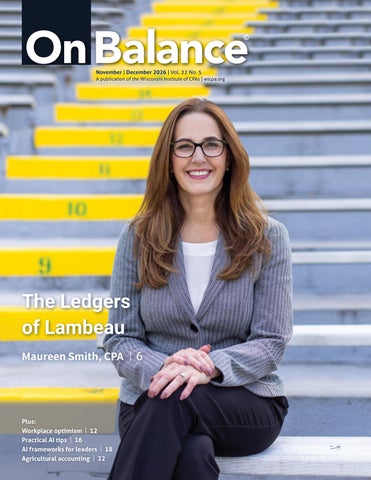
The Ledgers of Lambeau Maureen Smith, CPA | 6
Plus: Workplace optimism | 12 Practical AI tips | 16 AI frameworks for leaders | 18 Agricultural accounting | 22
CELE
B R AT E
ACCOUNTING CAREERS MONTH NOVEMBER 2026
Inspire the future talent. To help raise awareness of the accounting profession, we’re looking for volunteers to go into high schools to talk about accounting as a career. We’ve made it extremely easy for you to participate! Reach out to one or more high schools you’re interested in speaking at Schedule a day and time with the school Let us know by completing the Accounting Careers Month Volunteer Form We’ll provide you with everything you need including a presentation, talking points, tips, resources and fun gifts for students!
Get involved at wicpa.org/CareersMonth
Wiscons Certifie
A publication of the Wisconsin Institute of CPAs | wicpa.org
November | December 2026 Vol. 22 No. 5
6 Features
Columns
6
The Ledgers of Lambeau Maureen Smith, CPA, ensures the numbers off the field are equally important as the ones on it. Some accountants knew early in their lives which profession they would pursue, but Smith, CFO of the Green Bay Packers, called an audible on her initial plans and never looked back. By Brent Roberts
22 AGRICULTURAL ACCOUNTING Moving Beyond Tax Compliance: Using Established Farm Guidelines to Create Advisory Opportunities Typically, farmers maintain cash-basis records of income and expenses and asset listings for tax depreciation; then they trust their CPAs to convert that information into tax returns. By Daniel J. Nugent, JD, CPA
12 Embracing the Sunny Side of Work and Life Will Only Help Leaders Grow Their Teams and Businesses While staff appreciate efforts at providing a better work-life balance, they look up and see a lot of frustrated people. If the life of a leader looks unattractive, the firm may have a succession problem on their hands. By Gary Thomson, CPA
26 COMPELLING CULTURE The Power of Culture A good employee gives notice, and you’re caught off guard. The compensation was competitive. The work was interesting. On paper, nothing was wrong. So, what happened? By Corie Hoffman
16 Modern Finance, Smarter Tools: Practical AI For Decision-Makers AI is no longer simply a buzzword in finance; it’s a practical tool in the decision-making process that allows teams to spend less time crunching the numbers and more time having conversations and making decisions. By Mary Newby, MSBA 18 The Horses Are Already Out of the Barn The tools are out, and employees are using them with very little restrictions or controls. But there certainly is the need to build fences and establish rules for where they can go. By Jeffrey T. Lemmermann, CPA, CISA, CITP, CEH wicpa.org
30 RETIRING ACCOUNTANTS From Ledger to Leisure: The Strategic Retirement Blueprint for Accountants Transitioning from a career defined by precision and balance sheets to a fulfilling retirement requires more than just a healthy savings account. By treating your retirement as the ultimate long-term audit of your life, you can secure a future that is as stable as it is rewarding. By Randolph P. (Randy) Johnston, MCS 34 AI IN ACCOUNTING AI Won’t Replace Accountants, but Stagnant Thinking Might Another deadline, another missing document and another return waiting for review will always appear. Being too busy to learn may feel understandable; however, it is becoming a dangerous business strategy. By Sherron Permashwar, CPA/PFS
On Balance
16
22 Departments 3
Outlook | chair’s letter
4
In Touch | president & CEO’s message
11 Welcome | new members 25 Memorials | departed members 33 Kudos | members in the news
November | December 2026
1
On Balance is published five times a year by the Wisconsin Institute of Certified Public Accountants (WICPA). Change of address should be sent to: Membership, W233N2080 Ridgeview Pkwy, Suite 201, Waukesha, WI 53188; Phone: 262-785-0445 or 800-772-6939; Fax: 262-785-0838; email: comments@wicpa.org. Statements and opinions expressed are those of the authors and not necessarily those of the WICPA. Publication of an advertisement does not constitute an endorsement of the product or service by On Balance or the WICPA. Articles may be reproduced with permission. © Copyright 2026 On Balance.
Join us online!
2026-2027 WICPA OFFICERS/BOARD MEMBERS
INSIDE STAFF
Chair Neil R. Keller, CPA
President & CEO Tammy J. Hofstede
Chair-elect Michael D. Donahue, CPA
Design & Layout Brett Stallman
Past Chair Stacy A. Stinson, CPA, MBA
Advertising Johnathan Dorsey
Secretary/Treasurer Christopher M. Cholka, CPA, CGMA
Editor Brent Roberts
Directors Jessica B. Gatzke, CPA, MST Jeffrey T. Lemmermann, CPA, CISA, CITP, CEH Kale Post, CPA, MPA Sali L. Sheafor, CPA Angela Storm, CPA
Printing Special Editions
AICPA Council Benjamin J. Hauser, CPA Wendi M. Unger, CPA
WE WANT YOUR FEEDBACK
March | April 2026 | Vol. 22 No. 2 A publication of the Wisconsin Institute of CPAs | wicpa.org
(AND WE HAVE SWAG!) (GIVING) TO BACK THE FUTURE
May | June 2025 | Vol. 21 No. 3
Allyson Hofstede, CPA | 6
A publication of the Wisconsin Institute of CPAs | wicpa.org
May | June 2026 | Vol. 22 No. 3 A publication of the Wisconsin Institute of CPAs wicpa.org
Love On Balance? Wish it covered different topics? Have ideas to make it even better? Now’s your chance to tell us.
Plus: Internal Revenue Code Section 1031 | 12 Artificial intelligence policies | 16 Roth conversions and estates | 20 Cybersecurity auditor opportunities | 34
Class Act
September | October 2026 | Vol. 22 No. 4
A publication of the Wisconsin Institute of CPAs | wicpa.org
Stacy Stinson, CPA, MBA | 8
Plus: Trade issues | 14 Changes to ERC | 18 Auditing in economic uncertainty | 22 Workplace culture | 30 Tax bill update | 36
SUPER CPA Neil Keller, CPA | 6
Complete the On Balance reader survey by Nov. 30 and you’ll be entered to win one of five WICPA Swag Bags.
PLUS: Automation advantages | 12
Student loans and retirement savings | 16
S corporation elections | 20
Hidden Excel secrets | 32
Achievements and Altruism Michael Friedman, CPA, JD | 6
Plus: QM policies | 12 Fraud risk | 16 Data center taxes | 20 Forensic accounting | 24
4 Share your thoughts. 4 Win some swag. 4 Help shape the future of On Balance.
2
On Balance
November | December 2026
Take the survey today! Scan here or visit wicpa.org/OBSurvey
wicpa.org
OUTLOOK | CHAIR’S LETTER “Our willingness to change, our ability to accentuate the human element and our constant vigilance will help ensure that we take ownership of our profession while embracing the power of AI to help make the profession better.”
Accounting Isn’t a Game … or Is It? By Neil Keller, CPA
I
t is no secret that I am a big video game nerd. One of my favorite games back in college was a game called Tetris in which randomly shaped pieces fall from the top of the screen at an ever-increasing pace, and your job is to arrange them to make lines before they stack all the way to the top. Little did I ever expect that the lessons I learned from playing that game would make for a successful career in accounting.
Focus on the current; miss the opportunities of the future One aspect of Tetris was that it gave you a preview of what piece was coming next. Many of my friends would be so focused on where they were going to put the falling piece that all they could do was react to each following piece. My placement was always based on not just what I had but what was coming. Isn’t that really a key to our profession? For CPAs, there is tremendous value in our consulting and our proactive approach to not only our clients but also to our own firms and businesses. CPAs who are too focused on today miss where the profession is heading and ultimately are always playing a game of catch-up, which is becoming harder to do in our rapidly changing landscape.
the flip side, during my career I have met CPAs who were so worried about making a mistake that they became ineffective at their roles. “Analysis paralysis” is a real thing!
When things get too fast, fall back to the basics Inevitably, there would be a point in each game of Tetris when the pieces fell so fast that it became overwhelming. In my best games, when this would happen, I would just focus on making solid decisions until I became accustomed to the speed, and then I could go back to more complex planning.
It was surprising to me how often one of my friends would be doing great playing Tetris and then make one bad move that would compound into another and another until they would ultimately lose.
The pace of change in the accounting profession is faster now than any other point in my 30+ year career. I discussed this rapid change in my last column, and it can be a real challenge for all of us. CPAs can meet this feeling of being overwhelmed by going back to what makes us special. If we meet the challenge by relying on our strong ethics to guide us and our intelligence and great work ethic to learn, adjust and excel, we can still be successful, even if the pieces keep falling faster.
Even the best in our profession will undoubtedly make a mistake from time to time. What the successful ones can do is learn from it, fix it as best as they can and move on. From personal experience I can tell you that some of the most important things I learned through my career were about things I should have done differently. When I am speaking to students and new CPAs, I love to share those stories because they show that perfection is an unattainable goal, and it is how you handle those situations that really shapes your story. On
Neil Keller, CPA, is a principal at Sikich and the WICPA board of directors chair. Contact him at neil.keller@sikich.com or 262-317-8578.
Don’t dwell on mistakes
wicpa.org
Just like my friends and Tetris, CPAs are all playing the same game, but it often comes down to our approach to determine what we make of our career. How we move the pieces we face will go a long way in deciding our CPA experience. Here’s to wishing you that straight piece when you need it most (if you know, you know).
On Balance
November | December 2026
3
IN TOUCH | PRESIDENT & CEO’s MESSAGE “For many students, meeting a CPA is the moment accounting becomes more than a class or a career option. It becomes a possibility.”
November Is Accounting Careers Month Inspiring the Next Generation of CPAs By Tammy J. Hofstede
T
CELE
B R AT E
ACCOUNTING CAREERS MONTH NOVEMBER 2026
he accounting profession continues to play a vital role in the success of Wisconsin’s businesses, communities and economy. Every day, CPAs help individuals and organizations navigate change, make informed decisions and build stronger financial futures. The impact of our profession extends far beyond numbers, and that’s something worth celebrating. For the fourth year, I am proud to share that Wisconsin will recognize November as Accounting Careers Month. This statewide initiative shines a spotlight on the tremendous contributions CPAs make every day while helping students and future professionals discover the many opportunities available within the accounting profession. We know the profession offers far more than many people realize. Accountants serve as trusted advisors, business leaders, entrepreneurs, consultants, innovators and strategic decisionmakers. Yet many students have little exposure to the profession or the diverse career paths it offers until someone takes the time to share their story.
Brenna Van Rooy, CPA, spoke to a class at Appleton North High School about the benefits of accounting.
While we celebrate our profession, we also recognize the important work ahead. As firms and organizations continue to face workforce shortages and experienced professionals approach retirement, attracting the next generation of talent has never been more important. By sharing our experiences and passion for the profession, we can help students discover the opportunities that an accounting career provides. As part of Accounting Careers Month, I invite you to invest just one hour in the future of our profession. Speaking to students about your career journey can open doors they may never have considered. Whether you work in public accounting, business and industry, government, education or
4
On Balance
November | December 2026
Lisa Hansen, left, visited Maisy Hansen’s Waukesha West High School class to speak about a career in accounting.
wicpa.org
consulting, your story has the power to inspire future CPAs. Students often connect most strongly with real experiences: hearing how you chose accounting, what challenges you’ve overcome and why you continue to find purpose in the work you do. You do not need to be a professional speaker to make an impact. A single conversation, classroom presentation, career fair appearance or mentoring opportunity can help a student see possibilities they may never have considered before. For many students, meeting a CPA is the moment accounting becomes more than a class or a career option. It becomes a possibility. I hope you’ll join us by volunteering to speak with students this November or throughout the year. Together, we can strengthen our profession, support Wisconsin’s future workforce and help shape the next generation of leaders.
YOU can make a difference. Thank you for your continued commitment to the profession and for helping ensure a strong future for accounting in Wisconsin. To learn more about Wisconsin Accounting Careers Month and volunteer opportunities, visit wicpa.org/careersmonth. Tammy J. Hofstede is president & CEO of the WICPA. Contact her at 262-785-0445 ext. 4518 or tammy@wicpa.org.
CELE
To help raise awareness of the accounting profession, we’re looking for volunteers to go into high schools to talk about accounting as a career.
B R AT E
ACCOUNTING CAREERS MONTH NOVEMBER 2026
To learn more, visit wicpa.org/CareersMonth Wisconsin Institute of Certified Public Accountants
wicpa.org
On Balance
November | December 2026
5
The Ledgers of Lambeau — Maureen Smith, CPA
6
On Balance
November | December 2026
wicpa.org
Maureen Smith, CPA, ensures the numbers off the field are equally important as the ones on it.
S
ome accountants knew early in their lives which profession they would pursue, but Maureen Smith, CPA, CFO of the Green Bay Packers, called an audible on her initial plans and never looked back.
Smith earned her undergraduate degree in sociology and recalled, “Due to a number of life events, I needed to find a career path to provide for my young family, and most of the options By Brent Roberts using my field of study were not really going to generate the kind of income that I needed. So, as a single mom, I started looking at careers that were going to be accommodating to a young family and stumbled into accounting.” Despite that career pivot, accounting wasn’t a totally foreign concept to Smith, whose aunt was a CPA and grandfather a corporate controller at General Motors. Even during her time studying sociology, Smith was drawn to the demographics and population studies — basically, the numbers side of things — although she had never taken a business class. Facing the crossroads in her life head-on, she went back to school, fulfilled the accounting major equivalency, took all the classes in order to sit for the CPA Exam (which she passed in 2002 in Minnesota and scored in the top 10 in the state) and then started her career in public accounting in her late 20s.
Team, talent and tenure So, where does Smith find enjoyment and inspiration in her day-to-day role? Much like the Packers players and coaches, she needn’t look any further than her team. “At different phases of our careers, we enjoy different pieces of it. I will say I’ve been here for three years, and I delight in the long-tenured staff, their dedication to the team, the knowledge that exists about the organization and the established nature of that. I’ve come from start-ups and small business accounting, and having the history and the longevity here is amazing,” said Smith, who also oversees the team’s IT function and the business side of its real estate development. “I really enjoy the team of people I lead and find them to be delightful. I take a lot of joy in getting the team around some strategic goals, seeing them produce and being part of setting the vision, but really working with them on where we’re trying to go — that’s very exciting to me at this point in my career.”
wicpa.org
On Balance
November | December 2026
7
Typical day … no way Is there such a thing as a typical day in any area of accounting, including sports? “There is no typical day in professional sports,” Smith noted. “We have seasons. Right now, we’re in football season, which is the time of year when we get all of our day-to-day accounting responsibilities and the added excitement of hosting games and all the spikes that come with our revenue and activities.” She further explained, “In January we’ll move into our budgeting season (we’re on a March 31 fiscal year) and spend the first three months of the year preparing and presenting our budget, and then like everyone else, we’ll move into our audit and reporting season. We have significant National Football League (NFL) reporting that goes along with our financial statement audits, for both the salary cap and other required league reporting, where they attempt to make our financials ‘apples to apples’ with the other teams. “That takes us through around the end of June, and we spend the summer focused on our shareholder reporting and getting ready for our annual shareholders’ meeting. And then we head back into gearing up for the football season.”
Cap and GAAP Along with not having a typical day, Smith and her team face unusual challenges, some specific to the league and others unique to the Packers. “The impact of player contracts on our financial statements is not insignificant. They are a very significant portion of our expense and are one of the most important things that we invest in,” she explained. “Additionally, salary cap accounting and GAAP accounting are very different things, so you have to understand how to translate them. I don’t have to be a cap expert, but what I have to be — and what I need my team to be — is capable of translating the differences so we can simplify and articulate how the players’ contracts are impacting our financial performance. Also, multistate payroll and the large payroll that exists for players goes into that and the complexity of it.” Smith also cited revenue reporting as a key area because the NFL salary cap is based on revenue, both nationally and locally. “The Packers’ revenue activity is also audited separately, and the players’ union is definitely interested in the revenue performance because of the impact on the cap,” she said. “Beyond that, the unique structure — the one-of-one of the Packers — definitely is different, so we don’t report to an owner, but we share our financials and have oversight from a board and accountability to our shareholders, and that makes this role very different than any of my peers, either in soccer or in football,” Smith stated. “It’s one of the most rewarding
8
On Balance
November | December 2026
Smith reflects on the joy of serving in a leadership role for an NFL team.
“
It’s one of the most rewarding things, and we get the opportunity to really use the strong financial performance to reinvest in both the team and our facilities as well as the Packers’ larger commitment to our community reinvestment. things, and we get the opportunity to really use the strong financial performance to reinvest in both the team and our facilities as well as the Packers’ larger commitment to our community reinvestment.”
wicpa.org
Gateway to the gridiron Knowing what’s involved with working in accounting for a professional football team, Smith suggested there’s not one specific career path to take for someone who wants to work in this area. “I think there are a lot of different routes one can take to get here. I will say the thing I find the most beneficial in my role from the path that I took was the broad range of experience. So, I wasn’t narrowly focused in my previous roles, and I have a lot of different exposure to a lot of things, and that’s very helpful,” Smith said. “I think public accounting is always beneficial in your path, whether you stay there for a few years or a long time, because it gives you such a great baseline for your career. So, I recommend that people spend at least some time finding out what they can learn in public accounting, even if they don’t intend to stay there for their whole career.” Smith lived that path, having started her career in public accounting, and then spent some time doing small-business consulting, mostly for the flexibility while she had five young children. From there, she went to work for a Fortune 5 company — UnitedHealth Group — for five years, then onto a soccer team (Minnesota United FC, which is a privately held company), and now she “gets the extreme honor to work for a publicly owned nonprofit corporation that’s not publicly traded and is a one-of-one sports team,” so all of those experiences provided her with that opportunity.
Motivating mentors Having achieved this level of success in her career, Smith reflected with gratitude on some of the key people who have helped her along the way. “I’ve had a lot of people who have influenced my career. The partners at my first public accounting firm in Minneapolis, who are both retired now, took a chance on me as I was starting my career and heading into my first busy season,” she recalled. “Especially with young children and perhaps needing more flexibility than many of their starting associates needed, their willingness to take me under their wing was really impactful.” Smith also credited Dr. Bill McGuire, the owner of Minnesota United FC, who “made a huge impact on me. I really appreciated his drive and vision and his relentless pursuit of what he believed he could bring to the community, and I was really honored to be part of building that project with him. He taught me a lot about how to translate the skills in accounting into a story and the need for someone in my role to tell the right story with the numbers.” She also expressed a strong belief in the value of becoming a CPA and of organizations like the WICPA that represent accounting professionals.
wicpa.org
Smith and her team face unusual challenges, and there is no typical day in professional sports.
“
My CPA designation is something I take a lot of pride in, and being a member of an association (WICPA) that represents our profession is really important to me. “My CPA designation is something I take a lot of pride in, and being a member of an association that represents our profession is really important to me,” Smith said. “I appreciate the network, the education, all the things you can learn from having that peer group. I think these associations help advocate for why our profession is so meaningful and why we need to continue to get young people interested in this career.”
The path paved in green and gold Smith grew up in Michigan and raised her family in Minneapolis, where her husband also is from, so they spent 25 years there before moving to Green Bay for her current role.
On Balance
November | December 2026
9
“My parents were so excited back in Michigan because they felt like I was moving home, and I had to remind them that there’s still a big lake between us!” Smith shared. “But I look at Green Bay as splitting the difference, so I’m halfway home, and I’m doing something I really love for an incredible organization.” So, is Smith a Packers fan in addition to being the CFO? “Of course! I go to all of our home games and about half of our road games. I added a lot of green to my wardrobe when I joined the Packers,” she said. “When I stop down to see my family in the stands, I’m definitely known to let out a cheer. I would say that fandom takes on a different feeling when you work for a team and you’re invested in different ways. You want the wins just as badly, but you understand the implications in a way that’s more than fandom.” Outside work, she and her husband have five grown children, who live in five different states, and four grandchildren, and she said visiting them in all of those places is her highest priority. She also serves on the board of the Greater Green Bay Community Foundation and plays competitive beginner women’s hockey. “I started playing in my 40s with a team of women in Minneapolis, and they agreed to let me keep my roster spot when I moved to Green Bay as long as they could tell people that the team treasurer is the CFO of the Packers,” Smith said.
Smith (center) and two of her teammates on the Loonachicks celebrate after a game.
“So, when I get back to Minnesota for four or five games a year, I get back out on the ice, and that’s been a delight. I was inspired by my youngest son who was a hockey player, and I really enjoy it. I didn’t get to play team sports growing up because there weren’t many opportunities for girls, and I felt like I missed out. Now I get to be in a locker room on a team of women, and while we skate slow, we get to have all the experiences of being on a team.” Brent Roberts is the WICPA communications director. Contact him at 262-785-0445, ext. 4515, or brent@wicpa.org.
Check out our featured member benefit providers von Briesen & Roper, S.C.
Waukesha State Bank
Franklin Alliance
von Briesen & Roper, s.c. is a full-service law firm with seasoned experience in local, state, federal and international tax matters. From our offices throughout Wisconsin, Chicago and Naples, Florida, we partner with CPAs on business transactions and dispositions, mergers, employee benefits, intellectual property, audits, tax controversies and more.
Established in 1944, Waukesha State Bank is one of the largest locally owned and independent community banks in Wisconsin, with full-service offices in Brookfield, Delafield, Menomonee Falls, Mukwonago, Muskego, New Berlin, Oconomowoc, Pewaukee, Sussex and Waukesha. Learn more at www.waukeshabank.com. Member FDIC.
Franklin Alliance is an operating company that partners with independent boutique CPA firms. As a growth and succession partner, it invests capital, provides recruiting, technology, and offshoring support while firms keep their name, culture, leadership, and meaningful ownership. We are backed by patient capital to provide you with more resources.
These affinity partners and more can be found at wicpa.org/discounts.
10
On Balance
November | December 2026
wicpa.org
WELCOME NEW MEMBERS! Get to know the newest members of the WICPA. August 1 – September 30, 2026
Patrick Arne
Ruby A. Escareno
Carly Lois
Evan Roge
Louisa Barnum
Anthony Evers
Brady Lonigro
David Rosario Perez
Antonio Ferreira
Philip Lowney
Rowan Franke
Emma Mangarelli
Mid-America Real Estate Masters, Vrakas CPAS + Advisors
Sandra Bender Zachary D. Berghouse R&R Insurance Services
George Bezold
Deloitte & Touche LLP Barr Inc.
UW–Platteville
Katherine Frey
Vrakas CPAs + Advisors Menasha Corporation
Yi Russin
Deloitte & Touche LLP
Katie M. Mathison
Anna R. Blair
Andrew R. Garcia
Leo Matuga
Sheldon J. Brookins
Daniel M. Gierczak
Cheryl A. McCormick
Erin Brown
Carter D. Grim
Hailey Miller
Adam Buchinger
Molly Hansen
Elizabeth Mueller
Jack J. Cannizzo
Kelly Hanson
Zeph Childers
Dakoda D. Hawkins
Viterbo University Baker Tilly
Veriha Trucking UW–Madison
Brookdale Senior Living BDO USA, P.C.
UW–Platteville
Wipfli Financial Advisors, LLC RSM US LLP
Korry C. Rowe
Reinl Accounting, Inc.
Ernst & Young LLP
Monroe Tax Consultants LLC
St. Norbert College
Deloitte & Touche LLP
Blue Eagle CPA LLC
Michael Sandwisch Jr. Tremper High School
Dean A. Schara
Carroll University Unit Drop Forge
Lukas Schinella
Processed Metals Innovators Inc.
Kole M. Schmitz
Vrakas CPAS + Advisors
RSM US LLP
Owen M. Simonar
Pinnacle Consulting Group, LLC
Garrett Smith
Alexis Naumann Alexi A. Needham
PwC
Wegner CPAs
Sandra L. Swan
Dennis W. Nelson
Hannah Thede
Christine Novak
Olivia K. Thompson
Maria Jaramillo
Tyler Obradovich
Jacob Trickey
Honkamp, P.C.
Kendra L. Jensen
Zachary M. Oszman
Craig Varney
Whitney Dehart
Jennifer J. Johnson
Harsh Patel
Skylar Wade
UW–Platteville
Caleb A. Chrudimsky UW–Platteville
Joshua Deakin KPMG LLP
Cora L. Decorah
UW–Platteville
Holly Hopkins Benjamin Janiszewski PwC
Appvion
Christopher Johnston
Joshua DeMars
Michael Joyce
Nature’s Way Brands
Abigail Dennis MBE CPAs, LLP
Bridget Doran
Ernst & Young LLP
Jonathan Dudzinski Hannah Eggers
Precision Pipeline
Ian Emmerich Colin D. Enz RSM US LLP
wicpa.org
Ernst & Young LLP
ACRO Automation Systems, Inc.
Baker Tilly
Wipfli Advisory LLC
Batley CPA, LLC
Summit Accounting Group, Inc. Carew Concrete & Supply Co., Inc. RSM US LLP
Baker Tilly
UW–Stevens Point
Madelyn Walz
Amelia Pena
CarlsonSV
Katharine Petts
Calvin M. Wambura
Hunter Kowalski
Christine Popowski
Jason Weaver
Karlie I. Kroening
Eric Rabe
Julia M. Weber
Jessa J. Read
Megan Wegner
Kaelyn R. Kelly
Carthage College
Trenton Krogmann
Vrakas CPAS + Advisors
Marina Kuksgauzen Aaron Leighty Harmony Lightbody
Craig High School
UW–Stevens Point
Wipfli LLP
The Osthoff Resort
Ernst & Young LLP
Parker J. Reich
John M. Werner
Ramona L. Rogan
Goodwill Industries of Southeastern Wisconsin
On Balance
REI Tax Guys
Derek Ziesmer
Madison Mallards
November | December 2026
11
Embracing the Sunny Side of Work and Life Will Only Help Leaders Grow Their Teams and Businesses
C By Gary Thomson, CPA
PA firm leaders are understandably frustrated today with everyday challenges, the unrelenting pace of change and pressures to ensure future viability. What some leaders don’t understand, though, is they’re not hiding their feelings — they leak out indirectly, infecting everyone from their partners to first-year recruits.
While staff appreciate efforts at providing a better work-life balance, they look up and see a lot of frustrated people. If the life of a leader looks unattractive, the firm may have a succession problem on their hands on top of everything else.
12
On Balance
November | December 2026
But while there’s no denying we’re operating in a difficult business environment, it’s also opportunistic. This mix of frustration and opportunity is precisely why leaders must cultivate optimism — it provides the balance needed to navigate the storm while steering toward growth. That doesn’t mean putting on an exuberant, bubbly, rah-rah facade. It doesn’t mean you have to change who you are or ignore the pressures the firm is facing. Think substance over style. Clarity on the firm’s future and the strategies needed to get there lead to a confident, genuinely positive outlook, and if communicated correctly, the rest of the firm will feel it too.
Know yourself first Optimism isn’t just a mindset; it begins with self-awareness. Leaders should understand their own strengths and weaknesses and strive to understand why and how they affect other people
wicpa.org
One way to find your North Star is to ask some tough questions, such as: • What is our five-year vision for the firm? • What are the priorities that support it? • What can we learn from past wins and challenges, and what will enable success in the future? • Should we explore private equity? • Is M&A better suited for us? • Are we considering offshoring and outsourcing? • Do we spend time on technology and automation?
Communicate thoughtfully These questions can be discussed in a partner meeting or retreat. I’m a big fan of setting an end date, such as three to five years, and using the plan as a rallying cry in all communications.
— and why others affect them the way they do. You may need to adapt your approach to accommodate others. For example, people process information and express themselves differently. Adjusting your communication style helps ensure your message is understood and received how you intended. Leaders should also adapt to others’ work styles, showing they can adjust their behavior depending on who they are leading. When you show flexibility in your behavior, others feel respected and valued. Be aware enough to connect with others in ways that maximize understanding, collaboration and success. Not only can you develop a more empathetic leadership style, but knowing your own strengths and weaknesses breeds confidence, which is contagious.
Use your strategic plan as your North Star I recently met with a group developing a strategic plan, and the preamble stated that every strategy was designed to further the firm’s overall goal: to remain independent. Every firm needs that kind of clarity — a North Star. Without common ground, partners may answer staff questions about the future in different ways, confusing employees about where the firm is headed. Even though leaders have different personalities and communication styles, clarity means they’ll hit the same themes in conversations.
wicpa.org
Your starting point in meetings — by industry, offices, staff levels or another combination — should involve a reminder of the firm’s focus. Maybe the goal is to be Virginia’s top independent firm by 2030. Repeating the goal and expectations surrounding it sets the tone and tempo for the meeting, keeping everyone aligned on the “why” and “how.” Once the North Star is clear, the next challenge is ensuring it’s communicated consistently across the firm. This is so important because the accounting profession tends to separate information into different buckets — this applies to the equity partners, this only relates to supervisors, etc. Feeding out information in bite-sized chunks doesn’t help staff put all the pieces together. A consistent message, communicated in a relatable way to various groups, creates a culture of clarity that breeds optimism about the future. Bolster your communication with genuine care and concern by staying in touch with your teams and serving as a facilitator and source of information and resources. Stronger relationships almost always lead to better outcomes, especially when paired with true collaboration. This is particularly important when working across multiple generations, where buy-in and optimism are far more likely when people feel respected, included and part of the solution.
Test your North Star Even with the best intentions, optimism can slip away without focus. Keep asking questions, at least annually, to make sure you’re still on the right track and your strategies are aligned. We can’t ignore that technology and competition are revolutionizing the profession. Modifications may be necessary.
On Balance
November | December 2026
13
“
However, don’t change directions so fast that people’s heads are on a spindle. I suggest doing a quick test on your goals and strategy. Discussion points should cover progress over the last year in meeting priorities; whether the priorities should remain the same; and whether some activities should be stopped, started or continued.
In essence, optimism serves as both a personal anchor and a collective motivator.
Develop ‘an unwarranted degree of optimism’ When I think about leadership, I often reflect on one of my favorite quotes. It’s from organizational consultant and author Warren Bennis in The Leadership Advantage: “Every exemplary leader that I have met has what seems to be an unwarranted degree of optimism — and that helps generate the energy and commitment necessary to achieve results.”
I also like this quote from salesman, author and motivational speaker Zig Ziglar: “People often say that motivation doesn’t last. Well, neither does bathing — that’s why we recommend it daily.” Optimism is not about ignoring reality; it’s the discipline of charting a future course, communicating it clearly and believing in your firm’s ability to not only get there but to thrive.
Bennis suggests that without this hopeful outlook, leaders may struggle to rally others or sustain momentum. In essence, optimism serves as both a personal anchor and a collective motivator. I believe optimism can be fostered through discipline. If optimism isn’t intuitive, some daily structure can help. Recognize the patterns and triggers that get you thinking more optimistically. Develop habits to demonstrate optimism that are unique to your own motivations — and hold yourself accountable.
Gary Thomson, CPA, owns Richmond-based Thomson Consulting. With nearly 40 years of experience, Thomson has launched and grown his own CPA firm and now consults with firms of all sizes on practice management, leadership and other topics. He is a former chair of the VSCPA board of directors and long-time VSCPA volunteer. Reprinted with permission from the Virginia Society of CPAs.
FOR WISCONSIN CPAS & THEIR SMALL-BUSINESS CLIENTS
Secure, low-cost checks your clients can trust Give your small-business clients a lower-cost, high-security alternative Save your clients money with every check. High-security features that help reduce check fraud risk. Compatible with leading accounting and payroll platforms. Optional variable-data printing and mailing for statements, invoices, and account notices.
Scan to get your exclusive 10% CPA savings code
14
On Balance
November | December 2026
bank-a-count.com | 1-866-385-6316 Serving financial professionals since 1956 4.9 rating from business customers.
wicpa.org
Join the WICPA Educational Foundation Board! The WICPA Educational Foundation is seeking members to serve on its board of directors. Some of the opportunities include: Assisting in efforts to attract students to the profession. Providing strategic governance in accordance with the WICPA Educational Foundation mission. Acquiring new leadership skills. The WICPA Educational Foundation plays a pivotal role in supporting programs to improve awareness and perceptions by educating students and educators about the exciting opportunities available to accounting professionals.
To apply, visit wicpa.org/EFBoardApplication through Feb. 27, 2027.
wicpa.org
Questions? Contact tammy@wicpa.org.
On Balance
November | December 2026
15
Modern Finance, Smarter Tools: Practical AI for Decision-Makers
Y
ou’re in the middle of a presentation and a board member asks you a question that isn’t in your slides — something like “What happens to our margin if steel prices rise another 6% next quarter?” A few years ago, you’d have to tell the board that you’d follow up in the coming By Mary Newby, week as you run the analysis and MSBA generate a report. But today, it means generating answers from a model instantly using artificial intelligence (AI). That shift from “I’ll get back to you next week” to “Let’s see right now” is how AI is revolutionizing finance departments. AI is no longer simply a buzzword in finance; it’s a practical tool in the decision-making process that allows teams to spend less time crunching the numbers and more time having conversations and making decisions. AI tools are all around us, and you may already be taking advantage of them without even knowing it’s AI. If you use QuickBooks, you’ve probably seen Intuit Assist suggest a transaction category or draft a client email. If you work in Microsoft Excel, you can use Microsoft Copilot to explain a formula or flag an outlier in your data. If your organization is utilizing NetSuite or Sage, embedded AI features are quietly summarizing variances and forecasting cash flow in the background. None of these examples require extensive technical knowledge or downloading new software. AI is already working inside the tools you use every day.
Critical decisions AI is delivering in five key areas for finance decisionmakers: forecasting, risk monitoring, close automation, self-service reporting and advisory support. 1
Forecasting and scenario modeling
Nowhere is AI’s practical value more direct than in forecasting. Traditional forecasting means building a model and manually rebuilding it each time an assumption changes, like a rate change or a slow month. AI-assisted forecasting tools, on the other hand, hold the underlying relationships live. This means changing assumptions automatically recalculates the whole scenario in seconds instead of hours. Many AI tools also ingest actuals continuously, making forecast updates dynamic instead of static between quarterly budgeting cycles.
16
On Balance
November | December 2026
“
AI tools are all around us, and you may already be taking advantage of them without even knowing it’s AI. 2
Anomaly detection and risk monitoring
Traditional error detections work off fixed rules like “flag any expense over $1,000” or “flag any transaction on a weekend,” which can be easy to work around. AI-based anomaly detection is more dynamic. The AI tool learns what “normal” looks like for a specific vendor, employee or account and flags anything that breaks that pattern. 3
Close and reporting automation
Month-end close uses AI-assisted tools to automate the routine matching that is usually done by hand. The tooling brings in a human only when something doesn’t match or looks unusual (similar to anomaly detection and risk monitoring, just applied to the close checklist). So, while AI tools trim the time it takes to close, it doesn’t skip any crucial steps. Instead, it automates the steps that never needed a human’s judgment in the first place. 4
Natural-language financial queries
Arguably, the most mainstream way folks are using AI today is through conversational AI, which is asking an AI-enabled tool questions in plain English. This method of utilizing AI can be extremely beneficial in finance spaces. For example, someone outside the finance department wants to know why marketing spending jumped last month; instead of asking the team to compile data and produce justification, you could ask a conversational AI tool. An integrated natural-language query tool allows you to ask a question in plain English, and the tool searches the underlying financial data to provide a direct answer. It’s the difference between requesting a report and asking a question. 5
Client advisory services
Advisory work is where CPAs add the most value but are often bottlenecked by research time. Using AI tools to do research and data gathering cuts the prep time, so more of the engagement is spent actually advising instead of gathering.
wicpa.org
“
While the capabilities of AI are impressive, none of these focus areas work without discipline, and that’s where a CPA’s judgment matters most.
Use your judgment While the capabilities of AI are impressive, none of these focus areas work without discipline, and that’s where a CPA’s judgment matters most. The first guardrail to consider is data governance and confidentiality. Consider where the data (your organization’s or your client’s) goes once it’s in the AI tool. Ensure you are following all data governance protocols, and discuss them with your vendors and/or internal IT team before implementing new AI tools. Next, ensure human oversight and professional judgment are looped into every step where AI is implemented. AI tools are drafting assistants, not decision-makers. Even the most sophisticated AI tools can be wrong, so human intervention is essential to achieve optimal efficiency and consistent results from the tools. Finally, consider and stay up to date with regulatory and ethical guidelines. The AICPA has published ethics guidance specific to AI-powered tools, and the WICPA has run continuing education sessions on responsible AI use for Wisconsin CPAs.
Intent to implement Now that you understand what AI can do and the guardrails to consider, how do you start implementing it in your workplace? My advice: Start simple. The goal of introducing AI isn’t necessarily an ROI but building confidence with the tool before entering high-stakes implementations.
wicpa.org
Before buying anything new, see what you already have! As discussed earlier, a surprising amount of AI capability is already included in tools your teams are using. Get acquainted with how you can take advantage of your current AI capabilities with tools you already pay for. I suggest building your team’s AI literacy in small pieces. For example, a short, recurring team training on something quick and easy that AI can accomplish will help your team feel empowered to use and explore the tools. While introducing AI to your teams, set a simple data policy before adoption spreads informally. It doesn’t need to be complex or exhaustive; it just needs to clearly state what kind of client or company data can and cannot be used by a given tool. AI in finance isn’t about replacing professional judgment; it’s about giving professionals more time and more information to make judgments more quickly and comprehensively. Every example in this discussion points to the same trade: less time gathering, reconciling and rebuilding and more time deciding. That’s a meaningful shift for finance teams, but it pays off only when guardrails like data policies are considered. The firms that benefit most from AI won’t be the ones that adopt it the fastest; it will be the ones that adopt it deliberately. Mary Newby, MSBA, is a data analytics consultant at 7Rivers, Inc., where she works with data vault engineers and business stakeholders to ensure the data is accurate and meets client needs. Contact her at mary.newby@7riversinc.com.
On Balance
November | December 2026
17
The Horses Are Already Out of the Barn!
AI frameworks can help organizations put up the fences that should have been in place before adoption began.
N
othing highlights the breakneck pace that technology development has taken more than what is going on with artificial intelligence (AI) today.
Faced with pressure from competitors, the AI-everywhere mentality of vendors and the everBy Jeffrey T. increasing need to do more with Lemmermann, CPA, less, business management has been CISA, CITP, CEH put in the position of having to embrace a technology it largely knows little about — and even less on how to control it. In May of 2026, Gallup released the statistics that 52% of employees use AI in their current role. An April report from the
Federal Reserve reported that 78% of the U.S. workforce were working for a firm that has adopted AI. Yet a July survey from Nationwide Cybersecurity1 shows that only 35% of companies have written policies or guidelines on the use of AI tools. The tools are out, and employees are using them with very little restrictions or controls. For most, there is little desire to put the horses back in the barn. But there certainly is the need to build fences and establish rules for where they can go and determine who is responsible for the gate.
Frameworks matter … again! The early mantra has been to develop an AI policy and tell employees to use AI responsibly. All well and good, but that is like posting a sign that says the horses should go to the river west of the barn to drink. The “how” to get them to the river matters. Frameworks are more than policies. https://news.nationwide.com/download/517767c8-d457-49de-bdc3a46fa54f41f2/nationwidecybersecuritysurvey2026report-final.pdf 1
18
On Balance
November | December 2026
wicpa.org
With AI usage spreading through organizations, management is now asking questions: What AI are we using? What data is going into it? Who approved it? What decisions are being made with it? Can employees rely on the output? What happens when an AI agent can take actions rather than merely answer questions?
them. Within the ISO world, it would complement ISO/ IEC 27001, which is the global standard for managing information security, helping organizations protect sensitive data through a structured information security management system (ISMS). This table explains how the two work together:
These are all questions that a properly implemented framework will answer. Among other things, a good framework can help establish:
Shared Core Feature
How ISO 27001 Handles It
How ISO 42001 Extends It
Risk Management
Looks for cybersecurity threats to data confidentiality, integrity and availability
Looks at AIspecific impacts like algorithmic bias, model hallucination and societal risk
Data & Supply Chain
Protects infrastructure against data breaches and hacks from suppliers
Validates the data quality, lineage and compliance of third-party AI models
Operations & Audits
Mandates security monitoring, logging and periodic internal reviews
Tracks automated decision logs to ensure explanations can be provided if something goes wrong
• Inventory and ownership of AI systems • Acceptable and prohibited uses • Training, data-handling and human oversight requirements • Risk assessment, approval and impact-assessment processes • User and administrator training requirements • Requirements for vendor-provided AI tools • Monitoring and testing procedures and cadence • Periodic management review The point is that frameworks turn vague statements such as “use AI responsibly” into identifiable responsibilities, processes, controls and evidence.
Frameworks that are ready to help now The International Organization for Standardization (ISO) The ISO has provided the most comprehensive framework around AI to date. A global standard called ISO/IEC 42001:2023 outlines how an artificial intelligence management system (AIMS) should work. An AIMS focuses on three main ideas: • Control: Ensuring the AI acts predictably and follows company rules • Ethics and fairness: Checking that the AI does not show bias or treat people unfairly • Transparency: Keeping clear logs so human supervisors can look back and see exactly why an AI made a certain decision For our horses, this would equate to the setup of a management system: defining rules for when the horses need to be let out of the barn; a plan for regular health checks; backup plans for bad weather; and a way to record what has been done, when and by whom. That overarching plan is what an AIMS does for a company’s AI. ISO 42001 applies to organizations that develop, provide or use AI. The “use” part is the important item, since it by far encompasses the largest share of organizations. It is also designed to work with other frameworks, not replace
This is important because ISO 42001 can work with other frameworks, as well. If your organization has already adopted National Institute of Standards and Technology (NIST) SP 800-53, for example, ISO 42001 could be layered with the work that has already been done to help extend the depth that AI governance needs. National Institute of Standards and Technology Speaking of NIST, it has developed the NIST AI Risk Management Framework. Published in January 2023, the framework “seeks to cultivate trust in AI technologies and promote AI innovation while mitigating risk.”2 Like the NIST CSF (Cybersecurity Framework), this framework is organized into functions that are reliant on each other. These functions apply across all stages of an AI system’s life cycle: https://www.nist.gov/news-events/news/2023/01/nist-risk-management-frameworkaims-improve-trustworthiness-artificial 2
wicpa.org
On Balance
November | December 2026
19
• Govern: Establishes an organizational culture, policies, procedures and accountability structures dedicated to continuous risk awareness • Map: Identifies the context, intended purpose and potential impacts (including legal and social consequences) of an AI system • Measure: Employs qualitative and quantitative methods to evaluate AI trustworthiness, system performance and specific risks (like bias or error) • Manage: Allocates resources and applies technical controls or procedural safeguards to prioritize and respond to tracked risks While covering the same topic, the offerings from NIST and ISO can be used together to offer an even stronger management platform. ISO 42001 addresses this question: “How should we establish and operate an AI management system?” NIST AI RMF centers on questions like these: “What risks does this AI use introduce, how do we understand them, how do we measure them, and what are we going to do about them?”
“
The Committee of Sponsoring Organizations (COSO) of the Treadway Commission
The gates that are needed include establishing accountability, controls, monitoring mechanisms and reliable information processing methods.
COSO also has resources that are ready to help. The publication “Achieving Effective Internal Control Over Generative AI,”3 released in February this year, builds on work they did in 2021 with a document titled “Applying the COSO Framework and Principles to Help Implement and Scale Artificial Intelligence.”4 These resources put AI into the context of a tool that can be managed like other technologies across the organization. While AI creates new risks, many of the control concepts for managing those risks are well established. The new publication addresses these new risks with familiar internal control concepts of authorization, segregation of duties, data reliability, change management, management review, monitoring and oversight, and formal documentation. It also offers tools like starter templates, defined control testing procedures and metrics that are ready to use in any environment.
Where to go from here? AI governance isn’t creating something that hasn’t been seen before. The gates that are needed include establishing accountability, controls, monitoring mechanisms and reliable information processing methods. These are issues that are very familiar. Frameworks provide organizations with something badly needed right now: a structured method of deciding where
20
On Balance
November | December 2026
AI can be used, under what conditions, by whom, with what oversight and at what level of acceptable risk. Once the doors were opened, AI adoption outran AI governance. Frameworks such as ISO 42001, NIST AI RMF and COSO give organizations a way to catch up by converting AI from an uncontrolled collection of tools and experiments into a governed business activity. 3 4
https://www.coso.org/_files/ugd/719ba0_ef4dbc255331406e95faf46e7a9e3a1c.pdf https://www.coso.org/_files/ugd/3059fc_e17fdcd298924d4ca4df1a4b453b4135.pdf
Jeffrey T. Lemmermann, CPA, CISA, CITP, CEH, is a senior information assurance auditor and consultant at SynerComm Inc. in Brookfield. He has been working in cybersecurity for over 30 years, leading assessments, tabletop exercises and information security program development engagements across many industries. Contact him at 262-373-7100 or jeffrey.lemmermann@synercomm.com.
wicpa.org
wicpa.org
On Balance
November | December 2026
21
{ Agricultural Accounting | Farmer Tips }
Moving Beyond Tax Compliance: Using Established Farm Guidelines to Create Advisory Opportunities
T
By Daniel J. Nugent, JD, CPA
raditionally, many farmers have maintained their books primarily to prepare annual federal and state income tax returns. Typically, farmers maintain cash-basis records of income and expenses and asset listings for tax depreciation; then they trust their CPAs to convert that information into tax returns.
While necessary, the information on a tax return does not fully answer the questions farm managers should be asking, such as these: • Which components of my operation are profitable? • How much working capital is available? • Is my farm carrying an appropriate debt load? • What are the costs of production for each commodity? • Are business and personal activities properly segregated? • How does my farm compare to similar farms? The need for standardized agricultural accounting became apparent during the Farm Financial Crisis of the 1980s. In response, the Agricultural Division of the American Bankers Association commissioned the Report of the National Commission on Agricultural Finance, which identified a need for standardized agricultural accounting practices. Ultimately, this led to the founding of the Farm Financial Standards Council (FFSC), which maintains a standardized accounting framework for preparing financial statements to help producers better understand their farm businesses.
Primary challenge: Understanding tax vs. accrual accounting A major hurdle CPAs face is helping farmers differentiate between tax accounting and financial accounting. Cash-basis records or another permitted tax accounting methodology
22
On Balance
November | December 2026
“
The need for standardized agricultural accounting became apparent during the Farm Financial Crisis of the 1980s. may be appropriate for preparing a tax return, but they provide an incomplete or even misleading picture of a farm’s true financial performance. Consider a typical Wisconsin grain farm. The farmer may grow and harvest a crop in one year and then sell much of it the following year. Cash-basis accounting will capture most of the production expenses in the first year and most of the related revenue in the second. Further, changes in prepaid expenses, inventories and accrued expenses along with tax depreciation can obscure the farm’s actual profitability. The solution to this problem does not necessarily require the farmer to change their accounting process. Instead, CPAs can convert existing records into meaningful accrual-basis financial information following FFSC guidance. An accrualadjusted income statement can measure profitability, a balance sheet measures liquidity and solvency, and a statement of cash flows helps explain how cash is generated and used. For CPAs, this creates an opportunity to move beyond tax preparation and help the farmer understand their operations to make informed decisions.
FFSC frameworks The FFSC’s Financial Guidelines for Agriculture provide standards for agricultural financial reporting, while its Management Accounting Guidelines for Agriculture provide
wicpa.org
guidance for developing reliable management information. Together, they provide a framework for moving a farm from tax compliance toward improved financial management.
Step 1: Prepare financial statements The first step is developing a plan to move from IRS Schedule F information to accrual-adjusted financial statements. Typically, the farmer can continue to use existing accounting practices during the calendar year while enhancing the retention of certain financial information and keeping an electronic register of the farm’s checkbook. From these records, a CPA can assist in preparing a balance sheet at the beginning and end of the year using the records to make year-end adjustments to match revenues with related costs. This process synchronizes beginning and ending balance sheets to the cash-basis ledger, allowing a CPA to calculate accrual-adjusted revenues, operating expenses and financial depreciation.
wicpa.org
From these statements, a CPA can calculate measures of liquidity, solvency, profitability, repayment capacity and financial efficiency. A CPA also can explain the meaning of these measures to farmers and help them understand changes over time. These measures tell a farmer considerably more about their business than taxable income alone, as two farms with comparable taxable income can have different levels of working capital, debt, asset utilization and profitability. The standardization process of preparing financial statements helps to reveal these differences.
Step 2: Add management accounting Once whole-farm financial performance has been established, CPAs can help their clients move to enterprise accounting by establishing profit, cost and support centers. A profitable farm may have individual enterprises perform very differently. For example, a Wisconsin grain farm may produce corn and soybeans with an acceptable overall return,
On Balance
November | December 2026
23
{ Agricultural Accounting | Farmer Tips }
but one crop may have a substantially different net return than the other. Similarly, livestock operations may have significant differences in feed, labor, machinery and facility costs among different enterprises, locations or production segments. Management accounting provides a way to organize that information. A CPA can help a farmer establish consistent enterprise accounting for corn, soybeans, dairy, beef, custom work or other activities. Costs can then be analyzed at the appropriate production level, such as per acre, bushel, hundredweight or head. The goal is not to create more accounting work. Rather, it is to answer important questions: • Why is machinery cost per acre increasing? • What does it cost to produce a bushel of corn? • Is rented land generating an adequate return? • Which enterprise is contributing most to overall profitability? Those questions turn accounting information into actionable management intelligence.
Step 3: Benchmark performance After developing reliable financial and management information, a CPA can help the client analyze their operation against similar farms. The Farm Financial Management Database (FINBIN), operated by the Center for Farm Financial Management at the University of Minnesota, provides whole-farm, crop and livestock financial and production benchmarks. Users can create reports and select among different characteristics to develop comparison groups of similar farms. Benchmarking should serve as a starting point for discussion and investigation. For example, if a client’s return on assets is lower, is the problem the farm’s margins, asset utilization or both? What strategies could be implemented to improve the farm’s performance?
Creating a year-round advisory service The opportunity for CPAs isn’t to move away from annual tax compliance but to utilize their knowledge and relationships to support a broader financial management service. The FFSC provides the framework. Accrual accounting provides a better measure of economic performance. Management accounting provides a methodology to help determine the performance of individual enterprises and related costs. FINBIN provides external benchmarks for comparison.
24
On Balance
November | December 2026
“
A CPA can help a farmer establish consistent enterprise accounting for corn, soybeans, dairy, beef, custom work or other activities. Instead of the farmer simply asking, “How much do I owe?” the CPA can help the farmer ask: • How did my farm actually perform? • Why did it perform that way? • How does it compare with similar farms? • What should we monitor or investigate before making future decisions? For CPAs, this approach can transform a primarily compliance-based relationship into a year-round advisory relationship, where enhanced financial information helps farmers better understand and manage their businesses. Professor Daniel Nugent is a CPA who teaches accounting and business law at the University of Wisconsin-Platteville. He is currently the vice president of the Farm Financial Standards Council. Contact him at nugentd@uwplatt.edu.
wicpa.org
memorials Michelle Marie Adams, CPA (1954-2025)
Philip E. Hergert, CPA (1951-2026)
Michelle Marie Adams, CPA, age 71, passed away on Nov. 8, 2025. Adams joined the WICPA in 1977 and earned her CPA license in 1980. She is preceded in death by her husband, Bart, and is survived by three children, three grandchildren, four siblings and many other relatives and friends.
Philip E. Hergert, CPA, age 74, passed away on July 22. He graduated from Oshkosh High School in 1969 and the University of Wisconsin-Oshkosh in 1973 with a major in accounting. Hergert began his professional career at an accounting firm in Appleton and became a CPA in 1976. He returned to Oshkosh in 1984 to work for his family’s business, Hergert’s Sport Center, until 1987, when he started his own CPA firm, Malkowsky & Hergert. He sold the firm to KerberRose S.C. in 2013 and remained a shareholder. Hergert was an active WICPA member for more than 50 years and served on the organization’s Federal Taxation and Wisconsin Taxation committees. He is preceded in death by his first wife of 44 years, Mary Jo, and a sister. He is survived by his wife of four years, Melodi; two daughters; two grandchildren; and other relatives and friends.
Richard L. Blamey, CPA, CGMA (1941-2026) Richard L. Blamey, CPA, CGMA, age 84, passed away on July 30. Blamey was born and raised in Fond du Lac. He graduated from the University of Wisconsin-Madison with an accounting degree in 1964. Blamey became licensed as a CPA in 1968 and joined the WICPA in the same year. He began his career with Grant Thornton LLC in Madison before being asked to open an office in Fond du Lac. After several years in public accounting, he joined the private sector with K.W. Muth Company in Sheboygan. He later became CFO at Vinyl Plastics Inc. (now known as VPI) in Sheboygan, where he remained until his retirement. Blamey served on the board of several organizations during his career, including the First Church of Christ, Scientist, in Fond du Lac, the University of Wisconsin-Fond du Lac and the Fond du Lac Rotary Club. He is survived by his wife of 50 years, Ann; three children; six grandchildren; and other extended family and friends.
David Broberg (1937-2026) David Broberg, CPA, age 89, passed away on Aug. 15. Broberg was born in Chicago but spent much of his childhood in northern Minnesota and Alaska. He later graduated from the Wharton School at the University of Pennsylvania in Philadelphia. Broberg earned his CPA license in 1962 and began his career as an intern at a CPA-led accounting practice in Wisconsin. He joined the WICPA in 1963. A year later, he moved to Grand Rapids, Minnesota. As an entrepreneur, he engaged in a variety of business ventures, including opening a frozen pizza factory and launching an outfitting business. He retired from his last business partnership, Broberg & Ferraro, in 2005. He is survived by his wife of 34 years, Jacquelyn; two children; two grandchildren; and many other relatives and friends.
Gerald Van De Kreeke, CPA (1946-2026) Gerald Van De Kreeke, CPA, age 80, passed away on July 9. He was born and raised in Sheboygan. After graduating from Sheboygan North High School in 1964, he served in the U.S. Air Force until 1972. He continued his education at the University of Wisconsin-Milwaukee, where he graduated with a bachelor’s degree in accounting and later earned his CPA license. Van De Kreeke started his own business in Sheboygan, Van De Kreeke and Associates, and joined the WICPA in 1977. He was active in many community organizations, including the Sheboygan Rotary Club, the Sheboygan Board of Water Commissioners and the Sheboygan County Historical Research Center. He is survived by his wife of 58 years, Sharon; one son; two granddaughters; and other extended family and friends.
If you are aware of a member obituary and believe it should be included in Memorials, please send a copy of the obituary or contact John Rasche at john@wicpa.org.
wicpa.org
On Balance
November | December 2026
25
{ Compelling Culture | Employer Priorities }
THE POWER OF CULTURE
E
very leader has felt it: A good employee gives notice, and you’re caught off guard. The compensation was competitive. The work was interesting. On paper, nothing was wrong. So, what happened?
More often than not, the answer isn’t pay. It’s culture — and specifically, whether that person felt trusted, safe, valued and that they belonged.
By Corie Hoffman
I spend most of my time in rooms full of leaders working through exactly this question, and it’s the topic I brought to the podium at the 2026 WICPA Business & Industry Spring
26
On Balance
November | December 2026
Conference: the power of culture and why it’s the single biggest lever leaders have to create workplaces people love.
You’re already building culture Culture is your organization’s values and beliefs manifested in the daily behavior of everyone in it — not the words on your website, not the mission statement in the break room — the behavior. Here’s the exciting part: Culture is being built every single day, in every interaction, which means you already have more influence over it than you might realize. Every team has a culture. The opportunity in front of every leader is to shape that culture intentionally — on purpose, with care — rather than leaving it to chance.
wicpa.org
Photo provided by the WICPA
For CPA firms and finance teams, that intentionality pays off in measurable ways. Research from Forbes, Gallup, Harvard Business Review and Deloitte confirms what most of us already sense: 88% of job seekers say a healthy culture is vital to their success, and 82% believe culture is a competitive advantage. Meanwhile, 63% of U.S. companies now find it harder to retain than to hire, and a toxic culture can cost an estimated $50 billion a year in turnover nationally. The upside is just as striking: Gallup’s newest global research shows engaged teams see roughly 23% higher profitability and far lower turnover, while disengagement costs the world economy an estimated $10 trillion in lost productivity. The message is clear: Culture isn’t a soft metric. It’s a business strategy. Belonging compounds the effect. BetterUp’s research found that when employees feel that they belong, turnover drops by roughly 50%, sick days drop by 75% and job performance climbs 56%. People don’t leave organizations. They leave the experience of not feeling seen, heard and valued.
Meet your culture carriers If you’re a firm leader or partner, here’s a finding worth celebrating: Gallup’s research on the American manager found that a single person — the front-line manager — accounts for 70% of the variance in a team’s engagement. That’s genuinely great news — it means you don’t need a massive initiative to transform your culture, just an investment in the leaders you already have. That same research found that 42% of voluntary turnover is preventable when managers step in early. Nearly half of your regrettable attrition sits inside one relationship: the one between an employee and the person they report to — a relationship every firm can strengthen. Think about what that means for a CPA firm. Partners set the vision and the values, and middle managers bring them to life: in the one-on-ones where someone feels genuinely heard, in the moment a manager notices someone’s stretched thin and checks in, in the small celebrations of a job well done. That’s where culture becomes real, day after day. Here’s an opportunity worth getting excited about: Many of our best managers were promoted because they were excellent at the technical aspects of their role. With the right support, those same strengths make them exceptional people leaders, too — and investing in that growth is one of the highest-leverage moves a firm can make.
Three simple ways to lead well Strong cultures, in my experience, are built on three things: trust, communication and alignment — all learnable
wicpa.org
Hoffman spoke on workplace culture at the 2026 WICPA Business & Industry Spring Conference.
“
People don’t leave organizations. They leave the experience of not feeling seen, heard and valued. skills. For middle managers, that looks like a few simple, repeatable habits: • Set clear expectations, and share the why behind them, not just the what. People commit wholeheartedly to reasons they understand. • Give feedback often — both the kind that celebrates and the kind that corrects. Behaviors that get recognized get repeated, so calling out what’s working is one of the simplest ways to build the culture you want. And when something needs to shift, a simple structure — name the behavior, share its impact and then ask a question that invites the person into solving it with you — turns feedback into a conversation people
On Balance
November | December 2026
27
{ Compelling Culture | Employer Priorities }
welcome. Both moves build culture: Recognition reinforces what you want to see more of, and constructive feedback protects it by naming what you won’t let slide. • Show up predictably. As James Clear writes in Atomic Habits, “We don’t rise to the level of our goals; we fall to the level of our systems.” Wanting a strong culture isn’t enough on its own — it takes systems that make it real: a daily habit that models it, a weekly one-on-one that actually happens, a quarterly gut-check on how the team’s really doing, an annual rhythm for celebrating wins. Consistency builds trust, and systems are what make consistency possible.
The lever you already have Firms spend enormous energy competing for talent: recruiting events, signing bonuses, flexible schedules. All of that matters, and it’s worth celebrating when it works. But one of the most powerful retention strategies is often already inside your walls: the day-to-day experience of working for a great manager.
WE’RE WITH YOU FOR LIFE
“
One of the most powerful retention strategies is often already inside your walls: the day-to-day experience of working for a great manager. If you want to strengthen your culture, start by investing in the managers in the middle of your org chart. Equip them, celebrate them and give them room to grow — and watch your turnover, engagement and belonging numbers move in the direction you’ve been hoping for all along. Corie Hoffman is a leadership coach and culture consultant at The Perk, a leadership and culture development studio based in Madison, Wisconsin. She works with organizations to build accountable, connected teams through her Middle Manager Protocol program. Contact her at corie@choosetheperk.com.
Over 50 Accounting & Tax Practices Sold Here’s what you can expect when you work with us: Confidential process to protect client relationships and staff continuity.
FROM YOUR FIRST HIRE TO
GROWING
YOUR TEAM At Payroll Complete, we don’t think in terms of accounts or employee numbers. We know your business and your team. We manage the details of payroll and human resources processes so that you can manage the details of your business. • Payroll & Tax Management • Time & Attendance • HR Support • Hiring & Onboarding • And More!
28
On Balance
Complimentary valuations. Confidential marketing proven to generate multiple offers from qualified buyers.
Contact for a Confidential Conversation Matt Sobieski, CPA
Accounting Practice Sales 612-964-8884 msobieski@sunbeltmidwest.com
Scan to learn more about our industry insights.
Request a free quote today at PayrollCompleteWaukesha.com
November | December 2026
sunbeltmidwest.com/accounting
wicpa.org
2027 WICPA
A
W
A
R
D
S
NOMINATE SOMEONE YOU KNOW FOR AN EXCELLENCE AWARD! H Accounting Educator H Community Service H Accounting Student H Distinguished Career H Business & Management H Diversity & Inclusion H CPA in Public Practice H Woman to Watch H Young Professional Submit your nomination at wicpa.org/awards by Nov. 20, 2026. Recipients will be announced in January and honored at the Member Recognition Banquet & Annual Business Meeting on May 7, 2027. The individual nominated must be a WICPA member.
wicpa.org
On Balance
November | December 2026
29
Photo courtesy of Pexels
{ Retiring Accountants | Easing the Transition }
From Ledger to Leisure: The Strategic Retirement Blueprint for Accountants
T
ransitioning from a career defined by precision and balance sheets to a fulfilling retirement requires more than just a healthy savings account. Is there a strategic retirement blueprint for accountants? Retirement transition demands a specialized strategy that By Randolph mirrors the rigor of the accounting P. (Randy) profession, ensuring that financial Johnston, MCS independence aligns with personal purpose. By treating your retirement as the ultimate long-term audit of your life, you can secure a future that is as stable as it is rewarding. If you have been providing tax-planning advisory services, it is wise to be thoughtful about your own situation.
The accountant’s retirement outlook Preparing for life after the firm involves a shift in mindset from accumulation to preservation and distribution. Accounting professionals often face unique challenges, such as high-stress peak seasons and a professional identity deeply tied to their work. A successful transition necessitates a dual-track approach: managing the technicalities of diverse
30
On Balance
November | December 2026
income streams while simultaneously designing a lifestyle that replaces the intellectual stimulation of the daily grind.
Core strategic priorities Effective retirement planning for financial experts begins with a comprehensive assessment of existing assets. Beyond the standard 401(k) or IRA, many professionals look toward the equity they have built in their primary residences as a flexible resource. While downsizing is a common route, some individuals explore options like cash-out refinancing to access funds tied up in their homes, which can then be used to pay off higher-interest debt or support broader retirement goals. When executing this strategy, it is essential to monitor the market to find the best cash-out refinance rates, ensuring the cost of borrowing does not outweigh the investment benefits. • Diversified income streams: Relying on a mix of Social Security, pensions and private investments • Tax-efficient drawdowns: Sequencing withdrawals to minimize the lifetime tax burden • Healthcare contingencies: Accounting for the rising costs of long-term care and Medicare premiums • Estate integrity: Ensuring that legal documents reflect current wishes and minimize probate hurdles
wicpa.org
The Kinetic Wealth Framework To navigate this transition, professionals can utilize the Kinetic Wealth Framework. This model focuses on the movement of assets rather than their static value, prioritizing liquidity, and cash flow velocity during the first decade of retirement. By ensuring that assets remain “kinetic,” or easily accessible and adaptable to market shifts, accountants can avoid the trap of being “asset rich but cash poor” during their most active retirement years. Maintaining this momentum requires commitment to the same discipline applied to client files. As the transition nears, it is vital to keep a pulse on your portfolio and remember the fundamental wealth-building practices that served you during your peak-earning years. This continuous oversight prevents the “set it and forget it” complacency that can lead to unnecessary risk exposure in a volatile economy.
Debt management and optimization Eliminating high-interest liabilities is a prerequisite for a stress-free retirement. For many accountants, this includes evaluating the cost of carry-on mortgages against the market’s potential returns. Industry data suggests that reducing fixed monthly costs provides a significant psychological safety margin during market downturns. You can explore how minimizing debt improves retirement readiness by reviewing recent AICPA surveys on professionals’ financial aspirations and obstacles today.
Retirement readiness comparison Strategy Component
Conservative Approach
Growth-Oriented Approach
Asset Allocation
70% Fixed Income/30% Equity
40% Fixed Income/60% Equity
Primary Goal
Capital Preservation
Inflation Protection
Risk Tolerance
Low (Volatility Averse)
Moderate (Market Participant)
Fixed 3% to 4%
Variable based on performance
Withdrawal Rate
wicpa.org
“
Eliminating high-interest liabilities is a prerequisite for a stress-free retirement. Establishing personal fulfillment Financial stability is only half of the equation. Many accountants find that the sudden absence of structure leads to a sense of drift. Transition planning should include a “pro-bono” or consultative phase where your skills are utilized in a lower-stress environment. Research indicates that staying mentally active helps prevent cognitive decline, which is a critical component of enjoying the wealth you have built. Staying informed about plan design changes also ensures you are using every available tool to maintain your mental and financial sharpness.
How to transition with confidence 1. Conduct a lifestyle audit: Estimate your future monthly expenses based on your desired travel and leisure activities. 2. Optimize Social Security: Analyze the break-even point for delaying benefits until age 70. 3. Secure health coverage: Research supplemental insurance plans to bridge the gap before Medicare eligibility. 4. Draft a legacy plan: Update your will and beneficiary designations to reflect your current family structure. 5. Test-drive the budget: Live on your projected retirement income for six months before actual retirement. Professional organizations emphasize that the psychological shift is often more difficult than the financial one. Understanding the timing of your career exit is crucial for both firm continuity and personal peace of mind. Without a clear succession plan, the exit can become a source of stress rather than a celebration of achievement. Strategic planning also involves looking at the broader economic landscape and legislative updates. For instance, staying current with the new retirement account contribution limits for the 2026 tax year can help you maximize your final years of accumulation. These small adjustments at the end of a career can have an outsized impact on a portfolio’s longevity.
On Balance
November | December 2026
31
{ Retiring Accountants | Easing the Transition }
Furthermore, as you refine your exit strategy, consider emerging trends in the retirement industry to ensure your personal plan accounts for modern health savings strategies and shifts in mandatory enrollment. Leveraging these insights allows an accountant to retire with the same excellence they provided to their clients.
Conclusion
?
Frequently asked questions u
Calculating the gap requires a deep dive into projected expenses and guaranteed income sources such as Social Security and pensions. u
A successful retirement for an accounting professional is the result of applying the same analytical rigor to one’s personal life as was applied to a career in finance. In effect, that is the strategic retirement blueprint for accountants. By balancing aggressive debt management with creative income strategies and a focus on personal well-being, you can ensure the next chapter is both stable and vibrant. The transition from managing assets for others to enjoying them for yourself is the ultimate reward for a career built on integrity and foresight. Randolph P. (Randy) Johnston, MCS, the owner of K2 Enterprises and Network Management Group, Inc., has been a leading authority in technology for over 40 years. Inducted into the Accounting Hall of Fame in 2011, he has remained a Top 25 Thought Leader in Accounting from 2011 through 2026. He also was recognized in the 2025 Accounting Today Top 100 Most Influential People in Accounting — his 21st consecutive year on that list. Contact him at randy@k2e.com.
How can I accurately calculate my retirement gap?
What are the tax implications of selling a practice? Selling an accounting practice often involves capital gains taxes and potentially ordinary income tax on non-compete agreements.
u
Is long-term care insurance worth the premium? For many professionals, long-term care insurance acts as a hedge against catastrophic healthcare costs that could deplete an estate.
u
Should I pay off my mortgage before retiring? The decision to pay off a mortgage depends on your interest rate compared to your expected investment returns and your need for monthly cash flow.
u
How do I maintain professional connections after leaving the firm? Maintaining connections can be achieved through emeritus memberships in professional bodies or part-time consulting roles.
Reprinted with permission from K2 Enterprises.
Audited financial statements approved for fiscal year ended April 30, 2026 The Finance Committee of the WICPA Board has reviewed and approved the WICPA audited financial statements for the fiscal year ended April 30, 2026. The WICPA Educational Foundation Board has reviewed and approved the audited WICPA Educational Foundation financial statements for the fiscal year ended April 30, 2026. Members may request a copy of the audited financial statements by contacting WICPA president & CEO Tammy Hofstede at 262-785-0445 ext. 4518 or tammy@wicpa.org.
32
On Balance
November | December 2026
wicpa.org
kudos
Willam Bares
Matthew Brannan
Joe Clary
Sarah Curtis
William Dintenfass
Joe Fischer
Brad Hermes
Brian Johnston
Grace Olson
Benjamin Rawson
Nicole Rice
Katie Rieger
Michael Schafer
Kyle Scherr
Jake Thompson
Parker Ulness
Blake Olson
William Bares, CPA, has been promoted to shareholder at Vrakas CPAs + Advisors in Brookfield.
Brian Palm, CPA, has joined Creative Planning LLC in Wausau as tax director.
Matthew Brannan has been promoted to supervisor at Vrakas CPAs + Advisors in Brookfield.
Dawn Peterson, CPA, MST, president and CEO at Cushman & Wakefield | Boerke in Milwaukee, was named in the Milwaukee Business Journal’s 2026 list of Women of Influence.
Joe Clary, CPA, has joined PremierBank in Fort Atkinson as vice president and CFO. Sarah Curtis has been promoted to senior associate at Vrakas CPAs + Advisors in Brookfield. William Dintenfass, CPA, has been promoted to audit supervisor at RitzHolman CPAs in Milwaukee. Joe Fischer, CPA, has joined Interstate Clearing & Construction in Oconomowoc as corporate controller. Barb Gonnering, CPA, has been promoted to partner at Wipfli LLP in Green Bay. Brad Hermes, CPA, has been promoted to principal and Wisconsin’s market expansion leader at Sikich in Brookfield. Brian Johnston has been promoted to senior accountant at RitzHolman CPAs in Milwaukee. Laura Menard has been promoted to finance and business administration manager at Premier Logistics LLC in Green Bay. Blake Olson has been promoted to senior accountant at RitzHolman CPAs in Milwaukee. Grace Olson has been promoted to senior accountant at RitzHolman CPAs in Milwaukee.
Rachel Ratkowski, CPA, has been promoted to tax practice leader at BDO USA in the firm’s Milwaukee office. Benjamin Rawson, CPA, has been promoted to senior associate at Vrakas CPAs + Advisors in Brookfield. Nicole Rice, CPA, has been promoted to principal at Vrakas CPAs + Advisors in Brookfield. Katie Rieger, CPA, has joined Prairie Trust, a division of Waukesha State Bank, as fiduciary tax manager. Michael Schafer, CPA, has been promoted to senior manager at RitzHolman CPAs in Milwaukee. Kyle Scherr has been promoted to associate II at Vrakas CPAs + Advisors in Brookfield. Kayla Schuppel, CPA, has been promoted to partner at Wipfli LLP in Milwaukee. Jake Thomson, CPA, has been promoted to supervisor at RitzHolman CPAs in Milwaukee. Parker Ulness, CPA, has been promoted to manager at Vrakas CPAs + Advisors in Brookfield. Collin Zander, CPA, has been promoted to senior accountant at Strohm Ballweg LLP in Middleton.
Want your new job, promotion or award mentioned in Kudos? H Email your announcement and photo in JPG format to john@wicpa.org. H
wicpa.org
On Balance
November | December 2026
33
{ AI In Accounting | Modern Thinking }
AI Won’t Replace Accountants, but Stagnant Thinking Might Learning AI Is Only Half the Assignment
T
By Sherron Permashwar, CPA/PFS
he accounting profession cannot keep postponing its future until after tax season. Another deadline, another missing document and another return waiting for review will always appear. Meanwhile, artificial intelligence (AI) is changing the work. Being too busy to learn may feel understandable; however, it is becoming a dangerous business strategy.
The profession faces two learning demands at once: learning to use and evaluate AI and learning how to use the time it saves to give clients better advice. Buying software alone addresses neither demand. Both require CPAs to reconsider how they work and what clients need. For decades in accounting, providing tax planning while managing the demands of compliance brought pressure and challenges. Preparing returns often left less time for deeper financial conversations. Accountants may have seen
34
On Balance
November | December 2026
opportunities to help clients, but seeing them and having the time to pursue them were different. In a Thomson Reuters survey of 150 tax-firm leaders responsible for advisory services, 52% said their teams needed stronger skills, and 41% said compliance work left too little time to grow those services.1 These were firms already offering advisory, and even they struggled to train their teams and make time to deliver more. That distinction matters. Knowing the tax rules does not automatically prepare a CPA to offer ongoing advice. Recognizing a deduction is different from helping a client weigh competing financial priorities. CPAs need practice asking broader questions, explaining trade-offs and turning recommendations into clear next steps. Those skills deserve time on the calendar just as much as technical updates do. AI adds urgency to that learning. In Thomson Reuters’ 2026 AI in Professional Services Report, which included tax, accounting and other professions, 40% of respondents said their organizations used generative AI, up from 22% in 2025.2 Adoption is growing quickly, but readiness is another question.
wicpa.org
The next two to five years are likely to bring substantial changes in how accounting work is prepared, reviewed and delivered. Not every task will disappear, but firms that wait for certainty will have less time to adapt. The practical changes extend beyond writing emails. AI can help extract information from documents, organize records, draft research summaries and prepare work papers, to name a few. In the exhibit hall at AICPA ENGAGE in Las Vegas, companies were offering AI solutions for seemingly every part of the profession, and the message was hard to miss: AI is moving into the everyday work of accounting. Tax software companies are also developing AI tools to handle more return preparation, though the features available differ by product. As software takes on more preparation, professionals must become stronger at checking source information, identifying missing facts and challenging conclusions. Reviewing an answer requires understanding how it could be wrong. This is where to draw the line between embracing AI and surrendering judgment. A confident answer is not evidence. Accountants must check calculations and cited tax guidance, protect client information and understand what their tools can and cannot do. Professional skepticism belongs in the daily work. But skepticism should prompt testing and informed decisions; it should not become a respectable excuse for avoiding change. The need for training is already clear. In Intuit’s 2025 survey of 700 U.S. accounting professionals, including accountants and bookkeepers, only 28% said their training programs fully met modern demands.3 Firms cannot expect employees to master new skills while treating learning as something to squeeze into an already full workday. Yet learning about AI is only half the assignment. If every hour saved becomes another return accepted, the practice may become faster without becoming more useful to clients. A firm can modernize its software and preserve the same limitations in its service. That is stagnant thinking with a newer subscription. Time saved through AI creates room to take tax planning further. CPAs already see pieces of a client’s financial life on the return. Holistic financial planning connects those pieces to the client’s goals, considering taxes alongside cash flow, retirement, insurance and family needs. The conversation moves from what happened last year to what the client should prepare for next. An employee considering self-employment, for example, needs more than an explanation of estimated taxes. Health coverage, household expenses, retirement savings and uneven income all belong in the conversation. A client approaching retirement needs to understand how income sources, taxes and spending fit together. Those questions exist whether or not the CPA has made room to discuss them.
wicpa.org
“
CPAs must learn to question AI and develop the skills to give better advice with the time it saves. Financial education is essential to that work. Clients need to understand why a recommendation matters and how to act on it. CPAs moving into planning need the right training, clear agreement about the services they will provide and other professionals to call on when needed. The Personal Financial Specialist credential is one path to deeper expertise. Planning needs dedicated time and a fee that reflects the work. It deserves more than a hurried conversation during filing season. Compliance will remain necessary. The profession’s opportunity is to build on that foundation while technology changes how the work gets done. The philosophy is clear: Caution should protect clients, not protect the status quo. CPAs must learn to question AI and develop the skills to give better advice with the time it saves. The greater threat is becoming more efficient at a service model they have stopped questioning. Sources Thomson Reuters, Reimagining Tax Advisory Services, 2025 survey. Thomson Reuters, 2026 AI in Professional Services Report. 3 Intuit, 2025 QuickBooks Accountant Technology Survey. 1 2
Sherron Permashwar, CPA/PFS, is the founder of The Modern Savvy CPA, a financial educator and wealth strategist who draws on nearly three decades of tax, accounting and finance experience to make complex financial concepts practical, understandable and actionable. Contact her at sherron@themodernsavvycpa.com or learn.modernsavvycpa.com.
On Balance
November | December 2026
35
SPONSORED CONTENT
ENGAGEMENT LETTER DOs AND DON’Ts By CAMICO
S
igned engagement letters help CPA firms improve communication with clients and protect the firm from litigation as the first line of defense. Use the following tips to help you write more effective engagement letters.
Engagement letters should… • State the purpose of the engagement. • Define the scope and limits of the engagement. • Specify known negative conditions or adverse situations. • Include client instructions, responsibilities, deliverables and dates.
• All-encompassing language. Limit the scope of your firm’s work by avoiding superlatives and absolutes such as all, every, any, complete, confirm, totally, validate and verify. • Legal jargon or ambiguity. Don’t use abbreviations or words only a CPA would understand. Any ambiguity will most likely be decided in the client’s favor in a court of law.
Additional tips • Avoid evergreen letters — update letters annually to reflect changes in the scope of the engagement.
• Note reliance on facts provided by the client.
• Update engagement letters whenever engagements change.
• Outline terms of fee collections and the consequences of late payment.
• Avoid usurious interest charges. Instead, assess a “late fee” for unpaid balances.
• Include a stop-work clause.
• For tax engagements, include the full or exact name of the client, entity type, specific state name(s) and tax year(s), and purpose of the engagement.
• Indicate the firm’s record retention policy. • Include third-party service provider language, if applicable. • Include alternative dispute resolution language (i.e., mediation for all disputes and an arbitration clause for fee disputes only). • Confirm client’s acknowledgment to the terms of the agreement and request client’s signature.
Additional considerations • Include protective language in traditional tax and financial statement engagement letters that specifically disclaims the firm’s responsibility related to advising on any legal, regulatory, or employment-related matters. • Specify the client’s responsibility for the adequacy of a system of internal control. • If applicable, explain limitations regarding financial statement distribution.
Save yourself time and energy by using the letters specially crafted for CPA firms by CAMICO experts As seen above, a clear, comprehensive engagement letter is one of your best safeguards against future disputes. CAMICO offers policyholders with Professional Liability Insurance access to engagement letter review services. CAMICO’s internal Loss Prevention Specialists are happy to review and comment on your drafted engagement letters – at no cost. Furthermore, CAMICO has 150+ sample engagement and disengagement letter templates available on its Members-Only Site. CAMICO experts designed these sample letters to be clear and understandable for clients, provide appropriate documentation for you, and effectively outline the scope of your work.
• Evaluate the appropriateness and efficacy of including limitation of liability clauses.
Engagement letters should not include… • Marketing information. The engagement letter should be viewed and composed as a contract.
To learn more about CAMICO’s insurance program and risk management benefits, visit www.camico.com. Need guidance with your insurance options? Email or call Harris Hauptman, CAMICO Senior Account Executive, at hhauptman@camico.com, or 800.652.1772 Ext. 6727. Copyright ©CAMICO. All rights reserved.
36
On Balance
November | December 2026
wicpa.org
SOME THINGS WORK BETTER TOGETHER. Just like a good peanut butter and jelly sandwich, insurance and risk management work better together. When you purchase CAMICO’s Accountants Professional Liability insurance, you are not just insuring your business. You also have access to CPA-focused risk management services and resources — such as unlimited guidance from in-house specialists, education and training, an online library of loss prevention resources (sample letters, articles, archived issues of CAMICO’s newsletter, alerts, and much more), and proactive claims support. With 40 years of experience protecting CPAs there is very little that CAMICO’s team of experts hasn’t seen.
Visit www.camico.com to learn more. What CPAs say about CAMICO.
CPA PROFESSIONAL LIABILITY INSURANCE AND RISK MANAGEMENT SOLUTIONS
Harris Hauptman Senior Account Executive T: 800.652.1772 Ext. 6727 E: hhauptman@camico.com W: www.camico.com Accountants Professional Liability Insurance may be underwritten by CAMICO Mutual Insurance Company or through CAMICO Insurance Services by one or more insurance company subsidiaries of W. R. Berkley Corporation. Not all products and services are available in every jurisdiction, and the precise coverage afforded by any insurer is subject to the actual terms and conditions of the policies as issued. ©CAMICO Services, Inc., dba CAMICO Insurance Services. All Rights Reserved.
wicpa.org
On Balance
November | December 2026
37
{ 2026-2027 CPE Calendar }
FREE TO MEMBERS PROGRAMS
DATE
TITLE
On-Demand On-Demand On-Demand On-Demand On-Demand Dec. 4
ACRONYM
CR
TITLE
ACRONYM
CR
TITLE
ACRONYM
CR
Resolving Ethical Conflicts (Free to Members) In the Crosshairs: Accountant Liability Issues (Free to Members) GASB Update (Free to Members) Ethical AI Practices for CPAs: Ensuring Responsible Use Talent Strategies for the Modern Workforce CalCPA Workplace Wellness 2026 – Emotional Intelligence
LIVESTREAM PROGRAMS
DATE
Nov. 9 Nov. 10 Nov. 10 Nov. 13 Nov. 17 Nov. 17 Nov. 18 Nov. 18 Nov. 19 Nov. 20 Nov. 23 Nov. 24 Nov. 24 Dec. 1 Dec. 7 Dec. 8 Dec. 8 Dec. 9 Dec. 11 Dec. 11 Dec. 15-16 Dec. 17 Dec. 17 Dec. 17 Dec. 17 Dec. 17 Dec. 17 Dec. 18 Dec. 18 Dec. 18 Dec. 18 Dec. 18 Dec. 18 Dec. 21 Jan. 6-7, 2027 Jan. 11, 2027 Jan. 12, 2027 Jan. 18, 2027 Feb. 8, 2027
CONFERENCES DATE
Nov. 10 Nov. 16-17 Dec. 17 March 22, 2027 May 13, 2027 May 20, 2027 Sept. 14, 2027 Sept. 22, 2027
38
CFO Series: AI in the Digital World (Live Replay) Introduction to Forensic Accounting Ethical Considerations for CPAs Adapting to OBBBA Changes: A Strategic Review Accounting for Revenue Under ASC 606 & Final PIR Report Findings Mastering Accounting for Income Taxes Multistate Income Tax Issues Tax Research – Intermediate Concepts Select Estate & Life Planning Issues for the Middle-Income Client Guide to Payroll Taxes & 1099 Issues CFO Series: Driving Efficiency (Live Replay) Best Practices in Not-for-Profit Accounting & Reporting The Most Critical Challenges in Not-for-Profit Accounting Today Construction Contractors: Accounting, Auditing & Tax CFO Series: Indispensable Skills (Live Replay) The Road Ahead: Critical OBBBA Changes Impacting Accounting & Finance Professionals Top Individual Tax Planning Strategies Forms 7217 & 7203 This Year’s Top Tax & Financial-Planning Ideas Virtual Currency: Keeping Up With the Tax Code Federal Tax Update Current Issues in Accounting & Auditing: An Annual Update Financial Statement Disclosures: A Guide for Small – & Medium-Sized Businesses Surgent’s S Corporation, Partnership & LLC Tax Update Preparation, Compilation & Review Engagements: Update & Review IRS Tax Examinations & Hot Issues Maximizing Your Social Security Benefits Annual FASB Update & Review Non-GAAP Financial Statement Options: Cash, Modified Cash & Tax Basis Securing a Comfortable Retirement Ethical Considerations for CPAs Surgent’s Individual Income Tax Update The Essential Multistate Tax Update CFO Series: Driving Efficiency (Live Replay) Federal Tax Update CFO Series: Indispensable Skills (Live Replay) Getting Ready for Busy Season: Review Individual Tax Form Changes CFO Series: Essential Cost Containment (Live Replay) CFO Series: Essential Cost Containment (Live Replay)
Accounting & Auditing Conference – WICPA Office, Waukesha & WICPA CPE Livestream Tax Conference – Brookfield Conference Center, Brookfield & WICPA CPE Livestream Accounting Technology Conference – WICPA Office, Waukesha & WICPA CPE Livestream Business & Industry Spring Conference – Brookfield Conference Center, Brookfield & WICPA CPE Livestream Financial Institutions Conference – WICPA CPE Livestream Only School District Audit Conference – WICPA CPE Livestream Only Not-For-Profit Accounting Conference – WICPA CPE Livestream Only Business & Industry Fall Conference – Brookfield Conference Center, Brookfield & WICPA CPE Livestream
On Balance
November | December 2026
BISCOD3 FICOD3 SDAOD3 NFPAOD3 BIFCOD3 CWWEI
CFOA2 ITFA ETH4 ADO2 ARV2 AIT4 MIT4 TRS2 PMI4 GPT4 CFOA3 BPN4 CNA4 CAAT CFOA4 RAO2 ITPS F722 IEF4 VCR2 FTU2V AAU4 GSM4 BCP4 CL4COMP EXI4 SSR4 FUR4 CMT4 SCR4 ETH4 BIT4 MST4 CFOA3 FTU3V CFOA4 ITFC CFOA5 CFOA5
ACCAUD TAX TECH BISC FICLS SDALS NFPA BIFC
1.2 1.5 1.8 1 1 1
8 4 4 2 2 4 4 2 4 4 8 4 4 8 8 2 2 2 4 2 16 4 4 4 4 4 4 4 4 4 4 4 4 8 16 8 2 8 8
8.5 15.6 7.9 TBD TBD TBD TBD TBD
wicpa.org
BREAKFAST PROGRAM LIVESTREAMS
DATE
Nov. 18 Nov. 20 Dec. 1 Dec. 8 Dec. 9 Dec. 18 Jan. 8, 2027 Jan. 12, 2027 Jan. 27, 2027 Jan. 29, 2027 Feb. 12, 2027 Feb. 17, 2027
TITLE
The Changing 401(k) Landscape: Pooled Plans, Plan Design & Tax Incentives Employment Law Update Charitable Contributions of Property Virtual Member Orientation Federal Tax Update & Detailed Review of OBBBA AI Won’t Replace CPAs, but Stagnant Thinking Might Individual Income Tax Update Exchange Transactions Under Section 1031 Turning Employee Voices Into Actionable Results: The Power of Stay Conversations AI & Excel: Practice Examples to Realize the Value Money, Mindset & Decision Making: The Hidden Forces Behind Financial Behavior Ransomware, AI & the Cost of Doing Nothing: A Cyber Risk Masterclass for Finance Leaders
IN-PERSON PROGRAMS
DATE
Dec. 4 Dec. 11 Jan. 8, 2027 Jan. 15, 2027 Jan. 20, 2027
TITLE
Individual Income Tax Update – Stoney Creek Hotel, Onalaska Individual Income Tax Update – Oneida Casino Hotel, Green Bay Individual Income Tax Update – WICPA Lower Level Conference Center, Waukesha Individual Income Tax Update – Spark by Hilton Madison Central, Madison Individual Income Tax Update – WICPA Lower Level Conference Center, Waukesha
SPECIAL EVENTS
DATE
April 29, 2027 May 7, 2027 June 11, 2027 Sept. 17, 2027
TITLE
Bowling Night Membership Banquet New CPA Banquet Golf Outing
ACRONYM
CR
ACRONYM
CR
ACRONYM
CR
BP1118LS BP1120LS BP1201LS VMO1208 BP1209LS BP1218LS BP0108LS BP0112LS BP0127LS BP0129LS BP0212LS BP0217LS
LCBP12 NBP12 WBP01A MBP01 WBP01B
BOWL BANQUET NEWCPA GOLF
2 2 1 0 2 2 4 1 2 2 2 2
4 4 4 4 4
NA NA NA NA
YOU have the opportunity
to impact thousands of students and educators in Wisconsin.
Through your contribution to the WICPA Educational Foundation, you can help us reach students and educators from grade school through college to create awareness about the accounting profession. As you think about giving back to the profession and your tax planning for 2026, consider donating to the WICPA Educational Foundation.
Questions? Contact Tammy J. Hofstede, WICPA president & CEO at tammy@wicpa.org.
To contribute, visit wicpa.org/EF.
wicpa.org
On Balance
November | December 2026
39
{ WICPA | Society in Action }
More than 200 golfers participated in the sold-out 2026 WICPA Golf Outing at Ironwood Golf Course in Sussex, enjoying a day of networking, camaraderie and friendly competition. WICPA members connected with the next generation of accounting professionals at the UW–Whitewater Accounting Career Fair. Representing the profession were Neil Keller, CPA; UW–Whitewater accounting professor Dana Outhouse; and WICPA Membership Outreach Coordinator Lily Keller.
Accounting professionals participated in the two- day interactive AICPA Quality Management (QM) Standards seminars hosted by the WICPA, gaining practical insights to support successful implementation of the new standards.
Business and finance leaders gathered at the WICPA Business & Industry Fall Conference to explore emerging trends, economic developments and key issues shaping today’s business environment.
WICPA Membership Outreach Coordinator Lily Keller connected with accounting students at the UW–Stevens Point Accounting Networking Night, helping students build relationships and explore career opportunities in the profession.
Students tested their accounting knowledge and engaged with professionals during UW–Whitewater’s Accounting Jeopardy Night. WICPA representatives Lily Keller and Public Relations Manager John Rasche joined the event to support future CPAs and promote careers in accounting.
40
On Balance
November | December 2026
wicpa.org
ATTRACT CLIENTS WITH OUR NEW FIND A CPA DIRECTORY WICPA Member Benefit!
As one of the first online search results for Wisconsin CPAs, our Find a CPA Directory offers you prime advertising visibility and makes it easy for your next client to find you! Listings in the Find a CPA Directory are exclusive to WICPA Members. Your listing allows you to: Publicize your contact information Highlight the industries and cities you serve
sin Institute of ed Public Accountants
Detail your specific services Post your availability to accept new clients Personalize your listing by adding your photo
Your free listing awaits! Enroll today at wicpa.org/find-a-cpa.
PRSRT STD U.S. POSTAGE
The Magazine for Wisconsin CPAs
Wisconsin Institute of Certified Public Accountants W233N2080 Ridgeview Parkway, Suite 201 Waukesha, WI 53188
PAID
Milwaukee, WI Permit No. 5845