November | December 2025 | Vol. 21 No. 5 A publication of the Wisconsin Institute of CPAs | wicpa.org
PLUS: Managing burnout | 12
Nonprofit accounting standards | 16
Foreign entity classification | 20
Employment law changes | 24
An Innovative 401(k) Plan Solution A Pooled Employer Plan (PEP) delivers powerful advantages that save time, streamline costs, and offer modern features.
Spectrum Pathway Key Features With a PEP, you can rely on professionals to handle your administrative and fiduciary duties. This allows you to delegate many of the plan responsibilities, alleviating stress and freeing up your valuable time.
Spectrum Investment Advisors helps businesses make the most of their retirement benefits. Whether you’re starting fresh or enhancing an existing plan, our dedicated team will guide you every step of the way. Contact us today.
Simplified Administration Easy Setup & Maintenance Shared Admin & Plan Costs Plan Design Flexibility
Spectrum Investment Advisors 6329 West Mequon Rd. Mequon, WI 53092 262-238-4010 www.spectruminvestor.com Spectrum Investment Advisors, Inc. is an SEC registered investment adviser located in Mequon, WI. Registration with the SEC does not imply a certain level of skill or training. Our Privacy Notice, as well as our Form ADV Parts 2A and 2B and our Form CRS are available for you to view at: https://spectruminvestor.com/disclosures/
A publication of the Wisconsin Institute of CPAs | wicpa.org
November | December 2025 Vol. 21 No. 5
6 Features
Columns
6
24 EMPLOYMENT LAW Compliance checkup: State employment law updates for Wisconsin and Illinois The end of the year is a good time for employers to evaluate their compliance with recent changes in state employment laws and start planning ahead for next year. By Erica A. Storm, JD
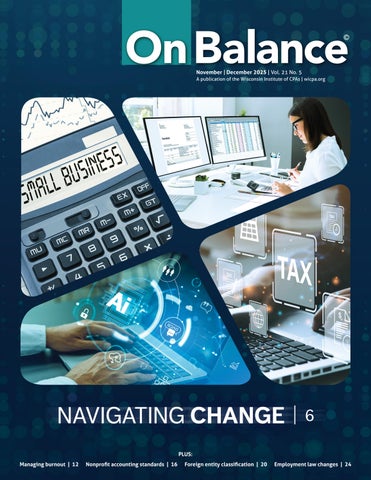
Navigating change Leaders of smaller firms are challenged to oversee tax and tech updates — and keep daily operations moving forward. By Brent Roberts
12 Solving for staff shortages and work exhaustion in the CPA profession If you want to change the outcome of your work, you must study four crucial areas of practice management. By Jason Glisczynski, CFP, CPWA, CEPA 16 Auditing, accounting and tax updates for nonprofit organizations Nonprofit organizations have been through a whirlwind of significant new accounting standards, and the impact will be felt for years. By Sam Brunson, CPA, and Karl Eck, CPA 20 Determination of foreign entity classification in the US and entity classification election As more taxpayers expand operations beyond U.S. borders, it becomes increasingly important to understand how foreign entities are treated for income tax purposes. By Heidi Konkel, CPA
wicpa.org
30 BUILDING DESIGN Section 179D: A practical guide to maximizing the energy-efficient building deduction For CPAs working with architects, engineers, contractors and building owners, understanding Section 179D is more important than ever. By Rachel McDaniel 34 FEDERAL FUNDING Federal funding cuts: Impact on accountants and their clients While the federal fiscal deficit is not new, it has increased dramatically, especially during the COVID-19 pandemic. By Jordan Boehm, CPA
20
30 Departments 3
Outlook | chair’s letter
4
In Touch | president & CEO’s message
10 Memorials | departed members 19 Kudos | members in the news 28 Welcome | new members
36 ACCOUNTING EDUCATION Bridging the gap: How real-world experiences bring accounting to life While classroom instruction provides students with a good foundation, learning should extend beyond it. By Daniel J. Nugent, CPA, JD On Balance
November | December 2025
1
On Balance is published five times a year by the Wisconsin Institute of Certified Public Accountants (WICPA). Change of address should be sent to: Membership, W233N2080 Ridgeview Pkwy, Suite 201, Waukesha, WI 53188; Phone: 262-785-0445 or 800-772-6939; Fax: 262-785-0838; email: comments@wicpa.org. Statements and opinions expressed are those of the authors and not necessarily those of the WICPA. Publication of an advertisement does not constitute an endorsement of the product or service by On Balance or the WICPA. Articles may be reproduced with permission. © Copyright 2025 On Balance.
Join us online!
2025-2026 WICPA OFFICERS/BOARD MEMBERS
INSIDE STAFF
Chair Stacy A. Stinson, CPA, MBA
President & CEO Tammy J. Hofstede
Chair-elect Neil R. Keller, CPA
Design & Layout Brett Stallman
Past Chair Ryan J. Hanson, CPA, CGMA
Advertising Sue Daniels
Secretary/Treasurer Christopher M. Cholka, CPA, CGMA
Editor Brent Roberts
Directors Michael D. Donahue, CPA Jessica B. Gatzke, CPA, MST Benjamin J. Hauser, CPA Tori M. Morrow, CPA, CGMA, MBA Sali L. Sheafor, CPA
Contributor Sharon Zalewski Printing Special Editions
AICPA Council Neil R. Keller, CPA Wendi M. Unger, CPA
UNLOCK COMPREHENSIVE PROTECTION LOOKING FOR PROFESSIONAL LIABILITY COVERAGE? PEARL INSURANCE IS THE ANSWER. • Highly Rated Carrier: AXA XL is rated (A+) by A.M. Best—one of the highest you can earn. • Stacking Deductible Waivers: Get up to $50,000 of your deductible waived through early resolution, settlement through arbitration/mediation, and/or the use of an engagement letter—that’s real savings!
GET A PROFESSIONAL LIABILITY QUOTE
• Integrated Team: Sales, underwriting, and retention are all under one roof for faster turnarounds to save you time. AXA XL is a division of AXA Group providing products and services through our four business groups: AXA XL Insurance, AXA XL Reinsurance, AXA XL Art & Lifestyle and AXA XL Risk Consulting. Coverage is underwritten by the following AXA XL companies: Greenwich Insurance Company and Indian Harbor Insurance Company. Not all insurers do business in all jurisdictions nor is coverage available in all jurisdictions. AXA, the AXA and XL logos are trademarks of AXA SA or its affiliates.
2
On Balance
November | December 2025
wicpa.org
OUTLOOK | CHAIR’S LETTER “CPE is more than just a requirement. It is part of our commitment to lifelong learning. As a profession, let’s be visible by posting our learning activities on social media to show the public that they can rely on us.”
Embracing Education By Stacy A. Stinson, CPA, MBA
A
s we near the end of our continuing professional education (CPE) reporting period, it is a good time to reflect on all that we have learned over the past couple of years and why it is crucial for the profession. I have always considered myself a lifelong learner. I have pursued education for most of my life. I tell students that their learning will never end, and I smile when one of my accounting alumni tells me they are “learning something new every day” in the profession. However, for confirmation, I consulted my Google AI for a description of lifelong learning, which included these terms: continuous, self-motivated, personal growth, professional advancement, both formal and informal, a mindset for growth, brain health and voluntary participation. All of those words resonated with me; yet when I add the word “required,” it somehow doesn’t feel the same as when I pursued learning sign language or learning to crochet. Over the past few years of my service on the WICPA board and committees, I have considered how to view earning CPE in the same way. The accounting profession is constantly evolving, and we must stay current with new regulations, technological advancements and changing business processes to ensure that we provide the best service possible to our clients and stakeholders. While my stakeholders are students, I continually seek topics that benefit my own learning, ultimately enhancing their educational experience. Over the past couple of years, I’ve worked on refining my communication style, researched emotional intelligence and auditing, learned about AI tools to enhance productivity and research, and even took a short class on QuickBooks over the summer. More recently, I attended the WICPA Fall Business & Industry Conference and the Not-for-Profit Accounting Conference, where I met new people and learned about the impact of tax law changes, advances in technology, the importance of board service and more.
wicpa.org
CPE requirements signal to the public and stakeholders that CPAs can be trusted, will stay up to date with knowledge and will continue to maintain ethical integrity. But as we serve our clients as business partners, how can CPE fit into an already busy schedule? Here are some ways to earn CPE credits: 1. Keep track of research done to answer a client’s question. If it took more than 50 minutes (1 CPE credit), it may qualify. 2. Use technology. Find an online self-study course, a live conference or a webinar. 3. Connect with a local college to present an accounting topic. 4. Listen to a podcast, or see what qualifies if you create your own and present accounting topics. 5. Use the 20 hours of complimentary CPE classes offered by the WICPA, and sign up for content newsletters and webinars offered by public accounting firms to reduce the cost of CPE. The WICPA also provides members with an outstanding tool to assist with CPE tracking (look for this on our new website) and a detailed list of requirements and FAQ. CPE is more than just a requirement. It is part of our commitment to lifelong learning. As a profession, let’s be visible by posting our learning activities on social media to show the public that they can rely on us. Now take a moment for yourself to reflect on the knowledge you have gained and take pride in your commitment to your technical and professional development. Note: Beginning December 2021, for license renewal, all active licensed CPAs and those who practice as a CPA must complete CPE requirements to renew their license. If you do not renew your license, you must identify yourself as CPA “inactive certificate holder.” Stacy A. Stinson, CPA, MBA, is assistant professor of accounting at Concordia University and the 2025-2026 WICPA board of directors chair. Contact her at 262-243-2099 or stacy.stinson@cuw.edu.
On Balance
November | December 2025
3
IN TOUCH | PRESIDENT & CEO’s MESSAGE “I sincerely hope you will join us in this initiative because you’ll not only contribute to the growth and strength of our profession but also influence the leaders of tomorrow.”
November Is Accounting Careers Month Celebrate Being a CPA, and Help Make a Difference!
CELE
B R AT E
ACCOUNTING CAREERS MONTH NOVEMBER 2025
By Tammy J. Hofstede
W
ICPA members, firms and companies are the economic engines of our state’s economy. With high standards of ethics and professionalism, CPAs are critical to the vitality and prosperity of the state and responsible for the fiscal health and well-being of individuals, businesses and institutions. We count on CPAs every day of the year, and so does Wisconsin. For the third year, I’m very excited to announce we have worked with Governor Evers to proclaim November 2025 as Accounting Careers Month in Wisconsin. We are proud of the work you do, the difference you make and the way you represent our CPA profession. We celebrate and thank YOU, our members! It is also more important than ever to recognize the importance of CPAs to our communities and businesses and support outreach efforts to future CPAs. With the challenges our profession continues to face, we need to not only advocate but also do everything we can to help it grow. As part of our Accounting Careers Month initiative, we are taking the opportunity to increase awareness of the numerous options an accounting career provides. It is well known how impactful it is for members to reach out to others about the profession, especially students.
3. Then let us know by completing the Accounting Careers Month Volunteer Form. Once we receive your form, we’ll provide everything you need, including a presentation, resources and fun gifts for students and educators.
As part of Accounting Careers Month, I am asking YOU to give back to the profession and volunteer some of your time to go into high schools this November (or any time of year) to talk about the career opportunities available in accounting.
I sincerely hope you will join us in this initiative because you’ll not only contribute to the growth and strength of our profession but also influence the leaders of tomorrow.
We have made it very easy for you to participate — in just three easy steps! All you need to do is:
Want to learn more about Wisconsin Accounting Careers Month and volunteer? Go to wicpa.org/careersmonth.
1. Reach out to your own contact, or send our prewritten letter to one or more high schools you’re interested in speaking at.
4
2. Schedule a day and time with the school(s) and/or teacher(s) to speak to a class.
On Balance
November | December 2025
YOU can make a difference!
Tammy J. Hofstede is president & CEO of the WICPA. Contact her at 262-785-0445 ext. 4518 or tammy@wicpa.org.
wicpa.org
ACCOUNTING CAREERS MONTH PROCLAMATION
WICPA expresses concerns with DOR on QCD billings WICPA President & CEO Tammy Hofstede met with representatives from the Wisconsin Department of Revenue on Thursday, Oct. 16, to express concerns with the DOR’s 1099-R billing project and the qualified charitable distribution issue. During the meeting, the DOR agreed: • If your client received a letter for both 2021 and 2022, one appeal can be filed for both notices. The DOR will treat it as an appeal for both years (do not need to enter each separately). Submit information for one year, and if it is complete and supports that the audit notice should be cancelled, the DOR will cancel both notices.* • They have a team and backup to address appeals, and as soon as they receive the documents, the focus will be on appeals. • If your client paid the bill and should not have, a claim for refund should be submitted. • The DOR will not send out additional notices related to QCDs, however, they will continue to send “single issue billings” under the billing project for other 1099 codes through the end of the year. *This means if the DOR sent a 2021 notice and a 2022 notice to taxpayer “Tom Smith,” he can file one appeal (either for the 2021 year or the 2022 year) and submit detailed documentation to support the QCD (for either 2021 or 2022). If the documentation is complete, and supports that the audit notice should be cancelled, the DOR will cancel both the 2021 notice and the 2022 notice. The WICPA continues to monitor the progress and will continue discussions with the DOR. Please contact Tammy Hofstede, WICPA president & CEO, with questions, or call the DOR at 608-264-4229, ext. 2222.
wicpa.org
On Balance
November | December 2025
5
NAVIGATING
CHANGE
Leaders of smaller firms are challenged to oversee tax and tech updates—and keep daily operations moving forward.
T
he phrase “the only constant is change” is believed to have been coined by an ancient Greek philosopher, but it also applies to modern-day small and mid-sized accounting firms in Wisconsin.
While all firms need to stay abreast of the latest tax changes and technology offerings, the smaller entities often must simultaneously do that and ensure little or no interruption in day-to-day operations — with fewer people to manage change and serve clients.
By Brent Roberts
6
On Balance
“As far as managing the day-to-day, it’s really about having everyone in the right seat on the bus,” explains Michael Matuszak, CPA, CEO of KerberRose. “So, if you have someone who’s really good at tax legislation, let them focus on that. You don’t want them off doing something in operations.
November | December 2025
wicpa.org
“
If everyone is excelling in what they’re good at, then the bus as a whole will continue to move forward, and you’ll be very successful.
If everyone is excelling in what they’re good at, then the bus as a whole will continue to move forward, and you’ll be very successful.”
Timely tax topics
Of all the updates that firms need to stay current on, tax laws and policy arguably top the list. “We’re a BDO Alliance firm. We also have a tax committee that’s watching all things being published by the IRS, the state of Wisconsin and other states that we’re in. We follow quite a few industry publishers, and our tax committee pushes out the tax policy updates across the firm,” says Tim Moy, CPA, CGMA, managing partner of MBE CPAs.
“
We follow quite a few industry publishers, and our tax committee pushes out the tax policy updates across the firm.
Tim Moy, CPA, CGMA
Joshua TeBeest, CPA, shareholder, Tax Service Line lead of Vesta, notes, “For the quick-hit updates, we’ve developed an internal cadence that we call our ‘Monday bursts,’ and that’s a quick-hit email that covers not just tax and legislation; it’s
wicpa.org
Michael Matuszak, CPA
also a firm-wide communication for anybody that has something that they’re spearheading or that they’re in charge of to make people aware of what’s happening now or down the pipe.” He adds, “We also do a tax update in the fall as the year closes out and we ramp up into compliance season. We participate in the WICPA Tax Conference, and we attend the CPAmerica Tax Conference the week before or the week after, so within a week of those wrapping up, the handful of tax leaders determines what everybody needs to know and makes sure everybody at the firm is on the same page.” TeBeest also encourages an employee focus relative to legislative updates. “Legislatively, we’ve learned that we need to do a better job taking the pulse of our staff. For example, finding out how everybody feels about the One Big Beautiful Bill Act and if anything is lacking in their CPE before we close out the year. We’ve noticed it’s much more successful in terms of retention when we ask the staff what they really need and want.”
“
We’ve noticed it’s much more successful in terms of retention when we ask the staff what they really need and want.
On Balance
Joshua TeBeest, CPA
November | December 2025
7
Technology and efficiency As rapidly as tax changes can come about, advances in technology typically happen even faster. According to Matuszak, “If people aren’t thinking about these topics, they’re going to get left behind. It’s part of the day-to-day — you’re always looking at technology because you’re trying to serve your clients in the most efficient manner and add as much value as you possibly can.” TeBeest echoes that sentiment. “Each leader has their own area of expertise, and we try to see what’s out there and what’s emerging in terms of technology that may be able to make us more efficient or make something that we’re providing for our clients more user friendly. We’re also very fortunate for the firm size that we are to have four dedicated individuals in our technology department, which is spearheaded by someone who used to be in tax.” One of the most significant technology-related changes in the accounting profession is the proliferation of artificial intelligence, which has become an essential part of internal IT discussions. Moy shares, “We have an AI committee, and each of our department leaders has some involvement. We’re just starting to gain traction; there’s been some delivered through the vendors. We’re figuring out how to deploy it for efficiency and profitability. We want to make sure that if we’re using a large language model, our client data is protected, so we’re cautious with where we go.”
8
“
Each leader has their own area of expertise, and we try to see what’s out there and what’s emerging in terms of technology that may be able to make us more efficient or make something that we’re providing for our clients more user friendly. — Joshua TeBeest, CPA down to change management. You can’t change your software all at once, or people are going to get burned out. So, there’s software that’s doing the job today, but it’s not going to be the software of the future.
While keeping up with the latest technology is important for firms and their clients, strategy and timing also are key factors.
“We’re likely to review our practice management software next year and see what that next generation looks like. It’s always going to come down to vetting the new thing that’s out there. You can’t get complacent and comfortable because you’ve had the same software for numerous years and it’s working for you.”
Matuszak says, “We’re going to continue looking at the items that our IT consultant recommended. It really comes
However, he cautions, “You don’t want to always be the early adopter either. There’s that happy medium of wanting
On Balance
November | December 2025
wicpa.org
Moy adds, “We also use some industry experts, and right now one of them is helping us with Lean Six Sigma, and another is helping us build out our CAS department. We also have our own ERP software, so that gets us involved in streamlining the tech stack through several vendors. “A lot of the changes coming in during the next 12 months are around a single pane of glass project to streamline how we interface with clients. We are also working on a document storage project and starting to work on a timekeeping program that utilizes AI. We’ve seen big changes on tax management and ERP, single pane of glass, AI and use of application programming interfaces.” He advises, “I really encourage all of our people to think about how they’re intaking and processing work. There’s some great technology out there, and I’m very proud of what we’ve built with practice ERP.”
to be on the cutting edge but also not the first because the first is the one that goes through all the pain points. We like to know that it’s a vetted and proven software that’s going to work, and then we adopt it.” TeBeest also stresses the importance of budget and client satisfaction. “It’s really about managing what we think is best and trying to do so in a budget we think is most beneficial. If you’re looking to make a switch to any sort of technology, you’ve got to really evaluate what return that sort of investment is going to have and the big-picture outlook with dollars and cents. We’ve always been a firm that’s tried to be innovative and put things out there that are going to be the most beneficial for our team members and clients while not constantly switching and doing something different.” He elaborates, “In terms of technology, it’s important that we’re not bombarding clients with constant change. If they know what your firm is about, and you’re heavily reliant on technology and staying current, hopefully they’re doing the same in their work and personal lives and appreciate what you’re doing.” And Moy cautions, “As we think about streamlining the interfaces on the delivery, drop-off and pick-up of work product, any time that is streamlined is positive. We’ve got to gain real efficiencies not just in how we do the work but also how we teach and how we deliver the work.” Drilling down on specific changes in the technology space, the latest areas of focus go beyond AI. “The biggest changes in the last few years from a software and IT perspective, I think, have been very focused on data security. We have a lot of confidential client information, and we’re laser focused on this area,” Matuszak observes.
wicpa.org
“
I really encourage all of our people to think about how they’re intaking and processing work. There’s some great technology out there, and I’m very proud of what we’ve built with practice ERP. — Tim Moy, CPA, CGMA It’s all about the clients Matuszak encourages others to always remain client focused when keeping up with legislative changes or investing in technology. “It allows people to do what they like and what they’re good at, which leads to better client service, which leads to those clients referring more business, which allows you to hire more people and continue growing. “From a client service perspective, it is making that client experience as seamless as possible, providing ways for them to easily share information back and forth with us in a secure manner, having software that’s user friendly, being responsive to those clients and being the one-stop shop that make it super easy for the client.” Brent Roberts is the WICPA communications director. Contact him at 262-785-0445, ext. 4515, or brent@wicpa.org.
On Balance
November | December 2025
9
memorials Karl E. Fraedrich, CPA, CMA (1939–2025)
Karl Fraedrich, CPA, CMA, age 85, passed away on Saturday, Sept. 6. Fraedrich was born and raised in Easton. He graduated from Wausau Senior High School in 1957 and went on to earn a bachelor’s degree in accounting (1961), an MBA (1965) and a Ph.D. (1969) from the University of Wisconsin–Madison. He served as a professor at the University of Wisconsin–Whitewater for 31 years and held several leadership positions, including Accounting Department chair and associate dean for the College of Business and Economics. A lifetime member of the WICPA, he also served on various committees for both the WICPA and the Waukesha chapter of the Institute of Management Accountants. He was an active member of Trinity Lutheran Church in Fort Atkinson and served on several of its committees, including a term as president. He retired in 1998 and moved to Venice, Florida, where he also served on committees for the Emmanuel Lutheran Church. He is survived by his two sons, four grandchildren, and nieces and nephews.
William C. O’Loughlin, CPA (1939–2025)
William (Bill) C. O’Loughlin, CPA, age 86, passed away on Sunday, Sept. 14. O’Loughlin moved to Milwaukee after graduating high school in Merrill and went on to earn his degree from the University of Wisconsin–Milwaukee. He became a CPA
and joined the WICPA in 1973. O’Loughlin’s robust accounting career included 25 years with Medalist Industries, a Milwaukeebased manufacturer of industrial and recreational products. He was a longtime member of the Wauwatosa Presbyterian Church. O’Loughlin is survived by his wife of 64 years, Jean; a son and two daughters; seven grandchildren; six greatgrandchildren; and other extended family and friends.
Debra R. Welch, CPA (1958–2025)
Debra Welch, CPA, age 66, passed away on Tuesday, July 29. Welch was born and raised in Tomah. After graduating from Tomah High School in 1976, she attended the University of Wisconsin–Whitewater and earned her bachelor’s degree in accounting. She obtained her CPA license in 1983 and became a WICPA member in 1984. For most of her 43-year career, Welch worked at CliftonLarsonAllen (CLA) and ended as the audit engagement director before retiring in 2023. Welch dedicated many years of her life to the Queen of the Apostles Catholic Parish and School in Tomah, serving on the parish council, the parish council of Catholic women and the finance committee. In addition to her parish involvement, Welch also belonged to the Tomah American Business Women’s Association and was the treasurer of the Tomah Health Community Foundation. She is survived by her husband of 44 years, Rick; two daughters; one son; seven grandchildren; and many other relatives.
If you are aware of a member obituary and believe it should be included in Memorials, please send a copy of the obituary or contact John Rasche at john@wicpa.org.
Check out our featured member benefit providers CTaccess
Pearl Insurance
von Briesen & Roper, s.c.
CTaccess is a technology performance company. We use technology to improve how people work. As a managed services provider, we deliver people-focused, secure and operationally efficient outsourced IT. We also specialize in automating business processes with advanced workflow, artificial intelligence and e-form solutions.
Pearl Insurance has provided professional liability insurance to accountants for more than 60 years with comprehensive and competitively priced coverage. By continuously evolving insurance plans, we stay ahead of the curve as an industry leader with coverage that responds to the needs of accounting professionals.
von Briesen’s tax team handles any type of matter that may present a significant tax issue. We partner with CPAs to successfully address any state, local, federal or international issue.
These affinity partners and more can be found at wicpa.org/discounts. 10
On Balance
November | December 2025
wicpa.org
CELE
B R AT E
ACCOUNTING CAREERS MONTH NOVEMBER 2025
Inspire the future talent. To help raise awareness of the accounting profession, we’re looking for volunteers to go into high schools to talk about accounting as a career. We’ve made it extremely easy for you to participate! Reach out to one or more high schools you’re interested in speaking at Schedule a day and time with the school Let us know by completing the Accounting Careers Month Volunteer Form We’ll provide you with everything you need including a presentation, talking points, tips, resources and fun gifts for students!
Get involved at wicpa.org/CareersMonth On Balance
wicpa.org
Wiscons Certifie November | December 2025
11
SOLVING FOR STAFF SHORTAGES AND WORK EXHAUSTION IN THE CPA PROFESSION
W
hat is the one thing you would change about the outcome of your work if you had a magic wand? More revenue? More profit? Happier clients? Work fewer hours without sacrificing income? It’s easy to get burned out in the accounting profession. The industry almost forces you into a productivity paradox: You charge by the hour yet need to get more efficient to keep up with the work, and by being more efficient you do the same work in less time, resulting in being paid less for the same result you produced before!
By Jason Glisczynski, CFP®, CPWA®, CEPA®
If you want to change the outcome of your work, you must study four crucial areas of practice management: 1. Project- or value-based versus hourly billing 2. Segmenting your book of business
12
On Balance
November | December 2025
3. Finding more revenue from existing clients 4. Operational efficiency From there, you then examine the six root causes of work exhaustion: 1. Too many low-revenue clients 2. The difficulty of implementing CAAS or other advisory services 3. Lack of coordination and collaboration between professionals 4. Lack of peer-reviewed, sophisticated strategies 5. Lack of adequate time to thoroughly vet professional relationships and new technologies and regularly stress-test them 6. Fear of straying from the status quo, allowing your ego and loyalty to others get in the way of meaningful change Let’s break down the first two areas of practice management, which are the most critical and the most difficult components to master. If you can master these, the rest of the above list is easy.
wicpa.org
“
If you are stuck on charging by the hour and not being paid for your expertise, you will be forever stuck on the hourly treadmill, and it’s going to get worse as technology and consumer demand rapidly evolve. Project- or value-based versus hourly billing How do your clients perceive you? How do you position yourself ? Most of the time you are viewed as a full-time historian and part-time prognosticator. You meticulously report what has happened and project what you think will happen in the future based on the data. While useful — and necessary — the real value is application of data with finely honed skills to deliver advice and strategy that moves the needle for the client. Hourly billing fails to reflect the true value of service and advice, forcing the client to view your services through the lens of a time investment and misalignment of incentives for you. Project- or value-based billing aligns the client’s cost with the perceived or achieved value and shifts the focus to the outcome and the impact of your services, encouraging efficiency, innovation and a deeper understanding of the client’s needs. If you believe that you are not capable of or do not have the expertise to charge a client $10,000 for an hour of work that puts an additional $50,000 on their bottom line, a 5x return on the client’s investment in your fee, you are correct. You have a fixed mindset: “I stick to what I know.” “My abilities are unchanging.” “I don’t like to be challenged.” “My potential is predetermined.” Those with a growth mindset think differently: “Challenges help me grow.” “I like to try new things.” “I can learn to do anything I want.” By adopting a growth mindset, you are taking the first step to unlocking the full potential of the opportunity you have in front of you.
it takes an hour. In the next operating room, a neurosurgeon is removing a brain tumor located in a very precarious spot requiring a very specialized set of equipment and skills; failure to remove the tumor will result in almost certain death. This procedure also takes an hour. Are those surgeons paid the same amount? While they spent the same amount of time in surgery, the level of expertise is drastically different. The second procedure required more expertise than the first. The same can be said for highly sophisticated and advanced tax strategy versus standard forecasting. If you can adopt a growth mindset, you can make more money and have happier clients while working fewer hours, but this is only the beginning. The next step is arguably the most challenging.
Segmenting your book of business This is where most firms fail. They try to add CAAS, wealth management, fractional CFO or other services before they segment their book of business, putting the cart before the horse. Without proper client segmentation of your existing clientele, there is no way to determine what the best path forward is. Client segmentation consists of implementing a strategy for client attention that is fair, but not equal. You must accept the fact that some clients will choose not to stay, and some
If you are stuck on charging by the hour and not being paid for your expertise, you will be forever stuck on the hourly treadmill, and it’s going to get worse as technology and consumer demand rapidly evolve. While an hourly billing model makes sense in certain applications, it does not apply when using expertise. There is a difference between tax preparation, tax planning and tax strategy. Tax strategy is the most impactful for the client and demands the highest level of compensation. For example, you have two surgeons. One of them performs a procedure on your foot to remove a bunion, and
wicpa.org
On Balance
November | December 2025
13
you may have to release, and that is OK. You must believe that serving fewer clients who are significantly more profitable will lead to better outcomes for everyone, including those whom you will no longer serve.
and the remainder of the process when teaching CPE classes for WICPA.)
The first step in client segmentation is defining your client avatar (ideal client) and the related “total client value factors” of the ideal client, such as profitability, the “no hassle” factor, if they refer you to others and how closely they match your avatar. Then you measure your existing clients against the total client value factors to see how each client scores. Put clients in three or four (no more, no less) groups based on their score. Keep in mind that calculations are not a substitute for your considered judgment, and you may need to adjust your ideal client profile many times. Armed with your book of business properly segmented, look for trends and common challenges you can solve for the group of clients that most closely fits your ideal client profile. This will tell you if implementing CAAS, wealth management or a combination will be your best path forward. This completes the segmentation part. Once finished, you are now ready to begin your journey of adding CAAS or wealth management to your offering, and there are many ways to do this with a high degree of success and a much shorter runway than you ever thought possible. (I cover this
Before introduction of a new service model, additional considerations include but are not limited to identifying alternative service providers (in-house or external), introducing and enrolling existing clients, and releasing clients who do not fit or choose to leave. You may have an opportunity to sell a block of clients to an aggregator, internally, or to another firm, and a merger or being acquired may be of interest. The path to reducing burnout and achieving greater results for your clients is proven, systematic and achievable when you have the right tools and strategy in place. Avoid the common pitfalls of “chasing the money” or “shiny object syndrome,” stay focused on the result you desire, and the path to success is literally sitting right in front of you. The longer you wait, the harder it will become. Cheers to your success! Jason Glisczynski, CFP®, CPWA®, CEPA®, is founder and managing partner of Silvertree Private Client Group. With over 20 years of experience, he specializes in personalized, tax-efficient wealth strategies for manufacturing families, business owners, and highincome clients in central Wisconsin. Contact him at 715-544-1610, or jason@silvertreeplan.com.
Join the WICPA Educational Foundation Board! The WICPA Educational Foundation is seeking members to serve on its board of directors. Some of the opportunities include: • Assisting in efforts to attract students to the profession. • Providing strategic governance in accordance with the WICPA Educational Foundation mission. • Acquiring new leadership skills. The WICPA Educational Foundation plays a pivotal role in supporting programs to improve awareness and perceptions by educating students and educators about the exciting opportunities available to accounting professionals.
To apply, visit wicpa.org/EFBoardApplication through Feb. 27, 2026.
14
On Balance
November | December 2025
Questions? Contact tammy@wicpa.org.
wicpa.org
wicpa.org
On Balance
November | December 2025
15
AUDIT, ACCOUNTING AND TAX UPDATES FOR
NONPROFIT ORGANIZATIONS
N By Sam Brunson, CPA and
onprofits have been through a whirlwind of significant new accounting standards. Revenue recognition, leases and current expected credit losses were significant changes, impacting both auditee and auditor in the years of adoption. The impact of these standards will be felt for some years as we come to better understand industry practice and as clarifying guidance is issued. Although these standards are in the rearview mirror, change is a constant that will always be with us. That said, let’s look at some of the more significant updates affecting nonprofits.
Karl Eck, CPA
Auditing standards
SAS 147, effective for periods beginning on or after June 30, 2023, requires successor auditors to make inquiries of predecessor auditors regarding fraud and noncompliance with laws and regulations. Once an engagement is accepted, the auditor should document the inquiries with the predecessor auditor and the results of those inquiries. While this standard has been in effect for some time, this serves as a friendly reminder for firms that may not have picked up on the nuances. SAS 149, effective for audits of group financial statements for periods ending on or after December 15, 2026, introduces a risk-based approach to group audits (whereas the previous method focused on identifying significant components). SAS 149 directs the group auditor to use professional judgment in determining the components on which to perform procedures, based on assessed risks. SAS 149 also introduces the term “referred-to auditor.” For auditors, the standard will result in a shift in audit approach and documentation for group audits. Auditees will be impacted by additional or reduced audit requests for information depending on the auditor’s risk assessment.
16
“
The impact of these standards will be felt for some years as we come to better understand industry practice and as clarifying guidance is issued. and conditions when evaluating lease arrangements to determine whether a lease exists and how to classify and account for the lease. Leasehold improvements can be amortized over their useful life rather than the lease term. In some cases, identifying the enforceable terms and conditions could have necessitated a legal opinion, which would not be necessary under this standard. Also, leasehold improvements are more likely to be amortized over terms that align with economic reality. ASU 2023-08 is effective for fiscal years beginning after December 15, 2024, with early adoption permitted. It requires crypto assets that meet certain criteria to be measured at fair value with detailed disclosures, including: • The types of crypto assets held, • Changes in holdings, • Fair-value measurement techniques, and • Gains and losses recognized. Previously cryptocurrency was reported as an indefinitelived intangible asset that was written down when impaired. ASU 2025-05 simplifies credit loss estimates for short-term receivables under ASC 606. Nonprofits can now use a practical expedient (assuming current conditions remain unchanged) and may consider post-balance-sheet collections when estimating losses.
Accounting standards updates
This ASU includes an accounting policy election that allows an entity to consider cash collection activity after the balance sheet date when estimating expected credit losses on current accounts receivable and current contract assets. The election may be made only if the practical expedient is also elected.
ASU 2023-01 addresses leases between entities under common control. Nonprofits can now rely on written terms
This should provide relief to nonprofits when calculating credit losses for current receivables.
On Balance
November | December 2025
wicpa.org
Proposed ASU 2024-ED400: Goodwill and Other – Internal-Use Software The purpose is to modernize the accounting for “internaluse software.” Many entities have shifted from using a sequential development method to an incremental and iterative development method, which has led to diversity in practice in determining when to begin capitalizing software costs. Under this ASU, capitalizing software would occur when both of the following occur: • Management has authorized and committed to funding the software project. • It is probable that the project will be completed, and the software will be used to perform the function intended. The proposed amendments would supersede the website development costs guidance and incorporate the recognition requirements for website-specific development costs from Subtopic 350-50 into Subtopic 350-40.
Self-funded health insurance Self-funded health insurance is not new, but organizations are increasingly turning to self-insurance to achieve lower costs when faced with increasing health insurance rates. With self-insurance, the employer is responsible for employee health claims. Nonprofits may deduct health premiums from employee wages and charge cost reimbursement grants an “employer portion” to fund claim costs. Financially, this option is great when claims are low but not so much in a year with high claims.
wicpa.org
Stop loss coverage can be purchased to mitigate risks of high claims. For example, a stop loss policy might pay when individual claims for an employee exceed $50,000 and/or when aggregate employee claims exceed $1,000,000. Usually, claims are tracked and paid by a third-party administrator. Nonprofit organizations and auditors need to be aware of incurred but not reported (IBNR) claims. IBNR occurs when, for example, an employee has a medical procedure performed on or before year-end and has not been billed. An organization should prepare an estimate of IBNR claims that exist at year-end. The TPA might have reports that can assist with calculating an IBNR estimate. Uniform Guidance does not specifically address self-funded health insurance but does discuss the self-insurance concept and reserve levels and requires costs to be comparable to traditional insurance.
Revisions to Uniform Guidance The Office of Management and Budget issued a final rule revising the Uniform Guidance, effective October 1, 2024. Key changes include the following: • Raising the single audit threshold from $750,000 to $1 million • Increasing the de minimis indirect cost rate from 10% to 15% There are numerous other changes, and the reforms aim to reduce administrative burdens and improve cost recovery for nonprofits.
On Balance
November | December 2025
17
Yellow Book 2024 revisions The Government Accountability Office released the 2024 revision of the Yellow Book, effective for financial audits, attestation engagements and reviews of financial statements for periods beginning on or after December 15, 2025. The update shifts from “quality control” to “quality management.” A system of quality management that complies with Government Auditing Standards is required to be designed and implemented by December 15, 2025. An audit organization should complete its evaluation of the system of quality management by December 15, 2026. Early implementation is permitted.
Legislative changes: One Big Beautiful Bill Act The OBBBA was signed by President Trump on July 4, 2025. As a result, certain types of nonprofit organizations could see increased tax liabilities. The bill also introduced new rules for charitable contributions and ends key energy tax incentives. Below is a summary of the major provisions of the bill impacting nonprofit organizations. • Certain nonprofit educational institutions (excluding state colleges and universities) are now subject to a tiered tax rate schedule rather than a flat 1.4% rate. Tax rates now range from 1.4% to 8%. • Nonprofit organizations currently pay an excise tax on compensation in excess of $1 million given to any of the organization’s top five covered employees. Under the new law, the excise tax will apply to compensation of all employees who receive in excess of $1 million, not just the top five. • The act reinstates the charitable contribution deduction for individual taxpayers who do not itemize (excluding donations to donor-advised funds and supporting organizations). Taxpayers will be eligible for an abovethe-line deduction of up to $1,000 for a single taxpayer and up to $2,000 for joint filers. There is no expiration date for this provision. • In addition to the various existing limitations on charitable contribution deductions made by individuals, there will now be a 0.5% floor. Aggregate contributions of an individual will be allowed only to the extent they exceed 0.5% of the taxpayer’s adjusted gross income computed without regard to any net operating loss carryback. • In addition to the existing 10% ceiling, corporations will now be subject to a 1% floor. If total contributions do not exceed 1% of the corporation’s taxable income for the year, no deduction is allowed. • Taxpayers in the highest tax bracket will now see a 35% cap on their overall itemized deductions. • Clean-energy credits and incentives were largely gutted by the OBBBA. Most major clean-energy credits will
18
On Balance
November | December 2025
“
The road ahead may be complex, but proper awareness, planning and execution are imperative to success. now end by mid-July 2026. Nonprofits that have relied on clean-energy tax credits to make certain projects financially viable need to know that the calculations have just changed. If your organization does work that involves clean-energy credits, you need to take another look at your plans right away.
Looking ahead With many changes coming in the next year, nonprofit leaders and auditors must stay vigilant. The road ahead may be complex, but proper awareness, planning and execution are imperative to success. Sam Brunson, CPA, is a senior manager in Wipfli’s Tax practice. She has nearly 10 years of experience working with nonprofit organizations. Contact her at sbrunson@wipfli.com or 406-532-4238. Karl Eck, CPA, is an audit partner in Wipfli’s Nonprofit, Government and Education practice. He has over 25 years of experience auditing nonprofit organizations with a primary focus on federal single audits. Contact him at keck@wipfli.com or 608-270-2983.
wicpa.org
kudos
Jim Brandenburg
Thomas Kieffer
Anthony Laszewski
Miranda Schultz
Rich Sippl
Jim Brandenburg, CPA, MST, tax director at Sikich in Brookfield, was interviewed for a July 23 Milwaukee Journal Sentinel newspaper article by Hope Karnopp titled “Wisconsinites often flock to Arizona, Florida to retire. Will new tax cuts keep them here?”
Scott De Young, CPA, president of Municipal Well & Pump in Waupun, has been appointed to Horicon Bank’s board of directors.
Thomas Kieffer, CPA (inactive), CFP, CTFA, has been promoted to vice president – senior wealth advisor for Waukesha State Bank’s Wealth Management division. Crystal Kirchner, CPA, has joined Wisconsin River Partners, a private equity firm in Wausau, as CFO.
Anthony Laszewski, CPA, senior vice president and commercial banking manager at Waukesha State Bank, was interviewed for a BizTimes Milwaukee magazine article by Arthur Thomas titled “How do bankers see the state of the economy?” Miranda Schultz, CPA, executive vice president, CFO and COO of Wolf River Community Bank in the Fox Valley, has been named to the Independent Community Bankers of America’s 2025 “40 Under 40: Community Bank Leaders” list. Pamela Schneider, CPA, CMA, JD, tax, business and estate planning consultant at von Briesen & Roper, s.c., has been appointed to the advisory board of the Women’s Fund of Greater Green Bay.
Rich Sippl, CPA, has joined MSI General Corp., a commercial construction firm in Nashotah, as controller.
Stacy Slatky
Victoria Thayer
Angela Thomas
Robert Traylor
Stacy Slatky, CPA, will be promoted to CFO at Bank of Luxemburg, replacing current CFO Joe Mauel, CPA, who plans to retire at the end of this year.
Angela Storm, CPA, audit partner and deputy chief accountant at KPMG in Milwaukee, has been appointed to FASB’s Emerging Issues task force. Victoria Thayer, CPA, president and founder of Novii CPA in Madison, has received the 2025 Edgewood College Alumni Promise Award, which recognizes alumni under 40 for their professional accomplishments and community service.
Angela Thomas, CPA, state controller at the Wisconsin Department of Administration, has received the 2025 Financial Leader – State and Local Agencies Award from In Business Madison magazine.
Robert Traylor, CPA, CFO and executive vice president at Horicon Bank, has been appointed as a member of the Moraine Park District board.
FIRM NEWS Berndt CPA in Madison has been recognized as one of Accounting Today’s 2025 “Best Accounting Firms to Work For,” ranking No. 11 nationwide among small firms and the only Wisconsin firm to be included in this year’s Top 100 list.
Want your new job, promotion or award mentioned in Kudos? H Email your announcement and photo in JPG format to john@wicpa.org. H
CPA licenses expire Dec. 14
RENEW NOW!
The Wisconsin Department of Safety and Professional Services (DSPS) is reminding CPAs to renew their licenses before they expire on Sunday, Dec. 14. If you have questions, please call 608-261-2112 or email DSPSRenewal@wisconsin.gov.
wicpa.org
On Balance
November | December 2025
19
Determination of Foreign Entity Classification in the US and Entity Classification Election
A
s more taxpayers expand operations beyond U.S. borders, it becomes increasingly important to understand how foreign entities formed by those taxpayers are treated for U.S. income tax purposes. Foreign entities may be classified by default By Heidi Konkel, as corporations, partnerships or CPA disregarded entities under U.S. tax law, depending on their legal structure and ownership. This article explores the default classification rules, how to elect a different classification and common pitfalls that can lead to incorrect filings. Understanding the rules avoids misclassification or failure to file the correct informational returns, which can result in significant penalties, often starting at $10,000 per form with additional penalties accruing monthly for continued noncompliance.
Foreign entity default classification for U.S. tax purposes A foreign entity’s default classification for U.S. tax reporting depends on its ownership structure and liability protections under local law. The IRS maintains a list of “per se” corporations; these entities are automatically treated as corporations for U.S. tax purposes, such as Japan’s Kabushiki
20
On Balance
November | December 2025
“
Understanding the rules avoids misclassification or failure to file the correct informational returns, which can result in significant penalties, often starting at $10,000 per form with additional penalties accruing monthly for continued noncompliance. Kaisha or Switzerland’s Aktiengesellschaft. These entities cannot change their classification via election. A full list is available in the instructions to Form 8832 Entity Classification Election. For entities that are not “per se,” classification hinges on liability protections. If any owner has unlimited liability under local law or organizational documents, the entity defaults to either a foreign partnership (multiple owners) or a foreign
wicpa.org
disregarded entity (single owner). If all owners have limited liability, the default classification is a foreign corporation. For example, a United Kingdom Limited Company defaults to be treated as a corporation in the U.S., as their owners have limited liability. Conversely, a Canadian Unlimited Liability Company has owners with unlimited liability and defaults to a passthrough entity.
Reporting requirements based on default classification Once liability obligations are determined, the next step is to determine the ownership structure. An entity with one owner with unlimited liability would be classified as a disregarded entity and be required to file Form 8858, Information Return of US Persons with Respect to Foreign Disregarded Entities and Foreign Branches. An entity with more than one owner where one of those owners has unlimited liability would be classified as a partnership and would file Form 8865, Return of US Persons with Respect to Certain Foreign Partnerships. Conversely, for any foreign entity where there is no owner who has unlimited liability, the default filing would be Form 5471, Information Return of US Persons with Respect to Certain Foreign Corporations.
Entity classification election Foreign companies that are not a “per se” company can make an entity classification election using Form 8832. This election can significantly affect tax obligations, reporting requirements and strategic planning. Timing of filing is critically important. The filing is to be filed within 75 calendar days of the date that the change is to be in effect. When the change is filed, the change must be in effect within 12 months of the date of the filing. The filing itself should be filed using a certified mail receipt. Once the election is filed with the IRS, a confirmation letter should be mailed to the taxpayer within 60 days. This letter should be maintained in the permanent records of the taxpayer. In the first tax year that the foreign company is included in the U.S. income tax return, a copy of the signed 8832 should also accompany the income tax return. Revenue Procedure 2009-41 can be used if the 75-day rule is missed. Using this procedure, the taxpayer has up to three years and 75 days to file an entity election from the date that the election is to be effective. There are additional requirements when filing. First, the taxpayer must have been filing their income tax return consistently with the election. Next, a reasonable disclosure that caused the delay is to be included in the filing. Finally, signature(s) by representative(s) of the foreign corporation and U.S. taxpayer are made under “penalties of perjury.” If the timing of the election is missed, the only other option would be to obtain a private letter ruling on the classification.
wicpa.org
Should an original election be made to either treat the foreign company as a foreign disregarded entity or foreign partnership, and later it is discovered that the foreign company has different ownership, an additional form should be filed under Revenue Procedure 2010-32. This election is made under the same restricted time limits. It is possible to file Form 8832 using both Revenue Procedures 2009-41 and 2010-32. Once an election is made to change the entity classification, generally the entity cannot change its election again within 60 months. However, the IRS (per private letter ruling) may allow the entity to change its classification if more than 50% of the ownership interest did not own any interest in the entity on the effective date or filing date of the prior election. An additional exception exists if an election was made on the date of formation of the foreign entity; then the 60-day rule does not apply. Changing a foreign entity’s classification for U.S. tax purposes can trigger significant tax consequences, such as deemed transactions, liquidations or asset contributions. If the election is made at the time of the entity’s formation, these events typically have no impact on the U.S. income tax return. However, if a taxpayer owns a Controlled Foreign Corporation (CFC) and later elects to treat it as a disregarded entity, the CFC’s accumulated earnings and profits may be recognized as taxable income in the year the election takes effect.
Common pitfalls 1. Misunderstanding default classifications: Practitioners may incorrectly assume that entities labeled “limited” qualify as pass-throughs without verifying owner liability.
On Balance
November | December 2025
21
Conclusion
2. Incorrect Form 8832 usage: Errors include elections for ineligible entities, wrong effective dates, missing signatures or not specifying whether the election is initial or a change.
Navigating the classification and election process for foreign entities under U.S. tax law is a critical responsibility for tax professionals advising globally active clients. Understanding default classifications, recognizing when an entity is eligible to make an election and adhering to strict timing and procedural requirements are essential to ensuring compliance and avoiding costly penalties. Missteps such as misinterpreting liability protections, incorrectly filing Form 8832 or failing to maintain proper documentation can lead to significant financial consequences and increased audit risk.
3. Overlooking relevant timing: A foreign entity’s classification becomes relevant when it affects U.S. tax liability or reporting. Filing Form 8832 too early or too late can result in misalignment with reporting obligations. 4. Poor documentation: Taxpayers should retain organizational documents, ownership charts, signed elections and IRS correspondence. 5. Neglecting the five-year rule: Once an entity makes a classification election, it generally cannot change that classification for five years without IRS consent. Not planning for this restriction can lock a business into unfavorable tax treatment.
By proactively analyzing entity structures, staying current with IRS guidance and applying best practices in documentation and filing, practitioners can help clients optimize their tax positions while remaining compliant with U.S. informational reporting obligations. As international operations continue to grow, so too does the importance of getting foreign entity classification right from the start.
6. Hybrid entity confusion: Entities may be treated differently under U.S. and foreign law, leading to treaty benefit denial, withholding errors and transfer pricing issues.
Heidi Konkel, CPA, is a senior manager at Wegner CPAs in Baraboo. She has over 20 years of experience working with closely held companies with over five years specializing in international tax. Contact her at Heidi.konkel@WegnerCPAs.com or 608-355-7711.
KEEPING COSTS DOWN FOR YOUR CLIENTS
Our Philosophy We are a Wisconsin-based company, focused on one thing: our customers. We take pride in offering the lowest prices and the very best customer service, and have been doing so since 1956.
Our Products 001001 ABC COMPANY,
INC
123 MAIN STREET 12345 ANYTOWN, USA FOR ARE AVAILABLE UP TO 6 LINES NAME AND ADDRESS CUSTOMER’S
001001 ABC COMPANY,
Nelson & Weiler
INC
Property Management Company
1302 North Thompson Ave Anytown, USA 11779
001001
Business Checks ABC COMPANY,
INC
Deposit Tickets
Pre-Inked Stamps
Envelopes
Bank-A-Count Corp. offers a variety of computer, manual, and blank stock checks and accessories. Our business checks are guaranteed to be compatible with your accounting software. We also offer a full range of Pre-Inked Stamps, Deposit Products and Accessories. 4.9
Google Customer Reviews
www.bank-a-count.com 1-866-385-6316
“Always, always, always Bank-A-Count’s customer service support is excellent, friendly, and efficient. Truly appreciate the effort made by them to complete my order and do it right the first time.” - Bizrate Review, February 2025
22
On Balance
November | December 2025
wicpa.org
Your wealth, our guidance Markets move. Emotions rise. But your financial plan shouldn’t waver. At The Burish Group, we help investors navigate uncertainty with proven strategies, personalized guidance, and a calm, disciplined approach. Whether you’re planning for retirement, preserving wealth, or seeking growth, we’ll help you stay focused on what matters most—your long-term goals. The Burish Group UBS Financial Services Inc. burishgroup@ubs.com
Scan the QR code to visit our website and start the conversation about your financial plan.
Madison 8020 Excelsior Drive Madison WI 53717 608-831-4282 Brookfield 17335 Golf Parkway, Suite 525 Brookfield, WI 53045 262-794-0872
Over $6.5 billion in local assets under management.*
*As of August 1, 2025. As a firm providing wealth management services to clients, UBS Financial Services Inc. offers investment advisory services in its capacity as an SEC-registered investment adviser and brokerage services in its capacity as an SEC-registered broker-dealer. Investment advisory services and brokerage services are separate and distinct, differ in material ways and are governed by different laws and separate arrangements. It is important that you understand the ways in which we conduct business, and that you carefully read the agreements and disclosures that we provide to you about the products or services we offer. For more information, please review the client relationship summary provided at ubs.com/relationshipsummary, or ask your UBS Financial Advisor for a copy. © UBS 2025. All rights reserved. UBS Financial Services Inc. is a subsidiary of UBS Group AG. Member FINRA/SIPC. VIP_08142025-1.1 Exp.: 08/31/2026 wicpa.org
On Balance
November | December 2025
23
{ Employment Law | Compliance }
Compliance Checkup: State Employment Law Updates for Wisconsin and Illinois
T
By Erica A. Storm, JD
he end of the year is a good time for employers to evaluate their compliance with recent changes in state employment laws and start planning ahead for next year. This article focuses on key changes under Wisconsin and Illinois law to help employers manage their compliance efforts.
Wisconsin legal updates The Wisconsin legislature has passed a couple of new employment laws, and it is important to be aware of these compliance priorities.
Conviction record discrimination The Wisconsin Fair Employment Act prohibits discrimination based on certain protected classes, including arrest and/or conviction record. The Wisconsin legislature passed a law in its last session requiring the Department of Workforce Development to maintain a toll-free hotline and a website to assist employers seeking to employ individuals with a conviction record. These efforts are still in progress. This law does not impose new obligations on employers but is a reminder that Wisconsin employers cannot base employment actions on an individual’s arrest or conviction record unless it is “substantially related” to the employment. Arrest records can be used as a basis for employment actions only if there are pending charges.
24
“
The Wisconsin legislature has passed a couple of new employment laws, and it is important to be aware of these compliance priorities. looking to voluntarily train their employees right away, industry groups and government agencies have resources for this type of training.
Illinois legal updates A number of employment law changes took effect throughout 2025, with some additional changes coming in 2026.
Employee leave As of Aug. 1, 2025, employers covered by the Military Leave Act must give eligible employees up to eight hours of paid leave per month (up to an annual cap of 40 hours) to participate in a military funeral honors detail.
Human trafficking prevention
Beginning Jan. 1, 2026, Illinois employers with more than 15 employees must provide at least 10 days of unpaid leave to employees with a child who is a patient in a neonatal intensive care unit. Employers with more than 50 employees must provide 20 days of unpaid leave.
The Wisconsin legislature also passed a law in its previous session requiring certain employees to undergo training regarding identifying and preventing human trafficking crimes, including certain employees of community-based residential facilities and other employees likely to interact with the public and vulnerable individuals. The DWD is currently developing regulations and training on labor trafficking. For employers
Illinois employers must provide reasonable break time to an employee who needs to express breast milk, for one year after the child’s birth. Effective Aug. 1, 2025, these breaks must be paid, and employers may not require employees to use paid leave during the break time or otherwise reduce their compensation.
On Balance
November | December 2025
Nursing Mothers in the Workplace Act
wicpa.org
Equal Pay Act Since Jan. 1, 2025, employers with 15 or more employees must include compensation and benefits information in job postings and inform current employees about opportunities for promotion if they are seeking external job candidates for a position. The pay transparency requirement applies to jobs that will be performed, at least in part, in Illinois and to jobs performed outside of Illinois if the employee will report to a supervisor, office or other worksite located in Illinois. Effective June 30, 2025, all employers with 100 or more employees in Illinois must submit information regarding their employees’ gender, race and ethnicity to the Illinois Department of Labor, along with other data, to demonstrate pay equity among their employees.
Illinois Human Rights Act The Illinois Human Rights Act prohibits discrimination in employment based on certain protected classes. Effective Jan. 1, 2025, the IHRA was expanded to provide
wicpa.org
employment protections based on reproductive health decisions and family responsibilities. Beginning Jan. 1, 2026, employers will be prohibited from using artificial intelligence that results in illegal discrimination and must notify employees if AI is used in making employment decisions. Employers will also be prohibited from using zip codes as a proxy for protected classes and may not make employment decisions based on where the applicant lives.
E-Verify rules The Right to Privacy in the Workplace Act was amended effective Jan. 1, 2025, to clarify that Illinois state law does not require employers to use E-Verify and that no state or local government entity can require its use. Illinois employers that use E-Verify must comply with specific requirements, such as providing notices if a potential discrepancy is identified or if a Form I-9 audit is to be conducted. A Trump administration lawsuit challenging the amendments because they interfered with federal law was dismissed in August 2025.
On Balance
November | December 2025
25
{ Employment Law | Compliance }
Worker Freedom of Speech Act
• Update employee handbooks. Employee handbooks should be reviewed and updated regularly to account for changes in employment laws and employer operations. The handbook should include policies that are relevant to each state where employees are located.
Effective Jan. 1, 2025, Illinois banned “captive audience meetings,” prohibiting employers from taking or threatening adverse action against employees who decline to take part in employer-sponsored meetings about the employer’s religious or political opinions. A lawsuit challenging the Act’s constitutionality is pending.
• Train HR staff, managers and supervisors. These employees are critical to an organization’s compliance efforts and can create unintended liability if they are not up to date on changes to employment laws. Training should be sure to include differences in requirements for each state.
Recommended actions for all employers Wherever employers and their employees are located, there are steps that all employers should take to manage their compliance obligations: • Monitor employees’ work locations. With the rise of remote work, employees can often perform their jobs from anywhere. However, working in a different state on a permanent basis will likely subject the employer to the employment laws of that state.
Disclaimer: This content was accurate as of the article’s writing in September. Please check with your own legal counsel, as needed, to confirm.
• Keep up with legal developments in states where employees perform work. Employers need to stay up to date on any changes to state laws where employees work. In some states, laws can change frequently.
Erica Storm, JD, is a shareholder at the law firm of von Briesen & Roper, s.c. She has a wide range of experience in employment law and employee benefits consulting. Contact her at erica.storm@vonbriesen.com or 262-923-8673.
TRACK YOUR CPE WITH THE WICPA’S CPE TRACKER The CPE Tracker is an easy to use tool created to keep track of all your CPE in one convenient location. • Automatically tracks WICPA formal learning activities • Add any non-WICPA CPE courses • Print reports for any reporting period
To get started, visit wicpa.org/cpetracker
26
On Balance
November | December 2025
wicpa.org
vv
YOUR WISCONSIN TAX RESOURCE The Tax Section of von Briesen & Roper, s.c. has the knowledge and experience to address any state and local tax matters. Our strategic approach to state and local tax issues allows us to minimize the impact of property tax valuations and assessments, provide tax audit support, handle Resolution Unit appeals, litigate cases in the Wisconsin Tax Appeals Commission and resolve collection issues. The bottom line? We get results. To learn more about our Tax Section, please contact Daniel Welytok at daniel.welytok@vonbriesen.com.
vonbriesen.com/tax Milwaukee • Madison • Neenah • Waukesha • Green Bay • Eau Claire wicpa.org
On Balance
November | December 2025
27
WELCOME NEW MEMBERS! Get to know the newest members of the WICPA. August 1 – September 30, 2025
Amy Agallar
Donald W. Glanzer
William Lorenz
Parker J. Rome
Sultan A. Alothri Graham Arndt
Andrea J. Groendal
Paul M. Lyons
Benjamin D. Rosinski
Stacie Groser Jolene Halbach
Brady A. March
Max S. Salaja Uriel Sancha
Kevin Harris Fardin Hayder Kayla Helean Taylor Hietpas
Froedtert Health
Modine Manufacturing Co.
Meicher CPAs LLP
Zurn Elkay Water Solutions
RSM US LLP
Cassidy Bailey RSM US LLP
Sargento Foods Inc.
Joshua P. Beeck BDO USA LLP
MariaDelCarmen Betancourt
Concordia University Wisconsin
Benjamin S. Beyersdorf
Baker Tilly
Margin Method CPA LLC
Alyssa Hillman
Corinne L. Bialo
RSM US LLP
Deloitte & Touche LLP
Tyler J. Jackson
Q’Mara Carrington
St. Augustine Prep Academy
Zoe Coleman
Cassandra Jacobsen RSM US LLP
RSM US LLP
Trevor Jandrey
Hailey A. Currie
Jewelers Mutual Insurance Co.
Abigail Dietrich UW–Whitewater
KPMG LLP
Hayden Kendall Thomas G. Kieffer
Waukesha State Bank
Ryan T. Donahue Allison R. Drost
Kelsey Kloss
RegalRexnord - Specialty Components
CLA
Ben Emler
Sandra J. Knodl
RSM US LLP
Edgerton Trucking Inc.
Carolyn B. Erickson Alexander Esch
Danella Kollross
Schreiber Foods Inc.
RSM US LLP
Gunnar Kostka
Kathleen Fitzpatrick
RSM US LLP
HG Weber & Co. Inc.
Artur Kozlowski
Michael Fitzpatrick Leonardo Fredette
Meicher CPAs LLP
Jubilee Krump
UW–Whitewater
Encore Homes Inc.
Cristian Galeano
St. Augustine Prep Academy
Amanda Galeano-Zaragoza St. Augustine Prep Academy
Kaytlin R. Gessert Wipfli LLP
Aaron B. Gibson
Aaron Gibson CPA LLC
June M. Gilbertson Julia C. Glaeser Jump Trading Group
28
Ellsworth Adhesives
On Balance
Noah Kuhn Brant LaLuzerne Cayden Lambert RSM US LLP
Julia A. Langer Ozenberger
State of Wisconsin Legislative Audit Bureau
Trevor L. Linzmeier Brooke M. Lonigro Baker Tilly
November | December 2025
CLA
Ernst & Young LLP Baker Tilly
Alexandria Maritch Julie M. Morgan
Wisconsin Department of Revenue
Michael J. Murillo
Deloitte & Touche LLP
Carson M. Myers
The Boucher Group Inc.
Heidi L. Nell
Nicolet National Bank
Alexandria N. Nelson CLA
Linda E. Newman RSM US LLP
William R. Olstinske Aperture
Gavin M. Opitz UW–Madison
Erin M. Overman Quad
Brandon Pace Berndt CPA
Monica L. Parkes
Girl Scouts of WI Southeast
Madelynn Parks CLA
Adam Rakers
PRS - MECA Solutions LLC
Kyle J. Reilly Baker Tilly
Evan Reinemann Carthage College
Mason Reuter RSM US LLP
Sarah R. Ringwell Wigwam Mills Inc.
Paul M. Roch
University of Houston
Sandra Rogers
North Shore Golf Club Inc.
Zurn Elkay Water Solutions Ernst & Young LLP
UW–Milwaukee
Michelle L. Scheibe JBT Corporation
Preston R. Schwartz
Creech Schwartz Wealth Management & Partners
Brittany Schyvinck Wegner CPAs
Michael S. Shaykevich BDO USA LLP
Benjamin J. Siekierski PwC
Connor Smith RSM US LLP
Madeline C. Sobojinski Douglas Dynamics
Kershaw E. Stumbris
Pinnacle Consulting Group LLC
Alecia Swenson Cody Tackman
Cody Tackman CPA
Dominick Thompson Syntegon
John A. Turchi
The Angelus Corporation
Elizabeth L. Tyson
Andrea & Orendorff LLP CPAs
Olivia VandenHeuvel PwC
Christopher Waite
Deloitte & Touche LLP
Michael C. Waller Jason Wegener Carthage College
Theodore D. Wiebel Neocoil
Ethan M. Winter
Wipfli Financial Advisors LLC
Taylor Zake CLA
wicpa.org
YOU have the opportunity
to impact thousands of students and educators in Wisconsin.
Through your contribution to the WICPA Educational Foundation, you can help us reach students and educators from grade school through college to create awareness about the accounting profession. As you think about giving back to the profession and your tax planning for 2026, consider donating to the WICPA Educational Foundation.
Questions? Contact Tammy J. Hofstede, WICPA president & CEO at tammy@wicpa.org.
To contribute, visit wicpa.org/EF.
INSPIRE FUTURE ACCOUNTANTS PROMOTE ACCOUNTING & YOUR ORGANIZATION! Step up and shape tomorrow’s accounting professionals by hosting high school students at your organization. The WICPA Educational Foundation’s Accounting Awareness Grants provide funding for high school educators to bring students to you for a presentation or activity to learn more about accounting. By volunteering to host a class, your organization will:
Spark interest in the accounting profession
Strengthen the CPA pipeline with future talent
Showcase your internships & job shadow opportunities
Don’t miss the chance to inspire and recruit the next generation of accountants. Get noticed by high school educators now! Learn more at wicpa.org/HighSchoolActivityHost.
wicpa.org
On Balance
November | December 2025
29
{ Building Design | Section 179D Tax Deduction }
Section 179D: A Practical Guide to Maximizing the Energy-Efficient Building Deduction
30
On Balance
November | December 2025
wicpa.org
T
he Section 179D tax deduction has long served as a valuable federal incentive for promoting sustainable design and energy efficiency in commercial and public buildings. Originally enacted under the Energy Policy Act of 2005, this deduction By Rachel encourages investment in greener McDaniel infrastructure for qualifying improvements to interior lighting, HVAC systems, hot water systems and the building envelope. For projects placed in service in 2025, the deduction can reach up to $5.81 per square foot, making it one of the most powerful incentives for energy efficiency in the United States tax code. For CPAs working with architects, engineers, contractors and building owners, understanding Section 179D is more important than ever. Thanks to recent enhancements under the Inflation Reduction Act and key regulatory changes, new opportunities and compliance requirements have emerged.
Understanding Section 179D The purpose of Section 179D is to reward the installation of energy-efficient systems in both privately and publicly owned buildings. For private-sector buildings, the building owner may claim the deduction. For public or nonprofit buildings, the deduction can be allocated to a “designer”— defined by the IRS as the person or firm that creates the technical specifications for energy-efficient systems. Designers may include architects, engineers and design-build contractors who develop system plans and influence energy outcomes. Improvements must relate to interior lighting, HVAC and hot water systems, or the building envelope. Energy modeling must demonstrate energy savings above a baseline established by American Society of Heating, Refrigerating and Air-Conditioning Engineers Standard 90.1.
Increased deduction potential — with strings attached Beginning in 2023, the deduction structure shifted. Rather than a flat maximum $1.80/sq. ft., a sliding scale now applies, with energy savings as low as 25% qualifying for partial deductions. Importantly, projects that meet prevailing wage and apprenticeship standards unlock a higher deduction range — upward of $5.00/sq. ft.
wicpa.org
If construction began after Jan. 29, 2023, construction projects must meet prevailing wage and apprenticeship requirements to access the enhanced deduction tier of up to $5.00+/sq. ft. If the building’s construction started before Jan. 29, 2023, the taxpayer is exempt from having to meet prevailing wage and apprenticeship requirements and is eligible to take the increased deduction.
Year
Energy Savings (%)
Base Deduction (no labor standards met) per sq. ft.
Bonus Deduction (with labor standards met) per sq. ft.
2006-2022
50%
Up to $1.80
N/A
2023
25%–50%
$0.54–$1.07
$2.68–$5.36
2024
25%–50%
$0.57–$1.13
$2.83–$5.65
2025
25%–50%
$0.58–$1.16
$2.91–$5.81
Prevailing wage requirements Contractors and subcontractors must pay laborers and mechanics at least the local prevailing wage set by the U.S. Department of Labor.
Apprenticeship requirements A set percentage of total labor hours must be performed by registered apprentices: 10% in 2023, 12.5% in 2024 and 15% in 2025. If sufficient apprentices are unavailable in a local area, exceptions may apply. Failing to meet these labor requirements results in defaulting to the base deduction range.
On Balance
November | December 2025
31
{ Building Design | Section 179D Tax Deduction }
Recurring deductions and expanded eligibility Another key change introduced by the Inflation Reduction Act is the ability to claim recurring deductions for a single building over time. A new deduction is available for commercial buildings every three years. For government and nonprofit buildings, the timeline extends to four years. However, each subsequent deduction claim must be based on new qualifying improvements with energy modeling confirming compliance with the latest ASHRAE standards. In addition to federal, state and local government buildings, properties owned by tribal governments, religious institutions and other nonprofits are now eligible to allocate deductions to designers.
Legal developments and changing interpretations The definition of a “designer” is central to eligibility for allocated deductions. IRS Notice 2008-40 defines a designer as anyone who creates technical specifications for energyefficient systems. While this definition has held for years, its interpretation may evolve. The 2024 Supreme Court decision in Loper Bright Enterprises v. Raimondo reversed the Chevron deference — a legal doctrine requiring courts to defer to an agency’s interpretation of a statute when the statute is ambiguous and the agency’s interpretation is reasonable — so courts are no longer obligated to defer to IRS interpretations in cases where statutory language is ambiguous. This decision opened new opportunities for taxpayers to challenge restrictive
32
On Balance
November | December 2025
interpretations, potentially strengthening the case for firms that contribute meaningfully to energy-efficient design — even if their role does not fit neatly within previous IRS definitions. For firms looking to assess eligibility under Section 179D, the focus should remain on the substance of their contributions. If your team created technical drawings, engineering calculations or system specifications that directly influenced the building’s HVAC, lighting or envelope performance, it may qualify as a designer. Installers, repair crews or those involved solely in construction without a design role do not meet the threshold.
A note on the One Big Beautiful Bill Act While the future of Section 179D currently looks bright, legislative changes have now placed a firm expiration on its availability. The OBBBA has passed and includes a provision that terminates 179D for any project whose construction begins after July 4, 2026. This definitive sunset provision significantly reduces long-term planning certainty and highlights the importance of acting now.
The role of tax consultants and CPAs: strategic planning and compliance Tax professionals are instrumental in helping firms maximize Section 179D’s potential. They play a key role in: • Energy modeling coordination: Ensuring accurate modeling aligned with ASHRAE standards and IRS guidance.
wicpa.org
• Labor compliance: Tracking and verifying prevailing wage and apprenticeship metrics. • Designer allocations: Drafting compliant allocation letters from public or nonprofit property owners. • Strategic timing: Advising clients on construction start dates relative to bonus deduction eligibility and legislative termination.
Time is of the essence Section 179D remains one of the most generous and impactful tax incentives for advancing energy-efficient infrastructure in the United States. Its expanded scope, recurring eligibility and enhanced deduction amounts present a critical opportunity for firms in the architecture, engineering and construction industries — as well as for the tax professionals who support them. But with added complexity and a fixed end date now established, seizing that opportunity requires preparation. Projects must meet specific design, labor and documentation requirements. Those who do not act quickly, may miss out on this time-sensitive opportunity.
“
Section 179D remains one of the most generous and impactful tax incentives for advancing energy-efficient infrastructure in the United States. Tax consultants and CPAs who guide clients through the nuances of Section 179D can help unlock substantial benefits while making meaningful contributions to a more sustainable environment. Rachel McDaniel is a manager at EPSA USA and leads the firm’s energy efficiency tax incentive services. She advises engineering, architecture and construction firms on leveraging Section 179D and other sustainabilityfocused incentives. Contact her at rmcdaniel@epsa.com.
A NEW ERA OF LEADERSHIP Announcing Eric Trost as the New President of SVA Certified Public Accountants A respected leader within the firm, Eric brings decades of experience in tax strategy, business leadership, and client service. His vision and commitment to innovation will guide SVA into the future - building on our strong foundation and continuing to deliver measurable results to the clients and communities we serve. We also extend our sincere thanks to Glen Weyenberg as he retires after years of dedicated service and leadership. His impact will continue to shape our firm for years to come.
We’re Excited for the Future Under Eric’s Leadership! Measurable Results.
®
wicpa.org
E SVAaccountants.com A 800-279-2616 m info@sva.com
On Balance
November | December 2025
33
{ Federal Funding | Fiscal deficit }
Federal Funding Cuts: Impact on Accountants and Their Clients
L
et’s start with a brief understanding of what has led us to the current situation of federal fiscal restraint that businesses, nonprofits, governments and individuals face. While the federal fiscal deficit is not new, in the last 20 years or more, it has increased dramatically, By Jordan especially during the COVID-19 Boehm, CPA pandemic, because of significant economic support for businesses, nonprofits, government and individuals. First, the support came through the Coronavirus Aid, Relief, and Economic Security Act in March 2020, which approximated $2.2 trillion in additional appropriations, including support such as the Paycheck Protection Program. Second, the support came through the Coronavirus Response and Relief Supplemental Appropriations Act in December 2020, which approximated $900 billion in additional appropriations, including direct payments to individuals, support for unemployment and small business aid. Third, the support came through the American Rescue Plan Act in March 2021, which approximated $1.9 trillion, including direct payments to individuals, expansion of the child tax credits and $350 billion for state and local governments. While this is not a comprehensive list of all the support provided to the economy, it demonstrates the significance of the additional federal fiscal deficit during this time. So, what happens when the federal fiscal deficit expands? The additional money that was minted and put into the economy resulted in significant inflation, as the productivity of the economy, or the ability to create a unit of goods or services for every dollar that exists, did not increase at the same rate of change. As a result, inflation impacted every part of our economy as we worked to find a new equilibrium between supply and demand. In response to the increase in
34
On Balance
November | December 2025
“
While the federal fiscal deficit is not new, in the last 20 years or more, it has increased dramatically, especially during the COVID-19 pandemic, because of significant economic support for businesses, nonprofits, government and individuals. the rate of inflation, the Federal Reserve needed to respond by increasing interest rates, or the cost of money. In 2022 and 2023, they raised their benchmark interest rate by 4.25% and 1%, respectively. The reduction in monetary support worked as a brake on the economy by slowing it in an effort to find the supply-and-demand equilibrium. Normally, increasing the benchmark interest rate would lead to a recession in the economy, but overall, this time was different. While the stock market struggled, and certain industries did as well, the U.S. economy as a whole was able to grow. Today, we find ourselves at a point in time when we need to understand the impact of the federal fiscal support from the COVID-19 pandemic coming to an end. Additionally, there is increased pressure to further reduce the federal fiscal deficit to prevent the continued growth of our national debt. The reduction in economic support will impact private businesses, nonprofits, governments and individuals. Let’s dive a bit further into what we can do as CPAs to prepare our organizations for the impact of fiscal austerity.
wicpa.org
“
The reduction in federal support, while difficult, will create opportunities for the private economy to deliver new and innovative ways to meet the needs of those impacted.
Start by assessing your organization’s exposure to federal funding by identifying the revenue at risk and reviewing the contract terms. The One Big Beautiful Bill Act signed into law on July 4, 2025, introduced federal budget changes, including over $1 trillion in spending cuts over the next 10 years that are aligned with significant policy shifts. Key areas that are at risk of significant reductions in federal spending are health care programs, education and student loans, renewable energy and climate incentives, and social programs. The impact to health care programs, such as Medicaid, the Affordable Care Act Marketplaces and Medicare, are anticipated to reduce planned spending by as much as $910 billion over the next 10 fiscal years. These impacts will be felt within the economy both directly and indirectly. Understanding the federal funding sources at risk will allow for the construction of contingency plans, including scenario planning, prioritizing essential services and developing cost-reduction strategies. Programs eliminated or significantly reduced by the OBBBA will not simply vanish overnight; instead, they will undergo phased reductions, eligibility tightening and administrative restructuring over several years. Financial modeling will be essential for assessing how these impacts of reduced federal spending over time will affect your organization.
wicpa.org
Collaborate on ways in which you can innovate your goods and services delivery model to be economically viable given the changes in policies and federal funding. The end goal of your process for determining economic viability will be your ability to provide goods and services without a structural deficit, which still provides the quality that the end user is desiring and expecting. The reduction in federal support, while difficult, will create opportunities for the private economy to deliver new and innovative ways to meet the needs of those impacted. As CPAs, we are analytical and critical thinkers who are adaptable and continuous learners. We communicate strongly and meet the needs of those we serve. This is a time when we can bring the best of who we are to the table and help solve some very difficult problems.
Jordan Boehm, CPA, has been providing assurance, consulting and advisory services to state and local government organizations and higher education institutions for more than 14 years. He focuses on developing custom strategies to challenges the state and local government organizations and higher education institutions face with respect to their finance and accounting and compliance functions. He can be reached at jordan.boehm@claconnect.com
On Balance
November | December 2025
35
{ Accounting Education | Real-world experiences }
Bridging the Gap: How Real-World Experiences Bring Accounting to Life
W
hen it comes to preparing students for the challenges and opportunities of the accounting profession, my role as a professor isn’t just about being a coach, counselor or mentor. It’s about facilitating opportunities for students to build the essential By Daniel J. skills they need to become successful Nugent, CPA, JD professionals. Sure, learning the rules and crunching numbers are essential, but my goal is to help students understand that accounting isn’t just about numbers. Accounting is really about understanding how organizations work, communicating crucial information and making strategic decisions. While classroom instruction provides students with a good foundation, I believe learning should extend beyond it. That’s why I’m dedicated to creating opportunities for students to connect academic knowledge with real-world experiences. Whether through meeting professionals, attending conferences on emerging trends in accounting or networking with industry experts, these experiences help students become more adaptable and prepared to thrive in an ever-evolving profession.
Learning from firsthand experience While textbooks are essential, they don’t always capture the realities of accounting and the nuances of working in the field. This is especially true in my Governmental and Nonprofit Accounting course, which is why every semester I organize a field trip to the Wisconsin Capitol to give students a behind-the-scenes look at how accounting theory and concepts come to life. We kick things off with a session led by Sen. Howard Marklein, CPA, CFE, who co-chairs the legislative committee overseeing state appropriations and revenues. His talk offers an insider’s in-depth look at Wisconsin’s budget process, demonstrating how the textbook concepts students have learned are applied in the real world to shape public policy and impact the community. Additionally, he shares his
36
On Balance
November | December 2025
Sen. Howard Marklein, CPA, CFE, co-chairs the legislative committee overseeing state appropriations and revenues.
“
I’m dedicated to creating opportunities for students to connect academic knowledge with real-world experiences. personal journey, explaining how his background in forensic accounting at Baker Tilly equipped him with the skills to ask insightful questions and analyze evidence, ultimately helping his colleagues in the legislature make more informed decisions about allocating public funds. Students then attend a joint event hosted by the State Controller’s Office and the Legislative Audit Bureau, where they meet the CPAs responsible for managing Wisconsin’s
wicpa.org
finances. During the event, they learn about the distinct roles of both offices: The state controller oversees the processing of the state’s financial transactions and prepares reports for decision-makers and the public, while the Legislative Audit Bureau conducts independent, nonpartisan audits and evaluations of public finances and programs. During the presentation, students ask questions and gain insight into how transparency and accountability are maintained by these professionals. To conclude the event, they participate in a scavenger hunt through Wisconsin’s Annual Comprehensive Financial Report, allowing them to apply their accounting knowledge in an engaging and interactive way.
Exposure to cutting-edge tools and technologies The accounting profession is evolving quickly, which makes it crucial for students to familiarize themselves with the tools and technologies shaping its future. That’s why I make it a point to bring students to the WICPA’s annual Accounting Technology Conference. It’s a day outside the classroom packed with hands-on experiences and exposure to some of the most cutting-edge advancements in accounting. During the conference, students interact with national experts, attend workshops and participate in seminars on everything from advanced data analytics and Microsoft Power BI to the rising impact of artificial intelligence. This event isn’t just about developing technical skills; it’s also about gaining a broader understanding of how emerging technologies will shape their careers and the profession as a whole in the years to come. Plus, it provides a chance to reflect on and discuss the real-world implications and ethical considerations
surrounding these technologies. It’s a rare opportunity to glimpse the future before even graduating. Beyond the learning experience, the conference also allows students to network with industry professionals from across Wisconsin. For many students, approaching professionals can feel intimidating, but the truth is students find accountants are often eager to share their insights and offer guidance. These interactions help students explore opportunities and uncover career paths they would not have found on campus.
Networking over dinner: Making connections in a relaxed setting Networking can be intimidating, so I ease the process for students by arranging dinner sessions with public accounting firm partners during field trips. These dinners offer a relaxed alternative to classroom presentations or career fairs, allowing students to build genuine connections with future employers. During dinner, students engage in direct conversations with firm partners, who often share their insights into the challenges and rewards of being an accountant. Students can ask questions, learn about the practical applications of what they’ve studied, and receive advice about their college experiences and career paths. Finally, what truly sets these dinners apart is the chance for students to practice important soft skills, such as communication, professional etiquette and casual conversation. While accounting is a technical field, it also requires strong interpersonal and communication skills. Whether collaborating with colleagues or interacting with clients, accountants must be able to communicate complex information effectively. These dinners enable students to refine these skills in a low-pressure environment.
Staying ahead of the curve The accounting profession is always changing, and staying ahead of industry trends is essential for success. By extending learning beyond the classroom, I provide students with real-world experiences that deepen their understanding of accounting in practice. Whether through field trips, attending conferences or networking over dinner, these experiences prepare students to thrive in an ever-evolving field.
Nugent, fourth from right, took his class to the 2024 Tech Conference at the WICPA office. Standing to his right is Tammy Hofstede, WICPA president & CEO.
wicpa.org
Professor Daniel Nugent is a CPA who teaches accounting and business law at the University of Wisconsin–Platteville after a 14-year career performing complex financial audits, single audits and compliance attestation examinations of Illinois’ agencies, bonding authorities, universities and retirement systems. Contact him at nugentd@uwplatt.edu.
On Balance
November | December 2025
37
{ 2025-2026 CPE Calendar }
FREE TO MEMBERS PROGRAMS DATE
TITLE
ACRONYM
CR
Feb. 11, 2026 On-Demand On-Demand On-Demand On-Demand
Beyond the Resume: Hiring with Intuition, Inclusion & Insight (Free to Members) Creating & Leading Accountable Teams (Free to Members) Ethics & Decision Making (Free to Members) Leveraging AI in Public Financial Management (Free to Members) Current Issues in Business Ethics (Free to Members)
BP0211LS BISCOD3 FICOD3 SDA03 NFPAOD3
1.2 1.2 1.5 1.2 1
DATE
TITLE
ACRONYM
CR
Nov. 20 Dec. 4 March 24, 2026 May 13, 2026 Sept. 15, 2026 Sept. 24, 2026 Nov. 16 - 17, 2026
Accounting & Auditing Conference- WICPA Office, Waukesha & Livestream Accounting Technology Conference- WICPA Office, Waukesha & Livestream Business & Industry Spring-Brookfield Conference Center, Brookfield & Livestream Financial Institutions Conference- Livestream Only Not For Profit Accounting Conference- Livestream Only Business & Industry Fall-Brookfield Conference Center, Brookfield & Livestream Tax Conference- Brookfield Conference Center, Brookfield & Livestream
ACCAUD TECH BISC FIC NFPA BIFC TAX
8.5 8.3 TBD TBD TBD TBD TBD
CONFERENCES
IN-PERSON BREAKFAST PROGRAMS DATE
TITLE
ACRONYM
CR
Dec. 5 Dec. 12 Jan. 9, 2026 Jan. 16, 2026 Jan. 21, 2026
Individual Income Tax Update- Stoney Creek Hotel, Onalaska Individual Income Tax Update- Oneida Casino Hotel, Green Bay Individual Income Tax Update- WICPA Lower Level Conference Center, Waukesha Individual Income Tax Update-Sheraton Madison Hotel, Madison Individual Income Tax Update- WICPA Lower Level Conference Center, Waukesha
LCBP12 NBP12 WBP01A MBP01B WBP01B
4 4 4 4 4
ATTENTION!
THE CURRENT CPE REPORTING PERIOD ENDS DEC. 31, 2025 Reporting Period: Jan. 1, 2024 – Dec. 31, 2025 CPE Requirement: 80 total CPE credits Ethics Requirement: 3 Ethics CPE credits
Visit wicpa.org/CPErequirements for more information about CPE requirements.
38
On Balance
November | December 2025
wicpa.org
BREAKFAST PROGRAM LIVESTREAMS DATE
Dec. 17 Jan. 9, 2026 Jan. 23, 2026 Jan. 28, 2026 Feb. 6, 2026 March 18, 2026
TITLE
Tax Update & OBBBA Individual Income Tax Update- WICPA Livestream Digging Deeper: Hidden Real Estate Tax Benefits Under UNICAP & TCJA Busy Season Resilience: How to Keep Your Team (&Yourself) Strong, Focused & Well From Start to Finish Understand how to increase Business Value. Spoiler, It is not All About Earnings Litigation and Forensic Services: What CPAs need to know
ACRONYM
CR
ACRONYM
CR
ACRONYM
CR
BP1217LS BP0109LS BP0123LS BP0128LS BP0206LS BP0318LS
2.4 4 1.2 1.2 2.4 2.4
SEMINAR LIVESTREAMS DATE
Nov. 17 Nov. 17 Nov. 18 Nov. 19 Nov. 19 Nov. 19 Nov. 24 Nov. 24 Nov. 25 Nov. 25 Dec. 1 Dec. 1 Dec. 8 Dec. 8 Dec. 9 Dec. 15 Dec. 16-17 Dec. 17 Dec. 17 Dec. 17 Dec. 17 Dec. 18 Dec. 18 Dec. 18 Dec. 18 Dec. 19 Dec. 19 Dec. 19 Dec. 19 Dec. 22 Jan. 5-6, 2026 Jan. 8, 2026 Jan. 8, 2026 Jan. 12, 2026 Jan.19, 2026 Feb. 9, 2026
TITLE
IRS Tax Examinations and Hot Issues CFO Series: Doing the Right Things Right Critical Issues Involving Taxation of Construction Contractors Small-Business Accounting, Audit, and Attest Update Surgent’s Individual Tax Planning Ideas Real Estate Taxation: Critical Considerations S Corporation Taxation: Advanced Issues A Complete Tax Guide to Exit Planning Top Business Tax Planning Strategies Guide to Payroll Taxes and 1099 Issues AI-Driven Ethics and Data Analytics: A Roadmap for Accountants Surgent’s Individual Income Tax Update Surgent’s Mastering Basis Issues for S Corporations, Partnerships, and LLCs Section 199A: Applications and Challenges Non-GAAP Financial Statement Options: Cash, Modified Cash, and Tax Basis CFO Series: Doing the Right Things Right Federal Tax Update Current Issues in Accounting and Auditing: An Annual Update Maximizing Your Social Security Benefits Surgent’s S Corporation, Partnership, and LLC Tax Update Preparation, Compilation, and Review Engagements: Update and Review Ethical Considerations for CPAs Employer’s Handbook: Health Care, Retirement, and Fringe Benefit Tax Issues Annual FASB Update and Review This Year’s Top Tax and Financial-Planning Ideas Financial Statement Disclosures: A Guide for Small and Medium-Sized Businesses Securing a Comfortable Retirement Surgent’s Federal Tax Update Unlocking AI: Fundamentals and Generative AI for Accountants CFO Series: Minding the GAAP Federal Tax Update Getting Ready for Busy Season: Key Changes Every Tax Practitioner Should Know How to Effectively Represent Clients Under IRS Audit CFO Series: Minding the GAAP CFO Series: Leading and Reporting CFO Series: Leading and Reporting
EXI4 CFOS3R1-25 TCC4 SMP4 ITP4 RET4 SCA4 EXP2 BTPS GPT4 AIE4 BIT4 HMB4 AIG4 CMT4 CFOS3R2 FTU2 AAU4 SSR4 BCP4 CL4COMP ETH4 HCR4 FUR4 IEF4 GSM4 SCR4 BFT4 UAI4 CFOS2R1 FTU3 NFF4 RCA2 CFOS2R2 CFOS5R1 CFOS5R2
4 8 4 4 4 4 4 2 2 4 4 4 4 4 4 8 16 4 4 4 4 4 4 4 4 4 4 4 4 8 16 4 2 8 8 8
SPECIAL EVENTS DATE
Apr. 30, 2026 May 8, 2026 June 12, 2026 Sept. 18, 2026
wicpa.org
TITLE
Bowling Night Member Recognition Banquet & Annual Business Meeting New CPA Banquet Golf Outing
BOWL BANQUET NEWCPA GOLF
On Balance
November | December 2025
NA NA NA NA
39
{ WICPA | Society in Action }
The WICPA hosted another successful, sold-out Golf Outing in September.
Over 150 golfers took part in the 2025 WICPA Golf Outing at Ironwood Golf Course in Sussex.
From left; Director of Accounting Programs and Associate Professor of Accounting in the Lubar College of Business at the University of Wisconsin-Milwaukee Veena Brown, WICPA President & CEO Tammy Hofstede and Lead Manager – Experience, Learn, and Earn Program, CPA Pipeline at the AICPA & CIMA Lindsey Yopp, were panelists at the 2025 American Accounting Association Plenary Session.
Membership Outreach Coordinator Lily Keller at Hawkfest, an Arrowhead DECA run event drawing in over 5,000 attendees including families, students and future professionals.
As a gold sponsor of the Waukesha County Business Alliance’s 107th Annual Meeting in September, the WICPA was happy to celebrate the success and achievements of local business leaders. From left; Devin Yates, Allyson Hofstede, CPA, both members of the WICPA Young Professionals Committee, WICPA Communications Director Brent Roberts, Membership Outreach Coordinator Lily Keller and Public Relations Manager John Rasche attended the event. 40
On Balance
November | December 2025
Tammy Hofstede, WICPA president & CEO, right, and Lily Keller, membership outreach coordinator, left, attended the Carthage Career Fair in September.
The WICPA Business & Industry Fall Conference, held on September 9 at the Brookfield Conference Center, provided CEOs, CFOs, controllers, directors, managers and accounting staff with updates on current and upcoming issues and implications affecting various areas of business to more than 200 attendees and livestream participants.
wicpa.org
2026 WICPA
A
W
A
R
D
S
NOMINATE SOMEONE YOU KNOW FOR AN EXCELLENCE AWARD! H Accounting Educator H Community Service H Accounting Student H Distinguished Career H Business & Management H Diversity & Inclusion H CPA in Public Practice H Woman to Watch H Young Professional Submit your nomination at wicpa.org/awards by Nov. 26, 2025. Recipients will be announced in January and honored at the Member Recognition Banquet & Annual Business Meeting on May 8, 2026. The individual nominated must be a WICPA member.
PRSRT STD U.S. POSTAGE
The Magazine for Wisconsin CPAs
Wisconsin Institute of Certified Public Accountants W233N2080 Ridgeview Parkway, Suite 201 Waukesha, WI 53188
PAID
Milwaukee, WI Permit No. 5845