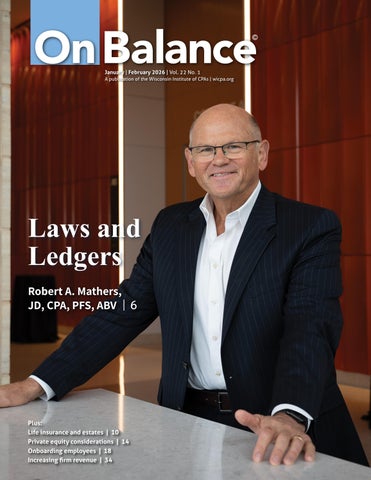
January | February 2026 | Vol. 22 No. 1 A publication of the Wisconsin Institute of CPAs | wicpa.org
Laws and Ledgers Robert A. Mathers, JD, CPA, PFS, ABV | 6
Plus: Life insurance and estates | 10 Private equity considerations | 14 Onboarding employees | 18 Increasing firm revenue | 34
BS
Business Checks & Accessories
RECRUITERS
BATTERMAN SCHOOL OF
BUSINESS
Technologies LLC Technology Consulting for the Home and Business
Zetley Law Offices, S.C.
A publication of the Wisconsin Institute of CPAs | wicpa.org
January | February 2026 Vol. 22 No. 1
6 Features
Columns
6
Laws and Ledgers Robert A. Mathers, JD, CPA, PFS, ABV, takes estate planning personally — a lesson learned from his family’s challenges. Many people go into either the accounting or legal profession, but finding someone who has done both is more of a rarity. By Brent Roberts
22 RETIREMENT PLANNING PEP Talk: What Is a Pooled Employer Plan? When it comes to retirement benefits, employers have more choices than ever. Two options are the traditional single-employer plan and the newer pooled employer plan. By Manuel Rosado, MBA
10 Big Beautiful New Tax Law – Effect on Life Insurance Policies in Estate Planning Many individuals purchased life insurance to replace income or protect assets, and with the estate tax exemption at a permanent $15 million, many policies no longer serve their original purpose. By Rosie K. Mathers, MBA, CFP, CLU, ChFC, and Robert A. Mathers, JD, CPA, ABV, PFS
26 CHARITABLE GIVING LAWS Charitable Giving After the OBBBA When Congress passed the OBBBA, headlines focused on tax rates and SALT relief. Less noticed were changes to the charitable contribution rules. By Pat Hoffert, CPA
14 Independence at a Crossroads: Should Your Firm Take the Private Equity Path? With growth capital on the table and cultural costs in the balance, accounting firm leaders face a high-stakes decision — should they take the private equity deal or remain independent? By Chris Camara 18 The Onboarding Experience — Making a Lasting Impression In today’s competitive job market, finding the right candidate is only half the battle. The real opportunity lies in how you bring that person into your organization. By Shelly Dretzka, SPHR wicpa.org
14
30
30 DATA ANALYSIS From Numbers to Narratives: Mastering Data Analysis for CPAs The proliferation of electronic data has brought the accounting profession to a pivotal moment. CPAs are challenged to redefine their roles. By Bryan L. Smith, CPA.CITP, CISA
Departments 3
Outlook | chair’s letter
4
In Touch | president & CEO’s message
13 Kudos | members in the news 21 Memorials | departed members
34 BUSINESS DEVELOPMENT How to Identify and Build New Industry Niches in a Public Accounting Firm For many firms, growth comes from strengthening relationships in the industries they already serve. But there comes a time when expansion means diversifying. By Timothy Allen, MBA, PAFM
32 Welcome | new members
On Balance
January | February 2026
1
On Balance is published five times a year by the Wisconsin Institute of Certified Public Accountants (WICPA). Change of address should be sent to: Membership, W233N2080 Ridgeview Pkwy, Suite 201, Waukesha, WI 53188; Phone: 262-785-0445 or 800-772-6939; Fax: 262-785-0838; email: comments@wicpa.org. Statements and opinions expressed are those of the authors and not necessarily those of the WICPA. Publication of an advertisement does not constitute an endorsement of the product or service by On Balance or the WICPA. Articles may be reproduced with permission. © Copyright 2026 On Balance.
Join us online!
2025-2026 WICPA OFFICERS/BOARD MEMBERS
INSIDE STAFF
Chair Stacy A. Stinson, CPA, MBA
President & CEO Tammy J. Hofstede
Chair-elect Neil R. Keller, CPA
Design & Layout Brett Stallman
Past Chair Ryan J. Hanson, CPA, CGMA
Advertising Sue Daniels
Secretary/Treasurer Christopher M. Cholka, CPA, CGMA
Editor Brent Roberts
Directors Michael D. Donahue, CPA Jessica B. Gatzke, CPA, MST Benjamin J. Hauser, CPA Tori M. Morrow, CPA, CGMA, MBA Sali L. Sheafor, CPA
Printing Special Editions
AICPA Council Neil R. Keller, CPA Wendi M. Unger, CPA
ACCOUNTING SCHOLARSHIPS
Receive $3,000 in scholarship money!
Apply online at wicpa.org/scholarships through March 13, 2026. Scholarships are awarded from the WICPA Educational Foundation to qualified accounting students that have completed at least 90 credits of a degree program that qualifies to sit for the CPA Exam.
2
On Balance
January | February 2026
wicpa.org
OUTLOOK | CHAIR’S LETTER “While we understand the value of the CPA license, it is important that we continue to uphold our high standards and work with our local governments so they understand the role of the CPA and the importance of licensing to protect the public.”
Inspiration Through Involvement By Stacy A. Stinson, CPA, MBA
W
elcome to the new year! Over the past few months, I have welcomed participants at several WICPA conferences, co-presented to high school students in the UWM Future Success Program–Metro Business Club and sat on a college educator panel at the WICPA High School Educator Accounting Symposium. This allowed me to meet colleagues from across the state and be an advocate for the profession.
national level, consistent messaging and follow-through at the state level meant that our voices were heard.
As chair, I am also privileged to be a member of the AICPA Council (the Council). The Council brings together state society CEOs and board members, AICPA and NASBA executives, and national committee members and staff to discuss the accounting profession. This fall, the meeting was held in Denver and attended by accounting professionals in education, public accounting, private industry, entrepreneurship and government.
Licensing: We learned more about the Alliance for Responsible Professional Licensing with a panel discussion that included members of the landscape architect profession, NASBA and AICPA leadership. The panel, moderated by Lexy Kessler, chair, AICPA, addressed licensing deregulation and its varying impact across professions. While we understand the value of the CPA license, it is important that we continue to uphold our high standards and work with our local governments so they understand the role of the CPA and the importance of licensing to protect the public.
Here are some areas that stood out for me: CEO update: Mark Koziel, president & CEO of the AICPA and CEO, Association of International Certified Professional Accountants, provided an overview on the government shutdown, tariffs and artificial intelligence. He also stressed that the profession must continue to advocate and expand more into the trusted advisor role. CPA pipeline: We discussed the new pathway to CPA and talked about ways that we can influence the pipeline in our state. We also discussed being visible by forming partnerships with other organizations, such as Future Business Leaders of America, Junior Achievement, Beta Alpha Psi and DECA Inc., along with working with high school educators. These collaborations will help strengthen awareness of the accounting profession. Advocacy: We celebrated big wins. The capital visits that we held in Washington, D.C. last May resulted in some key tax reforms, such as the pass-through entity tax, SALT deductions, 100% bonus depreciation and Section 529 qualified education expenses. Our lobbying at the state and wicpa.org
Strategic visioning: This part of the meeting allowed us to discuss the global strategic visioning initiative, AICPA Rise 2040. Council members reviewed summarized materials from our May session and continued discussion on proposed core values and competencies. All feedback was shared with the RISE 2040 committee to ensure our interests were represented.
Finally, we were treated to a presentation by Bill Stainton, a 29-time Emmy Award-winning executive producer. His presentation was dynamic and engaging and reminded us that everyone can be creative and innovative when we are open to new relationships, ideas and solutions — no matter the messenger. We concluded the meeting excited and inspired to look for new ideas and creative solutions all around us. As we fill our calendar for 2026, here is a personal invitation from me to you to attend a WICPA conference; annual bowling night on Thursday, April 30, in New Berlin; and our annual Member Recognition Banquet & Annual Business Meeting on Friday, May 8. As a state society, let’s continue to build relationships, collaborate on issues, support each other and share our successes. Stacy A. Stinson, CPA, MBA, is assistant professor of accounting at Concordia University and the 2025-2026 WICPA board of directors chair. Contact her at 262-243-2099 or stacy.stinson@cuw.edu.
On Balance
January | February 2026
3
IN TOUCH | PRESIDENT & CEO’s MESSAGE “Tackling the workforce development issue is complex and includes many variables, and making a CPA license more accessible is critical to ensuring the future of the profession.”
Additional Pathway to CPA Licensure Legislation Introduced in Wisconsin By Tammy J. Hofstede
A
ccounting is the language of business, but fewer professionals are speaking that language. As the accounting profession adapts to pipeline issues, shifting demographics and retirement cliffs, and changing standards and client demands, the current certified public accountant (CPA) licensure framework must also evolve. The number of new CPAs entering the profession remains a hot topic and is a challenge for firms and organizations large and small. The financial environment is growing more complex for everyone, increasing demand for CPA services. State societies listened to the profession and committed to leading together from the front. We collaborated to make much needed changes that broaden access while maintaining the integrity and trust of the CPA license. Tackling the workforce development issue is complex and includes many variables, and making a CPA license more accessible is critical to ensuring the future of the profession. For nearly two years, we have been reviewing additional licensure pathway proposals and exploring options to eliminate any unnecessary barriers to entry into the accounting profession. Most notably, the time and costs required to become a CPA have been under increasing scrutiny. Over the last several months, I have worked closely with Sen. Howard Marklein and Rep. Bob Wittke to draft legislation that evolves the state’s CPA licensure model to broaden access and better meet the profession’s workforce demands while maintaining the rigor and trust of the CPA license. I have also been meeting with legislators to inform and educate them about our licensing/workforce bill. On November 26, 2025, AB696/ SB732 was introduced in the Wisconsin Legislature. This bill is the result of collaboration among the WICPA, its CPA members, 54 other CPA licensing jurisdictions and the national regulatory bodies of AICPA and NASBA and of updates and ongoing discussion with the Accounting Examining Board. It ensures Wisconsin remains aligned with evolving
4
On Balance
January | February 2026
Tammy Hofstede, WICPA President & CEO, testifies at the Assembly Committee on Regulatory Licensing Reform hearing on AB696.
Michael Friedman, CPA, JD and Stacy Stinson, CPA, MBA, testify at the Assembly Committee on Regulatory Licensing Reform hearing on AB696.
standards around the country while safeguarding public trust and the profession’s integrity. These changes do not solve the entire talent problem, but they do address identified barriers. Our extensive coordination with fellow state CPA societies has helped us craft legislation that modernizes and advances the profession by responding to the needs of CPAs and those who employ them across the country. Our legislation also takes our neighbors into consideration to minimize any disruption to CPA practice mobility across state lines. Currently, Wisconsin requires CPA candidates to complete 150 credit hours of qualifying education, gain one year of relevant work experience and pass all portions of the Uniform CPA Exam to become licensed in the state — a structure that’s been in place since 2001. The research has shown that the cost of additional education is a significant barrier to many would-be CPAs. It also shows that 150
wicpa.org
hours resulted in a 15% reduction in first-time CPA Exam candidates after the 150-credit requirement was implemented, with the decline aggregating over multiple years. This structure no longer supports the profession’s current and future workforce needs given the ongoing talent shortage and growing need for CPAs, who hold an essential role to serve the business community and protect public interests. There are currently two pathways to obtain a CPA license, which requires a master’s degree or 150 credits of college education, passing the CPA Exam and one year of experience. AB696/SB732 introduces an additional third, alternative pathway to the traditional 150-credit hour education model. This pathway is nationally aligned and allows candidates to obtain a CPA license with a bachelor’s degree, completion of the CPA Exam and two years of professional experience.
From left: Tammy Hofstede, WICPA President & CEO; Senator Howard Marklein; Michael Friedman, CPA, JD; WICPA Board Chair Stacy Stinson, CPA, MBA; and Representative Robert Wittke.
Why this matters: • Modernizes CPA licensure – It offers an additional flexible, more experience-based route that balances education and work experience. It allows for earlier entry into the workforce and further enhancement of skills and competency as internships and apprenticeships are growing. It also creates a stronger business environment and strengthens the state’s economy. • Strengthens the pipeline – It provides a viable solution to help alleviate the growing shortage of accounting professionals by removing unnecessary barriers to entry without lowering standards.
Where are we now? Stacy Stinson, CPA, WICPA board chair and assistant professor of accounting at Concordia University Wisconsin; Michael Friedman, CPA, JD, director at Scribner, Cohen and Company S.C.; and I testified at the hearing before the Assembly Committee on Regulatory Licensing Reform on December 17. The Assembly will vote on AB696 in early January, while we anticipate the Senate will be scheduling a hearing and vote by mid-February.
How YOUR voice can be heard
• Preserves professional mobility – It maintains critical national standards for interstate practice by enabling Wisconsin CPAs to continue serving clients across state lines.
Contact your state representative and senator and urge them to support AB696/SB732 to ensure Wisconsin continues to attract and retain accounting professionals.
AB696/SB732 also addresses updating the administrative rules simultaneously, so there will be no delay in having an immediate effective date.
Tammy J. Hofstede is president & CEO of the WICPA. Contact her at 262-785-0445 ext. 4518 or tammy@wicpa.org.
The WICPA is incredibly grateful to Sen. Howard Marklein and Rep. Robert Wittke for co-authoring this important bill and to Reps. Barbara Dittrich, Daniel Knodl, Priscilla Prado, Sylvia Ortiz-Velez and Chuck Wichgers for sponsoring it. We would like to acknowledge each of them for their commitment to advancing this important legislation for the accounting profession in Wisconsin.
CURRENT PATHWAYS: 1. Master’s Degree + Exam + 1 Year Experience 2. Bachelor’s Degree, completed at least 150 credits (allows for double major, minor or credits not transferred to a 4-year college or university from a technical college) + Exam + 1 Year Experience NEW: 3. Bachelor’s Degree + Exam + 2 Years’ Experience
Rep. Robert Wittke and Senator Howard Marklein testify at the Assembly Committee on Regulatory Licensing Reform hearing on AB696.
wicpa.org
On Balance
January | February 2026
5
LAWS AND
LEDGERS Robert A. Mathers, JD, CPA, PFS, ABV, takes estate planning personally — a lesson learned from his family’s challenges.
M By Brent Roberts
any people go into either the accounting or legal profession, but finding someone who has done both is more of a rarity. Robert A. Mathers, JD, CPA, PFS, ABV, a partner at Quarles & Brady, is one of those accomplished individuals.
After serving in leadership roles at accounting firms earlier in his career, Mathers transitioned to the legal world, where he describes his work as falling into three buckets (trusts and estates, tax, and general corporate work), but in reality, it’s working with families every day and serving as a consigliere. He is licensed in Wisconsin, Minnesota, Florida and Arizona and in the last five years has found a multistate niche in the trusts and estate practice. For Mathers, serving in an advisory capacity is “an honor to serve clients that have those sorts of needs. I feel truly blessed to be able to advise them through some of those once-in-a-lifetime decisions. That’s one of the main differences between practicing law and accounting. Both are trusted positions with clients — some would argue accountants even more so than lawyers. In the CPA profession we had a partner to staff ratio of 1:6, but in the legal profession, it’s about half that. It’s just a much closer relationship that’s focused more on implementation, and it feels good to be able to implement some of these strategies for clients and families.”
6
On Balance
January | February 2026
Where there’s a will, there’s a (better) way For some attorneys, trusts and estates is simply the area of law that they practice, but for Mathers, his interest was borne from his family’s challenges. “I remember it like it was yesterday. My grandpa was president of the Chicago Stockyards way back in the day, retired to Green Lake, Wisconsin, and had a residence there and in Naples, Florida. When he passed away in 1980, I was a junior in high school, and I remember my mom being the executor of the estate. Back then estate exemptions were much lower, so more people paid an estate tax. “Seeing my mom go through what she did with his estate and the tax that was paid, I remember thinking, ‘That’s really not fair’ — so it wasn’t immediate, but it’s what got me going in this direction. That was a family business, and my uncle was a big part of that with my grandpa, so it was a game changer for me vocationally.”
The path that was meant to be Mathers knows that the law has been his professional path for a while. However, in high school he played football and was a wrestler; he really wanted to play football, even getting a couple of looks from big schools but no offers. From there, he played at the University of Wisconsin– Platteville his first semester and didn’t know what he wanted to do, thinking at the time that he was fairly good at math, so he went into the engineering school. Based on his reflection, it was a rude awakening that he wasn’t good at football or engineering.
wicpa.org
Mathers speaks to the 2025 WICPA Tax Conference audience about the One Big Beautiful Bill Act.
Big picture, clear vision After spending years working in the accounting profession, Mathers now finds professional joy in being a trusted partner to his former colleagues. “I enjoy being a resource for CPAs, and having been one myself for many, many years I can appreciate a lot of the challenges they go through. Working with accountants today, my favorite part is getting involved with succession planning, where it’s truly a team sport and we’re living transfer of wealth on a day-to-day basis. I really enjoy that part of it.” So, what words of wisdom does Mathers have for those accounting professionals? “I encourage my counterparts on these teams to look more holistically at the problem-solving that’s going on.
wicpa.org
My best colleagues working with clients are very technical and can get pretty focused on very narrow issues, so one of the challenges is making sure we look holistically at the client’s objectives and what they’re trying to do and not get too caught up in the technical — although there is a premium on technical expertise, it really requires both. So, I would encourage them to go up to 10,000 feet before we come down to the runway, and it’s back-and-forth so we can land the plane and know which direction we’re going, as well.”
More consulting, greater balance Mathers reflects that for the first time in a long time, while there’s a tax law change, it’s a moderation of what was going to happen. The One Big Beautiful Bill Act relaxed everything that was going to be more confiscatory, and we
On Balance
January | February 2026
7
“
I enjoy being a resource for CPAs, and having been one myself for many, many years I can appreciate a lot of the challenges they go through. CPA firms to get in and do this consulting work because they’re not burdened with another tax law sunsetting.”
Knowledge through networking When Mathers thinks about the origins of his time in the accounting profession, involvement with the WICPA certainly comes to mind.
Mathers spoke at the 2018 WICPA Member Recognition Banquet.
find ourselves in a position where the advice for 2026 is not to really worry about the changing tax laws so much as it is to get the accounting practices to a little less of a compliance focus and a little more of an advisory focus. As far as why that matters locally, he says, “I know that’s a strategic focus for a lot of smaller CPA firms in Wisconsin — can we do more consulting work? Some CPA firms I work with are actually trying to get to 50-50 compliance and consulting. This is really the year to be consultants and not have to worry so much about the compliance changes.” For the local CPA firms that want to shift their focus, Mathers encourages a review of a recent court ruling. “We had a major tax law change come out of the U.S. Supreme Court a couple of years ago with the Connelly case that addressed the structure of client buy-sell agreements. That’s a great place for CPAs in 2026 to do some consulting because that case isn’t just about buy-sell agreements. When we look at clients holistically, it’s the system of governance for the enterprise, and I think 2026 should be a boom year for
8
On Balance
January | February 2026
“This goes back a long way. My undergraduate degree was not in accounting; it was in management information systems, and through taking some classes in law school, I was able to sit for the CPA Exam in Wisconsin.” He adds, “For me, way back when we moved to Wisconsin, it really was forming alliances to help me be a better businessperson and to be a better accountant. Back then the WICPA had breakfast meetings in different geographic locations, and my wife taught in the business school at University of Wisconsin–Oshkosh, so I would go to these breakfast sessions for the networking and the knowledge base as a young CPA. Now, every time I teach for the WICPA, I always learn something as I’m preparing, so it’s made me a better professional. The ability to collaborate and have some roles on the Tax Committee also has been wonderful.”
When family meets finances While Mathers takes great pride and joy in his legal career, the opportunity to also work in the financial arena, with his family no less, was too good to pass up. He shares, “With the impending merger of the CPA firm I was part of, I had the opportunity to dispose of my partnership interest and practice law, so rather than moving my family, I stayed local and started over with a new career. Along with my law firm partnership, through my wife’s — Rosie’s — knowledge and expertise, we created Private Wealth Advisers. The family-owned company helps both individual clients and other professionals, including CPA firms and independent Registered Investment Advisors. When we work together to solve clients’ problems, it’s really nice because it’s a seamless delivery of implementation and solutions.”
wicpa.org
“
Now, every time I teach for the WICPA, I always learn something as I’m preparing, so it’s made me a better professional.
Mathers interacts with the audience during his presentation on the One Big Beautiful Bill Act during the 2025 WICPA Tax Conference.
Meaningful mentorship It’s likely not too often that a tenured professional gets to where they are without some guidance and assistance along the way, and Mathers is no exception.
Photo provided by Robert Mathers
“I look at this intersection of law, accounting and wealth management, and I remember as a kid, there was this lawyer in Ripon, Wisconsin, Steve Sorensen. He was a new lawyer back then, and we went to his law offices, and he was telling us what lawyers do. I stayed in touch with him over the years and was actually business partners with him at von Briesen & Roper, s.c. “On the accounting side, Carl George was the CEO of Clifton Gunderson and taught me a lot about business in general and how to run things. “In the wealth management practice, Russ Alan Prince, president of R.A. Prince & Associates, Inc., used to come through Chicago, and I would time myself so I could go meet him at O’Hare Airport, and he showed us just how valuable CPAs can be to clients.”
Mathers with his wife, Rosie.
On a mission to do good
Brent Roberts is the WICPA communications director. Contact him at 262-785-0445, ext. 4515, or brent@wicpa.org.
wicpa.org
Photo provided by Robert Mathers
In their free time, Mathers and his wife enjoy golf and traveling, particularly getting out of the country. They’re also involved with the Collier Community Foundation in Naples and do an annual mission trip to an orphanage in Jamaica, where they work on a variety of projects. Being on the selfdescribed “back nine” of his career, Mathers strives to turn success into significance. Mathers has made many trips to Jamaica, working on projects for an orphanage.
On Balance
January | February 2026
9
Big Beautiful New Tax Law Effect on Life Insurance Policies in Estate Planning
M
any individuals purchased life insurance to replace income or protect assets (e.g., funding a buy‑sell or providing liquidity for estate tax on a closely held business). With the estate tax By Rosie K. Mathers, exemption at a permanent $15 million and indexed to inflation, MBA, CFP, CLU, many legacy policies no longer ChFC and serve their original purpose. Owners may be fatigued from premium payment. Lapses may be imminent. Many policy owners may be tempted to simply surrender unneeded policies. However, surrendering a policy to the carrier without considering alternatives may unknowingly Robert A. Mathers, waste value. For example, a JD, CPA, ABV, PFS homeowner who purchased a $1,000,000 home from a builder many years ago for $100,000 would never sell that property back to the builder for the original $100,000 purchase price. Policy owners have many different choices, including exchanging, modifying or selling the asset. Going through a life settlement process can identify, evaluate and unlock value and liquidity for policy owners who no longer desire coverage.
Understanding life settlements A life settlement is the sale of a life insurance policy to a third‑party investor. The buyer assumes future premiums and receives the death benefit upon the insured’s passing. This can make sense for owners who (1) no longer need the policy, (2) cannot maintain premiums or (3) prefer immediate resources.
Legal foundation (Grigsby v. Russell, 19111) In Grigsby v. Russell, 222 U.S. 149 (1911), the U.S. Supreme Court held that a life insurance policy is private See also Pruco Life Ins. Co. v. Brasner (S.D. Fla 2011) (affirming that a validly issued policy may be sold to a third party without an insurable interest if procured legitimately). 1
10
On Balance
January | February 2026
“
Surrendering a policy to the carrier without considering alternatives may unknowingly waste value. property freely assignable by its owner. Justice Holmes wrote that policies should possess the ordinary attributes of property. The holding legitimized the secondary market for life settlements.
Tax history of life settlements Historically, tax treatment was uncertain. Early guidance treated the seller’s gain above basis as ordinary income.2 Section 7702 (1984)3 defined life insurance contracts for tax purposes, and Rev. Ruls. 2009‑134 and 2009‑145 addressed income recognition for sellers and basis for purchasers, but basis reductions limited net proceeds to sellers.6 The 2017 Tax Cuts and Jobs Act7 effectively overturned the 2009 basis‑reduction rule and aligned the seller’s basis determination in a sale with surrender treatment. Today, settlement proceeds are characterized in three layers: (1) tax‑free recovery of basis, (2) ordinary income on amounts above basis up to cash surrender value and (3) capital gains on amounts above cash surrender value. A recent IRS revenue ruling also confirmed that term policies have tax basis (generally cumulative premiums8). These clarifications materially improve after‑tax outcomes for many sellers.
Estate planning context Under the One Big Beautiful Bill Act,9 the federal estate and gift exemption will increase from $13.99 million in See Rev. Rul. 64 51, 1964 1 C.B. 322. See Deficit Reduction Act of 1984, Pub. L. No. 98 369, § 221(a), 98 Stat. 494, 767 (1984) (enacting I.R.C. § 7702 to define life insurance contracts for federal tax purposes). 4 Rev. Rul. 2009 13, 2009 21 I.R.B. 1029 (superseding part of Rev. Rul. 2008-42 and clarifying the IRS’s position about whether such gains should be treated entirely as ordinary income). 5 Rev. Rul. 2009 14, 2009 21 I.R.B. 1 (2009). 6 See Rev. Rul. 2009-14, I.R.B. at 1032 (referring to the Situation 2 example). 7 See Tax Cuts and Jobs Act, Pub. L. No. 115 97, §§ 13520–13522, 131 Stat. 2054, 2213–18 (2017). 8 Id. 9 One Big Beautiful Bill Act, Pub. L. No. 119 21, 139 Stat. 72 (2025). 2 3
wicpa.org
2025 to $15 million in 2026 ($30 million for married couples), indexed for inflation — an all‑time high. Fewer estates will owe federal estate tax, prompting policy owners to reassess whether existing policies still match their intended purpose. In some cases, maintaining coverage continues to make sense (e.g., hedging liquidity needs for very wealthy families or guarding against future law changes). But where a policy is obsolete or underperforming, owners should compare options: lapse, surrender, exchange or sell (via life settlement).
Practice guide — how to evaluate and execute Step 1: Actively manage the policy. Most life insurance policies aren’t actively reviewed, and financial professionals have no monitoring obligation. Oversight often falls to the
wicpa.org
owner or their advisor (e.g., trustee, attorney or CPA) to ensure the policy still meets its purpose. Studies show nearly 80% of consumers don’t know life settlements exist,10 90% of seniors would have considered selling lapsed policies had they known it was possible11 and about half of advisors admit limited knowledge of the option.12 Larger insurers have little incentive to promote awareness since they profit when policies lapse or owners surrender. An estimated $112 billion in death benefit is lost annually among those 65 and See Peter Hershon, “More Than 8 in 10 Seniors Unaware of Life Settlement Option,” ThinkAdvisor (May 12, 2016) (finding that 86.1% of 604 surveyed seniors were unaware of life settlements). 11 See Insurance Studies Institute, Survey of Senior Life Insurance Policyholders 1 (2010) (finding that “90 percent of seniors who have let a policy lapse would have considered selling it if they had known a life settlement was an option”). 12 See Insurance Studies Institute, “Why Sell? Life Settlements: A Guide for Financial Advisors,” 1 (2024) (noting that “49 percent of advisors cited lack of knowledge as the reason for not recommending life settlement options to clients”). 10
On Balance
January | February 2026
11
older.13 Regular, proactive reviews help owners recognize risks early and evaluate whether maintaining, restructuring or selling the policy creates the best outcome. Step 2: Engage. There are two main ways to sell a life insurance policy. One is to work directly with a licensed provider that buys policies using its own or institutional funds, offering a single price — often with lower fees and a faster process but no way to confirm if the offer reflects fair market value. The other is to engage a life settlement broker or financial professional who represents the policy owner and solicits bids from multiple providers to secure the highest offer. This competitive approach may take longer and involve additional fees but can result in greater proceeds for the seller. Step 3: Prepare the policy for sale. Some policies can be sold within 90 days without medical review. However, most sales require a three- to six-month process (sometimes longer). The good news is an indicative value range can often be provided within about 24 hours based on an in‑force illustration. Typically, paperwork is completed, medical and policy data are compiled, life expectancy is estimated, and an initial offer is made. If a broker is retained, an auction may occur. On acceptance, ownership changes, and the buyer assumes all future premiums.
Conclusion
See Life Insurance Settlement Association, “American Seniors Forfeit $112 Billion in Benefits Annually Due to Lapsed or Surrendered Life Insurance Policies” (Feb. 24, 2015) (presenting research that “Americans who are aged 65 or older leave approximately $112 billion in benefits on the table each year by lapsing or surrendering their life insurance policies”) (press release), available at https://www.globenewswire.com/newsrelease/2015/02/24/. 13
On Balance
Rosie K. Mathers, MBA, CFP, CLU, ChFC, is CEO of Private Wealth Advisers LLC. She holds Life & Health and Variable licenses (Florida, Wisconsin), and Series 6 and 65 registrations. A former university faculty member, she developed and taught a personal financial planning curriculum. Rosie partners with clients, CPAs and RIAs on accumulation and distribution planning and life insurance evaluation and placement. She remains active in professional and community organizations. Robert A. Mathers, JD, CPA, ABV, PFS, is a tax attorney at Quarles & Brady LLP serving closely held businesses and owners in business law, tax, estate planning and private wealth services. A former national tax director and wealth management CEO at a national CPA firm, he advises professional services firms and serves on multiple councils and committees. He is admitted in Florida, Wisconsin, Minnesota and Arizona and before the U.S. Tax Court. Disclosures
Securities offered through Valmark Securities Inc., Member FINRA, SIPC. Investment Advisory Services offered through Valmark Advisers, Inc., a SEC Registered Investment Advisor. Private Wealth Advisers LLC and Quarles & Brady LLP are separate entities from Valmark Securities, Inc. & Valmark Advisers Inc. ________________________________________________________
Given today’s elevated estate and gift tax exemptions and life insurance policies no longer serving their intended purposes, life settlements deserve consideration alongside lapse,
12
surrender and conversion options. With today’s clear tax rules, net proceeds for sellers can be meaningfully better than surrender in many cases. Owners and fiduciaries should assess if the policy still fits owners’ estate planning and financial objectives. Based on that review, owners can make informed decisions regarding available alternatives to continuing premium payments.
January | February 2026
In a life settlement arrangement, the current policy owner transfers the ownership and beneficiary designation to a third party, who will receive the death proceeds upon the death of the insured. As a result, this buyer has a financial interest in the seller’s death. When an individual decides to sell their policy, he or she must provide complete access to his or her medical history, and other personal information, that may affect his or her life expectancy. This information is requested during the initial application for a life settlement. After the completion of the sale there may be an ongoing obligation to disclose similar and additional information later. Valmark Securities supervises all life settlements like a security transaction. A life settlement may affect the seller’s eligibility for certain public assistance programs, such as Medicaid, and there may be tax consequences. Individuals should discuss the taxation of the proceeds received with their tax advisor. Individuals considering life settlements should carefully read the entire sales agreement, consult their advisors, and consider all available options before selling their policies. Valmark Securities and its registered representatives act as brokers in the life settlement transaction and receive compensation from the purchaser. A life settlement transaction may require an extended period to complete. Due to the complexity of the transaction, fees and costs incurred with the life settlement transaction may be substantially higher than other securities. Once the policy is transferred, the policy owner has no control over subsequent transfers.
wicpa.org
kudos
Michael Donahue
Kelli Keys
Seth Kuehnel
Brooke Leiterman
Michael Donahue, CPA, president at Donahue & Associates in Grafton, was named in Forbes magazine’s 2025 list of America’s Top 200 CPAs. Nicole Gabriel, CPA, has been promoted to the shareholder group of Vrakas CPAs + Advisors in Brookfield.
Kelli Keys, CPA, has been promoted to the shareholder group of Vrakas CPAs + Advisors in Brookfield.
Seth Kuehnel, CPA, has been promoted to partner at Wegner CPAs in Waukesha. Brooke Leiterman, CPA, has been promoted to principal at Reilly, Penner & Benton CPAs in Milwaukee.
Diane Rieder, CPA, CCE, has been promoted to executive vice president at Premier Financial Credit Union in New Holstein. Susan Sowatzke, CPA, CGMA, MST, has joined JG Development in Madison as controller.
Cory Spice, CPA, and his wife, Trisha, are the new owners of Lindeman’s Cleaning, a 70-year-old dry cleaning company with
Adam Vincent
Monica Weggeman
Noel Willis
several locations in the Green Bay area, now affiliated with Martinizing Cleaners.
Adam Vincent, previously a tax intern at Sikich in Brookfield, has been promoted to staff tax accountant.
Monica Weggeman, CPA, CISSP, CISA, CIA, PMP, has been promoted to senior manager at Baker Tilly in Milwaukee. Noel Willis, CPA, MST, has been promoted to partner at Wegner CPAs in Waukesha.
FIRM NEWS Berndt CPA in Madison has been recognized as one of Accounting Today’s 2025 “Best Accounting Firms to Work For,” ranking No. 11 nationwide among small firms and the only Wisconsin firm to be included in this year’s Top 100 list.
Want your new job, promotion or award mentioned in Kudos? H Email your announcement and photo in JPG format to john@wicpa.org. H
Check out our featured member benefit providers 8am CPACharge
Spectrum Investment Advisors
Waukesha State Bank
WICPA members enjoy first three months with no 8am CPACharge monthly fee. CPACharge helps accounting firms get paid faster with next-day funding, seamless reconciliation and secure online payments — all designed for accounting professionals.
Spectrum Investment Advisors co-sponsors the annual Retirement Plan Investment Seminar, which offers WICPA members CPE credits at a nominal cost. WICPA members can work directly with Spectrum to receive plan consulting services for their retirement plan program as well as individual wealth/asset management services.
Established in 1944, Waukesha State Bank is one of the largest locally owned and independent community banks in Wisconsin, with full-service offices in Brookfield, Delafield, Menomonee Falls, Mukwonago, Muskego, New Berlin, Oconomowoc, Pewaukee, Sussex and Waukesha. For more information, visit www. waukeshabank.com. Member FDIC.
These affinity partners and more can be found at wicpa.org/discounts. wicpa.org
On Balance
January | February 2026
13
Independence at a Crossroads: Should Your Firm Take the Private Equity Path? With growth capital on the table and cultural costs in the balance, accounting firm leaders face a high-stakes decision — should they take the private equity deal or remain independent?
A
s private equity (PE) continues to reshape the accounting profession, certified public accounting firm leaders are grappling with a critical question: Can they remain independent and still compete?
PE has moved from the fringes of the accounting profession to center stage. Since 2021, roughly two dozen of the 100 largest accounting firms in the United States have either sold an ownership stake to PE investors or been acquired by a firm that’s done so.
By Chris Camara
Once wary of external ownership, accounting firms are now actively courting or being courted by investors. The country’s top 30 firms in particular have embraced PE to fund rapid growth, invest in technology and improve operations. “My observation is high performers do really well in the PE world,” says Allan Koltin, CPA, CGMA, CEO of Koltin Consulting Group in Chicago and a top advisor to CPA firms. “But the downside to that is low performers don’t do so well.”
14
On Balance
January | February 2026
wicpa.org
Here, firm managing partners and consultants reveal strong arguments for and against taking the PE path.
Investment, speed and scale PE can solve an immediate problem: the need for capital. Injecting more capital into a firm can accelerate mergers, upgrade technology and pay for unfunded deferred compensation programs. Bob Lewis, MBA, president of The Visionary Group in Palatine, Ill., estimates 85% of firms are in that category. With valuations being three or even four times greater than before, retiring partners can also exit with sizable payouts. Another attraction is speed, says Matt Rampe, a partner with consulting firm Rosenberg Associates. PE-backed firms move faster into acquisitions and advisory services than traditional partnerships. Rob Brown, a U.K.-based host of multiple accounting podcasts and co-founder of the Accounting Influencers network, says PE also brings experienced professional support: “Sometimes accountants aren’t entrepreneurs, so PE brings in a lot of people with operational expertise that have run and scaled businesses.” A recent PE survey by INSIDE Public Accounting shows that PE-backed firms significantly outpace their non-PE counterparts in total growth, posting an impressive 38.4% increase compared to just 11.7%. Even excluding mergers and acquisitions, PE firms still lead with 16% organic growth versus 10.3% for non-PE firms.
Culture clashes, lost control and client concerns Of course, PE doesn’t come without trade-offs — and some of them are significant. Brown notes that moving decision-making from a partner group to private investors with growth targets is a leap some firms aren’t willing to make: “PE provides fuel, but it also changes who’s driving the organization. Firms need to ask themselves if that direction fits their long-term goals.” A common structural change is the spin-off of audit functions into separate entities. Jeffery Mowery, CPA, JD, LLM, CFP, managing partner and co-founder of Mowery & Schoenfeld LLC, a firm that’s maintained its independence from PE, questions whether these spun-off audit practices might be underfunded or pressured to cut corners, potentially undermining public trust. One of the main deterrents to PE for many firm leaders is the fear of losing a sense of who the firm is (i.e., its culture). Rampe notes that some PE professionals have significant experience in accounting firms and understand the traditions and cultures that come with those environments. Others,
wicpa.org
“
One of the main deterrents to PE for many firm leaders is the fear of losing a sense of who the firm is. however, have no experience, and Rampe says that can backfire if PE firms are attempting to make rapid change: “I think you’re going to hit very strong resistance if you don’t understand or disregard a firm’s tradition and culture.” Mowery says he’s already starting to see disgruntled professionals leave PE-backed firms. For example, a partner that he recruited from a PE-backed firm is now starting a new service line. “The A players aren’t going to stay,” he predicts. And despite what some say, Mowery stresses that clients do very much care about who owns the firm, especially if they’re suddenly receiving services from someone new.
Lessons from firms that said no For Chicago-area firms like Mowery & Schoenfeld and Topel Forman LLC, the answer to PE investors is still no — they know that an influx of capital comes with cultural trade-offs and questions about long-term control. Some firms aren’t just resisting PE opportunities and offers — they’re walking away from them. Others have gone through due diligence and backed out before closing. Some, like Mowery, aren’t even taking phone calls. According to Thomson Reuters’ 2025 State of Tax Professionals Report, 57% of firms said PE isn’t even on their radar, and another 30% said they’re not interested even when approached. While PE has been touted for the fat paychecks that retiring partners can receive upon closing, not everyone is satisfied. For example, after Grant Thornton sold a 60% stake to New Mountain Capital last year, 350 retired U.S. partners hired lawyers to represent them, arguing that lump-sum payouts understated their earned retirement benefits. They contended that the “discount rate” used was manipulated to favor current partners. Lewis says he’s not hearing about regrets so much as discomfort over growing pains. PE can be aggressive about making acquisitions, and some leaders would prefer to pump the brakes to better integrate firms before moving on to the next batch. Koltin also notes that the administrative work required can be a headache as well.
On Balance
January | February 2026
15
“
Firms should also think about their culture and their clients, asking themselves what they want to preserve about their culture. Strong differentiators can fend off PE So, can firms stay independent and still compete? It’s not easy, but some firms are proving it’s possible. Mowery & Schoenfeld, for example, has a lot going for it — fast growth, a group of young partners, investment capital, top talent and a reputation for being a great place to work. “The reasons we’re an attractive target for PE firms give us the ability to remain independent,” Mowery says. The firm’s key differentiators are an entrepreneurial mindset, family-like relationships with clients, a strong emphasis on professional development and career growth with staying power. In fact, seven of 18 partners began their careers with the firm. “I couldn’t sell this firm out from under those people. I couldn’t and wouldn’t do that — I couldn’t face them,” Mowery explains. “We have people who’ve worked in this firm for 20 years. It’s the only job they’ve ever had, and they’re phenomenal at it.” Additionally, Topel Forman has doubled in growth over the last five years from $20 million to about $40 million — all without PE. Managing Partner David Levine, CPA, JD, says one of the firm’s key differentiators is the flexible culture, where not one of its 150-person staff are required to work from the office. Also, Topel Forman’s small-firm mentality means the partners truly have a say in controlling their destiny. And
16
On Balance
January | February 2026
more importantly, its clients and staff prefer the firm to stay independent. “We’ve been trying to reimagine what an accounting firm should be. We’ve ‘over-hired’ to lower our busy season hours,” Levine says. “We’re trying to make this more of a regular profession without killing our people a couple times a year during deadlines.” In May 2025, Topel Forman’s partners fully examined the PE issue over a two-hour meeting and decided against it. “This is where we want to be right now,” Levine explains.
Getting your firm ready to compete with PE Not every firm that wants to stay independent has the foundation that firms like Mowery & Schoenfeld and Topel Forman enjoy — but with deliberate work, they can build it. Rampe advises that firms first think about why they started their firm, and what’s their differentiator? If you’re a plain vanilla firm, with the same mission statement you can find on any other firm’s website, Rampe says it’s likely time to go back to the drawing board. Firms should also think about their culture and their clients, asking themselves what they want to preserve about their culture. Rampe advises firms to get a strong understanding of what their clients need and their pain points, their firm’s most valuable service and how clients want to buy services from them.
wicpa.org
Brown suggests that firms who want to remain independent but also compete with PE-backed firms take these actions: • Raise prices and exit unprofitable client relationships to release trapped margins. • Focus on niche sectors to command higher fees and build deeper client relationships. • Use Small Business Administration loans, bank lending or employee stock ownership plans for funding instead of giving up equity to an external entity. • Redesign succession and equity structures to retain and reward emerging leaders. • Use offshore support and automation to scale without expanding headcount. • Merge with like-minded independent firms to gain scale without sacrificing ownership. • Build a strong internal culture that appeals to professionals who want purpose as well as pay — not just a paycheck. In this environment, Levine notes that firms must run more efficiently, hold partners accountable and be willing to invest in talent and technology: “If you’re not going to take this potentially lucrative offer from PE, then you can’t also tuck your checkbook in your back pocket and not invest in your business — you’ll get left behind.”
Raising capital without PE To preserve ownership, some firms are also exploring multiple alternatives to fund their futures: • Going public: Andersen Tax has taken a major step toward going public, filing for an initial public offering that would make it only the second publicly traded accounting firm after CBIZ. • Minority investments: Bain Capital’s stake in Naperville, Ill.-based Sikich, a top 25 firm, is providing needed capital while allowing current leadership to remain in control. • Family offices and sovereign wealth funds: These investors are increasingly pursuing minority positions in accounting firms to gain access to estate, tax and philanthropic planning expertise. • Selling non-core assets: Spinning off wealth management or consulting units can generate capital without selling the firm.
Is PE good for the profession? According to IPA’s PE survey, 39% of respondents — most of whom were CPA firm partners or managing partners — believe PE is raising the competitive bar, 39%
wicpa.org
believe it’s too soon to tell, and the remainder consider it a negative force. What’s more, 55% of managing partners believe PE is a short-term phenomenon or aren’t sure. Lewis believes PE is vital for the profession, which can be undisciplined about making needed investments: “The profession was literally dying without PE.” Koltin echoed this sentiment: “In this business, if you don’t grow, you die a slow death.” Overall, Rampe believes it comes down to execution: “Do PE firms bring in high-quality and happy team members, great client experience, better technology and better profit for everyone? If so, I think they could elevate the industry, especially at this moment when the profession could use some overhaul.” Despite the positives that PE can bring to the profession, consulting experts stress that accepting a PE investment isn’t right for everyone — and firms that want to resist PE must be proactive. Independence isn’t a default anymore,” Brown says. “It’s a strategy you have to fight for. It’s got to be resourced, priced and protected — otherwise you’re putting your head in the sand if you think PE isn’t coming for you.” Whether firms are leaning toward a PE deal or committed to staying independent, the most important action for them now is to make an intentional decision — aligning their values, culture and future. Chris Camara is a Rhode Island-based freelance writer who has covered the accounting profession for more than 20 years. Reprinted from Insight, the magazine of the Illinois CPA Society.
On Balance
January | February 2026
17
The Onboarding Experience — Making a Lasting Impression
Y
ou’ve made the hire.
Now it’s time to make them feel welcome and confident in their decision to join your team.
In today’s competitive job market, finding the right candidate By Shelly Dretzka, is only half the battle. The real SPHR opportunity lies in how you bring that person into your organization. Effective onboarding goes far beyond the first-day paperwork or IT setup. It’s about connection, clarity and culture; elements that influence how long a new employee stays and how engaged they become. According to research from BambooHR, employees who experience a strong onboarding process are 18 times more likely to feel committed to their employer. Conversely, a poor
18
On Balance
January | February 2026
“
Simply put, onboarding is your first and best opportunity to make a lasting impression. onboarding experience can lead to disengagement and costly turnover. In fact, Glassdoor reports that a great onboarding experience can improve new-hire retention by 82%, while a Society for Human Resource Management study found that 69% of employees are more likely to remain with a company for three years if they experience a well-structured onboarding program. Simply put, onboarding is your first and best opportunity to make a lasting impression.
wicpa.org
Preboarding: Start early The onboarding experience starts before your new hire walks through the door. The time between an accepted offer and the first day is a critical phase known as preboarding. Many organizations underestimate this stage, yet it sets the tone for everything that follows. Employees often make up their minds about whether they’ll stay long term within the first few weeks, even before they officially start. That’s why communication and preparation are essential from day one. Here are key strategies to make your preboarding process more effective: Personal touches Simple gestures go a long way in creating a sense of belonging before the first day. Send a handwritten card signed by the team, or have the president or hiring manager make a quick welcome call. Small touches like asking about the new hire’s favorite snack for day one or including them in a welcome announcement (with photo) show that your team cares about them as a person, not just an employee ID number. Informative materials Provide practical information early. Send a digital welcome packet that includes the employee handbook, benefits overview, organizational chart and company history. Clear and early communication reduces anxiety and allows the new hire to show up prepared and confident. Care package If possible, mail a small welcome package, something that reflects your culture. This could include branded merchandise, a coffee mug, local treats or a personal note from their new team. These thoughtful details help bridge the gap between acceptance and arrival. Onboarding schedule Give your new employee a road map. Outline their first few weeks, including meeting schedules, introductions and key responsibilities. Provide details like dress code, parking information and where to meet on the first day. At aHRrow, the team communicates regularly with new hires before their start date. It’s about removing uncertainty. When a new employee knows what to expect, they can focus on learning and connecting rather than worrying about logistics. Be prepared Nothing deflates excitement like a workstation that’s not ready. Make sure their desk, computer, phone and logins are set up before day one. Being prepared signals professionalism and respect for their time.
wicpa.org
The first day: Make it count The first day is when anticipation meets reality. It’s your opportunity to reinforce that joining your organization was the right choice. Onboarding should focus on building relationships, setting expectations and introducing culture, not overwhelming the new hire with policy reviews and endless forms. Warm welcome Start with energy and warmth. Have someone greet them upon arrival. Consider a small welcome sign at their workspace or a first-day lunch with their new team. These gestures help reduce first-day nerves and foster a sense of connection. A warm welcome also communicates something deeper: that people matter in your organization. Companies can transform their retention just by being intentional about that first-day experience; it’s the moment when trust and engagement begin. Efficient paperwork and policies Administrative tasks are important, but they shouldn’t dominate the day. Whenever possible, complete paperwork electronically before the first day.
On Balance
January | February 2026
19
At aHRrow, new hires receive the employee handbook in advance. When employees have time to review policies ahead of orientation, it creates more meaningful conversations. It shifts onboarding from reading to engaging. Instead of running through every policy line by line, use the time to explain why your company’s policies exist and how they protect employees, ensure fairness and align with your values. Culture and connection Introduce new employees to your organization’s mission, vision and values. Encourage leaders to share stories that illustrate these principles in action. This approach turns abstract ideas into real examples of culture. Make space for questions. New hires often hesitate to speak up, but inviting dialogue early helps build psychological safety and trust.
Beyond the first week: Sustaining engagement Onboarding isn’t a single event — it’s a process. While the first week sets the foundation, real integration happens over the first 90 days and beyond. A structured, long-term onboarding plan helps new hires understand their role, build relationships and find purpose in their work. Regular check-ins Schedule consistent check-ins for 30, 60 and 90 days. These meetings give new employees a chance to share how they’re settling in, ask questions and receive feedback. At aHRrow, we help clients design simple check-in forms and automated reminders to ensure consistency. Regular touch points show employees they are supported. It’s one of the easiest ways to prevent disengagement before it starts. Training and development Provide structured learning opportunities. Whether it’s job shadowing, mentoring or online training, development sends a message: You’re investing in their success. For small businesses, this doesn’t need to be complex. Even dedicating one hour a week to role-specific coaching can make a big difference. Foundation building During the first few months, reinforce your organization’s culture and communication norms. Introduce new hires to different departments and team members to help them understand how their work contributes to the bigger picture. Encourage managers to share company wins and updates regularly. Transparency builds trust and helps employees feel like part of the team faster.
20
On Balance
January | February 2026
Why great onboarding pays off Beyond morale, there are measurable business benefits to effective onboarding. When employees feel connected and supported, productivity rises. According to the Brandon Hall Group, organizations with a strong onboarding process improve new hire productivity by more than 70%. Retention improves, turnover costs drop, and culture strengthens. Small businesses, in particular, can’t afford to get onboarding wrong. When you have only 20 or 50 employees, losing even one person can disrupt operations and culture. Investing time in onboarding is really about protecting your investment in talent. A strong onboarding process also enhances your employer brand. When employees share positive experiences, whether through reviews or word of mouth, it becomes easier to attract top talent.
The role of HR in creating a seamless experience In smaller organizations, onboarding often falls on the owner or office manager. But as businesses grow, managing the details and compliance requirements can become overwhelming. That’s where an HR partner can make a difference. Fractional HR consultants (like aHRrow) can design customized onboarding programs, automate forms and reminders and ensure compliance with employment laws, freeing business owners to focus on growth. Outsourced HR doesn’t replace leadership involvement — it enhances it. It gives leaders the structure, tools and communication plan they need to build lasting relationships with new hires.
Conclusion: Invest in the experience Onboarding is more than a checklist; it’s a first impression that lasts. From preboarding communication to 90-day check-ins, every interaction tells your new hire something about your culture, your priorities and their future in your organization. A thoughtful onboarding program isn’t just good HR — it’s smart business. It strengthens engagement, improves retention and sets the stage for long-term success. When employees feel welcomed, prepared and supported, they do their best work. And that’s the kind of start every business — and every employee — deserves. After 25 years in HR shaping culture, resolving complex employee issues and driving performance, Shelly Dretzka launched aHRrow, a people-first HR consulting firm for small businesses with under 100 employees. She partners with leaders ready to grow, delegate and move beyond daily HR headaches. Contact her at shelly@hrwisconsin.com or 414.852.7772.
wicpa.org
memorials Warren O’Brien Bostrom, CPA, MBT (1972–2025)
Warren “Boz” O’Brien Bostrom, CPA, MBT, a popular speaker at WICPA conferences, passed away on Thursday, Oct. 9. He was 52. Bostrom was a professor of accounting and finance at the College of Saint Benedict and at Saint John’s University, both in central Minnesota. The 1995 SJU graduate spent nine years in Big 4 accounting, specializing in international tax and finance, before returning to his alma mater to join the faculty in 2004. He earned tenure in 2011 and was promoted to full professor status in 2020. He is survived by his wife of 27 years, Kacey; one son; three daughters; his parents; and many other relatives and friends.
William Patrick Fogarty, CPA (1952–2025)
William Patrick “Pat” Fogarty, CPA, age 73, passed away on Monday, Oct. 20. After graduating from Messmer High School in Milwaukee in 1970, Fogarty went on to earn a bachelor’s degree in business and a master’s degree in accounting at UW–Milwaukee. He became licensed as a CPA in 1981. Fogarty worked for several accounting firms before opening his own, Fogarty & Associates LLC, in 1987. After selling his firm in 2020, he worked part time for Gordon J. Maier & Company LLP in Racine until the spring of 2025. Fogarty was a dedicated member of St. Patrick Catholic Church and a Racine Dominican Associate for 40 years. He served on the board for several nonprofit organizations, including the Volunteer Center of Racine County, Cops and Kids and the HOPES Center. He is survived by his wife of 40 years, Elaine; two stepdaughters; five grandchildren; three siblings; and other relatives and friends.
Elmer Walter Glaeske, CPA (1936–2025)
Elmer Walter Glaeske, CPA, age 89, passed away on Thursday, Nov. 13. Glaeske was born in Long Prairie, Minnesota, but moved to Oconomowoc during his childhood. He graduated from Oconomowoc High School in 1954 and earned his accounting degree from Spencerian Business College in Milwaukee in 1957. Before joining the WICPA in 1968 and becoming a CPA in 1969, Glaeske served two years in the U.S. Army and six years in the Army Reserves. In 1971, he partnered with a local accounting firm in Portage to form Miller, Brussell, Ebben and Glaeske, LLC. He retired in 1998 but stayed active playing golf and enjoying Portage High School athletics. Glaeske was preceded in death by his wife of 38 years, Bonnie, and a brother. He is survived by three sons, four grandchildren, one brother and other relatives and friends.
David Michael Leslie, CPA (1937–2025)
David Michael Leslie, CPA, age 87, passed away on Friday, Sept. 26. He was born in Racine and graduated from Washington Park High School in 1957. A lifetime member of the WICPA, Leslie received his accounting degree from UW–Madison in 1960 and became licensed as a CPA in 1964. Leslie’s extensive accounting career included executive roles at several firms, including Felle & Associates, S.C. in Mount Pleasant and Leslie, Hamilton, Brashaw and Garrity PC in Racine. He retired in 2023. Leslie was an active Rotarian, holding many office positions, and served as board president of Lincoln Lutheran in Racine for several terms. He is survived by his wife of 64 years, Judith; three sons; six grandchildren; and many other relatives and friends.
Roger H. Schroeder, CPA (1942–2025)
Roger H. Schroeder, CPA, age 82, passed away on Saturday, Sept. 6. He graduated from Watertown High School in 1960 and earned his degree in accounting from UW-Madison in 1964. Schroeder served in the U.S. Army for two years after his college graduation. He started his career at KPMG in 1966, joined the WICPA in 1968 and earned his CPA license in 1969. He eventually became KPMG’s tax partner in charge of the Milwaukee office before retiring in 1999. Even in retirement, Schroeder worked as a part-time accounting professor at UW–Madison for five years and as a tax practitioner at a family-owned accounting firm for 25 years. Schroeder was a lifelong member of the Lutheran Church and was actively involved with many organizations, including the Rotary Club of Milwaukee, Better Business Bureau and Public Policy Forum. He is survived by his wife of 61 years, Shirley; three daughters; nine grandchildren; four great-grandchildren; and many other relatives and friends.
Norbert Francis Whittle, CPA (1933–2025)
Norbert Francis Whittle, CPA, age 91, passed away on Sunday, Oct. 5. He was born and raised in Elkader, Iowa, and graduated from Elkader High School in 1952. Whittle served in the U.S. Navy from 1953 to 1957. In 1967, he earned his CPA license; he joined the WICPA a year later. Whittle’s accounting career included 18 years as a CPA at RitzHolman CPAs in Milwaukee and 20 years as the executive vice president of Reiman Publications in Greendale. He retired in 1998. Whittle was a member of the Knights of Columbus, American Legion and VFW. He was also a member of Our Lady of Good Hope Catholic Church in Milwaukee, where he served on several finance-related committees. Whittle is survived by his wife of 68 years, Dorothy; two daughters; three sons; 10 grandchildren; six great-grandchildren; and many other relatives and friends.
If you are aware of a member obituary and believe it should be included in Memorials, please send a copy of the obituary or contact John Rasche at john@wicpa.org.
wicpa.org
On Balance
January | February 2026
21
{ Retirement Planning | Pooled employer plan }
PEP Talk: What Is a Pooled Employer Plan? A new 401(k) solution to simplify retirement benefits
W
By Manuel Rosado, MBA
ith all the buzz around pooled employer plans, or PEPs, lately, it’s worth taking a closer look at what they are, the benefits they offer and how they differ from single-employer plans.
When it comes to offering retirement benefits, employers today have more choices than ever before. Two popular options are the traditional singleemployer plan and the newer pooled employer plan. Both are designed to help employees save for retirement and can be excellent solutions depending on a company’s size, goals and internal resources. But how do you know which one is right for your company?
What is a PEP? A PEP allows multiple unrelated employers to participate in a one large 401(k) plan. Instead of each company sponsoring its own plan, participating employers “pool” their resources under one plan that’s managed by professional fiduciaries. Benefits include: • Shared plan expenses, • Reduced fiduciary liability, • Simplified plan oversight, • Plan customization options, • Premium, low-cost investment options and • A streamlined audit process. It’s an efficient and cost-effective way to offer a competitive retirement plan. While it is especially appealing for small to midsize businesses, it can also be a smart choice for larger companies looking to simplify plan management and reduce complexity.
22
On Balance
January | February 2026
“
While it is especially appealing for small to midsize businesses, it can also be a smart choice for larger companies looking to simplify plan management and reduce complexity. How PEPs differ from single-employer plans While single-employer plans offer full customization, they also come with a full set of responsibilities. As the saying goes, “With great power comes great responsibility.” From investment selection and annual audits to compliance and regulatory filings, managing these tasks can be demanding. For smaller teams, the workload can stretch HR and finance resources thin. On the other hand, PEPs combine the strengths of scale and professional management. Many of the administrative and fiduciary duties are handled by the pooled plan provider, while each employer retains control over key features such as eligibility, matching formulas and vesting schedules. This approach helps employers focus on supporting employees rather than managing complex plan details. Audits are another key area where PEPs stand apart. A retirement plan audit is required once a plan reaches 100 or more active account balances. In a single-employer plan, the individual employer is responsible for arranging and paying for its own audit, which can cost anywhere from $8,000 to $20,000. A PEP requires only one consolidated audit for the entire plan, with the cost shared among
wicpa.org
all participating employers. This shared structure can substantially reduce both the administrative burden and the overall cost per employer.
When does a PEP make sense? A PEP may be the right fit if your company: • Wants to reduce its fiduciary and administrative burden. • Prefers a streamlined solution with fewer reporting requirements.
wicpa.org
“
This shared structure can substantially reduce both the administrative burden and the overall cost per employer. On Balance
January | February 2026
23
{ Retirement Planning | Pooled employer plan }
• Is a smaller business looking to offer retirement benefits without large overhead. • Needs a plug-and-play plan to comply with state mandates. • Seeks access to premium services at pooled pricing. With a single tax form; consolidated plan audit; and robust employee engagement features like seamless enrollment, targeted messaging and a financial wellness platform, a PEP can be a powerful employee benefit.
When is a single-employer plan a better fit? • Has complex ownership or compensation structures. • Requires unique plan design elements. • Wants to maintain complete control over plan administration. • Has the internal resources (or existing vendor relationships) to manage plan operations. • Prioritizes a fully tailored benefits experience for employees.
24
Single employer 401(k) Plan
Pooled Employer Plan
Plan design
Fully customized plan design tailored to company goals
Standardized, with customizable features like autoenroll and safe harbor
Administration
Plan sponsor manages or outsources responsibilities
Managed by pooled plan provider
Fiduciary liability
Retained by the employer unless delegated to fiduciaries
Reduced liability by the employer
Cost
Costs based on plan size and provider fees
Pooled pricing shared across employers
Compliance and filing
Employer handles own Form 5500, audits required (100+ participants)
One tax form, reduced audit costs
Best fit for
Companies with unique needs, complex structures or growth plans
Small to midsize businesses seeking simplicity
On Balance
January | February 2026
“
With a single tax form; consolidated plan audit; and robust employee engagement features like seamless enrollment, targeted messaging and a financial wellness platform, a PEP can be a powerful employee benefit. Ready to explore your options? If you’re evaluating retirement plan options, it’s important to consider your business goals, available resources and workforce needs. A PEP and a single-employer plan both offer valuable paths to help employees save for the future. The key is finding the one that fits your organization best. Manuel Rosado, MBA, is president of Spectrum Investment Advisors in Mequon. He has been in the investment management and retirement plan industry since 1999. Contact him at mrosado@spectruminvestor.com or 800-242-4735.
wicpa.org
UPCOMING WICPA CONFERENCES YO U R S O U R C E F O R K E Y U P DAT E S & I N S I G H T S O N T I M E LY I SS U E S
IMPLEMENT
SUCCEED
LEARN
NETWORK
SAVE THE DATE!
Business & Industry Spring Conference
Business & Industry Fall Conference
Financial Institutions Conference
Accounting & Auditing Conference
School District Audit Conference
Tax Conference
Not-for-Profit Accounting Conference
Accounting Technology Conference
Tuesday, March 24 Brookfield Conference Center & WICPA CPE Livestream Wednesday, May 13 WICPA CPE Livestream Only Wednesday, May 27 WICPA CPE Livestream Only Wednesday, Sept. 16 WICPA CPE Livestream Only
Thursday, Sept. 24 Brookfield Conference Center & WICPA CPE Livestream Tuesday, Nov. 10 WICPA Office & WICPA CPE Livestream
Monday, Nov. 16 - Tuesday, Nov. 17 Brookfield Conference Center & WICPA CPE Livestream Thursday, Dec. 17 WICPA Office & WICPA CPE Livestream
WICPA members save up to $150 on registration! Registration opens approximately eight weeks prior to a conference. View conferences currently open for registration at wicpa.org/conferences. wicpa.org On Balance
January | February 2026
25
{ Charitable Giving Laws | Meaningful changes }
Charitable Giving After the OBBBA
W
hen Congress passed the One Big Beautiful Bill Act (OBBBA), most headlines focused on tax rates, SALT relief and estate changes. Less noticed were meaningful changes to the charitable contribution rules.
after December 31, 2025. The OBBBA effectively makes 2025 a pivotal bridge where we are left under pre‑change charitable rules for 2025 but locked into a future where:
As we head into busy season, CPAs are in a useful in‑between moment. We are preparing for 2025 returns under the old rules while helping clients plan for changes taking place in 2026 and beyond. That makes this filing season the perfect time to reset expectations and lay out multi-year giving strategies.
• C‑corporations face a percentage‑of‑income floor on their charitable write‑offs.
By Pat Hoffert, CPA
Let’s take a look at how the new rules reshape conversations with individual, corporate and nonprofit clients during the 2025 tax season.
2025 as the bridge year The OBBBA was signed in 2025, but most of the charitable provisions are effective for tax years beginning
26
On Balance
January | February 2026
• Itemizers face a new adjusted gross income “floor” before any charitable deduction is allowed. • High‑income donors see the tax value of deductions capped, even if they give aggressively. • Non‑itemizers gain access to a modest universal charitable deduction.
By the time this issue reaches publication, the window for changing the amount or timing of 2025 gifts will have closed. But there are still things CPAs can do during filing season: • Help clients understand what they did (or did not) accomplish with 2025 giving. • Use 2025 as the baseline for a 2026–2027 charitable strategy. • Flag clients who may be surprised by the new floors, caps and limits.
wicpa.org
Itemizers: Preparing clients for the new floor and caps For taxpayers who itemize, the most meaningful change is the introduction of a 0.5% of AGI floor on charitable deductions. Starting in 2026, charitable contributions are deductible only to the extent they exceed 0.5% of AGI. For example, a taxpayer with $500,000 of AGI must give more than $2,500 before any deduction is allowed. In addition to the floor, the OBBBA also limits the value of itemized deductions — including charitable — for top-bracket taxpayers. While cash gifts to public charities can still be deducted up to 60% of AGI, highincome donors will see the tax value of those deductions capped at roughly 35 cents on the dollar instead of their 37% marginal rate. Key steps to take with clients could include these: • Walk through 2025 and then model 2026. When reviewing Schedule A, show clients how their 2025 giving would have looked under the new rules and what that means for their usual pattern of gifts. • Identify “habitual givers” near the floor. Some clients give the same dollar amount every year. Under the new rules, they may need to increase or bunch gifts to see a tax benefit.
Non‑itemizers: Making the most of the universal deduction The OBBBA revives a version of the “above‑the‑line” charitable deduction for taxpayers who do not itemize. The dollar cap is modest ($1,000 for single filers and $2,000 for married filing joint), but for many middle‑income households, it is the only way their giving appears on their return. Additionally, the OBBBA added a dollar-for-dollar tax credit of up to $1,700 ($3,400 married filing joint) for qualifying donations to state-certified scholarshipgranting organizations. During filing season, CPAs can: • Flag non‑itemizers whose 2025 returns show regular recurring gifts, such as church or school donations, and explain how the new universal deduction and the new tax credit could apply going forward. • Clarify what counts. Clients may assume all charitable giving is eligible. It is worth a quick reminder that the deduction includes only cash gifts to qualifying public charities. Gifts to donor-advised funds are excluded.
wicpa.org
Corporations: Rethinking “check‑the‑box” giving The OBBBA gives corporate giving a significant overhaul. Under prior law, corporations could deduct charitable contributions up to 10% of taxable income, with a five-year carryforward for excess amounts. The OBBBA keeps the 10% cap but introduces a new 1% floor on the deduction. CPAs can use 2025 returns to: • Quantify last year’s charitable giving in percentage terms and show whether that level would have cleared the new floor. • Encourage clients to adopt a giving policy — for example, committing to a set percentage of pretax income and channeling that through a more deliberate process rather than one‑off requests.
Nonprofits: Helping them understand the donor’s side These changes also matter for nonprofit clients and the boards CPAs serve on. Development staff understand their donors, but they may not understand the nuances of AGI floors, caps and universal deductions. You can add value by helping nonprofits: • Segment donors. The impact of the OBBBA looks quite different for a high‑AGI itemizer, a retired non‑itemizer and a C‑corporation. • Set realistic expectations. Organizations may fear the new floors will “kill” small‑dollar giving, while others may overestimate the boost from the universal deduction. Grounded, fact‑based conversations can help temper reactions.
On Balance
January | February 2026
27
{ Charitable Giving Laws | Meaningful changes }
“
Three conversations to start this busy season Even though the 2025 charitable window is closed, the 2025 filing season is the right time to reset how clients think about giving under the OBBBA. Consider weaving these questions into your meetings:
The OBBBA did not change the reasons people give, but it did change the tax impact of giving.
1. “Looking at your 2025 return, how important is the tax deduction to your giving?” This helps you gauge whether the new floors and caps will change behavior or simply change expectations. 2. “If these new rules had applied in 2025, how would your results look — and how would you feel about that?” A simple “what if ” comparison makes the impact more concrete than abstract percentages.
The OBBBA did not change the reasons people give, but it did change the tax impact of giving. This filing season, CPAs have an opportunity to translate those rule changes into practical guidance and help clients support the causes they care about while navigating a charitable environment that looks a little different than it did just one year ago.
3. “What’s your future giving plan?” Shifting the focus from “What are you giving this year?” to a multiyear pattern gives you room to recommend strategies that fit the new landscape.
Pat Hoffert, CPA, is managing partner at Reilly, Penner & Benton LLP, Milwaukee. He has over 25 years of experience advising closely held businesses and their owners. Contact him at phoffert@rpbllp.com or 414-271-7800.
YOU have the opportunity
to impact thousands of students and educators in Wisconsin.
Through your contribution to the WICPA Educational Foundation, you can help us reach students and educators from grade school through college to create awareness about the accounting profession. As you think about giving back to the profession and your tax planning for 2026, consider donating to the WICPA Educational Foundation.
Questions? Contact Tammy J. Hofstede, WICPA president & CEO at tammy@wicpa.org.
To contribute, visit wicpa.org/EF.
28
On Balance
January | February 2026
wicpa.org
THURSDAY, APRIL 30 NEW BERLIN ALE HOUSE
REGISTRATION INCLUDES 3 Games of Bowling Shoe Rental Food & Beverages
EVENT AWARDS & PRIZES* $250+ in Team Awards & Prizes $100+ in Individual Prizes Bowling Gift Card Package
For more information and to register, visit wicpa.org/BowlingNight wicpa.org
Balancean award Januaryor | February *Attendee must be present when awards and prizes are announced toOn receive prize. 2026
29
{ Data Analysis | Strategic data analysis for CPAs }
From Numbers to Narratives: Mastering Data Analysis for CPAs
T
he accounting profession is evolving from traditional recordkeeping to strategic data analysis. CPAs now use advanced analytics and visualization tools to turn raw data into actionable insights, helping organizations make informed decisions. By mastering data By Bryan L. Smith, analysis and adopting a narrative CPA.CITP, CISA approach, CPAs become trusted advisors who deliver clarity, credibility and ethical guidance in a data-driven world.
The evolution of the accounting profession Over the years, the accounting profession has undergone significant transformation, requiring CPAs to broaden their skills and shift their mindsets. In the past, accountants were often viewed as back-office recordkeepers, sometimes referred to as “bean counters,” with a primary focus on arithmetic accuracy and compliance paperwork. The main tools at their disposal included ledgers, pencils, adding machines and paper journals. As time progressed, the profession experienced a dramatic shift with the advent of personal computers, spreadsheets and accounting software. These technological advancements led to widespread automation of manual processes across nearly every organization. Despite these changes, CPAs continued to concentrate on essential functions, such as compliance, audit, tax preparation, transaction processing and historical reporting. Today, the proliferation of electronic data has brought the profession to another pivotal moment. CPAs are now challenged to define their role in this data-driven world. It is time to move beyond simply managing the numbers and embrace the narrative, leveraging data to provide deeper insights and strategic guidance.
“
By mastering data analysis and adopting a narrative approach, CPAs become trusted advisors who deliver clarity, credibility and ethical guidance in a data-driven world. questions, ensuring their analysis is targeted and effective. Once the datasets are identified, the CPA can extract the appropriate data into a usable format. Although this may take some technical knowledge and resources, it will be automated, and the emphasis will be on the relevant data. Next, statistical measures are created to summarize and describe data distributions. These measures are more than the two-dimensional calculations in spreadsheets; they are multidimensional calculations that allow the CPA to create metrics that help identify trends and patterns within the data set. A well-defined measure is critical in answering the business questions. A simple measure might be average daily sales per store. A complex measure might be percentage of confidence that true mean accounts payable balance is within X dollars of the sample mean. Think of a measure as this: “If you know this one thing about your data, you could make the organization better.” Next, we must use data visualization techniques that transform complex measures into clear visual formats, making it easier to interpret results and support informed decisionmaking. Take these two visuals:
Key data analysis skills and concepts for CPAs So, how is this done? Think of it this way: • Data = Raw figures • Analysis = Meaningful insights We must take data and turn it into meaningful insights. CPAs can play a critical role in assessing data relevance by pinpointing datasets that directly answer specific business
30
On Balance
January | February 2026
wicpa.org
They represent the exact same information — amount over time. Even though Table 1 has limited data, our data is probably much more complex, and we must focus in order to determine what the data is telling us. With Chart 1, having the exact same data, we can quickly determine that the amount increases over time, and there was a dip at one point. This is a simple example of transforming data into a clear visual format. At this point, we don’t know what caused the dip or why there was a dip, but quickly we see the data.
The critical role of storytelling in data analysis Building a narrative through storytelling with data is moving beyond just presenting the numbers or visuals. We follow the framework of metric g driver g meaning g action. For example: Revenue dropped 6% g identify the affected product line g assess the associated risks g suggest strategic response or action. This helps decision-makers grasp the full context and implications, making data more actionable. By adopting this narrative style, CPAs elevate their role from mere reporters of facts to trusted advisors who provide valuable insights and drive informed decisions. When CPAs serve as independent advisors, they do not have a stake in the game and can provide the best, unbiased narrative.
Leveraging tools for data analysis When you make the decision to move from numbers to narrative, be assured that the tools needed for data analysis are mature and readily available to help you make this transition. In the 1980s we made the transition from paper spreadsheets to electronic spreadsheets. In the 1990s we
wicpa.org
moved from paper ledgers to bookkeeping software. In the 2000s we moved from bookkeeping software to ERP software. We leveraged software applications to improve organizational effectiveness and efficiency. Today, there is a vast array of data analysis and business intelligence software and applications. These tools are included in applications we currently use, like our accounting/ERP software, our productivity software (Microsoft Office), our audit software and probably many other applications we use in our businesses. These analytic tools leverage artificial intelligence platforms to speed data interpretation and report writing — in some cases, creating automated executive summaries that CPAs can refine and contextualize. They can even help highlight insights that humans might miss. This allows us to leverage AI to find the insights while we give them meaning.
Conclusion In today’s data-driven world, the role of the CPA has evolved far beyond balancing books and verifying figures; it’s about transforming data into decisions and numbers into narratives. As guardians of integrity and interpreters of information, CPAs bridge the gap between raw data and strategic action, ensuring that every insight is both accurate and ethical. Mastering data analysis isn’t just a technical skill, it’s the new language of leadership for the accounting profession, empowering CPAs to tell the story behind the numbers and shape the future of business with clarity, credibility and confidence. Bryan L Smith, CPA.CITP, CISA, is the owner of DataSmith Pro, LLC, a company that helps accounting, tax and financial professionals leverage technology to increase the quality and efficiency of their services. Contact him at bsmith@datasmithpro.com or 248-613-1818.
On Balance
January | February 2026
31
WELCOME NEW MEMBERS! Get to know the newest members of the WICPA. October 1, 2025 – November 30, 2025
Sandra Janine Aguirre Flores The Suby Group
Maria K. Kang Kylie M. Kearns
John L. Altman Ramon Barahona NOVII CPA LLC
Theresa P. Blazei Brianna Boegel
Hawkins Ash CPAs LLP
Sales Tax Advisory Network LLC
Sarah J. Seaborn
Kallie Kietzer
Sara A. Shuler
Natalie P. Kohtala
Milwaukee Area Technical College
Kevin J. Lange
Cory J. Silseth
UW–Stevens Point
Gabriela Larson UW–Whitewater
UW–Platteville School of Business
Pamela Brooks
Tessa M. Lawson
Patricia Viergutz
KerberRose S.C.
Carroll University
Kristen Brummell
Zoey Leasman
Leo D. Burke
Matthew Lester
SVA Certified Public Accountants
Abigail C. Curtin
Laura Menard
Mia J. D’Amato
UW–Green Bay
Emily S. Eisenhauer
Stephen C. O’Sullivan Focus CPA
City of Wausau Finance Department
Nathan Reynebeau
Jon M. Hafemann
Gavin Ridge
Gardner Denver
Taylor M. Rockey
PwC
David P. Rudolph
Bailey A. Hopp
Chad Schaefe
Eide Bailly LLP
Baker Tilly
Jacob R. Joseph
Kyle D. Scherr
UW–Platteville
Vrakas CPAs + Advisors
Morgan Kaczmarek
Zachary Schneck
On Balance
UW–Stevens Point
Mason Wirfs Sierra R. Wirth
Marc James & Associates, P.C.
UW–Stevens Point
Nicholas J. Vogel
Elmbrook CPAs & Advisors
WE’RE WITH YOU FOR LIFE
Josie Nelson
Milwaukee County Comptroller
32
Steven L. Wintheiser
CLA
Belmont High School
Lucida Tax & Accounting Solutions
Cohen & Company
Aidan D. Nabi
Maryellen Engelke
Jonathan Hayes
Jennifer R. Weltzien
Mubarak Mohammed
PPG Partners LLC
High Point Capital Group
UW–Stevens Point
Keegan A. Little
Carroll University
Mary A. Groat
Andrew J. Weinstock
Medical College of Wisconsin
Victoria T. Crivello
Jason D. Foelker
Jessica R. Warehime
Hunter J. Vick
Kylie A. Bohlman Wipfli LLP
David A. Warde Jr.
Emily Schneider
Robert W. Baird & Co. Inc.
January | February 2026
FROM YOUR FIRST HIRE TO
GROWING
YOUR TEAM At Payroll Complete, we don’t think in terms of accounts or employee numbers. We know your business and your team. We manage the details of payroll and human resources processes so that you can manage the details of your business. • Payroll & Tax Management • Time & Attendance • HR Support • Hiring & Onboarding • And More!
Request a free quote today at PayrollCompleteWaukesha.com
wicpa.org
wicpa.org
On Balance
January | February 2026
33
{ Business Development | New industry niches }
How to Identify and Build New Industry Niches in a Public Accounting Firm
F By Timothy Allen, MBA, PAFM
or many firms, growth comes from strengthening relationships in the industries they already serve. That makes sense; it’s where the firm has the most experience, credibility and connections. But there comes a time when a firm may want to expand to balance out cyclical industries or services, mitigate risk or develop additional revenue streams.
The question becomes this: How do you successfully build new industry niches when your firm is already known for others? The process takes intention, patience and a plan. It’s not just about marketing to a new sector; it’s about developing true expertise and credibility that follows what you’ve built elsewhere.
Start with strategy, not opportunity Too often, firms pursue new opportunities not because they make sense but because a single prospect or referral comes along. That reactive approach leads to chasing in many directions and can spread resources too thin. Instead, building a new niche should start with a strategic internal evaluation. Ask yourself: • Which industries have growth potential or recurring needs for our type(s) of services? • How do these industries align with our existing skill sets, service offerings or culture? • Which industries are underrepresented among our current clients, and why? • What would our ideal client in a new industry look like? For example, if your firm already serves manufacturing clients, moving into construction or wholesale distribution may be a logical extension. If you are strong in health care, expanding into veterinary or dental practices could make sense. Look for areas where your expertise can transfer but still offers room to differentiate.
34
On Balance
January | February 2026
“
Every successful niche starts with a champion: someone who will take ownership, build relationships and provide strategic direction. At the same time, assess internal readiness. Do you have partners or managers with interest or experience in the industry? Can you dedicate marketing, training and business development resources to make it successful? An industry niche won’t grow if it’s just a side project; it needs leadership and focus.
Identify and empower a champion Every successful niche starts with a champion: someone who will take ownership, build relationships and provide strategic direction. This doesn’t necessarily have to be a partner right away, but it does need to be someone credible who is passionate about the industry and willing to put in the time to learn and grow it.
wicpa.org
Champions should: • Immerse themselves in the industry’s publications, associations and events. • Learn the language, trends and challenges that the industry faces (if they don’t already know). • Develop relationships with key players — bankers, attorneys, brokers and others who specialize in the industry.
“
The goal in a new niche isn’t to dominate overnight; it’s to establish a foothold and grow steadily.
That champion should lead internal education efforts, collaborate with marketing to create tailored content and work to build the brand and attract the right kind of prospects.
Do your homework and build knowledge as quickly as possible Credibility in a new industry takes time, but firms can accelerate the learning curve through deliberate research and education. Start by identifying the financial and operational pain points unique to the target industry. What are their compliance issues, cash flow cycles, tax considerations or workforce challenges? Understanding those issues helps position the firm as a knowledgeable industry expert. Industry association memberships, benchmarking reports and roundtable discussions can be invaluable. Many industries have annual conferences, state chapters and trade publications. Showing up consistently in those spaces, even just to listen at first, goes a long way toward building brand awareness and trust. You might also partner with an existing client or referral source connected in that space. Ask to join a meeting, tour a facility or cohost an educational session. Real-world exposure is the fastest way to build authentic understanding.
Develop targeted marketing and messaging Once your team begins to understand the nuances of a new industry, the next step is to develop the attributes of your ideal client in that industry (size, revenue, geography, etc.). Then position the firm as a go-to resource. Generic marketing won’t cut it. Your content must speak directly about the issues that matter most in that industry. Create materials like: • Industry-specific blog posts or newsletters addressing emerging regulations or best practices. • Educational sessions or webinars cohosted with trusted industry partners. The key is to educate first, sell later. In most industries, business owners are skeptical of advisors who simply want to get
wicpa.org
into their market. But if you lead with insight — showing that you understand their daily challenges — credibility will follow. It’s okay to acknowledge that you’re expanding into an industry because you see a real need for better advisory relationships. Transparency builds trust, and most industries welcome fresh perspectives when they’re backed by curiosity and commitment.
Start small and build momentum The goal in a new niche isn’t to dominate overnight; it’s to establish a foothold and grow steadily. Take a crawl-walk-run approach and start with a few well-chosen clients who align with your goals and values. Focus on delivering exceptional service and learning from those engagements. As you gain experience, document everything. Create internal resources: checklists, templates, tax strategies and process guides so the next team member joining the niche can get up to speed quickly. Over time, those efficiencies and insights form the backbone of a repeatable, profitable niche practice.
On Balance
January | February 2026
35
{ Business Development | New industry niches }
Momentum builds when:
• Involvement in industry associations and events.
• You share early successes internally and externally.
• Content engagement or referral activity.
• Your marketing team amplifies those stories through newsletters, blogs or social media. • Your champion (and others) continues showing up at industry events and association meetings and actively participating.
Integrate, don’t isolate One of the most common mistakes many firms make is treating a new niche like a separate project rather than an extension of the firm’s larger strategy. Cross-collaboration is key. Your tax, assurance and client accounting teams should all understand the niche’s value and how they can contribute.
Measure, adjust and stay committed Finally, treat niche development like any other business initiative: Set goals, measure outcomes, and adapt as you go. Track things like: • New clients or engagements within the target industry. • Revenue growth and profitability.
Most importantly, stay patient. True niche development can take 24–36 months (or longer) before it starts to fully mature. But with consistency and focus, the payoff is significant. Most firms see a more balanced client portfolio, stronger market reputation and deeper advisory relationships.
Conclusion Building a new niche isn’t just a marketing exercise, it’s a firmwide effort to understand, serve and grow alongside a new community of businesses. When done well, it can transform a firm from being “accountants who do taxes” to trusted advisors who help shape an entire industry’s financial future. Timothy Allen, MBA, PAFM, is chief growth officer for MBE CPAs, a Baraboo-based, midsize public accounting firm with 19 offices across the U.S. He has more than 20 years’ experience helping public accounting firms grow and operate more efficiently. Contact him at tallen@mbecpa.com.
T O G E T H E R, we have the power to make a difference.
Contributions to the WICPA Political Action Committee (CPAC) and Legislative Involvement Fund (LIF) allows the WICPA to: Educate lawmakers about the issues impacting Wisconsin CPAs.
Ensure a healthy business climate for CPAs and the clients you serve.
Strengthen the voice and visibility of the WICPA and its members.
Support the election campaigns of candidates who support our issues.
Learn more and make a contribution at wicpa.org/cpaclif. 36
On Balance
January | February 2026
wicpa.org
JOIN A CONFERENCE PLANNING COMMITTEE 2026 CONFERENCES Accepting Volunteers
Participate in planning a WICPA conference and enjoy: FREE registration* (a $300-$400 value!)
MARCH
24
BUSINESS & INDUSTRY SPRING CONFERENCE
MAY
FINANCIAL INSTITUTIONS CONFERENCE
MAY
SCHOOL DISTRICT AUDIT CONFERENCE
SEPT.
NOT-FOR-PROFIT ACCOUNTING CONFERENCE
SEPT.
BUSINESS & INDUSTRY FALL CONFERENCE
NOV.
ACCOUNTING & AUDITING CONFERENCE
NOV.
TAX CONFERENCE
13
27
Exclusive networking Leadership skill development Recognition for your WICPA involvement
16
24
Informal CPE credit 10
* To receive free conference registration: • attend one planning meeting ~ 2 hours • select topics • contact speakers • introduce speakers at conferences
16-17
For more information or to join, email tammy@wicpa.org. On Balance January | February 2026
wicpa.org
37
{ WICPA | Society in Action }
Michael Goller, JD, speaks on hot tax practice and procedure and ethics issues and their impact on the practioner to over 400 attendees of the Tax Conference.
WICPA President & CEO Tammy Hofstede with AICPA Vice Chair Jan Lewis and AICPA President & CEO Mark Koziel at the AICPA & CPA/SEA Leadership Conference.
Michael Friedman, CPA, JD, Stacy Stinson, CPA, MBA, and Tammy Hofstede, WICPA President & CEO testify to legislators during the Regulatory Licensing Reform hearing on AB696.
Omunazia Hicks, Marcus Smrecek, CPA, Elizabeth Unger and Allyson Hofstede, CPA speak to attendees of the High School Educator Accounting Symposium as part of the CPA/CPA2b panel.
Current WICPA Board Chair Stacy Stinson, CPA, MBA, and WICPA Board Past Chair Matthew Schaefer, CPA, CGMA, attended the Accounting & Auditing Conference.
38
On Balance
The WICPA was the sponsor for the UW-Oshkosh Accounting Professionals Jeopardy Themed Night attended by Membership Outreach Coordinator Lily Keller.
January | February 2026
WICPA President & CEO Tammy Hofstede stands with UW-Platteville Assistant Professor Daniel Nugent and some of his accounting students attending the WICPA Accounting Tech Conference.
WICPA Membership Outreach Coordinator Lily Keller works the booth at the UW-Whitewater Accounting Career Fair.
From left: WICPA Membership Outreach Coordinator Lily Keller, Kayla Nabbefeld, CPA, and WICPA President & CEO Tammy Hofstede were featured presenters at the UW-Oshkosh COB Accounting Club.
wicpa.org
{ 2026 CPE Calendar }
FREE TO MEMBERS PROGRAMS DATE
TITLE
ACRONYM
CR
Feb. 11 On-Demand On-Demand On-Demand On-Demand
Beyond the Resume: Hiring with Intuition, Inclusion & Insight (Free to Members) Creating & Leading Accountable Teams (Free to Members) Ethics & Decision Making (Free to Members) Leveraging AI in Public Financial Management (Free to Members) Current Issues in Business Ethics (Free to Members)
BP0211LS BISCOD3 FICOD3 SDA03 NFPAOD3
1.2 1.2 1.5 1.2 1
DATE
TITLE
ACRONYM
CR
March 24 May 13 May 27 Sept. 16 Sept. 24 Nov. 10 Nov. 16 - 17 Dec. 17
Business & Industry Spring -Brookfield Conference Center, Brookfield & Livestream Financial Institutions Conference - Livestream Only School District Audit Conference - Livestream Only Not For Profit Accounting Conference - Livestream Only Business & Industry Fall -Brookfield Conference Center, Brookfield & Livestream Accounting & Auditing Conference - WICPA Office, Waukesha & Livestream Tax Conference - Brookfield Conference Center, Brookfield & Livestream Accounting Technology Conference - WICPA Office, Waukesha & Livestream
BISC FIC SDA NFPA BIFC ACCAUD TAX TECH
TBD TBD TBD TBD TBD TBD TBD TBD
TITLE
ACRONYM
CR
Individual Income Tax Update-Sheraton Madison Hotel, Madison Individual Income Tax Update- WICPA Lower Level Conference Center, Waukesha
MBP01B WBP01B
4 4
CONFERENCES
IN-PERSON BREAKFAST PROGRAMS DATE
Jan. 16 Jan. 21
KEEPING COSTS DOWN FOR YOUR CLIENTS
Our Philosophy We are a Wisconsin-based company, focused on one thing: our customers. We take pride in offering the lowest prices and the very best customer service, and have been doing so since 1956.
Our Products 001001 ABC COMPANY,
INC
123 MAIN STREET 12345 ANYTOWN, USA FOR ARE AVAILABLE UP TO 6 LINES NAME AND ADDRESS CUSTOMER’S
001001 ABC COMPANY,
Nelson & Weiler
INC
Property Management Company
1302 North Thompson Ave Anytown, USA 11779
001001
Business Checks ABC COMPANY,
INC
Deposit Tickets
Pre-Inked Stamps
Envelopes
Bank-A-Count Corp. offers a variety of computer, manual, and blank stock checks and accessories. Our business checks are guaranteed to be compatible with your accounting software. We also offer a full range of Pre-Inked Stamps, Deposit Products and Accessories. 4.9
Google Customer Reviews
www.bank-a-count.com 1-866-385-6316
“Always, always, always Bank-A-Count’s customer service support is excellent, friendly, and efficient. Truly appreciate the effort made by them to complete my order and do it right the first time.” - Bizrate Review, February 2025
wicpa.org
On Balance
January | February 2026
39
Save The Date 2026
Member
Recognition Banquet Friday, May 8, at 5 p.m. Brookfield Conference Center Save the date for the WICPA’s signature event of the year to: • Recognize membership milestones
• Present the 2026 Excellence Awards
• Elect the 2026–2027 Board of Directors
• Enjoy dinner, drinks and networking
Complimentary for WICPA members. Registration is required to attend.
40
On Balance
January | February 2026
wicpa.org
Are you interested in creating another revenue stream for your business? Partner with a Top Wealth Management Team in the US
Our firm’s proven resources may help you and your clients We consistently emphasize a high standard of service and professionalism in our dedication to client relationships. Backed by the strength and breadth of the world’s best bank for wealth management,1 our team has access to the resources and technology necessary to help clients pursue their investment objectives. Ask us about our trusted advisor referral program.
The Burish Group UBS Financial Services Inc. burishgroup@ubs.com Madison 8020 Excelsior Drive, Suite 400 Madison, WI 53717 608-831-4282
Brookfield 17335 Golf Parkway, Suite 525 Brookfield, WI 53045 262-794-0872
Over $5.5 billion in local assets under management*
advisors.ubs.com/burishgroup
*As of April 29, 2024. 1 The Euromoney awards were independently determined and awarded by the Euromoney editorial team. UBS did not pay a fee in exchange for these awards. For more information on a particular award, please visit ubs.com/us/en/designation-disclosures. As a firm providing wealth management services to clients, UBS Financial Services Inc. offers investment advisory services in its capacity as an SEC-registered investment adviser and brokerage services in its capacity as an SEC-registered broker-dealer. Investment advisory services and brokerage services are separate and distinct, differ in material ways and are governed by different laws and separate arrangements. It is important that you understand the ways in which we conduct business, and that you carefully read the agreements and disclosures that we provide to you about the products or services we offer. For more information, please review the client relationship summary provided at ubs.com/relationshipsummary, or ask your UBS Financial Advisor for a copy. © UBS 2025. All rights reserved. UBS Financial Services Inc. is a subsidiary of UBS Group AG. Member FINRA/SIPC. VIP_03182025-1 Exp.: 03/31/2026
PRSRT STD U.S. POSTAGE
The Magazine for Wisconsin CPAs
Wisconsin Institute of Certified Public Accountants W233N2080 Ridgeview Parkway, Suite 201 Waukesha, WI 53188
PAID
Milwaukee, WI Permit No. 5845