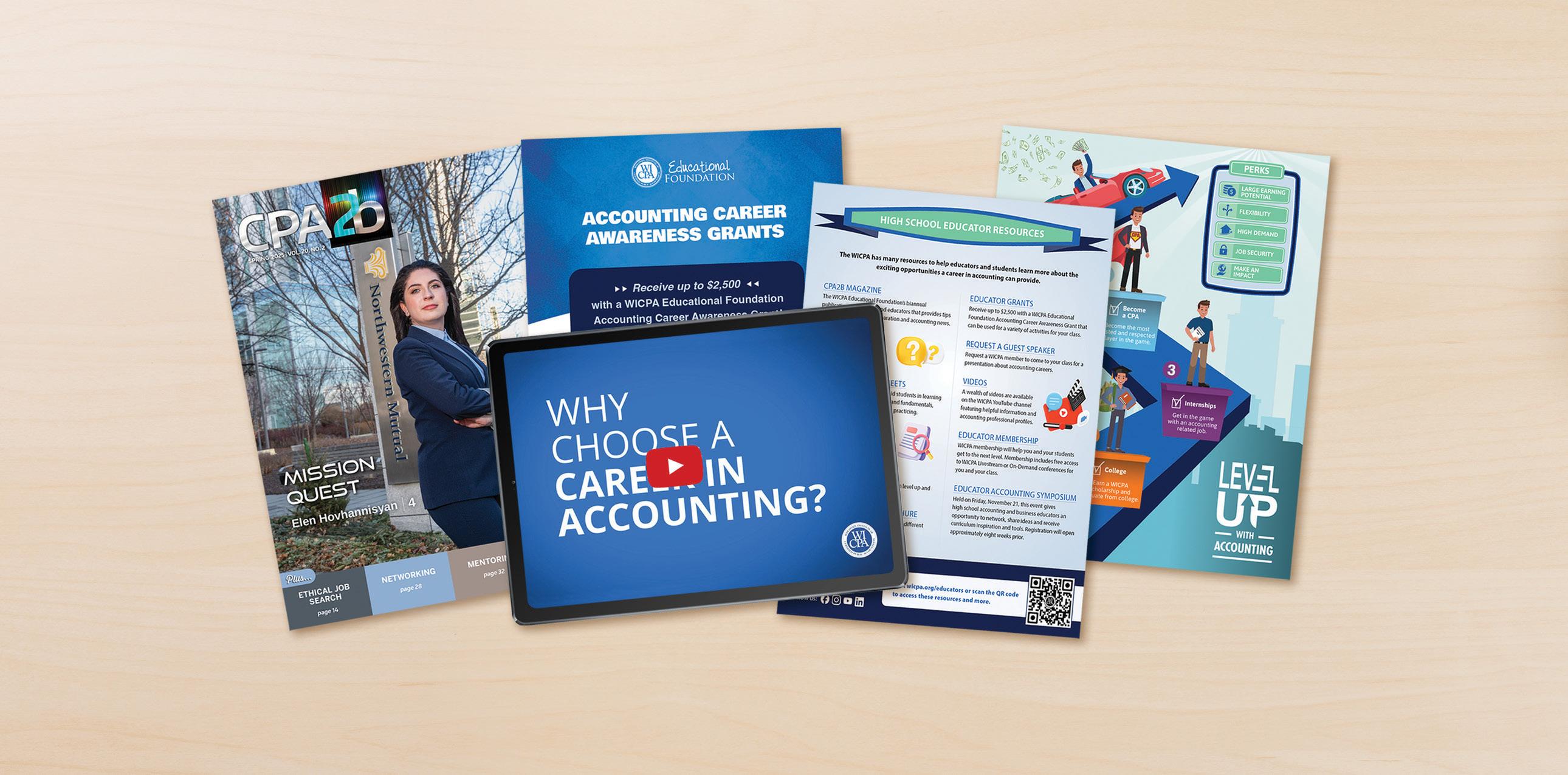
Join the premier association for Wisconsin accounting and business professionals.
WICPA Connect:
Leadership Development:
Join the YP Committee, write for WICPA publications, enhance public speaking skills and more.
Connect with professionals in our members-only online community and chat with other students in our exclusive student community.
News & Resources:
Get tips on accounting careers, technical trends and the latest in accounting news with our awardwinning publications, e-news and online resources.
Career Center : Put yourself in front of employers by posting your résumé.
Networking Opportunities:
Join over 7,000 professionals who represent business contacts, employers and mentors.
Educational Savings:
Apply for college scholarships and save on CPA review courses and conferences.
Credibility:
List WICPA membership on your résumé and LinkedIn, to demonstrate your commitment to the profession and set yourself apart from other talent.
The WICPA aims to simplify the path to becoming a CPA.
4 message from the president & CEO
Additional pathway to CPA licensure legislation introduced in Wisconsin
The number of new CPAs entering the profession remains a hot topic and is a challenge for firms and organizations large and small.
By Tammy J. Hofstede
6 member profile
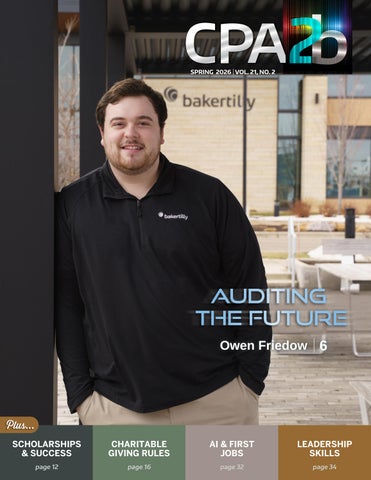
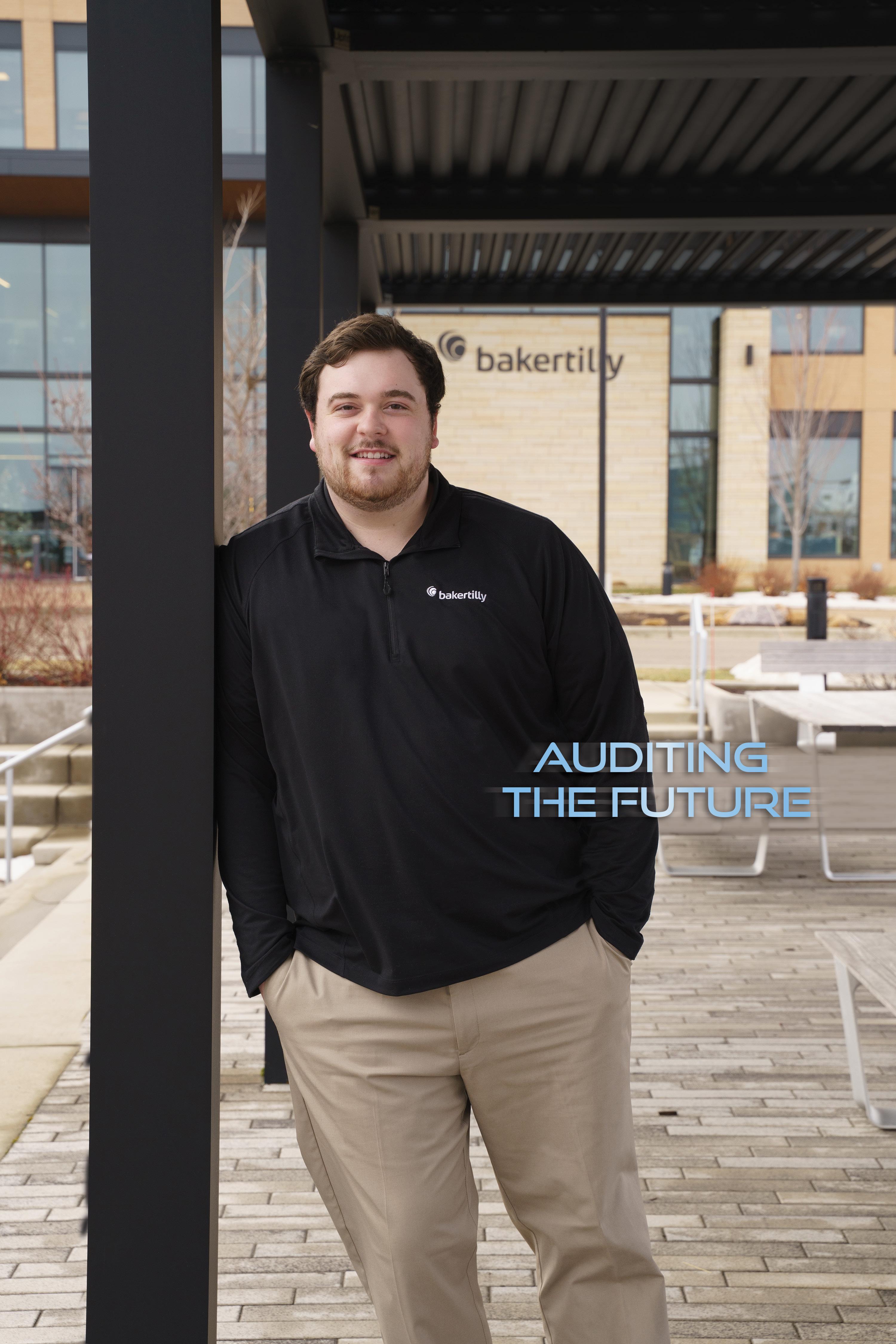
Auditing the future
Owen Friedow was raised around numbers — and now calculates his own path.
By Brent Roberts
12 focus on scholarship winners
Where are they now?
Previous scholarship winners share how having the CPA designation has helped them in their careers.
By Diane Bancroft-DeYoung, CPA; Kylie Dawes, CPA; and Amy Kowalchuk, CPA
16 focus on doing good
Helping those who do good do it well
Giving away money from donors is regulated by many oversight bodies, and the rules continue to get more complex.
By Michelle Weber, CPA
20 focus on education funding
The new and improved 529 plan — not just for college anymore
Clients can open a 529 to pay for an array of educational expenses, trade and professional licenses and continuing education classes.
By
Sandi Weaver, CPA, CFP, CFA
24 professional perspectives
Destination CPA
Three young professionals share their career paths and provide insight into what it’s like to be a CPA, whether in public accounting or industry.
By Ben Brossard, CPA; Cory Loppnow, CPA; and Alex Tordoff, CPA
28 looking back
Note to self
A seasoned professional writes a letter to her college-student self to reassure her that she’s choosing the right career.
By Renee Bardenwerper, CPA
30 career preparation: accounting major
Top 6 reasons to major in accounting
The core reasons for choosing accounting remain stronger than ever — and in many ways, more compelling.
By Caitlin Smith, CPA
32 career preparation: AI
Is AI going to take my job?
This question is being asked by a lot of people in the profession, and much of it is based on reality — and some on fiction.
By John Higgins, CPA.CITP
34 career preparation: soft skills
Communication and leadership skills for today’s world
Today’s work environment is more challenging than ever, and candidates have to find a way to stand out.
By Edward M. Thelen, CPA
DEPARTMENTS
2025-2026 WICPA
Educational Foundation
Board of Directors:
President
Jeff Dewane, CPA, CGMA, CMA, MBA
Secretary/Treasurer
Jon C. Gaines, CPA, CGMA, MBA
Directors
Mark Bichler
Janet J. Egan, CPA
Allyson Hofstede, CPA
Lee Liermann, CPA
Kale Post, CPA, MPA
Bret J. Priaulx, CPA, MBA
Gina C. Skibo, CPA
Victoria Thayer, CPA
Angela C. Thomas, CPA
WICPA Board Liaison
Christopher M. Cholka, CPA, CGMA
WICPA President & CEO
Tammy J. Hofstede
Publication Team:
Editor
Brent Roberts
Design & Layout
Brett Stallman
Advertising
Sue Daniels
Printing Special Editions
Join Us Online!
ACCOUNTING SCHOLARSHIPS
Receive $3,000 in scholarship money!
Apply online at wicpa.org/scholarships through March 13, 2026. Scholarships are awarded from the WICPA Educational Foundation to qualified accounting students that have completed at least 90 credits of a degree program that qualifies to sit for the CPA Exam.
WICPA Student Membership: No Cost, Endless Opportunities
By Lily Keller
Starting your accounting journey can be exciting and also bring about many questions, so the WICPA aims to simplify the path to becoming a CPA. Whether you’re a high school or college student, the WICPA has benefits to support you on your journey. Here is just a glimpse of some of the benefits free WICPA student membership can give you.
Accountant profile videos
Underneath the Student Resources tab, there’s a playlist of 27 videos of accountants, each with their own unique story and path to their CPA. These videos are meant to help students gain insight into the various options available to them when pursuing an accounting degree and CPA certification. If a whole playlist isn’t appealing, there are also videos by the WICPA that go into the benefits of being an accountant and getting your CPA license.
Accounting FAQs
The Accounting FAQs page aims to answer commonly asked questions by students interested in accounting. It provides essential information for students who want to pursue careers in accounting and also addresses students who are deciding whether or not to get their CPA license. These questions range from the basics — such as “What is accounting?” — all the way to “What types of skills will I need?”
Advocacy
The WICPA advocates for the accounting profession in many ways. The goal of the organization’s legislative and regulatory efforts is to promote and protect the CPA profession. Career Center
Finding an internship or job can be exciting but also stressful, and it can be hard to figure out what’s
a trustworthy job listing or a legitimate employer. Our Career Center is meant to connect you with employers, allowing you to post your résumé for free and find your perfect accounting internship or job. Highlighting your WICPA membership on your résumé and LinkedIn profile can add a layer of credibility and commitment to your accounting career.
College scholarships
The WICPA Educational Foundation offers scholarships to accounting students who plan to sit for the CPA exam. These scholarships are $3,000 and can help make your path to CPA more accessible.
Committees
The WICPA has many committees to keep members involved in advocacy, tax laws, conference planning and other key areas. There is also a committee for young professionals that offers early-career accountants opportunities to learn and connect as well as plan networking events. The Young Professionals Committee is a great place to connect with your peers and network, as well as learn from various speakers on relevant accounting topics.
CPA2b magazine
CPA2b, which is the magazine you’re reading right now, is free for student members and helps keep students up to date on what’s happening in the accounting world. CPA2b also provides tips on things — like interviews, résumés, LinkedIn profiles and more — that are useful to students of all stages in their educational journey.
When you join the WICPA, the opportunities are endless. You’re not just becoming a member, you’re entering a world of opportunities, connections and growth. The path to your accounting career and future starts here. Head over to wicpa.org and join for free today!
Lily Keller is the WICPA’s membership outreach coordinator. Contact her at 262-785-0445, ext. 4511, or lily@wicpa.org.
Additional Pathway to CPA Licensure Legislation Introduced in Wisconsin
By Tammy J. Hofstede
Accounting is the language of business, but fewer professionals are speaking that language. As the accounting profession adapts to pipeline issues, shifting demographics and retirement cliffs, and changing standards and client demands, the current certified public accountant (CPA) licensure framework must also evolve.
The number of new CPAs entering the profession remains a hot topic and is a challenge for firms and organizations large and small. The financial environment is growing more complex for everyone, increasing demand for CPA services. State societies listened to the profession and committed to leading together from the front. We collaborated to make much needed changes that broaden access while maintaining the integrity and trust of the CPA license. Tackling the workforce development issue is complex and includes many variables, and making a CPA license more accessible is critical to ensuring the future of the profession.
For nearly two years, we have been reviewing additional licensure pathway proposals and exploring options to eliminate any unnecessary barriers to entry into the accounting profession. Most notably, the time and costs required to become a CPA have been under increasing scrutiny. Over the last several months, I have worked closely with Sen. Howard Marklein and Rep. Bob Wittke to draft legislation that evolves the state’s CPA licensure model to broaden access and better meet the profession’s workforce demands while maintaining the rigor and trust of the CPA license. I have also been meeting with legislators to inform and educate them about our licensing/workforce bill. On November 26, 2025, AB696/ SB732 was introduced in the Wisconsin Legislature.
This bill is the result of collaboration among the WICPA, its CPA members, 54 other CPA licensing jurisdictions and the national regulatory bodies of AICPA and NASBA and of updates and ongoing discussion with the Accounting Examining Board. It ensures Wisconsin remains aligned with evolving standards around the country while safeguarding
public trust and the profession’s integrity. These changes do not solve the entire talent problem, but they do address identified barriers.
Our extensive coordination with fellow state CPA societies has helped us craft legislation that modernizes and advances the profession by responding to the needs of CPAs and those who employ them across the country. Our legislation also takes our neighbors into consideration to minimize any disruption to CPA practice mobility across state lines.
Currently, Wisconsin requires CPA candidates to complete 150 credit hours of qualifying education, gain one year of relevant work experience and pass all portions of the Uniform CPA Exam to become licensed in the state — a structure that’s been in place since 2001. The research has shown that the cost of additional education is a significant barrier to many would-be CPAs. It also shows that 150 hours resulted in a 15% reduction in first-time CPA Exam candidates after the 150-credit requirement was implemented, with the decline aggregating over multiple years. This structure no longer supports the profession’s current and future workforce needs given the ongoing talent shortage and growing need for CPAs, who hold an essential role to serve the business community and protect public interests.
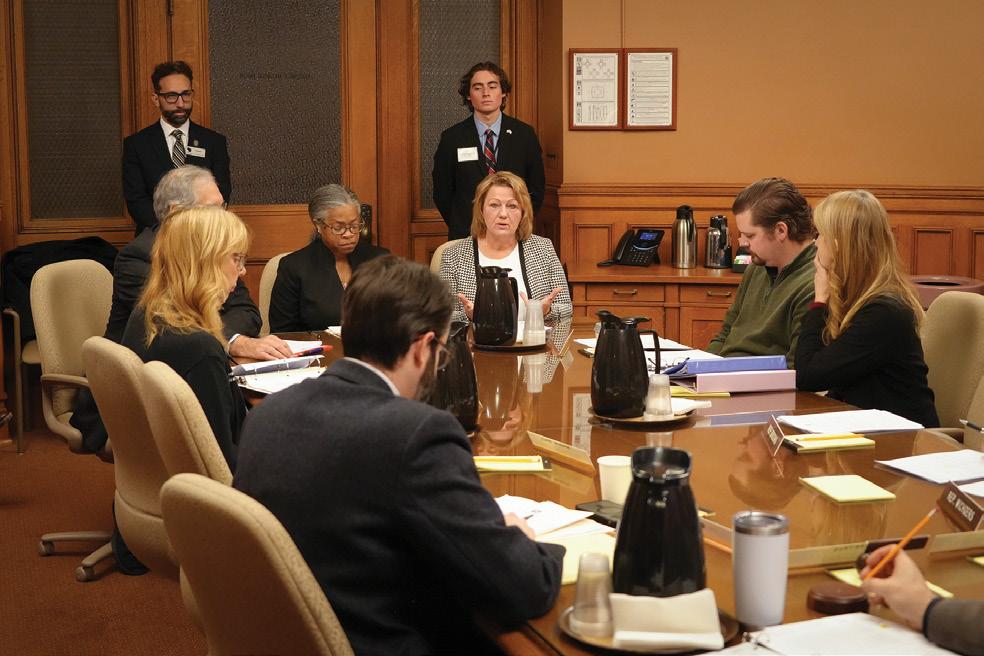
Tammy Hofstede, WICPA president & CEO, testifies at the Assembly Committee on Regulatory Licensing Reform hearing on AB696.
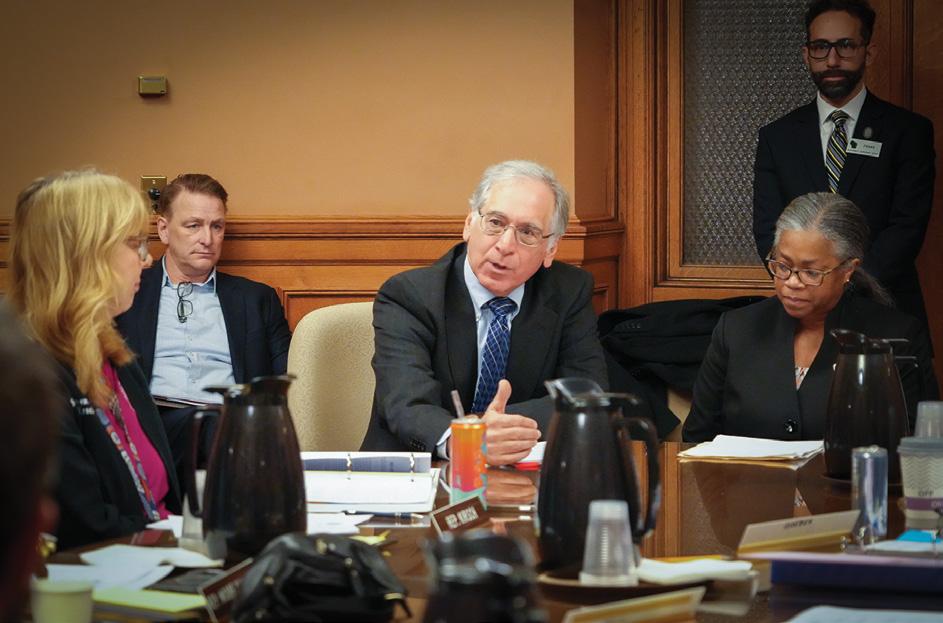
Michael Friedman, CPA, JD, and Stacy Stinson, CPA, MBA, testify at the Assembly Committee on Regulatory Licensing Reform hearing on AB696.
There are currently two pathways to obtain a CPA license, which requires a master’s degree or 150 credits of college education, passing the CPA Exam and one year of experience. AB696/SB732 introduces an additional third, alternative pathway to the traditional 150-credit hour education model. This pathway is nationally aligned and allows candidates to obtain a CPA license with a bachelor’s degree, completion of the CPA Exam and two years of professional experience.
Why this matters:
• Modernizes CPA licensure – It offers an additional flexible, more experience-based route that balances education and work experience. It allows for earlier entry into the workforce and further enhancement of skills and competency as internships and apprenticeships are growing. It also creates a stronger business environment and strengthens the state’s economy.
• Strengthens the pipeline – It provides a viable solution to help alleviate the growing shortage of accounting professionals by removing unnecessary barriers to entry without lowering standards.
• Preserves professional mobility – It maintains critical national standards for interstate practice by enabling Wisconsin CPAs to continue serving clients across state lines.
AB696/SB732 also addresses updating the administrative rules simultaneously, so there will be no delay in having an immediate effective date.
The WICPA is incredibly grateful to Sen. Howard Marklein, Sen. Dora Drake and Rep. Robert Wittke for co-authoring this important bill and to Reps. Barbara Dittrich, Daniel Knodl, Priscilla Prado, Sylvia Ortiz-Velez, William Penterman and Chuck Wichgers for sponsoring it. We would like to acknowledge each of them for their commitment to advancing this important legislation for the accounting profession in Wisconsin.
Where are we now?
Stacy Stinson, CPA, MBA, WICPA board chair and assistant professor of accounting at Concordia
University Wisconsin; Michael Friedman, CPA, JD, director at Scribner, Cohen and Company S.C.; and I testified at the hearing before the Assembly Committee on Regulatory Licensing Reform on Dec. 17 and the Senate Committee on Licensing, Regulatory Reform, State and Federal Affairs on Jan. 27. The Assembly will vote on AB696 in early February, while we anticipate the Senate will vote on SB732 by the end of February.
How YOUR voice can be heard
Contact your state representative and senator and urge them to support AB696/SB732 to ensure Wisconsin continues to attract and retain accounting professionals.
Tammy J. Hofstede is president & CEO of the WICPA. Contact her at 262-785-0445 ext. 4518 or tammy@wicpa.org.
CURRENT PATHWAYS:
1. Master’s Degree + Exam + 1 Year Experience
2. Bachelor’s Degree, completed at least 150 credits (allows for double major, minor or credits not transferred to a 4-year college or university from a technical college) + Exam + 1 Year Experience
u More details on current pathways can be found at wicpa.org/examchecklist
NEW:
3. Bachelor’s Degree + Exam + 2 Years’ Experience
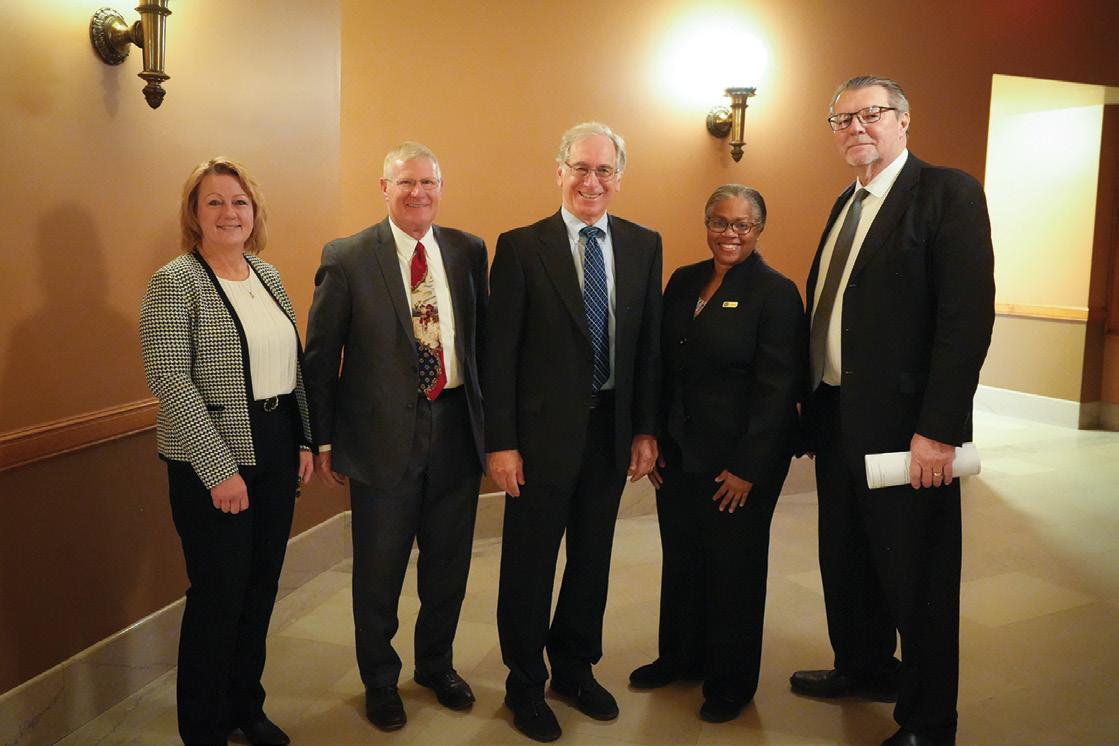
From left: Tammy Hofstede, WICPA president & CEO; Senator Howard Marklein; Michael Friedman, CPA, JD; WICPA Board Chair Stacy Stinson, CPA, MBA; and Representative Robert Wittke.
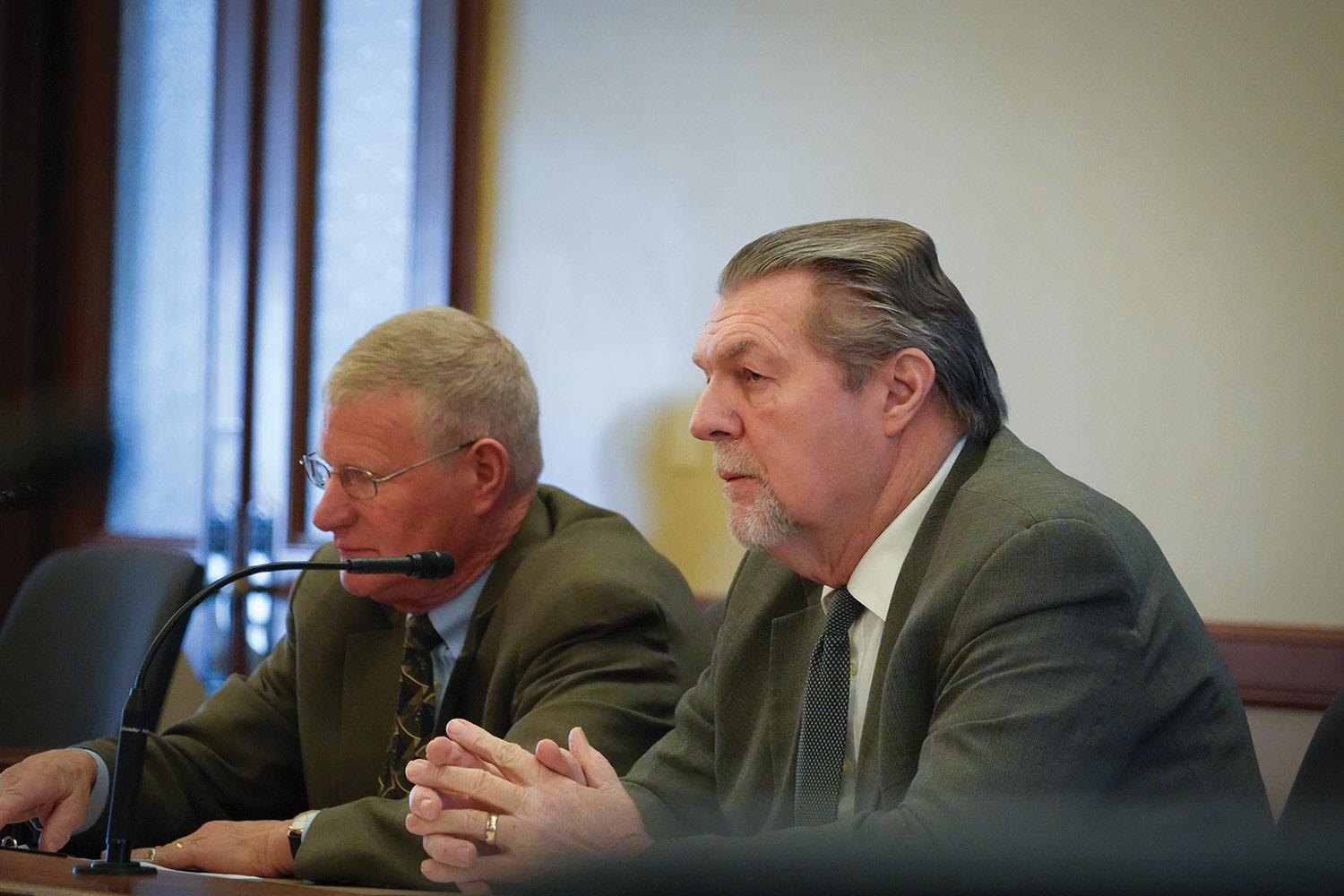
Rep. Robert Wittke and Senator Howard Marklein testify at the Senate Committee on Licensing, Regulatory Reform, State and Federal Affairs hearing on SB732.
Owen Friedow was raised around numbers — and now calculates his own path.
by Rick Swearingen
Photography
For some aspiring and recent college graduates, there’s a degree of uncertainty about the future, but Owen Friedow began charting his path early on and was laser-focused on achieving his goals.
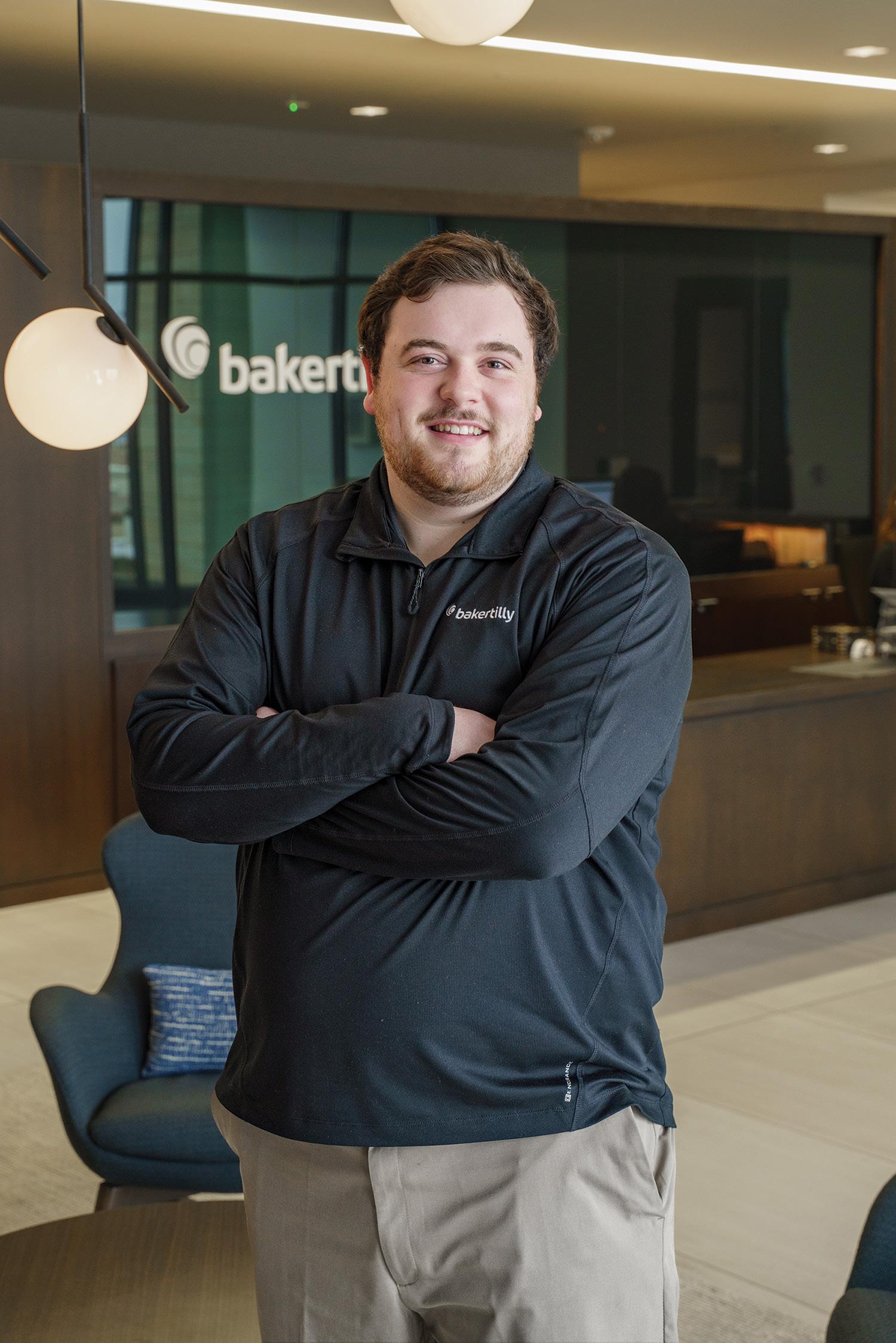
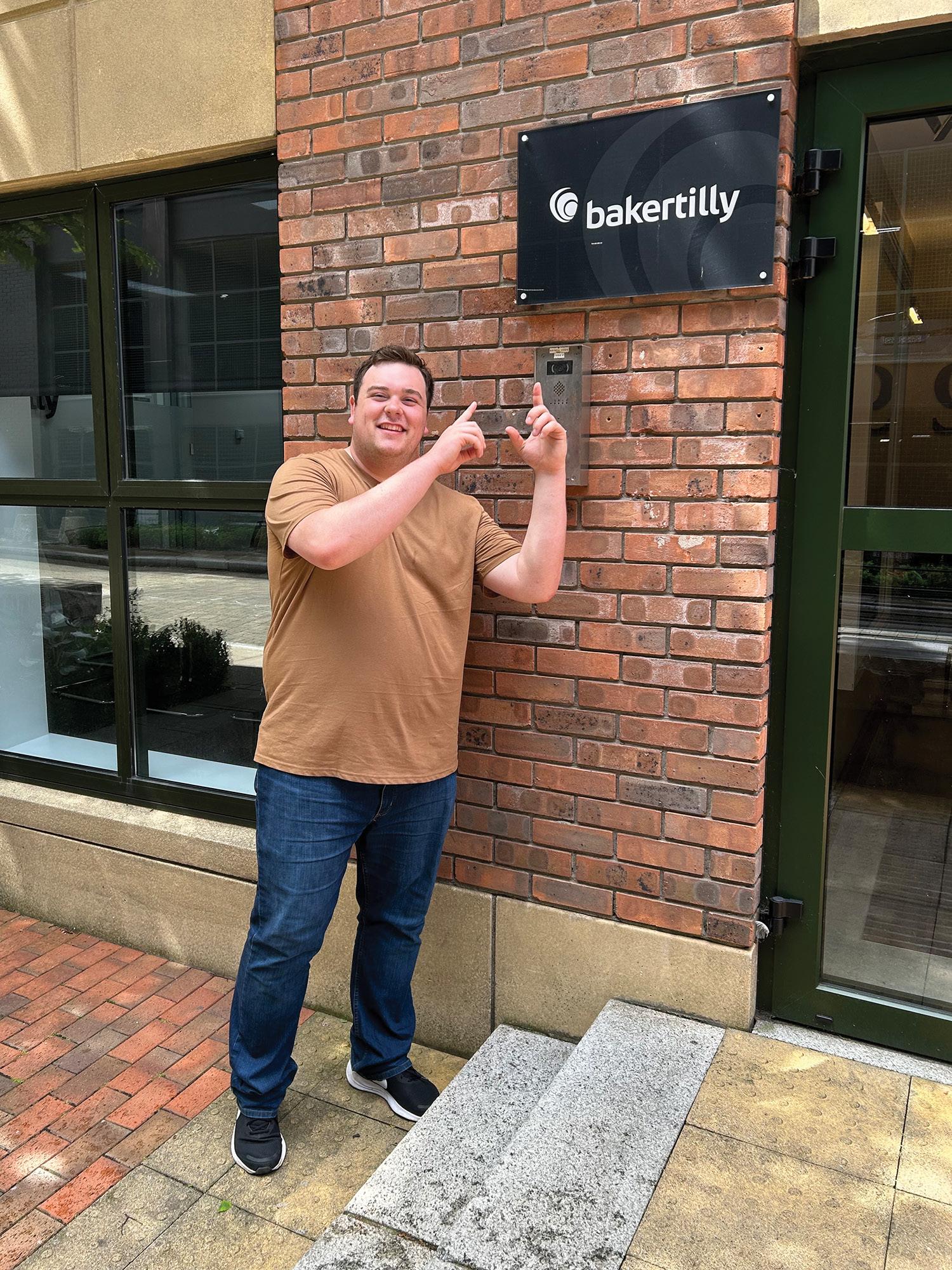
Friedow graduated from the University of Wisconsin–Platteville in December and last month started his new role as audit associate at Baker Tilly in Madison (which also is his hometown), where he will focus primarily on completing audits for public and private business clients.
Numbers and nurture
Long before he graduated from — let alone began — his college education, Friedow was hooked on accounting; in fact, some might say he’s been around numbers for almost his entire life.
“Our high school offered classes my senior year through Madison Area Technical College, and I was able to take an introductory accounting class, and just like every young accountant, I fell in love with debits and credits,” Friedow shares. “I really enjoyed it — thought it was fun and a really good career to get into with the need for CPAs.” He further notes, “My mom also is heavily involved in business as the chief technology officer for Madison Investments. Growing up, I was always playing on her floor while she was working, so when I took the accounting class, I immediately knew that I wanted to get into it.”
He also thinks of his dad with great reverence, calling him “my biggest inspiration.” Friedow recalls that his dad was a Ph.D. in English, “so completely different from what I do. And with a growing family, he decided to become a stay-at-home father. That showed me that you can become the highest you can be in your field, but if family needs come, or something happens, you can adapt. We unfortunately lost him about two years ago right before ‘busy season.’ He was really pushing me to get my CPA even before that, so getting my CPA will be a great thing I can do to honor his memory.”
When Friedow transitioned from high school to college, academics certainly were a priority, but he reflects that taking internships provided valuable real-world learning opportunities.
“
Long before he graduated from — let alone began — his college education, Friedow was hooked on accounting; in fact, some might say he’s been around numbers for almost his entire life.”
Inspiration through internships
Friedow completed six internships during his college career, which he acknowledges is more than some others, but appreciated the opportunity to work and experience how much fun it is to be part of the profession.
He started working at Johnson Block his sophomore year in the spring, so it was his first “busy season” internship with a lot of tax work, mostly focused on agricultural clients. He recalls,
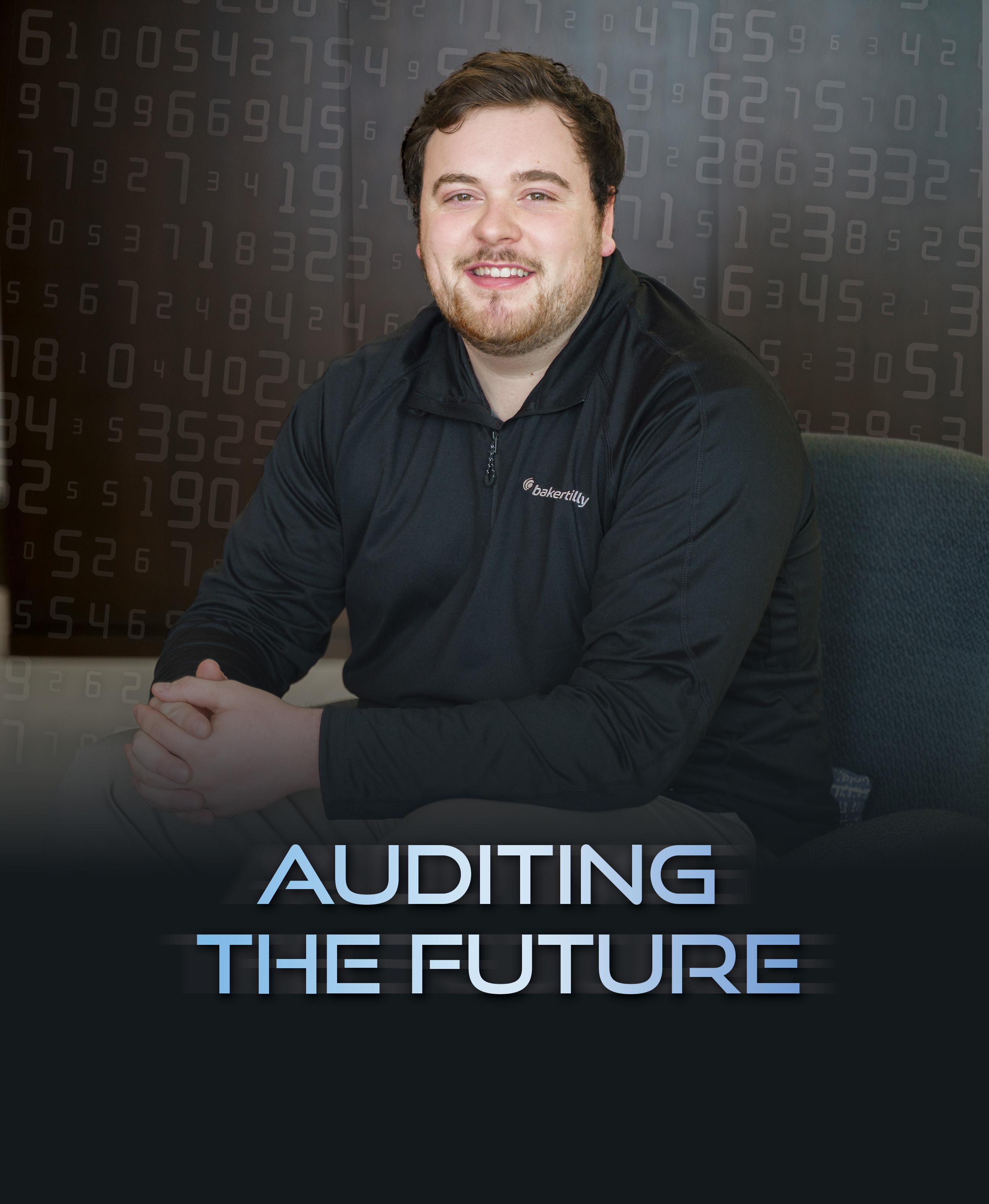
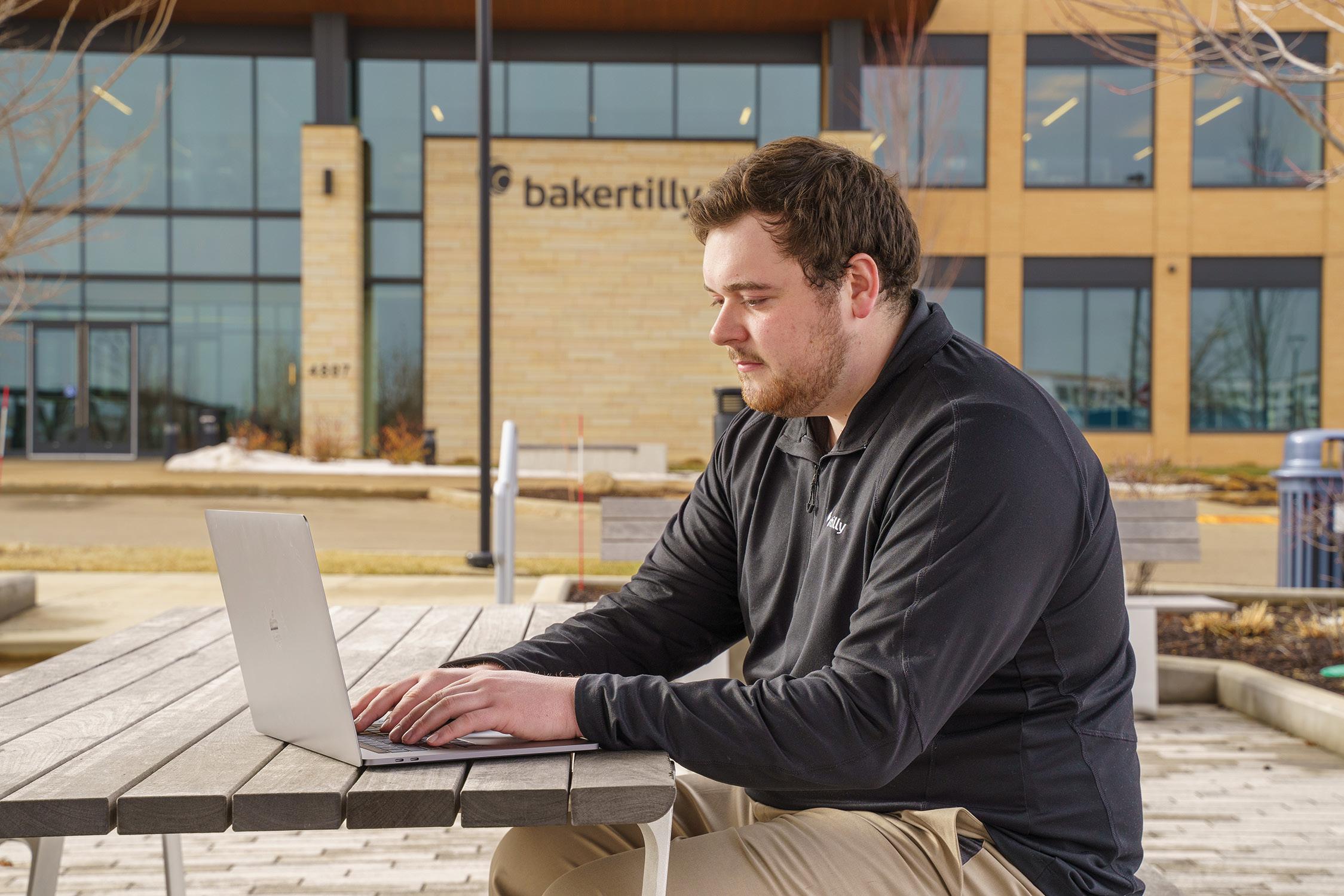
After graduating from UW–Platteville in December, Friedow joined Baker Tilly as an audit associate.
“I think that the small firm was great for the first internship, and I went back for a second one. However, I knew I wanted to see both small and big firms, so my first of three internships at Baker Tilly focused on audit, and that gave me a chance to compare tax and audit.”
Friedow also had an opportunity through a connection from a professor to do an internship with CohnReznick, a Chicago-based firm, where he worked remotely from his house in Madison and focused on state and local tax. He cites a project that involved looking at historic credits for a building in New York and says, “I thought that was really cool because it was completely different from tax and audit.”
Through all of those experiences, he ultimately decided that he liked audit the best. “Looking long term, audit is such a great background for whatever career path I choose because I’m looking at the financials of all of these different clients, I’m on walkthroughs and seeing how these companies really work, and that’s something I find fascinating,” Friedow says.
He also credits the combination of classroom and hands-on learning as vital to preparing him to begin his professional journey.
The key things that I learned in the classroom are to show up and the ability to meet deadlines.” “
“The key things that I learned in the classroom are to show up and the ability to meet deadlines. For example, you have a group project, so how do you work with a team? It’s also a great background in theoretical concepts, such as learning the audit standards (which was great for the CPA Exam), and when I began my auditing internship, I knew how to apply that knowledge.” As far as the CPA Exam, Friedow has passed the Audit section and has begun studying for the FAR test. He hopes to take FAR and the other two sections early next summer after “busy season.”
He is a strong advocate of making the most of the college experience outside the classroom.
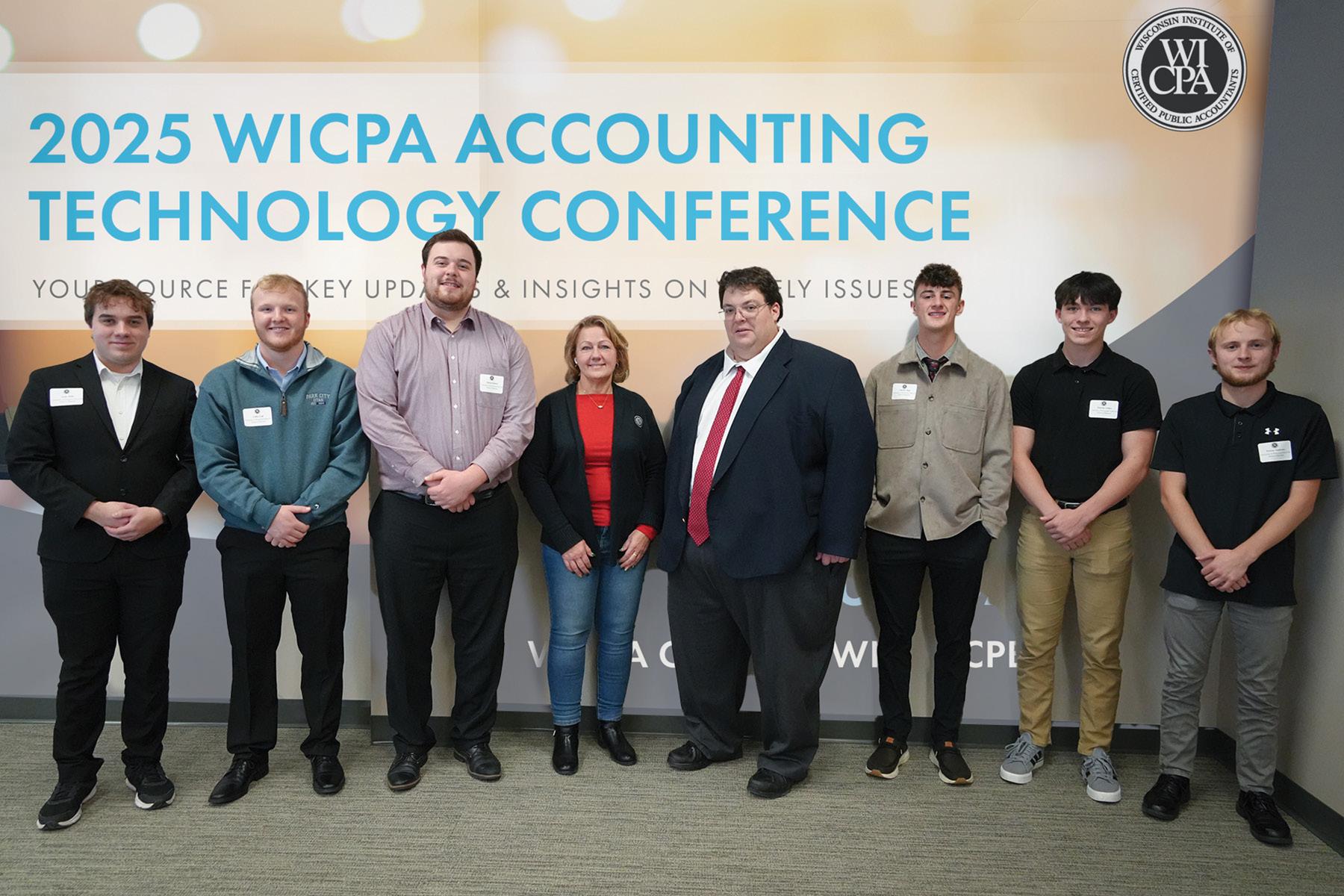
Friedow, third from left, along with fellow UW-Platteville accounting students pose with WICPA President & CEO Tammy Hofstede and UW-Platteville Assistant Professor Daniel Nugent during the 2025 WICPA Accounting Tech Conference.
Photo provided by the WICPA
“The two biggest things are to get involved, and especially if you can get into leadership early, you can really mold how your college experience goes and try different things. That’s particularly true with internships, and I’d encourage people to get those early on. Go for one in audit and another in tax. They pay well, you get experience, and you’re building relationships. It also made it clear to me which area I wanted to pursue after graduation.”
Extracurriculars also played an important role for Friedow, including serving as president of the Accounting & Finance Club, where he helped organize a public accounting night. He cites the importance of the annual class trip to the WICPA Accounting Technology Conference, which he attended three times.
Along with active participation in and out of the classroom, Friedow is a vocal proponent of pursuing the CPA designation.
“I think that when you look at the accounting world, there’s no higher credential than a CPA, and when you earn it, nobody is concerned about where you went to school or whether you have a master’s degree; they care that you’re a CPA and entrusted to
The two biggest things are to get involved, and especially if you can get into leadership early, you can really mold how your college experience goes and try different things.” “
handle their taxes and audits. So, hitting that pinnacle is a big motivating factor.”
Cold rinks and warm memories
As an aspiring CPA, Friedow knows that he won’t be skating by during his career, but his times playing hockey in college were a different story.
Photos provided by Owen Friedow
Photo provided by Owen Friedow
Friedow was a member of the UW-Platteville club hockey team and even stepped in as player-coach.
Friedow visited the Baker Tilly office in Dublin, Ireland, while on a study abroad program.
“It was a club team, and the best part was just being with the guys. We got to go on road trips to places like St. Louis and Omaha, which were far drives from campus but great opportunities to connect with everyone.”
While playing was great, Friedow also had an opportunity to step into a new role.
“One year we didn’t have a coach, so I stepped in as a player-coach, which was interesting as far as trying to lead people. I was lucky enough to have a great support system. I plan to continue playing and hope to coach one day. I’ve been playing hockey my whole life, and I see no reason to stop.”
And when he ponders any parallels between hockey and auditing or accounting, he says, “Auditing is really team based, and you’re working with a lot of different people, which is very similar to hockey. It also compares to both auditing and accounting in terms of having to put in hard work but also having fun.”
When Friedow was not in class or on the ice, his desire to be social with others remained.
Auditing is really team based, and you’re working with a lot of different people, which is very similar to hockey.”
“A couple of years ago, some friends and I founded the pickleball club on campus, and we had a couple of accounting professors come out and play with us. It’s been great for the campus community; for example, an engineering professor and an accounting student who never would have met had the opportunity to do so.”
Brent Roberts is the WICPA communications director. Contact him at 262-785-0445, ext. 4515, or brent@wicpa.org.
THURSDAY, APRIL 30
SCHEDULE
5:30 p.m. Check-in
6:00 p.m. Bowling
8:00 p.m. Awards & Prize Drawings
104 PERSON LIMIT
$45 per Bowler
$160 for 4-Person Team
REGISTRATION INCLUDES
3 Games of Bowling
Shoe Rental
Food & Beverages
EVENT AWARDS & PRIZES
$250+ in Team Awards & Prizes
$100+ in Individual Prizes
Bowling Gift Card Package
For more information and to register, visit wicpa.org/BowlingNight.
UPCOMING WICPA CONFERENCES
Business & Industry Spring Conference
Tuesday, March 24
Brookfield Conference Center & WICPA CPE Livestream
Business & Industry Fall Conference
Thursday, Sept. 24
Brookfield Conference Center & WICPA CPE Livestream
Financial Institutions Conference
Wednesday, May 13
WICPA CPE Livestream Only
School District Audit Conference
Wednesday, May 27
WICPA CPE Livestream Only
Not-for-Profit Accounting Conference
Wednesday, Sept. 16
WICPA CPE Livestream Only
Accounting & Auditing Conference
Tuesday, Nov. 10
WICPA Office & WICPA CPE Livestream
Tax Conference
Monday, Nov. 16 - Tuesday, Nov. 17
Brookfield Conference Center & WICPA CPE Livestream
Accounting Technology Conference
Thursday, Dec. 17
WICPA Office & WICPA CPE Livestream
WICPA members save up to $150 on registration! Registration opens approximately eight weeks prior to a conference. View conferences currently open for registration at wicpa.org/conferences.
Receiving the scholarship was a huge relief and a turning point for me. It eased the financial pressure and allowed me to spend more time focused on my classes and professional growth instead of worrying about working extra hours to make ends meet. More than anything, it reinforced my commitment to the accounting profession and encouraged me to pursue my goal of becoming a CPA.
2. What advice do you have for students figuring out their career path?
Be curious and open-minded. My career unfolded over time through experiences, conversations and opportunities I never could have planned. Do not be afraid to ask questions and say yes to learning opportunities. Work hard — the skills and work ethic you build early will matter just as much as the specific job title you start with.
3. What is your favorite part about being a CPA?
What I have appreciated most about being a CPA over the years is the trust that comes with the profession. My clients rely on me to make thoughtful,
ethical decisions, and that responsibility is something I take pride in. I also love the variety of work — each day brings new challenges, new learning opportunities and the chance to solve problems that have a real impact on the businesses and individuals I serve.
4. How has having the CPA designation helped you in your career?
Earning my CPA credential has been one of the most rewarding accomplishments of my career. It opened doors, expanded my opportunities and provided credibility at every stage. It signaled a commitment to the profession and helped me earn increased responsibility, leadership roles and the trust of those I worked with along the way.
5. What is the biggest way your career has changed from your first job to now?
Early in my career, I focused on completing tasks accurately and learning the technical side of the job. Over time, my responsibilities have shifted, and success is less about individual tasks and more about mentoring others, seeing the bigger picture and helping shape long-term outcomes.
Kylie Dawes, CPA
Job Title: Senior Tax Manager l Employer: Baker Tilly
1. What did the scholarship mean to you?
I was a first-generation college student, and the only funds available for me to pay tuition were personal savings, new loans and scholarships like these. As a result, throughout my college career, I was working part time, whether that was at the tutoring center on campus, back at my high school job with Walgreens or with new accounting-focused internships. Receiving the WICPA scholarship allowed me to focus on and expand my studies. In addition to a full credit load each semester, I was also able to complete the two-part CMA Exam during my time at UW–Oshkosh as a means to prepare for the four-part CPA Exam in the future.
2. What advice do you have for students figuring out their career path?
Admittedly, after taking one accounting elective in high school, I knew accounting was my future. I had it in my head that I’d work in a corporate environment, as the crazy deadlines and long hours that you hear about in public accounting did not appeal to me. However, I found myself with a corporate internship and no full-time job to follow, so I thought I would rule out public accounting by accepting a tax season internship ... but what do you know, nine years later, I’m still here! My advice would be to try everything that you can. Instead of trying to figure out what might work for you based on research, try it for yourself. You may be surprised!
3. What is your favorite part about being a CPA?
My favorite part about being a CPA is the people I have the opportunity to work with, both my colleagues and my clients. This career is a lot more rewarding than I expected when I started. Each day I have the opportunity to help someone, whether that be a new hire who is trying to understand the tax code or clients who are debating a new business opportunity or have found themselves in hardship. I’ve always been interested in helping others learn (as
evidenced by my volunteer time with a local elementary afterschool program and my time tutoring on campus), and being a CPA gives me the opportunity to do so at times that are really important for others.
4. How has having the CPA designation helped you in your career?
The CPA designation has helped me continue my growth at Baker Tilly, as it is a “requirement” to move into management, but more importantly, I think it’s provided an additional level of trust with my clients. Becoming certified is no easy task. Those three letters after my name really signify that I have taken the time to learn about this industry and have a great background to be able to assist them with their personal and business needs. While Baker Tilly has always had a CPE requirement of its own, Wisconsin’s new CPE requirement further shows that I’m not only maintaining that knowledge but am staying current on updates in the accounting world.
5. What is the biggest way your career has changed from your first job to now?
As an intern and a first-year tax associate, I was the “doer.” My tasks were given to me by someone internally and often consisted of preparing a tax return. As I moved into a senior associate role, I became the reviewer instead of the doer. The biggest change, however, came when I started working on a client list of my own and became their main point of contact. My role changed to consulting, which is the most rewarding part of my career. Instead of being asked when a tax return will be complete, the questions now range from “How do I make this change in QuickBooks?” to “I’m thinking about retiring; what do I do next?” This has allowed me to continue learning new things myself to be the best advisor I can to my clients, but it has also allowed me to continue teaching those I’m working with, providing them the “why” to the work they’re doing.
Amy Kowalchuk, CPA
Job
Title:
Global Controller
Employer: Mercury Marine, a division of Brunswick Corporation
1. What did the scholarship mean to you?
Having a scholarship allowed me to be comfortable continuing my education to get 150 credit hours and my master’s in accounting in order to pursue the CPA verification vs. considering graduating after four years without a CPA. This has been really impactful to my career as a whole, as I was able to get great experience during my master’s program at UW–Milwaukee as a teaching assistant and also take all parts of the CPA Exam before starting my first job at Deloitte in audit.
2. What advice do you have for students figuring out their career path?
I think the best thing you can do is talk to various people in the profession at different stages of their career, in different companies and in different roles. The field is so much broader than many people realize. Although you will never have full perspective before you get out and start working, networking can help you consider what roles or companies could be the best fit for you. Also, it will give you perspective on skills that you want to gain early in your career that will help keep your options open for roles in the future.
3. What is your favorite part about being a CPA?
My favorite part about being a CPA is having the opportunity to be involved in many different types of activities across a company and to work crossfunctionally with other departments. Every transaction has a financial impact and requires understanding of how it will be accounted for and come through the financial statements. It has been fun to see companies across different industries and get to play a part in the different strategies companies execute to try to continue to grow and operate profitably, whether it be M&A activity, supply chain management, financing transactions, etc.
4. How has having the CPA designation helped you in your career?
Being a CPA has provided me with a lot of flexibility and optionality in my career. For example, being a manager for a Big Four public accounting firm (which requires a CPA) was a very beneficial experience and also was a great résumé builder, helping me to get my first role in industry as an accounting director. Having the CPA designation is required or highly preferred for various other roles, so I have always seen it as something that keeps the most doors open to me in my career, and it is relatively easy to maintain with just the ongoing CPE requirements.
5. What is the biggest way your career has changed from your first job to now?
There has been a lot of change since the beginning of my career, but I would say some of the biggest changes are moving from public accounting to industry roles; the continued level of increased responsibility over time; and a larger portion of my more recent roles being focused on leading, coaching and developing my teams. Once you get to the manager level and above, the focus on people is one of the most important aspects of the job, which is something that you may not think about when starting off your career, when your focus is more on learning the work itself.
WELCOME STUDENT MEMBERS
MariaDelCarmen Betancourt
Concordia University
Wisconsin
Pamela Brooks KerberRose S.C.
Q’Mara Carrington
St. Augustine Prep Academy
Fenglong Chang Wausau West High School
Jolene Check
UW–Madison
Keyla I. Cortes Waukesha North High School
Victoria T. Crivello
Carroll University
William M. Deedon Wausau West High School
Abigail Dietrich
UW–Whitewater
Hope K. Dunaway
Kimberly High School
Ethan H. Dykman Wausau West High School
Reece O. Ellingsen Waukesha North High School
Antonio Evans
Concordia University
Wisconsin
Leonardo Fredette
UW–Whitewater
Cristian Galeano
St. Augustine Prep Academy
Amanda Galeano-Zaragoza St. Augustine Prep Academy
Brett Hartjes
UW–Eau Claire
Stephen R. Hawthorne UW–Milwaukee
Landen F. Hoover
Wausau West High School
Elliot Hummer
UW–Stevens Point
Susan L. Johnston
Kettle Moraine High School
Jacob R. Joseph
UW–Platteville
YOUR SOURCE FOR KEY UPDATES & INSIGHTS ON TIMELY ISSUES
TUESDAY, MARCH 24 BROOKFIELD CONFERENCE CENTER & WICPA CPE LIVESTREAM
Helping Those Who Do Good Do It Well
Weber, CPA
I’m not saying I’m a superhero, but I do have a superpower. I help those who do good do it well. For over two decades I have used skills learned in academia, knowledge learned on the job and my moral compass to make a difference. Some might say that I fell into my future by accident, but I’m certain it was fate.
Sitting in my high school bookkeeping class, I knew accounting was my future. I loved the order and structure of it all. So, after high school I pursued a degree in accounting. In college I learned that I had a specific interest and knack in taxation. It was during a tax season internship that I first was made aware of nonprofit accounting. My professor introduced me to a former big eight partner who had relocated from New York City to Wisconsin to open a small, community-focused practice. He was philanthropically minded and woven into the typical client load of individual and small business bookkeeping, auditing and tax filings was a niche practice of providing those services to small, community-based nonprofits. It was my first foray into charities and nonprofits. I learned that I enjoyed it, and I loved working with the people who were making a difference. Nonprofits have so many compliance and reputational areas of complexity — and I love rules.
My internship was supposed to last four months, but I stayed for two years (until graduation). When interviewing for my first position out of college, I looked to public accounting. During those interviews,
I’m not saying I’m a superhero, but I do have a superpower. I help those who do good do it well.” “
I spoke of my nonprofit experience and how I hoped to continue working in that niche area. In 2005, I started as a tax associate at Grant Thornton in Milwaukee. While my early years brought a variety of tax clients, I continued to provide tax services to nonprofits. As I continued in my career, I specialized fully in nonprofit taxation and grew to be not only a tax advisor but also an industry expert in nonprofits.
Clients looked to me for help realizing their charitable dreams. In 2018, I made partner at the firm — a career milestone that “high school me” never dreamed possible.
In 2023, after 18 years at the firm, I left public accounting to become the CFO at the Community Foundation for the Fox Valley Region in Appleton, Wisconsin. In my role, I oversee finance, investments, database/technology, human resources, compliance and operations for a community foundation with approximately $700 million in assets. What qualifies me to hold this role? The experience I gained providing hundreds of clients with technical and practical guidance and, of course, my CPA credential.
What is a community foundation? It’s a taxexempt, nonprofit, publicly supported philanthropic organization with the long-term goal of building permanent, named funds for the broad-based public benefit of the residents in a given area.1 There are
approximately 900 community foundations in the U.S., and they collectively hold over $152 billion in assets. Community foundations play a critical role in community-based philanthropy by providing grants and resources to initiatives and organizations within their local areas. I often refer to us as a philanthropic matchmaker: We connect our generous donors to the needs within our community.
One might think that collecting money from donors and giving it away is an easy endeavor, but I can assure you it is not. While it’s very fulfilling work, it is also complicated work. The charitable sector is heavily regulated by many oversight bodies and rules: the Financial Accounting Standards Board, the Uniform Prudent Management of Institutional Funds Act UPMIFA, the U.S. Treasury/IRS, state attorneys general, watchdog organizations and public opinion. The rules continue to get more complex, while calls for greater accountability and transparency rise.
There is great need for more CPAs, and for those who look to it as a profession, many opportunities exist, including in the nonprofit sector.”
This is where CPAs shine. As a CPA, I can read complex legal rules and interpret them for our constituents. I advise our Gift Planning team on items to consider when arranging for the donation of a closely held business or non-cash asset. I consult with our Donor Services team regarding the UPMIFA and properly managing an endowed fund. In meetings with our Community Engagement team, I share insights obtained from working with hundreds of nonprofit clients over two decades. My own department looks to me for leadership in accounting for nearly 2,000 funds, navigating HR challenges, optimizing our CRM and financial database and structuring our technology for optimal internal and external performance — all in an environment growing in volatility. I act as a liaison to both our CEO and our board of directors, who look to me for expertise that can be translated into functional actions.
In my role, I have a unique seat for the “great wealth transfer.” This refers to the estimated $124 trillion that will be transferred by 2048 from older generations to younger generations and charitable organizations.2 Experts project that $18 trillion is predicted to go to philanthropic causes. This transfer of wealth and its impact on philanthropy will prove to be a significant event in U.S. financial history and a time of extraordinary opportunity and professional challenge.
There is great need for more CPAs, and for those who look to it as a profession, many opportunities exist, including in the nonprofit sector. This heightened need comes at a time when we see more individuals retiring from the accounting profession. In fact, the U.S. Bureau of Labor Statistics projects that 75% of current CPAs are approaching the end of their careers.3 Yet accounting undergraduate enrollment in U.S. colleges and universities grew by only 7.3% year over year in the fall 2025 semester, according to new data from the National Student Clearinghouse. The increase for accounting majors follows an 11.3% rise in fall 2024 and a 1.9% increase in fall 2023 at the undergraduate level.4
I’m reminded of a quote from the superhero Iron Man: “Heroes are made by the path they choose, not the powers they are graced with.” Sitting here looking back on my 23-year career, I’m humbled and proud of the impact I have made … all because of the path I chose. Michelle Weber, CPA, is CFO at Community Foundation for the Fox Valley Region, Appleton. She has more than 20 years of experience in the nonprofit industry. Contact her at mweber@cffoxvalley.org.
1 Definition adopted by the Community Foundation Leadership Teams, which at the time was part of the Council of Foundations in March 2088.
2 According to Cerulli’s U.S. High-Net-Worth and Ultra-High-Net-Worth Markets 2024 report
The massive One Big Beautiful Bill (OBBB) that recently passed can benefit 529 plans. Many of your clients likely contribute to their children’s and grandkids’ 529 accounts.
Young adults can open and save in their own 529. But these are no longer just for college or for young people. Is your client paying a broad array of educational expenses, trade and professional licenses, continuing education classes?
They can open a 529 account for themselves to pay with tax-advantaged dollars.
The two biggest benefits are tax-free growth and a small state tax break. Your client contributes after-tax money. The funds grow and are not subject to tax; withdrawals are tax-free if used for qualified expenses.
Over 67% of states give a state tax deduction for contributing to their state’s 529 plan; nine states give a deduction for contributions to any plan anywhere; five states give a tax credit. The article “How Does Your State’s 529 Plan Income Tax Benefit Work?” on savingforcollege.com explains each state’s benefits.
Clients can now take out up to $20,000 per year for K–12 expenses, which has expanded to a broad list, including:
• Tuition to public, private, religious schools;
• Expenses for curriculum materials, textbooks, online education materials;
• Tutoring (can’t be related to the student, must meet some qualifications);
• Fees for standardized tests (e.g., ACT, SAT), AP exams, college admission exams;
• Dual enrollment fees for postsecondary programs (college courses taken in high school); and
• Educational therapy for disabled students (e.g., speech therapy).
If your client plans to use a private school for their kids, they can contribute to a 529 for the state tax benefits and then pay tuition payments.
If your client plans to use a private school for their kids, they can contribute to a 529 for the state tax benefits and then pay tuition payments.” “
The 529 is for dental hygienists, electricians, plumbers, carpenters, culinary school chefs, aircraft maintenance technicians, computer network techs, auto mechanics and more. Whether for themselves or their children, clients can pay qualified expenses at vocational schools, in registered apprenticeship programs — as well as at colleges — and include:
• Tuition, fees and standardized tests;
• Books and supplies (e.g., tools, equipment for vocational schools and apprenticeships);
• Computers, software and internet access;
• Room and board (even if the student stays at home, but it’s not allowed for apprenticeships);
• Special-needs equipment and services; and
• Student loans up to $10,000 (lifetime) per borrower.
CPAs and many clients can take advantage of the OBBB’s expansion of 529s. Qualified expenses now apply for most post-graduate programs, most professional schools (e.g., master’s, medical, law, business, cosmetology) and trade certification programs — to get a credential or an eligible occupational license. These include:
• Tuition, fees, books, other required expenses;
• Fees for exams to obtain the credential (e.g, trades, plumbing, cosmetology); and
• Fees to maintain the credential (continuing education requirements).
As CPAs, we paid a fee to sit for the exam. That can now be paid from a 529 account. You can also now
pay a portion of your required annual 40 hours of continuing education courses as well as your license renewal with funds routed through a 529 plan. I am also a certified financial planner, which requires 15 hours of continuing education annually; that can now be paid from a 529.
If clients have a career where they sit for an exam to get a credential, apply for a license to get that credential or have ongoing continuing education requirements, you might advise them to use a 529 for the tax benefits. The client can be owner, custodian and beneficiary.
If a client has a 529 with unused funds, they can position it by rolling over the balance to a family member. And the circle is wide! An eligible family member for this purpose includes spouse, child, stepchild, foster child, father/mother, son/daughter-inlaw, father/mother-in-law, aunts and uncles and their spouses, nieces and nephews and their spouses, even first cousins and their spouses.
Overfunding had previously been an issue, but 529s can be rolled over to that wide family circle and tapped to seed the beneficiary’s Roth IRA account; check if the 15-year requirement will be an issue. Up to $35,000 of those Roth contributions can come from a 529 account.
For a deeper dive, consider listening to a podcast from the Massachusetts chapter of the Financial Planning Association. They recently interviewed Saving for College’s Chris Stack on their 257th podcast: “5 to 9 Things You Don’t Know About 529 Plans.”
It’s time for a mental reset when it comes to 529 plans. Clients (and we ourselves!) can avoid paying taxes and snare state tax benefits on the dollars paid for many education-related costs during their lifetime.
Sandi Weaver is the owner of Weaver Financial in Mission, KS. Sandi@WeaverFinancialPlanning.com linkedin.com/in/sandiweaveratfsa/
Aspire. Inspire.
Reprinted from The Asset, the official publication of the Missouri Society of Certified Public Accountants. On campus. Online. Or even while they are still in high school, Wisconsin’s largest business school has accounting programs that meet students in the life they live, to pursue the future they want. Learn more about UW-Whitewater’s award-winning accounting department by visiting uww.edu/cobe/departments/accounting.
DESTINATION CPA
A regular feature profiling young professionals who provide their insights about what it’s like to work as a CPA in public accounting or industry
Ben Brossard, CPA
Job title: Accounting Manager
Employer: Green Bay Packers
What influenced your decision to become a CPA?
I knew that obtaining the CPA credential would open more opportunities for my career. When I chose accounting as my major, I knew at that point I would sit for the Exam.
How did you complete the 150 hours necessary to take the CPA Exam?
I double majored in finance to obtain additional credits. I participated in track and field while at UW–Eau Claire. My professors and coaches had significant influence in helping me reach my professional goals after college.
What are some dead-wrong assumptions people make about CPAs?
We sit behind screens all day! Communicating with a variety of stakeholders has been immensely important in my role.
What’s the best part about your current job?
The variety in my job and the people I get to interact with make this an extremely fun role. NFL organizations have many complex challenges that I get to solve as a CPA.
Who do you consider to be a mentor or inspiration?
My biggest mentors professionally have been the two members of our accounting team, Carla Shrank and Scott Murphy. They are tremendously supportive of our entire finance team. They have also helped oversee the tremendous growth of the Packers organization.
What was your first year like?
My first year in public accounting was a challenge, however I met so many new young professionals my age. I worked at Ernst & Young in Minneapolis prior to moving to the Green Bay area. I was exposed to many different people and
industries. I also sat for the Exam the first year after graduation. I’d recommend completing as many sections of the CPA Exam as you are able before starting your career!
What surprised you the most when you started your job?
How much autonomy we were given to make decisions and be accountable for our own work.
What’s the best thing about being a CPA?
There are so many different career paths you can take. You can do tax, internal/external audit, financial analysis and modeling, or analytics. More than anything, the CPA credential displays your ability to learn.
What do you like most about the organization you work for?
I have been so fortunate to work for my hometown team. We are given so many unique opportunities as employees of the Green Bay Packers. There is such a need for accounting and finance talent at all NFL teams due to the unique revenue-sharing model.
What do you do outside of work? Do you have any hobbies or special interests?
I have young kids who I get to coach in their activities. We are surrounded by an immense amount of family and friends. We love heading north in the summer months to the lakes near St. Germain and Eagle River, Wisconsin.
What are your goals for the future?
As my role has evolved, I have been afforded the opportunity to guide decisions that can have a meaningful impact on the club. I would like to lead a financial department at some point in my career.
Cory Loppnow, CPA
Job title: Director – Accounting
Employer: Milwaukee Brewers Baseball Club
What influenced your decision to become a CPA?
My first college accounting course came naturally to me. I found myself teaching my roommate before we took exams. As I learned about the industry, the job security it offered and the high potential of being hired, I knew this was a great profession to pursue.
How did you complete the 150 hours necessary to take the CPA Exam?
I went to UW–Whitewater, and their program made the track to 150 credit hours very easy. I obtained my bachelor’s, and then a year later I graduated with my master’s. I was immediately hired as part of an internship set up by the school.
What are some dead-wrong assumptions people make about public accounting?
People incorrectly assume CPAs crunch numbers all day. You have to be able to get out and talk to people, constantly learning how their specific areas work. Developing that skill makes you a better accountant and a better asset to your organization.
What’s the best part about your current job?
A lot of people want to work in sports because of the “end product” — what you see on the field or on the court. The best part about my job is that I have learned how a baseball club actually functions. From baseball operations to business operations, there are a lot of moving parts, year-round. I get to see how they change and work together.
Who do you consider to be a mentor or inspiration?
I wouldn’t say I have one specific person, but I’ve been fortunate to work with people who are always willing to help. We have leadership and senior co-workers in the accounting department and across the club who will answer questions and provide feedback. This collaborative mentorship has really helped me in my career.
What was your first year like?
My first year was eye-opening. After completing school and the CPA Exam, I felt like I had a pretty good
handle on things. Then I saw how accounting actually works in the real world, for both audit and tax, and I realized there was way more to learn and understand.
What surprised you the most when you started your job?
When I started in public accounting, what surprised me the most was how each company is unique. It’s easy to think that accounting is accounting across all industries, but that is not the case. Each industry and organization has nuances. Walking into a new company every week or two and understanding their practices was a unique challenge.
What’s the best thing about being a CPA?
Being a CPA gives you the chance to gain experience quickly because the natural progression into public accounting grants you perspective on different industries and companies. That experience leads to wide-open job opportunities as you progress in your career.
What do you like most about the organization you work for?
I work in sports, which was always a dream since I was in school. However, after you’ve been in any industry for over nine years, the thing you need is good people. We have many great people in our organization, which motivates me to keep showing up.
What do you do outside of work? Do you have any hobbies or special interests?
Outside of work I enjoy spending time with my family. You’ll find us playing at a park, riding along the bike trail or (of course) cheering on the crew.
What are your goals for the future?
I want to continue growing within my organization and the sports industry. There is always something changing or something new happening in baseball that ultimately touches our department, and that constantly provides new challenges.
Alex Tordoff, CPA
Job title: Senior Accountant
Employer: Milwaukee Bucks
What influenced your decision to become a CPA?
I enjoyed learning the basic principles of accounting in high school, and I appreciated the challenge of advanced courses as I progressed through college. The job stability and various career paths available for CPAs were also major influences.
How did you complete the 150 hours necessary to take the CPA Exam?
I entered UW–Whitewater with AP and CAPP credits from high school. Additionally, I enrolled in at least 15 credits per semester and took advantage of summer courses to reach the 150-credit requirement in four years.
What are some dead-wrong assumptions people make about CPAs?
CPAs are more than just number crunchers. We are able to use sound logic, historical figures and financial modeling to help make decisions for the company and lead from the front.
What’s the best part about your current job?
I get to combine my love for basketball and my passion for accounting in one career. The challenges, details and fluidity of a niche industry like the NBA constantly keep me on my toes.
Who do you consider to be a mentor or inspiration?
I consider my college classmates, who remain close friends, an inspiration, as I can lean on them for advice and rapport.
What was your first year like?
My first year in public accounting almost felt like another year of college, as I was learning something new every day. It was trial by fire at times, but I know I’m a better professional for it.
What surprised you the most when you started your job?
When I started with the Bucks, I was surprised by the number of audits the team completes in a year. We complete two audits required by the NBA and a typical financial GAAP audit. The information and support required varies for each one, which provides a nice change.
What’s the best thing about being a CPA?
Being a CPA provides the potential for job flexibility outside the typical accounting career path. A CPA designation is respected and can be utilized for careers in FP&A, consulting, forensics, education and many other specialized interests.
What do you like most about the organization you work for?
An organization like the Milwaukee Bucks is a dream to work for because they have a national reputation with a hometown feel. I am proud when I get to say, “I work for the Bucks” because people respond positively to the impact the organization and the team have on the community.
What do you do outside of work? Do you have any hobbies or special interests?
I like to stay active by playing pick-up basketball, exploring Milwaukee and skiing during the winter months. I also love to spend time with friends and family by learning a new board game, playing euchre or going to sporting events.
What are your goals for the future?
My goal for the future is to continue progressing in my career with the Bucks and to become someone who the finance department and Bucks organization can look to for guidance, leadership and evolution.
Note to Self
Note to Self is a column in which CPA professionals write notes to their college-student selves to give them a glimpse into their future. In this issue, Renee Bardenwerper, CPA, principal, Real Estate, with CLA (CliftonLarsonAllen LLP), pens a letter to her younger self. Renee graduated from the University of Wisconsin–Whitewater with a Bachelor of Business Administration degree in accounting and finance in 2003.
Dear College Student Renee,
Reflecting on over 20 years in the CPA profession, I’ve learned countless lessons that can be applied to both my professional and personal life. But if I were to go back and share these lessons with myself in the infancy of my career, three key items come to mind. Stepping outside of one’s comfort zone is essential for growth. Assuming positive intent when working with others creates a foundation of trust and understanding, and creating a team
with complementary strengths can lead to collective success.
Stepping outside your comfort zone can drive growth. As a CPA, you’ll encounter rapid changes in technology and continuously evolving client needs. Embracing discomfort by keeping an open mind can help you develop new skills while becoming more resilient and adaptable and making you a valued business partner to your clients. In addition, not having all
the answers is OK. Being willing to consult with others, collaborate and leaning in to solve problems can be incredibly rewarding. This process not only expands your capabilities but also enhances your ability to help others. Accepting discomfort by taking on new roles and responsibilities and challenging yourself will lead to continued growth and development.
Assume positive intent. Sometimes, when you feel a significant amount of pressure to complete projects and meet deadlines and the stress levels feel like they’ve reached an all-time high, it may be easy to get frustrated or let emotions get the best of you. Working with a team, it is important to remember that you all have a similar goal in mind despite different ways of approaching things. Shifting the focus from blame to understanding fosters a more open, empathetic and productive work environment. When teammates are given the benefit of the doubt, space is created for honest dialogue, which builds trust along the way.
Building a successful team means collaborating with colleagues whose strengths and skills complement your own. Surrounding yourself with teammates who excel in areas you don’t creates opportunities to leverage each other’s unique talents, leading to better decision-making and innovation. Self-awareness is key; regularly reflecting on your own strengths and growth areas allows you to recognize where others can add value. Personal and professional growth can occur for everyone. Ultimately, a balanced team — where members balance each other’s strengths and weaknesses — can achieve more together. As my family always says, “Teamwork makes the dream work!”
These are just a few of the lessons I’ve learned along the way. Starting out as a new professional can be scary and intimidating, but facing new situations with confidence, the willingness to ask questions and the ability to build trust through true collaboration with colleagues can lead to a successful and rewarding career.
Sincerely,
Renee
Top 6 Reasons to Major in Accounting
ach academic year brings a new generation of students to the doorstep of the accounting profession.
Some arrive with a clear vision of becoming accountants, while others are still exploring what the field has to offer.
Professors and mentors often hear the same question:
“Why accounting?” Despite an evolving business landscape and the rapid rise of automation and analytics, the core reasons for choosing accounting remain stronger than ever — and in many ways, more compelling. Here are six key reasons to major in accounting:
1
It’s a profession that will always be in high demand and have job security.
From small business owners to large corporations, from nonprofits to individual taxpayers, accounting services are essential to every corner of the
economy. The demand for qualified accountants has remained steady — even during periods of economic uncertainty. As long as there are financial transactions, compliance obligations and strategic decisions to be made, businesses and individuals alike will need the expertise that only trained accounting professionals can offer. The CPA license remains a highly regarded credential, setting professionals apart in the job market and signaling a high standard of credibility and expertise.
2
It offers many avenues.
One of the most compelling aspects of majoring in accounting is the sheer breadth of career opportunities it provides. While public accounting in tax and audit remains a traditional path, students today are exploring roles in forensic accounting, internal auditing, business valuation, governmental and nonprofit accounting, among others. Many accountants transition into consulting, risk management, corporate finance or executive leadership positions. With such diverse options, accounting serves as a strong foundation for multiple career directions.
3
It provides flexibility in a changing workforce.
In recent years, the profession has made meaningful strides in offering flexibility, an increasingly important factor for today’s workforce. Hybrid and remote work models have become commonplace in both public- and private-sector roles. This shift has been especially meaningful for working parents, caregivers and professionals balancing career growth with personal responsibilities. Firms and organizations recognize that attracting and retaining top talent requires flexible scheduling, modern tools and supportive cultures. Accounting offers a pathway not just to employment but to a career that can adapt to personal and professional life stages.
4
It’s more than just numbers.
The image of accountants as number crunchers or bean counters has long been outdated. Today’s accountants are expected to be analytical thinkers, strategic partners and trusted experts with financial data. Whether facilitating complex transactions, driving organizational change or interpreting emerging compliance requirements, today’s accountants are sought after for their analytical perspective as much as their numerical expertise. The ability to communicate complex financial information clearly and provide actionable advice has become one of the profession’s most essential and respected strengths.
5
There are opportunities to rise.
Accounting is not a static career — it’s a launchpad. The profession offers clear, attainable pathways to advancement based on skill, expertise and professional commitment. Whether beginning in a staff role at a firm or an entry-level corporate accounting position, individuals who develop technical proficiency, earn certifications like the CPA and continue building their leadership and communication skills can rise through the ranks. Many go on to become senior managers, partners, controllers, CFOs and even CEOs. The accounting profession is uniquely structured to reward competence and ambition, offering opportunities to move up — or pivot — throughout one’s career.
For students with long-term ambitions in business, finance or entrepreneurship, accounting offers more than technical training — it provides a powerful platform for leadership and long-term success.” “
6
It provides a foundation for future leadership.
Many high-level executives — including CFOs, CEOs and board members — have built their careers on an accounting background. The profession develops core competencies essential for effective leadership: financial fluency, regulatory insight, risk assessment and a deep understanding of business operations. CPAs are recognized for their discipline, integrity and strategic thinking — qualities that are indispensable at the executive level. For students with long-term ambitions in business, finance or entrepreneurship, accounting offers more than technical training — it provides a powerful platform for leadership and long-term success.
As the profession continues to evolve in response to technology, regulation and global markets, the case for majoring in accounting remains solid. For students who want a career that combines analytical thinking, business insight, adaptability and upward mobility, accounting offers a compelling and enduring path.
Caitlin Smith, CPA, is a partner at SKC & Co. CPAs, LLC. She is a member of the NJCPA and can be reached at csmith@skcandco.com.
Reprinted from the fall issue of New Jersey CPA magazine (njcpa.org/newjerseycpa).
Is AI Going to Take My Job?
By John Higgins, CPA.CITP
This is the question being asked these days by a whole lot of people in the accounting profession at every career stage from student to managing partner. It originates from all the hype surrounding the rapid development of AI technology and its advanced capabilities. Much of it is based on reality, and some of it is based on fiction.
My answer to the question is this: “Only if you allow it to.”
There are two primary strains of thought about AI: positive vs. negative (or optimistic vs. pessimistic). And it is not an either/or choice. I think every one of us has thoughts and opinions about AI from both perspectives. I am an optimist, and as I continue to learn about the
capabilities of AI technology, I believe it will be predominantly a positive force. However, I also believe that we will have to work to ensure that AI technology evolves in that direction and protect against negative outcomes and applications of the technology.
Back to the original question: As you prepare for a career in accounting, what should you know, and what can you do to ensure that AI does not take your job? First of all, it is important to understand that there is a substantial concern on the part of senior (and sometimes not-so-senior) leadership in the accounting profession that AI doing all the entry-level work — such as balancing a general ledger, reconciling bank statements, preparing a tax return, etc. — in accounting and tax services will prevent new students entering the profession from developing the expertise that comes from doing it. This is a legitimate concern, as all these traditional entry-level tasks will most likely be automated with the application of artificial intelligence over the next few years.
In my opinion, the best way to approach this issue head on is to become as knowledgeable as you can about how AI technology can be applied in the field of accounting and how you can use it as your career “jet pack” of knowledge and skills. The emerging adage is AI won’t replace accountants, but accountants who leverage AI will replace accountants who don’t. This is like the impact electronic spreadsheet software (e.g., Excel) had on accounting professionals — and tax preparation software for that matter, as well.
If I knew as a student entering the profession as much as I know about AI today, I would not hesitate to take on any assignment from my manager. Why? Because I know my “AI jet pack” will explain to me, in as much detail and at a level I can understand, not just how to do a task but, more importantly, why the task needs to be completed in the first place and what impact it has on the business. The AI may even provide suggestions of ways to achieve the goals of the tasks in an entirely new and innovative way altogether. Developing the skills to harness the power of AI in this way can be an invaluable career booster.
My recommendation for you, as an aspiring accountant, is to leverage the power of AI in every way possible to supplement your learning and build your knowledge base. Along the way you will need to evaluate whether your AI usage is ethical. After all, ethics is the cornerstone of the accounting profession. I encourage you to tune in to AI podcasts to supplement your college education and to understand how AI is evolving and being applied. This applies to not just the field of accounting but to business more broadly. You will begin to identify patterns for use cases, which will increase your value to any organization.
When you arrive at your post-college job interviews, this is the time to highlight your AI knowledge, skills and enthusiasm. Realize that every business — large, medium and small — is seeking to understand the concept of AI and how to take advantage of it in their business models. The more you can articulate the benefits of AI and how you can help the prospective employer harness it, the better the impression about you, which other candidates may not be able to replicate.
Once you get hired, whatever type of business it is, take the initiative to help with the AI adoption process. Not only will this give your employer the motivation to provide you with expanded
The emerging adage is AI won’t replace accountants, but accountants who leverage AI will replace accountants who don’t.” “
responsibilities and career growth; it will also accelerate your professional development and will open up many new career opportunities for you, as well as increase your market value.
John Higgins, CPA.CITP, is the visionary behind Higgins Advisory, LLC, specializing in guiding CPAs and CFOs through digital transformation. He has founded and sold two CPA technology advisory startups in his career and now focuses exclusively on helping accounting professionals understand and apply emerging technologies. Contact him at john@higginsadvisoryllc.com.
Communication and Leadership Skills for Today’s World
Today’s work environment is more challenging than I have ever seen.
Candidates today have to find ways to stand out more than in previous years. We also have AI hovering over the business world and changing the way entry-level roles are being defined. Here are a few ways in which you can make an early impression and get your footing in your career through highlighting communication and leadership skills.
Communication skills
Having good communication skills comes in a number of forms. Compared to when I was in school, I feel today’s students are more well versed in their formal presentation skills. However, there are a couple of important additional communication skills that can be useful, especially in situations when you are asked questions and will have to answer extemporaneously.
(A little) silence can be golden — the power of the pause
You may encounter some of these difficulties at work when you are trying to provide a response to a question someone has asked you. It might be a difficult question that you have been asked or one that requires a detailed, formulated response.
The solution to this issue is to take a short pause, maybe up to 10 seconds, to organize a response to the question you have been asked. This is a difficult skill to master because people generally feel awkward or uncomfortable when there is silence in a meeting.
Through my participation in Toastmasters (toastmasters.org), I was able to practice this skill during club meetings, where we devote a portion of the meeting to impromptu speaking. When facing a similar situation at work, I would pause for a few seconds to organize my thoughts and then provide a polished answer to what was being asked of me. I could tell I gave a good answer either by direct praise I would receive or by the body language of the other individual who asked me the question.
Purposeful redirection
While we always have the opportunity to deflect questions we are asked, in the business world it is not in our best interest to directly do this. There may be times when we do not immediately know the answer but still need to respond proactively.
One of the best phrases I have learned to use over the years is the following: “I don’t know the answer to that. Let me look into it, and I will get back to you.” I find this type of redirection to be very beneficial for the following reasons.
• You will find the answer to a topic on which a leader wants more information.
• You are showing initiative by agreeing to research the topic.
• You will have the time to research and provide a thorough answer to what’s being asked.
• You will likely build good rapport and/or a good networking relationship with the individual.
Leadership skills
When I started joining organizations in college, I felt it was important to serve in a leadership role within any group I had agreed to join. As I started doing this as a full-time professional, I needed to be more purposeful in my leadership journey. While my experiences have been through Toastmasters, I encourage you to look for an opportunity that suits your interests and passions.
Start out small — build the foundation
Not long after I joined my Toastmasters club, I knew at some point I wanted to serve as club president. However, I knew I would have to build myself up, in terms of both confidence to do the role as well as Toastmasters knowledge, before I got to that point.
When I was first asked to be a club officer, I took the lowest role of sergeant-at-arms. The sergeant-at-arms opens the meeting and is the individual charged with first welcoming guests at the door. I felt both of these responsibilities would help increase my confidence both in interacting with others and in general.
I then took on the vice president – education and vice president – membership roles because those required the most effort and were the “engine” to the machine that was our club. I then was elected president of the club and felt ready to lead people. Doing it in the controlled, supportive environment of Toastmasters would allow me to apply things in the real world.
When I started joining organizations in college, I felt it was important to serve in a leadership role within any group I had agreed to join.” “
When the time is right, level up
As my term as president was concluding, I was asked to serve in a role called area director, in which I was a liaison to a number of Toastmasters clubs. I enjoyed this role, as I had a lot of Toastmasters wisdom to share, and it gave me a perspective of leadership at a higher level.
I then had an opportunity to combine my enthusiasm for Toastmasters with my natural skill set in accounting by serving as the treasurer for our district. At this time, everything was fairly rudimentary, as everything operated in Excel spreadsheets. It was at this point that I pushed myself by trying to find ways to enhance the required reporting. I made sure any sections that required narratives were very detailed and that documentation was very thorough. One addition I made was to create actual vs. budget spreadsheets, which eventually became incorporated in the Toastmasters reporting.
The confidence I gained from all I had added to the treasurer role, along with encouragement from others, finally inspired me to run for and be elected to our top district roles, culminating in serving a year as district director and leading approximately 2,000 Toastmasters.
Conclusion
If you feel you need some assistance in working on these skills, I highly encourage you to seek out a mentor who can guide you appropriately. By working on the skills above, you will be able to reach for the stars with knowledge and experience that will stand out in this technology-driven world.
Ed Thelen is a market finance analyst at Humana Inc. in Milwaukee, WI. He has over 25 years’ experience in consulting, public accounting and corporate finance and accounting and has been a member of Toastmasters for 27 years. Contact him at ethelen@humana.com or 262-408-4652.
Friday, May 8, at 5 p.m. Brookfield Conference Center
• Recognize membership milestones
• Elect the 2026–2027 Board of Directors
• Enjoy dinner, drinks and networking Save the date for the WICPA’s signature event of the year to: