VOL. 1, NO. 8
SEPT. 2015
A NEW SEASON
Web : http://washingtoninformer.com/news/wi-bridge/
Facebook : www.facebook.com/wibridgecommunity
Email : wibridge@washingtoninformer.com
Twitter : @InformerBridge www.twitter.com/informerbridge Instagram : WashInformerBridge www.instagram.com/washinformerbridge
CONTENTS
EDITOR’S LETTER
PUBLISHER Denise Rolark Barnes
Millenials Challenge Misconceptions About “Justice Or Else!” 3 Black Women Fight Against Exploitation Online 4 Reducing Child Mortality In Sub-Saharan Africa 5 What Tupac Can Teach Current Artists 6 The Importance of African Centered Education 7 WI Bridge Viewpoints 8
ON THE COVER
Greetings WI Bridge readers, old and new,
STAFF
Last week, thousands of black people from all walks of life, including yours truly, converged on the Washington Convention Center during the Congressional Black Caucus Annual Legislative Conference. This yearly gathering always provides participants an opportunity to network and inch closer to lifelong professional and personal goals. The atmosphere at this year’s festivities differed from years past, in part because of the energy D.C.’s young people brought. Students from Bell Multicultural and Dunbar high schools and other institutions walked through the convention grounds eager to immerse themselves in black politics, history, and culture. Seeing their enthusiasm for learning reassured me that the future of our race is not lost. We just have to nurture that potential and the adolescents channel their energy productively; a duty I’m willing to carry out through WI Bridge.
Sam P.K. Collins Editor-in-Chief
Chelsea Fuller Editor
REPORTERS
For now, we celebrate the impending changing of seasons and the continuous raising of the millennial conscious. This issue, themed “A New Season” does just that, exploring the youth presence in the upcoming “Justice or Else!” event and the power of black women in their assault against the entertainment industry’s exploitation of black bodies. Another piece, courtesy of the D.C. chapter of the National Black United Front, explains the importance of African-centered education. We also honor the legendary Tupac Shakur with a piece that shows how his legacy carries on in contemporary hip-hop. Also be sure to check out our WI Viewpoints question and responses and additional information we have in this issue.
Melvin Graham
Loren B. Coleman, Ph.D.
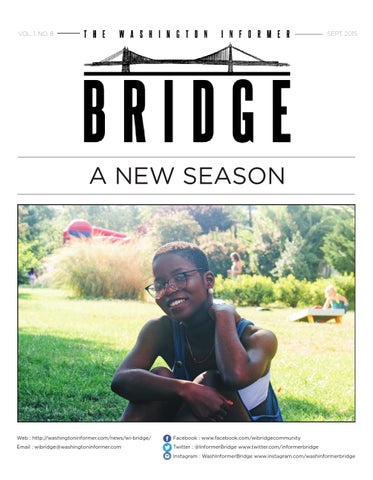
As always, it’s a pleasure serving the D.C. community. We’re always on the lookout for writers. You’re highly encouraged to join the staff and use your voice for the greater good. Until next time. Yours in the Struggle, Fabiola Ching, 18, founded the Coalition Zine, an online media platform that encourages discussions between women and nonbinary people of color. The Coalition Zine features written work and photography by women and binary people of color that center on issues of feminism and the portrayal of girlhood. Ching, a writer, said she created it out of frustration about how the independent zine culture space shunned people like her. / Photo by Dejah Greene
Ambre Tomlinson
Sam P.K. Collins Editor-in-Chief WI Bridge
PHOTOGRAPHER MISSION STATEMENT The WI Bridge sets out to highlight contemporary issues through the experiences of youth and capture the progressive, entrepreneurial spirit of the Millennial generation other publications gloss over. Writers will take to streets and feature people, programs, initiatives, and movements that uniquely address prominent youth issues. This hard-hitting coverage will lay to rest misconceptions of Generation Y and bring all to an understanding of diverse youth experiences.
Dejah Greene
LAYOUT Kelcey Abney
2| WI BRIDGE
MILLENNIALS CHALLENGE MISCONCEPTIONS ABOUT “JUSTICE OR ELSE!” Briana Thomas WI Bridge Contributing Writer
The Greenbelt, Md. organizing committee, works to inform the community of the issues within America’s criminal justice system. A recent New York Times study shows an evident rise in the incarceration of black people, who often receive harsher prison sentences than their white counterparts. Working class men like Darrell Morrison exercise the right to speak out against unlawful prejudice.
More than one million people, many of whom are young adults, are expected to mobilize next month to hold the U.S. government accountable for black lives. Two decades after the historic Million Man March, black America will join the Honorable Minister Louis Farrakhan and the Nation of Islam (NOI) on the National Mall again during the gathering known as “Justice or Else!”
Morrison has been a member of the Greenbelt Justice or Else team since the location started its outreach efforts a year ago. His service centers on finding solutions to a flawed government especially by engaging and educating young adults. Morrison believes the spike in black-on-black crime throughout the Metropolitan area is unrelated to the march, “We have a criminal justice system that can handle those things appropriately.”
“We don’t just speak for the living. We speak for the dead who cannot today speak, but want their children to speak on their behalf,” Farrakhan said during a press conference at Metropolitan A.M.E. Church in Northwest earlier this year. In 1995, an estimate of 837,000 black men gathered on the National Mall in support of brotherhood and unity. That day, they pledged to be active heads of homes and community members. But, Farrakhan has said publicly, the second march has a different focus.
Yet, some supporters of the movement denounce the accusations of black-onblack crime. Many activists believe the mass attention on crime in inner cities distracts from the issue of law enforcement officers killing unarmed African-American men and women.
On October 10, the 82-year old activist will address issues of racism, police brutality on black people, poverty and a subpar education system. As of May, more than 380 people have been shot and killed by police nationwide. Blacks were killed at three times the rate of their white counterparts and other ethnic groups. Oftentimes, officers suffered no consequences. For many black people, the string of policeinvolved killings call to mind what some call the overincarceration of people of color. An overzealous criminal justice system has been connected to high rates of unemployment among black people, a good number of whom have served time for nonviolent offenses. With the support of Black Lives Matter, NOI, and other groups, youngsters involved in the “Justice or Else!” planning have prepared to raise awareness about the United State government’s mistreatment of African Americans. But not everyone supports such a move. Critics call the movement racist and hate filled. Commentators on major media outlets view the ultimatum “or else” as threatening. Others believe the march will not solve the issue of blackon-black crime. Young people from the D.C. metropolitan area have met to planned all year as part of an effort to debunk these misconceptions.
Charles Moreland, Ward 7 Justice or Else organizer, and his mother alongside Minister Louis Farrakhan.
Charles Moreland, Ward 7 organizer for Justice or Else, for example, often invites community members to weekly meetings at The House of Praise in Northeast. Inspired by Farrakhan’s speech at Shiloh Baptist Church in June in Northwest, the Moreland jumped into the fold, attending more community meetings and networking with fellow millennials. He said that came out of a startling realization that he was one of the youngest people in the room at times. “We need more people who are ignorant and complacent to the cause,” said Moreland, 22, a student at Virginia State University “Anybody who has doubts about the march, instead of speculating or fearfully guessing, just come out. If the situation isn’t getting better, then it’s getting worse.” Moreland stressed making a difference would take the energy and spirit of youth. Local organizing committees like that in Ward 7 often encourage children ages 6 to 21 to use flyers and social media to
help promote the march to businesses and citizens throughout the area. The rise in social media helps Justice or Else groups broadcast their own news. At meetings, residents address issues of education, healthcare, and financial instability. Gatherings at the House of Praise meetings, hosted by Apostle Stephen Young, are often referred to as “town hall style meetings.” A typical meeting can have between 100 and 200 guests in attendance, a testament to what Moreland describes as the Justice or Else’s movement’s reach beyond religion. “I can’t condemn a man who everyday puts effort and so many hours into bettering his people,” Moreland said. Maryland and Virginia committees join forces with D.C. organizers in the larger citywide meetings for delegates. However, every week more than 10 local committees meet within their neighborhoods. People of all ages, genders and religious beliefs band together in pursuit of implementing a change in government policies.
Graphic videos of negligent police arrest like, the Sandra Bland case in Texas, have provoked people of color to fight back. “ There is no such thing as Black-onBlack crime. Crime has no color,” said Moreland who awaits the rise of a Black political party. Moreland feels Black representation in the government will solve issues of drug smuggling and gun control that elevate crime rates in urban communities. Along with, gender equality, immigration laws, Native-American poverty, and black unemployment, Minister Farrakhan intends to act on the “or else.” If America doesn’t follow the demands of marchers, then a economical boycott takes place. The religious leader encourages the immediate boycotting of major corporations who are unwilling to cooperate with the progression toward equality. “When they feel the pain of our withdrawal or our economic power from them, then we can talk about real change in America …” Farrakhan told News One Now. “Either ‘they are’ going to treat us right or we’re going to withdraw our economic support.”
3 | WI BRIDGE
BLACK WOMEN TAKE FIGHT AGAINST EXPLOITATION ONLINE By Loren S. Coleman, Ph.D. WI Bridge Contributing Writer @Ms_LorenS
During a recent debate, three Republican presidential candidates chose civil rights activists Rosa Parks as the woman they would want to see on the $10 bill. But none of them mentioned the context in which Parks exercised her constitutional right of civil disobedience, or highlighted how those civil rights Parks and others fought and died for are still violated in 2015. Social, legal and economic institutions scrutinize and propagate black women and their bodies, yet simultaneously, in some sectors, such as lifestyle, entertainment and politics, admire, exploit and appropriate them. With institutionalized attacks on black women in media and society coupled with pressure to conform to homogenizing standards, how do black female millennials challenge instances of cultural appropriation and exploitation? Through social media. Black women are using online platforms to speak out against institutionalized racism and raise awareness of the pervasiveness of cultural appropriation and exploitation in popular culture. Acts of resistance in popular culture should not be devalued or ignored, as this resistance can work in solidarity with the Black Lives Matter Movement, which encourages and provides space for black women across sectors to demand the recognition and celebration of black female bodies and our diverse cultural identities. “There is a lack of consistency in the celebration of black women in media,” said Michelle Peters, 29, a student at Pennsylvania State University and lifestyle blogger who writes on black women fashion, representation and health. “It seems that black women experience more scrutiny in the media. I do feel that the media feels threatened by the Black Lives Matter Movement, and tries to deflect attention from it by calling attention to negative stories about black women,” said Peters, who hails from Southeast. The recent exchange between Nicki Minaj and Miley Cyrus during the Video Music Awards (VMAs) speaks to the scrutiny of black women in entertainment. When Minaj learned that 4 | WI BRIDGE
her “Anaconda” music video was not nominated for Video of the Year, she called attention to the lack of diversity in body image in this year’s nominated music videos. Minaj specifically stated that black women heavily influence popular culture, but were rarely awarded for it. Later, in an interview with the New York Times, Cyrus criticized Minaj for her statements on diversity in representation, calling them selfish and angry. “Miley stepped in to help ‘the cause’ and dismissed Nicki’s feelings,” said Peters, who’s studying liberal arts and media. “Everyone wants to emulate the black woman with the big butt and curves, but we still get teased. Although she’s achieved some form of fame, she’s associated with some form of negativity.” After Minaj called out Cyrus during her acceptance speech at the VMAs, during an acceptance speech, media outlets called Minaj’s statement forceful and aggressive, paying little attention to how her initial statement shed light on the struggles black women endure in the entertainment industry. As Peters said, it’s not just about one music video and the heated exchange at the award show. These situations show up consistently across other areas where black women are often ignored, narrowly defined and violated. But Peters, an avid blogger and tweeter, said black women are fighting back and speaking out. She noted how black women took to Twitter in protest when Allure magazine published its Afro tutorial using a white model, and critics body shamed Serena Williams during Wimbledon. “People are not keeping quiet because social media gives you everything in real time,” Peters explained. “Instead of us saying this is so messed up, we retweet an article and send a tweet saying this is whack. Now, we are more quick to reply to institutions that culturally appropriate black women.” Parallel to these struggles in entertainment media are instances of police brutality against black women. The recent deaths of Natasha McKenna and Sandra Bland have catalyzed focus on black women in the Black Lives Matter movement, especially because of the potential in their social media activism. Discrimination in entertainment media and personal life are often seen as
D.C.-based blogger Michelle Peters/ Photo courtesy of Rosa Love DC
operating in isolation of one another. This stems from misconceptions about popular culture and the distance between our lives and those of people in entertainment, sports and politics. British Cultural Studies scholar Stuart Hall says two definitions of popular culture help form this gap. First, popular culture is often understood as that which is produced and accepted by the masses. It’s also understood as the culture of “the mass or people.” In both views, resistance and protest is limited because culture is either created for people, or it includes all activities among people. Hall offers a more complex and critical definition of popular culture that emphasizes that culture is produced by people, and therefore people have the power to make change. For Hall, popular
culture is a site of constant struggle and resistance. This understanding of popular culture helps explain how Peters, and other black women who challenge instances of exploitation via social media are working as a part of the Black Lives Matter movement, which is vehemently fighting for the respect, value and rights of black women.
REDUCING CHILD MORTALITY IN SUB-SAHARAN AFRICA By Sam P.K. Collins ThinkProgress Health Reporter Child mortality rates throughout the Motherland have plummeted since the turn of the century, falling below the 6 million mark for the first time since the World Health Organization (WHO) started collecting data, a new report shows. However, global health officials say there’s more to be done to meet longterm reduction goals in Sub-Saharan Africa, especially as 16,000 children under the age of five die prematurely daily. Nearly 50 percent of under-five deaths take place within the first month of life. Causes often include prematurity, pneumonia, diarrhea, sepsis, and malaria, all of which are preventable. “We know how to prevent unnecessary newborn mortality. Quality care around the time of childbirth including simple affordable steps like ensuring early skinto-skin contact, exclusive breastfeeding and extra care for small and sick babies can save thousands of lives every year,” Dr. Flavia Bustreo, WHO Assistant Director, told East African Business Week. “‘The Global Strategy for Women’s, Children’s and Adolescents’ Health, to be launched at the UN General Assembly this month, will also be a major catalyst for giving all newborns the best chance at a healthy start in life,” she added. In June, nearly 2,500 organizations and global health leaders converged on Geneva, Switzerland to update the Global Strategy for Women’s Children’s and Adolescents’ Health. Reports from WHO say that most participants agreed that the strategy proved effective in supporting women, children, and those living in underdeveloped areas. Improving the strategy, last drafted in 2000, would require a protection of the recent gains made in fragile countries, particularly regions affected by Ebola. The updated document will most likely expand upon those ideas. “Rapid improvements since 2000 have saved the lives of millions of children,” United Nations Undersecretary General for Economic and Social Affairs Wu Hongbo said in a statement. “However, this progress will need to continue and even accelerate further, especially in high-mortality countries of sub-Saharan Africa, if we are to reach the proposed child survival target of the 2030 Agenda for Sustainable Development.”
Child at play in Timbuktu, Mali. / Photo Courtesy of Emilio Labrador, Creative Commons License, https://flic.kr/p/65sBKq
Though newborn deaths have declined in sub-Saharan Africa since the 1990s, children in the region are still 15 times more likely to die under the age of five, especially if they live in rural areas, poor households, or are born to a mother denied basic education. Democratic Republic of Congo and Nigeria account for a significant number of under-five child deaths. In some cases, war and sectarian violence often exacerbates the situation because families go long periods without food and clean water. Recurrent civil conflict in Somalia, for instance, disrupted food distribution, driving its child mortality rate up past that of neighboring Ethiopia and Kenya. Research shows that reducing childhood mortality as outlined in WHO’s Millennium Development Goals means connecting expectant mothers to basic, cost-effective health services, effectively mitigating childhood illness, and encouraging breastfeeding. Other strategies include increasing immunization against measles and other preventable diseases.
sending them to rural and isolated pockets of the country. Nurses who receive training are equipped to treat tuberculosis, diarrhea, malaria, and malnutrition. The East African nation has also prioritized its rural farmers with policies that enable them to grow healthy food and economically develop their communities.
Countries eager to make progress can look to health programs that have been successful in keeping newborn children healthy since the United Nations first adopted the Millennium Development Goals in 2000. Ethiopia, for example, has trained and compensated more than 38,000 health workers since 2003,
But improving on those gains may require some cooperation on the part of the pharmaceutical industry. While treatments for pneumonia, diarrhea, and malaria are relatively cheap, prices for vaccine packages to treat a dozen illnesses have increased by more than 2700 percent in a 10-year span. UNICEF
Malawi, too, has made significant gains in reducing child mortality by connecting poor mothers with maternal resources — it counts among the six countries that met and surpassed its health spending target. Until a financial scandal compelled donors to withdraw financial support in 2013,nearly 65 percent of births in impoverished regions of the country take place in the presence of a medical professional, thanks to a program launched by the country’s Ministry of Health. “Mother’s Groups” in Zimbabwe help women and girls of all ages fulfill their responsibilities, including those related to the health and wellbeing of their children.
and other global health organizations pay Western manufacturers twice as much for medication than they would have doled out to Indian and Indonesian competitors. That’s why polio and measles still have a stranglehold on many underdeveloped nations. “We’re building momentum in many countries in the poorest parts of the world,” Dr. Mickey Chopra, UNICEF’s head of global programs, said last year amid the release of a report highlighting how preventable disease caused child mortality rates to soar. “The challenge is to spread what works. It is very, very easy to prevent those three diseases from killing kids. An antibiotic is 10, 20 cents, and that saves the life basically.” This article originally published on Sept. 14 at http://thinkprogress.org/ health/2015/09/14/3701250/reducingchildhood-mortality/.
5 | WI BRIDGE
WHAT TUPAC CAN TEACH CURRENT ARTISTS By Adolf Alzuphar
WI Contributing Columnist @alzuphar Nineteen years ago this month, the hiphop world lost a legend when Tupac Shakur succumbed to wounds suffered during a drive-by shooting. What he left behind for our community are musical standards -- songs that remain
Glorious rhythm or lyrics is often the songs we pick as black standards. A son of members of the Black Panther party, Tupac espoused the ideology one can find in Eldridge Cleaver’s book “Soul on Ice”. He was not a Panther himself, and there is no comparison between his work and singer Elaine Brown’s album “Seize The Time”
“Back to Back,” Drake’s diss song to Meek Mill serves as an example. In it, he takes on an aggressive position and flow similar to that of Tupac’s. While the symbols he use in his lyrics closely resemble the late-great Notorious B.I.G.’s, he still mimic’s Shakur’s flow. Meek Mill’s songs too are descendants of Tupac’s narratives rapped as anthems. A song like “Long Souls” is very similar
“commercial creation” and not organic art. He would, however, find today’s producers to be some of the greatest ever. The heavy beats of today, despite being of the Southern hip-hop tradition, are his legacy, and he would appreciate their tone all the while wanting to make a West Coast version. Tupac would more than likely not like what he would perceive to be the political naivete of
“Tupac’s
musical innovations are the foundations of the commercial hip-hop of today, despite none of it being at the level of his genius. ” popular long after their release -- and a fundamental influence on musicians today and for generations to come. The question of why he died remains a popular topic of discussion. But to honor his musicianship, it’s time to ask ourselves instead why Tupac’s songs remain timeless, what’s in hiphop’s future, and what would he think about today’s music. His anthems about drug dealing and gang life are still the sort of thing that a large part of the hiphop community embraces. Tupac also addressed issues that were and still are of concern to black life, such as the relative poor state of black people amid American economic prosperity. Understanding why Tupac’s music remains fundamental to black life would require a look at 20th century black sociologist and anthropologist St. Clair Drake’s theory of “coping, co-opting, and resisting.” Drake wrote that black people cope with life in the United States through an identification with a glorious past, whether it be Ethiopia’s or Egypt’s. 6 | WI BRIDGE
because he was not as political or direct in his approach. But he still touched on the issues in his own way. Tupac’s albums have what we like to call “classics”. The socially conscious “Brenda’s Got a Baby” fits this description as much as “California Love”, an ode to life in a state where a plethora of African-American triumphs and tragedies have taken place, does. “How Do U Want it” remains a song of black male cynicism. “Ambitionz Az a Ridah” also stands as a anthem for drug dealing. “All Eyez on Me” is the opposite of Ralph Ellison’s “Invisible Man” because it shows the black will to be at the center of American attention by any means necessary. It could be the soundtrack of our times. Tupac’s musical innovations are the foundations of the commercial hip-hop of today, despite none of it being at the level of his genius. Tupac is the king of the hip-hop anthem, a formula that today’s artists mimic.
to Meek Mills’ “Ready or Not” on his mixtape Dreamchasers 2. A musician that Tupac Shakur has most likely influenced more than anyone is Kanye West. Tupac’s “All Eyez on Me” and “Life Goes On” displays the bittersweet nature of life and shares similarities with Kanye’s “We Don’t Care.” It’s the aesthetic of Kanye West’s albums and the arrogance he displays. To this day, Tupac remains fundamental to contemporary hip-hop as it regains its conscious voice. His now popular conversation with Kendrick Lamar on the song “Mortal Man” from the album ‘To Pimp A Butterfly’ is only the tip of the iceberg. Hip-hop today has become a tradition that young men and women are initiated into, and Tupac is central to that process. Tupac, given his personality, would more than likely find today’s hip-hop scene, that now includes heavy influence from the South, competitive and thrilling. He would find some of today’s artists to be mediocre, accusing them to being a
the contemporary MC. Machiavelli, from whom Tupac took his pseudonym Makaveli, was a very harsh political philosopher. Today’s rapper has no real qualms about politics let alone about oppression and the almost heartwrenching state that blackness finds itself in with a black president. However, it’s important not to mythologize Tupac. He is still a rapper of gang life anthems despite his social consciousness. The black middle class is larger than ever. Never has there been more blacks educated in music. Today’s producers are the greatest that this community has ever seen since the foundations of hip-hop. Now is also the time to create music that is both beautiful and grand for our community and especially for our children, while using the sound Tupac has left behind for us as a legacy.
THE IMPORTANCE OF AFRICAN-CENTERED EDUCATION Salim Adofo
National Secretary, National Black United Front @salimadofo In the 1990s, the National Black United Front (NBUF) compiled a World African Centered Education Plan with which it would create a global independent African Centered Education System comprised of new and existing African-centered schools. One tenet of the plan called for the expansion of afterschool and enrichment programs in African communities.
purification, renewable energy, global warming and volcanoes. Additionally, the principles of Kwanzaa (unity, selfdetermination, collective work and responsibility, cooperative economics, purpose, creativity and faith) serve as a guide in creating a healthy a productive learning environment for children and their families. Parents, guardians, and extended family members are highly encouraged to participate aspects of the program and its implementation. This includes
of the East Cultural Center, the Council of Independent Black Institutions, the Afrikan Street Festival, the NY State Freedom party and many other organizations and programs. At the time of his death in 2013, Weusi served as an educator in New York City for more than 40 years. Quality education should teach people how to produce goods and services,, and control the economy, politics, and structure of their communities. However, the current system teaches black
Points of the World African Centered Education Plan 1. African Centered curriculum development and educational restructuring in the public schools. 2. Expanding the number and quality of supplementary or after school programs in the African Community. 3. Working to restore African extended communities through aligning with African religious / spiritual institutions, community organizations, social organizations, and educational groups to create pilot block by block organizing around African Centered education. 4. Through NBUF’s Prison Project, work to implement African Centered Education in the education programs in the prisons of America. 5. Encourage African governments throughout the world to adopt the African Centered Education thrust. 6. Support, when appropriate, African Centered Charter Schools.
Students participated in a 2012 session of the National Black United Front’s N’Joya Weusi Saturday School at Turkey Thicket in Northeast/ Photo courtesy of Salim Adofo
More than a decade later, the local chapter of NBUF kicked off the first session of the N’Joya Weusi Saturday School at the Turkey Thicket Recreation Center in Brookland. The goal would be to supplement the subpar education black children received District’s public, private, and charter schools. NBUF’s educational program focused on science, technology, engineering, mathematics, also known as STEM, and the principles of Kwanzaa. This wasn’t by accident. A 2014 CBS News report said 19 percent of 8th graders in the District scored “proficient” or better on the National Assessment of Educational Progress Test. In the math section, the same group scored an average of 265 out of 500 points. NBUF fills in these gaps during saturday school sessions. Students have conducted science experiments on water
financing, preparation of lunch, recruitment, and facilitation of daily lessons. By having a child’s family participate, the family bond is strengthened, a positive value system is reinforced inside and outside of the home, and the a stronger sense of community is developed.
youth to be first-class consumes and subjects of the prison industrial complex. The NBUF World African Centered Education Plan and the N’Joya Weusi Saturday School are organizing tools that counter the miseducation of black youth and set African people on the path to selfdetermination.
Perhaps no one embodied these values more than Baba Seydou N’Joya and Baba Jitu Weusi, two of NBUF’s founding members for whom the program is named. N’Joya, a longtime Pan-African activist and one-time member of NBUF’s labor section, helped black people file workplace discrimination complaints. Before his death, he worked in the interests of political prisoners, electoral politics and reparations.
This isn’t true for D.C. only. The school, which started out as a six-week summer program, now functions quarterly, expanding operations to Houston. Plans to open a Baltimore center are also in the works.
Weusi, also an activist and NBUF architect, was a founding member
To learn more information on the National Black United Front N’Joya Weusi Saturday School, contact nbufdc@gmail.com or (301) 836-1826.
7. The establishment of an NBUF African Centered Teacher Training Institute. 8. Develop a National Strategy of electing African Centered School Board Members at the local level and establish a National African Centered School Board Organization. 9. Strive to coalesce with nonEnglish speaking African people in furthering our efforts to internationalize the African Centered Movement. 10. That NBUF consolidate the African Centered movement through aligning and collaborating with African Centered entertainers, study groups, churches/temples, scholars, and rites of passage programs. 11. Establish an NBUF African Centered Education Summit Network and periodically convene NBUF Educational Summits. 7 | WI BRIDGE
WI BRIDGE VIEWPOINTS
Each month, a WI Bridge reporter hits the streets, asks the questions that matter, and compiles the best responses for readers to see. Do you have a suggestion for a Viewpoints question? Email wibridge@ washingtoninformer.com and you might see your inquiry in a future issue.
HAS THE BLACK LIVES MATTER GROUP’S CONFRONTATIONAL STRATEGY AS OF LATELY BEEN EFFECTIVE IN FURTHERING ITS CAUSE? Black Lives Matter’s confrontational strategy has successfully received the world’s attention and I admire the group’s courage and tenacity. However, I’m interested in the group’s contingency plan and would love to hear a clear cut agenda. The ongoing presidential election would be a phenomenal opportunity for Black Lives Matter to use their existing platform and organize a debate where candidates would discuss their position [on matters of criminal justice]. There, they can inquire about ways those candidates would incorporate such concerns into future legislation and progressive policy if elected into office. This could be a great way to increase understanding of the movement and gain more supporters. We need more dialogue.
Krystal Branton, 35, Northwest
I believe the confrontational aspect of The Black Lives Movement is not as effective as it could be. I feel that what is being broadcasted is black people being angry instead of showing the real issues.
Naeemah Powell, 26, Southeast
Answers Compiled by Sam P.K. Collins
The Black Lives Matter group’s confrontational approach may not be the most effective in furthering the campaign to end police brutality. A more data-driven approach would work—numbers don’t lie. Instances of black-on-black crime are lower than in years past while the number of African Americans dying at the hands of police is on the rise. The number of incarcerated nonviolent African-American offenders is high because of socioeconomically biased laws on the books. What also should also be highlighted are the number of successes seen in black communities that the media doesn’t address: high school dropout rates are on the decline and college matriculation for blacks has increased as has the graduation rates for schools across the country. In short, we as a people must change the perception of ourselves, begin respecting and supporting our communities, or else no one else will. Tylah Johnson, 23, Hyattsville, Md.
The Black Lives Matter movement has shown that expressing ourselves to the rest of society is confrontational in any manner. There is no “cause” to furthered until we as black people improve our mentality. We must value ourselves before holding anyone else accountable for how we are treated.
Rob Boyd, Northwest
YOUR BUSINESS COULD BE ADVERTISED ON THIS PAGE. For more information, send inquiries to WIBridge@washingtoninformer.com
8 | WI BRIDGE