VOL. 1, NO. 9
OCT. 2015
WHAT NOW?
Web : http://washingtoninformer.com/news/wi-bridge/
Facebook : www.facebook.com/wibridgecommunity
Email : wibridge@washingtoninformer.com
Twitter : @InformerBridge www.twitter.com/informerbridge Instagram : WashInformerBridge www.instagram.com/washinformerbridge
CONTENTS
EDITOR’S LETTER
Thoughts of Millennials Who Didn’t Attend “Justice Or Else!” 3
Peace and blessings WI Bridge readers, old and new,
Swaliga Promotes STEAMCentered Education 4 Tony Lewis, Jr.’s Message Gives Students Hope 5 Davis’ Emmy Win Raises Hollywood Diversity Question 6 Local Fashion Designers Celebrate The Craft 7 WI Bridge Viewpoints 8
ON THE COVER
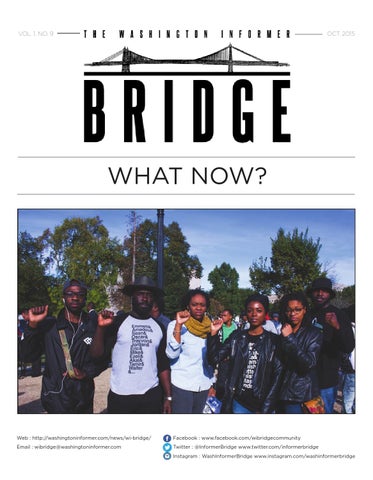
A group of Millennials (Left to right: Mike Meadows,Samuel Adaramola, Michaela Thurston, Raven Best, Corinne Griffith, and Traimont Holt) hold up their fists in solidarity on the National Mall during the observance of the 20th anniversary of the Million Man March, themed “Justice or Else!” The Oct. 10th event attracted nearly one million people of color from across the United States, many of whom listened as the Nation of Islam’s Honorable Minister Louis Farrakhan spoke touched on a slew of political and social issues for two hours from the steps of the steps of the U.S. Capitol. WI Bridge Viewpoints highlights some thoughts about the historic event. An accompanying piece sheds light on a group not mentioned in all of the “Justice or Else!” coverage -Millennials who stayed home. / Photo by Dejah Greene
2| WI BRIDGE
PUBLISHER
Earlier this month, legions of melanated people from various parts of the country converged on the National Mall for what was supposed to be a day of action. The marquee event, themed “Justice or Else” commemorated the 20th anniversary of the Million Man March. In the months leading up to October 10th, the Honorable Minister Louis Farrakhan, head of the Nation of Islam (NOI) hit the black media circuit and NOI mosques across the U.S. rallied support in a well-coordinated grassroots effort.
among black people of different ethnic backgrounds, sexual orientations, religious and political affiliations, and the sort. News flash, that’s not the media’s job! As the de-facto fourth branch of government, the mainstream media acts as an agent in the perpetuation of the forces that have always destroyed black lives. No need to worry though. The black press -- the press we as black people should support -- covered the March. This issue includes some coverage from the Millennial perspective via an article and our WI Bridge Viewpoints. Please read for a perspective that I believe wasn’t represented last weekend.
On the morning of “Justice or Else,” people, young, and old, heard the minister speak eloquently about the troubles black people have faced in this country since before the so-called American Revolution. In his speech, he called out the U.S. government for its atrocities against people of color while attempting to hold black men and women more accountable in their actions. However, few participants, especially Millennials, left the Mall feeling inspired. How could you expect them to do so with no list of demands or action plan in place?
Other pieces in this special edition of WI Bridge, titled “What Next?” focus on budding fashionistas in the D.C. metropolitan area making an impact along the East Coast and beyond, and the emergence of STEAM (science, technology, engineering, arts, and mathematics). Also check out a piece about how some young sisters took Viola Davis’ historic win at the Emmy’s. D.C.’s own native son Tony Lewis, Jr. also graces the inside of this edition in a piece that looks back at his visit to his alma mater, the University of the District of Columbia.
With other mass gatherings, this modern-day march on Washington felt like the same rhetoric-filled political posturing that does significantly less than what’s intended. Even more damaging to my eyes, and the movement, that morning was the sight of black people in line for good eats at the Smithsonian food kiosk and on the grounds of Taste of DC. If “Justice or Else” was supposed to be a threat, then I’m sure the powers that be consider it an empty one. Even as we stood in solidarity in the heart of Downtown D.C., we willingly gave our dollars to the Machine via restaurants, hotel stays, Uber and Lyft rides, and whatever else we didn’t sacrifice in the name of Revolution. So in essence, gathering and asking for our freedom AGAIN proved counterproductive.
As always, attaining our freedom is OUR responsibility, not that of the government or “well-meaning” allies and nonprofit organisations. As a member of the grassroots media, it’s our duty to disseminate the information. What part are you playing? Remember that we’re not all meant for the spotlight. That’s not the ONLY mark of leadership as we have been duped into believing. Putting in the consistent and collective work in our own way -- whether it’s among the children, in the streets, as an entrepreneur , or whatever else, will allow us to live freely as one people. Thank you for letting WI Bridge be a partner in getting the job done.
Even more appalling, to me at least, was this notion that the mainstream press would cover this moment of unity
Yours in the Struggle, Sam P.K. Collins Editor-In-Chief WI Bridge
Denise Rolark Barnes
STAFF Sam P.K. Collins Editor-in-Chief
REPORTERS Loren B. Coleman, Ph.D.
PHOTOGRAPHER Dejah Greene
LAYOUT Kelcey Abney
THOUGHTS OF MILLENNIALS WHO DIDN’T ATTEND “JUSTICE OR ELSE!” By Sam P.K. Collins WI Bridge Editor-in-Chief @SamPKCollins Earlier this month, thousands of people of African descent converged on Downtown D.C. to commemorate the 20th anniversary of the Million Man March. The event, themed “Justice or Else!” attracted black men, women, and children from across the country eager to take the fight against police brutality and systemic racism to the next level. The hype built up around the mass rally, however, didn’t prove enough to convince some young people to support the Honorable Minister Louis Farrakhan and Nation of Islam (NOI) on October 10. Those who stayed home did so out of disdain for the NOI’s views on women and homosexuality, and skepticism about the event’s effectiveness. “Min. Farrakhan is indoctrinating people who are looking up to him [when he says] homosexuals are not sane and he calls them swine,” entry level professional and local activist Maronel Stewart said, referring to YouTube videos of speeches she watched. “That could be a hindrance to our brothers and sisters opening up to members of the LGBTQ community.” The decision to sit out of “Justice or Else!” didn’t come quickly for Stewart, who initially planned to participate with her boyfriend as an act of black resistance. But as she learned more about Min. Farrakhan’s take on issues related to black women and gay rights, attending the march in solidarity with her brothers and sisters in the LGBTQ community seemed like a conflict of interest. So she forwent the march, choosing instead to deep condition her hair and eat breakfast in her pajamas while watching re-runs of The Simpsons. In a Facebook post earlier that week, Stewart railed against those who overlooked what she described as Min. Farrakhan’s misogyny and homophobia for the “bigger picture.” “How could you claim that you support the black community when you ignore the disrespect of women and LGBTQ people in our community for the ‘sake of the movement’? There’s no room for hate.” Stewart, 22, said. “In one of Farrakhan’s speeches, he said professional women were failures and they couldn’t be happy without
men. In another he implied women need to be dressed a certain way to be respected. These are ideas that shouldn’t be promoted by a leader in the black community. He has a responsibility to be inclusive and respectful of black women and LBGTQ people. That’s just something I didn’t see from him,” she added. Stewart’s sentiments echoed that of some Millennials who felt conflicted about “Justice or Else!” but attended anyway out of an obligation to support Min. Farrakhan and NOI. However, for some who made that choice, parts of his more than 3-hour speech didn’t sit well. While Aaron Goggans, campaign coordinator at the DC Employment Justice Center, said he enjoyed seeing the exchange of black dollars on the National Mall, he took to social media to criticize Min. Farrakhan’s call for
and Union Temple Baptist Church in Southeast. Even there, the organization’s conservative messages often clashed with those that resonate with young black women. Tia Dolet, president of the Black Graduate Student Association at University of Maryland, College Park, faced a similar dilemma when she attended campus forums about the state of the black male population. She said that when it came to matters of academic achievement, some panelists placed blame on the young women, telling them to help their brothers more. Fatigued of male-centered dialogue that didn’t acknowledge women’s significant role in today’s movement, Dolet decided to sit out of “Justice or Else!” She mulled over her choice with her fellow executive members, many of whom were either black women or members
importance of intersectionality, defined as the crossing of different forms of oppression. “A few black men have been receptive to the idea of inclusiveness and intersections,” she said. “We have to make sure that everyone gets a hashtag. It starts with a conversation and looking at the dynamics to understand why we march for some and not for others. There are gender issues in the black community.” Even with a post-march meeting, outline of demands, and a call to boycott corporations during the holiday season, some Millennials who didn’t attend the march see little value in asking the oppressor for justice. Bowie State University student Amadu Jalloh, suspicious of the NOI’s involvement in the assassination of famed member Malcolm X, said
“How could you claim that you support the black community when you ignore the disrespect of women and LGBTQ people in our community for the ‘sake of the movement’?” women to “sacrifice themselves for their offspring because they’re genetically programmed to do so.“ He, too, noticed a seemingly blatant disregard for black women’s control over their bodies.
of the LBGTQ community. She later recounted reading criticisms of Min. Farrakhan’s speech on social media and hearing the stories of friends leaving in the droves.
Popular blogger TheNewAfrican also grappled with her decision to attend the march, saying it showed her that much work remains to be done to address the complexity of blackness she said elders often gloss over. In her Tumblr post, titled “Reflections on the Million Man March,” she too criticized Farrakhan’s diatribe against abortion and called on members of the black community to unlearn oppressive behavior that hinders the present-day movement.
“It’s always about attending these mass gatherings but never about protecting our issues,” Dolet said. “I get upset when you try to get people to rally after something happens to a black woman and they don’t show up. We put our gender on the back burner and are starting to understand that it has to be addressed. I feel some type of way when black male leaders ignore us and place blame on us for whatever reason.”
In the weeks leading up to the march, NOI, along with other organizations, rallied support among black women during panel discussions at Galbraith A.M.E. Zion Church in Northwest
Like Stewart, Dolet remained resolute in articulating her point of view among those sympathetic to the Min. Farrakhan’s cause. She said productive dialogue came out of that, with some young black men understanding the
attending “Justice or Else!” would have went against everything the late activist represented. Against his friends’ wishes, he worked on the day of the march, criticizing NOI’s inclusion of other oppressed others he said have seen relatively more progress. “We can never be in our space because we need the approval and validation of other races. That’s one thing I’ve noticed,” Jalloh said. “We need to focus on ourselves. Those other groups are treated as humans, but we’re not. This was a big social meeting, not a rally for justice. I would have liked to see more black unity. If it’s a march about inequality, then it should have been us. It’s very important to see ourselves in this struggle.” This article originally appeared on AllEyesOnDC.com.
3 | WI BRIDGE
SWALIGA PROMOTES STEAM-CENTERED EDUCATION Briana Thomas
WI Bridge Contributing Writer @Briatho For two years, the Swaliga Foundation has partnered with the Boys and Girls Club of Greater Washington (BGCGW) to give students an education that integrates science, technology, engineering, and math curricula with the arts. This collaboration has become part of the national STEAM (science,technology,e ngineering, arts, and math) movement, which aims to help children adapt and function in modern-day America by coupling what have been considered vastly different subjects. “I show the young learners we work with how the science and math they learn in school relates to music and different things like drawing, because STEAM is just a way to get kids excited about education,” said Lemond “IMAG” Brown, 27, founder of the Swaliga Foundation. The District’s graduation rate sits at 61 percent, well below the national average of 81 percent, according to data from the Office of the State Superintendent of Education. People who don’t obtain a high school diploma have a greater chance of being unemployed than those who have a high school diploma or a college degree. Dropouts often struggle to find jobs and dire financial circumstances may influence them to participate in illegal activities that lead to jail time. Brown said with the support of nonprofit organizations like the Swaliga Foundation, founded in 2012, students in low-income neighborhoods can use their passion for performing and fine arts as an incentive to stay in school. In 2013, he launched the STEAM the Block initiative -- in which he shows children the connection between the arts and technology -- at Boys and Girls Clubhouse 14 on Benning Road in Northeast. Since then, Brown and his colleagues have served nearly 500 children a week throughout the metropolitan area. Next spring, the Swaliga Foundation will take 12 students and their mentors to South Africa. “We show them how the internet can be a tool [that] has to be used the right way,” Brown said. “We show them 4 | WI BRIDGE
Lemond ‘IMAG’ Brown, founder of the Swaliga Foundation, leads children in a discussion about technology./ .Photo courtesy of Boys and Girls Club of Greater Washington
how to make apps and how a device actually works. [We also] teach them to be creators of technology and not just consumers.” Brown said he aims to bridge the performing arts gap between the workforce and childhood development through the Swaliga tribe, a group comprised of artists, fashion designers, poets, doctors and journalists. Members of Swaliga, or “the tribe,” like Chene “The Benu” Byrd teach youth in D.C.’s Ward 1 how to shoot documentaries with cellular phones, play instruments, engage students in art therapy and mural projects and correlate graphic designing with emotional expression. Byrd, a community connection specialist for K-12 students at Jubilee Housing Community in Northwest, participates in an active “STEAM ecosystem” that partners with neighborhood companies and small businesses to provide children with internships. “When you think of the tribe, think of a band of brothers and sisters who have come from all different backgrounds. We are a melting pot. We put our passions and expertise into one pot, add some heat and we are cooking,” Byrd said.
Byrd, also youth leader at the Jubilee House’s Teen Renaissance Center in Northwest, noted that children look forward to the STEAM-centered program because it gives them a sense of self-worth and community. While she acknowledged racial adversity, she said it doesn’t make children harder to guide. It just shows how society needs more teachers. For now, Swaliga will likely expand by inducting more leaders and teachers into its organization and incorporating Brown’s music, which he describes as “anti-pop culture.” Brown will release his first studio album and short film, “Melanin King Project,” in November as a way to promote a positive shift in popular culture. He said he feels the mainstream music industry uses and takes advantage of black customs and melanin to influence youth into participating in trends and fads that aren’t uplifting to the community. “In this time where people are shedding more light on how black people are being mistreated the album will speak to that. The album gives insight to why we are so great, and why our melanin is great,” Brown said, who wants to spread his message globally.
Brown said he feels people of color have a harder time being successful but finding one’s passion can alleviate adversity. Long before receiving a bachelor’s degree in architectural engineering from Drexel University in Philadelphia, Brown knew if he wanted to practice music, then he would have to earn good grades. Brown said he can recall, as a child, taking piano lessons, and banging his drumsticks on the tables and walls at family cookouts. His family, especially his father who is his best friend, gave him sound advice and mental support to pursue his passions, but schoolwork always came first. “Music has kept me out of a lot of things, because I was more focused on music, and spent my time making music instead of doing things that would get me in trouble,” Brown said.
TONY LEWIS, JR.’S MESSAGE GIVES STUDENTS HOPE By Sam P.K. Collins WI Bridge Editor-in-Chief @SamPKCollins By his 11th birthday, Tony Lewis, Jr.’s father, alleged head of a D.C. drug syndicate, had served nearly two years of a life sentence in a federal penitentiary on the other side of the country. HIs mother also developed what would later be diagnosed as schizophrenia. Even with the guidance of a loving grandmother, Lewis said he navigated life in the District with his street smarts during a time when the city gained a reputation as the “murder capital.” Decades later, Lewis, college graduate and community activist, reflected on those childhood experiences in “Slugg: A Boy’s Life in the Age of Mass Incarceration,” a book that has been heralded as the ideal comingof-age story for those trying to find their way. He recently discussed his published work, childhood memories, and current events during an event at University of the District of Columbia (UDC) in Northwest, his alma mater and an institution that has given countless Washingtonians a pathway to a better life. “In my life of service, I get asked this question of how I didn’t fall into this trap,” Lewis told Dr. George Derek Musgrove, professor at University of Maryland Baltimore County and moderator at the Sept. 30 discussion. “Many people in my community succumbed to addiction, prison, [and violence]. I’m still trying to figure out the process and chart out how I became a respected activist. The way I could connect with people was being transparent. My story helped people see the greatness in themselves,” Lewis added. More than 200 students, professors, and D.C. residents filed into UDC’s Theater of the Arts for the two-hour event that included a question-and-answer segment and cupcake social. Audience members watched as a montage of Lewis family photos played from a projector. During the discussion, Lewis and Musgrove discussed violent crime in D.C. during the 1980s and 1990s, the school-toprison pipeline, discrimination of returning citizens, and the lasting effects of mass incarceration. Such conversation provided Lewis the opportunity to reflect on his life experiences, give historical context
D.C. activist and author Tony Lewis, Jr. spoke before nearly 200 people at the University of District of Columbia’s Theater of the Arts earlier this month./ Photo courtesy of John Gordon
to his father’s incarceration, and rail against the forces he said vilify poor black people for decisions they make out of desperation. “America took the African–American drug dealer and voided him of his humanity. My father wasn’t a bad person. He just made bad decisions,” Lewis said. “ When [mass incarceration] is so entrenched in your community, you don’t really see it as a bad thing. Two of my cousins are serving more than 40 years in prison. The title of the book isn’t to catch you on to something. It’s to show you that people from my childhood are either dead or in prison.” Lewis, a community star of sorts, found fans in the audience that evening. Christopher Mitchell said Lewis’ story challenged a misconception that UDC is a subpar institution. Mitchell, a freshman at UDC, enrolled in a tech training program at Year Up shortly after graduating from Friendship Collegiate Academy in 2012. However, failed attempts to gain employment drove him to enroll at UDC, where he’s currently pursuing a bachelor’s degree in criminal justice, a field he said piques his interest. “Being at UDC makes me feel great. It’s good seeing people adding to their
life and doing something constructive,” Mitchell said. “ This school allows people who can’t afford an out-of-state college education to live their dreams. Tony Lewis, Jr. broke down so much and made these concepts simple so that people could understand it. That’s how I could relate.” Latanya Rogers, professor of literature at UDC, shared Mitchell’s sentiments. She said that, unlike so-called marquee academics, her students could see Lewis in themselves. “This is a nontraditional campus so our students are familiar with that crossroads experience where they have to make that choice,” Rogers said. “The lesson for them will be in what factors helped Tony Lewis, Jr. choose the right path when he had so many opportunities to go the wrong way. Also, he’s so relatable. He’s not a big shot telling people what to do.” Though he graduated from Gonzaga College High School in 1998, Lewis said it would be years before he appreciated the value of a college degree. During the event, he told Musgrove that studying alongside men and women decades his senior at UDC inspired him to complete his studies. In 2004, he graduated magna cum laude with a bachelor’s degree
in urban studies. He also attained a certificate in nonprofit management, a tool in his effort to help at-risk youth and ex-offenders. Anika Spratley Burtin, professor of education at UDC, said stories like Lewis’ inspire her work at the university. Burtin started her tenure at UDC in 2012 after working at Johns Hopkins University in Baltimore. She too challenged fallacies about the university, saying that students’ desire to better their lives compels academics to leave flagship institutions to teach there. “Hard-working staff and academics come here to change lives. UDC provides an opportunity for our students to [determine] their life trajectory,” Burtin said. “If our students are native to the area, what does that say about our community? They should see UDC as a beacon. You can get a quality education and make your dreams come true.” This story originally appeared on AllEyesOnDC.com.
5 | WI BRIDGE
“Many of our artists could win these awards, but the opportunity is lacking for black actors and actresses. We are in some ways being oppressed.”
DAVIS’ EMMY WIN RAISES HOLLYWOOD DIVERSITY QUESTION Loren S. Coleman, Ph.D.
WI Bridge Contributing Writer @Ms_LorenS “The only thing that separates women of color from anyone else is opportunity,” said Viola Davis in her Emmy acceptance speech last month. Since 1982, five black women have been nominated for best actress in a drama series but Davis is the first to win an Emmy for her lead role on ABC’s How to Get Away with Murder (HTGAWM). “Many of our artists could win these awards, but the opportunity is lacking for black actors and actresses. We are in some ways being oppressed,” said Kyris Brown, 32, director of International Affairs and Admission at Grambling State University in Grambling, Louisiana. In her acceptance speech, Davis quoted Harriet Tubman to speak to the struggles black women face in Hollywood. For the seasoned actress, the lack of diversity in television doesn’t stem from a talent deficit among black women. Instead, a lack of opportunity contributes to the minimal presence and type cast characterizations of black women in Hollywood. “I was shocked that she even won the 6 | WI BRIDGE
award. She was the first black woman to win an Emmy,” said Brown, a resident of Cleveland, Miss. “You almost have the expectation that she will not win. You get used to seeing the same thing.” In her interview with New York Times Magazine before the series premiere of HTGAWM last year, Davis said black women often have to fight for roles in Hollywood, making it necessary they raise awareness about the pervasiveness of stereotypical representations and why some of them agree to these roles. She had also shed light on how doing so negatively affected her career. Yet, Shonda Rhimes and Pete Norwalk, HTGAWM creator and producer, respectively, reached out to Davis to play Annalise Keating, a defense attorney and law professor, who is complicated and complex, unlike Davis’ previous roles as the mammy in The Help, or the addict mother in Get On Up. The show is largely built around the murder of Keating’s husband, a white psychology professor. Subplots intertwined with his death emerge throughout the season. For example, we learn that Keating has an affair with a black police officer. Just two episodes into its second season, the audience sees a more vulnerable
Keating. We learn about her past relationships, one of which is with a former girlfriend and colleague. We also see her struggle with her public and private identities, and in this role, Davis portrays more than just a mammy. But, there is still work to be done. “Mass media [organizations] are white owned and they are not working to empower us. [T]hey limit our understanding of black culture,” said Brown, a student of black history and culture. “For example, while I am a follower of Dr. Martin Luther King, Jr., his narrative remains dominant, while we are missing stories of Nat Turner and Marcus Garvey in the media. The opportunities are not there because there is lack of control.” Brown’s point on media ownership is consistent with findings from UCLA’s 2015 Hollywood Diversity Report that ultimately finds that lack of diversity in Hollywood begins with white male gatekeepers. Minorities constitute nearly 40 percent of the U.S. population, and remain underrepresented in every sector in Hollywood. In 2013, white people accounted for 94 percent of media CEOs and/or chairs and 93 percent of senior management.
Television network and studio heads were 96 percent white and 71 percent male in the 2012-2013 television season. Actors of color had just 6.5 percent of the lead roles in broadcast scripted programming in that time frame, according to the University of California Los Angeles’ diversity report. “White men want to give people a bone, and wipe the stain away. White people love to associate progression with the ‘firsts.’ But, when you look at the data in say, education and earning opportunities, you find that there is not an equal playing field,” said Brown. While Viola Davis’ award should be celebrated and recognized as a progressive shift in history, there must be conscious and continuous efforts to claim an economic stake in media ownership and production. “Right now Shonda Rhimes is getting a lot of attention, but I hope she doesn’t hit her peak and plateau,” said Brown. “A lot of black people in positions of power don’t create their own. While I don’t agree with the content Tyler Perry produces, I can appreciate him for creating his own. But, now it’s time for diversity in content.”
LOCAL FASHION DESIGNERS CELEBRATE THE CRAFT By Brianna Rhodes
She was very reluctant to start sewing apparel, but she kept on her.
WI Bridge Contributing Writer @Bri_Rhodes24
Steadman said she has taken that attention to detail in her own endeavors. During D.C. Fashion Week, Steadman said her most memorable moment was when walked the stage showing off her fashion line, Very Rich Style, and saw her mother intently watching from the audience.
The world is increasingly finding the District to not be an area that’s just about politics. Fashion designers from the D.C. metropolitan area are making their mark in the industry, taking part in events locally and along the East Coast. Some fashionistas, like Kelsy Dominick, are putting the region on the map.
“At first I did not want to learn how to sew, but my mom kept coercing me into it, I don’t know maybe she saw something in me that I didn’t” Steadman said.“ [Since then], fashion has been a love affair. Maybe [my mother] saw something in me I didn’t,” she added.
Last month, she attended New York Fashion Week (NYFW) for the first time during which presented her clothing collection DiDomenico, which derives from her Italian surname, which means “the day of God.” That week, Sofia Nikitchuk, Miss Russia 2015, saw one her dresses, which Dominick said she’ll use in an international show in Taiwan in December.
That love for fashion in tandem with the sights and sounds of the city can inspire a new creation. That was the case for Nicole Oliver, Clinton, Mdbased designer and founder of Arreit Nicole. She also participated in Fashion Week, unveiling wares she said were influenced by D.C.’s architecture.
“[At first], I was nervous [and] a little on the edge. [But], walking on stage I had a huge sigh of relief. I realized it wasn’t a dream,” Dominick, who hails from Haymarket, Virginia, said about her experience at NYFW. “That one person can change the exposure of the brand,” she said. Other local designers have enjoyed similar success during Fashion Week events in New York and the District. Artists have taken that love for fashion -- which one can see in the heart of Adams Morgan, U Street, and K Street -- to the runway. In a way, they represent the different walks of life, cultures, and backgrounds that make D.C. a unique city. NYFW took place at Skylight at Moynihan Station and Skylight Clarkson Square in New York in September. International Management Group (IMG), a global leader in sporting events, media, and fashion, managed the weeklong event. Mark Shapiro, IMG’s chief content officer, said he wanted to create the best experience possible that extended beyond a physical location and moment in time. “We’re looking forward to reintroducing the industry to a showcase of creative talent, style and innovation that made the New York runways famous,” Shapiro wrote on the NYFW website. D.C. Fashion Week (DCFW) partnered with independent fashion designers,
For example, the tangerine-colored lines in her clothes represent the sun. The zippers also show how the sun hits the beams of buildings from different angles. She said making her dreams come to fruition involved an intricate trial-and-error process that included choosing the right fabrics.
A model walks in a piece from local fashion designer Michelle Gibson’s MCG collection during D.C. Fashion Week./ Photo courtesy of Phelan Marc
producers, and models. It was created to increase economic development in the area of fashion design, clothing merchandising and modeling. Its purpose is to enhance the visibility of the nation’s capital as a center for international fashion. Michelle C. Gibson, another Marylandbased fashion designer who participated in DCFW activities, said she had difficulty turning her clothing line, MCG, into something tangible. She noted that artists and designers often have to learn to trust their instinct and understand that only they can understand their vision. With her work, Gibson said she learned
“It can be rewarding just saying that you’re done,” said Oliver about her clothing. “Keep going, and don’t let anybody kill your dreams. I don’t care how big you think they are. Live with no regrets. God has a purpose for everything.”
how to translate what she sees so others can identify with it. By being relatable, she has found her voice as a fashion designer. “I think understanding that you have to be a storyteller in order for people to understand you and your vision, is something I have realized as I have gotten older,” said Gibson, 23. For local fashion designer Velicia Steadman, her work has become a family affair. She recalled reluctantly learning how to sew when she was younger. When she first started sewing she just made things for her house. She started out just making curtains and pillows. Her mom kept influencing her to try clothing and her mom knows that I am very particular about her clothes. 7 | WI BRIDGE
WI BRIDGE VIEWPOINTS
Each month, a WI Bridge reporter hits the streets, asks the questions that matter, and compiles the best responses for readers to see. Do you have a suggestion for a Viewpoints question? Email wibridge@ washingtoninformer.com and you might see your inquiry in a future issue.
Do you think the commemoration of the 20th anniversary of the Million Man March came at a right time? Do you think it will pave the way for more important discussions? “As far as the Million Man March [is concerned], the very fact that we are commemorating it 20 years later, in such a different world, is a beautiful thing. I feel that in spite of this, we still face the same issues. This march picks up where the last left off. I applaud the Nation of Islam for working so hard to organize this event.”
Philip Harris, 20, Baltimore
“I was at the march in 1995. I had never seen such unity among black men. Minister Farrakhan is one of the best speakers to speak on black people’s situation in America. I think the discipline he learned in the Nation of Islam has given him the insight and patience to lead. I don’t think there’s anyone else, other than maybe Dick Gregory, that could lead and organize this march.” Ayanna, 25, Northwest
“I feel like [the march] is greatly needed, I’ve never attended one, but Its nice. I think maybe [we need to] do more than just march. We need more action. After Dr. King died, we dropped the ball, and missed out on opportunities for action. But it’s cool that the Nation of Islam is doing this.”
Answers Compiled by Dejah Greene
“I feel that Minister Farrakhan’s involvement is important. He did this 20 years ago. He’s going to play a big role. It [was] better this time around because he wanted more than the men [out there] He wanted everyone -- men, women and children. With social media involved, it was bigger.”
Mike, 23, Northwest
Marcus, 21 Northwest
“I think the ‘Justice or Else!’ march is a great thing, especially given the [rise of the] Black Lives Matter and other police accountability movements. Minister Farrakhan’s involvement is key. Who is better than him. Who has crusaded for more for black people in recent years?”
Jaleel, 20, Northwest
YOUR BUSINESS COULD BE ADVERTISED ON THIS PAGE. For more information, send inquiries to WIBridge@washingtoninformer.com
8 | WI BRIDGE