VOL. 1, NO. 5
JUNE 2015
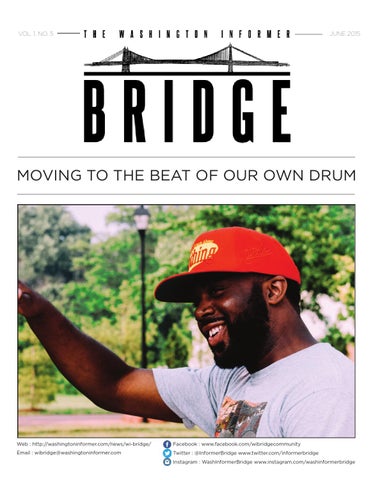
MOVING TO THE BEAT OF OUR OWN DRUM
Web : http://washingtoninformer.com/news/wi-bridge/
Facebook : www.facebook.com/wibridgecommunity
Email : wibridge@washingtoninformer.com
Twitter : @InformerBridge www.twitter.com/informerbridge Instagram : WashInformerBridge www.instagram.com/washinformerbridge
CONTENTS
EDITOR’S LETTER
PUBLISHER Denise Rolark Barnes
Active Fathers Debunk Negative Narratives 3 P-Stew Leads Group of HipHop Fathers 4 Teacher Continues Fight For Music Education 4-5 D.C. Jazz Community Remembers B.B. King 6 Looking Back: Africa Day Jamboree 2015 7 WI Viewpoints 8
ON THE COVER
Hi WI Bridge readers, There’s much to celebrate in the month of June. As the summer season gets underway, we would like to recognize the fathers in our communities and honor our musical pioneers of African descent as a part of Father’s Day and Black Music Month. This edition of the WI Bridge sets out to achieve both goals in a Millennial-like fashion. Open the pages of our publication and learn about local fathers’ efforts to shatter stereotypes about black men’s role in the home through hiphop activism and intergenerational fatherhood networks. This issue also includes a feature about Keith Killgo of The Blackbyrds that highlights his work as an educator at a D.C. public school. Readers can also glean the thoughts of D.C.’s young people about upcoming
concerts and legendary blues musician B.B. King. Before I close this letter, a special shout out goes out to the budding musicians in the District and surrounding areas. Please continue to express your thoughts through the arts and push the culture forward. As always, we welcome commentary about our work. Feel free to reach out. For young reporters hungry for reporting opportunities, the WI Bridge can serve as a stop in your journalism career. For more information, email WIBridge@washingtoninformer.com. Yours in the struggle, Sam P.K. Collins Editor-in-Chief WI Bridge
STAFF Sam P.K. Collins Editor-in-Chief
Chelsea Fuller Editor
REPORTERS Melvin Graham
Loren B. Coleman, Ph.D.
IN MEMORIAM Earlier this month, Denise W. Barnes, the oh so ever fearless and uncompromising editor-in-chief of The Washington Informer, transitioned after a long bout with illness. Denise W. edited and mentored WI Bridge editor-in-chief, Sam P.K. Collins – one of her few students -- during his three years as a Washington Informer contributing writer. In the months before her death, Denise W. supported the WI Bridge as an advisor and cheerleader. Her wealth of knowledge helped senior staff members strengthen the publication’s infrastructure and effectively guide reporters. Akeem Mimiko, a rapper from Bowie, Maryland, has fine tuned his craft for nearly 10 years while seeing firsthand how the art form motivates people to live life to their fullest potential. Mimiko, 25, told WI Bridge that when he finds himself in a funk, he pushes himself to persevere and “appreciate the struggle” as his mother has wisely suggested. Those words and a lifelong goal to help others lead positive lives inspires his music that he says will make people want to party and feel good. His newest single “Be You” speaks to this mantra./ Photo by Dejah Greene
2| WI BRIDGE
Ambre Tomlinson
PHOTOGRAPHER
For that, the WI Bridge salutes Denise W. for her journalistic prowess and dedication to the dissemination of information, particularly when it came to the Millennials, a group in which she showed great interest. Rest in Power Denise W. You will be sorely missed!
MISSION STATEMENT The WI Bridge sets out to highlight contemporary issues through the experiences of youth and capture the progressive, entrepreneurial spirit of the Millennial generation other publications gloss over. Writers will take to streets and feature people, programs, initiatives, and movements that uniquely address prominent youth issues. This hard-hitting coverage will lay to rest misconceptions of Generation Y and bring all to an understanding of diverse youth experiences.
Dejah Greene
LAYOUT Kelcey Abney
ACTIVE BLACK FATHERS DEBUNK NEGATIVE NARRATIVES He said that the collective community plays an integral role in co-parenting because resources for middle-class fathers are embedded in familial and social networks from college, graduate school, and neighborhood.
By Loren S. Coleman, Ph.D. WI Bridge Contributing Writer @Ms_LorenS During his 2008 Father’s Day speech, President Barack Obama mentioned the relationship between high rates of violence in low-income, urban communities and the absence of fathers in black homes.
In the nation’s capital, various opportunities exist for fathers committed to family life. Bond, for example, participates in Fit Fathers, an organization that encourages fathers and families to lead healthy lifestyles. Offerings include group workouts, outdoor activities, and nutrition classes.
Not long after, he received much criticism for what some considered his reinforcement of the “absent black father” narrative. This myth, used in popular culture and often substantiated with statistically significant data, doesn’t celebrate the role of the black father.
Even with a common pride in their offspring, a generational divide on some issues remain for black fathers. Even with its appeal, Bond, a Gen-Xer, said that the distractions of ubiquitous social media is a challenge, noting that he consciously puts his mobile device away when interacting with his children, Wilkes has a different take, pointing out the advantages of having untold amounts of knowledge at his fingertips.
Yet, men across generations are working to dispel these misconceptions. “One of the main challenges of being a black father is this myth that the black father is not present,” said Jermane Bond, 43, a father of three who has lived in D.C. for 13 years. His research focuses on black men’s health and the black family. “Personally, I try to be more involved by going to school events. I want to show that I am available and accessible,” said Bond, program director of Boys and Men of Color at the National Collaborative for Health. The world may be catching on. A 2013 report by the Centers for Disease Control and Prevention (CDC) challenged the notion of the “absent black father,” showing that men of color play an active role in their children’s lives. The CDC’s research revealed, for example, that 41 percent of black fathers helped their children with homework throughout the week.
of males of color of all ages. Typical depictions include that of the black sidekick, token black man, source of comedic relief, athlete, hypersexualized ladies’ man, absentee father, and the violent, drug-dealing criminal. Dr. Darren Smith, a scholar of education, culture and society and Huffington Post columnist, wrote that such images shown across media platforms can create misconceptions and misunderstandings about black men, often leading to forms of racial discrimination. William Wilkes, an expectant father, says that the black community has complacently consumed those stereotypical images.
Yet, the media’s damaging representation of black men often overshadows the CDC’s findings and the experiences of fathers involved in their children’s lives. Bond says that those images contribute immensely to the negative stereotypes
“It’s all about supply and demand,” said William Wilkes, 31, who lives in Northwest. “The media supplies what we demand, and as a community, we need to demand something different. We have been broken over time. It takes
conditioning to understand worth and value.” Consistent with the optimistic characteristics of the millennial generation, Wilkes, who said his partner will give birth in September, believes that change can happen, one involved father at a time. In preparation for fatherhood, Wilkes said he has reached out to other fathers in the community and picked their brains about what it takes to be a great parent. “I like to research successful people,” said Wilkes, who works in advertising sales and real estate. “If I can instill those successful values into my child, then he can be successful. I seek out great men, and look for consistencies among them.” Bond shares Wilkes sentiments about collaborating with other male figures.
“I have a higher expectation for my child being born now, because of information access,” said Wilkes. “With an increased focus on morals and information sensitivity, I will help lay a proper foundation for my son. However, with access to so much information instantaneously, my son should be more worldly, and be able to impart knowledge on a variety of topics.” Even with technological changes, Bond says that black fathers have always provided for their children no matter what. “This will not be seen or celebrated in the media,” said Bond. “The intergenerational impact of black men and black fathers is present and has remained consistent. It is not always about being the best. Black fathers have always done the best with what they had.”
YOUR BUSINESS COULD BE ADVERTISED ON THIS PAGE. For more information, send inquiries to WIBridge@washingtoninformer.com 3 | WI BRIDGE
P-STEW LEADS GROUP OF HIP-HOP FATHERS the entertainment industry, but lessons By Ambre Tomlinson WI Bridge Contributing Writer on how to better oneself and strengthen their family. The league’s mentoring @missgreeneyez program: Hip-Hop Fathers- I Do Radio,
Cool is a subjective term. Hip-Hop in 2015 often depicts images of people living glamorous and frivolous lifestyles focused on material possessions, lifestyles many audiences think are cool. A few gentlemen in the Hip-Hop broadcast journalism community have joined forces to show the public that the coolest and most important roles in their lives are fatherhood and helping the community. P-Stew of 93.9 WKYS, Midieast barber Eric Gonzalez and ListenVision radio personality Matthew Crews make up The United League of Hip Hop Fathers. P-Stew wants to make sure that supporters of Hip-Hop music are able to differentiate between the messages in music that are simply for entertainment value and reality which highlights the struggles and meaningful joys in life. “I want to show this generation that it is cool to take care of responsibilities and raise your children with love and strong guidance,” P-Stew said. “Being a gangster is not the answer. You want to show strength, power and control? Control your household and raise these kids that need you.” The United League of Hip-Hop Fathers, which launched in January, provides participants with the tools necessary to not only achieve dreams of breaking into
teaches youth and adults the history of radio, the development of media and provides youth educational preparatory courses. Partner, Eric “E-Storm” Gonzalez, is doing his part by teaching a barber class for the program. In addition to teaching students how to cut hair, he will also impart business skills like how to network, market and promote your brand. He believes providing youth with the tools they need to succeed in an increasing difficult job market is an invaluable opportunity.
Along with educational qualities for the aspiring artist or media professional, The United League Of Hip-Hop Fathers even steps in when needed to serve as advisors, peer counselors and friends to children and teens with absentee fathers. The league will first operate through Boys and Girls Clubs and participating summer camps, then once it receives proper funding it plans to operate from its own facility, P-Stew said. The decision to target underserved communities stems from the major need that exists in those areas. “We know it is difficult to compete with the presence of negative television programming and social media, but we strive to counter it with positive imagery,” P-Stew said. P-Stew, who hosts shows on both 93.9 WKYS FM and ListenVision Live, often interviews celebrity guests, and has collected pictures of many entertainment icons doing positive activities with their children. He posts the images on social media with the hashtag #HipHopFathers then shares the images with the guests on his shows. The feedback has been overwhelmingly positive and supportive, he said. They have received drops advertising the league from celebrities like Jamie Foxx,
The Dream and Raekwon to name a few. The term “league”was included in the name of the organization to highlight the correlation with sports, health and fitness, P-Stew said. The league hosted its first annual Hip-Hop Father’s Flag Football Tournament and Family Fun Day on Father’s Day, Saturday June 20, at Tucker Road Athletic Complex in Fort Washington, Maryland. Cotton candy, food trucks and games were available for the family fun portion. Dental health kiosks teaching the importance of oral care and fitness specialists encouraging methods of healthy living were also onsite at the event. Men also had the opportunity to sign up and become Hip Hop Fathers. “You don’t have to have biological children to be a Hip-Hop Father. If you have a skill set it is worthless unless you share it with the youth to help them grow. That sharing is what it means to be a Hip-Hop Father,” said P-Stew. With so many negative and stereotypical depictions in Hip Hop, a genre that reaches millions, having a group that displays the great work being done by men in the Hip Hop community and those who support it has served as a tremendous asset. The United League of Hip-Hop Fathers makes it cool to be a strong, educated and hardworking man and or father. They want all men to know that being a father and strong male role model is possible for anyone who is willing to learn.
TEACHER CONTINUES FIGHT FOR MUSIC EDUCATION
Keith Killgo/ Courtesy photo
4 | WI BRIDGE
By Sam P.K. Collins Weeks after wrapping up his seventh WI Bridge Editor-in-Chief academic year at the Southeast-based @SamPKCollins school, Killgo is more determined than
administrators and city leaders that music education counts as a worthy investment.
When Keith Killgo first walked through the doors of Anacostia Senior High School nine years ago, he knew he had much work ahead of him. As director of Fine Arts, he wanted to groom students that would one day be counted amongst the best musicians of their generation. What Killgo didn’t expect, however, was pushback from higher-ups about the direction he wanted to take the school’s music program.
“Great teachers in the school system are handcuffed. It’s frustrating trying to explain that music programs need support to people who don’t understand the importance of what I do,” said Killgo. “In Wards 7 and 8, options are next to none. That’s why we have to educate the kids,” added Killgo, also a jazz musician who plays with the jazz and funk fusion group The Blackbyrds, known for their 1975 hit “Rock Creek Park.”
ever to provide students living east of the Anacostia River with the same resources their counterparts enjoy in more affluent parts of the District.
Some of the plans in progress include the development of a music education program at nearby Kramer Middle School that would provide students the foundation needed to read and compose music, and play instruments proficiently once they reach high school. But fulfilling this dream, Killgo says, means convincing new school
Killgo’s experience as an artist and
Yaayaa Hunt, an Anacostia alumna, sitting with Anacostia’s flag girls and dancers at the Mid-Atlantic Drum Line and Auxiliary Competition in 2010./ Courtesy photo
producer in tandem with his familiarity with the music industry has allowed him to impart knowledge to children across the District. Each week, students from Duke Ellington listen as he delves into the intricacies of the industry as part of a seminar entitled “Show Me the Money” which he hosts at The Lincoln Theatre, also in Northwest. Since becoming a faculty member at Anacostia in 2006, Killgo said he has tried to make do with what he had, even purchasing fine arts and audio equipment for his students and dry cleaning band members’ uniforms. Earlier this academic year, he created a six-week Saturday band program in conjunction with The Musicianship, a local nonprofit that organizes music lessons, experiences and opportunities for D.C. students. But Killgo says his service and that of his fellow educators won’t suffice, especially in lieu of what he calls disparities in funding and focus on a few District schools and sports programs. Last month, some parents criticized D.C. Mayor Muriel E. Bowser’s $2.4 billion education spending plan, saying that it didn’t fund enrichment programs for prepubescent students like what one would find at Alice Deal, considered one of the District’s most popular middle schools. Without those funds, efforts to create music programs at Kramer – a
feeder school for Anacostia – would be futile. That lackadaisical attitude toward music has permeated into the high school culture, Killgo said. At Anacostia, football and basketball reign over music and the possibility of coaches poaching band members remains a constant worry. Reminders of an uneven playing field haunt the veteran performer even when he leaves school grounds. He recounted seeing scholarships go to students from Ellington and Woodrow Wilson Senior High School – located west of Rock Creek Park in Northwest – last year during an American Idolstyled competition at the “A Tribute to Broadway” gala at the Kennedy Center. He believes some of those awards should be dispersed equally. “As much as I respect what the students at Duke Ellington are doing, there just can’t be a few good schools in D.C. I know there’s more talent than that,” Killgo said. “Why isn’t that money flowing over here? We don’t have the leadership that trusts us to do what we do. Ward 8 has suffered for many years. How better off would we be if we could convince the academic administrators that music has to start in elementary and go through to high school?” Killgo said the quintessential yearround musical education starts when a
child enters kindergarten, each grade level building upon skills learned at the previous juncture. Helping students reach their full potential proves difficult. But that’s not the case for all of Killgo’s pupils, some of whom have enjoyed music careers after graduating. For Killgo’s former pupil Paul Spires, an education in the music legend’s class led him into the studio with the Blackbyrds and on a European tour with the group in 2013. Spires, a 2008 alumnus of Anacostia, said that Killgo opened his eyes to his ability as a multifaceted artist, wishing that other teachers would follow his lead in encouraging their students to learn about music. “They need more staff members to participate and get youth to join the marching band,” Spires, a local recording artist, said. “I was just rapping when I first met Mr. Killgo, but he opened my mind to recording songs and singing. He showed me that I had to be creative and think outside of the box so that I wouldn’t be a cliché. He also told me to have my business together and know myself when entering the industry.” Yaayaa Hunt, a 2011 Anacostia alumna, recalled what she called Killgo’s genuine nature that helped her overcome behavioral issues and master the clarinet. Though she no longer plays the instrument, Hunt said she relishes
her continuous involvement in the community as an assistant coach for Anacostia’s dance team, an activity she once enjoyed as a student. “When I acted up, teachers told me they were only here to get a paycheck but that wasn’t Mr. Killgo’s approach,” said Hunt, 21, who raises funds for Pennsylvania State University. “He was always there for us, even practicing with us until 8pm. We would always go to class, study hall, and then practice. He taught us that practice makes perfect and that we should always believe in our work. He created this sense of community,” said Hunt, a Southeast resident. And Killgo shows no signs of stopping. While he has expressed plans to collaborate with other teachers to spur students’ interest in music-centered activities, he said another trick up his sleeve would pack more of a punch. “My next goal is to reach out to the parents,” Killgo said. “If they take off to see their children perform, that’s so encouraging. Getting a relationship between the parents and the schools would help us lobby administrators because they can make more noise than if I just whine.” 5 | WI BRIDGE
D.C. JAZZ COMMUNITY REMEMBERS B.B. KING markets and progressing. I enjoy living By Sarafina Wright here, because I can make a living off WI Bridge Contributing Writer of doing what I love and that’s playing @Dreamersexpress music.” Months after his passing, jazz musicians in the District continue to celebrate blues singer and songwriter Riley “B.B.” King’s life and illustrious 67year career. King, commonly referred to as “The King of Blues,” died in May at the age of 89 while in hospice. A day later, the White House released an official statement, saying “The blues has lost its king, and America has lost a legend. The ambassador who brought his allAmerican music to his country and the world.”
Fans in the area expressed their grief, many saying that they enjoyed the innovation, artistry, and character of a man who many considered one of the most influential blues musicians of his time. “When I think of B.B. King, I think of his humanity,” said Nasar Abadey, a jazz drumming professor at the Peabody Institute of The John Hopkins University in Baltimore. “His bandmates stayed with him, many of them up until their deaths. He had the same band for decades. That is uncommon and unheard of for bandleaders,” said Abadey. Abadey, a drummer, began his career in the 1960s at the age of 18. He said Frankie Dunlop, a jazz drummer and his cousin, heavily influenced him and gave him his first drumming set. For Abadey, King, and other musicians like Dunlop, John Coltrane, Miles Davis and Wayne Shorter are the roots that have sustained many jazz and blues careers. “I got the chance to see B.B. live way before white people, or other communities knew who he was for $3 or $4,” Abadey said. “In Buffalo as a young musician then, he influenced me a lot. I’ve been all over the world and I can say everywhere I went, jazz took me there. It has served me my entire adult life,”Abadey said. Abadey expressed plans to keep King’s legacy alive during events hosted by CapitalBop, Inc, a Northwest-based nonprofit organization dedicated to preserving, promoting and presenting jazz in The District. Its monthly D.C. Jazz Loft shows and two annual festivals have contributed to D.C.’s jazz culture. “The D.C. jazz scene is very vibrant,” Abadey said. “Outside of New York City, it is second to none. There are many young prominent players coming out of this scene and moving on to bigger 6 | WI BRIDGE
King, born on September 25, 1925 in Berclair, Miss, got his start at the age of 12 as a musician in the Elkhorn Baptist Church gospel choir. A self-taught guitarist, King later traveled to Memphis where he earned the moniker “Blues Boy,” or “B.B.” His standout hits include “There Must Be Better Somewhere,” “Sweet 16” and “The Thrill is Gone,” for which he received the Grammy Hall of Fame Award because of its cultural significance. In total, King won 15 Grammys and received 21 nominations. In 1980, he entered the Blues Hall of Fame. Seven years later, he was inducted into the Rock & Roll Hall of Fame and received the Grammy Lifetime Achievement Award. In 2009, King released “One Kind Favor,” for which he won Best Traditional Blues Album. King not only excelled in music, but entrepreneurship. His restaurant “B.B. King’s Blues Club” has locations in Memphis, Nashville, Los Angeles, New York City, Connecticut, Orlando, West Palm Beach, and Las Vegas. Braxton Cook, a saxophonist and student at The Juilliard School in New York City calls King the quintessential artist. “[B.B. King] helped pioneer the sound of the blues guitar. He occupied a very sweet spot where he could inspire musicians, but also connect with the people on a large scale. He influenced artist like Chuck Berry, Pat Metheny and Prince,” Cook said. Cook, who who came up through the ranks in D.C.’s jazz scene, still stays abreast of what’s happening locally, even from the Big Apple. He said the changes have made him happy. “The jazz scene has changed tremendously since I first began playing in the city. In 2007, it seemed like U Street was overflowing with musicians and jazz clubs like Twins Jazz, Cafe Nema, Bohemian Caverns, Utopia etc.,” Cook said. “After the recession in 2008 I began to notice a decline in concert attendance in general and this greatly affected the clubs. Unfortunately, many spots closed. However, a few clubs such as Twins Jazz and the historic Bohemian Caverns survived and in 2015 they appear to be thriving,” Cook said.
Braxton Cook, saxophonist, student at The Julliard School tours nationally and internationally with his own quartet./ Photo courtesy of William Brown
“Jazz is a very resilient art form that has endured many musical droughts and diminishing support however, the D.C. jazz scene is one that really seems to appreciate the art,” Cook said. The media support for jazz has played some part in that. In 2008, Askia Muhammad, news director for WPFW-FM, interviewed King during the opening of the B.B. King Museum and Delta Interpretive Center in Indianola, Miss, where he was later laid to rest. Muhammad said he loved King’s philanthropic spirit, a town he claimed as home. “His hometown is my hometown. My grandmother’s house is a block away from The Club Ebony where his career began,” Muhammad said. “[B.B. King] of course was a phenomenal artist whose guitar style and vocal style was very unique, but what I love and appreciate about him. He is the most famous person to ever come from Indianola, he was loyal and loved his hometown and the folks from down there,” added Muhammad. Abadey said he believes that King will
Nasar Abadey, drummer, composer and jazz drumming professor at The Peabody Institute at The John Hopkins University in Baltmore./ Courtesy photo
be remembered for his master of jazz, an intellectual’s music. . “Jazz challenges my intellect and you have to use your intellect to understand it. This is what B.B. did that made him special. His music was intellectual, but anybody could appreciate it,” Abadey said. “B.B. and those like him are our roots, and we are the branches. The tradition is important to study and carry it on. He was a role model for us all and he set the pace.”
LOOKING BACK: AFRICA DAY JAMBOREE 2015 The sun shone brightly over Capitol Heights, Md. last month during the inaugural Africa Jamboree, a celebration of African liberation and Pan-African culture through the creative arts. Events that day included guest presentations and live performances by Ras Lidj, Rasta King, Violet Marley, Jonah Da Rebel, Neon Revolutionaries, Dejazmatch Kwasi, and other acts. Guests also enjoyed food and purchased art from across the Diaspora. Students from the the Young Entrepreneurial Scholars Institute home school, who cohosted the May 24 event, ran the RBG Cafe that afternoon and collaborated with other vendors. Africa Jamboree committee members include Sista Anjahla, Ras Benjamin, Dutty Bookman, Sherine Bonsu, Asli Browne, and youth members Ania Benjamin, Jalaw Benjamin, Iyana Benjamin and Judah Benjamin. Below are photos from the event, courtesy of Higher Vibrationz Media.
Captions from left to right: 1. Co-Organizers Sista Anjahla and brother Dutty Bookman 2. Youth take part in face painting. 3. Rad Lidj -- accompanied by Matt “Swamp Guinee” Miller, Hamas Benjamin, Dejazmatch Kwasi, and Jahril Benjamin -- demonstrates the similarities between African drumming and D.C.’s go-go music. 4. Reggae musician Chaddy Royal brought some vibes to the Jamboree 5. Co-Organizers Sista Anjahla and brother Dutty Bookman 6. Vendors of all ages displayed their creative works in celebration of African heritage.
7 | WI BRIDGE
WI BRIDGE VIEWPOINTS
Each month, a WI Bridge reporter hits the streets, asks the questions that matter, and compiles the best responses for readers to see. Do you have a suggestion for a Viewpoints question? Email wibridge@ washingtoninformer.com and you might see your inquiry in a future issue.
WHAT FESTIVALS OR CONCERTS DO YOU PLAN ON ATTENDING THIS SUMMER? “I’m going to Jamaica this summer, but I really can’t wait for the J. Cole and Chris Brown concerts. Musically, J. Cole is my favorite artist, but if we are talking in terms of physical attraction, I have to say Chris Brown.”
Shadaja Lloyd, 18, Bowie, Md.
“My brother and I are going to see the Northeast Groovers Band at the Howard Theatre. Ooh, they are spectacular. Seeing them live is a supernatural experience.”
Michael Newton, 21, Waldorf, Md.
“Fort Dupont Park has a free jazz concert every summer and I really want to go. I’ve heard the concerts are always a great time! I usually go to the Boulevard at the Capital Centre on Thursday nights to listen to the live bands perform in the parking lot, while I shop and eat.”
Briana Thomas WI Bridge Contributing Writer
“On August 22, I’m going to see Chris Brown at Jiffy Lube Live. I have to support my boyfriend! He is a Jack of All Trades: he can dance, dress, sing and rap. The tickets were only $25 so I could not miss this opportunity.”
Jenee Wood, 27, Forestville, Md.
Ericka Pratt, 21, Northeast
“You have never been to a drum circle? Wow. Meridian Hill Park offers the dance and drums throughout the summer. I would go with a special someone, great outdoor event for a double date with friends.” Carmen Moore MS, FNP-BC, Alexandria, Va.
YOUR BUSINESS COULD BE ADVERTISED ON THIS PAGE. For more information, send inquiries to WIBridge@washingtoninformer.com
8 | WI BRIDGE