VOL. 2, NO. 6
JULY 2016
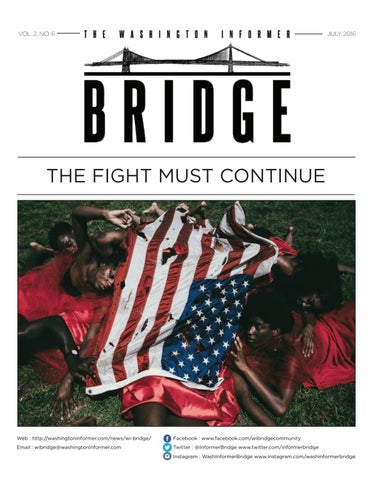
THE FIGHT MUST CONTINUE
Web : http://washingtoninformer.com/news/wi-bridge/
Facebook : www.facebook.com/wibridgecommunity
Email : wibridge@washingtoninformer.com
Twitter : @InformerBridge www.twitter.com/informerbridge Instagram : WashInformerBridge www.instagram.com/washinformerbridge
CONTENTS
EDITOR’S LETTER
PUBLISHER
What’s July 4th to Black Folks? 3
Peace and blessings WI Bridge reader,
Denise Rolark Barnes
Recent Killings Strengthen Movement For Black Liberation 4-6 Our Call to Action! 7 On The Lookout: The Self-Care Edition 8
ON THE COVER
By now, you’ve seen and heard the news of more Black bodies succumbing to officers’ bullets. In the age of social media, it’s hard to avoid the traumatizing footage and ignore the harsh reality of life as a Black person in the United States. No, these aren’t the type of conditions our parents promised us. Unfortunately, we haven’t overcome and the question remains of what’s to be done in the ongoing fight for Black liberation. The answer to that question is as complex as the issues at hand. In meeting our journalistic obligation, the WI Bridge wants to present an analysis of what young people are doing on the ground to raise awareness, organize, and combat the institutional forces that marginalize Black folks. As I’ve learned in the course of my short life, everyone has their own way of contributing to the movement. This issue is a testament to that, highlighting people who represent different industries and ideologies. Regardless of their profession, they have something to offer us as we work to change the tide. Read their stories and understand how imperative it is that we remember our purpose as human beings in this Earthly realm. Also, check out the WI Bridge Call to Action and our compilation of activities and events you can take part in to keep your spirits up. As always, we’re more than happy to be of service to the D.C. community and show the rest of the world just what our millennials can do. Enjoy this read and see you next month.
This month’s cover photo is part of the “IMMOORTAL” catalogue, coordinated by Afrovelvet, Donnisha Hebert, Gary Williams, and Temon George on the National Mall. Afrovelvet, the creative director of this project, said the oncamera deaths of Alton Sterling and Philando Castile compelled her to show the world how it preys on the magic of Black people. In this photo, models lie under a damaged, worn-out American flag. / Photo by Gary Williams
MISSION STATEMENT The WI Bridge sets out to highlight contemporary issues through the experiences of youth and capture the progressive, entrepreneurial spirit of the Millennial generation other publications gloss over. Writers will take to streets and feature people, programs, initiatives, and movements that uniquely address prominent youth issues. This hard-hitting coverage will lay to rest misconceptions of Generation Y and bring all to an understanding of diverse youth experiences.
2| WI BRIDGE
VOL 2, NO. 6
Yours in the struggle, Sam P.K. Collins Editor-in-Chief WI Bridge
EDITOR-IN-CHIEF Sam P.K. Collins
PHOTOGRAPHER Dejah Greene
LAYOUT Kelcey Abney
CONTRIBUTERS Ambre Tomlinson Austin Weatherington Brianna Rhodes Sam P.K. Collins Tia Dolet William Langford
WHAT’S JULY 4TH TO BLACK FOLKS? By Tia C. Dolet
WI Bridge Contributing Writer Earlier this month, I observed Fourth of July the same way I celebrate any other day off—sleeping in, watching daytime talk shows, day drinking, and Netflix. When I finally did leave my apartment, I was very intentional about not wearing red, white or blue and most certainly not a combination of the three. Although I do identify as an American, as a Black American I find it extremely hard to be patriotic. Growing up, July 4th was my favorite holiday. For my family, it meant the Cookout of All Cookouts. After eating, my cousins and I would count down the minutes until nightfall but could never wait for the sun to set before lighting sparklers. Every single year, someone would accidentally kick over a lit sidewalk firework, sending us all bolting up the alley to avoid losing a limb. Those were some of my happiest memories growing up in the Washington, D.C. area. But as I grew older and started to learn more about our history in this country, the timeline didn’t seem to add up. How would we (Black people) commemorate the “freedom” and independence of the U.S. when our ancestors were still enslaved on July 4, 1776—and would remain in bondage for nearly another century? In college, I stumbled upon Frederick Douglass’ “What to the Slave is the Fourth of July?”. While reading this passionate address, it became vividly clear that my then-favorite holiday was a scam.
Another photo from the “IMMOORTAL” catalogue, coordinated by Afrovelvet, Donnisha Hebert, Gary Williams, and Temon George on the National Mall. / Photo by Gary Williams
join them in exulting over “freedom”. Seizing the platform, Douglass made it clear to his White audience that “this Fourth of July is yours, not mine. You may rejoice, I must mourn.” Ironically, my grandparents lived right across the street from Frederick Douglass’ former D.C. home, now a historical site in Anacostia. For decades, just steps away from his home, our
and protections that document promised us. When put into perspective, my yearly routine of running to Old Navy to buy a commemorative flag t-shirt no longer felt like a notion of logic, but one of indoctrination. We are all taught through our K-12 education, and subconsciously through
How would we (Black people) commemorate the “freedom” and independence of the U.S. when our ancestors were still enslaved on July 4, 1776—and would remain in bondage for nearly another century? In college, I stumbled upon Frederick Douglass’ “What to the Slave is the Fourth of July?”. While reading this passionate address, it became vividly clear that my then-favorite holiday was a scam. In 1852, then a freed man, Douglass was asked to give a speech monumentalizing the signing of the Declaration of Independence. Although it was fellow abolitionists who extended the invitation, these White abolitionists overlooked their biggest privilege of that time period—neither they nor their White family members had ever been enslaved. This was not Douglass’ reality, so one can imagine how insulted he must have felt by their selfish assumption that he’d
family would happily and unknowingly celebrate the day he denounced. Now at the start of July, I am constantly asking myself: Still, what is this holiday to Black folks? Within that 87-year timespan between July 4, 1776 and the 1863 signing of the Emancipation Proclamation, countless Black people lived their entire lives under the toil and trauma of American slavery. And for the next hundreds of years, we continued to fight and die for the full-citizen rights
our family traditions, that July 4th is a day to celebrate our autonomy in this declared great country. But as part of a community where our people continue to struggle for basic American entitlements, I find it hard to have American pride on this day or any other day. This year, before people could fully clean their grills, two Black men were racially profiled and senselessly murdered by police officers—Alton
Sterling of Baton Rouge, Louisiana and Philando Castile of Minneapolis, Minnesota. According to The Counted project, their untimely deaths marked at least 136 Black persons murdered by the police this year. How can this nation be celebrated as the Land of the Free when a large part of our population is still being persecuted for being Black and are still being disproportionately murdered by paid public servants? Why are we lighting fireworks? Like Frederick Douglass did back in 1852, I challenge this nation to reevaluate what this holiday truly means to Black Americans. Are we living in a country that justly rewards us with equal rights, equal access and equal protection under the law? As a Black person, I am unwaveringly committed to holding this nation accountable for the daily systemic attacks on many aspects of our livelihood. Until then, July 4th will be just another day. “There is not a nation on the earth guilty of practices more shocking and bloody than are the people of the United States, at this very hour.” Written in 1852, Douglass’ statement still holds remarkable truth in 2016.
VOL 2, NO. 6 WI BRIDGE | 3
RECENT KILLINGS STRENGTHEN MOVEMENT FOR BLACK LIBERATION On Various Fronts, Black Millennials Show No Signs of Backing Down By Sam P.K. Collins and Brianna N. Rhodes WI Bridge Editor-in-Chief & Contributing Writer @SamPKCollins
Between videos of police officers killing of Black men and women, white supremacist rhetoric at the Republican National Convention, and concerted efforts to incite violence against Black activists and label them as terrorists, July proved to be a turning point in the contemporary fight for Black liberation. As signs of social injustice and inequality become more frequent and conspicuous, Black millennials in the D.C. metro area, many of whom are angry, confused, and eager to do something, have taken their fight for Black lives to new levels,
WI Bridge, she opened up an account at Industrial Bank, a D.C.-based Blackowned financial institution.
community. The teller told me the more people they get, the more opportunities they can make,” she said.
Spivey, and a significant number of other customers as she would learn upon visiting Industrial, made this move not long after Alton Sterling of Baton Rouge, Louisiana and Philando Castile of Minneapolis, Minn. died in encounters with police. These post-July 4th incidents, both of which people close to the victims filmed, reopened wounds from recent judicial and legislative
Spivey counted among the legions of Black people from various walks of life, including the Hip-Hop industry, who either opened up an account at the Blackowned bank or transferred their funds there in light of the shooting deaths of Sterling and Castile. This recent act of resistance has made a highly noticeable impact; some sources estimate that as much as $1 million Black dollars have
combined their chants of Black solidarity with calls for Black-centered advocacy and commerce at all levels that can financially cripple the entities doling out Black pain. Kenneth Worles, Jr., a communications specialist and D.C. resident by way of Memphis, walked through the crowd that humid July 10th evening passing out sheets of paper outlining action steps that people could take after protesting. Tips on the one-pager included learning the names of and
“The Fraternal Order of Police and police unions operate like fraternities. They close ranks around the most horrible members. These organizations invested $220,000 to ensure the acquittal of officers in the Freddie Gray case. We want to continue to confront the people and institutions that show us Black lives don’t matter. As more people see how messed up the institution of policing is, the more it forces them to speak up,” added Master, 28 from Southeast. making moves that will not only benefit them, but their communities. Some have called it something reminiscent of the 1970s. “This is a good time for Pan-Africanism. Things have gotten more blatant and people are getting more enlightened. With Black August coming up, I hope more folks follow,” Falani Spivey, a guerilla filmmaker and native Washingtonian said in reference to the annual commemoration of martyred 1970s-era Black liberation fighters George Jackson, Jonathan Jackson, William Christmas, James McClain, and Khatari Gaulden. Days before talking to 4 | WI BRIDGE VOL 2, NO. 6
disappointments and served as a painful reminder to Black America that the fight against institutional racism would require more than social media rhetoric and protesting. “People want to talk and revisit history and not do anything,” Spivey added, noting that consolidating Black dollars can strengthen neighborhoods and provide more economic opportunities for Black people. “We consume too much to not put our money in these banks. People ask where are the small business loans [for Black people] but Industrial Bank does stuff in the
been transferred in the last couple of weeks. In D.C., Black millennials have coalesced on other fronts, converging at public spaces to peacefully protest as has been done before. In the past, many young people with radical leanings have criticized such course of action as soft and dependent on a system with no conscious to acquiesce to will of oppressed groups. However, during a recent gathering at the African-American Civil War Memorial in Northwest aptly named #BeyondtheHashtag, an intergenerational cadre of speakers
contacting local and state officials who could push legislation, collecting the contact information of fellow protestors, compiling and circulating information about the current grassroots movements, and raising funds that will keep local and statewide efforts rolling. “D.C. is one of the only cities where people know how to make stuff happen. We can raise money and make change,” said Worles, owner of the 3i Design Group. When he’s not putting his feet on the pavement, Worles spreads information about what’s happening nationally, and in D.C. and Memphis
Millennials Kenneth Worles and Jasmine Gales hold their fists up in solidarity during the Beyond the Hashtag protest at the African American Civil War Memorial in early July./ Courtesy photo
via “You Gon’ Get This News Mane,” a daily roundup of the top stories. Since its launch on Facebook earlier this year, it has been a critical tool in keeping Worles’ friends, family, and colleagues abreast of the issues. “You have a local government and the federal government. You can make a lot of moves in one city; scheduling meetings with congressmen and senators. I like how people maneuver. That’s why I plan to take all the information I learn here and take it back to Memphis.” Across the Potomac River in Alexandria, Virginia, the Northern Virginia Urban League Young Professionals Network hosted an event at Shiloh Baptist Church during which millennials connected with community leaders and discussed action steps. A marketing and advertising professional by the name of Matthew counted among the dozens of young people in the audience on the night of July 14th. He attended the gathering out of a need to stay abreast and express what some may consider radical thoughts. Though Matthew, who declined to give his last name, said he gained a lot from
participating in the discussion, he felt that more millennials should’ve been in the room. For him, alcohol and lowvibrating media impedes any effort to sustain a movement for Black lives. “This is a town hall meeting but people would rather go to happy hour. That’s the problem,” said Matthew, 26. “They call it fake Negro outrage; when you’re mad for a day and want to be up in arms but then Beyoncé drops a new album or Power comes on this weekend. So we’ll halt something that should mean way more to us for something that’s destructive. There’s a time and place for everything. Right now there’s an awakening but we’re just a hashtag and a rally. That’s all we are,” said Matthew, a Glendale, Maryland resident. But responses to police brutality have gone well beyond hashtags. In recent weeks, people took far more aggressive approaches to combatting deadly policing tactics, sparking outrage, spurring calls for peace, and raising questions about what’s to come next in the movement for Black lives. Less than a week after Sterling and
Castile’s deaths, a Black military veteran by the name of Micah X Johnson allegedly killed five police officers during a protest before officials used drone technology to blow him up. Days later, three officers also died during an attack alleged to have been carried out by Gavin Long, also a military veteran, on his 29th birthday. Though Black grassroots organizers decried the acts of violence, media outlets, police organizations, and politicians have conflated these solo actors with Black Lives Matter, and more generally the movement for Black liberation. Additionally, the litany of “good-cop porn,” as the videos that show police officers committing acts of kindness has been colloquially called, has become a distraction in the ongoing conversation about the institution that allows officers to commit acts of violence with impunity. Despite criticism from pro-cop conservatives that he hasn’t done enough to quell violence against law enforcement, U.S. President Barack H. Obama has shared their police sentiments about recent events, notably
revealing his viewpoint during a town hall on race that aired on ABC on the night of July 14th. Just as he had done during the Dallas officers’ funeral, Obama showed his appreciation for law enforcement, attempting to dispel rhetoric critics of anti-police brutality movements say paints all officers in a bad light. For millennials perturbed by the nation’s first Black president’s lukewarm response to police-sanctioned death of Black people, his recent overtures to the boys in blue have been displeasing. But some people, like freelance photographer and D.C. native Naomi Hawk, remain unfazed by the cop propaganda, describing it as part of an attempt by the government to absolve itself of any responsibility in the deaths of Black people, and more recently police officers who died in acts of retaliation. “With brutality against officers, eyebrows are getting raised but there’s nothing new about police brutality, especially for those whose family experienced life lost the hands of police,” said Hawk, 24, cousin of Rafael Briscoe, a young man VOL 2, NO. 6 WI BRIDGE | 5
Metropolitan Police Department (MPD) officers shot and killed during a jump out in 2011. To her family’s dismay, a jury later cleared the officers involved. Hawk said that situation helped her truly understand the power’s reach of power and deteriorated her trust in D.C. Police Chief Cathy Lanier and MPD. “I’m not one to personally cheer when I find out an officer lost their life in the line of duty but that doesn’t necessarily negate why that even happened in the first place,” she added. While police officers and their supporters would be quick to contest such an assertion, history has shown time and time again that law enforcement officials rarely face consequences for their involvement in civilian deaths, due mainly to the lobbying power of the local, state, and national police union organizations. Nearly two weeks before Sterling and Castile died, Baltimore City Police Officer Caesar Goodson, Jr., the transport van driver in the Freddie Gray case, was acquitted of all charges in his trial. Legal analysts say this latest non-conviction, the third so far in the case, could make securing convictions in the last two trials more difficult. The Baltimore police union head later renewed calls to have Maryland State Attorney Marilyn Mosby drop charges for the officers who’ve yet to have their day in court. Disappointed, but not deterred, several on-the-ground actors have jumped into action, using an infrastructure that’s been in place since George Zimmerman’s acquittal to directly address these organizations for their part in perpetuating violence against Black men and women. Last week, 40 activists representing Black Youth Project 100, Black Lives Matter DMV, and other grassroots organizations blocked the entranceway of the legislative office of the National Fraternal Order of Police, a coalition that represents law enforcement official. They, along with their comrades in Detroit, New York, and Philadelphia, chained themselves to the front steps of the Northeast-based building. Protestors said this act of resistance, which started on the morning of July 20th and lasted well into the nighttime hours, counted as a means of the stopping the passage of the laws that protect police officers from prosecution when they killed Black people while on duty. “I don’t want to neglect that there are good cops but when you belong to an organization that assures no one is held responsible for the death of Freddie Gray, there’s a problem,” said Samantha Master, a member of Black Youth 6 | WI BRIDGE VOL 2, NO. 6
Black Youth Project 100 and other grassroots coalitions protested in front of the Fraternal Order of Police headquarters in Northeast last week as part of an effort to stop legislation that protects officers who kill Black people. Samantha Master (pictured) counted among the 40 participants. / Courtesy photo
Project 100, an activist-member based organization of millennials dedicated to justice and freedom. “The Fraternal Order of Police and police unions operate like fraternities. They close ranks around the most
During her interview, Master debunked the notion that the vigorous organizing seen locally and nationally this month came out of nowhere. For her, and more than likely other young Black people, the most recent police-involved killings reaffirmed that Black men and women
“Young people have reacted to the false prophecy. We want a world where Black people are free,” she said. “That looks like economic justice, the end of policing as we know it, the end of Palestinian oppression, gay and queer people living with dignity and respect, Black women
“I don’t want to neglect that there are good cops but when you belong to an organization that assures no one is held responsible for the death of Freddie Gray, there’s a problem,” said Samantha Master, a member of Black Youth Project 100, an activist-member based organization of millennials dedicated to justice and freedom. horrible members. These organizations invested $220,000 to ensure the acquittal of officers in the Freddie Gray case. We want to continue to confront the people and institutions that show us Black lives don’t matter. As more people see how messed up the institution of policing is, the more it forces them to speak up,” added Master, 28 from Southeast .
aren’t safe from the law, regardless of what protocol they follow or how they act. That’s why Master said she’s in this fight for the long haul, hoping to fulfill the dreams that the elders wanted to see in the decades after the passage of promising Civil Rights legislation.
making their own decisions, and the investment of a Black future. We don’t see our work for the moment. Our work will be finished once our vision for a world where Black lives matter is realized.”
OUR CALL TO ACTION! Compiled by William Langford WI Bridge Contributing Writer @WilliamL_SEN
The current climate of the nation has caused many in our community to really take a step back and begin pondering the type of future we want for ourselves and our children. Time and time again, African Americans have met brutality and injustice with diplomacy and we have not seen any legitimate attempts by our decision makers to create an environment of true equilibrium. The time has come to take proactive measures rather than simply reacting to the injustices as they occur. The following consists of what I believe will give us the collective impact to create a better future for our community.
1 Boycott of all things economically feasible that aren’t Black owned or directly influential to our community We shop in our community and slowly redirect our business services there. Our elite students and student athletes start committing to HBCUs instead of traditionally white colleges and universities. Our elite professional athletes and entertainers redirect their resources, attention, public appearances, etc. back into the communities for which they represent by their very color. Our best doctors, lawyers, professors, teachers, etc. uplift the quality of those services provided directly related to those particular industries.
2 Community protection by current and former military and law enforcement personnel Current and former law enforcement and military personnel (initially voluntarily but eventually a well-funded entity) supply the community with a ready militia and defense unit from those who seek to intimidate our communities, undermine our inalienable human rights, and attempt to carry out overt or covert acts of violent injustice within the community. Card-carrying, firearmholding members of these distinguished fraternities who have sworn allegiance in protection of this country must now come together and swear an even greater allegiance to our communities.
3 Resurgence of community development and community outreach programs Through the resources and manpower redirected through the aforementioned economic boycott, we rebuild opportunities for both young people and adults alike. Professional athletes, bring your personally funded camps, leagues, and other auxiliary endeavors into local community recreational facilities. Market your merchandise at a cost that is realistically feasible. Instructors should bring camps and programs that increase our community knowledge reservoir. Elite athletes can create high school academies directly dedicated to elite athletic development that employ former professional and college athletes, professional agents, general managers, presidents, etc., to teach sound financial management and career planning.
4 A direct call to accountability of all our local community leaders at the city, county, state, and federal levels. Those who have been voted in by us, to represent us, will no longer be allowed to steal our votes for the purpose of professional advancement. Our aldermen, city council men and women, U.S. House and Senate representatives, police chiefs and all other leadership positions will be vetted by the community. Those who have a history of putting their livelihoods on the line in the face of resistance and pushing our concerns to the forefront will be counted on to play a more active role.
5 An immediate shift in the media content being displayed and portrayed BY our community or those who would be readily identified as one of US. We will no longer support, encourage, or tolerate entertainers or entertainment outlets that portray us negatively. Black actors, artists, and CEOs of media outlets and production companies who perpetuate false stereotypes will no longer be tolerated. We will petition our entertainers to present well thought out entertainment content that elevates our minds. We will fully fund and support our own media outlets that show our lives organically, not acting as a controlled medium for dissemination of agendas.
6 A reinvented job market within our community. Those with hiring decision-making powers must bring jobs to the community. Local establishments will hire within the community based on needs and abilities only. Criminal history will no longer be considered a deciding factor for employment. Able establishments must begin offering internship, apprenticeship, and mentorship programs for youth and those seeking job training in a market that’s constantly changing. Establishments in the community that are not Black owned or show an unwillingness to hire at all levels within the company from directly within the community will no longer receive our financial support.
VOL 2, NO. 6 WI BRIDGE | 7
ON THE LOOKOUT: THE SELF-CARE EDITION By Austin Weatherington
WI Bridge Contributing Writer @a4aus
It was Audre Lorde who so brilliantly stated “Caring for myself is not self-indulgence, it is self-preservation, and that is an act of political warfare.” If her words ring true, now more than ever, radical political warfare in the form of loving self-care is imperative. So what’s one to do when staring state-sponsored violence, deafening political clamor, and complicit community members dead in the face? They surround themselves with positivity and love. That honest, unapologetic, sharemy last-dollar type of love. Here are some ways you can give, receive, and be in the midst of love in these most trying times.
SUMMER CONCERT SERIES
BLACK JOY SUNDAYS
It was the 1970s funk band, the Blackbyrds who introduced the world to the allure of Rock Creek Park. It is safe to say that in 2016 the legacy of the park lives on. The storied Summer Concert Series at Fort Dupont and Carter Barron is back and better than ever. Whether its blues, jazz, or funk bands both locations are sure to get your head-bopping and toe-tapping. Shows happen each Saturday in the summer. Be sure to visit nps.gov/fodu and nps.gov/rocr for lineup.
Imagine fruitful discourse of revolution, melodic hymnals, poems and prayers, and cunning games of Uno & Spades all housed on one majestic pallet in the middle of the park. These are just a few of the features of #BlackJoySundays. Coined as a place where “ALL Black people” can bring their “love and their pain” #BlackJoySundays is an initiative of #BLACKLIVESMATTERDC and happens each Sunday evening at Malcolm X Park. For more information, refer to the Facebook page “Black Joy Sunday.”
THE ANACOSTIA COMMUNITY MUSEUM Although originally intended to be an outreach opportunity to bring more Black people to the National Mall, The Anacostia Community Museum is reversing that mission and bringing all people back to community. The museum’s newest exhibit “1963-1975 Twelve Years That Shook and Shaped Washington” explores D.C.’s rich history of community building, activism and engagement. The exhibit is FREE and will be on display until late October. The museum is also offering free shuttle service from selected locations across the city. For more information on Twelve Years, as well as other events and exhibits at the museum go to www.anacostia.si.edu
WI BRIDGE | 8
VOL 2, NO. 6
THE NIGHT OUT FOR SAFETY & LIBERATION The Night Out for Safety and Liberation aims to shift the narrative within the community around public safety to go beyond policing and incarceration, and to instead focus on what actually makes our communities safer. This event will take place on August 2nd from 5:30 to 9:30 PM at The Perch, 3400 Georgia Avenue NW Washington DC 20010. For more details, go to Facebook.com/ DCnightoutforsafetyandliberation.