VOL. 1, NO. 6
JULY 2015
A DREAM UNFULFILLED
Web : http://washingtoninformer.com/news/wi-bridge/
Facebook : www.facebook.com/wibridgecommunity
Email : wibridge@washingtoninformer.com
Twitter : @InformerBridge www.twitter.com/informerbridge Instagram : WashInformerBridge www.instagram.com/washinformerbridge
CONTENTS
EDITOR’S LETTER
PUBLISHER Denise Rolark Barnes
‘Dope’ Wits Through Stereotypes 3 Despite Adversity, Young Black Women Triumph Professionally 4 Reclaiming Our Tool For Rebellion 5 Program Exposes Gifted Children To New Opportunities 6 ThinkProgress: Black Activists Aren’t Ready To Forgive 7 WI Viewpoints 8
ON THE COVER
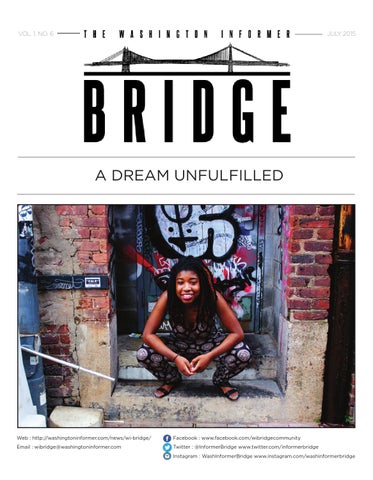
Brinea Fenner, A a 22-year-old Morgan State University student, said she didn’t celebrate Independence Day this year out of a belief that black people in America haven’t truly attained freedom. She added that the “revolution” in 1776 didn’t include her ancestors. Commenting on the tensions between black people and the government, Fenner, who studies business administration, said that African Americans have reached the peak of their frustration: “The country is being forced to explain and deal with the racial injustices they’ve tried to hide for decades and our generation is not having it any longer. As long as there is no justice, there will be no peace,” Fenner said. / Photo by Dejah Greene
2| WI BRIDGE
Hi esteemed WI Bridge reader, Thank you for your commitment to our publication and the cause of black liberation in the United States and abroad. Despite numerous legislative successes in decades past, the situation of people of African descent remains precarious. For every professional and political advancement, there exists an untold number of atrocities for which few, if any, have been held accountable. That’s why the WI Bridge, a millennial publication first and foremost, wants to take powers- that-be to task. This issue, themed “A Dream Unrealized,” challenges the myth of American exceptionalism and provides a rallying cry for the youth who, like the members of our staff, have grown tired of the daily injustices levied against our brothers and sisters. Articles in this edition explore the internal, environmental and professional pressures people of color face as they try to survive and excel in the U.S. They also give a glimmer of hope, in all the despair, that we will overcome, thanks to our ingenuity and the guidance of our elders. One piece highlights the work of the Emerging Scholars program in exposing children of color
from low-income neighborhoods to new educational opportunities. Another story explores the new blockbuster film “Dope” in depth. For the sisters, we have a piece about the ups and downs of professional development as a black woman. An article about militant self-defense, courtesy of ThinkProgress, sheds light on a marginal, but increasingly popular, sentiment among black people. Our opinion piece implores the mainstream hip-hop community to raise the youth’s consciousness through song, or risk losing one of our viable tools of dissent. Finally, our Viewpoints section includes ruminations of July 4th, some of which may surprise you.
STAFF Sam P.K. Collins Editor-in-Chief
Chelsea Fuller Editor
REPORTERS Melvin Graham
As you can probably tell by this lengthy letter, I really enjoyed reading and editing these pieces. I hope that you feel the same way when checking out our work. The best has yet to come for WI Bridge. Please enjoy the journey and be on the lookout for a community event, tentatively scheduled for September.
Loren B. Coleman, Ph.D.
Forever yours in the struggle, Sam P.K. Collins Editor-in-Chief WI Bridge
Ambre Tomlinson
PHOTOGRAPHER
MISSION STATEMENT The WI Bridge sets out to highlight contemporary issues through the experiences of youth and capture the progressive, entrepreneurial spirit of the Millennial generation other publications gloss over. Writers will take to streets and feature people, programs, initiatives, and movements that uniquely address prominent youth issues. This hard-hitting coverage will lay to rest misconceptions of Generation Y and bring all to an understanding of diverse youth experiences.
Dejah Greene
LAYOUT Kelcey Abney
‘DOPE’ WITS THROUGH STEREOTYPES By Briana Thomas WI Bridge Contributing Writer For a young man in the urban city, the threat of violence lurks around every corner and the influence of street life can destroy a promising future. Film writer and director Rick Famuyiwa explores these themes in his newest film “Dope.” The movie, set in his birthplace of Inglewood, Calif. follows Malcolm, played by Shameik Moore, as he navigates life in the hood and plays with his punk rock band. Youngsters of color around the country can relate to the constructive message of the Sundance film because Famuyiwa creates a main character whose life mirrors that of Inglewood teens today. Lauren Brown, 21, and William Thomas, 22, share laughs while viewing the coming of age film, “Dope.”
“[T]hese kids were completely different. They were connected to the world that me and my friends weren’t,” Famuyiwa told Miramax Films while reminiscing about his childhood. “They were able to express themselves, put their music online and connect to a larger world outside of the confines of Inglewood.” The comedy drama, produced by Forest Whitaker and Nina Yang Bongiovi, both known for the award-winning film, “Fruitvale Station,” allows Famuyiwa to revisit topics he explored in his prior work. Famuyiwa, who also directed the late 1990s film, “The Wood” reveals the daily dilemma that thriving black males face in trying to gain white acceptance and not succumb to peer pressure.“Dope”shows a glimpse of what W.E.B. Dubois coined as a state of double consciousness in his 1903 book, “The Souls of Black Folk.” In the movie, Malcolm grapples with psychosocial division, described as individual challenges one faces in a social environment including fear, anxiety and confusion. After a drug dealer mistakenly gives Malcolm contraband, his life turns into a series of bright ideas, costly mistakes, illegal transactions, a love interest and a potentially life-saving college interview. Eventually, Malcolm realizes he doesn’t fit in his community and may never conform to white societal standards. He refuses to adapt to his peers’ social norms , nor does he dull his black identity with Americanism and popular culture. Similarly, children of color in the metropolitan area rebelled against negative stereotypes.
Jonathan Hunter, contributing writer for Afro-American Newspapers, said he longs to be a black person living in America without others frowning upon him and offering limited success. “Malcolm is just a black kid trying to be ‘good’ in a bad community. I can relate to his story,” said Hunter, 23, who lives in Northeast. “As an African-American child who always earned good grades, I was excluded from the popular crowd. I’ve been criticized and ridiculed by my peers who say I’m ‘acting white,’” says Hunter, also a graduate student at American University in Northwest. Hunter said he understands the “Dope” characters’ inner pain. For him, the film brought awareness to misconceptions about black culture. “When a black person performs well in school and speaks what we know as proper English, they are teased. I don’t know why black people do that, but white people just don’t do that,” he said. In the movie, Malcolm’s punk rock band, Awreeoh (pronounced “Oreo”), takes an ironic approach to culture and race relations by embracing a slang term that his peers used to humiliate him. Malcolm sees himself as a counter to the stereotype of a young black man in the hood: Smart, comic geek, sober, wary of colloquial speech, non-violent and not intrigued with 21st century pop culture. Truly, Malcolm defies just about every black cliché. In contrast, many young people of color only acculturate to society controlled by white people by behaving viciously or dropping out of school. Even a small child can be labeled as a threat or menace.
The recent occurrences of excessive police force and extermination of black lives without consequence raises a greater issue of inequality. Still, people everywhere are speaking out about racial and socioeconomic disparities, even the actors and actresses of the independent film “Dope.”
“Dope.” The screenplay awakens once combined with the presence of stars like A$AP Rocky who plays a drug dealer named Dom. Quincy Brown, the son of Sean “Diddy” Combs, plays Jaleel and Zoe Kravitz stars as Nakia. Kimberly Elise and Rick Fox also make cameo appearances.
“We are telling a story. We are giving a message. If you see this movie 20 years from now, you may forget about Trayvon Martin, but you won’t forget about the message,” Shameik Moore told Slate magazine.
Each character plays a vital role in the film which uses music, love, fashion and technology to fuel the ambitions of young souls fighting to survive in an unaccepting world.
Nearly 90 minutes into the film, the audience sees a total change in Malcolm. In a scene where he stares blankly into a computer screen, he ultimately objects to writing a college essay that would please Harvard University’s admissions board. Instead, Malcolm embraces his journey and culture, ending his monologue with a salute to Trayvon Martin -- a 17- yearold black male murdered by a white neighborhood watchmen in Florida in 2012 -- by tossing his hood over his head and turning his back toward the camera. “Dope” debunks cultural stereotypes, while creating new black identity that conquers every inner battle amid an outward social war. Rather than a cry for human equality, the movie stands as a platform for activism, telling others to accept themselves. Famuyiwa brought well renowned artists onboard to assist with spreading a positive message through the means of entertainment. With singer-songwriter Pharrell Williams as the executive producer, creative throwback fashion and smashing hit tunes are a sure part of
Young people throughout the area said these elements attracted them to the film. “It has the whole shebang of hip-hop aesthetic in the film,” says Olamide Williams, 21, of Fort Washington Md. Williams said he sees the film as a wakeup call to the black community that resembles other films like Spike Lee’s “Do the Right Thing.” This 2015 “wake-up call” also features a number of up-and-coming actors and actresses: Kiersey Clemmons plays Diggy, Malcolm’s lesbian best friend, Toni Revolori appears as Jib, Malcolm’s sidekick, and Blake Anderson takes the role of Will, the mastermind behind Malcolm’s “dopey” adventure. For some cast members, acting in “Dope” counted as the experience of a lifetime. “We knew we made a great movie, but after it screened . . . I was in a situation where I had to pinch myself and make sure I wasn’t dreaming,” Moore recently told Rolling Stone magazine. 3 | WI BRIDGE
DESPITE ADVERSITY, YOUNG BLACK WOMEN TRIUMPH PROFESSIONALLY By Teniola Ayoola and Briana Thomas WI Bridge Contributing Writers
advocacy and political organizations. Despite the odds, some people still want to challenge negative perceptions of black women.
By the time she had received her bachelor’s degree in communications in May, Honor Camillia had walked across the stage twice. Two years earlier, Camillia, 19, graduated from The School Without Walls High School in Northwest with an associate’s degree as part of a dual enrollment, early-college program with The George Washington University.
For instance, Sherry S. Williams, 34, said she has dedicated her life to motivating women of color through her online platform, “This Is Her Way.” Williams, born and raised in the Bronx, New York, started these efforts locally after moving to the District last year, providing women with the space they need to make meaningful connections and celebrate sisterhood.
With a collegiate-level diploma under her belt, a position on D.C.Mayor Muriel Bowser’s Healthy Youth and Schools Commission and a scholarship from the National Association of Negro Business & Professional Women’s Clubs, Camillia has her sights set on law school.
For two years, women from across the U.S. have converged on the nation’s capital to attend Williams’ “Conversations Her Way” and “Leadership Her Way” series where they weigh in on issues affecting black women’s professional journey. Her work has been featured in the Huffington Post and Black Enterprise Magazine.
These feats have placed her among an untold number of women of African descent raising the bar for their black sisters and white counterparts in the U.S. despite a myriad of societal and personal obstacles.
“It wasn’t enough for me to accomplish my own personal goals, as much as it was for other women to understand that those possibilities existed for them too,” Williams told Black Enterprise in June. “I wanted to dismantle the myth that the only time women get together is when we are throwing bread at each other. I wanted to bridge the generational gap amongst seasoned and young professionals,” Williams said. “It was those negative images, and the lack of authentic communication, that ignited the will; I needed to make [Her Way] come to life.”
“I come from a single-parent household,” said Camilla, who grew up and still lives on Capitol Hill in Northeast. “That was the biggest setback. Most people have two parents, but I just had one who worked full time.My mom is a principal and education is a big thing in my household so I didn’t have a choice but to succeed,” she added. A May report by the National Coalition on Black Civic Participation showed that black women represent an increasing portion of those enrolled in postsecondary institutions. In 2010, they represented 60 percent of all black people with a bachelor’s degree, 71 percent of those who attained a master’s and 65 percent of those who completed their doctoral studies. Yet, many women of color need more than a degree to sway their odds of success in the workplace. Black men and white professionals earn nearly twice as much as black women, and women of color have the greatest likelihood of working for poverty-level wages. According to a June report titled “And Still I Rise: Black Women Labor Leaders’ Voice | Power | Promised” by the Institute for Policy Studies in Northwest, black women make just 64 cents on every dollar earned by white men.
4 | WI BRIDGE
Sherry S. Williams, founder of HerWay, an organization based in Washington, D.C. that’s dedicated to connecting, supporting and empowering women of all color/ Photo by Ruby Melton
“The visible and invisible flags of injustice flying around America must come down,” said Arlene Holt Baker, former executive vice president of AFLCIO. Baker, the first African American woman elected to one of AFL-CIO’s senior positions, advocates for health care reform, labor rights and fair trade. “Still we [black women] rise, but in too many instances our pay, the number of hours we work on a single job, or our positions don’t rise.” But the report also contained some promising news. It featured interviews with more than 27 black women in America at different stages of their careers, each of whom offered gems of advice to readers. The group included Baker, Valerie Ervin, former Montgomery County, Maryland council member and Alicia Garza, co-founder
of the Black Lives Matter international movement. “One of the reasons why we produced the report is that we wanted to remind black women of how powerful we are. We have a way of getting things done, of making a way out of no way,” said Kimberly Freeman Brown, co-author of the study. “We’re all familiar with how American society casts black women as lazy women who don’t work. Women who do nothing but have babies and want to collect welfare. That’s a very common notion of black women that has shaped public policy for years,” added Brown, president of KFB Consulting LLC, a management consulting firm that supports progressive leaders and
Some organizations have vowed to continue a fight that’s more than a century old. For instance, the National Association of Colored Women’s Club (NACWC), founded in 1896, had set out to protect the rights of black women, old and young, in 32 states. Sharon Bridgeforth, NACWC president since 2014, said its mission now centers on raising the standard and quality of black life in home and family. “In light of what has been going on, it is time for us to be very vigilant,” Bridgeforth said. “For black people I think that we have fallen asleep and we are not concerned about what is happening to our people. Take responsibility. Call someone out when we’re not being treated fairly.”
RECLAIMING OUR TOOL OF REBELLION
D.C. hip-hop artist Ras Nebyu / Courtesy photo
By Adolf Alzuphar WI Bridge Guest Columnist @alzuphar It’s obvious that much of today’s commercial hip-hop has deteriorated into something lyrically immoral and irresponsible that’s dangerous for our society’s young people. Producing the newest music has essentially become a quest to make a profitable product in which one raps about their “unusual” lifestyle over instrumentals. In “Trap Queen,” Fetty Wap and his boo “ just set a goal, talkin’ matchin’ Lambos.” For other artists, their activities involve lots of sex, drug use, and the latest gadgets, as explained by Young Thug in “My Bitches.” Rappers spit these lyrics on infectious beats that have become the vanguard of global music production. Nicki Minaj’s 2014 hit “Anaconda” serves as a prominent example. How can our communities reverse this phenomenon, given the United States. Constitution’s protection of one’s speech and hip-hop’s ability to take countless young black people out of poverty? The answer is to create an alternative. On our way to doing so, it’s important to understand one fundamental aspect of commercial hip-hop’s popularity: Dissent. The history of American cultural practice involves dissent and consent, in part because both themes fall in line with morality and capitalism. For
example, “normal” values may include waking up early, going to work, coming home to feed one’s kids and attending church every Sunday. For many, it has also become the norm to drink, laugh, and play with friends, as long as it fits society’s views of what’s ordinary. These ‘norms’ are learned mostly in households, churches, schools and in children’s media. It’s hard to consent to anything as an African American. Given the nature of life in the U.S. and the amount of discontent that one generally feels, rebellion serves as the only way to produce new music in which young people would want to participate. Those themes articulate feelings of being black in America. Dissent, on the other hand, goes against the values constructed by or for a generation. Black America, as we know it today, is the product of triumphant dissent. Sometimes youth have been at the forefront of political, cultural and social movements. For instance, the Student Nonviolent Coordinating Committee (SNCC) made a name for itself in the 1950s and 1960s marching alongside Dr. Martin Luther King, Jr. and other civil rights stalwarts. The triumph of Brown v. Board of Education allowed black people to eventually join the middle class. The Afro became a 1970s black beauty symbol and young people created rock ‘n’ roll. The same idea holds true for the AfricanAmerican musical creations of the 20th
and 21st centuries. Early jazz musicians of the late 19th and early 20th century spiced up standard musical notes. Some artists, like Jelly Roll Morton, broke the mold by playing the piano, then considered a ‘girl’s instrument.” R&B later challenged the black church’s ideas of morality and normalcy. The soul music of black love troubadours -- who have and still give us hope through their songs -- serves as an ode to one’s self and their conceptions of beauty. In its infancy, hip-hop too dissented. When hip-hop mogul Russell Simmons co-founded Def Jam, record companies and radio stations disregarded the art form because they didn’t consider it “normal.” Years later, artists like Run DMC, LL Cool J, and Slick Rick would become household music industry names, making hip-hop music lucrative. Decades later, American capitalism and insouciance ensures that contemporary hip-hop no longer rebels. Instead, record companies categorize, fossilize and churn out song-products in the name of profit rather than craft. That’s why the song-product has become as much of a business practice as it is a cultural practice. Today, commercial hip-hop has become as fragile as a house of cards. It’s weakness lies in that -- as a cliche song product -- it’s a lyrical alienation from profound African-American experiences and imagination. In other words, hiphop lyrics are in no way Frederick Douglass narratives, nor are they Maya Angelou poems. The genre doesn’t truly
represent the depth of black people as it has in the past. When compared to the work of James Baldwin, many hip-hop lyrics don’t speak about the profound conditions and experiences that people live. Baldwin’s work, though not initially successful in black circles, confronted ideas about religion and sexuality. His 1956 book “Giovanni’s Room” turned away from those values, causing audiences to think in depth about pleasure, pain, restrictions and what some black people might not like about American society. Today’s commercial hip-hop doesn’t do that. However, few exceptions exist including Kendrick Lamar and J. Cole, whose Forest Hills Drive album counts as an undisputed classic. Wale, too, creates songs that guide youth in rebellion while asking them to think profoundly about their lives. But that’s not enough. Commercial hip-hop still remains dangerous for the youth. That’s why the African-American intelligentsia must learn to master the appeal of rebellion in order to develop black life just like their predecessors have done. We have to return to the glory of Motown and Crisis Magazine in order to enrich African-American culture because hip-hop is one of the few popular art forms with which most people of African descent identify. If not, this may become a least pleasant life for us all.
5 | WI BRIDGE
PROGRAM EXPOSES GIFTED CHILDREN TO NEW OPPORTUNITIES By Ambre Tomlinson WI Bridge Contributing Writer @Missgreeneyez “Give a man a fish and he eats once. Teach a man to fish and he will never go hungry again.” When Ed Carr, a real estate developer and avid philanthropist, sold his business and decided to give back to underserved youth, he knew the best way to help a child is to arm them with a solid education. He partnered with Tom Whitworth, then headmaster of Flint Hill School in Oakton, Virginia and seven local independent schools. These academies had some of the most reputable educators in the D.C. metropolitan area and surrounding regions, areas, mentors, prestigious private secondary schools, a knowledgeable board of directors and a staff of caring administrators. Carr, his board of directors, and staff developed a non-profit organization that identifies academically-gifted students in fourth grade, prepares them with a 14-month academic, leadership enrichment preparatory program in fifth grade and then places them as sixth graders in these participating private schools. After the scholars are placed, the program provides services under the category of Scholars Advancement. Scholars Advancement follows the student’s progress and provides support in counseling and mentoring them through their high school and college matriculation. They called this program Emerging Scholars. Though these children are tested as academically gifted, they are not able to afford a private school education under normal circumstances. Emerging Scholars supports them in identifying and obtaining scholarships and other financial resources. As if all of these services weren’t enough to pique the interest of a parent looking to change the course of their child’s life for the better; Emerging Scholars is also a free program for those who qualify. This program was instantly a valuable asset to children and families of the DMV, said executive administrative assistant Betty Tomlinson. As another school year comes to a close and the fourth Emerging Scholars class graduates from high school, the program, now in its 12th year, continues to grow. Emerging Scholars has become more than a program. It’s a new way of life for its students and their families. 6 | WI BRIDGE
ES Founder Ed Carr and Sarah Kashef (Cohort 3 - Columbia University student). Sarah speaks about her college experience and how Emerging Scholars contributed to her success. / Photo courtesy of 316 Group LLC
Emerging Scholars Executive Director Ruth Hazel Little has always been actively-aligned with the program. As the previous development director and board member, she has seen the progression from multiple viewpoints. “We choose to place our scholars in private schools at the beginning of their sixth grade year because we get them before the social aspects of peer pressure kick in and most private schools have openings in the sixth grade,” Little said. “Developmentally, it has proved to be an ideal year to make this transition.”
High School in Alexandria, Virginia, Kent School in Kent, Conn., and the Field School in the District. They developed comparable language arts, mathematics and technology courses as well as daily lessons in social cues, manners, professional behavior and poise, Emerging Scholars’ executive director Ruth Little said.
financial situations.” “We take our children on field trips like canoeing down the Shenandoah River and team building at George Mason University so that when they are placed in independent schools and start experiencing these things on a regular basis they are knowledgeable and comfortable in these situations”
Betty Tomlinson, the executive administrative assistant, also had thoughts, saying: “One of the most important aspects of the preparation Emerging Scholars provides is social
Tomlinson added, “We do not want these new activities to seem foreign or uncomfortable to them. We want our scholars to be confident and sure of themselves while transitioning from a public to a private school education. Change can be intimidating, especially as a child, but we teach and prepare them to have the same faith in themselves that we have in them.”
Cohort 4 High School graduates pose for a photo op at their graduation reception luncheon Front row: Bosede Ojiboye, Alexis Reyes, Christopher Allen, Ruth Hazel Little (ES Executive Director) Back row: Gregorio Sapia, Misha Wooden, Melanie Hill, Damien Jones/ Photo courtesy of 316 Group LLC
Emerging Scholars graduates have been accepted into more than 40 local independent schools including, but not limited to: Flint Hill School, Burgundy Farm Country Day School and Episcopal
comfort. We make sure to expose our children to places and situations they have never seen and afford them with opportunities they were not previously able to experience because of their
Anthony is a young man that was chosen by Emerging Scholars while he was a fourth grader at Cameron Elementary School in Alexandria. Anthony was always a bright, shining star academically and excelled with Emerging Scholars. He first received a scholarship to attend Burgundy Farm Country Day School for middle school and then moved on the St. Stephens and St. Agnes for high school. Emerging Scholars followed him from one school to the next providing support and mentoring during his transition from adolescence to young adulthood. To read the entire article, please visit http://washingtoninformer.com/news/ wi-bridge/.
THINKPROGRESS: BLACK ACTIVISTS AREN’T READY TO FORGIVE By Sam P.K. Collins WI Editor in Chief In the days after white supremacist Dylann Roof killed nine black congregants during a Bible study at Emanuel A.M.E. Church in Charleston, South Carolina, Americans of various racial and socioeconomic backgrounds across the country have joined together in remembering the group now known as the Emanuel Nine. At the gatherings, onlookers sing hymns and light candles as speakers call for prayer and forgiveness of aggressors. As noble as that philosophy might be, an often ignored but growing number of African Americans aren’t buying into it — perhaps out of a frustration with the litany of state-sanctioned violent acts against black men and women for whom the courts have held none responsible. Some black people have instead adopted the ideology of militant self-defense, arguing that they have no choice but to take up arms against those who threaten their livelihood and that of their family. Last month, many people of color took to social media to voice this position as part of the #WeWillShootBack online movement, sparked by Taurean “Sankofa” Brown, a community activist and blogger who hails from Kinston, North Carolina. Brown, a self-described revolutionary and proponent of militant self-defense, said that dissenters who have called for peace often forget that black people have always had to take arms up against those who used violence to intimidate them and limit their progress in the United States. “There’s a campaign to pacify black people,” Brown, 28, said. “The point of this movement is to educate and let black people know that we too have the right to protect our families and communities by any means necessary.” That opportunity may be around the corner. Black people across the country will learn about gun laws in their state and attend community trainings where instructors will show them how to use and clean their weapons as part of National Gun Registry Day, tentatively scheduled for early August. In preparation for the daylong event, Brown said he reached out to Akinyele Omowale Umoja, chair of American-American Studies at Georgia State University and author of “We Will Shoot Back: Armed Resistance in the Mississippi Freedom Movement.” “There will be black firearms instructors who are able to give our people that education. This message resonates
Taurean “Sankofa” Brown, creator of the #WeWillShootBack hashtag and outspoken proponent of black militant self-defense./ Courtesy photo
with black youth who have seen that reformism does nothing and generally other black people — especially older black people who remember the violence before, during, and after the Civil Rights movement,” brown said. “That mindset hasn’t died, but folks have tried to erase it from history.” The growing sentiment around armed self-defense cannot be ignored. A survey by the Pew Research Center earlier this year showed that 54 percent of black people view gun ownership positively, describing it as a means of protection — an increase of 29 percentage points from just two years prior. While African Americans living in rural regions may feel neutral about gun ownership, some of their counterparts in urban centers with strict gun laws have found a change of heart in recent years, initially out of fear for their lives in high-crime neighborhoods. Particularly after the Charleston massacre and other acts of violence against black people, the focus among some African American clergy and civil rights officials has shifted. Numerous threats prompted members of a Minnesota church to tote registered
pistols and sit throughout the chapel in preparation for a probable attack. In April, the head of the Georgia chapter of the Southern Christian Leadership Conference gave a similar call a week after police officers killed a mentally ill black man, telling protestors at a rally in Atlanta that “we’re going to have to do something in our community to let the rest of America know that we’re not going to be victimized.” Many black people, perhaps frustrated by the media’s lukewarm treatment of Roof, couldn’t stomach any talk that didn’t involve punitive recourse for the June massacre. Not long after family members of the Emanuel Nine said they forgave Roof, Stacey Patton of the Chronicle for Higher Education wrote in a Washington Post opinion piece that black people shouldn’t have to be kind in moments of absolute tragedy in order to have their humanity recognized. Such action and commentary, however, hasn’t come without backlash — with some critics calling to mind the civil rights movements of Dr. Martin Luther King, Jr. and Mahatma Gandhi, both stalwarts of nonviolent resistance who said “an eye for an eye makes the entire
world go blind.” However, some religious leaders, like Kadir Muhammad, head of the Nation of Islam (NOI)’s Mid-Atlantic region and Mosque No. 4, located in Washington, D.C., lampoon such arguments. Muhammad counted among more than 500 people who filed into Metropolitan A.M.E. Church in the District to hear the Honorable Minister Louis Farrakhan, leader of the NOI, officially announce the observance of the Million Man March’s 20th anniversary to be held on the steps of the U.S. Capitol in October during an event aptly themed, “Justice or Else.” Days earlier at a candlelight vigil, Muhammad told onlookers that too much has happened to young African American men and women in recent years for black people to appeal to the whims of the majority power structure and the white people who benefit from systemic inequality, regardless of whether they want to be allies.
To read the entire article, visit http://thinkprogress.org/ justice/2015/06/27/3674188/blackarmed-resistance/. 7 | WI BRIDGE
WI BRIDGE VIEWPOINTS
Each month, a WI Bridge reporter hits the streets, asks the questions that matter, and compiles the best responses for readers to see. Do you have a suggestion for a Viewpoints question? Email wibridge@ washingtoninformer.com and you might see your inquiry in a future issue.
“DID YOU FEEL PATRIOTIC ENOUGH TO CELEBRATE INDEPENDENCE DAY THIS YEAR?” I didn’t celebrate the fourth. My family usually does, but due to unforeseen circumstances, the barbeques didn’t happen. But even though police brutality and the injustices between the government and the black community are hard to overlook, barbeques with family is something that has been ingrained in us. I think what needs to happen to improve the relationship between the government, police and the black community is to start holding the police who kill these unarmed black men accountable.
Answers Compiled by Dejah Greene @greeneuphorias
I celebrated Independence Day as a family day more than acknowledging the meaning of the holiday. My ancestors were not free or considered people for that matter when independence happened. I hope that the political climate between the police and black community will improve. I believe politicians need to take responsibility for the increasing class gaps in our society and acknowledge the inconsistencies so we can live up to the ideals we claim this country embodies.
Raven Best, 23, Bowie, Maryland
Drake Bailey, 20, Bowie, Maryland
I believe the relationship between the police and the black community could be improved by the police not stereotyping people. Just because people are black, it doesn’t mean they are committing crimes.
I chose not to celebrate Independence Day after I began to learn who were truly free on this day. They were not not my ancestors! There’s nothing wrong with having fun and eating barbeque with your family, but it’s always important to know what you’re actually celebrating. It’s sad to say I had to learn the truth about July 4th through social media and extra research on my own since public schooling did not tell me my people were still enslaved on this day.
Anjie Schneidmill, 19, Columbia, Maryland Steven Young III, 19, Laurel, Maryland
YOUR BUSINESS COULD BE ADVERTISED ON THIS PAGE. For more information, send inquiries to WIBridge@washingtoninformer.com
8 | WI BRIDGE