VOL. 2, NO. 1
FEB 2016
OUR BLACK HISTORY
Web : http://washingtoninformer.com/news/wi-bridge/
Facebook : www.facebook.com/wibridgecommunity
Email : wibridge@washingtoninformer.com
Twitter : @InformerBridge www.twitter.com/informerbridge Instagram : WashInformerBridge www.instagram.com/washinformerbridge
CONTENTS
EDITOR’S LETTER
PUBLISHER
Millennials Celebrate the Black Panthers’ 50th Anniversary 3
Peace and blessings WI Bridge reader,
Denise Rolark Barnes
Black History Month Becomes A Diasporic Celebration 4-5 The DeceptiComics Take D.C. By Storm 6 The Three Wise Men of Hip-Hop 7
As another Black History Month comes to a close, I happily reflect on what has been an action-packed 29 days. For the first time in years, prominent celebrities of African descent unapologetically flaunted their blackness. During Super Bowl 50, Beyoncé made black America get into formation. A week later, Brother Kendrick took us back to the Motherland with his historic Grammy’s performance. On the home front, Washingtonians of various ages and backgrounds engaged in thought-provoking dialogue about the need for black history in our schools, African achievement predating the slave trade, and the contemporary Pan-African liberation movement. As our attention turns more on issues of economic inequality, racism, and black genocide, our people understand that now, more than ever, is the time to organize, centralize, and come as one. At the WI Bridge, we always celebrate black excellence and raise black consciousness, one article at a time. In this issue, we not only honor our ancestors, but we also celebrate this publication’s one-year milestone. Since appearing in the February 2015 edition of the Washington Informer, much of the region has come to know WI Bridge as a representation of millennial ingenuity and imagination. It’s no different this time around, with pieces about the “Three Wise Men of Hip-Hop,” the Black Panther Party’s 50th Anniversary, black comedy with a conscious, and Black History Month from a global perspective.
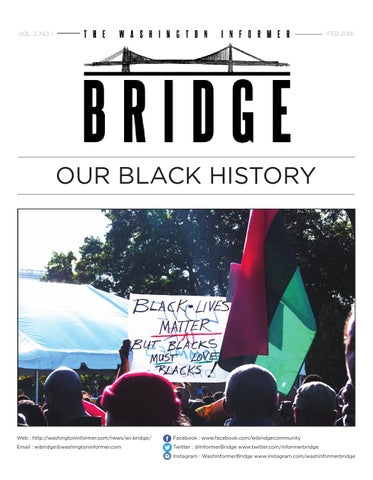
ON THE COVER
As always, we hope that you enjoy our news product. #THROWBACKTHURSDAY: On October 10, 2015, thousands of people converged on the National Mall in Washington, D.C. to commemorate the 20th anniversary of the Million Man March and demand institutional solutions to a bevy of issues including police brutality, human trafficking, and mass incarceration. In their remarks, Louis Farrakhan, head of the Nation of Islam, and other speakers touted the power of self-love and faith in this contemporary freedom struggle. / Photo by Dejah Greene
Yours in the Struggle, Sam P.K. Collins Editor-in-Chief WI Bridge
2| WI BRIDGE
VOL 2, NO. 1
Sam P.K. Collins
PHOTOGRAPHER Dejah Greene
LAYOUT Kelcey Abney
CONTRIBUTERS Adolf Alzuphar Brianna Rhodes Sam P.K. Collins Sifiso Ngobeni
MISSION STATEMENT The WI Bridge sets out to highlight contemporary issues through the experiences of youth and capture the progressive, entrepreneurial spirit of the Millennial generation other publications gloss over. Writers will take to streets and feature people, programs, initiatives, and movements that uniquely address prominent youth issues. This hard-hitting coverage will lay to rest misconceptions of Generation Y and bring all to an understanding of diverse youth experiences.
EDITOR-IN-CHIEF
Chance to win 200K for your business. www.mltapthefuture.com.
MILLENNIALS CELEBRATE THE BLACK PANTHERS’ 50TH ANNIVERSARY By Brianna Rhodes WI Bridge Contributing Writer @Bri_Rhodes24 Half a century after Huey P. Newton and Bobby Seale founded the Black Panther Party for Self-Defense, the nationwide fight against militaristic police forces still rages on. During Black History Month, millennials on the front lines of today’s movement paused to reflect on the legacy of what many consider one of America’s most revolutionary groups. “I am so glad that it is [the Black Panther Party’s] 50th anniversary and that attention is being brought to their movement. Somewhere between when I was high school and now, there’s been this purposeful image of the Black Panthers as a militant group.” Karen Abdul-Malik, a nationally renowned storyteller also known as Queen Nur, said. Even at a young age, Abdul-Malik’s father instilled in her the importance of black pride. As a teenager, she supported the Black Panther movement to the point of being labeled militant by high school officials. These days, she tells stories of African and African-American traditions and heritage. “I was in high school in the 70s,” she added. “I went to a school that was 1 percent black. We used to have race riots. I was 10 years old around [the time of the] Black Panther movement. It taught me that I have power. I have the power to speak, speak up for my rights. That’s what the Black Panther Party taught me and it taught me to be prideful in myself. So that’s what I got out of it,” Abdul-Malik added. People across the nation spent much of Black History Month acknowledging the Black Panther Party’s accomplishments in celebration of its 50th anniversary. During Super Bowl 50 earlier this month, Beyoncé paid tribute to the Black Panthers during her halftime performance at Levi’s Stadium in Santa Clara, California, located 40 miles from where the organization started. Her dancers sported black leather outfits, afros, and berets, the party’s signature attire. On Feb. 16th, PBS aired “The Black Panthers: Vanguard of the Revolution,” a 2015 documentary about the group’s inception and activist history that included commentary from former members. Celebrations also happened locally. Sankofa Video Books & Café in Northwest hosted a pre-Super Bowl
Huey Newton and Bobby Seale founded the Black Panther Party for Self Defense in 1966. Black millennials in D.C. and across the country are celebrating the 50th anniversary of the group’s inception this year. / Photo courtesy of AtlantaBlackStar.com
discussion about the Black Panther Party earlier this month. Guests discussed the historical significance of the group’s fight against police brutality and other social and economic issues currently affecting majority black communities. In 1966, Newton and Seale, students at Merritt Junior College in Oakland, California, formed the Black Panther Party to patrol African-American communities and protect residents from acts of police brutality. Black Nationalist leader Malcolm X, who was assassinated the year prior, inspired much of the group’s philosophies, outlined in its Ten Point program. At the height of their movement, the Black Panthers advocated for full employment, decent housing, fair court proceedings, and the exemption of black males from the military. In their efforts to battle police brutality in Oakland, the Black Panthers took advantage of the Second Amendment. They received national attention on May 2, 1967 when members marched fully armed into the California State Legislature in Sacramento to protest against the impending Mulford Act, which would repeal laws allowing people to carry firearms. The Panthers also gave to the community, organizing a Free Breakfast for Children
Program that spread to every city with a. They also provided educational enrichment, tuberculosis testing, legal aid, ambulance services, and shoes for the impoverished. Their national recognition caused the Federal Bureau of Investigations (FBI) to label them as the “greatest threat to national security.” Through the Counterintelligence Program (COINTELPRO), the FBI dismantled the party through violence and sabotage. Many Black Panthers died, including Fred Hampton, the Chicago Black Panther leader who was shot dead in his own home during a police raid in 1969. Even as a remnant of the past, Chase Weddington, 24, from Charlotte, North Carolina believes the example of the Black Panther Party gives black people the strength and pride to support one another. “The Black Panther Party was a group of people that showed that collectively as a group of black people we’re strong in what we stand for and we can pull ourselves together supporting the cause of trying to show that there’s a togetherness of black people,” said Weddington. Abdul-Malik said she’s proud that black people across the country are celebrating the Panthers this year and acknowledging how they took care of
their community and took advantage of rights guaranteed by the law. “The Black Panther Party was purposely designed and I am so glad the story is coming out because the story shows a few things. For one, it shows what they did for the community and how they came together to serve the community,” Abdul-Malik said. “Two, all they did was say ‘okay, the Constitution says we have this right and all we’re doing is embodying this right.’ The National Rifle Association [supports] the right to bear arms, but when it came to the Black Panthers who had [used] that right, all of a sudden it’s not cool.” Fifty years later, the Black Panthers’ principles and ideals lives on through memoirs written by its members, hip-hop music, and black people who continue the fight against police brutality. These revolutionaries have paved a way for black people to be black and proud, and assert their black identity. “It was something that was needed,” Weddington said. “Even though we do not have The Black Panther Party today, you will always have a sense of Black Panthers inside of you if you’re black. I think people think about how proud they are to be black and how they [The Black Panther Party] wouldn’t break or bend or anything like that.”
VOL 2, NO. 1
WI BRIDGE | 3
BLACK HISTORY MONTH BECOMES By Sifiso Ngobeni
WI Bridge Contributing Writer @The Real_Sifiso For 90 years, people of African descent have spent much of what’s now known as Black History Month reflecting on and revisiting historically significant moments that aided in the political freedom of black people. Although it has roots in the United States, Black History Month’s influence has gone worldwide in recent decades. For instance, South African-based company eBukhosini Solutions has dedi-cated its resources to African consciousness in the Johannesburg area since 2003, creating leadership programs for young people.
under Nel-son Mandela, black South Africans would have opportunities and representation equal to that of whites. Unfortunately the negotiations between Mandela and the former apartheid government failed to produce the expected results, especially when it came to the improvement of living condi-tions and economic opportunities. Figures show that black people, encompassing 80 percent of the population, earn six times less than their white counterparts. The widening income gap has caused tension. For example, the Association of Mineworkers and Construction Union led a three-month protest for a living wage of $812 in the mining sector. Frustrated South Africans have also committed xenophobic acts against
Source: http://www.statssa.gov.za/publications/P03014/P030142011.pdf
This year, eBukhosini developed a program titled “HISTORY & RACISM: Understanding the ‘Black Experience.’” It will provide a historical overview of theories that explain the origins and expansion of racism along with its effects on people. This will be achieved through classes, youth seminars in various townships like Soweto and Thembisa, along with collaborations with higher education institutions, teaching African history and its relevance to young people today. “In South Africa’s post-Apartheid era, substantial discussions on racism have not been the norm. The tendency has, rather, been that discourses of shock and disbelief erupt in response to particular incidences of racist behavior or utterances,” said Baba Buntu, eBukhosini’s found-er. Throughout the month of February, Buntu joined efforts with other entities to spearhead this endeavor, targeted at students and young people under the age of 35. This project couldn’t have come at a more opportune time. KwaZulu Natal estate agent Penny Sparrows’ Facebook post last month likening black people to monkeys highlighted the need for dialogue about racism in South Africa. Those remarks generated comments from both support-ers of her rhetoric and those who labelled it as racist. For black people in South Africa, the presidential election of 1994 symbolized the first step in the country’s transformation and liberation of oppressed groups. Many hoped that 4 | WI BRIDGE VOL 2, NO. 1
Last October, students from Durban University of Technology in South Africa marched against school fees. / Photo courtesy of Nasiphi Debe
Africans from other countries seeking employ-ment. Addressing racism and developing innovative ways to address it has become increasingly diffi-cult. Many South African youth say they detest learning about African history because of what they describe as the emotive sense of disempowerment, failure and suffering often attached to it. After 25 years, impoverished South Africans remain angry toward those who have
benefitted and continue to do so from the genocide and theft committed by their ancestors. “Young people aren’t interested in black history because they see no relevance or value in it. Only by drawing parallels that illustrate how we can truly extrapolate value from history can we make history relevant,” said Poet Donald Mokgale, a 27-year-old South African advertising strategist. Mokgale alluded to the power of visuals
in creating a real comprehension of the significance of history and its impact on the current South African socio-political environment. “I saw a collage of two images. One on the left was of the 1976 Soweto Youth Uprising and the other was of 2015 #FeesMustFall student protests. I believe this is one of the best ways to do it,” he said. Siyabonga Lerumo, a South African activist, described racism as something that should be ad-dressed openly so that victims can better understand its manifestation. He also said white peo-
A DIASPORIC CELEBRATION
A young woman holds up a sign during the “Fees Must Fall” protest in Durban, South Africa last year. / Photo courtesy of Nasiphi Debe
ple have to ask the difficult questions about their privilege and how they attained it. “Until white people recognize amongst themselves that they are a problem in society and every nation they have come in contact with, will they ultimately have to face reality and truth of the situation because I would love to believe that it kills them every day,” Lerumo said. Lerumo has been involved with eBukhosini Solutions for five years, participating in its commu-nity programs and speaking about issues facing young South Africans on mainstream platforms like Kaya FM and Youth Station YFM. ”In order to set themselves free from the bondage they have created for themselves, they would need to start having these conversations amongst themselves truthfully,” he added. Africans’ current relationship with Black History Month has been presented as discourse with no action following it, often time due to the capital-driven nature of mass media. Advertisers and
stakeholders in the government control the news content. Much of the annual occasion remains underground albeit South Africa’s reputation as the vanguard of African politics. The narrative of oppression and subjugation is not exclusive to Africa. It’s an experience to which black people around the world can relate, thus making Black History Month a compila-tion of shared experiences, good and bad, throughout the global black family. This is especially the case for black immigrants in the U.S. Northern Virginia, located just outside of D.C., has a population that represents a variety of countries and cultures. The diversity offers a greater understanding of how black foreigners re-late to black history and make it relevant in their lives. Nehry Louis-Jeune, a 19-year-old Haitian, said Black History Month and Haiti’s Independence Day are necessary proponents of change and sources of power. To her, they provide examples of what has been done before can be
replicated and improved.
and resources.
“Independence Day narrates the freedom story. Black History Month celebrates the people who contributed to the fight for it,” she said.
“Black history is just as important as European history, Asian history, et cetera,” Barkindo, a Ni-gerian, said. “It gives me a sense of appreciation towards my people and culture. It also enlightens us and the younger generations on history. Black History Month should continue being cel-ebrated in my opinion because it spreads knowledge across cultures.”
Louis-Jeune said she believes that Black History Month should be a time for the black family to question itself, examine efforts made toward self-liberation, and dedicate resources to tell its own narratives. “I’ve learned that the law isn’t always ethical nor in the masses’ best interest. Like the Jim Crow laws that enforced segregation in the U.S from the 1880s through 1960s. It’s important to ask questions and question ideas, although that can be dangerously fatal some-times,” she said. Asma Barkindo, secretary of the Black Student Association at Northern Virginia Community Col-lege said she believes that Black History Month allows black people to honor black people in the community and recognize the hardships they endured to provide today’s generation with the privileges
Ivorian exchange student Nicodeme Shina Alabi on the other hand said the existence of Black History Month indicates the failed integration of African people. He said true black history needs to be taught from early childhood, becoming a part of every black child’s DNA. “We cannot have Black History Month as a month alone. If there is serious and honest intent to integrate people in America specifically, then it should be part of the curriculum from early childhood development,” he said.
VOL 2, NO. 1
WI BRIDGE | 5
THE DECEPTICOMICS TAKE D.C. BY STORM By Sam P.K. Collins
WI Bridge Editor-in-Chief @SamPKCollins Like their counterparts in the music industry, many black comedians, including Dick Gregory and Dave Chappelle more recently, have used their platform to weigh in on the social and political issues of their time in a manner that kept audiences laughing and thinking simultaneously. Funnymen and women of African descent continue that tradition today, providing a perspective that rarely gets heard beyond the confines of barbershops, churches, and other black meeting spaces. One particular comedic group by the name of The DeceptiComics has taken on this responsibility with ease that comes with combined decades of experience and respect for the craft. During a show in the District earlier this month, the quintet kept dozens of guests at a local comedy club thoroughly entertained with quips about family life, their sexual escapades, living in the age of #BlackLivesMatter, and encounters with law enforcement officials. Gordon Baker-Bone, a member of the Decepticomics, said his interactions with audience members spoke to the uniqueness of D.C., what many describe as a diverse, political city. “You never know who’s coming through that door so you try to have fun with them. That’s why a lot of the big name comics come down here,” said BakerBone, 32. On the night of the Feb. 12, he, along with fellow comedians Dillon Stevenson, John Minus, D’Mike Brown, and Cerrome Russell, performed before more than 60 people, many of whom commenced Valentine’s weekend festivities, at the Bier Barn Tavern in Northwest. That evening, Brooklyn-born comedienne and the mistress of ceremonies Rae Sanni opened the show with reflections on her dating life and an upbringing in what’s considered one of the United States’ most dangerous neighborhoods. When Baker-Bone, the third act for the night, graced the stage, he pushed boundaries and regaled the audience with his tales of engaging in sexual intercourse with a beau during her menstruation. While it’s a topic few feel comfortable openly discussing, Baker-Bone’s smooth delivery and nonchalance elicited several chuckles. 6 | WI BRIDGE VOL 2, NO. 1
(Top Row L to R): Gordon Baker-Bone, Cerrome Russell, Mike Brown, Rae Sanni, and John Minus. Kneeled down: Dillon Stevenson/ Photo courtesy of Olivia Scott
“I provide a bit of shock value. I cover the topics that the rest of the group don’t like talking about – relationships, political stuff, Black Lives Matter. I’ll still talk about anything that people believe are taboo and get my ideas out in the best way,” Baker-Bone added. That collective mindset has bolstered the DeceptiComics’ profile in the five years since members of the group hosted their first show at Parkside Lounge, located in New York City’s lower eastside, shortly after connecting via Twitter. Since then, they have the wowed audiences along the East Coast and parts of the South. At a time when black comedy fans are shying away from slapstick comedy and comics who roast audience members, the DeceptiComics have perfected their formula, providing a brand of comedy that requires some knowledge of current events and popular culture among its listeners. For instance, the group’s name, a reference to the popular action series Transformers, speaks to a desire to “destroy audiences with brutal wit and deadly punchlines” and win the war against “staid, boring comedians of the past.”
In doing so, they’re challenging prevalent narratives of black comedians that cast them as one-dimensional, shallow figures. What audiences see instead are men with families, burgeoning careers, and insecurities they have no qualms about revealing. “That’s just how I naturally communicate on stage. I’m like a ball of energy. I’m your favorite country cousin coming to talk trash to you. That’s how it is. I’m big and my voice is big. I don’t give people a chance to breathe when it’s their time to laugh,” said Russell, 36. Russell, a native of Sumter, Georgia and comedian of nearly 15 years, spoke at length about his experiences as a husband and father while performing in D.C earlier this month. He also touched on issues of police brutality and institutional racism, keeping the audience laughing throughout his set as he recounted how he engaged trolls on social media. He said such issues would resonate with the educated professionals in the room. “I’ve been talking more about the political and social issues in the last couple of years,” Russell added. “I usually get a lot of positive feedback.
The whole point isn’t to make fun but to make someone investigate it further for themselves and talk about it with other folks. [During those times], people aren’t not laughing as much but [you still get] reactions of ‘that’s right’ from the crowd. It’s kind of like you’re preaching on Sunday.” For Taryn Myers, such comedy served as a breath of fresh air. Myers, a Baltimorean who attended the Decepticomics show with her friend, applauded the group’s efforts to sophisticate their joke telling and entrance the audience with their wit. “I thought it was really good. I like intelligent comedy that makes me laugh out loud,” Myers said. “The topics were timely and it matched how I felt at the time. This is a good way to raise consciousness because people who are listening are more likely to take in things they hear. If that was the point of the performance, then I think they had it.”
THE THREE WISE MEN OF HIP-HOP
(L to R): Kendrick Lamar, J. Cole, and Wale/ Photos courtesy of The Come Up Show, Creative Commons License via Flickr.com
By Adolf Alzuphar
WI Bridge Contributing Writer @alzuphar J.Cole, Kendrick Lamar, and Wale are commercially successful artists in a land with an infinite amount of unsigned and lesser known conscious hip-hop acts. Both Wale and J. Cole have risen to the top under the guidance of megastars. On the other hand, Kendrick is an independent artist. However, they have one thing in common – they are wisdom rappers. Though many rappers include snippets of wisdom in their songs, these three centralize it in their work. They are the best representatives of a hip-hop tradition that’s in the midst of a revival. Of the three artists highlighted in this piece, Kendrick is the most known. He’s the man of the hour, in part because his judgment has become the most popular in recent years. Why? For one, he is the most political. Like a sociologist or a political philosopher, he explores why he is who he is, all the while reminding us to focus on the big picture: that things are horrible, despite some great moments. Kendrick’s main idea is the same as philosopher Jean Jacques Rousseau’s -- we are born pure but society destroys us. To illustrate this idea but also to offer hope that we will triumph, he goes into detail about the aspects of world that
carry out that mission (bad girlfriends), while chanting honestly about the difficult path to success (King Kunta), community (We Gon’ be Alright), and purpose in life (She Needs Me). Kendrick’s wisdom is brutal. He advocates for a turn to sex and alcohol as a way out of what society has done to a person. With that being the case, how wise is Kendrick’s music? It’s true that society destroys a human being. While he should get praise for his witty and reflective album titles, his gems about alcohol use are too brutal to be recommended. Wale’s entry into the hip-hop game manifested differently. He first came into the spotlight repping the D.C. metropolitan area, also known as the “DMV”. It’s how he positioned himself in the industry. Though not from an area well known for its hip hop artists, Wale held the D.C. flag up high and proudly. Not only did he become known for it, he also garnered respect for his belief in self. After releasing the “Seinfeld” mixtape, a classic, and a massive flop of a debut album, he rebranded himself as a rapper of introspection and love. Those types of lyrics catapulted him into superstardom. As great as some of his older raps were (the color of my skin / the content of my character), it was his advice about relationships that wowed large audiences. For example, “The
Breakup Song” offered a prescription for how young men should navigate love honestly. On the other hand, J. Cole is the bard Jermaine Cole’s Nom De Guerre. He recently headlined the “MLK Now” event in New York during the Martin Luther King holiday. He spoke about being “poisoned by the system” in a chat with Hollywood director Ryan Coogler. As a rapper who wants to affect social change, his real impact stems from his suggestions as to how we live with our memories. For instance, his first line in “No Role Modelz” that goes ‘First things first rest in peace Uncle Phil / For real, you the only father that I ever knew’ highlights a brutal reality about television and our unfiltered past as young men and women. Cole continues by bringing these memories to light and coming to terms with the details of his younger days. It’s a recurring lesson in all of his music and one that our contemporaries, especially those who want to change society, should consider. Wisdom has been very important in black culture. From Bouki stories in Haiti, Anansi stories in Jamaica, and Brer Rabbit stories in the old South, Africans across the Diaspora have spent centuries telling each other useful anecdotes from
the Motherland adapted to life in the Americas. These stories count as the precursor to black written literature. The blues, the music that ushered in all other contemporary genres, was also heavily laced with gems of knowledge, some of which told us that a man could not live without his woman and that the world could be a very melancholic place. Bob Marley’s songs are another great example of a central place that wisdom plays in black culture. Wholesome poetry and music has generally been the traditional way of civilizing young black people, whether secularly or religiously. It goes back to Africa. The proverbs that NigerianAmericans use daily serve as proof. That tradition has continued in Hip-hop. Songs like Tupac’s “Keep Your Head Up” can stand side by side with some of Gil Scott-Heron’s work as songs that civilize. Hip Hop’s development has been limited because of the commercialization of the genre. Despite the appeal of fast cash however, several artists continue to uphold a cultural mission. The three wise men Kendrick, Cole, and Wale are commercially successful rappers that should elicit praise from the community. If they continue to go down the path that they now do, they will each have an incredible corpus of wisdom raps for generations to come. VOL 2, NO. 1
WI BRIDGE | 7
8 | WI BRIDGE VOL 2, NO. 1