VOL. 2, NO. 3
APR 2016
MILLENNIAL RISING
Web : http://washingtoninformer.com/news/wi-bridge/
Facebook : www.facebook.com/wibridgecommunity
Email : wibridge@washingtoninformer.com
Twitter : @InformerBridge www.twitter.com/informerbridge Instagram : WashInformerBridge www.instagram.com/washinformerbridge
CONTENTS
EDITOR’S LETTER
PUBLISHER
In Memoriam: Prince 3
Dearly beloved We are gathered here today To get through this thing called life
Denise Rolark Barnes
“Power of One” Connects Millennials to the Community 4-5 Millennial-Owned Spa Makes Waves 6 DCPS Student Fights for Human Rights 7
Electric word life It means forever and that’s a mighty long time But I’m here to tell you There’s something else The afterworld
An excerpt of “Let’s Go Crazy” by Prince
PHOTOGRAPHER
After several minutes of deep thought and some procrastination on my part, the words above have proven to be the most fitting opening to this editor’s note. As a so-called Millennial, life can as unpredictable as it is challenging. Even with the hurdles we’re overcoming, many members of my generation have a long way to go in cementing a legacy equal to that of the artist formerly known as Prince. His sudden death earlier this month unleashed a cacophony of purple-tinted landmarks, tributes, musings, reflections, and newfound information about his philanthropy and advocacy.
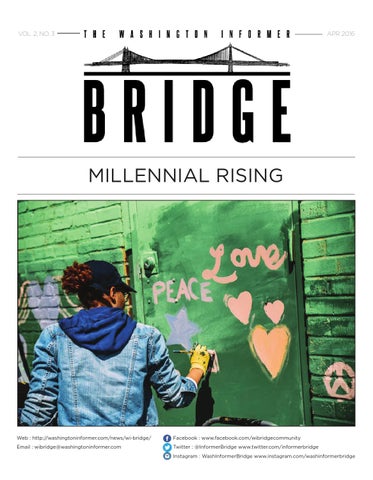
A young woman painted words of affirmation on a door during the Malcolm X Boulevard Clean-up last month. This sister counted among legions of Millennials who took part in service projects as part of the Broccoli City Festival (BCFest)’s Power of One campaign. Participants won tickets to the fourth annual BCFest, happening on Saturday, April 30th on St. Elizabeths East Campus in Congress Heights in Southeast. You can read more about Power of One on Page 4. / Photo courtesy of Shaughn Cooper (@ShaughnCooper)
MISSION STATEMENT The WI Bridge sets out to highlight contemporary issues through the experiences of youth and capture the progressive, entrepreneurial spirit of the Millennial generation other publications gloss over. Writers will take to streets and feature people, programs, initiatives, and movements that uniquely address prominent youth issues. This hard-hitting coverage will lay to rest misconceptions of Generation Y and bring all to an understanding of diverse youth experiences.
2| WI BRIDGE
Sam P.K. Collins
A world of never-ending happiness You can always see the sun, day or night -
ON THE COVER
EDITOR-IN-CHIEF
VOL 2, NO. 2
For many of us, Prince’s death, like that of other legendary public figures in recent years, painfully reminds us that we have a responsibility to carry on his work and take our craft, whatever that may be, as seriously as he had taken his. Such a task can be harrowing, especially for those of us who just rose out of a foggy adult adolescence. However, I find comfort in knowing that nothing ever dies. Instead, that energy transfers and takes on another shape. Though he’s not physically here, the artist formerly known as Prince lives through us. You can read more about that on the next page. In this issue of WI Bridge, themed “Millennial Rising,” we showcase the entrepreneurial, grassroots, philanthropic spirit of the Millennial generation, as we have done in previous editions. In this go around, we expand our scope of the young people featured by celebrating the work of Amara Evering, a D.C. teenager who sparked a movement at her high school that’s centered on human rights. We also interview Shakira “Milan” Latimer, a young mother who started her own business. Our feature piece highlights the Broccoli City Festival’s Power of One campaign, an all-hands-on-deck effort to beautify and unite the District. We sincerely hope that you enjoy this journalistic work. As always, feel free to comment and let us know what your thoughts. Many thanks to those doing what needs to be done to ensure our liberation, one act of love at a time. Yours in the Struggle, Sam P.K. Collins Editor-in- Chief WI Bridge
Dejah Greene
LAYOUT Kelcey Abney
CONTRIBUTERS Adolf Alzuphar Brianna Rhodes Monet Jones Sam P.K. Collins
IN MEMORIAM: PRINCE
Photo of a Prince mural in St.-Romain-au-Mont-d’Or, Rhone-Alpes, France. Creative Commons License, Courtesy of Thierry Ehrmann
By Adolf Alzuphar
WI Bridge Contributing Writer Prince, producer of a world famous silky and funky pop brand of R&B, is no longer living. He passed away at the age of 57 earlier this month, leaving behind 39 albums and countless performances that are now major moments in American cultural history. Prince, born Prince Rodgers Nelson, was born the son of a jazz musician, with whom he co-wrote several songs. One of those songs, “Around the World in Eight Days,” went double platinum. As a teenager growing up in the 1970s, Prince recorded his very first album For You, a project that didn’t prove commercially successful. He had to wait until the release of his second album before becoming a well-known artist. That work, titled Prince, went platinum. After the release of Prince, Prince underwent different phases in his career, from deciding to not go by that moniker to later reneging on that change. He also performed with The Revolution, a backup band that he formed up until 1986, when they disbanded. However, his music remained constant: a coming
together of what he thought was a phenomenal sound that included pop, rock, R&B, and sexual lyrics. Though his music is often interpreted as being soulful, Prince intended for it to be sexy, in the most Midwestern of ways, Minneapolis being where he chose to make a home at the infamous Paisley Park. In the U.S., when a Black person has released 39 commercial albums, it’s a both a time to congratulate him or her and to ask one’s self why it is that this person produced more than three dozen works of sincerity. The answer is never as simple as “a career.” When that person is venerated by most, if not by all, as a major contributor to their lives, it’s only normal to think of them as a largerthan-life figure that produced grandeur. Finally, when that person passes away at a fairly young age, promising to pull millions behind his funeral procession, the Black person in question was inhabited by a ghost that pushed him or her to continually produce in a society that taxes a Black person enough to not want to be a productive human. Prince, before being a dandy, before
being a man from the Midwest, before a great athlete according to many comedians despite being a flamboyant person, was such a person and through his life and death we have witnessed American turpitude and glory on a Black man’s way to canonical achievement. It’s the most important part of his whole biography: that Prince was a Black man in America though in this case a genius. How he lived his Blackness is fundamental to understanding his art, however under wraps he kept his opinions about said Blackness. Once a person of any race or ethnic group passes away, it’s always good to ask if we as a society treated him well. Was he a man at peace with himself entertaining us? Did we care about his livelihood? Were questions ever asked about his psychological wellbeing and if it felt right that a musician was continually erratic with others and egotistical about being at the center of attention? Did we care about Prince the person? There are a multitude of interviews that illustrate the fact that his opinion was important to Americans. There are limits to the questions that one can ask a public figure and to the amount of concern that
one can show him or her. There are supposedly a whole bunch of unreleased Prince recordings in “The Vault.” We can only hope that they’re released soon but chances are that it will be the same scenario as for Tupac’s songs. Was he at the end of his career? He released a song “Baltimore” to very little fanfare. It seems to be that his older hits thrill more than his newest albums that are unknown by most, even those who claim to be diehard fans. What are we, the living, to make of Prince’s death? We should look for the good in Prince and attempt to reproduce it or teach this society’s posterity to reproduce it. For example, Prince’s ideas about personal liberty that were at the foundations of his sexual lyrics are lessons in human rights that need to be learned in a society often too culturally conservative or Christian for its own good. Finally, taking his songs that are not only hit singles seriously could be a great next step. Then we can understand his art and not only what we liked about Prince.
VOL 2, NO. 2 WI BRIDGE | 3
“POWER OF ONE” CONNECTS MILLENNIALS By Sam P.K. Collins
WI Bridge Editor-in-Chief @SamPKCollins With gentrification and urban renewal near completion, the preservation of the District’s authentic flavor depends heavily on the unification of native Washingtonians and Black transients, two groups that seldom occupy the same spaces, in part because of geographic and socioeconomic barriers that create a “Tale of Two Cities.” In the months leading up to the fourth annual Broccoli City Festival (BCFest), more than 1,000 Black Millennials, many of whom hail from various parts of the country and world, have engaged members of the D.C. community while completing a bevy of service projects as part of what has been touted as the Power of One campaign. For their service, participants earn a general admission ticket to the April 30th event to take place at Gateway DC, located on the grounds of St. Elizabeths East campus in Congress Heights. In the process, they forge genuine relationships with longtime residents and challenge misconceptions about volunteerism in the District. Months after the campaign’s February launch, many longtime Washingtonians have attested to this fact.
to see young African Americans doing positive things in the community, especially if they come from a similar background. This was the first time we had gotten volunteers in such large numbers. Some of them teared up and cried when they recognized the value of what we were doing.” This service project, called “Community
at a local community center.
reducing energy use in the District.
During these ventures, volunteers literally got down and dirty, becoming more acclimated with the Earth as well as communities east of the Anacostia River.
On the day of BCFest, revelers on the grounds of Gateway DC will learn about environmental issues and connect with local and national organizations leading on-the-ground efforts to beautify communities and tackle food insecurity. Those groups include Cultivate the City, Serve DC, the National Fair Housing
The Power of One campaign builds upon previous efforts to the push
“Folks asked us why we were doing this service and we told them that we’re part of the community as well. It should inspire them to let them know that they could do something. There’s nothing special about what we’re doing. We’re just keeping our neighborhoods beautiful,” - Candace Glover, 26
Garden Refresh” counted among nine opportunities under the Power of One campaign. Other endeavors included a meal prep, community clean-up projects at Gateway DC and Anacostia Park in Southeast, the distribution of the 1,500 meals to nearly 90 homeless shelters, transitional homes, and nonprofit organizations; mural paintings, tree plantings, and the expansion of a garden
young professionals into service and promotes ideas of healthy eating and sustainable living, both of which have caught traction in recent years. Since 2009, the Broccoli City Lifestyle Group, the entity that hosts BCFest, has developed programs that promote healthy living. Past collaborators include DC Sustainable Energy Utility, a government entity committed to
Alliance, and the D.C. Department of Parks and Recreation. BCFest has also taken the sounds up a notch. Performances scheduled for that day include Future, Jhene Aiko, and the Internet. The Rock Creek Social Club and Rodney Rikai will host the festivities. While BCFest is guaranteed to attract legions of young people and
“I was so impressed when I drove up and saw a large number of young Black people at the site,” Pastor Cheryl Mitchell Gaines of the Regeneration House of Praise, also known as the Church in the Field, in Southeast, told WI Bridge when recounting her time spent with Power of One members. In March, more than 100 young people converged on a large plot of land Gaines, along with a group of at-risk youth, has tended to since 2012 as part of the Project EDEN (Everyone Deserves to Eat Naturally). For several hours on a Saturday morning, the squad of eager volunteers rebuilt garden beds, painted the buildings on site, moved compost bins, and cut grass. To Gaines’ pleasant surprise, these Millennials, most of whom were Black, represented a host of career fields and industries. “Many of them were credentialed and trained as accountants, attorneys, and other wonderful careers,” Gaines said. “It’s always good for the young people 4 | WI BRIDGE VOL 2, NO. 2
Darryl Perkins of the Broccoli City Festival totes large trash bags during a Power of One community affair at Anacostia Park in Southeast earlier this month. / Photo courtesy of Shaughn Cooper (@ShaughnCooper)
TO THE COMMUNITY
Three young ladies put their all into lugging trash bags across Anacostia Park in Southeast during a Power of One community project earlier this month./ Photo courtesy of Shaughn Cooper (@ ShaughnCooper)
organize them around important issues, Darryl Perkins, a lead organizer of BCFest and D.C. resident of 12 years, said the work won’t stop on the night of the annual event. During an interview with WI Bridge, Perkins revealed plans to focus on five District communities and conduct ongoing service projects long after the tents close on the night of April 30th. With BCFest predicted to attract nearly 12,000 people, Perkins said the opportunity proved ripe to put the values of sustainability and health into action. Touching on Power of One’s catchy name, he also alluded to the Millennial idea of a service-oriented egalitarian society, where everyone contributes in their own way. “This festival has become much bigger than Broccoli City but building thriving
communities has always been at the core of what we do,” Perkins said. “We get people out to engage the community. People are becoming more aware and there’s a culture shift. We want people to feel like squares if they don’t care about their community. This is something fun where people get to discuss real issues with likeminded folk.” Candace Glover, Power of One’s volunteer coordinator, echoed Perkins’ sentiments, noting that participants have found that they have a lot more in common with their neighbors than they thought before taking part in the campaign. “When people first heard about us volunteering, they thought we were privileged but we’re regular people just like them,” said Glover, 26, a yoga instructor. She participated in a service
project at Miner Elementary School in Northeast where her group, with the help of Casey Trees, planted trees and cleaned up the campus. “Folks asked us why we were doing this service and we told them that we’re part of the community as well. It should inspire them to let them know that they could do something. There’s nothing special about what we’re doing. We’re just keeping our neighborhoods beautiful,” said Glover, a lifelong Washingtonian who currently lives in Prince George’s County, Maryland. The Power of One campaign has also been effective in bringing longtime community gardening advocates into the fold. For example, Xavier Brown, a native Washingtonian and expert
horticulturalist, connected young Black transients with residents through the service project he coordinated at Project Eden with Pastor Gaines. He told WI Bridge that those experiences would change forever change their lives, especially since it happened in areas that young professionals rarely frequent. “The volunteers had good attitudes and were excited about three to four hours of work,” Brown said. “For anyone who’s not from this city, Power of One gives them a broader view of the District. If you just watch the news, you don’t see the good work being done. Everyone I talked to [during the service project] wanted to become more involved. It’s up to me and other native Washingtonians to make sure that they’re involved and going to places other than downtown and U Street,” said Brown, a Southeast resident. VOL 2, NO. 2 WI BRIDGE | 5
MILLENNIAL-OWNED MOBILE SPA MAKES WAVES By Brianna Rhodes
WI Bridge Contributing Writer @Bri_Rhodes24 As millennials, we’re going through the journey of discovering our true purpose in life. Although it may come with a few hard times and lots of trial and error, it’s all worth it in the end. Shakira “Milan” Latimer is the perfect example of this testimony. Growing up in what some would consider one of the roughest parts of the District, she had a vision of becoming her own boss, even as a teenage mom. Latimer, now 26, eventually made her dreams come true through the Milan Experience, her mobile relaxation spa. “Living in Southeast, I always wanted more. I just never knew how to get there,” Latimer said as she recounted a childhood in the Shipley Park Apartments on Southern Avenue. “Where I grew up I didn’t actually witness people getting shot, but I saw dead bodies, so that scarred me.” “There are just a lot of things I’ve seen from my childhood [that] people shouldn’t see as a child,” Latimer, a 2008 graduate of Ballou Senior High School and mother of a son, added. “Those situations just came with me not wanting to work for anybody. I think that pushed me a little harder and also the simple fact that I am a young mother.” Latimer started the Milan Experience in April 2013. Months after, she attended the National Massage Therapy Institute to gain more experience in the field. After graduating in May 2014, she received her credentials from the National Certification Board for Therapeutic Massage & Bodywork, based in Illinois.
known as a deep tissue massage. Latimer also has another component of her business that she considers her personal favorite. “I have a private chef that gives the client a three-course meal,” she said. “While you’re getting a massage, the chef is in your kitchen cooking so by the time you get off the table you’re eating appetizers.” Latimer told WI Bridge that since giving birth to her son in 2007 her outlook on life has changed, saying that the bundle of joy has been the driving force behind every decision she has made. The entrepreneur also credits her family for their support as she pursued her dreams. Before Milan Experience, Latimer worked at a gift shop across the street from her house. For years, she explored other business ventures including braiding hair and cooking. However, those options didn’t satisfy her. It wasn’t until she gave one of her friends a head massage and he asked her for the price of her services that her interest in massage therapy piqued. “My last job really made me want to be an entrepreneur,” Latimer said. “That situation made me realize that I didn’t want to work for anyone else. I went through the whole notion of what can I do and massaging really just fell on my lap.” Latimer’s clients say they’ve received much satisfaction from her portable spa. Brandon Anderson, a D.C.-based human resources specialist and Latimer’s client of three months, said he doesn’t plan on returning to the storefront spa he frequented before meeting Latimer. “The storefront spa does not give you the same attention that a mobile spa
Shakira “Milan” Latimer became an entrepreneur despite life’s hurdles and uncertainty about what career field she wanted to pursue. These days, she independently operates the Milan Experience, her mobile spa service. / Courtesy photo
my home where I felt most comfortable. Having the services delivered in my home is actually a great experience. ” Tauheed Burke, owner of a local financial services firm and construction company described Latimer’s services as “outstanding.”
“Listen to your inner self. If you wake up and say like ‘dag I hate my job,’ then don’t do it,” - Shakira Latimer These days, Latimer works independently, providing services at her clients’ homes and various hotels in the D.C. metropolitan area. Her offerings include a portable steam sauna, herbal body scrub, and Swedish massage, also 6 | WI BRIDGE VOL 2, NO. 2
does,” Anderson said. “I’ve been going to a storefront for about a year now and the massage and care is not the same. When I actually looked into Ms. Milan’s services, I thought it would be really good for someone to come into
“First of all, when [Milan] first did the massage for me in my office, she laid the pebbles down on the floor,” Burke, Latimer’s client of two years, said. “She made sure she had her candles.
She made sure that everything was the atmosphere of a spa. That was the first step. The second thing is that she really pays attention to detail and she studied what areas of my body needed the most focus and she would go figure that out and gear towards that.” Latimer advises anyone who wants to pursue their dreams to not give up and make a career out of something they enjoy. “Listen to your inner self. If you wake up and say like ‘dag I hate my job,’ then don’t do it,” she said. “[This is] never work for me like because I love what I do. When you love what you do and when you wake up in the morning and it’s like ‘oh yes let me see if anybody booked online or do I have any messages’ because I can’t wait to do massages. I say find something that when you wake up in the morning it just makes you smile.”
DCPS STUDENT FIGHTS FOR HUMAN RIGHTS Her Friend, a D.C.-based Student Reporter, Reflects on Her Journey
Amara Evering (center, brown jacket), a senior at Wilson High School in Northwest, started to the Human Rights Clubs in 2014 in light of the police-related killings taking place across the country./ Courtesy photo
By Monet Jones
WI Bridge Contributing Writer Twitter: @_theMonet IG: Monetbagz Another AllEyesOnDC community news event proved successful earlier this month when Sam P.K. Collins, founder and host of the grassroots media movement, reached out to younger members of the millennial generation. One of the interviewees, Amara Evering, is a colleague of mine. Amara, a senior at Woodrow Wilson High School in Northwest, took the initiative to start the Human Rights Club nearly two years ago and fill a social justice gap in her school community. The Human Rights Club is an allinclusive group for students ready to make a change. By handling issues that range from race to the environment, the widespread impact of this group has been incredible. The Human Rights Club started off with only six students chatting about the Michael Brown case during lunch hours in 2014. Since then, they have worked toward getting much of the
school community involved in making a change. Two weeks after Ferguson, Missouri police officer Darren Wilson killed Brown, Amara and her fellow Human Rights Club members organized a schoolwide “lay down.” For 10 minutes during the lunch period, many students showed how Brown was left dead in the streets for hours by lying face down on the ground in the same way. This event helped everyone involved experience what our brothers and sisters often face when injustices such as that which had been committed against Brown occur. During the April 15th interview at Sankofa Video Books & Café in Northwest, Collins asked Amara why she felt the need to start this type of club. Amara chuckled, explaining that human rights are a basic right. Later through the interview, Amara and Collins connected the topic of human rights to the way Black people have been treated throughout American history. Police brutality, racial profiling and other injustices are nothing new to Black people. Ever since we stepped foot off of those ships as enslaved people, we have been treated like “things” instead of human beings. It seems like natural
human rights do not apply to people of color; there’s always an explanation to justify cruelty against us. Sometimes, we as African Americans forget that we do have power and rights. The minds of young people, including those around my age, are constantly being brainwashed. When Black Twitter isn’t creating memes or discussing celebrity gossip, we forget that there are things going on around the world that affect us. Organizations like the Human Rights Club not only ensure that we identify those issues but we take the proper steps to find effective solutions. Not surprisingly, Amara said she doesn’t use social media, including Twitter and Instagram. With social media’s rapid growth, it’s hard for one to step back and reflect on how something affects them without the negative or positive influence of others. Amara said she doesn’t want to experience the negative aspects of using social media. She also pointed out that her parents are also very connected to their African Roots, keeping her not only “woke” but aware. Growing up
in such environment helped Amara grow into a young lady that’s not afraid to speak out and stand for something beyond herself. Black people around the country have to realize that although our blood brothers or sisters may not be directly affected by these events, they could’ve been. Brown could’ve been your brother, Sandra Bland, found dead in her Texas jail cell last year, could’ve been your mother. Throughout Africa, people often remember that they’re part of a family. That’s why when Amara speaks out about an issue, she takes it personally. Though Amara’s graduating in a few weeks, she hopes to keep the Human Rights Club up and running. With more than 20 members staying behind, efforts continue to take in anyone else who’s willing to fight. The Human Rights Club also has a faculty sponsor who has been at Wilson for some years now and will ensure that things run smoothly. Amara said it may be difficult to predict what will take place in the future but remains confident that she laid down a foundation strong enough to keep the club alive and well long after she leaves Wilson. VOL 2, NO. 2 WI BRIDGE | 7
8 | WI BRIDGE VOL 2, NO. 2