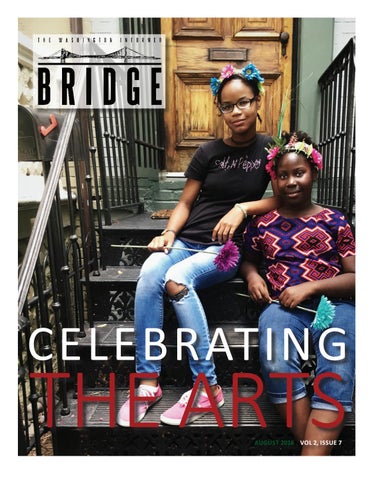
CELEBRATING
THE ARTS AUGUST 2016 | VOL 2, ISSUE 7
AUGUST 2016 | VOL 2, ISSUE 7
MISSION STATEMENT The WI Bridge sets out to highlight contemporary issues through the experiences of youth and capture the progressive, entrepreneurial spirit of the Millennial generation other publications gloss over. Writers will take to streets and feature people, programs, initiatives, and movements that uniquely address prominent youth issues. This hard-hitting coverage will lay to rest misconceptions of Generation Y and bring all to an understanding of diverse youth experiences.
EDITOR’S LETTER
Peace and blessings WI Bridge readers old and new,
TABLE OF CONTENTS
Vusi Mchunu Launches New Clothing Line . . . . . . . . . . . . . 3 Rock Creek Social Club Celebrates Six Years . . . . . . . . 4 - 5
In September, look out as we lead an important discussion about political participation, a topic of much discussion among Millennials eager to make a change, and in essence become the change that they want to see.
Analyzing Dana Dane with Fame . . . . . . . . . . . . . . . . . . . . . . . . . . . 7
ON THE COVER
EDITOR-IN-CHIEF Sam P.K. Collins
PHOTOGRAPHER Dejah Greene
LAYOUT
Dominiqua S. Eldridge
This month’s cover photo features Jay and Misty, two participants in the BlackGirlCentered Saturday Summer Program at the Thurgood Marshall Center Trust in Northwest. For six Saturdays, these youngsters, along with nearly a dozen other young women, engaged in a bevy of social and cultural activities. This photo was taken somewhere in the Shaw/U Street neighborhood near TMCT after a recent session. / Photo by Lloyd Kofi Foster
Yours in the struggle, Sam P.K. Collins Editor-in-Chief WI Bridge www.facebook.com/wibridgecommunity
Web: http://washingtoninformer.com/news/wi-bridge/
@InformerBridge www.twitter.com/informerbridge
Email: wibridge@washingtoninformer.com
WashInformerBridge www.instagram.com/washinformerbridge
WI BRIDGE | 2
Denise Rolark Barnes
The Resurgence of the House Negro . . . . . . . . . . . . . . . . . . . . 6
Since our last issue of WI Bridge, much has taken place across the United States and around the world that further makes the case for Blackcentered media that challenges the status quo and galvanizes people to act in the interest in their community. When it comes to our entertainers, the same especially holds true, for they are the ones who produce the soundtrack for our revolution. This edition of WI Bridge celebrates the people in our community making a change on the social front, including Vusi Mchunu, the Rock Creek Social Club, and BlackGirlCentered, an organization that creates safe spaces for young sisters to explore themselves and build healthy relationships with one another. In this issue, we also challenge those who legitimize state pushback against those who want to dismantle the systems that threaten Black lives. All in all, it’s imperative that we strive to be the best in whatever we do so that future generations can prosper.
PUBLISHER
CONTRIBUTING WRITERS Adolf Alzuphar Ambre Tomlinson Sam P.K. Collins William Langford
AUGUST 2016 | VOL 2, ISSUE 7
“I was able to make noise in the streets with just word of mouth. Imagine how far it would’ve spread if we had social media back then,” said Mchunu. Even in the mid-1990s when Mchunu obtained his first kiosk in the Centre at Forestville, he was always very particular about all aspects of each garment he created. He took materials, color choice, fit and weight of the cloth into consideration, personalizing each piece of clothing. Time passed on and a series of trials and tribulations as well as a shift in fashion trends put the Mchunu brand on hold for a while. Though new fashion inspired by Mchunu’s original wave emerged, true fans and D.C. natives never forgot the quality of those custom pieces he made during the good old days. “My supporters have waited long enough.” Mchunu said. Mchunu said he’s a strong believer in and supporter of small business. “D.C. culture needs to come back. Black entrepreneurs can now use gentrification to showcase specialty items [that characterize] your community to a new audience. The support of the small businesses helps communities flourish,” he said.
D.C. fashion legend Vusi Mchunu announced the launch of VMC Brand, slated for this fall, in an interview with WI Bridge. / Courtesy photo
Vusi Mchunu Launches New Clothing Line By Ambre Tomlinson WI Bridge Contributing Writer @Missgreeneyez
It would be very difficult to mention iconic street fashion in the D.C. metropolitan area without paying homage to Vusi Mchunu, a designer and artist famous for his unique design and vibrant color choices. His brand Mchunu became a fashion staple and D.C. cult classic in the 1990s and early 2000s. Now the seasoned fashion designer is back with a fresh line called VMC Brand, providing hot, new styles for the summer and a new website to launch early this fall. The garments are still crafted with close attention to detail and consideration for the consumer’s wants and needs in addition to fresh, color choices and sleek, new design ideas. “I’ve got to come back strong in order to compliment where I previously left off,” Mchunu said. The re-launch brings along with it a huge fashion show highlighting yet another brand of Mchunu’s, created with tried and true methodology. As an immigrant who traveled to the U.S. with big dreams, Mchunu’s life has flourished tremendously from its meager beginnings.
His first dwelling was a small house in an impoverished area in Durbin, South Africa. During the winter of 1986, Mchunu arrived to the United States and settled in Harlem. “New York City influenced my love of art and fashion greatly,” he said. As a boy, Mchunu dreamed of America. He imagined the hustle and bustle of the city and streets littered with ambitious business people on the go. New York painted a real picture of this before his very eyes. Inspired by the cold weather and the cityscape, Mchunu began to draw. His creative outlet would one day become a legacy of art, fashion and music. In 1989, Mchunu’s family relocated to Clinton, Maryland. Enamored with clothing brands such as Versace and Moschino, he traveled back to New York as a young man to pick up pieces of clothing from its Garment District to take back to the D.C. area and craft into wearable works of art, creating what would become the Mchunu brand.
Mchunu is also paying homage to his humble beginnings with an inspirational music campaign named “Immigrant Baby,” slated to be released alongside VMC Brand. This idea arose out of his frustration with the current state of immigration reform and the lack of African voices in the discussion. With his music, Mchunu strives to be a positive and familiar face for other immigrant children in U.S. struggling with assimilation. “I hope to send a message of empowerment to Black youth,” said Mchunu. “I hope to send a message of empowerment to Black youth.” said Mchunu. “I want Black youth to work hard and build their aspirations into a stable future to capture that American dream.” He goes in depth about the state of Black America and its youth in “Young and Black in America,” his single off the Immigrant Baby album that features DeAngelo Redman. “I want Black youth to work hard and build their aspirations into a stable future to capture that American dream.” For aspiring designers, Mchunu’s advice is to always invest in your brand rather than material possessions he says have no real value. He also encourages immigrants to lift themselves up then reach back to their homelands to help their people. His legacy gets stronger each time he builds something new out of whatever he picks up. One of Mchunu’s first promises to himself once he stepped foot on American soil was to create a name for himself that he can show his people when he returns to South Africa. He has accomplished that feat and so much more.
3 | WI BRIDGE
AUGUST 2016 | VOL 2, ISSUE 7
Rock Creek Social Club hosted its Grilled Cheese Social at Marvin in Northwest in April. This event attracted hundreds of millennials. / Courtesy photo
Rock Creek Social Club Celebrates Six Years By Sam P.K. Collins WI Bridge Editor-in-Chief @SamPKCollins
On the sixth anniversary of the Rock Creek Social Club (RCSC)’s introduction to the world, its founding members would like to remind folks that they’re not a group of promoters. As they often have to explain, RCSC’s work in the D.C. metropolitan area goes well beyond hosting parties. During a time when gentrification and shifting demographics created a tale of two cities, RCSC has been a driving force in creating an egalitarian social atmosphere for millennials from various walks of life. Now the group’s sights are turning national, with plans in the
WI BRIDGE | 4
works to expand its brand to cities many native Washingtonians now call home. “We understand that no matter what type of event we do, there’s some type of promotion. We promote running, sustainability and a healthy lifestyle, along with other things,” RCSC founding member Kevin “Scooty” Hallums, 35, told WI Bridge. “A lot of that gets lost in translation and people group us with promoters. That’s not who we are and if you’re gonna use that word, you can’t limit us to that. We’re a lifestyle brand and creative marketing and branding
agency,” he said. In 2010, Hallums, Jerome Baker III, a well-known DJ, and a few friends, formed RCSC in response to a D.C. party scene they said placed too much emphasis on professionalism and what patrons wore. After three meetings with the owners of Recess Lounge, an upscale establishment perched steps from the White House, RCSC hosted its first “Good Life Tuesdays” event on the night of August 16th, Baker’s 30th birthday. In the weeks and months after its launch, millennials from various parts of the D.C. metropolitan area would come to
know what RCSC could offer when it came to nightlife. Unlike other parties at the time, “Good Life Tuesdays” didn’t have a strict dress code, VIP tables, or the oh so familiar velvet ropes that separated cliques from the main dancefloor. Partiers also didn’t have to pay at the door. These ingredients set the stage for historic moments in RCSC’s short run. During their visits, widely renowned Hip-Hop stars Wale, Bun B, and Common posted up and mingled with revelers throughout the night. When Common appeared at Recess, he gave an
AUGUST 2016 | VOL 2, ISSUE 7
Social Club treats people like FRIENDS “ RockandCreek are all about the VIBES without having to take anyone’s money.
”
- Monique Okanlawon impromptu performance for nearly 60 people after festivities winded down. To this day, folks in D.C.’s creative scene still speak about that experience. Baker, a native of Mesa, Arizona who’s been DJing for 20 years, likened RCSC’s parties to the types of functions he would spin tunes at in New York City, specifically because of the lax dress code. He also said that forming RCSC provided an opportunity to diversify the music partygoers heard. At that time, Southern HipHop music, particularly that which came from Atlanta, maintained a strong presence in the D.C. club scene. Baker set out the expand the palate, spinning R&B tunes and exposing millennials to Kid Kudi, Big K.R.I.T. and others. “In college, I always traveled to D.C. to party. We knew that we had to carry a dress shirt and slacks and the I was just tired of it,” said Baker, 35, as he recounted how he spent his weekends as a student at Hampton University, located just hours outside of the District, in the late 1990s and early 2000s. “It was an old D.C. guard type of thing. People saw a formula that was successful and others started to do it. Just because someone puts on a suit and tie, doesn’t mean they can’t act a fool. The dressing up takes out the good time part out of going out. With RCSC, if you come in and have on whatever you have on, you can still have a good time.” By 2012, after a short hiatus and internal changes, spin-off events with a similar formula followed, including the Grilled Cheese Social day parties and a collaboration with Everyday People, a New York-based entity that hosts brunches. RCSC also had a hand in the launch and promotion of the Broccoli City Festival. In 2014, they brought their four-year anniversary celebration to U Street Music Hall in 2014. Last November, they formed a partnership with SoulCycle, an indoor cycling organization that promotes fitness
through community. The month before that, RCSC connected with the District Running Collective for weekly runs through the city. The group has also stepped artist management with DJ Spinser Tracy and Farrah Flosscett as their clients. Through a combination of their hospitality and a penchant of knowing most of their patrons on first-name basis, the members of RCSC have been able to build a strong network spanning thousands of people. With the
said the more she went to Recess, the more she got to know members of RCSC. Those connections led to volunteer opportunities at the Broccoli City Festival. “I remember Good Life Tuesdays just being friends and friends of friends, now Grilled Cheese Social gets packed long before 3p.m,” said Okanlawon, a native Washingtonian and alumna of The Art Institute of California, San Francisco. “There are a lot of places where you can see the same people but not know anyone. You
Kevin “Scooty” Hallums, along with a group of friends from the D.C. metro area, founded the Rock Creek Social Club in 2010. Since then, they’ve brought together people from different walks of life with their various events. / Courtesy photo
rise of relatively new social media platforms including Instagram and Snapchat, their reach has increased even more. So much so, they’ve attracted a bevy of sponsors, including Gatorade, Heineken, Under Armour, the Howard Theatre, Reebok, Bulleit Frontier Whiskey, and W Hotels. “RCSC treats people like friends and are all about the vibes without having to take anyone’s money. That’s the thing I like about their events,” said Monique Okanlawon, 26, a hotel guest services agent who lives in Montgomery County, Maryland. She started attending RCSC functions not long after returning from school in 2010. She
want people to feel comfortable and RCSC has been able to do that. If I’m not working, I always try to go. It always benefitted me to network and get to know people in the city,” Today, RCSC consists of 14 members, six of whom work on the brand fulltime. Some of the bonds formed in this group, like that between Hallums and Justin McCrae, executive producer and co-host of Rock Creek Radio, RCSC’s weekly show, go back more than 20 years. Hallums and Dominque Wells, both alumni of Parkdale High School in Riverdale, Maryland, met through Hallums’ cousin. Two years ago, Baker and
Hallums met Ainz Neal, now RCSC’s strategy and business development specialist, through a mutual friend. Alexis Johnson, RCSC’s marketing and development coordinator and Howard University alumna, joined the movement two years ago, helping bridge the gap between older and younger millennials. These familial relationships prove critical at a time when RCSC is pivoting its focus nationwide while tackling today’s social issues through grassroots connections. At this point, this new project is in the discussion stages but RCSC members say once plans solidify, these community-based events will target areas east of the Anacostia River, particularly the Congress Heights neighborhood, building upon work they’ve have done individually. “We’ve been having dialogue about doing more communitybased things in the fall. We threw around different ideas,” said Neal, 34, a husband and father of two who hails from Brooklyn, New York. “There are issues in the system and things we need to teach our people. We have to come together and make change the right way. It’s good to know that there are people who are likeminded. A big part of this is getting to the kids. We want to show people that you can be successful and have the resources,” he added. Beyond that, Baker noted his wish just want to keep up with a D.C. that’s constantly changing. Just as they have done before, RCSC members are forging relationships and creating with likeminded people. “Expansion and embracing the new parts of D.C. that have risen are top priorities,” Baker said. “There are people dong new projects who are just like us and do what we want to do. These individuals inspire us. D.C. is a small city where you’re one person away from meeting someone so we’ll definitely take advantage of those connections.”
5 | WI BRIDGE
AUGUST 2016 | VOL 2, ISSUE 7
The Resurgence of the House Negro By William Langford WI Bridge Contributing Writer
Black Americana Antique Postcard HOUSE NEGRO singing & dancing with young Shirley Temple Publisher UNK Arcade Card Actor Bill Robinson from the film The Littlest Rebel/ Flickr Creative Commons
Since the beginning of the Black Lives Matter (BLM) movement, we have seen an escalation in the tension between African Americans and establishment supporters, most notably law enforcement. Many have questioned the agenda of BLM. However, the inquiries of motive may have fallen just short of relevancy.
telling them that he would suffer as long as he fought the system.
As of late we have seen an even greater trend in the resistance to the BLM support and the rise in the number of Blacks who are willing to go out and defend the actions of the police and the establishment by asserting that Blacks bear the responsibility for the injustices we endure. They say that the establishment created an environment that will allow us to rise from oppression if we get out of our own way. For generations, division has been a central force used against us by distorting our differences as adjectives of hierarchy. During cattle slavery in the United States, the so-called House Negro created this division. The House Negro always thought he was better or more ‘accomplished’ than the Field Negro. He always blamed the suffering of the Field Negro on his indignation towards his captors,
WI BRIDGE | 6
This not only drove a wedge between the House and Field Negro. Even among the Field Negros, division was palpable because some in the field looked up at the House Negro doing “so well,” thinking that the way to happiness was acquiescence, even if it was towards the captors. A faction of House Negros pretended to be in alliance with the Field Negro, covertly serving an agent of the plantation owner and preventing uprisings by leaking information about plans the Field Negros entrusted to him. As division grew among the Field Negros, the slave owner sat back and watched as the only threat to his livelihood internally dismantled while he continued to clothe and feed the house negro at no real cost to himself or his estate. Today, we see this dynamic playing out in the media. As many Black communities lay victim to imperialistic oppression, there are a handful of Black people, given an acceptable place in White society, who present themselves before the country as “educated, well-to-do African Americans” and chastise any Black resistance of the
establishment. Fox News and CNN call on individuals like radio host Jesse Patterson and Milwaukee Sheriff David Clarke to debate matters related to Black injustice with the understanding that these boule Blacks will either talk around the issues with eloquent soliloquies on why Blacks are responsible for their own success or failures, poke holes in legitimate arguments with out of context statistics, or just frustrate the individuals with whom they are debating by defending the establishment. While we waste time in these meaningless confrontations, the Al Sharptons of the world and organizations such as the NAACP parade behind the scenes, ensuring that we wear ourselves thin by marching and protesting instead of having real discussions. These are all tools of oppression designed to funnel energy, time, and resources into dead-end endeavors, divide and anger us in an attempt to destroy our credibility, and essentially disarm us. It’s time to do away with these tools of destruction and operate with those meant for the true liberation of ALL oppressed people. Let’s bring Black communities together and educate the Black voting
majority about vetting candidates for local leadership positions. They can vote in the best interest of community agendas and hold local political leaders accountable. By intelligently choosing our own local leadership, we can begin to have a real conversation about how we choose to govern ourselves. We can also vote for legislation proposed by our vetted local leaders that will unlock the access to the resources desperately needed. With all the untapped resources in our community, why are we still marching with our hand out? The answer is UNITY! If we as a collective in every corner of this nation stand united, we can force our way into local municipalities, police our own streets, be judge and jury of our own offenders, dictate how and where our tax dollars are spent, and most importantly get out of the faces of these oppressors who are delaying real action. Let’s control our own media message by using innovative outlets for content. We have the manpower, now let’s put our minds to work.
AUGUST 2016 | VOL 2, ISSUE 7
Analyzing Dana Dane with Fame By Emmanuel Adolf N. Alzuphar WI Bridge Contributing Writer @alzuphar
Slick Rick, the ruler, was well known for his rapping style, a storytelling heavy version of New York City nightclub Hip Hop full of humor and hubris. It is as if his rapping is much less aggressive than that of most rappers and songs such as “Childrens Story” and “La Di Da Di.” Dana Dane, on the other hand, is not. He released an album Dana Dane with Fame of the very same style a year before Slick Rick’s first album The Great Adventures of Slick Rick. What could possibly possess this culture to listen to two rappers with similar rap styles and enter one into the Pantheon of Hip Hop because of this style while relegating the other one to cultish obscurity? Well, Slick was the funnier and more eccentrically dressed rapper; Dana Dane’s stories aren’t as facile as Slick Rick’s. The same goes for his visual aesthetic. Dana Dane’s debut album Dana Dane with Fame, produced by Herb ‘Luv Bug’ Azor, a Haitian American producer, is a 9 song album released on Profile Record’s, one of the major record labels of what’s now considered to be “Golden Age Hip Hop.” Slick Rick’s first and subsequent albums were released on Def Jam, also during “Golden Age Hip Hop.” He would go on to release four albums in total, whereas Dana released three and one best of. Slick Rick’s albums have gone platinum, whereas Dane Dane’s most successful release, his first album, has done much worse relatively, only going gold. They were high school friends and both belonged to a hip hop crew, The Kangol Crew, before becoming professional rappers. It is probably why their rapping styles are similar. The similarities in their songs are striking, though their differences may have made one song popular and not the other. The song “Cinderfella Dana Dane” begins with ‘Once upon a time’ as Slick Rick’s “Children’s Story” does also. They are both fairy tales about a boy, though Dana’s is an autobiography. Slick Rick’s story is constructed almost like a fairy tale (in a land / where justice stood / there lived a little boy) whereas Dana Dane’s story has the qualities of a noir film, as if listening to Spike Lee’s movie Crooklyn. Dana raps with much more hubris in “Cinderfella Dana Dane,” which makes Slick Rick’s story easier on the listener and much, much, less of a boast. What’s fascinating is that nor and boastful Hip Hop is now in vogue but in 1987, when “Cinderfella Dana Dane” was released, may have not liked noir and boasting as much.
Dana Dane/ Photo courtesy of Catherine McGann
Considering the song “Delancy Street” may give us the key to our enigma. Stylistically, “Delancey Street” is very similar to the poignant and chill drum kit beats of Slick Rick’s songs. The song is that of a complex narrative, as that occurs on hip New York City named Delancey Street all the while Like Rick, he raps with humor, Unlike Rick, however, he delivers us a extremely complex and long narrative that cannot be listened as easily as “La Di Da Di” or “Children’s Story” and requires serious concentration to its lyrical nooks and crannies on the first try. Like Rick, he raps with hubris and we hear a young woman sing that ‘Dana’s Dane’s / my man.’ However, Dane’s song is hard to rap or bop one’s head along to without missing what he has just said. That the “Nightmares” is similar to “Delancy Street” in its narrative complexity and points us to the answer: Slick’s music was easier on the ears. Visual style and facility for the listener means a lot in the determination of who will be a musical legend. Miles Davis’s music is much less complex and revolutionary than Ornette Coleman’s but in popular culture, Miles is much better known. Though he was popular in his day, Dana Dane is not as well known as Slick Rick today and it is surely because, in the end, Slick Rick’s songs were better for every day of his times of cookouts, outdoors parties, and other entertainments wherein youngsters and adventuring adults seek a good time. Regardless, Dana Dane with Fame should be considered the precursor in recorded music of the style that has made Slick Rick a legend for his singularity in rap.
7 | WI BRIDGE