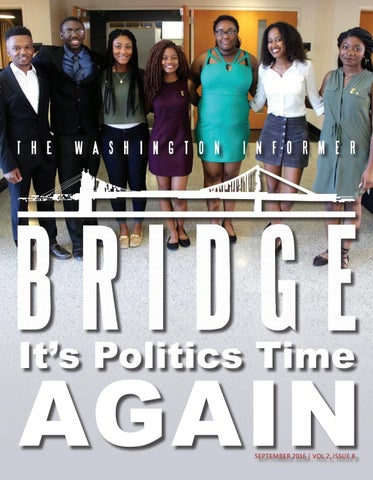
It’s Politics Time
AGAIN SEPTEMBER 2016 | VOL 2, ISSUE 8 AUGUST 2016 | VOL 2, ISSUE 8
SEPTEMBER 2016 | VOL 2, ISSUE 8
MISSION STATEMENT The WI Bridge sets out to highlight contemporary issues through the experiences of youth and capture the progressive, entrepreneurial spirit of the Millennial generation other publications gloss over. Writers will take to streets and feature people, programs, initiatives, and movements that uniquely address prominent youth issues. This hard-hitting coverage will lay to rest misconceptions of Generation Y and bring all to an understanding of diverse youth experiences.
TABLE OF CONTENTS
Millennials: Continue the Fight for Reparations . . . . . . . . . . . . . . . 3 Black Student Leader Galvanizes Millennial Votes
.....4-5
PUBLISHER
Denise Rolark Barnes
EDITOR-IN-CHIEF Sam P.K. Collins
Building a United Front in November . . . . . . . . . . . . . . . . . . . . . . . . . 6 - 7
PHOTOGRAPHER EDITOR’S LETTER
ON THE COVER
Dejah Greene
Peace and blessings WI Bridge readers far and near, It’s with deep regret that I announce this issue as my as last as editor-in-chief. Though our time together has come to an end, I’m very grateful for having had the opportunity to curate this product every month. Since its inception, the WI Bridge has torn away at the notion that young people aren’t equipped to take the movement for our freedom to new heights. This issue, themed “It’s Politics Time Again” continues that legacy. In this edition, a young brother gives a rallying cry for reparations that he says we desperately need for the hundreds of years of torture and disenfranchisement. We also go down to Foggy Bottom to see what some college students are doing to galvanize the youth vote with Election Day just weeks away. As always, our resident music and arts critic Adolf Alzuphar brings the fire and passion in his review of a historically significant piece. There’s also voting information to accompany our news and literary content.
LAYOUT
Dominiqua S. Eldridge
As president of the Black Student Union at the George Washington University in Northwest, Abeke Teyibo (fourth from the left) wants to increase student political organizing and engagement. In this issue of WI Bridge, she tells our own Brianna N. Rhodes how she plans to do that. / Courtesy photo
Anthony Morse Brianna N. Rhodes Sam P.K. Collins William Langford
Politics isn’t just confined to one election season; it’s a perpetual journey that permeates every facet our life. Use this publication to get on the road to self-determination at the local and state level, especially if our aim is to attain true power all over the country. Before I sign out, many thanks to the Washington Informer for this opportunity and to the community for its support. May the young people continue to inspire and spark that fire. Yours in the Struggle, Sam P.K. Collins Editor-in-Chief WI Bridge www.facebook.com/wibridgecommunity
Web: http://washingtoninformer.com/news/wi-bridge/
@InformerBridge www.twitter.com/informerbridge
Email: wibridge@washingtoninformer.com
WashInformerBridge www.instagram.com/washinformerbridge
WI BRIDGE | 2
CONTRIBUTING WRITERS
SEPTEMBER 2016 | VOL 2, ISSUE 8
U.S. Congressman John Conyers (D - Mich 13th District) has introduced HR40, a bill to establish a Commission to Study Reparations proposals for African Americans Act, every year since 1989/ Flickr Creative Commons
Millennials: Continue the Fight for Reparations By Anthony Morse
WI Bridge Contributing Writer A recent Associated Press poll showed that 62 percent of those polled ages 18-35 opposed the U.S. government providing reparations to African-Americans for slavery while 32 percent support the measure. However, the poll is much different among racial lines. Sixty-two percent of Black Americans and 40 percent of Latinos want reparations while 21 percent of White Americans are in favor. There have been recent efforts to diminish and whitewash slavery and its effects on the descendants of African slaves. American slavery cannot be rectified or reconciled without proper restitution, remuneration and rehabilitation of African Americans. Presidential Green Party Candidate Jill Stein and her running mate Ajamu Baraka formally favor reparations and reconciliation with African-Americans while our frontrunners Donald Trump (R) and Hillary Clinton (D), thoroughly oppose reparations to African Americans. As millennials, we are taught to “not see color,” but when numbers come into play, the disparities against Blacks aren’t colorblind, and quite discouraging, starting from the moment the first Africans stepped foot onto The New World up until today. For 246 years, Africans were kidnapped and brought to America for servitude. That equates to about 10 generations of Africans subjected to deplorable, inhumane, dehumanizing, degrading conditions and treatment. During this time of free labor in the South and unlimited funding of industrialization in the North, the American economy began the form of capitalism and became an economic powerhouse. After the abolishment of slavery and start of Reconstruction, Jim Crow laws were enacted and Black Americans were terrorized, lynched, and marginalized for almost a century. They were
denied voting rights, access to quality schools, and also left out of government programs to assist Americans in achieving “The American Dream.” Federal programs under the original Homestead Act of 1862 and The Oregon Donation Land Act of 1850 granted millions of acres of free land in the East and the West to white Americans. The opportunity to obtain wealth in this country through homeownership overwhelmingly favored whites in America during Jim Crow. Government agencies such as the Federal Housing Administration and the Homeowners Loan Corporation, with the help of “Separate but Equal” laws, encouraged segregation. Between 1934 to 1962, the federal government backed $120 billion of home loans, more than 90 percent of which went to white Americans. The passage of the 1964 Civil Rights Act deemed Jim Crow laws unconstitutional. This bill was a pivotal stepping stone for Black liberation in America. But even the late great Martin Luther King Jr. knew this wouldn’t be enough. He told actoractivist Harry Belafonte days before his death that “I fear I am integrating my people into a burning house.” In the year leading up to his death, King organized and mobilized “The Poor People’s Campaign” in which he planned to lead another march on Washington for economic justice. He said “This time, we are coming to get our check.” Reparations are not just a check. It’s not meant to only rectify the effects slavery, but also Black Codes, Jim Crow, discrimination, marginalization, domestic terrorism, police brutality, mass incarceration – all of which have affected the descendants of slaves and only Black Americans over the longest period of time in this country. Last year, the Obama administration earmarked $12 million to assist the Holocaust
survivors in this country. What about the African Holocaust Mr. President? For too long we’ve accepted the “at least” mentality that keeps us at the bottom in all facets of human development. In education, economics, social and political status, African Americans are the least. At the end of slavery, newly freed slaves owned less than a percent of America’s wealth, as of 2014, African Americans hold 2.6 percent. “At least” we progressed by 2 percent in 150 years right? True equity and equality in America require reparations, restitution, and reinvestment to African Americans. The root word of reparations is “repair”. Blacks have not had an opportunity to repair themselves after slavery and for simply being Black in America. We have technically been “free” for about 50 years. Reparations would allow us to repair ourselves, our communities, and gain wealth, social, political, educational, and health equality. It’s not a “handout,” After 246 years of building this country and 100 more of being marginalized, terrorized and discriminated against, I stand on the shoulders of our ancestors and say I believe we as people have earned it. I encourage all millennials to research the congressional bill HR40 which has been introduced to the U.S. House of Representatives every year since 1989. HR40 is a bill to establish a Commission to Study Reparations proposals for African Americans Act. It’s time for our generation to complete what those before us started. Equality, Equity, and justice has been on the forefront every Black liberation agenda. If America truly wants to live up to the “Justice & equality for all” mantra, it first has to make amends for its racist and unjust past. Only then can radical progress be accomplished.
3 | WI BRIDGE
SEPTEMBER 2016 | VOL 2, ISSUE 8
Black Student Leader Galvanizes Millennial Votes
GW students led a protest last semester on campus./ Courtesy photo
Brianna N. Rhodes
WI Bridge Contributing Writer @Bri_Rhodes24 As president of the Black Student Union (BSU) at The George Washington University, Abeke Teyibo has to ensure that her organization acknowledges Black students’ concerns and address the needs of the community. With the U.S. presidential election only weeks away however, Teyibo’s responsibilities have expanded to getting her peers to the ballot box to participate in what many are describing a potentially life-changing event. “I think it’s important for Black students in general to vote because it’s important to show that we also have a voice in the community,” Teyibo said. “People tend to say that if they do not vote it will make a stronger appearance but I disagree. If you do not vote, you’re basically saying, in my opinion that your vote doesn’t matter. It’s important for us to vote especially at this time, for me because of the fact that someone that we do not want at all to win…Trump,” Teyibo, a 20-year-old senior, added. Whoever wins the election on Nov. 8th will move into the White House, located just up the street from GWU. Hillary Clinton, former secretary of state in the Obama administration, serves as the Democratic nominee, while controversial mogul and reality television star Donald Trump has clinched the Republican nomination. Since the Democratic and Republican conventions earlier this summer, Clinton and Trump have worked hard to garner support among Black people. This ultra-tight race has pitted supporters of Trump, with whom his call to “make America great again” resonate, against those who say they value Clinton’s decades of Washington insider experience. Among Black voters, this election has sparked discussion about the viability of either presidency at a time when Black issues are gaining more prominence. While there’s some consensus that a Trump presidency would be disastrous for African Americans, not all are ready to give their vote to Clinton. This debate has prompted some discussion about third party candidates. Eager to take advantage of this opportunity, Teyibo, in her capacity as BSU president, has organized a number of events and panels with other organizations on campus to provide an open
WI BRIDGE | 4
“
SEPTEMBER 2016 | VOL 2, ISSUE 8
The thing is in any type of political field they will say that they will help or they will do this or do that but that doesn’t necessarily mean that that will come across for later in years. It doesn’t necessarily mean that they will actually do it. Right now they’re just trying to get the popular vote from the public.
”
space for discussion amongst students on campus about the upcoming election. One of them is slated to take place later this month. “Right now, we’re trying to work with GW Democrats. Basically we’re having political panels on campus,” Teyibo said. “We’re talking about social injustice and how students can become more active in that sense and also have a conversation about what nationality or race you consider yourself and whom you think would be best for your specific group. So we have different speakers coming in, one to represent the black community, and one to represent those that even though they cannot vote, people that are foreign, to get their perspective on how they feel about each candidate,” she added. With the upcoming presidential election taking place in two months, students are becoming active on campus and advocating for the importance of the college student vote in this election. Experts say the turnout will affect domestic and international policy. Even with her confidence in galvanizing student political involvement, Teyibo admits that she’s not sure how Clinton or Trump will tackle the issues affecting the Black community, or if they would address them at all. “The thing is in any type of political field they will say that they will help or they will do this or do that but that doesn’t necessarily mean that that will come across for later in years. It doesn’t necessarily mean that they will actually do it. Right now they’re just trying to get the popular vote from the public,” Teyibo said, stressing that even with that reality of political trickery, she places her bet more on Clinton than Trump. “I would put my faith in Hillary before I ever put my faith in Trump of doing anything for the Black community. Especially because of the fact -I’m Democratic so I know that Obama will be a helping hand for her and she will open her ears to him because he’s so favorited by many. I also know that Bernie Sanders said that he would help her along her campaign and also be that stature that she will need if she ever did become the President of the United States of America. Those are two gentlemen that I personally believe in. So I feel like she will do more towards the black community than Trump would ever do but how much she does is still in question,” Teyibo added.
Abeke Teyibo, president of the Black Student Union at GWU./ Courtesy photo
Overall, this upcoming election will change the whole aspect of how the black community is seen. The black vote is more important than ever. Depending on who wins the election, will determine the fate of our country. “It changes how comfortable we can be in time of war. It changes the accessibility we have to travel the world. It changes everything and I don’t think students think about it that far ahead, because they’re saying ‘why do I care, it doesn’t really matter in my community.’ It goes far beyond our community. It’s a global issue.” Teyibo said. Teyibo said she stepped into her role as president of GW’s Black Student Union to bridge the gap between student and professor relationships on campus. Teyibo, who’s also involved in other organizations, wanted to set a middle ground for students of color and their Caucasian counterparts to communicate and develop relationships. At PWI’s, also known as Predominantly White Institutions, there tends to be a separation of students of various ethnicities on campus. “It [BSU] gives them [students] hope that if anything ever goes wrong or if they ever need a helping hand that we’re there for them. Our Black student union is by far really engaged in student activities so we don’t only participate regarding social events,” Teyibo said. “We have panels regarding becoming a black entrepreneur, internships, and community service. We also have vigils for people who have died and we also have group discussions about how can you retain your mental health as a black student. These are topics that we feel like are really important, especially at a PWI because sometimes you get comments that shock you and sometimes you don’t really feel like people are trying to understand you but more analyze you as a subject at a PWI,” Teyibo said.
5 | WI BRIDGE
SEPTEMBER 2016 | VOL 2, ISSUE 8
Flickr Creative Commons
Building a United Front in November By William Langford
WI Bridge Contributing Writer
a united front at the polls this November, we can send a “Behind message to the political universe that we are here, we are united,
As we quickly approach the 2016 general election, there has been a general sentiment of political melancholy in the Black community in particular given the impending exit of President Barack Obama in January.
The fire and fervor with which the Black community became awakened and involved during the last two general elections has been more splintered and far less impactful during this general election cycle. President Obama’s tenure has left a sense of disappointment in our community, in turn leaving many Black people far less confident in our political system. Many see the last two terms as having lacked substance with many of the same concerns that President Obama promised to address during his presidency going unaddressed, and some even becoming exacerbated.
WI BRIDGE| 6
and we are taking real steps toward real accountability within the political system. What’s lacking is the proper perspective, not of what was accomplished by ‘our’ president, but what was accomplished by our people. With more than 45 million Black people in America as of the 2010 Census, we carry a large political stick. With only 64 percent of eligible White Americans voting in the last general election and Mitt Romney having only lost by nearly 5 million in the popular vote, imagine the scenario had Blacks thrown only 1/3 of our 16.5 million democratic votes in the other direction. We have a vast resource of unity within each and every Black community across America. Behind a united front at the
”
polls this November, we can send a message to the political universe that we are here, we are united, and we are taking real steps toward real accountability within the political system. No more photo ops and cameo appearances during election season, and no saxophone playing and ‘Amazing Grace’ antics for vote. We as a community can establish a new standard of governance through our political voice. For the first time since such numbers were published by the US Census Bureau in 1996, Blacks voting outpaced White voting by more than 4 percent in the general election. Imagine if we
SEPTEMBER 2016 | VOL 2, ISSUE 8
were able to produce an 80% turnout. Our participation can’t stop at just showing up. We have long since shown our collective desire to support our own cause. However, for decades we have lacked the intelligent leadership needed to see actual solutions. We have sung, we have marched, we have begged, we have even exercised our right to vote but why have we not yet seen the longstanding progress we seek? I believe it is because we have not taken proper stewardship over our own communities. We have championed the voices of those who have promised liberation to the Black community and all oppressed communities, ultimately bringing little to none. It’s time for us to no longer place leaders on a pedestal for our representation but rather become actively informed of the inner workings of our communities. We all have city council men and women and town and district representatives. Week after week, there are agenda meetings and proceedings held within each and every state governed region within this nation. Yet, these meetings go unattended and the agendas go unchallenged. Council men and women who chase career objectives couldn’t care less about the long-term viability of the Black and poor communities. They’re simply looking for easy resume builders. They know 6,000 votes in a district of 40,000 eligible Black voters can win someone a seat. Yet, we want to point the collective finger at others when we have yet to intelligently address these issues ourselves. The Black community is ripe with outreach organizations, churches, and community bodies set up to
aid the community. Because of the lack of unity however, these organizations duplicate resources in an attempt to gain market share when instead they can pool and efficiently distribute what they have together. This idea goes beyond our community organizations. We can change our public school systems by selecting well-vetted Board of Education members who care about the progress of our young people and will put into action what they preach. We can hold our Advisory Neighborhood Commissioners accountable if we know who they are and what values they represent. The District of Columbia in particular is a hidden gem in the Black community not only regionally, but nationally as well. Carrying nearly 50 percent of the voting populace in the city (including a large majority or virtual sweep in Wards 4, 5, 7, and 8), Blacks have the political hammer in this region if they choose to take the time to learn how to wield it effectively. With this general election, we can begin not by focusing on the presidency, but paying attention to the candidates who really impact our daily lives, including our delegates to the House of Representatives, At-Large Council member seats, Council member and State Board of Education seats for Wards 2, 4 (61 percent AA voters), 7 (90+ percent AA voters), and 8 (90+ percent AA voters), our At-Large Board of Education seats, and our Advisory Neighborhood Commissioner. Making competent decisions regarding these political seats will be key in setting the tone for the next mayoral campaign, beginning to create urgency within the day to day actions of decision makers in regards to addressing the concerns and negligence within the Black community in a meaningful way.
Three young and driven new political faces on the scene this election will be Ward 8 Council Member candidate and for Board of Education member Trayon White, At-Large candidate Robert White, and Ward 8 Board of Education candidate and current ANC 8C04 representative Markus Batchelor, all of whom have the look of the future faces of the political hierarchy in the nation’s District. By fully supporting homegrown community leaders such as these gentlemen, we not only have true representation but we also have individuals who must be accountable to the communities to which they govern not only because of occupation, but also because of loyalty through affiliation. We can be more active and attentive in our local politics in a far more engaging way when we are governed by members of our own communities. I hope that these words do not fall on deaf ears and in November we send a resounding message to all of our brothers and sisters across the nation that the time for change was yesterday but the call to action is now. Let’s take our first true step towards liberation and a better tomorrow for the country as a whole.
Markus Batchelor, candidate for the Ward 8 State Board of Education seat, chats with a constituent. / Courtesy photo
7 | WI BRIDGE