VOL. 1, NO. 4
MAY 2015
COMMENCEMENT
Web : http://washingtoninformer.com/news/wi-bridge/
Facebook www.facebook.com/wibridgecommunity
Email : wibridge@washingtoninformer.com
Twitter : @InformerBridge www.twitter.com/informerbridge Instagram : WashInformerBridge www.instagram.com/washinformerbridge
CONTENTS
EDITOR’S LETTER
PUBLISHER Denise Rolark Barnes
Baltimoreans Create Movement Built to Last 2-3 Dreams Deferred For Degree-Holding Millenials 3 Commencement Speakers Should Share Authenticity and Vulnerability 4-5 J.Beale’s Career is Still #Nothinbad 5 Thursday Network: Bringing Professionalism and Service Together 6 WI Viewpoints 7
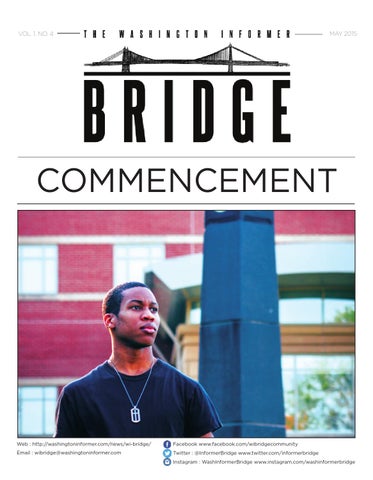
ON THE COVER
Hi WI Bridge Readers, Every spring, people from all walks of life and in different junctures of their academic careers walk across the stage and receive accolades for their completion of their studies during a ceremony known as graduation. The journey didn’t come without challenges, and even as one celebrates with friends and family, questions linger about what comes next. In this issue of WI Bridge, appropriately named Commencement, we break down the concept of graduation with articles and think pieces that address many facets of the graduate and post-graduate experience. In this issue, our reporters ask academics about the job climate for millennials of color, deconstruct the anatomy of an ideal commencement speech, and chronicle a local artist’s graduation to mainstream stardom. We also ask people about the value of
a college degree and look back at how Baltimoreans turned their frustrations into community action. As always, we try to give our readers a little bit of everything for their enjoyment. It’s our hope that this material sparks discussion about the education system and what some may consider the best means of preparing the youth for the future. As journalists, we’re always thinking about the future. If you’re a reporter thinking about your future in the industry, feel free to drop us a line at wibridge@washingtoninformer. com.
STAFF Sam P.K. Collins Editor-in-Chief
Chelsea Fuller Editor
REPORTERS
Sam P.K. Collins Editor-in-Chief WI Bridge
Melvin Graham
Loren B. Coleman, Ph.D
MISSION STATEMENT The WI Bridge sets out to highlight contemporary issues through the experiences of youth and capture the progressive, entrepreneurial spirit of the Millennial generation other publications gloss over. Writers will take to streets and feature people, programs, initiatives, and movements that uniquely address prominent youth issues. This hard-hitting coverage will lay to rest misconceptions of Generation Y and bring all to an understanding of diverse youth experiences.
Travis Brownlee, 21, recently graduated from Bowie State University in Bowie, Maryland with a bachelor’s degree in sociology. Brownlee said that during his years at the local historically black college, he has enjoyed the unique campus culture and gained a tightknit college family that has enabled him to succeed academically. He feels exceptionally proud to walk across the stage, a feat that so many black men don’t have the chance to achieve because of systemic hardships. With this chapter behind him, Brownlee has expressed plans to help grow his family business and attain a private pilot’s license./ Photo by Dejah Greene 1 | WI BRIDGE
YOUR BUSINESS COULD BE ADVERTISED ON THIS PAGE. For more information, send inquiries to WIBridge@washingtoninformer.com
Ambre Tomlinson
PHOTOGRAPHER Dejah Greene
LAYOUT Kelcey Abney
BALTIMOREANS CREATE MOVEMENT BUILT TO LAST
Hip-hop Freeway joined Baltimore youth during a community event./ Photo courtesy of Craig Jernigan
By Sam P.K. Collins WI Bridge Editor-in-Chief @SamPKCollins In the days after civil unrest in Baltimore overtook the news coverage on the mysterious death of Freddie Gray, Baltimoreans redoubled their effort to show what Charm City is really about. Community members came out in droves towing brooms, trash bags, and trash cans — maneuvering around the flurry of protestors, fully armored police officers, and a bevy of news cameras — to clean up and restore order to their community after Monday night’s melee. Church and community groups served food to kids who wouldn’t get free lunch with schools closed. But it turns out these efforts may be more than a stopgap to address the immediate needs of residents adversely affected by around-the-clock police presence. Slowly but surely, a movement has been coalescing in Baltimore through the collaborative efforts of clergy people, educators, youth advocates, and members of street gangs – key players who have the clout to unite their groups around the pressing needs of the community and start the long-term planning to address the city’s long-
ignored plight.
funneled in pounds of food, clothing, toiletries, and medical supplies to United Methodist Church. During his interview, King discussed plans to distribute meals and create care packages for community members who have been without medication since the nearby pharmacy went up in flames.
“This is ongoing because we in Baltimore are in this for the long haul. People under their own initiative and creativity have brought supplies that have transformed Baltimore beyond what the city has seen,” said Reverend Eric King of Metropolitan United Methodist Church in Baltimore. This week, United Methodist’s fellowship hall morphed into a cafeteria and gathering space for children who King said most likely wouldn’t have been able to eat in lieu of school closures on Tuesday. That day, more than 100 youngsters converged on the grounds of the church where they feasted on pizza, sandwiches, granola bars, and fruit snacks while gulping down cold water and juice. An interdenominational group of volunteers that included teachers and parents watched as children frolicked around the space.
It doesn’t stop there. With the help of local activist groups and Pastor Willie Johnson, a Ferguson protester, King and other church leaders said they want to spark conversation with the disillusioned youth about their frustration and help them channel their energy to create substantial, longterm solutions to combat decades of harsh policing, high unemployment, neighborhood decay, and other social ills that affected residents long before the cameras showed up.
A mural dedicated to those who fell victim to police violence./ Photo courtesy of Craig Jernigan
In the days since outside police forces entered Baltimore and city officials
imposed a curfew, local volunteers and allies from surrounding cities have
“Ministers across the country have walked through a community that has been looted and talked to the people. We met with gang members from different sets and learned that there were many who tried to get looters to stop robbing the store. This has opened up conversation about what we could do to better our community,” King said. 2 | WI BRIDGE
For Baltimore teacher Chelseay Parks, that conversation with her second graders has to take place amid the chaos, especially since many of them have most likely heard accounts of the protests from their older siblings. Parks, a native of Atlanta, spent much of the morning assisting other volunteers with food distribution and conversing with parents about how she should best address the events that have unfolded in the last couple of weeks. “Part of our job is giving them a little more info without sacrificing their childhood. Kids in this environment always have teaching moments about the injustices they face,” Parks said. Parks recounted an instance when she taught a group of fourth graders about implicit bias with what she described as the “blue eyes, brown eyes exercise,” a teaching tool that has been used since the 1960s to explain racial discrimination in
a tangible manner by dividing students by eye color and giving the blue-eyed students special privileges. “It’s difficult to communicate with the younger students because they won’t understand structural racism and how things are stacked against them,” Parks said. “It’s difficult to navigate but we want to have a conversation about it. In education, it’s important to understand what you’re going through and how external influences put you in your current position.” Niya Rucker, a 21-year-old Park Heights resident, was counted among the volunteers Tuesday morning. Despite reaching the height of her frustration with the outsiders who came into Baltimore after the riots broke out, Rucker remained determined to beautify her neighborhood and talk to her contemporaries who have neglected the words of cautious adults.
“If you’re not from Baltimore, you wouldn’t understand,” Rucker said. While she condemned the actions of those who looted stores, Rucker, who recounted a dismal childhood, said their anger resonated with her. That’s why she has recently taken more of an interest in advising younger residents. “The children here don’t have proper guidance. This stuff kicked off because a post was made for them. They don’t know what they’re fighting for.” However, Baltimore-area youth advocate Craig Jernigan said the young looters are the exception rather than the majority. After watching the high point of the conflict around the corner from his house on Monday, Jernigan met with other youth advocates. He said that plans are in motion to pass out supplies to families affected by the fires and give fire fighters moral support. This project, set to jump off with the help of allies
from Harrisburg, PA, will be led by at least 20 young people currently under state supervision. “These young people weren’t out there looting and rioting and I’m really impressed with that,” said Jernigan, program director at the Baltimore Youth Advocate Project. “Many of the advocates told me that their youth were safe at home and accounted for. The ones I’m talking to are frustrated. They are all saying the same message about being treated wrongly by police and getting racially profiled. They see it all of the time. It’s not just about Freddie Gray. It’s bigger than that. It’s about all of their peers. They’ve calmed down and their focus has increased.” This article originally appeared on ThinkProgress.org.
DREAMS DEFERRED FOR DEGREE-HOLDING MILLENNIALS of time, effort, and By Loren B. Coleman, Ph.D. WI Bridge Contributing Writer substantial amounts of money. @Ms_LorenS Graduation. The receiving or conferring of an academic degree or diploma. Each year, undergraduate students check their academic degree progress to ensure that they have fulfilled all required credits for graduation. After completing their studies, students hope to matriculate in their respective and chosen careers, earning higher salaries and more prestige. Yet, in 2015, 9.1 percent of millennials are jobless, a rate that’s higher than that for average unemployment, the U.S. Chamber of Commerce Foundation reports. “I watch a lot of first generation and students of color get a piece of paper that means so much, and as an educator, I am happy,” said Nicola Corbin, an assistant professor of communication at Weber State University in Ogden, Utah. “However, two months later I still see them looking for jobs. I still see them hustling and that dream has not materialized,”Corbin said. The perpetuation of a capitalist society depends on the sustainment of the American Dream rhetoric, which fetishizes the graduation from high school, access to to college, and securement of a middle class life. However, for millennials, earning an undergraduate degree does not necessarily guarantee a stable, conventional job or one in which graduates invest an average of six years 3 | WI BRIDGE
“In college there is a lack of skills acquisition,” said Coleman, 32, from Jackson, Miss. “We live in an economy that provides space for anyone to be an entrepreneur and producer of goods.”
“Graduation assumes an individual graduates from a dependent to an independent individual, i.e. an engaged citizen,” With new demands from the said Marcus Coleman, market and digital native an assistant professor in generation, educational Communication Studies institutions are being forced to and Interdisciplinary reconceptualize the learning Studies at the University environment. Students should of Southern Mississippi develop skills on how to Marcus Coleman gave a presentation during the Center for Black in Hattiesburg, Miss. Dr. learn, but students don’t have the Studies’ commemoration of the 50th anniversary of the Voting Rights Act “College graduation is a of 1965 at the University of Southern Mississippi in Hattiesburg, Miss. Afexpectation. There is a disinterest site of privilege that less ter the panel, the Center organized a voter registration drive with student in critical thinking and a greater student volunteers./ Photo courtesy of Dr. Sherita Johnson, Center for and less are able to attain Black Studies interest in learning about social because it is increasingly media, said Corbin, who in her expensive. The American Dream is not “I think everyone should pursue scholarship explores color, gender and inextricably linked to graduation. Many college, and it is even more incumbent representation politics among women of reach the dream of financial stability for students of color,” said Corbin, 37, color in popular culture. without ever graduating from college.” originally from Guyana. “A college While CNBC reports that the economy degree is the minority tax that we have The lack of stability in the job market created 295,000 new jobs in 2014, to pay to prove ourselves over and has encouraged, and forced others to lowering the unemployment rate to over again. Often times, it’s less about start their own businesses. In 2011, 5.5 percent, millennials still struggle knowledge and skills, and more about millennials launched 160,000 startups to find jobs in this rebounding market. social status.” per month. However, there were some Generation Opportunity, a youth challenges, including loan and credit advocacy nonprofit in Washington Millennials are graduating from high approval from banks, and a lack of D.C., reports that the millennial school at 72 percent, the highest in education. unemployment rate was 9.1 percent in two decades, and 68 percent of those March 2015. And for black millennials, high school graduates are enrolled in “Our students have to be taught how to the unemployment rate was 20.4 college. Fifty-eight percent of those learn, and that is why interdisciplinary percent. Generation Opportunity entering a four-year institution will studies is so important,” said Coleman, emphasized that economic opportunity earn an undergraduate degree in six His research investigates black and job availability are necessary for years, reported in the U.S. Chamber of patriotism and civic engagement. “We social mobility and progress, yet black Commerce Foundation’s comprehensive don’t teach students theory; we teach millennials lag behind in the acquisition report on millennials. students how to research, so they can of these key ingredients. leave here and go teach themselves.”
COMMENCEMENT SPEAKERS SHOULD SHARE AUTHENTICITY AND VULNERABILITY By Chelsea Fuller WI Bridge Editor @fulloffaith22 I remember what I wore to a T. The feelings of joy, anticipation, bittersweet completion and pride that overwhelmed me each time I received a diploma are still palpable years later. I remember the details, big and small, about each graduation I’ve had -- including what I ate, the family and friends who came, the pictures I took, the cards I received and the hands I shook. But for some reason, the words spoken and charges given during the commencement addresses escape me. In high school, our principal said something along the lines of “Congratulations, you did it! Good luck in the future.”When I graduated from West Virginia University, the School of Journalism’s commencement speaker was some NPR editor whose name and message are as obscure and irrelevant to me now as they were then. I remember feeling that I was not the target audience for the message she crafted which is probably why I don’t remember anything she said.
Denzel Washington at Dillard University in New Orleans/Photo courtesy of Getty Images
Katie Couric was the speaker when I received my master’s degree from American University. I love Katie so I was actually excited about her address. I remember her excitement when sharing stories about her journalism career and memories of her supportive father, but nothing tangible. She urged us to take risks using a generic analogy, comparing our life journeys to a GPS that would always re-route and get us back on course. Cute right? Yeah. But it didn’t stir anything inside me. I still felt she was talking at me, not to me.
I haven’t had this experience personally, but some speakers manage to deliver speeches that actually make an impact. Some of the greatest commencement speeches in history were not only given by presidents, scholars and billionaires, but also by people who openly and honestly shared parts of their story in a way that was encouraging, but not isolating or boastful. So what separates the forgettable from the powerful? A combination of authenticity and vulnerability, sprinkled with a little humanity. During the 2015 graduation season, a few commencement addresses made national headlines. Award-winning actor and philanthropist Denzel Washington, for example, told graduates of Dillard University in New Orleans to keep God in their lives against the urging of the administration. He also advised them to be consistent in the pursuit of their goals and to “fail big.”
Commencement addresses are supposed to be a vital and memorable part of a graduation ceremony. In theory, having a notable person share words of wisdom and encouragement to graduates on the day they’ve worked so hard to reach is a wonderful thing. But it seems that far too often these messages don’t resonate with graduates. Maybe it’s the coursing adrenaline and excitement that make it hard to concentrate and retain these speeches. Maybe it’s that these messages aren’t really written to inspire, but to impress. But I believe an excited mind and pounding heart can decipher between what’s genuine and what’s affected, what’s written to engage everyone and what’s created for those with whom the speaker identifies. First lady Michelle Obama at Tuskegee University/ Photo courtesy of Getty Images
First lady Michelle Obama also gave a resounding address at Tuskegee University in Tuskegee, Ala. She encouraged graduates of the historically black institution to continue walking in the proud legacy of those who came before them. What made her speech so different and impactful was the level of vulnerability she shared; a vulnerability that extended past the typical “We all have struggles, but you can overcome” type of prose, to one that exposes real 4 | WI BRIDGE
pain, fears and societal realities. First lady Obama opened up about the fear, self-doubt and worry she had before and during her time as this nation’s first African-American first lady. She candidly explained how people’s limited and often racist views of her and her family affected her. Although the way she identified with the struggles shared by people of color at certain points in the speech opened her up to serious criticism, that kind of audacious sharing of the truth touches people. “I realized that if I wanted to keep my sanity and not let others define me, there was only one thing I could do and that was to have faith in God’s plan for me,” Obama told graduates at Tuskegee University. “I had to ignore all the noise and be true to myself and the rest would work itself out. I have learned to block everything out and focus on my truth.” This kind of commencement speech is refreshing. The level of authenticity and boldness expressed transcends race, gender, economic class and religion because it tugs at the humanity in all people. During his 1962 commencement speech at Yale University in New Haven, Conn., President John Fitzgerald Kennedy said “For the great enemy of truth is very often not the lie — deliberate, contrived and dishonest — but the myth — persistent, persuasive, and unrealistic.” This quote, to me, sums up why certain commencement speeches don’t create a lasting or even temporary meaning on graduates. Once one reaches the point in life or career where they’re given the honor and privilege of delivering a commencement speech, they may believe the best addresses to be lofty and filled with quotes to boldly go where no one else has gone before, fear nothing, and dare greatly. But living up until that point means there has been great accomplishment, pain, failure, disappointment and wisdom gained. Speeches that genuinely delve into those things expose a person’s vulnerability by unearthing their weaknesses, hopes, fears and self-perceptions. The ability to connect is found in the honest sharing of what lies in one’s heart. With my doctoral degree, I have one more graduation looming. I hope the speech I hear on that day is full of bold and courageous truths that empower me to one day have a platform to share my own.
5 | WI BRIDGE
J. BEALE’S CAREER IS STILL #NOTHINBAD By Ambre ‘MzGreenEyez’ Tomlinson WI Bridge Contributing Writer @Missgreeneyez J.Beale, the Virginia Hip-Hop sensation with the vocals that seem to dim the lights, has stepped on the scene heavily as the new “It” artist. In the last few years his voice has served as the perfect complement to many D.C. metropolitan area rapper’s songs. Now, as he graduates from being the sexy voice on the hook of the song to a celebrated artist and a businessman in his own right, J.Beale leaves an audience of followers asking what’s next for his #NothinBad brand. Still spinning off the success and notoriety of his last album “This is Forever” and several performances at popular venues around the city, J.Beale has created a solid buzz. His style, music and sex appeal have all matured, and now he is ready to show the world the man he has become. After rocking the stage at the Howard Theatre for the Kama Sutra Experience event, Beale displayed a powerful voice, a strong stage presence and a full band of talented musicians and back-up singers. “The music I’m working on now is a salute to all my fans who told me what they like most about my sound,” J.Beale said. Currently, J. Beale is diligently working on a mixtape that features club songs sure to rock the dance floors of D.C., as well as ballads that tame the ladies’ restless hearts. Beale said “I try to cater to the range of different types of people that make up my fan base. Each listener deserves to hear the aspects of the music I make that they favor the most.” The new music keeps the feel-good quality Beale’s #NothinBad movement emanates, proving this phrase will be an underlying theme in this artist’s catalog. Beale has also been adding a plethora of new material to his archives by way of collaboration. He has several songs set to release soon with Maybach Music Group artists Fat Trel, Young Breed and Quise. On Mother’s Day, Beale released “Dear Mama,” a single that’s featured on Fat Trel’s new mixtape “Georgetown.”. To date, it has virally received positive feedback. Aside from the music, J.Beale is a true lover of fashion and design. He and business partner LT developed a clothing
J.beale clad in his clothing line, Hard Grind apparel. / Photo by Ambre Tomlinson
brand he said caters to today’s trendy youth. “I am currently expanding my portfolio and including a fashion line called “Hard Grind. “The clothing style is sleek and comfortable, yet stylish. The company utilizes lightweight, breathable fabrics and high-quality materials. The summer collection will be online soon. DJ Drama, a supporter of the brand, first recognized the quality and appeal of the clothing during a studio session J.Beale had in Atlanta. LT had on a pair of jogger sweats created by “Hard Grind.” Drama was impressed and ordered several pieces on the spot, saying that “Hard Grind” is an brand that he would wear. J.Beale has an action-packed summer ahead of him, including several performances and appearances all leading up to an exciting fall event. He and his camp plan on throwing a back-to-school celebration called “The 7th Street Block Party” located right across from Howard University. This celebration will serve as a thank you to all the supporters that keep his brand flourishing as well as a meet and greet
J.Beale onstage at the Howard Theatre during the Kama Sutra Experience showcase in March./ Photo by Ambre Tomlinson
with Howard university students and members of the community. “We just wanna invite the people out for a fun barbeque, music and good times. We’re organizing some exciting things coming up soon but absolutely #NothinBad,” Beale said.
THURSDAY NETWORK: BRINGING PROFESSIONALISM AND SERVICE TOGETHER By Charis A. Goff President, Thursday Network @charisgoff There are moments in life when one can find themselves overwhelmed with possibility. For many, college graduation epitomizes that feeling. “What is next?” “Can I compete?” “Where can I contribute?” In looking for a place to find answers to those questions, many end up in an unexpected place – the Greater Washington Urban League (GWUL). This nonprofit, which is known for its venerable civil rights history and dedication to serving the needs of the residents of the D.C. metropolitan region, is also home to the Thursday Network, a unique organization focused on the development and support of young civic leaders. Thursday Network is the young professionals’ auxiliary of GWUL, comprised of men and women between the ages of 21 and 40. First and foremost, a service organization, Thursday Network creates programming and partnerships around the National Urban League’s four empowerment goal areas of health, housing, jobs and education. Events also delve into topics of concern for those in our service area -Washington, D.C. and Prince George’s County and Montgomery County in Maryland. This organization serves as the optimal place for recent college graduates to find a base, whether they’re new to the area or transitioning out of their student status. Our membership includes those who are focused on building opportunity. Through annual signature programming, as well as events designed to meet the community’s most immediate needs, Thursday Network has become a dedicated force that’s committed to volunteerism and philanthropy. Weaved through all of this work is economic empowerment, civic engagement and cultural awareness. We place a high priority on membership’s personal and professional development to ensure GWUL has a strong team to perform the necessary work of our organization, as well as increase representation of members as community and industry leaders. The auxiliary hosts monthly meetings on various topics including financial literacy, social entrepreneurship, and personal fitness. Members have found not just new employment through the networking opportunities provided;
Members of the Thursday Network lead a discussion about bullying with students at John Philip Sousa Middle School in Southeast./ Photo courtesy of the Thursday Network
Charis A. Goff, president of the Thursday Network/ Courtesy Photo
they have also discovered different career paths. Because of the training and project management experience offered, they find themselves better prepared for success in their own work – whether it be in traditional jobs or entrepreneurial ventures. In addition to direct chapter service, members have the resources of the GWUL, from relationships with the Board of Directors to the League’s new Entrepreneurship Center.
With all of that said, the priority of the organization is community service. In the past year alone, Thursday Network has held some of its largest events since the chapter’s inception in 1992. Service to the League and the community is robust and innovative. In January 2015, the Annual Martin Luther King, Jr. Blanket & Toiletries Drive was a huge success -- more than 600 blankets and toiletry packages were assembled and distributed by almost 300 volunteers at this event focused on reaching the homeless population not currently in shelters. The League was honored to be joined by Housing and Urban Development Secretary Julian Castro for this special event. Year round, Thursday Network provides quality service through the Empowerment Academy mentoring program at local schools, service at area non-profits including resume and finance workshops at Prince George’s House men’s shelter, meal prep at DC Central Kitchen and book drives for area schools. Annually, the “I EMPOWER” Scholarship Fund continues to recognize local students who exemplify service and leadership with support for higher education, adding to the more than $150,000 that has been awarded since its inception. Young Blacks Give Back Month is a service blitz held each May since 1994, aiming to raise the profile of young black professionals dedicated to their communities and encourage more to get involved.
The heart of Thursday Network’s mission and one of its greatest strengths lies in its ability to support the League’s mission of empowerment. A large piece of the chapter’s work over the last year has been increased advocacy. In partnership with GWUL, Thursday Network created the “Combating Police Brutality Action Plan”, which includes a series of town hall events to connect law enforcement, community advocates, and legislators in discussion on community policing and proactively addressing violence against community members. The series continues in D.C. on June 11th at Anacostia Neighborhood Library. It would be difficult to appreciate the breadth of offerings provided by the chapter without experiencing it in person – and most events are open to the public. Thanks to the blend of early career professionals and more seasoned leaders, there is a chance to give in service, while you develop yourself. This is an organization that truly is only as strong as its membership, creating an atmosphere of collaboration and creativity. For the new graduates looking for a community organization that is also interested in their unique talents and resources, Thursday Network is a place for them to feed their skills and their passion. For more information about Thursday Network, visit thursdaynetwork.org. You can also follow Thursday Network on Twitter at @thursdayntwk
6 | WI BRIDGE
WI BRIDGE VIEWPOINTS
Each month, a WI Bridge reporter hits the streets, asks the questions that matter, and compiles the best responses for readers to see. Do you have a suggestion for a Viewpoint question? Email wibridge@ washingtoninformer.com and you might see your inquiry in a future issue.
WITH THE RISING COST OF A COLLEGE EDUCATION, IS THERE STILL VALUE IN GETTING A DEGREE? “I’m in school right now, and I don’t think it’s actually worth it. I attend Technical Learning Center in Northwest. I think it’s better for a black man to have a trade like mechanics or engineering. That’s what I like to do. All my life that’s the type of work I did. I just started going to technical school so I can go to school for veterinary technician. I like dogs, so after college I plan on opening my own dog daycare and grooming shop.”
Barry Davis, 22, Southeast
“Why wouldn’t it be? A college education is not necessarily about obtaining knowledge. I think it’s more about setting out a series of goals and finishing them, and learning how to acquire knowledge. The benefit is in the learning ‘How To’, and spending four years to devote to really figuring that out. I studied journalism, and I graduated from Wayne State university in Detroit, Michigan.”
Grace Adunola, Northwest
“It depends on what field you are going into. For myself, I’m graduating with a masters degree in social work. Going into social work requires a master’s degree. Not so much for a field like cultural studies, unless you’re going for a Ph.D. In all honesty, I believe that you have to do something to better yourself. Why not take the chance of investing in yourself, regardless of the price?”
“[It’s not worth it after] undergrad. I have a master’s degree in social work and I don’t have a master’s level job. When I graduated from my graduate program, I realized that in the field of in social work, you get paid so little anyway. There’s also a lack of high-paying jobs that that require a higher degree. To get those jobs you need lots of experience. I don’t think [the master’s degree] is worth it.”
Maurice Mayo, 27, Baltimore
“I believe college is way too expensive for what we are paying now. A lot of these kids go to college and get these masters degrees and they don’t have any experience when they come out, and so they don’t have a great job. They have all this knowledge and all this debt. So, I really don’t think that college is all that necessary anymore. Better alternatives are networking or the military.”
By Teniola Ayoola, WI Bridge Contributing Writer, @ayoolateniola
Jamila Stevenson, 24, Northeast
“The worth of a degree depends on your career field. In the information technology field, you need a bachelor’s degree, but you may not need to go further in your education. For an MBA, usually you can also get that experience on the field, depending on what you are doing. I’m thinking about getting my MBA right now, but I have an opportunity at my job to get into project management.”
Ashlee Bullock, 20, Norfolk, Virginia
Damola Songuro, 36, Northeast
YOUR BUSINESS COULD BE ADVERTISED ON THIS PAGE. For more information, send inquiries to WIBridge@washingtoninformer.com
7 | WI BRIDGE