VOL. 1, NO. 3
APRIL 2015
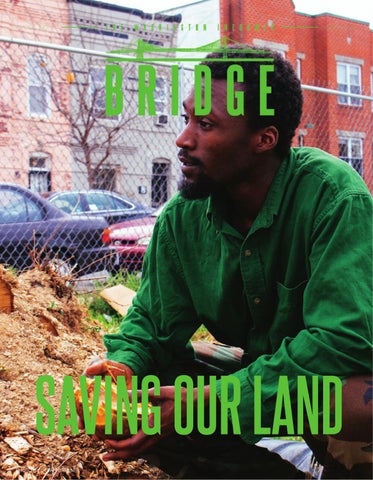
SAVING OUR LAND PHOTO BY DEJAH GREENE
CONTENTS
EDITOR’S LETTER
PUBLISHER Denise Rolark Barnes
Broccoli City Festival DC 2015- What Can We Expect? 2 DC’s Newest Approach to Sustainable and Affordable Housing Recieves Mixed Reviews 3 Millenials Say They Need More Sustainable Transportation 4 Looking Back with Dejah Greene 5
ON THE COVER
Dear WI Bridge Readers, Thanks for your continuous support of a grassroots publication that aims to spread awareness about the issues of concern to D.C.’s black millennial population. So far, it has been a lovely ride. As our staff grows, so does our ability to keep our eyes and ears to the streets and tell the real stories of local people of various backgrounds and career fields. Our April issue, the third installment in our series, focuses on sustainability, a theme that’s a testament to the changing of the seasons and the passion with which we, the young people of the nation’s capital, talk about our relationship with the Earth. In this edition, you will read about an upcoming Earth Day festival that has been the talk of the town for
the last couple years. Readers can also grasp an understanding of why smart growth will reduce traffic and save our ecosystem. Another piece in this issue features entrepreneurs who are saving the Earth, one storage unit at a time.
STAFF Sam P.K. Collins Editor-in-Chief
As always, we want to hear your thoughts about WI Bridge. Please send any and all inquiries to wibridge@ washinformer.com. We’re also on the lookout for D.C.’s brightest and hungriest journalists. If you think you have what it takes, contact us today. Sam P.K. Collins Editor-in-Chief WI Bridge
Chelsea Fuller Editor
REPORTERS Melvin Graham
Loren B. Coleman, Ph.D
MISSION STATEMENT The WI Bridge sets out to highlight contemporary issues through the experiences of youth and capture the progressive, entrepreneurial spirit of the Millennial generation other publications gloss over. Writers will take to streets and feature people, programs, initiatives, and movements that uniquely address prominent youth issues. This hardhitting coverage will lay to rest misconceptions of Generation Y and bring all to an understanding of diverse youth experiences.
Ambre Tomlinson
PHOTOGRAPHER
Clifton Powell, a 32-year-old massage therapist, founded the Coconut Grove, a safe space for residents who live near Hanover Place and North Capitol Street in Northwest to connect, tend to the earth, and beautify their community, Powell says the project, now in the midst of its second growing season, has changed the conditions of the neighborhood for the better: residents have interacted with each other more in recent months and the incidences of crime have decreased./ Photo by Dejah Greene
1 | WI BRIDGE
Dejah Greene
LAYOUT Kelcey Abney
BROCCOLI CITY FESTIVAL DC 2015 -- WHAT CAN WE EXPECT? By Ambre ‘MzGreenEyez’ Tomlinson WI Bridge Contributing Writer @Missgreeneyez The warmer weather and spring flowers are finally here in D.C., just in time for the annual Broccoli City (BC) Festival 2015. Focused on health and environmental sustainability, the popular festival brings together people from all walks of life, all of whom share a respect for green initiatives. Key players from the D.C. Metropolitan area music and entertainment scene will be present to grace the stage with the color and versatility this festival celebrates. Along with great music, Broccoli City Festival DC offers a taste of environmental and spiritual health conscious practices. Some vendors provide healthy and delicious cuisine, sustainable fashions, jewelry, hair care and artwork while others provide fitness booths and workout challenges Jamon Williams, communications director for Broccoli City, explained that the Broccoli City movement is in its earliest stages. “The company blossomed originally from an organic t-shirt company in Los Angeles, California” Williams said. “Marcus Allen and Brandon McEachern and I built the company to be what it is today.” BC Festival is now bi-coastal, taking place each year in California and Washington DC. Williams said he attributes the success of the festivals to “creativity, the sharing of ideas and not being afraid to keep a good idea going until it comes to fruition.”
is a well-known party guru in DC, and is famous for providing a fabulous turn out and “turn up.” Baker stated “I look forward to not only good music and the opportunity to give new talent some shine, but maybe learning some new yoga tips as well.” He is a firm believer of caring for your body and practices yoga regularly. Another esteemed and beloved DJ from the DMV, DJ Money, will make an appearance. DJ Money said “I came up with all new material, heavy energy and a crew of dancers and hype men that everyone in the crowd can’t help but respond to.” Local Songbird Reesa Renee referred to her appearance at Broccoli City 2014 as “A big family reunion where I was asked to say the prayer.” A common thread between all of the performers, vendors and planned attendees, is a pride of their individuality and an awareness of the beauty that they weave when they come together in support of a worthy cause. Broccoli City Co-founder Brandon McEachern said “As we promise to do each and every year, BC Fest delivers a one-of-a-kind cultural experience that bridges the divide between environmental and urban communities.”
Broccoli Festival 2015 Flyer
“We’re very excited about this year’s festival and look forward to commemorating the 45th anniversary of Earth Day with one of the most influential artists of our generation headlining,” said Broccoli City Co-founder Brandon McEachern. “Every year our goal is to deliver BC Festival-goers with a lineup that’s unique to the BC Fest experience.” The 2015 artist line up has some diverse talent the audience is sure to love. Ms. Erykah Badu will be headlining along with Willow and Jaden Smith, Tiara Thomas and the sultry songstress on the rise, Tink, just to name a few. Some area favorites on the bill include Abir Haronni, Lightshow and Born I Music. This year’s host DJ is Jerome Baker, III., who also hosted last year’s event. Baker, co-owner of Rock Creek Social Club,
Thousands of people from across the D.C. metropolitan area attended the Broccoli Festival on the grounds of St. Elizabeths East Campus in Southeast. This year’s installment will take place at the same location on April 25./ Photo Courtesy of DJ Fusion of Fuse Box Radio
WI BRIDGE | 2
D.C. NEWEST APPROACH TO SUSTAINABLE AND AFFORDABLE HOUSING RECEIVES MIXED REVIEWS By Loren B. Coleman, Ph.D. WI Bridge Contributing Writer Twitter: Ms_LorenS Just a few blocks from Brookland-CUA metro station, nestled between two detached brick homes, SeaAU stands three stories high. SeaAu, the first recycled residential shipping container apartment building in Washington, D.C., developed by Travis Price Architects, markets mainly to Catholic University students.
to include granite countertops and the newest appliances? As the District’s population continues to grow, so does the demand for housing. While the real estate market is booming, some residents are able to take advantage of new developments, and others are not.
“I think it’s pretty cool,” said Autumn Saxton-Ross, program director of Place Based Initiatives at the National Collaborative for Health Equity who has lived in D.C. for 21 years. “This is a great example of how the city can produce sustainable and affordable housing. To me, sustainability in all contexts, is about using the least amount of resources to create the greatest benefit for communities, and SeaAU does just that.” The apartment building, located on Seventh Street NE, is made up of 24 sea shipping container units, with each standing nine feet high, eight feet wide and 40 feet long. Inside the apartment building, green features include Photo Courtesy of Travis Price Architects sound and heat insulation, birch plywood and plywood floors. For example, after the construction of the Twenty-four shipping containers are Columbia Heights metro, new businesses stacked on top of each other, creating six flocked to the neighborhood and drove bedrooms and bathrooms, and a common rent prices up. In the 2000s, the Black kitchen and living space on each floor, population in the Columbia Heights with simple and modern interior features. declined by more than 25 percent, Since its completion, plans are in place while the White population quadrupled, to open similar developments in the according to Governing’s gentrification city to help increase affordable and report. Numbers indicated that more environmental-friendly housing options Black residents in Columbia Heights for millennials and homeless populations either could not afford to or refused to in Washington, D.C. pay steadily increasing rent prices. “It’s cheaper for us to keep the sea containers, then to ship them back,” said Saxton-Ross, 38, originally from Kansas City, Mo. “So, why not use them to build sustainable housing? Sustainability is movement away from the overextension of resources. And the city should think of alternatives to this vast development of luxury housing. What happened to just housing? Does everything have 3 | WI BRIDGE
“I was living in Columbia Heights as it started to flourish, said Mohamed Sheriff, 29, originally from Newark, NJ. “My apartment building informed residents that we had an option for upgrades in our units that would eventually increase our rent at minimal rates. Our rent went from 1400 to 1900 dollars a month because of these upgrades. I had to move because I couldn’t afford that,” said Sheriff,
a literature specialist at the National Endowment for the Arts who has lived in D.C. since 2008. Columbia Heights is just one example of a neighborhood where communities of color, specifically millennials, have been squeezed out, and then, struggle to find affordable housing in the city. And these millennials are young professionals, with full-time jobs,
another way to squeeze more money out of renters.” Despite some initial resistance from city officials, SeaAU is now home to 18 residents. Currently, Price Architects plans to build a second shipping container building on Gales St. N.E., just shy of the H. Street Corridor. Unlike SeaAU, this building will have three-bedroom units for family living. To help provide more sustainable and affordable housing in
Photo Courtesy of Travis Price Architects
said Sheriff, as he described his renter’s experience in the city. The 2014 Census reported the city’s population is up 90,000 from its low point of 572, 059 in 2000. While the city benefits from population growth, there are not enough affordable housing options in the city, according to Mayor Muriel Bowser in her 2015 State of the District Address. In her address, Mayor Bowser promised to secure an additional $100 million for affordable housing initiatives in the district. And using fewer resources, like SeaAU, and existing infrastructures to provide affordable housing is necessary and sustainable, according to Saxton-Ross. However, not all D.C. residents believe affordability is a priority for housing developments like SeaAU. “Why try to reinvent the wheel?” asked Sheriff. “If the city were really trying to create real opportunities for affordable housing, it would have happened already. These shipping container units sound like
D.C., Price Architects plans to offer forty percent of the Gale St. units as affordable housing. Half would be held for those making the area’s median income, which is $107,000 and the other half would be offered to those making 50 to 80 percent AMI, Price detailed in a WTOP interview. Eventually Price plans to construct floating shipping container communities for millennials to live on the Potomac River, and pop-up villages for homeless populations near Georgetown. “The renting market in D.C. is pushing out lower and middle classes, and now, upper-middle class single professionals are being pushed out, too,” said Sheriff. “Who are all these new developments for? It is no longer just about race. It’s about social economics and class.”
MILLENNIALS SAY THEY NEED MORE SUSTAINABLE TRANSPORTATION By Melvin Graham WI Bridge Contributing Writer @_MelG_ Millennials, categorized as those with birth years ranging from the early 1980s to the early 2000s, have been flocking to the D.C. metropolitan area in droves over the last few years in pursuit of professional opportunities. While this group, also known as Generation Y, is said to be the most environmentally conscious generation to date, the Pew Research Center found that the influx of young people travelling to and from work daily has caused great damage to the environment.
stormwater flows, temperatures, natural habitat and community cohesion.”
A December 2014 report from RealtyTrac, a real estate information company, described the D.C. metropolitan area as a home to the three U.S. cities with the highest percentage of millennials: Arlington, Va. with 39 percent, Washington, D.C. with 35 percent and Alexandria, Va. with 34 percent. Between personal automobiles, passenger-determined travel and public transit, this generation utilizes a myriad of transportation options, all of which pollute the air, water and land.
ARCADIS, a firm that provides consultancy, design, engineering and management services in sustainability, publishes an annual index that ranks cities based on planet, people, and profit, which are essentially the same three DDOT sustainability elements of environment, social structure and economy. Washington, D.C. ranks as the sixth most sustainable city in the U.S.
Michelle Phipps-Evans, DDOT’s communication specialist, echoed this mantra and cited the details expressed in its guidebook: “Our sustainability approach consists of three elements: Environment; social structure and economy,” said Phipps Evans. “This plan serves as an important step in keeping DDOT’s commitment to using sustainable practices.”
“I rely on Metro trains and buses, along with Uber and Lyft,” said Christine Deloatch, 27, who lives in Takoma Park, Maryland. “Convenience, saving money and ‘going green’ are factors that led to choosing my forms of transportation,” said Deloatch, an event planner and publicist who also highlights avoiding traffic as an advantage of not owning a car. According to an annual traffic index created by TomTom, a navigation system maker that ranks cities based on the length of time that residents spend idly in their cars, Washington D.C. counts as the ninth worst city in the country for traffic congestion. This ranking speaks not only to the inconvenience posed to commuters, but to the amount of time their cars emit carcinogens into the air. This has encouraged some transportation entities to create new routes that will allow drivers to reach their respective destinations is less time. D.C. officials are among those making a change. The District Department of Transportation (DDOT) uses its Environmental Policy and Process Manual as a guide for addressing environmental issues that arise during the planning and execution of DDOT projects. The first chapter stresses that the local government agency “understands the influence of transportation facilities on the development of adjacent land and the ability of transportation infrastructure to affect the environment by changing
Photo courtesy of Melvin Graham
and intensity of extreme weather events will impact transportation facilities and services for residents, commuters and businesses in the District. As D.C. strives to improve sustainability while continuing to develop economic infrastructure, an important factor to consider is how DDOT responds to the growing list of commuter destinations that exist out of walking range from public transportation. Jessica Gray, who works as a business manager for several charter schools in the District, needs transportation options which are not limited by the reach of public transportation. “I mostly drive, but I use the train and Uber periodically,” said Gray, 28 from Southeast D.C.. “My job requires me to be flexible and mobile, so a car makes more sense for me than relying on the train or bus.” Public transportation is controlled by the Washington Metropolitan Area Transit Authority (WMATA), which operates Metrorail and Metrobus throughout the District and its surrounding areas in Maryland and Virginia.
Jessica Gray/ Courtesy Photo
The DDOT is striving to improve the District’s ranking in sustainability with two main climate change initiatives, the Greenhouse Gas (GHG) Emissions Inventory and the Climate Change Adaptation Plan, according to the section on DDOT’s website detailing projects and planning for the environment. The Greenhouse Gas Emissions Inventory is an effort to account for, monitor and reduce DDOT’s GHG emissions. The results of the inventory have shown that improvements are already being made and can be used to strategize how to further reduce emissions. The Climate Change Adaptation Plan takes into consideration how global warming, sea level rise and the increased frequency
According to WMATA’s website, the sustainability plan of WMATA includes connecting communities by expanding the reach of transit through new system access points via rail stations and bus stops and making stations more walkable and fixing accessibility barriers to existing development. WMATA’s website also details initiatives similar to that of DDOT to improve sustainability for the Metrorail and Metrobus services that it provides throughout the city and its surrounding areas. WMATA has a greenhouse gas target of 50 percent reduction in GHG emissions per vehicle mile and 30 percent renewable electricity by 2025 and lists current initiatives of Leadership in Energy & Environmental Design (LEED) certified new construction and major facility retrofits and asset inventory
and evaluation for solar generation capacity. WMATA’s climate change initiatives include a regional bus network optimization program and the target is 10 percent increase in GHG displacement by 2025. In comparison, the Metropolitan Transportation Authority (MTA), which operates the public rail and bus transit system in New York City, Ny., has many similar goals concerning sustainability. Its most recent self-conducted sustainability report identifies several factors that MTA can leverage to increase environmental gains: avoiding carbon emissions; managing regional congestion; and optimizing land use. Using New York City as a benchmark, Ashley Graham, 23 from Brooklyn, New York feels that the District could improve its sustainability in several ways. Graham, an transdisciplinary design graduate student who earned her undergraduate degree in D.C., notices an abundance of clearly marked and protected bike lanes and multiple train and bus routes in all areas of her new city. According to DDOT, approximately seven miles of bicycle lanes could be added to District streets in 2015. WMATA recently added Phase One of its Silver Line, expanding train access to residents as far as Reston, Va. Phase Two will continue through Fairfax County, Va. into Loudoun County, Va., ending the need of a car to access Dulles International Airport. “Due to the sparseness of the D.C. transit system, residents are more dependent on cars for transportation which decreases the financial capacity of the mass transport system, leading to more pollution,” said Graham. “D.C.’s transportation sustainability is dependent on increasing ridership of mass transportation to build more robust infrastructure and decrease wait times and scarcity of accessible transit options.” WI BRIDGE | 4
LOOKING BACK WITH DEJAH GREENE Dejah Greene, a 22-year-old photographer from Bowie, Maryland, chronicled the National Cherry Blossom Festival,Washington, D.C.’s springtime celebration centered on the the flower that symbolizes a peaceful friendship between the United States and Japan. Below are the photos Ms. Greene took of the performers who graced the stage at the April 10 event. Lead Opera singer during the opening ceremony at the Cherry Blosom Festival
Miss America’s Outstanding Teen Olivia McMillian sings a song from the movie ‘Frozen’ at the Cherry Blossom Festival
Grammy Award winning singer Estelle
Howard Gospel Choir of Howard University
5 | WI BRIDGE
NCSS Queen’s Float U.S. Cherry Blossom Queen, and Runner up
Washington D.C. Ballou Majestic Marching Band from Ballou High School
Washington Redskin Cheerleaders
All Star Tap Dance Performers
“Sing into Spring” Vocal Cherry Blossom Competition Sopranessence
Tamagawa University Taiko Drumming and Dance Troupe
WI BRIDGE | 6
YOUR BUSINESS COULD BE ADVERTISED ON THIS PAGE. For more information, send an email to wibridge@washingtoninformer.com or call 202-306-6294.