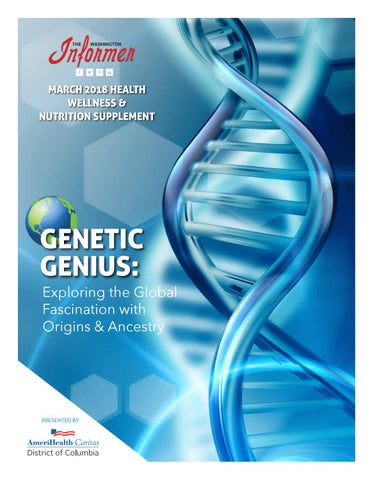
MARCH 2018 HEALTH WELLNESS & NUTRITION SUPPLEMENT
GENETIC GENIUS:
Exploring the Global Fascination with Origins & Ancestry
PRESENTED BY
FROM THE EDITOR
NEWSPAPER READING IS A HABIT DON’T BREAK THE HABIT!
Genetic Genius
Exploring the Global Fascination with Origins & Ancestry
READ THE WASHINGTON INFORMER YOUR WAY: In Print – feel the ink between your fingers of our Award Winning Print Edition
n
On the Web – www.washingtoninformer.com updated throughout the day, every day
n
n
On your tablet
n
On your smartphone
n
n
n
Weekly Email Blast – sign up at www.washingtoninformer.com
202-561-4100 For advertising contact Ron Burke at rburke@washingtoninformer.com
Dr. Shantella Sherman Special Editions Editor
...Informing you everyday in every way
In Memoriam Dr. Calvin W. Rolark, Sr. Wilhelmina J. Rolark THE WASHINGTON INFORMER NEWSPAPER (ISSN#0741-9414) is published weekly on each Thursday. Periodicals postage paid at Washington, D.C. and additional mailing offices. News and advertising deadline is Monday prior to publication. Announcements must be received two weeks prior to event. Copyright 2016 by The Washington Informer. All rights reserved. POSTMASTER: Send change of addresses to The Washington Informer, 3117 Martin Luther King, Jr. Ave., S.E. Washington, D.C. 20032. No part of this publication may be reproduced without written permission from the publisher. The Informer Newspaper cannot guarantee the return of photographs. Subscription rates are $45 per year, two years $60. Papers will be received not more than a week after publication. Make checks payable to: THE WASHINGTON INFORMER 3117 Martin Luther King, Jr. Ave., S.E Washington, D.C. 20032 Phone: 202 561-4100 Fax: 202 574-3785 news@washingtoninformer.com www.washingtoninformer.com
PUBLISHER Denise Rolark Barnes STAFF D. Kevin McNeir, Editor Ron Burke, Advertising/ Marketing Director Shevry Lassiter, Photo Editor Lafayette Barnes, IV, Assistant Photo Editor John E. De Freitas, Sports Photo Editor Dorothy Rowley, Online Editor ZebraDesigns.net, Design & Layout Mable Neville, Bookkeeper Dr. Charles Vincent, Social Sightings columnist Tatiana Moten, Social Media Specialist Angie Johnson, Circulation REPORTERS Stacy Brown (Senior Writer), Sam P.K. Collins, Timothy Cox, Will Ford (Prince George’s County Writer), Eve M. Ferguson, Hamil Harris, Tatyana Hopkins, Jade James-Gist, Edwin Lake, Daniel Kucin, D. Kevin McNeir, Lauren Poteat, Dorothy Rowley, Brenda Siler, Sarafina Wright (General Assignment Writer) PHOTOGRAPHERS John E. DeFreitas, Shevry Lassiter, Roy Lewis, Demetrious Kinney, Mark Mahonny, Lateef Mangum
Cruising the aisles of a local Tar-get store a few weeks ago, I stum-bled upon a 23andMe home testing kit, set obscurely among a sundry of discounted endcap items. Priced at a steal - $25, what made the item even more oddly placed, was that unlike the lotion, vitamins, and hair essentials occupying the same shelf, the 23andMe kit had been touted as one of the most revolutionary breakthroughs in modern history. Tapped as a means of not only drawing direct and distinct lines from our present lives to genetic ancestors removed by thousands of years, DNA ancestral testing also offered a p otential d isclosure o f hereditary disease, and thereby, the medical insight necessary to pretreat or prevent. The n ation’s g rowing o bsessions with genetics, genomes, DNA, environment, and predisposition, are not exactly a new phenomenon. In fact, much of our nation’s policies, whether situated within public health, education, housing or the criminal justice system, have firm f oundations i n t he s upposed strengths or weaknesses of the American gene pool. As early as 1850, Francis Galton – a cousin of Charles Darwin – began yanking at the collars of white fears by introducing the science of eugenics which
theorized: 1) that not only were hair texture, eye color, and some diseases passed through DNA from parent to successive generations, but so too, were social traits like laziness, I.Q., criminality, immorality, and poverty; 2) that weeding out the unfit through incarceration in asylums or reproductive sterilizations was the only means for keeping the social purity and strength of America intact; and 3) that those with African ancestry – even the smallest amount – could be classified as genetically and socially inferior (or dysgenic) and therefore, a hazard to whiteness. Eugenics, though disproven, scientifically bracketed Jim Crow seg-
regation, socially promoted redlining, and emotionally crippled one segment of America into believing in their own genetic superiority. Today, eugenics continues to undergird our social engagement, public policy, and popular culture. As an historian, I see eugenics clearly in laws that criminalize 3-year-olds in the fits of tantrums by labeling them “feral,” or animalistic. Conversely, eugenics can be seen in popular television series like BBC’s cloning drama Orphan Black, in current events wherein leaders tout drug trafficking as a “race trait” among immigrants; or speak of African-Americans as the face of poverty, health crises, or poor intellect. For geneticists, who’ve marveled at the resilience of African genes, from the earliest Matrilineal line traced through anthropology to the Biblical Eve, to the HeLa cells harvested from Henrietta Lacks, understand African DNA is anything but dysgenic. In fact, given its origins (past), resilience (present), and research-building properties (future), Black genes amount to genetic genius. It is here, that The Washington Informer invites you to invest a bit of time in your own understanding of: Who you are, to whom you belong, and the pricelessness of your DNA. Read, Enjoy, Grow.
“Eugenics, though disproven, scientifically bracketed Jim Crow segregation, socially promoted redlining, and emotionally crippled one segment of America into believing in their own genetic superiority. Today, eugenics continues to undergird our social engagement, public policy, and popular culture.”
www.washingtoninformer.com / MARCH 2018 HEALTH WELLNESS & NUTRITION SUPPLEMENT
H-2
The Science of it All
Compiled by Ronda Smith, Special to the Informer
be used for their purposes in perpetuity.
Genetic ancestry testing can prove confusing for those who have not done a bare amount of research, but there’s little to fear. While based on science, there are a few basic categories to note in order to determine which tests you want. There are three types of genetic ancestry testing commonly used for genealogy listed below. With all testing that requires your blood, saliva, stool or urine samples, read the fine print concerning the scope and reach of the samples. In many instances, your samples become the property of the testing agents after the services and may
Y CHROMOSOME TESTING (THE GUY THING TEST):
Variations in the Y chromosome, passed exclusively from father to son, can be used to explore ancestry in the direct male line. Y chromosome testing can only be done on males, because females do not have a Y chromosome. However, women interested in this type of genetic testing sometimes recruit a male relative to have the test done. Because the Y chromosome is passed on in the same pattern as are family
names in many cultures, Y chromosome testing is often used to investigate questions such as whether two families with the same surname are related.
MITOCHONDRIAL DNA TESTING (MAMA’S MIGRATION TEST):
This type of testing identifies genetic variations in mitochondrial DNA. Although most DNA is packaged in chromosomes within the cell nucleus, cell structures called mitochondria also have a small amount of their own DNA (known as mitochondrial DNA). Both males and females
have mitochondrial DNA, which is passed on from their mothers, so this type of testing can be used by either sex. It provides information about the direct female ancestral line. Mitochondrial DNA testing can be useful for genealogy because it preserves information about female ancestors that may be lost from the historical record because of the way surnames are often passed down.
SINGLE NUCLEOTIDE POLYMORPHISM TESTING (WHERE ARE YOUR ROOTS TEST):
These tests evaluate large numbers of variations (single
nucleotide polymorphisms or SNPs) across a person’s entire genome. The results are compared with those of others who have taken the tests to provide an estimate of a person’s ethnic background. For example, the pattern of SNPs might indicate that a person’s ancestry is approximately 50 percent African, 25 percent European, 20 percent Asian, and 5 percent unknown. Genealogists use this type of test because Y chromosome and mitochondrial DNA test results, which represent only single ancestral lines, do not capture the overall ethnic background of an individual. HS
FREE ADMISSION WALTER E. WA SHINGTON CONVENTION CENTER
March 10-11, 2018 In partnership with Giant Pharmacy / Johnson & Johnson Family of Consumer Companies
DOREEN GENTZLER Expo Host & NEWS4 Anchor/Health Reporter
The George Washington University Hospital
H-3 H-3
MARCH 2018 HEALTH WELLNESS & NUTRITION SUPPLEMENT / www.washingtoninformer.com
Eat Well to Stay Healthy
Submitted by AmeriHealth Caritas District of Columbia (DC) January 1 may have come and gone, but it is never too late to stick to healthy resolutions. This is especially true if you want to make healthy eating a priority. Eating the right foods is a good goal to have. That’s because eating healthy and staying active put you on the path to good health. Now is a great time to start adding healthy foods into your diet. Start with small changes and work your way up. This may give you a better chance of sticking with your eating goals. Think of each little change as a small victory on your path to living healthier. Keep making these small “wins” and you will build a
healthy eating style for yourself.
HERE ARE SOME SMALL CHANGES TO GET YOU STARTED:
• Fill at least half of your daily plate with fruits and vegetables. There are many different kinds to choose from. Be creative and eat a variety of fruits and vegetables of different colors, shapes, and sizes. • Choose whole grains over refined grains at least half the time. • Try to eat different kinds of proteins, like lean meats and beans. • Cut back on high-fat foods. Start by eating one less serving each week until you are eating two servings or less of high-fat
foods each week. • Talk to your doctor about other ways you can make healthy food choices. No matter your lifestyle, there are many ways for you to eat healthy. Do you need tips for family meals? Need ideas for how to eat healthy in a hurry? Or are you hoping to find ways to sneak more veggies into your day? If so, then keep reading.
MAKE MEALS A FAMILY AFFAIR
Share your healthy habits with your family and: • Involve your kids at mealtime. Eat your meals with your children when you can. You may even invite them into the kitchen to help prepare food or set the table. Then, turn off the TV and enjoy upbeat talks at the table. • Make food fun. Talk about the colors, feel, or flavors of foods to get kids excited about them. • Let kids be tasters. Your kids may not want to eat healthy at first. They might need a few tries before accepting a new food. Keep trying different healthy foods to find what your kids like.
• Visit the food store together. Let your child pick out a new healthy food to try. Then ask what they want to make for meals that week. See if you can find ways to make healthier versions of their favorite foods. For example, you can bake instead of frying. • Forget the clean plate club. Instead of making kids eat a full plate of food, let them serve themselves small portions and ask for more if they are still hungry. • Sweets are “sometimes” treats. Treats should be just that — treats. These sweet and sugary foods are not for every day.
Be sure to teach your child that cookies and other sweets are only “sometimes” foods.
ADD NUTRITION, QUICK!
If you want to make a healthier meal in a hurry, try these tips: • Add frozen vegetables, such as corn, peas, edamame, or spinach to your favorite macaroni. Frozen vegetables are fast and easy, and just as healthy as fresh veggies. • Drink your veggies. Add uncooked kale, spinach, carrots,
CONTINUED ON PAGE H-5
www.washingtoninformer.com / MARCH 2018 HEALTH WELLNESS & NUTRITION SUPPLEMENT
H-4
CONTINUED FROM PAGE H-4 or collards to orange juice with pineapple or bananas. Blend well with ice for a tasty smoothie. • Add nuts or beans to rice and pasta dishes for added protein. • Instead of jelly or jam, use sliced fruit on your peanut butter sandwiches. Bananas, strawberries, apples, peaches, or grapes are all yummy.
EAT RIGHT FOR YOU AND YOUR BABY
If you are pregnant, one of the best things you can do for your baby is to eat healthy. But remember, eating for two does not mean eating twice as much food. Give your baby important vitamins and minerals with a balanced diet by eating: • Nine to 11 servings of bread, cereal, rice, and pasta each day. Be sure to choose whole grains and brown rice options. • Four to five servings of vegetables. Try to make at least two servings green, leafy vegetables. • Three to four servings of fruit a day. • Three servings of milk, yogurt, and cheese a day. • Three servings of meat,
“If you are pregnant, one of the best things you can do for your baby is to eat healthy. “ poultry, fish, dry beans, eggs, and nuts. Pregnant women should also drink plenty of fluids. Ask your doctor how much fluid you should get each day. For help with eating healthy during your pregnancy, contact the AmeriHealth Caritas District of Columbia (DC) Bright Start® program at 1-877-759-6883. Sources: ChooseMyPlate.gov and Medline Plus All images are used under license for illustrative purposes only. Any individual depicted is a model.
Programs available to members Being the best version of you means making smart food choices and staying active. If you are an AmeriHealth Caritas DC member, we have programs to help. • The Weight Watchers® program can help you reach your weight-loss goals with the help of a trained meeting leader and group support. If you are an AmeriHealth Caritas DC member, you can get local meeting vouchers to get started in the program. This means you can attend Weight Watchers meetings in your community at no cost to you. To learn more or to sign up for the Weight Watchers program, call 202-216-2318. • AmeriHealth Caritas DC members can join a no-cost fitness program. Check out www.fitnesscoach.com to learn more about the program. • The AmeriHealth Caritas DC Member Wellness Center gives members free cooking classes, fitness classes, and care management help. With free transportation and a Kids’ Zone, the Member Wellness Center makes it easier to create a healthy lifestyle. To learn more, call 1-877-759-6224. • Wellness Circles are an AmeriHealth Caritas DC partnership with Summit Health Institute for Research and Education (SHIRE). Members can join Wellness Circles at no cost. You can learn about healthy eating and exercise habits to keep your blood sugar and blood pressure in check. Call 202-216-2318 to get more information or register. • Aunt Bertha, at acdc.auntbertha.com, is an online search service that helps you link to resources in the District and across the United States. Just enter your ZIP code to find resources near you. There are many resources for nutrition and healthy eating. For more information about these programs, call AmeriHealth Caritas DC Member Services at 1-800-408-7511 (TTY/TDD 1-800-570-1190). Take advantage of them and see how they make you feel. Start small and stick with it. Your health is worth it.
I got a gift card for getting my postpartum checkup. You can too. You can get a $25 gift card if you: • Are an AmeriHealth Caritas District of Columbia member
Rewards Program
• See a midwife or OB/GYN within three to eight weeks (21 – 56 days) after giving birth
After your exam, you can sign up for a gift card to one of these retailers: • Walmart • Chipotle • H&M
• Downtown Locker Room (DTLR)
Visit www.amerihealthcaritasdc.com/giftcard to learn more. Note: Member cannot get more than $50 in incentives each year.
AmeriHealth Caritas District of Columbia complies with applicable federal civil rights laws and does not discriminate on the basis of race, color, national origin, age, disability, or sex.
www.amerihealthcaritasdc.com ACDC-18175599
H-5 H-5
MARCH 2018 HEALTH WELLNESS & NUTRITION SUPPLEMENT / www.washingtoninformer.com
Who Are Your People?
Finding Family through DNA Genealogy
By Barrington M. Salmon Special to the Washington Informer
IN SEARCH OF REAL ANCESTORS
Anaisa Bayala remembers vividly as a child trying to sit still while her mother put chemicals in her hair to straighten it. “She used to relax my hair at age 4. She threatened me, told me if I told anyone, she’d beat my (butt),” said Bayala, with a laugh. “Mom tried to hide our culture, but she moved into a Black neighborhood.” Her mother was born in the Dominican Republic, Bayala said, where even though most residents are undoubtedly Black, they claim to be ‘Indios,’ Spanish or anything but African. Bayala, a genealogy enthusiast, said she also recalls coming home from school and asking her Abuelo, her grandfather about his experiences as a black man in the 1940s and ‘50s. “Ignorant me. I opened a can of worms. He let me have it, yelled at me, lit into me, told me he wasn’t black,” Bayala said. “He said ‘I’m Indio.’ It wasn’t my grandfather’s fault. It is something that was engrained in the Caribbean. There are 32 degrees of blackness and 95 percent of the people in the Dominican Republic are black but people described themselves as Indians with good hair and said they got their complexions by being in the sun.” Bayala said she didn’t grow up with her father, who was Puerto Rican, but when they reconnected she asked lots of questions, then went digging. “My father and I used to talk all the time and he would ask me ‘how many people did I bother today?’ It became a daily thing. I had him on speed dial.” “This is like vindication for our Ancestors.” Bayala, a project manager at Verizon in Florida, said she’s fallen in love with genealogy, ancestry and the search for family and roots. Bayala, who grew up in New York City, said she’s traced her ancestry to Angola
and has cousin matches from the Gambia, Ghana and the Congo. She said she has cousin matches from Gambia, Ghana and Congo. “I have more than 21,000 cousin matches from Ancestry DNA. I’m a first-generation immigrant whose parents came to the U.S. beginning in the 1940s, yet I have many Jamaican and Brazilian cousins. The nice thing about it is we all descend from this line.” Bayala said she created a website where she helps other people to seek and find family and ancestors without cost, and also offers them references of where to track down information. Her website has detailed genealogical information from 15 different Caribbean islands and nation-states.
‘FINDING YOUR ROOTS’
Bayala is one of millions of people of African descent who are or have used DNA testing to trace their roots. Like her, they seek to fill the void of not knowing their history, the names of their ancestors or where they’re from. Most are descendants of enslaved Africans torn from the continent of Africa beginning in the 1400s, with an estimated 30-90 million transported to the New World, and millions more dying before they reached ports in the Caribbean, U.S. and Latin America. Many people of African descent and people of color hit a brick wall in their search for family because enslaved people were stripped of their original African names, language and culture in what many historians describe as the most dehumanizing chapter in world history. Slave owners in the U.S., Britain and elsewhere regarded enslaved Africans as property and often didn’t bother to list them by name. Also, many didn’t have a last name or were given the name of the slave master. The mini-series, Roots, triggered in the late 1970s an upsurge of interest in African Americans’ past, their ancestry and blood ties. The PBS program, Finding Your Roots, in its fourth year and wildly popular, showcases host and historian Henry Louis Gates and a team of genealo-
gists and researchers, unearthing the family histories and stories of American celebrities. Among those who have sat with Gates: actress Lupita N’yong’o, singer-songwriter Carly Simon, actress Angela Bassett, Sen. Bernie Sanders, political strategist Ana Navarro, rapper Nas and basketball star Carmelo Anthony. “What we have is story telling power,” Gates said in an earlier interview. “We turn raw data into narrative. If you trace your family tree and you find say the 1900 census, well it looks pretty boring if you’re looking at it on the computer screen. But if you could contextualize it, figure out why were they there? What was happening in this society at the time? Why would they move from what is now Poland to New York City with five dollars in their pocket? It’s fascinating and riveting.”
Gates, the Director of the Hutchins Center for African and African American Research at Harvard, said spotlighting how different ethnic groups contributed to world history and the ways that their experiences ‘merged or conflicted’ with those of other groups is also of immense value, he explained. At the end of the day, he said, a program like ‘Finding Your Roots’ is “part of a larger education process to make us all realize we’re fully human.” “Finding Your Roots is aimed at more than satisfying individual curiosity and telling an engrossing story, said Gates, a writer and executive producer of the series. “It carries a message of shared origins that he argues can benefit society. The science of DNA proves that ‘there aren’t four or five biologically distinct races.
The Fine Print
Understanding Your DNA Rights After Testing By Barrington M. Salmon Special to the Washington Informer If you plan to take a DNA test to determine your ancestry, legal, privacy and other experts caution you to read the fine print before you sign away your rights. A November 2017 NBC News story, authored by Maggie Fox, pointed out that in signing on the dotted lines, individuals give away the most important thing they own: their genetic fingerprint or DNA. “It sounds like such a fun gift idea: a DNA test that can tell your sister-in-law whether she really has Native American ancestors, or one that promises to craft your friend a perfect diet based on his genes,” Fox wrote.
“Home DNA tests are likely a big seller, but privacy experts say consumers should be cautious. The problem is that when you send away a tube of your spit or cheek swab, you are giving away your full genetic code. Every cell on that cheek swab carries the full sequence of your DNA, including the mutation pattern that makes it uniquely yours.” Peter Pitts president and co-founder of the Center for Medicine in the Public Interest concurs, saying your saliva “is the most valuable thing you own.” A 2008 law called the Genetic Information Nondiscrimination Act, according to Pitts, forbids discrimination based on genetic information and includes firing someone because they have a gene that predisposes them to an
We’re all from one race, the human race, genetically. And we know that genetically we all descended from common ancestors that left the African continent 50,000 years ago. That’s a fact.” Gates praised the uptick in digitization of data and records and advances in DNA testing, both which enhance the search process of the celebs backgrounds. But nothing can replace the old-style searches, which while tedious and painstaking are an important element in the search process. “It’s such a great gift that you can give to people,” Gates said. “I love genealogy. I think that if people do their family tree and have their DNA analyzed, it’ll help to break down barriers. It helps people realize that we’re all the same at the level of genomes.’ Read More at www.washingtoninformer.com where writer Barrington Salmon examines AfricanAncestry. com and the power of genetic genius. HS expensive disease. But it would also be hard to prove an employer did that, said Pitts. “You don’t want that information displayed to other people. Ultimately you don’t want an employer to have access to your information.” Still, as more Americans take advantage of DNA testing, concerns over privacy and ownership, particularly in the wake of the book and film The Immortal Life of Henrietta Lacks, which documents the lifesaving HeLa cell medical research gained through harvesting cancer cells from a lone African American woman in 1951, have risen. Lacks gave neither her expressed consent for the procedure that removed the two cervical samples, nor received compensation for what later formed a trillion-dollar research and treatment platform. Those offering saliva for ancestry and DNA results do, in
CONTINUED ON PAGE H-7
www.washingtoninformer.com / MARCH 2018 HEALTH WELLNESS & NUTRITION SUPPLEMENT
H-6
Noteworthy Works on Genetics, Eugenics & Racial Identity Compiled by Ronda Smith, Special to the Informer
THE SOCIAL LIFE OF DNA Alondra Nelson
In The Social Life of DNA, Alondra Nelson takes us on an unprecedented journey into how the double helix has wound its way into the heart of the most urgent contemporary social issues around race. For over a decade, Nelson has deeply studied this phenomenon. Artfully weaving together keenly observed interactions with root-seekers alongside illuminating historical details and revealing personal narrative, she shows that genetic genealogy is a new tool for addressing old and enduring issues. In The Social Life of DNA, she explains how these cutting-edge DNA-based techniques are being used in myriad ways, including grappling with the unfinished business of slavery: to foster reconciliation, to establish ties with African ancestral homelands, to rethink and sometimes alter citizenship, and to make legal claims for slavery reparations specifically based on ancestry.
REVISITING RACE IN A GENOMIC AGE CONTINUED FROM PAGE H-6 signing a disclosure, forfeit a number of things, including compensation if a company conducts scientific research with their genetic material and profits from their DNA. Joel Winston, a consumer protection lawyer who writes a column for ThinkProgress, notes that AncestryDNA takes ownership of submitters’ DNA in perpetuity. He quoted from the contract: “Specifically, by submitting DNA to AncestryDNA, you agree to “grant AncestryDNA and the Ancestry Group Companies a perpet-
H-7 H-7
Barbara Koenig, Sandra Soo-Jin Lee, and Sarah Richardson How are we to understand race? The simplicity with which this question is posed belies the complexity and fraught character of the public, scholarly, and political debates over race today. Revisiting Race in a Genomic Age suggests that the answer hinges, in part, on a larger set of issues linked to the production and consumption of knowledge in Western societies today. For that matter, the intractable and apparently irresolvable debate over the “reality” of race also may be seen as stemming from yet another broad set of uncertainties about the respective roles of culture and biology in constituting social forms of identity. The idea that we will have a simple answer to these questions anytime soon is illusory; but the task of trying to generate that answer involves some of the most interesting and pressing issues now confronting anthropologists.
documentary series. As Harvard scholar Henry Louis Gates Jr. shows us, the tools of cutting-edge genomics and deep genealogical research now allow us to learn more about our roots, looking further back in time than ever before. Gates provides practical information for amateur genealogists just beginning archival research on their own families’ roots, and he details the advances in genetic research now available to the public. The result is an illuminating exploration of who we are, how we lost track of our roots, and how we can find them again.
A CENTURY OF EUGENICS IN AMERICA: FROM THE INDIANA EXPERIMENT TO THE HUMAN GENOME ERA Paul A. Lombardo
Henry Louis Gates, Jr. Who are we, and where do we come from? The fundamental drive to answer these questions is at the heart of Finding Your Roots, the companion book to the hit PBS
In 1907, Indiana passed the world’s first involuntary sterilization law based on the theory of eugenics. In time, more than 30 states and a dozen foreign countries followed suit. Although
ual, royalty-free, world-wide, transferable license to use your DNA, and any DNA you submit for any person from whom you obtained legal authorization as described in this Agreement, and to use, host, sublicense and distribute the resulting analysis to the extent and in the form or context we deem appropriate on or through any media or medium and with any technology or devices now known or hereafter developed or discovered.” Winston added that the AncestryDNA terms also require customers to confirm that they “understand that by providing any DNA to us, you acquire no
rights in any research or commercial products that may be developed by AncestryDNA that may relate to or otherwise embody your DNA.” Essentially, you still own your DNA, but so does Ancestry.com. You can commercialize your own DNA for money, but Ancestry.com is also allowed to monetize your DNA for millions of dollars and doesn’t have to compensate you.” With all these potential pitfalls, the warning is Caveat Emptor – Let the Buyer Beware. So, please take the time to read the small print. HS
FINDING YOUR ROOTS: THE OFFICIAL COMPANION TO THE PBS SERIES
the Indiana statute was later declared unconstitutional, other laws restricting immigration and regulating marriage on “eugenic” grounds were still in effect in the U.S. as late as the 1970s. A Century of Eugenics in America assesses the history of eugenics in the United States and its status in the age of the Human Genome Project. The essays explore the early support of compulsory sterilization by doctors and legislators; the implementation of eugenic schemes in Indiana, Georgia, California, Minnesota, North Carolina, and Alabama; the legal and social challenges to sterilization; and the prospects for a eugenics movement basing its claims on modern genetic science.
WHITE TRASH: THE 400YEAR UNTOLD HISTORY OF CLASS IN AMERICA
Nancy Isenberg In this landmark book, Nancy Isenberg argues that the voters who boosted Trump all the way to the White House have been a permanent part of the American fabric and reveals how the wretched and landless poor have existed from the time of the earliest British colonial settlements to today’s hillbillies. Surveying political rhetoric and policy, popular literature and scientific theories over four hundred years, Isenberg upends assumptions about America’s supposedly class-free society where liberty and hard work were meant to ensure real social mobility - and forces a nation to face the truth about enduring malevolent nature of class.
IN SEARCH OF PURITY: POPULAR EUGENICS & RACIAL UPLIFT AMONG NEW NEGROES
Shantella Sherman In Search of Purity examines the reinterpretation of eugenic theories by Black scholars, who helped integrate the science into a social movement for racial uplift. Areas of analyses include: The Talented Tenth, links between ideas about social
MARCH 2018 HEALTH WELLNESS & NUTRITION SUPPLEMENT / www.washingtoninformer.com
degeneracy and physical hygiene, eugenics courses and professors at Howard University, hereditarian, and colorism. Terms like germ plasm (negative characteristics transmitted through genes through continual selection, unchanged, from one generation to the next), and racial hygiene (a public health platform designed to eliminate, among other ailments, venereal disease and promote healthy reproduction within a race) are analyzed in their relation to popular discourses about Black cleanliness that included “moral fitness” and intellectual ineptness.
WAR AGAINST THE WEAK: EUGENICS AND AMERICA’S CAMPAIGN TO CREATE A MASTER RACE Edwin Black
W a r Against the Weak is the gripping chronicle documenting how American corporate philanthropies launched a national campaign of ethnic cleansing in the United States, helped found and fund the Nazi eugenics of Hitler and Mengele -- and then created the modern movement of “human genetics.” Some 60,000 Americans were sterilized under laws in 27 states. This expanded edition includes two new essays on state genocide. Black examines what the eugenics movement cost America and how the idea of fusing science with popular culture ensured eugenics would impact all segments of American society. Black follows the method in which American legislation for sterilization was adopted by several European countries, including Switzerland, Denmark, Norway, and Germany – which, under Adolf Hitler utilized the platform during the Holocaust. WI
Medical Revolution: DNA, Sickle Cell, & the Stem Cell Debate By Stacy M. Brown WI Senior Writer Deoxyribonucleic acid – or DNA – testing is a very exciting frontier for sickle cell disease, specifically for African-Americans, said Dr. Lanetta Bronté, president of the Foundation for Sickle Cell Disease Research, a comprehensive nonprofit that provides a platform for researchers, healthcare providers, and those living with the monogenic disorder. “Many that are DNA-tested learn their true genetic heritage for the first time. Next, if they are unaware of their sickle cell trait status, they need to visit participating medical centers to know with certainty if they have sickle cell trait or not,” Bronté said. Approximately 2 million people
have the sickle cell trait and a majority don’t know. That and the DNA revolution counts among the highlights of the Foundation for Sickle Cell Disease Research’s 12th annual Sickle Cell Disease Research & Education Symposium at the Marriott Wardman Park in Northwest from June 15 to 17. Dr. Philippe Leboulch is scheduled to keynote the symposium and he’s expected to provide an update on his progress with the development of LentiGlobin BB305 for therapeutic ex vivo gene transfer in severe sickle cell disease. Leboulch’s vector made headlines last year with a 13-year-old sickle cell patient in Paris. Fifteen months after receiving the innovative treatment, the patient is now in complete remission of clinical signs of sickle cell
disease and correction of any biological signs, Bronté said. “The patient no longer needs to be transfused or suffers from vaso-occlusive crises. The patient will also avoid developing the potential co-morbidities many sickle cell disease patients have,” she said. While gene therapy remains very risky, this early work shows how beneficial it can be for a sickle cell patient, Bronté added. “This is an exciting time to be involved with sickle cell disease, as there are new treatments, expanding research, and a community of advocates determined to improve the quality of these patients’ lives,” she said. Despite being the first “molecular disease” ever discovered and the most common genetic disease in the US, sickle cell disease has no universal
cure and is a devastating disease that predominantly affects people from African descent, who are long underand unequally-served by the medical and research communities, said Michael Friend, who co-founded the Minority Coalition for Precision Medicine with sickle cell patient advocate, Shakir Cannon. Friend, who presented a seminar last month on sickle cell, said the disease is getting renewed attention as CRISPR researchers set their sights on finally curing it at the DNA level using gnome editing. Scientists have successfully used gene editing to repair 20 to 40 percent of stem and progenitor cells taken from the peripheral blood of patients with sickle cell disease, Rice University bioengineer Gang Bao told Science Daily last month. Bao, in collaboration with Baylor College of Medicine, Texas Children’s Hospital and Stanford University, is working to find a cure for the hereditary disease. A single DNA mutation causes the body to make sticky, crescent-shaped red blood cells that contain abnormal hemoglobin and can block blood flow in limbs and organs. In his talk at the annual American Association for the Advancement of Science meeting in Austin, Bao revealed results from a series of tests to see whether CRISPR/Cas9based editing can fix the mutation. His presentation was part of a scientific session titled “Gene Editing and Human Identity: Promising Advances and Ethical Challenges.” “Sickle cell disease is caused by a single mutation in the beta-globin gene – in the stem cell’s DNA,” he said, according to Science Daily. “The idea is to correct that particular mutation, and then stem cells that have the correction would differentiate into normal blood cells, including red blood cells. Those will then be healthy blood cells,” he said. Dr. Charles S. Abrams, an expert with the American Society of Hematology and the Francis C. Wood Professor of Medicine in the Department of Pathology and Lab-
oratory Medicine at the University of Pennsylvania’s Perelman School of Medicine, said sickle cell disease has been described in various tribes in African for more than 5,000 years. “It was discovered approximately 100 years ago by Dr. Ernest Irons when he noticed a dental student named Walter Clement Noel had red blood cells with the shape of a sickle,” Abrams said. “Red blood cells are basically bags of hemoglobin. Everyone with sickle cell disease has a change – or mutation – in the DNA of their hemoglobin gene,” he said. Abrams continued: “This mutation causes their hemoglobin to be abnormal, and consequently the red blood cells sometimes have this sickle shape. A variety of lab tests, including genetic tests can be done to diagnose an individual and to determine the risk of passing the sickle cell gene onto their children.” In Bao’s lab, he collaborated with Vivien Sheehan, an assistant professor of pediatrics and hematology at Baylor and a member of the sickle cell program at Texas Children’s, to collect stem and progenitor cells (CD34-positive cells) from patients with the disease, Daily Science said. These were then edited in the Bao lab with CRISPR/Cas9 together with a custom template, a piece of DNA designed to correct the mutation. The gene-edited cells were injected into the bone marrow of immunodeficient mice and tested after 19 weeks to see how many retained the edit. “The rate of repair remained stable, which is great,” Bao said. This engraftment study was carried out in the lab of Matt Porteus, an associate professor of pediatrics at Stanford. Another major finding of the study is that the CRISPR/Cas9 system could introduce large alterations to the genes in patients’ cells, in addition to small mutations or deletions. These off-target effects could cause a disease. The findings, part of an upcoming paper, are a step toward treating sickle cell disease. Obstacles in the way of a cure include optimizing the CRISPR/Cas9 system to eliminate off-target effects, as well as finding a way to further increase the amount of gene-corrected stem cells, according to Science Daily. Bao pointed out that researchers still don’t know whether repairing as much as 40 percent of the cells is enough to cure a patient. “We’d like to say, ‘Yes,’” he said, “but we don’t really know yet. That’s something we hope to learn from an eventual clinical trial.” HS
www.washingtoninformer.com / MARCH 2018 HEALTH WELLNESS & NUTRITION SUPPLEMENT
H-8
SEX IS...
TRUST Talk to your kids openly and honestly about sex.
Visit SexIsDC.org
LEARN. SHARE. BE. H-9 H-9
MARCH 2018 HEALTH WELLNESS & NUTRITION SUPPLEMENT / www.washingtoninformer.com
@SexIsDC
Educating and Empowering African-Americans about End-of-Life Care By Brandi Alexander When my father’s cancer came out of remission in 2010, he declined in a matter of months. I had never had one conversation with him about his end-of-life care goals, preferences and values. My family spent so much time fighting over what we thought he wanted, when in reality, none of us knew what he really wanted. That experience taught me not only the importance of these discussions, but also how much of a need there is for us to start planning early, before a time
of crisis. Unfortunately, African-Americans are less likely to complete advance directives or have conversations with our families and healthcare providers about our their end-of-life care goals, preference and values, according to a 2014 report in the American Journal of Preventive Medicine. It is critical that our community begin focusing on advance care planning about the end-of-life care options, including educating ourselves about the value of hospice and palliative care. The sad truth is that we suffer
What are your advance healthcare plans? Compassion & Choices is committed to helping people navigate their end-of-life options and make informed healthcare decisions. Having a plan in place gives everyone peace of mind. Visit CompassionAndChoices.org/eolctools for all of our FREE end-of-life tools and start having conversations about your end-of-life care today.
from higher rates of healthcare outcome disparities caused by smoking, obesity, hypertension, heart disease, and cancer. By not having frequent conversations about endof-life care options early, to prepare before a health emergency occurs, people of color often opt for aggressive, futile medical treatments that only prolong an agonizing dying process. African Americans are less likely to access comfort care, hospice and palliative care to maximize the quality of remaining life. In fact, we only account for only 8 percent of hospice users. Unlike many of the other disparities that impact the community, this is one we actually have some control over. It starts with having a conversation. 20 percent of African-Americans have not talked to anyone about end-of-life care, according to research conducted by the Duke Divinity School and the National Hospice and Palliative Care Organization. Every individual has a responsibility to lead by example on healthcare issues, so I challenge you to start having conversations today, with your personal networks and your healthcare professionals. Complete an advanced directive and identify
your power of attorney, the person who will make decisions for you in the case that you can not speak for yourself. The most loving thing you can do is to make your wishes known to your loved ones, it provides peace for all involved. Tomorrow is not promised, so whether you want every treatment option available or none at all, it’s imperative to make sure it is clear to those who matter to you the most. Start this process by visiting Compassion & Choices website page, compassionandchoices.org/ plan-your-care, where one can access state-specific advance directives and find other resources and tools to help, free of charge. We even offer a diagnosis decoder that generates questions for physicians specific to a particular illness. Educating and utilizing these resources will not only empower you, it will also have a positive and lasting impact on our community as a whole and the way we experience end of life. Remember...talking about death will not kill you...advocate for yourself! Brandi Alexander is the national constituency director for Compassion & Choices, the nation’s largest, oldest and most active nonprofit organization dedicated to expanding and improving patient-driven, end-of-life care options. HS
“African-Americans are less likely to complete advance directives or have conversations with our families and healthcare providers about our their end-of-life care goals, preference and values...”
Compassion & Choices is the nation’s oldest, largest and most active nonprofit organization committed to improving care and expanding options for the end of life.
www.washingtoninformer.com / MARCH 2018 HEALTH WELLNESS & NUTRITION SUPPLEMENT
H-10
Does It Really Run in Your Family?
By Brittany E. Tillman, CHES Overwhelmingly you will hear people’s responses about disease, “it runs in my family”. Does it really run in your family? One of the major contributing factors to the manifestation of disease in the human body is the food we put in our body, environmental influences and some genetics. Geneticists strongly believe that disease is caused by the interaction between genes (genetic makeup) and the environment. Two people may react different even if exposed to the same environmental agents, because of variances in genetic factors. One may be at high risk to develop the disease and one may be at low risk to develop the disease even if exposed to the same environmental agent. Some environmental agents are: mold, ozone, pesticides, air, pollution, cleaning solutions, dust mites and some foods and medications. Researchers have also confirmed that pathogens play a strong role in chronic disease. Pathogens, such as bacteria can be passed on from one generation to the next via the mother to the fetus; from the father to the child via sperm; blood donation,
bone marrow donation; organ donation/transplantation; and social contact. Let’s use cancer as a model; cancer is caused by a carcinogen (cancer causing agent) that can lead to the development of cancer. A few lifestyle agents that can cause cancer are: chemicals from tobacco smoke, radiation from the sun, char-grilled foods, and processed meats preserved with added chemicals, or preserved by curing, salting or smoking. The World Health Organization (WHO) stated that studies have proven that lifestyle factors are contributing factors or primary determinants for most cancers. Contributing factors that can’t be altered are your age, sex and race and/or ethnicity. The lifestyle factors include, smoking tobacco, dietary and exercise habits, carcinogens (cancer causing agents) and infectious agents. Roughly 5-10% of cancer is genetic. Genetic predisposition or genetic susceptibility is when a person is not born with a disease but may be at high risk of acquiring the disease from a genetic mutation often inherited from a parent. Look at genetic predisposition as the likelihood or chance of developing the disease from a gene mutation or family history. The National Institute of Health’s (NIH), National Human Genome Research Institute (NHGRI) lists breast cancer, colon cancer, prostate cancer and skin cancer as genetic disorders. Parkinson’s disease, sickle cell disease, autism, cystic fibrosis, Down syndrome and Chron’s disease are a few known genetic disorders. Let’s not overlook the fact that there are several human diseases that don’t have a genetic factor and those that do, such diseases are under investigation by NHGRI. Then there are some
diseases that are not diagnosable by physicians and these diseases are classified as an undiagnosed rare or genetic condition. Multifactorial inheritance disorders are disorders caused in conjunction with inherited mutation of genes and environmental factors. Multifactorial inheritance disorders attribute to heart disease, diabetes and some cancers. An article published with The National Center for Biotechnology Information (NCBI) of NIH
states that genetic factors are not the major causes of chronic disease. Ask yourself is this disease really genetic or do me and family member(s) share common environments and other potential factors that increase their risk? Do I overly indulge in processed meats that have the potential to cause cancer? Do we live in environments heavily saturated with fast food that you eat on a constant basis? Do I smoke cigarettes that can influence lung or
throat cancer? Do I eat red meat that can influence heart disease? Do I have a healthy dieting and physical activity ritual that will positively decrease the likelihood of obesity and/or overweight? There are preventative measures that will decrease the likelihood of chronic disease. So before you decide that the chronic disease that may plague your family is genetic think about the various factors that increase the likelihood of that chronic disease(s). HS
Health Neurotics, LLC is an emerging health promotion firm in
Washington, DC offering health promotion consultation products and services. Health Neurotics specialize in diet and physical activity aspects of health promotion and health education for adolescents using health literacy standards and cultural competence to targeted demographics. One of our most celebrated efforts was a guest appearance on Sirius XM Shade 45 nationally syndicated radio show, First Aid with Kelly Kinkaid focusing on Diabetes Awareness Month. Our soon to be available highlighted invention, Body Cycle is a health education game for adolescents 12 and older to actively engage in learning about chronic disease and behavior change. A Kickstarter campaign soon to be launched to raise capital to fund the app development of Body Cycle, preview with this link, https://www.kickstarter. com/projects/43371897/280157118?ref=4it77i&token=28d4290f. Contact Health Neurotics at Brittay.e.tillman@gmail.com.
H-11 H-11
MARCH 2018 HEALTH WELLNESS & NUTRITION SUPPLEMENT / www.washingtoninformer.com
Rewards Program
I got a gift card for getting my postpartum checkup. You can too. You can get a $25 gift card if you: • Are an AmeriHealth Caritas District of Columbia member
After your exam, you can sign up for a gift card to one of these retailers: • Walmart • Chipotle
• See a midwife or OB/GYN within three to eight weeks
• H&M
(21 – 56 days) after giving birth
• Downtown Locker Room (DTLR)
Visit www.amerihealthcaritasdc.com/giftcard to learn more. Note: Member cannot get more than $50 in incentives each year.
AmeriHealth Caritas District of Columbia complies with applicable federal civil rights laws and does not discriminate on the basis of race, color, national origin, age, disability, or sex.
ACDC-17124963
www.amerihealthcaritasdc.com
www.washingtoninformer.com / MARCH 2018 HEALTH WELLNESS & NUTRITION SUPPLEMENT
H-12