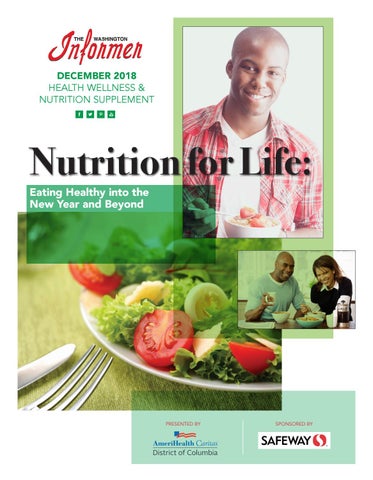
DECEMBER 2018 HEALTH WELLNESS & NUTRITION SUPPLEMENT
Nutrition for Life:
Eating Healthy into the New Year and Beyond
PRESENTED BY
SPONSORED BY
WORDS FROM THE EDITOR
NEWSPAPER READING IS A HABIT DON’T BREAK THE HABIT!
READ THE WASHINGTON INFORMER YOUR WAY: In Print – feel the ink between your fingers of our Award Winning Print Edition
n
On the Web – www.washingtoninformer.com updated throughout the day, every day
n
n
On your tablet
n
On your smartphone
n
n
n
Weekly Email Blast – sign up at www.washingtoninformer.com
202-561-4100 For advertising contact Ron Burke at rburke@washingtoninformer.com
...Informing you everyday in every way
In Memoriam Dr. Calvin W. Rolark, Sr. Wilhelmina J. Rolark THE WASHINGTON INFORMER NEWSPAPER (ISSN#0741-9414) is published weekly on each Thursday. Periodicals postage paid at Washington, D.C. and additional mailing offices. News and advertising deadline is Monday prior to publication. Announcements must be received two weeks prior to event. Copyright 2016 by The Washington Informer. All rights reserved. POSTMASTER: Send change of addresses to The Washington Informer, 3117 Martin Luther King, Jr. Ave., S.E. Washington, D.C. 20032. No part of this publication may be reproduced without written permission from the publisher. The Informer Newspaper cannot guarantee the return of photographs. Subscription rates are $45 per year, two years $60. Papers will be received not more than a week after publication. Make checks payable to: THE WASHINGTON INFORMER 3117 Martin Luther King, Jr. Ave., S.E Washington, D.C. 20032 Phone: 202 561-4100 Fax: 202 574-3785 news@washingtoninformer.com www.washingtoninformer.com
PUBLISHER Denise Barnes STAFF D. Kevin McNeir, Editor Ron Burke, Advertising/ Marketing Director Shevry Lassiter, Photo Editor Lafayette Barnes, IV, Assistant Photo Editor John E. De Freitas, Sports Photo Editor Dorothy Rowley, Online Editor ZebraDesigns.net, Design & Layout Mable Neville, Bookkeeper Dr. Charles Vincent, Social Sightings columnist Tatiana Moten, Social Media Specialist Angie Johnson, Circulation REPORTERS Stacy Brown (Senior Writer), Will Ford (Prince George’s County Writer), Hamil Harris, Tatyana Hopkins, Jade JamesGist, D. Kevin McNeir, Lauren Poteat, Dorothy Rowley, Sarafina Wright (General Assignment Writer) PHOTOGRAPHERS John E. DeFreitas, Shevry Lassiter, Roy Lewis, Demetrious Kinney, Mark Mahonny, Lateef Mangum, Travis Riddick
Emotional Eating Many of us have found ourselves aiming for the nearest drive-thru, bar, or dessert counter, after a stressful day, but few of us make the connection between how we feel, what we eat, and how much of it we eat. As we move into 2019, New Year’s resolutions must begin to take on holistic approaches to better nutrition, which include: mental, emotional, physical and spiritual well-being. Let us be clear, this is easier said than done. The relationship between Americans and food has been a complex affair characterized by merging cultures, divergent socioeconomics, and regional tastes. For African Americans that relationship has also incorporated migratory patterns that shifted foodways – or the cultural, social, and economic practices relating to the production and consumption of food – for better or worse. For instance, African Americans migrating from the South to areas North and West brought with them foods and preparation methods cherished in the South and made them regular staples in new locales. Few scholars, however, noted the spreading girth and increase in dietary-related morbidity of migrants from the South or the toll loneliness or stress played in their eating habits. Decades later, scientific and medical communities worry that the very foodways that once sustained Black Americans, coupled with stress, food deserts and ‘corner store’ meals have contributed to generational obesity, high blood pressure, diabetes, and other chronic conditions. As the Informer prepped for this final Health, Wellness & Nutrition supplement of the year, celebrated author and Purdue University English professor Roxane Gay, released a memoir in which she detailed being gang raped at age 12. In the process of telling the story, Gay simplified the links between food as comforter or protector and chronic health conditions, in one passage. I had very little comprehension of what happened to me. I was stunned, and I just assumed, "OK, we just had sex." And I didn't realize that there was a thing called rape. I didn't realize that there was a vocabulary to describe the experience, and that it wasn't my fault. I thought I didn't fight enough, I didn't get away, and so I was complicit in what happened… After I was raped, I needed comfort. I felt so weak and I felt so powerless, and I wanted to make myself bigger. And so, I would overeat, and I would get quite a lot of comfort from that, and when you are 12 and 13 and 14 and 15 and a sheltered kid from the suburbs, you don't really have access to vices other than food, and so I ate. Gay’s weight would eventually reach more than 500 pounds, as she worked to keep the secret from her parents, family and friends. Her honesty also pushed researchers across the nation, including the Journal of the American Medical Association, Each of the stories in the University of Alabama at Birmingham, and this health supplement Tulane University to examine how emotions influence nutritional absorption, cravings for comfocus on recognizing fort foods, weight gain, and the potential developand managing habits ment of chronic conditions in African Americans. that contribute to gaps Each of the stories in this health supplement focus on recognizing and managing habits that in nutritional well-being contribute to gaps in nutritional well-being and and have addressed have addressed topics such as eating alone, managing alcohol consumption, and healthy alternatopics such as eating tives to Southern and soul foods. We hope this alone, managing alcohol will be the beginning of a larger personal examconsumption, and healthy ination for readers that will bring success to nutrition-related resolutions. alternatives to Southern
Read, Learn, Grow! Dr. S
and soul foods.
www.washingtoninformer.com / DECEMBER 2018 HEALTH WELLNESS & NUTRITION SUPPLEMENT
HS-2
Tips to Avoid Weight Gain During, After Holidays Lee Ross Special to the Informer For millions of Americans, each holiday offers an opportunity to potentially fall off the healthy-living wagon and into a quagmire of sweets, alcohol, processed, or salty meals. Whether they come in the form of holiday gatherings, like Christmas, or reunions, cookouts, and birthday parties throughout the year, socializing often sets the table (pun intended) to the collapse of sensible nutritional intake. But rather than lament the coming holiday season or become anxious about celebrations coming in the new year, the Informer has found a few proven tips to help you keep nutritional balance and good health at the center of each gathering.
STICK TO EXERCISE ROUTINES
One of the most effective ways to maintain body weight and ensure healthy eating is to maintain regular, sustained aerobic
activity. Often when holidays or celebrations approach, already established exercise routines are abandoned, leaving our bodies open to faulty metabolism. The weight-gain many experience, is as much a function of not exercising, changing metabolic rates, and subsequently, gaining weight.
SIDESTEP TEMPTATIONS
Control coming in contact with ‘tempting’ foods by avoiding trouble spots. For instance, if you live or work near a Krispy Kreme or have a co-worker who keeps a candy dish on their desk, pick a new route around them. Mentally plan out how you will avoid tempting situations, and in dire cases, ask friends to “Keep me away from the birthday cake (candy dish, shrimp plates, etc.).”
PLAN AHEAD
Never go to the grocer or a party hungry. We’ve all walked into a grocery store hungry and walked out with unhealthy items we never intended to purchase. As
the body looks to satisfy hunger, our minds dance toward comfort foods that are quick. The same holds true for partygoers. Hors d’ oeuvres often take the place of sit-down meals at parties and can be heavy in fat, salt, and sugar content. If you have not eaten beforehand, you may be tempted to keep packing up small treats until they amount to full, high calorie plates of food. Try eating a healthy snack (fruit, yogurt or granola bar) before a party to curb a rush for hors d’oeuvres. The same works for grocery shopping throughout the year.
5 Setting and sticking to eating goals during the holiday season should be the litmus test to setting yearlong goals of better, more nutritional eating habits. /Courtesy photos
AVOID FRIED FOODS
The general rule for healthy meal celebrations is 1) small portions, 2) loads of vegetables; and 3) No seconds. In instances where you serve yourself, pick a small plate used for appetizers for your main course. If only large plates are available, be sure to fill at least half of the plate with vegetable, and limit the amount of crackers, chips, cheese and meat. If fried items are the staple of the
evening, opt for one small serving and do not go back for seconds.
AVOID THE SAUCES, CREAMY DRESSINGS
Avoid sauces made from cream, half-and-half or meat drippings. For salads, use oil and vinegar, vinaigrette or low-fat dressings. Broth -based or vegetable sauces are okay.
FOCUS ON SOCIALIZING
Mingling and holding conversations are the easiest ways of avoiding poor nutritional choices at gatherings year-round. Nurse a single appetizer plate as you make your way about the room and make the people, rather than the food your focus. WI
DCHealthLink.com (855) 532-5465 TTY 711
Get Covered DC. Stay Covered DC.
‘TIS THE SEASON OF GIVING Give yourself and your loved ones the gift of quality, affordable health insurance OPEN ENROLLMENT
November 1, 2018 - January 31, 2019 Enroll by December 15th for coverage beginning January 1st
• • • •
KRISTIN, Customer Since 2015
H-3 HS-3
FREE Expert Help 25 Health Plans to Fit Your Budget Reduced Premiums Available Separate Adult Dental Plans Also Offered
Don’t Delay, Enroll Today
DECEMBER 2018 HEALTH WELLNESS & NUTRITION SUPPLEMENT / www.washingtoninformer.com
Facts About HIV and AIDS: Are You at Risk? Submitted by AmeriHealth Caritas District of Columbia Since the 1980s, HIV has been a major health concern across the globe. People all over the world need to learn about the risks and dangers of the virus. That is especially true in the District, which has the highest lifetime risk of getting HIV and AIDS in the country. Statistics show people living in D.C. have a one in 13 chance of being diagnosed with the disease in their lifetimes. The good news is that there is hope. Modern medicine is better able to treat HIV, and more information than ever before is available about how to avoid it. World AIDS Day on December 1 is dedicated to teaching people the truth about the disease, but you can learn all year long. Do your part to reduce your risk and increase awareness about HIV and AIDS.
HIV AND AIDS
HIV stands for human immunodeficiency virus. This virus attacks the immune system, making it harder for your body to fight off diseases. Over time,
HIV can destroy the cells in your body that protect you from infections. There is currently no cure for HIV. Once you are diagnosed, you will have the infection for life. AIDS is acquired immunodeficiency syndrome. This is the final stage of HIV. People with AIDS have had their immune systems badly damaged by HIV and are less able to fight infection. They are at higher risk of being diagnosed with other diseases, like pneumonia, the flu, and certain cancers. Without treatment, life expectancy with AIDS is one to three years. Not everyone who has HIV will develop AIDS. A person can live with HIV for a long time without knowing it. It can take 10 years or more for HIV to become AIDS. During that time, a person may not have any symptoms. With the right medicine, it is possible for someone with HIV to live nearly as long as people who are HIV-negative. The most important factors are being diagnosed early and following your treatment plan.
HOW HIV SPREADS
HIV is spread by certain bodily fluids. Blood, semen, pre-seminal fluid, breast milk, and vaginal and rectal fluids can all contain the virus. If a person with HIV engages in any activity that exposes those fluids, he or she could spread the infection. The two most common ways people get the virus are through sexual contact and drug use with shared
needles. Sexual activity: Unprotected sex with an infected person is one of the most common causes of HIV infection. Most of the fluids that carry the virus can be exposed during sexual activity. If those fluids are able to enter the other person’s body, the virus may spread. Anal sex is the highest-risk sexual behavior, followed
by vaginal sex. It is rare but not impossible to get HIV through oral sex. Using condoms and practicing safe sex can greatly reduce the risk of transmission. Drug use: Sharing needles or syringes can lead to the spread of HIV. Blood and other bodily fluids can stay in the needle and HIV PAGE HS-5
I got a gift card for getting my prenatal checkup. You can too. You can get a $25 gift card if you: • Are pregnant and within your first trimester • Are an AmeriHealth Caritas District of Columbia member
Rewards Program
• See a midwife or OB/GYN for your first prenatal office visit
Visit www.amerihealthcaritasdc.com/giftcard to learn more. Note: A member cannot get more than $50 in incentives each year.
ACDC-1776299
www.amerihealthcaritasdc.com
All images are used under license for illustrative purposes only. Any individual depicted is a model.
AmeriHealth Caritas District of Columbia complies with applicable federal civil rights laws and does not discriminate on the basis of race, color, national origin, age, disability, or sex. English: ATTENTION: If you speak English, language assistance services, at no cost, are available to you. Call 1-800-408-7511 (TTY/TDD: 202-216-9885 or 1-800-570-1190). Spanish: ATENCIÓN: si habla español, tiene a su disposición servicios gratuitos de asistencia lingüística. Llame al 1-800-408-7511 (TTY/TDD: 202-216-9885 o 1-800-570-1190). Amharic: ማሳሰቢያ፡ አማርኛ መናገር የሚችሉ ከሆነ፣ ከከፍያ ነጻ የሆነ የቋንቋ ድጋፍ አገልግሎት ይቀርብልዎታል፡፡ በስልክ ቁጥር 1-800-408-7511 (TTY/TDD: 202-216-9885 ወይም 1-800-570-1190) ይደውሉ. 1-800-408-7511 اﺗﺼﻞ ﺑﺮﻗﻢ.ﺎن ﻓﺈن ﺧﺪﻣﺎت اﳌﺴﺎﻋﺪة اﻟﻠﻐﻮﻳﺔ ﺗﺘﻮاﻓﺮ ﻟﻚ ﺑﺎ، إذا ﻛﻨﺖ ﺗﺘﺤﺪث اﻟﻠﻐﺔ اﻟﻌﺮﺑﻴﺔ: ﻣﻠﺤﻮﻇﺔ: Arabic .(1-800-570-1190 أوTTY/TDD: 202-216-9885 )رﻗﻢ ﻫﺎﺗﻒ اﻟﺼﻢ واﻟﺒﻜﻢ
www.washingtoninformer.com / DECEMBER 2018 HEALTH WELLNESS & NUTRITION SUPPLEMENT
HS-4
HIV FROM PAGE HS-4
pass from one person to another. Even if the needle has not been used recently, it could still contain the virus. HIV can live for up to 42 days in a used needle. In addition, there are some less common ways to contract HIV. For example, HIV-positive women can pass on the virus to their children through birth. Blood transfusions, being bitten by a person with HIV, or contact between open wounds and HIV-infected fluids can also spread the virus. While it is possible to get the disease from one of these methods, they all are rare. Some groups are at a higher risk to get HIV. Statistics show you may be at a higher risk if you are: • Gay, bisexual, or a man who has sexual contact with other men • African American • Hispanic or Latino If you are not in one of these groups, you still could be at risk. No matter your risk level, taking steps to stay safe can reduce your risk of infection.
PREVENTION AND TREATMENT
There are many things you can do to prevent the spread of HIV. And if you have the virus, there
are treatment options available. • Practice safe sex: Using condoms correctly every time you have sex can greatly reduce your risk of getting HIV and other sexually transmitted diseases (STDs). Reducing the number of sexual partners you have can also lower your risk. You can avoid certain activities, like anal sex, which carry a higher risk than others. • Pre-exposure prophylaxis (PrEP): PrEP is a medicine that can lower the chance of getting HIV in a person who is at high risk. The medicine can stop the virus from taking root and spreading in a person. PrEP is not for everyone, and is reserved only for certain highrisk people. For example, if you are HIV-negative but have a partner with HIV, you may be eligible for PrEP. • Post-exposure prophylaxis (PEP): This medicine is for people who may have recently been exposed to HIV. It can prevent infection after a recent exposure. It must be taken as soon as possible if you think you are at risk. PEP is for emergency use only, up to 72 hours after exposure. If you think you have been exposed to HIV due to unsafe sex, drug use, or sexual assault, contact your health care provider right away.
• Antiretroviral therapy (ART): If you have been diagnosed with HIV, there is still hope. There are medicines you can take called ART, which can help manage the virus. By taking medicine, taking care of your body, and getting help from your provider, it is possible to live a healthy life with HIV.
BE TESTED, BE SAFE
There is no way to know if you have HIV without being tested. Just because you feel fine does not mean you don’t have the virus. People with HIV may not show any symptoms for years. During that time, they could accidentally spread the virus to others without knowing. This is why having an HIV test is so important. You have many options for being tested in the District. To find a testing center near you, you can: • Visit gettested.cdc.gov • Text your ZIP code to KNOW IT (566948) • Call 1-800-CDC-INFO (1-800-232-4636) These testing options are confidential. No one will know you were tested or your status. Whether you have HIV or not, you should always practice safe sex. Using a condom every time you have sexual contact is
important in stopping the spread of the disease. There are resources for free condoms available in the D.C. area. Go to www.rubberrevolutiondc.com to learn more. If you have questions or concerns, AmeriHealth Caritas District of Columbia is here to help.
You can contact our Member Services department at any time if you have questions or need help making an appointment. Call us at 1-866-842-2810. Sources: Centers for Disease Control and Preventions, AIDS. gov
Know the Myths about HIV There are a lot of false ideas out there about HIV and AIDS. Sometimes it is hard to know if something is real or just a rumor. Get the facts about HIV here and help spread the truth. The myth: You can get HIV/AIDS by being around someone with the disease. The truth: You can’t get HIV by hugging, shaking hands, or touching someone with the disease. You also cannot get it from breathing the same air, sharing a toilet, or touching the same objects like doorknobs. The myth: You can catch HIV from mosquitos. The truth: It is not possible to get HIV from mosquitos, ticks, or other insects. The myth: You can tell someone is HIV-positive by looking at him or her. The truth: The only way to tell if someone has HIV or AIDS is through an HIV test. The myth: Straight people cannot get HIV. The truth: All people, regardless of sexual orientation, can get HIV.
I got a gift card for getting my prenatal checkup. You can too. You can get a $25 gift card if you: • Are pregnant and within your first trimester • Are an AmeriHealth Caritas District of Columbia member
Rewards Program
• See a midwife or OB/GYN for your first prenatal office visit
Visit www.amerihealthcaritasdc.com/giftcard to learn more. Note: A member cannot get more than $50 in incentives each year.
ACDC-1776299
www.amerihealthcaritasdc.com AmeriHealth Caritas District of Columbia complies with applicable federal civil rights laws and does not discriminate on the basis of race, color, national origin, age, disability, or sex. English: ATTENTION: If you speak English, language assistance services, at no cost, are available to you. Call 1-800-408-7511 (TTY/TDD: 202-216-9885 or 1-800-570-1190). Spanish: ATENCIÓN: si habla español, tiene a su disposición servicios gratuitos de asistencia lingüística. Llame al 1-800-408-7511 (TTY/TDD: 202-216-9885 o 1-800-570-1190). Amharic: ማሳሰቢያ፡ አማርኛ መናገር የሚችሉ ከሆነ፣ ከከፍያ ነጻ የሆነ የቋንቋ ድጋፍ አገልግሎት ይቀርብልዎታል፡፡ በስልክ ቁጥር 1-800-408-7511 (TTY/TDD: 202-216-9885 ወይም 1-800-570-1190) ይደውሉ. 1-800-408-7511 اﺗﺼﻞ ﺑﺮﻗﻢ.ﺎن ﻓﺈن ﺧﺪﻣﺎت اﳌﺴﺎﻋﺪة اﻟﻠﻐﻮﻳﺔ ﺗﺘﻮاﻓﺮ ﻟﻚ ﺑﺎ، إذا ﻛﻨﺖ ﺗﺘﺤﺪث اﻟﻠﻐﺔ اﻟﻌﺮﺑﻴﺔ: ﻣﻠﺤﻮﻇﺔ: Arabic .(1-800-570-1190 أوTTY/TDD: 202-216-9885 )رﻗﻢ ﻫﺎﺗﻒ اﻟﺼﻢ واﻟﺒﻜﻢ
H-5 HS-5
DECEMBER 2018 HEALTH WELLNESS & NUTRITION SUPPLEMENT / www.washingtoninformer.com
All images are used under license for illustrative purposes only. Any individual depicted is a model.
The Power of Protein Elaine Magee, MPH, RD Wellness Services Corporate Dietitian It’s time to put failed fad diets behind us! Instead, this year, we are all about the power of protein and making small changes that will last a lifetime. While many diets will warn against the hazards of sugars and carbs, we are focusing on how lean and healthful protein-rich foods in every meal can help put the weight loss odds in our favor. Who’s with us? Read on for what we know about the benefits of protein in meals and snacks and how you can easily incorporate powerful proteins into your New Year plan!
BUILDING AND PRESERVING MUSCLE MASS
Protein is vital to building and repairing body tissues and muscles. So, it’s not surprising to hear including more protein in your meals seems to preserve muscle mass which helps prevent the met-
abolic slowdown that often occurs with weight loss. This recipe for Oven Fried Lemon Chicken Bites will help add protein to any meal or snack and tastes delicious!
DISTRIBUTING PROTEIN THROUGHOUT THE DAY
Getting high-quality protein in equal amounts throughout the day is important to building and preserving muscle mass as we age, by helping our bodies absorb protein better and more efficiently. Generally, 20-30 grams of protein per meal is thought to trigger muscle growth, although more research is needed. Even faves like pizza can contribute up to 30 grams of protein when made thoughtfully! Take your pizza night to a whole new level with this recipe for Protein-Packed Pizza, complete with a cheesy cauliflower crust. The whole family will LOVE this fun dish!
FEELING FULL AND SATISFIED
Getting the ideal amount of protein in meals and snacks may decrease hunger and make you feel fuller longer. Eating protein seems to decrease levels of the hunger hormone, ghrelin, while increasing production of hormones that help us feel full and satisfied. Keep in mind, because solid protein foods usually take longer to digest, they promote fullness better than liquid protein sources. Fill up on this High Protein Pasta Salad featuring a variety of solid protein sources!
PROTEIN AT BREAKFAST
On average, Americans consume about 12 grams of protein at breakfast. This is just half of what is considered ideal by many experts who suggest ample protein in the morning may give an extra boost to weight control. This may be partly due to an enhanced feeling of fullness and possibly better blood sugar levels throughout the day. Just one tiny egg adds 6 grams of quality protein to your meal, along with 13 essential vitamins
and minerals, including hard-toget vitamin D, carotenoid plant compounds that help preserve eye function and choline, a nutrient that may benefit your brain and memory. This Southwest Style Quick Quiche offers 22 grams of protein per serving and is great for breakfast, lunch or dinner!
NUTRITIOUS PROTEIN-RICH FOODS
The ideal protein-packed meal is low in saturated fat and refined carbohydrates with a good portion
of the meal (and sometimes the protein) coming from plant-based foods. Reach for high-quality proteins like fish, seafood, poultry, eggs, dairy foods and lean meats. On the plant-based side, opt for soybeans/ edamame, tofu, beans, legumes, nuts and seeds and try substituting whole grains like quinoa, kamut, whole wheat and oats whenever possible. This recipe for No Boil High Protein Lasagna is filled with high-quality proteins like extra lean beef, whole wheat noodles and two types of cheeses. Yum!
NATURALLY DELICIOUS CHOICES MADE WITH REAL INGREDIENTS. Open Nature Grass Fed 85% Lean Ground Beef 16-oz.
O Organics Italian Soda or Sparkling Lemonade
O Organics Celery Hearts
Open Nature Lamb Leg Bone-in Semi Boneless.
3-ct.
O Organics Tea 20-ct.
O Organics Snack Nuts 8 to 10-oz.
O Organics Coffee Pods 72 to 80-ct.
Open Nature Roast Beef In the Deli.
PURELY DELICIOUS CHOICES, CERTIFIED TO THE HIGHEST ORGANIC STANDARDS.
EXCLUSIVELY AT Q4 supplement-WashInformer.indd 1
12/5/18 12:44 PM
www.washingtoninformer.com / DECEMBER 2018 HEALTH WELLNESS & NUTRITION SUPPLEMENT
HS-6
Looking for a
NEW PHARMACY? Fill your prescriptions where you already shop – at Safeway!
$25GIFT CARD
*
with new or transferred prescription
PLUS
% 20OFF
SHOPPING PASS*
after every three prescriptions filled
See pharmacy for details. • • • • • •
Transferring is easy – just tell us where you currently fill your prescriptions and we’ll do the rest! We accept all major insurance plans, including military and government. Medicare Part D co-pays as low as $0! Learn more at the pharmacy. We fill prescriptions for your furry family members also – compare and save on pet meds! Put your prescriptions on Auto Refill and we’ll notify you when they’re ready for pick-up. Download our FREE mobile app to manage your prescriptions on the go.
*Offer not valid for beneficiaries of state and federal healthcare programs. Limited time offer. Additional restrictions apply.
Safeway Pharmacy is Your One Stop for Vaccinations*** Get 10% off your next grocery purchase with any immunization!
• FREE flu shots with most insurance** • The CDC recommends 2 different pneumonia • • •
vaccines for seniors The new shingles vaccine is over 90% effective and recommended for those 50 and older Travel vaccines Tetanus, HPV, Hepatitis, Meningitis and more!
**No co-payment unless required by your plan. ***Available vaccinations vary by location and are subject to state law restrictions.
ALBCIV122460
H-7 HS-7
DECEMBER 2018 HEALTH WELLNESS & NUTRITION SUPPLEMENT / www.washingtoninformer.com
ALBCIV122460_Rx_EasternAd.indd 1
12/4/18 1:18 PM
Eating Single: Can Social Media Unravel Nutritional Balance? Lee Ross Special to the Informer A strange thing happened a year ago while picking up food from a local restaurant. Amid the rancorous laughter of servers and the blare of music at a D.C. bistro, I noticed the number of young people dining alone. In addition, those who were dining with others, seemed firmly affixed to phones, tablets, and cameras – even as their food set going cold before them. It occurred to me that the craze of social media and created an anti-social mentality that was often centered around food and eating out. But what happens to the body’s metabolism when the fellowship of eating with others loses its meaning? In the 1960s, researchers raised concerns about the psychological and physical health effects of eating alone. The Atlantic magazine called eating together the quintessential human experience, and
When the meal, the company, and the experience are down to one person, does that really spell health concerns? 5 Eating alone, even by choice, can eventually lead to poor digestion, as the fellowship associated with meals reportedly aids in metabolism. / Courtesy photo
ways in which food and digestion are experienced, a form of ritual. When the meal, the company, and the experience are down to one person, does that really spell health concerns?
According to a recent study from Oxford Economics and the National Centre for Social Research, eating alone has been linked to problems including depression, a blockage of blood
SUPPORT ORGAN, EYE AND TISSUE DONATION IT’S A DECISION EVERYONE CAN LIVE WITH
supply to the heart, obesity and developing metabolic syndrome: a combination of conditions such as high blood pressure, diabetes, and high cholesterol that raise the risk of heart disease and stroke. Nearly 45 percent of those examined in another study had an increased risk of being obese and a 64 percent increased risk of having metabolic syndrome, even after the researchers adjusted for factors such as age, cigarette and alcohol use, total weekly exercise, education level and occupation status. “At the same time, eating patterns have become irregular, informal, and individualized in the form of more eating alone,” researchers for the journal Obe-
sity Research & Clinical Practice wrote, adding, “Unmarried men who ate alone had the highest risk for metabolic syndrome, more than three times the risk of men who said they usually dined with someone else.” Still, some clinicians note an increase in depression and mental health conditions associated with eating alone that also contribute to how much we eat, what we eat, and our moods before, during and after consuming food. “It is difficult to separate out the impact of eating alone on physical, and in particular psychological, consequences due to the association between eating alone and other factors that [affect] physical and mental health such as loneliness, living alone and socioeconomic factors,” said Dr Katherine Hanna from the Queensland University of Technology in Australia. Sam Dick of the Campaign to End Loneliness said eating alone can be a problem if it is not a choice. “Choosing to eat alone is very different to having to eat alone,” he said. “A moment of solitude to enjoy a solo dinner is not the same as not having someone to eat with on a regular basis, which is the case for many older people. We must consider the longterm implications for the cultural movement of eating alone. Sharing a meal with others is one of the best ways to bond and build our connections.” WI
Helpful tips to avoid the consequences of eating alone, include:
Register online or at the MVA when you obtain your license. DonateLifeMaryland.org
BEING PRESENT AT THE TABLE WITH OTHERS –
which means, no electronic devices, engaging in conversation with those around the table, and discussing the food you’re eating as you eat.
ASK TO JOIN OTHERS –
Too often we would rather leave a coffeehouse than share a table with a stranger. A stranger is only a friend you’ve not yet met.
ASK OTHERS TO JOIN YOU –
If you see someone eating along, ask if they’d care to join you. Sometimes the kindness of strangers is more nourishing than food.
REVIVE FAMILY MEAL TIME –
Particularly in African-American households, the loss of shared meals has crippled the ability to gauge emotional need and support each other in daily life. Commit to one shared meal per day with household members, and one shared meal per month with extended family (where possible).
www.washingtoninformer.com / DECEMBER 2018 HEALTH WELLNESS & NUTRITION SUPPLEMENT
HS-8
10 Tips to Keep Your Family Healthy During Holiday Festivities During the holiday season, it’s likely you and your family will be attending numerous holiday parties and possibly even hosting one. While it’s important to make sure the festivities are fun for the whole family, here are 10 tips from Children’s National Health System to ensure children have a healthier experience:
1. BRING HEALTHIER SNACKS TO EVENTS.
Try a recipe that incorporates fruits and vegetables with a lowfat dip, make homemade pizzas on whole wheat, or bring a fruit salad with a yogurt dip.
2. INCORPORATE HEALTHIER SUBSTITUTES.
Find ways to swap out ingredients in holiday recipes for healthier alternatives to lower the amounts of fat, added sugar and calories children consume.
3. MAKE HEALTHY DRINKS EASILY AVAILABLE.
Make sure water is easy to grab for children. To make the healthier options a little more appealing to kids, create some fun ice cubes out of 100 percent fruit juice or offer seltzer water.
4. DON’T BRING RAVENOUS CHILDREN.
Never take children to a holiday
H-9 HS-9
party on an empty stomach because it leads to less self-control and more overeating on empty calories. Aim to keep kids on a regular schedule with three meals a day and healthy snacks.
5. INVOLVE KIDS IN THE PREPARATION.
Children can be included in the holiday food preparation as early as their toddler years. Remember to make it appropriate for their skill and age levels.
6. BE A HEALTHY ROLE MODEL.
Show your children that you eat a variety of foods and monitor your own portion sizes at holiday celebrations. You and other family members are the number one role models for these behaviors.
7. SHIFT THE FESTIVITIES’ FOCUS.
Make the holiday festivities more about enjoying family, traditions and activities, rather than the food.
8. ENCOURAGE KIDS TO GET MOVING.
Exercise is even more important during the holiday season and we recommend that children get an hour a day, every day. Balance out some of the increased treats with increased activity.
9. KEEP SLEEP SCHEDULES CONSISTENT.
With all the holiday excitement, it can be difficult for children to unwind from the festivities and get a good night’s rest. Parents can help by sticking to their child’s regular bedtime schedule as often as possible.
10. REINFORCE REGULAR HAND WASHING.
To help keep children from spreading germs or contracting an illness at holiday celebrations, they should regularly wash their hands. Teach kids to wash their hands for 30 seconds or sing happy birthday twice while washing and then dry with a clean towel.
DECEMBER 2018 HEALTH WELLNESS & NUTRITION SUPPLEMENT / www.washingtoninformer.com
THINK FAMILY-WIDE Parents should think about maintaining a healthy diet throughout the holidays for the whole family, rather than just for the kids. Help make the healthy choice the easy choice by encouraging and role modeling healthy habits at home. The staff at Children’s National wish you and yours a happy and healthy new year. Their office at THEARC has expanded, and is now accepting new patients. Call 202-436-3060 for an appointment today. For more information on keeping your kids happy and healthy, visit RiseandShine.ChildrensNational.org, where you can get advice straight from the experts at Children’s National.
Southern Discomfort Shantella Y. Sherman WI Special Editions Editor The Journal of the American Medical Association announced this year that much of the Southern cuisine that has become regular meals in African-American households has lost a lot of its nutritional vigor – through over-consumption and methods of preparation. Whether it’s pulled pork or fried chicken, granny’s celebrated macaroni and cheese or a favored cousin’s banana pudding, the Southern comfort found in these foods, may have created generational gaps in nutrition, as well as avoidable (but critical) conditions, such as hypertension and diabetes. In fact, JAMA’s research found that even as other groups take easily to Southern foods, their occasional intake, coupled with an overall healthy lifestyle has kept them from developing these same nutritional gaps and chronic conditions. Researchers from the University of Alabama at Birmingham crunched data collected from nearly 7,000 men and women older than 45 living across the U.S. — not just in the South — over the course of a decade. Their goal: to figure out why Black Americans are at greater risk for high blood pressure. Over the course of the study, 46 percent of Black participants and
33 percent of white participants developed hypertension — and diet seemed to explain much of the disparity. Black participants were much more likely to eat a Southern-style diet regularly, which featured fried foods, organ meats and processed meats, dairy, sugar-sweetened beverages and bread. And this diet was more strongly correlated with hypertension than any other factor the researchers measured, including participants' levels of stress and depression, exercise habits, income or education level. Thomas LaVeist, a dean and professor of health policy and management at Tulane University, believes unraveling the connections between soul food consumption and disease requires a larger understanding of African American foodways, including the spiritual, cultural, and community aspects of daily life. “The traditional African-American Southern diet was really designed for survival as African-Americans were not able to access a balanced, nutritious diet during slavery and during Jim Crow. What they had was organ meats and parts of slaughtered animals that others didn't eat, and greens they grew themselves,” LaVeist told National Public Radio (NPR). “And what they did is take those scraps and turn it into what's now an inter-
Restoring the Nutritional Value of Soul Food Cooking
5 Southern and soul food has been linked to the increased development of chronic health conditions in African Americans, when ill-prepared. /Courtesy photo.
nationally renowned cuisine. But the thing to realize is the food that once helped sustain African-Americans through a truly insane period of history isn't well-adapted to the food environment today, or the health challenges of today." Southeast resident and former chef, Samuel Major, told the Informer that while growing up in Columbia, S.C., most Black families enjoyed the bounty of Southern or soul food only once or twice a year. The daily diet consisted of fresh fruits and vegetables grown from their gardens, unsalted nuts,
grains, beans, and protein from fish or an occasional rabbit or chicken. “The food gets a bad reputation now, but it’s really how much and how often we ate it that kept us strong and healthy. You see a joker today eating 15 or 20 fried or barbecue chicken wings with French fries and soda for lunch two or three times a week and that don’t count the other food he’s eating all week,” Major, who turned 91 November 3, said. “When you have to catch, kill, prepare and cook before you eat, you’re happy sometimes to have some fresh okra and tomatoes
Alternatives to Unhealthy Southern Cooking Trends Informer Staff Report Southern food remains among the most misunderstood cultural staples in the country. Noted for being prepared by deep frying, or prepared by heavily breading or battering, and seasoned with salt, pork, or fat, just as many Southern classics include healthy options including root vegetables, greens, and peas, as well as fresh fish and roasted meats. At a 2010 University of Arizona Nutrition and Health Conference lecture “Feeding Your Soul: Exploring the Healthy Side of Southern Cooking,” chefs Scott Peacock and Wendy Kohatsu, M.D., explored new ways of sacrificing unhealthy fats, salt, and calories without giving up home-cooked flavor. The Informer offers you, here, a few of their lecture notes and best recommendations. Choose healthier fats and cooking methods. Can you actually cook with olive oil instead of butter and lard? The answer is yes. Scott uses many different types of cooking liquids, oils, and fats in his Southern cooking. He likes using a rich stock to flavor food, for example cooking collard greens in a homemade pork stock versus frying in tons of oil. Spice it up! Southerners from Louisiana and the Mississippi Delta are famous for their Creole and Cajun cooking. A blend of chilis, bell pepper, onion and celery add zing to foods without over-relying on salt and fat. Use Spanish smoked paprika to add a heady smoky flavor without the pork, suitable for vegan diets. The paprika will also add a vibrant red color to liven up in the plate. The best varieties of Spanish smoked paprika come from the de Vera region, try the dulce (sweet) variety that still has a mild chili kick to it Roast it. Roasting vegetables concentrates their flavor by evaporating some of the natural water content. Roasting also adds flavor via caramelization, i.e. the intense heat (over 350 degrees, well above anything you cook via boiling) converts some of the naturally-occurring sugars in plants to undergo molecular reactions that makes foods more delicious-tasting. Portions Matter. When it comes right down to it, quantity matters as much as quality. So, from a caloric perspective, it’s okay to choose richer foods, but WATCH OUT FOR THE PORTION SIZE. Go Veggies. Southerners rely on fresh vegetables from the land to create home-cooked meals. Staples such as pole beans, tomatoes (green and red), cucumbers, root vegetables, mustard and collard greens are the backbone of Southern cuisine. Peacock added, “Use only real food, as pure and of the highest quality you can find. For example, in the collard green recipe, I use olive oil not because I think it is healthier, but because I like the flavor and lightness,” he said. “I am well known for my fried chicken, but I would not think of serving it daily or even weekly. I view fried foods as an occasional treat; something to be savored and appreciated.”
with a little cornbread.” The concept of too much of a good thing echoes constantly among older African Americans who hail originally from the South. But stress may also be a culprit in the impact of soul food consumption on Black bodies. For instance, JAMA’s study also revealed the amount of stress that the average Black Americans face in 2018 is at phenomenal levels and impacts the body’s ability to process and metabolize foods – both good and bad. "If you think about it, stress can, for example, affect how well people sleep, which can lead them to overeat or crave unhealthy food," said biostatistician Suzanne Judd, also of the University of Alabama at Birmingham, who co-authored the study. “A diet high in fat, salt and sugar would increase the risk of hypertension for anyone, of any race. What does surprise me is how this one particular style of eating explained so much of the difference between the rates of hypertension for Black and white participants. And then there's also the possibility that the food reveals something about the social history of those who eat it.” Mr. Major concurred. “Stress can make a good plate of food go bad in your stomach, that’s true. But also, Booker T. Washington said that a man or woman who has no control over the soil cannot sustain themselves or their bodies and that’s what we’re seeing today, so I grow my own food,” Major said, making a point to show off that he still has all of his teeth, clear vision, and a clean bill of health. “We have to put soul food in its place – which is an occasional treat, not every day eating. As a people, we have to eat what’s good to our bodies, not just to our tongues.” WI
www.washingtoninformer.com / DECEMBER 2018 HEALTH WELLNESS & NUTRITION SUPPLEMENT
HS-10
Eating Healthy Now, The New Year & Beyond By Brittany E. Tillman, Health Neurotics LLC, CHES, Whether a sprint, a 100-meter dash or cross country, set a goal to start the race of a lifetime today! Reaching the finish line comes in different strides and strategies for each person. It’s challenging, and I think we can all agree that it will not be easy. Preparation will be one of your keys to success in the New Year for your healthy journey. Focus on behavior strategies for your personality and/or character. What works for you? When can you set aside time to prepare? What do you know about the foods and beverages you consume? Are you utilizing markets or neighborhood gardens in your communities or nearby? If you have a green thumb are you growing fresh herbs, fruits and vegetables?
THE RELAY RACE
• Learn how to cook, living a healthy lifestyle means lots of cooking and less eating out • No time to cook, use one off day and prepare for the whole week • Build flavors in your food, it makes transitioning to different diets easier, nobody likes bland food • Eat organic when possible • Drink a gallon or more of spring water per day, preferably Crystal Geyser, Fiji, Mountain Valley, Starkey, not purified, tap or filtered water • Be physically active for at least 15-30 minutes per day or exercise at least 3 times per week and include weight lifting • Enjoy a daily intake of herbs because they naturally provide the body with minerals, this can be accomplished with teas or capsules • Limit or eliminate canned foods, prepared or fast foods, as they contain unhealthy preservatives • Ditch the microwave, use a toaster oven, conventional and/ or convections oven or a food warmer for on the go meals (microwaves kill your nutrients and emits radiation) • Eat more alkaline foods, an alkaline diet wards off disease while an acidic diet contributes to the onset of disease, Dr. Sebi's Nutritional Guide • Limit or eliminate a meat and seafood diet because they
H-11 HS-11
cause severe inflammation and destroys the integrity of your mucous membrane • Limit or eliminate alcohol/ beer/wine intake because fermented foods contribute to yeast build up and disrupt gut health • Eat fruits with seeds only, no seed= genetically modified • Cut out the whites: white flour, white sugar, white rice, white cow’s milk, use alternatives such as, chickpea/garbanzo, teff, spelt, coconut, kamut or rye flour; date sugar or agave nectar; wild rice, fonio or quinoa • Limit or eliminate dairy products (milk, eggs, cheese) as they are acidic, dairy intake contributes to breast cancer, prostate cancer, heart disease, digestive problems and mucous build up • Try alternatives to cow’s milk (cow’s milk is for baby cows), such as hemp milk, coconut milk, walnut milk, brazil nut milk or hazelnut milk • Eat whole grains such as, quinoa, amaranth, kamut, rye, spelt, wild rice, teff • Use high smoke point oils for cooking such as, avocado oil or grapeseed oil • Only use low smoke point oils for cold foods (salad, cold pastas) such as, olive oil or coconut oil • Ditch table salt and pick up sea salt which naturally consists of Iodine (protector of thyroid health) • Limit or eliminate sodas and juice, for example sugar is highly acidic and contributes to onset of disease, such as, diabetes and obesity • Limit or eliminate processed foods, as they contain hybrid and genetically modified products, artificial flavoring, food coloring and contribute to chronic disease such as, obesity and especially colon cancer • Limit or eliminate yeast and yeast products (breads, yogurt, beer, wine, alcohol) as they can trigger yeast growth and/or overgrowth and can weaken the immune system • Limit or eliminate soy, soy is linked to the increase in estrogen, breast cancer, thyroid problems, dementia, stroke and prostate cancer • Limit or eliminate wheat gluten, as it can cause gut health problems, inflammation and intestinal damage
• Use smaller plates; eat at a slower pace; use plates for snacks instead of eating out the package • Use nutrition labels; heaviest ingredients are listed first • Eat foods with ingredients you can pronounce I know it’s a long list that is hard to digest! Remember what is at stake, obesity, cancer, diabetes, heart disease, stroke… When you gear up and approach the start line, know that there will be hurdles but don’t give up. Try one or a few behavior changes for at least 30 days. Evaluate your progress and any changes you notice or feel. Keep a daily log to visualize process and track changes. Then your old behaviors will be a thing of the past. WI
Health Neurotics, LLC is an emerging health promotion firm in Washington, DC offering health promotion seminars, consultations, products and services. Health Neurotics specialize in nutrition education for adolescents and adults using health literacy standards and cultural competence to targeted demographics. One of our most celebrated efforts was a guest appearance on Sirius XM Shade 45 nationally syndicated radio show, First Aid with Kelly Kinkaid focusing on Diabetes Awareness Month. Visit us at www.healthneurotics.com, shop our all natural product line at www.healthneurotics.com/shop or contact Health Neurotics at healthneurotics@gmail.com.
DECEMBER 2018 HEALTH WELLNESS & NUTRITION SUPPLEMENT / www.washingtoninformer.com
Looking for a
NEW PHARMACY? Fill your prescriptions where you already shop – at Safeway!
$25GIFT CARD
*
with new or transferred prescription
PLUS
% 20OFF
SHOPPING PASS*
after every three prescriptions filled
See pharmacy for details. • • • • • •
Transferring is easy – just tell us where you currently fill your prescriptions and we’ll do the rest! We accept all major insurance plans, including military and government. Medicare Part D co-pays as low as $0! Learn more at the pharmacy. We fill prescriptions for your furry family members also – compare and save on pet meds! Put your prescriptions on Auto Refill and we’ll notify you when they’re ready for pick-up. Download our FREE mobile app to manage your prescriptions on the go.
*Offer not valid for beneficiaries of state and federal healthcare programs. Limited time offer. Additional restrictions apply.
Safeway Pharmacy is Your One Stop for Vaccinations*** Get 10% off your next grocery purchase with any immunization!
• FREE flu shots with most insurance** • The CDC recommends 2 different pneumonia • • •
vaccines for seniors The new shingles vaccine is over 90% effective and recommended for those 50 and older Travel vaccines Tetanus, HPV, Hepatitis, Meningitis and more!
**No co-payment unless required by your plan. ***Available vaccinations vary by location and are subject to state law restrictions.
ALBCIV122460
ALBCIV122460_Rx_EasternAd.indd 1
www.washingtoninformer.com / DECEMBER 2018 HEALTH WELLNESS & NUTRITION SUPPLEMENT
HS-12
12/4/18 1:18 PM