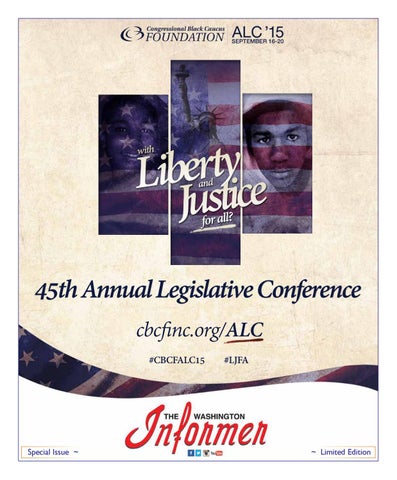
礀 琀 爀 攀 䰀椀戀 猀琀椀挀攀 䨀甀 眀椀琀栀
愀渀搀
昀漀爀 愀氀氀氀
㐀㔀琀栀 䄀渀渀甀愀氀 䰀攀最椀猀氀愀琀椀瘀攀 䌀漀渀昀攀爀攀渀挀攀 挀戀挀挀渀挀⸀漀爀最⼀䄀䰀䌀 ⌀䌀䈀䌀䘀䄀䰀䌀㔀 ⌀䰀䨀䘀䄀
1
Special Issue ~
September 2015 The Washington Informer - 45th Annual Legislative Conference Special Issue www.washingtoninformer.com
~ Limited Edition
NEWSPAPER READING IS A HABIT DON’T BREAK THE HABIT! Dear Friends and Supporters, On behalf of the Congressional Black Caucus
READ THE WASHINGTON INFORMER YOUR WAY:
Foundation, Incorporated (CBCF), I am proud to
In Print – feel the ink between your fingers of our Award Winning Print Edition
n
welcome you to the 45th Annual Legislative Con-
ference (ALC). The theme of this year’s conference, “With Liberty and Justice for All?,” poses a valid
On the Web – www.washingtoninformer.com updated throughout the day, every day
n
question about the civil and social inequities that
n
On your tablet
n
On your smartphone
n
n
liberty and justice for all Americans.
n
Weekly Email Blast – sign up at www.washingtoninformer.com
an owned institution that shares our mission to advance the global black community,
African Americans continue to face. Throughout this year’s milestone conference, we
will identify forward-looking solutions that move us closer toward that ideal promise— We are proud to partner with The Washington Informer, an African-American womby producing a limited edition special issue just for you. This publication includes
in-depth information about the CBCF’s programs, ALC policy sessions, panelists, and
202-561-4100 For advertising contact Ron Burke at rburke@washingtoninformer.com
...Informing you everyday in every way
In Memoriam Dr. Calvin W. Rolark, Sr. Wilhelmina J. Rolark THE WASHINGTON INFORMER NEWSPAPER (ISSN#0741-9414) is published weekly on each Thursday. Periodicals postage paid at Washington, D.C. and additional mailing offices. News and advertising deadline is Monday prior to publication. Announcements must be received two weeks prior to event. Copyright 2015 by The Washington Informer. All rights reserved. POSTMASTER: Send change of addresses to The Washington Informer, 3117 Martin Luther King, Jr. Ave., S.E. Washington, D.C. 20032. No part of this publication may be reproduced without written permission from the publisher. The Informer Newspaper cannot guarantee the return of photographs. Subscription rates are $45 per year, two years $60. Papers will be received not more than a week after publication. Make checks payable to: THE WASHINGTON INFORMER 3117 Martin Luther King, Jr. Ave., S.E Washington, D.C. 20032 Phone: 202 561-4100 Fax: 202 574-3785 news@washingtoninformer.com www.washingtoninformer.com
PUBLISHER Denise Rolark Barnes
signature events.
Each year through the ALC, the CBCF provides a forum for more than 9,000 at-
tendees representing business, community, emerging leaders, elected officials, media, and every day Americans to participate in solution-centered sessions on issues
that impact African Americans and black communities world-wide. Proceeds from the conference support the CBCF’s education, health, economic empowerment, environmental sustainability, and public policy initiatives.
Highlights of the conference include the National Town Hall entitled “Black Lives
STAFF D. Kevin McNeir, Managing Editor Ron Burke, Advertising/ Marketing Director Lafayette Barnes, IV, Assistant Photo Editor John E. De Freitas, Sports Photo Editor Dorothy Rowley, Online Editor Zebra Designs, Design & Layout Mable Neville, Bookkeeper Mickey Thompson, Social Sightings columnist Stacey Palmer, Social Media Specialist Angie Johnson, Circulation REPORTERS Stacy Brown, Sam P.K. Collins, Eve Ferguson, Will Ford, Elton Hayes, D. Kevin McNeir, Dorothy Rowley, Kia Croom, Sarafina Wright
PHOTOGRAPHERS John E. DeFreitas, Shevry Lassiter,
Matter: Ending Racial Profiling, Police Brutality and Mass Incarceration.” The Exhibit Showcase including the popular Authors Pavilion showcasing contemporary Afri-
can-American literature, and Health Pavilion with free health screenings; the inspira-
tional Prayer Breakfast featuring a keynote address delivered by Rev. Dr. Otis Moss, III of Trinity United Church of Chicago; and the conference culminating black tie event, the Phoenix Awards Dinner.
I invite you to continue the conversations we begin at the ALC on social media.
Tweet us directly using our handle, @CBCFInc, and use the official hashtag, #CBC-
FALC15, to share your thoughts about the conference. I also encourage you to download our conference companion app, CBCF ALC, available in the Apple and Android Google Play stores.
Thank you for your support and continued commitment to the CBCF’s mission. Our goal is that you will leave the conference both energized and equipped to be the
change you want to see in your community and nation. For more information about the CBCF and the ALC, visit www.cbcfinc.org. Sincerely,
Roy Lewis, Corey Parrish, Travis Riddick, Nancy Shia
A. Shuanise Washington President and CEO
www.washingtoninformer.com The Washington Informer - 45th Annual Legislative Conference Special Issue September 2015
2
Lawmakers: Zero Tolerance Policies are Leaving Our Children Behind By Tim Pulliam, Writer @TimPulliam Zero tolerance policies in schools are damaging African-American children, especially boys. Instead of getting an education, many are being pushed into the prison system. At issue is the No Child Left Behind Act. In 2002, President Bush signed the bill into law to improve student test scores, but No Child Left Behind was not equipped to address another systemic problem – inequities in zero tolerance and school disciplinary policies – and it should. In 1995, Congress passed a rule that required students who brought a gun to school to be expelled. This led to states forming zero tolerance policies, which overtime has expanded sanctions (depending on the school district) to include not just gun violence, but lesser offenses like fighting and unruly behavior or insubordination. Statistics show these guidelines are negatively impact-
ing black and brown students. The Justice and Education departments’ civil rights division estimates that African-American students make up 15 percent of student populations without disabilities, but they make up 35 percent of the students who are suspended once, 44 percent of the students who are suspended more than once and are 3.5 times more likely to face expulsion than their white peers. Additionally, more than 50 percent of African-American and Hispanic students are involved in school-related arrests. Zero tolerance policies must change. The Congressional Black Caucus Foundation, Incorporatedheld policy briefings this year with the White House, the Congressional Black Caucus, the Department of Justice, the Annie. E. Casey Foundation, educators and the community to address the impact that zero tolerance policies have on the minority school-toprison pipeline. One common recommendation out of these meetings is to eliminate policies
that involve expulsions and outof-school suspensions for nonviolent behaviors. As Congress debates the reauthorization of the No Child Left Behind law, they should include mandates that would reduce the severity of zero tolerance punishments for nonviolent offenders. Doing that will save young Black lives. Currently No Child Left Behind focuses solely on academic testing; it mandates school districts tests children in certain grades, in order to gauge the amount of support needed for underserved school districts, teacher performance and students’ academic progress from year-toyear. The Reauthorization of No Child Left Behind legislation must address the inequities in zero tolerance policies and their relationship to student and school performance and the health of African-American communities. Unfair zero tolerance rules undoubtedly affect the public purse and the private wallet. Minority students are more likely to be
booked into the juvenile justice system and then eventually funneled into the prison pipeline at the expense of taxpayers according to the Department of Education. The American Civil Liberties Union estimates that local, state and federal government entities spend $20,000 to $50,000 annually to keep an individual behind bars. Let’s consider keeping individuals like Kyle Thompson, a Black teen from Farmington, Michigan, in school and far away from the juvenile justice system. According to a CNN report last year, the 15 year old was arrested and kicked out of school for a tugof-war incident with his teacher over a note. Thompson had been on house arrest for eight months at the time of the article. He regrets his behavior. “I want to be accepted as a different person, not as a criminal for getting kicked out of school,” Kyle said. “I want to have a chance at going to another school to prove myself.” n
圀䔀䰀䌀伀䴀䔀匀 夀伀唀 吀伀 吀䠀䔀 㐀㔀吀䠀 䄀一一唀䄀䰀 䰀䔀䜀䤀匀䰀䄀吀䤀嘀䔀 䌀伀一䘀䔀刀䔀一䌀䔀 䨀伀䤀一 唀匀 䤀一 䌀䔀䰀䔀䈀刀䄀吀䤀一䜀 㔀 夀䔀䄀刀匀 䤀一 匀䔀刀嘀䤀䌀䔀
䀀圀愀猀栀䤀渀昀漀爀洀攀爀
3
⌀刀攀愀搀圀愀猀栀䤀渀昀漀爀洀攀爀 ⌀圀愀猀栀䤀渀昀漀爀洀攀爀㔀
September 2015 The Washington Informer - 45th Annual Legislative Conference Special Issue www.washingtoninformer.com
Congressman Louis Stokes Remembered as Trailblazer By Sarafina Wright WI Staff Writer Congressman Louis Stokes left his mark in this world as the first Black man elected to Congress from the state of Ohio in 1969, a founding member of the Congressional Black Caucus in 1971 and a health care champion for all people. Stokes died August 18, 2015, at the age of 90 at his home in Cleveland, Ohio leaving behind a legacy as a vanguard for public health. “Lou dedicated his life to public service and giving a voice to the voiceless,” Rep. Maxine Waters (CA-43) said. “I especially enjoyed working with Lou to address the tragic impact of HIV/AIDS in minority communities.” “Together with the Clinton Administration and our colleagues in the CBC, Lou and I founded the Minority AIDS Initiative in 1998,” Waters said. The initiative serves as a resource for prevention and to help minorities living with HIV/AIDS. Stokes’ dedication to public health and policy inspired a CBCF fellowship in his name as well as numerous libraries including the Louis Stokes Health Sciences library on the campus of Howard University in Washington, D.C. “Rep. Stokes was the epitome of a trailblazer,” said Congressional Black Caucus Foundation, Incorporated President A. Shuanise Washington. “Mr. Stokes will always be remembered for his service.” Stokes served as the chair for several congressional committees including the House Select Committee on Assassinations, House Ethics Committee, Permanent Select
Intelligence Committee and he held a seat on the powerful House Appropriations Committee during his 30 year tenure as a Congressman. “Congressman Stokes was my predecessor, mentor and friend. He was a giant of a man – the person who everyone measured themselves against,” Rep. Marcia Fudge (OH-11) said. “His work affected thousands. When he spoke, people listened.” “He constantly fought to combat pervasive health disparities plaguing the African-American community and served as a voice for people who could not speak for themselves,” Fudge said. Stokes established the CBC Health Braintrust – an advisory task force, in order to establish health equity and reduce health disparities in all communities. Rep. John Conyers (MI-13) remembers Stokes as his colleague but most important, his friend. “In 1971, I joined Louis and several other African-American colleagues in forming the Congressional Black Caucus – the conscience of the Congress – to bring more awareness to issues impacting the advancement of Black Americans,” Conyers said. Conyers praised Stokes for his work with the Health Braintrust. “To this day, the CBC Health Braintrust remains one of the most active elements of the Annual Legislative Conference,” Conyers said. President Obama celebrated Stokes for his service. “Lou leaves behind an indelible legacy in the countless generations of young leaders that he inspired and he will be sorely missed,” Obama said. Rep. G.K. Butterfield (NC-
01), Chair of the Congressional Black Caucus, paid homage to his colleague. “Mr. Stokes was the embodiment of a public servant. He selflessly used his elected positions to increase opportunities for millions of African Americans,” Butterfield said. “We will miss our dear friend, Louis Stokes, but the impact of his legacy of service and commitment to his constituents and the African-American community will be remembered for generations to come.” n
Lou leaves behind an indelible legacy in the countless generations of young leaders that he inspired and he will be sorely missed. President Barack Obama
Birth of the CBC In January of 1969, newly-elected African-American representatives of the 77th Congress joined six incumbents to form the Democratic Select Committee. The committee was renamed the Congressional Black Caucus, and the CBC was born in 1971. Founding members were Representatives Shirley Chisholm, William Clay, George Collins, John Conyers, Ronald Dellums, Charles Diggs, Augustus Hawkins, Ralph Metcalfe, Parren Mitchell, Robert Nix, Charles Rangel, Louis Stokes, and D.C. Delegate Walter Fauntroy. The founders’ goals were to positively influence the course of events pertinent to African Americans and others of similar experience and situation, and to achieve greater equity for persons of African descent in the design and content of domestic and international programs and services. While the CBC has been primarily focused on the concerns of African Americans, the Caucus has also been at the forefront of legislative campaigns for human and civil rights for all citizens. n
www.washingtoninformer.com The Washington Informer - 45th Annual Legislative Conference Special Issue September 2015
4
GOVERNMENT OF THE DISTRICT OF COLUMBIA
MURIEL BOWSER, MAYOR
45TH ANNUAL LEGISLATIVE CONFERENCE Congressional Black Caucus Foundation September 16–20, 2015
In 2015, the Mayor Marion S. Barry Summer Youth Employment Program served thousands of youth in the District of Columbia, providing valuable, real-life work experience to young people ages 14 to 24. Mayor Muriel Bowser is creating pathways to the middle class through high-quality workforce training and employment – starting with our youth. As we explore solutions to achieve true "liberty and justice for all," we implore lawmakers, business leaders and community advocates across the nation to continue their support of our city's young people - keeping them gainfully employed, engaged, and elevated to greater heights.
SYEP expansion will provide young adults, ages 14-24, with six weeks of meaningful work experience and individualized support that will help them to identify a career pathway.
5
September 2015 The Washington Informer - 45th Annual Legislative Conference Special Issue www.washingtoninformer.com
New Prince George’s County Legislators Eager to Attend Conference By William J. Ford WI Staff Writer @jabariwill Prince George’s County residents planning to participate in the Congressional Black Caucus Foundation’s 45th Annual Legislative Conference, Sept. 16-20, will mark their first time attending as Maryland legislators. Delegates Diana Fennell (D-District 47A) of Colmar Manor and Erek Barron (D-District 24) of Mitchellville attended previous conventions. “This will be my first time attending ever, so I am pretty excited,” said Del. Darryl Barnes, 50, (D-District 25) of Upper Marlboro, who’s among eight new members of the county’s House delegation that began work in Annapolis this year. “I am hoping to gain some valuable experience and learn
from experienced legislators to bring ideas back to the state of Maryland and help make a positive change.” Del. Barnes will also co-host a reception with Del. Dereck E. Davis (D-District 25) of Mitchellville on Friday, Sept. 18, from 6-8 p.m. at the Cambria Hotel and Suites in Northwest, adjacent to the Walter E. Washington Convention Center. The gathering will overlap with a reception hosted by Prince George’s County Executive Rushern L. Baker III (D) from 7-9 p.m. Both events will honor the CBC and the CBCF for supporting issues impacting communities of color. The Maryland state legislators said they plan to incorporate strategies obtained from the ALC and use them to enhance public policy in Prince George’s. Fennell said she hopes to
share with CBCFALC conference attendees what the county and state of Maryland have accomplished, including the recently adopted guidelines against racial profiling, making Maryland the first state in the nation to issue new guidelines. However, she expressed displeasure over a bill that didn’t pass in Annapolis to restore voting rights for ex-felons. “I would like to know if this is going on in other states. We need to know what other people are doing elsewhere to improve the quality of life here in the state of Maryland,” Fennell said. The year’s theme at the annual caucus, “With Liberty and Justice for All?” aims to explore, discuss and resolve challenges that affect the Black community. Barron said he’s reviewed the schedule with interesting topics that will focus on finances and
(Top Right) Del. Erek Barron (D-District 24) of Mitchellville would attend the Annual Legislative Conference event for the first time as a state official. Barron, who has attend the caucus in previous years, hasn’t decided whether he’ll attend this year because of the recent birth of his first child. /Courtesy photo
䔀砀栀椀戀椀琀 匀栀漀眀挀愀猀攀
伀渀攀 漀昀 琀栀攀 瀀爀攀洀椀攀爀 攀砀栀椀戀椀琀 猀栀漀眀挀愀猀攀猀 椀渀 琀栀攀 䄀昀爀椀挀愀渀ⴀ䄀洀攀爀椀挀愀渀 挀漀洀洀甀渀椀琀礀Ⰰ 琀栀攀 䌀漀渀最爀攀猀猀椀漀渀愀氀 䈀氀愀挀欀 䌀愀甀挀甀猀 䘀漀甀渀搀愀琀椀漀渀Ⰰ 䤀渀挀漀爀瀀漀爀愀琀攀搀 ⠀䌀䈀䌀䘀⤀ 䄀渀渀甀愀氀 䰀攀最椀猀氀愀琀椀瘀攀 䌀漀渀昀攀爀攀渀挀攀 猀栀漀眀挀愀猀攀 昀攀愀琀甀爀攀猀 琀栀攀 氀愀琀攀猀琀 最漀漀搀猀 愀渀搀 猀攀爀瘀椀挀攀猀 漀昀 椀渀琀攀爀攀猀琀 琀漀 䄀昀爀椀挀愀渀 䄀洀攀爀椀挀愀渀猀⸀ 吀栀攀 猀栀漀眀挀愀猀攀 椀猀 昀爀攀攀 琀漀 琀栀攀 最攀渀攀爀愀氀 瀀甀戀氀椀挀 愀渀搀 漀昀昀攀爀猀 栀攀愀氀琀栀 猀挀爀攀攀渀椀渀最猀Ⰰ 愀 樀漀戀 昀愀椀爀Ⰰ 愀渀搀 愀 挀漀渀琀爀愀挀琀 瀀爀漀挀甀爀攀洀攀渀琀 瀀氀愀琀昀漀爀洀⸀ 吀栀攀爀攀 椀猀 愀氀猀漀 愀渀 愀甀琀栀漀爀猀 瀀愀瘀椀氀椀漀渀 愀渀搀 洀愀爀欀攀琀瀀氀愀挀攀 眀椀琀栀 瀀爀漀搀甀挀琀 搀攀洀漀渀猀琀爀愀琀椀漀渀猀 愀渀搀 洀甀挀栀 洀漀爀攀⸀ 一攀愀爀氀礀 ㈀ 攀砀栀椀戀椀琀椀渀最 挀漀洀瀀愀渀椀攀猀 瀀愀爀琀椀挀椀瀀愀琀攀 椀渀 琀栀攀 攀砀栀椀戀椀琀 猀栀漀眀挀愀猀攀⸀
圀栀愀琀 礀漀甀 挀愀渀 攀砀瀀攀挀琀
∠ 匀攀猀猀椀漀渀猀 ☀ 一攀琀眀漀爀欀椀渀最 䔀瘀攀渀琀猀 ∠ 伀渀ⴀ匀椀琀攀 䨀漀戀 䤀渀琀攀爀瘀椀攀眀猀 ∠ 䌀漀氀氀攀最攀 刀攀挀爀甀椀琀洀攀渀琀 ∠ 倀爀漀搀甀挀琀 䐀攀洀漀猀 ∠ 䌀漀漀欀椀渀最 吀椀瀀猀 ∠ 䘀椀琀渀攀猀猀Ⰰ 䠀愀渀搀 ☀ 䰀椀渀攀 䐀愀渀挀椀渀最 匀攀猀猀椀漀渀猀 ∠ 䌀攀氀攀戀爀椀琀礀 䄀甀琀栀漀爀 䈀漀漀欀 匀椀最渀椀渀最猀
䔀砀栀椀戀椀琀 猀挀栀攀搀甀氀攀
(Right) Del. Diana Fennell (D-District 47A) of Colmar Manor would attend the Annual Legislative Conference event for the first time as a state official. Fennel has attended the ALC in previous years./Courtesy photo
∠ 䘀爀攀攀 䠀攀愀氀琀栀 匀挀爀攀攀渀椀渀最猀 愀渀搀 匀攀洀椀渀愀爀猀 ∠ 匀挀愀瘀攀渀最攀爀 䠀甀渀琀 ∠ 圀攀氀氀渀攀猀猀 匀琀愀琀椀漀渀猀 ⠀䴀愀猀猀愀最攀猀⤀ ∠ 倀爀漀昀攀猀猀椀漀渀愀氀 䠀攀愀搀 匀栀漀琀猀 ∠ 刀愀昀昀氀攀猀 ☀ 䜀椀瘀攀愀眀愀礀猀 ∠ 䐀椀猀挀漀甀渀琀攀搀 吀爀愀瘀攀氀 倀愀挀欀愀最攀猀 ∠ 伀渀攀 匀琀漀瀀 匀栀漀瀀瀀椀渀最 ⠀䄀瀀瀀愀爀攀氀Ⰰ 䄀爀琀椀猀琀爀礀 愀渀搀 洀漀爀攀⤀
䰀漀挀愀琀椀漀渀㨀 圀愀氀琀攀爀 䔀⸀ 圀愀猀栀椀渀最琀漀渀 䌀漀渀瘀攀渀琀椀漀渀 䌀攀渀琀攀爀 ⠀䠀愀氀氀 䔀⤀ 䐀愀琀攀猀㨀 吀栀甀爀猀搀愀礀Ⰰ 匀攀瀀琀攀洀戀攀爀 㜀 ጠ 匀愀琀甀爀搀愀礀Ⰰ 匀攀瀀琀攀洀戀攀爀 㤀Ⰰ ㈀ 㔀 吀栀甀爀猀搀愀礀㨀 ㈀㨀 倀⸀䴀⸀ ጠ 㜀㨀 倀⸀䴀⸀ ⠀最爀愀渀搀 漀瀀攀渀椀渀最 愀琀 ㈀ 渀漀漀渀⤀ 䘀爀椀搀愀礀㨀 㤀㨀 䄀⸀䴀⸀ ጠ 㘀㨀 倀⸀䴀⸀ 匀愀琀甀爀搀愀礀㨀 㠀㨀 䄀⸀䴀⸀ ጠ 㨀 倀⸀䴀⸀
⌀䰀䨀䘀䄀 ⌀䌀䈀䌀䘀䄀䰀䌀㔀
(Top) Del. Darryl Barnes (D-District 25) of Upper Marlboro would attend the Annual Legislative Conference event for the first time ever. Barnes was elected as a state delegate in November. / Courtesy photo
criminal justice. However, he hasn’t decided whether he’ll attend because of the recent birth of his first child. “I am hoping I can. It’s always great to network with like-minded people and to learn something new that I can bring back for our residents here [in Prince George’s County],” he said. Del. Carolyn J.B. Howard (D-District 24) of Mitchellville, who’s been a state legislator for 27 years, said she particularly looks forward to attending the
“Not for Sistah’s Only” session on Sept. 19. Rep. Gwen S. Moore (D-Wisconsin), the first black woman elected to Congress from that state in 2004, will headline the discussion. “Voting is always an issue. We are always looking for ways to include everybody to vote and make it easier to vote,” Howard said. “There shouldn’t be all these roadblocks put in front of people to vote. When people can easily vote, then everything else in life will fall into place.” n
www.washingtoninformer.com The Washington Informer - 45th Annual Legislative Conference Special Issue September 2015
6
Experience. Expand. Explore.
It’s The Place To Be! Prince George’s County, Maryland is the highest income African-American county in the United States. Located right outside of Washington, D.C., with a population over 900,000, it is home to Joint Base Andrews and Air Force One, the Washington Redskins, NASA Goddard Space Center, National Harbor, University of Maryland and Six Flags America. From its acres of farmland to its beautiful suburban neighborhoods, Prince George’s is a growing county with over $7 billion in development which includes a new world class Regional Medical Center and a premium MGM Resort and Casino. Whether you are looking for a great place to live or locate your business, Prince George’s County is The Place To Be!
Visit Us @ Experienceexpandexplorepgc.com
Rushern L. Baker, III
County Executive
7
September 2015 The Washington Informer - 45th Annual Legislative Conference Special Issue www.washingtoninformer.com
Salute to Amelia Boynton Robinson Continuing the Fight for Voting Rights for Future Generations
By Melanie Campbell We recently lost a hero in the passing of Amelia Boynton Robinson, who was deservedly deemed “The Matriarch of the Voting Rights Movement.” I believe even in her death, she sent us a message that the fight for justice continues as she passed on Women’s Equality Day on August 26. Mrs. Robinson was a living example of a true revolutionary freedom fighter and servant leader. She began fighting for our voting rights long before she was beaten, gassed and nearly killed on the Edmund Pettus Bridge on Bloody Sunday on March 7, 1965, in Selma, Alabama. She started her journey for justice as a government worker with the U. S. Department of Agriculture in the 1930’s working with her husband, the late S. W. Boynton, fighting for our voting rights and the right for African Americans to own property in the Black Belt of Alabama in poor rural communities. Throughout the 1960’s, “Robinson’s home and office became the center of Selma’s civil rights battles, used by Dr. Martin Luther King, Jr. and his lieutenants, congressmen and attorneys to plan the demonstrations that would lead to the passage of the Voting Rights Act (VRA) of 1965.” (Source: National Visionary Leadership Project). Mrs. Robinson was a trailblazer and visionary leader who never allowed her gender, race or age to define her path. She emulated her bold courage as the “first African-American woman to run for Congress in Alabama in 1964 and first woman, white or Black, to run on the Democratic ticket in the
state.” (Source: National Visionary Leadership Project.) She worked for over 50 years fighting for human rights, racial equality and economic opportunity until God brought her home. We owe a huge debt to Mrs. Robinson and the known and unsung sheroes and heroes who led the fight on Bloody Sunday over 50 years ago and who never left the battle field for justice. Fifty years later, we are engaged in a battle for the Voting Rights Act once again. Two years ago, the U.S. Supreme Court, in the name of what it calls states’ rights, gutted the provision that called for mandatory federal observation of election procedures. We remember the unjust act handed down by the U.S. Supreme Court on June 23, 2013, in the Shelby v. Holder decision to strike down Section 4 of the VRA that makes it nearly impossible for the U.S. Justice Department to do its job to protect our voting rights in over 15 states and jurisdictions. Most are southern states that have historically discriminated against African Americans and other minorities. Further, individual states began restrictive voting practices that limited access to voters, early voting and stronger ID laws. Lest we forget…. if we believe that #BlackLivesMatter and we want to end the senseless killing of our young Black men, women and children by law enforcement and vigilantes…we need a strong Voting Rights Act to protect our vote. Today we have a new generation of leaders, organizers and activists who are taking up the fight for civil rights, women’s rights, economic justice, human rights and criminal justice. We all know that the fight for justice continues from generation to generation; that’s why the movement for black lives is so potent. Today, we are faced with the current challenge of demanding that the leadership in the House of Representatives do their jobs to restore the voting rights protections of the VRA by calling for a hearing in order to pass the Voting Rights Advancement Act. Our predecessors fought and died to ensure that Black people and other minorities have the right to vote and have that vote protected – we must honor that legacy by
demanding the Congress act today to #RestoretheVRA. I was honored to have walked behind Mrs. Robinson as she crossed the Edmund Pettus Bridge with President Barack Obama and the First Family on the commemoration of the 50th Anniversary of Bloody Sunday on March 8, 2015 in Selma. I pledge to “never forget to remember” Amelia Boynton Robinson by continuing to fight for our voting rights, women’s rights, economic and social justice, now and for future generations yet unborn. Melanie L. Campbell is president and CEO of the National Coalition on Black Civic Participation and convener of the Black Women’s Roundtable Public Policy Network n
We recently lost a hero
in the passing of Amelia Boynton Robinson, who
was deservedly deemed “The Matriarch of the
Voting Rights Movement.”
NOTE:
On Saturday, Sept. 19, During the 45th Annual Legislative Conference, Dr. Amelia Boynton Robinson will receive the Harold Washington Award posthumously at the Phoenix Awards Dinner for championing the causes of the poor, underprivileged and oppressed.
www.washingtoninformer.com The Washington Informer - 45th Annual Legislative Conference Special Issue September 2015
8
BUILDING A STRONG FOUNDATION
Building a world-class resort requires building on the diversity that makes a community strong. MGM National Harbor is working with the people who represent the best of the region’s talented and skilled workforce. Like Derrick Parks of Metropolitan Protective Services Inc., which provides physical security for the construction site; Nieshia Harris, apprentice electrician; and Eric Coates, an environmental health and safety manager with McKissak & McKissak. Working together, MGM National Harbor will ensure that the foundation of our new resort is as strong as the foundation of this community.
#MeetTheTeam
Building Excitement.
MGMNationalHarbor.com
9
September 2015 The Washington Informer - 45th Annual Legislative Conference Special Issue www.washingtoninformer.com
Immigration: More than Just a ‘Brown’ Issue By D. Kevin McNeir WI Managing Editor
Congresswoman Frederica Wilson. Courtesy photo
While most Americans support the development of serious immigration policy solutions, GOP presidential candidates have offered ideas that are both ridiculous and even illegal – policies that would actually violate the dictates of the 14th Amendment. But more sensible voices can be heard across the country and one elected official from Florida continues to speak on behalf of people of all colors who seek a better life on our American shores. Congresswoman Frederica Wilson, a member of the House of Representatives since 2011, represents the 24th Congressional District in South Florida. Her signature issue has always been education. However, with a constituency that includes those from Cuba, the Caribbean, Africa and Haiti, and given her maternal parents being from the Bahamas, she also takes
the challenges facing immigrants quite seriously. “There are two issues that we’ve been working on and solved through policy changes and with the support of the State Department: temporary protective status and family reunification,” Wilson said. “Neither came without a battle and great patience. And we’re still trying to pass legislation that’s now pending in Congress that would help secure visas for innocent youth that include children in Haiti and young girls in Nigeria.” “I have traveled to Africa and to Haiti and have come to know these immigrants as people. This is a life or death issue for them. And very few people running for president on the Republican ticket actually embrace immigrants. When they do, they look to people from Mexico or Central America. That’s the perception the media tends to put forth. In truth, immigrants are not just brown. “In my district, we have a Ca-
ribbean basin of Blacks who have immigrated to the U.S. We have people from Haiti – many of whom came after the earthquake. We have a lot of people from Africa. But no one seems to be talking about black immigrants. There’s no catastrophic incident that’s forcing us to pay attention to their daily struggles.” “But we should. For example, the government in the Dominican Republic has been deporting Haitians – forcing them to leave what has become their home and return to their native country that still has not fully rebounded from the earthquake that took place years ago. People are using fabric, paper, cardboard, whatever they can get their hands on to build makeshift homes. People are boarding rickety boats attempting to get to safer lands and are drowning at sea.” “Immigration should be one of our major concerns – and it must include Blacks,” Wilson said. One Miami resident, a Black Cuban and the president of the
Democratic Black Caucus of Florida, recently appeared on a Miami-based news show to talk about immigration. “The conversation tends to be about Mexicans or Venezuelans,” said Henry Crespo, Sr. “You rarely see the discussion include those from Africa or Haiti – people who are Black. That’s just absurd. When was the last time you saw a black Mexican, a black Cuban like me or even a black Jew in Israel? We don’t see images of these kinds of people but they certainly do exist and in significant numbers.” “The U.S. has a vested interest in immigrants from places like Venezuela because of the country’s resources. But because of the poverty that still has most Haitians locked in its grips, they ignore them. Sure, we offered our assistance after the earthquake but soon after we turned our backs on them once more. Immigration is not just about brown people.” n
Congrats to the CBCF on their 45th Annual Legislative Conference. Stroll historic King Street for more than 100 independent boutiques & restaurants. Minutes from Washington, D.C., yet a world away. VisitAlexandriaVA.com | #ExtraordinaryALX
www.washingtoninformer.com The Washington Informer - 45th Annual Legislative Conference Special Issue September 2015
10
S:9”
kia.com
Thank you for driving positive change. Kia Motors America is proud to support the Congressional Black Caucus Foundation’s 45th Annual Legislative Conference.
11
September 2015 The Washington Informer - 45th Annual Legislative Conference Special Issue www.washingtoninformer.com
T:12.375”
B:12.875”
S:11.875”
Optional features shown. Not all optional features available on all models or trims. Some features may vary.
The Consequences of Police Brutality Holmes Norton, CBC Decry Militarization of Law Enforcement
By Stacy M. Brown WI Contributing Writer When Rep. G.K. Butterfield was sworn in as the new chair of the Congressional Black Caucus in January, the North Carolina Democrat pledged that criminal justice reform would be the centerpiece of the CBC’s work in 2015. Now, after incidents between police and African Americans including the death of Freddie Gray in Baltimore, many are still seeking justice and the call that black lives matter has never been louder. “Police brutality and its cousin, racial profiling, are the oldest unresolved civil rights issues in the United States. Until cameras carried by civilians, documented these widespread practices, there was wholesale denial that police used unnecessarily harsh tactics in black communities,” said longtime District of Columbia Del. Eleanor Holmes Norton. “The failure to address arbitrary and sometimes brutal or deadly police tactics against African Americans has created a fissure between African Americans and those charged with protecting them,” said Norton, 78, who was first elected in 1990. Holmes Norton, a District native and graduate of Antioch College, Yale University and Yale University Law School, has dedicated her life to civil rights causes, performing work for the American Civil Liberties Union in the 1960s and the New York Human Rights Commission in the 1970s. “As a member of Congress, I believe my role is to help find remedies for these age-old problems. My amendment to the Transportation, Housing and Urban Development appropriations bill that passed the House in fiscal years 2015 and 2016 prohibits states that receive federal transportation funding from engaging in racial profiling,” she said. Moreover, in the wake of the shooting of Michael Brown in Ferguson, Missouri, Holmes Norton introduced a bill to establish a grant program from existing Department of Justice (DOJ) funds for local task forces to bring community representatives, polit-
D.C. Congresswoman Eleanor Holmes Norton has continued to push through legislation against racial profiling. Photo Courtesy of Think Progress
CBC Chair G.K. Butterfield has pledged criminal justice reform as the centerpiece of the CBC’s work for 2015. Photo Courtesy
ical officials and local police to the table to identify best police practices and other ways to improve relations between communities and their police. Holmes Norton also has written to the DOJ to request that the department undertake the grant program on its own because those grants can be done now without additional funding. Further, Butterfield noted that
the statistics and the video clips have been crystal clear. And while the overwhelming majority of law enforcement officers put their lives on the line every day to protect local communities, he said there are some officers who abuse the responsibility to protect and to serve by using excessive and sometimes deadly force when a less severe response is warranted. “There is a well-founded mis-
trust between the African-American community and law enforcement officers,” Butterfield said. “The CBC will [continue to] seek legislative action to reverse this terrible trend. Let me also be clear. To reform the law enforcement system will not reform the criminal justice system.” Among the major issues the CBC said it continues to monitor is the militarization of America’s
police force. Federal programs providing surplus military equipment, along with departments’ own purchases, have outfitted officers with firepower that is often far beyond what is necessary for their jobs as protectors of their communities, Butterfield said. Sending a heavily-armed team of officers to perform normal police work can dangerously escalate situations that need never have involved violence, ACLU officials said and, in the organization’s recent report on police militarization titled, “War Comes Home,” it was revealed that SWAT teams, which were originally devised as special responders for emergency situations, are being deployed for drug searches more than they are for all other purposes combined. The change in equipment is too often paralleled by a corresponding change in attitude whereby police conceive of themselves as at war with communities rather than as public servants concerned with keeping their communities safe, according to the authors of the ACLU report. “To address militarization of the police, which has emerged as a central issue in police overreaction, I have co-sponsored a bill that restricts the use of grant funds for purchase of military equipment by local law enforcement,” Holmes Norton said. “I support President Barack Obama’s Executive Order to ensure that military surplus available to local law enforcement has a legitimate civilian law enforcement purpose as well as strict and transparent training requirements,” she said. Additionally, Butterfield noted that Congress needs to exercise more oversight of the resources the federal government allocates to state and local law enforcement. The CBC recommends working on such issues as accountability and transparency policies relating to policing, including data collection, civilian complaint review programs and cameras, he said. Like other members of the CBC, Holmes Norton said she strongly supports body-mounted police cameras, even though it has BRUTALITY continued on Page 13
www.washingtoninformer.com The Washington Informer - 45th Annual Legislative Conference Special Issue September 2015
12
BRUTALITY continued from Page 12
been difficult to secure convictions of police even when police action has been documented with cameras. She noted that she supported an amendment, which passed and was placed in the House Commerce, Justice, and Science Appropriations bill for a $10 million increase in appropriations for body cameras. Holmes Norton also supported a House resolution, which passed 421-6, urging states to use body cameras. She said the Major Cities Chiefs Association supports body cameras and the president also deserves credit for taking the lead on body cameras with a three-year funding program for up to 50,000 body-mounted cameras, which she strongly supports. “The presence of militarized police may make citizens more inclined to waive their rights under the Fourth Amendment against searches and seizures and militarized police may violate the spirit of the federal Posse Comitatus Act, which restricts the participation of the military in domestic law enforcement,” Holmes Norton said. The longtime representative
said it is important to understand that one of the major causes of gun violence is the failure of Congress to renew the bans on assault weapons and large capacity magazines, as well as to extend the Brady Act to require background checks of individuals purchasing guns in private transactions, such as unregulated gun shows or over the internet, allowing convicted felons, drug addicts and people with mental health issues to purchase guns. “Unfortunately, legislation to require full background checks did not emerge after the Newtown, Connecticut, shootings of children and teachers. “However, in the District of Columbia, all gun purchasers must undergo a background check, and D.C. law bars assault weapons and large capacity magazines and residents are subject to other gun safety provisions such as registration of all guns,” she said. “This year, as in others, I prevented passage of a Republican bill to eliminate all of D.C.’s gun laws. The District’s gun carry law requires a permit applicant to demonstrate a good reason for carrying a gun. However, in most states applicants do not need to demonstrate good cause to carry.”
More
The CBCF
60 students
than 150
awards more
have partic-
Individuals
than 250 pub-
ipated in The
have served as
lic service,
CBCF’s Emerg-
Congressional
public health,
ing Leaders:
Fellows
education,
US-China Study
since 1976
and arts
Abroad
scholarships
Delegation since 2014.
n
Federal programs providing surplus military equipment, along with departments’
own purchases, have outfitted officers with firepower that is often far beyond
䴀漀搀攀爀愀琀漀爀
一愀琀椀漀渀愀氀
吀漀眀渀 䠀愀氀氀 �甀爀猀搀愀礀Ⰰ 匀攀瀀琀攀洀戀攀爀 㜀
䀀䈀愀氀氀爀漀漀洀 䄀 簀 㤀㨀 愀⸀洀 ⴀ 㨀㌀ 愀⸀洀⸀
刀漀氀愀渀搀 䴀愀爀琀椀渀
䠀漀猀琀 漀昀 一攀眀猀伀渀攀 一漀眀
䈀氀愀挀欀 䰀椀瘀攀猀 䴀愀琀琀攀爀㨀 䔀渀搀椀渀最 刀愀挀椀愀氀 倀爀漀漀氀椀渀最Ⰰ 倀漀氀椀挀攀 䈀爀甀琀愀氀椀琀礀Ⰰ 愀渀搀 䴀愀猀猀 䤀渀挀愀爀挀攀爀愀琀椀漀渀
what is necessary for their jobs as protectors of their communities.
G.K. Butterfield Chair CBC
13
September 2015 The Washington Informer - 45th Annual Legislative Conference Special Issue www.washingtoninformer.com
⌀䰀䨀䘀䄀 ⌀䌀䈀䌀䘀䄀䰀䌀㔀
Powerhouse Educational Discussion Opens Annual Legislative Conference By Dr. Patrice Howard senior policy analysis and research The Congressional Black Caucus Foundation, Incorporated’s Future Focus Series kicks off Thursday and Friday with three sessions designed to engage African Americans in conversations about technology, criminal justice and the environment. Since the advent of our technology-driven society, African Americans have fallen behind in accessing digital communication tools, continue to experience disproportionate rates of incarceration and are often the first and most-devastated victims of climate-related natural disasters and environmental toxins. These three Future Focus sessions will examine the issues of technology, criminal justice and environmental sustainability, respectively, with a focus on engaging activists and policy-makers in our communities to discuss innovative solutions that
will, spur them into action. The Tech Talk Diversity Summit, scheduled for Thursday afternoon between 1:30 and 3:30 p.m. in Room 207-A, will examine reports that show the underrepresentation of African Americans at America’s major technology companies. In each of the major tech companies, only 2.6 percent of the staff and one-third of the executive leadership is African American. Collectively, these findings indicate that African Americans are grossly underrepresented at every stage of participation in the technology industry. The session panelists include: Andrea Hoffman, founder and CEO, Culture Shift Labs; Dr. William Spriggs, chief economist, AFL-CIO; and Dr. Karl Reid, executive director of the National Society of Black Engineers. On Friday, September 18, between 9 and 11 a.m., experts will gather in Room 140-A to contin-
Historically ALC sessions are informative, engaging and well attended / Photo by Shevry Lassiter
ue the Future Focus Series with a session on the School-To-Prison Pipeline. This session examines the direct relationship between race-based school discipline and the subsequent increase in America’s prison population. According to the U.S Department of Education, African-American students were expelled and suspended at three times the rate of white students in 2015. Catherine L Hamon, assistant secretary Office of Civil Rights of the Department of Education, will give introductory remarks. Panelists for the session include: Glenn Martin, founder and president at
JustLeadershipUSA; Dr. Niaz Kasravi, deputy director at the Anti-Recidivism Coalition; Khalilah Harris, deputy director for The White House Initiative on Educational Excellence for African Americans; and Anita Sewell of youth leader Racial Justice NOW! Friday afternoon, between 1:30 and 3:30 p.m., the CPAR 2015 Future Focus Series will turn to the subject of Environmental Sustainability in Black Communities: Increasing African American Awareness on Environmental Sustainability, Climate Change and the Green Economy. This special session will
take place in Room 206. With a focus on integrated strategies that promote green retail and green consumption while also reducing pollution, the panel will discuss innovative community, government and business-led programs that take an active role in environmental stewardship and community resilience in African-American communities. Check your program book, conference signage and CBCF ALC mobile app for the daily ALC schedule, room assignments and session times. n
A strong foundation starts with good health. You can still get 2015 health coverage. Learn more:
For more information visit HealthCare.gov or call 1-800-318-2596.
Washington_Informer_Ad_CBCALC_FINAL.indd 1
9/8/2015 10:12:00 AM www.washingtoninformer.com The Washington Informer - 45th Annual Legislative Conference Special Issue September 2015 14
VaShawn Mitchell, Otis Moss Headline Annual Prayer Breakfast WI Staff Report WASHINGTON—Stellar Award-winning gospel singer VaShawn Mitchell will perform and the Rev. Dr. Otis Moss, III will deliver the keynote address at the Congressional Black Caucus Foundation, Incorporated (CBCF) Annual Prayer Breakfast, Saturday, Sept. 19, at the Walter E. Washington Convention Center in Washington D.C. The Miles College Choir will also perform. Proceeds from the Prayer Breakfast benefit the CBCF’s many programs and initiatives. To purchase tickets and register for the ALC, visit www. cbcfinc.org/alc. The Prayer Breakfast serves as a signature event of the 45th Annual Legislative Conference (ALC). The service draws roughly 3,000 attendees each year. Interactive One will livestream the
event for the second year in a row on NewsOne.com. “The Prayer Breakfast is unique in that it brings our conference guests together in the spirit of worship,” said A. Shuanise Washington, president and chief executive officer of the CBCF. “The Breakfast provides an opportunity for thoughtful reflection and is a welcomed respite from the very important work that occurs during the ALC. We are especially thankful for our title sponsor, The Coca-Cola Company, and the Radio One Family for their continued support of this uplifting event.” VaShawn Mitchell is one of gospel music’s shining stars. His 2010 album, “Triumphant” rose to the top of the charts. “Billboard” magazine declared the album’s single, “Nobody Greater,” the most played gospel song of 2011 and named Mitchell the
top Gospel Radio Artist of the same year. Dr. Otis Moss, III is the senior pastor of Trinity United Church of Christ in Chicago and an accomplished author, speaker, and activist. He published his first book, “Redemption in a Red Light District,” in 1999. His sermons, articles, and poetry have appeared in various publications. For the last three decades, the Prayer Breakfast has been the inspirational high note of the ALC. Past guests include: Richard Smallwood, Marvin Sapp, Anthony Brown and Group Therapy and the Rev. Dr. Calvin O. Butts, III. n
Otis Moss III photo by newsone
The Breakfast provides an opportunity for thoughtful reflection and is a welcomed respite from the very important work that occurs during the ALC. A. Shuanise Washington President & CEO CBCF
15
September 2015 The Washington Informer - 45th Annual Legislative Conference Special Issue www.washingtoninformer.com
VaShawn Mitchell photo by newsone
Make Affordable Homeownership a National Priority
Nikitra Bailey Executive Vice President Center for Responsible Lending GREETINGS, CONFERENCE ATTENDEES, HONOREES AND FRIENDS: The Center for Responsible Lending (CRL) joins in welcoming all of you to the Congressional Black Caucus Foundation, Incorporated (CBCF) 45th Annual Legislative Conference (ALC). Over the next few days, hopefully
you will meet CRL staff members who are participating in sessions that address predatory lending issues that strip wealth-building opportunities from our communities and the nation. Whether working with the Congressional Black Caucus, individual lawmakers or testifying before committees, CRL shares its research findings across several lending areas. Regardless of the issue, our research reveals that consumers of color often face excessive fees and sometimes discriminatory lending practices that hamper their ability to build wealth and long-term economic security. Our pledge is also our mission: to continue the fight for fair lending practices and products
for all, but especially for those in under-served and low-wealth communities who have historically suffered from predatory and discriminatory lending practices. Of all the issues we address – mortgage reform, payday, auto dealer interest markups, student lending, debt collection and overdraft – none is more vital to closing the racial wealth gap as creating a fair opportunity for sustainable home ownership. This basic need is shared across locales, generations, races and lifestyles. More than just a place to return to at the end of a work or school day, it is also where celebrations with family and friends, holidays and a host of memories are created. And for many, investing in a home is a foundation for building and transferring family wealth. The nation’s uneven economic recovery remains of concern to many families – particularly Black and Latino families who were hit the hardest by the foreclosure crisis. For example, according to the most recent Home Mortgage Disclosure Act (HMDA) report: • Blacks receive just 4.8 percent of all purchase mortgage originations in 2013; • Black, Latino and low-and-moderate income borrowers continue to be predominantly served by government-backed loan programs rather than by the private, conventional market; and • On today’s median salary, a 22-year old elementary school
teacher would wait until 2035 and be 44 years old before he/ she could make a 10 percent down payment on a median-priced home. To change these key measures, citizen advocates must actively join organizations working to bring the American Dream of homeownership to more communities. CRL believes that key reforms can deliver on that promise: • Enforce existing fair housing and lending laws; • Require banks to increase conventional mortgage credit to all credit-worthy borrowers; • Continue efforts that prevent unnecessary foreclosures and help keep people in their homes; and • Preserve current mortgage rules that require lenders to ensure that borrowers can afford to repay their mortgages. As the slow housing recovery demonstrates there is a market imperative to ensure that African-Americans, Latinos, and middle class families have access to mortgages in both the public and private sectors of the market. The market cannot fully recover without them. Over the next few days, we ask that you lend your collective voices and influence to assure that ALL credit-worthy borrowers have a fair opportunity to own a home, build long-term wealth and create those important family memories. n
The nation’s uneven economic recovery remains of concern to many families – particularly Black and Latino families who were hit the hardest by the foreclosure crisis.
www.washingtoninformer.com The Washington Informer - 45th Annual Legislative Conference Special Issue September 2015
16
National Newspaper Publishers Association (NNPA) Proudly Salutes the Congressional Black Caucus Foundation on its 2015 Annual Legislative Conference and 45 Years of Advancing the Global Black Community NNPA – the Black Press of America – is a proud supporter of the CBCF
17
September 2015 The Washington Informer - 45th Annual Legislative Conference Special Issue www.washingtoninformer.com
The Flag is Removed in South Carolina History of the Confederate Flag By Sarafina Wright WI Staff Writer The mass shooting of nine churchgoers in June 2015, at the historic Emanuel African Methodist Episcopal Church in Charleston, S.C. gave new life to the decadeslong struggle over whether the infamous Confederate flag should fly on the grounds of the state Capitol. Dylan Roof, the accused killer, displayed photos on social media with the Confederate flag as a self-proclaimed white supremacist which sparked national conversations that made it to South Carolina’s top government officials. After much critique and political pandering, the South Carolina General Assembly voted to remove the flag with the backing of Gov. Nikki Haley (R). “Today we are here in a moment of unity in our state without ill will to say it is time to remove the flag from our capitol grounds,” Haley said during a press conference in June. “This flag, while an integral part of our past, does not represent the future of our great state.” On July 10, 2015, after 54 years on the grounds of the state Capitol, the flag finally came down. In previous years, activists, protestors and civil rights groups alike endured a long fight with the state to remove what they deemed to be a symbol of hate. In 1999, the NAACP issued a national economic boycott against the state for its refusal to expel the Confederate flag from atop of the state’s Capitol. Begrudgingly, the South Carolina state senate passed a bill on April 12, 2000, that would remove the flag from flying atop of the Capitol building and place it on state ground next to monuments of late Confederate soldiers. The Confederate flag has not always flown on top of the state Capitol. In 1961, South Carolina celebrated the centennial of the beginning of the Civil War. One year later the allwhite legislature voted to commemorate “Dixie” with the Confederate
battle flag flying high on the state Capitol. For some, the Confederate flag represents heritage and a southern way of life. But for others, it represents racism, violence and an ugly time in the nation’s history. The very first Confederate flag debuted in March 1861, displaying three red bars and seven stars in the form of a circle representing the original Confederate states of South Carolina, Mississippi, Florida, Alabama, Georgia, Louisiana and Texas. This flag would remain in use until 1863.
Simultaneously, the Confederate battle flag had come into use, which today remains widely known with the red back drop, navy blue x, filled with 13 white stars. The second official flag design included the Confederate battle flag in the left hand corner with a white back drop that now included 13 stars representing four additional southern states of Virginia, Arkansas, Tennessee and North Carolina. Kentucky and Missouri were represented by two stars even though succession in those states were not successful. The third Confederate flag saw
a short life span in 1865 debuting months before Confederate General Robert E. Lee surrendered to the Union. It held the same design as the second flag but with a thick red bar on the right side. Beginning in 1865, the Confederate battle flag has been the unofficial, official flag of the South. Aside from South Carolina, southern states such as Tennessee, Mississippi and Georgia have been cast in the spotlight as they still use the contentious flag on license plates and in state flags. So far there has only been lip
service about the handling of these issues, but no action. NAACP President Cornell William Brooks praised South Carolina for doing away with “one of the longest standing symbols of hatred and exclusion” at a press conference in July. “By removing the flag, South Carolina not only denounces an odious emblem of a bygone era but also honors the lives of nine students of scripture who were gunned down in a church, including that of Rev. Clementa Pinckney, the former South Carolina state senator,” Brooks said. n
The First Official Flag of the Confederacy in use from March 1861-May 1863.
The Confederate Battle Flag, known as the Southern Cross, was used in battles and as the Navy jack at sea. Eventually it became the popular symbol of the South.
The second Official Flag of the Confederacy in use from May 1863-March 1865.
The third Official Flag of the Confederacy used in March of 1865 until the collapse of the Confederacy.
Series for Educators Tops CBCF Conference Agenda By Muriel Cooper
The Congressional Black Caucus Foundation, Incorporated (CBCF), the American Federation of Teachers (AFT), the National Education Association, (NEA) and the White House Initiative on Educational Excellence for African Americans have partnered to create a specialized day for educators in its inaugural Professional Development Series for Educators on September 16 – the opening day of the 45th Annual Legislative Conference. All sessions will take place at the Walter E. Washington Convention Center. Four concurrent sessions will be offered on issues that have been identified by educators in the K-12 system as being relevant to their peers and students across America. Participating educators can receive a signed certificate quantifying earned professional development hours upon completing the Series. It is the responsibility of each educator to determine, in advance of conference registration, if the hours are acceptable to their school districts. Educators are also responsible for obtaining certificate signatures
following each session. AFT is the certifying body for the Series. The CBCF began working on this partnership almost a year ago. Looking to bring additional value to its attendees while expanding its ALC footprint, the CBCF created its first professional development series, targeting a growth market which traditionally has supported the conference. Last year almost eight percent of attendees were educators and expressed an interest in sessions addressing their classroom needs. In additional to the four concurrent sessions, the White House Initiative on Educational Excellence for African Americans will present two panels in the afternoon, bringing the full weight of the Department of Education on the systemic problems facing schools, particularly those related to underachievement. This convening will dually broaden educators’ engagement with lawmakers, stakeholders and concerned citizens as well as provide professional development hours toward continuing education requirements. As the premier convener of people who are concerned about public policy and the impact on black and underserved communities, the CBCF will draw on its years of
President Barack Obama signs the White House Initiative on Educational Excellence for African Americans Executive Order in the Oval Office, July 26, 2012. Standing behind the President, from left, are: Patricia Coulter, CEO National Urban League of Philadelphia; Rep. Danny Davis, D- Ill.; Reverend Al Sharpton; Dr. Freeman Hrabowski, President of University of Maryland, Baltimore County; Secretary of Education Arne Duncan; Benjamin Jealous, President of the NAACP; Ingrid SaundersJones, Chair of the National Council of Negro Women; Rep. Chaka Fattah, D-Pa.; Kaya Henderson, Chancellor of DC Public Schools; and Michael Lomax, President of the United Negro College Fund. (Official White House Photo by Pete Souza)
experience and the resources of its partners to provide timely information on education issues. The partnering organizations impact millions of active and retired teachers and related professionals. The NEA represents more than three million teachers from pre-school through college, and has more than 14,000 affiliate organizations in every state in America. Founded in 1916, the AFT represents an additional 1.6-million teachers, and includes paraprofessionals and other school-related personnel.
Registered educators will also be offered the full spectrum of the ALC with its 70 public policy themed issue forums and braintrusts, networking opportunities and rejuvenated Exhibit Showcase. For more information on conference sessions focused on education, check at the ALC registration desk, your program book, conference signage or the CBCF ALC mobile app for the daily schedule, room assignments and specific session times. n
www.washingtoninformer.com The Washington Informer - 45th Annual Legislative Conference Special Issue September 2015
18
19
September 2015 The Washington Informer - 45th Annual Legislative Conference Special Issue www.washingtoninformer.com
Scenes From Last Year... all photos courtesy of the CBCF
Phoenix Awards Dinner Eric Holder, his wife, Sharon Malone, and Valerie Jarrett watch in admiration as President Obama gives the keynote at Phoenix Awards
A musical guest opens the Phoenix Awards dinner by belting out a beautiful tune as attendees arrive.
My Brother’s Keeper Townhall
Attendees of the My Brother’s Keeper Townhall are greeted by members of the 5000 Role Models of Excellence Project.
Sourjner Truth Reception
President Barack Obama and First Lady Michelle Obama make their way through the crowd of admirers.
Roland Martin and Ernie Isley snap a quick photo after the Phoenix Awards dinner.
Democratic Leader Nancy Pelosi grabs a photo op with the Braxton sisters, ToWanda and Trina.
www.washingtoninformer.com The Washington Informer - 45th Annual Legislative Conference Special Issue September 2015
20
National Town Hall
Scenes From Last Year... (Left to Right) Congresswoman Marcia L. Fudge, Congressman Xavier Becerra, former executive director of the Lawyers’ Committee for Civil Rights Under Law, Barbara Arnwine, Congressman John Lewis, Civil rights attorney and activist Elaine Jones, and the President of the Leadership Conference on Civil and Human Rights Wade Henderson sit on the National Town Hall Panel to discuss voting rights.
Congressman John Lewis looks engaged as Elaine Jones, civil rights attorney and activist speaks on the importance of voting.
Congressional Black Caucus Foundation Fellows watch as Congresswoman Marcia L. Fudge speaks on the progress voting has made.
My Brother’s Keeper Town Hall
Young woman asks questions during the session titled, “Closing the Race Gap.”
Actor Hill Harper leads session discussion on race and equality during ALC.
21
September 2015 The Washington Informer - 45th Annual Legislative Conference Special Issue www.washingtoninformer.com
The CBCF works to advance the global black community by developing leaders, informing policy and educating the public. Each year, the CBCF undertakes significant scholarship/internship, public health, and economic empowerment programs that benefit thousands of people both across the United States and throughout the global community. LEADERSHIP INSTITUTE FOR PUBLIC SERVICE Through the Leadership Institute for Public Service (LIPS), the CBCF’s stellar fellowship and internship programs are among the largest of its kind. Our programs provide talented student leaders and professionals with the oppor-
tunity to pursue careers in public policy and public service. Thanks in part to our innovative internship and scholarship program, the CBCF is successfully diversifying the ranks of officeholders and staff on Capitol Hill and through the federal and state governments. ANNUAL LEGISLATIVE CONFERENCE The CBCF’s influence extends to African-American intellectuals and others focused on policy and legislative issues. Each September, thousands of elected officials and industry leaders, celebrities, media, emerging leaders and everyday Americans come to Washington, D.C., for the organization’s Annual Legislative Conference
(ALC). The conference features participation by the Congressional Black Caucus and includes dozens of policy forums, general sessions, exhibits, a job fair, book signings and vast networking opportunities.
opportunities. The CBCF’s public health initiatives include Act Against AIDS Leadership Initiative (AAALI), the Spirit of Healthy Living (SoHL) program and the Black Health Empowerment Project (BHEP).
ECONOMIC DEVELOPMENT & PUBLIC HEALTH The CBCF produces district-level forums throughout the country to explore public policy concerns, promote public health and financial empowerment and to solicit opinions and recommendations of citizens at the local community level. Economic development projects include SHOP for Wealth, economic development forums, and small business
GLOBAL FUNDRAISING The CBCF and our volunteers through the Congressional Black Caucus Spouses also sponsor an annual scholarship classic that raises hundreds of thousands of dollars for educational and training opportunities for college students. The CBCF programs are supported by fundraising events and the generous support of our corporate partners. To better expand and sustain our research efforts, and to
enhance leadership education programs, the CBCF is establishing a multi-million-dollar endowment to provide support for its efforts not just for one year, or even one generation, but in perpetuity. AVOICE (AFRICAN AMERICAN VOICES IN CONGRESS) The Avoice Virtual Library is a premier source of historical information about contemporary African-American policy issues important to researchers, academics, educators and students. Designed to capture and preserve the rich history of political and legislative contributions of blacks for future generations, it is the only virtual library project of its kind. n
匀琀愀礀 挀漀渀渀攀挀琀攀搀 愀昀琀攀爀 琀栀攀 挀漀渀昀攀爀攀渀挀攀 愀渀搀 攀砀瀀氀漀爀攀 瀀漀氀椀挀礀 椀猀猀甀攀猀⸀ 瘀椀猀椀琀 瀀漀氀椀挀礀渀漀眀⸀漀爀最
www.washingtoninformer.com The Washington Informer - 45th Annual Legislative Conference Special Issue September 2015
22
pepco.com
WE ALL HAVE THE POWER TO
MAKE A DIFFERENCE.
We are proud to support the efforts of the Congressional Black Caucus Foundation and all those who come together to make a difference for the communities we serve.
23
September 2015 The Washington Informer - 45th Annual Legislative Conference Special Issue www.washingtoninformer.com
CREATE OPPORTUNITES. GIVE TODAY. Every year, CBCF prepares the next generation of leaders by providing internships, fellowships and scholarships to hundreds of students from all over the country. We are able to provide critical programs and research because of the generosity of our donors. Support CBCF today!
cbcfinc.org/support
www.washingtoninformer.com The Washington Informer - 45th Annual Legislative Conference Special Issue September 2015
24