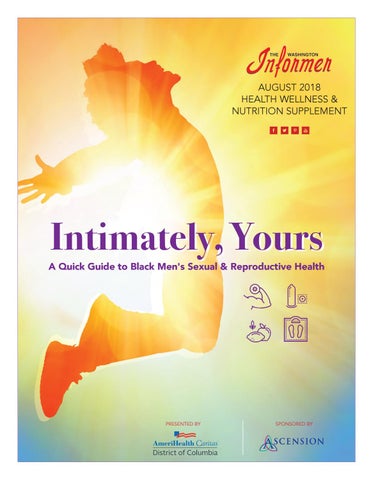
AUGUST 2018 HEALTH WELLNESS & NUTRITION SUPPLEMENT
Intimately, Yours
A Quick Guide to Black Men's Sexual & Reproductive Health
PRESENTED BY
SPONSORED BY
WORDS FROM THE EDITOR
NEWSPAPER READING IS A HABIT
Intimately, Yours By Shantella Y. Sherman WI Special Editions Editor
DON’T BREAK THE HABIT!
READ THE WASHINGTON INFORMER YOUR WAY: In Print – feel the ink between your fingers of our Award Winning Print Edition
n
On the Web – www.washingtoninformer.com updated throughout the day, every day
n
n
On your tablet
n
On your smartphone
n
n
n
Weekly Email Blast – sign up at www.washingtoninformer.com
202-561-4100 For advertising contact Ron Burke at rburke@washingtoninformer.com
...Informing you everyday in every way
In Memoriam Dr. Calvin W. Rolark, Sr. Wilhelmina J. Rolark THE WASHINGTON INFORMER NEWSPAPER (ISSN#0741-9414) is published weekly on each Thursday. Periodicals postage paid at Washington, D.C. and additional mailing offices. News and advertising deadline is Monday prior to publication. Announcements must be received two weeks prior to event. Copyright 2016 by The Washington Informer. All rights reserved. POSTMASTER: Send change of addresses to The Washington Informer, 3117 Martin Luther King, Jr. Ave., S.E. Washington, D.C. 20032. No part of this publication may be reproduced without written permission from the publisher. The Informer Newspaper cannot guarantee the return of photographs. Subscription rates are $45 per year, two years $60. Papers will be received not more than a week after publication. Make checks payable to: THE WASHINGTON INFORMER 3117 Martin Luther King, Jr. Ave., S.E Washington, D.C. 20032 Phone: 202 561-4100 Fax: 202 574-3785 news@washingtoninformer.com www.washingtoninformer.com
PUBLISHER Denise Barnes STAFF D. Kevin McNeir, Editor Ron Burke, Advertising/ Marketing Director Shevry Lassiter, Photo Editor Lafayette Barnes, IV, Assistant Photo Editor John E. De Freitas, Sports Photo Editor Dorothy Rowley, Online Editor ZebraDesigns.net, Design & Layout Mable Neville, Bookkeeper Dr. Charles Vincent, Social Sightings columnist Tatiana Moten, Social Media Specialist Angie Johnson, Circulation REPORTERS Stacy Brown (Senior Writer), Will Ford (Prince George’s County Writer), Hamil Harris, Tatyana Hopkins, Jade JamesGist, D. Kevin McNeir, Lauren Poteat, Dorothy Rowley, Sarafina Wright (General Assignment Writer) PHOTOGRAPHERS John E. DeFreitas, Shevry Lassiter, Roy Lewis, Demetrious Kinney, Mark Mahonny, Lateef Mangum, Travis Riddick
A curious thing happened a few months ago while brainstorming ideas for health stories and investigative projects with a group of student interns. As we began to ponder the extent to which obstetrics and gynecology had grown as specialized fields in the U.S., it was noted that there appeared no corresponding specialty to address the overall sexual and reproductive health of males. Except where incidents of injury to the groin, infertility or sexually transmitted infections occurred, few males – particularly Black males – sought the advice of physicians. And while this may seem an unnecessary field of inquiry, only recently have doctors made steadfast headway in linking health conditions such as high blood pressure, hypertension, diabetes, and even insomnia, to impaired sexual performance and infertility. Additionally, many medications used to treat chronic conditions cite potentially negative impacts on sexual function. To be clear: In the same manner that regular OB / GYN and related examinations are important to young girls and women, so too, are those that impact the overall sexual health and well-being of men and boys. Further, recent data collected through an informal survey of 100 Black men (17-70) in the D.C. metropolitan area by The Washington Informer showed roughly 82 percent would consult a close male friend about a sexual or reproductive issue they experienced, rather than discussing it with a spouse (girlfriend or partner) or physician. Another 12 percent would go first to their spouse (girlfriend or partner), only 5 percent opted to visit a doctor with their concerns; and the remaining 1 percent said they would keep schtum and hope the condition healed on its own. The over-riding sentiment was that a friend may have had similar experiences and can point to a cure-all that keeps the spouse from being alarmed and avoids a doctor’s visit. “The last thing you want to do is tell your girlfriend that you have problems down there,” one respondent told the Informer. “She will either think you’ve been cheating or that it’s time for her to dump you because you can no longer perform sexually.” Keeping quiet has fostered a pandemic rise in sexually-transmitted infections across the region and among all ages and sexual orientations. In addition to increases in syphilis and chlamydia cases, sexual health advocates continue to aggressively canvass Black neighborhoods after the spread of the sexually transmitted bacteria, Neisseria gonorrhoeae, also known as Super Gonorrhea, surfaced. Super Gonorrhea resists antibiotics enlisted to treat typical strains. The lack of awareness and professional care not only influence the spread of sexually-transmitted infections, but also impacts fertility. “The big lie is that when a woman cannot get pregnant, it is because of her body. Conception is; however, a shared process and men tend to bear as much of the burden as women – only no one talks about it,” Joachim Mills who underwent treatment for tes“In the same manner ticular torsion (twisting of spermatic cord), told the Informer. “There was a lot of embarrassment I felt that regular OB/GYN initially, but it was worth it to become a father.” Equally important to the discussion of Black male and related sexual and reproductive health is the accessibility, examinations are awareness, and care provided to the transgender community, members of which face hurdles of disimportant to young crimination and abuse that keep them away from needed services. girls and women, so With Black men reporting a particular aversion to visiting doctor’s offices, prevention and access remain too, are those that keys to a happy and productive sex life. The Washimpact the overall ington Informer invites you to set aside bashfulness, hang-ups, and fears in this edition. Now is the time sexual health and to advocate and advance Black men’s sexual and reproductive health. It is, quite literally, a matter of well-being of life.
Read, Learn & Enjoy. Dr. S
men and boys.”
www.washingtoninformer.com / AUGUST 2018 HEALTH WELLNESS & NUTRITION SUPPLEMENT
HS-2
Fertility 101: Seeking Solutions to Ensure Healthy Outcomes By Lee Ross, Special to the WI Shantella Y. Sherman, WI Special Editions Editor To gain a better understanding of men’s sexual and reproductive health, the Washington Informer enlisted the help of Dr. Paul R. Shin, Director of Reproductive Urology at Shady Grove Fertility’s Center for Male Fertility. Male factor is the cause of infertility in 40 to 50 percent of couples yet is rarely discussed. WI: It is estimated that between 40 and 50 percent of fertility-related challenges facing a couple are due to men's sexual health, yet little note is taken of men's reproductive health, until issues arise with their fecundity. Do you believe the overall health of men would benefit from a reproductive platform that begins with puberty, similar to those provided for females through gynecology? DR. SHIN:Its mind-blowing if you look at the raw numbers. The majority of referrals of sperm test are initiated by female partners whose gynecologists ask for it. It makes sense. Women have more moving parts than men and have more things that can go wrong, but nothing could be further from the truth that infertility is a women’s issue. No one thinks in terms of having trouble having a baby. You find someone you like, get married (or not), and have a baby. The minute you stop using contraceptives, the belief is that you are going to get someone pregnant. It’s easy to get pregnant so why can’t it happen to me? Women engage in the medical system and routine medical care at much earlier rates than men. Adolescent boys have a physical once every year or every few years for cursory assessments. The girls have a level of engagement that makes them much more comfortable seeking advice and treatment. Some men also see going to a physician about their genitalia as a sign of weakness. It is a popular perception that is not rooted in fact. If boys’ exams included more than a cursory look, physicians could chart some potential issues and head them off. For instance, a doctor would note if development seems delayed in the testicles which could be a sign of Klinefelter syndrome (where boys are born with an extra copy of the X chromosome) or Hypogonadal syndrome (which impacts levels of testosterone or estrogen during puberty). WI: Are there healthy lifestyle choices that ward off erectile dysfunction and enhance male fecundity? DR. SHIN:Causes are multifactorial, as there may be mental and emo-
H-3 HS-3
tional causes as well. Classic things that cause vascular conditions, like hypertension, do have a hand in things when the person is in their 50s or 60s and that makes sense. When a person is in their 20s and 30s, those physical things that create a pattern of regular erectile dysfunction signal a harbinger of later in life problems. Don’t smoke, eat a reasonable diet, rest, seem like common sense; only some people don’t have access to healthy foods, live in food deserts and are hit with social hot button issues. There are couples and lifestyle choices for your broader lifestyle that will help with fertility and sexual health. Between 60 and 70 percent of the population experience some issues with sexual health and fertility, whether it is delayed ejaculation, premature ejaculation, sperm count, or injuries. When they come to us, we tease out those issues with patients – which may be physical, but also complicated by anxiety and a loss of confidence.
unique problem faced by generally older women who put off having babies for pursue education or because they had not found the right person. They feel they are behind the 8-ball. Then, you have to throw in male factors and the discussion of fertility rates and things become clearer. We start with a basic understanding that even in two healthy, young people, only 15 to 20 percent are the best odds for getting pregnant. Factor in low sperm counts, irregular menstrual cycles, and we know what is reasonable. And when it comes to sperm count, think of sperm like the American ninja warriors. Is it better to start with one or two runners or 40 to 50? The Center for Male Fertility at Shady Grove Fertility offers a range of services including basic evaluation and testing to state-of-the-art microsurgical techniques including varicocele repair, vasectomy reversal, and vasectomy, or percutaneous epididymal sperm aspiration (PESA) and tes-
ticular sperm extraction (TESE) in the in vitro fertilization (IVF) setting. The program is led by Paul R. Shin, M.D. and Cori Tanrikut, M.D., board certified reproductive urologists who care for patients in our D.C. metro and Baltimore metro locations, respectively. SGF is a leading fertility and IVF center of excellence with more than 50,000 babies born and counting. With 32 locations throughout MD, PA, VA, D.C., GA, and FL, we offer patients individualized care, accept most insurance plans, and make treatment affordable through innovative financial options, including treatment guarantees. More physicians refer their patients to SGF than any other center. To learn more or to schedule an appointment, call 1-888761-1967 or visit ShadyGroveFertility.com HS
WI: What are the most common causes of infertility in men and can you debunk the myth that treatments for infertility for men are painful? DR. SHIN: Causes and conditions vary, but many have to do with dilated varicose veins that can cause testicular warming. The only treatment is surgical repair of the veins and while it does hurt, patients are given pain meds. They may miss a few days of work, but I often tell men that whatever discomfort they go through, is nothing compared to pregnancy and having a baby. The concept is that of a “man cold” where men sometimes have a hypersensitivity to pain. Some discomfort is the nature of treatment. WI: What protocol does your practice have for alleviating the anxieties many men face when seeking help for sexual or reproductive concerns? DR. SHIN: We stress that they are not alone because with infertility, the perception is that they are alone. Everyone on social media and their mother who has a baby put it up on Facebook. Men are reminded what others have and they don’t. We talk to couples so that they understand that infertility is common and we’re in the process of figuring it out. We go through demystifying basic anatomy – discussing how babies are made and what we’re trying to improve upon. Most couples never had to talk about intercourse and are less comfortable admitting they don’t know these things. We talk about reproductive concepts and work to build up their knowledge. Also, there is the
AUGUST 2018 HEALTH WELLNESS & NUTRITION SUPPLEMENT / www.washingtoninformer.com
Keep Your Student Healthy Submitted by AmeriHealth Caritas District of ColumbiaSM Most of us dread the back-toschool routine, even though we welcome its familiar pace after we’re in it. Take time to prepare now and get back into the swing of school with ease. And remember, healthy students are better learners.
START NOW TO BE READY.
Eating right and getting enough sleep and exercise can help students do their best. • Slowly move bedtimes back. We all tend to veer off regular bedtime schedules during the summer. A couple of weeks before school starts, begin pushing bedtimes back by 15 minutes each night. If meal times or other routines have changed, reset those too. • Encourage kids to eat right. Healthy breakfasts and lunches help students be more alert. Help kids pack lunches or make healthy choices at the cafeteria, and limit junk food. AmeriHealth Caritas District of Co-
lumbia (DC) members can take healthy cooking classes at no cost at our Member Wellness Center. To see our monthly schedule, visit www.amerihealthcaritasdc. com. • Keep reading all summer. Let kids choose what they like to read. Comic books, catalogs, and magazines all count. Children and adults in the District can earn prizes for reading through the D.C. Public Library Summer Challenge. Learn more at www. dclibrary.org/summerchallenge. • Research and talk about after-school activities. You can narrow the choices down to one or two that your child will enjoy. Make sure your child has time for homework and personal time. Help children with school-related concerns and stress. Helping your kids with school is one of your most important jobs as a parent. • Teach them study skills. Make sure your child has a quiet place with plenty of light to study. Many parents set a time each day for homework. Pay bills, read, or do other “homework” at HEALTHY PAGE HS-5
I got a gift card for getting my postpartum checkup. You can too. You can get a $25 gift card if you: • Are an AmeriHealth Caritas District of Columbia member
Rewards Program
• See a midwife or OB/GYN within three to eight weeks (21 – 56 days) after giving birth
After your exam, you can sign up for a gift card to one of these retailers: • Walmart • Chipotle • H&M
• Downtown Locker Room (DTLR)
Visit www.amerihealthcaritasdc.com/giftcard to learn more. Note: Member cannot get more than $50 in incentives each year. AmeriHealth Caritas District of Columbia complies with applicable federal civil rights laws and does not discriminate on the basis of race, color, national origin, age, disability, or sex.
English: ATTENTION: If you speak English, language assistance services, at no cost, are available to you. Call 1-800-408-7511 (TTY/TDD: 202-216-9885 or 1-800-570-1190). Spanish: ATENCIÓN: si habla español, tiene a su disposición servicios gratuitos de asistencia lingüística. Llame al 1-800-408-7511 (TTY/TDD: 202-216-9885 o 1-800-570-1190). Amharic: ማሳሰቢያ፡ አማርኛ መናገር የሚችሉ ከሆነ፣ ከከፍያ ነጻ የሆነ የቋንቋ ድጋፍ አገልግሎት ይቀርብልዎታል፡፡ በስልክ ቁጥር 1-800-408-7511 (TTY/TDD: 202-216-9885 ወይም 1-800-570-1190) ይደውሉ. 1-800-408-7511 اﺗﺼﻞ ﺑﺮﻗﻢ.ﺎن ﻓﺈن ﺧﺪﻣﺎت اﳌﺴﺎﻋﺪة اﻟﻠﻐﻮﻳﺔ ﺗﺘﻮاﻓﺮ ﻟﻚ ﺑﺎ، إذا ﻛﻨﺖ ﺗﺘﺤﺪث اﻟﻠﻐﺔ اﻟﻌﺮﺑﻴﺔ: ﻣﻠﺤﻮﻇﺔ: Arabic .(1-800-570-1190 أوTTY/TDD: 202-216-9885 )رﻗﻢ ﻫﺎﺗﻒ اﻟﺼﻢ واﻟﺒﻜﻢ
www.amerihealthcaritasdc.com
www.washingtoninformer.com / AUGUST 2018 HEALTH WELLNESS & NUTRITION SUPPLEMENT
HS-4
HEALTHY FROM PAGE HS-4
the same time your child does schoolwork. This shows kids how the skills they are learning in school are applied to real life. • Help kids get organized. Teach them how to plan a schedule, make to-do lists, and set goals and deadlines for projects. You can help your child learn how to break large tasks into smaller ones. • Support a healthy schoollife balance. Make sure homework and study time are not too stressful or overwhelming. Personal time, time with friends, and extracurricular activities are important for children too. • Be ready to help with any challenges. Talk with your kids if they are having anxiety or concerns about school, classmates, or teachers. If your child has an issue, you might want to meet with an administrator or school counselor to learn more and help find a solution. Stay connected to your kids by talking with them every day about their experiences in and out of school. Expect them to do their best so they can be proud of themselves. Ask open-ended questions and listen. Car trips are a good time to fit in these important talks. HS
FIND US ON TWITTER:
Back-to-school Checklist
FIND US ON FACEBOOK:
• • • • •
www.twitter.com/amerihealthdc
www.facebook.com/ AmeriHealthCaritasDC
#BESTME CORNER
#BestMe is a campaign created by AmeriHealth Caritas DC all about being the best you possible.
Schedule a yearly well visit for your child. Make sure your child has eye and dental exams. These are provided at no cost to AmeriHealth Caritas DC members under age 21. Make sure your child is up to date on vaccines Help kids make healthy food choices Help kids stay active and ready to learn Learn how to get kids to school safely
Five Tips for a Stress-Free Morning Your morning can set the tone for the rest of your day. Weekday mornings can be challenging with the added stress of getting your child ready for school and making sure they arrive on time. Start your day off right with these ideas: • • • • •
Think of something you’re grateful for as soon as you open your eyes. It can be different each day or the same. Smile and laugh. We hold a lot of stress in our faces. A laugh or smile can help release some of that tension. Breathe. Take a few slow, deep breaths as you move about in the morning. This calms and grounds you. Listen. Research says music can help with stress, so use it to start your day! The sounds of nature have also been shown to relieve stress. Meditate. Meditating, being mindful, or saying a prayer during the first few minutes of your day can instantly help your mind and body relax and focus.
Sources: “Back to School” and “Head Back to School Safer and Healthier this Year!,” Centers for Disease Control and Prevention, accessed June 12, 2018, www.cdc.gov/features/ back-to-school/index.html. “Back to School,” U.S. Department of Education, accessed June 9, 2018, youth. gov/feature-article/backschool. “Five Tips to Help Manage Stress,” American Psychological Association, accessed June 12, 2018, www.apa.org/helpcenter/ manage-stress.aspx. All images are used under license for illustrative purposes only. Any individual depicted is a model
I got a gift card for getting an eye exam. You can too. You can get a $25 gift card if you:
Rewards Program
• Are 18 – 75 years old
• Have type 1 or 2 diabetes
• Are an AmeriHealth Caritas District of Columbia member
• See your eye doctor for a retinal eye exam
Visit www.amerihealthcaritasdc.com/giftcard to learn more. Note: A member cannot get more than $50 in incentives each year.
AmeriHealth Caritas District of Columbia complies with applicable federal civil rights laws and does not discriminate on the basis of race, color, national origin, age, disability, or sex.
English: ATTENTION: If you speak English, language assistance services, at no cost, are available to you. Call 1-800-408-7511 (TTY/TDD: 202-216-9885 or 1-800-570-1190). Spanish: ATENCIÓN: si habla español, tiene a su disposición servicios gratuitos de asistencia lingüística. Llame al 1-800-408-7511 (TTY/TDD: 202-216-9885 o 1-800-570-1190). Amharic: ማሳሰቢያ፡ አማርኛ መናገር የሚችሉ ከሆነ፣ ከከፍያ ነጻ የሆነ የቋንቋ ድጋፍ አገልግሎት ይቀርብልዎታል፡፡ በስልክ ቁጥር 1-800-408-7511 (TTY/TDD: 202-216-9885 ወይም 1-800-570-1190) ይደውሉ. 1-800-408-7511 اﺗﺼﻞ ﺑﺮﻗﻢ.ﺎن ﻓﺈن ﺧﺪﻣﺎت اﳌﺴﺎﻋﺪة اﻟﻠﻐﻮﻳﺔ ﺗﺘﻮاﻓﺮ ﻟﻚ ﺑﺎ، إذا ﻛﻨﺖ ﺗﺘﺤﺪث اﻟﻠﻐﺔ اﻟﻌﺮﺑﻴﺔ: ﻣﻠﺤﻮﻇﺔ: Arabic .(1-800-570-1190 أوTTY/TDD: 202-216-9885 )رﻗﻢ ﻫﺎﺗﻒ اﻟﺼﻢ واﻟﺒﻜﻢ
ACDC-1777796
www.amerihealthcaritasdc.com
H-5 HS-5
AUGUST 2018 HEALTH WELLNESS & NUTRITION SUPPLEMENT / www.washingtoninformer.com
Providence Health System to Realign Services for Optimum Preventative Patient Care opportunity to make meaningful change lies, and we must put our focus and energy on advancing a model of transformation that will In a move that repositions paserve the District in new and lasttient care from acute to prevening ways.” tative and community-based, The new Providence will look Providence Health System anto transform the way care is denounced today a transformation livered in the District with a new community-focused perspective that provides other types of needed services, such as care coordination, telehealth/virtual care, primary and urgent care, home care, community-based behav- Providence Hospital is slated for a transition in services from acute to preventative care at the end of 2018. /Courtesy picture ioral healthcare, and senior care. In addition, Providence will look residents] in a collaborative way, Agencies that represent senior at non-healthcare-related services and to shift – keeping health at populations, which include the that impact an individual’s well- our center, but also addressing D.C. Office on Aging, would being. This new approach will those factors that keep people help us provide the services our allow Providence to take a leader- healthy and out of episodic vis- seniors need to be healthier – ship role in transforming health- its to the hospital,” Ruth Pollard, whether that is staying in their Ruth Pollard, Vice President Vice President & Chief Strategy homes, or offering outpatient care delivery. & Chief Strategy Officer at Providence Hospital “We are committed to our mis- Officer at Providence Hospital therapy.” Director of the D.C. Depart(Providence sion that we serve all – especially (Providence Health System) told Health System) the most vulnerable. Our shift to the Informer. “We are looking to ment of Health LaQuandra Nes/Courtesy focus on community health will create collaborative solutions, us- bitt, said the shift would work picture allow us to engage community ing a holistic approach that does towards larger goals for the city’s health. and civic leaders, look at the data not duplicate services.” Providence Health & Services “DC Health’s vision is for [detailing the needs of District rests on a 160-year tradition of the District to be the healthicaring for the city’s most vulner- est city in America,” said Dr. able, often disenfranchised resi- LaQuandra Nesbitt, Director of dents. That care, established by the DC Department of Health. the Sisters of Providence (Sacred “Providence’s new approach is a Heart nuns) in 1856, champi- positive step towards creating a oned a ministry for a continuum comprehensive, accessible, equiof medical care that spanned the table healthcare system capable lifetime of the patient – from of providing the highest quality birth to end of life, and result- services in a cost-effective maned in the erection of Providence ner to those who live and work hospital in 1861. Pollard be- in D.C.” lieves that mission will be further Providence’s transition also enhanced by the transformation. touts the increased utilization In 22 states and the District of Columbia, Ascension teams work Providence and Ascension will of technological innovation and together to provide care to all, especially those who are struggling. remain in the District and con- digital, personalized care – necestinue to provide care for the com- sary tools in the future of expeWe are committed to connecting the many aspects of health to munity through this transforma- dited and efficient care delivery. make it easier for all to access the care they need for life’s journey. tion, according to Pollard. The “Digital, personalized heath plan will utlize task forces, repre- and care coordination ensures senting associates and physicians that as our patients and consumthroughout Providence, who will ers navigate through systems of have a voice in defining targeted health and even social services, transition plans for the future there will be better communiof Providence. While acute care cation and sharing of respective services will close, these bodies data. This allows all service prowill also review plans for all other viders -- health and non-health services, such as Carroll Manor, providers – to contribute to the Providence’s skilled nursing facil- wellness in the patients,” Polity, which will continue to oper- lard told the Informer. “The ate uninterrupted as part of As- needs-assessment data we’ve colcension Living, the senior living lected over a decade shows that and care division of Ascension. barriers to healthy living like “It is important, and we are affordable housing, transportacommitted to making sure we tion, and employment, can be ascension.org continue to engage our consum- addressed in the District as we ers and civic leaders in meeting all come together to engage and the needs of seniors, for instance. collaborate.” What does that future look like? HS By Shantella Y. Sherman Special to the Informer
of services believed best-suited to the needs of residents. While maintaining traditional engagements with the District’s care populations, Providence will begin focusing on collaborative work that effectively removes barriers to healthy lifestyles at the close of 2018. “We know that 15 percent of a person’s life is spent in actual healthcare, which means the remaining 85 percent is spent in other areas that either positively or negatively impact their overall wellbeing,” said Keith Vander Kolk, Health System President and CEO in a prepared statement. “That is where the greatest
Serving communities with compassionate, personalized care
www.washingtoninformer.com / AUGUST 2018 HEALTH WELLNESS & NUTRITION SUPPLEMENT
HS-6
DCHealthLink.com
(855) 532-5465 TTY 711
ENROLLED SINCE 2016
HEALTH INSURANCE FOR SMALL BUSINESS
By offering employees multiple plan choices, a small business: • SAVES money • PROVIDES better employee benefits • PAYS only one monthly bill And best of all, there’s easy online, hassle-free enrollment!
Just ask a broker for details! Enrollment Is Year Round
SELF EMPLOYED? NO EMPLOYEES YET?
Sign Up During Open Enrollment — Nov 1, 2018 - Jan 1, 2019
H-7 HS-7
AUGUST 2018 HEALTH WELLNESS & NUTRITION SUPPLEMENT / www.washingtoninformer.com
Recommended Books on Black Male Sexual Health
By Lee Ross Special to the Informer
The consensus among many American men shows they would rather confide in an older, trusted male – whether a family member or close friend – than to speak with a health professional or even their spouses about any concerns they have with their sexual health. While this trend manages to alleviate some stressors and hang-ups, side-stepping the physician’s office tends to make minor issues major and force men to worry over normal occurrences. The books below give insight into just how prevalent some health concerns are, while pushing readers to take their annual exams as seriously as women, and to consider their sexual habits in the context of their overall mental, emotional, and physical well-being.
BIOENVIRONMENTAL ISSUES AFFECTING MEN'S REPRODUCTIVE AND SEXUAL HEALTH Suresh C Sikka, Wayne J.G. Hellstrom
Bioenvironmental Issues Affecting Men's Reproductive and Sexual Health is structured into two parts related to men’s reproductive and sexual health with eight sections designed to enable a logical flow of such knowledge. The book is focused on the biology of key organs involved in male reproduction and the environmental influences affecting their functions with particular emphasis on clinical aspects. This is an essential reference for those working and learning in the field of human reproduction, reproductive toxicology and environmental influences on reproductive and sexual health. Brings together the leading authorities working in the field of male reproduction and sexual health and how the environment affects these issues.
SUPPORT ORGAN, EYE AND TISSUE DONATION IT’S A DECISION EVERYONE CAN LIVE WITH
Register online or at the MVA when you obtain your license. DonateLifeMaryland.org
MEN'S SEXUAL HEALTH: FITNESS FOR SATISFYING SEX Barry W. McCarthy, Michael E. Metz
Men's Sexual Health is a breakthrough book about vital and satisfying male sexuality. It presents a new model of male and couple sexuality, which establishes positive, realistic expectations of pleasure and satisfaction, as opposed to the self-defeating traditional demand for perfect intercourse performance. Men and couples who adopt this approach will enjoy sexuality throughout the lifespan. The authors introduce the new “smart thinking,” focused on an integration of mind and body, which confronts the myths and misunderstandings which limit male sexual growth. The book will help men and women understand how to pursue sexual and relational health, overcome sexual problems, with the goal of greater acceptance and satisfaction.
THE BLACK WOMAN'S GUIDE TO BLACK MEN'S HEALTH Andrea King Collier, Willarda V. Edwards
This is a comprehensive medical guide for black women to help them improve the health of the black men they love. It is packed with valuable information, advice and personal stories from celebrity and non-celebrity women about their men's health issues. Sex and sexuality are a normal and healthy part of a man’s life. His sexual health and well-being are probably very important, yet, when he goes into a doctor’s office to discuss problems in the bedroom – whether it’s a lack of desire, or other issues – he tends to shy away from the real issues. This book offers the women who love Black men a guide to helping men open up about their fears, challenges, and sexual health needs in order to better advocate for their overall good health.
EXPLORING BLACK SEXUALITY Robert Staples
In this pioneering study, a distinguished Black sexologist tackles one of the most controversial aspects of American race relations. The subject of Black sexuality has been widely discussed in every possible popular format for the past four hundred years, yet serious scholarship in the area is lacking. While Black sexuality has been a pervasive force in American life, it has been too sensitive a topic for Black or white authors to write about in a serious, non-polemical format. Robert Staples explores same-sex attitudes and behavior, interracial sexual relations, rape, prostitution, pornography, and the stereotypes of Black sexual superiority in this scholarly yet accessible collection. This groundbreaking study concludes with a speculation on the future of Black sexuality in the 21st century based on our knowledge of current demographic and economic forces. HS
www.washingtoninformer.com / AUGUST 2018 HEALTH WELLNESS & NUTRITION SUPPLEMENT
HS-8
Battles in Meeting the Sexual & Reproductive Needs of the Transgender Community By Anthony Bridgman Special to the WI Far more U.S. teens than previously thought are transgender or identify themselves using other nontraditional gender terms, with many rejecting the idea that girl and boy are the only options, new research finds. While the ability to self-identify may seem liberating, it also awakens questions and concerns around sexual and reproductive health. Transgender people have a high prevalence of HIV/ STDs, violence victimization, mental health issues, and suicide when single, and according to the Williams Institute, African-American same-sex couples are less likely than their different-sex counterparts to have health insurance coverage for both partners (63 percent versus 79 percent), making sexual health concerns costly or difficult to manage. Northwest resident Dalia Minx, 24, says that even with health care provided by the city, she feels uncomfortable discussing her lifestyle and desire for gender reassignment with a medical profession she believes judges her with a glance. Born a male, Minx told the Informer that she ran away from home, couch surfed with friends, and eventually became homeless. Resorting to “treating,” – exchanging sexual interaction for shelter, clothing, and food, Minx believes she sidestepped potential infections and poor health outcomes by prayer alone. “That song, Somebody Prayed for Me, is nothing but the truth. I was out there in the streets and when you are like that, you’re vulnerable. The last thing you want to do is face judgment from people who are supposed to help you,” said Minx, who returned to her family home in Columbia, S.C., and reconciled with her parents. “I’m back in D.C. going to school, but I can understand the hesitation among ‘the girls’ about exposing their lifestyles to doctors. That’s not a queer thing, that’s an anyone who’s been living rough-thing. At some point, though, you have to make sure you’re healthy.” Minx’s grandmother insisted she get tested for “all-manner of disease” before leaving Columbia and she was happy to report a clean bill of health. Minx was fortunate. Complicating the outreach from organizations specializing in transgender health since 2017 are several policies enacted under Donald Trump’s adminis-
H-9 HS-9
tration that attempt to make null the Affordable Care Act’s non-discrimination portion. Known as Section 1557, the legislation initially kept federally funded programs that provide health care, coverage or related services from discriminating against patients based on sex. The provision has been in effect since the law’s enactment and helped fuel a federal push to protect transgender people from discrimination in receiving health care services. Philadelphia resident Solorah Singleton, 36, was first featured in a Kaiser Medical News feature and like Minx was born male but identifies as female. That’s where the similarities end. Singleton, according to KMN has been waiting for a breast augmentation and spent years taking hormone therapy, never seeing surgery as an option. Having been approved for the gender transitioning process, which will include surgery, Singleton now faces several unexpected loopholes created by the pushback against Section 1557. “Transgender patients seeking sexual and reproductive health care often fear that they will be treated in ways that are disrespectful or judgmental because of their gender identities or sexual choices, or because aspects of their bodies may not conform to gender norms,” one report concluded. “Too often those fears are justified. Many providers assume that transgender patients do not need services such as pelvic exams or contraception, or that treating transgender patients is too complex for their practice. These dynamics contribute to significant disparities in sexual and reproductive health for transgender people.” The National Center for Transgender Equality offered recommendations to improving transgender sexual and reproductive healthcare that include: Follow accepted medical guidelines. Sexual and reproductive health providers should become familiar with clinical guidelines and recommendations for transgender people. Adopt policies of respect and nondiscrimination. Providers should also adopt a formal policy of nondiscrimination and respect for each patient’s gender identity. Train staff on cultural competence and nondiscrimination. Clinics should train providers and staff on transgender-appropriate care, nondiscrimination, and inclusivity.
Incorporate transgender inclusion in grant guidelines. The U.S. Department of Health and Human Services should revise program guidelines for Title X family planning grants to prohibit discrimination on the basis of gender identity and sexual orientation and to address the cultural and clinical needs of transgender patients. Report discrimination. Federal law prohibits gender-based discrimination by health care providers that accept any form of federal funding. Eliminate public policies that require sterilizing procedures for trans people. Policies requiring transgender people to undergo sex reassignment surgery before changing their gender marker on government documents violates their reproductive rights and frequently amounts to forced sterilization. Federal, state, and local agencies should update policies to permit gender marker changes without requiring proof of surgery or other invasive medical procedures. HS
Solorah Singleton speaks with nurse practitioner Caroline Cylkowski about her medical history during an exam. /Photo by Eileen Blass/for Kaiser Health News
\
..
Prevention Center
"
��� -::,�/
0
u '-'0
..., u ...., .::: (/')
0
Wards 7&8
-
8At
'
RI
/At.st<•
.,. _____ ·"' C·1V\of1 '
:,:.
_,,.h,--,f,r/1,-•",l1>�•
Bridging Resources in Communitiies, Inc. and tihe Wards 7 b 8 DC Preventiion Centier is glad tio be a part; of tihe Washingtion Informer's Healtih, Wellness b Nutiritiion Issue
AUGUST 2018 HEALTH WELLNESS & NUTRITION SUPPLEMENT / www.washingtoninformer.com
Preventing Testicular Injuries By Lee Ross Special to the Informer In men and boys, the testicles hang outside the body in a pouch of skin called the scrotum. Because of their location, many types of accidents can cause testicular injuries, including blunt trauma (a hit or kick – 85 percent of the cases), motorcycle or bicycle accidents, cuts or piercings, animal bites, bullet wounds, and accidents with machinery. In an increased number of cases among teens and college-aged males, not an accident, but a game of “Sack Tapping,” (also called Roshambo and Nut Tag), where guys punch or kick each other in the groin to determine who can withstand the most pain, is a popular cause of penile and testicular trauma. Bruises, blood clots, testicular torsion — in which the organ twists up to 360 degrees — and, more rarely, testicular rupture, are consequences of the game. Some events are unavoidable, though there are some preven-
tion measures that will help protect men and boys from serious injuries. Wear a jockstrap when you're playing sports. If you're doing an activity that could lead to a hard strike -- such as baseball or martial arts -- also wear a protective cup. Be sure the cup fits well and is properly placed over your penis and testicles. Wear your seat belt while in a vehicle. Use caution when riding motorcycles and bicycles. Take care near machinery that could snag your clothing or skin. Avoid loose clothing and belts.
WHAT TO DO IF INJURED:
Lay Down. Lying down flat on your back can reestablish proper blood flow to the brain, relieving headache and nausea. This position can also help relax the groin ligaments and other muscles that seize up. Hydrate and Cool Off. Moving to a cool place and hydrating as tearing, sweating, vomiting, and the increase in body temperature can leave the injured low on fluids. Over-the-counter pain relievers, particularly those that can help reduce inflammation, like acetaminophen may also be helpful.
See a Doctor If the Pain Persists. If the pain resulting from a groin injury is persistent, if there was serious nausea, vomiting, or fever, or if there are obvious signs of trauma – like bruising or swelling – seek medical treatment immediately. In serious cases, groin hits can cause testicular torsion (a twisting of the testicle), rupture, and can even threaten fertility. HS
Follow all safety rules while using machinery. Do NOT engage in and warn young males around you of the dangers of playing Sack Tapping, Nut Tag or Roshambo games.
SEX IS...
HEALTHY Share correct information and resources about sex and sexual health with your peers.
Visit SexIsDC.org
LEARN. SHARE. BE.
@SexIsDC
www.washingtoninformer.com / AUGUST 2018 HEALTH WELLNESS & NUTRITION SUPPLEMENT
HS-10
Re-Used Condoms & STIs By Andrea Currie Special to the WI The Center for Disease Control and Prevention (CDC) warned about the dangers of reusing condoms in a tweet, August 2, designed to encourage Americans to use fresh condoms with each act and partner. The trend of using, washing, and reusing condoms grew popular in 2015 among young adults who claimed the practice helped the environment. Instead, researchers believe it may be the leading culprit in the rise of sexually transmitted diseases and the spread of Super Gonorrhea, an antibiotic-resistant strain of the sexually transmitted infection. ‘We say it because people do it: Don't wash or reuse #condoms! Use a fresh one for each #sex act," the tweeted said. The CDC also released several statements warning against the reuse of condoms saying the product’s usefulness diminishes by such practices. “Incorrect use, such as reusing a condom or using more than one at a time, diminishes the protective effect of condoms by leading to condom breakage, slippage, or leakage,” Dr. Elizabeth Torrone, an epidemiologist at the CDC's Division of STD Prevention, said in a statement. More than 78 million people contract gonorrhea each year, according to the World Health Organization, with more than 800,000 of those cases reported in the United States. The sexually transmitted disease has traditionally been treated with antibiotics, but the rise of drug-resistant gonorrhea has prompted the CDC to label it an “urgent threat.” The CDC estimates that 246,000 gonorrhea infections in the U.S. each year are resistant to at least one antibiotic. That’s an alarming figure, considering gonorrhea can lead to blindness, infertility and serious infections in the heart and nervous system, possibly even resulting in death. “Every time we think we understand how gonorrhea bacteria manage to survive and cause disease in people, we learn something new,”
H-11 HS-11
said lead researcher Alison K. Criss of UVA’s Department of Microbiology, Immunology and Cancer Biology. “Our discovery is especially exciting because it opens up new ways to tackle the growing threat of untreatable gonorrhea.” Exciting for researchers; not so much for patients. Additionally, 1.6 million cases of chlamydia, and 28,000 cases of syphilis were reported to CDC last year, though the numbers could be still higher with undiagnosed cases. The CDC advises several tactics to ensure condom safety and fewer STIs: • Do NOT use a condom more than once. • Check the expiration date, as condoms do expire.
...researchers believe it may be the leading culprit in the rise of sexually transmitted diseases and the spread of Super Gonorrhea, an antibiotic-resistant strain of the sexually transmitted infection.
• Make sure the latex has zero tears in it or risk leakage (that means checking the package to see if it has any holes in it, too). • Be sure the condom fits properly. There's a risk of tears (if too tight) and slippage (if too loose). • Leave room at the tip of the condom for ejaculation to prevent broken condoms. • Make sure to use a condom throughout intercourse. • Avoid sharing towels or underclothing. • Wash before and after intercourse. • Get tested for HIV and other STIs. • If you have a problem with drug or alcohol abuse, get help. People who are drunk or on drugs often fail to have safe sex. • If you believe you have an STI, STOP having sexual contact, VISIT A PHYSICIAN, and complete all necessary TREATMENT. • Follow your doctor's instructions for treatment. • Don't resume having sex unless your doctor says it's okay. • Return to your doctor to get rechecked. • Be sure your sex partner or partners also are treated. HS
AUGUST 2018 HEALTH WELLNESS & NUTRITION SUPPLEMENT / www.washingtoninformer.com
Serving communities with compassionate, personalized care In 22 states and the District of Columbia, Ascension teams work together to provide care to all, especially those who are struggling. We are committed to connecting the many aspects of health to make it easier for all to access the care they need for life’s journey.
ascension.org
www.washingtoninformer.com / AUGUST 2018 HEALTH WELLNESS & NUTRITION SUPPLEMENT
HS-12